Tuesday, July 20, 2021

A PREVENTATIVE INCIDENT
Accidental mix of bleach and acid kills Buffalo Wild Wings employee
Incidents like this, which create chlorine gas, occur more than 2,000 times per year in the US

by Leigh Krietsch Boerner
November 13, 2019 | A version of this story appeared in Volume 97, Issue 45


Credit: Shutterstock

FAST FACTS ABOUT WORKING WITH CLEANERS


▸ Check labels on cleaners before using them to learn about risks.

▸ Keep cleaners locked up and away from children and pets.

▸ Don’t mix cleaners.

▸ Never mix bleach with anything (it can have toxic reactions with many other substances).

▸ Make sure to use cleaners in a well-ventilated area.

▸ If an accidental mixture occurs, don’t try to clean it up or neutralize it. Get out of the area and call 911.


You should never mix bleach with anything, but that’s what happened during an accident at a Buffalo Wild Wings in Burlington, Massachusetts, on the evening of Nov. 7. According to Burlington Fire Department assistant chief Michael Patterson, an employee spilled the cleaner Scale Kleen on the floor. Later, another employee started to clean the floor with another cleaner called Super 8. The mixture turned green and started bubbling. The bubbling puddle emitted fumes, driving employees and customers to evacuate the restaurant. The manager, 32-year-old Ryan Baldera, attempted to clean up the liquid and was overcome by the fumes. He died later at the hospital, states a Burlington Fire Department press release.


According to safety data sheets, Super 8 is a mixture of 8–10% sodium hypochlorite in water, stronger than household bleach. Scale Kleen contains 22–28% phosphoric acid, 18–23% nitric acid, and less than 1% urea. Generally, strong cleaners like these are used in businesses, but some may be available to the public. Mixing bleach and acid gives off chlorine gas, says Neal Langerman, CEO and principal scientist at Advanced Chemical Safety. The reaction is “well-known, simple, instantaneous,” he says. “The green bubbles give it away.”


Chlorine gas is a chemical warfare agent introduced during World War I and is still used in conflicts in the Middle East, Langerman says. When chlorine gas hits a person’s lungs, it generates a noxious mixture of hydrochloric acid, hypochlorous acid, hypochlorite, and other corrosive compounds. “Dissolve” is a pretty apt description of what the mixture does to tissue, he says. The cause of death tends to be chemical pneumonia. “The victim’s lungs cease being able to move gases and fill with liquid,” Langerman adds. “The medical staff would just see their patient going south with their lungs filling with liquid that they can’t keep empty. At some point, a pressure respirator just can’t compete with damage that’s done.”


Mixing bleach with other substances can also create harmful situations. Adding ammonia to bleach creates chloramine, another toxic gas. Bleach plus hydrogen peroxide creates oxygen gas so violently, it can cause an explosion. “One should not mix household cleaners as a general rule,” Langerman says. “You do not necessarily make a strong cleaner by mixing two cleaners together.”


Because the incident at Buffalo Wild Wings is an ongoing investigation, officials are not releasing Baldera’s cause of death, says a Burlington Fire Department spokesperson. According to the American Association of Poison Control Centers, accidental exposures to chlorine gas from mixing bleach and acid happened 2,284 times in 2017, the most recent year for which the agency has data. In the US, the Federal Hazardous Substances Act requires that cleaning products be labeled with the hazard and what first-aid steps to take if there’s an accident. Most US states, including Massachusetts, where the accident occurred, require that managers of restaurants get certification through ServSafe, a training and testing program from the National Restaurant Association. Part of this training is the appropriate handling of chemicals.


Event Horizon Telescope captures ‘beautiful’ images of second black hole’s jet

The massive jets of material shooting out of Centaurus A’s center are powered by a matter-guzzling black hole.

 
NASA/CXC/SAO; ROLF OLSEN; NASA/JPL-CALTECH; NRAO/AUI/NSF/UNIVERSITY OF HERTFORDSHIRE/M. HARDCASTLE

The astronomy team that 2 years ago captured the first close-up of a giant black hole, lurking at the center of the galaxy Messier 87 (M87), has now zoomed in on a second, somewhat smaller giant in the nearby active galaxy Centaurus A. The Event Horizon Telescope’s (EHT’s) latest image should help resolve questions about how such galactic centers funnel huge amounts of matter into powerful beams and fire them thousands of light-years into space. Together the images also support theorists’ belief that all black holes operate the same way, despite huge variations in their masses.

“This is really nice,” astronomer Philip Best of the University of Edinburgh says of the new EHT image. “The angular resolution is astonishing compared to previous images of these jets.”

The EHT merges dozens of widely dispersed radio dishes, from Hawaii to France and from Greenland to the South Pole, into a huge virtual telescope. By pointing a large number of dishes at a celestial object at the same time and carefully time stamping the data from each one with an atomic clock, researchers can later reassemble it with massive computing clusters—a process that takes years—to produce an image with a resolution as sharp as that of a single Earth-size dish. One challenge is getting observing time on 11 different observatories simultaneously, so the EHT only operates for a few weeks each year; poor weather and technical glitches often further narrow that window.

The virtual telescope probed Centaurus A during the same 2017 observing campaign that produced the now-famous image of the supermassive black hole in M87Science’s Breakthrough of the Year for 2019. Centaurus A, about 13 million light-years away, is one of the closest galaxies to Earth that is bright at radio wavelengths. It also has obvious jets spewing matter above and below the galactic disk, a hallmark of an active giant black hole. “We wanted to see what the jet looked like at the resolution” EHT could offer, says team member Michael Janssen of the Max Planck Institute for Radio Astronomy. “We didn’t know what to expect.”

The Event Horizon Telescope has produced detailed images of the beams of matter from Centaurus A’s center, revealing the jets have a dark center paralleled by glowing edges.

 
M. JANSSEN, NATURE ASTRONOMY (2021) 10.1038

The result, which he and colleagues report today in Nature Astronomy, was a detailed image of how the jet emerges from the region around Centaurus A’s supermassive black hole, showing a remarkable similarity to EHT’s images of M87’s jet on a much smaller scale. Images of Centaurus A’s jets taken by other telescopes at different wavelengths revealed little detail, but the EHT images show the jet with a dark center flanked by two bright stripes; Best suggests the jet may appear bright around its edge because its outer regions rub against surrounding gas and dust, causing them to glow.

Astrophysicists don’t fully understand how galactic nuclei drive these fantastically powerful fountains. One theory holds that an accretion disk, the swirling whirlpool of matter spiraling into the black hole, generates a magnetic field that funnels some of the matter into a jet. Others argue this magnetic field must tap into the rotational energy of the black hole itself to be able to achieve such colossal power.

The new observations of Centaurus A don’t resolve that question, but they hold clues. Janssen says the images show that the remarkably parallel edges of the jet narrow into a cone close to the black hole. The base of that cone remains wide, he says, which might suggest it is coming from the accretion disk. “It remains to be seen,” he says.

Theoretical astrophysicist Jim Beall of St. John’s College says there may be no single answer: The spin of the black hole drags on the innermost stable orbit of the infalling matter, which in turn affects how the accretion disk shapes and powers the jet. “It’s a symbiotic relationship,” he says. “The EHT takes us down close to the accretion disk. The results are really quite beautiful.”

The pictures of Centaurus A also fill in a size gap in black hole observations. Observers have studied the workings of jets coming from the very largest of black holes—including M87—weighing billions of times the mass of our Sun. They’ve also seen jets from much smaller black holes, with masses of a few tens of Suns. The new view of Centaurus A, at 55 million times the Sun’s mass, looks just like its bigger and smaller relatives. This confirms the idea that black holes are essentially simple objects, defined only by their mass, charge, and spin, so those with the mass of a large star should behave no differently from one with the mass of a galaxy.

Our universe might be a giant three-dimensional donut, really.

THAT MAKES GOD A COP 😄😄😄


By Paul Sutter - Astrophysicist 
(Image credit: wacomka/iStock/Getty Images Plus)

Imagine a universe where you could point a spaceship in one direction and eventually return to where you started. If our universe were a finite donut, then such movements would be possible and physicists could potentially measure its size.

"We could say: Now we know the size of the universe," astrophysicist Thomas Buchert, of the University of Lyon, Astrophysical Research Center in France, told Live Science in an email.

Examining light from the very early universe, Buchert and a team of astrophysicists have deduced that our cosmos may be multiply connected, meaning that space is closed in on itself in all three dimensions like a three-dimensional donut. Such a universe would be finite, and according to their results, our entire cosmos might only be about three to four times larger than the limits of the observable universe, about 45 billion light-years away.

Physicists use the language of Einstein's general relativity to explain the universe. That language connects the contents of spacetime to the bending and warping of spacetime, which then tells those contents how to interact. This is how we experience the force of gravity. In a cosmological context, that language connects the contents of the entire universe — dark matter, dark energy, regular matter, radiation and all the rest — to its overall geometric shape. For decades, astronomers had debated the nature of that shape: whether our universe is "flat" (meaning that imaginary parallel lines would stay parallel forever), "closed" (parallel lines would eventually intersect) or "open" (those lines would diverge).

That geometry of the universe dictates its fate. Flat and open universes would continue to expand forever, while a closed universe would eventually collapse in on itself.

Multiple observations, especially from the cosmic microwave background (the flash of light released when our universe was only 380,000 years old), have firmly established that we live in a flat universe. Parallel lines stay parallel and our universe will just keep on expanding.

But there's more to shape than geometry. There's also topology, which is how shapes can change while maintaining the same geometric rules.

For example, take a flat piece of paper. It's obviously flat — parallel lines stay parallel. Now, take two edges of that paper and roll it up into a cylinder. Those parallel lines are still parallel: Cylinders are geometrically flat. Now, take the opposite ends of the cylindrical paper and connect those. That makes the shape of a donut, which is also geometrically flat.

While our measurements of the contents and shape of the universe tell us its geometry — it's flat — they don't tell us about the topology. They don't tell us if our universe is multiply-connected, which means that one or more of the dimensions of our cosmos connect back with each other.

Look to the light


While a perfectly flat universe would extend out to infinity, a flat universe with a multiply-connected topology would have finite size. If we could somehow determine whether one or more dimensions are wrapped in on themselves, then we would know that the universe is finite in that dimension. We could then use those observations to measure the total volume of the universe.

But how would a multiply-connected universe reveal itself?


A team of astrophysicists from Ulm University in Germany and the University of Lyon in France looked to the cosmic microwave background (CMB). When the CMB was released, our universe was a million times smaller than it is today, and so if our universe is indeed multiply connected, then it was much more likely to wrap in on itself within the observable limits of the cosmos back then. Today, due to the expansion of the universe, it's much more likely that the wrapping occurs at a scale beyond the observable limits, and so the wrapping would be much harder to detect. Observations of the CMB give us our best chance to see the imprints of a multiply connected universe.

The team specifically looked at the perturbations — the fancy physics term for bumps and wiggles — in the temperature of the CMB. If one or more dimensions in our universe were to connect back with themselves, the perturbations couldn't be larger than the distance around those loops. They simply wouldn't fit.

As Buchert explained to Live Science in an email, "In an infinite space, the perturbations in the temperature of the CMB radiation exist on all scales. If, however, space is finite, then there are those wavelengths missing that are larger than the size of the space."

In other words: There would be a maximum size to the perturbations, which could reveal the topology of the universe.

Making the connection


Maps of the CMB made with satellites like NASA's WMAP and and the ESA's Planck have already seen an intriguing amount of missing perturbations at large scales. Buchert and his collaborators examined whether those missing perturbations could be due to a multiply-connected universe. To do that, the team performed many computer simulations of what the CMB would look like if the universe were a three-torus, which is the mathematical name for a giant three-dimensional donut, where our cosmos is connected to itself in all three dimensions.

"We therefore have to do simulations in a given topology and compare with what is observed," explained Buchert. "The properties of the observed fluctuations of the CMB then show a 'missing power' on scales beyond the size of the universe." A missing power means that the fluctuations in the CMB are not present at those scales. That would imply that our universe is multiply-connected, and finite, at that size scale.

"We find a much better match to the observed fluctuations, compared with the standard cosmological model which is thought to be infinite," he added.

"We can vary the size of the space and repeat this analysis. The outcome is an optimal size of the universe that best matches the CMB observations. The answer of our paper is clearly that the finite universe matches the observations better than the infinite model. We could say: Now we know the size of the universe."

The team found that a multiply-connected universe about three to four times larger than our observable bubble best matched the CMB data. While this result technically means that you could travel in one direction and end up back where you started, you wouldn't be able to actually accomplish that in reality. We live in an expanding universe, and at large scales the universe is expanding at a rate that is faster than the speed of light, so you could never catch up and complete the loop.

Buchert emphasized that the results are still preliminary. Instrument effects could also explain the missing fluctuations on large scales.

Still, it's fun to imagine living on the surface of a giant donut.

Originally published on Live Science.


RELATED CONTENT


Paul Sutter is a research professor in astrophysics at the Institute for Advanced Computational Science at Stony Brook University and the Flatiron Institute in New York City. He is also the host of several shows, such as "How the Universe Works" on Science Channel, "Space Out" on Discovery, and his hit "Ask a Spaceman" podcast. He is the author of two books, "Your Place in the Universe" and "How to Die in Space," as well as a regular contributor to Space.com, LiveScience, and more. Paul received his PhD in Physics from the University of Illinois at Urbana-Champaign in 2011, and spent three years at the Paris Institute of Astrophysics, followed by a research fellowship in Trieste, Italy,
NASA's Hubble Space Telescope photographed colliding galaxies after recovering from a month-long mystery glitch

Morgan McFall-Johnsen
Mon., July 19, 2021, 

NASA's Hubble Space Telescope photographed colliding galaxies after recovering from a month-long mystery glitch


The Hubble Space Telescope hovers at the boundary of Earth and space in this picture, taken after Hubble's second servicing mission in 1997. NASA

NASA shared the Hubble Space Telescope's first photos since it was fixed this weekend.

Hubble is back online after a month of mysterious glitching that forced NASA to use backup hardware.

The photos show colliding galaxies and a long galactic spiral.

The Hubble Space Telescope is back, and NASA has the pictures to prove it.


The Earth-orbiting observatory went offline on June 13 and stayed that way for more than a month while engineers struggled to identify a mysterious glitch. NASA still hasn't announced what exactly caused the problem, but the agency's engineers managed to bring Hubble back online by activating some of its backup hardware on Thursday.

"I was quite worried," NASA Associate Administrator Thomas Zurbuchen said in a Friday video interview with Nzinga Tull, who led the Hubble team through troubleshooting. "We all knew this was riskier than we normally do."

Hubble slowly powered up its science instruments again over the weekend and conducted system check-outs to make sure everything still worked. Then it snapped its first images since the whole debacle started.

The telescope focused its lens on a set of unusual galaxies on Saturday. One of its new images shows a pair of galaxies slowly colliding. The other image shows a spiral galaxy with long, extended arms. Most spiral galaxies have an even number of arms, but this one only has three.

Hubble's first images after recovering from a month-long glitch show some unusual galaxies. Science: NASA, ESA, STScI, Julianne Dalcanton (UW) Image processing: Alyssa Pagan (STScI)

Hubble is also observing Jupiter's northern and southern lights, or auroras, as well as tight clusters of stars. NASA hasn't shared images from those observations yet.

"I'm thrilled to see that Hubble has its eye back on the universe, once again capturing the kind of images that have intrigued and inspired us for decades," NASA Administrator Bill Nelson said in a press release. "This is a moment to celebrate the success of a team truly dedicated to the mission. Through their efforts, Hubble will continue its 32nd year of discovery, and we will continue to learn from the observatory's transformational vision."


A mysterious glitch that took a month to fix


The Hubble Space Telescope in orbit above Earth. NASA


Hubble, the world's most powerful space telescope, launched into orbit in 1990. It has photographed the births and deaths of stars, spotted new moons circling Pluto, and tracked two interstellar objects zipping through our solar system. Its observations have allowed astronomers to calculate the age and expansion of the universe and to peer at galaxies formed shortly after the Big Bang.

But the telescope's payload computer suddenly stopped working on June 13. That computer, built in the 1980s, is like Hubble's brain - it controls and monitors all the science instruments on the spacecraft. Engineers tried and failed to bring it back online several times. Eventually, after running more diagnostic tests, they realized that the computer wasn't the problem at all - some other hardware on the spacecraft was causing the shutdown


Nzinga Tull, Hubble systems anomaly response manager at NASA’s Goddard Space Flight Center in Greenbelt, Maryland, works in the control room July 15 to restore Hubble to full science operations. NASA GSFC/Rebecca Roth

It's still not totally clear which piece of hardware was the culprit. Engineers suspect that a failsafe on the telescope's Power Control Unit (PCU) instructed the payload computer to shut down. The PCU could have been sending the wrong voltage of electricity to the computer, or the failsafe itself could have been malfunctioning.

NASA was prepared for issues like this. Each piece of Hubble's hardware has a twin pre-installed on the telescope in case it fails. So engineers switched all the faulty parts to that backup hardware. Now the telescope is back in full observation mode.

"I feel super excited and relieved," Tull said after making the hardware switch. "Glad to have good news to share."

Though NASA has fixed the glitch, it's a sign that Hubble's age may be starting to interfere with its science. The telescope hasn't been upgraded since 2009, and some of its hardware is more than 30 years old.

"This is an older machine, and it's kind of telling us: Look, I'm getting a little bit old here, right? It's talking to us," Zurbuchen said on Friday. "Despite that, more science is ahead, and we're excited about it."

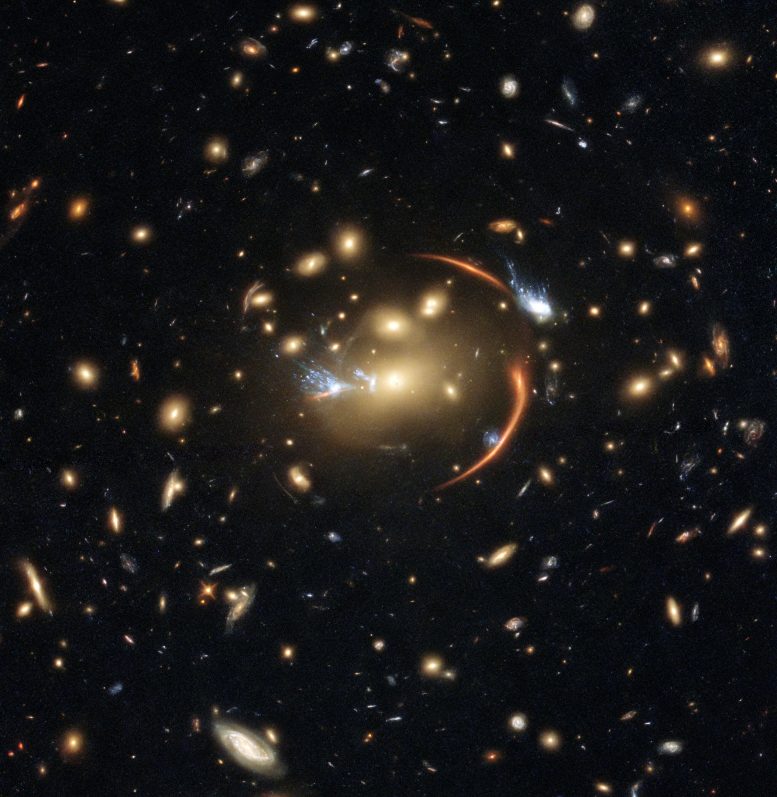
Cosmic Lens Flare: Hubble Captures Strong Gravitational Lensing


Galaxy cluster MACSJ0138.0-2155 imaged by the Hubble Space Telescope. Credit: ESA/Hubble & NASA, A. Newman, M. Akhshik, K. Whitaker

The center of this image from the NASA/ESA Hubble Space Telescope is framed by the tell-tale arcs that result from strong gravitational lensing, a striking astronomical phenomenon which can warp, magnify, or even duplicate the appearance of distant galaxies. 

Gravitational lensing occurs when light from a distant galaxy is subtly distorted by the gravitational pull of an intervening astronomical object. In this case, the relatively nearby galaxy cluster MACSJ0138.0-2155 has lensed a significantly more distant quiescent galaxy — a slumbering giant known as MRG-M0138 which has run out of the gas required to form new stars and is located 10 billion light years away. Astronomers can use gravitational lensing as a natural magnifying glass, allowing them to inspect objects like distant quiescent galaxies which would usually be too difficult for even Hubble to resolve.

This image was made using observations from eight different infrared filters spread across two of Hubble’s most advanced astronomical instruments: the Advanced Camera for Surveys and the Wide Field Camera 3. These instruments were installed by astronauts during the final two servicing missions to Hubble, and provide astronomers with superbly detailed observations across a large area of sky and a wide range of wavelengths.


Spyware Pegasus: Amazon Cuts NSO Infrastructure and Deletes Accounts

For the Israeli company NSO and its spyware Pegasus, the latest revelations have the first consequences. A major cloud provider has pulled the plug.

readPrint viewRead commencontributions

(Image: Ioan Panaite/Shutterstock.com)

.
from
  • Martin Holland


The US cloud service provider AWS (Amazon Web Services) has shut down infrastructure and accounts associated with the Israeli NSO Group and its spyware Pegasus. This is reported by the US magazine Vice, citing Amazon, referring to the recent allegations against the Israeli company, whose surveillance software was found on dozens of smartphones by journalists, human rights activists, their family members and businessmen. "When we learned of these activities, we reacted quickly and blocked the relevant infrastructure and accounts," Amazon said.

The NSO Group has been criticized for years because the spyware developed there, contrary to the company's promises, was repeatedly used by totalitarian governments to spy on the press and dissidents. The latest allegations have now been made by a consortium of journalistswho were able to evaluate parts of a data set of more than 50,000 telephone numbers. These were allegedly selected by NSO customers as potential spying targets. In Germany, journalists' associations were already demanding consequences,in Hungary the government denied allegations there and in France the government announced investigations.

A detailed summary of the technical background published by Amnesty International revealed, among other things, that the infrastructure used by NSO to operate the spyware was also based on AWS. 73 servers were assigned to the US provider. Other providers used include Digital Ocean, Linode and the European provider OVH. While Amazon has now reacted, there are still no statements from the others. According to the technical reports on Pegasus spyware, NSO had probably only recently switched to AWS and the associated content delivery network Cloudfront. NSO had vehemently rejected the allegations made on Sunday.

ABOUT SPYWARE PEGASUS AND ABOUT THE NSO GROUP:
Starlink & Co .: Call for debate on satellite constellations at the UN


Published by: MRT
Published on: July 20, 2021

A group of astronomers is campaigning for satellite constellations like Starlink to land on the United Nations agenda before the restrictions on sky observation become too severe. The US science magazine Nature reports, citing Piero Benvenuti, a former Secretary General of the International Astronomical Union (IAU). Together with others, he has already managed to put the topic on the agenda in a sub-committee of the Committee for the Peaceful Uses of Outer Space (COPUOS), and the entire committee is now to discuss it. The aim is a common idea of ​​how unregulated space can be used fairly.

Tens of thousands of satellites planned

Responsible for worries in the astronomy community are space companies like SpaceX and OneWeb, which have already begun building global satellite networks for Internet access. SpaceX in particular is setting an enormous pace and has already launched more than 1,700 satellites for Starlink. Further mega constellations have been announced. The fear is therefore growing that astronomy, but also simple sky observation, would be impaired by the rapidly growing number of satellites in low orbits. Especially when the satellites have not yet reached their final position, some of them are clearly visible in the sky and even experts were surprised by their brightness. Not only the IAU, but also the European Southern Observatory ESO, warned of the consequences.

Benvenuti assures Nature that the debates in United Nations bodies are not intended to play off astronomers against satellite operators. Instead, it is a matter of reaching a consensus on the use of space that takes into account all interests. Because even if companies like SpaceX adhere to – self-imposed – guidelines for minimizing the visibility of the satellites, these will be visible to observatories and some planned giant telescopes could be drastically restricted in their work. At the same time, there are no globally binding guidelines on the extent to which satellites are allowed to change the night sky at all. Even the UN does not have the authority to issue such rules, but there nations can agree on common rules.

Technical solutions


Benvenuti and the others are now hoping that the topic will be discussed at the next meeting of the UN Committee on the Peaceful Uses of Outer Space from August 25, and they point to the urgency, writes Nature. While an international set of rules is unlikely to become a reality for years, even in the best case scenario, SpaceX is continuing to expand its constellation at great speed.

This is another reason why the research community also relies on technical solutions, such as databases on satellite orbits, in order to be able to avoid affected regions of the sky. In addition, software is being worked on in order to be able to remove the traces of the satellites from recordings. Others, meanwhile, tried to include the perspectives of indigenous communities who have deep cultural ties to the starry sky, which are also affected by the satellites.

The article includes interactive graphics that are created and delivered by the Berlin service provider Datawrapper. For data protection at Datawrapper, see their Data protection. Personal or personally identifiable data from readers of the interactive chats are not collected.

Article Source
Biden orders review of remittances to Cuba


By Kevin Liptak and Paul LeBlanc
CNN
Updated Mon July 19, 2021


Washington (CNN)President Joe Biden has directed his administration to examine remittances to Cuba in the wake of protests on the island to determine ways for those residing in the US to send money to the country, a senior administration official told CNN.

"At President Biden's direction, the United States is actively pursuing measures that will both support the Cuban people and hold the Cuban regime accountable," the official said.

The "Remittance Working Group" will work to "identify the most effective way to get remittances directly into the hands of the Cuban people," the official said.

Biden had said last week he believed that under the current circumstances, remittances -- the practice of Americans transferring money to their Cuban relatives -- would end up in the hands of the regime. But since then he's faced pressure to show solidarity with protesters


Cuba's government controls the financial sector on the island and all communications. Getting around the government to send money or improve internet access is a challenge other US administrations have tried and failed to overcome.

But the issue has taken on increased urgency in recent days alongside the largest
 protests on the island in decades. Thousands of Cubans took to the streets across the nation this month to protest chronic shortages of basic goods, curbs on civil liberties and the government's handling of a worsening coronavirus outbreak, marking the most significant unrest in decades.

The State Department also is reviewing its plans to bolster staffing at the US Embassy in Havana "to facilitate diplomatic, consular and civil society engagement, and an appropriate security posture," the official said.

The White House is exploring whether to sanction "Cuban officials responsible for violence, repression and human rights violations against peaceful protesters in Cuba," the official said. The US will "intensify diplomatic engagement with regional and international partners to support the aspirations of the Cuban people."

Last week, Biden said he was looking into the potential for restoring internet access to Cuba. The official said Monday that the US would "work closely with the private sector and the US Congress to identify viable options to make the internet more accessible to the Cuban people."

Since Biden's arrival in office, Cuba policies have remained in review.

Under the Obama administration, Cuba oversaw the reopening of embassies and relaxing of many restrictions long in place since the embargo. 

But the Trump administration enacted some of the toughest economic measures against Cuba in decades, reinstated travel restrictions and -- before leaving office -- named Cuba a state sponsor of terrorism.

CNN's Maegan Vazquez contributed to this report.
Braid: Alberta MLAs need a pay cut of their own before they start on nurses

It seems only fair, as negotiations with the nurses begin, for Alberta MLAs to take a pay cut of $22,000

Author of the article:Don Braid • Calgary Herald
Publishing date:Jul 19, 2021 • 
The Alberta Legislature in Edmonton, May 26, 2020. 
PHOTO BY ED KAISER/POSTMEDIA

When UCP politicians say nurses are the best paid in Canada and must take a three-per-cent cut, they’re forgetting something.


Those very politicians are the nation’s most lavishly paid provincial politicians by a wide margin.


This has often been noted before. The information isn’t hard to find; every province publishes it.

Alberta MLAs from all parties earn a base annual pay of $120,936.


The next best paid, at $116,550, are Ontario legislators.


But the average base pay for members of all 10 provincial legislatures is $98,448, even including Alberta’s bloated compensation.


So it seems only fair, as negotiations with the nurses begin, for Alberta MLAs to take a pay cut of $22,000.

You’d think the UCP members would be proud to do this.

Will it happen? Let’s not be ridiculous.

Premier Jason Kenney’s MLAs took a five-per-cent cut in 2019. That still left them the highest paid in Canada by far, but it’s probably all the virtue-signalling we’ll get out of them.


Here’s the striking list of base political pay in all the provinces, from lowest paid to highest: Prince Edward Island, $74,394; New Brunswick, $85,000; Nova Scotia, $89,234; Newfoundland and Labrador, $95,357; Quebec, $95,704; Manitoba, $96,214; Saskatchewan, $100,068; British Columbia, $111,024; Ontario, $116,550; and Alberta, $120,936.

The Alberta debate over the five-per-cent cut was heated. The NDP agreed in principle, as long as the government didn’t use it as leverage to lower public sector wages.

Kenney took a 10-per-cent reduction, down to $186,000 a year. Full ministers lost five per cent, leaving them at $181,000, not much short of the boss.

The cuts at least recognized that Alberta political pay was absurdly above the national norm.


But today, it remains far too high for a province that could be about to cut pay for nurses and other crucial workers.

Many Albertans took pay cuts during the pandemic, if they kept their jobs at all. Politicians, who set their own pay, are uniquely protected.

Each province has different rules about expenses and top-ups to the base pay. It’s a rare politician anywhere who is only paid the starter salary.

Alberta MLAs, for instance, get an annual budget of $23,160 to rent housing in Edmonton, if they don’t already live there. There are generous allowances for travel, mileage and meals.


Members of Quebec’s National Assembly are paid well below the national average, but part of it is tax-free, a perk abolished in Alberta several years ago.

In a statement July 6, Finance Minister Travis Toews said: “We respect and appreciate the invaluable role they (nurses) have played in helping the province emerge from the COVID-19 pandemic. . .

But he added: “On average Alberta nurses make 5.6 per cent more than in other comparator provinces (he means the big ones).


“This costs Alberta approximately $141 million per year at a time when our finances are already stretched.”

Toews is comparing Alberta to Ontario, B.C. and, apparently, Quebec. MLAs’ base pay across those provinces averages $107,643.


So, UCP MLAs, would you settle for a cut of $13,000 from your base pay?

You could always cut the remaining $9,000 later, to get down to the national average.

Good MLAs work hard. They have endless meetings in the legislature and in their ridings. Long sessions are a grind. Today’s political culture is toxic.


But it’s basically the same job in every province. MLAs represent constituents and debate policy. Ministers and the premier run the government and get paid for the extra work.

The size of the province has little to do with it. Provinces with more people have more MLAs.

There’s no sane explanation for, say, the $35,000 MLA pay difference between New Brunswick and Alberta, or the $25,000 gap between Manitoba and Alberta.


The cost of bloated political compensation of course is tiny compared to health care costs.

But the legislature is where it all starts, every penny. If MLAs are really in this for the province, rather than just themselves, they will cough up.

Don Braid’s column appears regularly in the Herald.
Twitter: @DonBraid
Facebook: Don Braid Politics

Calgarians have a stake in Maine nuclear fuel storage facility

Facility part of the deal when Enmax bought U.S. utility for $1.8 billion, including debt

The Maine Yankee former nuclear power plant operated from 1972 to 1996 and was decommissioned in 2005. The facility was part of the deal when Enmax bought U.S. utility Versant Power (formerly Emera Maine) in March of 2020. (Versant Power)

Enmax's acquisition of a utility in Maine last year came with a nuclear surprise that city council members say they weren't told about.

When the city-owned Enmax closed on its deal to buy Versant Power (formerly Emera Maine) in March of 2020, it also acquired Versant's interest in a former nuclear power plant.

The Maine Yankee plant operated from 1972 to 1996 and was decommissioned in 2005.

Versant owned 12 per cent of the electricity generated by the power plant. Its ratepayers also paid up front for 12 per cent of the decommissioning costs.

The plant was torn down and tonnes of spent nuclear fuel rods from the facility were temporarily encased in 64 concrete silos at a protected site in Wiscassett, Maine.

Part of the deal

The president of Versant Power, John Flynn, tells CBC News that Enmax couldn't avoid taking on the Maine Yankee obligation when it purchased Versant.

"As part of the acquisition, Enmax really didn't have the opportunity to pick and choose the assets or relationships or obligations it wanted," said Flynn. "It was making a bid for the entire company."

He said there isn't a market for a temporary nuclear waste storage facility, so any buyer of Versant would have had to take on that obligation.

The city-owned Enmax has a stake in a Maine nuclear fuel storage facility. (Evelyne Asselin/CBC)

There are approximately $10 million US in annual costs related to the safe operation of the spent nuclear fuel storage site, including monitoring, maintenance and security.

About 38 people work at the site.

But Flynn said this doesn't actually cost Versant or Enmax any money.

It's covered by a trust fund which includes legal settlements from the US Department of Energy (DOE), which has a legal responsibility to ultimately remove the tonnes of spent fuel and find a permanent storage site.

Temporary site may be used for years

Flynn said there's currently no estimate from the DOE on when it may move the materials to a final storage site.

He said the trust fund has enough money in it that the operation of the temporary facility will be covered for years to come.

In some years, Flynn said annual payments from the fund have been made to Versant customers who prepaid the decommissioning costs during the years the nuclear power plant was in operation.

The 11-acre temporary storage site is patrolled around the clock by armed security guards.

"The entire site is surrounded by a security perimeter that has 24/7 security that is of the level you would expect to see on an army base, so it is a hyper-secure site."

While Enmax says it doesn't own the spent nuclear fuel, it does list in its annual financial report the historical 12 per cent interest in Maine Yankee.

Council kept in dark

The situation concerns Coun. Evan Woolley, who said that Enmax never mentioned the spent nuclear fuel site when the utility briefed city council on its bid for Versant.

He is one of several council members contacted by CBC News who said they were unaware of that part of the $1.3 billion acquisition, which also included $500 million in debt.

"Owning 12 per cent of a company that owns a bunch of nuclear waste has not only reputational risk but also real risk in terms of the world that we live in," said Woolley.

Coun. Evan Woolley said it was unacceptable that Enmax never mentioned the spent nuclear fuel site when the city-owned utility briefed council. (Justin Pennell/CBC)

The Ward 8 councillor, who is also the chair of council's audit committee, said he would have liked to have known this information before council approved Enmax's purchase.

"For us to not have been made aware of that is unacceptable," said Woolley.

"Enmax and now Versant Power, which was Emera Maine, is owned by Calgarians. So council and the shareholder are accountable for that decision."

Outside eyes needed

He describes Enmax's pitch to city council to approve its takeover of the company in Maine as "rushed."

His preference is that in future, a third party could assess such business opportunities for council and make a recommendation. 

That perspective could come from the city's chief financial officer, the city solicitor or an external consultant.

A report is expected before the audit committee in September, which he said could result in changes that could help ensure Enmax and all of the city's wholly-owned subsidiaries are on the same page as city council in the future.

He describes Enmax as "the massive gorilla in the room in terms of its size and scale."

"The risk appetite of Enmax versus the risk appetite of a shareholder are different. And that's where we need to provide better alignment," said Woolley.

If council approves of any changes for its subsidiaries, he said it would mean that another transaction like the Versant purchase could not occur in the way that it did.

Reactors at Bruce nuclear station violated terms of operating licence
MATTHEW MCCLEARN
GLOBE & MAIL
 JULY 19, 2021


Bruce Power, which operates the plant in Kincardine, Ont., announced in a July 13 statement that pressure tubes in Unit 3 and Unit 6 were found to have 'higher-than-anticipated readings.'

Two reactors at the Bruce Nuclear Generating Station have violated the terms of its operating licence, its operator and the federal regulator have revealed.

Bruce Power, which operates the plant in Kincardine, Ont., announced in a July 13 statement that pressure tubes in Unit 3 and Unit 6 were found to have “higher-than-anticipated readings.” The following day, the Canadian Nuclear Safety Commission (CNSC) issued its own statement saying hydrogen equivalent concentration (Heq) levels in some of the station’s pressure tubes exceeded the allowable limit of 120 parts per million.

Pressure tubes are six-metre-long rods that contain bundles of uranium fuel. A CANDU reactor contains several hundred of them – and they are considered the principal life-limiting component of Canada’s reactor fleet. Pressure tubes with high Heq levels are at risk of developing blisters and cracks that could cause them to fracture.

Citing an ongoing “regulatory process” that “will continue to evolve,” Bruce Power did not answer questions from The Globe and Mail regarding how many tubes were affected or how much they exceeded the allowable limit. In a statement, spokesperson John Peevers wrote: “All six units that are currently operating have recently undergone similar inspections and demonstrated fitness for service.”

The CNSC, which regulates the industry, said in a written response to questions Friday that two tubes at the Bruce facility exceeded licensing limits. In the tube in Unit 6, the Heq level was measured at 212 ppm, almost double the allowable limit. It’s unclear what could have caused such an off-the-charts reading.

“Although a licence non-compliance is serious, it does not mean that safety of the operating units is compromised,” the CNSC said. It added that both reactors were already shut down when the exceedances were discovered. (All the tubes in Unit 6 are in the process of being replaced.)

At issue is the industry’s ability to accurately predict how long Canada’s aging nuclear reactors, many of which have already exceeded their 30-year design life, can continue to operate safely.

In 2018, Bruce Power said it expected tubes in units 5, 7 and 8 would exceed the hydrogen concentration limit before being shut down for refurbishment.

In response to Bruce Power’s contraventions, on July 13 the CNSC ordered the company, along with fellow CANDU operators Ontario Power Generation (OPG) and New Brunswick Power, to review the fitness for service of their pressure tubes and report back no later than the end of July.

Frank Greening, a retired OPG employee who worked for more than a decade with pressure tubes, said the Unit 6 tube reading is unprecedented and puts the regulator in a difficult position.


“If they take that hard line, they would have to tell just about the whole Canadian nuclear industry to shut down these units until they can sort this out,” Dr. Greening said. “And that’s borderline catastrophic … I think we’d have brownouts, or rolling blackouts, because I don’t think they can make up the deficit.” (According to the Canada Energy Regulator, Ontario generates about 60 per cent of its electricity with nuclear power; in New Brunswick, the figure is almost 40 per cent.)

Another option would be to raise the allowable limit for hydrogen concentration, which the CNSC has done before. Pressure tubes were originally expected to remain in service for 30 years, and the CNSC has raised regulatory limits several times as reactors approached them. For example, the maximum allowable hydrogen concentration was originally 100 ppm but was increased to 120 ppm a few years ago.

Pressure tubes deteriorate as they age, picking up deuterium (an isotope of hydrogen) through a corrosion process known as deuterium ingress. In combination with other aging processes, deuterium ingress causes tubes to grow in length and diameter, known as creep, which allows more coolant to bypass the fuel bundles, lowering the margin of safety. Over time, tube walls become thinner and more brittle, which can cause them to crack and eventually fracture.

In January, 2019, the CNSC renewed Bruce Power’s licence to operate the Bruce station for 10 years, to 2028. However, the regulator insisted that before Heq levels exceeded 120 ppm, Bruce Power would have to prove that its pressure tubes could continue to operate safely above that level. If any pressure tube reached the limit, it declared, the operator would have to shut down the reactor.

At the time, Bruce Power promised to “extend the validity limits of the existing fracture toughness model to 140 ppm of [Heq] in pressure tubes by the end of 2018 and to 160 ppm of [Heq] by the end of 2019.”

But the CNSC said it received a new fracture toughness model for review this May. “No decisions regarding acceptance of the model have been made at this time,” it said.

The regulatory violations at the Bruce station are the latest indication that the industry’s approach to managing the aging of pressure tubes, and predicting deuterium ingress, may be breaking down.

“It shows their predictions aren’t worth beans,” Dr. Greening said. “Their predictions are failing. And this is not the first time.”

In March, The Globe reported that, since 2017, CNSC staffers had expressed concerns about unreliable data from pressure tube inspections by OPG at its Pickering plant, east of Toronto. CNSC staffers warned that measuring and predicting deuterium ingress is “potentially one of the biggest issues currently faced by the Industry.”

In a video statement released shortly after the story was published, CNSC president Rumina Velshi said: “We’ve heard from some who engage in sensationalism and who prefer to either misrepresent or ignore the facts.” She insisted the regulator considered safety to be a paramount concern.

After the revelations by Bruce Power this month, the CNSC acknowledged that the industry’s predictive models appear to “underpredict the maximum hydrogen equivalent concentration in pressure tubes of CANDU reactors.”