It’s possible that I shall make an ass of myself. But in that case one can always get out of it with a little dialectic. I have, of course, so worded my proposition as to be right either way (K.Marx, Letter to F.Engels on the Indian Mutiny)
Tuesday, July 20, 2021
July 8 earthquakes felt in Whitehorse
Quakes were caused by the same tectonic feature that caused more violent 2017 shaking.
A series of earthquakes just south of the BC-Alaska border (in orange) were felt as far away Whitehorse on July 8.(Earthquakes Canada Image)
Faintly rumbling ground and clattering dishes in Whitehorse on July 8 were caused by a tectonic event that began millions of years ago.
Early in the afternoon, some Whitehorse residents felt the quake and took to social media to describe the shaking. It was also picked up on an Earthquakes Canada seismograph.
Taimi Mulder, an earthquake seismologist with the Geological Survey of Canada, said the initial quake was detected at 1:49 p.m. with its epicentre just south of the British Columbia border in Alaska, about 28 kilometre from Pleasant Camp. Its magnitude was measured at a 4.4.
Mulder said the initial quake was followed by a series of more than 10 aftershocks, three of which were magnitude 3 or greater.
Quakes in the area are common and Mulder said one that could be felt in Whitehorse is not unheard of. She said the most recent major event in the area was a pair of magnitude 6.3 quakes on May 1, 2017.
Those quakes disrupted power to over 8,000 residents of the Southern Lakes area and parts of Whitehorse. It also forced the brief evacuation of a Whitehorse office building. Mulder said she heard the story of a hiker in the Tatshenshini-Alsek Park in B.C. who faced a few scary moments as the mountain shook beneath their feet.
The July 8 quake was not nearly as strong as the 2017 tremors, but Mulder said it was caused by the same complex tectonic history. Beneath the Yukon and Southeast Alaska, the Pacific plate of the earth’s crust is subducting, or slowly sliding beneath the North American plate. She said many of the earthquakes in the area are related to this ancient subduction.
Mulder said the crumpling of plates during this subduction is one of the causes of the soaring mountains along the coast. Even before the Pacific plate began to be forced under the North American plate, Mulder said another tectonic feature called the Kula plate subducted beneath Alaska and the Yukon completely between 40 and 60 million years ago.
Why green hydrogen — but not grey — could help solve climate change
Green hydrogen has unprecedented support from business and political leaders. But several challenges remain. (Shutterstock)
July 15, 2021 9.29am EDT
What if you could drive your car for 1,000 kilometres on a single tank of fuel and with zero emissions? That is just one example of what is possible in a hydrogen economy.
After decades of development, hydrogen and renewable electricity are poised to revolutionize the global energy system, enabling climate-friendly solutions. When combined with digital technologies, they will trigger economic growth as transportation, telecommunications and civil infrastructures become smart and interconnected.
In a post-pandemic world, several countries have included hydrogen fuel in their national recovery strategies. Canada and the United Kingdom have incorporated net-zero targets and disclosures to climate risk into national legislation. By identifying hydrogen’s role explicitly, the world is creating an international market for related zero-carbon solutions.
I have worked on hydrogen energy systems since 1993, and I have never seen such rapid changes in hydrogen policy, markets and technologies.
Get your news from people who know what they’re talking about.Sign up for newsletter Carbon intensity is colour blind
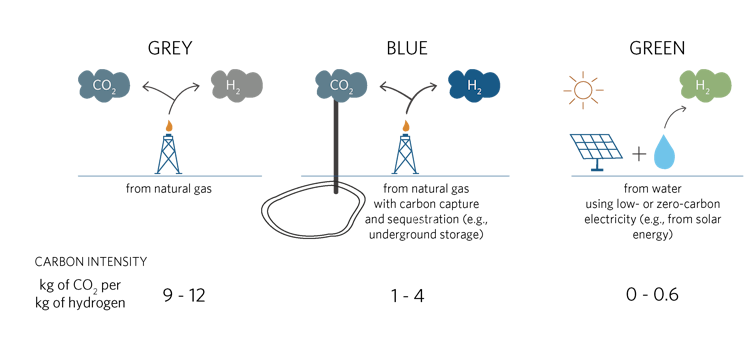
Hydrogen is a zero-carbon fuel, and it comes in three basic colours: grey, blue and green.
Grey hydrogen can be produced inexpensively using coal or natural gas, but it has a significant carbon footprint. Most of the grey hydrogen produced today is made by a process called steam methane reforming, which generates between nine kilograms and 12 kilograms of carbon dioxide for each kilogram of hydrogen produced. Grey hydrogen can turn “blue” when most of these carbon emissions are captured and, for example, sequestered underground.
Green hydrogen is more expensive to produce, but it can be manufactured with zero emissions using renewable electricity to split water into oxygen and hydrogen. Globally, less than two per cent of hydrogen is produced this way.
The basic colours of hydrogen. Cleaner hydrogen produces less carbon dioxide, but it is more expensive. (Walter Mérida/Data: PEMBINA, IEA), Author provided
Many other colours have been added to the palette, but the focus on colour is a distraction. What really matters is the carbon intensity of the production process — that is, the tonnes of carbon produced for each tonne of hydrogen.
Hydrogen can be burned like any other fuel in cars, ships and airplanes, but because it does not contain carbon, it will not produce CO2 emissions. More importantly, it can also power fuel cells that convert hydrogen into clean electricity directly. This feature will trigger a revolution in portable, urban and autonomous power over long distances.
Challenges to widespread hydrogen adoption include the lack of a refuelling and distribution infrastructure, embryonic and evolving safety standards, and high costs. Most of these challenges are being addressed as the number and scale of demonstration projects increases. A global market
The Hydrogen Council, a global industry group, estimates that by 2050 hydrogen will represent 18 per cent of the energy delivered to end users, avoid six gigatonnes of carbon emissions annually, enable US$2.5 trillion in annual sales and create 30 million jobs globally.
This month, British Columbia announced it would be the first province in Canada to introduce a hydrogen strategy to reduce emissions and create jobs. Other, similar strategies already exist elsewhere in the world. Canada may be late to the game, but it still has a chance to become a hydrogen powerhouse.
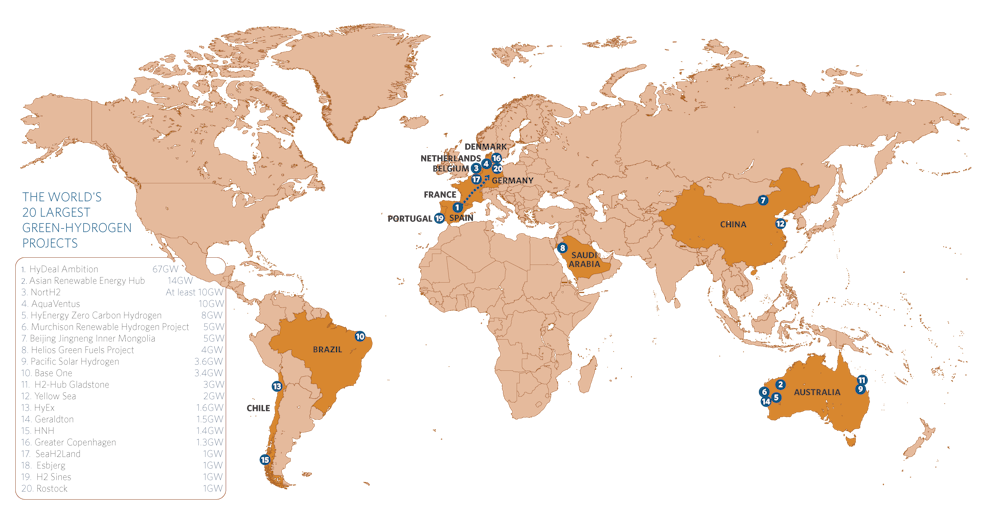
In the wake of a 750-billion euro recovery plan, the European Commission unveiled “A hydrogen strategy for a climate-neutral Europe.” Its investments in water electrolysis alone could be 24 billion to 42 billion euros by 2030. Hydrogen was also the focus of the first Energy Earthshot announced in June by the U.S. Department of Energy, and national hydrogen strategies have been developed by Japan, Germany, South Korea and Australia.
Canada unveiled its Hydrogen Strategy in December 2020. The government says that the clean fuel sector could be worth $50 billion, create 350,000 green jobs and help Canada reach its net-zero targets by 2050. In June, Canada launched a $1.5-billion Clean Fuels Fund to increase domestic capacity to produce low-carbon fuels, including hydrogen.
Largest green hydrogen projects under consideration as of December 2020. Their completion will depend on finding adequate market conditions. (Walter Mérida/Data: Recharge News), Author provided
Beyond guilt-free driving, hydrogen may enable Canada to respond to the global demand for solutions as the world embarks on a transformational energy transition. Canada’s opportunity
Canada could become a leading blue and green hydrogen exporter.
Our country has been a global leader in hydrogen technologies for more than a century. Commercial products based on these technologies are running cars, buses and trains around the world.
British Columbia, Manitoba, Québec and Ontario could export green hydrogen made using hydro or nuclear electricity. Alberta can repurpose its oil and gas infrastructure and labour force to produce blue hydrogen at globally competitive prices
Scaling up investment and increasing domestic hydrogen demand will be critical to trigger local economic development, maintain Canada’s leadership and respond to global market signals
.
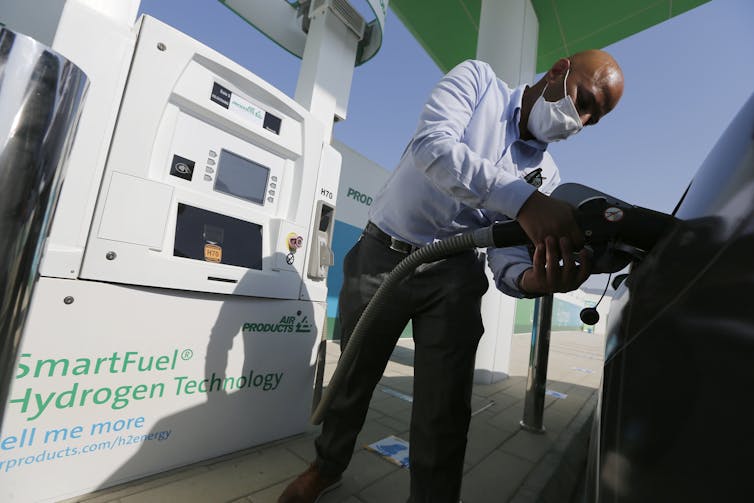
Air Products recently inaugurated a hydrogen fuelling station in Dhahran, Saudi Arabia. (AP Photo/Amr Nabil)
At the end of June, Canada’s Senate approved Bill C-12, writing our national greenhouse gas emissions targets into law. The carbon tax and clean fuels initiative represent additional steps to create the incentives and regulatory certainty needed to promote private investment. In Budget 2021, Canada also proposed a tax credit for investments in carbon capture, use and storage technologies.
Informed by a similar measure in the United States, the tax credit will explicitly “support hydrogen production.” A public consultation is open until Sept. 7, providing an opportunity to refine and harmonize the role of hydrogen in Canada’s energy transition.
Beyond powering clean cars, the links between hydrogen and renewable electricity can decarbonize seasonal energy storage, steel manufacturing, urban and industrial heatingand aviation. Such links will trigger a revolution in the digital technologies required to monitor, control, trace and certify smart and sustainable energy systems.
By leading the way in hydrogen and digital technologies, Canada has a golden opportunity to pivot from a resource economy to a low-carbon economy in a single generation.
Author
Walter Mérida Associate Dean of Research for Applied Science, University of British Columbia Disclosure statement Walter Mérida receives funding from the Natural Sciences and Engineering Research Council of Canada, the Canada Foundation for Innovation, Western Economic Diversification Canada, Natural Resources Canada, the B.C. Knowledge Foundation, and MITACS. He serves on the Board of Directors for the Canadian Hydrogen and Fuel Cell Association, and the Climate Change Advisory Board for Toronto Dominion Insurance. Partners
How to solve the Bitcoin energy consumption problem
As the world grapples with crypto mining’s carbon footprint, Nischal Shetty of WazirX examines the technical and regulatory solutions.
Blockchain technology is redesigning the world order via its interlinked network of blocks, simplifying monetary transfers and transforming the financial space.
But its pros may be weighed down by the huge environmental cost that cryptocurrency mining incurs each year. Currently, Bitcoin mining alone is responsible for more than 0.5% of global energy consumption.
Bill Gates, in early March, criticized Bitcoin for being the most energy-consuming transaction method known ever to mankind. Since then the Twitterati have been abuzz about how cryptocurrency mining has been hogging down energy from the already limited available resources. Down from their reputation of being a panacea for every malady, Bitcoin and its accompanying blockchain technology are earning notoriety as NFTs (non-fungible tokens) powered by blockchain are steadily gaining traction in the digital scene.
Recently, an NFT artwork by the digital artist Beeple was sold for US$69 million by Christie’s auction house as an NFT. Around the same time, French sculptor cum environmentalist Joanie Lemercier was horrified to learn that the sale of just six of his NFT artworks consumed energy equivalent to a total of two-year energy consumption of his studio.
Excessive energy consumption: hype or problem area?
Cryptocurrencies are created — or mined, in blockchain terminology — over a decentralized network of computers that validates payments between users and maintains a historical log of transactions. Almost all the cryptocurrencies use a proof-of-work consensus mechanism that requires the miners to solve difficult computational problems, thus consuming a lot of electricity. There are hundreds of thousands of such computers that mine such cryptocurrencies actively, and only 39% of them use renewable energy resources, according to a University of Cambridge report.
The environmental cost of the digital revolution far supersedes the current stats that convict Bitcoin and blockchain as the sole culprits of degrading environment. A single swipe of your debit card initiates a rally of transactions over a humongous but buried network of systems. Though the frequency of transactions in banks and financial institutions (500 billion per year) is incomparable to that of the Bitcoin network (100 million), cryptocurrency mining isn’t inherently prone to leave a carbon footprint.
We ought to know how climate change is a huge environmental issue being realized today by businesses and the masses alike. A 2019 study by Harvard Business Review found that the market for sustainable products was touted to grow 5.6 times faster than the other not such responsible products. Another study found 79% of the customers preferring socially and environmentally responsible products. With changing customer preference towards environment-friendly products, the crypto industry has to work towards more sustainable energy solutions as it nears mainstream adoption. Let us look at the solutions available to tame the cryptocurrency industry’s carbon footprint and excessive energy consumption.
Solutions within and without
Changing the way coins are mined
The proof-of-work consensus mechanism is averse to saving energy due to its insatiable and unending consumption issues. It is, therefore, pertinent to change the way coins are mined. Easier said than done. Attempts have been made to bring in more energy-efficient consensus mechanisms, like the proof of stake and proof of authority.
Proof of stake is a low-energy consuming consensus mechanism as it leverages the efficacy of coins itself in the network. A user who has locked his tokens can verify blocks; therefore, the need for intensive mining is eliminated. Ethereum founder Vitalik Buterin strongly believes that blockchains sharding based on proof-of-stake is “thousands of times more efficient.”
A group of hackers created an eco-friendly network based on the same called the PIVX network. The network’s energy requirements can be sufficed by a single wind turbine alone!
A proof-of-authority consensus mechanism leverages the identity of the people being a reputation-based consensus system. It is one of the most efficient and eco-friendly consensuses that could replace the proof of work.
Finding alternative energy sources
Bitcoin mining currently consumes 69.85 TWh per year, which ismore than the energy consumed by Austria in a year. There is an urgent need to shift to alternative resources to cut on the carbon footprint. The shift to environmentally fit energy solutions is already visible. Some mining nodes now use hydropower Some mining businesses rely on gas leaks captured from oil fields. Others are increasingly exploring solar-powered machines to fuel their mining operations.
Countries that have a surplus of renewable energy sources can encourage miners by allowing subsidized rates and other such allowances. Companies can work on a more efficient and robust mining and grid infrastructure that can help miners store and channel energy flows.
Reducing crypto mining’s carbon footprint
Exploring the uses cases of blockchain further, Canadian business consultant, Magdalena Gronowska says: “Miners can provide grid balancing and flexible demand-response services and improve renewables integration.” Miners can support the community rather than draining it. The mining firms can take up reforestation programs and other sequestration programs to help improve the air quality.
Mining rigs can utilize the heat from their units to warm houses in cold temperatures. Hotmine in Siberia is a fine example of the above application. Places like Iceland offer natural cooling to the Bitcoin mining rigs and also harvest hydropower and geothermal energy that further help make Bitcoin mining more green and clean.
Environmental regulations
Government and policymakers around the world can put into force regulators and categorical bans for cryptocurrencies that flout the prescribed limits of CO2 emissions. For instance, Quebec has introduced a moratorium on new currency mining. The crypto industry, like other industries, could be brought within the ambit of corporate social responsibility (CSR) regulations that are becoming increasingly mandatory for business enterprises today.
Development and environment protection have and will always be at loggerheads. What is essential is to find the middle path. Making mining more energy-efficient and switching to alternate modes of energy can go a long way in making it a carbon-neutral technology.
What is required to be told and understood is that Blockchain tech has been testing its limits ever since its inception. The crypto community is self-aware and thinking about how to tackle the energy consumption issue. Being a disruptor tech still in its nascent phase, it possesses the potential to rethink, revise and rework on its shortcomings. As the DigiEconomist founder Alex de Vries says, “Ideally, change comes from within.” The alternative currency and tech are sure to find an alternate solution soon.
Nischal Shetty is the CEO of Indian crypto exchange WazirX. He also founded Crowdfire, a marketing bot for content creators. He holds a bachelor of engineering in computer science from Visvesvaraya Technological University and was named to Forbes India 30 under 30 in 2014.
A single China-based mining operation reportedly plans to move 1 million Bitcoin mining rigs to Canada over the next 24 months with the help of a U.S. company.
The partnership between Optimum Mining Host (OMH) and Black Rock Petroleum Company (BRPC) could offer a glimpse at the scale of the mining operations being forced to leave China because of the country's restrictions on cryptocurrencies. Or it could be a sign that companies want to cash in on the uncertainty of Bitcoin's future.
BRPC said it plans to "host and operate up to one million Bit miners" for OMH "across three Natural Gas producing sites located in Alberta Canada." The first 200,000 units are set to be hosted at the Quirk Creek plant near Millarville, Alberta, and it seems that BRPC and OMH would split the costs of maintaining the devices
It's worth noting that, at least in our searches, mentions of OMH begin and end with this announcement. BRPC's website also relies exclusively on stock imagery, and founder Zoltan Nagy is also said to be "President and Principal Controlling Executive Officer" as well as "Financial & Accounting Officer, Treasurer, Secretary, Director.
BRPC is also listed on OTC Markets, which has more lax requirements than the likes of the New York Stock Exchange or NASDAQ, under the BKRP ticker symbol. But if the announcement was meant to buoy the company's share price, it didn't work. That price fell from $3.04 on July 15 to $2.26 at the time of writing and was declining even before the rest of the market crashed because of the Delta variant of COVID-19.
Even without this deal, there are signs that China-based Bitcoin mining operations plan to move to the U.S. and Canada in pursuit of cheap energy, privacy protections, and the relative stability of their regulations for cryptocurrency mining. There are also reports of miners planning to move hundreds of thousands of mining rigs.
Companies planning to move up to a million systems used for Bitcoin mining wouldn't be outside the realm of possibility, then, even if it's hard to fathom multiple operations devoting that much hardware to the cryptocurrency. Whether or not BRPC will be the first company to facilitate that great migration remains to be seen.
Cryptocurrency & Mining
1 million Bitcoin mining rigs being moved from China to Canada
Optimum Mining Host is moving 1 million Bitcoin mining rigs from China to ALBERTA, Black Rock Petroleum Company will help out.
Anthony Garreffa@anthony256
PUBLISHED MON, JUL 19 2021
It seems the gigantic crackdown on cryptocurrency mining operations in China is going to the next level, with Chinese Bitcoin mining outfit, Optimum Mining Host, moving 1 million Bitcoin mining rigs from China to Canada.
Moving 1 million anything from one place to another is a gigantic operation no matter what it is, which is why the company is getting Black Rock Petroleum Company to help out. Moving all of that hardware out of China is going to be hard -- for many reasons, not just a logistics reason -- with the 1 million rigs being moved out of China and into Alberta, Canada spread out across 3 locations.
The new Alberta, Canada relocation will have the 1 million Bitcoin mining rigs will be spread across three Natural Gas producing sites. The first 200,000 machines will be hosted by the Quirk Creek Gas plant which is operated by Caledonian Midstream Corporation.
The companies signed a 24-month contract, with an optional 12-month extension available if required. The initial deployment of 200,000 Bitcoin mining rigs will be joined by 300,000 "near term" machines and then mid-term 500,000 immediately available once their new home in Canada is ready.
Maybe they're not Bitcoin mining machines and maybe most of the hash power used for "cryptocurrency mining" is really feeding into a huge AI... and that AI wants to have itself moved from China to Canada. Hah ;)
1 Million Bitcoin Mining Systems Could Be Headed To Canada From China
The Chinese Bitcoin mining firm, Optimum Mining Host, is reportedly moving 1 million Bitcoin mining rigs all the way to Canada over the next 24 months with the help of the Black Rock Petroleum Company.
1 Million Bitcoin Mining Rigs Will Be Moved To Canada In The Next 24 Months
With China cracking down on cryptocurrency mining operations, many operations have already been shut down and are looking elsewhere. The two main reasons behind China's move to ban cryptocurrency mining operations are two have a carbon-neutral footprint and the People's Bank of China wants to move away from the volatile cryptocurrencies. In an official statement, the People's Bank of China said that:
Virtual currency trading activities disrupt the normal economic and financial order, breed the risk of illegal and criminal activities such as illegal cross-border asset transfer and money laundering, and seriously infringe on the property safety of the people.
Mining operations in certain regions have already been shut down and graphics card prices in China have begun to drop. The partnership between Optimum Mining Host and Black Rock Petroleum Company shows the great scale of mining operations that were previously operating in China as well as the trouble companies are going to have to go through to move all of the equipment out of China.
In the statement, Black Rock and Optimum Ming Host describe how many mining rigs will be utilized as well as where they will be located. 1 million mining rigs will be located across 3 sites in Alberta, Canada.
Caledonian Mainstream (“Caledonian”) is an Alberta-based company and the owner/ operator of 14 producing liquids-rich natural gas wells at Quirk Creek, Caledonian will become a wholly owned subsidiary of Black Rock upon completion of the recently announced transaction and Black Rock will utilise the site to host and operate up to 200,000 of the one million bit miners with 300,000 mining machines at a second site in Alberta and 500,000 at a third site to be identified shortly as negotiations are concluded.
The statement doesn't specify how the cost of operating all the bitcoin mining rigs will be split, but it seems as if the two companies will be splitting the cost. The linked statement goes over the agreement in its entirety.
A miner inspects a setup in Sichuan, China in September, 2016. (Image Credits: Chinafile) Tom's Hardware also noticed that the Black Rock Petroleum Company website is very basic only uses stock imagery. The founder Zoltan Nagy holds both the "President and Principal Controlling Executive Officer" position as well as the "Financial & Accounting Officer, Treasurer, Secretary, Director" position. Both executives on the about us section of the website also do not have headshots and opted for a stock image.
It is certainly plausible to move 1 million systems to Canada from China, but whether or not it actually happens is another question. We will just have to wait and see for 24 months if the 1 million mining rigs have arrived in Canada.
Black Rock Petroleum Company Announces Bitcoin Mining Agreement
July 15, 2021 11:53 ET | Source: Black Rock Petroleum BLACK ROCK PETROLEUM ANNOUNES BITCOIN MINING AGREEMENT TO OPERATE UP TO ONE MILLION BITMINERS TO BE DEPLOYED ACROSS THREE NATURAL GAS ENERGY PRODUCING SITES IN ALBERTA CANADA.
Los Angeles Ca , July 15, 2021 (GLOBE NEWSWIRE) -- Black Rock Petroleum Company (OTC:BKRP), a Nevada corporation (“Black Rock”), announced today it has entered into a binding agreement with Optimum Mining Host Limited Liability Co to host and operate up to one million Bit miners to be relocated from locations in China and exported to Canada by(OMH) to be deployed by BKRP, across three Natural Gas producing sites located in Alberta Canada with the first 200,000 units to hosted on site of the recently announced Planned acquisition by BKRP, the Quirk Creek Gas plant operated by Caledonian Midstream Corporation.
The contract term is 24-month contract with an optional 12-month extensions with prior notice. OMH will pay the fully loaded electrical supply costs. OMH will maintain different electronic payment term in account of the fully loaded electrical costs, around 2 cents (USD) or $55.55 (USD) per miner per month as wholesale price. Payments can be made in US Dollar (USD) or Canadian Dollar (CDN). OMH will pay the host and maintenance services fee of 2.19 cents (USD) or $60.00 (USD) per miner per month. For equipment installation, service, firmware updates, maintenance, and repair, BKRP will charge an Administrative and Management fee of 1.83 Cents (USD) or $50.00 (USD) per miner per month. Maintenance and repairs are limited to swapping hash boards, fans, or miner configuration changes as the normal course of business. OMH will provide and maintain an expected inventory of spare parts for the number of miners installed and replenished based upon known failure rate. OMH will pay the fee of 0.36 cents (USD) or $10.00 (USD) per miner per month, for the allocation of the host services OHM required to have including: OMH Authorized Chinese speaking technicians, OHM Authorized English/Chinese speaking technicians, and OMH Authorized 24-7 hi-level Armed securities guard with enforcement power. OMH will pay BKRP all in price extra 0.18 cents or $5.00 (USD) per miner per month Any provided equipment that is found to cause damage to the electrical infrastructure at the facility will be disconnected and the companies will work together to resolve the issue. If faulty equipment cannot be remediated within 15-days than BKRP will remove it from the network and OMH has the right to provide replacement devices for the term of the contract. The initial contract commitment is for 200,000 machines to be scheduled for deployment, plus near term 300,000 machines and midterm 500,000 immediately contract commitment when the host capacity is ready.
Caledonian Mainstream (“Caledonian”) is an Alberta-based company and the owner/ operator of 14 producing liquids-rich natural gas wells at Quirk Creek, Caledonian will become a wholly owned subsidiary of Black Rock upon completion of the recently announced transaction and Black Rock will utilise the site to host and operate up to 200,000 of the one million bit miners with 300,000 mining machines at a second site in Alberta and 500,000 at a third site to be identified shortly as negotiations are concluded.
Raw production at Quirk Creek has recently averaged approximately 12 MMcf/d, with natural gas sales averaging approximately 8.5 MMcf/d, approximately 475 barrels of natural gas liquids and 60 tonnes of molten sulphur per day. Total remaining recoverable natural gas associated with the Quirk Field are estimated at 49 Bcf on a proved plus probable producing basis.
The Quirk Creek plant is connected to the Plains Midstream Pipeline by a company-owned, 34-mile pipeline capable of transporting natural gas to market in Fort Saskatchewan Alberta, as well as the TC Energy Gas Transmission Pipeline, with routing through Southern Alberta, the interior of British Columbia and the Western United States, terminating in the Sacramento/San Francisco.
Zoltan Nagy, Chief Executive Officer of Black Rock, commented on the recent announcement, with the company entering the Bitcoin Mining and Hosting business in Canada, it joins publicly traded companies in this space like Riot Blockchain,(RIOT) Marathon Digital (MARA) and Argo Blockchain (ARGO) and Genesis Digital Assets the worlds largest bitcoin miner as a serious competitor achieved via its agreement with OMH, to provide one million bitcoin mining machines and that “Caledonian Midstream is a great fit for Black Rock, and as demand for natural gas continues to grow, in Alberta and across North America, and the Quirk Creek property is perfectly situated to service those markets. Current production levels are good, and our engineers have looked at the property’s historical production records and analysed recent reserve evaluations, and we are confident we have the expertise, technology and resources to materially increase production and, in turn, the cash flow of the site and to host and operate bitcoin miners at an energy cost of circa three cents Canadian per KWH.
ABOUT BLACKROCK PETROLEUM
Black Rock Petroleum Company is expanding and diversifying its operations by the acquisition of Caledonian Midstream that owns and operates the Quirk Creek Gas Plant in Alberta Canada and by entering the very lucrative and cash generative Bitcoin and Crypto Mining Sector via its agreement with (OMH) to host and operate up to one million bit miners in Alberta Canada, in addition to its existing oil and gas exploration-stage company in California.
To learn more about Black Rock Petroleum, please visit the website
Source: Black Rock Petroleum Co./ Torrance Petroleum Co.
Safe Harbour Statement: This press release may contain certain forward-looking statements and information, as defined within the meaning of Section 27A of the Securities Act of 1933 and Section 21E of the Securities Exchange Act of 1934; and is subject to the Safe Harbour created by those sections. This material contains statements about expected future events and/or financial results that are forward-looking in nature and as such are by definition subject to risks and uncertainties.
ROARING 20'S SPECULATION
Russian Crypto Industry Scrambles to Attract Miners as Kazakhstan Overtakes Russia in Mining Volume
An industry association representing the Russian crypto sector has launched a project to entice bitcoin miners. Despite its abundant sources of cheap energy, Russia is now lagging behind Kazakhstan, another Eurasian Economic Union member, in terms of cryptocurrency production.
Russian Project Aims to Expand Country’s Crypto Mining Capacity
The Russian Association of Crypto Industry and Blockchain (Racib) has unveiled a project to bring a larger portion of the global computing potential engaged in cryptocurrency mining to Russia. The Russian Federation, Racib noted in an announcement, ranks among the top five nations by total electricity production. What’s more, the country’s energy system features unique characteristics that can benefit enterprises involved in the minting of digital coins.
Racib has listed a number of them, including the large surplus of power-generating capacity which reaches 50% in certain regions. The colder Russian climate is another advantage as it allows the cooling of mining equipment at little cost, thus improving the efficiency of data centers. Add to that the wide availability of traditional fuels and other energy resources, as well as the low population density in many areas that makes it possible to deploy large-scale facilities and infrastructure. Racib emphasizes:
All this … provides the best conditions for the formation of specialized clusters in the country to support the global cryptocurrency networks and the infrastructure of the global digital economy.
The crypto association says it will implement the project in close cooperation with central and regional Russian authorities and state-run corporations. Several working groups have been established already with the participation of the energy industry and public institutions. The organization claims its main foreign partner in the project is a “consortium of the largest mining companies in China.”
Amid an ongoing crackdown on crypto miners in the People’s Republic, Racib hopes some of them will transfer their computing power to the Russian Federation to increase Russia’s share of the global hashrate.
Kazakhstan Overtakes Russia as Crypto Mining Destination
Environmental concerns are believed to be a major motive behind Beijing’s squeeze on crypto mining and Racib thinks Russia has an answer. Eco-friendly hydro and nuclear energy sources form around 40% of the country’s energy balance. And as far as Bitcoin is concerned, Russia’s involvement in the miners’ migration from China should “provide a more decentralized network format of the main digital currency” and help “avoid another concentration of mining resources in one region, in this case North America.”
Chinese miners are already on the move, however, and Russia should hurry up if it wants to lure some of them to its territory. Others have been quicker to take advantage of the shift, including Kazakhstan, another former Soviet Republic, and a member of the Russia-led Eurasian Economic Union (EEU).
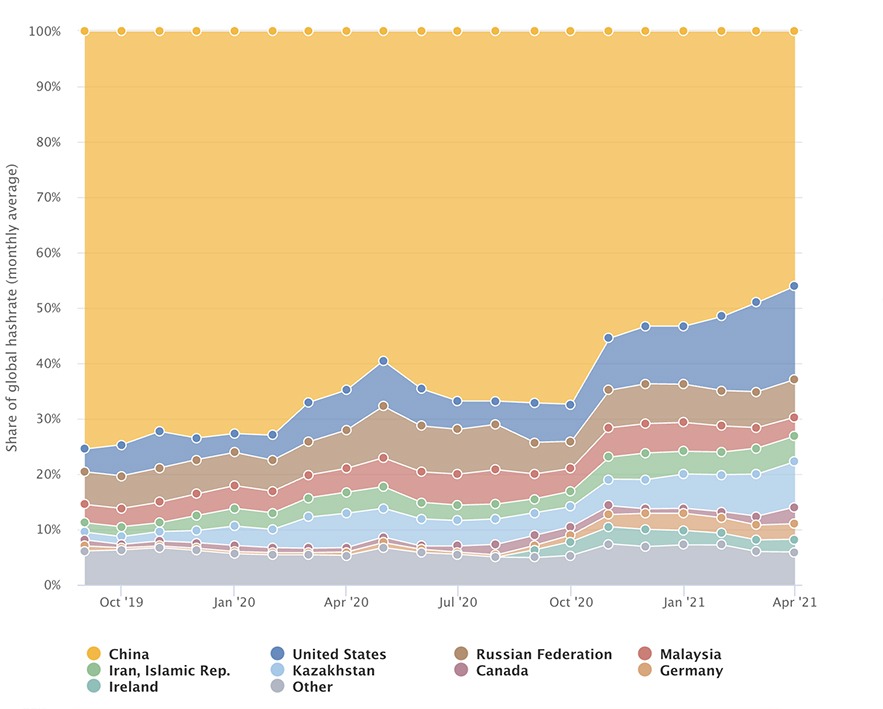
Evolution of country share in global hashrate (monthly average). Source: University of Cambridge.
In less than two years, the Central Asian country has increased its share in the global bitcoin extraction by almost six times, from 1.4% to 8.2%, according to a study conducted by the University of Cambridge. By crypto mining volume, Kazakhstan is now third in the world, the data quoted by RBC (a major Russian business news portal) shows, overtaking Russia which ranks fourth with 6.8%.
During the same period, between September 2019 and April of 2021, China’s share has dropped from 75.5% to 46%, while the United States has climbed to second place, increasing its share from 4.1% to 16.8%, the report details. According to the research, the Islamic Republic of Iran is now fifth with 4.6%. Still, Russia has a chance to improve its position as Kazakhstan recently introduced a surcharge for electricity consumed by miners despite opposition from the local crypto industry.
Watch Malaysian police use a steamroller to crush 1,069 bitcoin mining rigs worth $1.3 million
As the cryptocurrency market surged earlier this year, it brought into focus the massive energy consumption digital coin mining takes.
By Edited by Gadgets 360 Newsdesk | Updated: 20 July 2021 14:45 IST
Photo Credit: YouTube/ dayakdaily
HIGHLIGHTS
Malaysia police reportedly seized 1,069 mining rigs from miners
Cryptocurrency mining rigs need a huge amount of electricity to operate
Eight people were reportedly arrested
Bitcoin mining rigs were crushed by the Malaysian police with a steamroller, a video of which has now gone viral on YouTube. The police last week crushed more than a thousand electronic rigs used by Bitcoin miners illegally, with a steamroller. Authorities in the city of Miri in the coastal Sarawak state reportedly seized 1,069 rigs from miners who allegedly stole electricity to run mining operations. The devices were seized between February and April and have an estimated value of RM 5.3 million (roughly Rs. 9.4 crores). Eight people were reportedly arrested for being involved in mining activities using stolen electricity.
The authorities, however, did not mention why the police decided to destroy the rigs in such a dramatic way, and not use the expensive systems for something else.
A local news outlet in Sarawak, Dayak Daily, uploaded the video on YouTube that shows the rigs being steamrolled. Watch the video below:
As the cryptocurrency market surged earlier this year, it brought into focus the massive energy consumption in mining digital coins. The energy-intensive “proof-of-work” process, through which Bitcoins are earned/generated, makes computers compete to solve complex mathematical equations. Given the competitive element in the quest for valuable cryptocurrency, powerful mining rigs — PCs purpose-built to maximise mining rewards — are preferred by cryptocurrency miners.
A total of 1,069 units of Bitcoin mining rigs were seized in the Malaysian city, reported local newspaper The Star. All the seized rigs were “disposed of” at the Miri district police headquarters on Friday, July 16.
The report said the Sarawak electricity board suffered damages of RM 8.4million (roughly Rs. 14.89 crores) due to electricity theft by Bitcoin miners. The individuals arrested for electricity theft have been fined up to RM 8,000 (roughly Rs. 1.41 lakhs) and jailed for up to eight months, the police chief told The Star.
Electricity theft is a major issue in regions where Bitcoin is mined as some miners use illegal means to secure the power supply necessary to make a big profit from cryptocurrency mining. Because of the additional pressure it puts on the electric grid, authorities have to often resort to load sharing that results in regular outages.