Monday, July 26, 2021

Clashes erupt outside parliament after Tunisian president ousts PM, suspends legislature
Supporters of Tunisian President Kais Saied and the Ennahda party clashed in front of Parliament. © Fethi Belaid, AFP

Issued on: 26/07/2021 - 
Text by: FRANCE 24

Street clashes erupted on Monday outside Tunisia's army-barricaded parliament, a day after President Kais Saied ousted the prime minister and suspended the legislature, plunging the young democracy into a constitutional crisis.

Saied sacked Prime Minister Hichem Mechichi and ordered parliament closed for 30 days, a move the biggest political party Ennahdha decried as a "coup", following a day of angry street protests against the government's handling of the Covid pandemic. The president on Monday also announced he would replace the country's defence and justice ministers.

Soldiers from early Monday blockaded the assembly in Tunis while, outside, the president's supporters hurled volleys and stones at backers of Ennahdha, whose leader staged a sit-in to protest being barred entry.

Saied's dramatic move – a decade on from Tunisia's 2011 revolution, often held up as the Arab Spring's sole success story – comes even though the constitution enshrines a parliamentary democracy and largely limits presidential powers to security and diplomacy.


It "is a coup d'état against the revolution and against the constitution," Ennahdha, which was the biggest party in Tunisia's ruling coalition, charged in a Facebook post, warning that its members "will defend the revolution".

The crisis follows prolonged deadlock between the president, the premier and Ennahdha chief Rached Ghannouchi, which has crippled the Covid response as deaths have surged to one of the world's highest per capita rates.

"I have taken the necessary decisions to save Tunisia, the state and the Tunisian people," Saied declared in a statement on Sunday, a day that had seen angry Covid street protests in multiple cities.


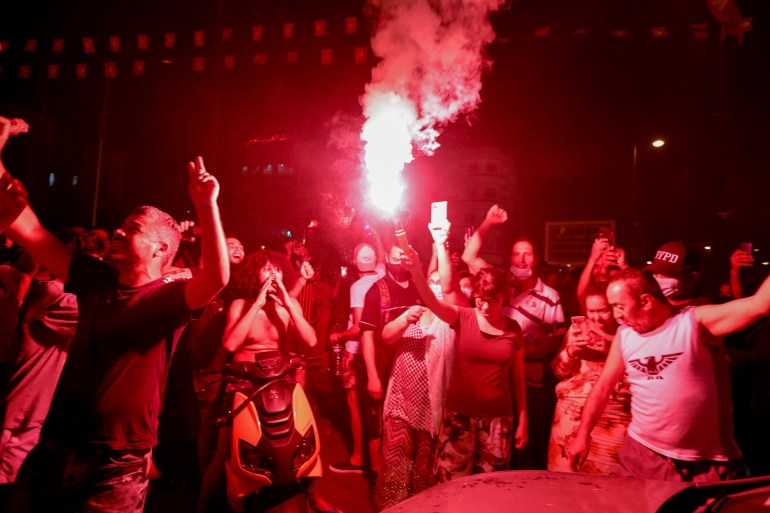
The president's announcement sparked jubilant rallies by his supporters. Large crowds took to the streets of the capital late Sunday to celebrate and wave the national flag, as car horns sounded through the night and fireworks lit up the sky.

"Finally some good decisions!" said one Tunis protester, Maher, celebrating in defiance of a coronavirus curfew. Others held up signs with a simple message to the sacked government: "Game Over".


'Most delicate moments'

Before the president's announcement, thousands had marched in several cities protesting against Ennahdha, criticising the largest party in Tunisia's fractious government for failures in tackling the pandemic.

A senior Ennahdha official, speaking to AFP on condition of anonymity, alleged that the protests before the president's announcement, and the subsequent celebrations, had all been choreographed by Saied.

"We are also capable of organising large demonstrations to show the number of Tunisians who are opposed to these decisions," this official said.

Since Saied was elected president in 2019, he has been locked in a showdown with Mechichi and Ghannouchi, who is also house speaker. The rivalry has blocked ministerial appointments and diverted resources from tackling Tunisia's many economic and social problems.


"We are navigating the most delicate moments in the history of Tunisia," Saied said Sunday.

He said the constitution did not allow for the dissolution of parliament, but did allow him to suspend it, citing Article 80 which permits it in case of "imminent danger".

In a later Facebook post, he clarified that the suspension would be for 30 days.

Saied said he would take over executive power "with the help" of a government, whose new chief will be appointed by the president himself.

He also said that parliamentary immunity would be lifted for deputies.


'Birth of a dictator'

In the 10 years since the revolution which toppled dictator Zine El Abidine Ben Ali, Tunisia has had nine governments, some of which have lasted only a few months, hindering the reforms necessary to revamp its struggling economy and poor public services.

Tunisia has recently been overwhelmed by Covid-19 cases which have raised the death toll to more than 18,000.

Last week, Mechichi fired his health minister over his handling of the pandemic as cases skyrocketed – the latest in a string of health ministers to be sacked.

In Sunday's Covid protests, hundreds rallied in front of parliament, shouting slogans against Ennahdha and premier Mechichi.

Demonstrations were also reported in the towns of Gafsa, Kairouan, Monastir, Sousse and Tozeur.

Several protesters were arrested and a journalist was injured when people hurled stones and police fired tear gas canisters, an AFP reporter said.


Daily newsletterReceive essential international news every morningSubscribe

"The people want the dissolution of parliament," the crowd had chanted.

After Saied's announcement, many Tunisians expressed relief.

Nahla, brandishing a Tunisian flag, was jubilant and told AFP: "These are courageous decisions – Saied is unblocking Tunisia. This is the president we love!"

But one man, aged in his forties, watched on without enthusiasm and said: "These fools are celebrating the birth of a new dictator."

(FRANCE 24 with AFP)


Tunisia’s democracy is in crisis. Here’s a timeline of key events

The sacking of Tunisia’s parliament is the latest step along a bumpy road since the country’s 2011 revolution.

Demonstrators gather in front of police officers during an anti-government protest in Tunis, July 25, 2021 [Zoubeir Souissi/ Reuters]

26 Jul 2021


Tunisian President Kais Saied has sacked the government and frozen the parliament in one of Tunisia’s biggest political crises since the 2011 revolution that introduced democracy.

Here is a timeline of Tunisia’s bumpy decade of democracy and the path to Saied’s decision on Sunday.

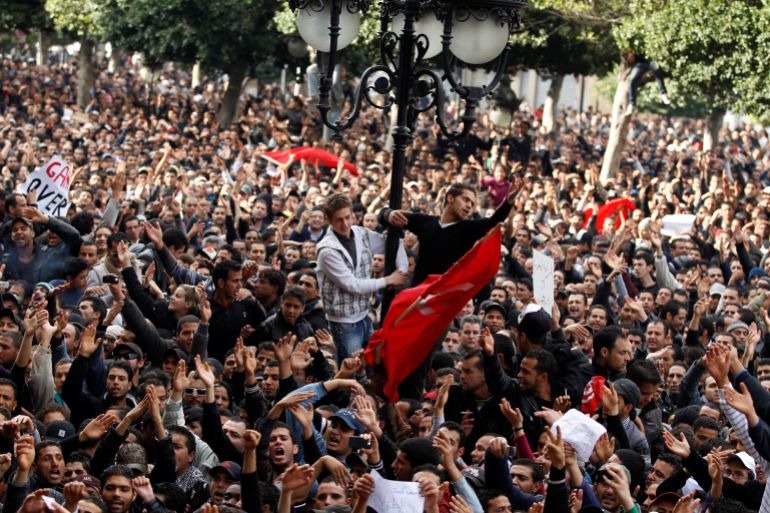
December 2010 – Vegetable seller Mohamed Bouazizi sets himself on fire after police confiscated his cart. His death and funeral spark protests over unemployment, corruption and repression.Protesters demonstrate against Tunisian President Zine El Abidine Ben Ali in Tunis, January 14, 2011 [Zohra Bensemra/ Reuters]

January 2011 – Strongman Zine El Abidine Ben Ali flees to Saudi Arabia as Tunisia’s revolution triggers the Arab Spring uprisings across the region.

October 2011 – Moderate Islamist party Ennahdha, banned under Ben Ali, wins most seats and forms a coalition with secular parties to plan a new constitution.

March 2012 – Growing polarisation emerges between Islamists and secularists, particularly over women’s rights, as Ennahdha pledges to keep Islamic law out of the new constitution.


February 2013 – Secular opposition leader Chokri Belaid is assassinated, prompting street protests and the resignation of Prime Minister Hamadi Jebali. Fighters mount attacks on police
.
Tunisians hold a placard of late opposition leader Chokri Belaid during his funeral procession in Tunis, February 8, 2013 [Anis Mili/Reuters]

December 2013 – Ennahdha cedes power after mass protests and national dialogue, to be replaced by a technocratic government.

January 2014 – Parliament approves a new constitution guaranteeing personal freedoms and rights for minorities, and splitting power between the president and prime minister.

December 2014 – Beji Caid Essebsi wins Tunisia’s first free presidential election. Ennahdha joins the ruling coalition.

March 2015 – ISIL (ISIS) attacks on the Bardo Museum in Tunis kill 22 people. In June, a gunman kills 38 at a beach resort in Sousse.

The attacks devastate the vital tourism sector and are followed by a suicide bombing in November that kills 12 soldiers
.
Flowers laid on the beach at a resort that was attacked by a gunman in Sousse, Tunisia, June 28, 2015 [Zohra Bensemra/Reuters]

https://youtu.be/eRIA4cKWI3E


March 2016 – The army turns the tide against the ISIL threat by defeating dozens of fighters who rampage into a southern town from across the Libyan border.

December 2017 – The economy approaches crisis point as the trade deficit soars and the currency slides.

October 2019 – Voters show dissatisfaction with the major parties, first electing a deeply fractured Parliament and then political outsider Kais Saied as president.

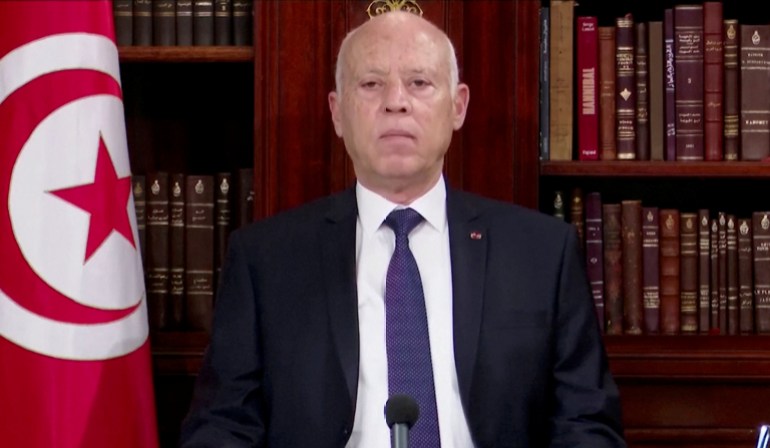
Tunisian President Kais Saied addresses the nation, July 25, 2021 [Screengrab from Tunisian President’s Office

Tunisian men flash the victory sign as tyres burn on blocked roads in Tataouine to protest the government’s failure to keep its promise to provide jobs and investments, February 12, 2021 [Fathi Nasri/ AFP]

January 2020 – After months of failed attempts to form a government, Elyes Fakhfakh becomes prime minister but is forced out within months over a corruption scandal.

August 2020 – Saied designates Hichem Mechichi as prime minister. He quickly falls out with the president and his fragile government lurches from crisis to crisis as it struggles to deal with the pandemic and the need for urgent reforms.

January 2021 – A decade on from the revolution, new protests engulf Tunisian cities in response to accusations of police violence and the devastation the COVID pandemic wrought on an already weak economy.

July 2021 – Saied dismisses the government, suspends Parliament and says he will rule alongside the new prime minister, citing an emergency section of the constitution. The move is dismissed by Ennahdha and others in Parliament as a coup.

SOURCE: REUTERS
Tunisia’s president accused of ‘coup’ after dismissing PM

Tunisian president sacked PM Hicham Mechichi and suspended parliament after day of anti-government protests.

People celebrate in the street after Tunisian President Kais Saied announced the dissolution of parliament and Prime Minister Hichem Mechichi's government [Zoubeir Souissi/Reuters]
25 Jul 2021
|
Tunisia’s president has suspended parliament and dismissed Prime Minister Hichem Mechichi in a move condemned as an attack on democracy by his rivals but which others greeted with celebrations on the streets.

President Kais Saied said on Sunday he would assume executive authority with the assistance of a new prime minister after violent protests broke out in several Tunisian cities over the government’s handling of the COVID-19 pandemic and the economy.

It is the biggest challenge yet to a 2014 constitution that split powers between the president, prime minister and parliament.

“Many people were deceived by hypocrisy, treachery and robbery of the rights of the people,” he said in a statement carried on state media.

“I warn any who think of resorting to weapons … and whoever shoots a bullet, the armed forces will respond with bullets,” he added.

He also suspended the immunity of members of parliament, insisting his actions were in line with the constitution.

The statement followed an emergency meeting at his palace after thousands of Tunisians marched in several cities, with much of the anger focused on the Ennahdha party, the biggest in parliament.
Tunisian President Kais Saied has said he will assume ‘executive authoritiy’ after dismissing the prime minister and suspending parliament [File: Karim Jaafar/AFP]

Tunisian Parliament Speaker Rached Ghannouchi accused President Saied of launching “a coup against the revolution and constitution” after the move.

“We consider the institutions to be still standing and supporters of Ennahdha and the Tunisian people will defend the revolution,” Ghannouchi, who heads Ennahdha, told the Reuters news agency by phone.

The party also condemned the president’s move as a “state coup against the revolution”.

“What Kais Saied is doing is a state coup against the revolution and against the constitution, and the members of Ennahdha and the Tunisian people will defend the revolution,” Ennahdha wrote in a statement on its Facebook page.
‘No leadership’

Saied has been enmeshed in political disputes with Prime Minister Mechichi for more than a year, as the country grapples with an economic crisis, and a flailing response to the COVID-19 pandemic.

Saied and the parliament were elected in separate popular votes in 2019, while Mechichi took office last year, replacing another short-lived government.

Tunis-based journalist Rabeb Aloui told Al Jazeera that Saied’s move did not come as a surprise, as he had threatened to dissolve parliament and sack the prime minister.

“Since last September we (have) lived under a political crisis,” Aloui said.

She said many young Tunisians, particularly those who were protesting on Sunday, have expressed joy at the announcement.

The demonstrators had also called for social and economic reforms, however, and those issues still need to be addressed, Aloui added.

“We are really living under an economic crisis, with the health crisis too [from] the coronavirus pandemic,” she said.

Tunisia has been overwhelmed by COVID-19 cases, with more than 18,000 people dying from the disease in the country of about 12 million.

“There’s a failure of governments and the president himself is offering no leadership,” 

Thousands protest

Thousands of people had defied virus restrictions and the scorching heat to demonstrate earlier on Sunday in Tunis, the capital, and other cities. The crowds of mostly young people shouted “Get out!” and slogans calling for the dissolution of parliament and early elections.

The protests were called on the 64th anniversary of Tunisia’s independence by a new group called the July 25 Movement.

There was heavy security presence, especially in Tunis where police blockades blocked all streets leading to the capital’s main road, Avenue Bourguiba. The avenue was a key site for the Tunisian revolution 10 years ago that brought down a dictatorial government and unleashed the Arab Spring uprisings
.
A Tunisian protester lifts a national flag at an anti-government rally as security forces block off the road in front of the parliament in the capital Tunis [Fethi Belaid/AFP]

Police were also deployed around the parliament, preventing demonstrators from accessing it.

In Tunis on Sunday, police used pepper spray against protesters who threw stones and shouted slogans demanding that Prime Minister Mechichi quit and parliament be dissolved.

Witnesses said protesters stormed or tried to storm the offices of Ennahdha in Monastir, Sfax, El Kef and Sousse, while in Tozeur they set fire to the party’s local headquarters.

Ennahdha, banned before the revolution, has been the most consistently successful party since 2011 and a member of successive coalition governments.
Tunisia police storm Al Jazeera office in Tunis

Security forces involved in the raid said they were carrying out instructions and asked all journalists to leave.


26 Jul 2021

Tunisian police has stormed Al Jazeera’s bureau in the capital Tunis, expelling all the staff, after President Kais Saied late on Sunday ousted the government in a move his foes called a coup.

At least 20 heavily armed plainclothes police officers entered the office on Monday, Al Jazeera journalists in Tunis reported, saying the officers did not have warrants for the raid.

“We did not receive any prior notice of the eviction of our office by the security forces,” Lotfi Hajji, Al Jazeera’s bureau chief in Tunisia, said.

Security forces involved in the raid said they were carrying out instructions from the country’s judiciary and asked all journalists to leave.

Reporters said they were ordered by security officers to turn off their phones and were not allowed back into the building to retrieve their personal belongs.

The officers confiscated other equipment.

Reporters Without Borders (RSF) said it “condemns the storming of Al Jazeera’s office in Tunisia and the media’s involvement in political conflicts.”
Parliament suspended

President Saied suspended parliament and dismissed Prime Minister Hichem Mechichi on Sunday in a move condemned as an attack on democracy by his rivals but which others greeted with celebrations on the streets.

The presidency said the parliament would be suspended for 30 days, though Saied told reporters the 30-day period can be extended if needed “until the situation settles down.”

Saied said he would assume executive authority with the assistance of a new prime minister after violent protests broke out in several Tunisian cities over the government’s handling of the COVID-19 pandemic and the economy.

It is the biggest challenge yet to a 2014 constitution that split powers between the president, prime minister and parliament.


“Many people were deceived by hypocrisy, treachery and robbery of the rights of the people,” he said in a statement carried on state media.

“I warn any who think of resorting to weapons … and whoever shoots a bullet, the armed forces will respond with bullets,” he added.

He also suspended the immunity of members of parliament, insisting his actions were in line with the constitution.

The People’s Movement party hailed his move as “a path towards correcting the course of the revolution which has been violated by anti-revolutionary forces, led by Ennahda.”

However, the Democratic Current party rejected the president’s measures and called for unifying efforts to get the country out of the crisis by respecting democracy, human rights and fighting political corruption.

SOURCE: AL JAZEERA


Tunisian president accused of launching 'coup' after sacking PM, freezing parliament


Kais Saied's moves come as Tunisia grapples with an economic, COVID-19 crisis

Thomson Reuters · Posted: Jul 25, 2021 

Tunisian President Kais Saied is seen on TV announcing the dissolution of parliament and Prime Minister Hichem Mechichi's dismissal on Sunday. (Fethi Belaid/AFP/Getty Images)


Tunisia's president dismissed the government and froze parliament on Sunday, prompting crowds to fill major cities in support of a move that dramatically escalated a political crisis, but that his opponents called a coup.

President Kais Saied said he would assume executive authority with the assistance of a new prime minister, in the biggest challenge yet to a 2014 democratic constitution that split powers between president, prime minister and parliament.

Crowds of people quickly flooded the capital's streets, cheering and honking car horns in scenes that recalled the 2011 revolution that brought democracy and triggered the Arab Spring protests that convulsed the Middle East.

However, the extent of support for Saied's moves against a fragile government and divided parliament was not clear and he warned against any violent response.

"I warn any who think of resorting to weapons... and whoever shoots a bullet, the armed forces will respond with bullets," he said in a statement carried on television.

People celebrate in Tunis following Saied's announcement on Sunday. (Fethi Belaid/AFP/Getty Images)

Years of paralysis, corruption, declining state services and growing unemployment had already soured many Tunisians on their political system before the global pandemic hammered the economy last year and COVID-19 infection rates shot up this summer.

Protests, called by social media activists but not backed by any of the big political parties, took place on Sunday with much of the anger focused on the moderate Islamist Ennahda party, the biggest in parliament.

'A new page in history is turning': Polls suggest political outsider Kais Saied winner in Tunisia election

Ennahda, banned before the revolution, has been the most consistently successful party since 2011 and a member of successive coalition governments.

Its leader Rached Ghannouchi, who is also parliament Speaker, immediately labelled Saied's decision "a coup against the revolution and constitution" in a phone call to Reuters.

"We consider the institutions still standing, and the supporters of the Ennahda and the Tunisian people will defend the revolution," he added, raising the prospect of confrontations between supporters of Ennahda and Saied.

Parliament Speaker Rached Ghannouchi, head of the moderate Islamist Ennahda party, speaks to supporters during a rally in opposition to Saied in Tunis on Feb. 27. (Zoubeir Souissi/Reuters)

The leader of another party, Karama, and former president Moncef Marzouki both joined Ennahda in calling Saied's move a coup.

"I ask the Tunisian people to pay attention to the fact that they imagine this to be the beginning of the solution. It is the beginning of slipping into an even worse situation," Marzouki said in a video statement.
Disputes over constitution, economic reforms

Crowds numbering in the tens of thousands stayed on the streets of Tunis and other cities, with some people setting off fireworks, for hours after Saied's announcement as helicopters circled overhead.

"We have been relieved of them," said Lamia Meftahi, a woman celebrating in central Tunis after Saied's statement, speaking of the parliament and government.

"This is the happiest moment since the revolution," she added.


Saied gather on the streets and set off flares in Tunis on Sunday. (Zoubeir Souissi/Reuters)

Saied said in his statement that his actions were in line with Article 80 of the constitution, and also cited the article to suspend the immunity of members of parliament.

"Many people were deceived by hypocrisy, treachery and robbery of the rights of the people," he said.

The president and the parliament were both elected in separate popular votes in 2019, while Prime Minister Hichem Mechichi took office last summer, replacing another short-lived government.

Prime Minister Hichem Mechichi is seen in Tunis in September 2020. (Riadh Dridi/The Associated Press)

Saied, an independent without a party behind him, swore to overhaul a complex political system plagued by corruption. Meanwhile the parliamentary election delivered a fragmented chamber in which no party held more than a quarter of seats.

Disputes over Tunisia's constitution were intended to be settled by a constitutional court. However, seven years after the constitution was approved, the court has yet to be installed after disputes over the appointment of judges.

The president has been enmeshed in political disputes with Mechichi for over a year, as the country grapples with an economic crisis, a looming fiscal crunch and a flailing response to the COVID-19 pandemic.

PHOTOS | Protesters, police clash in Tunisia:

Violent demonstrations broke out on Sunday in several Tunisian cities as protesters expressed anger at the deterioration of the North African country's health, economic and social situation. (Zoubeir Souissi/Reuters)Show next image (2 of 5)
Hide captionToggle Fullscreen1 of 5

Under the constitution, the president has direct responsibility only for foreign affairs and the military, but after a government debacle with walk-in vaccination centres last week, he told the army to take charge of the pandemic response.

Tunisia's soaring infection and death rates have added to public anger at the government as the country's political parties bickered.

Tunisian president toppled in seminal Arab Spring event has died, his lawyer says

Meanwhile, Mechichi was attempting to negotiate a new loan with the International Monetary Fund (IMF) that was seen as crucial to averting a looming fiscal crisis as Tunisia struggles to finance its budget deficit and coming debt repayments.

Disputes over the economic reforms seen as needed to secure the loan, but which could hurt ordinary Tunisians by ending subsidies or cutting public sector jobs, had already brought the government close to collapse.

Serbia fumes over Croatia's plan to put 
Tesla on euro coins
SHOULD WE TELL THEM HE WAS SLOVENIAN
People walk past a bronze statue of inventor and engineer Nikola Tesla, on July 26, 2021 in Zagreb DENIS LOVROVIC AFP

Issued on: 26/07/2021 

Zagreb (AFP)

Croatia's plan to put famous inventor Nikola Tesla on its euro coins has sparked criticism in Serbia, whose central bank said Monday it would take the issue to the EU.

Tesla, an ethnic Serb born in present-day Croatia in 1856 when the country was part of the Austro-Hungarian empire, is a source of pride in both countries, whose ties have been frosty since Yugoslavia's bloody collapse in the 1990s.

Zagreb and Belgrade both claim the pioneer of modern electrical engineering as their own.

Croatia has yet to introduce the euro in the country, and plans to do so in 2023.

In a statement to AFP, the National Bank of Serbia (NBS) said putting Tesla on the coins would be "inappropriate."

It would mean "usurping the cultural and scientific heritage of the Serbian people" since Tesla identified himself as a Serb, it said.

"Appropriate actions with EU institutions" will be undertaken if it eventually happens, it added without elaborating.

The plan has sparked debate on social networks between those who accuse Zagreb of "stealing Tesla" and those arguing he "belongs to the whole world."

Zagreb has rejected the criticism, stressing that Tesla was born in Croatia.

Prime Minister Andrej Plenkovic said Friday that Serbia cannot influence the decision.

"I don't see why it should be a problem to anyone," he said.

His deputy Boris Milosevic, an ethnic Serb, said the move made him "proud and happy".

Tesla, whose ashes are housed in Serbia, saw himself as a citizen of the world.

He spent most of his professional career in the US and eventually became a naturalised American.

Tesla patented more than 700 inventions in his lifetime, including wireless communication, remote control and fluorescent lighting.

Though he made the cover of Time magazine in 1931, Tesla died alone in a New York hotel 12 years later at the age of 86.

His name however shot to international fame after Elon Musk named his electric car company after him.

© 2021 AFP
French Minitel pioneer dies aged 88
The Minitel, an internet forerunner, allowed users to check the news and make restaurant reservations
Marcel BINH AFP/File

Issued on: 26/07/2021 - 
Paris (AFP)

Gerard Thery, the telecoms engineer whose Minitel project brought internet-style communications to France long before other industrialised countries, has died aged 88, officials said Monday.

Thery, "who oversaw the development of the Minitel ahead of its commercial launch in 1982, died in Paris on July 18, the civil registry confirmed.

Developed by France Telecom and freely distributed to households, the Minitel allowed users to check the news, search phone directories, buy train and plane tickets, make restaurant reservations and even engage in online sex chats.

With its simple interface and easy-to-use payments system, the boxy device is thought to have been an early source of inspiration to Apple founder Steve Jobs.

At its height in the early 1990s the Minitel was installed in nine million French homes, with 26,000 services available and annual revenues of about a billion euros (about $1.2 billion).

But the advent of the internet made its dial-up connection and black-and-white screen obsolete.

Despite the protests of some fierce hold-outs, operator France Telecom-Orange decided to pull the plug in 2012.

French farmers were among those who mourned it the most, as it was still widely used at the time in remote areas without access to high-speed internet.

While the Minitel was a major success at home and a source of national pride, France never succeeded in exporting the technology.

Some critics blamed widespread use of the Minitel for France lagging behind other wealthy countries in adopting internet use.

But others argued that the Minitel gave France early expertise in e-commerce, pointing to successful entrepreneurs such as Xavier Niel of French telecoms network Free, who got their start as service providers on the system.

"I consider it to have been something great, even if it ended at an impasse," Thery said at an event organised by France's Association for ICT History in 2019.

Thery was born in the small town of Sallaumines in France's northern Pas-de-Calais region in 1933 and spent his entire career in telecoms, serving as national telecommunications chief from 1974 until 1981.

© 2021 AFP
Macron backs heritage bid of remote Polynesian islands
The Marquesas Islands are campaigning for world heritage status 
Ludovic MARIN AFP

Issued on: 26/07/2021 - 

Atuona (French Polynesia) (AFP)

French President Emmanuel Macron on Sunday backed a bid by the Marquesas Islands to gain UNESCO world heritage status.

Macron, the first head of state to visit the remote archipelago in French Polynesia, was greeted by a traditional ceremony of 600 dancers and musicians from its six islands.

He was the only person at the gathering wearing a suit -- with everybody else clad in costumes made of leaves from the local auti plant -- as he addressed a crowd from onboard a traditional Polynesian double-hulled canoe.

"This nature and this culture is our treasure," Macron said. "This is why I will fight alongside you for the Marquesas to get the Unesco classification."

The UN cultural body awards world heritage status to sites judged to be of special universal value to humanity.

Top heritage sites include the Great Wall of China, the Great Barrier Reef in Australia, Machu Picchu in Peru and the Acropolis in Greece.

Marquesa Islands authorities have been campaigning for years to get the archipelago's unique combination of "nature and culture" recognised.

"We may just be a group of small rocks in the Pacific, but we have riches that deserve to become part of the world's heritage," Polynesian culture minister Heremoana Maamaatuaiahutapu said.

Macron is on his first official trip to French Polynesia, mostly dedicated to discussing the French overseas territory's strategic role, the legacy of nuclear tests and rising seas due to global warming.

The trip is seen as a chance for Macron to highlight the extent of France's global footprint through its overseas territories, which extend from the Pacific to the Caribbean to Latin America and the Indian Ocean.

The Pacific is of particular strategic importance in the context of China's rising power.

© 2021 AFP

Malaysian doctors stage walkout amid worsening Covid outbreak
Hundreds of junior doctors at state-run Malaysian hospitals staged walkouts demanding better conditions ARIF KARTONO AFP

Sungai Buloh (Malaysia) (AFP)
Issued on: 26/07/2021 - 

Hundreds of junior doctors at state-run Malaysian hospitals staged walkouts Monday demanding better conditions as the country faces its worst coronavirus outbreak yet.

Dressed in black and holding signs with slogans including "equal pay, equal rights, equal opportunity" and "we are your future specialists", they protested at medical facilities nationwide.

The doctors are on contracts for a set period and say their treatment is worse than that of permanent government staff, even as they have found themselves on the frontline of the fight against Covid-19.

They complain of a lack of job security, poor benefits and that very few are eventually offered permanent positions.

We want "equal rights, to be a permanent doctor," said a medic at a government hospital that treats virus patients outside Kuala Lumpur.

"We would definitely not be here if we were treated fairly... we should be appreciated for what we do," the doctor, who spoke on condition of anonymity, told reporters.

The medic was among dozens who took part in the action at the hospital, which lasted around half an hour.

Local media reported that several hundred participated across the country, but some doctors complained they were threatened by police and senior hospital staff in a bid to halt the protests.

Those involved said senior doctors took over their duties before they walked out, to ensure that patient care was not jeopardised.

Malaysia is currently battling its most serious outbreak, driven by the highly contagious Delta variant. Officials have reported over one million cases and about 8,000 deaths.

There are over 23,000 doctors on these contracts in Malaysia -- about 45 percent of the total medical doctors in the public healthcare system, according to official estimates.

Last week, the government said it would extend junior doctors' contracts for up to four years in a bid to forestall the protests.

But they stopped short of offering permanent jobs, and the organisers of Monday's walkout criticised the move as "short-sighted".

© 2021 AFP

KILLER TOO 
Scottish climber dies on Pakistan's K2


Issued on: 26/07/2021 - 
K2, the world's second-highest peak, is known as "savage mountain" due to the punishing winds and temperatures AMELIE HERENSTEIN AFP/File

Islamabad (AFP)

Scottish climber Rick Allen has died while attempting to summit Pakistan's K2, his expedition team said, the latest death on the world's second-highest peak.

Allen was killed after being hit by an avalanche while attempting a new route on the mountain over the weekend. His body was recovered on Sunday evening.

"After consulting with his family and friends, the legend will be buried this morning under the foot of Mighty K2,” Karakorum Expeditions wrote on Facebook Monday.

A charity that Allen was raising money for during the climb also confirmed his death.

"Rick died doing what he loved the most and lived his life with the courage of his convictions," tweeted Partners Relief & Development, adding that two other climbers on the expedition survived the avalanche.

Allen's death comes a week after South Korea's Kim Hong-bin was killed after falling into a crevasse while descending from the nearby Broad Peak.

With Pakistan's borders open and few other places to go due to the coronavirus pandemic, the country's summer climbing season is attracting a large number of alpinists.

The summer season follows history being made in northern Pakistan as a team of Nepali climbers became the first to summit K2 in the winter.

But at least five other climbers died on K2's slopes while a sixth went missing during an ascent on a nearby peak.

Known as "the savage mountain", K2 has harsh conditions -- winds can blow at more than 200 kilometres per hour (124 miles per hour) and temperatures can drop to minus 60 degrees Celsius (minus 76 Fahrenheit).

Unlike the world's highest peak Mount Everest, which has been scaled by thousands of climbers young and old, K2 is much less travelled.

© 2021 AFP