Thursday, August 05, 2021

Scientists discover fossil of largest land mammal to ever inhabit the Earth
Sci-tech
Web Desk
August 03, 2021


The ancient rhino’s skull alone was roughly the size of a human torso while the animal’s shoulders would have reached five meters above the ground

The fossilized skull of the largest land mammal,
Appearing to be some strange mix of a giraffe and an elephant, Paraceratherium was in fact a giant early rhinoceros.

The ancient rhino’s skull alone was roughly the size of a human torso.

Chinese palaeontologists have discovered fossilised remains of the largest land mammal to ever inhabit the Earth.

In a major achievement, Chinese palaeontologists have discovered fossilised remains of the largest land mammal from along the border of the Tibetan plateau.

According to a report published on the World Socialist Web Site (WSWS), a research team from the Institute of Vertebrate Palaeontology and Paleoanthropology (IVPP) of the Chinese Academy of Sciences led by Professor Deng Tao found a new species of Paraceratherium, the largest mammal to ever walk the Earth.

While appearing to be some sort of a strange mix of a giraffe and an elephant, Paraceratherium was in fact a giant early rhinoceros.

The ancient rhino’s skull alone was roughly the size of a human torso while the animal’s shoulders would have reached five meters above the ground. Paraceratherium linxiense is named after the Linxia Basin in central China where its fossils were discovered.

According to the University of Montpellier’s rhino palaeontologist Pierre Olivier, in comments made to National Geographic, Paraceratherium would have been able “to eat flowers at the third or fourth floor of a building” today.

The animal’s very own steps would have been felt through the earth, as estimates suggest it could have weighed a whopping 20 tonnes.

Deng’s team found that early species of Paraceratherium spread to central and south Asia around 43 million years ago.

This giant mammal led an existence similar to a modern giraffe, feeding on huge amounts of plants throughout the Oligocene, a period lasting from 34 to 23 million years ago. It lived in a massive area encompassing what is now modern-day Eurasia.

The findings give palaeontologists clues as to how this rhino genus spread across what is now Eurasia. Paraceratherium likely had social structures and reproductive cycles not dissimilar from the modern elephant, living in small social groups where females would guard younger members of the species.

Ironically it was likely gomphotheres, an ancestor and relative of elephants, that likely drove Paraceratherium to extinction. Like elephants, gomphotheres were mixed browsers, feeding on both grasses and trees.

This change was not restricted to Paraceratherium’s range, as gomphothere descendants spread across the world. The engineering opened new ecological niches and, in turn, enabled animals more closely resembling modern rhinos to diversify and eventually become the horned beasts we know today.

These discoveries have provided numerous fascinating insights into the world of millions of years ago.

Is This The Next Major Threat For Natural Gas?

From California to Massachusetts, some U.S. cities are enacting—or trying to enact—bylaws banning natural gas hookups in new homes, citing concerns over climate change and efforts to decarbonize energy supply.

The quest of many U.S. towns and cities to ensure that all newly built homes will be all-electric has resulted in a fierce battle in dozens of states, many of which have moved to preemptively prohibit their towns from banning natural gas in new homes.

The battle is also between the gas lobby and environmentalists, while many consumers—while supporting their state’s clean energy goals—are wary of rising energy bills and rising costs of building and maintaining an all-electric new home. 

Emissions from the commercial and residential sectors accounted for 13 percent of U.S. greenhouse gas emissions in 2019, as per Environmental Protection Agency (EPA) data. These emissions are generated primarily from fossil fuels burned for heat, the use of certain products that contain greenhouse gases, and the handling of waste.

As climate change concerns and climate goals became a prominent issue at town meetings, Berkeley, California, became two years ago the first U.S. city to ban natural gas hookups in new homes, with few exceptions.

Other towns followed, or at least they tried.

Gas Ban Bylaws Pit Cities Vs States

More than a dozen states have introduced this year preemption bills to restrict local communities’ efforts to enact regulations banning natural gas hookups in new homes. As of the end of June, Alabama, Arkansas, Colorado, Florida, Georgia, Indiana, Iowa, Kansas, Kentucky, Michigan, Mississippi, Missouri, North Carolina, Ohio, Pennsylvania, Texas, Utah, West Virginia, and Wyoming had such preemption bills introduced, according to a tally compiled by the Natural Resources Defense Council (NRDC). Four other laws went into effect last year in Arizona, Louisiana, Oklahoma, and Tennessee. 

In March this year, Colorado homeowners and businesses called on the General Assembly to protect their right to propane and natural gas as part of a new initiative, “Protect My Gas.”

“There’s a movement underway to ban gas from homes and businesses. This effort would have severe consequences on the residents and businesses of our state: higher utility bills, new appliances and the threat of rolling blackouts,” said Dan Binning, Executive Director of the Colorado Propane Gas Association and a member of the Protect My Gas coalition.

Massachusetts Town’s Fight To Demand All-Electric New Homes

The latest chapter in the cities-vs-states battle over natural gas hookups is unfolding in Massachusetts, where a town outside Boston is taking its fight to ban fossil fuels in new homes into a second year.

Brookline, Massachusetts, passed such a bylaw in 2019, becoming the first city outside California to attempt to restrict a type of energy supply to new homes. In July 2020, however, Massachusetts Attorney General Maura Healey rejected Brookline’s bylaw, saying it superseded state authority, although she noted that she supports efforts to reduce greenhouse gas emissions.

Brookline now tries with new ordinances, and instead of outright bans, the town is rewording the proposed bylaws requiring future homeowners to agree to go fossil free in exchange for a special building permit.

“We think it will pass muster with the AG,” Brookline Town Meeting member Lisa Cunningham told Boston’s news outlet WBUR in June.

“There’s really only one way to reduce our emissions, and that is to stop using gas and stop using fossil fuels,” Cunningham told The Wall Street Journal last month.

Acton, Arlington, Concord, and Lexington also want to have the right to demand all-electric new homes by asking the Massachusetts legislature to allow them to ban gas hookups in new homes or in buildings undergoing major renovations.Related: Merger Mania Paves The Way For A New Era In U.S. Shale

Energy Choice and Energy Costs

However, many consumers are not sold on the idea of living in all-electric new homes. They are concerned that their choice of energy—natural gas or propane in this case—is taken away, and that their energy bills will be higher, especially in towns with colder winters.    

Opponents of the natural gas ban, including the American Gas Association, say that residential energy costs would be much higher without any use of natural gas at homes.

According to an American Gas Association study from 2019, the total annual residential energy cost for appliances in a typical new natural gas home is $879 lower than the electric home, $924 lower than the oil home, and $965 lower than the propane home. For space heat alone, residential consumers of natural gas can save $525 a year relative to electricity consumers, $593 a year compared to oil customers, and $655 a year compared to propane customers, according to the association.

The National Association of Home Builders (NAHB) said in two separate studies this year that all-electric homes cost more upfront and that American consumers still prefer gas to electricity for cooking.

NAHB’s What Home Buyers Really Want, 2021 Edition survey showed that consumers generally prefer electricity (51 percent) to gas (33 percent) for their air heating and cooling systems, but prefer gas (51 percent) to electricity (39 percent) for cooking. Consumers were split on electricity (45 percent) versus gas (40 percent) for water heating systems, with 15 percent indicating no preference.

Total added construction costs for all-electric homes range from around $11,000 to $15,000 for cities with colder climates such as Denver and Minneapolis, a study prepared for NAHB showed earlier this year. In warm climates such as in Houston, the total added construction costs range from $3,988 to $11,196.

Overall, the study found that all-electric homes cost more upfront in comparison to gas homes. Electric homes in cold climates were also found to have higher ongoing utility costs, NAHB said.

Higher costs for homes could be a big hurdle to lower-income households, opponents of the all-electric buildings say.

“Jurisdictions considering electrification should evaluate these impacts on consumers and work with stakeholders to develop supporting economic measures,” NAHB says.  

By Tsvetana Paraskova for Oilprice.com

Indonesia Begins Construction of SE Asia's Largest Solar Power Plant


A worker inspects solar panels installed on the roof of Santika Premiere Hotel in Palembang, South Sumatra, on July 7, 2021. (Antara Photo/Nova Wahyudi)


BY :KEZIA KHO, GRACE NADIA CHANDRA
AUGUST 04, 2021

Jakarta. Indonesia is stepping up its efforts to reach clean energy targets with the construction of a 145 megawatt (MW) floating solar power plant, set to be the largest in Southeast Asia.

The project, with constructions underway in West Java, secured financing from state utility company Perusahaan Listrik Negara (PLN) and Masdar of United Arab Emirates on Tuesday.

Solar may be Indonesia's best shot of reaching its short-term clean energy target, an energy expert told the Jakarta Globe. The government aims to have 23 percent of energy coming from new and renewable sources by 2025, but by the end of last year, it was only halfway to the target.

"In the short-term until 2025, the energy source with the most potential to accommodate the country's target is probably solar, because it is relatively the fastest to develop compared to other renewable sources,” said executive director of energy research company ReforMiner Institute, Komaidi Notonegoro.

Director General of New Renewable Energy and Energy Conservation from the Ministry of Energy and Mineral Resources, Chrisnawan Anditya, said that one of government’s priorities is indeed solar power plants. Besides being fast to create and having a high development potential in the tropical archipelago, they are competitive in price.

In fact, solar panel prices have dropped 60 percent in the last 6 years. With financing schemes from solar developers, Indonesians can even order home panels to be installed for free.

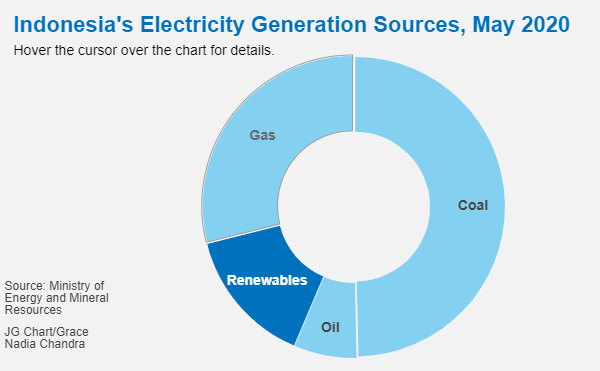
While solar power is now the cheapest it ever was — and the fastest growing renewable energy source worldwide — as of May last year, it amounted to less than 6 percent of Indonesia’s total power generation. The country still depends largely on coal and fossil fuel-fired plants, accounting to some 85 percent of national electricity sources.

On the other hand, the true potential of solar power remains untapped. The country has the potential to generate 207 gigawatts (GW) of solar power, but only around 0.09 GW or less than 0.1 percent has been utilized. The National Energy Policy (KEN) aims to increase solar power generation to 6.5 GW in 2025 and 45 GW in 2050.

One of the biggest solar power developers in the country, SUN Energy, has also announced plans to increase their Southeast Asian portfolio from 180 megawatts peak to 2 gigawatts peak, with its COO saying that "the wave of renewable energy is here to stay".

Issues to overcome
While the industry is promising, one reason there hasn’t been a mass adoption is that solar is still generally most accessible to upper-middle class citizens, said Notonegoro, who has over 20 years of research experience in renewable energy.

“In some ways, it should be cheaper to use solar,” he said. “But if we count 24 hours, in one full day, there are some issues, because solar energy is intermittent.”

This means that solar energy cannot be used to generate power for a full day, as panels may only capture 4 to 7 hour of daylight. After that, users have to either use batteries, buffers, or backups from other sources such as state electricity or a diesel-powered generator.

Notonegoro predicts residential projects may be most prominent in upscale neighborhoods such as Menteng, Pondok Indah, Bintaro or BSD in Greater Jakarta.

To push the industry, he views that PLN, the single buyer of Indonesia’s electricity market, needs to guarantee it would purchase power produced from renewable sources.

“All renewables whether they are solar, geothermal or others, must be 100% absorbed by PLN,” he said. “It will be pointless if they’re developed but no one buys them.”

There is also an issue of rooftop PVs requiring large surface areas of land, which is why they are easier to install in factories than houses. “It's especially true for minimalist houses which have not enough space and the power generated may not be big enough,” he added.

As of June, there are 3,913 users of rooftop PVs in Indonesia, according to government data. While households account for the largest user segment, around 82 percent of all users, the largest power generation goes to industries, with only 25 users utilizing 29.8 percent of the total capacity.

Government efforts to ease pricing
Back in 2018, the Ministry of Energy and Mineral Resources issued a regulation which allows PLN customers to pay 65 percent of their total tariff if they switch to rooftop PVs.

Next regulation anticipated to ease pricing is the proposed Presidential Regulation regarding tariffs for purchasing electricity sourced from new and renewable energy. The draft, published last year, outlines different tariff schemes that would simplify purchasing, for example ceiling prices, feed-in tariff and contract prices.

Director General of New Renewable Energy and Energy Conservation Anditya said he hopes the regulation will soon be approved.

“I have to be optimistic [that we can reach our targets],” he said. “All eyes are on us, to see whether on December 31, 2025, targets are achieved.”

He emphasized that the shift to new and renewable energy needs strong support from all stakeholders.

“When the Presidential Regulation is issued, the development of new and renewable sources cannot just rely on the Ministry of Energy and Mineral Resources. Many ministries will need to be involved, including the Ministries of Finance, State-Owned Enterprises, Agrarian Affairs, Maritime Affairs and so on,” he said. “They each will provide legal aspects to synergise the development of renewable energy.”

The urgency to shift to clean energy isn't just than a matter of fulfilling the 2025 target or the Paris Agreement, to which Indonesia is a signatory.

Today’s atmospheric carbon levels are the highest they have been in hundreds of thousands of years, leading to catastrophic rise in global temperatures.

Lowering carbon emissions cannot be done without reforms within the power sector, which is responsible for nearly two-thirds of emission growth globally.


Net zero targets 'unrealistic' says Oxfam report

By Beth Timmins
Business reporter, BBC News

Published
IMAGE SOURCE

Three millions trees are being planted in the Italian city of Milan by 2030, in order to fight climate change


Oxfam says governments and companies are "hiding behind unreliable, unproven and unrealistic carbon removal schemes" in order to hit targets.

Global attempts are being made to reach net zero carbon emissions by 2050.

But the charity claims net zero targets are often a "greenwashing exercise".

Net zero means any emissions that can't be stemmed by clean technology in 2050 will either be buried using carbon capture and storage, or soaked up by plants and soils.

Reaching net zero will also mean phasing out the internal combustion engine and dramatically increasing renewable energy technologies, such as wind and solar, while decreasing fossil fuel pollution.

Danny Sriskandarajah, chief executive of charity's UK branch, said companies and governments are using the "smokescreen" of net zero to continue "dirty, business-as-usual activities".

"A prime example of the doublethink we are seeing is the oil and gas sector trying to justify its ongoing extraction of fossil fuels by promising unrealistic carbon removal schemes that require ludicrous amounts of land," he told the BBC.

Nafkote Dabi, climate policy lead at Oxfam and co-author of the report, told the BBC that there is only 350 million hectares of land that can be used globally for afforestation and carbon removal without compromising food security.


Oxfam calculated that the total amount of land required for planned carbon removal could be five times the size of India, or the equivalent of all the farmland in the world


Researchers found the net-zero plans of Shell, BP, TotalEnergies and ENI could require a vast area of land

IMAGE SOURCEimage 

The charity analysed the net zero targets of four of the largest oil and gas producers: Shell, BP, Total Energies and ENI. The researchers found that their net zero plans alone could require an area of land twice the size of the UK.

"It's really worrying that only four companies could use so much of the remaining land available for the world," Ms Dabi explained.

"If all energy sectors follow the same plan, they would require 500 million hectares of land, which means worsening existing hunger issues in the global south."

In 2019, the Intergovernmental Panel on Climate Change (IPCC) found that if governments and companies that if governments and companies rely on reforestation only, by 2050, food prices could increase by 80% globally.

Ms Dabi added that emissions reduction is the "most urgent solution that needs to happen" and explained that relying on tree planting could lead to the displacement of communities which could in turn create more food shortages.

A recent analysis by the Transition Pathway Initiative, in partnership with the London School of Economics, found that none of the major oil companies' net zero targets currently align with a 1.5C future.

A spokesperson for BP commented: "We do not intend to rely on offsets to meet our own 2030 emissions reduction targets or aims." However, a spokesperson told the BBC that they "may help us to go beyond those aims if we can".

ENI responded that they did not "support these estimations" and said its progress toward carbon neutrality is audited independently.

Shell meanwhile said is was engaged with the investor group Climate Action 100+ and the Science Based Targets initiative as they develop new reporting, accounting and target-setting frameworks for the oil and gas industry.

Total Energies responded that it "prioritises lands concessions rather than lands purchase" and "will also develop other types of carbon removal techniques such as carbon sequestration in agricultural soils that avoids conflicts of uses".

A number of large oil and gas firms, such as Sinopec, ExxonMobil and Saudi Aramco, have not yet made a net zero pledge.

IMAGE SOURCE

In 2019, the UK government was the first among the G7 countries to make a net zero commitment by 2050 and currently more than 120 countries, including those in the EU, the US, China and Japan, have pledged to reach net zero by mid-century.

A swathe of corporate net zero climate commitments have also been made by a range of companies and investors, including British Airways, Unilever, Citigroup and BlackRock.

A government spokesperson from the Department for Business Energy and Industrial Strategy told the BBC: "We are absolutely committed to meeting our world-leading climate commitments, having already slashed emissions by 44% over the past three decades, and will publish our Net Zero Strategy later this year.

"While we are working hard to drive down demand for fossil fuels, there will continue to be ongoing demand for oil and gas over the coming years, as recognised by the independent Climate Change Committee," the spokesperson added.

To meet the Paris targets, the world collectively needs to be on course to have cut carbon emissions by almost half by 2030, with the sharpest cuts being made by the biggest emitters, according to the UN.

A recent report by the research group Oxford Net Zero by the research group Oxford Net Zero based at the University of Oxford and the Energy & Climate Intelligence Unit concluded that if entities with net zero targets set "robustness measures in place swiftly and those without come to the table equally quickly, net zero can be the window through which decarbonisation delivers the Paris Agreement".

On current plans, the UN estimates that we are on track to have reduced emissions by 1% compared to 2010 levels.


 Kansas is a national leader for renewable energy production


BY SARAH SPICER AUGUST 04, 2021


In 2020, Kansas created more electricity from renewable energy than any other state in the nation, except Iowa. This prevented 19.3 million metric tons of carbon emissions.

“Clean Power Annual proved Kansas’ renewable energy portfolio is growing, and this is only the beginning,” said George Stafford, of Boost Kansas, a local initiative of the American Clean Power Association. “The state’s geographic location, unique landscape, and statewide pro-renewable energy policies all help attract new businesses and increased renewable energy development.”

Renewable energy powers 43% of Kansas’ electricity and the state generated more energy from wind turbines than any other source, according to a recent report by the American Clean Power Association.

“Renewable energy is powering Kansas’ economy,” Stafford said. “This report does not simply highlight numbers, it highlights a growing economy and robust industry that is contributing to communities across the state.”

Across the U.S., there is enough wind and solar energy to power 50 million homes, which accounts for more than a third of the nation’s houses. In Kansas, renewable energy generates enough energy to power 2.8 million homes, which is more than the state currently has.

Renewable energy developments have created over 3,000 jobs and account for $12.7 billion in investment in the state. Kansas farmers nd ranchers were paid $32.3 million in land lease payments.


"World’s Most Powerful” Tidal Turbine Starts Pumping Green Electricity To Onshore Grid

“The world’s most powerful” tidal turbine has been hooked up to the onshore electricity grid in Orkney, a northerly archipelago in Scotland, and is ready to provide homes with clean, green electricity. 

The tidal turbine, known as the O2, was developed by Scottish engineering firm Orbital Marine Power. On July 28, they announced O2 “commenced grid connected power generation” at the European Marine Energy Centre (EMEC) in Orkney, meaning it's all set up and providing energy to the local power grid. 

The 74-meter-long (242-foot) turbine is said to be “the world’s most powerful” tidal turbine. It will lay in the waters off Orkney for the next 15 years with the capacity to meet the annual electricity demand of around 2,000 UK homes. The 2MW turbine is also set to power the EMEC’s land-based electrolyzer that will generate green hydrogen (hydrogen made without fossil fuels) that can also be used as a clean energy source.

Tide power.
Image courtesy of Orbital Marine Power

“Our vision is that this project is the trigger to the harnessing of tidal stream resources around the world to play a role in tackling climate change whilst creating a new, low-carbon industrial sector,” Orbital CEO, Andrew Scott, said in a press release.

Tidal energy is harnessed by converting energy from the natural rise and fall of ocean tides and currents. The O2 turbine consists of two submerged blades with a 20-meter (65-foot) diameter attached to a turbine that will move with the shifting currents of Orkney’s coast to generate electricity. Electricity is then transferred from the turbine along the seabed via cables towards the local onshore electricity network. 

Tidal turbine
Image courtesy of Orbital Marine Power

This method of harnessing energy is not just desirable because it doesn't release carbon emissions, but it’s more predictable than other renewable energy sources, such as solar or wind energy, which can be influenced by weather conditions. Tidal energy production is still in its infancy and there are relatively few large-scale tidal power plants in the world, but many argue that some parts of the world could potentially draw huge benefits from this innovative form of hydropower, especially coastal regions with strong currents such as the northern stretches of the UK. 

The largest tidal power operation in the world is the Sihwa Lake project on the west coast of South Korea, which harnesses enough power to support the domestic needs of a city with a population of 500,000 people. However, once fully operational, the MeyGen tidal power project in northern Scotland hopes to snatch its title. 

US Renewables Generated More Power Than Coal 
Or Nuclear In 2020 For First Time


By Jack Dunhill03 AUG 2021

Renewables produced more power than coal or nuclear power in the USA last year for the first time in history, according to a new report by the Energy Information Administration. With surges in wind, solar and hydroelectric power, the renewable industry produced 21 percent of all electricity generation in the US last year, a massive increase over the previous decade. 

Over the past year, the US has seen record growth in renewable power generation, adding 26 gigawatts of production capability in 2020 alone, 80 percent more than 2019. Combined with previous infrastructure, it brought the total renewable power production up to 170 gigawatts, which edged out both nuclear and coal by just a few percent (20 percent and 19 percent of total energy production, respectively).
The energy production statistics of 2020. Image Credit: EIA

This now moves renewables into the second-largest generator of electricity, though still trailing natural gas by a large margin of 19 percent. However, between renewables and nuclear, 41 percent of American electricity generation is now low-carbon or carbon-free.

While the trajectory is incredibly promising, the EIA still expects coal generation to rise as natural gas becomes more expensive. However, renewables are expected to continue to grow rapidly, with an estimated 10 percent more production in 2022.

[H/T: Common Dreams]

Supercritical launches carbon removal offset marketplace for tech firms to reach net zero

Image Credits: Supercritical co-founders - Michelle You (CEO), Aaron Randall (CTO)

It’s a little known fact that the carbon footprint of the technology sector is greater than the entire aviation industry (Aalto University and LUT University). At the same time, tech companies (like many others) are generally attracted to carbon offsetting schemes which don’t actually remove carbon from the environment and are often riddled with flaws.

Only carbon removal offsets contribute toward net zero because they actively take carbon out of the sky. And yet, so far there are very few schemes making carbon removal a focus, largely because only the biggest companies are able to play in this space, partly due to cost and the nascent nature of the technology.

This is where new startup Supercritical comes in.

The startup says its platform can help businesses get to net zero by measuring their climate impact and selling high-impact carbon removal offsets.

It has now raised £2 million / $2.7 million in pre-seed funding led by London’s LocalGlobe venture firm. The raise is also significant because the team was that which took Songkick to exit.

Supercritical says its platform assesses a company’s carbon impact, creates an actionable plan for reducing their emissions and recommends a portfolio of high-quality carbon removal offsets for companies to purchase. It will effectively be building a marketplace of carbon removal projects such as enhanced weathering, bio-oil sequestration and direct air capture.

Right now these technologies tend to be costly, as many are so early in development, but the opportunity is for Supercritical to become a market-maker for these emerging solutions, aggregating demand to help them scale and innovate faster.

The startup already has clients, including accuRx, Tide and what3words. Supercritical is also a member of the TechZero task force, a group of U.K. tech companies claiming to work toward NetZero Carbon impact.

Supercritical CEO and co-founder Michelle You said: “Businesses are rightly suspicious of traditional carbon offsetting options, which do nothing at best and at worst are outright fraud, but most companies lack the time and the expertise to find an adequate alternative. Our mission is to make it possible for any business to start the journey to net zero. Climate action can’t just be the reserve of the world’s biggest companies, and this is a crisis that can’t wait.”

Remus Brett, who led the investment from LocalGlobe, said: “Supercritical is providing a service that is as timely as it is essential. With COP26 approaching, the question of how businesses can meaningfully address their climate impact is a critical CEO issue. We are excited to be backing the exceptional team at Supercritical as they scale the only platform that helps companies focus their efforts on carbon removal rather than offsets.”

The startup is pushing at an open door. To keep warming below 1.5°C — one of the key goals of the 2015 Paris Agreement — at least 8 billion tonnes of carbon needs to be removed from the atmosphere every year, so the voluntary carbon offset market is set to be worth at least $100 billion by 2030, and that’s inside nine years.

Lawyers are trying to convince a judge to allow the Scottish government to investigate the Trump Organization under a 'McMafia' order, citing the New York criminal case

Jacob Shamsian and Thomas Colson
Aug 4, 2021, 
President Donald Trump at Trump Turnberry Luxury Collection Resort 
on July 15, 2018 in Turnberry, Scotland. Leon Neal/Getty Images

Lawmakers in Scotland are exploring whether to investigate the Trump Organization's finances.

Lawyers cited NYC prosecutors' investigation of the company and its CFO as a reason to move forward.

A judge is weighing whether lawmakers can use a "McMafia" order to open an investigation.


As prosecutors in Manhattan continue their investigation into the Trump Organization's finances, attorneys in Scotland are citing its progress to advocate for opening a parallel investigation into how the former US president's company financed golf courses in the country.

At a virtual court hearing in Scotland Thursday, the attorney Kay Springham asked a judge to allow the government to issue an "unexplained wealth order" (UWO), also known as a "McMafia order," The Scotsman reported. The order would force the Trump Organization to open up its books and explain how it financed the acquisition of its two Scottish resorts.

In trying to persuade the judge, Springham pointed to the criminal proceedings in New York, where the Manhattan District Attorney's Office has filed tax-fraud charges against the Trump Organization and its chief financial officer, Allen Weisselberg.

Weisselberg played roles in operating the company's two golf courses in Scotland. Insider first reported several days after the New York indictments were filed that Weisselberg was terminated from his role as director of Trump International Golf Club Scotland, the holding company that owns Trump's Aberdeenshire golf resort, the Trump International Golf Links.

Springham said the charges against Weisselberg illustrated why the Scottish government should be concerned about whether the Trump Organization concealed the sources of its wealth.

She suggested a UWO may extend to Weisselberg, as well as to former President Donald Trump
.
Trump Organization Chief Financial Officer Allen Weisselberg after his arraignment hearing in New York Supreme Court on July 1. Brendan McDermid/Reuters

"It's evident from the matters set out in the petition that there are real and substantial concerns about financial arrangements of the Trump Organization, of which Mr. Trump is the sole or principal owner," Springham said, according to The Scotsman.

She added: "Since the petition has been lodged, there have been further developments … the charges laid against the Trump Organization's chief financial officer [Allen] Weisselberg."

Representatives for the Trump Organization didn't immediately respond to Insider's request for comment.

In January, Patrick Harvie, the Green Party cofounder and a member of the Scottish Parliament, called for a UWO investigation into how the Trump Organization financed its all-cash purchase of the golf courses.

But Nicola Sturgeon, who leads the Scottish government, said the Scottish Parliament didn't have that power and only law officers — or independent prosecutors — could issue such an order.

Harvie and Avaaz, a nonprofit group, are challenging Sturgeon's claim. Avaaz hired Springham to convince a judge that Sturgeon was wrong about her interpretation of the law and that Scotland's elected ministers could invoke its powers.


The UWO is a relatively new legal instrument — the UK introduced it in 2018 as a way to help investigate money laundering and other financial crimes.
Trump on his golf course in South Ayrshire, Scotland, in 2018. 
Andrew Milligan/PA Images via Getty Images

Both of Trump's Scottish golf resorts have posted losses continuously since Trump has run them and owe millions of pounds to creditors. Harvie in February questioned how Trump was able to purchase both resorts between 2006 and 2014. Avaaz said Trump purchased both as part of a $400 million spending spree, which raised questions about how he had financed the deals.

In July, the Manhattan District Attorney's Office brought a 15-count indictment against Weisselberg and the Trump Organization, accusing the chief financial officer of dodging taxes on $1.7 million worth of income. Weisselberg and attorneys for the company pleaded not guilty to the charges.

Lord Sandison, who is ruling on Avaaz's appeal, said he would decide on the case shortly.

If the high court rules the Scottish government misinterpreted the law, Scottish lawmakers will have a chance to decide whether to initiate a UWO investigation into the Trump Organization.