Country-By-Country: Where EU Countries Stand On Trump’s Board Of Peace
By Eddy Wax and Magnus Lund Nielsen
(EurActiv) — Europe is largely opting to stay on the sidelines as Donald Trump convenes his new intergovernmental organisation, the Board of Peace, in Washington for the first time this week.
The inaugural session is expected to focus heavily on Gaza’s post-war governance and reconstruction. The initiative was first floated in September as Washington’s 20-point ceasefire plan for Gaza, but it has since been recast as a broader platform for international conflict resolution.
Across European capitals, the reaction has been cool, with countries opting for observer status and, in many cases, outright scepticism. Only Hungary and Bulgaria have signalled plans to fully join the scheme. Italy, Romania, and Cyprus will attend as observers. Some, including Denmark never received an invite.
The European Commission has likewise stopped short of membership, choosing instead to dispatch Commissioner for Mediterranean Dubravka Šuica, a relatively junior figure within the Berlaymont hierarchy.
Positions of EU countries
Austria: Unlikely to join. Austrian Chancellor Christian Stocker said his country had no plans to become a member. “There is already an organisation created for such cases, the UN … and I am not in favour of parallel structures”.
Belgium: Not joining, and not invited. Foreign Minister Maxime Prévot was forced to deny claims from the White House that Belgium had signed up last month. National broadcaster RTBFreported that the Americans had confused Belgium with Belarus. Belgium wants the EU to reach a common position on this, Prévot said.
Bulgaria: Looking to join. Caretaker Prime Minister Rossen Jeliazkov sat next to Trump when the initiative was officially launched last month in Switzerland, but the decision is still pendingratification in parliament.
Croatia: Not joining. Both Prime Minister Andrej Plenković and President Zoran Milanović – normally political rivals – appeared aligned on rejecting the invitation.
Cyprus: Observer status. Both Athens and Nicosia said they have open channels with Israel and the Palestinian Authority.
Czechia: Unlikely to join. Prime Minister Andrej Babiš said Prague wants to coordinate with other EU countries.
Denmark: Not invited. As relations with the US are at a low point after Trump put heavy pressure on Copenhagen and Nuuk to give up Greenland, a semi-autonomous Danish territory, Denmark was the only Scandinavian country not to receive an invitation.
Estonia: Not invited.
Finland: Not joining. President Alexander Stubb said the board “is a good initiative”, but addedthat Finland wouldn’t join in the current form. “We have a common European policy, and we’ll stick to that,” he told Finnish media Yle last month.
France: Not joining. France was among the first countries to indicate it would not join, criticising the board’s potential overlap with the UN, incompatibility with its international commitments, and a focus beyond Gaza.
Germany: Unlikely to join. So far, the German government has responded cautiously to the board. While it broadly supports efforts to achieve peace in Gaza, Foreign Minister Johann Wadephul has repeatedly pointed out that the UN already exists as an established international body to solve conflicts.
Greece: Observer status. Greece initially opposed the board, insisting it be limited to Gaza, fearing UN sidelining and potential challenges to its maritime dispute stance with Turkey. Still, the Greek government said that the board must adhere to UN Security Council resolutions.
Hungary: Joining. A close ally of Donald Trump, Prime Minister Viktor Orbán said his country would join the initiative as one of the founding members, “because Hungary needs peace in order to continue to grow and develop”.
Ireland: Not joining. Irish Deputy Prime Minister Simon Harris said last month the initiative raises “very serious red flags.” “Anything that Putin is considering joining with the word peace in it doesn’t sit well,” he said, according to local broadcaster RTE.
Italy: Observer status. Foreign Minister António Tajani said it was “appropriate” for Rome to participate as an observer at the first meeting on Thursday, as Cyprus had made a similar decision, currently holding the Council’s rotating presidency. “We are Europeans and, following this decision, we deemed it appropriate to send a delegation as observers.”
Latvia: Not invited.
Lithuania: Not invited and wouldn’t join.
Luxembourg: Not invited, and wouldn’t join. Prime Minister Luc Frieden said his country would probably not take part, even if it had been invited. He complimented the initiative to create peace in Gaza, but said he preferred existing multilateral organisations, like the UN, to deal with the matter, according to local media Paperjam.
Malta: Undecided. Prime Minister Robert Abela said that his country wasn’t officially invited to join, but the government has received an “informal” invitation. Abela has also criticised the board’s format.
Netherlands: Invited, unclear if it will join. Outgoing Dutch Prime Minister Dick Schoof confirmed last month that his country had received an invitation to join the initiative, but said that any final decision had still not been made. The incoming government, led by Rob Jetten, has yet to make any announcement on the issue.
Poland: Not joining. While the Polish President Karol Nawrocki, an ally of the conservative opposition party Law and Justice and Trump himself, has signalled support for the initiative, the decision ultimately lies with the government. Prime Minister Donald Tusk has said that Poland will not join “under the current circumstances”.
Portugal: Will only join if the focus remains on Gaza. The government has yet to accept the invitation, Foreign Minister Paulo Rangel said last month, but his country would be open to joining the initiative “if it is confined to Gaza,” according to local media Publico.
Romania: Observer status. President Nicușor Dan announced on Monday that he will attend the Washington meeting as an observer.
Slovakia: Declined. Prime Minister Robert Fico’s government will not accept the invitation to join. One reason the government cited is that it couldn’t afford the $1 billion fee to secure permanent membership.
Slovenia: Declined. Prime Minister Robert Golob declined to participate, saying in late January that it “seriously encroaches on the broader international order” and that its mandate, going beyond Gaza, was too wide.
Spain: Declined. Prime Minister Pedro Sánchez said last month that he rejected the offer, although his country “appreciates the invitation”. He framed the move as a way of staying consistent with Spain’s “commitment to the multilateral order, the UN system and international law.”
Sweden: Not joining. Swedish Prime Minister Ulf Kristersson said he will coordinate with other EU countries, but that his country will not join the initiative as “as the text currently stands,” according to Swedish media Aftonbladet.
And Brussels?
The European Commission confirmed that Mediterranean Commissioner Dubravka Šuica will travel to Washington for the Gaza talks. “We are not becoming a member,” chief spokesperson Paula Pinho said on Monday. “Šuica will be there in her capacity as commissioner responsible for the Mediterranean, representing our commitment to the implementation of peace in Gaza.”
Pressed on whether the EU would attend as an “observer,” the Commission declined to adopt the term.
Senior EU officials have voiced reservations about the initiative. “We have serious doubts about a number of elements in the charter of the board related to its scope, its governance and its compatibility with the UN Charter,” European Council President António Costa said after the informal gathering of EU leaders last month.
The’s diplomatic service has raised similar concerns. “The charter … raises a concern under the EU’s constitutional principles,” according to a European External Action Service document seen by Euractiv and drafted last month.
- Ines Fernández-Pontes, Natália Silenská, Sarantis Michalopoulos, Nicoletta Ionta, and Björn Stritzel contributed reporting.
France leads backlash against Commissioner Šuica's Board of Peace trip
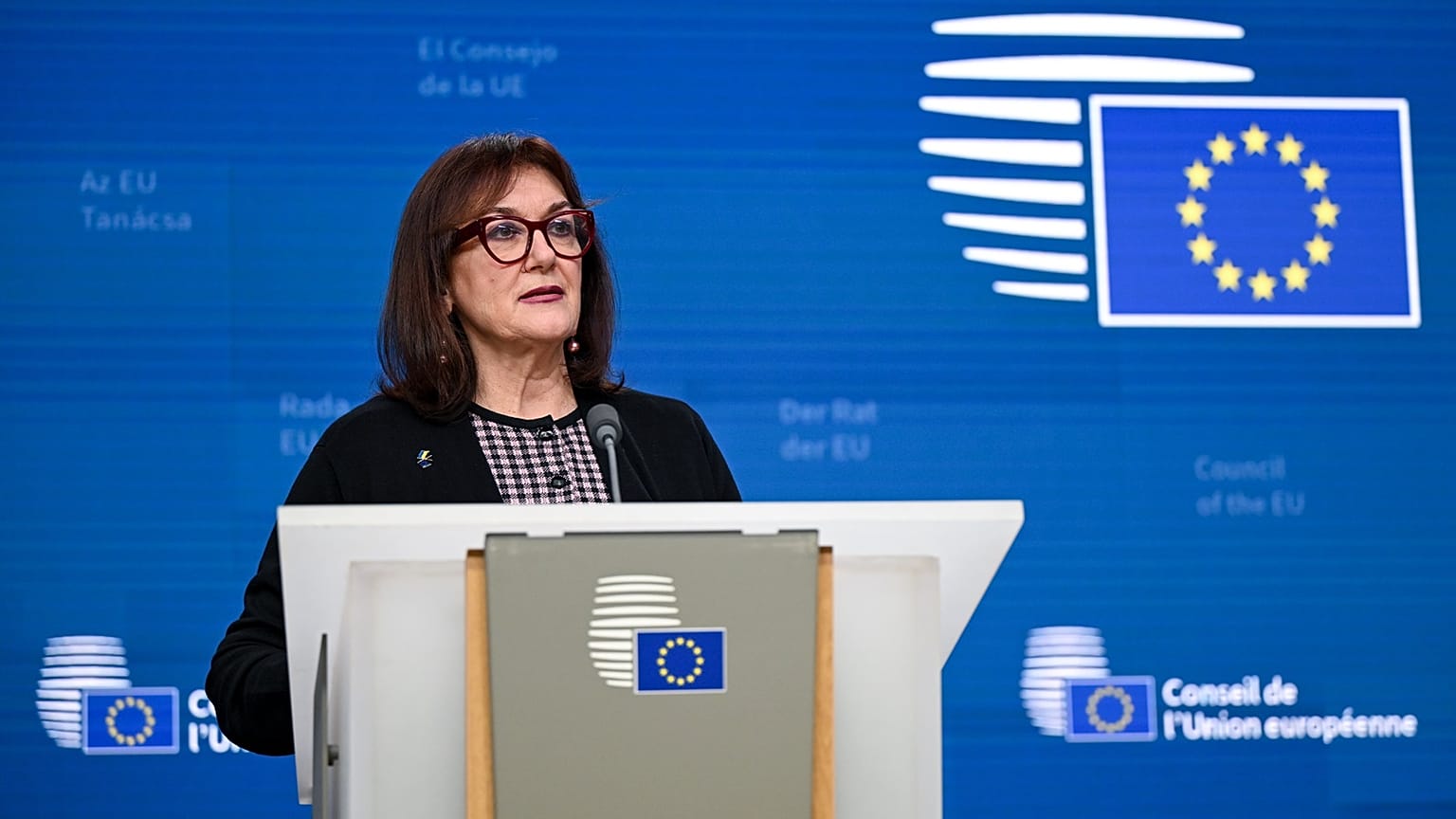
European Commissioner Dubravka Šuica is under fire for attending the first formal gathering of Donald Trump's Board of Peace, whose expansive mandate has raised serious concerns among member states.
The European Commission's surprise decision to dispatch Commissioner for the Mediterranean Dubravka Šuica to the first formal gathering of the Board of Peace in Washington has sparked outrage among several member states, with France leading the charge in voicing both institutional and political objections.
During a meeting of EU ambassadors on Wednesday, critics argued that Šuica's participation, which was not communicated to capitals beforehand, lacks the necessary mandate and risks being interpreted as a collective endorsement of the contentious initiative, several diplomats told Euronews, speaking on condition of anonymity.
"Member states were up in arms" in the meeting, a diplomat said.
Šuica's trip is taking place despite persistent concerns over the Board of Peace inaugurated by US President Donald Trump in January. Initially conceived to guide Gaza's post-war recovery, the board has since vastly expanded its mandate and is now designed as a shadow structure to the United Nations, with Trump as lifelong chairman.
France, Belgium, Spain, Ireland, Slovenia and Portugal were among those who raised strong objections on Wednesday.
Germany also voiced reservations, though more measured.
According to diplomats, France set the tone by arguing that Šuica's attendance was in breach of the EU treaties because the Commission is not entitled to set foreign policy, which is conducted based on unanimous positions agreed by member states.
Critics pointed out that Šuica, as Commissioner for the Mediterranean, is a political representative and therefore her presence in Washington carries substantial weight. The fact that the EU, as an organisation, is not a member of the Board of Peace was also mentioned to discourage Šuica from travelling.
In a statement, a Commission spokesperson defended the decision as a way to remain "closely engaged on all aspects relating to the peace process and the reconstruction in Gaza". The spokesperson insisted the Commission would not join the board.
The backlash was intense but not equally shared inside the room, exposing the stark divisions caused by Trump's bold attempt to challenge the multilateral system.
Hungary and Bulgaria are the only two member states that have expressed their intention to sit on the board permanently. But seven other capitals have signalled their intention to participate as observers in recent days.
Among those attending the formal gathering on Thursday are Hungarian Prime Minister Viktor Orbán, Romanian President Nicușor Dan, as well as senior diplomats from Bulgaria, Cyprus, the Czech Republic, Italy, Greece, Poland and Slovakia.
The Commission has repeatedly raised questions about the board's "scope, governance and compatibility with the UN Charter," of which all 27 member states are signatories, and asked the United States to amend the wording, to no avail.
Still, as the biggest donor of humanitarian aid to the Palestinian people, with a total contribution of €1.65 billion to the territories since the outbreak of the war between Israel and Hamas on 7 October 2023, Brussels does not want to be sidelined in the process.
The debate will continue next week when foreign affairs ministers gather in Brussels. Ministers will be joined by Bulgarian diplomat Nickolay Mladenov, appointed by Trump as High Representative for Gaza and tasked with linking up the Board of Peace with a technocratic Palestinian committee responsible for running its day-to-day business.

No comments:
Post a Comment