Saturday, November 06, 2021

Pennsylvania Gov. Tom Wolf said employers need to 'stop asking why there is a labor shortage' and 'start asking how we can make jobs better'

  • Pennsylvania Gov. Tom Wolf said workers demanding better pay and benefits are "not really asking a lot."

  • Wolf recently signed an executive order aimed at improving labor conditions in the state.

  • Workers need better protections to entice them back to work after the pandemic, he said.

Pennsylvania Gov. Tom Wolf has said that businesses need to "stop asking why there is a labor shortage" and "start asking how we can make jobs better."

Wolf told elected officials and labor leaders in Allentown on Thursday that workers were looking for jobs with better working conditions, pay, and benefits, per The Morning Call - and "that's not really asking a lot."

The US is suffering from a huge labor shortage because of mismatches between what workers want and what employers are offering.

Some business owners and lawmakers have blamed the labor shortage on workers, saying that "no one wants to work anymore." Some have attributed it to the supplemental employment benefits introduced during the pandemic, but businesses say they're still having problems finding staff two months after the benefits were cut off.

"There are so many job openings that people are choosing the best option for their family," Wolf said Thursday. "It's time we stop asking why there is a labor shortage and start asking how we can make jobs better."

Under an executive order Wolf signed on October 21, the state's labor department will post on its website a list of bad actors that violate labor laws, misclassify their workers, or fail to carry requisite workers' compensation insurance.

The order also included other clauses related to paid sick leave and compliance with safety standards. Wolf is also seeking to raise the state's minimum wage.

"It's time for us to bring worker protections and supports into the 21st century in the United States, and certainly here in Pennsylvania," Wolf said Thursday, per The Morning Call. "And that's how we support workers, that's how we entice them back to work after this pandemic."

Employment in Pennsylvania was 5.89 million in September, per preliminary data from the Bureau of Labor Statistics, down from 6.53 million in February 2020. The state's labor participation rate - the percentage of adults working or actively seeking employment - fell from 60.3% to 57.3% over the same time period.

Businesses across Pennsylvania say they're struggling to hire. Joseph Devor, who owns Joey's Chicken Shack near Harrisburg, previously told Insider that he'd had to rely on family members after his workforce fell to just four. Devor raised wages, cut the restaurant's opening hours, and hiked up menu prices as a result.

People have used the pandemic to evaluate what they want from work, and many have changed industries, opted for roles with more flexible schedules or with fewer hours. Others have returned to education, or taken early retirement.

Workers now have more power in the job market and, as a result, companies have been hiking up wages and offering improved benefits to attract them.

"The American working class is demanding fair pay, paid time off and safe working conditions," Jennifer Berrier, Secretary of the Pennsylvania Department of Labor and Industry said Thursday.

"If we want a robust economy driven by the American worker, we must earn back their confidence and offer more than a meager paycheck," she added. "And that's why this isn't really a labor shortage at all - what we're actually seeing is a shortage of jobs that afford workers a future out of poverty."

Expanded Coverage Module: what-is-the-labor-shortage-and-how-long-will-it-last


VW CEO Makes EV Pledge as Labor Leaders Criticize Pace of Transition

CEO Herbert Diess and labor leaders also clash over chip crisis


Herbert Diess said Volkswagen would build a future electric vehicle at its flagship German plant as he sought to head off an escalating conflict with VW’s powerful labor leaders.


A former Rivian executive sues the automaker for gender discrimination

Igor Bonifacic
·Contributing Writer
Thu, November 4, 2021


Electric transport startup Rivian has been sued by one of its former employees. Per The Wall Street Journal, Laura Schwab, an executive who was a vice president of sales and marketing at the automaker until last month, filed a gender discrimination complaint with the California Superior Court in Orange County on Thursday. In the lawsuit, Schwab alleges she was fired by Rivian after she complained of a “toxic ‘bro culture’” that saw other executives exclude her from meetings and ignore her advice.

“The culture at Rivian was actually the worst I’ve experienced in over 20 years in the automotive industry,” Schwab told The Journal. A veteran of the automotive industry, Schwab held executive posts at Aston Martin Lagonda and Jaguar Land Rover before she joined Rivian in November 2020.


According to the outlet, Schwab tried to push the company to address numerous concerns while she was there. In one instance, she allegedly tried to tell the other executives on Rivian’s leadership team that the company had underpriced its vehicles. In yet another situation, she tried to raise concerns about the quality of the automaker’s manufacturing process. In the former case, the company allegedly initially dismissed her advice only to later follow through on it after a male executive raised the same issue.

The suit comes ahead of Rivian’s planned IPO next week where the company will seek to raise as much as $9.6 billion in additional investment. It also recently started producing R1T trucks for customers. More broadly, the suit comes as several other companies in the tech space face scrutiny over their gender equality practices. Most notably, there’s Activision Blizzard, which was sued by California’s fair employment regulator in July for fostering what it described as a sexist “frat boy” workplace culture. The fallout from that lawsuit has been far-reaching. Following months of pressure from employees, the company ended its policy of forced arbitration in cases involving sexual harassment and discrimination and put in place a zero-tolerance stance toward harassment.

Citing the quiet period ahead of its IPO, Rivian declined to comment on the complaint.

Rivian hit with gender discrimination lawsuit that alleges toxic 'bro culture'

Kirsten Korosec
TECHCRUNCH
Thu, November 4, 2021


Rivian, the electric automaker that recently filed for an IPO, has been sued by a former sales and marketing vice president for alleged gender discrimination.

The lawsuit alleges that Laura Schwab, a former sales and marketing executive who had a long employment history with Jaguar Land Rover and Aston Martin before joining Rivian in November 2020, was fired after reporting gender discrimination to the company's human resources department. The lawsuit was filed Thursday in California Superior Court in Orange County.

A Rivian spokeswoman told TechCrunch that due to a quiet period ahead of its public offering, the company can't offer comment.

Schwab also filed a statement of claim with the American Arbitration Association and laid out her allegations in a blog post published on Medium. The AAA statement, viewed by TechCrunch, describes a "toxic bro culture" at the company's highest levels. The lawsuit alleges that Schwab was regularly ignored by her superior when trying to point out problems. She was regularly excluded from meetings attended by her male peers and decisions regarding her team were made without her input, the statement says. The AAA statement also says that her concerns regarding "Rivian's misleading public statements and flawed business practices," were dismissed.

When she spoke up to human resources about "the boys' club culture and gender discrimination she was experiencing from a C-level executive, Rivian abruptly fired her," the statement reads.


In one excerpt on the blog, Schwab wrote:

Rivian publicly boasts about its culture, so it was a crushing blow when I joined the company and almost immediately experienced a toxic bro culture that marginalizes women and contributes to the company making mistakes. I raised concerns to HR about the gender discrimination from my manager, the "boys club" culture, and the impact it was having on me, my team, and the company. Two days later, my boss fired me.

The complaint comes as Amazon-backed Rivian prepares to become a publicly traded company in one of the most anticipated debuts of the year. A recent regulatory filing showed Rivian hoped to raise up $8.4 billion in its initial public offering. The company plans to offer 135 million shares at a price between $57 and $62. Underwriters also have an option to buy up to 20.25 million additional shares. If underwriters exercise that option, Rivian would raise as much as $9.6 billion.

Based on the number of outstanding shares, that would put its market valuation at about $53 billion. If employee stock options and other restricted shares are considered, Rivian's valuation could be as high as $60 billion. Rivian filed October 1 to become a publicly traded company in the United States.
1,200 year old canoe discovered at Lake Mendota in Wisconsin

By Noah Sheidlower and Justin Lear, CNN 

On a brisk Tuesday at Lake Mendota in Madison, Wisconsin, maritime archaeologists, scuba divers, and residents of the Spring Harbor neighborhood stood in the cold as a canoe was brought to shore. But this was not just any racing or touring canoe -- it dates back more than 1,200 years.

© Ebony Cox/Milwaukee Journal Sentinel/USA TODAY NETWORK The Dane County Sheriff's dive team and the Wisconsin Historical Society team recover the 1,200 year old canoe from the bottom of Lake Mendota at Spring Harbor Beach in Madison, Wis
.
© John Hart/State Journal The canoe will undergo preservation efforts over the next two years before it can be displayed in a museum.

After days of planning the best way to raise the dugout canoe, teams of divers rejoiced as the canoe was laid down on the shore safely. According to Jim Skibo, Wisconsin's state archaeologist, the "remarkable" discovery was "something I've never found in my career."

© Ebony Cox/Milwaukee Journal Sentinel/USA TODAY NETWORK Wisconsin Historical Society maritime archaeologist Tamara Thomsen, middle, and State Archaeologist Jim Skibo, right, share a moment after the recovery of a 1,200-year-old canoe from the bottom of Lake Mendota Tuesday.

"Archaeologists are used to digging up things like broken pieces of stone tools, or pottery or metal artifacts, things that are not organic, so to find something that was organic... it's important to find something like that occasionally."


Tamara Thomsen, a maritime archaeologist with the Wisconsin Historical Society and owner of Diversions Scuba, first came across what she thought was a log sticking out of the bottom of the lake while riding an underwater scooter in June alongside co-worker Mallory Dragt. After investigating the find, Thomsen determined the log was actually a dugout canoe.

Carbon-14 dating on the canoe determined it was 1,200 years old, making it one of the oldest intact vessels ever found in Wisconsin, according to Skibo.

"I looked at it and it was in such a wonderful state of preservation that I was very suspicious that it was old because wood typically doesn't survive that long," Skibo told CNN.

According to Skibo, archaeologists occasionally find organic fragments of larger items that have been charred or preserved in a special microenvironment, but he noted all organic material breaks down quickly once underground. The canoe survived, he postulates, because it was kept in a constantly wet environment away from light in relatively deeper water. It was discovered on a slope under about 27 feet of water, according to CNN affiliate Madison.com -- he believes it is the deepest any dugout has been recovered.

Skibo said the canoe had net sinkers, which were simple stones that were notched and put on the end of nets for fishing, which further verified to him the canoe was quite old. Because he believed it could have been the oldest intact water vessel in Wisconsin, he knew it had to be taken out quickly because it was uncovered and would have decomposed rapidly.

Over six weeks, Thomsen, Skibo and a few others from the museum collaborated with the Dane County Sheriff's Office on the recovery and excavation. Last week, the Sheriff's Office Dive Team dredged around the canoe and fully exposed the boat, after which rods of rebar were stuck into the bottom of the lake to keep it in place, as reported by Madison.com. Small boats journeyed to the site, and four 45-pound bags of sand were placed in the canoe to give it weight as it was towed into shored at just 1.1 miles per hour.

© John Hart/State Journal A dugout canoe crafted in A.D. 800 was towed for most of its 1-mile trip to shore but guided by divers in shallow water for the final 100 yards or so to Spring Harbor Beach.

The canoe was transferred to a padded aluminum plank, then safely carried to a trailer. The excavation brought onlookers who watched from ashore for over four hours, including Satya Rhodes-Conway, the city's mayor.

Beyond being an uncommon find in the Midwest, the canoe "is a great way to tell multiple stories and to educate people about the people who came here and lived here before, as well as their craftsmanship," Skibo said. Carbon dating revealed that the canoe was likely constructed during the Effigy Mound Period, named after mounds shaped like animals that surrounded Lake Mendota.

© Wisconsin Historical Society The canoe was safely transported to a storage facility, where it was quickly placed in water so it would not dry out.

"Consider cutting down a tree that's two-and-a-half feet wide with a stone tool, and then hollowing it out and making it float. It must have taken hundreds of hours and a great deal of skill," Skibo said.

"You get a new appreciation for people that lived in a time when there were no modern-day tools to do this thing where they could do it quicker."

Those who built the dugout canoes in present-day Dane County were ancestors of the Ho-Chunk Nation, who primarily live in Wisconsin. They are often referred to as the "People of the Big Water."

For the next two years, the canoe will undergo preservation treatments, the first of which will preserve the canoe's liquid environment in a tank at the State Archive Preservation Facility that will kill algae or microorganisms. After that, water that saturated the wood will be replaced with a treatment of polyethylene glycol, to prevent further degradation, according to Skibo.

It will then be displayed in the Wisconsin Historical Society's proposed expanded museum in downtown Madison.

"I'm an archaeologist who tells stories from artifacts, and this is a great one," Skibo said. "It's about transportation. It's about subsistence and fishing. It's about all kinds of things about the time period, and I'm sure it'll be an important display piece and museum."
A FIRST
Alberta judge convicts man of assault for coughing on server in Calgary bar

CALGARY — A man who removed his mask and deliberately coughed on a server at a Calgary bar last year has been convicted of assault

.
© Provided by The Canadian Press

In a decision released last week, provincial court Judge Heather Lamoureux wrote that “emitting a force consisting of lung-air molecules” can qualify as use of force under the Criminal Code.

"The cough was not a reflexive action, but rather an intentional physical act," Lamoureux wrote.


The man, identified in the decision as 35-year-old Kyle Pruden, was also found guilty of assaulting a bar patron.

Court records show he received a conditional discharge and two years of probation for both assaults.

The altercations happened in November 2020 at the Black Swan Pub in Calgary.

The court decision says Pruden was in the pub playing on a video lottery terminal when he went to the bar to cash out about $160 winnings, the court document says.

Cayla Cossette, the employee, told Pruden that she was unable to pay out the winnings because the bar owner hadn’t replenished the cash float.

The judge’s ruling says Cossette testified that Pruden then took off his mask, started coughing at her and uttered: “Is this because of COVID?”

She testified that she was behind the bar when Pruden coughed on her, so he was less than two metres away.

A 60-year-old frequent patron of the bar gave Pruden $60 and he left the pub.

The court document says Pruden went to Boston Pizza to have beer and pizza before returning to the pub to recover the rest of his winnings.

At that point, it says, Pruden thought the bar patron was an employee and demanded the rest of his money.

The bar patron told him he had no more money to pay him and Pruden hit the man, bruising him.

In her decision, Lamoureux noted that there have been three other cases where people were convicted after coughing on others during the COVID-19 pandemic.

“It is important to note that the court in each of these cases was not presented with any arguments on the issue of force or intention,” she wrote. “In each instance, guilty pleas were accepted by the court.”

She also wrote that neither the Crown nor defence were able to find any reported trial decisions on whether such an act qualified as a crime.

Lamoureux relied on scientific consensus from the World Health Organization that COVID-19 is spread through respiratory droplets, which a person carrying the virus would expel when coughing.

“Air pressure is a force at the molecular level in the same manner as physical force visible to the naked eye. This is basic science, uncontroverted, and not requiring any expert opinion,” her decision says.

"Accordingly, when Mr. Pruden engaged in an intentional act of coughing, he was emitting a force consisting of lung air molecules into the atmosphere.

“This is an act of force within the definition of force in … the Criminal Code of Canada.”


— By Daniela Germano in Edmonton

This report by The Canadian Press was first published Nov. 4, 2021.

The Canadian Press
COVID-19 denier and conspiracy theorist Mak Parhar dead at 48

SOON TO BE A CONSPIRACY THEORY HIMSELF

CBC/Radio-Canada 
© YouTube Mak Parhar died in his home Thursday night of unknown causes. The B.C. Coroners Service is investigating.

Prominent COVID-19 denier Mak Parhar, who gained profile in both the Flat Earth conspiracy community and anti-mask movement, died at his home in New Westminster Thursday.

The 48-year-old's cause of death is not known. A spokesman for the B.C. Coroner Service said a coroner's investigation, which could take months, will be conducted.

Parhar has been in the news the past two years for spreading COVID-19 falsehoods, operating his yoga studio in contravention of public health orders and for being arrested and charged for disobeying quarantine laws.

In a rambling video from Nov. 3, Parhar said he had recently taken ivermectin, a drug that is falsely touted by anti-vaxxers as an off-label treatment for COVID-19, even though he didn't believe COVID-19 was real.

"... That horse parasite remover? So I did take that and I feel like 40 to 50 per cent better. But I am a little bit down right now," he said in the video.

Ivermectin is most commonly used as a livestock dewormer and has been proven effective in treating parasites, not viruses. Health authorities in the U.S. and Canada have issued warnings about taking it for COVID-19.

An earlier video Parhar shot in late October shows him coughing and complaining about being sick, but denying he has what he calls "CONVID."

"I'm jacked up on extra strength Advil and Tylenol for the last two days, that's the only way I can function. If I'm not on Advil or Tylenol, I'm lying in bed," he said.

Parhar's notoriety as a conspiracy theorist grew when he repeatedly violated Canada's Quarantine Act after returning to B.C. from a U.S. flat earth conference in the fall of 2020 — something he bragged about to a crowd rallying in front of the Vancouver Art Gallery.

He was arrested in November 2020, and was scheduled to appear in court last week but the dates were postponed. The Public Prosecution Service of Canada said Parhar informed the Crown he was too sick to start the trial.

In April 2021, Parhar had his lawsuit accusing the B.C. government of kidnapping and terrorism for arresting him, thrown out of court for being "patently absurd and nonsensical."

The City of Delta suspended the business licence of Parhar's yoga studio in March 2020 after he made false claims that hot yoga kills coronavirus, while encouraging students to show up for class despite public health orders at the time restricting gatherings.
Exclusive-UK gears up to produce rare earth magnets, cut reliance on China


FILE PHOTO: General view of the Walney Extension offshore wind farm operated by Orsted off the coast of Blackpool


Eric Onstad
Thu, November 4, 2021

LONDON (Reuters) - Britain could revive domestic production of super strong magnets used in electric vehicles and wind turbines with government support, to cut its reliance on China and achieve vital cuts in carbon emissions, two sources with direct knowledge said.

A government-funded feasibility study is due to be published on Friday, laying out the steps Britain must take to restart output of rare earth permanent magnets, the sources said.

A magnet factory would help Britain, hosting the COP26 U.N. climate talks in Glasgow, Scotland, meet its goal of banning petrol and diesel cars by 2030 and slashing carbon emissions to net zero by 2050.

British production of the magnets vanished in the 1990s when industry found it could not compete with China, but with the huge growth in demand the government is keen to secure enough supply.

Last month, the government set out plans to achieve its net zero strategy, which includes spending 850 million pounds ($1.15 billion) to support the roll out of electric vehicles (EVs) and their supply chains.

The study outlines how a plant could be built by 2024 and eventually produce enough of the powerful magnets to supply 1 million EVs a year, the sources who have read the report said.

"We're looking to turn the tide of shipping all this kind of manufacturing to the Far East and resurrect UK manufacturing excellence," one of the sources said.

The government's Department for Business declined to comment on details regarding a possible magnet factory because the report has not been released.

"The government continues to work with investors through our Automotive Transformation Fund (ATF) to progress plans to build a globally competitive electric vehicle supply chain in the UK," a spokesperson said in an email.

EV RAMP UP

British rare earths company Less Common Metals put together the feasibility study and is considering seeking partners to jointly build the factory, the sources said.

LCM is one of the only companies outside of China that transforms rare earth raw materials into the special compounds needed to produce permanent magnets.

Automakers will need the magnets as they ramp up EV output in Britain - Ford said last month it would invest up to 230 million pounds in an English plant to produce around 250,000 EV power units a year from mid-2024.

Rare earth magnets made of neodymium are used in 90% of EV motors because they are widely seen as the most efficient way to power them.

Electric cars with these magnets require less battery power than those with ordinary magnets, so vehicles can travel longer distances before recharging.

A race by automakers to ramp up EVs and countries to switch to wind energy is due to boost demand for permanent magnets in Europe as much as tenfold by 2050, according to the European Union.

The sources said government support would be vital so Britain could compete with China, which produces 90 percent of supply.

The strategy mirrors similar efforts by the EU and the United States to create domestic industries of raw materials, rare earth processing and permanent magnets.

($1 = 0.7404 pounds)

(Reporting by Eric Onstad; Editing by Veronica Brown and Elaine Hardcastle)
As Spain pledges more La Palma aid, some islanders ask: where's the cash?


The Cumbre Vieja volcano spews lava and smoke while it continues to erupt, 
as seen from El Paso

Marco Trujillo
Fri, November 5, 2021

LA PALMA, Spain (Reuters) - Spain will provide whatever is necessary for La Palma to recover from the destruction wrought by weeks of volcanic eruptions, its prime minster said on Thursday, as some residents said financial aid had been slow to arrive.

Visiting on Thursday, Pedro Sanchez said financial assistance for housing would be tax-exempt and that taxes on air travel to and from the island, part of the Canaries archipelo off northwest Africa, would be subsidised for a year.

"We are not going to spare any resource, energy or personnel to tackle the reconstruction tasks," he said. "The Spanish government is providing all possible resources to ensure the wellbeing, serenity and safety of La Palma residents."

Lava has destroyed more than 2,000 properties on the island since the Cumbre Vieja volcano began erupting in mid-September and thousands more have fled their homes as a precaution, prompting the government last month to pledge 225 million euros ($260 million) in aid.

Some 21 million euros of that has been disbursed and Sanchez said his administration would this week transfer a further 18.8 million euros for the agriculture and fishing industries and 5 million euros to tackle the "social aspect" of the crisis.

But in Los Llanos de Aridane, the closest town to the lava flow, some expressed frustration that they had yet to receive any of the promised cash.

"I want to believe (the aid is coming) but time is passing by and we see nothing," said Oscar San Luis outside the local notary's office, where he was waiting to file paperwork to apply for compensation.

"I remain hopeful. If you don't have hope what are you doing with your life?" said the 57-year old, who lost several holiday properties and his avocado plantation to the eruption.

The Canarian regional government said it had hired 30 people to verify claims lodged in a register for compensation.

Speaking shortly after Sanchez's address, Carlos Cordero Gonzalez, who runs a clothes shop in Los Llanos, said it was time for action as well as words.

"Now (the Prime Minister) just needs to say that the money is going to be sent directly to businesses and residents... I hope next week we have the funds in our accounts."

($1 = 0.8678 euros)

(Writing by Nathan Allen; editing by John Stonestreet)

The Lunar Society

by Ben Johnson

The 18th century was a time of change and revolution across the world. Intellectuals and ordinary men alike would gather to discuss anything and everything, from the social order problems of the day, to the latest scientific advances, and the intertwining political and philosophical issues. Clubs were formed in order to allow members the pleasure of enjoying the finest food and wine whilst debating these issues with other like-minded individuals.

The Lunar Society, or Lunar Circle as it was first called, was one such club. It met in and around Birmingham, England between 1765 and 1813. It was the members of this club however, that would set it apart from any other. They cheerfully referred to themselves as the ‘lunatics’, but this could not have been much further from the truth, as the revolutionaries involved would change the face of the world forever.

The Lunar Society was very particular about who was allowed to become a member. An exclusive club, it never had more than fourteen core members, and each member was noted for their special area of expertise including the greatest engineers, scientists and thinkers of the day. Their preferred venue was Soho House in Handsworth, the home of Mathew Boulton who was the heart of the Lunar Society. The society gained its name as its monthly meetings were always scheduled for the Monday nearest to the full moon, the better light helping to ensure the members a safer journey home along the dangerous, unlit streets.

The ranks of the dozen or so regular members of the Lunar Society were often swelled by visits and correspondents from more peripheral members including the likes of Thomas Jefferson, Benjamin Franklin, Sir Richard Arkwright, Thomas Bedoes, Anna Seward, John Smeaton, etc.

The historian Jacob Bronowski wrote of the Lunar Society,

“What ran through it was a simple faith: the good life is more than material decency, but the good life must be based on material decency. ”

But who were these men that would meet every month to discuss how science and technology could be made to serve society for the good of all? The pioneers that together would bring about the ultimate fusion of science and social change that would fuel the fires and ignite the Industrial Revolution:

Mathew Boulton (1728 – 1809), (pictured at the top of the article) of Boulton and Watt. The leading industrialist of his day, he developed modern-day industrial practice and introduced the first workers’ insurance schemes and sick pay.

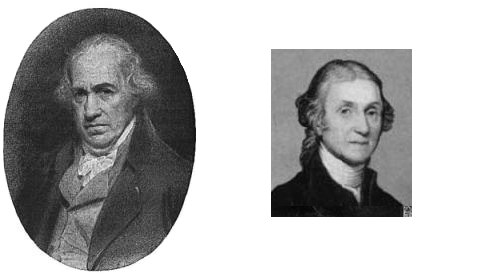
James Watt (1736 – 1819), of Boulton and Watt, developed the world beating steam engines that provided the power for the new factories that were springing up across the country.

Erasmus Darwin (1731 – 1802), poet, inventor and botanist. He published a theory of evolution 60 years before his grandson Charles. He developed a steering system that was used by Henry Ford and a mechanical copying machine. A visionary, who predicted the use of steam powered propulsion.

Josiah Wedgwood (1730 – 93), the father of English pottery, who was also Charles Darwin’s other grandfather. As an industrialist, he was dedicated to improving everyday life and brought affordable tableware to the masses.

Joseph Priestley (1733 – 1804), the rebellious cleric and scientist, famous for isolating oxygen, discovering carbon dioxide and carbonated (fizzy) drinks.

James Watt and Joseph Priestley

Photographs above: James Watt (left) and Joseph Priestley (right)

James Keir (1735 – 1820), the chemist responsible for making soap affordable to the great unwashed.

Richards Lovell Edgeworth (1744 – 1817), an inventor who also published books on educational theory.

William Murdoch (1731 – 1802), worked for Boulton and Watt and was the inventor of the gas light. He ended his days living at the court of the Shah of Persia, where he was believed to be an incarnation of Marduk, the ancient god of light.

William Small (1734 – 75), a mathematician, philosopher and mentor of Thomas Jefferson, third President of the United States of America. The Society was shocked when Small died at the early age of 40, he was replaced by …

William Withering (1741 – 99), a doctor and botanist, responsible for discovering the treatment of heart disease with the extract from the foxglove plant, digitalis.

Freemasonry, the Lunar Society, and the Midlands ...

https://dr-david-harrison.com/freemasonry/freemasonry-the-hidden...

2015-08-12


Lunar Society: Was Benjamin Franklin “the Father of the ...

  1. https://www.youtube.com/watch?v=DiaB4vimSPw

    For more information: https://WhoWeAreBook.com In this exclusive talk on Feb 18, 2021 to The Lunar Society 

No. 1726:
THE LUNAR SOCIETY

by John H. Lienhard

Today, let's drop in on a remarkable gathering. The University of Houston's College of Engineering presents this series about the machines that make our civilization run, and the people whose ingenuity created them.

It was called The Lunar Society of Birmingham, and it was active for at least sixteen years, beginning in 1775. It got its name from the practice of meeting each month on the Monday nearest to the full moon. That way, roads were better lit for members who had to travel at night.

Revolutionaries have always gathered in small groups, and this was a revolutionary group. The revolutions of the late eighteenth century took many forms, but they were all fomented in study groups. And these groups invariably got around to a common question: How could science and technology be made to serve society?

Ben Franklin had helped to set the pattern very early in the game. His life was centered both on revolution and on tying scientific knowledge to practical social change. And The American Philosophical Society started out as his study group.

Before the French Revolution, intellectuals (both men and women) gathered in salons to talk about scientific and social issues. Now the English Industrial Revolution was about to become the ultimate fusion of science, social change, and revolution. And the Lunar Society formed a primary focus for such change.

But, if the Lunar Society was not unique for its aims, it was certainly unique for its membership. It numbered only a dozen or so people, but what a dozen they were! The heart of the Society was Matthew Boulton, the industrialist who built Watt's engines.

Other members included James Watt, Erasmus Darwin (famous physician and writer and Charles Darwin's grandfather), and Joseph Priestley. Priestley was the rebellious cleric and scientist, famous for isolating oxygen. Josiah Wedgwood was known for fine tableware, but he was also dedicated to improving everyday life. He made huge contributions to the production of cheap tableware. (And Wedgwood was Charles Darwin's other grandfather.)

The roster goes on: the astronomer William Herschel, who discovered the planet Uranus was also a famous organist in his day. John Smeaton, designer of the Eddystone lighthouse, knew more about steam-engine design than anyone before Watt.

Can you imagine being in a room with these makers of the Industrial Revolution who were genuinely asking how to improve their world? Historian Jacob Bronowski looks at the Lunar Society and says,

What ran through it was a simple faith: the good life is more than material decency, but the good life must be based on material decency.

It comes as a jolt to see these dedicated capitalists as part of a revolutionary cabal. But capitalism was revolution in the late eighteenth century. When this group of writers, intellectuals, scientists, and industrialists consciously joined forces, it was precisely because they meant to shape a decent life for everyone.

I'm John Lienhard, at the University of Houston, where we're interested in the way inventive minds work.

(Theme music)


Bronowski, J., The Ascent of Man. Boston: Little, Brown and Company, 1973, Chapter 8, The Drive for Power.

Schofield, R. E., The Lunar Society at Birmingham: A social history of provincial science and industry in eighteenth-century England, Oxford: Clarendon Press, 1963.

This is a greatly revised version of Episode 168.

Boulton Watt Works
Boulton-Watt Works in Birmingham, England as shown in a 19th-Century Engraving, Source Unknown


The Engines of Our Ingenuity is Copyright © 1988-2002 by John H. Lienhard.

The longest lunar eclipse this century will happen in 2 weeks. Here's how to see it.

Aylin Woodward
Fri, November 5, 2021


The moon enters the maximum eclipse in Glastonbury, England, on September 28, 2015. Matt Cardy/Getty Images


A near-total lunar eclipse will occur on November 19, with prime visibility in North America.

It will last 3 hours and 28 minutes - the longest partial lunar eclipse this century, NASA predicts.

Here's how to see the rare event, when up to 97% of the moon will look red.

The longest lunar eclipse of this century comes in two weeks.

During the early hours of November 19, Earth will pass between the sun and moon, casting a shadow over the latter. The eclipse will peak just after 4 a.m. ET, when our planet will hide 97% of the full moon from the sun's light, giving the moon a reddish hue.

According to NASA, the partial lunar eclipse will last 3 hours, 28 minutes, and 23 seconds - longer than any other eclipse between 2001 and 2100.

Here's how and when to catch the rare celestial event.

People in North America can watch the entire spectacle

Lunar eclipses aren't visible worldwide - only in places where the moon is above the horizon.

For the upcoming eclipse, sky watchers in North America have the best seats in the house. People in all 50 US states, Canada, and Mexico can watch the full event.

You won't need a telescope or binoculars - simply go outside and look up at the sky any time between 2:19 a.m. and 5:47 a.m ET.

Or if you don't want to head into the chilly morning air, catch a live stream of the event here.

Folks in South America and western Europe will see most of the eclipse, though the moon will set before it ends. People in western Asia and Oceania will miss the earlier part of the event, as the moon will not have risen yet. Those living in Africa and the Middle East won't see any of the spectacle.

A map of locations where the partial lunar eclipse will be visible on November 19. NASA

If you miss the eclipse, don't fret. After this, NASA predicts another 179 eclipses in the next eight decades, with an average of two per year. The next eclipse will happen on May 16, 2022.
How a lunar eclipse works - and why it turns the moon red

Typically, the moon's white-grey face is illuminated by sunlight reflecting off its surface. But during a lunar eclipse, the moon, sun, and Earth briefly align so that our planet blocks sunlight from reaching the moon.

A diagram of the Earth, moon, and sun during a total lunar eclipse. Shayanne Gal/Business Insider

A total lunar eclipse occurs when 100% of the moon is obscured by the Earth's cone-shaped shadow, known as the umbra. During a total eclipse, or near-total eclipse like this month's event, the lunar surface takes on a bloody visage.

We have oxygen and nitrogen particles in Earth's atmosphere to thank for that light show. They're both better at scattering certain shorter wavelengths of light, like blue or violet, so colors with longer wavelengths like red, orange, or yellow linger. So when the moon sits in Earth's shadow, those reddish colors dominate what you see.