Monday, December 27, 2021

'We want to see the world become a wilder place': Calgary Zoo and Wilder Institute excited for conservation projects in the new year

'We're contributing to greater wildlife conservation happening all around the planet, which is exciting. And it's based here in Calgary, which is an amazing thing for our community'

Author of the article: Stephanie Babych
Publishing date:Dec 25, 2021 
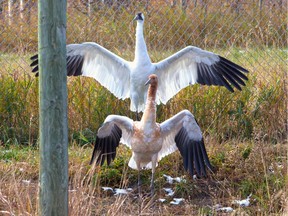
Whooping cranes photographed at the Calgary Zoo's Devonian Wildlife Conservation Centre. 
Gavin Young/Postmedia


With new conservation projects underway and some highly anticipated animal births in the coming year, the Calgary Zoo and recently rebranded Wilder Institute is thrilled about what they have to offer the community and international conservation efforts in 2022.

One of the biggest changes this year was the rebranding of the Calgary Zoo Foundation into the Wilder Institute in November. It’s a new identity that Steven Ross, the zoo’s chief development officer, says speaks to the role the institutions play in national and international wildlife conservation.

“The Wilder Institute is our call to action. We want to see the world become a wilder place, we want to see more wildlife and we want to see more wild spaces,” said Ross.

“This is to draw attention to the fact that we are a science-based institute that is leading — in a lot of ways — on some really exciting conservation work around the world.”

As the Wilder Institute and Calgary Zoo expand their conservation efforts, they intend to double the number of programs they’re involved in by 2030. And one of the programs Ross said he’s most excited about is plant conservation, something people might not immediately associate with wildlife protection.

People spend the sunny afternoon at Brawn Family Foundation Dinny’s Green featuring Dinny, the Calgary Zoo’s popular Brontosaurus, on Friday, September 3, 2021. 

The doors will be opening in 2022 for the zoo’s new wildlife conservation centre that’s being built south of Strathmore, giving the Wilder Institute a greater opportunity to expand the number of species it’s breeding and preparing for release.

Dr. Clément Lanthier, president and CEO of Wilder Institute and Calgary Zoo, said the transformative journey from a zoo that does conservation into a conservation organization that operates a zoo started in 2016.

“As part of our ambitious strategic plan, we are deepening our conservation efforts globally and aiming to significantly grow our community of supporters to enable this critical work,” Lanthier said in a press release.

By the end of next year, the Wilder Institute and Calgary Zoo will lead 16 global conservation programs in community conservation and conservation translocations alongside partner organizations for hippos, lemurs, mountain bongo, sitatunga, Vancouver Island marmot, burrowing owl, whooping crane, fisher, Half-moon hairstreak butterfly, Northern leopard frog, greater sage-grouse, swift fox, black-tailed prairie dog and black-footed ferret, sihek (Guam kingfisher) and Carolinian forest plants.

“Conservation is a challenging space and we’re all aware of climate change and other challenges that our world is facing, and we have a lot of hope in the work that we’re delivering. The species that we’re working to save each and every day are opportunities for folks to get involved with conservation,” said Ross.
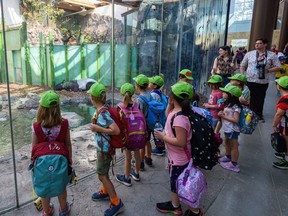
Visitors in the Calgary Zoo watch the newest residents of the Gateway to Asia, a newly re-imagined building formerly known as Panda Passage, on Thursday, July 22, 2021. 
Azin Ghaffari/Postmedia

The zoo is appreciative of the outpouring of support from the community, Ross explained.

“We’re contributing to greater wildlife conservation happening all around the planet, which is exciting. And it’s based here in Calgary, which is an amazing thing for our community,” he said.

This year, the Calgary Zoo welcomed more than one million guests to the park and connected with 1,600 children at summer camps and 10,000 students through school programs. This was despite the various public health measures and capacity limits in place over the course of the year due to the COVID-19 pandemic.

“We’ve continued to adapt our COVID protocols for people visiting the zoo and ensure that we have safety measures in place both for our staff and for all of our animals that we have on-site,” said Ross.

Calgary Zoo has thus far prevented outbreaks of COVID-19 among its animals, which has happened at several zoos in the world this year as the novel coronavirus was found to spread among tigers, hyenas, lions and gorillas, among other species. At the Lincoln Children’s Zoo in Nebraska, three snow leopards died from complications due to COVID-19 in November.
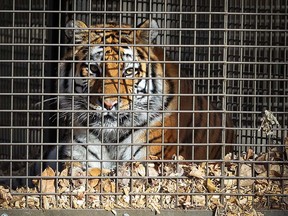
Female Amur tiger Sarma enjoys the day at the Calgary Zoo on Thursday, November 25, 2021. 
PHOTO BY GAVIN YOUNG/POSTMEDIA

The Calgary Zoo has been working alongside other Canadian zoos to get animal doses of vaccine approved and delivered to the country so they can immunize vulnerable species.

“Very early on, we took measures to create barriers for certain species around the zoo,” Ross said, explaining that they have been in contact with partners around the world to understand what species are susceptible and where there might be a risk.

“We have an incredible team of people that have gone above and beyond to ensure that their safety protocols are very carefully monitored and implemented.”

An example of the increased safety precautions is the lemur walk-through, which has remained closed through the pandemic to avoid possible transmission from visitors to the animals.

“We put in place a lot of extra measures to ensure that public can still enjoy the zoo and enjoy the connection that they have when they’re on-site with the species that are there but done in a way that we can ensure safety,” said Ross.
Over the course of 2021, the Calgary Zoo cared for 4,482 animals across 114 species and released 283 animals into the wild.

This image depicts a sleepy polar bear at Assiniboine Zoo in Winnipeg, Canada. The Calgary Zoo announced it will be bringing polar bears back to its Canadian Wilds section, as part of a larger revitalization plan.
 PHOTO BY CASTAVERON /Getty Images/iStockphoto

Construction for the $31-million redevelopment of the Canadian Wilds section of the zoo started this year with a revamping of the river otter space and will continue into the new year. The area will also become home to polar bears, which are returning to Calgary for the first time in more than 20 years.

The zoo is also expecting some exciting birth and pregnancy announcements in 2022, including the birth of a baby gorilla in the spring to 20-year-old western lowland gorilla Dossi and the troop’s silverback leader, Jasiri, and the anticipated pregnancy of Amur tiger, Sarma, who has been matched with a new partner after an unsuccessful three-year courtship with Youri.

sbabych@postmedia.com
‘A lot of abuse for little pay’: how US farming profits from exploitation and brutality


Two dozen conspirators forced workers to pay fees for travel and housing while forcing them to work for little to no pay


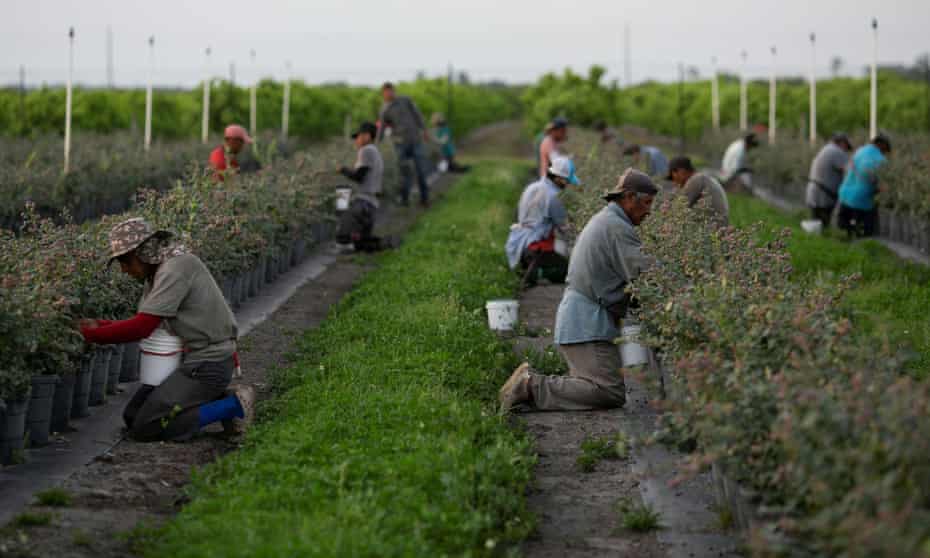
Workers pick blueberries at a farm in Florida on 31 March 2020. 
Photograph: Marco Bello/Reuters


Michael Sainato
Sat 25 Dec 2021 17.51 GMT

In June, a farm worker from Mexico, who requested to remain anonymous for fear of retaliation, was transported through a trafficking network from Monterey to work on farms in Georgia.

They paid the traffickers 20,000 pesos, about $950, loaned from their mother, taking frequent trips back and forth to Monterey, before being told it was safe to leave. Then they were finally transported across the border.

Initially, the worker was told they would be working on a blueberry farm, but was sent to a corn-farming operation instead.

“We arrived at the house where we would live, and had to clean the rooms ourselves. There were roaches, spiders, mosquitoes, and the mattresses were covered in lice,” the worker said. “The bathrooms and showers were dirty and clogged. The kitchen was horrible. We had no air conditioning in hot weather.”

The worker began work daily at 3 or 4am and worked until 3 or 4pm with just one 15-minute lunch break, making just $225 for 15 days of work. They heard rumors that the contractor had several workers die under them. The worker claimed that Haitian immigrants were also brought into the same network.

After 20 days at the corn farm, the worker was sent to a cucumber warehouse where they weren’t paid anything for their work, and then transferred to Texas before escaping the operation and returning to Mexico in July.

“There was a lot of abuse for little pay,” the worker added. “It was a total fraud.”

The contractor the worker said he worked under, JC Longoria Castro, was one of two dozen defendants indicted on federal conspiracy charges in October, based on findings from a multi-year investigation into a massive human smuggling and labor trafficking operation based in southern Georgia that extended to Florida and Texas.

The indictments characterized the operation as “modern-day slavery”, a longstanding issue in the US agricultural industry where workers were smuggled from Central American countries to the US and imprisoned as contracted farm workers.

Farmworkers in the US, especially immigrant workers, have few protections. They were excluded from the National Labor Relations Act passed in 1935, and the Fair Labor Standards Act of 1938. Workers in America’s agricultural fields are regularly subjected to abuses ranging from high occurrences of sexual assault and harassment, wage theft and safety issues including injuries, fatalities on the job, and exposure to hazardous chemicals.

The investigation, Operation Blooming Onion, found the conspirators forced workers to pay fees for transportation to the US, food, and housing through the H2-A work visa program, while withholding their travel and identification documents and forcing them to work for little to no pay in inhumane living conditions.

The two dozen conspirators made $200m from their operation, laundering the money through land, homes, over a dozen vehicles, the purchase of a restaurant and nightclub, and through a casino, according to the investigation. Over 100 workers were freed from the operation.

The H2-A visa program is an often used avenue for exploitation of migrant workers in the US, as it ties immigration status to employment on a temporary basis with no pathways to permanent citizenship. Many of these workers are forced to take on debt to recruiters to enter the H2-A visa program, with several cases of debt peonage, forced labor, and human trafficking reported through the program.

“It’s really the structure of the program that facilitates this kind of stuff happening, often with impunity,” said Daniel Costa, director of Immigration Law and Policy Research at the Economic Policy Institute.

He cited a severe lack of labor law enforcement in the agricultural industry as a driving factor in widespread abuses of workers, and the lack of regulating recruiters outside of the US who connect migrant workers with temporary jobs. Inspections conducted by the wage and hour division of the US Department of Labor declined significantly over the past few decades due to underfunding, and the low number of inspectors responsible for overseeing a vast number of employers.

“If you’re an agricultural employer, there’s only around a 1% chance that you’ll be investigated for anything in any given year, so they can pretty much get away with not treating your workers the way they should,” added Costa.

The workers were threatened with deportation or violence if they did not comply with the conspirators. The indictment include allegations of “raping, kidnapping and threatening or attempting to kill some of the workers or their families, and in many cases sold or traded the workers to other conspirators”. At least two workers died as a result of the living and working conditions and another was repeatedly raped, the indictment said.

Some of the workers were promised up to $12 an hour in pay, but instead were ordered by armed overseers to dig up onions by hand for $0.20 per bucket.

A grand jury indicted the 24 conspirators in a federal court in Waycross, Georgia on counts including forced labor, mail fraud, witness tampering and conspiracy to commit money laundering. Arraignments in the case were scheduled for 21 December and 6 January at the Southern District of Georgia federal courthouse in Waycross, Georgia.


Plant protein revolution is shaking up agriculture

Plant protein growing

The global plant protein market could double by 2026, reducing the need for meat

While there are those who demand greater access to agricultural land for city dwellers, especially since COVID-19 has pushed many to seek space far from major cities, others want to protect our land from real estate speculators.

It’s a real point of tension and an important debate. But beyond this, our approach to protecting farmland may have to change forever.

Two reasons often motivate governments to protect farmland.

First, many loudly proclaim the impossibility of creating agricultural land. While true to a certain extent, technologies allow us to repurpose land and make our acreage more efficient. And there are vertical farms. The greenhouse industry allows increased efficiency of our spaces and is expanding rapidly in Canada and elsewhere.

Also, our debate on farmland protection is based on the premise that consumers will continue to consume in the same way for years to come. But consumers’ habits are changing – slowly, but they’re changing. With our collective craze for plant-based proteins and the eventual arrival of emerging technologies like precision fermentation and cultivated meat that will shake up our plates, protein will mean something quite different in a few decades.

A real transition to plant proteins is shaping up. Most Canadians will continue to consume meat, but in smaller quantities for all kinds of reasons. According to a report by the Market Data Forecast group, the global plant protein market could double by 2026. This market is estimated at around $23 billion now, so it could exceed $46 billion in a few years.

That huge progression is just the start of a new trend. And don’t let Beyond Meat’s current slide fool you. The younger generations are interested in protein that’s more sustainable, simpler and less expensive. Given higher meat prices, retail price differences between vegetable and animal proteins are much less significant than a few years ago.

In Canada and around the world, agricultural land devoted to food production for livestock is substantial.

Major field crops include all varieties of wheat, barley, corn, oats, rye, canola, flax, soybeans, dried peas, lentils, dried beans, chickpeas, mustard seeds, canary seed and sunflower seeds. Our grain output is massive.

According to the Animal Nutrition Association of Canada, 80 per cent of the barley, 60 per cent of the corn and 30 per cent of the wheat crops grown in Canada are used to feed livestock. And according to Statistics Canada, about 15 million acres are used to produce these three crops for livestock in Canada – and 15 million acres is almost the size of New Brunswick.

Some of the land will obviously be repurposed and given over to other crops since the pressure to grow crops for livestock could drop significantly over time.

Cultured meat is also on the horizon, along with other technologies that require fewer resources. For example, the aquaculture production of fish and seafood could double in the next few years, giving more protein options to consumers.

You can understand where this is all going. A greater plurality of proteins will require more modest agricultural production.

As for milk, the darling of Eastern Canadian agriculture, precision fermentation could wipe out Canada’s dairy industry within 15 to 20 years, according to reports.

So protecting farmland isn’t the only issue we need to worry about. We also need to think about land occupancy in rural communities.

Despite this, the threat of running out of farmland to feed the planet by 2050 continues to be expressed. Certain groups are worried about the possibility of running out of food to feed our 10 or 11 billion people by 2050.

But according to the United Nations, 40 million square km, or 77 per cent of agricultural land in the world, is dedicated to animal production. It’s a safe bet that we won’t run out of agricultural land – just the opposite could happen. Experts even say climate change can give Canada new land in the North to cultivate crops.

We will have to find new ways of occupying our rural territory, not just protect it. The management of our agricultural heritage and the support offered to rural economies will undergo a major upheaval. Farmland management in Canada will change, and it needs to, for the sake of our rural communities.

Sylvain Charlebois is senior director of the agri-food analytics lab and a professor in food distribution and policy at Dalhousie University.

Growing year-round, north of 60

From commercial businesses to homegrown gardens, green thumbs share their thoughts on farming in the winter

Self-described "Carrot Queen" Lorrina Mitchell says she has grown lettuce and green onions in the wintertime, and knows many who grow herbs year round. (Submitted by Lorrina Mitchel)

Longtime Yukon resident Lorrina Mitchell has done a lot of research into the perfect type of tomato to grow in the dark winter months inside her home.

She came across a type of micro dwarf seeds that she says will grow about 18 to 24 inches tall, producing cherry-sized tomatoes.

Mitchell says she now has has 19 varieties and about a 20-year supply of seeds.

"There's nothing in the winter that makes you happier than to see something growing if it can produce your own food," she said.

Mitchell is one of many year-round farmers in Canada's territories who are eager to share their success stories.

Her plan is to be able to get the right rotation in place so that she'll have tomatoes growing year-round. She estimates having spent around $500 on her hobby over the past five to seven years on two tabletop gardens, plus another $100 or so on seeds.

Mitchell says she has two of these tabletop gardens. (Submitted by Lorrina Mitchell)

"I'm hoping this experiment just leads to the average home gardener being able to grow a few plants through the winter and get the both physical and psychological enjoyment from it," she said.

Growing year round is a growing businesses in the North.

Tarek Bos-Jabbar is the CEO of Cold Acre, a Whitehorse-based company that grows food in shipping containers using hydroponic units, and sells customized units to people as well as larger scale ones for communities in the Yukon and Northwest Territories.

Bos-Jabbar expects the business to triple its growing volume this winter, with a focus on leafy greens and herbs.

Tarek Bos-Jabbar says energy bills only make up about five or 10 per cent of his company's costs. The real cost, like any farming operation he says, is in labor. (Submitted by Cold Acres)

"We believe that the technology is there now, it's available, we can all grow year round, we can all start being a little more self-reliant and so we're trying to help communities tackle that and become more self-sufficient," he said.

Bos-Jabbar said the recent flooding in British Columbia shows just how brittle the supply chain is, leaving some grocery shelves running out of produce. Whatever his business can grow locally he said, will be better for the environment — and taste better. Plus, on the economic side, he said they're providing jobs and "keeping money in the Yukon."

"We're the end of the line, and so whatever we can produce locally is going to be way better for the environment."

Inside a Cold Acres container. Bos-Jabbar expects to triple the company's growing volume this winter. (Cold Acres/ Gary Bremner/GBP Creative)

Not everyone agrees.

"I find it craziness to tell you the truth, to expect that we're going to eat fresh greens all winter long, it doesn't even make sense," said Sheila Alexandrovich, who owns Wheaton River Garden, a community supported agricultural model based about 65 kilometres outside of Whitehorse.

"It doesn't add up for me at all," she said.

"The energy that goes into running sea cans full of greens in the middle of winter, what are we doing? You know, it just seems crazy."

Some of the sprouts Alexandrovich grows in the winter months. (Submitted by Sheila Alexandrovich)

Alexandrovich, who lives off-grid, said in the wintertime, she doesn't buy vegetables, instead relying on the 15 or so types of vegetables she has stored, dried, fermented or placed in a root cellar from the previous summer.

In the winter, she focuses on growing sprouts, which she says can grow in three to five days in a jar or seven to 10 days in soil.

"It's better to eat your salad in the summer and eat something that grows quicker, like a sprout in the winter or stored vegetables like potatoes, carrots and turnips," she said.

With files from Claudiane Samson

Spanish should eat less meat to limit climate crisis, says minister


Alberto GarzĂłn wants public to recognise impact of megafarms on the environment and change its eating habits


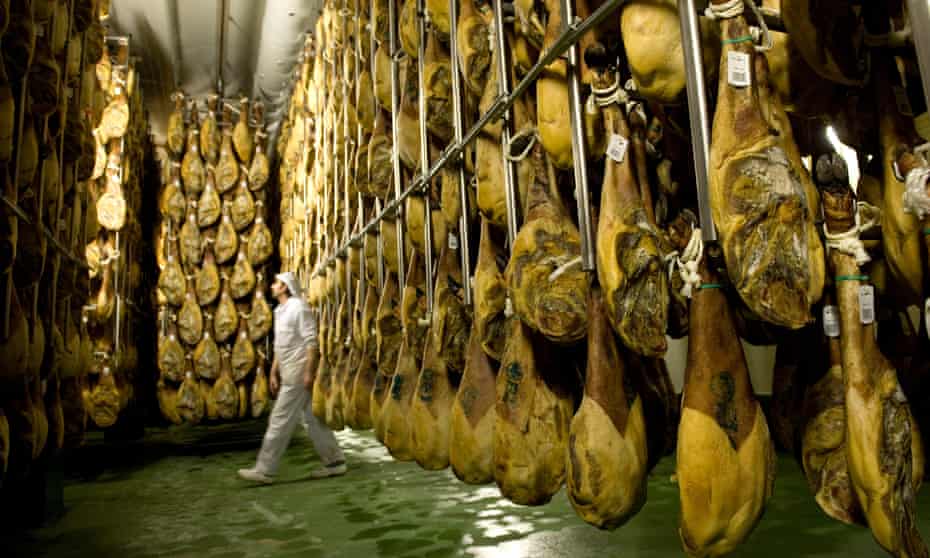
Rows of dry-cured Jamon Iberico de bellota (acorns) in the Estrella de Castilla factory in Guijuelo, near Salamanca, Spain. Photograph: Denis Doyle/Getty Images


Sam Jones in Madrid
Sun 26 Dec 2021

Eating less meat will play a key role in helping Spain mitigate the effects of the climate emergency, slow the process of desertification, and protect its vital tourism industry, the country’s consumer affairs minister has said.

Alberto GarzĂłn said people in Spain needed to realise the huge impact that eating meat – particularly beef raised on industrial megafarms – had on the environment, and to change their eating habits accordingly.

“People here know about the part that greenhouse gases play in climate change, but they tend to link it to cars and transport,” GarzĂłn told the Guardian.

“It was only very recently that everyone started to look at the impact of the animal consumer chain and, especially, at the impact of beef. Other countries were pretty advanced on that but in Spain it’s been a taboo.”

The minister said that the country’s geography made it profoundly vulnerable to climate change, adding the Spain people know and love is in danger of disappearing forever.

“If we don’t act, it won’t just be climate change we’re dealing with – it’ll be the triple crisis: the loss of biodiversity; pollution, and climate change,” he said.

“It would be the end for a country like Spain. Spain is a country in the Mediterranean basin – it isn’t the UK or Germany – and desertification is a very serious problem for our country, not least because it depends so much on tourism. Visiting a desert isn’t quite as attractive as visiting the Costa del Sol.”
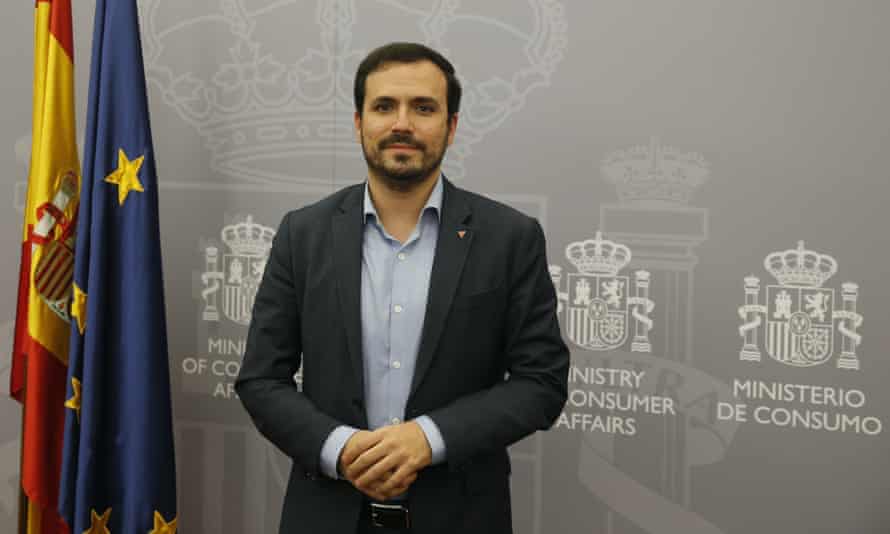
Alberto GarzĂłn at the ministry of consumer affairs in Madrid. 
Photograph: Anadolu Agency/Getty Images

GarzĂłn says Spaniards need not stop eating meat altogether but suggests they eat far less and ensure it’s good quality for the sake of their health and the environment. He contrasts cheap, mass-produced products with traditionally reared meat.

“Extensive farming is an environmentally sustainable means of cattle farming and one that has a lot of heft in parts of Spain such as Asturias, parts of Castilla y LeĂłn, AndalucĂ­a and Extremadura,” he said.

“That is sustainable; what isn’t at all sustainable is these so-called mega-farms … They find a village in a depopulated bit of Spain and put in 4,000, or 5,000, or 10,000 head of cattle. They pollute the soil, they pollute the water and then they export this poor quality meat from these ill-treated animals.”

The minister also pointed to a recent report that found that 20 livestock companies are responsible for more greenhouse gas emissions than either Germany, Britain or France.

GarzĂłn, an economist who is the coordinator for the United Left alliance in Spain’s Socialist-led coalition government, made headlines when he urged people to reduce their meat consumption in July.

He noted the average Spaniard eats more than 1kg of meat a week although the country’s food agency recommends people eat between 200g and 500g, and that Spain eats more meat than any other EU country, slaughtering 70 million pigs, cows, sheep, goats, horses and birds each year to produce 7.6m tonnes of meat.

His calls were roundly mocked and dismissed – not least by his own partners in government. The agriculture minister said the farming sector was being subjected to “profoundly unfair criticisms when it deserved respect for the honest work it does for both our food and our economy”, while the prime minister, Pedro Sánchez, appeared to scoff at the suggestion, saying: “Speaking personally, a medium-rare steak is hard to beat.”

GarzĂłn attributes the friendly fire to what he diplomatically terms “the differing programmes and policies” of the coalition parties, and says he always knew taking on the industrial meat industry would provoke a furious response.

“We knew from the start that the issue would be controversial, but it needed to be done,” he said. “Other countries – like Germany, the UK and France – are well ahead of us on this. This was the first time in Spain that someone in the government was saying what the scientists have been saying for a long time.”

The minister also noticed that most of the public criticism came from men who apparently “felt their masculinity would be affected by not being able to eat a piece of meat or have a barbecue”. Women, on the other hand, were far more open to the message.

“We think that part of society was already ready for this and had got its head round this,” he said. “But we still needed to push and there wasn’t a single political party that supported us. Not one. Not even within the governing coalition.”

Nevertheless, GarzĂłn is convinced that Spain is finally having a long overdue public discussion over meat.

“Civil society organisations and associations of ecologists, paediatricians, doctors and nutritionists all came out to defend us all the way,” he said.

“I think that helped us win the debate because the issue was debated for three days on all the news programmes and in bars.”

The minister’s other reforms – which include a crackdown on Spain’s betting industry, a ban on unhealthy food advertisements aimed at children and a symbolic toy strike to highlight gender stereotypes – have not always endeared him to certain businesses.

They have also made him a favourite target for the Spanish right, who accuse him of meddling in people’s lives.

GarzĂłn’s attempts to point out the sexism inherent in many toys was recently given short shrift by the far-right Vox party.

“I think GarzĂłn forgets that it’s up to us as parent to decide what we buy,” said its Madrid spokesperson, RocĂ­o Monasterio. “I’m going to go out and buy loads of dolls and cribs for my girls and I’m going to get cars and tractors and tanks for my nephews. And I think over Christmas we should all stuff our faces with meat.”
Explain like I’m 5: How did fuel make it into Iqaluit’s water supply?

The answer isn’t as simple as one might expect


City staff excavated the suspected source of the water supply’s fuel contamination in November, before removing it from the nearby water treatment plant.
 (Photo courtesy of the City of Iqaluit)

By Randi Beers

The fuel contamination of Iqaluit’s water supply left people asking a lot of questions, not least of which was — how did it get there in the first place?

Answering this question was one requirement among a longer list of must-dos before the territory’s chief public health officer, Dr. Michael Patterson, would consider telling people the city’s water was safe to drink again after diesel fuel was detected in the city’s water system in October. Patterson did lift the do-not-consume water advisory on Dec. 10, nearly two months after it was imposed on Oct. 12.

The original suspect was a crack in one of two underground holding tanks at Iqaluit’s water treatment plant, where water sits in chlorine before moving into a treated reservoir, called the North Clear well.

That tank is where the bulk of the fuel was found. In fact, according to numbers released by the Department of Health earlier this month, fuel levels categorized as F2 hydrocarbons (which includes diesel and kerosene) in that tank were 5.3 million micrograms per litre, or 1.3 million times over what’s considered safe for consumption.

But no obvious cracks were found in the North Clear well, Iqaluit’s chief administrative officer Amy Elgersma said at an Oct. 22 news conference. A month later, the city announced the fuel had come from a tank located nowhere near the North Clear well. So how did it end up accumulating there?


Fuel leaking from this tank made its way into Iqaluit’s water treatment system two months ago. (Photo courtesy of the City of Iqaluit)


City officials hired an engineering consulting firm called WSP Canada to get to the bottom of the mystery, and engineer Ian Moran provided the city with a two-page written report that explains everything. That report was provided to Nunatsiaq News by city spokesperson Aleksey Cameron.

The answer starts with a slow drip from a 60-year-old fuel tank, located outside the plant itself, and ends with a scientific phenomenon called petroleum vapour intrusion.

But let’s start at the beginning, in a place called the void.

“The void, as it is called, is the space between the water treatment plant and exposed bedrock,” states the report.

“The intent of the void is to provide an air barrier between the water treatment plant and an external environment, similar to how an insulated coffee mug works to keep your coffee hot. In this case, the water treatment plant is the smaller vessel within a larger vessel.”

Experts aren’t sure when, but at some point, a tank forgotten in the void years ago started leaking fuel. That fuel dripped down to the lowest part of the void, which is underneath the water treatment plant.


A surge tank, which holds wastewater from within the plant, sits just above that part of the void.

Eventually, the fuel got mixed with groundwater at the bottom of the void, and that contaminated water reached the bottom of the surge tank. The surge tank is made of concrete, which has natural pores. The fuel was able to “wick” up through those pores, into the tank, according to the report.


Engineer Ian Moran provided this visual overview of how Iqaluit’s water was contaminated by diesel hydrocarbons. The fuel leaked underneath the plant, was sucked up through natural pores in a tank at the bottom of the plant, vapourized, and eventually made its way to a raw water tank. (Graphic courtesy of Ian Moran/WSP Canada Inc.)

From there, the fuel continued to collect and vapourize in the surge tank until pressure created by the accumulating gas reached a point where it had to go somewhere. So it was pushed up, out of the surge tank, through an empty pipe to an unused tank underneath the water treatment plant.

The fuel continued to accumulate and vapourize, causing pressure outside the surge tank to rise too. Eventually, those gases found a way into a raw water tank that feeds into the water treatment plant through a phenomenon called petroleum vapour intrusion — it’s a fancy name that describes how certain, sometimes dangerous, gases can rise from underground into buildings above. Homeowners, especially, would be familiar with a similar type of vapour intrusion, as it’s how radon gets into basements.

By now, hydrocarbon vapours had infiltrated the water that moves through Iqaluit’s water treatment plant, and it would only be a matter of time before people started reporting the smell of fuel in their tap water.

In the end, there were no cracks found in any of the tanks or wells at the water treatment plant, including the North Clear well, according to the report.

People in Iqaluit were given the OK to start drinking their tap water again, as of Dec. 10, and a real-time hydrocarbon monitoring station is in place to alert officials of future contamination.

“As a result, the City of Iqaluit now has one of the most stringent water testing systems in Canada,” states the city’s water facts webpage.

Chief public health officer Dr. Michael Patterson has said the Health Department will order a third-party review of how the government handled the fuel investigation. There is no timeline for when that review will happen.

— with files from MĂ©lanie Ritchot


Hubble captures the site of an epic supernova, spotted by amateur astronomers

The eyes of the astronomy community are firmly on one event this week: The launch of the James Webb Space Telescope, the brand-new space observatory from NASA, the European Space Agency, and the Canadian Space Agency, which will be the world’s most powerful space telescope and the successor to the Hubble Space Telescope. But that launch doesn’t mean that Hubble will be going away, as the older telescope will continue to be used to capture beautiful images of space in the visible light spectrum, while James Webb will focus primarily on capturing data in the infrared wavelength.

This week’s image from the Hubble Space Telescope is an example of the striking visuals it is still possible to capture with this 30-year-old technology. It shows the galaxy NGC 3568, a barred spiral galaxy (like our Milky Way) which is located around 57 million light-years away in the constellation of Centaurus.

Hubble Space Telescope captures a side-on view of NGC 3568, a barred spiral galaxy roughly 57 million light-years from the Milky Way in the constellation Centaurus.
In this image, the NASA/ESA Hubble Space Telescope captures a side-on view of NGC 3568, a barred spiral galaxy roughly 57 million light-years from the Milky Way in the constellation Centaurus. In 2014 the light from a supernova explosion in NGC 3568 reached Earth – a sudden flare of light caused by the titanic explosion accompanying the death of a massive star.ESA/Hubble & NASA, M. Sun

One distinct feature of this galaxy is that it was the location of a huge supernova, when a star reached the end of its life and exploded in a dramatic cosmic event. The light from this supernova reached Earth in 2014 and, unusually, was spotted not by professional astronomers but by a team of amateur astronomy enthusiasts who watch for supernovas from their backyards.

“While most astronomical discoveries are the work of teams of professional astronomers, this supernova was discovered by amateur astronomers who are part of the Backyard Observatory Supernova Search in New Zealand,” the European Space Agency writes. “Dedicated amateur astronomers often make intriguing discoveries — particularly of fleeting astronomical phenomena such as supernovae and comets.”

People with inflammatory bowel disease have more microplastics in their feces: study

Tom Yun
CTVNews.ca writer
 Sunday, December 26, 2021 


These photos show two types of microplastics that were found in the fecal samples of the participants. (Environmental Science & Technology)

A small new study has found that people with inflammatory bowel disease (IBD) have more microplastics in their feces.

Researchers based in China wrote about their findings in a peer-reviewed paper published the journal Environmental Science & Technology on Wednesday. The examined fecal samples from 50 healthy people and 52 people with IBD, which refers to digestive tract conditions such as Crohn's disease and ulcerative colitis.

The researchers found that fecal matter from those with IBD had 50 per cent more microplastic particles per gram compared to those from healthy subjects.

Related Links
Read the full study

Microplastics are tiny plastic particles that are less than five millimetres long and are created through the degradation of plastic-containing products. These particles have been observed polluting various natural ecosystems, but they can also end up in the human body through air pollution as well as the use of take-out food containers, plastic water bottles and certain clothing.

The health effects of microplastics exposure in humans remains unclear, but previous studies have found that microplastics can cause intestinal inflammation and gut microbiome disturbances in some animals.

The study found that microplastics in the fecal matter of people with IBD were also smaller than those of the healthy subjects. The IBD participants had particles that were smaller than 50 micrometres, or 0.05 millimetres.

In both groups, the two most common types of plastics were polyethylene terephthalate (found in water bottles and food containers) and polyamide (found in food packaging and clothing).

"These results suggest that plastic packaging is an important source of human (microplastics) exposure," the authors wrote.

People who had more severe IBD symptoms also tended to have more microplastics in their fecal matter, the study found.

In addition, participants from both groups were surveyed about their lifestyle. The participants who reported drinking more bottled water, eating more take-out and being more exposed to dust were also found to have more microplastics in their feces.

While their research shows a correlation between IBC and microplastics in fecal matter, the researchers say it's unclear whether more exposure to microplastics increases the risk of getting IBD, or if people with IBD have more microplastics as a result of their disease.

"The relative mechanisms deserve further studies," the authors wrote.
'I will work hard to protect their jobs:' Mayor Amarjeet Sohi intends to keep City of Edmonton services public

Author of the article:  Dustin Cook
Publishing date:Dec 26, 2021 
Edmonton Mayor Amarjeet Sohi in conversation with Postmedia Edmonton on Dec. 18, 2021. 
PHOTO BY LARRY WONG /Postmedia
Article content

Newly-elected Edmonton Mayor Amarjeet Sohi will be fighting to keep jobs and services public as the City of Edmonton looks to reimagine itself out of the COVID-19 pandemic.

In a year-end interview with Postmedia two months into his term, Sohi called for services within the city’s jurisdiction to remain public and not be contracted out as Edmonton looks for ways to save money and position itself for the long term.

While a plan to outsource more than 100 bus cleaning and maintenance jobs was abandoned in November , the city is still advancing 17 actions through its “Reimagine Services” project.

Some involve contracting out work, including privatizing operations of three municipal golf courses as well as the newly-approved Lewis Farms Recreation Centre. An on-demand transit service is also being privately delivered in conjunction with the new bus network.


With other potential private partnership opportunities swirling around in transit operations and waste collection, Sohi said he doesn’t believe privatization is the way forward and he vowed to defend the jobs of city employees. Sohi served as a public transit driver in Edmonton before his election to city council in 2007.

“Our city employees provide a very valuable service to Edmontonians. From running rec centres to providing fire services, transit, libraries, policing, community programs, they give their best to our city. I want to ensure them that under this council and under my leadership as mayor, I will work hard to protect their jobs,” Sohi said..

“I don’t believe that privatization of public services actually saves money. It actually costs more in some cases and in some cases you see a clear reduction in the quality of service,” he added. “Yes, we need to make sure our city is run as efficiently as possible … but my fundamental belief is that we need to make sure our workers have job security, that they feel the organization values them, that we value their work and that we don’t create uncertainty for them.”


This doesn’t mean there isn’t room to look for new partnership opportunities or to work with non-profit organizations, Sohi said.

“My position is pretty clear, but that doesn’t mean that we don’t look at innovation within the organization. We need to have flexibility to foster innovation in the workforce and look at different ways of doing things, but that doesn’t mean privatization,” he said.

The Reimagine Services actions will be presented back to council in 2022 with further details about implementation plans and potential cost savings.

Sohi also raised some concerns with the city’s track record on completing infrastructure projects on time and on budget, pointing specifically to the $1.8-billion Valley Line Southeast LRT project that is now slated to open next summer, a year and a half behind schedule.

Although the vast majority of projects are generally on time, Sohi said these major LRT projects need to meet that same standard. He said he will be working with city staff to figure out why these problems are occurring and how to address them as the city continues to expand the transportation network.

“The delay is frustrating but it’s not going to cost us more money. Moving forward we need to make sure that we are building our projects on time and on budget.”

Looking ahead to 2022, Sohi said the uncertainty of the COVID-19 pandemic will continue to be one of the biggest challenges the city will face and that economic recovery will be crucial. Council’s decision to approve a 2022 tax levy increase of 1.91 per cent — the lowest in the region — is a step in that direction to keep costs low for Edmontonians, Sohi said, pointing out that economic recovery will have to work hand in hand with action on climate change and community safety.

“I think that’s the right approach. Keeping taxes affordable, fees affordable and continuing to invest in people, in communities, and tackle those big issues of climate change, the social issue of houselessness and inequity that exists in our city,” he said.

One of the first major decision points for council in the new year will be determining what to do with $14.4 million that was reallocated out of the 2022 police budget to be used toward community safety initiatives. City staff are slated to report back in the spring with recommendations along with an update on the work done on the priorities laid out by the Community Safety and Well-Being Task Force.
Brexit: ‘the biggest disaster any government has ever negotiated’

Simon Spurrell co-founder of the Cheshire Cheese Company.
 Photograph: Phil Noble/Reuters

Lisa O'Carroll
Brexit Correspondent
THE GUARDIAN
Mon 27 Dec 2021

A British cheesemaker who predicted Brexit would cost him hundreds of thousands of pounds in exports has called the UK’s departure from the EU single market a disaster, after losing his entire wholesale and retail business in the bloc over the past year. Simon Spurrell, the co-founder of the Cheshire Cheese Company, said personal advice from a government minister to pursue non-EU markets to compensate for his losses had proved to be “an expensive joke”.

“It turns out our greatest competitor on the planet is the UK government because every time they do a fantastic deal, they kick us out of that market – starting with the Brexit deal,” he said.

Spurrell predicted in January that Brexit would cost him £250,000 in sales. “We lost £270,000, so I got one thing right,” he said, describing the post-Brexit EU trade deal as the “biggest disaster that any government has ever negotiated in the history of trade negotiations”.

His online retail business was hit immediately after the Brexit negotiator David Frost failed to secure a frictionless trade deal addressing sales to individual customers in the EU.

Spurrell said he had lost 20% of sales overnight after discovering he needed to provide a £180 health certificate on each order, including gift packs costing £25 or £30. He said the viability of his online retail had come to a “dead stop”.
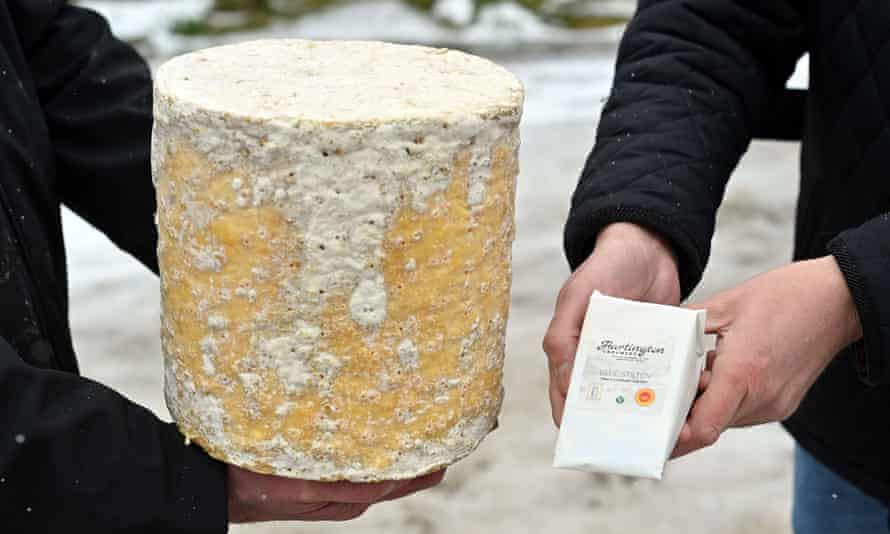
Cheese produced by Spurrell’s company. 
Photograph: Paul Ellis/AFP/Getty Images

After he embarked on a personal crusade to draw attention to the plight of UK exporters involving almost 200 media interviews around the world, he was invited to an online meeting with Victoria Prentis, a minister at the Department for Environment, Food and Rural Affairs. She suggested that emerging markets could compensate for the Brexit-related hole in the Cheshire Cheese Company’s finances.

Spurrell said he had pursued new business in Norway and Canada but post-Brexit trade deals sealed by the government had put barriers in place.

“We no longer have any ability to deal with the EU as our three distributors in Germany, France and Italy have said we have become too expensive because of the new checks and paperwork.

“And now we’ve also lost Norway since the trade deal, as duty for wholesale is 273%. Then we tried Canada but what the government didn’t tell us is that duty of 244% is applied on any consignment over $20 [£15].”

That meant Canadian customers who ordered a gift pack worth £50, including transport fees, were asked to pay £178 extra in duty when the courier arrived at their door, Spurrell said. “As you can imagine, customers were saying: ‘You can take that back, we don’t want it anymore’.”

Norwegian duty on a £30 cheese pack amounted to £190 extra, he said.

Spurrell is now pursuing the domestic market with greater vigour but says the cost of marketing has gone “through the roof” because all his competitors are having to do the same.

Sign up to the daily Business Today email or follow Guardian Business on Twitter at @BusinessDesk

“Before we could sell across the EU, now we are all fishing in the same pond. We used to be the biggest online sellers but now we are absolutely bombarded with attacks by all our cheese rivals because they are buying all the ads on Google to try to beat us. These are competitors who would never have bothered us before,” he said.

The “sad” thing, Spurrell said, is that it is the small to medium-sized companies such as his, important employers up and down the country, have been hammered by Brexit and other trade deals struck by the government, rather than giant rivals.

He noted that the Canadian company Saputo, with a market capital of more than C$14bn (£8.3bn), had done well out of the Norwegian deal as producers of three of the four “premier” cheeses singled out for “significantly reduced tariffs”.