Monday, December 27, 2021

For World’s Rarest Gorillas, Camera Traps Prove Pivotal for Protection


Once considered hunted to extinction, the Cross River Gorilla, “rediscovered” in the 1980s, is the planet’s most endangered subspecies of gorilla and Africa’s rarest ape.


December 26, 2021 by Mongabay


By Gianluca Cerullo

Cross River gorillas are Africa’s rarest and most endangered ape, once thought to have already been driven to extinction.

Camera traps have emerged as a critical tool for monitoring the health and population sizes of the subspecies.

Recent images have shown multiple young gorillas, which conservationists take as a sign that protection measures are working, and which have also helped raise awareness and funding for Cross River gorilla conservation.


MBE MOUNTAINS, Nigeria — Three hop-like steps and a leap, and suddenly Jacob Osang, an eco-guard with the Wildlife Conservation Society (WCS), appears to be levitating above the rainforest floor. With nimble-footed ease, he darts across a moss-covered trunk that bridges a rock-strewn gorge like a fractured bone. But if Osang is fazed by the idea that a chunk of rotting cellulose is all that stands between him and a 15-meter (50-foot) drop, he doesn’t show it.

“It’s my job!” he grins.

Osang calls this part of the forest Natural Bridge, and it’s clear why. The fall of this mega tree, now Osang’s favorite camera-trapping site, has rewired the circuitry of the rainforest. In life, the 40-meter (130-foot) hardwood would have pierced the canopy of Mbe Mountains Community Forest in southeastern Nigeria. For perhaps hundreds of years, its sprawling roots would have been a playground for duikers and porcupines, its gnarled branches a climbing frame for mona and putty-nosed monkeys. In its horizontal days, the fallen sentinel now serves a different purpose: It has become a wildlife walkway, a shortcut across the rugged landscape of the Cross River rainforest.

Osang’s camera trap images, set as part of WCS efforts to monitor Mbe Mountains’ unique fauna, have already revealed that Natural Bridge is a highway for hyraxes and a channel for threatened Nigeria-Cameroon chimpanzees. But Osang thinks it might be something even more special: a causeway for the Cross River gorilla (Gorilla gorilla diehli).

Once considered hunted to extinction, the Cross River Gorilla, “rediscovered” in the 1980s, is the planet’s most endangered subspecies of gorilla and Africa’s rarest ape. Experts estimate that its global population totals fewer than 300 individuals, with a transboundary range spanning the rainforest-blanketed borderlands of Nigeria and Cameroon.

All told, some 100 Cross River gorillas are thought to call Nigeria home. About a third of them reside in Osang’s patrol zone in Mbe Mountains, an 8,500-hectare (21,000-acre) community-owned forest corridor connecting two splotches of gorilla habitat. But these numbers are best guesses. And as conservationists’ efforts to protect this genetically distinct ape have redoubled, camera traps have emerged as a critical tool for monitoring the health and population sizes of the Cross River gorilla.

“It used to be that you only saw signs of Cross River gorilla if you spent days or sometimes weeks walking in the forest,” Osang says. “Now camera traps can tell us where the gorillas are and what they are doing.”

Gorillas through the lens


Camera traps have revolutionized the field of wildlife conservation, providing unprecedented insights into the secret lives of some of Earth’s rarest fauna. The motion-triggered devices have been the unsung hero behind everything from a new species of elephant shrew discovered in the Udzungwa Mountains of Tanzania, to the first-ever video of the world’s rarest rhino, the Javan rhino, romping in a mud wallow.

The Cross River gorillas’ own camera trap moment came in July 2020, when news outlets worldwide shared a series of momentous photographs captured by one of Osang’s traps in Mbe Mountains. These showed the first-ever photographs of a Cross River gorilla troop, including shots of several baby and adolescent gorillas.

California’s Prop 12 has hog farmers as far away as Iowa preparing for change

Hogs born Jan. 1, 2022, or later are subject to California’s Prop 12.


By Mary Stroka
Updated: December 26, 2021 -

California’s Prop 12 has a long reach, affecting hog farmers in faraway places like Iowa.

Some Iowa agricultural leaders have criticized the law, which prohibits the sale of pork from hogs that are the offspring of sows that were raised in pens with less than 24 square feet of usable floorspace per pig.
\

Hogs born Jan. 1, 2022, or later are subject to the law.

California accounts for about 15% of the U.S. pork market, the National Pork Producers Council said in a September news release. The NPPC is asking the U.S. Supreme Court to determine Prop 12’s constitutionality.

Iowa State University Extension and Outreach Farm and Ag Business Management Specialist Kelvin Leibold told The Center Square in an emailed statement that Iowa farmers are preparing for the enforcement of Prop 12.

Leibold said that while animal farms do their best to prevent the spread of disease, that’s not always possible.

“Pigs are like people,” Leibold said. “They move around from farm to farm, they play together and they ride in various forms of transportation. So, pigs get sick.”

One strategy to address sickness in pigs is “depop, repop,” he said.

“You sell every last pig you have on the farm and sanitize the heck out of everything and then you bring in some new (hopefully disease free) pigs and start your herd back up,” he said.

That’s an opportunity to remodel.

“Several farms are remodeling their gestation barns to meet Prop 12 standards so when they come back into production they will meet the standards and hopefully get paid a bunch of extra money for doing it!” he wrote. “Now the ‘harvest facilities’ will have to figure out how to process pigs into bacon and be able to sell the whole pig into the California market and make some money doing that as well.”

Leibold said there will not be enough pork to meet demand, and he hopes Californians will continue to be willing to pay premium prices for pork that meets Prop 12 standards.

“The pork price and the pork supply will reach some kind of equilibrium that matches increased costs with the price point that works for everybody,” he said. “But that will be a price higher than the current high prices.”

The rules aren’t finalized, however, and the North American Meat Institute, which advocates for the meat and poultry industry, continues to contest Prop 12. It told the California Department of Food and Agriculture that the proposed rules, despite changes, remain flawed and that the department must finalize them before enforcing them.

“Until CDFA publishes final rules, no one can adequately prepare to comply with a law with criminal sanctions and that authorizes civil litigation,” NAMI General Counsel and Chief Operating Officer Mark Dopp said in a Dec. 20 news release regarding a Dec 17 letter he sent to the department’s Animal Care Program Program Manager Dr. Elizabeth Cox. “Rather than apply ‘band aids’ to address some challenges, NAMI suggests CDFA go further and afford everyone in the supply chain, from hog producers all the way to foodservice and retail entities, the 28-month preparation time the law, and the voters, contemplated before enforcing any aspect of Prop 12 or its regulations.”

Dopp said in the letter that if the department does not extend preparation time, it should clearly state on its website and in a final rule that both whole pork meat that has entered supply chain and meat from hogs born by the end of December is not subject to Prop 12, as it stated in a March FAQ document.

Under Prop 12, the department was supposed to announce regulations for the law by Sept. 1, 2019.

Massachusetts Gov. Charlie Baker signed a law Wednesday delaying the state’s similar voter-approved law, Question 3, until August 2022.
Republicans move to ban federal funds to states, cities that allow non-citizens to vote

Several liberal municipalities from San Francisco to New York have moved to allow non-citizens to cast ballots in local elections.


By John Solomon
Updated: December 26, 2021

Sen. Marco Rubio, R-Fla., is leading a coalition of Republicans in Congress to sponsor legislation that would ban federal funding to states or localities that allow foreigners to vote in U.S. elections.

The new legislation, dubbed the Protecting Our Democracy by Preventing Foreign Citizens from Voting Act, was introduced after many liberal municipalities from San Francisco to New York have moved in 2021 to allow non-citizens to cast ballots in local elections

"It's ridiculous that states are allowing foreign citizens to vote," Rubio said. "However, if states and localities do let those who are not U.S. citizens to vote in elections, they shouldn't get U.S. citizen taxpayer money."

The measure is being cosponsored by GOP Sens. Steve Daines of Montana, Thom Tillis of North Carolina, John Kennedy, of Louisiana, Rick Scott of Florida and James Lankford, R-Oklahoma.

Rep. Jeff Duncan, R-S.C., plans to introduce companion legislation in the House.

"Voting in this country is a right that should solely be limited to American citizens. Allowing non-citizens or illegal immigrants to vote, even if only in state or local elections, gives foreign nationals influence on some of the most important decisions impacting our families, our rights, and our representation in government," Duncan said.

Daines said he was concerned that "far-left states and cities have moved to disenfranchise Americans by allowing non-citizens to participate in our elections."

Kennedy said the move toward non-citizen voting makes a mockery of U.S. citizenship."

The proposed federal law comes a few months after Georgia Secretary of State Brad Raffensperger proposed an amendment to his state's constitution banning non-citizen voting in his state.

"From New York City to San Francisco, more and more extreme liberal jurisdictions are extending voting to non-citizens," he told Just the News. "Citizens-only voting has overwhelming bipartisan support."

Rubio's new bill would prohibit federal funds from going to any state or local government that allows foreign citizens to vote in any federal, state or local election and require all state or local government to certify they do not allow foreign citizens to vote when apply or federal funding.

The issue of non-citizen voting first came to a boil at the end of the 2018 Georgia governor's race, when Democrat Stacey Abrams suggested the "blue wave" of voters she hoped would put in her office included the "documented and undocumented," the latter a liberal preferred term for illegal aliens.

Republicans from eventual winner Brian Kemp to President Donald Trump alleged she was calling for foreigners to vote. Abrams denied it, saying she only meant that illegal aliens are part of the constituency she planned to represent and was not seeking ineligible voters to cast ballots.

But within two years, several liberal communities have begun the process of allowing non-citizens to vote in local elections. A 1994 congressionally-passed law prohibits non-citizens from voting in elections for federal officeholders.

In Vermont, the cities of Montpelier and Winooski, both with populations under 8,000, have approved allowing non-citizens to cast ballots in municipal elections for mayor, city council and school board.

San Francisco, nine cities in Maryland and two communities in Massachusetts have all approved noncitizen voting, although the latter are still awaiting state legislative approval. And Chicago, New York City and Los Angeles are also moving forward with plans to allow foreign citizens to vote in local U.S. elections.

New York's City Council voted earlier this month to allow 800,000 non-citizens lawfully residing in the city to vote in municipal elections.
US Outlets hurt by dwindling public interest in news in 2021
By DAVID BAUDER

Exterior images, from left, appear of CNN headquarters on Aug. 26, 2014, in Atlanta, the New York Times building on June 22, 2019, in New York, News Corporation headquarters with Fox News studios on July 31, 2021, in New York and The One Franklin Square Building, home of The Washington Post, on Feb. 8, 2019, in downtown Washington. The metrics are ugly for many television, digital and print news organizations: after record-setting engagement numbers in 2020, many people are cutting back on news consumption. (AP Photo)

NEW YORK (AP) — The presidential election, pandemic and racial reckoning were stories that drove intense interest and engagement to news outlets in 2020. To a large degree, 2021 represented the inevitable hangover.

Various metrics illustrate the dwindling popularity of news content.

Cable news networks were the main form of evening entertainment for millions of Americans last year. In 2021, weekday prime-time viewership dropped 38% at CNN, 34% at Fox News Channel and 25% at MSNBC, according to the Nielsen company.

The decline was less steep but still significant at broadcast television evening newscasts: 12% at ABC’s “World News Tonight” and the “CBS Evening News;” 14% at NBC’s “Nightly News,” Nielsen said.

The Trump era saw explosive subscriber growth for some digital news sites like The New York Times and Washington Post. Yet readers aren’t spending as much time there; Comscore said the number of unique visitors to the Post’s site was down 44% in November compared to November 2020, and down 34% at the Times.

While a Dec. 23 headline on the Los Angeles Times front page — “How Much More Can We Take?” — referred to COVID-19, it could easily be applied to the news appetite in general.

For the most part, smart news executives knew the peaks of 2020 were not sustainable.

“It was entirely predictable,” said news media analyst Ken Doctor.

Perhaps that was most obvious at the cable news networks. They built a prime-time model almost entirely focused on political combat during the Trump years, which made it difficult for them to pivot to something different, said Tom Rosenstiel, a journalism professor at the University of Maryland.

“You become, to some extent, a prisoner of the audience you built,” Rosenstiel said.

Those networks remain focused on politics even as viewership interest wanes. The media monitoring company NewsWhip looked at 14 million political articles online last year and found they had an average of 924 engagements, or social media interactions. The 13.5 million articles NewsWhip has traced in 2021 had an average of 321 engagements.

To a certain extent, these outlets have turned elsewhere for revenue opportunities, Doctor said. CNN is preparing to debut a new streaming service early next year, and recently poached Fox News’ Chris Wallace to join that effort.

Fox News, while doubling down on conservative commentary following perceived threats from outlets like Newsmax and OANN, directed fans to its Fox Nation streaming service. Arguably Fox’s most attention-getting programming of the year was a documentary on the Jan. 6 Capitol riot by Tucker Carlson, that asserted it was an effort to silence Trump supporters.

Both CNN and MSNBC face key programming decisions in the new year. CNN must replace its most popular host, Chris Cuomo, who was fired after it was revealed how he helped his brother through a political scandal. MSNBC must replace Brian Williams in its lineup and will most likely see its most popular personality, Rachel Maddow, cut back on her hours.

Although usage of the Times’ digital site is down, the company passed 8 million subscriptions and is on pace to grow further. Doctor said the Times has done an effective job of diversifying beyond politics, most notably with its Wirecutter service of consumer recommendations.

Leaders at the Post have wrestled with how to deal their readers’ dependence on political fare, according to the Wall Street Journal. The company is looking internationally for growth opportunities, Doctor said, a focus that plays to the strength of its new executive editor, Sally Buzbee.

“People to some degree have focused inward,” Rosenstiel said. “They’re getting the news that they need but it’s not as much news as it was a year ago.”

Particularly for the national news outlets, Rosenstiel said 2021 may best be remembered as a transitional year away from the frenzied news pace of the Trump years.

He sees the effect of those years in the intensity with which the media has covered every twist and turn of legislative negotiations over President Joe Biden’s “Build Back Better” bill. Like most work in Congress, it’s slow-moving and filled with incremental developments.

He’s concerned that concentration on this story has distracted from other priorities, including focusing on local efforts to restrict voting rights, ultimately a more important story.

Some 100 to 120 local newspapers shut down in 2021, a number that is on pace with the declines of the past two decades, said Penelope Muse Abernathy, a professor at Northwestern University.

Yet local news outlets are also expected to have their smallest number of job cuts in 14 years, according to the research firm Challenger Gray & Christmas. That comes after 2020 saw the biggest number of lost newsroom jobs since 2008.

“What we’re seeing this year is kind of a watershed moment in the pivot from a print business model that is diminishing to a digital model that is beginning to take shape,” said Timothy Franklin, Abernathy’s colleague at Northwestern.

He cited the Boston Globe and Minneapolis Star-Tribune as two newspapers that are succeeding in the transition.

Local news outlets saw a boost in digital subscriptions as people sought information in the early stages of the COVID-19 pandemic. While interest in pandemic news has waned, Abernathy said she believes the outlets have done well in keeping many of those new subscribers.
‘White Christmas’ was the song America needed to fight fascism

UPDATED: Sun., Dec. 26, 2021
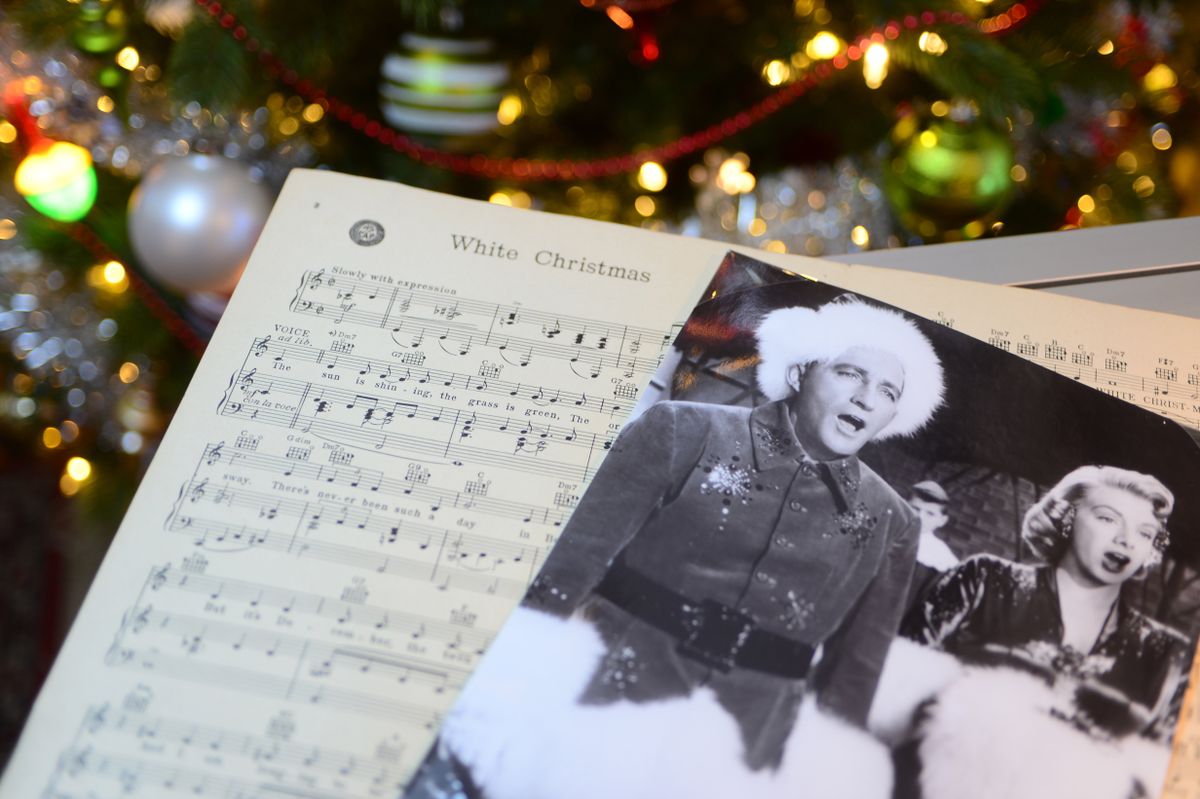
Bing Crosby’s song “White Christmas” and the movie of the same name, (AKA HOLIDAY HOTEL) 
starring Crosby and Rosemary Clooney, still attracts new fans with each generation. Memorabilia associated with it is displayed in the Bing Crosby house on the Gonzaga University campus. (JESSE TINSLEY/The Spokesman-Review)

By Dave Kindy
Special to the Washington Post

On Christmas Day 1941, crooner Bing Crosby stepped up to the microphone to introduce his new song. He was performing live on his hugely popular national radio show on NBC, “Kraft Music Hall.”

As the orchestra began to play, Crosby’s calming baritone floated over the airwaves: “I’m dreaming of a white Christmas, just like the ones I used to know …”

He ended the wistful song of holidays past, and the audience politely clapped. It was the first time he had sung “White Christmas” – what would become Irving Berlin’s super seasonal classic – but hardly anyone noticed it then.

The United States, still numb from the devastating attack on Pearl Harbor a little more than two weeks earlier, was preparing for a deadly war and had little time for a sentimental song about “sleigh bells in the snow” and “merry and bright” days.

“America was massively distracted,” said James Kaplan, author of “Irving Berlin: New York Genius,” published in 2019. “This was only 17 days after the worst attack on the country ever. There were more pressing concerns at the time.”

Of course, “White Christmas” would become the biggest-selling single of all time. According to Guinness World Records, it has sold some 50 million copies worldwide, with another 50 million in album sales.

So how did “White Christmas” become the megahit it is today?

Oddly, the very circumstances that inhibited its initial success eventually led to its explosion. As young men went off to face fascism and tyranny in faraway killing fields, the song’s touching message would resurface as a symbol of longing for a life that once was.

“White Christmas” was the brainchild of one on America’s greatest songwriters. Born Israel Beilin in western Siberia in 1888, Irving Berlin grew up on the mean streets of the Lower East Side of New York City. As a child, this son of an Orthodox rabbi learned about Christmas from an equally poor Irish Catholic family, the O’Haras. Young Izzy, as his childhood companions called him, was welcomed into their home, where they introduced him to what could best be described as a Charlie Brown tree. It left a lasting impression.

“This was my first sight of a Christmas tree,” Berlin told the Washington Post in 1954. “The O’Haras were very poor and later, as I grew used to their annual tree, I realized they had to buy one with broken branches and small height, but to me that first tree seemed to tower to heaven.”

Later, after incredible success as a writer of the American songbook, Berlin turned his attention back to those days to compose “White Christmas.” According to Kaplan, he probably tinkered with the idea for years before inspiration struck in early January 1940, when he said to his secretary, “I want you to take down a song I wrote over the weekend. Not only is it the best song I ever wrote, it’s the best song anybody ever wrote.”

Berlin later said he intended to use “White Christmas” in a revue he planned to produce, but then decided to hold it for the movie “Holiday Inn,” which starred Crosby and Fred Astaire. That film, about a couple of country inn owners who put on musicals for each holiday, spawned several Berlin hits, including “Easter Parade,” “Happy Holiday” and “Be Careful, It’s My Heart.”

Production for “Holiday Inn” was underway in 1941 when the Japanese bombed Pearl Harbor. Backed up by the Music Maids, Crosby introduced “White Christmas” on his national radio show on Christmas Day, but it barely made a dent in the public consciousness at the time.

In July 1942, the crooner recorded the song with an orchestra and his trademark whistling accompaniment. The movie was released the following month, and all of a sudden, the world took notice. “White Christmas” reached No. 1 on the charts in October 1942 and stayed there for 11 weeks.

For the many young men away at war, the song hit home. The early days of World War II were not good for the United States. Beginning with Pearl Harbor, the country suffered a string of defeats in the first few months of combat. Morale was low, and people needed something to hold onto. “White Christmas” and “Holiday Inn” became a lifeline for many Americans – especially overseas servicemen who heard it played on the Armed Services Radio Network

Kaplan compared the power of the song and movie to another major media event that took the world by storm: the appearance of the Beatles on the Ed Sullivan Show in February 1964 – less than three months after the assassination of President John F. Kennedy.

“The country was plunged into darkness after JFK’s death, followed by this bolt of sunshine on television,” he said. “There was something about this movie and this song that had a very similar effect on America in 1942.”

The Pulitzer Prize-winning poet Carl Sandburg understood what was happening. On the first anniversary of Pearl Harbor in 1942, he wrote about “White Christmas” in the Chicago Times:

“Away down under, this latest hit of Irving Berlin catches us where we love peace. The Nazi theory and doctrine that man in his blood is naturally warlike, so much so that he should call war a blessing, we don’t like it. … The hopes and prayers are that we will see the beginnings of a hundred years of white Christmases – with no blood-spots of needless agony and death on the snow.”

When the Armed Forces Radio Network began playing “White Christmas” in 1942, servicemen couldn’t get enough of it. The military’s broadcast service was flooded with requests to play the song. The image of snow making “treetops glisten” comforted those homesick young men as they fought and died in the deserts of North Africa and the jungles of the South Pacific.

In November 1942, Time Magazine reported that “White Christmas” had sold an astounding 600,000 records in just 10 weeks. It would also be played overseas on tens of thousands of V-discs – the small metal “victory” records listened to by troops as they ducked shells and bullets in their shelters on the front lines.

“White Christmas” became an essential part of Crosby’s repertoire. He sang it often, including when entertaining the troops on USO shows in Europe and the Pacific. Later in the war, though, the crooner tried to eliminate it from the lineup – not because he didn’t like it but because he thought it sad for servicemen to hear so far from home.

Howard Crosby, the singer’s nephew, spoke with his uncle about the song’s impact, especially with the troops. In 2016, he told The Spokesman-Review:

“In December 1944, he was in a USO show with Bob Hope and the Andrews Sisters in northern France. … He had to stand there and sing ‘White Christmas’ with 100,000 G.I.s in tears without breaking down himself. Of course, a lot of those boys were killed in the Battle of the Bulge a few days later.”

Crosby’s 1942 recording of “White Christmas” has stood the test of time. Not only did it become a hit again in 1954 with the movie of the same name – starring the crooner alongside Danny Kaye, Rosemary Clooney and Vera-Ellen – it still survives today as a staple on holiday playlists for radio stations, cable music channels and satellite services.

According to Kaplan, “White Christmas” has a potency that allows it to be enjoyed by succeeding generations and even among people of different faiths. The lyrics are powerful enough to convey strong feelings of home and family, yet simple enough so everyone – Christians, Jews, atheists and others – can believe in this vision of life and longing.

“’White Christmas’ appeals universally,” Kaplan said. “It is a great and timeless song. There is something so enigmatic and withheld about it that makes it one of the great works of popular art. Ultimately, ‘White Christmas’ is a dream. This is not reality he is positing on. He’s dreaming of a white Christmas. The images are very vivid and dreamlike.”

And it was just what the United States needed in the depth of war in 1942.

Americans Who Love Guns More Than People

Honestly, I am so sick of being surrounded by these people. I don’t think I’m alone.


December 18, 2021 by John Pavlovitz Leave a Comment


Kentucky Republican Representative Thomas Massie tweeted out a photo of his family all holding weapons and wearing beaming smiles, with the caption:
Merry Christmas!
ps. Santa, please bring ammo

Let’s put aside what the Conservative reaction would be to any Democrat lawmaker’s Christmas tweet that mentioned Santa and not Jesus. (The pearl-clutching “War On Christmas” cries would still be echoing through the canyons of GOP social media and partisan television.)

Let’s also table imagining the Republican Christian response, if a Muslim family shared a photo of themselves wielding an arsenal on one of their high holy days. (The allegations of terrorist indoctrination of children would be fierce and unrelenting.

And let’s not try to figure out how to connect the dots between people who incessantly remind you that they are “pro-life”—and joyfully waving a massive cache of high-powered weapons designed only for tearing through the flesh of the living.

Those are matters for another day.

Instead, I want to ask how any supposedly Christian family becomes so morally inverted, that they imagine a good idea to celebrate the birth of a Prince of Peace Jesus, is to pose with instruments of rapid carnage. Further, I’d like to ask how any adult with any self-awareness or working empathy, would share a photo like this on social media just days after a mass shooting at a high school that killed four people? Inside what kind of head is this a decent thing to do?

Honestly, I think there’s only one answer to these questions:

Millions of Americans now love guns more than people.

This happens when a political party has become so beholden to the NRA and to those who profit off the sale of weapons, its leaders use religious holidays to give them a bizarre social media shout-out.

It happens when a toxic religion of fear has been so ingrained in the minds of the faithful, they can no longer recognize the disconnect between middle finger-flying, gun-wielding bravado—and the compassionate healer Christ they claim to be devoted to.

It happens when human beings become so desensitized to mass murders in schools, shopping malls, and churches, that they can no longer find the capacity or reason to grieve them, especially when that grief is adversarial to their politics.

Most of all, this unfathomable disconnect between Christians and violence, occurs when Americans begin to treasure guns more than those murdered with them.

Honestly, I am so sick of being surrounded by these people. I don’t think I’m alone.

I think millions of people of faith, morality, and conscience, simply cannot comprehend how the cause of guns became to so many of our families, friends, and neighbors—the solitary hill they will gladly die on.

We cannot fathom how this became their greatest passion: not the poor or the hungry, not inequity or injustice, not pollution or climate change, not education or healthcare or anything remotely redemptive.

We don’t know why they feel compelled to plaster guns on their bumpers and their chests and profiles, in “Come and Take them” taunts and threats that project some antagonistic bullying provocation that looks nothing like Jesus.

Yet, the saddest part, is that these people wouldn’t be able to answer at this point, anyway. Once you’re trapped inside an addiction you aren’t able to see it clearly—and Conservative Americans are in the throes of a dependency on guns that has fully addled them. Until they can be shaken out of the intoxicating high they get when they brandish military-grade weaponry, we’re going to see more and more of this sickening, infuriating gun advocacy and less and less concern for lives taken with guns.

Until these people are able to actually dig deep enough to ask why they care so much about having their arms around a barrel and fingers on a trigger, they’re going to be ignoring mass shootings and defending vigilantes and opposing gun control legislation and posturing for unconscionable holiday photos.

And the rest of us who love people more than guns, are going to have to endure living alongside them—and to keep fighting for all our lives.

Previously published on johnpavlovitz.com
‘Tis the Season for Wasting Tons of Food

A viral TikTok reminded viewers just how much food ends up in our dumpsters and landfills.


ARIANNA COGHILLFellowBio


On December 11, a TikTok user named @dumpsterdivingfreegan uploaded a video showing a bounty of packaged and unopened food products that the account claimed came straight from a Whole Foods dumpster. “Dumpster diving at Whole Foods is nothing like I’ve ever seen before,” exclaimed the voiceover as the video panned to tables loaded with dozens of packages of meat, produce, dairy products, and even an entire frozen turkey, all allegedly pulled from the garbage. None of the food, the video claimed, had yet gone past its sell-by date.

The post quickly went viral. @dumpsterdivingfreegan didn’t respond to requests for comment, and a Whole Foods spokesperson said the company couldn’t confirm the veracity of the video. “Food can be discarded for any number of reasons outside of an expired ‘best by’ date,” the spokesperson added, “and just because the printed best-by date has not passed does not necessarily mean that food is safe to consume.” Regardless, the video racked up 4.7 million views on TikTok and 6.6 million more on Twitter, becoming the latest talking point in the decades-old conversation around food waste in the United States.

But first things first: What actually constitutes food waste? According to the United Nations Environmental Programme, food waste is defined as any food or drink meant for human consumption and “removed from the human food supply chain”—meaning any food that ends up in a landfill, controlled combustion, sewer, or compost.

In its 2021 Food Waste Index Report, UNEP reported that the United States ranked higher than any other country in terms of food waste from food services, at a little more than 141 pounds per person. They also reported that each year, an estimated one-third of all food produced gets thrown away. That’s around 1.3 billion tons of food that ends up rotting or spoiling—an amount worth approximately $1 trillion. And according to the Environmental Protection Agency, food waste constitutes 24 percent of municipal solid waste and is a big reason why landfills are the nation’s third-largest source of human-related methane emissions.

At the same time that all of this food is being wasted, there are still millions of households struggling with food insecurity across the country. According to the United States Department of Agriculture, 38.3 million people, including 6.1 million children, lived in food insecure households in 2020. There are several things that cause food insecurity, including but not limited to poverty and lack of affordable housing or health care. Hunger is often higher in Black, Latinx, and Native American communities, in part due to systemic racial injustice; a 2020 study in the Journal of Racial and Ethnic Health Disparities notes that “the concentration of social and economic disadvantage among racial/ethnic minorities is a significant predictor of their higher rates of food insecurity.” Between Thanksgiving and Christmas in the United States, food waste increases by 1 million extra tons.

This food waste paradox is exacerbated during the holidays. As many families cook and eat feasts that produce tons of leftovers, food waste numbers surge. Between Thanksgiving and Christmas in the United States, food waste increases by 1 million extra tons, or 25 percent. And while they make up the largest producers of food waste, individual households aren’t the only perpetrators: Restaurants, grocery stores, and retailers are all guilty, as well. In fact, together they create up to 40 percent of all of America’s food waste, almost as much as the household total of 43 percent.

“The reality as a regional grocery manager is, if you see a store that has really low waste in its perishables, you are worried. If a store has low waste numbers, it can be a sign that they aren’t fully in stock and that the customer experience is suffering,” wrote Doug Rauch, a former president of Trader Joe’s, in a 2011 study.

These industry attitudes, however, have begun to shift. Recently, several grocery stores, including Whole Foods, have taken a pledge to cut down their food waste in half by the year 2030.

But what about consumers? If you’re not the head of a huge agricultural corporation or grocery store chain, what can you do to to help shrink this problem? According to advocates, a few simple things can make a difference. For starters, the Environmental Protection Agency recommends donating to your local food bank, instead of letting the food expire.

Another suggestion is knowing the difference among the different expiration labels on your groceries. According to Recycle Tracking Systems, an environmentally focused waste management company, this can prevent households from throwing out food before it’s unsafe to eat. For example, a product’s “best if used by” date means it may not taste or perform as expected, but it’s still safe to eat by that date. But a “used by date” means that if you don’t consume the food by that date, it’s expired and unsafe to eat.

And if your food does go bad, the NRDC recommends giving composting a try. The process is basically making your own fertilizer out leftover organic waste, like food scraps or leaves. It also has plenty of environmental benefits, including improving soil health, reducing greenhouse gas emissions, and recycling nutrients.

Even those relatively simple steps can help lower your own personal amount of food waste this holiday season—and keep countless pounds of food out of landfills in the coming months and years.
SHE IS A TORY
Hinshaw will not 'judge' UCP for having Christmas party despite recommendations


Sean Amato
CTV News Edmonton
Updated Dec. 23, 2021

Dr. Deena Hinshaw said she would not "sit in judgement" after the United Conservative Party held a Christmas gathering just hours after she and other officials asked Albertans not to.

The province's chief medical officer of health was repeatedly asked Thursday by journalists if she was disappointed and frustrated by the revelation.

"My job is to provide recommendations, to provide the public specific details on what we know about variants," she said.

"If I were to sit in judgement of everyone who perhaps caused increased risk, I would not have enough hours in the day."

Hinshaw pointed out that many gatherings are still allowed, but again told Albertans that "it's very important right now to make choices that minimize the spread."

As she has throughout the pandemic, Hinshaw also refused to say what restrictions she recommended to the government, as COVID-19 case numbers continued to rise with the arrival of the highly-transmissible Omicron variant.

Premier Jason Kenney and Health Minister Jason Copping were not at Thursday's media briefing.

"We are appealing to Albertans to reduce their number of daily in-person contacts by half over the coming weeks. We also need Albertans to make personal choices in their daily lives that will slow transmission," Kenney said at approximately 4 p.m. on Tuesday.

"We strongly encourage workplaces to cancel any social gatherings," Copping added.

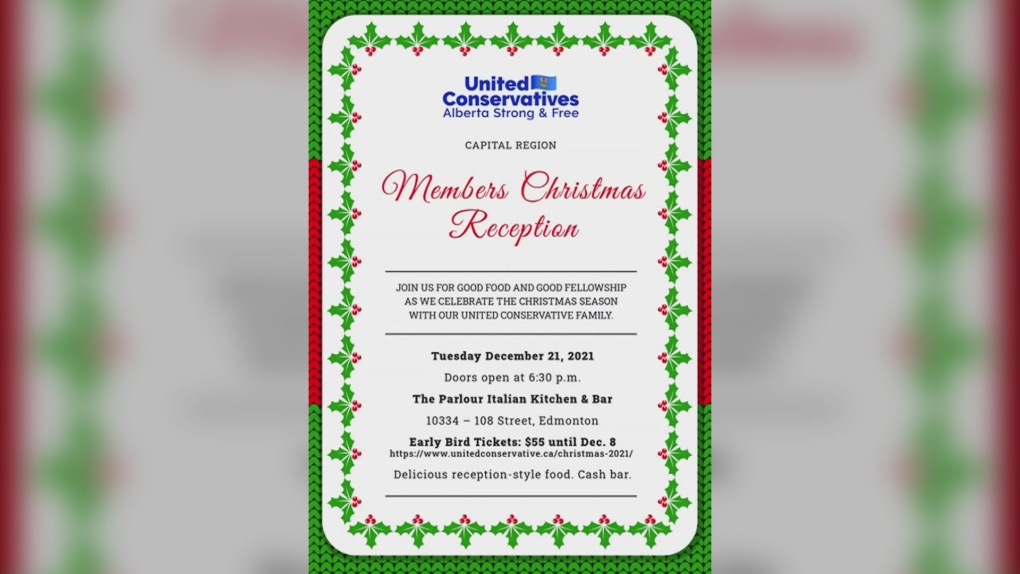
At 6:30 p.m., the doors opened to the UCP's capital region reception at Parlour Italian Kitchen and Bar just a few blocks from the Alberta legislature.

'ALBERTANS ARE FRUSTRATED'


"To have the health minister yesterday tell all Albertans, and all Alberta workplaces, 'we think you should be cancelling your holiday parties,' and the UCP to still hold those shows that Jason Kenney lacks all leadership," NDP MLA Christina Gray said.

A UCP spokesperson defended the decision to go ahead with the party. Dave Prisco said the gathering didn't break any rules, but a similar party in Calgary the night after was cancelled "in accordance with the premier's advice."

Kenney apologized in January for an international travel scandal involving several MLAs and staff members. He also apologized in June for not following COVID-19 rules during a rooftop dinner.

"Albertans are frustrated. The hypocrisy we continue to see from this government undermines our public health response and exhausts Albertans,” said Gray.

Justice Minister Kayce Madu confirmed he went to the party, but said he didn't know how many people were there.

"Absolutely, I was there. The timeframe was too close for that event to be cancelled," he claimed, adding that the business had already spent money and the party made a commitment to be there

Madu said "as far as I know" the event complied with provincial rules.

"Whilst I understand the concerns that some people have, what is expected of everyone is to understand what the rules are, comply with the rules. We will always have debate about the optics of particular course of action by some group, including myself," he said.

A source confirmed to CTV News Edmonton that Associate Minister Dale Nally was also at the party, but his spokesperson did not respond to questions about that on Thursday.

Party officials also would not say how many people attended, but the premier's spokesperson confirmed that neither Kenney nor Copping were there.

NDP Leader Rachel Notley said her team will not have a Christmas party.

"When we saw case counts rising, and other provinces impose restrictions, we cancelled this month's holiday staff party to reduce in-person contacts. It was the responsible thing to do," Notley tweeted on Wednesday.

Bars and restaurants were allowed to be open on Wednesday, with masking, vaccine and distancing rules in place.

Alberta reported 1,625 new cases of COVID-19 on Thursday after completing around 11,800 tests.

"I will just say that all of us, everyone across this province, we have an opportunity right now…the choices that we make will have significant consequences not just for us, but for those around us," Hinshaw said.

A complete list of the province's health measures is available online.

Opinion: Kenney sows confusion about Alberta's public pensions

Author of the article:Bob Ascah
Publishing date:Dec 21, 2021 

Alberta Premier Jason Kenney addresses the Calgary Chamber of Commerce on Dec. 8, 2021. PHOTO BY JIM WELLS /Postmedia

In response to a reporter’s question about my recently released Parkland Institute study on the Alberta Investment Management Corporation (AIMCo), Premier Kenney misled Albertans about the government’s role in funding the pensions of teachers, nurses and other public employees.

All Albertans, whether taxpayers or beneficiaries of these pension plans, should care about how AIMCo performs. First, there are nearly half-a-million Albertans, retired or working, who contribute to, and receive from, these plans hundreds of millions of dollars annually. If one includes family members, the plans probably impact close to one million Albertans. With nearly $100 billion in assets in these pension funds, two-thirds of AIMCo’s funds are pension-plan members’ investments, not public money.

Second, all Albertans have a stake in the Heritage Fund whose investment earnings are used to support public services. Unfortunately, last year Heritage Fund income fell dramatically due to an exotic, poorly executed investment strategy by AIMCo.

The premier asserted “that “broadly over the past decade they have performed as well or better than the average amongst comparable public pension fund managers.” Not true. The Parkland report showed that, when compared with four large provincial-based investment managers, AIMCo’s performance was certainly not better than most of its peers.

When compared against the Alberta Teachers’ Retirement Fund (ATRF), AIMCo’s performance was worse. Last May, ATRF reported to the Alberta Teachers’ Association that if AIMCo had managed ATRF funds the way they managed funds for other clients, over the past seven years the value in an AIMCo-managed teachers’ fund would have been $1.3 billion lower.

Premier Kenney then went on to state that public pensions “are effectively indemnified by the Crown.” If this were true, public-sector workers across Alberta should be celebrating this early Christmas present from Kenney. According to the premier, if pension funds underperform and they do not have enough to pay pension benefits in the future, “the taxpayer has to cover the difference.” Unfortunately, this is not true. Governing legislation and regulations over the past three decades have been developed to remove the government backstop. Finance Minister Travis Toews surely was surprised by the premier’s expansive and novel interpretation of Alberta public-sector pension law.

Kenney also claimed that by forcing the ATRF to invest through AIMCo, there would be $50 million in administrative savings. This estimate is fanciful for a couple reasons. First, as investment managers and pension experts know, it is not cost savings that matter most, it is net investment income after costs. If costs rise by $10 million but investment income increases by $30 million, the members benefit. Secondly, the ATRF’s total administrative expenses in 2020 were $40 million with the bulk of other expenses going to external investment management fees. It appears the premier was relying on an analysis by AIMCo that they could manage costs down by 25 basis points — a number that seemed to be accepted without any questions. It is doubtful if the government will track this number and report the assumed savings to the public.

All this muddling around should concern Albertans because the premier fundamentally misunderstands the pension bargain with government workers. On top of clarifying that he has not given public pension members a blank cheque in the form of a new government indemnity, he also needs to work with the owners of the pension funds, the workers who are investing in them, to actually fix the governance issues at AIMCo.

Public pensions are too important to be left to the whims of politicians. The premier and Finance Minister Toews need to quickly clear up the confusion about public pensions and remove the monopoly control they have given AIMCo over so many Albertans’ pensions.

Dr. Bob Ascah is the former director of the Institute for Public Economics at the University of Alberta and a former Treasury Board employee. His report is available at www.parklandinstitute.ca His blog is Abpolecon.ca.
Dozens of Drumheller prison staff infected with COVID-19 after Christmas party

Thirty-six staff members at the facility have tested positive for the virus; inmates' families say the spread has brought on new restrictions for their loved ones

Author of the article :Michael Rodriguez
Publishing date:Dec 26, 2021 
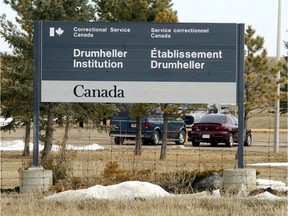
The entrance to Drumheller Institution PHOTO BY TED JACOB /Calgary Herald
Article content

Thirty-six staff members of a federal prison in Drumheller have tested positive for COVID-19 after some attended a staff gathering earlier this month, the Correctional Service of Canada has confirmed.

The Drumheller Institution, located about 130 kilometres east of Calgary, is a federal prison that can hold up to 582 medium-security inmates and 122 minimum-security inmates. No inmates have contracted the virus during the current outbreak and all infected staff members have been sent home to isolate, according to the Correctional Service.

“My husband is there and he said that one of the guards told him directly that they had a big potluck,” said Nicole Friesen, a northern Alberta woman who had to cancel a New Year’s visit with her inmate husband.

“I think it was pretty irresponsible considering the things that have been going around in the province with lots of places shutting down, and then (the staff) thought it was OK to just have a random party. Especially when people want to see their families around the holidays.”

The Correctional Service confirmed some staff members who tested positive attended the event but did not state the date or nature of the gathering, nor whether it violated public health orders.

To mitigate the virus’s spread, the prison has temporarily suspended visitation — a fact Edmonton resident Allison learned via a phone call from her husband on Dec. 22, just days before her planned trip to visit him at the facility on Christmas. Postmedia has agreed not to publish Allison’s last name due to fears of repercussions for her husband.

“(The guards) ended up having a Christmas party and a bunch of them were sent home, testing positive,” she said.

Both Friesen’s and Allison’s husbands are in the prison’s minimum-security unit, where inmates live in houses and are generally given more liberties than in a typical prison setting, with regular access to phone calls and more freedom of movement. But now with several guards and other staff getting COVID, they said phone use is being regulated and inmates are restricted to their rooms.

“They’re basically on lockdown, like in quarantine again,” said Friesen. “They are basically confined to their houses except for a couple of breaks during the day.”

Other sources within the prison community at Drumheller Institution, who spoke to Postmedia on the condition of anonymity due to fears of repercussions for their family members, corroborated the concerns highlighted by the two women. One woman, whose son is a medium-security inmate at the prison, said a pre-Christmas video call with her son was cancelled and moved to next week.

“They just told me it was due to COVID. They didn’t say anything about a Christmas party or that it was guards or who had COVID, but that was the reason given,” she said.

The Correctional Service refuted the claims regarding new restrictions in the prison, saying the institution is not locked down and inmates are not confined to their cells. The only change is the suspension of in-person visitation; inmates are still allowed out on their units throughout the day with access to video and phone calls to contact family and community supports, along with daily outdoor exercise time, the service said in a statement.

“CSC continues to closely monitor the situation, test broadly, and diligently apply infection prevention and control measures to prevent the spread of COVID-19 within the institution,” the federal agency said in an emailed statement Sunday.

“In addition to the use of masks, medical isolation and physical distancing, we have also established cohorts and modified routines as a measure to help prevent the spread of the virus.”

Earlier this year, Drumheller Institution had one of the most severe COVID-19 outbreaks in any Alberta federal facility, with 181 positive cases in inmates. No inmate deaths were directly tied to that outbreak. The prison was locked down for more than two months, with inmate movement heavily restricted, sparking mental-health concerns at the prison.

The Alberta government’s COVID-19 data website does not currently list the prison as having an active outbreak. AHS said the responsibility of declaring an outbreak in a federal institution lies with the Correctional Service.

As of Dec. 20, 84.6 per cent of inmates at Drumheller Institution have been fully vaccinated, according to the Correctional Service. Staff members at the prison are subject to the vaccine mandate for federal employees.