Thursday, August 04, 2022

The federal government isn't prepared to relocate America's climate change victims

Alex Lubben, Julia Shipley, Zak Cassel and Olga Loginova
·Columbia Journalism Investigations
Wed, August 3, 2022 

LONG READ

This article was produced in partnership with Columbia Journalism Investigations, the Center for Public Integrity and Type Investigations.


SMITHFIELD, Va. — When flooding from Hurricane Floyd in 1999 destroyed Betty Ricks’s home, she rebuilt it. Several years later, she posed proudly for a Christmas photograph beside her daughter and granddaughter in her new living room.

Then another flood — brought by Tropical Storm Ernesto in 2006 — claimed her house a second time, leaving soggy furniture and appliances jumbled sideways.

“Everything gone again,” Ricks said. The only thing she salvaged was the photograph, now water-streaked.

After that storm, she rebuilt her home from scratch once more. Yet more flooding followed.

Now she and some of her neighbors on Great Spring Road, who live adjacent to a creek that overflows during bad storms, see no way out of this dangerous loop but to move. With an increasing number of communities at high risk from worse and more frequent disasters fueled by the changing climate, experts warn that many Americans will find themselves in a similar situation.


Betty Ricks in her home in Smithfield, Va. The family photograph in the background is all she could save after a devastating tropical storm. 
(Julia Shipley/Columbia Journalism Investigations)

But the only way to leave without putting new buyers in the same position — or abandoning their homes altogether — is to seek relocation funds from the federal government.

Twice now, Ricks and her neighbors have asked for that help. Both times, their applications were denied.

Columbia Journalism Investigations in partnership with the Center for Public Integrity and Type Investigations spent a year digging into the growing need for climate relocation across the United States. Little organized government assistance exists for preventing the loss of homes and lives before a disaster, the investigation revealed — and there is no comprehensive focus on helping people escape untenable situations like Ricks’s.

That leaves people in harm’s way to fend for themselves. Many can’t.

Columbia Journalism Investigations and its partners analyzed federal disaster declaration data over the past three decades to identify communities repeatedly hit by major hurricanes, floods or wildfires, events that climate change is worsening.

The analysis revealed dozens of communities across the country in recent years — and hundreds over the last generation — bearing the brunt of successive disasters, from California to North Carolina, Washington state to Texas. Many are located near the Atlantic, Pacific or Gulf coasts, but the impacts are also felt far from the shoreline, in Missouri, North Dakota, Kentucky and elsewhere. No region of the country has been spared.


Cassandra Wilson of Ironton, La., gestures at her community's cemetery, flooded by Hurricane Ida in 2021. The storm surge pushed caskets out of the crypts.
 (Olga Loginova/Columbia Journalism Investigations)

What unites these pummeled communities is that they are often more socially and economically vulnerable than other places, the analysis revealed.

People of color make up more than half the residents in counties that experienced at least three climate disasters in the past five years. These counties also have a higher proportion of residents who speak limited English and people in poverty than the rest of the country.

The Federal Emergency Management Agency’s disaster preparedness spending — which includes money to help people relocate — already falls short of the need, experts say. And it’s not flowing out equitably, according to the analysis by Columbia Journalism Investigations and its partners.

Among hard-hit counties, places with a higher share of residents of color than the national average received about 40% less funding per person. A similar trend held over the last three decades.

Taken together, the findings highlight how, in the face of climate-driven disasters, communities across the country in the greatest need of government assistance receive less of it — if they get anything at all.

These challenges affect a large and growing number of people. In 2018, the government’s most recent National Climate Assessment warned that more than 13 million people across the country may need to move by the end of the century due to sea level rise. Add the effects of hurricanes, flooding rivers and wildfires, and millions more will need to seek out safer parts of the country — or remain trapped in damaged, dangerous conditions.

Take Smithfield.

Sea levels in this Hampton Roads region in Virginia, by the Chesapeake Bay, are rising faster than anywhere else along the Eastern Seaboard. Additionally, the land along the Virginia coast is slowly sinking, causing high tides to push water farther and farther inland. Along Ricks’s Great Spring Road, amid the region’s coastal floodplain, sudden heavy rains can cause water to rise up to 7 feet in just an hour, turning the streets into rivers.

Ricks has been rescued by boat from her home twice.


Ricks’s home in Smithfield, Va. (Julia Shipley/Columbia Journalism Investigations)

In 2010, she and her neighbors applied for a federal buyout through Isle of Wight County, where Smithfield is located. For decades, FEMA has facilitated the purchase of flood-prone homes. Following the buyouts, the government demolishes the structures, returning the land to open space to stop the cycle of damage and loss.

On Ricks’s application, a hazard mitigation consultant attested that the grant “would eliminate the possibility that another homeowner will suffer the same misfortune as Mrs. Ricks.”

The state agency denied Ricks’s application for unknown reasons; according to one official, no documentation that could explain the decision could be located.

In 2020, Smithfield officials tried again, applying for $920,240 in funding from FEMA to acquire and demolish Ricks’s home and four neighboring properties. The project would be “100% effective in preventing loss of property and life due to future flooding,” the town’s funding paperwork stated.

FEMA denied the request.

The money would have come from FEMA’s newly launched Building Resilient Infrastructure and Communities program, which allocated $500 million for disaster and climate change preparedness projects across the country. But Victoria Salinas, FEMA’s acting deputy administrator for resilience, said there wasn’t enough funding to help Smithfield in 2020. Across the country, requests for assistance exceeded $3 billion.


A Coast Guard helicopter conducts a flyover of the Charleston, S.C., area that was affected by Hurricane Matthew in 2016.
 (Petty Officer 3rd Class Alexandria Preston/USCG)

“We were oversubscribed,” Salinas said. “There are so many good projects that need to be funded, and communities want to invest in their resilience. They want to be making sure they’re safe today and tomorrow. There’s just not enough money on the streets to [fund them all].”

Ricks sees no way out without that help. She leaves the TV on in her bedroom, checking news broadcasts for warnings about incoming storms. She keeps important papers wrapped in plastic bags in a trunk at the foot of her bed, hoping that will be enough to save them when her home floods again.

Faced with intensifying hazards and a federal government failing to act, she asks a question with no clear answers:

“What am I going to do?”

No 1-stop shop for climate relocation

On a hotter planet, rising sea levels, largely driven by melting polar ice, and harsher hurricanes are threatening coastal areas. In the West, wildfires are more frequent and devastating. Every region of the U.S. is likely to experience more intense rainfall, according to the National Climate Assessment.

The federal government knows that climate change will displace millions, but it has been slow to respond to the growing threat. No single agency or program is responsible for helping Americans move to safer parts of the country.

“There’s not a one-stop-shop program for this,” Salinas said. “I think right now, what we do offer is pieces of it.”

The tundra near Kivalina, Alaska, in 2019. Permafrost, which is found to some extent beneath nearly 85% of Alaska, has been melting due to the Earth's rising temperatures. (Joe Raedle/Getty Images)

Vulnerable Americans must navigate a bureaucratic labyrinth, seeking funding from grant programs spread across multiple agencies. Taken together, Salinas said, the existing “patchwork quilt” of programs can help communities relocate. But tapping into them is difficult at best for small, under-resourced communities on the frontlines of climate change. Often they don’t have the resources to apply at all.

“What’s really frustrating is that every different program has different eligibility requirements and determinations,” said Kelly Main, the executive director of Buy-In Community Planning, a nonprofit that helps communities apply for buyouts. “Just being able to go through all of the different eligibility determinations for each of those programs, if you’re a one-person staff in a small town somewhere on the Gulf Coast, is extremely challenging.”

Smithfield is not alone in its struggles.

In Washington state, where rising seas cause repeated flooding, at least four tribal nations are seeking federal help to support relocation efforts and still need millions of dollars in order to move.

In Colquitt, a small community in Georgia, Hurricane Michael leveled a mobile home park in 2018. Records show that officials applied to FEMA for buyouts twice and received no assistance.

In Horry County, S.C., a working-class community just up the coast from Myrtle Beach, residents applied for a HUD-funded buyout program, but the process has dragged on for years, leaving homeowners stranded.

Because government assistance programs are so difficult to access, communities often find themselves dealing with the aftermath of disasters on their own. In De Soto, Mo., residents said they sit in their cars when it rains, ready to evacuate quickly if the Joachim Creek floods. The Army Corps of Engineers recommended buyouts for about 70 flood-prone properties in 2019. Since then, the city has applied for FEMA buyouts twice, but state and federal officials approved funding for just one property. The homeowner chose to remain in their home, according to De Soto’s city manager. No one in De Soto has been moved out of the flood zone.


Vehicles under water in Philadelphia on Sept. 2, 2021, in the aftermath of Hurricane Ida. (Matt Rourke/AP)

With no aid on the horizon, some residents have sold their flood-prone houses at a loss. “Right now they’re selling on this block, but they’re selling for 25 cents on the dollar,” said Ken Slinger, a De Soto resident who lives across the street from the Joachim Creek.

A federal buyout would allow him and his wife, Cindy, to move to a safer area, he said. Without one, they can’t afford a comparable home nearby.

For the government, the cost of doing nothing can escalate quickly.

In flood-prone areas, for example, the government might need to provide repeated rounds of aid to help residents recover and rebuild, said Jeffrey Peterson, a former Environmental Protection Agency official and member of the White House Council on Environmental Quality during the Obama administration. The “smarter investment,” he said, is for the government to buy out residents — avoiding the need for additional help.

“We could end up spending $500,000 on your house,” Peterson said. “So let’s buy it now for $250,000” and prevent escalating costs.

Mitigation efforts like seawalls may delay encroaching waters, but they also require large upfront investments. And even then they are only an interim solution, Peterson and other experts warn.

“Protection for most of our coastline doesn’t make any sense,” said Solomon Hsiang, a professor of public policy at the University of California, Berkeley. “For a lot of the U.S. coastline, relocation is probably cost-effective.”
Unmanaged retreat

Politicians’ unwillingness to fully acknowledge the problem is a key obstacle to funding relocation efforts, according to interviews with a dozen former federal officials.

“People’s climate risk is not something that politicians, that elected officials, that even appointed officials, or people running different agencies of governments in towns and cities across the country, are eager to know and make public — largely because they believe that they do not have the money to address the climate risks that might be revealed,” said Harriet Tregoning, a former senior HUD official who is now director of the New Urban Mobility Alliance, a coalition focused on urban transportation. “And highlighting climate risk without a plan for addressing those risks, they see as a recipe for undermining everyone’s confidence in the future of that community.”


Debris piles up on a curb as residents gut their flooded homes in the aftermath of Hurricane Ida in LaPlace, La., Sept. 7, 2021. (Gerald Herbert/AP)

The most recent effort to develop a plan for climate relocation came in 2016, when President Barack Obama established an interagency working group to craft a framework for “managed retreat,” a term that describes voluntary, community-led relocation projects. The Trump administration abandoned the project after just two months, and the Biden administration has not relaunched it.

Asked for comment, the White House did not address this directly. Its Council on Environmental Quality provided a list of efforts to defend people from climate-fueled disasters, only a few of which were about relocation, and offered a statement from Chair Brenda Mallory.

“The truth is: we need a wide range of strategies and solutions — across the entire Federal government — to help communities protect themselves from disaster, respond when disaster strikes, and, in some cases, move out of harm’s way,” she wrote. “Through a series of hazard-focused interagency working groups, we are working to get critical investments to the communities that are most vulnerable, support community-led efforts to protect against climate-fueled disasters, improve climate and risk information for communities, improve building standards and codes across the country, and share best practices and policies.”

Without any federal relocation policy in place, scientists say Americans are already in “unmanaged retreat” — families and individuals are taking matters into their own hands and, without government help, fleeing areas vulnerable to climate-driven disasters.

In Paradise, Calif., the 2018 Camp Fire, one of the worst wildfires in California history, burned down more than 13,000 structures — 95% of the town. At least 85 people died. Sarah Bates, a longtime resident, lost her home and everything in it: photo albums, all her furniture, the record collection she’d compiled during her 40-year stint as a radio DJ, the electric wheelchair she needed to get around.


U.S. Army Sgt. Rodrigo Estrada leads a team conducting search and debris-clearing operations in Paradise, Calif., after the Camp Fire in 2018.
 (Senior Airman Crystal Housman/U.S. Air National Guard)

In the wake of wildfires, government assistance is almost entirely directed toward rebuilding, not relocating.

“There’s no precedent for wildfire buyouts,” said Robert Barker, a spokesperson for FEMA Region 9, which includes California.

Bates decided she could no longer stay in Paradise, however. She initially moved to North Carolina before eventually settling in central Virginia, funding the move on her own. Once she got to the East Coast, she struggled to find affordable housing.

“There’s still people not in housing even now,” Bates said. “And it’s inexplicable to me that the government has not worked out what to do about helping them get rehomed after three years.”

More than 14,000 people moved out of Paradise after the Camp Fire, according to Peter Hansen and Jacquelyn Chase, researchers at Chico State University who analyzed change-of-address data to map the migration across the country. More than 4,000 left Butte County and more than 2,600 left California entirely, moving to Oregon, Indiana, Tennessee and other states, the analysis showed.

“The absence of managed retreat is going to be unmanaged retreat,” said Anna Weber, a policy analyst with the Natural Resources Defense Council. “It’s not going to be no retreat at all.”


Aerial view of a mobile home park that was destroyed during the Camp Fire in Paradise, Calif. (Robyn Beck/AFP via Getty Images)

In April, Valerie Butler, a member of the Smithfield Town Council and one of Betty Ricks’s neighbors, sent an email to the town manager and her fellow council members. In it, she urged her colleagues not to give up on efforts to obtain federal aid for relocation.

“I know the bureaucratic process can be daunting,” Butler wrote. But Smithfield was facing another hurricane season, and residents were frightened. “Can you imagine,” she wrote, “being in your home, a place of protection and safety, when it rains each time and your kids ask you, ‘is the boat going to have to come [and] get us.’

“This is heartbreaking. Resolving this situation should be a priority.”


CJI research assistants Gabriela Alcalde and Samantha McCabe contributed to this story. Carolynne Hultquist, a disaster researcher at Columbia University’s Center for International Earth Science Information Network, contributed to the data analysis.

Julia Shipley, Alex Lubben, Zak Cassel and Olga Loginova are reporting fellows for Columbia Journalism Investigations, an investigative reporting unit at the Columbia Journalism School. The Center for Public Integrity and Type Investigations, two nonprofit investigative newsrooms, provided reporting, editing, fact-checking and other support. Additional funding for this story was provided by the Fund for Investigative Journalism.

Hearing pain of Canada school survivors felt like slaps, pope says


Pope Francis holds a news conference aboard the papal plane on his flight back after visiting Canada

Wed, August 3, 2022 
By Philip Pullella

VATICAN CITY (Reuters) -Pope Francis said on Wednesday he felt the pain of survivors of Canada's residential school system "like slaps" and that the Catholic Church has to face up to its responsibility for institutions that abused children and tried to erase indigenous cultures.

The pope dedicated his talk at his weekly general audience to his trip last week to Canada, where he delivered a historic apology for the Church's role in the government-sanctioned schools, which operated between 1870 and 1996.

More than 150,000 indigenous children were separated from their families and brought to residential schools. Catholic religious orders ran most of them under successive Canadian governments' policy of assimilation.

The children were beaten for speaking their native languages and many were sexually abused in a system Canada's Truth and Reconciliation Commission called "cultural genocide."

The pope met indigenous survivors throughout the trip and on the last day, mostly elderly school survivors in Iqaluit, capital of the isolated Arctic territory of Nunavut, told him their stories in a private meeting.

"I assure you that in these meetings, especially the last one, I had to feel the pain of these people, like slaps, how they lost (so much), how the elderly lost their children and did not know where they ended up, because of this policy of assimilation," Francis said in unscripted comments.

"It was a very painful moment but we had to face up, we have to face up before our errors and our sins," he said.

During the trip, the pope's apologies evoked strong emotions and praise as a first step in reconciliation, but some survivors said they fell short of expectations and that he had not apologised clearly enough for the Church as an institution.

In an apparent attempt to answer the critics, he said on Wednesday that priests, nuns and lay Catholics had "participated in programmes that today we understand are unacceptable and contrary to the Gospel. That is why I went to ask forgiveness in the name of the Church".

Some were also heartened when the pope, speaking to reporters on the plane taking him back to Rome on Saturday, branded what happened at the schools as "genocide."

Francis, who is suffering from a knee ailment, walked the some 20 metres (yards) to his seat on the stage of the Vatican's audience hall using a cane and at the end remained standing to greet some participants. He later used a wheelchair when aides moved him among the crowd.

He mostly used a wheelchair during the Canada trip, including during his in-flight news conference on the return flight.

(Reporting by Philip Pullella, Editing by William Maclean and Frank Jack Daniel)

Pope promotes Vatican nurse credited with saving his life


Vatican Pope Nurse Massimiliano Strappetti, right, follows Pope Francis as he meets young people and elders at Nakasuk Elementary School Square in Iqaluit, Canada, Friday, July 29, 2022. Francis has promoted the Vatican nurse whom he credited with saving his life to be his "personal health care assistant." The Vatican announced the appointment of Massimiliano Strappetti, currently the nursing coordinator of the Vatican's health department, in a one-line statement Thursday, Aug. 4, 2022.
(AP Photo/Gregorio Borgia)

Thu, August 4, 2022

ROME (AP) — Pope Francis has promoted a Vatican nurse whom he credited with saving his life to be his “personal health care assistant.”

The Vatican announced the appointment of Massimiliano Strappetti in a one-line statement issued Thursday. Strappetti, the nursing coordinator of the Vatican’s health department, accompanied Francis on a difficult trip to Canada last month.

Francis, 85, last year credited Strappetti with having accurately ascertained an intestinal problem that led to the pope's 10-day hospital stay in July 2021 to remove 33 centimeters (13 inches) of his colon that had narrowed.

“A nurse, a man with a lot of experience, saved my life,” Francis told the COPE radio of the Spanish bishops' conference in the months after his surgery.

Francis noted that Strappetti's intervention was the second time a nurse had saved his life. A nurse in his native Argentina decided in 1957 to double the amount of drugs the future pope, then known as Jorge Mario Bergoglio, was prescribed after part of his lung was removed due to a respiratory infection, he recalled.

Francis has a personal physician, Dr. Roberto Bernabei, who was appointed last year. Bernabei is an internist and geriatric specialist at the Catholic University of the Sacred Heart in Rome.

The pontiff has had a series of health problems in the past year, most significantly strained ligaments in his right knee that sharply reduced his mobility. After months of magnetic and laser treatments, Francis can walk short distances with a cane or walker, though he also uses a wheelchair.

Strappetti was on hand to help with the wheelchair during Francis' general audience Wednesday. He coordinates the nurses of the Vatican's small health care system, which provides basic care for Vatican employees and their families.

Strappetti’s appointment was announced days after he and a doctor accompanied Francis on his weeklong “penitential pilgrimage” to Canada to atone for the Catholic Church’s role in the country’s residential schools for Indigenous children. Francis always travels with a doctor and nurse who are on call in case he has health problems. Strappetti, for example, was on hand when Francis issued his main apology and received a feathered headdress from Indigenous leaders.

On the flight home from the trip, Francis said he would have to slow down his future travels and maybe resign one day.

“This trip was a bit of a test. It’s true you can’t do trips in this state, maybe we have to change a bit the style, reduce, pay the debts of the trips that I still have to do and reorganize,” he said. But he added that “the door is open” to also resign if he can’t carry on.
MANCHIN KNIFES DEMS IN THE BACK
Surprise Senate vote would overturn Biden environmental rule

By MATTHEW DALY, Associated Press - 6h ago

WASHINGTON (AP) — In a surprise victory for Republicans, the Senate on Thursday voted to overturn a Biden administration rule requiring rigorous environmental review of major infrastructure projects such as highways, pipelines and oil wells — an outcome aided by Democratic Sen. Joe Manchin of West Virginia.


From left, Sen. Dan Sullivan, R-Alaska, Sen. John Barrasso, R-Wyo., and Sen. Shelley Moore Capito, R-W.Va., confer just before a news conference to discuss their efforts to rescind recent Biden administration rules on the National Environmental Policy Act, at the Capitol in Washington, Tuesday, Aug. 2, 2022. (AP Photo/J. Scott Applewhite)

Manchin, a key player on energy and climate issues and a swing vote in the closely divided Senate, joined Republicans to support the measure, which was approved 50-47. The vote comes as Manchin has proposed a separate list of legislative measures to speed up federal permitting for major projects in return for his support of a Democratic bill to address climate change.


sJournalists and staff follow Sen. Joe Manchin, D-W.Va., on Capitol Hill in Washington, Thursday, Aug. 4, 2022. (AP Photo/Manuel Balce Ceneta)

Republicans voted unanimously to overturn the Biden permitting rule, while Manchin was the only Democrat to do so. Three senators were absent: Republican John Cornyn of Texas and Democrats Patrick Leahy of Vermont and Jeff Merkley of Oregon. The vote sends the measure to the Democratic-controlled House, where it is unlikely to move forward.

Still, the vote signaled strong Senate support for action to reform the often onerous federal permitting process, which can take up to eight to 10 years for highways and other major projects. Streamlining federal review is a top Manchin and GOP priority that is not shared by most Democrats.

Sen. Dan Sullivan, an Alaska Republican, sponsored the measure to overturn the Biden rule, saying new regulations under the National Environmental Policy Act, or NEPA, will further bog down the permitting process and delay critical infrastructure projects the country needs.


Sen. Dan Sullivan, R-Alaska, left, and Sen. John Barrasso, R-Wyo., confer just before a news conference to discuss their efforts to rescind recent Biden administration rules on the National Environmental Policy Act, at the Capitol in Washington, Tuesday, Aug. 2, 2022. (AP Photo/J. Scott Applewhite)

The Biden rule — which overturns an action by the Trump administration loosening environmental reviews — requires regulators to consider the likely impacts on climate change and nearby communities before approving major projects. The new requirement “is going to add to the red tape" that prevents major infrastructure projects from being approved in a timely manner, Sullivan said.


 In this June 8, 2017, file photo, fresh nuts, bolts and fittings are ready to be added to the east leg of the pipeline near St. Ignace, Mich., as Enbridge Inc., prepares to test the east and west sides of the Line 5 pipeline under the Straits of Mackinac in Mackinaw City, Mich. A Michigan regulatory panel said Thursday, July 7, 2022, that it needs more information about safety risks before it can rule on Enbridge's plan to extend an oil pipeline through a tunnel beneath a waterway linking two of the Great Lakes
. (Dale G Young/Detroit News via AP, File)

While President Joe Biden has called infrastructure a priority — and pushed for a $1 trillion bipartisan infrastructure law passed last year — the new NEPA rule actually “makes it harder to build infrastructure projects” in the United States, Sullivan said.

“The only people, in my view, who really like this new system are radical far-left environmental groups that don’t want to build anything ... and probably the Chinese Communist Party,'' he said on the Senate floor. China and other competitors likely “love the fact that it takes 9 to 10 years to permit a bridge in the U.S.A.,'' Sullivan said.

The White House threatened a veto if the measure reaches the president's desk.

“This action would slow the construction of American infrastructure, lead to the waste of taxpayer resources on poorly designed projects and result in unnecessary and costly litigation and conflict that will delay permitting,'' the White House said in a statement Thursday.

Manchin countered that, "for years I’ve worked to fix our broken permitting system, and I know the (Biden) administration’s approach to permitting is dead wrong.''

Manchin called Thursday's vote “a step in the right direction" but said the measure likely "is dead on arrival in the House. That’s why I fought so hard to secure a commitment (from Democratic leaders) on bipartisan permitting reform, which is the only way we’re going to actually fix this problem.''


ipes sit in a cotton field waiting to be installed for new oil pipelines in Lenorah, Texas, Friday, Oct. 15, 2021. The frenetic search for more gas and oil is happening just as President Biden and world leaders are promising to cut methane emissions across the world. (AP Photo/David Goldman)

The new rule, finalized this spring, restores key provisions of NEPA, a bedrock environmental law that is designed to ensure community safeguards during reviews for a wide range of federal projects, including roads, bridges and energy development such as pipelines and oil wells. The longstanding reviews were scaled back under former President Donald Trump in a bid to fast-track projects and create jobs.

The White House Council on Environmental Quality said in implementing the new rule that it should restore public confidence during environmental reviews. The change could speed development by helping to "ensure that projects get built right the first time,” said CEQ Chair Brenda Mallory.

Projects approved by the Trump administration were frequently delayed or defeated by lengthy court battles from groups challenging environmental reviews as inadequate.

Manchin, who brokered a surprise deal last week on climate legislation with Senate Majority Leader Chuck Schumer, said he's won promises from Biden and Democratic leaders in Congress to pursue permitting reforms in the Senate to speed approval of projects in his energy-producing state and across the country. Manchin's wish list includes swift approval of the controversial Mountain Valley natural gas pipeline in his home state and Virginia. The pipeline is nearly complete but has been delayed for years by court battles and other issues.

Manchin’s list includes a number of proposals supported by Republicans, including a two-year deadline on environmental reviews; changes to the Clean Water Act; limitations on judicial review; and prompt action on projects determined by the Energy secretary to be in the national interest.

Environmental groups have decried Manchin's proposals as counter-productive to the climate legislation and a threat to the environment and communities where projects would be built.

Madeleine Foote, deputy legislative director of the League of Conservation Voters, dismissed the Senate vote Thursday as "nothing more than a Republican-led stunt to appease their fossil fuel-industry allies.''

Foote and other environmentalists said strong NEPA review is needed to ensure that those most affected by an energy project have a say in the projects built in their communities.

“Thorough, community-based environmental reviews are critical to helping eliminate environmental racism and making sure low-income communities and communities of color are protected from polluters who want to build dirty, toxic projects in their backyards,'' Foote said.

She called on Congress to approve the Manchin-Schumer climate bill as soon as possible. Schumer said votes on the bill are likely this weekend.

Kabir Green, director of federal affairs at the Natural Resources Defense Council, another environmental group, said Americans are “seeing the effects of climate change in catastrophic detail, from the heat waves in Texas to wildfires in New Mexico to the devastating flooding in Kentucky. But the Senate is voting to prevent the federal government from considering climate change when making decisions. This makes no sense.''
DISARM, DEFUND, DISBAND
Suit: Police chasing white suspect wrongly arrest Black man


This photo provided by Irina Danilova shows Donovan Johnson at Boston Common in Boston, Nov. 17, 2019. A civil rights lawsuit filed Wednesday, Aug. 3, 2022, says Johnson was minutes away from his home after leaving his job at a hospital in February 2021 when an officer who was chasing a white suspect ran up to Johnson, drew his gun and threw him to the snow-covered ground face first. 
(Irina Danilova via AP) 

ALANNA DURKIN RICHER
Wed, August 3, 2022 at 12:31 PM·3 min read

BOSTON (AP) — A suburban Boston police officer who was pursuing a white suspect pinned a 20-year-old Black man to the ground as he was walking home and placed a knee on the man's neck despite having no evidence that he was involved in any crime, according to a federal civil rights lawsuit filed Wednesday.

Donovan Johnson was minutes away from home after leaving work in February 2021 when a white officer who had been chasing the white suspect ran up to Johnson, drew his gun and threw him to the snow-covered ground face first, the lawsuit filed against the town of Arlington, Massachusetts, and three of its officers alleges.

The lawsuit says that the officer at one point pinned Johnson to the ground by placing a knee on Johnson's neck. The complaint says Johnson yelled “I can't breathe!”, but the officer “continued to pin Mr. Johnson to the ground with his knee,” while the white suspect police had been pursuing “was left unattended.”

The lawsuit filed in Boston federal court alleges that police violated Johnson's constitutional rights when they stopped him, searched him, handcuffed him and placed him in the back of a cruiser before releasing him with no charges.

Johnson said in an interview that the incident took such an emotional toll on him that he struggled to manage his daily life to the point that he almost lost his job as a grants administrator for a hospital.

“I was wrongfully arrested and wrongfully searched just because of the fact that he thought I was the person that he was chasing down,” Johnson said.

Arlington Police Chief Julie Flaherty said in an email that police couldn't comment as neither police nor the town had yet been served the lawsuit.

Johnson's lawyers say an internal investigation found that the officers violated several department policies and procedures. One of Johnson's attorneys, Mirian Albert of Lawyers for Civil Rights, said they hope the case brings systematic changes to eradicate racial profiling practices in the department.

“All people should feel safe in their own communities. Mr. Johnson's rights were violated within view of his home and this is exactly the type of police misconduct that fuels the mistrust between communities of color and law enforcement,” she said.

Police were were initially called to an Arlington hotel about a man seen there who the staff believed was previously involved in the theft of televisions, the lawsuit says. The white man was “known to police” for “prior criminal acts” and when officers arrived at the hotel, officer Steven Conroy showed a photo of the man to the front desk clerk, who said it appeared to be the same person.

Police went to the room to investigate, but the man escaped and they began to chase him, according to the lawsuit. Johnson, who was almost to his Somerville home, saw the man jog past him before Conroy approached and yelled at both men to “get the (expletive) on the floor.”

The white suspect got on his knees, but Johnson stayed standing, the lawsuit says. After that, Johnson says Conroy drew his gun, threw him to the ground and pinned him down with a knee on his neck.

Another officer who arrived in a cruiser recognized the white man and put him in handcuffs, and the suspect told the officer he didn't know Johnson, according to the lawsuit. A third officer who arrived “immediately jumped on” Johnson to help Conroy hold him down, according to the complaint.

Lawyers for Johnson say the officers had no reason to believe Johnson was involved in any crime: Police had a photo of the white suspect they were looking for, Johnson and the other man both told officers they didn’t know each other and “nothing in the investigation indicated that there was more than one male suspect involved,” the lawsuit says.

The complaint says Johnson was released at the hotel after its staff told officers they had never seen him before. Police left him to find his own way home, the lawsuit says.
STALINIST SHOW TRIAL
Brittney Griner found guilty in Russian court, sentenced to nine years in prison


Jeff Eisenberg
Thu, August 4, 2022

Brittney Griner, center, is escorted in a court room prior to a hearing in Khimki just outside Moscow, Russia, on Thursday. (AP Photo/Alexander Zemlianichenko)

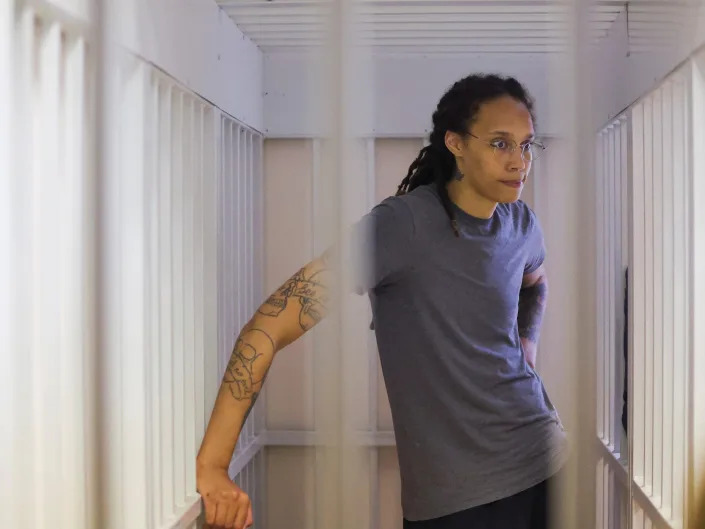
Inside her metal courtroom cage, a solemn, stone-faced Brittney Griner learned how long she’ll be locked away in Russian prison if the Biden administration can’t broker a deal to secure her release.

A Russian judge handed down a harsh nine-year sentence on Thursday, rejecting the WNBA star’s emotional apology and plea for leniency for the “honest mistake” of bringing less than a gram of cannabis oil into the country last February.

Griner was found guilty of drug possession and drug smuggling with criminal intent. The judge fined her 1 million rubles, roughly $16,300 U.S. dollars, in addition to sentencing Griner to just shy of the maximum 10 years that she was eligible to receive.

As the judge announced Griner’s verdict in Russian, a translator relayed what was said to the WNBA star. Griner displayed little emotion besides an occasional shake of her head or purse of her lips, but her supporters weren’t nearly so silent.

Standing outside the courthouse, Elizabeth Rood, Deputy Chief of Mission at the U.S. Embassy in Moscow, called the ruling a "miscarriage of justice."

President Biden echoed that soon afterward, describing Griner's nine-year sentence as "unacceptable" and pledging to "work tirelessly and pursue every possible avenue" to bring her home.

"I call on Russia to release her immediately so she can be with her wife, loved ones, friends, and teammates," Biden added.

In a joint statement to reporters, Griner’s attorneys, Maria Blagovolina and Alexander Boykov, called her nine-year sentence “absolutely unreasonable” and said they “will certainly file an appeal.”

"As legal professionals, we believe that the court should be fair to everyone regardless of nationality,” the attorneys’ statement read. “The court completely ignored all the evidence of the defense, and most importantly, the guilty plea. This contradicts the existing legal practice.”

The judge’s ruling comes nearly six months after she flew into a Moscow airport and Russian customs officials allegedly found .702 grams of cannabis oil in her luggage. That’s less than the weight of a pen cap or a stick of gum, yet prosecutors alleged it was enough to meet the “significant amount” threshold under Russian law and asked the judge to sentence Griner to nine and a half years in prison.

In her final statement to the judge at the end of closing arguments on Thursday, an emotional Griner apologized to her family, her teammates and her Russian club for "the embarrassment I brought on them."

"I never meant to hurt anybody," she said. "I never meant to put in jeopardy the Russian population. I never meant to break any laws here. I made an honest mistake and I hope that, in your ruling, that it doesn’t end my life here.

"I know that everybody keeps talking about political pawns and politics, but I hope that is far from this courtroom. I want to say again that I had no intent of breaking Russian laws. I had no intent. I did not conspire or plan to commit this crime."

That Griner’s words fell on deaf ears was no surprise. Experts have said for weeks that the real purpose of Griner’s trial was to paint a veneer of legitimacy on the Kremlin’s desire to hold her until it could extract concessions out of the U.S for her return. A guilty verdict and a long sentence were the outcome that gave Russia the most leverage with the Biden administration facing mounting pressure to bring Griner home.

“Look, the Russians are good at this stuff unfortunately,” said former State Department foreign services officer David Salvo, the deputy director of the Alliance for Securing Democracy and an expert on Russian foreign policy. “It's just a really unfortunate scenario for Brittney. You have a heavily politicized case with lots of attention all over American society and lots of pressure on the Biden Administration. The Russians are going to try to get every bit they can out of this.”

At the same time as Griner’s trial has unfolded inside a cramped courtroom outside Moscow, the question of her fate has also been discussed at the highest levels of U.S-Russian diplomacy. Last Friday, Secretary of State Antony Blinken spoke with Russian counterpart Sergey Lavrov to urge him to accept the U.S.’s “substantial proposal” to secure the release of Griner and Paul Whelan, another American whom the government considers wrongfully detained.

Blinken has declined to share details of the offer, but he has not denied reports that President Biden has signed off on trading a notorious Russian arms trafficker with high-level government and military intelligence connections. Viktor Bout is serving a 25-year sentence in an Illinois federal prison for conspiring to kill Americans and sell weapons to Colombian terrorists.

Griner’s sentence and guilty verdict essentially ends one chapter of her detainment and begins another. Russia has hinted that it will more seriously engage in negotiations once Griner’s trial is over — and the ultimate length of her stint in Russian prison will be determined by how long it takes Russia and the U.S. to negotiate a deal to bring her home.

William Pomeranz, an expert on Russian law and politics, predicted that the Kremlin won’t be in any hurry to accept the Biden administration’s 2-for-1 offer for Bout. Whereas Biden is under increasing domestic pressure to free Griner, Vladimir Putin doesn’t face the same level of urgency to bring Bout home.

“The U.S. pretty much laid its cards on the table, and now it’s the Russians who are in the driver’s seat,” said Pomeranz, the acting director of the Kennan Institute. “They can now dictate whether this prisoner swap happens and how fast this moves.”

As Griner waited on the diplomatic negotiations, there was little she could do to help her own cause. She couldn't fight against the inevitability of a guilty verdict. All she and her legal team could do was try in vain to make a case for a lenient sentence.

On July 7, Griner confessed to inadvertently violating Russian law, telling the judge she packed in a hurry and mistakenly brought the vape cartridges with her. Griner’s attorneys subsequently summoned character witnesses and introduced mitigating evidence to corroborate the WNBA star’s account.

The team captain and team director from Griner’s Russian basketball club testified on her behalf and described her as an exemplary citizen on and off the court. Griner’s lawyers also presented the court with an American doctor’s letter saying that Griner had been prescribed medical marijuana to help her cope with chronic pain from past basketball injuries.

In the end, none of it mattered.

As attorney and Russian legal expert Jamison Firestone said earlier this week, "“They are going to give her a lot of time. Then they are going to trade her.

Brittney Griner delivers final plea for leniency before verdict: 'I hope that in your ruling that it doesn’t end my life here'

Jeff Eisenberg
Thu, August 4, 2022 

Russian prosecutors asked a judge during closing arguments on Thursday to sentence Brittney Griner to 9 ½ years in prison, just shy of the maximum 10 years that she is eligible to receive.

Both a verdict and potential sentence in the WNBA star’s drug-smuggling trial are expected Thursday, her attorney told reporters.

Closing arguments ended with Griner herself having the final word. Standing in the defendant's cage at the back of the tiny courtroom, Griner took responsibility for her "mistake" and apologized to her family, her teammates and her Russian club for "the embarrassment I brought on them."

"I never meant to hurt anybody," Griner said. "I never meant to put in jeopardy the Russian population. I never meant to break any laws here. I made an honest mistake and I hope that in your ruling that it doesn’t end my life here.

"I know everybody keeps talking about political pawn and politics, but I hope that that is far from this courtroom," Griner continued. "I want to say again that I had no intent of breaking Russian laws. I had no intent. I did not conspire or plan to commit this crime."

For Griner, a guilty verdict has been a near certainty since even before the WNBA star confessed to packing in too great a hurry and accidentally taking vape cartridges containing cannabis oil in her luggage. Not only do Russian courts rarely acquit defendants under any circumstances, the Kremlin also has incentive to preserve its leverage in prisoner swap negotiations with the U.S.

Griner allegedly flew into Moscow on Feb. 17 carrying .702 grams of cannabis oil. That’s less than the weight of a pen cap or a stick of gum, yet prosecutors allege it’s enough to meet the “significant amount” threshold under article 229 of Russia’s criminal code, which is punishable with a prison term of 5 to 10 years.

For months, Griner and her supporters have pleaded with the Biden administration to broker a deal with the Kremlin to secure her release.

Thursday, Griner is expected to learn how long she could remain in Russian prison if those negotiations fizzle.

Yuval Weber, an expert in Russian military and political strategy, told Yahoo Sports that he expects Griner to receive the maximum possible sentence or close to it. The way Weber sees it, Russian government officials will dictate the length of Griner’s punishment based on what will allow them to extract the most out of the U.S. in negotiations for a prisoner swap or some other concession.

“The longer her sentence, the more basic leverage Russia has,” said Weber, ​​a distinguished fellow at Marine Corps University's Brute Krulak Center for Innovation and Future Warfare.

William Partlett, an associate professor at Melbourne Law School and an authority on Russian politics, told Yahoo Sports that the court doesn’t need to send Griner to prison for 10 years for the Kremlin to negotiate a favorable trade. A five-year sentence, according to Partlett, would allow Russia to portray itself as “lenient” and “forgiving” to the rest of the world while still maintaining the upper hand in negotiations with the U.S.

“The political calculus, which the Kremlin knows, is that Biden cannot let her sit in a Russian prison for that long,” Partlett said.

The one thing most experts do agree on is that the judge presiding over Griner’s case won’t be making an independent decision on her sentence. High-ranking Kremlin officials, they argue, will have the final say.

Describing Griner’s trial “entirely theater,” Dartmouth University foreign policy fellow Danielle Gilbert told Yahoo Sports “we shouldn’t trust it like we might trust a trial in the United States or other places around the world.” Gilbert said the “real purpose” of the trial is to lend a veneer of legitimacy to Russia’s efforts to hold Griner for as long as necessary while making demands for her release.

Brittney Griner, center, speaks to her lawyers in a courtroom 
prior to a hearing in Khimki just outside Moscow, Russia, Thursday, Aug. 4, 2022. 
(Evgenia Novozhenina/Pool Photo via AP)

“I’m 100 percent convinced that this is all about foreign policy leverage,” Gilbert said.

At the same time as Griner’s trial has unfolded inside a cramped courtroom outside Moscow, the question of her fate has also been discussed at the highest levels of U.S-Russian diplomacy. Last Friday, Secretary of State Antony Blinken spoke with Russian counterpart Sergey Lavrov to urge him to accept the U.S.’s “substantial proposal” to secure the release of Griner and Paul Whelan, another American whom the government considers wrongfully detained.

Blinken has declined to share details of the offer, but he has not denied reports that President Biden has signed off on trading a notorious Russian arms trafficker with high-level government and military intelligence connections. Viktor Bout is serving a 25-year sentence in an Illinois federal prison for conspiring to kill Americans and sell weapons to Colombian terrorists.

While Russian officials have not shot down the possibility that a deal can eventually be reached, they have insisted they won’t entertain any offer until the conclusion of Griner’s trial.

William Pomeranz, an expert on Russian law and politics, predicted that the Kremlin won’t be in any hurry to accept the Biden administration’s 2-for-1 offer for Bout. Whereas Biden is under increasing domestic pressure to free Griner, Vladimir Putin doesn’t face the same level of urgency to bring Bout home.

“The U.S. pretty much laid its cards on the table, and now it’s the Russians who are in the driver’s seat,” said Pomeranz, the acting director of the Kennan Institute. “They can now dictate whether this prisoner swap happens and how fast this moves.”

On July 7, Griner confessed to inadvertently violating Russian law, telling the judge she packed in a hurry and mistakenly brought the vape cartridges with her. Griner’s attorneys subsequently summoned character witnesses and introduced mitigating evidence to corroborate the WNBA star’s account.

The team captain and team director from Griner’s Russian basketball club testified on her behalf and described her as an exemplary citizen on and off the court. Griner’s lawyers also presented the court with an American doctor’s letter saying that Griner had been prescribed medical marijuana to help her cope with chronic pain from past basketball injuries.

​​Tom Firestone, ​​the former resident legal adviser at the U.S. Embassy in Moscow, told Yahoo Sports that Griner’s legal team did "the right things under the circumstances” but admitted that it’s “hard to say” whether it will actually help reduce the WNBA star’s sentence. After all, recent marijuana cases involving Americans in Russia have yielded a wide variety of outcomes.

In 2019, New York college student Audrey Lorber spent less than two months in prison after she allegedly entered Russia carrying 19 grams of marijuana. A Russian court found Lorber guilty of attempting to import marijuana, but she was released with time served and exempted from paying a fine.

Last month, a Pennsylvania school teacher received a far harsher punishment. Marc Fogel was sentenced to 14 years in Russian prison after being caught with medical marijuana that he says he used to treat a back injury.

“The Marc Fogel case is the most similar to Brittney Griner’s,” Firestone said. “He had a doctor’s prescription, he expressed remorse and he still received a 14-year sentence. That doesn’t augur well for Brittney.”

Gilbert, the Dartmouth foreign policy fellow, once assumed a Russian court would stick Griner with a similarly exorbitant sentence. Then Gilbert began to reconsider after a couple of puzzling moments during Griner’s trial that didn’t fit the max-punishment narrative.

First, prosecutors revealed that Griner had less than a gram of hash oil in her luggage at the time of her arrest. Then, Griner’s defense team was allowed to call Russian witnesses to speak on her behalf.

“That, in some ways, is inconsistent with a show trial where they’re going to smack her with the maximum possible sentence,” Gilbert said. “It allowed me to imagine a scenario where they might go another route.”

To Gilbert, what that means isn’t that Griner has received a fair trial. It’s that Russia could be playing “3D chess.”

“It might also be part of a strategy to make it look like this trial is legitimate,” Gilbert said. “If they want to give her a lighter sentence, it would still be disproportionate to what she did and it might be their way of trying to pretend to the rest of the world that this isn’t a hostage taking. They want the rest of the world to believe their legal system is fair. A lighter sentence might be part of reputational management.”

Brittney Griner is speaking out ahead of her sentencing.

As part of the ongoing trial related to her drug smuggling case, the WNBA star addressed the court directly after closing arguments on Aug. 4. During her speech, the 31-year-old shared the reason why she says she pleaded guilty to drug charges following her arrest in Moscow in February.

Earlier this year, the Phoenix Mercury star—who plays for a Russian team during the off-season—was arrested at Moscow's Sheremetyevo International Airport for allegedly possessing vape cartridges containing cannabis oil.

"My parents taught me two important things," Griner shared. "Take ownership for your responsibilities and work hard for everything that you have. That's why I plead guilty to my charges. I understand the charges against me. I had no intent to break any Russian laws. I want the courts to understand it was an honest mistake."

Griner than explained that she was in a "rush" to get back to Russia and her basketball team after having COVID-19 while on a break in the U.S.

"I want to apologize to the fans and my teammates for the embarrassment," she said through tears. "I want to apologize to my parents and siblings, the Phoenix Mercury and WNBA organization. I never meant to hurt anybody. I never meant to break any Russian laws. I made an honest mistake and I hope that in your ruling that it doesn't end my life here."

Brittney Griner
Christian Petersen/Getty Images

Concluding her emotional speech, Griner added that she "did not conspire to commit this crime," and hopes the court takes into the account the character references sent in on her behalf. "Again I want to apologize to my teammates for any damage that I have done to them," the athlete shared. "This is my second home and all I wanted to do was win championships and make them proud."

Following her arrest in February, Griner was charged with smuggling of narcotic drugs, psychotropic substances, their precursors, or analogues, and with illegal acquisition, storage, transportation, manufacture, processing of narcotic drugs, psychotropic substances, or their analogues.

She pled guilty to all charges during the second hearing of her trial on July 7.

According to NBC News, Russian prosecutors have asked to sentence Griner to 9 and a half years in prison. Her sentencing is expected to be announced during her Aug. 4 hearing.


Brittney Griner 'won over' Russian prison guards and inmates, and they reassured the WNBA star as she finished her trial

Rebecca Cohen

Thu, August 4, 2022 at

Brittney Griner stands in the defendant's cage during her Russian trial.
REUTERS/Evgenia Novozhenina/Pool

Prison guards and inmates told Brittney Griner "everything will be OK!" before her sentencing.

Griner's lawyer said the Russians were "won over" by the American WNBA superstar.

Griner was sentenced to nine years in Russian prison after hashish oil was found in her bags at a Moscow airport.

Prison guards and fellow Russian inmates offered Brittney Griner support and encouragement ahead of her final Russian court appearance, her lawyer said.

As the American WNBA superstar walked, handcuffed, to her sentencing hearing on Thursday, those closest to her at the facility where she's been detained reassured her: "Everything will be OK!"

Griner's attorney in Russia, Alexander Boykov, told the court that the WNBA star had "won over" a number of guards and inmates in the Russian prison where she is being held, Jezebel's Emily Liebert reported.


Griner is escorted to a court appearance.
AP Photo/Alexander Zemlianichenko

The two-time Olympic gold medalist was ultimately sentenced on Thursday to nine years in Russian prison after being found guilty of large-scale transportation of drugs with criminal intent. She has been held in custody near Moscow since her February arrest, when officials at a Moscow airport found vape cartridges containing hashish oil in her luggage.

She pleaded guilty to the charges early on in her trial — which began four months after she was arrested — with hopes that the move would help reduce her sentence. Instead, Griner received a sentence that was just six months less than prosecutor's requested and one year below the maximum sentence for her charge.

President Joe Biden announced in May that the US government was classifying Griner as "wrongfully detained" and later declared a national emergency to help free wrongful detainees. Just last week, the Biden administration announced that it had offered to swap a convicted Russian arms dealer, Viktor Bout, in exchange for the early release of both Griner and Paul Whelan — a former US Marine also detained in Russia.


American detainee Paul Whelan holds a sign ahead of a hearing in Moscow.
REUTERS/Maxim Shemetov

But some sources suggested that the eight-time WNBA All-Star would need to be sentenced before a swap could come to fruition.

Russia has yet to formally respond to the administration's offer, but suggested that they would be interested in the swap if the US helps to free an additional convict — a Russian national who was tried, sentenced, and imprisoned for murder in Germany.

John Kirby, the Biden administration's National Security Council Coordinator for Strategic Communications, slammed Russia's counter as "a bad faith attempt to avoid a very serious offer and proposal that the United States has put forward."

Griner.AP Photo/Alexander Zemlianichenko, Pool

Moscow officials fired back that "loudspeaker diplomacy" wouldn't succeed in bringing the detained Americans home, signaling that the US and Russia were still quite far from agreeing to a deal.

Still, there has been mounting public pressure on the Biden administration to get her home, and the prospect of Griner heading to a penal colony only increases the urgency of the situation. Biden, for his part, called on Russia to release Griner immediately after she was sentenced.

Conservatives Join Trump in Siding With Russia After Brittney Griner Guilty Verdict

Althea Legaspi
ROLLING STONE
Thu, August 4, 2022 


Brittney Griner was found guilty of smuggling illegal narcotics into Russia and sentenced to nine years in prison on Thursday. Griner had told the court she used marijuana for medicinal purposes, as is legal in the United States and other countries. She was caught with less than a gram of cannabis oil.

Former President Trump bashed Griner recently, calling her “a potentially spoiled person” who went to Russia “loaded up with drugs,” and right-wingers are now celebrating the verdict on social media in step with the Russian state, which found no sympathy for WNBA star and two-time U.S. Olympic gold champ.

Right-wing author Dinesh D’Souza used the conviction to defend Jan. 6 insurrectionists who tried to overthrow the U.S. government. “It seems like the Russians are doing to Griner what the Biden administration is doing to non-violent January 6 protesters,” D’Souza wrote. “Hard for us to feign indignation when the same thing is going on here!”


Conservative pundit Tomi Lahren showed her trademark lack of empathy, taking aim at Griner’s activism for racial justice and implying she hates America. “Brittney Griner is a cautionary tale. Hate America? Think it’s oppressive? Go to another country, play stupid games and find out what oppression and ‘No justice’ looks like. Too bad too sad.”


Commentator Tim Young whose Twitter handle is apropos for his comment, wrote “Brittney Griner is not a political prisoner… she carried drugs that were illegal with her in Russia and was arrested – there’s nothing ‘political’ about that.”


Trump-approved conservative commentator/author Nick Adams blamed Griner’s support of President Biden for the sentence and falsely claimed there would not have been an invasion of Ukraine had his Dear Leader been president. “While discussing Brittney Griner’s prison sentence, I think it’s important to note that Russia would have NEVER invaded Ukraine with Trump still in the White House,” Adams wrote. “In a way, Brittney Griner’s jail time is a result of her own activism and support of Joe Biden.”


As Media Matters pointed out in the lead-up to the sentencing, conservatives have been using Griner as a pawn alongside Russia, with each side furthering their agenda. The right wing wanted Trump as president over Biden and claim Trump would’ve saved Griner from jail. Meanwhile Russia likely wanted to exchange Griner for convicted Russian arms dealer Viktor Bout, who is currently imprisoned in America.

However, when the State Department made the offer to include U.S. Marine Corps veteran and former security executive Paul Whelan, Russia countered that offer with what the White House called a “bad faith” counter offer. President Biden addressed Griner’s detention following the guilty verdict on Thursday. “Russia is wrongfully detaining Brittney,” he wrote in a statement. “It’s unacceptable, and I call on Russia to release her immediately so she can be with her wife, loved ones, friends, and teammates. My administration will continue to work tirelessly and pursue every possible avenue to bring Brittney and Paul Whelan home safely as soon as possible.”