'I was never intending to be in this gig for a long time,' Kenney told an audience earlier this month
HE HAS NEVER DONE ANYTHING ELSE IN HIS LIFE BUT BE A POLITICIAN /LOBBYIST
The Canadian Press
Dean Bennett
Publishing date: Oct 02, 2022
Dean Bennett
Publishing date: Oct 02, 2022
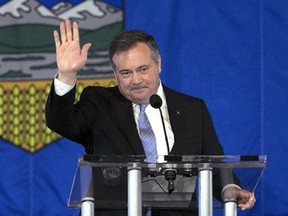
Jason Kenney announces he will step down as leader of the United Conservative Party, after receiving only a 51.4 per cent approval rating in a leadership review, May 18, 2022.
PHOTO BY JIM WELLS/POSTMEDIA/FILE
EDMONTON — Don’t cry for me, Alberta, I was leaving anyway.
It’s Premier Jason Kenney’s swan song message as he prepares to depart the province’s top job, forced out by the very United Conservative Party he willed into existence.
“I was never intending to be in this gig for a long time,” Kenney told an audience earlier this month. He had planned for one more provincial election, he said.
Instead, UCP members pick a new leader on Thursday, turning the page on a triumph-turned cautionary tale that saw Kenney’s philosophy and management style crash head-on into a once-in-a-generation catastrophe.
Kenney, whose office did not respond to requests for an interview for this story, rode to success in the 2019 provincial election.
Carson Jerema: Jason Kenney quits as Alberta's conservative movement eats itself
The former Calgary member of Parliament dismasted Rachel Notley’s NDP using an audacious blueprint that united two warring conservative factions.
It was a time of woe. Alberta’s economy was in the doldrums, its oil and gas sector in the bust phase of its traditional boom-bust cycle. Budgets were bleeding multibillion-dollar deficits.
Some Albertans were angry with Ottawa over rules deemed to be hindering energy projects. And they felt like suckers, giving billions of dollars in equalization payments and in return being ignored or demonized as climate criminals.
They sought a stick with which to hit Prime Minister Justin Trudeau.
EDMONTON — Don’t cry for me, Alberta, I was leaving anyway.
It’s Premier Jason Kenney’s swan song message as he prepares to depart the province’s top job, forced out by the very United Conservative Party he willed into existence.
“I was never intending to be in this gig for a long time,” Kenney told an audience earlier this month. He had planned for one more provincial election, he said.
Instead, UCP members pick a new leader on Thursday, turning the page on a triumph-turned cautionary tale that saw Kenney’s philosophy and management style crash head-on into a once-in-a-generation catastrophe.
Kenney, whose office did not respond to requests for an interview for this story, rode to success in the 2019 provincial election.
Carson Jerema: Jason Kenney quits as Alberta's conservative movement eats itself
The former Calgary member of Parliament dismasted Rachel Notley’s NDP using an audacious blueprint that united two warring conservative factions.
It was a time of woe. Alberta’s economy was in the doldrums, its oil and gas sector in the bust phase of its traditional boom-bust cycle. Budgets were bleeding multibillion-dollar deficits.
Some Albertans were angry with Ottawa over rules deemed to be hindering energy projects. And they felt like suckers, giving billions of dollars in equalization payments and in return being ignored or demonized as climate criminals.
They sought a stick with which to hit Prime Minister Justin Trudeau.
Kenney was that stick. He came toting a “fight back strategy,” vowing to take on Trudeau and the other happy hit men of the “Laurentian elite” hell-bent on strangling Canada’s energy “golden goose.”
To him, oil and gas were not just good business. It was a higher calling, a “moral cause” to redistribute earth’s bounty to neighbour nations so they could avoid buying it from human-rights-abusing dictators.
UCP AUSTERITY BUDGET
Taking the reins of power, he went to work.
Kenney cut corporate income taxes, abolished the former NDP government’s consumer carbon levy, slashed post-secondary funding, launched more privately delivered care in the public health system, reduced minimum wage for kids, went to war with teachers, sought wage cuts in the public sector, ripped up negotiated bargaining deals, and attacked doctors and nurses as comparatively overpaid underperformers.
He gambled big and lost $1.3 billion OF TAXPAYERS MONEY WITH NO SHAREHOLDER RIGHTS OR POWER on the failed Keystone XL oil pipeline.
Kenney’s plan for Alberta was founded on the conservatism of “prosperity first,” said political scientist Jared Wesley with the University of Alberta.
Kenney, said Wesley, spelled it out in his maiden speech as UCP leader in 2017 by reminding supporters that “in order to be a compassionate and generous society, you must be a prosperous one first.”
Wesley said such an ethos may have captured the mood of conservatives and enthralled others, “but as Albertans and their government were forced (during COVID-19) between prosperity and compassion — or as Kenney put it ‘livelihoods and lives’ — his focus on livelihoods was really out of touch with what people were looking for.”
Political scientist Laurie Adkin said the prosperity-first doctrine was narrowly defined to the benefit of a select few.
“There was really no light between the Kenney government and the oil and gas industry, and that is not good for democracy,” said Adkin with the University of Alberta.
“Government needs to represent the public interest and not a single economic sector to the cost of everything else.”
The math was simple, the corollary obvious: If Alberta’s identity is defined by economic prosperity through oil and gas, then those who challenge this worldview are, well, anti-Albertan
Kenney and his UCP vilified the green left and high-profile oilsands critics like David Suzuki and Tzeporah Berman. When world-renowned green teen Greta Thunberg came to the legislature, Kenney left town.
Kenney mocked Notley’s NDP government as a docile servant to Trudeau’s oil-killing agenda, kowtowing for crumbs, grubbing for “social licence.”
Quebec was an ingrate, fighting pipelines with one hand while accepting Alberta equalization money with the other. A U.S. governor challenging a cross-border pipeline was “brain-dead.”
To fight slurs on oil and gas, Kenney spent millions to create a “war room” that delivered a parade of gaffes, including a public fight with a children’s cartoon about Bigfoot.
Kenney launched a $2.5-million public inquiry into foreign funding of domestic green groups fighting Alberta’s oilsands. It never held an inquiry in public, went over time and over budget, and determined the funding was relatively modest and totally legal.
Over time, the enemy tag broadened. Kenney characterized the NDP as disloyal for its COVID-19 criticism. He linked one radio interviewer’s criticism of his government to an attack on Alberta itself. Reporters were at times dismissed as shills for the NDP or special interest groups.
No quarter was given, even in good times. When Trudeau came to Edmonton to announce a joint $10-a-day child-care program, Kenney, from the podium, said the money was recycled provincial funds anyway and Quebec got a better deal.
As COVID-19 hit with full force in 2020, decimating the economy, Kenney found himself battling a two-front war as bubbling rifts between him and his caucus and party exploded.
Those divides had started before the election, when Kenney promised his UCP would be run by and for the members, but then at the party’s founding convention in 2018 told reporters “I hold the pen” on what will and won’t be policy.
The UCP won in 2019 on the strength of rural votes, said political scientist Duane Bratt. But when Kenney picked his first cabinet, it was Calgary-centric, leaving disgruntled backbenchers seething in silence, poised to push back when things went south.
“It was a top-down government,” said Bratt with Calgary’s Mount Royal University.
“He did not have good relations with his MLAs. He hired attack dogs as staffers. And they just didn’t bully the NDP and journalists and members of the public, but their own MLAs as well.”
Kenney’s government was lauded in the first wave of COVID-19, invoking rules and closures to keep gatherings down, hold the illness at bay and keep hospitals operating.
But in subsequent waves, Kenney’s promise to balance “lives and livelihoods” left him whipsawed by those wanting rules to keep hospitals from cratering and those who felt the rules were unnecessary and a violation of personal freedom.
He tried to find a magic middle ground, which resulted in shifting restrictions: regional, provincial, on for some, off for others. Each time he waited until Alberta’s health system was on the brink of collapse before acting, with thousands of surgeries cancelled and waiting rooms jammed.
He announced Alberta was open for good in late spring of 2021, with all restrictions to be lifted earlier than the rest of Canada in a “Best Summer Ever” campaign. There were hats with that slogan and tweets at naysayers: “The pandemic is ending. Accept it.”
Within months, COVID-19 had overwhelmed Alberta’s hospitals so catastrophically that triage rules were imminent and the Armed Forces called in.
Extreme action was needed, so Kenney introduced a type of vaccine passport, something he had promised he would never do — a policy U-turn that enraged many in his party.
Then came the blame.
Kenney said he would’ve acted earlier except his chief medical health officer didn’t recommend anything. Months later, he said Alberta Health Services officials kneecapped his decision-making by delivering shifting bed capacity numbers.
The gig was not going well. Poll numbers were in free fall. UCP backbenchers openly questioned the restrictions — and Kenney.
And there were scandals piling into each other like cars on a freeway.
Alohagate: a bunch of Kenney caucus members ignored calls to stay home over Christmas to avoid the spread of COVID-19 and jetted off to sunny climes while Albertans shivered at home under strict gathering limits.
UCP caucus chair Todd Loewen resigned his post and was kicked out of caucus after publicly demanding Kenney quit for botching vital files, ignoring the backbench, and running a top-down, tone-deaf administration.
“We did not unite around blind loyalty to one man,” pronounced Loewen.
Kenney and some cabinet confidantes were surreptitiously photographed on the balcony of his office enjoying drinks and dinner in obvious violation of distancing rules.
The premier insisted there was no rule-breaking. But as outrage mounted, he announced his team had returned to the scene of the dine, pulled out the measuring tape, checked the chairs and concluded that, yes, they had gathered too close.
Such gaslighting, chortled Notley during question period.
There was more: a lawsuit alleging the premier’s office was fostering a “poisoned work environment;” drink parties in the agriculture minister’s legislature office; the justice minister trying to interfere in the administration of justice by calling up Edmonton’s police chief on a traffic ticket.
Humming in the background was a long-running RCMP investigation into potential criminal identity fraud in the vote that saw Kenney elected UCP leader.
And this was on top of Kenney’s government passing a law in 2019 that sacked the election official investigating Kenney’s UCP for campaign violations.
As the calendar flipped to 2022, the drumbeats of dissent grew louder, even as COVID-19 receded and oil and gas prices soared, returning Alberta to multibillion-dollar budget surpluses
UCP discontents had been angling to accelerate a party leadership review.
That vote was moved, changed to a special one-day vote, then altered again to a mail-in referendum. Critics said Kenney’s team was moving the goalposts to keep from losing.
Kenney called his critics “lunatics” and then, in his speech to kick off the leadership vote, asked for their forgiveness.
No matter.
On May 18, he got 51 per cent support — technically enough to survive, but he said it was time to go.
On Thursday, UCP members meet in Calgary to seal his fate.
The outcome is not in doubt. A new premier will be chosen.
The gig is up.
Taking the reins of power, he went to work.
Kenney cut corporate income taxes, abolished the former NDP government’s consumer carbon levy, slashed post-secondary funding, launched more privately delivered care in the public health system, reduced minimum wage for kids, went to war with teachers, sought wage cuts in the public sector, ripped up negotiated bargaining deals, and attacked doctors and nurses as comparatively overpaid underperformers.
He gambled big and lost $1.3 billion OF TAXPAYERS MONEY WITH NO SHAREHOLDER RIGHTS OR POWER on the failed Keystone XL oil pipeline.
Kenney’s plan for Alberta was founded on the conservatism of “prosperity first,” said political scientist Jared Wesley with the University of Alberta.
Kenney, said Wesley, spelled it out in his maiden speech as UCP leader in 2017 by reminding supporters that “in order to be a compassionate and generous society, you must be a prosperous one first.”
Wesley said such an ethos may have captured the mood of conservatives and enthralled others, “but as Albertans and their government were forced (during COVID-19) between prosperity and compassion — or as Kenney put it ‘livelihoods and lives’ — his focus on livelihoods was really out of touch with what people were looking for.”
Political scientist Laurie Adkin said the prosperity-first doctrine was narrowly defined to the benefit of a select few.
“There was really no light between the Kenney government and the oil and gas industry, and that is not good for democracy,” said Adkin with the University of Alberta.
“Government needs to represent the public interest and not a single economic sector to the cost of everything else.”
The math was simple, the corollary obvious: If Alberta’s identity is defined by economic prosperity through oil and gas, then those who challenge this worldview are, well, anti-Albertan
Kenney and his UCP vilified the green left and high-profile oilsands critics like David Suzuki and Tzeporah Berman. When world-renowned green teen Greta Thunberg came to the legislature, Kenney left town.
Kenney mocked Notley’s NDP government as a docile servant to Trudeau’s oil-killing agenda, kowtowing for crumbs, grubbing for “social licence.”
Quebec was an ingrate, fighting pipelines with one hand while accepting Alberta equalization money with the other. A U.S. governor challenging a cross-border pipeline was “brain-dead.”
To fight slurs on oil and gas, Kenney spent millions to create a “war room” that delivered a parade of gaffes, including a public fight with a children’s cartoon about Bigfoot.
Kenney launched a $2.5-million public inquiry into foreign funding of domestic green groups fighting Alberta’s oilsands. It never held an inquiry in public, went over time and over budget, and determined the funding was relatively modest and totally legal.
Over time, the enemy tag broadened. Kenney characterized the NDP as disloyal for its COVID-19 criticism. He linked one radio interviewer’s criticism of his government to an attack on Alberta itself. Reporters were at times dismissed as shills for the NDP or special interest groups.
No quarter was given, even in good times. When Trudeau came to Edmonton to announce a joint $10-a-day child-care program, Kenney, from the podium, said the money was recycled provincial funds anyway and Quebec got a better deal.
As COVID-19 hit with full force in 2020, decimating the economy, Kenney found himself battling a two-front war as bubbling rifts between him and his caucus and party exploded.
Those divides had started before the election, when Kenney promised his UCP would be run by and for the members, but then at the party’s founding convention in 2018 told reporters “I hold the pen” on what will and won’t be policy.
The UCP won in 2019 on the strength of rural votes, said political scientist Duane Bratt. But when Kenney picked his first cabinet, it was Calgary-centric, leaving disgruntled backbenchers seething in silence, poised to push back when things went south.
“It was a top-down government,” said Bratt with Calgary’s Mount Royal University.
“He did not have good relations with his MLAs. He hired attack dogs as staffers. And they just didn’t bully the NDP and journalists and members of the public, but their own MLAs as well.”
Kenney’s government was lauded in the first wave of COVID-19, invoking rules and closures to keep gatherings down, hold the illness at bay and keep hospitals operating.
But in subsequent waves, Kenney’s promise to balance “lives and livelihoods” left him whipsawed by those wanting rules to keep hospitals from cratering and those who felt the rules were unnecessary and a violation of personal freedom.
He tried to find a magic middle ground, which resulted in shifting restrictions: regional, provincial, on for some, off for others. Each time he waited until Alberta’s health system was on the brink of collapse before acting, with thousands of surgeries cancelled and waiting rooms jammed.
He announced Alberta was open for good in late spring of 2021, with all restrictions to be lifted earlier than the rest of Canada in a “Best Summer Ever” campaign. There were hats with that slogan and tweets at naysayers: “The pandemic is ending. Accept it.”
Within months, COVID-19 had overwhelmed Alberta’s hospitals so catastrophically that triage rules were imminent and the Armed Forces called in.
Extreme action was needed, so Kenney introduced a type of vaccine passport, something he had promised he would never do — a policy U-turn that enraged many in his party.
Then came the blame.
Kenney said he would’ve acted earlier except his chief medical health officer didn’t recommend anything. Months later, he said Alberta Health Services officials kneecapped his decision-making by delivering shifting bed capacity numbers.
The gig was not going well. Poll numbers were in free fall. UCP backbenchers openly questioned the restrictions — and Kenney.
And there were scandals piling into each other like cars on a freeway.
Alohagate: a bunch of Kenney caucus members ignored calls to stay home over Christmas to avoid the spread of COVID-19 and jetted off to sunny climes while Albertans shivered at home under strict gathering limits.
UCP caucus chair Todd Loewen resigned his post and was kicked out of caucus after publicly demanding Kenney quit for botching vital files, ignoring the backbench, and running a top-down, tone-deaf administration.
“We did not unite around blind loyalty to one man,” pronounced Loewen.
Kenney and some cabinet confidantes were surreptitiously photographed on the balcony of his office enjoying drinks and dinner in obvious violation of distancing rules.
The premier insisted there was no rule-breaking. But as outrage mounted, he announced his team had returned to the scene of the dine, pulled out the measuring tape, checked the chairs and concluded that, yes, they had gathered too close.
Such gaslighting, chortled Notley during question period.
There was more: a lawsuit alleging the premier’s office was fostering a “poisoned work environment;” drink parties in the agriculture minister’s legislature office; the justice minister trying to interfere in the administration of justice by calling up Edmonton’s police chief on a traffic ticket.
Humming in the background was a long-running RCMP investigation into potential criminal identity fraud in the vote that saw Kenney elected UCP leader.
And this was on top of Kenney’s government passing a law in 2019 that sacked the election official investigating Kenney’s UCP for campaign violations.
As the calendar flipped to 2022, the drumbeats of dissent grew louder, even as COVID-19 receded and oil and gas prices soared, returning Alberta to multibillion-dollar budget surpluses
UCP discontents had been angling to accelerate a party leadership review.
That vote was moved, changed to a special one-day vote, then altered again to a mail-in referendum. Critics said Kenney’s team was moving the goalposts to keep from losing.
Kenney called his critics “lunatics” and then, in his speech to kick off the leadership vote, asked for their forgiveness.
No matter.
On May 18, he got 51 per cent support — technically enough to survive, but he said it was time to go.
On Thursday, UCP members meet in Calgary to seal his fate.
The outcome is not in doubt. A new premier will be chosen.
The gig is up.
HIS SHORT FOUR YEAR AUTOCRATIC RULE WAS INSPIRED BY THIS GUY
Wednesday, August 23, 2006
Kenney is A Funny Guy
Meanwhile, Conservative government spokesman Jason Kenney compared Hezbollah to the German Nazi party yesterday and said Canadian opposition MPs are providing political cover to the banned organization.
This is funny coming from the guy who defended Franco and Hitler in the House of Commons during the debate on the private members bill to end the declaration of Candadian Veterans of the Spanish Civil War as being illegal and not recognized as Veterans.
Mr. Jason Kenney (Calgary Southeast, Ref.): Mr. Speaker, I too am pleased to rise to speak on Motion No. 75. I wish to commend my hon. colleague from Kamloops for having brought this motion before the House even though I disagree with it in principle and will vote against it.
On the other side, it was not simply a uni-dimensional coalition of fascists supported and motivated by Adolf Hitler. Indeed the German and Italian fascists supported elements of the Phalangist cause, but there were democrats, monarchists, catholics and others who opposed the Republican cause because they saw it as an encroachment of a foreign tyrannical political movement, communism, and its threatened imposition on Spain.
As usual with right wingers Kenney sees communism as a greater threat than Fascism.
This is funny coming from the guy who defended Franco and Hitler in the House of Commons during the debate on the private members bill to end the declaration of Candadian Veterans of the Spanish Civil War as being illegal and not recognized as Veterans.
Mr. Jason Kenney (Calgary Southeast, Ref.): Mr. Speaker, I too am pleased to rise to speak on Motion No. 75. I wish to commend my hon. colleague from Kamloops for having brought this motion before the House even though I disagree with it in principle and will vote against it.
On the other side, it was not simply a uni-dimensional coalition of fascists supported and motivated by Adolf Hitler. Indeed the German and Italian fascists supported elements of the Phalangist cause, but there were democrats, monarchists, catholics and others who opposed the Republican cause because they saw it as an encroachment of a foreign tyrannical political movement, communism, and its threatened imposition on Spain.
As usual with right wingers Kenney sees communism as a greater threat than Fascism.