Friday, February 14, 2025

AMERIKA


Repression vs. Activism — Colleges Crack 


Down While Gaza Solidarity Persists


February 12, 2025
Facebook

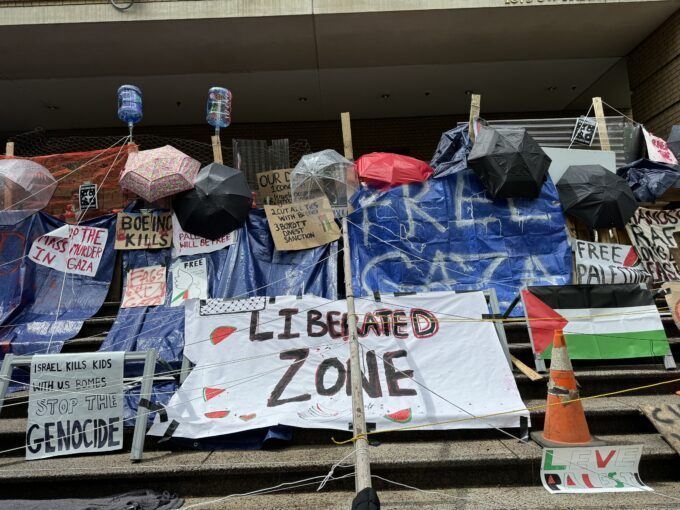
Photograph by Nathaniel St. Clair

Last spring, campuses across the country became flashpoints of anti-war resistance, as thousands of students mobilized in a powerful demonstration of moral conscience and collective action. Their demands were clear: an end to U.S. complicity in the genocide in Gaza and the dismantling of the war machine that sustains it. This wave of activism commanded both national and international attention.

Yet, in recent months, despite the ongoing slaughter and the White House’s egregious proposals to further orchestrate the ethnic cleansing of Gaza, mainstream coverage of the student movement in solidarity with the Palestinian people—and in opposition to what Martin Luther King Jr. condemned as “the madness of militarism”—has steadily faded from the headlines.

Despite the relative media silence, and amid an intensifying campaign of institutional repression, the campus-based fight against the intolerable status quo has not ceased. Students remain at the forefront of the struggle for a more just, less militarized, and truly democratic world.

What coverage remains has largely functioned to reinforce the narrative that universities—initially caught off guard by the spontaneous protests of the spring—have successfully reasserted control over their campuses from what they have long framed as unruly agitators.

In November, The New York Times framed administrators’ crackdown on campus protests as a success, reporting that their efforts “seem to be working.” These draconian measures have had a chilling effect on campus expression—undermining free speech, stifling dissent, and betraying the university’s role as a laboratory for democracy and social change.

Nonviolent civil disobedience—a cornerstone of student activism from the Civil Rights Movement to the anti-Vietnam War and anti-Apartheid struggles—is now being met with the heavy hand of repression, as both the legal system and university conduct boards enforce arbitrary, vague, and inconsistently applied punitive measures.

These crackdowns have disproportionately targeted advocates for Palestinian liberation and their allies. This assault on Palestine-related dissent has already prompted multiple complaints over civil rights violations.

In just the past two months, several alarming examples of escalating repression have underscored the intensifying crackdown on pro-Palestinian activism:

New York University imposed yearlong suspensions on 11 students for participating in a nonviolent sit-in, in what organizers have decried as an extension of a broader “campaign of collective punishment.”

The University of Rochester expelled four students—who were already facing felony charges—for distributing posters directly naming and accusing university leadership and faculty members of complicity in the military-industrial-academic complex and supporting the U.S.-backed genocide in Gaza.

The University of Minnesota threatened to hand down two-and-a-half-year suspensions and $5,500 fines to seven members of their Students for a Democratic Society chapter for their participation in a campus building occupation in October.

Harvard University adopted the IHRA definition of antisemitism, which conflates nearly all criticism of Zionism and of Israeli policy with antisemitism while simultaneously and hypocritically claiming “institutional neutrality.” Rights groups have condemned this move as “a prescription to chill campus speech.”

The University of Michigan suspended Students for Freedom and Equality (SAFE), the largest pro-Palestine coalition on campus, until at least 2026.

Faculty and staff have not been exempted from this wave of repression. In recent weeks:

New York University also barred two professors from campus for their participation in the nonviolent sit-in at their university’s library, a move experts describe as “tantamount to suspension.”

Columbia University pressured law professor Katherine Franke to resign over her support for pro-Palestine activism, joining others who have lost academic appointments or faced internal investigations due to their principled positions on Palestine.

At Harvard University, Jay Ulfelder, Director of the Nonviolent Action Lab at Harvard Kennedy School, left his position in protest, following David Vine in his departure from American University in September after publishing an op-ed condemning his institution’s complicity in genocide.

This all combines with the Trump administration vowing to further its unconstitutional crackdown on so-called “pro-Hamas students,” threatening international students with deportation through the cynical pretext of combating antisemitism.

This marks the first steps in the implementation of the Heritage Foundation’s “Project Esther,” a component of the broader fascistic Project 2025 agenda. These efforts have been further amplified by militant Zionist organizations like the World Betar Movement, which has reportedly deployed AI to compile lists of students involved in campus protest to be targeted for deportation.

Despite the intensifying climate of repression and intimidation, students, faculty, staff, and community members of conscience remain steadfast in their struggle for justice and a better world and continue to push back:

+ Within the University of California system, People’s Tribunals are being organized to expose institutional complicity, build grassroots power, document evidence, and hold those responsible accountable.

+ Scholars within the American Historical Association overwhelmingly voted to condemn the ongoing destruction of schools, libraries, and universities and the murder of academics in Gaza as scholasticide.

+ At Columbia University, students have initiated legal action against their administration, joining other lawsuits across the country.

+ In California, taxpayers are suing their representatives over the unlawful appropriation of public funds to support genocide.

+ Students at Bowdoin College launched the first encampment since last spring in protest of their university’s intransigence despite a democratic referendum that passed calling for the university to take a public stand against the genocide in Gaza.

Eric Ross is an organizer, educator, researcher, and PhD Candidate in the History Department at the University of Massachusetts Amherst. He is a coordinator of the national Teach-In Network sponsored by the RootsAction Education Fund.

Why is Canada Conniving With Trump Against Mexico?


February 11, 2025
FacebookTwitter

Photograph Source: Dan Scavino – Public Domain

In order to buy a 30-day reprieve from Trump tariffs on Canada PM Trudeau made a few concessions. Canada would name a drug-fighting “Czar,” and put extra border watchers in place. Nothing surprising, though disappointing and humiliating.

Giving way to U.S bullying will only bring more, as everyone understands. “The whining dog gets kicked,” as the proverb has it.

But there was another concession/agreement that does not belong in the category of compromise or reasonable concessions. Trudeau agreed with Trump to label Mexican drug cartels “terrorists,” a designation which Mexico vehemently rejects.

Why does Mexico object? Because the U.S. doctrine on terrorism asserts that the United States has extraterritorial rights and can capture and/or destroy any entity they deem terrorist. The threat of military intervention in Mexico to solve border and drug problems is an American constant.

Trudeau has no business fueling that fire. So why does he say it? And why are his compatriots (left, right, and center) silent on the matter?

Answer: Canada remains a strong and proud member of the imperial band, united in the “Five Eyes” of the Anglosphere (with the United States, the United Kingdom, Australia, New Zealand – in short, the WASPs).

The proper answer to Trump should: should be: Ask Mexico. After all it is a sovereign country. But instead Trudeau/Canada agreed to gang-up with Trump, giving Trump an extra weapon to wield against a Mexico, a country which has been the victim of U.S. aggression many times in the past.

Canada chose to join the U.S. attack on a sovereign country targeted by the same discriminatory tariff policy, a country that is also a potential ally of Canada in its own defense against the imperial actions of the new resident of the White House.

So, we learn that at the end of the day, Canada will fall-in behind Washington to remain a trusted stooge, as when it agreed to arrest a Chinese businesswoman when Trump asked it to. Note that Ontario premier Doug Ford recently did the same by saying that Trump should focus on the “real trade war with China.”

Mexico no doubt sees what is going on and will make appropriate preparations.

If Canada and Quebec ever have a hope of true sovereignty and independence, they should stop obeying the Anglo-American imperial order. The starting point is to respect Mexican sovereignty.

Mexico probably sees what is happening and will make appropriate preparations.

And Quebec must do the same. Nobody in Quebec forgets the 1995 referendum and the speed with which Ottawa rushed to Washington to implore the Clinton administration to come out strongly against Quebec sovereignty and also threaten to exclude Quebec from NAFTA?


U.S. Citizen Enters a German Prison for Anti-Nuclear 

Weapons Protest on February 26

February 13, 2025
Facebook

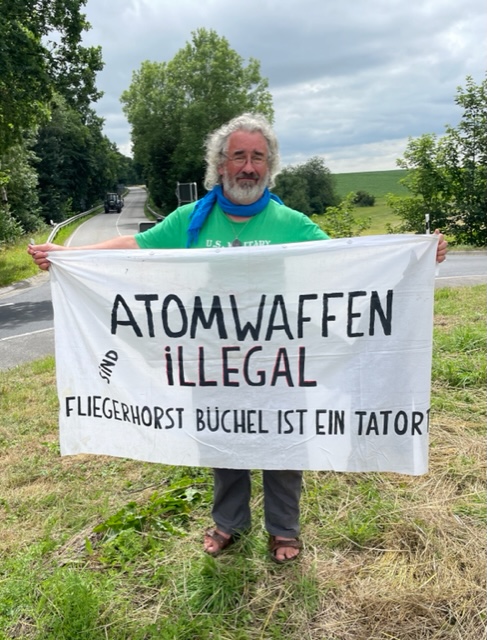
Photo: Brian Terrell.

While participating in an international peace camp on July 14, 2019 organized by Nukewatch and GAAA, Susan Crane of Redwood City, California and Susan van der Hijden of Amsterdam and I were apprehended by German Military police after cutting a hole in the security fence and entering the airfield at Büchel, Germany, with a banner that read “Atomwaffen sind Illegal- Fliegelhorst Büchel ist ein Tator!” (Nuclear weapons are illegal, Büchel airfield is a crime scene). Despite our assurances to the soldiers guarding the base that our intentions were not intended to violate the law but to call attention to the crime of the United States Air Force 702 Munitions Support Squadron keeping about 20 nuclear B61 bombs there, we were turned over to civilian police, cited and released.

It was only when I returned to a protest at Büchel again two years later in July of 2021 that I was served documents by local police informing me that the previous July, 2020, the court in Cochem had issued a penalty order against me and a fine of 900 euros for trespassing and unlawfully damaging property. Susan and Susan had both been served the same papers earlier and had already filed appeals, so I also filed my own, hoping to argue my case in a German courtroom.

If the courts in the hyper-incarcerated United States can be likened to a giant meat grinder, mindlessly pulverizing the bodies and lives of those who fall into it with blind and callous indifference, where due process is a luxury usually afforded only to the privileged few, the courts in Germany might be compared with grain mill, sifting out the wheat and chaff slowly with careful precision and so I go to jail now for a “crime” committed more than five years ago.

In the end, though, the German courts are no more ready than courts in the U.S. would be to hear a reasonable argument that the American nuclear bombs kept at Büchel under a NATO “nuclear sharing” agreement, ready to be loaded onto German planes to be “delivered” when so ordered, are there in violation of numerous laws, including the 1970 Nonproliferation Treaty which forbids any transfer of nuclear weapons between treaty signers, not to mention an existential threat to all life on this planet. After my two accomplices and some 18 other resisters in recent years had no success in their appeals to the various German courts, including the Federal Constitutional Court and up to the European Court of Human Rights in Strasberg, I decided to stop waiting for my day in court and dropped my own appeal.

On December 12, 2024, the court in Koblenz sent me a letter reminding me of the 900 euro fine (plus 77.5 euro costs) with the order to pay up or report to the prison at Wittlich, Germany, on February 26 to serve a 15 day sentence. I chose prison.

The world is a more dangerous place today than it was five years ago when we took bolt cutters to “de-fence” Büchel. For one thing, the old B61 nuclear bombs that had been kept ready at Büchel and at five other European bases since 1968, are being replaced now with new, more “flexible” and more “easily deployed” B61-12 bombs.

In January, 2022, officials at the Kansas City National Security Campus, 100 miles from my home in Iowa, announced the completion of the B61-12 Life Extension Program’s First Production Unit: “It is with great pride and excitement that we see the B61-12 achieve FPU,” said Eric Wollerman, President of Honeywell Federal Manufacturing & Technologies which manages and operates the campus.

Three years later, on January 7, 2025, the National Nuclear Security Administration (NNSA) announced the completion of the last production unit of the B61–12. Just weeks ago on January 16, as my accomplice Susan Crane was being released for prison for her “crimes” at Büchel, NNSA administrator Jill Hruby, in an address at the Hudson Institute, spoke glowingly of “the future of the nuclear security enterprise.” Despite the challenges we face, “all is not gloom and doom” because, she said, “The new B61-12 gravity bombs are fully forward deployed, and we have increased NATO’s visibility to our nuclear capabilities.” The B61-12 presumably in place at Büchel is just part of a $2 trillion program to extend the “lives” of and exercising “stewardship” over the U.S. nuclear weapons stockpile.

“I want to say, and this is very important: at the end we lucked out,” wrote William McNamara, U.S. Secretary of Defense during the Cuban missile crisis in his 1995 memoirs. “It was luck” McNamara insisted, not careful diplomacy nor any show of power, “that prevented nuclear war” in those cold war years.

It was not just luck, though, but also the persistence of anti-nuclear activists in the 1980s and ‘90s that brought the world away from the brink of nuclear destruction, demanding and getting meaningful international agreements and drastic reductions of nuclear stockpiles. Today, profiteers like Eric Wollerman and bureaucrats like Jill Hruby do not view the reduction of nuclear weapons of those recent decades as lifesaving progress toward a more peaceful and sustainable world to build upon, but as years of regrettable neglect. Today, they have reason to celebrate “the long-term future of the stockpile.” “It has been the honor to serve as the NNSA Administrator, and a pleasure to observe the progress” said Jill Hruby on January 16, “I am fond of saying that my proudest accomplishment is getting our mojo back in NNSA.”

While the officially stated “fundamental role of U.S. nuclear weapons,” according to the 2022 Nuclear Posture Review, is to “deter nuclear attack,” they also “allow us to achieve Presidential objectives if deterrence fails.” The new U.S. Strategic Command (USSTRATCOM) Command and Control Facility at Offutt Air Force Base near Omaha, according to a USSTRATCOM press statement, “will conduct strategic planning, warfighting operations, provide global situational awareness to the National Command Authorities and combatant commands, aid the president’s nuclear response decision-making process, and, if called upon, deliver a decisive response in all domains.”

Simply put, “Presidential objectives” and “a decisive response in all domains” both are ways of referring to the planned total destruction of life on this planet. If such power at the personal discretion of the President of the United States was of less concern before the 2024 election, it should be a terrifying thought today.

My first visit to Germany was in October of 1982, a time referred to as the “long hot autumn,” an exhilarating time when millions of Germans took to the streets to protest the short-range Pershing II nuclear missiles then deployed by the U.S. on trucks roaming the border between east and west. In solidarity with activists protesting around the globe, the Pershing program was successfully ended.

The need for a mass movement like the world saw back then could not be more urgent than it is today. I look with both fear and hope for one to arise. In the meantime, I know that mass movements are not made by people waiting for a mass movement to arrive. A mass movement is built by people joining with others to speak and act for peace the best they can in their circumstances and who are willing to risk apparent failure in their efforts.

On February 23, there will be a Global Day of Action to Close Bases taking place at military sites around the world. Two days later, on the day before I turn myself in to the prison at Wittlich, I will be joining Dutch and German friends protesting again at the gates of Büchel and the NATO nuclear sharing base at Volkel, in the Netherlands. From March 3-7, while I am quietly protesting in a German jail, the Atlantic Life Community will be in the streets of New York City for the 3rd Meeting of States Parties to the Treaty on the Prohibition of Nuclear Weapons at the United Nations. At the same time, on the other end of the country, the Pacific Life Community will be conspiring on their future actions on retreat at a monastery in St. David, Arizona. I am grateful to be part of this grand movement.

As I prepare for my brief sojourn at Wittlich, I am looking forward to joining my friends in Europe who will be seeing me off and greeting me on my release. I am grateful for the support and prayers of many friends, for Betsy, who with help from friends and neighbors will be holding down our farm in Iowa and for the support of my colleagues with the Nevada Desert Experience, with whom I will be joining in April for our annual Sacred Peace Walk from Las Vegas to the Nevada Test Site.

Brian Terrell is an Iowa based peace activist. He can be reached at:   brian1956terrell@gmail.com