Amazon Rebuked for 'Reckless' Lawsuit Against US Product Safety Agency
"Amazon wants to eliminate the Consumer Product Safety Commission so it can sell dangerous, poisonous, and defective crap with no consequences," said one critic.
This photo shows Amazon's logo on the tech giant's Sunnyvale, California office.
(Photo: Smith Collection/Gado/Getty Images)
Brett Wilkins
Mar 21, 2025
COMMON DREAMS
Consumer advocates this week denounced a lawsuit filed by e-commerce giant Amazon against the federal agency tasked with promoting product safety and alerting the public to risks, a move that comes amid the Trump administration's war on government regulators.
Amazon's lawsuit, filed earlier this month in a Maryland federal court, claims that the U.S. Consumer Product Safety Commission (CPSC) is unconstitutional. The Seattle-based company—which raked in $638 billion in 2024 revenue—says it should not be held legally responsible for products sold on its site by third-party vendors.
"Amazon is suffering, and will continue to suffer, irreparable harm from being subjected to an order issued by an unconstitutionally structured agency," the company's complaint states.
"Let's be real: Amazon would gleefully sell products that could kill your kids for a 5-cent profit."
Last July, the five CPSC commissioners unanimously determined that Amazon is "a 'distributor' of products that are defective or fail to meet federal consumer product safety standards, and therefore bears legal responsibility for their recall" under the Consumer Product Safety Act (CPSA). More than 400,000 products were subject to the CPSC order, including "faulty carbon monoxide detectors, hairdryers without electrocution protection, and children's sleepwear that violated federal flammability standards."
In January, the CPSC issued a decision and order outlining steps Amazon must take "to notify purchasers and the public about hazardous products for which the commission determined Amazon was a distributor under the CPSA."
Critics allege that by suing the CPSC, Amazon is attempting to avoid responsibility for shipping dangerous products to its hundreds of millions of customers.
"Instead of demonstrating its commitment to consumer safety, Amazon has fought the CPSC every step of the way for more than three years, and now it's going to court," Consumer Reports director of safety advocacy William Wallace said this week. "The law is clear that Amazon is a 'distributor' in this case and must carry out a recall."
Wallace continued:
Amazon wants to be held blameless for the safety of products sold by third parties on its platform, which is bad enough—but what's even worse is that the company is attacking the legal foundation on which the CPSC rests. Amazon's suit suggests the company thinks the people of the United States would be better off without an independent, bipartisan safety agency to enforce our laws and protect consumers from dangerous products. We strongly disagree and condemn Amazon's reckless constitutional claims.
"It's absurd to suggest that because a company hosts a marketplace online it should be exempt from sensible requirements that help get hazardous products out of people's homes and prevent them from being sold," Wallace added. "The court should reject Amazon's arguments. Taking Amazon at its word would mean hazardous products slipping through the cracks, even when they are capable of injuring or killing people."
Wallace's remarks came a day after the CPSC issued warnings for products including a toddler playset due to what the agency says is a risk of serious injury or suffocation death, a mattress posing a fire risk, and a brand of liquid Benadryl whose packaging is not child-resistant.
Amazon and SpaceX—owned by Elon Musk, the de facto head of the Trump administration's Department of Government Efficiency—have also spearheaded lawsuits claiming the National Labor Relations Board, the federal agency tasked with protecting workers' rights, is unconstitutional.
The companies and their billionaire leaders have found an ally in U.S. President Donald Trump, whose administration has signaled that it will not defend the precedent set by Humphrey's Executor v. United States, a 1935 Supreme Court ruling protecting commissioners at independent federal agencies from being fired by the president at will, if it is challenged in court.
Georgetown University Law Center professor Victoria Nourse toldThe Washington Post this week that right-wing lawyers are emboldened by the administration's stance, describing lawsuits like those filed by Amazon and SpaceX as "little fires being lit all over Washington."
"What Trump wants and what the companies want is to get rid of all this regulation, period," Nourse added.
As Economic Indicators Point to Recession, Trump Moves to Hide Key Data From Public
"Unfortunately tossing a scarf over the GDP numbers doesn't change the fact that their policies have us careening toward a downturn."

A customer shops for eggs at a grocery store on March 12, 2025 in Chicago, Illinois.
(Photo: Scott Olson/Getty Images)
Julia Conley
Mar 21, 2025
COMMON DREAMS
All signs are pointing to a coming recession as U.S. President Donald Trump imposes tariffs on close trading partners, oversees mass firings of civil servants, and pushes for cuts to public services—but by firing economists, advisers, and other experts tasked with advising federal agencies on economic shifts, the administration is working to ensure that the government and the public can't read those signs.
As Politicoreported Friday, experts serving on the Bureau of Labor Statistics' (BLS) Technical Advisory Committee were informed this week that they were no longer needed, leaving the BLS without a panel that has long advised the Labor Department on how economic changes can impact data collection.
A page for the committee was removed from the Labor Department's website, along with one that had information about the Data Users Advisory Committee, which has advised on how businesses and policymakers can use the agency's economic reports.
"It would be a bad sign for a software company to cancel all beta testing if you expect to keep making better software," Michael Madowitz, an economist at the Roosevelt Institute who served on the data users committee, told Politico. "This feels like the same sort of thing."
The dismissal of the advisers follows the disbanding by Commerce Secretary Howard Lutnick of another advisory board that has worked for years to ensure the government produces accurate data on economic indicators—the Federal Economic Statistics Advisory Committee (FESAC), which worked under the Commerce Department's Bureau of Economic Analysis.
"If laying off tens or hundreds of thousands of federal workers is going to drag down macroeconomic indicators in ways that are unhelpful to them, they're apparently quite willing to just rewrite definitions so they can insulate themselves to the extent possible from the fallout."
"Reduced transparency in official statistics is perhaps the most troubling aspect of disbanding FESAC," wrote Claudia Sahm, a former Federal Reserve economist, at Bloomberg on March 11. "Cutting off agency staff from external advisers creates an environment where political interference could occur much more easily—and go undetected. With political officials such as Lutnick arguing publicly that GDP should exclude government spending, it is especially important to have external, independent experts."
On Wednesday, the Federal Housing Finance Authority also placed workers who helped compile its home price index on administrative leave.
The dismantling of much of the federal government's data analysis apparatus comes amid the illegal firing of the two Democratic members of the Federal Trade Commission just after one called on FTC Chair Andrew Ferguson to take 10 steps to lower prices for U.S. consumers.
"This administration wants to write its own narrative," Stephanie Kelton, a professor of economics and public policy at Stony Brook University, toldThe Nation after the disbanding of FESAC. "If laying off tens or hundreds of thousands of federal workers is going to drag down macroeconomic indicators in ways that are unhelpful to them, they're apparently quite willing to just rewrite definitions so they can insulate themselves to the extent possible from the fallout."
The latest advisory committee firings this week came as the Federal Reserve projected higher unemployment, faster inflation, and slower growth—or "stagflation." Economic growth this year was projected to be 2.1% in the last weeks of former President Joe Biden's administration; the Fed now expects 1.7% growth, as well as the unemployment rate rising to 4.4%.
Other negative economic indicators include the largest manufacturing decline in nearly two years, according to the New York Federal Reserve's Manufacturing Index, and declining consumer confidence, with bars and restaurants reporting their largest sales decline last month since February 2023.
Members of Trump's own administration are increasingly admitting that a recession could be in the near future, but as Lindsay Owens, executive director of progressive think tank Groundwork Collaborative, said Friday, "the Trump administration is testing whether you can prevent a recession with a disappearing act."
"Unfortunately tossing a scarf over the GDP numbers doesn't change the fact that their policies have us careening toward a downturn," said Owens. "The fact that they are ramping up their obfuscation tactics confirms it."
Today's Social Media Are No Longer Safe for Journalism
This existential moment calls for a global social media platform for independent news media.
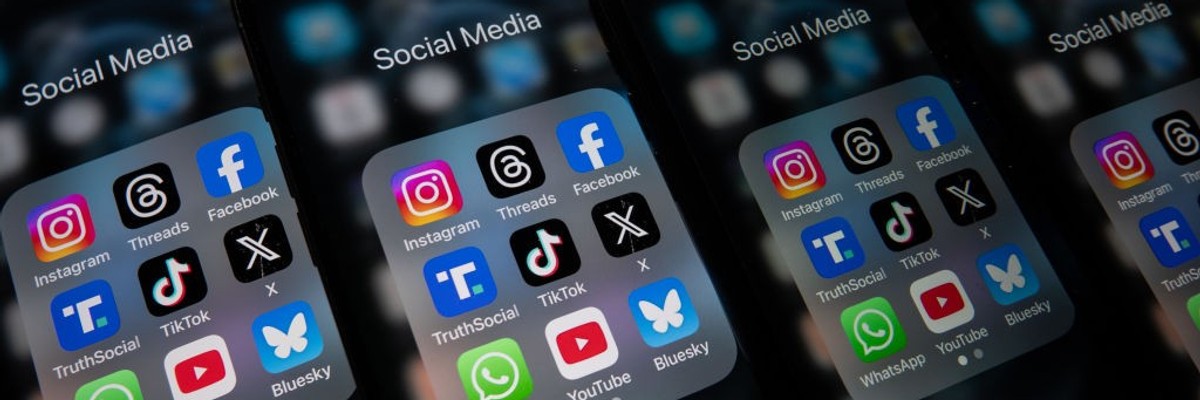
A serious issue for independent media that must be faced, writes Martin, "is that most social media platforms are increasingly antithetical to freedom of the press."
(Photo by Anna Barclay/Getty Images)
Christopher R. Martin
Mar 21, 2025Common Dreams
Hannah Arendt, the German-American political theorist who studied totalitarian regimes, noted in 1974 that “The moment we no longer have a free press, anything can happen. What makes it possible for a totalitarian or any other dictatorship to rule is that people are not informed; how can you have an opinion if you are not informed?”
Fifty years later, we have nearly reached that moment. This is existential for all independent (i.e., not allied with a political party or authoritarian regime) news organizations and their ability to reach audiences in the social media space.
Social media like Twitter (now X) and Facebook became important environments for the news media to enter two decades ago because they are where millions of people congregate online. For journalism organizations, the goal has been to post interesting stories and get referrals—those users who click through to the news site and boost web page views.
Yet, that relationship has fallen apart. Ultimately, tech companies are not interested in helping journalism or aiding civil discourse. The annual Reuters Institute for the Study of Journalism digital news report for 2025 notes “big falls in referral traffic to news sites from Facebook (67%) and Twitter (50%) over the last two years.”
The even bigger problem for independent news media is that most social media platforms are increasingly antithetical to freedom of the press.
There are millions of people in the social media space, and journalism shouldn’t leave them behind.
Since Elon Musk bought Twitter for $44 billion in 2022 and turned it into X, it’s become the disinformation-drenched social platform of the Donald Trump administration. This year, genuflecting to Trump, Meta (corporate parent of Facebook, Instagram, Threads, and WhatsApp) announced it would drop its independent fact-checking program in the U.S. in favor of an anemic, crowd-sourced “community notes” system, which has already been a failure at X. Another popular news platform, TikTok, has serious disinformation problems, security liabilities and an uncertain future.
Several news organizations around the globe decided they won’t take it anymore. NPR stopped posting on X in 2023, after the platform insisted on designating it as “U.S. state-affiliated media.” More recently, The Guardian announced it would stop posting on X, concluding it is “a toxic media platform.” Dagens Nyheter, the Swedish newspaper of record, Le Monde, the French newspaper of record, and La Vanguardia, the leading newspaper in Barcelona, quit X, too. The European Federation of Journalists, representing about 320,000 journalists, did the same. “We cannot continue to participate in feeding the social network of a man who proclaims the death of the media and therefore of journalists,” EFJ president Maja Sever wrote.
But, simply quitting X only eliminates the worst option and settles for the slightly less bad options that remain.
It doesn’t have to be this way.
There are millions of people in the social media space, and journalism shouldn’t leave them behind. For example, 54% of Americans get their news often or sometimes from social media. Adults 18-29 are the heaviest users of social media platforms. They deserve a social media platform that respects and informs them.
That’s why legitimate news media should band together and regain the autonomy they ceded to third-party social media. Independent news organizations–large and small–should cooperatively create and control their own social media platform that amplifies news and public information, encourages links to member news organizations, and excludes misinformation and disinformation.
Journalism has been so beaten down by big tech that it’s hard to imagine a different way of doing things.
The model for this is something almost as old as modern journalism, too: The Associated Press, an international cooperative nonprofit news agency. As the AP tells its founding story, “In 1846, five New York City newspapers funded a pony express route through Alabama to bring news of the Mexican War north faster than the U.S. Post Office could deliver it.” The problem with social media is similar–if it’s not working, work collectively to build another way. And, like the AP, it could be a global cooperative.
Journalism has been so beaten down by big tech that it’s hard to imagine a different way of doing things. But, a news-controlled social media platform could develop features that would demonstrate the multimedia ability of news organizations and enable the audience to create social connections in new and entertaining ways. Users could adjust their feeds to focus on local, regional, national, or international news, or whatever mix and topics makes sense to them, so all legitimate news organizations of any size get to be part of the platform.
Which news organizations and journalists could be part of such a social media cooperative?
Reporters Without Borders, the international journalism nonprofit, already has a powerful statement for fostering global information spaces for the common good, where “information can only be regarded as reliable when freely gathered, processed and disseminated according to the principles of commitment to truth, plurality of viewpoints and rational methods of establishment and verification of facts.” This would enable a broad range of journalism organizations to participate, and draw a bright line to exclude media propagating disinformation.
The challenge of creating a social media space for journalism is bigger than any single news organization can handle.
From a business perspective, journalism organizations, not third-party social media, would retain analytic data and any advertising revenue. The social media app could be free for any person with a subscription to any member news organization (e.g., a local newspaper, a national magazine of opinion, or digital news site), or with a nominal subscription fee, to provide built-in authentication and help prevent bot accounts. There are also strong global standards for content moderation through the International Fact-Checking Network, which was formed in 2015 and has a nonpartisan code of principles and more than 170 fact-checking groups around the world.
What would such a social media platform cost to create?
Clearly, $44 billion is too much. Bluesky, which has gained favor as an X alternative in recent months, offers a case for comparison. It started internally with just a handful of workers at then-Twitter in 2019. In the past two years, it’s received $23 million in seed funding to get it where it is today.
Bluesky may be the current favorite of many journalists, and has many advantages over other social media platforms, but its worthy purpose to encourage a less toxic space for public conversation does not primarily serve the goals of globally disseminating independent journalism.
Collectively building a nonprofit, cooperative global news-based social media platform would put verified news back in the center of public discourse.
The challenge of creating a social media space for journalism is bigger than any single news organization can handle. There has been talk for several years about Europe having its own social media platform to highlight democracy, diversity, solidarity, and privacy, and to avoid “foreign information manipulations and interference” from platforms based in the U.S. that have fallen into Trump’s power orbit and China-based platforms as well.
But, a nongovernmental platform, with a consortium of democracy-minded news organizations, may be most resistant to nationalisms and authoritarianism. The project could be built on an open-source structure like ActivityPub (the infrastructure behind Mastodon) or the AT Protocol (behind Bluesky), which would give more power to users.Collectively building a nonprofit, cooperative global news-based social media platform would put verified news back in the center of public discourse. The alternative is the independent press’s passive acceptance of whatever social media ecosystems Silicon Valley plutocrats or authoritarian governments decide to make, which is bad news for a free press.
Our work is licensed under Creative Commons (CC BY-NC-ND 3.0). Feel free to republish and share widely.
Christopher R. Martin is a professor of digital journalism at the University of Northern Iowa and author of No Longer Newsworthy: How the Mainstream Media Abandoned the Working Class, winner of the C.L.R. James Award.
Full Bio >
Neither Snow, Nor Rain, Nor Sleet, Nor DOGEHelp family farmers and other rural folks defend a strong public U.S. Postal Service from the Trump administration’s attacks.
Three United States Postal Service (USPS) mail trucks are parked in front of the post office in Danville, Pennsylvania.
(Photo: Paul Weaver/SOPA Images/LightRocket via Getty Images)
John Peck
Mar 22, 2025Common Dreams
Since 1775 when Benjamin Franklin became the very first postmaster general, the United States Postal Service has faithfully fulfilled the many lofty goals that are now inscribed outside the entrance of the U.S. Postal Museum in Washington D.C.: “Bond of the Scattered Family; Enlarger of the Common Life; Carrier of News and Knowledge; Instrument of Trade and Commerce.”
Affordable universal reliable communication is not something many people can take for granted. In fact, the USPS was such a great American idea (like our national park system) that it has since been replicated across the globe. Under the pretense that the USPS is “bankrupt,” though, President Donald Trump and other neoliberal free marketeers are hellbent on imposing an austerity program and ultimately privatizing this vital public service.
During Trump’s last stint in the White House, USPS was forced to shutter half of its mail processing centers, leading to longer delivery times, and 10% of the nation’s post offices, mostly in rural towns, were put on the auction block. Despite such, the USPS continues to have some of the highest public approval ratings of any federal government agency. After all, who else can you trust to make sure you get your seed orders or drug prescriptions in a timely fashion?
Now is the time to speak up and insure the proud iconic eagle of the USPS is not replaced by some anemic vulture version.
How did this quite preventable (and orchestrated) mugging of the USPS come about? Well, one needs to go back a few decades when the government first opened the door for corporate competitors to undermine the viability of the USPS. At just 73 cents to deliver a first class letter, USPS rates remain among the lowest in the industrialized world. Given the surge in packages, accelerated by the pandemic, private outfits like Fedex and Amazon are now allowed to mooch off the USPS’ amazing efficiency to help deliver their own packages (saving themselves up to 75%). Contrary to some naysayers, the USPS does not get a dime from U.S. taxpayers—it provides a valuable public service at cost to consumers. So attacks on the USPS claiming it is “horribly wasteful” are just flat out wrong.
The USPS is also hamstrung from taking advantage of other ways to expand its services that many people, especially rural folks, desperately need. For example, the USPS still offers money orders, but many other countries’ postal systems offer a much wider range of popular financial services such as checking and savings accounts, even low-interest loans. One recent study found that the USPS could earn an extra $8-9 billion per year just by providing basic banking options to the millions of Americans who now subsist on the fringes of the financial system. It is no surprise that Wells Fargo is drooling over the possible demise of USPS (as revealed in a recently leaked internal memo), since they hardly want any other option for those now subject to their predatory lending practices.
Now is the time to speak up and insure the proud iconic eagle of the USPS is not replaced by some anemic vulture version. Family Farm Defenders is among dozens of organizations that have joined the Grand Alliance to Save Our Public Postal Service. And just like many family farmers rely upon cooperatives for their collective bargaining against agribusiness, postal workers also deserve to have their labor rights respected as fully unionized federal employees. Please contact your elected officials to insure the future of USPS as a vital public good, and next time you are at the post office thank the workers for their essential service! As the unofficial motto of the USPS goes: “Neither snow, nor rain, nor heat, nor gloom of night stays these couriers from the swift completion of their appointed rounds.” Neither should DOGE!
Our work is licensed under Creative Commons (CC BY-NC-ND 3.0). Feel free to republish and share widely.
John Peck is the executive director of Family Farm Defenders.
Full Bio >
The End of Free Speech?If the White House can punish anybody who engages in speech it dislikes, nobody will be free to criticize the government—and corporate criminals will be free to run amok.
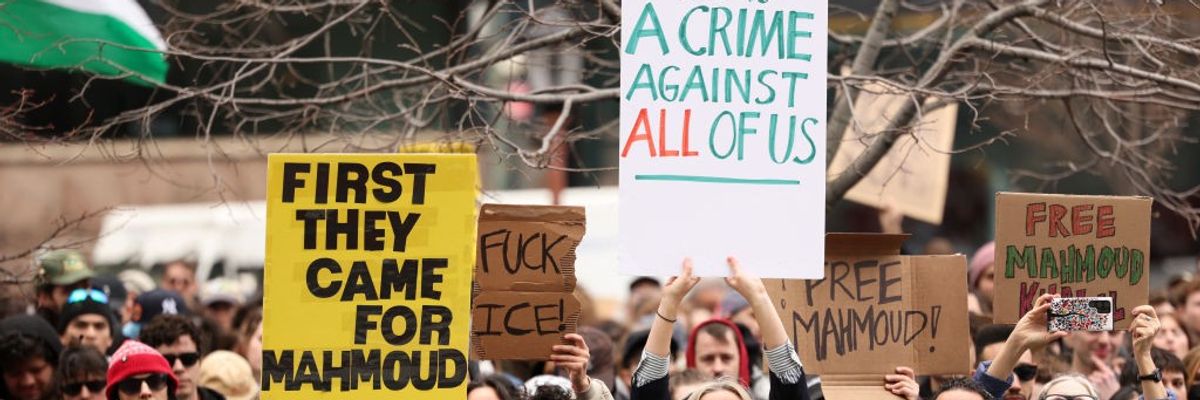
Pro-Palestinian protesters rally in support of Mahmoud Khalil outside of the Thurgood Marshall Courthouse, where a hearing is underway regarding Khalil's arrest, in New York City on March 12, 2025.
(Photo: Charly Triballeau/AFP via Getty Images)Common Dreams
Earlier this March, agents from the Department of Homeland Security, or DHS, arrested Mahmoud Khalil at his Columbia University-owned apartment building in New York City. Khalil, a lawful permanent resident of the United States, was then promptly disappeared by federal agents, who refused to tell Khalil’s wife (a U.S. citizen) why he was being detained or where he was being held. He has since been found by his attorneys and partner in a private Louisiana detention facility notorious for abuse. His deportation was successfully, though only temporarily, halted by a federal judge.
An initial hearing in Khalil’s case was subsequently heard—without him present—in New York City. There, the Department of Justice defended the kidnapping, and backed the White House’s claimed rationale: the Trump administration doesn’t approve of Khalil’s speech, and therefore it has the right to forgo due process, revoke his green card without judicial order, and deport him.
Khalil is a prominent pro-Palestinian leader at Columbia University. He was one of students’ lead negotiators during the anti-genocide encampments that formed on its campus in 2024. It is this right to speech, enshrined in the U.S. Constitution, and affirmed over and over and over again, that President Donald Trump and Secretary of State Marco Rubio are endeavoring to unilaterally, and with no constraints, gut.
Trump and his allies seemingly hope to manufacture a future in which any public critic of the administration or its friends can be defined, and prosecuted, as a “terrorist” for whom basic civil liberties can be summarily suspended.
To this end, the federal government has made no case that Khalil has committed a crime. Instead, the Trump administration has continuously boasted that Khalil is being targeted with the full force of the state for engaging in speech it doesn’t like; speech that is unambiguously guaranteed by the First Amendment, and that the White House now seeks to classify as “terrorism.”
Should Trump and Rubio succeed, as The Intercept aptly summarized, it will symbolize the death of free speech for American citizens and green-card holders alike.
Of course, it isn’t just Khalil—though if the government succeeds in his case it will be a chilling bellwether for the state of speech and protest in the Trump years and beyond. Even just in the weeks since kidnapping Khalil, it’s been reported that DHS officers have arrested another student protester at Columbia, stripped a different Columbia student of their visa status, denied a French scientist entry to the United States reportedly because of their expressed political disagreement with the administration, disappeared dozens of New Mexico residents, and more.
Of course, this playbook isn’t new, and Republicans have long sought to gut protected speech, and protected protest in particular. Indeed, dozens of Stop Cop City protesters and organizers are still navigating an abusive investigation and prosecution regime in Georgia that functionally seeks to render public displays of political dissent as violent conspiracy and “domestic terrorism,” including speech activities as mundane as handing out pamphlets.
As baseless and unconstitutional as those prosecutions were and still are, it’s this principle that is being pushed to new and even-more horrifying depths, as Trump and his allies seemingly hope to manufacture a future in which any public critic of the administration or its friends can be defined, and prosecuted, as a “terrorist” for whom basic civil liberties can be summarily suspended.
Indeed, Donald Trump, while turning the White House into a car dealership earlier this month, told reporters that people protesting Elon Musk’s hostile takeover of the U.S. federal government at Tesla storefronts, or protesting “any company,” should be labeled domestic terrorists, and that was something he “will do.”
Should the political persecution of Khalil succeed, it will foster a new era of the militarized American police state that greenlights the arbitrary and capricious abduction of organizers, dissidents, and critics of the Trump administration and the corporations it serves.
It should not need to be said, but to say it anyway: If foundational constitutional rights can be unilaterally suspended by the government, with no trial or even formal documentation of so-called wrongdoing, then those rights do not actually exist for anyone.
Who stands to benefit from such a bleak future? Advocates for authoritarianism for one, and corporations for another.
While the executive branch targets protesters’ rights to speech on White House orders, Trump’s own corporate allies and donors are pursuing adjacent tactics to divest normal people of the right to criticize the corporate hegemons ruining our lives.
Greenpeace, for example, just lost the trial brought against it by Energy Transfer, which seeks to functionally sue the group out of existence in the U.S. for criticizing the Dakota Access Pipeline (DAPL). That notorious project, controlled by Energy Transfer, is well-known for its environmental racism and for deploying extreme force against environmental advocates, Indigenous communities, and others who opposed it.
Greenpeace is set to appeal the verdict, but if Energy Transfer should ultimately succeed, it would not just spell the end of Greenpeace’s U.S. operations, but will also usher in a new era in which corporate money can not just silence, but wholly eradicate, organizations that are critical of corporate polluters, labor abusers, price-gougers, and more. Such a future would place a price tag on First Amendment protections, with only the most well-resourced entities in the country seemingly eligible to enjoy it, and everyone else left vulnerable to their whims and machinations.
The political kidnapping of Mahmoud Khalil is an egregious attempt to undo 233 years of American constitutional law, and—regardless of what Trump or others claim—threatens to end the right to free speech, and democracy, as we know it. Should the political persecution of Khalil succeed, it will foster a new era of the militarized American police state that greenlights the arbitrary and capricious abduction of organizers, dissidents, and critics of the Trump administration and the corporations it serves. That, to be clear, would wholly cement the United States’ descent into full-fledged fascism.
Crucially, though, even if they fail to make Khalil the defining, and chilling, example of a new epoch of American political prisoners, Donald Trump and his allies in and outside of government have made it clear: They want to eliminate the First Amendment, and will do whatever it takes to do so.
Our work is licensed under Creative Commons (CC BY-NC-ND 3.0). Feel free to republish and share widely.
Toni Aguilar Rosenthal
Toni Aguilar Rosenthal is a researcher at the Revolving Door Project
Full Bio >
'Columbia Has Lost Something It May Never Regain': Outrage as the University Yields to Trump's Demands
"Columbia's capitulation to fascist government intervention is so severe when you really look at the details," wrote an assistant professor at the University of California, Los Angeles.
Columbia University's library building is pictured by night on April 15, 2020, in New York City, New York.
(Photo by: Peter Titmuss/Education Images/Universal Images Group via Getty Images)
Eloise Goldsmith
Mar 22, 2025
COMMON DREAMS
Columbia University received a wave of criticism on Friday after it agreed to a number of demands from the Trump administration as part of negotiations over $400 million in federal grants and contracts that the Trump administration had pulled due to the school's alleged "inaction in the face of persistent harassment of Jewish students."
The school agreed to a ban on masks and to appoint a senior vice provost with broad power to oversee both the department of Middle East, South Asian, and African Studied and the school's Center for Palestine Studies, according to the Wall Street Journal, which first reported the news. Also, Columbia has hired over 30 "special officers" who will have the ability to remove individuals from campus and arrest them, per the memo from the school announcing the update.
On Friday evening, writer Ross Barkan wrote on X, "I confess I don't get Columbia folding. Don't they have an endowment worth many billions? Very rich alumni? Alumni who hate Trump? They could do a massive 'resistance' fundraiser to make up for lost federal dollars. Very odd and very weak." Others echoed this sentiment.
"Columbia's capitulation to fascist government intervention is so severe when you really look at the details," wrote Nour Joudah, an assistant professor at the University of California, Los Angeles, on X. "This is pathetic."
Leaders at Columbia's Knight First Amendment Institute expressed sadness. "The administration held up the university at gunpoint, but I can't help but feel that Columbia has lost something it may never regain," wrote the litigation director at the Knight Institute, Alex Abdo, on Friday.
Jameel Jaffer, executive director of the Knight Institute, wrote on Bluesky that it is "a sad day for Columbia and for our democracy."
The episode highlight's the Trump administration's escalating scrutiny of higher education.
In February, U.S. President Donald Trump signed an executive order with the purported aim of rooting out antisemitism on college campuses, and has vowed to go after foreign-born students who have engaged in pro-Palestine protests, which he has deemed "anti-American activity." The Department of Education—which the Trump administration is endeavoring to shut down—has also launched investigations into dozens of universities over alleged "race-exclusionary practices."
But Columbia has so far been at the center of the administration's feud with universities. In a March 7 press release, members of Trump's Joint Task Force to Combat Anti-Semitism announced the cancellation of $400 million, and a day later immigration agents arrested a recent Columbia University graduate who played a major role in pro-Palestine demonstrations last year. The arrest of Mahmoud Khalil, a legal permanent resident, has been widely decried.
On March 13, the Trump administration sent a letter to Columbia University Interim President Katrina Armstrong outlining a series of steps that Columbia must comply with in order to maintain a "continued financial relationship" between the school and the government.
Among the nine demands was a call for disciplinary proceedings for students involved in last year's Gaza Solidarity Encampments and occupation of Hamilton Hall. The same day Columbia received the letter it issued expulsions, multi-year suspensions, and temporary degree revocations for students involved in the Hamilton occupation.
An senior administrator at Columbia told the Journal that the university had considered legal challenges to resist the demands, but decided that the federal government had too many ways to take back money from the university. Columbia has an endowment of about $15 billion, though according to the outlet it would not "take long for it to cease to operate in any recognizable form without government money."
"Additionally the school believed there was considerable overlap between needed campus changes and Trump's demands," according to the Journal.
K-12 Leaders Rejected Weaponization of Antisemitism Claims. Why Won’t Higher Ed?
Columbia has capitulated in what one scholar calls “an ideological battle to shut down any dissent” against Trump.
March 22, 2025
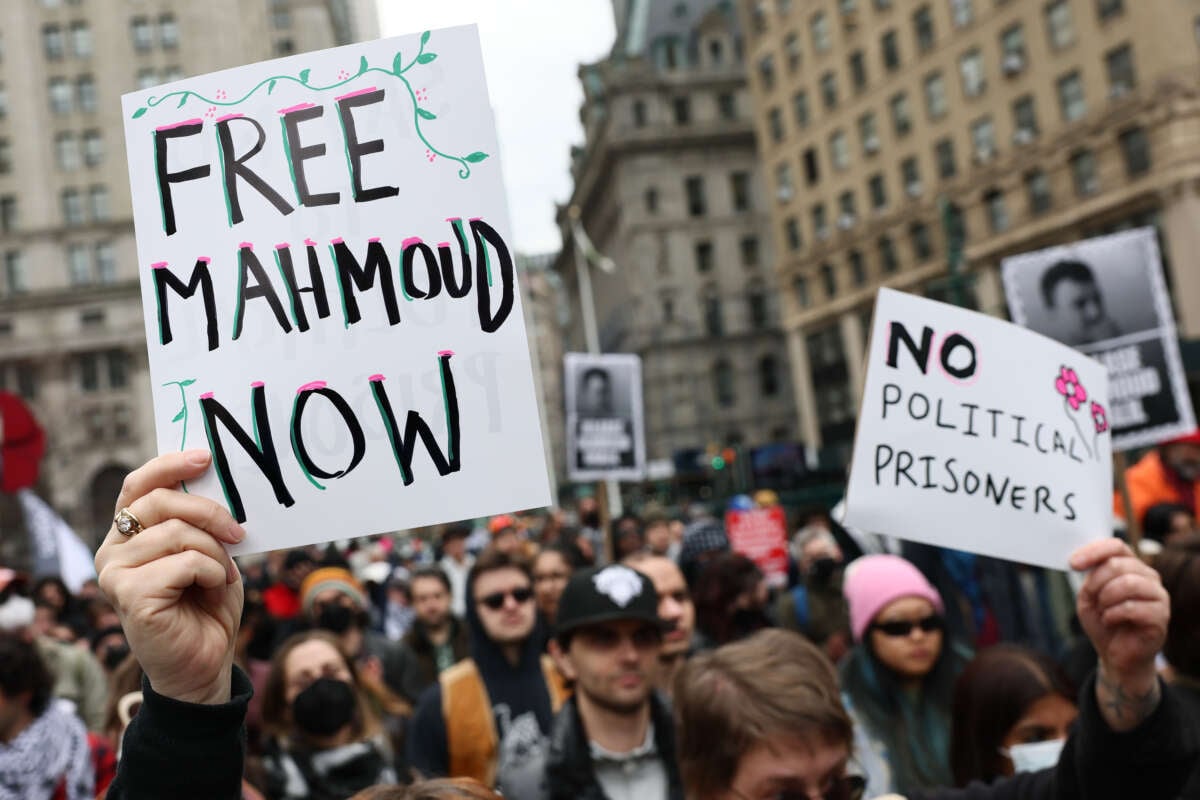
People gather outside of a New York court to protest the arrest and detention of Mahmoud Khalil at Foley Square on March 12, 2025, in New York City.Michael M.
Columbia University has caved into a broad set of demands from Donald Trump in an attempt to restore $400 million in federal funding withheld by his administration. Katrina Armstrong, the university’s interim president, announced on Friday that masks would be banned on campus (barring health or religious reasons), policing would be expanded, and curriculum related to the Middle East would come under review, among other new policies.
Meanwhile, Columbia University activist Mahmoud Khalil’s case has sparked concerns about the criminalization of political protest and the broader implications for higher education and political activism in the U.S. He remains in Immigration and Customs Enforcement (ICE) jail.
In this exclusive interview for Truthout, Nivedita Majumdar discusses how Khalil’s case displays xenophobic sentiment, the right-wing targeting of higher education and the relative silence of the Democratic Party in addressing civil liberties concerns.
Majumdar is a professor of English at John Jay College, City University of New York (CUNY). She is the co-chair of the John Jay chapter of the Professional Staff Congress, the CUNY faculty and staff union. Majumdar’s academic work focuses on postcolonial studies, Marxist theory and cultural studies. She is the author of The World in a Grain of Sand: Postcolonial Literature and Radical Universalism (Verso, 2021) and is actively engaged in academic governance and labor advocacy. The interview that follows has been lightly edited for clarity and length.
Daniel Falcone: ICE’s abduction of Mahmoud Khalil looks to be a strategic move to criminalize political protest and speech. What are the broader implications of this, not only for the immigrant rights movement but also for the future of political activism on college campuses across the U.S.?
Nivedita Majumdar: The ICE arrest and attempt to deport Mahmoud Khalil, a permanent resident, for leading a university protest is almost unprecedented for the attack on First Amendment rights. The current context in some ways is reminiscent of the political climate in the aftermath of 9/11 and the passage of the PATRIOT Act, which provided sweeping powers to law enforcement authorities, broad surveillance powers to the state without probable cause, and allowed noncitizens to be detained for long periods without being charged with a crime.
But even in that period, we don’t recall ICE agents rounding up international students from university dorms. Now, the Trump administration’s attempt to deport Khalil does not evoke the relatively recent PATRIOT Act; instead, it harks back to the Immigration and Nationality Act of 1952 that targeted Communists. As draconian as these acts were, it’s instructive that the state could carry out the violation of fundamental rights under those acts only at a moment of perceived national threat. Khalil’s arrest is a war on basic rights at a time when there is no external threat, nor is there any attempt to even make such a case.
The attack on universities is part of an ideological battle to shut down any dissent against Donald Trump’s agenda. It makes sense for them [the Trump administration] to start by targeting the pro-Palestinian movement with the cynical weaponization of antisemitism, because it activates both decades of cultivated anti-Arab sentiments, and a more generalized anti-immigrant sensibility. But we need to be very clear that they won’t stop with pro-Palestinian protesters; it’s just the lowest-hanging fruit. In fact if we want a sense of the broader agenda here, we can simply look at the administration’s letter to Columbia University demanding compliance on an expansive range of matters as a precondition for reconsidering the cancelation of $400 million in federal funding. It includes centralizing disciplinary processes under Columbia’s Office of the President and empowering the office to suspend and expel students, instituting “time place and manner rules” (i.e. restricting protests), banning masks, empowering campus police with full law enforcement authority (including those of arrest and removal), and placing the Middle East, South Asian, and African Studies Department under academic receivership, (meaning an outside chair would control the department). All of this under the pretext of fighting antisemitism!
If we have fully funded public universities and if all institutions, public and private, are meaningfully integrated into the larger society, it is harder to stigmatize them as elite and out of touch.
A cursory glance at the list gives you a sense of the actual agenda of squelching dissent by centralizing authority, diminishing civil rights, decimating academic freedom and ideological straitjacketing. There are currently 60 other universities which are now subject to similar investigations and consequences as Columbia. To what extent all of that succeeds is of course an open question.
Could you talk about the targeting of higher education by the right wing in general?
The targeting of higher education is often a part of the program of authoritarian regimes; we have recently witnessed similar attacks play out in Turkey, India, Hungary, and other places. The sector is deemed threatening for the institutional power it represents in its relative autonomy, its ability to shape young minds, and for being a central locus of critique and dissension.
About our current moment, I find it instructive that while it is certainly a perilous territory for all higher education, it is the elite institutions that are on the front line of their attack. I think there is a parallel here between making the pro-Palestinian movement the face of all “undesirable” protest and making Columbia the symbol of university culture. In both cases, they have started with easy targets. To appreciate what makes the top universities soft targets, we must consider Trump’s entire “anti-elite” discourse with which he has successfully mobilized the genuine grief and rage of ordinary working people in a broken system. First, the price tag attached to college makes it impossible for many to earn a degree and saddles those who do make it with often a lifetime of debt. This is the case with even public institutions, thanks to decades of systemic underfunding of these colleges and universities, and the increasing reliance on tuition.
With private universities like Columbia, Harvard, Brown and Stanford, they are simply perceived by the vast majority as inaccessible institutions with little impact on community life. Columbia and NYU are the largest private landowners in New York City, and it is impossible for city residents not to witness their massive footprint. But an ordinary New Yorker not directly connected to the schools would be hard pressed for a response if asked how the universities impacted their lives. For the most part, people remain indifferent to these institutions perceived as expensive and expansive oases for the select few.
Between underfunding and privatization, higher education has morphed into an entity that is simply not recognizable as a public good. Trump has cannily exploited this development to weave his anti-elitist narrative where higher education in general is part of the problem, and a school like Columbia, simply undesirable.
The Democratic Party has largely remained silent in the face of Khalil’s arrest, despite the broader implications for civil liberties. What does this say about the state of the party?
Yes, the Democratic pushback on the Khalil case has been pitiful. Several other people have been arrested by ICE after Khalil, similarly, with no regard to their constitutional rights. It is inexplicable how Rashida Tlaib’s statement circulated to a hundred progressive Congress members garnered only 14 signatures. The issue was not even one of condemning Israel, or supporting people with pro-Palestinian views, but simply the defense of the First Amendment right, and they could not step up to even that much. There was thankfully a statement by New York elected officials calling for the immediate release of Khalil, but even that had only 40 signatures. Beyond these petitions and a few social media comments, there has been little action to stem this frightening course of action.
A large part of the Democratic Party was extremely critical of the pro-Palestine protests, and under Joe Biden, often joined Republicans in denouncing student protesters, thus contributing to the current buildup. And now, virtually the entire party seems to have decided that nonconfrontation is the best strategy with Trump. There have been several demonstrations organized by local organizations protesting the treatment of Khalil and Columbia, and that is heartening.
But what is required in resistance to the unconstitutional government actions is a large-scale coordinated resistance that a national party is best positioned to organize. If we want an example of what an opposition can organize, think of the congressional hearings led by Rep. Elise Stefanik that took place under Biden. It is truly shameful to have this docility in the face of such flagrant violations, and the party must know that if Trump is allowed to get away with this violation, it only empowers him further. Trump will not stop with pro-Palestine protesters.
The Democrats lost the 2024 elections because of their inability to forge a platform addressing the pervasive economic anxiety in the country. Add to that, the aiding and abetting of a genocide which alienated the party’s youth base, while sealing the deal for Republicans. Now, in the face of Trump’s authoritarian march, the Democratic Party is in disarray with no ability or willingness to fight back.
Why isn’t higher ed fighting back harder, in your view?
The last time you interviewed me was at the time of the congressional hearings of college presidents of Harvard, Penn and MIT, and later also of the Columbia president. We witnessed then how the university leaders all caved under pressure, sacrificing both their students and principles of academic freedom and freedom of speech. Of course, the humiliation was not sufficient, and all but one of the university presidents had to resign from their positions.
You will recall those hearings were followed by hearings of school principals from three large public school systems, again for the purpose of interrogating their response to the alleged growing antisemitism in their schools. What was remarkable was that the principals struck a very different note compared to the college presidents. They refused to be badgered and held their ground with the message that they knew how to run their institutions; and one of them called out the “cheap political theater” in the name of combating antisemitism. None of the principals lost their positions coming out of the hearings.
What explains the difference between the hearings and the outcome? My sense is it’s because unlike the Ivies, public schools are fully funded and deeply entrenched in their communities. That makes our K-12 institutions much more immune from untoward political pressure.
Of course, while the funding situation of public higher ed institutions goes a long way in explaining the tepid response of leaders of the sector to the current assault, it still begs the question why universities like Columbia and Harvard, with billions in endowments, refuse to stand up and push back. One assumes they are afraid of losing their politically motivated donor base, but that is a pathetic reason to not fight for fundamental institutional values. At this point of existential threat, public and private universities need to join forces and push back; legal challenges are necessary, but they also need to take their case to the wider public.
Moving forward, how can we better organize higher education so it’s viewed as a public good?
I think the question for us is if it’s possible to build a similar model for higher education, that’s both fully funded and has community roots. Currently, the “fully funded” model is nowhere to be seen in the country. CUNY, where I teach, is integrated into the larger city. Its 25 campuses educate an extremely multiracial student body of half a million, and half of them come from families with income under $40,000. And a Stanford study provides a sense of why the institution remains deeply relevant for the city: CUNY alone propels almost six times as many low-income students into the middle class as all eight Ivy League campuses combined.
But there is little reward for this tremendous societal function. Only around 60 percent of the university is state funded and even that is not guaranteed. Every budget season, the university and the union are in Albany making a case for funds to run the institution; it’s the same for our state counterpart, SUNY, and indeed for public universities across the nation. This economic vulnerability, one that school principals thankfully do not share, makes it hard for university leaders to stand up to the kind of political pressure we are witnessing currently. We need a model of full and guaranteed funding for all public higher education institutions, so that is an essential fight.
I also believe both public and private universities — but especially private ones — need to be more structurally integrated into the social spaces they inhabit. Private universities, as nonprofit entities, are tax-exempt, and therefore should be in the business of actively serving their communities. There are many models that can be devised to make this work if there is political will. A portion of the faculty teaching load could be designated for free courses for community members. There can be routine workshops, exhibitions, readings, concerts etc., free and open to the public, led by faculty members. And none of this should be extra or voluntary labor by faculty but baked into the regular workload with the expectation that it will require the institution to expand faculty hiring. At a minimum, all university libraries should function as public libraries.
In the long run, if we have fully funded public universities and if all institutions, public and private, are meaningfully integrated into the larger society, it is harder to stigmatize them as elite and out of touch. And when they are under attack, you can expect societal outrage, instead of the broad indifference we are currently experiencing. There is a reason even someone like Trump must tread lightly when it comes to Social Security, Medicare and Medicaid: Attacking services that are genuinely public is simply not politically expedient. Of course, at this moment we are in an existential battle to save higher education and all our public institutions, so building out toward a more expansive community-oriented mode may not be feasible right now, but the moment should be a time for us to reflect also on our long-term objectives.
This article is licensed under Creative Commons (CC BY-NC-ND 4.0), and you are free to share and republish under the terms of the license.
Daniel Falcone is a writer, activist and teacher in New York City and studies in the Ph.D. program in World History at St. John’s University in Queens, New York. Follow him on Twitter: @DanielFalcone7.
Ethics Complaint Filed Over Trump Commerce Secretary's Public Push for Tesla Stock Purchases
Campaign Legal Center wants ethics officials to probe the "apparently flagrant violation of federal law."
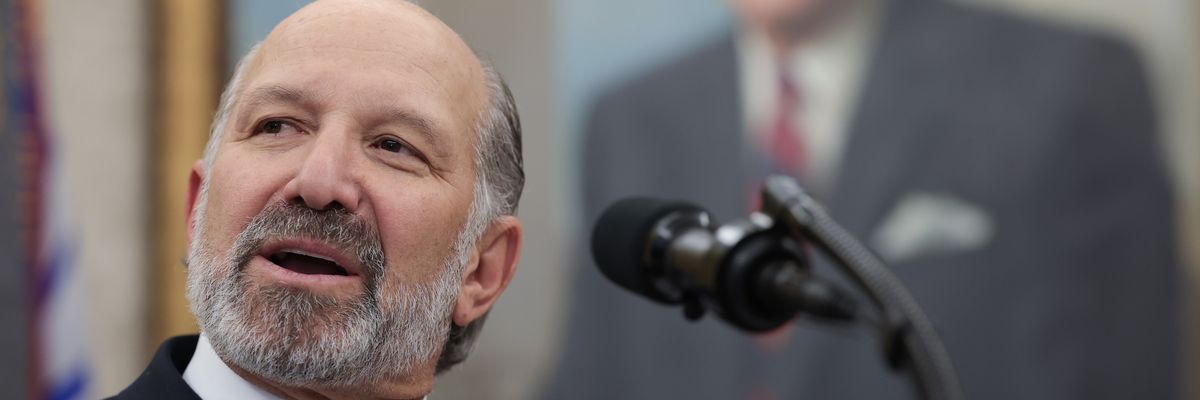
U.S. Commerce Secretary Howard Lutnick delivers remarks before being sworn in at the White House on February 21, 2025 in Washington, D.C.
(Photo: Win McNamee/Getty Images)
Eloise Goldsmith
Mar 21, 2025
COMMON DREAMS
The nonpartisan legal group on Friday filed a complaint with the Office of Government Ethics and the designated agency ethics official at the U.S. Department of Commerce, urging them to investigate comments U.S. Commerce Secretary Howard Lutnick made on Fox News earlier this week when he exhorted viewers to "buy Tesla," speaking of the stock of billionaire Elon Musk's electric vehicle company.
Campaign Legal Center (CLC) wants officials to look into whether Lutnick's comments on Fox News—which the group called an "apparently flagrant violation of federal law"—did violate the federal ban on government officials using their public positions for private enrichment.
According to the complaint, executive branch employees "may not use their public office for their own private gain; [or] for the endorsement of any product, service, or enterprise."
Other critics responded to the billionaire commerce secretary's comments on Fox by pointing out that, as one watchdog leader put it, "he conveniently forgot to mention his family business empire holds nearly $840 million in the company."
Elon Musk, the CEO of Tesla and also the largest shareholder, has been deputized by U.S. President Donald Trump to help oversee efforts to cut federal programs and personnel and is playing a core role in his administration.
"The president's Cabinet members take an oath to serve the American people, and with that oath comes the ability and privilege to exercise a vast amount of power," said Kedric Payne, vice president, general counsel, and senior director of ethics at Campaign Legal Center in a statement on Thursday.
"The Office of Government Ethics and Commerce ethics officials should hold Lutnick accountable and reassure the public that their officials will face consequences if they use their public office to enrich themselves or their allies," said Payne.
Lutnick made the comments when he was speaking on Fox News' "Jesse Watters Primetime" on Wednesday.
"Buy Tesla. It's unbelievable that this guy's stock is this cheap. It'll never be this cheap again... Who wouldn't invest in Elon Musk?" he told viewers.
Earlier this month, Trump hosted a Tesla car show at the White House. His and Lutnick's stunts come as the company faces protests over Musk's work for the administration and falling stock prices.
Tesla stock has tumbled since it reached a post-election high in December 2024. Axiosreported Thursday that shares have fallen 42% so far this year. Axios also reported that Tesla shares fell on Thursday after Lutnick made his comments on Fox News.
DOGE Is Hitting the Accelerator on the Creeping Privatization of the US GovernmentTrump’s latest moves can be viewed as a massive speedup of a decades-long trend, rather than a break from the past
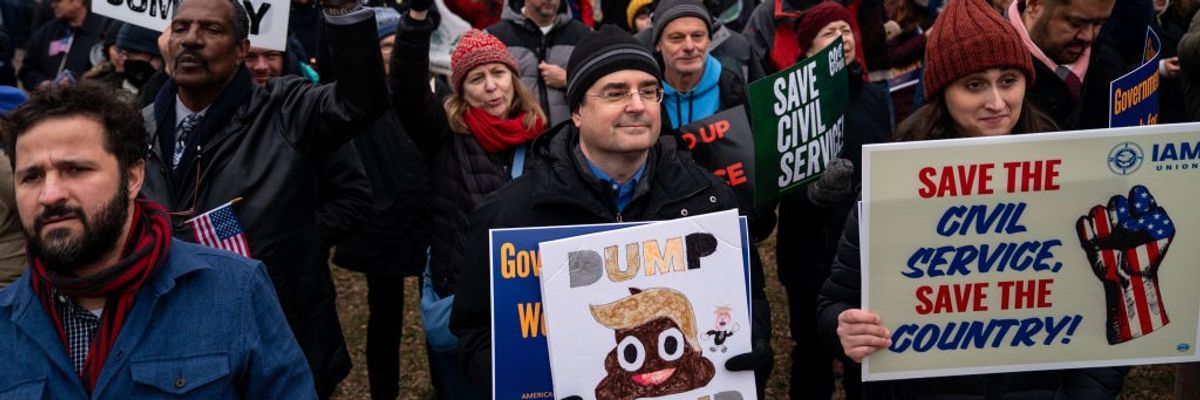
People hold signs as they gather for a "Save the Civil Service" rally hosted by the American Federation of Government Employees (AFGE) outside the U.S. Capitol on February 11, 2025 in Washington, D.C.
(Photo: Kent Nishimura/Getty Images)
The Conversation
Since returning to office, President Donald Trump has aggressively moved to shrink the federal government. His administration has frozen federal grants, issued executive orders aligned with the Heritage Foundation’s Project 2025, and, most prominently, created what he calls the Department of Government Efficiency, or DOGE.
DOGE has been billed as a cost-cutting initiative, although the actual amount of money being saved remains unclear. To lead DOGE, Trump appointed Elon Musk, a megadonor whose companies hold federal contracts worth billions. Musk has already moved forward with major cuts, including sweeping workforce reductions, the curtailment of government operations, and purges of entire agencies. Thousands of federal workers have lost their jobs.
While certainly dramatic, these actions reflect a longer trend of privatizing government. Indeed, my sociological research shows that the government has steadily withdrawn from economic production for decades, outsourcing many responsibilities to the private sector.
3 indicators of privatization
At first glance, total government spending appears stable over time. In 2024, federal, state, and local expenditures made up 35% of the U.S. economy, the same as in 1982. However, my analysis of Bureau of Economic Analysis data offers a new perspective, recasting privatization as a macroeconomic phenomenon. I find that U.S. economic activity has become increasingly more privatized over the past 50 years. This shift happened in three key ways.
First, government involvement in economic production has declined. Historically, public institutions have played a major role in sectors such as electric power, water delivery, waste management, space equipment, naval shipbuilding, construction, and infrastructure investments. In 1970, government spending on production accounted for 23% of the economy. By 2024, that figure had fallen to 17%, leaving the private sector to fill the gaps. This means a growing share of overall government spending has been used to fund the private sector economy.
The privatization trend risks eroding democratic accountability and worsening racial and gender inequalities.
Second, government’s overall ability to produce goods and services—what economists call “productive capacity”—has fallen relative to the private sector, both in terms of labor and capital. Since 1970, public employment has lagged behind private sector job growth, and government-owned capital assets have trailed those of the private sector. Although public sector capital investments briefly rebounded in the 2000s, employment did not, signaling a shift toward outsourcing rather than direct hiring. This has significant implications for wages, working conditions, and unionization.
Third, and relatedly, government increasingly contracts work to private companies, opting to buy goods and services instead of making them. In 1977, private contractors accounted for one-third of government production costs. By 2023, that had risen to over half. Government contracting—now 7% of the total economy—reached $1.98 trillion in 2023. Key beneficiaries in 2023 included professional services at $317 billion, petroleum and coal industries at $194 billion, and construction at $130 billion. Other examples include private charter schools, private prisons, hospitals, and defense contractors.
The Meaning of Privatization
Privatization can be understood as two interconnected processes: the retreat of government from economic production, and the rise of contracting. The government remains a major economic actor in the U.S., although now as more of a procurer of goods and services than a provider or employer.
The government’s shift away from production largely stems from mainstreamed austerity politics—a “starve the beast” approach to government—and backlash against the New Deal’s expansion of federal economic involvement. In 1971, the controversial “Powell Memo,” written by future Supreme Court Justice Lewis Powell, mobilized business leaders around the goal of expanding private sector power over public policy. This fueled the rise of conservative think tanks, including the Heritage Foundation, the eventual architect of the Project 2025 privatization agenda.
While government production shrank, government contracting expanded on promises of cost savings and efficiency. These contracting decisions are usually made by local administrators managing budgets under fiscal stress and interest group pressure, including from businesses and public sector unions.
Yet research shows that contracting frequently fails to reduce costs, while risking monopolies, weakening accountability and public input, and sometimes locking governments into rigid contracts. In many cases, ineffective outsourcing forces a return to public employment.
The Consequences of Privatization
Trump’s latest moves can be viewed as a massive acceleration of a decades-long trend, rather than a break from the past. The 50-year shift away from robust public sector employment has already privatized a lot of U.S. employment. Trump and Musk’s plan to cut the federal workforce follows the same blueprint.
This could have major consequences.
First, drastic job cuts likely mean more privatization and fewer government workers. Trump’s federal workforce cuts echo President Ronald Reagan’s 1981 mass firing of more than 11,000 air traffic controllers, a source of prolonged financial struggles and family instability for many fired workers. Trump’s firings and layoffs are already reaching far beyond Reagan’s.
As Trump’s administration aggressively restructures federal agencies, these changes will likely proceed without public input, further entrenching private sector dominance.
In addition, since federal spending directly contributes to gross domestic product, cuts of this magnitude risk slowing the economy. The Trump administration has even floated the idea of changing GDP calculations, potentially masking any reality of economic decline.
Rapid privatization is also likely to trigger significant economic disruptions, especially in industries that depend on federal support. For example, USAID cuts have already sent shock waves through the private sector agricultural economy.
Finally, the privatization trend risks eroding democratic accountability and worsening racial and gender inequalities. That’s because, as my prior research finds, public sector unions uniquely shape American society by equalizing wages while increasing transparency and civic participation. Given that the public sector is highly unionized and disproportionately provides employment opportunities for women and Black workers, privatization risks undoing these gains.
As Trump’s administration aggressively restructures federal agencies, these changes will likely proceed without public input, further entrenching private sector dominance. This stands to undermine government functioning and democratic accountability. While often framed as inevitable, the American public should know that privatization remains a policy choice—one that can be reversed.
An Unconstitutional Rampage
Trump and Musk are on an unconstitutional rampage, aiming for virtually every corner of the federal government. These two right-wing billionaires are targeting nurses, scientists, teachers, daycare providers, judges, veterans, air traffic controllers, and nuclear safety inspectors. No one is safe. The food stamps program, Social Security, Medicare, and Medicaid are next.
It’s an unprecedented disaster and a five-alarm fire, but there will be a reckoning. The people did not vote for this. The American people do not want this dystopian hellscape that hides behind claims of “efficiency.” Still, in reality, it is all a giveaway to corporate interests and the libertarian dreams of far-right oligarchs like Musk.
Common Dreams is playing a vital role by reporting day and night on this orgy of corruption and greed, as well as what everyday people can do to organize and fight back. As a people-powered nonprofit news outlet, we cover issues the corporate media never will, but we can only continue with our readers’ support.
This work is licensed under a Creative Commons Attribution 4.0 International License
Nathan Meyers
Nathan Meyers is a PhD candidate in sociology at UMass Amherst.
Full Bio >
'They Will Have to Come Through Us': Sunrise Protests Trump Attacks With Education Department Study-In"Trump and Musk want to defund public schools so they can give their fellow billionaires a bigger tax break," warned one organizer. "We won't let them rob us of a good education."
Activists protest Trump administration attacks on the U.S. Department of Education outside the agency's headquarters in Washington, D.C. on March 21, 2025.
(Photo: Kayla Bartkowski/Getty Images)
Brett Wilkins
Mar 21, 2025
COMMON DREAMS
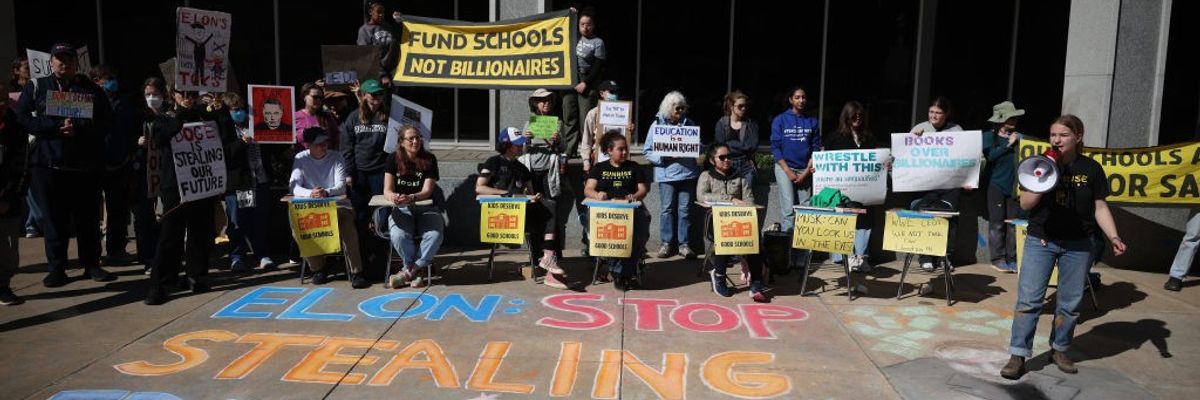
Students and allies rallied outside the Washington, D.C. headquarters of the U.S. Department of Education on Friday for a "study-in" protest against President Donald Trump's plan to shut down the federal agency—a longtime policy goal of right-wing groups including the organization behind the infamous Project 2025—and other administration attacks on their future.
Protesters set up school desks with signs reading "Trump, Stop Stealing From Kids" and "Kids Deserve Good Schools" on a sidewalk outside the agency's main office. Sunrise Movement, the youth-led climate campaign that led the demonstration, vowed to "defend our schools, our futures, and our democracy" from attacks by Trump and Elon Musk's Department of Government Efficiency.
"If Trump and Musk want to destroy the futures of millions of students across the country, they will have to come through us," Sunrise Movement said on Instagram ahead of the protest.
On Thursday, Trump signed an executive order directing billionaire businesswoman-turned-Education Secretary Linda McMahon to "take all necessary steps to facilitate the closure of the Department of Education and return education authority to the states." Trump's order followed the Department of Education's announcement earlier this month that it would fire half of its workforce.
The executive order delighted conservatives, who have long targeted the agency tasked with protecting civil rights and equal access in schools, administering federal student aid programs, funding billions of dollars in scholastic loans and grants, and more. The Heritage Foundation, which led Project 2025—often described as a blueprint for a far-right takeover of the federal government—applauded the directive.
However, according to Sunrise Movement:
Abolishing the Department of Education would have severe impacts on students, teachers, and parents. Schools will face larger class sizes, fewer teachers, and severe underfunding, making it even harder for students to get the education they deserve. Pell Grants would be eliminated, putting higher education out of reach for millions. Programs that support students with disabilities, English learners, and low-income families—as well as funding for school safety, mental health services, and building repairs—will be slashed.
"Trump and Musk want to defund public schools so they can give their fellow billionaires a bigger tax break," 19-year-old Sunrise Movement schools organizing manager Adah Crandall of Washington, D.C. said Friday.
"We won't let them rob us of a good education," Crandall vowed, adding that she won't let "Musk and his goons" destroy her generation's future.
Wanya Allen, a student at Seminole State College of Florida and Sunrise Movement's Philadelphia community lead, said: "The Department of Education is a human right. We are responsible as the youth to take the torch from our ancestors to continue the fight."
"The Pell Grant that allowed me to attend college is only made possible by the Department of Education," Allen added. "Trump and his billionaire Cabinet are stealing from everyday people like me and our opportunities to access education."

