Friday, April 04, 2025

Panarchy is the Universal Peace Deal



 April 4, 2025

FacebookTwitterReddit

Image by Markus Spiske.

The winds of March are roaring and everywhere you look peace is in the air, or at least that’s the impression you might get from eyeballing the latest headlines. Every other day it seems like another batch of barrel bomb-flipping butchers is getting together over finger sandwiches in the banquet room of a different five-star hotel to draw up plans for another ceasefire here or another peace deal there, but somehow people are still getting blown to bits all over the goddamn map.

We keep hearing how committed everyone is to peace in the Middle East and yet Benjamin Netanyahu seems to invade a new neighbor every other week, blasting through one red light after another and daring a very concerned international community to pull him over. The Europeans all shake their heads, but they keep cutting that psychopath checks instead of tickets between the endless procession of toothless interventions and talks about more toothless interventions. And we see a lot more of this same kind of shit going on over at the other global catastrophe in Ukraine.

While Donald Trump makes little secret about his desire to pave over the Gaza Strip and build a second Boca Raton on the mass graves, he’s hustling like a shit-eating European to keep Putin and Zelensky on the phone together. Every day we’re told by one of his sycophants that the mythic peace deal he promised to deliver on day one of his presidency is coming a little bit closer and yet cluster bombs are still dropping on both sides of Dnieper River.

In the latest peace fake out, just hours after agreeing informally to halting attacks on energy infrastructure, both Putin and Zelensky launched massive drone attacks deep into each other’s air spaces against pretty much every other kind of target. Yet the only time Trump ever turns off the tap of American artillery to Ukraine is when Zelensky hurts his feelings during another one those endless goddamn peace junkets.

The depressing reality here is that while peace talks may be in the air, talk is cheap among imperial death merchants. Powerful warlords like the ones in charge of the US and the EU frequently adopt a pacifist posture when their crusades begin to become toxic among their constituents back home, but this rarely amounts to much more than smoke and mirrors.

In no Babylonian hellhole is this truer than it is in Washington, where every president is a pacifist until his first war crime and sometimes even for a while after that. Richard Nixon was elected to end a war he would drastically escalate to downright genocidal proportions in Indochina. George W. Bush ran against the reckless Balkan interventionism of the Clinton regime before declaring war on pretty much everybody and Barack Obama ran on moving Dubya’s troops out of Iraq and back into the jaws of the Hindu Kush only to ship many of them back to Mosul anyway.

In spite of all the attempts by more liberal warmongers to paint Trump as some kind of Putinist Nevelle Chamberlain he is no exception to the rule. Donald spent his first term throwing freedom of navigation drills off the Russian coasts of the Black Sea while he shredded one Reagan era nuclear armistice after another. This Zionist rodeo clown isn’t a non-interventionist, he just poses like one for the cameras so he can appear vaguely principled while shaking down our fatted allies for spare change.

The really gross thing is that all this isolationist posturing, and empty peace talk seems to be souring entire generations of otherwise thoughtful people on the notion of minding our own goddamn business as a virtue. In Europe, the communists are turning to fascism again and in North America many of my fellow anarchists are beginning to sound like neoliberals. I see it online every day; well-intentioned social anarchists adopting a posture of hyper-internationalism that views isolationism with contempt and interventionism as woke, and all this does is push more equally well-intentioned rural populists away from the real solution to the globalism that they are perfectly right to detest.

The biggest problem in one warzone after another, from Yugoslavia and Iraq to Ukraine and Israel/Palestine, is that the Westphalian nation state makes citizenship an involuntary life sentence delivered at birth. If you look at maps of Ukraine and Israel over the last century alone, their borders convulse and contract like a cartographic cancer, trapping hundreds-of-thousands of people on either side of them like wayward sheep based on the arbitrary whims of whichever asshole signed the last peace deal between bloodbaths. Why should any population be expected to respect such flagrant madness?

Ukraine’s current borders are essentially a freeze frame of something slapped together by Stalin’s errand boys and then divided from Russia with Yeltsin’s equally unilateral divorce of the Soviet Union. No one in that cockamamy country had a say on any of this and the strife caused by chaining Novorossiyans and Ukrainians together before throwing away the key is what set the stage for opportunistic psychopaths like Victoria Nuland and Vladimir Putin to turn this region into a free fire zone.

The situation in Israel is even worse but fundamentally similar with the big thinkers of the so-called international community carving a hunk off of the Ottoman Empire’s corpse and then declaring it a Jewish homeland in spite of the fact of the Jewish population being a peacefully stateless minority in the region until the British began flooding it with Zionist lunatics from Europe. More recently, the same western know-it-alls of the global north have been giving lip service to the notion of a two-state solution, but even the ones who are serious about this posture fail to recognize that no matter where you draw the border, somebody gets cut off and fucked over just like the people of the Donbass and Ukraine.

If you study the demographic maps of both of these regions you will recognize that there are no straight lines to be drawn. Jews and Muslims, Catholics and Orthodox, all spattered across the board in pockets and enclaves like a Jackson Pollock painting. It looks like chaos until you realize that violence didn’t break out between these groups on any massive scale until other people began to organize them into states. Many empires rampaged across the Steppes and the Levant over the centuries but for the most part these regions remained largely decentralized and self-governed for thousands of years before the Nakbas and Holodomors started up.

The best way to respect the complicated diversity of these regions or any region for that matter is with a no-state solution based on the principles of pan-secession and panarchy. Allow any population of consenting citizens the right to form a nation anywhere at any time as long as that nation is governed by voluntary citizenship rather than geography. This way the members of a Palestinian caliphate could exist anywhere they herd their goats so long as any dissatisfied tribe of Bedouins is free to secede and form their own government whenever the spirit moves them.

That way Ukraine is free to secede from Russia, the Donbass is free to secede from Ukraine and Luhansk is free to secede from the Donbass without a single shot fired between them. This is the dream of panarchy or many anarchies; a world governed beneath a million flags with each flag free to represent any ideology or creed that its people desire so long as citizenship remains a choice, and boundaries are defined purely by who happens to occupy that patch of dirt at any given time.

This too would be a world of constant peace deals and ceasefires, but these would all occur daily and locally between neighbors over grazing rights and neighborhood charters. There would be little need for heavily armed jet sets of Bilderberg charlatans or massive global conglomerates like NATO and the European Union because people would no longer be governed by contrived cartels of belligerent bureaucrats that require industrial complexes just to wipe their ass. They would be governed by communities too small to bomb and markets too diverse to regulate.

You see dearest motherfuckers, at the end of the day, panarchy isn’t a philosophy, it is a universal peace deal between consenting citizens because all citizens deserve the right to consent to what governs them. Leave it to a state to make peace a dirty word but leave it to a million tribes to smash the state and make peace common sense again.

Nicky Reid is an agoraphobic anarcho-genderqueer gonzo blogger from Central Pennsylvania and assistant editor for Attack the System. You can find her online at Exile in Happy Valley.

Panarchy is a framework of nature's rules, hinted at by the name of the Greek god of nature- Pan - whose persona also evokes an image of unpredictable change.

Panarchy theory was developed by Lance Gunderson and CS Holling in order to understand how systems function and interact across scales.

Panarchy enables people to visualize how systems are embedded in systems and helps them understand how these interdependencies influence the spread of change.

Panarchy, which presented social-ecological systems as an interacting set of adaptive cycles, each produced by the dynamic tensions between novelty and .

1. Simplifying complex systems of people and nature · Systems of people and nature self-organize at multiple scales leading to uncertain dynamics and ...


Alberta NDP

This isn’t an April Fool’s joke. I wish it was. Last week our Premier spent taxpayer money to fly to Florida and share a stage with MAGA influencers.

Patriotic Canadians are boycotting travel to the U.S.A. because of Trump’s trade war. But not one single UCP MLA has called Danielle out for her fool’s errand to Florida.

Danielle spoke alongside Ben Shapiro, who’s called Canada a “silly country.” He laughed at Canadians’ concerns about annexation. And he said calling our Prime Minister “Governor” of the 51st state was “hilarious.”

“I’m not saying Canadians should vote in American elections, God forbid, or something,” Shapiro said on his podcast. “I mean we can annex it and then just call it an outlying territory or something. Puerto Rico, but of the north.”

Defending our country is no joke. But Danielle Smith and the UCP clearly don’t have the best interests of Albertans—or Canadians—at heart. Now more than ever we need to spread our message that better leadership is possible. If you’re on Team Canada, chip in.

Danielle spoke alongside Shapiro at a $1,500 per ticket fundraiser for PragerU, a producer of far right American “educational” material.

That’s not putting Alberta, or Canada, first. And it’s no laughing matter.

What’s truly foolish is Danielle still thinks she can spin her traitorous actions as if she’s doing all this for Alberta. She’s actually undermining us. Our Premier is siding with Trump over her own country, and we need to come together to stop her.

Never has more been at stake. It’s time to fight for Alberta’s future like we’ve never fought before.

We deserve a Premier and a government in Alberta who’s on Team Canada, because we bring a lot to the national table. We can win better. But only with your strong support.

Thank you.

Naheed


Naheed K. Nenshi
Leader
Alberta NDP

Facebook Twitter Instagram

Alberta New Democratic Party
Suite 201, 10544 - 114 Street NW, Edmonton AB T5H 3J7
1-800-465-6587

The Tenderloin: A People’s History of San Francisco’s Most Notorious Neighborhood

BOOK REVIEW 


 April 3, 2025
FacebookTwitter

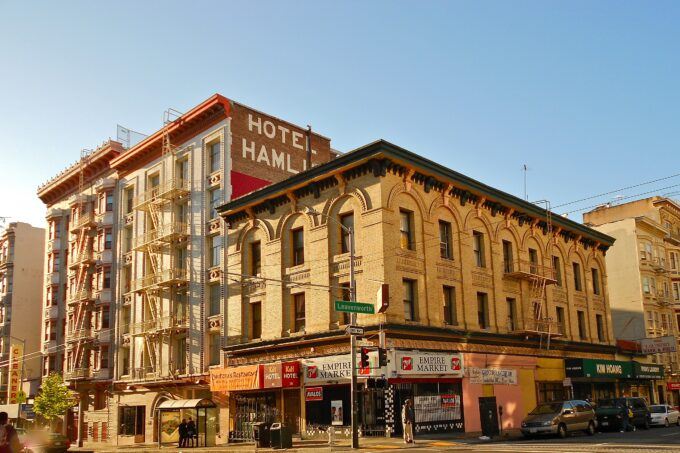
Upper Tenderloin Historic District. Photograph Source: Smallbones – CC0

“Any city that doesn’t have a Tenderloin isn’t a city at all”

– Herb Caen, longtime San Francisco Chronicle columnist

Few San Francisco neighborhoods have had more ups and downs than the 33-block area still called “The Tenderloin”—a name which derives from the late 19th century police practice of shaking down local restaurants and butcher shops by taking their best cuts of beef in lieu of cash bribes.

At various periods in its storied past, the Tenderloin has been home to famous brothels, Prohibition-era speakeasies, San Francisco’s first gay bars, well-known hotels and jazz clubs, film companies and recording studies, and professional boxing gyms.

In 1966, trans people hanging out at the all-night Compton’s Cafeteria staged a militant protest against police harassment three years before the more famous LBGTQ uprising at the Stonewall Inn in NYC. During the last decade, the Tenderloin has become better known for its controversial side-walk camping, open-air drug markets, and fentanyl abuse.

The failure of municipal government to deal with those social problems— in a residential neighborhood for working-class families with 3,000 children—contributed to recent electoral defeats of a district attorney, city supervisor, and San Francisco’s second female and African-American mayor.

For the past 45 years, Randy Shaw has been a fixture of the place as co-founder of its Tenderloin Housing Clinic (THC). After graduating from law school nearby, Shaw became involved in fights for tenants’ rights and more affordable housing at a time when blue-collar neighborhoods in San Francisco were starting to gentrify.

A Unionized Non-Profit

The THC, which now employs 200 SEIU Local 1021-represented staff members, began to acquire and develop its own network of Single Room Occupancy (SRO) buildings in the Tenderloin, as an alternative to run-down private landlord owned ones.

Today, THC provides subsidized housing and wrap-around services to several thousand of the city’s most needy tenants—who might otherwise be among the social outcasts living in the surrounding streets. Shaw estimates that the Tenderloin has a higher percentage of housing in nonprofit hands than any central city neighborhood in the nation, an arrangement which safeguards its distinctive character as an economically mixed neighborhood that includes many low-income people among its 20,000 residents.

In this second edition to his book, The Tenderloin: Sex, Crime, and Resistance in the Heart of San Francisco, Shaw recounts how this multi-racial working-class enclave managed to survive, if not always thrive, amid a city dominated by tech industry wealth and privilege.

That history of neighborhood resistance to displacement is also on display at the Tenderloin Museum (TLM). Created ten years ago, with much help from the author, this venue for community-based, historically-inspired cultural programming now operates under the direction of Katie Conry.

In her Forward to Shaw’s book, Conry describes the TLM’s many art shows, special exhibits, theatre productions, walking tours, and other public programs that have drawn 50,000 people to a downtown area many out-of-town visitors (and locals) are told to avoid. On April 11, for example, the THC is hosting a new production of The Compton’s Cafeteria Riot to commemorate that “collective act of resistance” and “the on-going fight for transgender rights.” (For ticket info, see here.)

Community Benefits Agreements

Other Californians fighting gentrification—or trying to make sure its benefits are more equitably shared—will find Shaw’s book to be an invaluable guide to effective activism around housing issues. It illustrates how persistent and creative grassroots organizing can challenge and change urban re-development schemes designed for the few, rather than the many. In too many Left Coast cities, it’s the latter who continue to get pushed out and left behind in the name of “neighborhood improvement.”

A central case study in The Tenderloin is the author’s account of how community residents won a pioneering “community benefits agreement” (CBA) with three powerful hotel chains. In the early 1980s, Hilton, Holiday Inn, and Ramada wanted to build three luxury tourist hotels adjacent to the Tenderloin. Given the city’s pro-development political climate at the time, these hospitality industry giants expected little organized opposition to their plans. Then Mayor Diane Feinstein lauded them for “bringing a renaissance to the area.”

However, as originally unveiled, their blueprint would have transformed nearby residential blocks by “driving up property values, leading to further development, and, ultimately the Tenderloin’s destruction as a low-income residential neighborhood.”

An Organizing Case Study

Among those faced with the prospect of big rent increases and eventual evictions were many senior citizens, recently arrived Asian immigrants, and longtime residents of SRO buildings in dire need of better ownership and management. Fortunately, this low-income, multi-racial population included some residents with “previously unrecognized activist and leadership skills” that were put to good use by campaign organizers, like Shaw, who were assisting their struggle.

During a year-long fight, hundreds of people mobilized to pressure the city Planning Commission to modify the hoteliers’ plans. As Shaw reports, the resulting deal with City Hall created “a national precedent for cities requiring private developers to provide community benefits as a condition of approving their projects.”

Each of the hotels contributed $320,000 per hotel per year for twenty years for low-cost housing development. They also had to sponsor a $4 million federal Urban Development Action Grant (UDAG) for the acquisition and renovation of four low-cost Tenderloin SROs. In addition, each hotel had to pay $200,000 for community service projects, and give priority in employment to Tenderloin residents.

Four decades later, community benefits agreements of this sort are not so unusual. But, in the absence of major new federal investment in public housing built with union labor, they are still much needed.

Where tax breaks or rezoning encourages various forms of private development today, the only way to win additional low-income housing units, living wage jobs, local hiring, or preservation of open space for public use is through grassroots campaigning by community-labor coalitions, aided by sympathetic public officials.

Otherwise mayors and city councils under the thumb of developers will simply offer financial incentives with a few strings attached—whether the project involved is a new hotel, casino, shopping center, office building, or luxury apartment building.

Back in the Tenderloin, as Shaw reports in the conclusion to his book, residents in recent years have had to mobilize around basic public safety issues.  Pandemic driven economic distress flooded their neighborhood with tent dwellers, drug dealing, and street crime that added to small business closures, drove tourists away, and made daily life hazardous for longtime residents (except when state and local politicians cleaned things up for high-profile gatherings like the Asia-Pacific Economic Cooperation leadership meeting in S.F. two years ago).

Nevertheless, the author ends on an optimistic note (characteristic of organizers): “New restaurants and small businesses are again opening in the Tenderloin. Street and crosswalk changes make the neighborhood among the city’s most walkable. New housing has increased the Tenderloin’s population…”

But, Shaw reminds us, residents of this urban enclave must still fight to achieve “the quality of life common to other San Francisco neighborhoods” while “protecting an ethnically diverse, low-income, and working-class community” with a colorful past and always uncertain future.

Steve Early has been active in the labor movement since 1972. He was an organizer and international representative for the Communications Workers of American between 1980 and 2007. He is the author of four books, most recently Refinery Town: Big Oil, Big Money and The Remaking of An American City from Beacon Press. He can be reached at Lsupport@aol.com