Saturday, April 12, 2025


The Hard Left is Talking to the Soft Left Again


Since the 1980s, the Labour left has been divided by a split between its hard and soft wings.  In the light of the Labour right’s new and brutal ascendancy, is it time for the two sides to think the unthinkable and at least have a conversation?  Bryn Griffiths, the presenter of the Labour Left Podcast sits down with Neal Lawson, of Compass, to ask: has the time come to try and heal some of the old wounds and work together?

You can find the latest episode of the Labour Left Podcast on YouTube here .  If you prefer to listen to your podcasts on the go, just go to your favourite podcast provider and search for the Labour Left Podcast and it will be there. In addition to all the usual podcast sites, you can watch the Labour Left Podcast on Substack  here, you can listen to it on Audible the audio book site here and now you can watch as well as listen on Spotify here.

In 1981 the Labour left split asunder when Neil Kinnock abstained during Tony Benn’s bid for the Deputy Leadership of the Labour Party and delivered a wafer-thin victory to Dennis Healey, an Atlanticist of the Labour right.  As a result, the Tribune Group split between the Bennite Socialist Campaign Group and leadership loyalists.  The fighting got worse when the local government left split over the need for councillors to join the miners, at the time of their historic, year-long strike, and open up a second front over ratecapping to defeat Margaret Thatcher, the neoliberal Conservative Prime Minister.

Our conversation got off to a wobbly start when we discovered that we both played prominent roles in Labour Students in the early 1980s where the left in-fighting was at its bloodiest. But, surprisingly, what comes over throughout the podcast is a clear-headed determination to get over our old wounds and focus on the struggle today to save the very essence of the Labour Party.

We discussed how the ‘playground bullies’ in Labour HQ had tried to expel Neal. It certainly felt at this point of the discussion that our enemies’ enemy might possibly become a nice new friend. Have a listen and see what you think. 

During the course of the podcast, we discuss the political culture which Keir Starmer and his Chief of Staff Morgan McSweeney have established within Labour and ask is it a culture fit for Government?  We are both enthusiastic advocates of proportional representation so we had a robust debate about how we secure the prize and what role Liberal Democrats might play. Looking in our rear-view mirror, we discussed what Labour should learn from Corbynism and the 2017 General Election campaign.  We of course discuss Gaza and the Labour Right’s Atlanticism.

As the interview unfolded, we found lots to agree about so we discussed what organisational form a pluralist Labour Left might take and what we need to do to get there.

Regardless of whether you’re reading this article as someone who comes from the soft left or the hard left of the Labour Party, I think you might be pleasantly surprised about how the discussion unfolds. If you feel delighted or provoked from either side of the historic divide, the pages of Labour Hub are open to you to explain why.

If you’re on the right of the Labour Party the podcast might make you uncomfortable.  Your behaviour over Gaza, the capping of third child benefits, the winter fuel allowance and now disability benefits cuts are breaking up your internal Labour Party alliances and we’re beginning to see new ones form.  The podcast demonstrates the opportunities before us and we’re serious.

We trust that you will find the latest Labour Left Podcast an invaluable resource.  If you do, please help us get the episode to more people by sharing, following, liking, rating and commenting on it wherever you see it.

If you’re new to the Labour Left Podcast, please take a look at our back catalogue.  Previous episodes have included Rachel Shabi on the Truth About Antisemitism;  Bernard Regan from the Palestine Solidarity Campaign Executive; Prof Harvey J Kaye on the legacy of the Communist Historians; Prof Corinne Fowler, talking about her book Our Island Stories: Country Walks Through Colonial Britain; Andrew Fisher telling the story behind For the Many Not the Few, Labour’s 2017 manifesto; Jeremy Gilbert, a Professor of Cultural and Political Theory, a champion of Gramsci, talking about Thatcherism; episodes with Mish Rahman, Rachel Godfrey Wood and Hilary Schan on the contemporary Labour left; Mike Phipps, author of Don’t Stop Thinking About Tomorrow: The Labour Party after Jereny Corbyn, taking a longer term look at the Labour left;  Mike Jackson, co-founder of Lesbians and Gays Support the Miners, on the Great 1984-85 Miners’ Strike; political activist Liz Davies telling her story as the dissenter within Blair’s New Labour; Rachel Garnham, a current co-Chair of the Campaign for Labour Party Democracy looking back at the history of the fight for democracy in the British Labour Party; and finally myself telling the story of Brighton Labour Briefing, a local Bennite magazine of the 1980s.

You can get the podcast on YouTube, Substack, Apple Podcasts and Audible. In fact, you can listen to it on all good podcast sites just search for the Labour Left Podcast

Bryn Griffiths is an activist in Colchester Labour Party and North Essex World Transformed. He is the Vice-Chair of Momentum and sits on the Campaign for Labour Party Democracy’s Executive. Bryn hosts Labour Hub’s spin off – the Labour Left Podcast. 


The Left must embrace the Precariat


Guy Standing

On May 15th, a one-day conference will be convened by the Progressive Economy Forum in SOAS, entitled Progressive Economics in the Age of Trump. Distinguished economists with diverse opinions will discuss the implications of Trump’s actions, assess the changing nature of capitalism, the stranglehold of finance over the British economy and policymaking, and the scope for progressive fiscal and social protection reforms. It is open to anybody who wishes to contribute. The context could scarcely be more alarming.

In a poll in April, only half of those who voted for Labour in 2024 felt able to say they knew what Labour stood for. In the Telegraph, the Prime Minister said Labour is “creating wealth in every corner and delivering security for everyone, everywhere.” Really? The conference will consider how it could do better. Indeed, the only glimmer of hope emanating from Trump’s actions is that they might break the mould that has been intensifying insecurity for much of Britain’s population for far too long.  

In the long evolution of capitalism, its progressive opponents (‘the left’) have only had transformative success when articulating a vision and strategy around the emerging mass working class. For much of the 20th century, that was the proletariat, industrial workers in relatively stable manual jobs.

But since the onset of de-industrialisation and the neoliberal economics revolution of the 1970s and 1980s, the left has floundered, alternating between trying to resurrect old-style social democracy and compromising with neoliberalism as with the Third Way, devised in the 1990s by Wim Kok of the Netherlands and adopted by Bill Clinton, Tony Blair, Gerhard Schroder and left-of-centre political parties. A key feature of the Third Way was a rejection of class-based politics, as stated by its intellectual guru Anthony Giddens.

The most one can say about the Third Way is that it enabled social democrats to be occasionally in office but not in power while the neoliberal political right replenished itself or recovered from mistakes, infighting or fragmentation.

Meanwhile, capitalism changed. It is vital to recall how, and how it has created a new class structure that should inform progressive politics. A starting point is Karl Polanyi’s The Great Transformation, published in 1944. His thesis was that capitalism evolves through crises. An old social order breaks down and a ‘dis-embedded phase’ begins with a lurch to laissez-faire, a free market system dominated by finance (in his words, merchant capital). In that phase, the state dismantles old systems of regulation, redistribution and social protection, which had moderated inequalities and insecurities. The dismantling leads to unsustainable inequalities and insecurities, until a crisis occurs in which “there is the threat of the annihilation of civilisation”.

At that point, there is either a lurch to fascism or a “double movement” in which the economy is re-embedded in society, with new systems of regulation, redistribution and social protection. A point only vaguely in Polanyi’s dialectical analysis is that, to succeed, the double movement must be a response to the insecurities, needs and aspirations of the emerging mass class.

After the Second World War, the “re-embeddedness” was social democratic, based on the needs and aspirations of the proletariat, with protective labour regulations, progressive income tax and labour-based social security. It was a class alliance, between the professional salariat and proletariat. That fizzled out in the 1970s, giving way to the neoliberal economics revolution of the Mont Pelerin Society, put into effect by Thatcher and Reagan in the 1980s. This took the world into the “dis-embedded” phase of the Global Transformation, the protracted construction of a globalised economic system. Those who dominated it preached ‘free markets’ and ‘deregulation’. But they actually produced a triumph of private property rights over market forces, best described as rentier capitalism.

The key developments were domination by finance and a vast strengthening of intellectual property rights, mainly by the US Bayh-Dole Act of 1980, which allowed federally funded research to be converted into corporate private property, and TRIPS in 1994, which globalised the US intellectual property rights regime. It was aided by neo-mercantilist fiscal policy, providing vast subsidies to wealthy corporations and individuals, who used their wealth to invest in financial markets, largely in hedge funds and private equity.

This led to conglomeration in most sectors; corporate giants took advantage of economies of scale and of scope, enabling them to raise mark-ups of prices over production costs. Helpful to this was the weakening of anti-trust legislation and regulators, due to a rationalisation that in a free market economy there was no need to worry about monopolies, since they would be temporary until competitors whittled away monopoly profits. The intellectual property rights regime mocked that presumption. Today, there are over 16 million patents in force, each one giving their owners a guaranteed monopoly for 20 years. That is not a free market. 

The most relevant features of the resultant rentier capitalism are fourfold. First, labour costs shaped international trade and production, putting downward pressure on wages  in rich countries. Second, there was a remorseless shift of income and wealth to forms of rent; the share of income going to those performing labour has shrunk, the share going to owners of financial, physical and intellectual property has jumped. Third, all countries pursued ‘labour market flexibility’ policies as a competitive device. Fourth, governments reacted to financial crises by pursuing ‘austerity’, cutting social spending to offset tax cuts designed to make their economy more attractive for investors.

An outcome was a new globalised class structure, in which a plutocracy has gained incredible wealth and power, while the new working class is the precariat. The  social democratic left failed to curb the plutocracy – indeed, they pandered to it – and failed to understand or respond to the needs and aspirations of the precariat. Tragically, the left today is paying a heavy price for that twin failure.

The right has understood rather better. I can illustrate that by relating a personal experience. Bizarrely, in early 2016 I was invited by the Bilderberg Group to speak on the precariat at their annual secret meeting, which that year was held in a palace hotel in Dresden. They wanted me to talk about my book, The Precariat: The New Dangerous Class, which has been translated into 24 languages.

I found myself addressing Henry Kissinger and about 100 figures of the western right-wing elite. I predicted that part of the precariat would vote for Brexit and for Donald Trump later that year. I expected a hostile reception, but to my surprise, there was a lot of interest, and several people asked to have private conversations afterwards, including Senator Lindsey Graham, a Trump supporter. The meeting operated under the Chatham House rule, and I should respect that in not revealing what was said.

However, during most of the three-day meeting, I shared a table with Peter Theil, multi-billionaire co-founder of Paypal, then the leading funder of Trump, and in 2024 to be the promoter of Vance as Vice-President. There is a good case for saying that Theil has been the single biggest influence on Trump’s policies.

In 2009, Theil wrote an article, “The education of a libertarian”, in which he said  democracy was incompatible with freedom, citing welfare beneficiaries and women in general as likely to vote for redistribution and public services, so in his view impeding wealth makers. He also wrote that “competition is for losers”, which is why he favoured monopolies. He was anti-free trade, advocated a dismantling of the federal bureaucracy, and for good measure, opposed multiculturalism in universities and all forms of ‘affirmative action’.

In 2025, Theil and his friend Elon Musk are shaping Trump’s authoritarian policies that are driving the world into another dark night with fascistic characteristics. But the point I want to make is that many at that meeting understood the precariat better than the mainstream left has done before or since.

Too many commentators use the terms ‘working class’, ‘middle class’ and ‘upper class’ without making any attempt to define what they mean. A class should be defined in three dimensions.  The first is its ‘relations of production’, or in plain English, the pattern of work and labour. The norm for the precariat is unstable, insecure labour coupled with a lot of work-for-labour and work-for-the-state that are ignored in official statistics. Much of it could be reduced, but policymakers ignore it. The precariat mostly lacks an occupational narrative. And it is the first class in history in which the modal level of education is above the level of labour they are likely to obtain. The left should respond to those characteristics empathetically, not resort to old ‘active labour market policy’ and welfare cuts.

The second dimension is distinctive ‘relations of distribution’, that is, forms of income. Again, the left has ignored the reality, typically thinking that raising the minimum wage will have a big effect. While welcome, it has limited relevance for the precariat. It experiences volatile, uncertain money wages while being deprived of non-wage benefits, probably accelerated by rises in the minimum wage. The precariat is also mired in debt, which is integral to rentier capitalism. And it is penalised by the state benefit system, abominably so by Universal Credit. A chilling fact is that over a third of all those in jobs rely on state benefits to achieve subsistence. And the left has cut them.

The third dimension is actually the most important and least recognised by the commentariat and politicians. This is ‘the relations to the state’. The precariat is the first mass class to lose rights of citizenship, that is, les droits acquis. This applies not only to migrants. The precariat is losing civil, social, economic and cultural rights. And it feels it has no political rights, because no party represents its interests and aspirations.

This leads to my final remarks. The precariat is still a ‘class in the making’, in that it is internally divided. As elaborated elsewhere, it is split into Atavists (mostly the less educated who believe that Yesterday was better than Today and that it can be brought back), Nostalgics (those without a Present, mainly migrants) and Progressives (those who feel they have lost a Future).

Those in that Bilderberg Group meeting understood that their strategy should involve an alliance between the plutocracy and the Atavists in the precariat, demonising and disenfranchising the Nostalgics, while knowing the mainstream left was not appealing to any part of the precariat. The mainstream left fell into the trap, alienating the Nostalgics by moving some way towards the right, alienating the Atavists by not moving enough, and failing to appeal to the Progressives by not offering a better Future

That explains what happened last year and what could continue unless the left changes. The Democrats lost to Trump not because he was hugely popular but because well over a third of the electorate did not vote. Trump received the support of under a third of the electorate. In the UK, faced by a worn-out, chaotic, corrupt Tory government Labour received the support of just 19% of the electorate, with fewer votes than under Jeremy Corbyn in 2019.  Now half of those who did vote for it do not know what it stands for.      

 In sum, the left is paying a heavy price for ignoring the precariat. But it is just conceivable that Trump’s shenanigans could prompt real change. The far right is hoping ‘the left’ will continue doing just the same. The situation brings to mind Tom Paine’s clarion call in a moment of despair: “These are the times that try men’s souls.”

Thursday, May 15th

Progressive Economics 2025, UK Economic Policy in the Age of Trump. Register here.

Guy Standing is Professorial Research Associate, SOAS, University of London, and co-president of BIEN, the Basic Income Earth Network.

Image: https://thebluediamondgallery.com/highway-signs/c/capitalism.html Credit: Pix4Free.org Copyright: This image is licensed for free of charge use, including for commercial use Attribution-ShareAlike 3.0 Unported CC BY-SA 3.0 Deed


‘If globalisation is over, Britain’s economy has been left dangerously exposed’


Photo: Stephen.I.Parsons / Shutterstock.com

The Prime Minister has told the country that “the world has fundamentally changed”.

It follows, then, that the government must break with the same economic orthodoxy that has failed to deliver sustained growth or rising living standards in the UK.

The UK’s governing class often boasts that we have one of the most open economies in the world. But if globalisation really has come to an end, then we are left exposed.

The Bank of England recently remarked that “today, the UK remains an open economy that is highly integrated in the global trade and financial systems.” Total trade, the sum of imports and exports, is equivalent to over 60% of UK GDP, more than the average across major economies.

And the UK is an important international financial centre too. Its total foreign assets, and liabilities, are over five times larger than UK GDP.

Our economy is dangerously exposed

All this sounds boastful at the best of times. But as we hear that the global economy is being transformed before our eyes, our economy is dangerously exposed.

Trump’s tariffs are symbolic of the decline of globalisation and neoliberal policies that have dominated the world for decades. The uncertainty created by these tariffs is affecting markets worldwide and shaking business confidence. China’s retaliatory tariffs on the US show the emerging tension. The UK is caught in the middle of this turmoil.

READ MORE: List of councillors quitting over welfare amid further cuts

The UK’s political establishment has long championed globalisation as an irreversible force. Former Prime Minister Tony Blair’s 2005 Labour Party conference speech encapsulated this view, declaring ‘I hear people say we have to stop and debate globalisation. You might as well debate whether autumn should follow summer.’ For Blair there was nothing the British people could do about globalisation so we shouldn’t waste time debating it.

This elitist mindset, where decisions are made by a disconnected political class, contributed to the Brexit vote and, similarly, to the rise of Donald Trump in the US.

Austerity policies almost invariably lead to stagnation

Now, the UK is at a dangerous crossroads. Trump’s tariffs increase the cost of British exports to the US by 10%, worsening the UK’s already bleak economic outlook. Our industrial base has shrunk, our public finances are stretched thin and our infrastructure is in urgent need of an upgrade. The country is ill-prepared for the economic and financial turbulence ahead. Some economists are even predicting a global recession.

At the Spring Statement the Chancellor chose to double-down on austerity. It is said that her fiscal rules are designed to reassure the international markets. But reassurance to the markets threatens the material conditions of millions of people in the country. The estimated £4.8 billion in cuts to welfare, including for the disabled, is predicted to push 400,000 more people into poverty, including 100,000 children.

The Chancellor also confirmed further cuts to public investment and indicated more cuts to some departmental budgets at the spending review in June. This approach mirrors the Conservative government’s austerity measures after the 2008 financial crisis, despite the fact that fiscal contraction stunted growth by draining money from the economy.

The government has pledged to focus on economic growth. The Conservatives said the same. Yet their austerity policies almost invariably led to stagnation. I am extremely concerned that history is repeating itself.

Trump’s tariffs will make growth that much harder and may even lead to contraction. The government’s current fiscal policy is poorly equipped to face this challenge. The Chancellor’s self-imposed fiscal rules – which require debt to fall as a share of GDP by the end of this Parliament and forbid borrowing for day-to-day spending – severely limit her ability to respond effectively.

These rules were misguided even before the global situation worsened, and now they appear absurd. If, as the Prime Minister claims, the world has changed, then it stands to reason that the UK’s fiscal rules need to change too.

The current economic orthodoxy is clearly failing

However, loosening fiscal rules alone is not enough.

The UK’s economic institutions – the Bank of England, the Office for Budget Responsibility (OBR), the Treasury, and the City of London – all play key roles in maintaining the current economic orthodoxy, which is clearly failing.

For instance, the Bank of England has pursued policies of monetary tightening, keeping interest rates higher than necessary and pulling money out of the economy. These actions have forced the Chancellor to repay £100 billion to the Bank. This is money that could otherwise be used for public investment or economic growth. The Bank’s governor remains steadfast in this approach, seemingly oblivious to the long-term damage they are inflicting.

The OBR is also part of the problem. This supposedly independent body has a track record of making inaccurate forecasts, which the government uses to justify austerity measures. As the New Economics Foundation has pointed out, the OBR’s analysis often underestimates the economic multiplier effect, leading to flawed predictions about public debt and spending needs.

The Treasury, meanwhile, remains entrenched in a rigid economic orthodoxy that has repeatedly failed to deliver sustainable growth. Its approach to taxation, spending, and fiscal policy is rooted in neoliberal theories that prioritise austerity and financial stability over investment and growth.

This has created a damaging cycle of fiscal tightening, public sector cuts, and underinvestment, leaving the economy starved of the resources it needs to grow.

A radical rethinking of economic policy is necessary

At the root of these failures is the dominance of the financial sector in shaping policy. The UK’s financial system, valued at £27 trillion in 2022 – far greater than the country’s total annual output – is driven by the interests of the City of London. Financial institutions rely on economic stability, low interest rates, and tight fiscal controls to protect their assets. The Treasury, the Bank of England, and the OBR often act as their servants, prioritising the financial elite’s interests over those of ordinary citizens.

Now is the time to challenge economic orthodoxy. The finance sector worldwide is unstable. Austerity measures, which disproportionately affect the poorest, are not only morally indefensible but economically counterproductive. The poorest households are the most likely to spend their income, stimulating economic activity. Cutting their spending power only stifles growth.

The time has come for a fundamental shift in economic policy. The government cannot continue pursuing the same failed approach. What is needed is a new vision for the UK economy, one that prioritises social justice and isn’t afraid to pursue investment led growth.

The government must stop clinging to outdated rules and begin a radical rethinking of economic policy. This is the only way to prepare the UK for the challenges of a post-globalisation world and build a fairer, more prosperous future for all.


UK

‘The first AI culture war is here – and Labour could lose it’


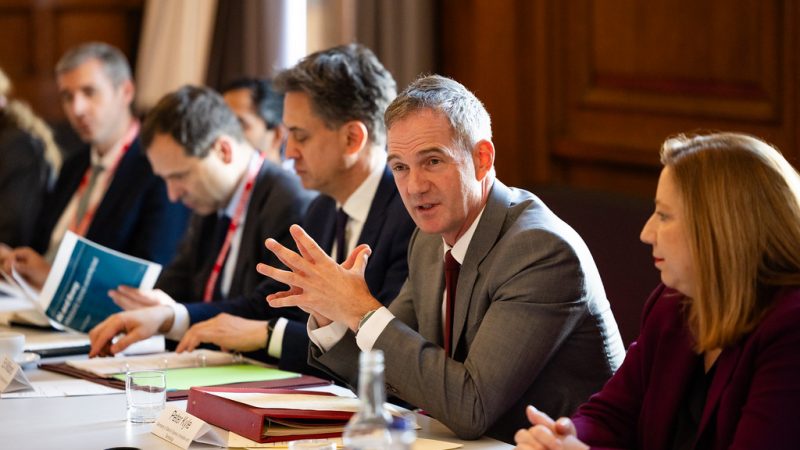
Peter Kyle at the first meeting of the AI Energy Council Photo: UK Government/Flickr

While the world focuses on tariffs, a new culture war is forming, this time around AI.

It has been a tough few weeks for the Labour government. The Spring Statement left the government third in Westminster polling intention as it enters its ninth month in power. 

To add insult to injury, Trump’s scattergun tariffs may quickly dash any hopes of economic growth that Starmer and Reeves had before the end of the year. This is even as Starmer showed some signs of international leadership and popularity, with the moves to defend Ukraine from a disengaged US administration and some massaging of American egos.  

Sadly, Starmer’s government is now back in the news for its established economic and political strategy. This involves painful and unpopular spending cuts predicated on the belief that economic growth may come later in the parliament, thanks to investments in energy infrastructure, housing, and technology. If that happens, and it’s a big if, then voters will forget the hard decisions at the start of the parliament.

Tech is the promised land of UK economic growth

On this, the government is touting tech, and more specifically AI, as a driver of labour productivity for both the public and private sectors. The announcement of the AI Opportunities Action Plan in January was followed by a £3.25bn ‘Transformation Fund’ presented at the Spring Statement itself, earmarked to put tech and AI at the centre of public sector reform. 

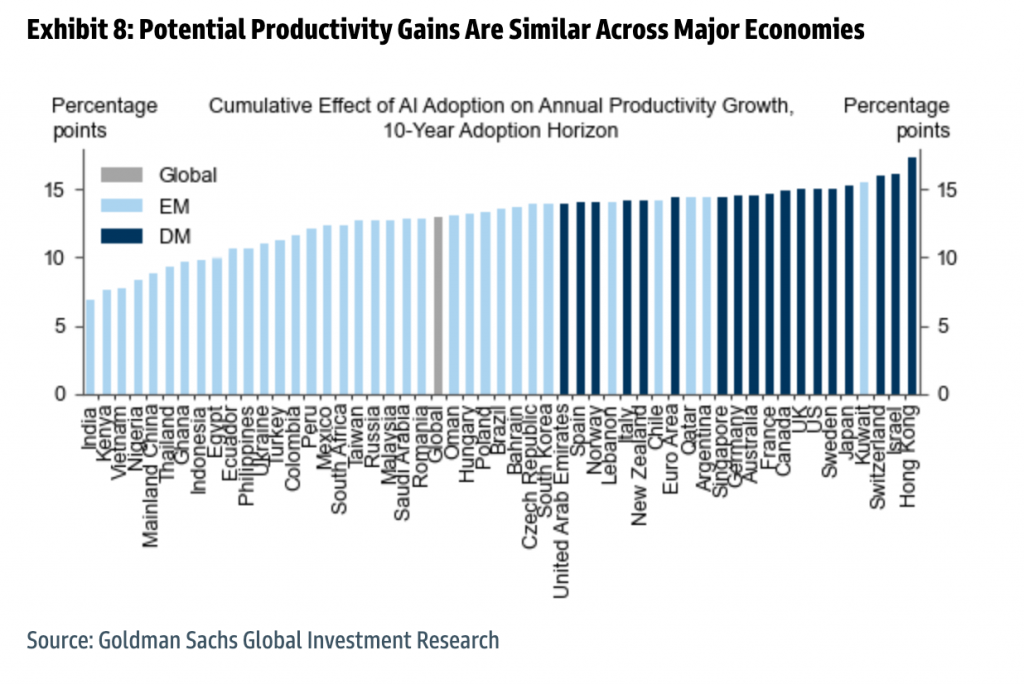
There is good reason to believe that AI will increase productivity across economies, and even that it’s already happening. That is great news for mature, ageing economies like the UK, which suffer from skills shortages but are politically not in a position to increase migration. 

It can also become a good news story if AI can boost areas the UK has expertise in, like life sciences research. AI used towards potentially life-saving scientific discoveries can, after all, only be a good thing.

READ MORE: New MP in spat with NEC member over planning reforms and ‘harm to nature’

The AI brand is in crisis

However, while the government charges forward towards embracing AI for its potential to help grow the economy and save lives, the average voter is going the opposite direction. 

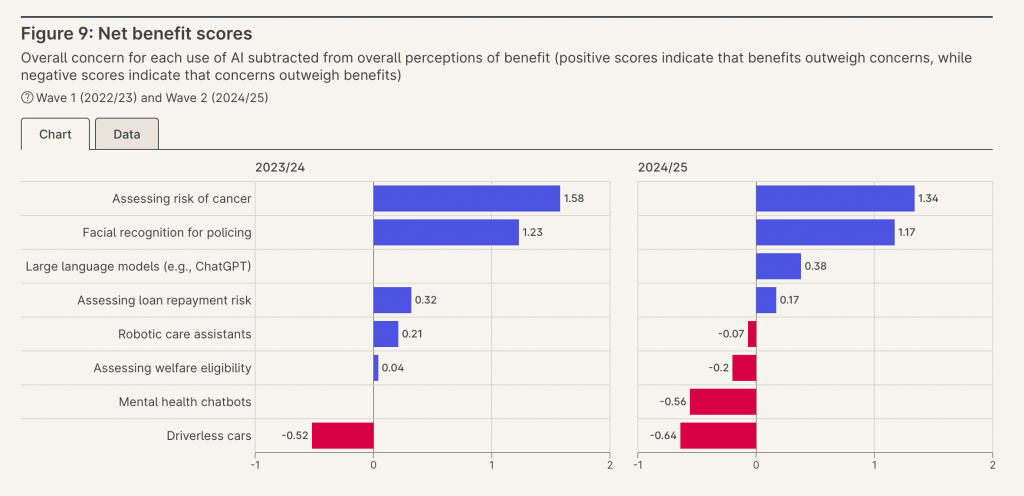
Voters’ views on AI in general and its applications particularly have remained fairly pessimistic over the past few years.

People generally don’t see how AI is being used for good, but they see plenty of occasions where it is misused. This can be inaccurate information, deepfakes or even financial fraud. 

Most worryingly, the UK public doesn’t trust that the Government (of any stripe) can effectively regulate AI, which is precisely the thing that would make the public trust it more.

READ MORE: ‘Give mayors more power to tackle economic challenges in their regions’

The public sees AI companies as copyright thieves

Nowhere are these harms more visible than in journalism and the arts. Here, the public is exposed daily to AI-driven misinformation, news of human artists being replaced by AI, and uses of intellectual property that may skirt copyright law.  

In Hollywood, actors and writers staged months-long strikes last summer over the use of their work and likeness to train AI that could replace them. 

Here in the UK, campaigns like #MakeItFair from print media publications, and protests over Meta’s alleged use of ‘shadow libraries’ to scrape copyrighted books are building the public’s image of AI companies as ‘IP thieves’ and AI as a harm to creatives.

This matters, not just because the UK creative industries continue to outperform other areas of the economy, despite Brexit and the pandemic. The arts, journalism, and media are populated by the educated, city-dwelling, left-leaning voters that the Labour Party wants to keep happy ahead of the next election. 

When the Labour government is seen unequivocally embracing AI, without making the case for distinguishing between harmful and beneficial uses of the technology, it damages its credibility for fairness in front of the core voters it needs to keep on side. 

It’s the messaging, stupid

The government would say that it has put forward the AI bill, which is set to protect creators. It has also made clear that a swathe of cases of potential copyright infringement fall outside of the UK Government’s jurisdiction, and therefore there isn’t much they can do. 

The problem is that a dangerous false choice may start building in people’s minds about AI, in the absence of effective regulation around the technology. Deregulate and grow the economy, or regulate to protect artists. 

That is a very advantageous framing for the Conservatives or Reform to occupy. If they do, and they’re successful, it won’t matter that the Labour Party has passed legislation to mitigate the risks of AI. They will be seen as both stifling innovation and not standing up for people’s own work. 

There is a path for the Labour government to thread the needle of an argument around the fair but boosted use of AI to the public. But if they’re not careful, this culture war will grow into another fire to control ahead of the next general election, regardless of the good economic news around it.


UK

New MP chairs of Labour Palestine group: ‘Let’s recognise Palestine now’

Creative-Asylum / Shutterstock


While we are both delighted to take on the roles of co-chairs of Labour Friends of Palestine and the Middle East (LFPME), we are acutely conscious of the sheer level of pain, suffering and horror affecting Palestinians and those across the region.

We had hoped to make the announcement at a more hopeful time, but as recent events have shown, hope has been in such short supply.

It can often feel hard not to give in to despair. The scale of devastation and suffering in Gaza is beyond words. Over 50,000 people killed, well over 100,000 injured, a healthcare system dismantled, an aid blockade in full effect, and almost the entirety of Gaza’s population having been displaced – often multiple times.

The reality facing Israeli hostages is bleak, with 59 still estimated to be in Gaza but many presumed to have already been killed by their captors. Even where hostages have been released, Hamas has subjected them to grotesque and inhumane treatment, proving yet further that they can play no role in the future of Gaza.

We must create hope where there is none

We saw thousands of Palestinians marching against Hamas last week to make this same statement.

The West Bank does not currently offer much hope either. Israeli tanks are there for the first time in decades, de facto annexation is happening in real time, and there is a rapid expansion of settlement activity along with the accompanying settler violence and displacement of historic Palestinian communities.

The situation across this entire landscape is intolerable. But we must create hope where there is none. That is why it is incumbent on the international community – including the UK – to step up and play a proactive part in changing the status quo and bringing about the future we all want to see.

READ MORE: ‘Detaining MPs shows Israel is no ally to Britain. Labour must change tack’

For its part, we’ve been glad to see the new UK government take a number of positive steps on Gaza, Palestine and the region.

In just a matter of months, it has worked for an immediate ceasefire and the release of hostages. It has restored funding to UNRWA, funded additional aid efforts, and supported the Arab Plan for Gaza.

It has put international law at the centre of its response, reversed the previous government’s objection to the ICC, condemned settlement expansion and settler violence, sanctioned settler groups, and called out Israel’s blockages on aid.

And of course, it has undertaken a comprehensive review of arms sales to Israel with the resulting suspension of arms transfers.

The UK should immediately recognise the State of Palestine

It is important to remember how far things have come in less than a year. None of these would have been imaginable under the previous government, who could barely bring themselves to call for a ceasefire or to fund UNRWA, let alone suspend arms sales and back the ICC.

But we would like the government to go further. Our longstanding position is that the UK government should immediately recognise the State of Palestine as an essential marker on the path to a two-state solution.

The government must also examine targeted sanctions on extremist far-right Israeli ministers as well as effective differentiation between green line Israel and its settlements in the West Bank. This should include a targeted restriction on goods entering the UK from illegal settlements.

What recent events have shown more than anything is that we cannot continue to feed the status quo and that there must be a strong international effort to change it.

The old ways of approaching this are failing Palestinians and they’re failing regional security, leading only to the erosion of the territorial viability for a Palestinian state. The longer we wait, the more impossible a two-state solution will become.

This is what we are putting at the core of LFPME, building on a decade and a half of its important work on Palestine and the wider region. We encourage all Labour members, councillors, CLPs, MPs, this government, and others to join us in doing so.


‘The government must re-nationalise British Steel’


Our steel industry has struggled since Thatcher’s privatisation in 1988. Once employing 186,000 workers in 1981, now thirty years on only 39,500 steel jobs remain. With Port Talbot’s blast furnaces offline until 2027, and Jingye refusing the government rescue package for Scunthorpe’s works, the prognosis was bleak even before Trump slapped a 25% tariff on UK steel.

It is right that Rachel Reeves is considering nationalising British Steel so that we can safeguard jobs and domestic production. In fact, it is vital that she does. Steel is a keystone of our economy. Far too important to be left to the market and the inevitable dismantling that would ensue. 

We will continue to need steel long into the future. To sustain our manufacturing, to build new infrastructure, and to enable our transition to net zero. With the environmental cost of imported steel being far greater than steel produced domestically, there is no route to net zero without a sustainable domestic steel industry.

That is why it is absurd that our economy does not properly plan for steel production and usage. In 2023 net imports for steel stood at 4.6 million tonnes, with the then Tory government allowing billions to be spent importing steel—produced with higher emissions, and even more additional emissions through shipping—and to the detriment of our steelworkers. 

It is a false economy that does not keep steel production in the UK, knowing full well that we will continue to need it and—with the right investment—that it can be the launchpad of a wider industrial revival. The current managed decline is the result of the decision of a government that did not care for steel communities’ concerns.

‘Looming job losses are a looming catastrophe for communities’

Labour knows better. We remember the devastation deindustrialisation inflicted on places like Sheffield, and the continuing impact of Thatcherism on our communitiesResearchers have suggested that the ‘destruction of Britain’s industrial base and all that has flowed from it’ was a more definitive event in British economic history than the 2008 financial crash.

The Co-operative Party has called for communities to be central to the government’s response to the trade war. General Secretary Joe Fortune said that the tariffs are an opportunity for a ‘new economic settlement for communities.’ He is right. We must think first and foremost about how tariffs will impact communities in places like Scunthorpe, Port Talbot, and Sheffield, and let that reality shape our response. 

We know that the 2,800 jobs threatened by Tata in Port Talbot, and the 2,700 jobs at risk in Scunthorpe, should not be reduced to numbers on a balance sheet. They are a looming catastrophe for communities.

‘Members and voters want to see ambition and action’

In 2023, Jonathan Reynolds said that a Labour government would stand with our steelworkers and ‘keep well-paid steel jobs in the UK for decades to come’. We must not sit idly by as Trump’s tariffs tank whole towns. It is time we make good on our promise.

We must nationalise British Steel and all UK steelworks. We must also deliver the public investment they need to increase capacity, investing both in jobs and communities, and also in our long-term economic future. After decades of reckless short-termism and the systematic neglect of UK steel, we can instead plan for our whole steel system to survive and thrive. 

We can make Port Talbot’s blast furnaces operational again while speeding up its electric arc furnace. We can retain Scunthorpe steelworks and increase activity. We can change procurement rules so that public contracts can only use domestic steel.

Members’ and voters’ confidence in the government is stagnating because they want to see ambition and action. Nationalisation is a unifying policy across the party: Blue Labour MP Jonathan Hinder has backed calls to renationalise British Steel; Unite the Union’s Workers’ Plan for Steel called on the party to take a public stake in our steel industry. Public ownership continues to have broad popular appeal

Voters are currently seeing Nigel Farage try to pretend he is more Labour than the Labour Party, as he backs calls for nationalisation. Voters remember a Conservative government nationalising Sheffield Forgemasters in 2021. They know that securing common ownership for the workers is our party’s raison d’être—and then they look on in confusion while a Labour government dithers,delays, and denies this reason for being.

Steelworkers are owed a thriving domestic steel industry. Entire communities, as well as our climate’s future, depend on it. This Labour government must renationalise UK steel.