Sunday, April 20, 2025


Facing Trump’s America


 April 18, 2025
Facebook

Image by Tim Dennell.

Recently, in an executive order, President Trump directed the removal of “improper, divisive, or anti-American ideology” from the Smithsonian Institution. That order was, in essence, an attempt to rewrite history on race and gender. One-hundred-and-one-year-old Colonel James H. Harvey, one of the last of the famed Tuskegee airmen of World War II, blamed Trump, saying, “I’ll tell him to his face. No problem. I’ll tell him, you’re a racist.” In addition, government websites began scrubbing African-American history, including in the case of the National Park Service eliminating a photo of the famed abolitionist Harriet Tubman and descriptions of the brutal realities of slavery.

Black people in America have often led change in this society because our humanity and our liberties were so long suppressed and denied.

Black people in my family and community were, of course, descendants of the enslaved. In their presence (as I well remember), you could feel their closeness to that terrible time in our history. When that Smithsonian news came out, I thought about the killings, rapes, lynchings, breeding, and selling of Black people that was, for several hundred years, so much a part of life in the United States of America and that was, if Donald Trump had anything to say about it, no longer to be part of the true history of the United States. I didn’t have to be reminded of who I was or my status as a Black American that day, or of the history he’d like to wipe out, because I lived in the South in the 1950s and 1960s and racism and Jim Crow were then in my face every day of my existence.

So, let me tell Donald Trump a thing or two.

Long, long ago, in the course of my time in high school and college, I realized that Black people in the South were still dealing with a form of American fascism not so dissimilar from Apartheid in South Africa. At the time, Black southern activists were deeply engaged in transforming the structure of this society.

Such activism, I believed then and I believe now, began in 1619, the moment enslaved Africans were deposited in chains on American shores. Harriet Tubman and Frederick Douglass became two spokespeople for those who had lived as slaves. Both tried to change the attitudes of the wider public. Later, many others, including Ida B. Wells-Barnett, W.E.B. Du Bois, and Marcus Garvey, would continue the work to end the legacies of slavery and eliminate all aspects of racism. During my youth, the North similarly had strong spokespeople for racial equality in Malcolm X and Adam Clayton Powell, Jr. In the West, Cesar Chavez was organizing the United Farm Workers to improve the conditions of Latinos working in the fields of California and the Southwest. At the same time, the emerging American Indian Movement (AIM) and the Asian American movement were growing in a collective struggle against discrimination and racism.

Those organizations energized student movements nationwide through sit-ins and demonstrations and by getting arrested as they fought for civil rights. The Black Panther Party, the movement against the war in Vietnam, and the growing Feminist movement added thousands more actions to that struggle. Years later, such movements would also influence the development of the Black Lives Matter, Lesbian, Gay, Bisexual, Transgender, and Queer movements and the National Domestic Worker Alliance.

My father always told me as a boy and later a young man: “Don’t go down to Alabama and Mississippi — those White-ass crackers down there don’t like Black folks.” But in 2019, I found myself in Montgomery, Alabama, the first capital of the Confederacy. All those years later, I could still hear my father’s voice ringing in my ears and had trepidations about being in that state with its racist history. I remembered the Montgomery Bus Boycott, demonstrations against White supremacy led by Martin Luther King, Jr., and young people in 1963, the water cannons and dogs used against Black children and adults, and racist Governor George Wallace’s attempt to block integration at the University of Alabama on June 11, 1963, saying: “Segregation now, segregation tomorrow, segregation forever.” I remember the horror of the 16th Street Baptist Church bombing in Birmingham, Alabama, where four little girls were murdered by White racists.

In February of 2019, I traveled to Montgomery with other board members of my son Khary’s social justice organization, The Brotherhood Sister Sol, to visit the Legacy Museum and the National Memorial for Peace and Justice created by Bryan Stevenson, the activist, lawyer, and founder of the Equal Justice Initiative. At the Legacy Museum, visitors experience 400 years of American history that includes enslavement, racial terrorism, and mass incarceration. The National Memorial is the first institution of its kind dedicated to the legacy of the Black Americans who were the victims of the racial terror of lynching. (Four thousand four hundred of those lynchings have been documented in the post-Reconstruction era from 1877 to 1950 by the Equal Justice Initiative.)

That memorial includes 805 hanging steel rectangles representing each of the counties in the United States where lynchings took place. As I walked through them, I immediately went to those representing Lenoir County and Jones County, North Carolina, where most of my family was born and raised. One victim was listed in Lenoir County, Lazarus Rouse on August 1, 1916, and one, Jerome Whitefield, on August 14, 1921, in Jones County. I was informed by the Equal Justice Initiative that, during the Reconstruction period (1865 to 1876), nine other Black victims were lynched in those two counties. Four of them were killed in 1866 (their names unknown); the other five were Cater Grady, Daniel Smith, John Miller, and Robert Grady on January 24, 1869, and Amos Jones on May 28, 1869.

The Museum and Memorial proved a deeply overwhelming experience for me, a sudden rush of long-ago race history being imprinted in the deep recesses of my mind. For many of those on the visit that day, it was emotional, but as the only Black person in our group to have lived through segregation and Jim Crow, I found it a genuinely wrenching physical experience. And yet while I felt distinctly ill at ease, shaken by what I had seen at the museum and memorial, within hours I began to feel powerful for the part I had played once upon a time as an activist in the Civil Rights Movement. That activism, I suddenly realized, had made me a better, stronger person, and I was reminded that the 400 years of Black struggles for equal rights in this country had not only inspired the nation, but the world.

Authoritarianism and Racism

Today, racism in this country is still a central force that progressives are working to change. We are, after all, living in a period when authoritarianism, racism, and incipient fascism are all on the rise again and, of course, Donald Trump is giving all-too-vivid voice to the hate that goes with them.

In a New Yorker article in 2016, Nobel Prize winner Toni Morrison wrote of the existential place of race for Whites in America this way:

“All immigrants to the United States know (and knew) that if they want to become real, authentic Americans they must reduce their fealty to their native country and regard it as secondary, subordinate, in order to emphasize their whiteness. Unlike any nation in Europe, the United States holds whiteness as the unifying force. Here, for many people, the definition of ‘Americanness’ is color.”

At another point in that year of Trump’s first presidential victory, she added:

“On Election Day, how eagerly so many white voters — both poorly educated and the well-educated — embraced the shame and fear sowed by Donald Trump. The candidate whose company has been sued by the Justice Department for not renting apartments to black people. The candidate who questioned whether Barack Obama was born in the United States, and who seemed to condone the beating of a Black Lives Matter protester at a campaign rally. The candidate who kept black workers off the floors of his casinos. The candidate who is beloved by David Duke and endorsed by the Ku Klux Klan.

“William Faulkner understood this better than almost any other American writer. In ‘Absalom, Absalom,’ incest is less of a taboo for an upper-class Southern family than acknowledging the one drop of black blood that would clearly soil the family line. Rather than lose its ‘whiteness’ (once again), the family chooses murder.”

And the great James Baldwin in his classic 1955 analysis of race in America, Notes of a Native Son, wrote:

“No road whatever will lead Americans back to the simplicity of this European village where white men still have the luxury of looking on me as a stranger. I am not, really, a stranger any longer for any American alive. One of the things that distinguishes Americans from other people is that no other people has ever been so deeply involved in the lives of black men, and vice versa. This fact faced, with all its implications, it can be seen that the history of the American Negro problem is not merely shameful, it is also something of an achievement. For even when the worst has been said, it must also be added that the perpetual challenge posed by this problem was always, somehow, perpetually met. It is precisely this black-white experience which may prove of indispensable value to us in the world we face today. This world is white no longer, and it will never be white again.”

Many in this diverse nation have compelling stories to tell, generating energy to battle the reactionary right-wing efforts to roll back any progress that has been made in past decades. In my life, I have endured the hardships of racism, as have so many others. However, my family, community, and various forms of activism enabled me to survive.

Walking in the Shoes of Black People in History

It is critical, even in Donald Trump’s America, that our activism remain nonviolent, tactical, and practical. We can reflect on a momentous decision by Martin Luther King, Jr., James Bevel, Wyatt Walker, Fred Shuttlesworth, Ralph Abernathy, and other civil rights leaders in Birmingham, Alabama, in the spring of 1963. Out of desperation, they decided to use high school students in demonstrations there in what became known as “the Children’s Crusade,” recognizing that Eugene Bull Connor, the notorious segregationist commissioner of public safety in that city, would employ violence against them. And, of course, he did. He ordered dogs and water cannons turned on those demonstrations, saying, “I want to see the dogs work. Look at those niggers run.”

The very brutality of Bull Connor, seen across the country and the world on the TV news, generated tremendous support for the civil rights movement.

I suspect that King, Bevel, Walker, Shuttlesworth, Abernathy and the other civil rights leaders in Birmingham knew that using high school students involved enormous risk, but those students already lived under segregation and racism and were walking in the shoes of others who had been similarly courageous in the past and this, of course, would be their contribution to civil rights.

Wyatt Walker explained what he did by indicating that he made no apology for using such a tactic to reveal the racist brutality of the grim system of segregation to the whole nation. He said, “I had to do what had to be done.”

His words in their simplicity are how we must confront what is now happening in our country, too. We all must take risks to make this a more democratic land that respects all people. The action of those civil rights leaders in Birmingham is one example of Black history that must never be erased because it still inspires others to act.

At the time, of course, the actions of those young people confronting Bull Connor in Birmingham inspired many throughout the country. Two weeks later, on May 19, 1963, along with 15 other protesters, I demonstrated in front of the then-segregated Holiday Inn in Durham, North Carolina. We were confronted with a dangerous situation. The leader of our group was 19-year-old Joycelyn McKissick, a fellow student of mine and the daughter of Floyd McKissick, a local civil rights leader and lawyer hated by many Whites in the area. We could see into that Holiday Inn through its plate glass windows and observe cops walking around its lobby with billy clubs, keeping a watchful eye on us. If that wasn’t ominous enough, 15 feet from us were 10 White men with broom handles and baseball bats shouting, “Fuck the niggers! Fuck the niggers!”

Despite the obvious danger, we continued picketing and singing. Fortunately for us, the White thugs didn’t get a chance to go after us because of the courage of McKissick. Without any warning, she broke from the picket line, ran to the door of the lobby, pushed it open, and flopped down on the floor inside. The cops shouted, “Get that McKissick bitch!” They then began to beat her with batons.

After a few seconds, I pushed open that same lobby door intending to flop on the floor, too, but was met by police officers who started beating me with their batons and billy clubs as I backed up against a plate glass window. I was still standing, trying to block those clubs being swung at my head, when a 260-pound Black football player named Roy burst through the lobby doors shouting, “Stop it! Stop it!” and moved aggressively toward the police. The officers appeared startled and possibly even scared by his size. All of a sudden, miraculously enough, they stopped beating Joycelyn and me. All of the demonstrators were, however, arrested and marched off to jail along with 1,000 people from the sites of other demonstrations in Durham. The city jail couldn’t cope with more than 1,000 arrested demonstrators. So, though we were held overnight, we were released the following morning.

That confrontation with the police in that Durham Holiday Inn empowered me for the rest of my life. Those billy clubs striking my body strengthened my mind and convinced me that, sooner or later, we could indeed overcome segregation and Jim Crow. They caused me to be less afraid and more confident in mass demonstrations to come.

To me, that experience was a powerful tool for change and, looking back, I believe the size of those demonstrations and their public nature caused the police to be somewhat more restrained as time went on, although I was aware that there would be times in other settings when nothing would prevent serious injury or even death at their hands.

Today, the many compelling stories of those suffering in this increasingly diverse nation of ours — from immigrants to domestic workers to all the discriminated-against people I’ve mentioned in this essay — must be told. As we experience Donald Trump’s twenty-first-century version of White nationalism, how we dealt with that difficult past should help us remember that we lived through terrible times by confronting them and that we can do so again, even in the terrible Trump era.

This piece first appeared on TomDispatch.

Douglas H. White is a civil rights activist, lawyer, and government official whose career has centered on human and civil rights and labor law. He was Human Rights Commissioner for the State of New York, City Personnel Director/Commissioner of the City of New York, and Deputy Fire Commissioner for New York City. He recently completed a memoir entitled Unbroken: The Last Generation of Black Americans Under Jim Crow and the Culture of Racism in America. The memoir is represented by Marie Brown Associates.


With Nationwide Actions on Saturday, Anti-Trump Protests Show No Sign of Slowing Down

Events on Saturday included marches as well as direct community-oriented actions, including neighborhood cleanups and food drives.


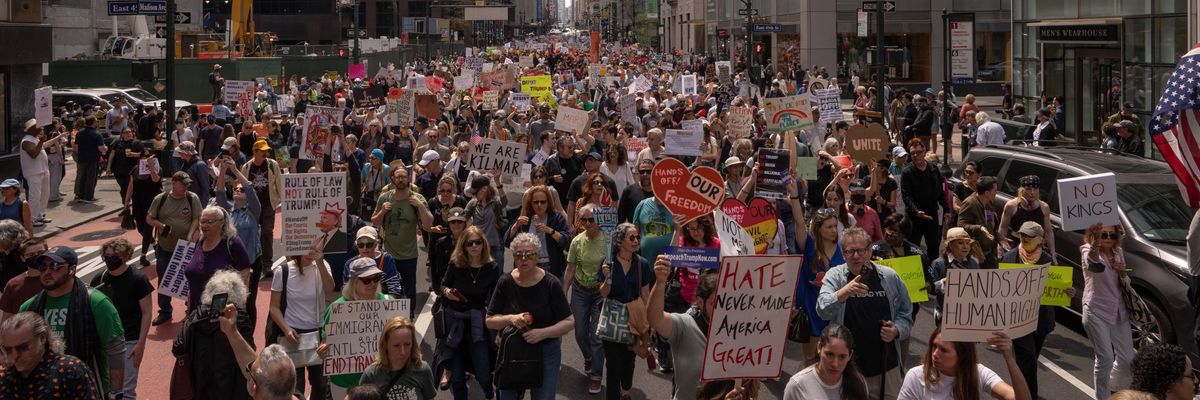
People take part in a protest against President Donald Trump's policies on April 19, 2025 in New York City.
(Photo: Adam Gray/Getty Images)


Julia Conley
Apr 19, 2025
COMMON DREAMS

Two weeks after millions of people attended "Hands Off" protests across the United States, expressing outrage over President Donald Trump's unlawful deportation operation, abandonment of due process for hundreds of migrants, and spending cuts in the interest of enriching the wealthiest Americans, organizers with the "50501" movement called for 11 million people to take to the streets again on Saturday—and early reports suggested the public remains mobilized against the administration.

With Trump intensifying his attacks on federal workers, the environment, freedom of speech, and migrants in recent weeks, organizers said hundreds of events were planned on Saturday—and the protests reflected the wide array of policies that have left Americans angry and fearful about who could be victimized next by the administration.

Signs at a rally outside the Ohio Statehouse in Columbus read, "Ban the fascists, not the books" and "Trump and Vance are traitors," referring to Vice President JD Vance.

Karen Kasler of the Statehouse News Bureau reported the Columbus protest drew the "largest crowd I've seen here since the protest following the U.S. Supreme Court's Dobbs decision overturning the right to abortion in 2022."


Major gatherings also took place in Chicago, New York, and Washington, D.C.

Hunter Dunn, a spokesperson for the 50501 movement—which grew out of a post on Reddit with a call for "50 protests in 50 states on one day"—toldThe Washington Post that the demonstrations are the actions of a "pro-democracy, pro-Constitution, anti-executive overreach, nonviolent grassroots movement."

In addition to protests, organizers called for participants to take part in actions to serve their communities, such as food banks and neighborhood cleanups.

"It's all about actions that support your community against the Trump administration—strengthening your community so that they can weather these assaults on democracy," Dunn toldNPR.

The expulsion of Maryland resident Kilmar Abrego Garcia—a migrant sent by the administration to a super-max prison in El Salvador under a deal with President Nayib Bukele—was a focus for many protesters, following a week of news about his situation. Administration officials have repeatedly claimed Abrego Garcia is a "convicted gang member" and have refused to return him to the U.S. despite a Supreme Court order.

"We are not angry people, we are loving people, but that situation is enraging to us," North Carolina resident Chris Gilbert told The Washington Post at a rally in the nation's capital. "We felt called to come up here to put pressure on the Trump administration. He runs for law and order but then his actions are the opposite."


Organizers say that as Trump has broadened his attacks—overseeing a deportation campaign in which international students have been abducted by plainclothes immigration agents, some wearing masks, in unmarked vehicles—the 50501 movement has grown considerably since its first call to action in early February.

The movement's first day of protests on February 5 included about 80 events in 88 cities, and Dunn said organizers were expecting close to 1,000 events Saturday.


Another round of anti-Trump protests hits US cities


Agence France-Presse
April 20, 2025 

A person shouts next to an image of US President Donald Trump as Nazi dictator Adolf Hitler, as people take part in a protest organized to 'Protect Migrants, Protect the Planet' on April 19, 2025 in New York City. (Adam Gray/Getty Images/AFP)

Thousands of protesters rallied Saturday in New York, Washington and other cities across the United States for a second major round of demonstrations against Donald Trump and his hard-line policies.

In New York, people gathered outside the city's main library carrying signs targeting the US president with slogans like "No Kings in America" and "Resist Tyranny."

Many took aim at Trump's deportations of undocumented migrants, chanting "No ICE, no fear, immigrants are welcome here," a reference to the role of the Immigration and Customs Enforcement agency in rounding up migrants.

In Washington, protesters voiced concern that Trump was threatening long-respected constitutional norms, including the right to due process.

The administration is carrying out "a direct assault on the idea of the rule of law and the idea that the government should be restrained from abusing the people who live here in the United States," Benjamin Douglas, 41, told AFP outside the White House.

Wearing a keffiyeh and carrying a sign calling for the freeing of Mahmoud Khalil, a pro-Palestinian student protester arrested last month, Douglas said individuals were being singled out as "test cases to rile up xenophobia and erode long-standing legal protections."

"We are in a great danger," said 73-year-old New York protester Kathy Valy, the daughter of Holocaust survivors, adding that their stories of how Nazi leader Adolf Hitler rose to power "are what's happening here."

"The one thing is that Trump is a lot more stupid than Hitler or than the other fascists," she said. "He's being played... and his own team is divided."

- 'Science ignored' -

Daniella Butler, 26, said she wanted to "call attention specifically to the defunding of science and health work" by the government.

Studying for a PhD in immunology at Johns Hopkins University, she was carrying a map of Texas covered with spots in reference to the ongoing measles outbreak there.

Trump's health chief Robert F. Kennedy Jr., a noted vaccine skeptic, spent decades falsely linking the measles, mumps, and rubella (MMR) jab to autism.

"When science is ignored, people die," Butler said.

In deeply conservative Texas, the coastal city of Galveston saw a small gathering of anti-Trump demonstrators.

"This is my fourth protest and typically I would sit back and wait for the next election," said 63-year-old writer Patsy Oliver. "We cannot do that right now. We've lost too much already."

On the West Coast, several hundred people gathered on a beach in San Francisco to spell out the words "IMPEACH + REMOVE," the San Francisco Chronicle reported.

Others nearby held an upside-down US flag, traditionally a symbol of distress.

Organizers hope to use building resentment over Trump's immigration crackdown, his drastic cuts to government agencies and his pressuring of universities, news media and law firms, to forge a lasting movement.


The chief organizer of Saturday's protests -- the group 50501, a number representing 50 protests in 50 states and one movement -- said some 400 demonstrations were planned.

Its website said the protests are "a decentralized rapid response to the anti-democratic and illegal actions of the Trump administration and its plutocratic allies" -- and it insisted on all protests being non-violent.

The group called for millions to take part Saturday, though turnout appeared smaller than the "Hands Off" protests across


The Tide Is Turning Against Trump’s Big Steal

Our population has been shocked and awed, just as intended. Yet we are waking up to great effect, beginning to fight back.


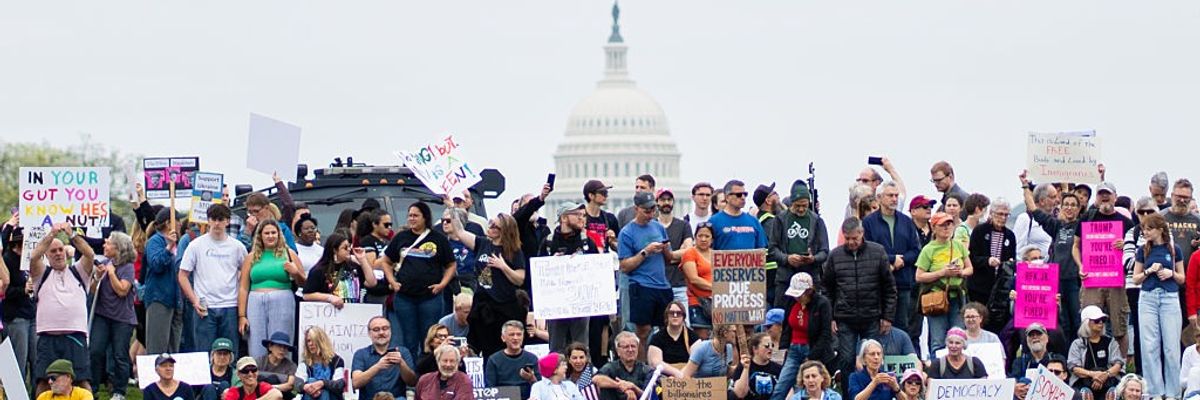
Thousands of protesters gather for the Hands Off rally on the National Mall in Washington on Saturday, April 5, 2025.
(Photo: Bill Clark/CQ-Roll Call, Inc via Getty Images)

Common Dreams

“Someday the wealthiest people, deprived of their ability to extract super-profits from developing countries, will turn their attention inward and gobble up the middle and working classes here in the U.S.”

So predicted my economics professor in 1962 at New York’s New School. These words were unbelievable to my 22-year-old ears. Picket fences were springing up all across America, accompanied by paid vacations, job security, and pensions. Expansion of our rights was the only vision on my horizon.

Riding a postwar economic boom, young people like myself were tearing down entry barriers to the middle class. Legal segregation was about to fall, women were gaining access to traditionally “male” jobs, and unions flourished. We enjoyed complete freedom of speech. No way could we be gobbled up.

Now every sector of public life is on the verge of privatization, with our hobbled Post Office the latest target. While not entirely new, this is an upleveling of the plunder.

“The independence movements exploding in Africa, in India, all over the world, will force the wealthiest Americans to seek the predatory profits they are used to at home,” my professor declared. “They will pauperize the U.S. working and middle classes.”

His words lingered, smoldering in the back of my mind. Could this ever come to pass in “the home of the free”? I knew about our blemished past, with its human slavery and genocide of Indigenous nations, yet still I held fast to our promise of democracy for all. The rule of law would never allow oligarchs to plunder our country the way we had plundered others.

In 1964, when the shockingly conservative Barry Goldwater became the Republican candidate for president, I wondered about the predication. Could this be the moment we began to tumble? In the early morning hours I voted, praying (and I was not then a praying woman) that Lyndon Johnson, the Democratic incumbent, would prevail. He did in a landslide, winning 61.1% of the popular vote. “That was a trial balloon,” my professor said. “They haven’t gathered enough strength yet.”

Republicans went to work winning local elections, then state level. In 1980, when President Ronald Reagan broke the air controller’s strike, I worried again. And union strength—that hold-the-line power—did decline, but enough folks didn’t fold and we retained our democracy.

Yet today the government disappears people without due process; threatens to cut benefits for working people while installing tax cuts for the wealthy; and demands oversight of universities, our bastions of free thought. What is this but the super-profit power grab my professor predicted so long ago?

Republicans have already narrowed our rights—reproductive and voting—to erase 20th-century gains. They’ve gutted public programs, underfunding education and offering for-profit and nonprofit charter schools instead. Our highly efficient public Medicare program has had to compete with private plans for the last 28 years.

(I always understood that a government plan, without profit, would be more cost-effective. I did not know how much better its coverage was until I needed open-heart surgery and my cardiologist asked, “Do you have original Medicare or an Advantage plan? Oh good, original. I can get you right into the hospital. With Advantage it takes weeks.” The private plans, I learned, often deny prior authorization, knowing that only 11.7% of people reapply despite the vast majority of reapplications gaining approval. In my 20 years with traditional Medicare no physician-requested treatment has ever been denied.)

Now every sector of public life is on the verge of privatization, with our hobbled Post Office the latest target. While not entirely new, this is an upleveling of the plunder.

Our population has been shocked and awed, just as intended. Yet we are waking up to great effect, beginning to fight back: Witness the 5.2 million demonstrators in April 5 Hands Off protests. Hundreds of grassroots organizations, taking root in local communities, have been preparing for this moment.

The president of Harvard University, Dr. Alan Garber, has just added the strength of that venerable institution to those holding the line. “The university will not surrender its independence or relinquish its constitutional rights,” he wrote, refusing a federal government demand for oversight. Other respected universities and colleges are rushing to support Harvard, even creating mutual defense pacts to support in each in case of government attack.

Rep. Alexandria Ocasio-Cortez (D-N.Y.) and Sen. Bernie Sanders’ (I-Vt.) Fighting Oligarchy tour is drawing massive, unprecedented crowds, like the 30,000 who lined up for three miles this week, awaiting a rally in conservative-leaning Folsom, California.

The tide is turning, with brave judges, educators, lawyers, courageous fired government whistleblowers, and countless others in every occupation stepping up.

Once more, people are holding the line. Once more, my old professor’s doomsday prophecy will not manifest. Not now. Not on our watch.

We’ve held off the Big Steal this long. We can do it again.


Social Democracy isn’t Going to Save the West


 April 18, 2025
Facebook

Photo by Nick Fewings

Over the last five or so decades, American elections have become increasingly defined by what they don’t accomplish. The classical liberal model of free and fair elections to select representatives who act in the public interest has been replaced with a rogue foreign policy establishment attached to public – private mechanisms (propaganda, censorship, and surveillance) meant to maintain social control. Rampant slaughter abroad and political repression at home now represent America’s relationship with the world.

In recent history, few Americans recognized the Biden administration’s end run around left politics for what it was. Recall, the left critique of woke ideology isn’t that it is directionally wrong. The critique is that it is misguided politics. Many of us who put the argument forward lived through the creation and long, sad, decline of Affirmative Action. The problem is that the frame of LeBron James being oppressed because he is black, while my neighbor who digs cans out of the garbage to live is privileged because he is white, is flawed.

For those who lived through it, the attack on Affirmative Action came by placing largely contrived, but otherwise representative, accounts of poor and working-class whites being denied opportunities in favor of ‘minorities.’ In fact, large corporations become large by crushing smaller competitors. And with nonexistent economic mobility in the US, the children of the rich inherit social control over the children of working people and the poor. Capitalism is a system of economic domination, not of equitable distribution. Just ask Donald Trump.

The two points made as the national Democrats acted to change the subject from economic maldistribution to identity-based bias were 1) the US has been down this road before, and the strategy that didn’t work was state-sponsored bias remediation and 2) the corporations ‘voluntarily’ launching DEI programs would abandon them the minute that the political tide turned. We can argue theory until we are blue in the face, but it was the left critique that produced the correct prediction about how DEI would be ended.

The broader question of liberal impact has it that income and wealth distribution are as concentrated as they have ever been, racial segregation is today accomplished through economic (class) segregation, and the US is ruled by a small group of oligarchs who use the state to make themselves ever richer. The Democrats have governed through enough of this to have these be their policies as well. Bill Clinton was one of the few Americans who really subscribed to Ronald Reagan’s neoliberal economic vision.

The domestic political result is that the two branches of the uniparty are now dedicated to reversing each other’s policies rather than conducting the people’s business. The way that this currently appears is that the Trump administration is reversing the state mechanisms that facilitated the Democrats’ hold on power 1933 – 1973, aka the New Deal. Through a weak read of history, Donald Trump’s supporters imagine that the gilded age that both branches of the uniparty have spent decades trying to recreate presented opportunities that it didn’t.

In his 1980 contest against Jimmy Carter, Ronald Reagan presented what is today called neoliberalism as a radical rebuke of state power. His (Reagan’s) project was to shift power from the state that had sponsored the Vietnam War to capital that had supplied ‘us’ with Hula-Hoops and black-and-white televisions. However, in a now disappeared quote. LBJ offered that ‘he can’t end the (Vietnam) war because his friends were making too much money from it.’ This later represented Joe Biden’s explanation of why war in Ukraine and genocide in Gaza are good for the US.

Graph: the bipartisan trend in privatizing Medicare finds recent Democrat and Republican administrations privatizing approximately the same proportions, with 8% going to the recent Democrat and 7% going to the past and current Republican. What swings the balance however (thus far) is that it is the ‘best practices’ provision in the ACA that will lead to the total privatization. The provision gives political hacks working for economic hacks the power to declare privatization a ‘best practice,’ making it official Medicare policy. Source: kff.org.

For those who missed it, Donald Trump hasn’t offered that his policies would benefit ‘us all.’ He has argued that his policies will benefit ‘the worthy.’ This is (Bill) Clintonism 101. Both Clinton and Trump argued that ‘opportunity’ is the best that the state can offer. Bill Clinton asserted that ‘a level playing field’ united the autoworkers who his passage of NAFTA rendered unemployed with Donald Trump, who in the mid-1970s inherited a real estate empire worth about $300 million dollars (inflation adjusted). Both men oversaw the return of income and wealth concentration to gilded age levels.

“True to form, the Social Democrat leaders refused the Communist party’s proposal to form an eleventh-hour coalition against Nazism. As in many other countries past and present, so in Germany, the Social Democrats would sooner ally themselves with the reactionary Right than make common cause with the Reds.” Michael Parenti.

The problem, for those who choose to see it, is that the entire ‘left’ program that was handed to the Democrats in both 2016 and 2020, from Bernie Sanders’ ascendance to the Black Lives Matter protests, is now a flaming bag of dog excrement waiting to be stomped out. The phrase ‘the Democratic party is the graveyard of social movements’ comes to mind. Sure, Donald Trump’s political program certainly gives the US the appearance of a former empire in free-fall. But then so did the DNC propping up Genocide Joe in a low-budget remake of Weekend at Bernie’s.

With Donald Trump throwing policy bombs and lighting fires domestically, the global class war that has been raging for the last fifty years has been brought home. Mr. Trump’s proponents see him, and themselves, on the winning side of history. This is exactly how American Democrats perceived themselves in the aftermath of the 2020 election of Joe Biden. But outside of life and death, history doesn’t have winners and losers. As Bob Dylan put it “… the loser now, will be later to win.’ History isn’t over until it is over.

This is to point to the folly of ideologically driven reforms rather than coming to some level of public agreement, sometimes known as democratic consent, over national governance. The Democrats enacted DEI and the next Republican president reversed it. Donald Trump tears down the permanent government and the Democrats spend the next four years launching foreign wars. That Democrats don’t know that their party is overwhelmingly responsible for privatizing Medicare begs the question of agency?

It is a sense of repeating cycles that replaces one national ideological predisposition with its opposite. But if history has a voice, it ties to underlying causes. The pattern hasn’t been a symmetrical back-and-forth where national balance is recovered. For five decades now, American politics have represented a relentless march to the hard right. No balance has been recovered via the electoral back-and-forth between the parties.

This point is important to understand. Both Democrats and Republicans claim ideologies. That the national politics has moved hard-right for five decades implies either that Republicans have controlled the politics for all five of these decades— which they haven’t, or that both Democrats and Republicans are right-wing parties. Given that the parties have taken turns governing, Republicans haven’t led the move hard-right. The answer that remains is that the Democrats are a hard-right party. As irony has it, neither party would last five minutes without the other.

This may be painful to read inside the sense of emergency being caused by Mr. Trump’s current idiot-King schtick as it is being applied to actual human lives. But Mr. Trump neither caused the dysfunction that brought him to power (twice), nor does he stand any more chance than the Democrats of fixing it. The result is that both parties have migrated from pretending to solve national problems to erasing the efforts of the other party. Mr. Trump is currently winning that effort to the great detriment of the American people.

There was a blood sport of sorts begun in the 1990s of guessing how long it would take various European Social Democratic parties to govern from the neoliberal right after winning election. They would run on the European equivalent of the political marketing campaigns of American Democrats, and then govern from the neoliberal-right upon election. What became apparent was that there were supra-national forces, call them political economy, that converted the wills of disparate electorates into a unified neoliberal front that transcended national borders.

Graph: it’s easy enough for those unfamiliar with the data to associate the large decline in life expectancy with the onset of the Covid-19 pandemic. The problem with doing so is that the graph looks largely the same in relative terms, when compared with peer nations. What this suggests is that the Covid-19 pandemic brought-to-light the existing deficiencies of the US healthcare system that were supposed to have been fixed by passage of the ACA. After shoveling billions more dollars in public largesse into health insurer executive bonus pools, the ACA has produced the worst healthcare system in the developed world. Why? Source: worldbank.org.

This paradox, where voters vote but donors control the policies that emerge, represents political disempowerment for all but the rich. With more nuance than yours truly imagined likely, Donald Trump’s targeting of Federal employees has targeted the PMC (professional-managerial class), meaning Democrats, quite effectively. This was Mr. Trump’s variation on Bill Clinton’s use of NAFTA to realign the Democrats with the interests of capital. The class that will remain in the burned-out shell of the US will be the oligarchs.

Key to this effort has been to conflate what politicians say about their policies with what the policies actually accomplish. Remarkably, even as a key provision in the ACA (Affordable Care Act) represents the clearest path for the Trump administration to privatize all of Medicare, Democrats are quadrupling down on their commitment to the program. The ACA provision, called ‘best practices,’ allows one politician in a position of authority to define privatized Medicare (Medicare Advantage) a ‘best practice,’ making it Federal policy to end non-private Medicare.

Graph: after relentlessly criticizing the deportation of immigrants by the Trump administration, Democrats slept through the Biden administration’s massive increase in deportations. The irony is that the Trump campaign spent its prior four years downplaying what the Democrats were doing. It was selling the fantasy of a ‘massive increase in illegal immigration.’ This is why I keep asking my Republican friends why they don’t vote for Democrats? Joe Biden did exactly what they just elected Donald Trump to do. Source: nytimes.com.

As readers certainly know by now, 54% of Medicare (graph below) has already been privatized, mainly by Democrats. The incongruity of Democrats nodding in the affirmative to claims by Democratic politicians that they will ‘save’ Medicare (and Social Security) is perfectly contradicted by the facts. Not only have Democrats privatized more of Medicare than have Republicans, but the ‘best practices’ provision of Obamacare seems designed to privatize all of Medicare. That Democrats don’t know this makes them dangerously misinformed.

In a similar vein, righteous anger over the Trump administration’s violent and likely illegal deportation of Venezuelan citizens who were legally in the US to a gulag in El Salvador is based on ignorance of the actual history of deportations by Presidents. As the graph above illustrates, following the public anguish over Donald Trump’s deportation of immigrants during his first term, the Biden administration doubled the number of deportations. Democrats who oppose the mass deportation of immigrants need to learn at least a few facts about the party that they claim to support.

To possible distinctions between ‘good’ and ‘bad’ deportations, the left has fought capital over open borders for several centuries. Industrialists long fought for open borders so as to flood the US with desperate workers in order to lower wages. The politics that took labor out of consideration is telling. Those who don’t care about labor tend to be aligned with capital. This would be the PMC left, American liberals, and the oligarchs. Having worked white-collar and blue-collar jobs, no working person would voluntarily open the door for their replacement.

While I didn’t participate in the national ‘Hands Offs’ protests, I spoke with friends who attended local events. The local politicians who attended are neoliberal, neoconservative, Zionist, apparatchiks. In a city plagued by FBI efforts to entrap its citizens in fake ‘terrorist’ plots, and that is a dumping ground for state projects that can’t be built elsewhere due to public opposition from powerful forces, the local politicians are aligned with national Democrats against the citizens.

The richest 1% of Americans (the oligarchs) owns over half of the stock market. And the richest 10% owns ninety percent of the stock market. Finance is what empowered the oligarchs. Ending its value could restore something resembling a democratic social order. Note that Democrats have spent the last five decades doing everything in their power to raise the value of the stock market. Bill Clinton was / is a stock market god, having overseen the largest market bubble until the next two market bubbles.

The point is that the stock market is a major source of the oligarch’s power. Letting the stock market fall to valuation levels of earlier stock market history would cut the economic power of the oligarchs down to size. Broadly economically adverse outcomes would accompany the move. But without dampening the economic power of the oligarchs, restoring economic and / or political democracy is impossible. Concentrated wealth will continue to purchase political power until it is made to stop doing so.

The current political lining-up, with Democrats protesting Mr. Trump and his policies under the idea that the next Genocide Joe will be incrementally better than the Republican alternative, misses that the US is an empire in free-fall. The post-War period when the US had the only intact industrial base is long past. The Democrats were urged to put together an industrial policy, and chose not to. This left the Trump – right to inflict its version of an industrial policy. The best guess here is that it will not end well.

Changing economic relations from the bipartisan neoliberal model to something else can proceed from the right or the left. Both the Democrats and the Republicans chose to hand the task to the Trump-right. Please re-read the quote from Michael Parenti above. In extraordinary circumstances, count on the Democrats to side with the right. What the US needs is economic redistribution to accomplish political redistribution. But the American Social Democrats (Democrats) like the current arrangement just fine.


Rob Urie is an artist and political economist. His book Zen Economics is published by CounterPunch Books.