Sunday, May 11, 2025

Even Dems Who Initially Backed Crypto GENIUS Act Block It Over 'Outstanding Issues'

"Democrats held firm against this corporate power grab. We're fighting for fairness, not billionaire greed!" said Our Revolution —though the effort to pass the bill is not over.



Advertisement featuring U.S. President Donald Trump 
with Bitcoin in Hong Kong on Sunday, April 6, 2025.
(Photo: May James/SOPA Images/LightRocket via Getty Images)

Jessica Corbett
May 09, 2025
COMMON DREAMS

In a win for progressive groups and lawmakers who have been sounding the alarm about legislation that would create a regulatory framework for stablecoins, the U.S. Senate Democratic Caucus—along with a couple of Republicans—blocked the cryptocurrency bill from advancing on Thursday in a 49-48 procedural vote.

A stablecoin is a digital asset whose value is tied to traditional currency, such as the U.S. dollar, or a commodity like gold. Sen. Kirsten Gillibrand (D-N.Y.) co-sponsored the Guiding and Establishing National Innovation for U.S. Stablecoins (GENIUS) Act, which advanced out of the Senate Banking Committee in March with support from five other Democrats.

Meanwhile, the committee's ranking member, Sen. Elizabeth Warren (D-Mass.), has blasted the bill—as has Sen. Bernie Sanders (I-Vt.), who caucuses with Democrats and warned this week that the GENIUS Act would make it easier for President Donald Trump "and his family to continue to engage in corrupt dealmaking enabled through their cryptocurrency."

Our Revolution, a group formed as a continuation of Sanders' 2016 presidential campaign, has similarly panned the legislation, with executive director Joseph Geevarghese calling it a "laughably weak and toothless regulatory bill—a sham crafted by cryptocurrency giants that is certain to line the pockets of the Trump family's crypto empire."
Concern over the bill has grown since the revelation last week that a stablecoin developed by the Trump family crypto firm, World Liberty Financial, would be used for a $2 billion deal between an investment firm established by the government of Abu Dhabi, MGX, and the world's largest crypto exchange, Binance.


In recent days, several crypto-friendly Democrats said they couldn't support the GENIUS Act in its current form, and ultimately, no members of the party's caucus voted for it. Thursday's vote was welcomed by Our Revolution, which said on social media that "Democrats held firm against this corporate power grab. We're fighting for fairness, not billionaire greed!"

Gillibrand, a key target of Our Revolution ahead of the vote, said in a statement that "I believe it is essential to the future of the U.S. economy and to everyday Americans that we enact strict stablecoin regulations and consumer protections where none currently exist. Over the past few years, I have worked in good faith with Republicans to author robust stablecoin legislation that protects consumers, enables innovation to thrive, and maintains the dominance of the U.S. dollar."

"The bipartisanship of this effort was on display when the bill passed out of the Banking Committee with strong support from Democrats and Republicans," she continued. "However, developments over the past week made it clear that there were a number of outstanding issues that needed to be addressed before this bill could pass the full Senate."

"I fully support my colleagues' efforts," Gillibrand said, specifically applauding Sen. Bill Hagerty (R-Tenn.) "for his tireless work across the aisle to improve and strengthen this bill." She added that "I remain extremely confident and hopeful that very soon we can finish the job."

According toAxios: "Key Senate players have been meeting all week, trying to land a deal to appease Democrats. Senate Republicans reviewed Democrats' proposed changes to the GENIUS Act, with Majority Leader John Thune (R-S.D.) and Sen. Mark Warner (D-Va.) negotiating up until the last minute."

Warner, one of the Democrats who voted the bill out of committee in March, said in a Thursday statement that "while we've made meaningful progress on the GENIUS Act, the work is not yet complete, and I simply cannot in good conscience ask my colleagues to vote for this legislation when the text isn't yet finished."

"I remain fully committed to getting this right," he said. "I plan to continue working with my colleagues to strengthen this legislation and move it forward in a way that promotes innovation while protecting the interests of the American people. It is my sincere hope that we can start floor consideration next week after we have finalized our work and given our colleagues adequate time to review."

While Thune reposted social media statements from his GOP colleagues expressing disappointment over the result and accusing Democrats of "hypocrisy," he also signaled that the effort to pass a stablecoin bill will continue by changing his vote from yes to no, which enables him to bring up the GENIUS Act at a later date.


Given expectations that the fight for the bill will go on, Democrats are still pushing for key reforms and additions. Citing recent reporting about Trump agreeing to attend a dinner with major investors in his cryptocurrency, Sen. Jeff Merkley (D-Ore.) said on social media Friday that "access to the White House shouldn't be up for sale to the highest bidder!!"

"This kind of blatant corruption takes a sledgehammer to public trust—we need to add my End Crypto Corruption Act to the GENIUS Act NOW!" added Merkley, pushing legislation that would ban the president, vice president, top executive branch officials, members of Congress, and their immediate families from issuing, endorsing, or sponsoring crypto assets.


Progressive Group Rebukes Democrats for Being 'Fully Complicit' in Industry-Backed Crypto Bill

The head of Our Revolution called the GENIUS Act "a sham crafted by cryptocurrency giants that is certain to line the pockets of the Trump family's crypto empire."


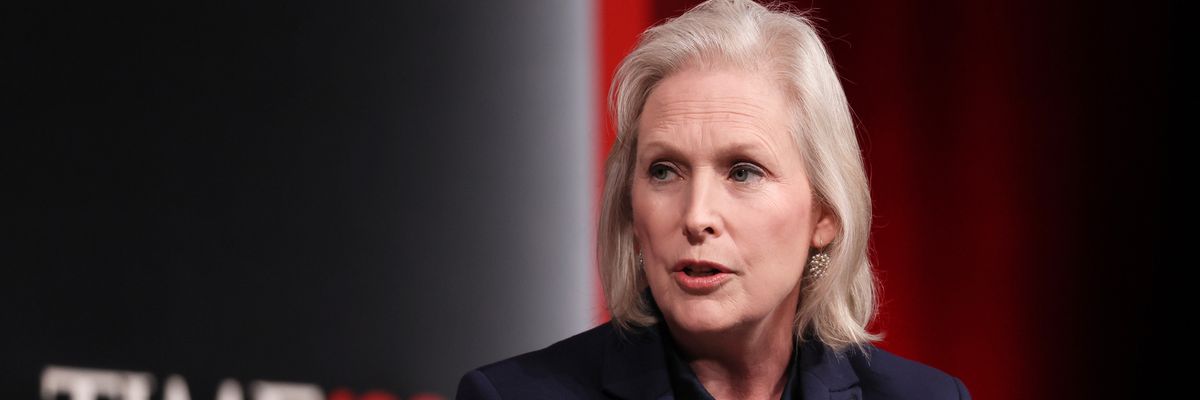
Sen. Kirsten Gillibrand (D-N.Y.) speaks onstage during the 2025 TIME100 Summit at Jazz at Lincoln Center on April 23, 2025 in New York City.
(Photo: Jemal Countess/Getty Images for TIME)


Eloise Goldsmith
May 07, 2025
COMMON DREAMS

As the Senate is reportedly poised to hold a Thursday procedural vote on legislation that would create a regulatory framework for a type of cryptocurrency called stablecoin, the group Our Revolution released a statement Wednesday denouncing Democrats for being "complicit" in the bill, which they say will likely enrich U.S. President Donald Trump.

Joseph Geevarghese, executive director of Our Revolution, said in a Wednesday statement that the Guiding and Establishing National Innovation for U.S. Stablecoins (GENIUS) Act is a "laughably weak and toothless regulatory bill—a sham crafted by cryptocurrency giants that is certain to line the pockets of the Trump family's crypto empire." Our Revolution is a progressive political organizing group launched as a continuation of Sen. Bernie Sanders' (I-Vt.) 2016 presidential campaign.

"Let's be clear," Geevarghese continued, "Democrats are fully complicit in the grift, with Sen. Kirsten Gillibrand (D-N.Y.) leading the charge as the bill's original sponsor. We call on every senator who still gives a damn about democracy to shut down this outright sellout to the cryptocurrency industry."

Common Dreams reached out to Gillibrand's office for comment.

The bipartisan bill was originally co-sponsored by Sen. Tim Scott (R-S.C.), Sen. Cynthia Lummis (R-Wyo.), and Gillibrand. Later, Sen. Angela Alsobooks (D-Md.) became a co-sponsor as well.

The GENIUS Act, which is backed by the crypto industry, would make it easier for U.S. firms to do business in stablecoin, according to the The New York Times.

Several other crypto-friendly Democrats in the Senate had backed the GENIUS Act, but over the weekend pulled their support, citing a desire for stronger provisions on anti-money laundering, national security, and other issues. "While we are eager to continue working with our colleagues to address these issues, we would be unable to vote for cloture should the current version of the bill come to the floor," wrote the group, which did not include Alsobrooks and Gillibrand, in a statement on Saturday.

A spokesperson for Alsobrooks toldThe American Prospect on Monday that at the Senate Banking Committee markup, "Democrats received commitments to address concerns about the bill. Those commitments should be honored, and she supports her colleagues in their efforts to further improve the bill."

The bill may need as many as 10 Democrats to clear a procedural vote due to potential defections on the GOP side, according to Axios.

Meanwhile, on Tuesday, Sen. Jeff Merkley (D-Ore.) and Senate Minority Leader Chuck Schumer (D-N.Y.) unveiled the End Crypto Corruption Act, a proposal that would bar the president, vice president, members of Congress, and their immediate families from issuing digital assets, like stablecoins. Gillibrand has joined that bill as a co-sponsor.

Critics of the GENIUS Act, like Sanders and Sen. Elizabeth Warren (D-Mass.), warn it would facilitate illicit activity and undermine consumer protection. Sanders warned on Tuesday that the GENIUS Act "makes it easier for President Trump and his family to continue to engage in corrupt dealmaking enabled through their cryptocurrency, to the great benefit of themselves and their tech oligarch backers."

Democratic lawmakers have voiced concern about a recent Trump crypto revelation—that a stablecoin created by the Trump-affiliated World Liberty Financial crypto venture will be used to complete a $2 billion transaction by an Emirati-state owned investment firm.

And while some reporting suggests that Trump's crypto maneuvers are actually harming the chances that the GENIUS Act will pass, Public Citizen co-president Lisa Gilbert said Wednesday that "all available signs point to Donald Trump trading deregulation of the crypto industry in exchange for personal and political enrichment."

"Crypto helped elect Trump, and now they are helping him add millions to his personal bank account," Gilbert added.
'Appalling and Lawless': Trump Moves to Fire Democrats on Consumer Safety Panel

"I'll see him in court," said Richard Trumka Jr., one of the commissioners.


Consumer Product Safety Comission member Richard Trumka Jr. was photographed at the agency's headquarters on January 20, 2023 in Bethesda, Maryland.
(Photo: Ricky Carioti/The Washington Post via Getty Images)

Jake Johnson
May 09, 2025
COMMON DREAMS

Three Democratic members of the Consumer Product Safety Commission vowed on Friday to fight back after U.S. President Donald Trump moved to fire them, an effort that the trio described as part of the White House's unlawful assault on independent agencies.

Mary Boyle, Richard Trumka Jr., and Alex Hoehn-Saric are now listed on the CPSC's website as "former commissioners." The Washington Post reported that Trump moved to fire the commissioners "shortly after" the Elon Musk-led Department of Government Efficiency visited the agency on Thursday.

"The Democratic commissioners objected to two DOGE employees being formally detailed to the agency," the Post noted, citing Trumka's account.

Boyle and Trumka said they received emails from the White House late Thursday informing them of the president's bid to remove them from their posts. Hoehn-Saric said in a statement Friday that while he has yet to receive communication from the White House, the acting chair of the CPSC is "preventing me from executing my duties as commissioner based on an assertion that the president is also seeking my removal."

"The illegal attempt to remove me from the CPSC happened immediately after my colleagues and I took steps to advance our safety work and protect our staff from arbitrary firings," said Hoehn-Saric. "President Trump's action politicizes a critical independent public safety agency that was structured by law to avoid such interference."

All three of the Democratic commissioners indicated that they don't intend to leave the agency quietly, following in the footsteps of commissioners at other agencies who have challenged Trump's attempts to fire them, setting the stage for a high-stakes battle at the U.S. Supreme Court.


Trumka, son of the late labor leader Richard Trumka, said Friday that he has "a set term on this independent, bipartisan commission that does not expire until October of 2028." Last week, Trumka defied a Trump executive order instructing federal agencies to submit all proposed rules to the Office of Information and Regulatory Affairs for review.

"I will continue protecting the American people from harm through that time," Trumka continued. "The president would like to end this nation's long history of independent agencies, so he's chosen to ignore the law and pretend independence doesn't exist. I'll see him in court."

Boyle, whose term was set to expire later this year, also signaled that she intends to remain at her post.

"Until my term as commissioner concludes,” Boyle said, "I will insist on following these time-tested principles, and I will use my voice to speak out on behalf of safety."

Consumer advocates voiced outrage in response to Trump's attempt to fire the CPSC commissioners.

"The illegal firing of CPSC commissioners is not just a brazen, unprecedented, and reckless assault on the rule of law, it is a direct threat to the lives and physical safety of Americans, especially our most vulnerable, infants and children," saidCourtney Griffin, Director of Consumer Product Safety at the Consumer Federation of America. "The consequences may be measured in preventable injuries, hospitalizations, and lives lost."

William Wallace, director of safety advocacy for Consumer Reports, said in a statement that "this is an appalling and lawless attack on the independence of our country's product safety watchdog."

"Anyone who cares about keeping their family safe should oppose this move and demand that it be reversed," Wallace added. "This isn't really about the individual leaders, as commendable as they are. It's about whether Congress can maintain a federal agency that takes strong action to protect the public, based on scientific evidence and insulated from political whims."

Democrats' Bill Would Extend Social Security and Medicare Solvency 'As Far as the Eye Can See'

BENEFITS, PAID FOR BY AMERIKANS,
NOT ENTITLEMENTS

"Working-class seniors pay into Social Security and Medicare their whole careers so they can enjoy a dignified retirement, but they end up paying a much larger share of their income in taxes than billionaires because the tax code is rigged in favor of the rich."


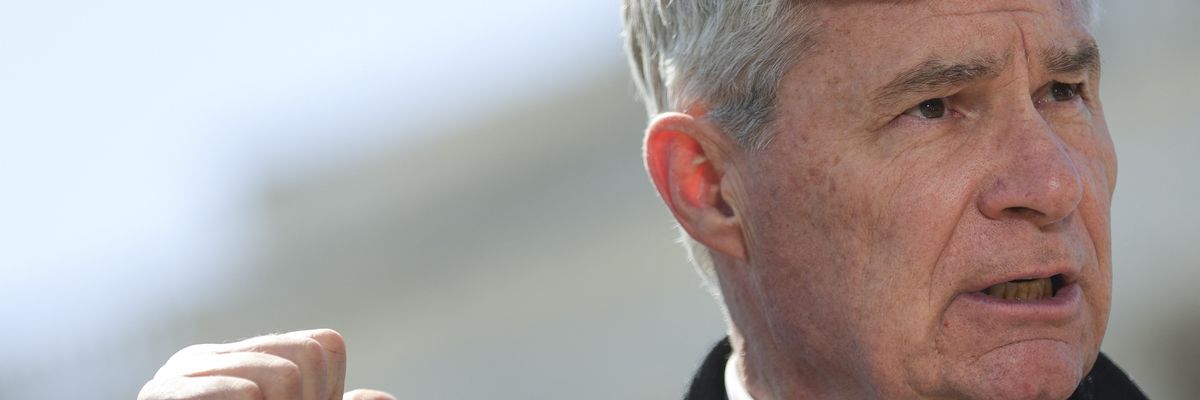
U.S. Sen. Sheldon Whitehouse (D-R.I.) speaks at a press conference hosted by the Climate Action Campaign outside of the U.S. Capitol in Washington, D.C. on April 9, 2025.
(Photo: Bryan Dozier/Middle East Images/AFP via Getty Images)


Julia Conley
May 09, 2025
COMMON DREAMS

Social Security and Medicare protect tens of millions of American senior citizens from poverty and medical bankruptcy each year, but economic justice advocates have long said the programs would be strengthened and remain fully solvent for as long as possible if the richest Americans contributed more to them—and on Thursday two Democratic lawmakers introduced legislation to ensure they do.

The bicameral bill, the Medicare and Social Security Fair Share Act, was reintroduced by Sen. Sheldon Whitehouse (D-R.I.) and Rep. Brendan Boyle (D-Pa.), with the aim of requiring people with yearly incomes of more than $400,000 to contribute a fairer share of their wealth to the two programs.

Currently the maximum amount of earnings for which American workers must pay Social Security taxes is just over $176,000.

The bill would lift the Social Security tax cap "to ensure that no matter the source of their income, high-income taxpayers would pay the same tax rate on their income exceeding that threshold," said the lawmakers in a press statement.

It would also increase the Medicare tax rate for income above $400,000 by 1.2% and include a provision ensuring owners of hedge funds and private equity firms can no longer avoid Medicare taxes.

Whitehouse and Boyle introduced the bill as the Trump administration and congressional Republicans work to slash Social Security—confirming Wall Street executive Frank Bisignano, who has backed billionaire Elon Musk's spending cuts at the Department of Government Efficiency (DOGE), to run the program this week.

"While Republicans are pushing a $7 trillion tax giveaway to the ultrarich, we're working to protect the benefits that millions of Americans have earned—and we won't let them be stolen to fund another billionaire windfall."

Republicans have also suggested Medicare could be slashed in order to pay for tax cuts for the wealthiest Americans and have pushed to expand privatized Medicare Advantage plans.

"Working-class seniors pay into Social Security and Medicare their whole careers so they can enjoy a dignified retirement, but they end up paying a much larger share of their income in taxes than billionaires because the tax code is rigged in favor of the rich," said Whitehouse. "As the Trump administration and Congressional Republicans gear up to deliver budget-busting giveaways for their billionaire donors, I will continue pushing to make our tax code fair and protect these twin pillars of retirement security as far as the eye can see."

Actuaries at the Centers for Medicare and Medicaid Services and Social Security Administration estimated that Whitehouse and Boyle's proposal would extend Social Security and Medicare solvency by at least 75 years.

Without new revenue, the trust funds that finance Medicare and Social Security are projected to be 100% solvent only through 2036 and 2033, respectively.

The legislation is endorsed by groups including Social Security Works, the National Council on Aging, and the Center for Medicare Advocacy.

"From my first day in Congress, I've pledged to protect the long-term stability of Social Security and Medicare—two bedrock promises our country made to seniors, workers, and people with disabilities," said Boyle. "Now, with [President] Donald Trump, Elon Musk, and DOGE-fueled billionaires openly attacking these programs, that fight is more urgent than ever."

"While Republicans are pushing a $7 trillion tax giveaway to the ultrarich," he said, "we're working to protect the benefits that millions of Americans have earned—and we won't let them be stolen to fund another billionaire windfall."
Scapegoating Wild Birds Won’t Solve Avian Flu: We Need Radical Farming Reform

As we reflect on the wonder of migratory birds, and the spotlight focuses on how our cities and communities can be made more bird-friendly, we must also consider how our food system is posing a threat to their very existence.


South Korean health officials inspect a rice field frequented by migrating birds in Seosan, 130 kilometers (78 miles) southwest of Seoul, on November 24, 2006.
(Photo: Jeon Young-Han/AFP via Getty Images)

Peter Stevenson
May 10, 2025
Common Dreams

For migratory and other wild birds, bird flu is a disaster. The U.S. Centers for Disease Control and Prevention, or CDC, states that 169 million U.S. poultry have been affected by highly pathogenic bird flu since January 2022. Yet worldwide, tens of millions of wild birds have died of bird flu—which has also spread to mammals, including over 1,000 US. dairy herds.

Saturday 10 May is World Migratory Bird Day, a global event for raising awareness of migratory birds and issues related to their conservation. The poultry industry and governments like to blame wild birds for bird flu. However, the Scientific Task Force on Avian Influenza and Wild Birds—which includes the United Nations Food and Agriculture Organization (FAO) and the World Organization for Animal Health (WOAH) stresses that wild birds are in fact the victims of highly pathogenic bird flu; they do not cause it. As a recent study states, “This panzootic did not emerge from nowhere, but rather is the result of 20 years of viral evolution in the ever-expanding global poultry population.”

Until recently, the bird flu viruses that circulate naturally in wild birds were usually of low pathogenicity; they generally caused little harm to the birds. It is when it gets into industrial poultry sheds—often on contaminated clothing, feed, or equipment—that low pathogenic avian influenza can evolve into dangerous highly pathogenic avian influenza.

Governments worldwide appear to have no strategy for how to end these regular bird flu outbreaks other than to hope they will eventually die down.

Industrial poultry production, in which thousands of genetically similar, stressed birds are packed into a shed, gives a virus a constant supply of new hosts; it can move very quickly among the birds, perhaps mutating as it does so. In this situation, highly virulent strains can rapidly emerge. The European Food Safety Authority warns that it is important to guard against certain low pathogenic avian influenza subtypes entering poultry farms “as these subtypes are able to mutate into their highly pathogenic forms once circulating in poultry.”

Once highly pathogenic avian influenza strains have developed in poultry farms, they can then be carried back outside—for example, through the large ventilation fans used in intensive poultry operations—and spread to wild birds. The Scientific Task Force states that since the mid-2000s spillover of highly pathogenic bird flu from poultry to wild birds has occurred “on multiple occasions.”

So, low pathogenic bird flu is spread from wild birds to intensive poultry where it can mutate into highly pathogenic bird flu, which then spills over to wild birds and can even return back to poultry in a growing and continuing vicious circle.

Following its evolution in farmed poultry, the highly pathogenic virus has adapted to wild birds, meaning that it is circulating independently in wild populations, with some outbreaks occurring in remote areas that are distant from any poultry farms.
Is There a Health Risk for Humans?


While the health risk to humans from bird flu may be low, it cannot be ignored. Highly pathogenic avian influenza has spread to mammals including otters, foxes, seals, dolphins, sea lions, dogs, and bears. Worryingly, it has been found in a Spanish mink farm where it then was able to spread from one infected mink to another.

The U.S. Department of Agriculture has said that cow-to-cow transmission is a factor in the spread of bird flu in dairy herds. The ability for bird flu to move directly from one mammal to another is troubling as a pandemic could ensue if it could move directly from one human to another.

Scientists at Scripps Research reveal that a single mutation in the H5N1 virus that has recently infected U.S. dairy cows could enhance the virus’ ability to attach to human cells, potentially increasing the risk of passing from person to person.

A 2023 joint statement from the World Health Organization, the FAO, and WOAH stated that, while avian influenza viruses normally spread among birds, “the increasing number of H5N1 avian influenza detections among mammals—which are biologically closer to humans than birds are—raises concern that the virus might adapt to infect humans more easily.”

Some mammals may also act as mixing vessels, leading to the emergence of new viruses that could be more harmful.
Pigs as Mixing Vessels

Pigs can be infected by avian and human influenza viruses as well as swine influenza viruses. Pigs can act as mixing vessels in which these viruses can reassort (i.e. swap genes) and new viruses that are a mix of pig, bird, and human viruses can emerge. The U.S. CDC explains that if the resulting new virus infects humans and can spread easily from person to person, a flu pandemic can occur.
Need for a Coherent Strategy to End Bird Flu

Governments worldwide appear to have no strategy for how to end these regular bird flu outbreaks other than to hope they will eventually die down. There is no sign of this happening. Without an exit strategy we are likely to face repeated, devastating outbreaks of bird flu for years to come. We need an action plan to restructure the poultry and pig sectors to reduce their capacity for generating highly pathogenic diseases.

We need to:Move to a poultry sector with smaller flocks and lower stocking densities to give the birds more space. Transmission and amplification of bird flu would be much less likely in such conditions.

End the practice of clustering a large number of poultry farms close together in a particular area. Between-farm spread is a major contributor to the transmission of highly pathogenic bird flu.

End the use of birds genetically selected for very fast growth. Such birds have impaired immune systems making them more susceptible to disease.

In light of pigs’ capacity for acting as mixing vessels for human, avian, and swine influenza viruses, the pig sector too needs to be restructured to make it less vulnerable to the transmission and amplification of influenza viruses. As with poultry, this would involve reducing stocking densities, smaller group sizes, and avoiding concentrating large numbers of farms in a particular area.

As we reflect on the wonder of migratory birds, and the spotlight focuses on how our cities and communities can be made more bird-friendly, we must also consider how our food system is posing a threat to their very existence. Failure to rethink industrial farming leaves us vulnerable, with the continued devastation of wild birds and poultry, and perhaps even a human pandemic.


Peter Stevenson is the chief policy adviser of Compassion in World Farming.
Full Bio >
'1.5ºC Is Dead': Climate Movement Holds Funeral for Paris Agreement Target

"We felt we needed a physical space where we could grieve together for what we are losing, and reflect on how to respond to the challenge now in front of us," said Alex Martin of Extinction Rebellion Cambridge.


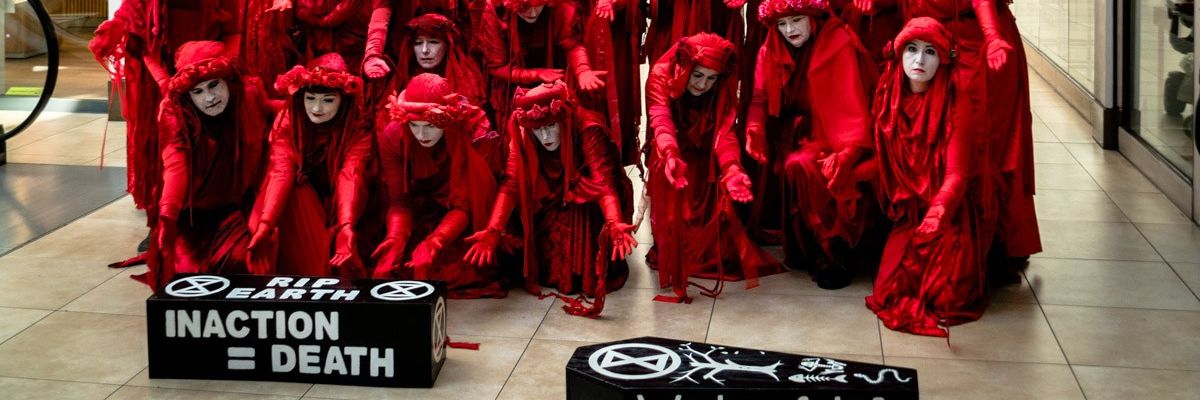
Members of the "Red Rebel Brigade" led a procession around Cambridge, England as part of a funeral for the Paris agreement's 1.5°C temperature target on May 10, 2025.
(Photo: Derek Langley)

Jessica Corbett
May 10, 2025
COMMON DREAMS

Extinction Rebellion and other climate organizations on Saturday held a funeral for the Paris agreement's 1.5ºC temperature target in Cambridge, England.

"The mock funeral idea grew out of the need to process the enormity and sadness of this moment," Alex Martin of Extinction Rebellion (XR) Cambridge said in a statement. "While many people are distracted by 1,001 things on their phones, we felt we needed a physical space where we could grieve together for what we are losing, and reflect on how to respond to the challenge now in front of us."

Almost a decade ago, parties to the Paris treaty agreed to work toward limiting temperature rise this century to 1.5ºC—but 2024 was the hottest year in human history, and countries around the world show no signs of reining in planet-wrecking fossil fuels anywhere near the degree that scientists warn is necessary to prevent catastrophic climate breakdown.

"Crossing 1.5ºC for a whole calendar year is a wake-up call for the world," said Olympic gold medalist and XR U.K. spokesperson Etienne Stott, highlighting another alarming record from last year. "If we want to avoid crossing further tipping points we need a complete transformation of society."


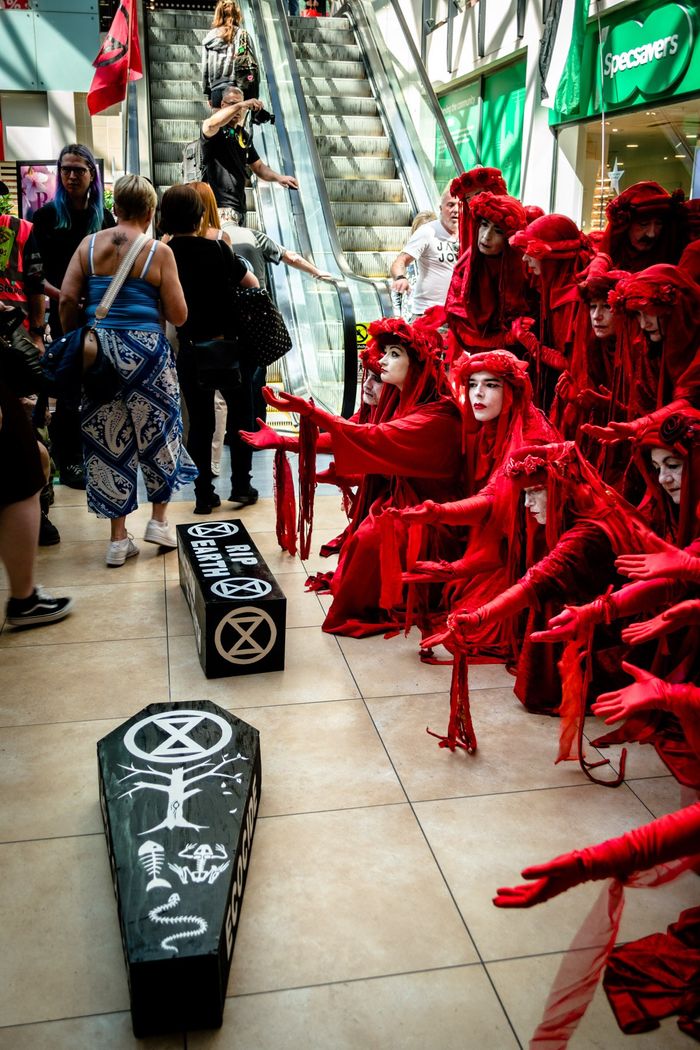
Extinction Rebellion and other climate groups held a funeral for the Paris agreement's 1.5°C temperature target in Cambridge, England on May 10, 2025. (Photo: Derek Langley)

Scientists from universities in the United Kingdom and Germany warned in a peer-reviewed paper published in the journal Earth System Dynamics last month that humankind is at risk of triggering various climate tipping points absent urgent action to dramatically reduce emissions from fossil fuels.

"There are levers policymakers can pull to rapidly phase out fossil fuels, but this requires standing up to powerful interests," Stott said Saturday. "Activists need to build power, resilience, and the world we want to see in our communities; but we also need to keep seeking the spark that will cause the worldwide transformation we need to see."

In addition to the Cambridge and U.K. arms of Extinction Rebellion, Saturday's action was organized by Cambridge Greenpeace, Cambridge Stop the War, and the Organization of Radical Cambridge Activists (ORCA).

Varsity, the independent student newspaper at the University of Cambridge, reported that the marchers "rallied at Christ's Pieces, where they heard from one of the organizers, who emphasised the harm caused by exceeding 1.5ºC of warming."

"The march then proceeded up Christ's Lane and down Sidney Street, led by a group of 'Red Rebels,' dressed in red robes with faces painted white, followed by 'pall bearers' carrying coffins painted black, with the words 'Inaction Is Death' in white," according to Varsity. "The procession was completed by a samba band who drummed as they walked, followed by protesters carrying a large sign reading 'Don't silence the science,' along with many other smaller placards."


Members of the "Red Rebel Brigade" led a procession around Cambridge, England as part of a funeral for the Paris agreement's 1.5°C temperature target on May 10, 2025. (Photo: Derek Langley)

Photos from organizers show participants displaying banners with messages such as "No Future on a Dead Planet," and additional messages painted on the black coffins: "1.5ºC Is Dead," "Act Now," "Ecocide," "RIP Earth," and "Web of Life."

"Politicians have broken their promises to keep global temperature rises to a livable 1.5ºC," declared Zoe Flint, a spokesperson for XR Cambridge. "For decades, people around the world have been resisting environmental devastation in their own communities and beyond—often facing state repression and violence as a result."

"With dozens of political protesters now in prison in this country, that repression has come to the U.K. too," Flint noted. "But when those least responsible for climate breakdown suffer the worst effects, we can't afford to give up the fight."

Parties to the Paris agreement are set to gather next in November at the United Nations climate summit, COP30, in Belém, Brazil.
Warning of Grave Threat to Free Speech, Judge Frees Rümeysa Öztürk

"There has been no evidence that has been introduced by the government other than the op-ed," U.S. District Judge William Sessions III said, referring to Öztürk's article urging divestment from Israel.


Rümeysa Öztürk (left) with her lawyer Mahsa Khanbabai (right) pose for a photo following the Fulbright scholar's release from Immigration and Customs Enforcement detention in Louisiana on May 9, 2025.
(Photo: Rümeysa Öztürk legal team)


Brett Wilkins
May 09, 2025
COMMON DREAMS

Rümeysa Öztürk, one of several pro-Palestine scholars kidnapped and imprisoned by the Trump administration under its dubious interpretation of an 18th-century law and a Cold War-era national security measure, was released from Immigration and Customs Enforcement custody Friday following a federal judge's order.


U.S. District Judge William Sessions III in Vermont ruled that Öztürk—a 30-year-old Turkish Ph.D. student at Tufts University in Massachusetts and Fulbright scholar—was illegally detained in March, when masked plainclothes federal agents snatched her off a suburban Boston street in broad daylight in what eyewitnesses and advocates likened to a kidnapping and flew her to a U.S. Immigration and Customs Enforcement (ICE) detention center in Louisiana.

"Thank you so much for all the support and love," Öztürk told supporters outside the facility following her release.


The government admits that Öztürk committed no crime. She was targeted because of an opinion piece published in Tufts Daily advocating divestment from Israel amid the U.S.-backed nation's genocidal assault on Gaza and its apartheid, occupation, ethnic cleansing, and colonization in the rest of Palestine. Öztürk was arrested despite a U.S. State Department determination that there were no grounds for revoking her visa.


"There has been no evidence that has been introduced by the government other than the op-ed," said Sessions, an appointee of former President Bill Clinton. "That literally is the case."


"There is no evidence here as to the motivation, absent consideration of the op-ed, so \that creates unto itself a very significant substantial claim that the op-ed—that is, the expression of one's opinion as ordinarily protected by the First Amendment—form the basis of this particular detention," the judge continued, adding that Öztürk's "continued detention potentially chills the speech of the millions and millions of people in this country who are not citizens."

"There is absolutely no evidence that she has engaged in violence, or advocated violence, she has no criminal record," Sessions noted. "She has done nothing other than, essentially, attend her university and expand her contacts in her community in such a supportive way."

"Her continued detention cannot stand," he added.

The Trump administration has openly flouted judge's rulings—including a U.S. Supreme Court order—that direct it to release detained immigrants. Sessions' Friday ruling follows his earlier order to send Öztürk to Vermont and Wednesday's 2nd U.S. Circuit Court of Appeals affirmation of the judge's directive, both of which have been ignored by the administration.

Seeing that Öztürk was still in ICE custody hours after his order, Sessions reiterated his directive Friday afternoon.

"In light of the court's finding of no flight risk and no danger to the community, petitioner is to be released from ICE custody immediately on her own recognizance, without any form of body-worn GPS or other ICE monitoring at this time," the judge wrote.

Mahsa Khanbabai, Öztürk's attorney, toldCourthouse News Service she's "relieved and ecstatic" that her client has been ordered released.

"Unfortunately, it is 45 days too late," Khanbabai lamented. "She has been imprisoned all these days for simply writing an op-ed that called for human rights and dignity for the people in Palestine. When did speaking up against oppression become a crime? When did speaking up against genocide become something to be imprisoned for?"

The Trump administration has dubiously invoked the Alien Enemies Act of 1798, which allows the president to detain dor deport citizens of countries with which the U.S. is at war, in a bid to justify Öztürk's persecution. The administration has also cited the Immigration and Nationality Act of 1952, which empowers the secretary of state to order the expulsion of noncitizens whose presence in the United States is deemed detrimental to U.S. foreign policy interests.

"When did speaking up against genocide become something to be imprisoned for?"

Secretary of State Marco Rubio—who lied about Öztürk supporting Hamas—has used such determinations to target people for engaging in constitutionally protected speech and protest.

"We do it every day," Rubio said in March in defense of the policy. "Every time I find one of these lunatics, I take away their visas."

Rubio has invoked the law to target numerous other students who the government admits committed no crimes. These include Mahmoud Khalil, Mohsen Mahdawi, and Yunseo Chung—all permanent U.S. residents—as well as Ranjani Srinivasan and others. Far-right, pro-Israel groups like Betar and Canary Mission have compiled lists containing the names of these and other pro-Palestine students that are shared with the Trump administration for possible deportation.

Foreign nationals—and some U.S. citizens wrongfully swept up in the Trump administration's mass deportation effort—are imprisoned in facilities including private, for-profit detention centers, where there are widespread reports of poor conditions and alleged abuses.

These include denial of medical care, insufficient access to feminine hygiene products, and rotten food at the South Louisiana ICE Processing Center, where Öztürk—who, according to Rep. Ayanna Pressley (D-Mass.), has received no religious or dietary accommodations and had her hijab forcibly removed—is being held.

Öztürk also suffers from asthma and told Sessions via Zoom Friday that her attacks have increased behind bars due to stress. Dr. Jessica McCannon, a pulmonologist, testified that Öztürk's asthma appears to be poorly controlled in ICE custody, according to courtroom coverage on the social media site Bluesky by freelance journalist Joshua J. Friedman.

U.S. Sen. Elizabeth Warren (D-Mass.) was among those who on Friday demanded Öztürk's immediate release, while other lawmakers and human rights and free speech defenders celebrated Sessions' decision.

"Rümeysa Öztürk has finally been ordered released," Sen. Ed Markey (D-Mass.) said on social media. "She has been unlawfully detained for more than six weeks in an ICE facility in Louisiana, more than 1,500 miles away from Somerville. This is a victory for Rümeysa, for justice, and for our democracy."


Seth Stern, director of advocacy at Freedom of the Press Foundation, said in a statement that "it is unfathomable that in the United States legal system, it takes 45 days for a judge to rule that people can't be put behind bars for writing op-eds the government doesn't like."

"Without a system committed to its principles, the Constitution is just words on paper, and they don't mean much if this can happen here," Stern continued. "Öztürk's abduction and imprisonment is one of the most shameful chapters in First Amendment history."

"We're thankful that Judge Sessions moved it one step closer to an end and we call on the Trump administration to release Öztürk immediately and not attempt to stall with any further authoritarian nonsense," he added.

Amid President Donald Trump's defunding threats and pressure from ICE officials, universities have told "many hundreds" of international students that they have lost their immigration status and must immediately self-deport. These notifications were based on the Department of Homeland Security's (DHS) termination of students' records on the Student Exchange and Visitor Information System (SEVIS), a database used by schools and authorities to access visa information.

Although DHS admitted in court that it had no authority to use SEVIS to revoke students' status, the Trump administration still canceled more than 1,800 visas before reversing course last month pending an ICE policy revamp.

In addition to moving to deport pro-Palestine students, the Trump administration is sending Latin American immigrants—including wrongfully expelled Maryland man Kilmar Abrego García—to a notorious prison in El Salvador, and the president has repeatedly threatened to send natural-born U.S. citizens there.

As with Öztürk and other detained students, the Trump administration has dubiously invoked the Alien Enemies Act in trying to deport García and others. However, federal judges—including multiple Trump appointees—have thwarted some of these efforts.

On Friday, White House Deputy Chief of Staff Stephen Miller said that Trump and his advisers are "actively looking at" suspending habeas corpus as a means of overcoming judicial pushback against the administration's deportation blitz.

"Well, the Constitution is clear—and that of course is the supreme law of the land—that the privilege of the writ of habeas corpus can be suspended in a time of invasion," Miller told reporters at the White House. No foreign entity has invaded the United States since Japanese forces landed in the Aleutian Islands in the then-territory of Alaska during World War II.

Critics pointed out that Miller's proposal is, in fact, blatantly unconstitutional.

"Since it appears needs to be said: The authority to suspend habeas corpus lies with Congress, not the president, and is only legal during extreme circumstances of rebellion or invasion," Democratic pollster and strategist Matt McDermott said on Bluesky. "Stephen Miller is full of shit."

It wasn't just Democrats and Palestine defenders who cheered Sessions' ruling Friday. Billy Binion, who covers "all things injustice" for the libertarian website Reason, said on social media that the government's "entire case against her is that... she wrote an op-ed."


"Hard to overstate how bleak—and frankly embarrassing—it is that the Trump administration wants to jail and deport someone for speech," he continued. "In America."

Trump Admin 'Reviewing' Visas After Arrest of Dozens of Pro-Palestinian Protesters at Columbia

"Repression breeds resistance—if Columbia escalates repression, the people will continue to escalate disruptions on this campus," wrote Columbia University Apartheid Divest.


New York City police arrested dozens of Pro-Palestinian protesters on Columbia University on Wednesday evening after they took over part of a central library in New York, U.S. on May 7, 2025.
(Photo: Lokman Vural Elibol/Anadolu via Getty Images)


Eloise Goldsmith
May 08, 2025
COMMON DREAMS


The New York Police Department arrested dozens of pro-Palestinian protestors on Columbia University's campus on Wednesday evening—prompting U.S. Secretary of State Marco Rubio to announce on X that the federal government is reviewing the visa status of those involved in the action.

On Wednesday afternoon, masked protestors, many wearing keffiyehs, gathered in Columbia's Butler Library. Video of the protest posted to social media shows demonstrators inside the library chanting "free Palestine."

Columbia has been under intense scrutiny from the Trump administration in recent months over the school's alleged failure to protect Jewish students. Critics say the administration is weaponizing antisemitism to attack Palestinian rights advocates. In March, the school faced backlash for making policy changes in line with demands from the Trump administration following the administration's decision to freeze $400 million in federal grants for the school.

Late Wednesday, U.S. Secretary of State Marco Rubio wrote on X: "We are reviewing the visa status of the trespassers and vandals who took over Columbia University's library. Pro-Hamas thugs are no longer welcome in our great nation."

In January, U.S. President Donald Trump signed an executive order with the professed aim of rooting out antisemitism at higher education institutions, and vowed to target foreign-born students who have engaged in "pro-jihadist" protests.

Acting university president Claire Shipman authorized the NYPD to enter campus around 7 pm on Wednesday in response to the rally in the library, according to the Columbia Daily Spectator. The student paper reported that the NYPD arrested roughly 75 protesters and began leading them out of the library shortly thereafter.

The Daily Spectator also reported that there were altercations between the police and protestors after the arrests made in connection to the library protest.

Eighty people "who did not comply with verbal warnings by the NYPD to disperse" were taken into custody, according to the NYPD, per reporting from CNN. Seventy-eight of those taken into custody were arrested and two others were issued summonses, the NYPD told the outlet. CNN noted that it's not clear how many of those arrested came from the protest inside the building.

The group Columbia University Apartheid Divest wrote on Substack on Wednesday that the protestors renamed the library in honor of Palestinian activist Basil al-Araj.

The organizers said that the action at the library "shows that as long as Columbia funds and profits from imperialist violence, the people will continue to disrupt Columbia's profits and legitimacy. Repression breeds resistance—if Columbia escalates repression, the people will continue to escalate disruptions on this campus."

In May of last year, the NYPD swept an occupation of Hamilton Hall and arrested dozens of student protestors.

Wednesday's events come not long after arrests by federal immigration agents of multiple noncitizens who had been active in pro-Palestine actions on Columbia's campus.

In March, federal immigration agents arrested pro-Palestinian activist and former Columbia student Mahmoud Khalil, who is currently languishing in an U.S. Immigration and Customs Enforcement facility in Jena, Louisiana. Another Palestinian green-card holder active in Columbia's student protest movement, Mohsen Mahdawi, was also arrested by federal immigration agents, but last month was released on bail.

Both of those cases have generated significant national attention.


Federal Judge Halts Trump and Musk's Illegal Overhaul of US Government

The second Trump administration "has thrown agencies into chaos, disrupting critical services provided across our nation," the coalition behind the lawsuit said, welcoming the temporary restraining order.


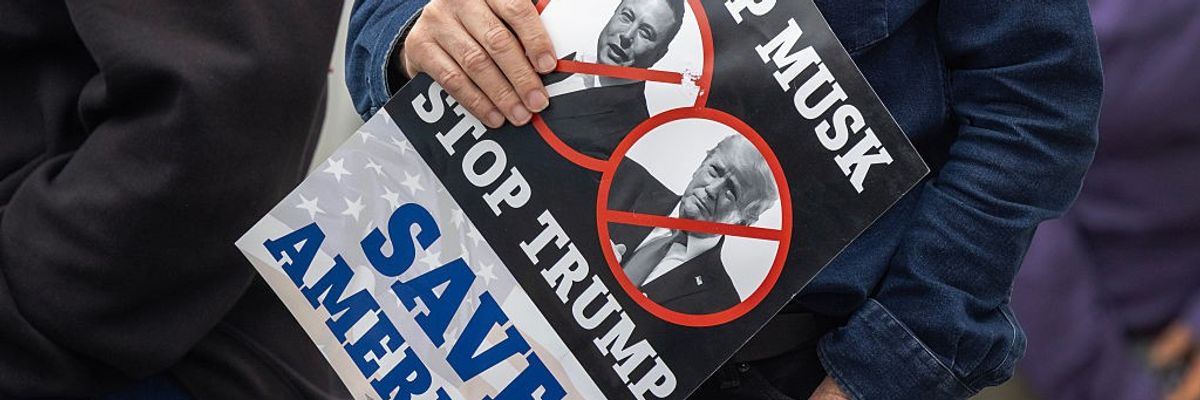
Demonstrators continue weekly protest rallies against U.S. President Donald Trump and his adviser, Tesla CEO Elon Musk, outside of a Tesla dealership on May 3, 2025 in Pasadena, California.
(Photo: David McNew/Getty Images)

Jessica Corbett
May 10, 2025
COMMON DREAMS

A federal judge in California on Friday temporarily blocked what at coalition of labor unions, local governments, and nonprofits argued was "the unconstitutional dismantling of the federal government by the president of the United States on a scale unprecedented in this country’s history and in clear excess of his authority."

Since returning to office in January, U.S. President Donald Trump—aided by his so-callled Department of Government Efficiency and its de facto leader, billionaire Elon Musk—has worked to quickly overhaul the bureaucracy, even though "the president does not possess authority to reorganize, downsize, or otherwise transform the agencies of the federal government, unless and until Congress authorizes such action," as the coalition's complaint notes.

District Judge Susan Illston agreed with the groups and governments, which include the American Federation of Government Employees (AFGE), American Federation of State County and Municipal Employees (AFSCME), Service Employees International Union (SEIU), Alliance for Retired Americans, Main Street Alliance, Natural Resources Defense Council, the city and county of San Francisco, Chicago, Baltimore, and more.

"The president has the authority to seek changes to executive branch agencies, but he must do so in lawful ways and, in the case of large-scale reorganizations, with the cooperation of the legislative branch," wrote Illston in a 42-page decision. "Many presidents have sought this cooperation before; many iterations of Congress have provided it. Nothing prevents the president from requesting this cooperation—as he did in his prior term of office."

"Indeed, the court holds the president likely must request congressional cooperation to order the changes he seeks, and thus issues a temporary restraining order to pause large-scale reductions in force in the meantime," said the judge, appointed to the U.S. District Court for the Northern District of California by former President Bill Clinton.

Illston added that "a temporary restraining order is, by definition, temporary. The court will not consider defendants' request for a stay of execution of the temporary restraining order, as doing so would render the exercise pointless. The court must promptly proceed to consideration of a preliminary injunction."

Welcoming the development in a late Friday statement, the plaintiff coalition said that "the Trump administration's unlawful attempt to reorganize the federal government has thrown agencies into chaos, disrupting critical services provided across our nation."

"Each of us represents communities deeply invested in the efficiency of the federal government—laying off federal employees and reorganizing government functions haphazardly does not achieve that," the coalition added. "We are gratified by the court's decision today to pause these harmful actions while our case proceeds."

The "largest and most significant challenge to Trump's authority to remake the government without congressional approval," as the coalition called it, was filed April 28 by the organizations' legal team: Democracy Forward, Altshuler Berzon LLP, Protect Democracy, Public Rights Project, and State Democracy Defenders Fund.

Illston's decision came just hours after an emergency hearing, during which coalition attorney Danielle Leonard "said the Trump administration's vision was to fundamentally degrade the services that Congress funds agencies to carry out, raising a profound separation of powers conflict," according toThe New York Times.

As the newspaper detailed:
"There's a presumption of regularity that used to exist with respect to the government's actions that I think they need to re-earn," she said.

Ms. Leonard said the Trump administration has never been able to point to any specific authority through which the president could seize that power from Congress. And she said that the government has consistently offered competing and contradictory explanations of why Mr. Trump can authorize the massive restructuring without Congress.


"It's an ouroboros: the snake eating its tail," she said.

Signaling a desire to keep moving through the process swiftly, Illston gave the plaintiff coalition until next Wednesday to file a motion for a preliminary injunction, and the federal defendants—Trump along with various federal agencies and their leaders—until the following Monday to respond, with a limit of 25 pages for both.

Even if the coalition's lawsuit ultimately succeeds, Republicans have a narrow majority in both chambers of Congress, meaning Trump could potentially work with lawmakers to pursue a similar gutting of the federal government before the midterm elections.


Elon Musk holds a personalized chainsaw gifted by Argentine President Javier Milei and a painting given by an attendee at the Conservative Political Action Conference (CPAC) at the National Harbor in Oxon Hill, Maryland on February 20, 2025.
(Photo: Valerie Plesch for The Washington Post via Getty Images)

Scale of Musk's DOGE Conflicts of Interest 'Should Alarm Every American'


"The wealthiest man in the world is working to dismantle the very same federal departments and agencies tasked with overseeing and placing checks on his businesses," says Public Citizen in a new analysis.


Brett Wilkins
May 08, 2025
COMMON DREAMS


Elon Musk, the world's richest person and de facto head of the Trump administration's so-called Department of Government Efficiency, "has had a direct business interest in over 70% of the agencies and departments targeted by DOGE since its inception," according to an analysis published Thursday by a leading U.S. consumer advocacy group.

The Public Citizen report, titled Duplicitous Oligarchy Grifting Endlessly, "maps out the entities DOGE has targeted and identifies which ones carry a known conflict of interest for Elon Musk's business entanglements" as the executive office leads the Trump administration's purge of federal agencies.

"The wealthiest man in the world is working to dismantle the very same federal departments and agencies tasked with overseeing and placing checks on his businesses," the report states. "He also now is adjacent to and could potentially access sensitive and potentially proprietary information from his biggest competitors in the various industries that have made him wealthy. He also has personal business interests that could shape what his DOGE project considers ripe for cuts."


Elizabeth Beavers, director of Public Citizen's Congress Watch, said in a statement that "it should alarm every American that the wealthiest man in the world has spent the last several months dismantling the same departments and agencies tasked with regulating his businesses."

"Musk's role as the most powerful person in government makes it highly unlikely that any regulator will crack down on his corporations and surely will make agency leaders look more favorably at Musk companies as potential government contractors," Beavers added.

The report considers Musk—who has signaled he will leave DOGE—to have a conflict of interest with a federal agency when one of his companies has received contracts or grants from the department, has an interest in its proprietary data, and is subject to its regulation or enforcement regime.

Public Citizen's analysis highlights interests with federal agencies including:Consumer Financial Protection Bureau, which Musk wants to abolish, would be in charge of regulating a proposed payments processing partnership between Visa and Musk's social media platform X;
Department of Justice, which is investigating electric automaker Tesla and possibly Musk as its CEO;
Federal Aviation Administration, which regulates Musk's SpaceX;
Food and Drug Administration, where some of the more than 1,000 fired staffers were reviewing Musk's Nueralink brain implants;
National Aeronautics and Space Administration, which has awarded SpaceX approximately $15 billion in contracts;
National Highway Traffic Safety Administration, which regulates Teslas, was hit with a 10% workforce reduction since President Donald Trump took office;
Securities and Exchange Commission, which has ongoing enforcement actions against Musk, including fines as high as $150 million for failing to file disclosure forms regarding shares of Twitter, which he bought in 2022; and
United States Agency for International Development, which was investigating whether Russia had improperly gained access to Musk's Starlink satellite internet system.

Musk—whose companies have tens of billions of dollars worth of government contracts—also has conflicts of interest with the departments of Defense, Agriculture, and Energy. SpaceX, for example, holds Pentagon contracts worth around $8 billion, including nearly $6 billion for the National Security Space Launch Phase 3 Lane 2 program.

Critics have laughed off the White House's assertion that Muskld self-police his conflicts of interest by recusing himself when DOGE and his business interests overlap.

"The report's findings make clear that this approach is deeply and incurably flawed—and that urgent action by Congress is required to safeguard the government from Musk's self-dealing and grift," Public Citizen said.


'The Corruption Is Staggering': Trump Officials Push Tariffed Nations to Approve Musk's Starlink

"The glaring conflict of interest inherent in this pressure to preference a Musk-owned company is disgusting," said Public Citizen co-president Lisa Gilbert.


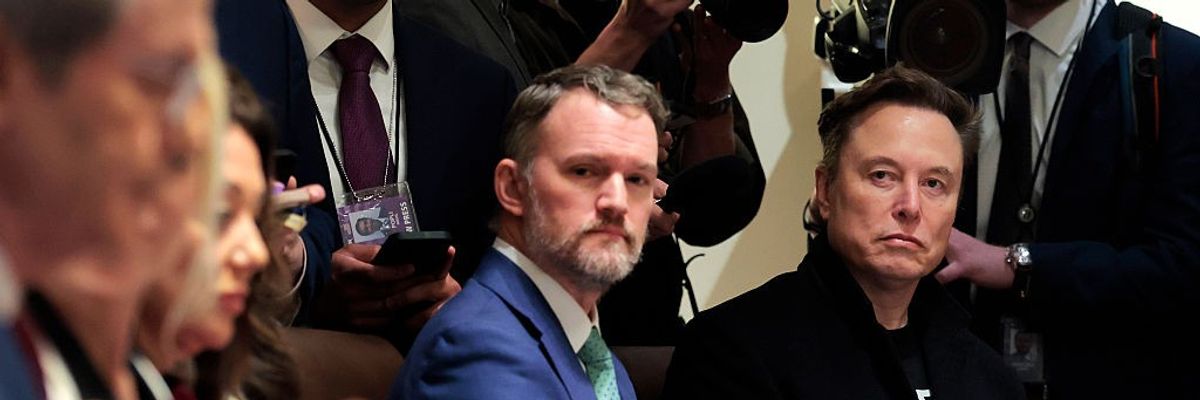
Elon Musk sits next to U.S. Trade Representative Jamieson Greer during a Cabinet meeting at the White House on April 10, 2025.
(Photo: Anna Moneymaker/Getty Images)

Jake Johnson
May 08, 2025
COMMON DREAMS


Trump administration officials have reportedly been pressuring countries facing U.S. tariffs to approve satellite internet services offered by Elon Musk's Starlink to help grease trade negotiations, further underscoring the conflicts of interest stemming from the mega-billionaire's proximity to the White House.

The Washington Postreported Wednesday that it obtained "a series of internal government messages" that "reveal how U.S. embassies and the State Department have pushed nations to clear hurdles for U.S. satellite companies, often mentioning Starlink by name."

"The documents do not show that the Trump team has explicitly demanded favors for Starlink in exchange for lower tariffs," the newspaper added. "But they do indicate that Secretary of State Marco Rubio has increasingly instructed officials to push for regulatory approvals for Musk's satellite firm at a moment when the White House is calling for wide-ranging talks on trade."

The Post points specifically to ongoing bilateral trade negotiations between the U.S. and India, where "government officials have sped through approvals of Starlink with the understanding that doing so could help them cement trade deals with the administration."

The Times of Indiareported Wednesday that Starlink, a subsidiary of Musk's SpaceX, "has been issued a Letter of Intent by the Indian government for satcom services."


Lisa Gilbert, co-president of the U.S.-based consumer advocacy group Public Citizensaid in response to the Post's reporting that "the glaring conflict of interest inherent in this pressure to preference a Musk-owned company is disgusting."

"The bottom line here is that tools of trade and government should be utilized for the benefit of the American public, not abused for personal tech bro profiteering," Gilbert added.

Rep. Greg Casar (D-Texas.), chair of the Congressional Progressive Caucus, called the revelations "a huge new scandal."

"Trump and Musk are using tariffs as leverage to get other countries to buy from Musk's companies. Working families pay $4,000+ more a year so Musk gets new deals," Casar wrote on social media. "They get richer. Everyone else gets screwed."


Last month, U.S. President Donald Trumppartially paused the more aggressive tariffs he sought to impose on countries around the world while leaving in place 10% across-the-board import duties, which are already raising costs for American families.

The Post reported Wednesday that "at least two countries have explicitly discussed or moved toward adopting Musk's Starlink as a means of avoiding Trump’s tariffs and negotiating a better trade deal with the United States."

Cambodia, which is facing a potential 49% tariff rate, appears to be one of those countries. The Post obtained a U.S. embassy cable indicating that Cambodian officials have signaled a "desire to help balance our trade relationship by promoting the market entry of leading U.S. companies such as Boeing and Starlink."

"Another cable from April 17 reported that Starlink was pushing for a license to operate in Djibouti," the newspaper reported. "Embassy staffers wrote they would help Starlink as much as they could: 'Post will continue to follow up with Starlink in identifying government officials and facilitating discussions.'"

U.S. Sen. Chris Van Hollen (D-Md.) said the internal cables show "gross corruption." Congressional Democrats are already probing the White House's use of Starlink services.

"Surprise, surprise: another Trump move that directly benefits Elon Musk—the guy who spent $260 million to elect Donald Trump and has been given the keys to the federal government," said Van Hollen. "They are rigging the government for themselves."

Trump's Tax Rate for Richest Would Affect Very Little of Their Income


Nobody should be deceived: The wealthiest taxpayers got enormous tax breaks from Trump’s 2017 law and are getting additional large tax breaks in what Trump and Republicans are proposing now.


People rally in support of fair taxation near the U.S. Capitol in Washington, D.C. 
on April 10, 2025.
(Photo: Bryan Dozier/Middle East Images/AFP via Getty Images)


Steve WamhoffCarl Davis
May 10, 2025
Institute on Taxation and Economic Policy

President Donald Trump has proposed extending all the temporary tax cuts he signed into law in 2017 with one (newly announced) exception—allowing the top rate to revert from 37% to 39.6% for taxable income greater than $5 million for married couples and $2.5 million for unmarried taxpayers. But many other special breaks in the tax code—some introduced by Trump’s 2017 tax law and many others that existed prior to it—would ensure that most income of very well-off people would never be subject to Trump’s 39.6% tax rate.

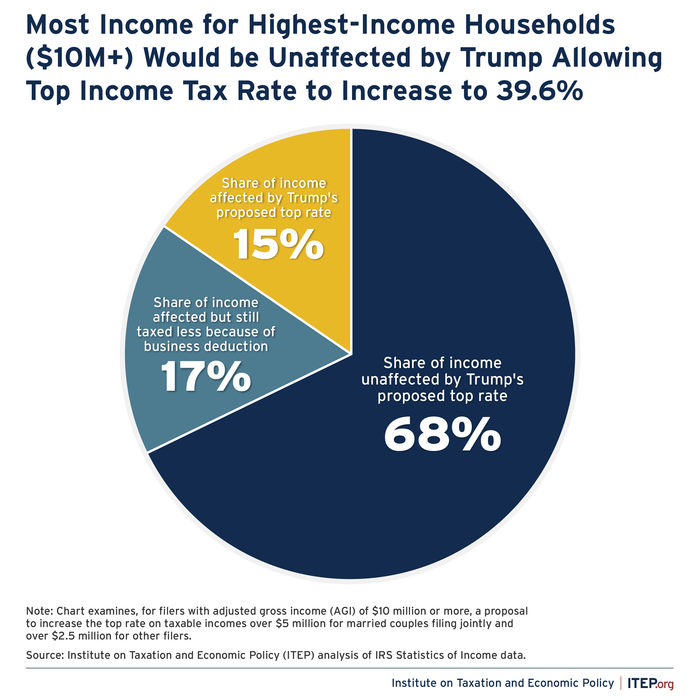
The very richest taxpayers broken out in IRS data are those with adjusted gross income (AGI) exceeding $10 million. Calculations using the most recent IRS data, which is for 2022, show that 85% of income from these extremely well-off taxpayers would not have been taxed at this higher rate, had it been in effect that year.

Of the $1.05 trillion in income reported by these taxpayers (who all reported at least $10 million), only $162 billion (15% of their total income) would have been subject to the 39.6% rate.


Another $176 billion (17% of their total income) would be taxed at a lower effective rate due to the 20% deduction for business income enacted as part of the 2017 tax law.

The vast majority of the income flowing to this group, $713 billion (68% of their total income) would not have been affected at all by Trump’s 39.6% rate. Most of this income is long-term capital gains and qualified dividends that have long been taxed at special, lower rates enacted under former President George W. Bush. It would be difficult for Congress to ever adequately tax extremely well-off people without reforming these and other special tax breaks for capital gains and dividends.

The 68% of income for these taxpayers that would not be subject to the 39.6% rate also includes income taxed at ordinary rates in brackets below the proposed 39.6% bracket. In addition, it includes income that is not taxable because of various deductions, like the deduction for charitable giving.

Had this proposal been in effect in 2022, the total additional tax paid by people with AGI exceeding $10 million would have been less than $8 billion.* The overall cost of extending the 2017 tax cuts, plus many new cuts that Trump and his supporters in Congress are considering, would cost orders of magnitude more than that.

In some ways, very well-off people are even more shielded from Trump’s proposed top rate than is illustrated in these figures. They have vast amounts of income that they are not required to report to the IRS, which are not included in this data and which are exempt from taxes under federal law. Most importantly, a wealthy person’s increase in net worth due to appreciation of assets is capital gain income that is not taxed until the assets are sold and the capital gains are “realized” as profits.


The corporate tax cuts enacted as part of the 2017 law mainly helped these taxpayers by increasing the value of their stocks, meaning they likely benefited from increased unrealized capital gains not reported in this data. The drafters of the 2017 law made those corporate income tax cuts permanent, unlike the personal income tax cuts and estate tax cuts that are temporary and being debated now as they near expiration. It will be difficult to adequately tax extremely well-off taxpayers without revisiting and reversing some of these corporate income tax cuts.

All else equal, it would be slightly better to let the top tax rate revert to 2017 levels as Trump suggests. But nobody should be deceived: The wealthiest taxpayers got enormous tax breaks from Trump’s 2017 law and are getting additional large tax breaks in what Trump and Republicans are proposing now. We need legislation that requires rich people to pay more taxes, not less. The Republican legislation will do the opposite, regardless of whether or not Congress includes this latest suggestion from Donald Trump.

*The revenue generated by a 39.6% rate compared to a 37% rate would be 2.6% of whatever taxable income is affected. As explained, only $162 billion of income for these taxpayers would have been entirely subject to the 39.6% rate, and 2.6% of $162 billion yields $4.2 billion. As explained, another $176 billion would have been subject to the 39.6% rate but because of the 20% deduction for pass-through business income, the revenue saved would be 20% less, yielding $3.6 billion. The sum of the two amounts is $7.9 billion. A small but indeterminate amount of additional revenue would also be raised from taxpayers with AGI below $10 million.