It’s possible that I shall make an ass of myself. But in that case one can always get out of it with a little dialectic. I have, of course, so worded my proposition as to be right either way (K.Marx, Letter to F.Engels on the Indian Mutiny)
Saturday, May 31, 2025
9th Circuit Rules Trump Order for Mass Firings 'Far Exceeds' Constitutional Authority The coalition behind the legal challenge the Court's decision "rightfully maintains the block on the Trump-Vance administration's unlawful, disruptive, and destructive reorganization of the federal government."
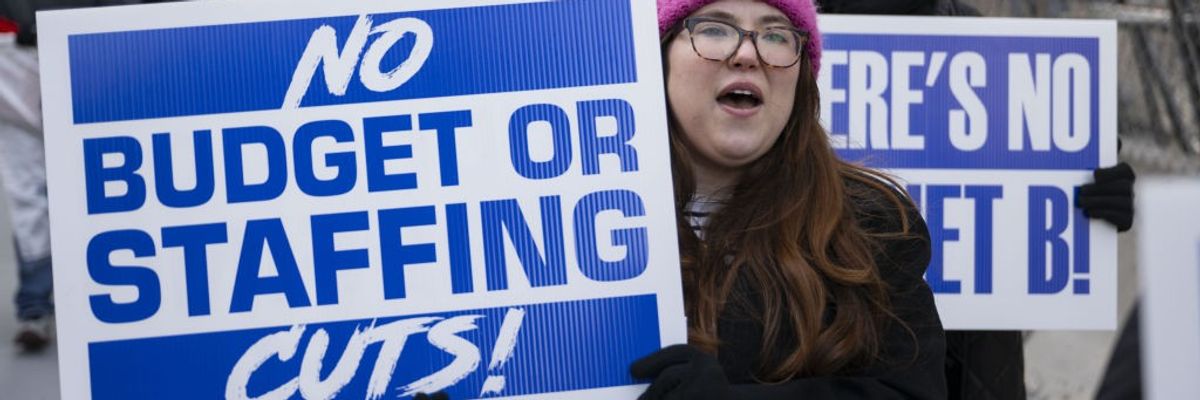
People holding banners chant during a rally outside Jacob K. Javits Federal Building against the firings of thousands of federal workers by U.S. President Donald Trump and Elon Musk's Department of Government Efficiency (DOGE). New York City, U.S., February 19, 2025. (Photo by Mostafa Bassim/Anadolu via Getty Images)
The 9th Circuit Court of Appeals on Friday night kept in place a block on President Donald Trump's efforts for massive firings and agency restructuring across the federal government, saying a far-reaching executive order signed in February went way beyond his constitutional authority and that the potential harm caused by the terminations warrants the hold while legal challenges continue to play out in the courts.
"The Executive Order at issue here far exceeds the President's supervisory powers under the Constitution," the appeals court wrote in its 2-1 decision.
The majority decision, written by Senior Circuit Judge William Fletcher, noted that while "the President enjoys significant removal power with respect to the appointed officers of federal agencies," the kind of far-reaching approach represented by Trump's executive order "has long been subject to Congressional approval."
According to the Associated Press: The Republican administration had sought an emergency stay of an injunction issued by U.S. Judge Susan Illston of San Francisco in a lawsuit brought by labor unions and cities, including San Francisco and Chicago, and the group Democracy Forward.
The Justice Department has also previously appealed her ruling to the Supreme Court, one of a string of emergency appeals arguing federal judges had overstepped their authority.
In a statement late Friday, the coalition behind the lawsuit that challenge Trump's order—which includes nationwide labor unions and non-profit groups as well as cities and counties in California, Illinois, Maryland, Texas, and Washington—welcomed the ruling as it once again slammed Trump's assault on the nation's federal workforce and the rule of law.
The 9th Circuit's decision, the coalition said, "rightfully maintains the block on the Trump-Vance administration's unlawful, disruptive, and destructive reorganization of the federal government."
Trump's actions, the statement continued, "have already thrown agencies into chaos, disrupting critical services to people and communities across our nation. Each of us represents communities deeply invested in the efficiency of the federal government – laying off federal employees en masse and reorganizing government functions haphazardly does not achieve that. We are gratified by the court's decision today to allow the pause of these harmful actions to endure while our case proceeds."
"The Trump administration's reckless attempt to dismantle our government without congressional approval threatens vital services Americans depend on every day—from caring for veterans and safeguarding public health, to protecting our environment and maintaining national security," said Everett Kelley, president of the American Federation of Government Employees (AFGE) union, the nation's largest federal worker union and a party to the suit, in response to the ruling. “This illegal power grab would gut federal agencies, disrupt communities nationwide, and put critical public services at risk. AFGE is proud to stand shoulder-to-shoulder with this coalition to protect not just the patriotic public servants we represent, but the integrity of American government and the essential services that our nation deserves."
The Nuclear Trump Factor
The threat of nuclear war has never been greater than today. The self-proclaimed peacemaker in Washington is to blame. An activist with a mask of U.S. President Donald Trump marches with a model of a nuclear rocket during a demonstration against nuclear weapons on November 18, 2017 in Berlin, Germany. (Photo: Adam Berry/Getty Images)
Hardly a day goes by without the phrase "Donald Trump is a danger to the world" being given new life. The threat posed by the U.S. president applies of course to the U.S. itself, which is in danger of sliding into fascist authoritarianism, and to the planetary boundaries that the billionaire cabinet is enthusiastically trampling all over with its "drill, baby, drill" policy.
What is less noticed is another global threat being driven by the MAGA insurrection movement in the White House, which has declared war on democracy, the state, and the planet. It is the risk of nuclear war. Although Trump is calling for an end to the fighting in Ukraine, which would reduce the threat of nuclear weapons being used in this crisis hotspot, the overall dangers have increased with the new administration.
First of all, it should be kept in mind that in the U.S., the president has sole authority, without restrictions or consultation, to ordera nuclear attack against any target at any time, for any reason. He does not have to consult with anyone, and the decision is beyond any control. This is made possible by the so-called "nuclear football" (officially called the "presidential emergency satchel"). Military personnel who carry it accompany the president wherever he goes.
Trump's hara-kiri and doomsday politics, which destroy trust and rely on macho gestures instead of nuclear restraint and international cooperation, are a permanent source of instability and escalation.
The U.S. president can therefore carry out nuclear strikes at any time, which would mean hundreds of millions of deaths and probably the end of humanity. Experts and some politicians in Congress warn that this is a risky, vulnerable, and undemocratic procedure, established by the Eisenhower administration in the late 1950s, which places the decision about the possible end of the world in the hands of a single person. On the other hand, this arrangement is a central element of the U.S. nuclear deterrence strategy, which is intended to send a frightening message to the world.
The mere fact that Donald Trump has once again concentrated this power in his own hands is a danger in terms of the possible use of nuclear weapons. The reasons for this are obvious. Trump has shown himself to be unpredictable, erratic, and emotionally unstable as a person and political leader. His endless lies, provocations, humiliations, and calls for violence are widely known. When he lost the 2020 election to Joe Biden, he initiated and supported an attempted coup on January 6, 2021. As the new president, he ultimately pardoned 1,500 convicted violent criminals, including neo-Nazi leaders who participated in the storming of the Capitol. He also faces multiple charges, including for his efforts to overturn the 2020 election results in his favor, and was convicted of rape by a New York court last year.
In October 2024, over 200 mental health experts warned before the election that Donald Trump was dangerous due to his symptoms of severe, untreatable personality disorder, which they diagnosed as "malignant narcissism." This makes him completely unfit for leadership, according to the health experts. Mary Trump, Donald Trump's niece and a clinical psychologist, also warned against his reelection. In her book Too Much and Never Enough: How My Family Created the World's Most Dangerous Man, she calls her uncle a sociopath. In it, she describes his upbringing in a dysfunctional family that promoted greed, cruelty, and racist and sexist behavior.
At first glance, it may seem reassuring that Trump declared during his first term that nukes were "the biggest problem in the world" and that his goal was to get rid of them. In February 2025, after taking office again, he said, "There's no reason for us to be building brand new nuclear weapons. We already have so many." Unfortunately, this is just rhetoric. Trump has done nothing in this direction so far and has actually increased the nuclear risks through his actions.
In 2018, during his first term as president, Trump announced his withdrawal from the nuclear agreement with Iran, which had successfully limited the uranium enrichment of nuclear fuel in exchange for sanctions relief. Since then, Iran has accelerated its nuclear weapons program. Estimates suggest that Iran could produce several bombs in a matter of months or even weeks. Shortly thereafter, following a series of escalating threats, Trump suggested that North Korea had agreed to denuclearization. Talks followed, but an agreement never materialized.
Furthermore, the first Trump administration indicated to the U.S. Congress that if deterrence against China failed, the U.S. would have to "win" militarily. Peter Kuznick, professor of history and director of the Nuclear Studies Institute at American University, toldTruthout: "U.S. politicians seem so panicked about China's enormous growth and the way it is challenging U.S. hegemony in the Pacific that they are willing to risk nuclear annihilation to prevent it."
Researchers at the Bulletin of Atomic Scientistswarned earlier this year, as they moved the Doomsday Clock to 89 seconds before midnight—midnight means "game over" for humanity—that the United States has "embarked on the world's most expensive nuclear modernization" and that "the 2024 election results suggest the United States will pursue a faster, more expansive nuclear investment program. It is possible that the United States will expand its nuclear efforts to include more nuclear options, rely more on nuclear brinkmanship to advance its security and deterrence goals, and shun proven efforts to reduce nuclear dangers. The United States is now a full partner in a worldwide nuclear arms race."
This is taking place amid chaotic DOGE (Department of Government Efficiency) attacks led by Elon Musk against the National Nuclear Security Administration (NNSA), in which hundreds of scientists and experts responsible for the country's nuclear security were fired. It is unclear whether all of them have returned to the agency after the layoffs were reversed and whether security gaps are to be feared.
The Trump administration is meanwhile pursuing a "peace through strength" strategy in its foreign policy. This is the motto of former U.S. President Ronald Reagan, under which the U.S. launched a historic wave of rearmament. Republicans in the U.S. Congress also support this concept. They want to fuel the arms race by increasing the already historically high U.S. defense budget. There are calls on Trump to demonstrate to Russia that the U.S. holds global supremacy. And there is pressure to resume nuclear testing in order to win the arms race, which observers view as very worrying. The military establishment is even calling for the reintroduction of tactical nuclear weapons into the U.S. arsenal, which can be used in regional wars, which would mean further dramatic destabilization.
But what increases the nuclear risks above all is that, just months after taking office, the Trump administration has triggered "potentially the fastest and most dangerous acceleration of nuclear arms proliferation around the world since the early Cold War." His repeated "America First" statements, saying that the U.S. no longer feels bound by partnerships and would not come to the rescue of allies in an emergency, have left them feeling abandoned by the United States.
This has sparked a debate in European capitals about whether the U.S. nuclear umbrella can still be relied upon. France and the U.K. have offered to fill the gap. In an interview in March before his election as Germany's new chancellor, Friedrich Merz did not even rule out the idea of developing his own nuclear bomb. And in Poland, Prime Minister Donald Tusk is now talking about his country "must reach for the most modern capabilities also related to nuclear weapons." In Ukraine, President Volodymyr Zelenskyy is openly considering reintroducing a nuclear deterrent.
The risk of nuclear weapons spreading further across the globe is greatest in East Asia. During his 2016 election campaign, Trump said that Japan and South Korea might have to develop nuclear weapons. "It's only a matter of time," he said. Former South Korea's right-wing president, Yoon Suk Yeol, finally welcomed the deployment of U.S. tactical weapons in South Korea and intended to arm his country with nuclear weapons. Even though Democratic Party candidate Lee Jae-myung, who is leading in the presidential election polls (official vote is on Tuesday, June 3), is skeptical about South Korea going nuclear, the debate continues in the country. Political scientists Jami Levin and Youngwon Cho see this as a fatal development: While Trump has been busy burning bridges in Europe and North America, his allies in East Asia—South Korea and Japan—have been watching the implosion of the U.S.-led international order in dismay. They have no alternative to the American nuclear umbrella but to build their own deterrent capabilities.
Above all, the increasing confrontation with China is viewed with concern. The tariff war that Trump started against Beijing could exacerbate the security crisis in the Pacific and end in a military conflict, according to fears. Trump's trade attacks are reinforcing the trend toward "decoupling," i.e., the economic disentanglement of the two economies from one another. This, in turn, could lead to a rivalry in which both sides are tempted to harm each other through proxy conflicts and attacks on national security. At the same time, strategy papers from the Pentagon show how easily an economic war can escalate into a military conflict (which would put the nuclear option on the table between the two nuclear powers), according to Jack Werner of the Quincy Institute for Responsible Statecraft in the U.S.: In a context of mounting economic pain on both sides, with surging nationalism in both countries becoming a binding force on leaders, both governments are likely to choose more destructive responses to what they regard as provocations from the other side. A single misstep around Taiwan or in the South China Sea could end in catastrophe.
Trump's economic and military advisers in the White House are geared toward confrontation with China. That is also the purpose of the presidential order to build a new space-based missile defense system, known as the "Golden Dome." Since Reagan, there have been repeated attempts to initiate such programs. U.S. President Barack Obama wanted to build ABMs (anti-ballistic missiles) in Eastern Europe, but it was only in the wake of the Ukraine war that the Czech Republic gave the green light.
However, all these missile defense systems are not about the possible interception of nuclear intercontinental ballistic missiles, i.e., self-defense, which cannot work technically, as military analysts have determined. ABM is, as the Rand Corporation, among others, explains, "not just a protective shield, but an enabler of U.S. actions." Lawrence Kaplan, professor at the U.S. Army War College and former senior editor of The New Republic, sums it up as follows: "In other words, missile defense is about preserving America's ability to exercise power abroad. It's not about defense. It's about offense. And that's exactly why we need it."
Even if such defense systems are incapable of preventing nuclear first strikes, they have the advantage of theoretically intercepting retaliatory strikes by enemies in response to a first strike. This means that there would be no threat of self-destruction, which could encourage military planners in the U.S. to launch first strikes while other nuclear powers lose their deterrent capability. And the message of Trump's "Golden Dome" has been received by those who were targeted. China, like Russia, has described the announcement from Washington as a "destabilizing" initiative.
While Trump has initiated negotiations in the Ukraine war that could reduce the nuclear dangers between NATO and Russia, he is simultaneously increasing them in the Pacific in an economic and military confrontation now focused on his main adversary, China, which increases the likelihood of a nuclear conflict.
The same applies to the Middle East. The Gaza war waged by Israel's Netanyahu government, a nuclear power, continues to be enabled by the U.S. with weapons and diplomatic blockade, while Trump has promoted the ethnic cleansing of the completely sealed-off enclave with his "Riviera Plan" remarks. The massacre of Palestinians, which has been going on for over a year and a half, has the potential to set the entire region ablaze. This is evident from the military exchanges with the Houthis in Yemen, Hezbollah in Lebanon, and Iran. Israeli Minister of Heritage Amichai Eliyahu even suggested in an interview that dropping a "nuclear bomb" on the Gaza Strip was "an option."
Israel is also regularly indicating that one prepares for an attack on Iranian nuclear facilities. Tehran has declared that it will hold Washington responsible if this happens. This could spark a full-scale war in the region that would draw the U.S. into the conflict, with all the dangers that this entails. At the same time, Trump is exacerbating the conflict himself. Although he wants to negotiate with Iran, he has announced military action if Tehran does not agree to his deal and end all uranium enrichment—which experts consider a dangerous hardline demand that will ultimately lead to war. They argue that it is unnecessary and unacceptable for the country because it would also rule out the civilian use of nuclear power for Iran. Trump threatened that if Tehran did not completely shut down its nuclear program, there would be "all hell to pay," while "all options are on the table"—which is an implicit threat of a nuclear strike.
A similar threat was directed at Russia. On social media, Trump stated on May 28: "What Vladimir Putin doesn't realise is that if it weren't for me, lots of really bad things would have already happened in Russia, and I mean REALLY BAD. He's playing with fire." Putin's confidant and Deputy Chairman of the Security Council of the Russian Federation, Dmitry Medvedev, replied: "Regarding Trump's words about Putin 'playing with fire' and 'really bad things' happening to Russia. I only know of one REALLY BAD thing—WWIII."
It is at this point a war of words between two nuclear powers. But Trump's hara-kiri and doomsday politics, which destroy trust and rely on macho gestures instead of nuclear restraint and international cooperation, are a permanent source of instability and escalation. It is therefore important to raise public awareness of the existential threat once again as civil society pressure on governments especially in countries that possess nuclear arms has to increase by seeking ways to revive the policy of détente—i.e. negotiations on disarmament and arms control, as took place in the 1970s under U.S. President Richard Nixon and in Germany with Chancellor Willy Brandt's Ostpolitik. Even under President Bush senior, there were initiatives launched that reduced the risks. These deescalation efforts are the results of organized peace movements that made a difference. Even in the dark times today there are still possibilities for addressing the dangers of atomic annihilation.
Our work is licensed under Creative Commons (CC BY-NC-ND 3.0). Feel free to republish and share widely.
David Goessmann David Goeßmann is a journalist and author based in Berlin, Germany. He has worked for several media outlets including Spiegel Online, ARD, and ZDF. His articles appeared on Truthout, Common Dreams, The Progressive or Progressive International. In his books he analyzes climate policies, global justice, and media bias. Full Bio >
After US Abortion Provider’s Murder, Clinics Became Safer; Let’s Not Undo That Progress Rolling back protections in the name of political ideology puts lives at risk and undermines decades of work to keep patients and staff safe.
Sandra Peters of Wichita makes her feelings known about slain Dr. George Tiller during a candlelight vi
In the wake of Dr. Tiller’s assassination, health centers across the country strengthened their security, determined to protect patients and staff from violence. Now that protection hangs by a thread. In March, the Trump administration announced that it would stop enforcing the Freedom of Access to Clinic Entrances (FACE) Act, a federal law that prohibits the threat or use of force, obstruction, and property damage to reproductive health care centers and protects people like Dr. Tiller and clinic escorts who try to ensure patients’ access to care. Rolling back these protections in the name of political ideology puts lives at risk and undermines decades of work to keep patients and staff safe.
Let me tell you what this looks like in real life.
As we remember and honor Dr. Tiller's life, I urge Congress to uphold the FACE Act. Dismantling this critical legislation sends a message that condones political violence.
As a volunteer escort with Planned Parenthood of Greater Ohio, I try to help patients feel safe when they come to access healthcare. I do it because, regardless of the care patients are seeking, they are needlessly subjected to name-calling, shaming, and harassment. Sometimes I use a large umbrella to visually block protestors filming patients without consent. Sometimes I help someone park farther away, where it is quieter and feels safer. I do what I can to offer warmth and dignity during a moment that can feel vulnerable, stressful, and deeply personal.
In return, I have been screamed at, had my photo taken by strangers, and have been threatened. I am not alone.
Attacks against reproductive healthcare centers, staff, and clinic escorts are not an anomaly. In the United States between 2023 and 2024, there were 621 incidents of trespassing in reproductive health centers; 296 death threats or threats of harm to abortion providers, patients, and clinic escorts; and at least 37 incidents of stalking. Behind these numbers are providers and volunteers like me and Dr. Tiller, who put their lives on the line to ensure that patients receive the care they need.
Since the overturning of Roe v. Wade in 2022, states throughout the Southeast and Midwest have enacted extreme abortion bans. Patients drive to our Ohio health centers with license plates from all over the country for vital reproductive healthcare. I help them find secure parking spaces away from protestors so they can enter and exit their vehicles safely. My fellow volunteers and I distract patients from the vitriol that protestors throw their way as they walk from their cars to enter our health centers. We all show up because we believe everyone deserves access to compassionate, quality care without harassment.
The people shouting at our patients do not speak for the majority. In 2023, Ohioans voted decisively to protect reproductive rights in our state constitution. Voters sent a clear message: We believe in bodily autonomy, privacy, and access to healthcare. Yet the federal government is abandoning us at the doorway where we are most vulnerable.
The FACE Act matters. It protects patients and providers facing harassment and threats just for seeking or providing healthcare. This is not abstract policy—it is about our neighbors, friends, and family. Everyone should be able to access medical care without fear.
As we remember and honor Dr. Tiller's life, I urge Congress to uphold the FACE Act. Dismantling this critical legislation sends a message that condones political violence. Ensuring safety is the bare minimum we can offer to the doctors, nurses, and volunteers who make great sacrifices to keep our communities healthy. We cannot let personal feelings and political ideology override public health and safety.
We all deserve to feel safe when we seek medical care. And those of us who help make that care possible deserve to be protected, too.
Our work is licensed under Creative Commons (CC BY-NC-ND 3.0). Feel free to republish and share widely.
Jennifer Mcnally Jennifer McNally is a Planned Parenthood Advocates of Ohio (PPAO) board member and volunteer clinic escort. Full Bio >
New Illegal Settlements Show Israel Is 'Blatantly Working to Destroy the Palestinian People'
"The international community is enabling Israel's crimes by standing aside while millions of Palestinians are subjected to this racist and brutal regime of the Israeli government," said the Israeli human rights group B'Tselem.
Palestinian women look at the ruins of what used to be their home in Nour Shams Refugee Camp in the occupied West Bank on May 29, 2025. (Photo: Wahaj Bani Moufleh/Middle East Images via AFP)\
Israeli government officials confirmed Thursday that they have approved the largest expansion of unlawful settlements in the occupied West Bank in decades, including the construction of new settlements and the "legalization" under Israeli law of existing outposts in the Palestinian territory.
The decision, reportedly made during a secret Israeli security cabinet meeting last week, drew sharp backlash from Israeli human rights organizations. A spokesperson for B'Tselem said the latest expansion of settlements—which the International Court of Justice has condemned as part of an illegal annexation campaign—shows that "Israel continues to promote Jewish supremacy through the theft of Palestinian land and the ethnic cleansing of the West Bank."
"The Israeli government is openly and blatantly working to destroy the Palestinian people, and any chances for a normal future for the people living between the Jordan River and the sea," the spokesperson said. "The international community is enabling Israel's crimes by standing aside while millions of Palestinians are subjected to this racist and brutal regime of the Israeli government."
Israeli settlements in the West Bank have grown rapidly since the Hamas-led attack of October 7, 2023, with the United Nations Human Rights Office estimating that Israel moved ahead with plans to build more than 20,000 housing units in new or existing settlements between November 2023 and October 2024.
"This extremist Israeli government is trying by all means to prevent the establishment of an independent Palestinian state," Nabil Abu Rudeineh, a spokesperson for Palestinian President Mahmoud Abbas, toldReuters on Thursday.
Israeli Defense Minister Israel Katz confirmed that's the government's objective, declaring that settlement expansion "prevents the establishment of a Palestinian state that would endanger Israel."
"The Israeli government no longer pretends otherwise: The annexation of the occupied territories and expansion of settlements is its central goal."
The new expansion will add nearly two dozen settlements, according to far-right Israeli Finance Minister Bezalel Smotrich, who lives in a West Bank settlement and vocally supports annexation of the Palestinian territory.
"This is a great day for settlement and an important day for the state of Israel," Smotrich wrote in a social media post on Thursday.
The announcement came amid continued Israeli raids and home demolitions in the West Bank, alongside the Israeli military's devastating assault on the Gaza Strip. Israel's attacks have displaced tens of thousands of people in the West Bank and virtually the entire population of Gaza.
It's unclear where the new settlements will be located in the West Bank, given that the expansion decision was made in secret. The Israeli anti-occupation group Peace Now suggested that the secrecy could stem from "concerns about the proceedings in the International Criminal Court, which has begun investigating Israel's settlement construction and development as possible war crimes."
The Wall Street Journalreported earlier this week that the chief prosecutor of the International Criminal Court was considering arrest warrants against Smotrich and Israeli National Security Minister Itamar Ben-Gvir for their roles in expanding West Bank settlements.
"The Israeli government no longer pretends otherwise: The annexation of the occupied territories and expansion of settlements is its central goal," Peace Now said in a statement Thursday. "The cabinet's decision to establish 22 new settlements—the most extensive move of its kind since the Oslo Accords, under which Israel committed not to establish new settlements—will dramatically reshape the West Bank and entrench the occupation even further."
"At a time when both the Israeli public and the entire world is demanding an immediate end to the war, the government is making clear—again and without restraint—that it prefers deepening the occupation and advancing de facto annexation over pursuing peace," the group added.
On Top of All of Israel's Other Bombs in Gaza, Study Reveals a War-Driven Carbon Bomb
"What we are facing is severely impacting all life in Gaza, and also threatening human rights in the region, and even globally, due to the aggravation of climate change," said one United Nations special rapporteur. Firefighting teams extinguish the blaze after Israeli military targeted a house belonging to the Yaziji family and several commercial shops in Gaza Strip on May 30, 2025. (Photo: Hamza Z. H. Qraiqea/Anadolu via Getty Images)
A group of researchers has released an updated analysis detailing the devastating impact that Israel's war on Gaza has had in terms of greenhouse gas emissions—in addition to loss of human life.
The study, first reported on by The Guardian and posted to SSRN on Friday, found that the projected planet-warming carbon emissions of "direct war activities" over 15 months of Israel’s military assault on Gaza were greater than the individual annual emissions of 36 countries and territories.
According to local health officials in Gaza, over 54,000 people have been killed in the enclave following October 7, 2023, when a deadly Hamas attack on Israel spurred a devastating military response.
"For over 600 days, Israel has been saying it's targeting Hamas, but it is civilians who have been corralled, bombed, and killed en masse every day," said Bushra Khalidi, policy lead in the Occupied Palestinian Territory for the anti-poverty group Oxfam, on Wednesday.
According to the study, 15-months of war, a period from October 2023 to January 2025, resulted in an estimated 1.89 million tonnes of carbon dioxide equivalent emissions. According to The Guardian's write up of the study, 99% of that 1.89 million tonnes of carbon dioxide equivalent was generated by Israel's ground invasion and aerial attacks on Gaza.
In January 2025, a cease-fire went into effect, but Israel ended the cease-fire in mid-March.
The estimated tonnes of carbon dioxide equivalent increases to 32.2 million tonnes when the study accounts for "pre-conflict and post-conflict related construction activities."
The pre-conflict emissions include the construction of security-related concrete infrastructure in both Israel and Gaza over the past 16 years, including Hamas' network of tunnels and Israel's "iron wall." Post-conflict relates to the future reconstruction needs of Gaza following extensive Israeli attacks.
"This updated research evidences the urgency to stop the escalating atrocities, and make sure that Israel and all states comply with international law, including the decisions from the [International Criminal Court] and the [International Court of Justice]," Astrid Puentes Riaño, U.N. special rapporteur on the human right to a clean, healthy, and sustainable environment, told The Guardian.
"Whether or not states agree on calling it a genocide, what we are facing is severely impacting all life in Gaza, and also threatening human rights in the region, and even globally, due to the aggravation of climate change," she added.
The study, which according to The Guardian is under peer review by the journal One Earth, follows a study released last year authored by some of the same researchers who tackled this same question of the climate costs of the war on Gaza.
"These calculations point to the urgent need for increased visibility and mandatory reporting of military emissions for both war and peacetime through the U.N. Framework Convention on Climate Change," the more recent study states, referencing a treaty ratified by nearly 200 countries in the 1990s to combat "dangerous" human interference with climate systems.
In Dissent, Jackson Warns of 'Devasting' Impacts as Supreme Court OKs Trump Ending Protections for 500K Migrants
One immigration lawyer wrote that the order "simply ignores the human costs and blesses the Trump admin's stripping of status of hundreds of thousands of people who entered the country legally."
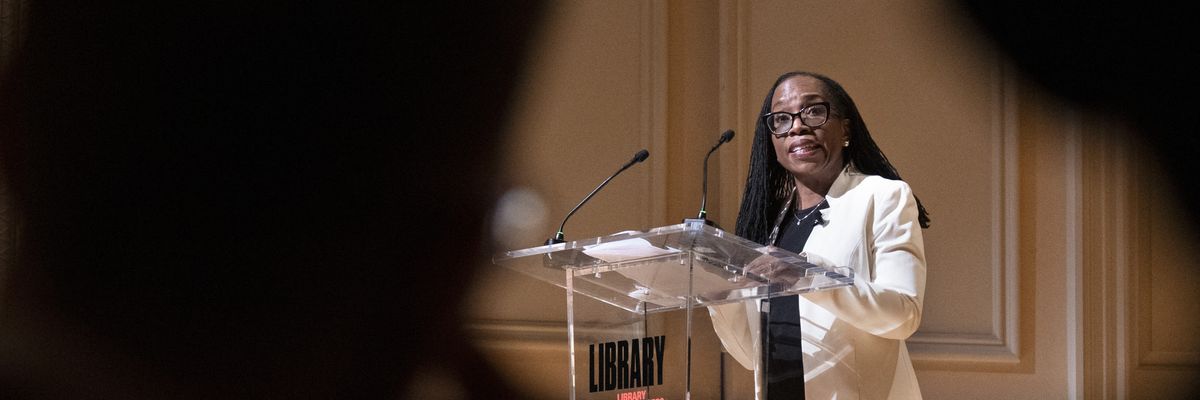
U.S. Supreme Court Justice Ketanji Brown Jackson speaks to the 2025 Supreme Court Fellows Program, on February 13, 2025, at the Library of Congress in Washington, D.C. (Photo: JACQUELYN MARTIN/POOL/AFP via Getty Images)
The U.S. Supreme Court on Friday cleared the way for the Trump administration to end, for now, legal protections for more than 500,000 Haitian, Cuban, Nicaraguan, and Venezuelan migrants with a ruling that liberal Supreme Court Justice Ketanji Brown Jackson blasted in a dissent as deeply harmful.
The decision puts on hold a ruling from U.S. District Judge Indira Talwani, who in April issued a stay on the Trump administration's move to end a humanitarian program extended to this group under former U.S. President Joe Biden. The ruling means the immigrants are at risk of being deported under President Donald Trump's mass deportation effort, even as the core legal issues in the case continue to play out in lower courts.
The unsigned order from the Supreme Court focuses on the so-called CHNV parole program, which allows certain individuals from those four nations to apply for entry into the U.S. for a temporary stay, so long as they have a U.S.-based sponsor, go through security vetting, and meet other conditions. In some cases, beneficiaries of the program work in the U.S.
On his first day in office, Trump issued an executive instructing the U.S. Secretary of Homeland Security to "[t]erminate all categorical parole programs," including CHNV.
"The court has plainly botched this assessment today. It requires next to nothing from the government with respect to irreparable harm" wrote Jackson in her dissent, joined by Justice Sonia Sotomayor. "And it undervalues the devastating consequences of allowing the government to precipitously upend the lives of and livelihoods of nearly half a million noncitizens while their legal claims are pending."
Friday's ruling is the second time this month that the Supreme Court has permitted the Trump administration to halt a program aimed at protecting immigrants who leave their home countries for humanitarian reasons. Earlier in May, the court issued an unsigned order allowing Trump to cancel Temporary Protected Status protections specifically extended to 350,000 Venezuelans immigrants while the legal case winds its way through lower courts.
The court's decision on Friday is a temporary order and litigation is still playing out, but it signals that a majority of the justices think the Trump administration is likely to prevail in the case, according to The New York Times.
"Respondents now face two unbearable options," according to Jackson's dissent. Jackson wrote that immigrants in the program could either chose to leave the U.S. and potentially confront dangers in their home countries, and other adverse outcomes, or "risk imminent removal at the hands of government agents, along with its serious attendant consequences."
"The court allows the government to do what it wants to do regardless, rendering constraints of law irrelevant and unleashing devastation in the process," she concludes in the dissent.
Aaron Reichlin-Melnick, senior fellow at the American Immigration Council, wrote: "an incredibly devastating decision which simply ignores the human costs and blesses the Trump admin's stripping of status of hundreds of thousands of people who entered the country legally."
Josh Gerstein, a legal reporter at Politico, wrote that the ruling "may spell trouble for Ukrainians/Afghans with similar status."
Democratic Voters Choose Fighting Corporate Power Over Neoliberal Abundance 'Scam': Poll
"At a moment when U.S. democracy is threatened by MAGA authoritarianism and deep inequality, doubling down on private-sector solutions while ignoring redistributive policy is a dangerous distraction," said one critic.
Critics of the so-called "abundance agenda" point to the huge crowds drawn by U.S. Sen. Bernie Sanders (I-Vt.) and Rep. Alexandria Ocasio-Cortez (D-N.Y.)—even in red states, like this April 14, 2025 rally inNampa, Idaho—as evidence that Democratic voters prefer candidates who focus on fighting corporatism. (Photo: Natalie Behring/Getty Images)
Democratic voters overwhelmingly prefer a populist program that takes on oligarchy and corporate power over the so-called "abundance agenda" that's all the rage among many liberals as party leaders examine why they lost the White House and Congress in 2024 and strategize about how to win them back.
That's according to a new Demand Progress poll of 1,200 registered voters "to test the resonance of the 'abundance agenda' being promoted as a potential policy and political refocus for the Democratic Party."
"What these voters want is clear: a populist agenda that takes on corporate power and corruption."
The poll revealed that 55.6% of all surveyed voters said they were somewhat or much more likely "to vote for a candidate for Congress or president who made the populist argument," compared with 43.5% who said they were likelier to cast their ballot for a candidate promoting the abundance agenda.
Among Democratic respondents, 32.6% said they were somewhat or much likelier to vote for abundance candidates, compared with 40.6% of Independents and 58.8% of Republicans. Conversely, 72.5% of surveyed Democrats, 55.4% of Independents, and 39.6% of Republicans expressed a preference for candidates with populist messaging.
"To get out of the political wilderness, and win over not just Democrats but also Independent and moderate voters, policymakers need to loudly state their case for helping middle- and working-class Americans," Demand Progress corporate power program director Emily Peterson-Cassin said in a statement Thursday.
"What these voters want is clear: a populist agenda that takes on corporate power and corruption," Peterson-Cassin added. "The stakes are too high for Democrats to fixate on a message that only appeals to a minority of independent and Democratic voters."
Inspired by San Francisco's YIMBY—or "yes-in-my-backyard"—movement to build as much market-rate housing as possible with scant consideration for the fact that only relatively wealthy people like themselves can afford to live there, New York Times columnist Ezra Klein and Atlantic staff writer Derek Thompson earlier this year published Abundance, which topped the Times' nonfiction bestseller list.
Klein and Thompson assert that well-meaning but excessive regulation in Democrat-controlled cities is thwarting progress, and that U.S. liberals' focus on blocking bad economic development has come at the expense of good development over the past half-century. They cite environmental and zoning regulations, as well as burdensome requirements attached to public infrastructure projects and housing construction, as some of the barriers to development.
The Demand Progress poll found that Republicans were much more likely to have a positive view of candidates embracing the abundance agenda. However, the movement has been gaining traction among centrist and even left-of-center Democrats in cities like San Francisco, where the Abundance Network, a YIMBY nonprofit, has become a major player in city politics and has bankrolled a tech-backed takeover of the local Democratic Party, as Mission Local's Joe Rivano Barros and others have detailed.
Leftist critics have pulled no punches in calling out the abundance agenda as neoliberalism dressed in progressive clothes.
"The abundance movement is a scam," Brandee Marckmann of the progressive San Francisco Education Alliance told Common Dreams on Thursday. "It's a rebranded Trumpian movement that punches down on working-class families. The only abundance these guys want is for themselves, and they want to line their pockets through political schemes that steal money from our public schools, public housing, and public transportation."
As Phoenix Project, a grassroots San Francisco group fighting dark money in politics, recently noted, "Ezra Klein and Derek Thompson's Abundance helped rebrand Reagan-era economics for a new generation, but behind the gloss lies a familiar web of tech, real estate, and right-wing influence."
"At a moment when U.S. democracy is threatened by MAGA authoritarianism and deep inequality, doubling down on private-sector solutions while ignoring redistributive policy is a dangerous distraction," the group added.
Pointing to the Demand Progress poll, The Lever's Veronica Riccobene wrote Thursday that "Democratic voters know who their real enemy is."
"A majority believe the 'big problem' in America is that corporations and their executives have too much economic and political power," she said. "It's not surprising, considering Sen. Bernie Sanders (I-Vt.) and Rep. Alexandria Ocasio Cortez (D-N.Y.) are pulling huge crowds on their 'Fighting Oligarchy' tour, even in deep-red states."
"Meanwhile, fewer Democratic voters believe the country's big problem is regulatory bottlenecking, a core argument of the neoliberal 'abundance' movement," Riccobene added.
As progressive political strategist Dan Cohen said in response to the new poll, "The voters are demonstrating that they understand the problem with quite a traditional view of American politics and economics: that there is too much power and influence in corporate hands and everyday Americans aren't getting their fair share."
"Democrats would be wise to listen to the voters and respond directly to those views with their rhetoric and actions," he added.
DC insider reveals how the 'super-rich' flipped the script on taxes — and how to fix it SHAWN THEW/Pool via REUTERS
Former Secretary of Labor Robert Reich says middle and low-income U.S. taxpayers should not be paying wealthy Americans to finance debt Republicans are determined to heap upon them last week.
“I’m old enough to remember when the US’s super-rich financed the government with their tax payments,” Reich wrote in The Guardian. “Under Dwight Eisenhower … the highest marginal tax rate was 91%. … But since the Reagan, George W Bush and Trump 1 tax cuts, tax rates on the super-rich have plummeted. So instead of financing the government with their taxes, the super-rich have been financing the US government by lending it money.”
Reich points out that the majority of U.S. debt is not held by foreigners, that more than 70% of it is owned by Americans, and it is to these “super-rich” that taxpayers must pay incrementally more every year to cover the nation's ballooning debt.
And “[t]hey’ll pay even more interest on the growing debt – to the super-rich,” if Republicans pass the budget bill coursing through Congress, he warns, and “they’ll pay higher interest rates on all other long-term debt.” This will inevitably mean higher borrowing costs on everything from mortgages to auto loans as higher rates on treasury bonds filter through the U.S. economy.
In addition, the rising debt crisis gives lawmakers “even more excuse to do what they’re always wanting to do: slash safety nets. So many Americans could lose benefits they rely on, such as Medicaid and food stamps.”
But that debt crisis is still a very real argument, claims Reich, pointing out that Moody’s ratings firm announced the government’s rising debt levels would grow further if Republicans extended Trump’s 2017 tax cuts.
“So-called ‘bond vigilantes’ have already been selling the U.S. government’s debt, as the Republican tax package moves through Congress,” Reich said, and “they’re expected to sell even more, driving long-term interest rates even higher to make up for the growing risk of holding US debt.”
The solution? Reduce the federal debt by ending Trump tax cuts “that mainly benefit the wealthy and big corporations – and instead raise taxes on them.”
Deregulation. Privatization. Tax cuts. Free trade. Stagnant pay for most. A soaring stock market for the top. That’s the legacy of neoliberalism. It also brought us Trump. We cannot go back to that place. There's a better path.
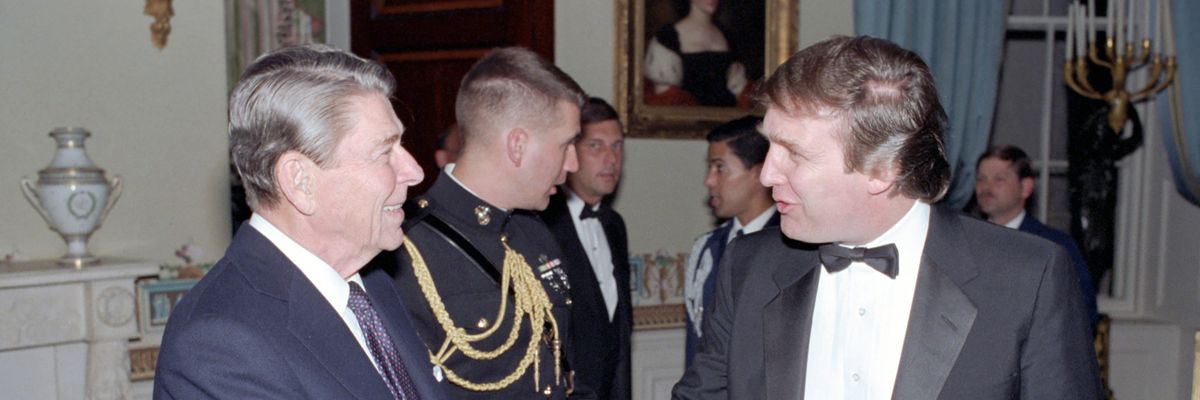
Then U.S. President Ronald Reagan (1911 - 2004) shakes hands with then-real estate developer and now U.S. President Donald Trump in a reception line in the White House's Blue Room, in Washington D.C. on November 3, 1987. (Photo: White House Photo Office/PhotoQuest/Getty Images)
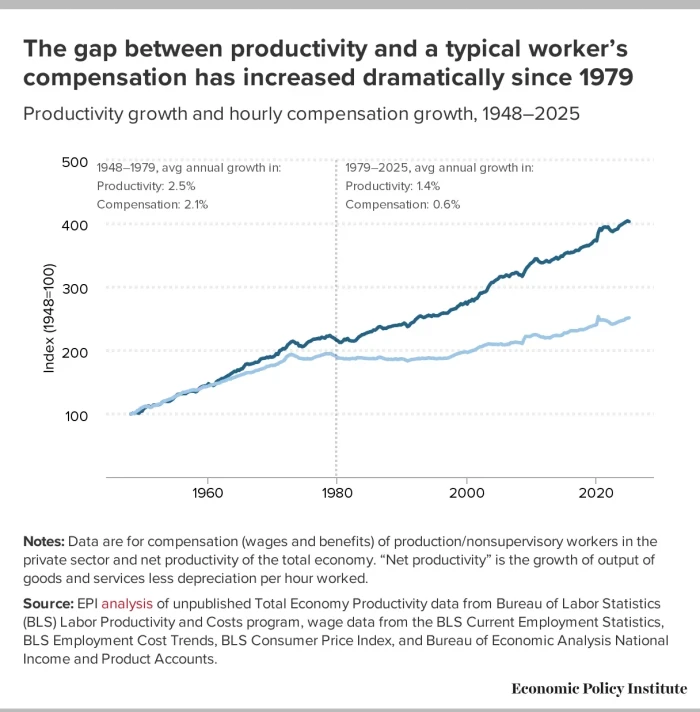
I rarely ask you to look at charts. Today is an exception. This one is from the Economic Policy Institute. It compares the typical American’s pay starting just after World War II (light blue line) with the nation’s increasing productivity since then (dark blue).
The chart shows the widening divergence between the rise of pay and the yields from productivity.
In the first three decades after World War II, the typical American’s pay rose in tandem with the nation’s growing productivity. The benefits from higher productivity were broadly shared.
But then, starting in the late 1970s and dramatically after 1980, pay barely grew, even as productivity continued to soar. The benefits from higher productivity went increasingly to the top.
Why?
I’ve been looking into this question for a long time.
I’ve also been living it, as head of policy for the Federal Trade Commission under Jimmy Carter, secretary of labor in the Clinton administration, and an economic adviser to Obama. I’ve chronicled this in my upcoming memoir, Coming Up Short.
Much of the answer has to do with a giant upward shift in power.
It started in 1971, with a memo written for the U.S. Chamber of Commerce by Lewis Powell exhorting corporations to play a far more active role in American politics. They did, and their increasingly active role paid off, at least for their CEOs and top investors.
It continued through Reagan’s tax cuts and deregulation, his legitimization of union bashing, and the emergence of corporate raiders who insisted that corporations maximize shareholder value above all else.
And onward through George H.W. Bush and Bill Clinton’s North American Free Trade Agreement, their support for China’s accession to the World Trade Organization, and their deregulation of Wall Street.
And then through George W. Bush’s tax cut — again, mainly for big corporations and wealthy individuals — and Barack Obama’s bailout of Wall Street after it nearly destroyed the world economy.
Deregulation. Privatization. Tax cuts. Free trade. Stagnant pay for most. A soaring stock market for the top.
That’s the legacy of neoliberalism.
It also brought us Trump — who exploited the anger and resentment stirred up by all this and pretended to be a strongman on the side of the working class (while quietly giving the emerging American oligarchy everything else it wanted, including a giant tax cut; he’s readying another as you read this).
Now some neoconservatives, posing as “moderates,” are hijacking the story and trying to rehabilitate neoliberalism.
Consider David Brooks, who wrote recently in The New York Times that:
— “wages really did stagnate, but they did so mostly in the 1970s and 1980s, not in the supposed era of neoliberal globalism.” (Brooks is wrong. Look at the above chart. Pay did begin to head up again in the 2000s but the pay-productivity gap has continued to widen.)
— there was “a return to higher productivity and higher wage growth, from 1994 to today. That is to say: Median wages have grown since NAFTA and the W.T.O., not declined.” (Wrong again. Look at the chart.)
— “the inequality gap is not as great as one might think.” (Well, I think it significant, and most analysts agree.)
— “the basic approach to economic policymaking that prevailed between 1992 and 2017 was sensible and … our job today is to build on it.” (Sensible only as compared to Trump’s first and second terms. But as I said, hardly sensible when you consider that widening inequality combined with unbridled globalization, deregulation, and union-bashing contributed to the rise of Trump.)
Neoliberalism should not and cannot be rehabilitated.
We need instead a strong, bold progressive populism that strengthens democracy and widens prosperity by:
— getting big money out of politics, even if this requires amending the Constitution,
— requiring big corporations to share their profits with their average workers,
— strengthening unions, and
— raising taxes on the super-wealthy,
— to finance a universal basic income, Medicare for all, and paid family leave.
Those now trying to rehabilitate neoliberalism won’t like any of this, of course, but we cannot return to the path we were on. It will just lead to more Trumps, as far as the eye can see.
Robert Reich Robert Reich, is the Chancellor's Professor of Public Policy at the University of California, Berkeley, and a senior fellow at the Blum Center for Developing Economies. He served as secretary of labor in the Clinton administration, for which Time magazine named him one of the 10 most effective cabinet secretaries of the twentieth century. His book include: "Aftershock" (2011), "The Work of Nations" (1992), "Beyond Outrage" (2012) and, "Saving Capitalism" (2016). He is also a founding editor of The American Prospect magazine, former chairman of Common Cause, a member of the American Academy of Arts and Sciences, and co-creator of the award-winning documentary, "Inequality For All." Reich's newest book is "The Common Good" (2019). He's co-creator of the Netflix original documentary "Saving Capitalism," which is streaming now. Full Bio >
Major shift in GOP views on same-sex marriage: report
A decade after the U.S. Supreme Court’s landmark ruling affirming that the Constitution guarantees same-sex couples the same rights and responsibilities of marriage as different-sex couples, public support for marriage equality remains robust at 68 percent—ten points higher than just a month after the 2015 Obergefell decision, though slightly below the all-time high of 71 percent. While Democratic support has continued to climb, Republican backing has declined sharply.
Nearly nine in ten Democrats (88%) say marriages between same-sex couples should be recognized by law as valid, according to Gallup, but less than half that—just 41 percent—of Republicans agree. That’s a fourteen-point drop from the highest level recorded for right-wing voters, 55 percent, in 2021 and 2022.
“The current 47-point gap between Republicans and Democrats is the largest since Gallup first began tracking this measure 29 years ago,” the polling firm reported.
Asked whether they “personally believe that in general” gay or lesbian relations are “morally acceptable or morally wrong,” even fewer Republicans, just 38 percent, said they are morally acceptable. The national average is 64 percent, and the average among Democrats is 86 percent. Diving deeper, Gallup found that a majority “of U.S. adults in most demographic subgroups think same-sex marriage should be legal and say same-sex relations are morally acceptable.”
The only subgroup listed on Gallup’s graphic where a majority disagreed are weekly church-goers, “a group that is more Republican.”
“One-third of these frequent churchgoers support same-sex marriage, while 24% of them consider gay or lesbian relations as morally acceptable.”
Gallup also delivered a warning for marriage equality supporters, noting that “the widening political divide suggests potential vulnerabilities in the durability of LGBTQ+ rights.”
“In 2022, Supreme Court Justice Clarence Thomas wrote in his concurring opinion in the Dobbs v. Jackson Women’s Health Organization decision that the high court ‘should reconsider’ its past rulings, including those on same-sex relationships and marriage. Since then, Republican lawmakers in some states have introduced resolutions asking the Supreme Court to overturn Obergefell. During his second term, President Donald Trump has implemented policies that significantly roll back LGBTQ+ protections, particularly affecting transgender individuals. These occurrences suggest that same-sex marriage in the U.S. could face renewed legal and political challenges.”
Dem on DOGE committee pounces on 'out of control' Musk's reported drug problem
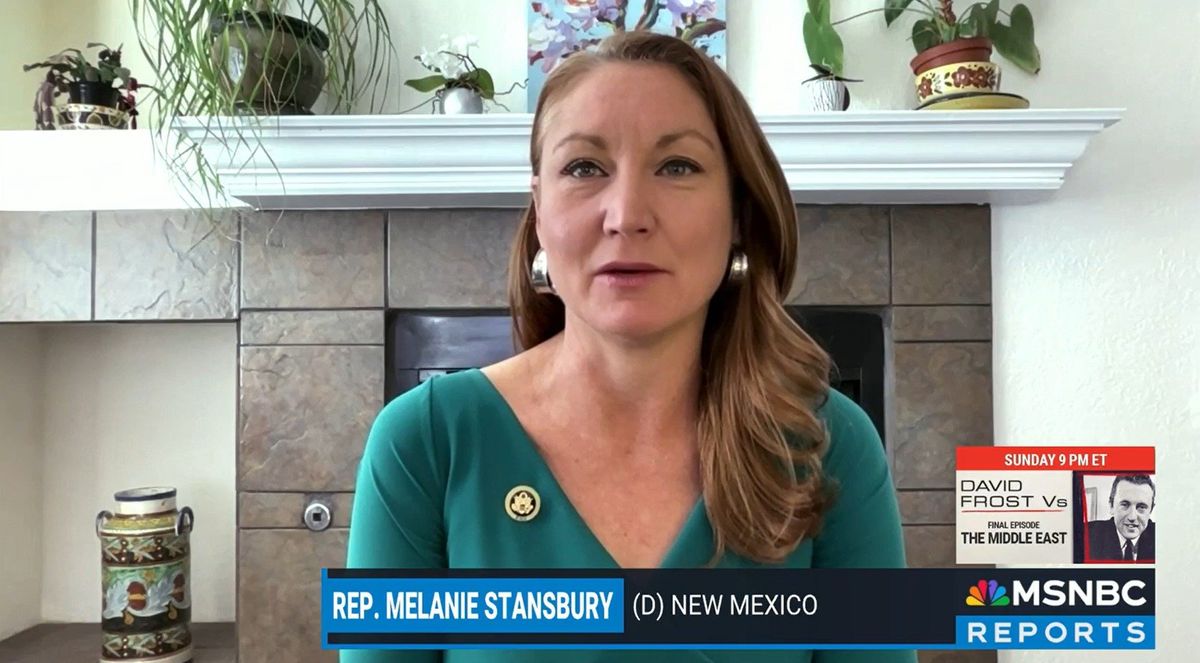
Congresswoman Melanie Stanbury speaking on Elon Musk (MSNBC Screenshot) 2025-05-30
Elon Musk is “out of control” with his alleged drug use, and now House Democrats have filed a Civil Liability against Musk to hold him personally liable for the work he’s done at the Department of Government Efficiency, according to Congresswoman Melanie Stanbury (D-NM).
The revelation came while she was speaking on Ana Cabrera Reports Friday morning.
First, Stanbury railed against Musk’s alleged drug use, which the New York Times first reported, saying, “If you observed his behavior over the last three and a half months, it's very obvious that he was completely out of control.”
“Just like, you know, other rich dudes who want to tinker with what they think are toys, this is not a joke,” Stanbury said. “This is the democracy that is our country and the American people's lives. So, you know, there's going to be very serious consequences, and we will hold Elon Musk accountable for the damages that he's done.”
She added, “Musk wreaked havoc on the federal government. And so it does not surprise me that it was being enhanced by, you know, substances that make you act crazy. But I think, you know, it's not a joke because he [has] literally shattered thousands of American lives. He's disrupted our entire federal government.”
The Congresswoman noted that there isn't a lot democrats can do because they are not in control of Congress. However, she “and Jamie Raskin (D-MD) have also filed legislation for civil liability against Elon Musk and any special government employee. But it also necessitates that we win back the House and use the tools of Congress to hold them accountable. Right now, the courts are a primary tool.”
She later noted some of the unethical and illegal actions Musk has purportedly taken while head of DOGE, saying, “We know that there are DOGE staff sitting in the cabinet secretary offices of almost every major agency, and we've seen this play out even over the last week at the Department of Interior.”
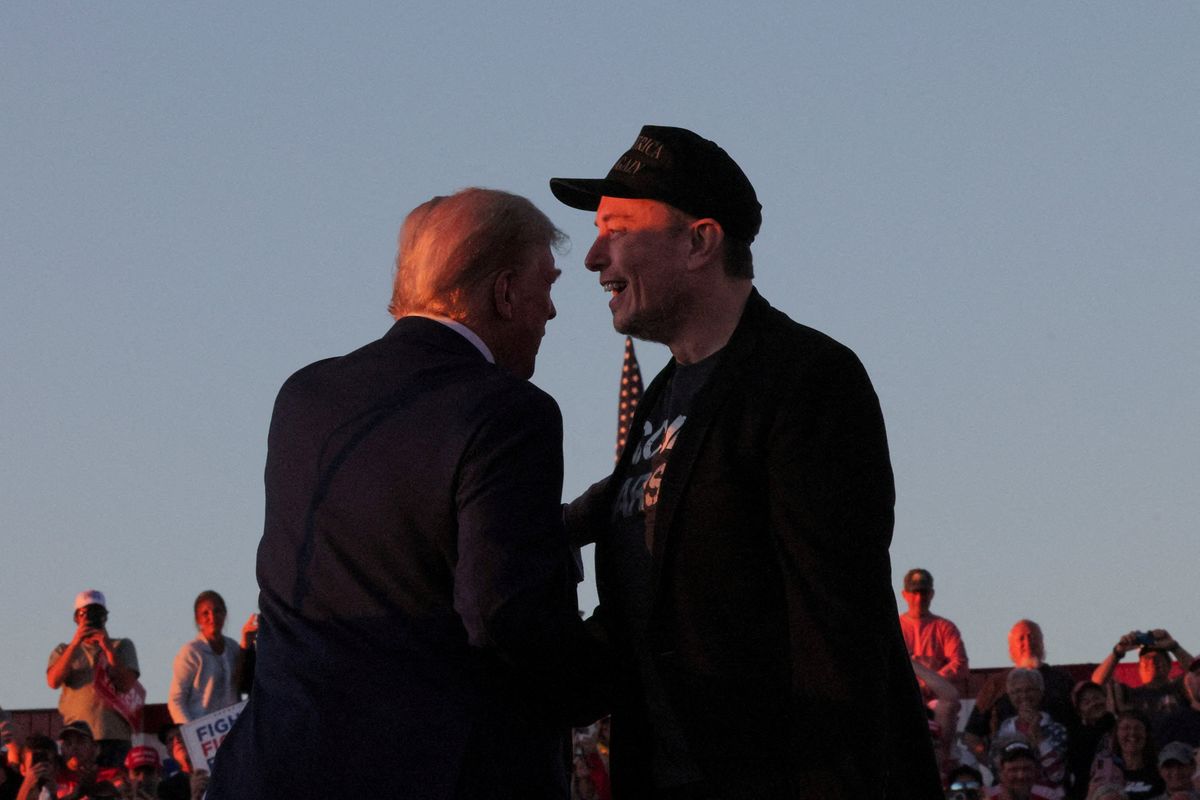
FILE PHOTO: Tesla CEO and X owner Elon Musk stands with Republican presidential candidate former U.S. president Donald Trump during a campaign rally in Butler, Pennsylvania, U.S., October 5, 2024. REUTERS/Brian Snyder/File Photo
Rep. Alexandria Ocasio-Cortez (D-NY) sounded the alarm in a new interview with Rolling Stone's Lorena O'Neil published Friday about how, in her view, the Trump presidency has become a vessel for the will of tech billionaires, who are behind some of the most destructive policy initiatives against working people.
This comes at a moment when one of the most visible of these billionaires, Elon Musk, is formally exiting the White House — though perhaps not going away entirely — after installing his Department of Government Efficiency (DOGE) task force to help Trump purge the civil service.
"There is almost no area of our lives that has not been affected by this tech-billionaire class because they’re buying elections," said Ocasio-Cortez, an outspoken progressive lawmaker. "The balance of the Senate has been shifted because of the crypto lobby dumping millions of dollars into right-wing authoritarian candidates. And it’s important to note that this money is not going into just issue-lobbying alone."
What makes this particularly chilling, she continued, is that crypto billionaires aren't just doing the usual lobbying and favor-seeking for their industry: "This is about crypto billionaires trying to install and support authoritarians and fascists, because they believe that if those fascists are personally close to them, then they can control far beyond the regulation of financial instruments. They think they can really start imposing this dystopian worldview that includes everything from the subjugation of women to democracy itself."
The GOP's fight to pass a "big, beautiful bill" that cuts hundreds of billions from Medicaid — something even some MAGA Republicans are uncomfortable with — is part and parcel of that, she argued.
"Elon Musk dumped hundreds of millions of dollars into trying to buy the U.S. presidential election, and he is trying to recoup that investment by getting one of the largest tax cuts for billionaires in American history — which the Republican Party is trying to pay for through massive cuts to Medicaid, for Americans with disabilities, health care for the poor," she said. "They’re trying to cut Medicaid and SNAP food assistance to pay for additional tax cuts for Elon Musk and his industries, as well. And so it’s really important for people to understand that this goes beyond tech. This is about the extreme concentration of money and power."
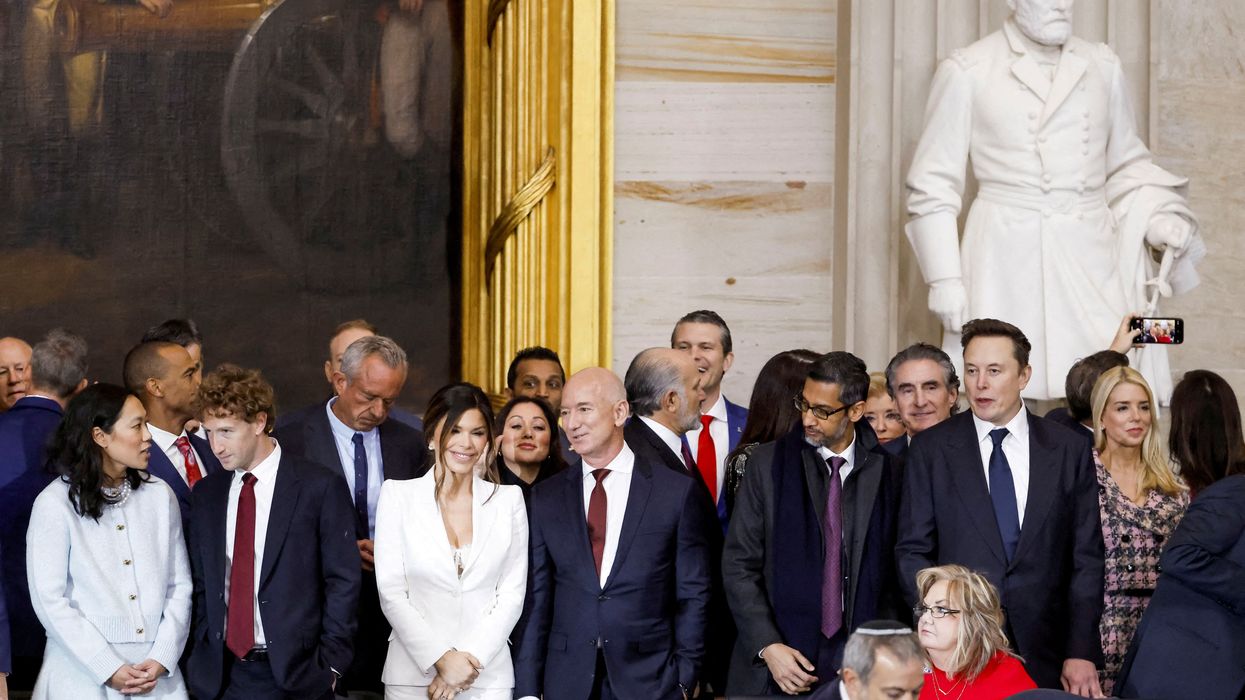
The scene of tech CEOs like Musk, Amazon's Jeff Bezos, and Meta's Mark Zuckerberg sitting close to Trump at his inauguration, she continued, is "a moment in history personified."
"This is not just people buying favors," Ocasio-Cortez said. "This is about who controls this country, and everyone else is just a formality, and that is the worldview that we are up against right now. This is the stakes of the present moment. And when Sen. Sanders and I talk about oligarchy, this really is what this is. It is beyond partisan as well. It is concentrated. It is most concentrated in the Republican Party. But it’s also the power that controls our politics writ large."
Musk Might Be Gone, But Watchdogs Warn Trump/DOGE Carnage Will Continue
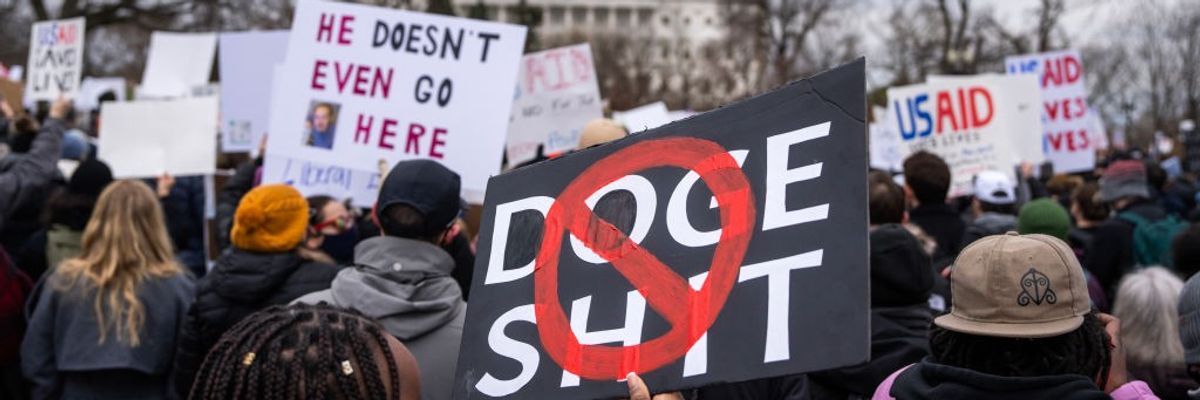
"Musk's departure obscures but does not actually change the continuity of DOGE's staff and mission to destroy everything that protects the public from the depredations of the most rapacious oligarchs," said one critic. Demonstrators protest the Trump administration's evisceration of the federal government—spearheaded by Elon Musk's Department of Government Efficiency (DOGE)—during a February 5, 2025 protest on Capitol Hill in Washington, D.C. (Photo: Tom Williams/CQ-Roll Call, Inc. via Getty Images)
Critics of the so-called Department of Government Efficiency cautioned Friday against undue elation or complacency over Elon Musk stepping down as de facto DOGE chief, warning that officials at the contentious agency are pressing ahead with U.S. President Donald Trump's mission of eviscerating key agencies and the ability of the federal government to properly function.
With Musk's official departure from DOGE this week—returning to the private sector to run his beleaguered business empire—most of the agency's leadership and rank-and-file staff remain in place. As the Revolving Door Project (RDP) noted Friday, key DOGE officials "maintain extensive ties to Musk's corporate empire, with many of them having come to DOGE directly from one of Musk's companies."
According to RDP research, "at least 46 former or current DOGE members have substantial and direct ties to Elon Musk."
"DOGE isn't going anywhere, according to the Trump administration's own officials," RDP said. The watchdog group warned specifically about Office of Management and Budget (OMB) Director Russell Vought, who they said "seems to be the new boss in town."
The visions of the two men, said RDP, "have been aligned from the start. Musk endorsed Vought's view of the unconstitutionality of the Impoundment Control Act and said that DOGE would work 'closely with [OMB].'"
Vought co-authored the policy portion of Project 2025, a far-right blueprint for gutting the government and expanding executive power.
"There is no daylight between Elon Musk and Russ Vought on the aim of greenlighting corporate abuse, as anyone can see from their joint destruction of the Consumer Financial Protection Bureau," RDP executive director Jeff Hauser said Friday. "DOGE's Musk-tied staffers have already burrowed into the government, and having a new boss who has coordinated extensively with Musk isn't likely to change their actual actions much at all."
"Musk's departure obscures but does not actually change the continuity of DOGE's staff and mission to destroy everything that protects the public from the depredations of the most rapacious oligarchs," Hauser added.
Another watchdog, Accountable.US, noted Friday that Vought "has a nearly 20-year record working on Republican efforts to cut Social Security and Medicare—including overseeing numerous Trump budget proposals."
"It's proof that DOGE's extreme agenda, which is causing ordinary families to fall behind, is full steam ahead as Trump and his allies in Congress push forward deep cuts to Americans' essential benefits," the group continued. "Last week, congressional Republicans advanced the largest cuts to Medicaid and [Supplemental Nutrition Assistance Program] in history, which would result in 14 million Americans losing health coverage, 3 million households without food assistance, and an increased burden for millions with higher education and energy costs. All while adding over $4 trillion to the deficit."
"Americans deserve real government reforms to cut red tape, eliminate waste, and ensure taxpayers are able to access the services they pay for," Accountable.US added. "That was never DOGE's goal. Instead Trump and Musk tried to gut Medicare, Medicaid, and Social Security, to line their own pockets and those of their billionaire friends with tax cuts, and the administration is only just getting started."
As one staffer at the DOGE-beset National Institutes of Health told Politico, "DOGE is still hungry. We've still got to feed the fucking dog."