.jpg)
The Conversation
January 31, 2026
By Rachelle Wilson Tollemar, Adjunct Professor of Spanish, University of St. Thomas.
Minneapolis residents say they feel besieged under what some are calling a fascist occupation. Thousands of Immigration and Customs Enforcement agents have been swarming a city whose vast majority in 2024 did not vote for Donald Trump — or for a paramilitary roundup of its diverse population.
Tragically, two residents have been killed by federal agents. Consequently, social media is aflame with comparisons of Trump’s immigration enforcers to Hitler’s Gestapo.
While comparisons to Hitler’s fascist regime are becoming common, I’d argue that it may be even more fitting to compare the present moment to a less-remembered but longer-lasting fascist regime: that of Francisco Franco, dictator of Spain from 1936 until his death in 1975.
.jpg)
In 2016, critics warned that Trump’s campaign rhetoric was grounded in textbook fascism, exhibiting signs such as racism, sexism and misogyny, nationalism, propaganda and more. In return, critics were met with intense backlash, accused of being hysterical or overly dramatic.
Now, even normally sober voices are sounding the alarm that America may be falling to fascist rule.
As a scholar of Spanish culture, I, too, see troubling parallels between Franco’s Spain and Trump’s America.
Putting them side by side, I believe, provides insightful tools that are needed to understand the magnitude of what’s at risk today.
Franco’s rise and reign
The Falange party started off as a a small extremist party on the margins of Spanish society, a society deeply troubled with political and economic instability. The party primarily preached a radical nationalism, a highly exclusive way to be and act Spanish. Traditional gender roles, monolingualism and Catholicism rallied people by offering absolutist comfort during uncertain times. Quickly, the Falange grew in power and prevalence until, ultimately, it moved mainstream.
By 1936, the party had garnered enough support from the Catholic Church, the military, and wealthy landowners and businessmen that a sizable amount of the population accepted Gen. Francisco Franco’s coup d'etat: a military crusade of sorts that sought to stop the perceived anarchy of liberals living in godless cities. His slogan, “¡Una, Grande, Libre!,” or “one, great, free,” mobilized people who shared the Falange’s anxieties.
Like the Falange, MAGA, the wing of the Republican Party named after Trump’s slogan “Make America Great Again,” repeatedly vilifies the left, who mostly live in cities, as godless anarchists who live like vermin.
Once in power, the Francoist regime commissioned a secret police force, the Political-Social Brigade — known as the BPS — to “clean up house.” The BPS was charged with suppressing or killing any political, social, cultural or linguistic dissidents.
Weakening resistance
Franco not only weaponized the military but also proverbially enlisted the Catholic Church. He colluded with the clergy to convince parishioners, especially women, of their divine duty to multiply, instill nationalist Catholic values in their children, and thus reproduce ideological replicas of both the state and the church. From the pulpit, homemakers were extolled as “ángeles del hogar” and “heroínas de la patria,” or “angels of the home” and “heroines of the homeland.”
Together, Franco and the church constructed consent for social restrictions, including outlawing or criminalizing abortion, contraception, divorce, work by women and other women’s rights, along with even tolerating uxoricide, or the killing of wives, for their perceived sexual transgressions.
Some scholars contend that the repealing of women’s reproductive rights is the first step away from a fully democratic society. For this reason and more, many are concerned about the U.S. Supreme Court’s recent overturning of Roe v. Wade.
The #tradwife social media trend involves far-right platforms echoing Francoist-style ideologies of submission, restriction, dependence and white male dominance. One of TikTok’s most popular tradwife influencers, for instance, posted that “there is no higher calling than being a wife and a mother for a woman.” She also questioned young women attending college and rebuked, on air, wives who deny their husbands sexual intimacy.
.jpg)
Weakening the economy
Economically, Franco implemented autarkic policies, a system of limited trade designed to isolate Spain and protect it from anti-Spanish influences. He utilized high tariffs, strict quotas, border controls and currency manipulation, effectively impoverishing the nation and vastly enriching himself and his cronies.
These policies flew under the motto “¡Arriba España!,” or “Up Spain.” They nearly immediately triggered more than a decade of suffering known as the “hunger years.” An estimated 200,000 Spaniards died from famine and disease.
Under the slogan “America First” — Trump’s mutable but aggressive tariff regime — the $1 billion or more in personal wealth he’s accumulated while in office, along with his repeated attempts to cut nutrition benefits in blue states and his administration’s anti-vaccine policies may appear to be disconnected. But together, they galvanize an autarkic strategy that threatens to debilitate the country’s health.
Weakening the mind
Franco’s dictatorship systematically purged, exiled and repressed the country’s intellectual class. Many were forced to emigrate. Those who stayed in the country, such as the artist Joan Miró, were forced to bury their messages deeply within symbols and metaphor to evade censorship.
Currently in the U.S., banned books, banned words and phrases, and the slashing of academic and research funding across disciplines are causing the U.S. to experience “brain drain,” an exodus of members of the nation’s highly educated and skilled classes.
Furthermore, Franco conjoined the church, the state and education into one. I am tracking analogous moves in the U.S. The conservative group Turning Point USA has an educational division whose goal is to “reclaim" K-12 curriculum with white Christian nationalism.
Ongoing legislation that mandates public classrooms to display the Ten Commandments similarly violates religious freedom guarantees ratified in the constitution.
.jpg)
Drawing comparisons
Trump has frequently expressed admiration for contemporary dictators and last week stated that “sometimes you need a dictator.”
It is true that his tactics do not perfectly mirror Francoism or any other past fascist regime. But the work of civil rights scholar Michelle Alexander reminds us that systems of control do not disappear. They morph, evolve and adapt to sneak into modern contexts in less detectable ways. I see fascism like this.
Consider some of the recent activities in Minneapolis, and ask how they would be described if they were taking place in any other country.
Unidentified masked individuals in unmarked cars are forcibly entering homes without judicial warrants. These agents are killing, shooting and roughing up people, sometimes while handcuffed. They are tear-gassing peaceful protesters, assaulting and killing legal observers, and throwing flash grenades at bystanders. They are disappearing people of color, including four Native Americans and a toddler as young as 2, shipping them off to detention centers where allegations of abuse, neglect, sexual assault and even homicide are now frequent.
Government officials have spun deceptive narratives, or worse, lied about the administration’s actions.
In the wake of the public and political backlash following the killing of Alex Pretti, Trump signaled he would reduce immigration enforcement operations] in Minneapolis, only to turn around and have Defense Secretary Pete Hegseth authorize the use of an old military base near St. Paul, suggesting potential escalation, not de-escalation. Saying one thing while doing the opposite is a classic fascist trick warned about in history and literature alike.
The world has seen these tactics before. History shows the precedent and then supplies the bad ending. Comparing past Francoism to present Trumpism connects the past to the present and warns us about what could come.

From ‘Moscow gold’ to record reserves: Spain’s gold, then and now

The Bank of Spain closed 2025 with gold and currency reserves valued at almost €94 billion, an all-time high driven by astronomical demand for the metal.
At the end of 2025, the Banco de España recorded gold and foreign exchange reserves were valued at nearly €94 billion, the highest figure since comparable statistics became available.
The increase reflects, above all, the rising demand for gold on the international market — recent dips aside — as a safe-haven asset in a year marked by geopolitical and financial uncertainty.
But in Spain, gold is never just an accounting figure. It is also a matter of historical memory. And few expressions are as charged as those referring to so-called “Moscow gold,” one of the most controversial episodes in Spain’s 20th-century economic and political history.
Gold to finance the revolution
Before 1936, Spain’s gold reserves were not exceptional by international standards, but they were sufficient to place the country on the global financial map.
According to historian Magdalena Garrido Caballero, Professor of Contemporary History at the University of Murcia, this gold gave Spain a degree of room for certain international manoeuvres albeit far removed from those of major economic powers.
That margin, however, evaporated with the outbreak of the Spanish Civil War. The diplomatic isolation of the Second Republic, reinforced by the Non-Intervention Committee, left the Republican government with few options for financing the purchase of arms and supplies.
In this extreme context, the Republican government decided to transfer most of the Banco de España’s gold reserves abroad, primarily to the Soviet Union. The aim was clear: to pay for arms, supplies and military assistance to sustain the war effort.
The transfer was real and well documented. In October 1936, some 510 tonnes of gold left the Algameca depot in Cartagena.
It was not an improvised or clandestine operation, but a conscious decision made by the Republic’s legitimate authorities in a context of total war.
Return the gold?
Contemporary historiography has dismantled many of the myths constructed in later decades. Garrido Caballero stresses that the central misconception is the idea that the gold could — or should — have been returned.
Studies by historians such as Ángel Luis Viñas and Pablo Martín Aceña show that the gold was spent during the war, through verified and documented payments, enabling the Republic to resist the military uprising for almost three years.
From this perspective, the “Moscow gold” did not constitute either theft or plunder by the Soviet Union, but a financing operation carried out under exceptional circumstances.
Some of the gold was also sold to France for the same purpose, although this episode never acquired the same symbolic weight.
'Fascist' talking point
After the war, Franco’s regime turned the “Moscow gold” into a powerful propaganda tool.
According to Garrido Caballero, the regime exploited the episode to justify the severity of the post-war period, to reinforce the image of an exploitative Soviet enemy and to delegitimise the Second Republic.
The issue appeared repeatedly in diplomatic reports, the national and international press, and official speeches for decades.
Internationally, however, the matter gained little traction. The United Kingdom viewed it as a bilateral issue between states, while Soviet authorities consistently maintained that there were no outstanding reserves of the gold sent by the Republic.
Where is Spanish gold held today?
Almost 90 years on, the question still resurfaces: where is Spain’s gold?
The answer is much less dramatic than the persistent myth. Spain today holds around 281 tonnes of gold, divided between the Bank of Spain and deposits in the United States, the United Kingdom and Switzerland, according to data from the World Gold Council.
This gold is not tied to the amounts sent to the USSR, but a result of decades of monetary policy, European integration and asset management within the Eurosystem.
From historical trauma to financial asset
The 2025 record does not mean Spain has recovered its lost gold.
Rather, it reflects the rise in the metal’s price on international markets. Today, gold no longer fully backs a national currency or it is not used to finance wars. Instead, it functions as an asset of stability, leverage and confidence in a globalised financial system.
A comparison between 1936 and 2025 reveals a profound shift. During the Civil War, gold was a tangible resource on which a government’s survival depended. This is no longer the case.
The Hardest Part of Fighting Fascism Comes After the Fascists Have Fallen
Having lived in Argentina after dictatorship, I know restoring democracy requires far more than just deposing fascists.
By Joel Westheimer ,
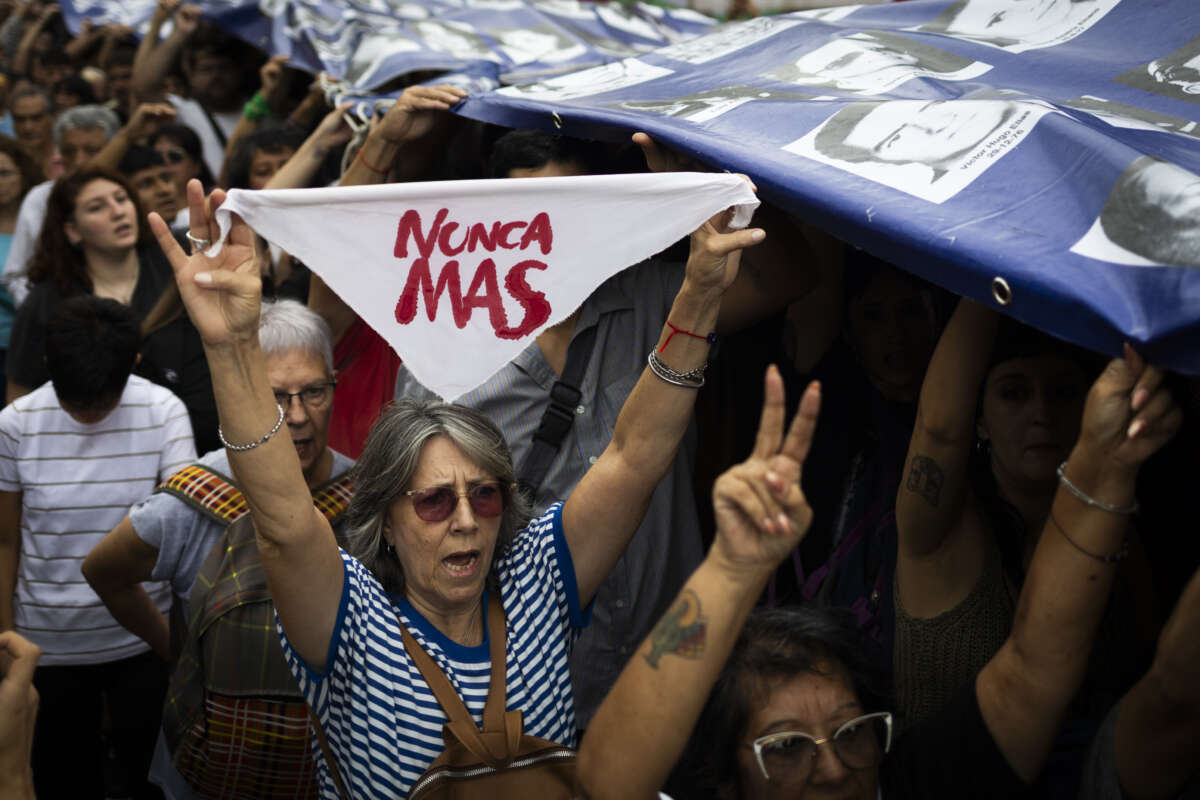
Ilived in Argentina in the mid-1980s, just after the fall of the brutal military dictatorship that ruled from 1976 to 1983. The country was taking its first, shaky steps back toward democracy. It was a time of great hope, but also of grave uncertainty — because while the generals were gone, the political culture that enabled them remained.
Like most of the nation, I was captivated by the pioneering trials of the military generals that promised to restore justice. But watching the trials, reading the commentary, and witnessing the national response, it became increasingly clear that after a dictatorship collapses, its shadow lingers. Institutions that propped it up may be quick to pivot but slow to reform. And a political culture conditioned to authoritarian rule does not easily snap back.
I see that same danger now in the United States.
Let’s be clear: Fascism isn’t some distant or hypothetical threat — it is already here. Unmarked vans and masked agents snatch students off the streets without due process. Judges and lawyers are intimidated. The most powerful institutions in society — universities, tech firms, law firms, billionaires, legislators — preemptively prostrate themselves to an autocratic leader’s whims, not because they are forced to, but because they calculate that accommodation is safer than resistance. Tens of millions of people are demonized while the military is deployed against civilian populations. These are not warning signs. They are the thing itself.
Democracy is not just a system of government. It is a way of thinking, of arguing, of living together.
In Argentina, the military junta was defeated, but the nation’s political culture remained deeply scarred. The public had seen generals on trial, but many still struggled to grasp why their crimes mattered. The substance of the prosecution — that to fight terrorism, members of the military became terrorists themselves — was incomprehensible not only to the defendants but also to an alarming number of legislators who had returned to power. Even after convictions, defendants like Jorge Rafael Videla, commander of the first and most ruthless of the three military juntas, proclaimed innocence, maintaining that the proceedings were nothing more than a “trial generated by political motivations.” Ex-president Roberto Eduardo Viola, convicted of responsibility for torture and murder, echoed Videla, adding that “had the military not won [the dirty war] the country would not now be living in democracy. Instead, we would now be a Marxist international dictatorship.”
It was not only these men who needed to face their crimes. Early in the trials, nearly an entire day was spent hearing the defense counsel’s attempt to prove that the daughter of a prominent human rights lawyer might have been a terrorist, and therefore her murder was justified. The claim was not only false; it inverted the very idea of justice. The spectacle continued until the editor of the English-language newspaper that had illegally published the names of the disappeared was called to testify. When a defense attorney asked him how he knew the woman was not a terrorist, the editor replied simply: “Because everyone knows that a person is innocent until proven guilty.”
That moment was electric. It was also sobering. A foundational democratic principle had to be restated aloud, as if newly rediscovered. Years of authoritarian rule had so corroded civic norms that even the presumption of innocence could no longer be assumed as common sense.
A public culture trained to reward cruelty, spectacle, and domination does not revert on its own to one grounded in deliberation and care.
Democracy is not just a system of government. It is a way of thinking, of arguing, of living together. It rests on habits of mind — about truth, responsibility, evidence, dissent, and the limits of power. Once those habits are degraded, they are not easily restored.
Argentina faced a powerful temptation in the years after the trials to move on. The central call of human rights organizations was for “castigo a los culpables” (punishment to the guilty). But conviction of these brutal authoritarian generals would not restore democratic culture. To treat justice as an endpoint — try the guilty, punish them, close the chapter — does not ensure a robust democracy capable of resisting the next aspiring fascist leader. Punishment alone could not repair what had been broken. Fear had reshaped social life and cynicism had replaced trust. Many people had internalized the idea that the right strong leader who didn’t have to deal with interference from independent legislatures or courts might fix the nation’s problems.
The United States now risks a similar fate. Even if authoritarian leadership is removed through elections or legal action, the damage will persist. Institutions that learned to comply will not automatically relearn courage. Citizens who learned that politics is dangerous, rigged, or pointless will not suddenly reengage. A public culture trained to reward cruelty, spectacle, and domination does not revert on its own to one grounded in deliberation and care.
This is why focusing solely on an individual villainous leader misses the deeper problem. Authoritarianism is not just a personality; it is a political project that reshapes institutions and habits alike. When it recedes, what remains are organizations that survived by accommodating power, and citizens unsure of what democracy is for. Without a deliberate effort to rebuild democratic culture, post-authoritarian societies risk becoming democracies in name only. Elections return, but fear and distrust remain. Free speech exists on paper, but silence persists in practice.
Without a deliberate effort to rebuild democratic culture, post-authoritarian societies risk becoming democracies in name only.
In the long aftermath of military rule, Argentine democracy moved unevenly forward, struggling at times to sustain public trust and institutional legitimacy. Fast-forward to today, and the country has entered a new phase of democratic erosion — one in which elections still occur, but many citizens place their faith in an anti-democratic populist who treats democracy as a means rather than a shared project. Javier Milei, elected president in 2023, treats democratic institutions as obstacles rather than aspirations. He governs through permanent crisis rhetoric, stokes division, and routinely questions the legitimacy of political opposition, not merely their policies. In doing so, he undermines the idea that democracy exists to balance interests, protect minorities, or sustain public goods.
In the years following 1983, Argentina did many things right: civilian control of the military; war crimes trials; and memory, truth, and justice initiatives. Milei emerges not despite that history, but partly because of what remained unresolved, what was never fully repaired. Deep distrust of political institutions remained and economic precarity hollowed out solidarity. Milei is not a return to military dictatorship, but he is a symptom of democratic exhaustion — an anti-democratic populist who exploits the failures of democratic culture rather than openly rejecting democracy itself.
If the United States manages to restore democratic governance after this authoritarian moment, it will need far more than new leaders. It will require a massive cultural and educational project — one that re-teaches not only how democracy works, but why it matters. One that confronts institutional complicity rather than glossing over it. And one that restores civility, compassion, and trust.
Schools and universities are among the few public institutions capable of cultivating democratic habits at scale.
Schools and universities will be central to this work. They are among the few public institutions capable of cultivating democratic habits at scale (which is why they are among the first institutions to be attacked by authoritarian regimes). But they, too, will have to reckon with their own failures — with the ways they rewarded obedience over inquiry and collapsed in the face of political pressure. Democratic renewal will demand that education once again be understood not as workforce preparation, but as preparation for shared self-government.
When the military dictatorship in Argentina fell, one could still see in the streets of Buenos Aires the green Ford Falcons which were used to transport many of the desaparecidos to and from clandestine prisons in the countryside. They stood as monuments to tragedy and as metaphors for the remnants of authoritarian rule. Yet, every Thursday afternoon, the Madres de Plaza de Mayo (mothers demanding truth about their sons and daughters who were murdered during the military dictatorship) continue even today to march in front of the Casa Rosada to remind the nation of the fragility of the rule of law.
When the violent power-grabbers who currently lead the U.S. government are held accountable for their abuses, we will breathe a sigh of relief. Accountability is necessary, but it is not sufficient. Justice and fair and free elections matter, but democracy does not survive on procedures alone. It survives when people believe it is worth defending — when they experience it not as an abstract ideal, but as a way of living together that makes dignity, disagreement, and solidarity possible.
That work does not end when autocrats fall. In many ways, it only begins.
This article is licensed under Creative Commons (CC BY-NC-ND 4.0), and you are free to share and republish under the terms of the license.
Joel Westheimer
Joel Westheimer is professor of democracy and education at the University of Ottawa and an education columnist for the Canadian Broadcasting Company. Westheimer is a member of the National Academy of Education and a fellow of the Royal Society of Canada. He can be reached at joelwestheimer@mac.com. Find out more at joelwestheimer.org.

No comments:
Post a Comment