Sunday, June 29, 2025

NATO’s Promise of War


The Five Percenters


he confidence trickster was at it again on his visit to The Hague, reluctantly meeting members of the overly large family that is NATO. President Donald Trump was hoping to impress upon all present that allies of the United States, whatever inclination and whatever their domestic policy, should spend mightily on defence, inflating the margins of sense and sensibility against marginal threats. Never mind the strain placed on the national budget over such absurd priorities as welfare, health or education.

The marvellous irony in this is that much of the budget increases have been prompted by Trump’s perceived unreliability and capriciousness when it comes to European affairs. Would he, for instance, treat obligations of collective defence outlined in Article 5 of the organisation’s governing treaty with utmost seriousness? Since Washington cannot be relied upon to hold the fort against the satanic savages from the East, various European countries have been encouraging a spike in defence spending to fight the sprites and hobgoblins troubling their consciences at night.

The European Union, for instance, has put in place initiatives that will make getting more weaponry and investing in the military industrial complex easier than ever, raising the threshold of defence expenditure across all member countries to 3.5% of GDP by the end of the decade. And then there is the Ukraine conflict, a war Brussels cannot bear to see end on terms that might be remotely favourable to Russia.

The promised pecuniary spray made at the NATO summit was seen by NATO Secretary General Mark Rutte as utterly natural if not eminently sensible. Not much else was. It was Rutte who remarked with infantile fawning that “Sometimes Daddy has to use tough language” when it came to sorting out the murderous bickering between Israel and Iran. Daddy Trump approved. “He likes me, I think he likes me,” the US president crowed with glowing satisfaction.

Rutte’s behaviour has been viewed with suspicion, as well it should. Under his direction, NATO headquarters have made a point of diminishing any focus on climate change and its Women, Peace, and Security agenda. He has failed to make much of Trump’s mania for the annexation of Greenland, or the President’s gladiatorial abuse of certain leaders when visiting the White House – Ukraine’s Volodymyr Zelensky and South Africa’s Cyril Ramaphosa come to mind. “He is not paid to implement MAGA policy,” grumbled a European NATO diplomat to Euroactive.

In his doorstep statement of June 25, Rutte made his wish known that the NATO collective possess both the money and capabilities to cope, not just with Russia “but also the massive build-up of military in China, and the fact that North Korea, China and Iran, are supporting the war effort in Ukraine”. Lashings of butter were also added to the Trump ego when responding to questions. “Would you really think that the seven or eight countries not at 2% [of GDP expenditure on defence] at the beginning of this year would have reached the 2% if Trump would not have been elected President of the United States?” It was only appropriate, given the contributions of the US (“over 50% of the total NATO economy”), that things had to change for the Europeans and Canadians.

The centrepiece of the Hague Summit Declaration is a promise that 5% of member countries’ gross GDP will go to “core defence requirements as well as defence and security-related spending by 2035 to ensure our individual and collective obligations”. Traditional bogeyman Russia is the predictable antagonist, posing a “long-term threat […] to Euro-Atlantic security”, but so was “the persistent threat of terrorism”. The target is optimistic, given NATO’s own recent estimates that nine members spend less than the current target of 2% of GDP.

What is misleading in the declaration is the accounting process: the 3.5% of annual GDP that will be spent “on the agreed definition of NATO defence expenditure by 2035 to resource core defence requirements, and to meet NATO Capability Targets” is one component. The other 1.5%, a figure based on a creative management of accounts, is intended to “protect our critical infrastructure, defend our networks, ensure our civil preparedness and resilience, unleash innovation, and strengthen our defence industrial base.”

Another misleading element in the declaration is the claimed unanimity of member states. The Baltic countries and Poland are forever engaged in increasing their defence budgets in anticipation of a Russian attack, but the same cannot be said of other countries less disposed to the issue. Slovakia’s Prime Minister Robert Fico, for instance, declared on the eve of the summit that his country had “better things to spend money on”. Spain’s Prime Minister Pedro Sánchez has also called the 5% target “incompatible with our world view”, preferring to focus on a policy of prudent procurement.

Rutte seemed to revel in his role as wallah and jesting sycophant, making sure Trump was not only placated but massaged into a state of satisfaction. It was a sight all the stranger for the fact that Trump’s view of Russian President Vladimir Putin, is a warm one. Unfortunately for the secretary general, his role will be forever etched in the context of European history as an aspiring warmonger, one valued at 5% of the GDP of any of the NATO member states. Hardly a flattering epitaph.

Binoy Kampmark was a Commonwealth Scholar at Selwyn College, Cambridge. He lectures at RMIT University, Melbourne. Email: bkampmark@gmail.comRead other articles by Binoy.


Public Schools, Climate Disasters, Workers’ Control


When teachers’ union president Ray Cummings told the superintendent that her plan could put students in danger, he brought together problems of excluding workers from critical decisions and schemes to use climate disasters to privatize public schools.

On May 16, 2025 a tornado tore through predominantly Black north St. Louis, killing 5, and leaving thousands of homes, businesses and schools either destroyed or with roofs ripped off. A month later, many buildings still had blue tarps over the top as the only way to protect them from hot summer downpours.

Without consulting the teachers’ union, School Superintendent Millicent Borishade outlined a policy to move students from seven damaged buildings to other schools which were selected according to “bell schedules, proximity from the original schools, space utilization, athletics and principal input.”

Upon learning of the proposal, Ray Cummings, presidents of the American Federation of Teachers (AFT) Local 420 in St. Louis, wrote to the superintendent that it could result in serious conflicts between students. He explained that there is often mistrust between students from different neighborhoods. Cummings warned that violence could easily erupt by cramming such groups together.

Missouri AFT President Carron “CJ” Johnson told me during an interview that she agreed with Cummings that Borishade’s proposal “threatens to create unsafe conditions by consolidating students from different areas into overcrowded, unfamiliar environments, heightening tensions and security risks to those who may not be wearing the right color shoes for that neighborhood.” She also emphasized that St. Louis already has problems with school buses and that the administration should not be making the transportation situation worse.

But the superintendent’s plan would crowd Yeatman-Liddell Middle School into Gateway Middle, which has a capacity of 658 students. Their combined total would be 737 students. Johnson pointed out that “Dunbar Middle School never should have been closed and if it could be re-opened it could accommodate students from Yeatman-Liddell or any other school that would be able to enter it.”

The capacity of Miller Career Academy is 1013 students. A similarly dubious part of the superintendent’s measure would be to transfer students from two damaged schools to Miller, bringing its enrollment to 1253.

Superintendent Borishade relocated from Seattle to St. Louis in 2023. AFT’s president Johnson said that the superintendent “is not in tune with students, families or workers. She is not listening to people on the ground. She is not changing her narrative to fit with the people of St. Louis.”

One of the big concerns for Cummings and Johnson, as well as other union members and parents, is that schools hit hard by the May 2025 tornado may never be reopened and that the buildings could be sold to charter school operators. For years, pro-privatization groups such “Opportunity Trust” have provided money to those pushing charter schools in St. Louis. They try, and often succeed, in electing candidates to the St. Louis Board of Education (i.e., “School Board”) who typically advocate closing as many public schools as possible. Others run for the School Board to win approval for their own charter school.

Privatizers push hard to open charters in Black neighborhoods, claiming that Black parents must send their children to charter schools if they want them to learn how to read. The two great ironies of this argument are that (a) those coordinating such charter school schemes are typically white and (b) there is no evidence that Black children who attend Missouri charters have better reading scores than those attending public schools.

Critics have documented that charter schools represent a range of threats to public education. Charters typically do not require professional and non-professional staff to have the same level of degrees and qualifications as do public schools. As a result, they offer lower pay and fewer benefits to staff that may result in greater turn-around and less bonding with students.

Charters often offer fewer academic hours and extra-curricular activities as do public schools. They can “cream” students, meaning that they only admit students with the best academic records or fewest behavioral problems. Even if they do not “cream,” they are very likely to “dump” problem students back to public schools.

Charter schools may not test the proficiency of students the same way public schools do, meaning it is harder to evaluate their claims of success. Above all, decision-making processes for charters are not done by publicly elected boards, meaning that parents and others may have little to no ability to influence governing bodies set up to increase corporate profits.

When Hurricane Katrina slammed New Orleans in 2005 privatizers smelled a gold mine. The May 7, 2025 webinar on “Defending Public Education” was co-hosted by the Green Party of St. Louis and AFT Local 420. Dave Cash, President of the United Teachers of New Orleans, described how the “near total privatization of New Orleans public schools had devastating consequences for communities, teaching staff and students.”

Like St. Louis, New Orleans teachers have had a hard time getting decision-makers to listen to them, a task made more challenging to those organizing a union when the privatizers are motivated by profit rather than concern with education. Like New Orleans, those in St. Louis are worried that those interested in undermining public education will let no catastrophe be overlooked as an opportunity to destroy what should be our right as citizens. As climate-related crises escalate, so will openings to dismantle public services.

The problem of top administrators ignoring sound advice from those who carry out daily tasks brings up the very old question of “workers control.” Should unions limit themselves to “bread and butter” issues like pay, benefits, sick leave and vacation? Or, should unions seek more control over the work lives and decision-making power for employees? It is a core question of whether working people should accept their roles as mere cogs in the wheel of production or seek to humanize labor by defining their own jobs.

One of the best known current advocate of workers’ control is Michael Albert, who originated the idea of “participatory economics” or “parecon.” Albert emphasizes ways tasks can be shared so that there are “more and more people having a more and more appropriate level of say over their own lives.”

Historically, the concept of workers control has been emphasized as a safety and health issue. People working in factories are worried about injuries from unsafe use of tools or speed-up causing accidents and injuries. But now that a huge number of union members are in professional jobs, workers’ control applies to issues such as stress, treatment by administrators and how work affects the public – such as students who could be endangered by poorly thought out policies that could increase clashes at school.

The dispute over what should be done for St. Louis schools following the climate disaster has deeper ramifications than might meet the eye. More that just asking how students should be relocated after the 2025 tornado, it brings up the question of how decisions should be made. Teachers know student strengths and weaknesses because they are in touch with them daily. It may not be enough to say school bureaucrats must listen to teachers. Is it time to establish veto power for elected worker representatives who are themselves directly affect by decisions and represent others who are similarly affected?

Don Fitz (fitzdon@aol.com) writes for and is on the Editorial Board of Green Social Thought where this article first appeared. He has been the St. Louis Green Party candidate for County Assessor and candidate of the Missouri Green Party for State Auditor and Governor. He is author of Cuban Health Care: The Ongoing Revolution (2020). Read other articles by Don.

Charter Schools and “Paperism”


It is standard practice for most charter school owners, operators, promoters, commentators, reporters, and even some “critics” of charter schools to habitually describe charter schools, word-for-word, as they are spelled out in state charter school laws (while often overlooking inconvenient or unflattering descriptions as well). Even those who try to be somewhat nuanced or grounded in their descriptions of charter schools engage in this pattern.

This is “paperism”—dogmatically repeating what appears on paper without deeply thinking about, let alone questioning, how charter schools actually operate in practice. Part of this stems from an ossified prejudice that says there is no gap between charter school rhetoric and charter school reality. Whatever appears on paper is automatically assumed to be correct and indisputable. One is supposed to instantly believe what they read in state charter school laws while ignoring how charter schools work in real life. In this way, words on paper are reified to the extreme, thereby fostering anti-consciousness.

Writers who enumerate the differences between charter schools, public schools, and private schools in order to “educate the public” about their “educational options” are one of the groups most guilty of paperism. Such writers pop up regularly and nonchalantly repeat all kinds of things that bear little resemblance to how charter schools really operate. More often than not, such forces promote a neoliberal view of phenomena, thereby undermining the public interest and a socially responsible path forward. Such a view distorts reality by mixing facts with myths, half-truths, omissions, and falsehoods.

In doing so, many charter school promoters and commentators present a distorted view of charter schools to the public, causing many to reach comclusions about charter schools that are different from the reality of countless charter schools. For example, charter school supporters and commentators consistently promote half-truths and disinformation about student admission and enrollment practices (including “lotteries”), tuition policies, teacher credentials and qualifications, funding sources, the nature and philosophy of high-stakes standardized tests, student achievement, the origin and rationale for charter schools, the “publicness” of charter schools, the condition, history, and programmatic offerings in traditional public schools, the nature of charter school accountability, the meaning of “choice” versus rights, so-called “innovation” in charter schools, and the factors common to all charter schools no matter how “different” they are said to be from each other.

Charter school supporters and commentators do not present the whole story so that people are properly informed and oriented. They regularly overlook many important facts and relationships. Coherence, context, connections, and correct conclusions become major casualties in this flawed scheme designed to wreck public opinion.

Importantly, charter school promoters and commentators fail to analyze, let alone reject, a fend-for-yourself, egocentric, consumerist, competitive, “free market” model of education. They do not see education as a modern social responsibility and basic right that must be guaranteed in practice. In their view, it is superb that parents are “customers,” not humans, who have to “shop” for a school the same way they shop for shoes and hope they find something good. A brutal dog-eat-dog world of competing consumers (”winners” and “losers”) is seen as the best of all worlds. In this outmoded set-up, all the pressure is put on parents to figure out everything. They have to ask a million questions, verify a million things, and hold tons of people accountable every day in an exhausting, never-ending, up-hill battle—all while trying to earn a living in an increasingly chaotic, expensive, and alienating world. The unspoken assumption is that zero social responsibility for basic needs like education in a modern society is somehow acceptable. You are entirely on your own in the name of “choice,” “freedom,” and “rugged individualism” in this arrangement that privileges private property over all else. There are no guarantees or certainty in this kind of world. Thus, if your charter school is one of the many that fail and close every year in America—oh well, better luck next time!

The racist and imperialist doctrine of Social Darwinism is taken to the extreme in this old set-up in which only “the fittest survive.” Meaningful accountability and redress are largely absent in this divisive context. This arrangement is also buttressed by a set of ideas that uncritically presupposes that all forms of government are inevitably bad, dangerous, undesirable; the risk-taking ego-centric consumer is the end-all and be-all, the center of the universe.

To be sure, these neoliberal forces do not possess, let alone defend, a modern definition of “public” or the “public interest.” They do not see charter schools as the privatized education arrangements that they are. They ignore or downplay the fact that charter schools differ from public schools in their structure, operation, governance, oversight, funding, philosophy, and aims. They casually treat deregulated, segregated, unaccountable, de-unionized charter schools operated by unelected private persons as if they were public schools. Despite dozens of differences between charter schools and public schools, many charter school supporters, researchers, and commentators continue to irresponsibly assert that both types of schools are public schools, as if “public” can mean anything one wants it to mean. Key differences between these two types of schools magically disappear in this ahistorical approach to phenomena.

The gap between charter school rhetoric and charter school reality has been wide for 34 years. Relentless top-down neoliberal disinformation about charter schools has left many rudderless and confused. This will not change until the pressure to not investigate phenomena is actively rejected. Disinformation and anticonsciousness can take hold, spread, intensify, and wreak havoc only when serious uninterrupted investigation disappears.

Special Note

On the question of the origin of charter schools as being schools that supposedly started out decades ago to empower teachers by giving them the “flexibility,” “freedom,” and “autonomy” to “innovate” and “think outside the box,” it is revealing that 34 years later, 95% of charter schools are not started, owned, or operated by teachers. “Innovate” is just a another way of undermining teachers unions and the institution of public education in a modern society. “Innovation” includes demonizing public schools and attacking collective bargaining agreements that enshrine the valid claims of workers.

About 90% of charter schools are deunionized. It is thus no accident that charter school teachers less experienced and less credentialed than public school teachers, and they are also paid less while working longer days and years than their public school counterparts. Not surprisingly, the teacher turnover rate in charter schools is very high coast to coast. This constant upheaval invariably undermines learning, continuity, stability, and collegiality.

More charter schools equals more problems for education, society, and the economy. Charter schools on the whole do not solve any major problems, they just exacerbate them. Privatization makes everything worse. Fully fund public schools and keep all private interests out of public education at all times. No public wealth of any kind should be funneled to private entities.

Shawgi Tell (PhD) is author of the book Charter School Report Card. He can be reached at stell5@naz.eduRead other articles by Shawgi.

'We only have one exit': Life under blockade in West Bank village


Since the Israel-Iran war started in June 2025, life has become even more constrained in Ras Karkar, a village west of Ramallah in the West Bank. Hatem Nofal, head of the local emergency committee, describes a daily existence dictated by Israeli iron gates, expanding settlements, and the increasing isolation of his community.

From left to right: Residents of Ras Karkar unload food supplies at the village entrance; Hatem Nofal stands before his village entrance; an Israeli army garrison near the village.
From left to right: Residents of Ras Karkar unload food supplies at the village entrance; Hatem Nofal stands before his village entrance; an Israeli army garrison near the village. © The FRANCE 24 Observers/Hatem Nofal

There are currently nearly 900 movement obstacles in the West Bank, including checkpoints, concrete roadblocks, earthmounds, and, notably, iron gates locked at the entrances to Palestinian villages. The UN’s humanitarian agency OCHA recorded 205 of these gates in May 2025, with most being closed or intermittently controlled by the Israeli army. 

This policy of closure has intensified since the start of the war in Gaza in October 2023, and further, with the Israel-Iran war, making daily life for Palestinians even more challenging. In August 2023, OCHA documented 645 permanent obstacles across the West Bank, including 118 iron gates.

In January 2025, the Israeli army erected 18 new gates, obstructing access to major roads from Palestinian urban areas, according to The Wall and Settlement Resistance Commission

‘Here, in Ras Karkar, we only have one entry and exit point’

The FRANCE 24 Observers team spoke with Hatem Nofal, head of the local emergency commission:

The gates are locked. The army moves from the gate of Dar Ammar to that of Khartbatha, and then elsewhere. These are constant patrols. Here, in Ras Karkar, we only have one entry and exit point, with no alternative routes. This road is very difficult and dangerous: the army can shoot, arrest, or leave you stranded for hours in your car.

“The Ras Kar gate has been permanently closed for 12 days,” Nofal says in a video published on June 22, nine days after the Israel-Iran war began. Nofal provided this video to the FRANCE 24 Observers team.

Since the start of the Israel-Iran war, the gates have been completely closed. For instance, there is a total blockade at the Al-Askar gate. Cars cannot pass through. Only pedestrians are allowed to cross on foot. Within a 500-metre radius of Ras Karkar, five gates are closed, including at Ras Karkar, Deir Ammar, and Kharbatha Bani Harith. Residents have to walk between these gates, sometimes as far as 400-500 metres, and then get a car to go to Ramallah or to work.

Residents are walking from Ras Karkar to the village of Kafr Ni'ma, covering a distance of 500 metres. In the background, an Israeli army garrison can be seen. "Once they reach Kafr Ni'ma, they have to go to Ramallah by public transport to work," Nofal says.

The Palestinian villages of Ras Karkar and Al-Janiya, home to an estimated 4,000 to 5,000 residents combined, are surrounded by seven to nine Israeli settlements. These settlements include Talmon B, Dolev, Nerya, Harsha, Kerem Reim, and Zayit Raanan.

The entrance gate to Al-Janiya has been closed for over 15 years, because it is located less than 100 metres from an Israeli settlement.

The Israeli army maintains that this close proximity poses a risk of friction with settlers. The only remaining access for Al-Janiya residents is through Ras Karkar, which itself faces severe restrictions.

Map showing Israeli settlements and outposts around the Palestinian village of Ras Karkar, in the West Bank (non-exhaustive list).
Map showing Israeli settlements and outposts around the Palestinian village of Ras Karkar, in the West Bank (non-exhaustive list). © France Médias Monde graphics studio.

Colonial pressure significantly reduces the buildable land for Palestinians. Nofal says that out of 20 square kilometres, Israeli authorities have authorised only 600 square metres for construction.

In late May 2025, Israel announced the legalisation of 22 new outposts in the West Bank. At least two of them – Harsha and Zayit Raanan – directly impact the Ras Karkar region, being both located in the immediate vicinity of the village.

Their regularisation tightens the grip around Ras Karkar and intensifies movement restrictions. 

‘We have four ambulances prepared to be dispatched wherever there's a need’

With his group of volunteers, Nofal is working tirelessly to organise the delivery of food to Ras Karkar, as well as the transport of the sick to Ramallah hospital:

We've formed an emergency commission to support the population in times of need. In each village, we have groups of 10 to 30 people, depending on its size. We're connected by radio, ready to intervene in any emergency. We have four ambulances prepared to be dispatched wherever there's a need, such as in case of a fire or a medical issue. We work with local councils, Palestinian authorities, and sometimes even with the Israelis to allow the passage of essential goods like food, medicine, gas, and fuel.

In this video filmed on June 25, 2025, Nofal and other volunteers can be seen carrying a sick woman on a chair from Ras Karkar to Kafr Ni’ma, just 500 metres away. They were forced to cover this distance on foot to transport the patient to Ramallah Hospital from Kafr Ni’ma.

Getting to Ramallah: an obstacle race

The nearest public hospital to Ras Karkar is in Ramallah, located 14 kilometres away. But getting there means walking 400 to 500 metres between several closed gates, then hoping to find a vehicle whenever possible. 

Before, it would take barely 15 minutes to get to Ramallah hospital. Now, you have to walk between the gates, sometimes for 400 to 500 metres, and then find a car. It takes at least 45 minutes, sometimes longer if the army blocks the road or confiscates car keys.

Since vehicles cannot pass through the gates, Nofal says the goods must be transferred from vehicle to vehicle or carried by hand. Residents are at the mercy of the soldiers to allow essential supplies to pass.

We transfer food, medicine, and gas by hand, from one gate to another. Sometimes, we have to cross roads reserved for Israeli settlers, which is forbidden for us.

Nofal can be seen transferring fruits and vegetables from one car to another at the entrance of the Palestinian village of Ras Karkar. © Facebook/Hatem Nofal

The case of Ras Karkar is emblematic of the fragmentation of the West Bank, where 900 obstacles – including over 200 locked iron gates – have been documented, and colonial expansion continues despite international condemnation.

Algeria sentences French football journalist to seven years in jail


Algerian authorities have sentenced a French sports journalist, known for his coverage of African football, to seven years in prison on charges of "gloriying terrorism", according to media rights group Reporters Without Borders (RSF). Christophe Gleizes, 36, a contributor to So Foot magazine, was ordered by a court in Tizi Ouzou to be taken into custody immediately.


Issued on: 29/06/2025 - 
By: FRANCE 24

French football journalist Christophe Gleizes has been sentenced to seven years in prison. © X screen capture

Algeria's authorities have sentenced a prominent French sports journalist specialised in African football to seven years in prison for "glorifying terrorism", media rights campaigners RSF said Sunday, denouncing the verdict as "nonsensical".

Christophe Gleizes, 36, who contributes to the So Foot magazine, was ordered by the court in Tizi Ouzou to be immediately incarcerated and will appeal the ruling on Monday, Reporters Without Borders (RSF) said.

"He has now been unjustly convicted and imprisoned for simply doing his job," said the group.

Gleizes, who has co-authored a book about football in Africa, was arrested in May 2024 and then placed under judicial control and was unable to leave the country, RSF said.


"Christophe Gleizes has been subjected to an absurd judicial control order for over a year," said Thibaut Bruttin, RSF's director general.

"His seven-year sentence is nonsensical and demonstrates one thing: today, nothing escapes politics," he added.

Gleizes travelled to the country and Tizi Ouzou to write about the local football club Jeunesse Sportive de Kabylie, named after Algeria's Kabylia region, home to the Berber Kabyle people.

"We are in shock," his family said in a statement shared by RSF.

"There is no justification for Christophe having to endure this ordeal. How can one justify punishing a journalist for practising his profession with integrity?"
'In shock'

As well as "glorifying terrorism", he was convicted of "possessing publications for propaganda purposes harmful to national interests", RSF said.

It said Gleizes had 2015 and 2017 been in touch with a Tizi Ouzou football figure prominent in the Movement for the Self-Determination of Kabylie (MAK), designated a "terrorist" organisation by the Algerian authorities in 2021.

"The first two interactions between Christophe Gleizes and this individual occurred well before this designation," it said adding he had also not concealed contacting the person again in 2024 as part of preparations for the report.

"Imprisoned for doing his job!" said So Foot. "His loved ones and editorial team are in shock," it added.

The jailing of Gleizes comes at a time of growing tension between Algeria and former colonial master France.

Algeria arrested and jailed French-Algerian writer Boualem Sansal in November on national security charges and has defied calls from President Emmanuel Macron for his release.

Macron angered Algiers in July 2024 when he backed Moroccan sovereignty over the disputed Western Sahara, where Algeria backs the pro-independence Polisario Front.

(FRANCE 24 with AFP)

Extremism and video games: How extremist groups are grooming children

stock photo
Copyright Joerg Sarbach/AP

By Foteini Doulgkeri
Published on 

The identification and reporting of a chat on a gaming platform between two minors preparing an armed attack on a school likely resulted in innocent lives being saved. According to experts, reporting extremist content by users themselves is key to tackling the problem.

Online gaming represents one of the world's largest industries with over 900 million players and estimated annual revenues of tens of billions of dollars, according to European Commission figures.

This growth is not only attributed to the development of online games and communities, but also to game hosting and related communication platforms designed specifically for players and games. However, there is growing concern about the intersection between video games and violent extremism, apparently on the rise.

A European study finds that extremists and terrorists, who are often pioneers in the digital space, have new opportunities through games and related platforms.

During an event held in Athens in the framework of the GEMS project, which is part of the European Network against Video Game Extremism initiative, the latest concerns were vividly presented.

There are various ways in which online games can be aimed at radicalisation; there are games made by extremists that usually have similar content of a far-right nature. In other cases extremists exploit other major gaming platforms to get their messages across.

"The real danger here is that, through games, the barrier to violence becomes thinner. In two ways. First, especially games that are extremist in nature, they paint an image and a story in which there is an enemy. There's this group of people, it could be the LGBTQ+ community or Muslims, foreigners, whatever. And it builds a story in which these people are a threat. They're also presented negatively, and it's okay to go after them. So, essentially, it's a very effective way of indoctrinating and creating these feelings of hatred and hostility. And then there's the idea of actually socializing people and normalizing violence. The problem is that they're targeting younger and younger people. So we even have 12-year-olds recruiting other 12-year-olds. So we could definitely say that the problem of extremism and violence nowadays has really become a problem of teenagers or even children, which is a very big challenge for our prevention efforts," Daniella Pisoiu, scientific director of SCENOR - The Science Crew in Austria, told Euronews.

Games industry wants to create safe communities for players

"Finding the right balance between artistic freedom and dealing with hate games is something that definitely requires action from game distribution platforms. The European games industry has been working for years to create healthy, non-toxic online communities for everyone and this has been our goal for a long time. We have created a number of different methodologies, tools etc. for this and something that we are more successful on this side and we hope that other industries building digital communities will pick up on is the strong investment in community management", Yari Peka Kaleva, managing director of the Swedish-based European Game Creators Federation, told Euronews.

The event also featured the Watchtower tool, which is based on Artificial Intelligence and developed as part of the GEMS project designed to enhance the detection and prevention of extremist activities in game spaces.

LA REVUE GAUCHE - Left Comment: Search results for EMOTIONAL PLAGUE

'Kolobrzeg's Venus' - a 6,000-year-old figurine discovered in Pomerania excites scientists

"Kolobrzeg's Venus" - the 6,000-year-old figurine discovered in Pomerania.
Copyright Maturana Moreno, Jesus Antonio
By Katarzyna-Maria Skiba
Published on 

A simple figurine, only 12 centimetres high, has made its mark in the history of Pomerania. Made of limestone, without eyes, nose or mouth, hollowed out by the waters of the Parsęta River, it is considered the 'discovery of the century' and expected to shed new light on Poland's archaeology.

Discovered by a farmer in Pomerania in 2022, the so-called "Kolobrzeg Venus" has now been confirmed as a six-thousand-year-old artefact, which, according to archaeologists, is unique in the history of Polish specimens. Following an extensive dating process, the figurine will be presented in a new part of the permanent exhibition of the Museum of Polish Arms.

This "unusual stone figurine" - as the experts examining it describe it in a press release - was discovered in the village of Obroty, near the Parsęta River. It came into the hands of Waldemar Sadowski, a member of the Parsęta Exploration Group operating at the Society of Friends of the Museum of Polish Arms in Kołobrzeg. Then, in 2023, archaeologist Marcin Krzepkowski of the Relicta Foundation, together with a team of experts, confirmed the uniqueness of the artefact.

There had never been such a discovery in the history of this country. According to the researchers, the Kolobrzeg Venus figurine "will be one of the oldest artefacts" in the museum, and "at the same time a unique find in Central and Eastern Europe from the area of Western Pomerania".

“Kołobrzeska Wenus”
“Kołobrzeska Wenus”fot. Muzeum Oręża Polskiego

The figurine dates back to the Neolithic period and archaeologists believe that it is most likely a symbol of Venus, the goddess of love and fertility. Although the figurine has no facial features, it clearly highlights female characteristics. It is possible that it was used for fertility rituals in the Neolithic era.

"It may be the work of the first farmers who settled in the fertile lands of Western Pomerania, in this case around the Parsęta River," - write the researchers in the release.

'Discovery of the century'

While this is not the only Venus figurine found in Europe, experts say that "the Kolobrzeg Venus represents [...] a unique find from an area of Poland where, for the time being, we do not find an analogue". What's more, while this type of figurine was usually made of clay, the Polish example was made of limestone, a mineral used in fewer cases of this type of work.

"I can confidently say that this is the discovery of the century," - Aleksander Ostasz, historian, underwater archaeologist and director of the Museum of Polish Arms in Kołobrzeg, told National Geographic.

"It absolutely pushes our boundaries of Kolobrzeg's history". - he added.

The figurine now joins other well-known examples, including the Venus of Willendorf, discovered in Austria in 1908, and the Venus of Hohle Fels, discovered in 2008, as one of the largest prehistoric discoveries from the region. According to the communiqué, experts will continue to study the figurine to gain more information about Neolithic life.

"Currently, an interdisciplinary team of scientists assembled by Marcin Krzepkowski of the Relicta Foundation, is preparing a detailed study devoted to the Kolobrzeg Venus," the press release reads.

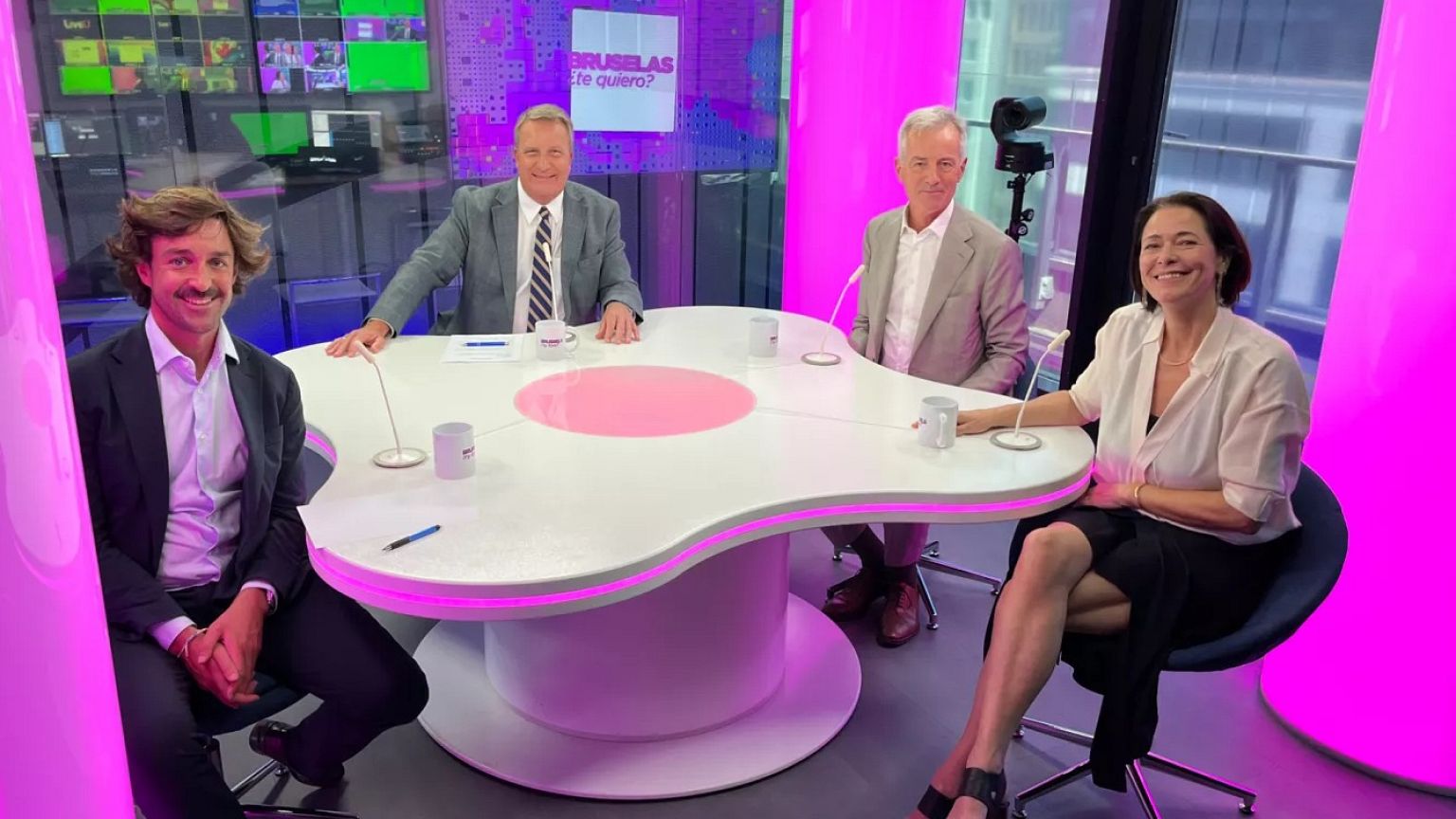
Brussels, my love? A placated Trump and an EU-Canada love fest

Copyright Euronews

By Stefan Grobe
Published on 28/06/2025


In this edition of our weekly talk show, the panellists discussed the outcome of the NATO summit, the military conflict over Iran's nuclear programme and the new partnership and security pact between the EU and Canada.

The leaders of the NATO countries met in The Hague for their annual summit. In view of the latent Russian threat, they agreed on a drastic increase in collective defense spending. But it was also about satisfying the unpredictable man in the White House. Does this solve all the problems now?

For decades, Europe has been the most loyal ally of the United States. That’s what most political and military leaders on both sides of the Atlantic understood Europe’s role on the world stage to be. 

That today is insufficient, as US president Trump treats his faithful allies as if they were devious freeloaders.

That’s why the prospect of being abandoned by the US produces existential angst among Europeans. Who would lead the western defense in case of a Russian attack?

In The Hague, European NATO allies agreed to invest more in the defense of their own continent: the target is now 5% of GDP over the next few years.

Is this realistic for everyone? Is it enough? Does it come with a new strategic role for Europe? And most important: will it placate Washington in the years to come?

Questions our guests discussed this week: Kathleen Van Brempt, a Belgian member of the European Parliament from the Social Democrats, Matthew Robinson, director of the Euro-Gulf Information Centre, and Karel Lannoo, chief executive of the Centre for European Policy Studies.

The NATO summit was overshadowed by the Middle East conflict. After all, the largest and most important member of the alliance became a party to the war there. The US attacks on Iranian nuclear facilities came in support of Israel and ultimately brought about a ceasefire - but this was broken just hours later.

Does diplomacy still have a real chance after all?

The problem: there are still too few answers to too many questions. Is Trump's decision like kicking a hornet's nest? What real damage have the bombings caused? Is the Iranian nuclear program now history?

And what about regime change in Tehran? Does Trump want one or does he not? And how could this be achieved without a military invasion? And finally: what about the ceasefire?

Finally: Thank you Donald Trump! The US president's behavior has practically turned his neighbor Canada and the European Union into political lovers.

Trump's threat of the 51st federal state was echoed in this country by talk of the 28th member state of the EU. This week, the leaders of the EU and Canada met in Brussels for a summit - which also focused on defence. But that's not all: the bilateral security and defence pact, that was signed here, is the most far-reaching agreement that Europe has ever entered into with a third country.

This will open up new avenues for joint work on crisis management, military mobility, maritime security, cyber and cyber threats, and defence industrial co-operation.

Is Canada replacing the US as a favorite partner in North America?