Friday, July 18, 2025

Government intervention necessary for Canadian steel industry’s survival: Joly


By Spencer Van Dyk
Updated: July 17, 2025

In the face of trade uncertainty with the U.S., PM Carney has announced new measures to focus on Canada’s steel sector. Lindsay Biscaia has the details.

Industry Minister Melanie Joly says government intervention will be necessary for the Canadian steel industry’s survival, as U.S. tariffs continue to threaten it.

“Survival, and I think eventually, much more than that, the fact that they can thrive,” Joly said in an interview on the Vassy Kapelos Show across the iHeart Radio network on Thursday.

In March, the U.S. placed a 25 per cent tariff on Canadian steel and aluminum, doubling the tariff rate to 50 per cent in June.

Joly pointed to efforts to get Canadian shipyards to use domestic steel and for the government to leverage its procurement purchasing power to support the industry as examples of other potential measures the federal government is willing to pursue, beyond what has already been announced.

On Wednesday, the prime minister announced additional tariffs that target steel originating in China in an effort to protect the Canadian market.

In February, Canada laid out a series of counter-tariffs in response to the U.S. measures at the time, but has yet to respond to the doubling of steel and aluminum levies specifically.

Joly said she hopes Wednesday’s announcement will “calm down the anxiety in the steel sector,” while helping to protect jobs in the industry.

In a statement Wednesday, the United Steelworkers union called the announcement, specifically the changes to tariff rate quotas, a “major win for workers.”

But many industry stakeholders and experts are still concerned.

In an interview on The Vassy Kapelos Show on Wednesday, François Desmarais of the Canadian Steel Producers Association said diversifying the market, including domestically, is likely not enough to make up for the drop in exports to the U.S., because the latter is such a significant importer of Canadian steel, and the global market is oversaturated.

According to Desmarais, shipments to the U.S. fell by about 25 per cent and there were about 1,000 job losses in March, after U.S. President Donald Trump announced his initial round of 25 per cent tariffs on steel and aluminum. Once Trump increased the rate to 50 per cent last month, “basically all our export to the U.S. have stopped,” Desmarais said.

Joly said the steel industry should be seen not just as key to the manufacturing sector, but also to defence, as Canada has promised to meet its NATO defence spending target sooner than the previous government hoped to.

“Definitely, the steel industry is impacted by the tariffs that are imposed by the White House,” Joly told Kapelos, when asked whether the sector is at risk of collapse.

“They needed to pivot,” she also said. “They needed it to make sure, first, that we protect the Canadian market from any form of dumping from foreign steel, and at the same time, we need to support them as we’re creating much more a domestic market for them, maybe through defence procurement or maybe also through our major infrastructure projects to make sure that they build, or they develop the type of steel that our industries need here.”

Canada and the U.S., meanwhile, have been in ongoing negotiations for a new economic and security deal.

Last month, Carney said he and Trump were working toward a deal by July 21. But the U.S. president last week issued a new threat to impose 35 per cent tariffs on Canadian imports as of Aug. 1.

A White House official has confirmed to CTV News that the increased 35 per cent tariff will not apply to Canadian goods that comply with the Canada-U.S.-Mexico Agreement (CUSMA). Carney has since revised the deadline to reach an agreement by Aug. 1.

Pressed on whether the Canadian government will accept a deal with Trump that includes some baseline levies — after Carney shifted his tone earlier this week and cast doubt on securing a tariff-free deal with the president — Joly called the U.S. a “difficult administration,” and repeated that Canada will not negotiate in public.

“At this time in the negotiations, we’ll let the prime minister do his work, and we will make sure also, of course, that we don’t negotiate in public,” Joly said, when asked about the federal government’s concessions to the U.S. after campaigning on the promise of a strong response to Trump.

“And these are complex negotiations for every country on Earth,” Joly added. “So, it is important that we stand strong. It is important that we defend Canada and Canadians interest, and we will make sure to be there, and we have Canadians’ back.”

Spencer Van Dyk

Writer & Producer, Ottawa News Bureau, CTV News


Understanding Canada’s moves to block cheap steel imports

By The Canadian Press
 July 18, 2025 

Prime Minister Mark Carney delivers a statement at the Walters Group Steel fabrication plant in Hamilton, Ont., Wednesday, July 16, 2025. THE CANADIAN PRESS/Chris Young.

Prime Minister Mark Carney announced Wednesday that the government was tightening rules around steel imports. The move is an effort to protect Canada’s domestic industry from dumping as the global trade of the metal undergoes major shifts because of government actions out of the United States and China.

Here’s a look at some of the key questions.

What is dumping?

Dumping refers to foreign firms selling goods at artificially low prices, or prices that don’t accurately reflect their cost of production. It can also mean a company selling goods for less in foreign markets than comparable goods are selling for in their home market.

Companies tend to dump goods either by selling below cost to gain market share, or because an excess of production in their home countries has them looking for markets to offload the goods and recover some costs.Trade War coverage on BNNBloomberg.ca

Government subsidies can be a significant contributor to firms selling at artificial prices because they distort price structures. Subsidies can include simply giving money to companies to help them grow, more indirect aids like preferential access to land, as well as government loans and loan guarantees and tax breaks.


The Canadian government uses all of these levers to help grow domestic industries, but governments can only go so far within international trade rules. Subsidies that artificially reduce costs so manufacturers can flood foreign markets at unfairly low prices crosses that line.

How big of a problem is steel dumping for Canada?


While dumping cases are determined on specific products, the overall scale of steel imports has swelled over the past decade. Offshore imports have climbed from 19 per cent of the Canadian market in 2014 to 39 per cent in 2022, according to the Canadian Steel Producers Association.

The steel industry also dominates anti-dumping inquiries at the Canadian International Trade Tribunal, the body tasked with determining whether imported goods are being sold at artificially low prices.

The Canadian steel industry has challenged dozens of product categories from cold- to hot-rolled steel, various wires, piping and rods, even including stainless steel sinks. The tribunal has largely ruled in favour of applications that dumping has occurred and is harming Canadian industry.

And while there are problems now, the bigger concern is how much more product, especially from China, might get diverted to the Canadian market as the U.S. moves to close off imports.

It’s also expected to be a growing problem in the future as China’s domestic demand slows. China already has 50 million tonnes of overcapacity in steel production across its 360 mills, according to Wood Mackenzie, but it said that overcapacity could swell to 250 million tonnes over the next decade. Canada’s total production, meanwhile, was 12.1 million tonnes in 2023.

How long has it been a problem?

A long time. Canada introduced the first anti-dumping provisions in the world in 1904, which singled out a “special duty on under-valued goods,” according to international trade expert Dan Ciuriak in a report.

What was unique about the measure was that it was a flexible tariff, meant to make up the difference between the selling price and the fair market value.

The problem has continued and grown as global trade has increased, leading to growing calls to do more about it.

For steel, concerns grew as China’s exports surged to 110 million tonnes in 2015 before starting to retreat, only for it to surpass that total in 2024 with 115 million tonnes in exports, according to the International Trade Administration.

Back in 2020, United Steelworkers union national director for Canada Ken Neumann said the problem of illegal steel dumping needs to stop.

“Our union will continue to aggressively defend the jobs of steelworkers across Canada who for too long have been harmed by steel imports dumped into our country and sold at unprofitable, below-market prices.”

What do the latest tariffs aim to achieve?

Canada already imposed 25 per cent tariffs on imports of steel and aluminum from China last year, with the move coming into place in October.

But the steel industry and others have maintained that other countries are taking steel produced in China, processing it further and then trying to export it as originating from the there.

The latest measures are meant to help protect against that work-around. That’s why the government imposed the 25 per cent tariff on steel products that were “melted and poured” in China.Latest updates on commodities here

The move is the culmination of years of efforts to increase transparency in steel imports, including a requirement that went into effect only last November for importers to declare the country the metal is melted and poured.

Catherine Cobden, CEO of the Canadian Steel Producers Association, said the measures will go some ways to tackle China’s actions as an “egregious” overcapacity practitioner.

“Canada is taking direct aim at global steel overcapacities, and frankly, it’s a strong position, and I think will be applauded around the world. This is something that even the United States hasn’t yet done.”

---

Ian Bickis, The Canadian Press

This report by The Canadian Press was first published July 18, 2025.
Canada eyes Mercosur trade pact to reduce U.S. reliance, minister says

Mercosur - includes Brazil, Argentina, Paraguay and Uruguay 

By Reuters
July 18, 2025 at 6:40AM EDT

Minister of International Trade Maninder Sidhu arrives for a caucus meeting Parliament Hill in Ottawa on Wednesday, June 11, 2025. THE CANADIAN PRESS/Sean Kilpatrick

OTTAWA -- Canada’s international trade minister says that there was interest from both sides to advance trade talks with South American bloc Mercosur, as Ottawa seeks new deals in a push to diversify from the U.S.

Prime Minister Mark Carney and his team have been locked in talks with U.S. President Donald Trump to hash out a trade deal by August 1, which could help reduce tariffs on Canada.

But his government is also preparing to rely less on a relationship that generated bilateral trade of over $1 trillion (US$727.33 billion) last year and to focus on diversifying trade by signing free trade pacts globally.

“I had conversations with the foreign minister of Brazil, and there is appetite to carry out conversations around Mercosur,” Minister Maninder Sidhu said in an interview with Reuters.

Brazilian President Luiz Inacio Lula da Silva had said in April that he was interested in advancing talks for a trade deal between South America’s Mercosur bloc and Canada.

Mercosur - which includes Brazil, Argentina, Paraguay and Uruguay - has had negotiation rounds for a trade deal with Canada in the past.

Canada is also keen to continue talks with China to address trade challenges and views a thawing of relations between India and Canada as an important step to support trade, the Minister said.

“With China, there are opportunities, there are challenges,” he said, adding that the countries are holding frank discussions on a path forward on trade tariffs around exports of canola, beef, pet food and many other products.

Canada has 15 free-trade deals covering 51 countries, giving it access to 1.5 billion consumers and Sidhu said that Ottawa will be pursuing more such deals in the coming months without giving a specific target.

He had signed a free trade deal with Ecuador and an investment promotion pact with the UAE in his first two months in office and said discussions are on with the ASEAN countries and also individually with countries in the Indo-Pacific, including Indonesia and the Philippines.

Over-exposure

Sidhu said Canadian companies are over-exposed to the U.S. and they are not as competitive as they used to be due to Trump’s tariffs.

“My job is to be out there opening doors,” he said, adding that he would seek to diversify not only trade but Canada’s defense procurements from the U.S.

Carney has promised to increase defense spending by an additional C$9 billion this year to meet NATO’s target of spending 2% of GDP.

“We are working with the European Union and other partners around the world to help unlock some of those procurement opportunities in defense for our Canadian companies,” he said.

Canadian exports to the U.S. dropped in May to 68% of total exports from a monthly average of 75% last year. The U.S. share in May was the lowest on record as companies pushed to diversify from the U.S.


He did not respond directly on what a trade deal between Canada and the U.S. would look like, but said the government would “work towards a deal that’s best for Canadian businesses and Canadian workers.”

Reporting by Promit Mukherjee; Editing by Caroline Stauffer, Rod Nickel and Saad Sayeed, Reuters
‘Actions are louder than words’ First Nations say as Carney tries to turn the page with major projects summit

By Rachel Aiello
 July 17, 2025 


‘There’s a lot of work to do’: AFN Chief speaks following meeting with PM Carney

‘It is colonization in 2025’: First Nations leaders on Bill C-5 following meeting with PM
Indigenous leaders hope meeting with PM ‘is the first step of many’
Carney: One Canadian Economy Act has Indigenous economic growth ‘at its core’


GATINEAU, Que. — Prime Minister Mark Carney opened Thursday’s First Nations major projects summit trying to turn the page, but attendees were quick to say that it’s going to take more than one meeting to build consensus around Ottawa’s plans to rapidly develop new energy and infrastructure projects.


Carney convened the major one-day meeting, bringing First Nations chiefs and organizations together at the Museum of History to discuss the implementation of his Building Canada Act, which gives cabinet the power to sidestep existing laws to expedite approvals for big energy and infrastructure projects deemed to be in the national interest.

Thursday’s summit – attended by several cabinet ministers and Indigenous MPs as well as hundreds of First Nations stakeholders – was set up after the Liberal government faced major backlash from chiefs who said their rights were not respected in the rush to pass the legislation through Parliament.

“I’m going to say a few words, and then I’m going to listen,” Carney said at the start of his 15-minute opening remarks.

He went on to emphasize how the contentious legislation – known as Bill C-5 before it passed into law last month – is about enabling a process, and that the government has yet to identify specific projects to start consulting on.


“By moving forward together, we can write a new chapter. We together can write a new chapter in the relationship between the government of Canada and First Nations. And those aren’t just words. This isn’t an aspiration. This is the law,” Carney told the crowd, seated in the grand hall, which features the world’s largest indoor collection of totem poles.

Seeking to assure the many chiefs who came to the national capital region for the meeting that the federal government is only interested in projects that have Indigenous interest and collective economic opportunity, the prime minister promised First Nations leaders they can “help build the prosperity of your communities for generations to come.”

Setting expectations Wednesday for the discussion to be led by Indigenous people, Assembly of Manitoba Chiefs Grand Chief Kyra Wilson said Thursday that as of mid-morning, it was “more so a panel format where we’ve been listening in on a number of different speakers.”

But that seemed to change as the day went on. Coming out of the day-long discussions on meaningful consultation and economic prosperity, attendees speaking to CTV News said that while Carney stood by his law – signalling amendments won’t be the path he takes – the prime minister did hear them out.

“The agenda was, I would say, abandoned to accommodate the speeches of the chiefs and the concerns of the chiefs, which I feel was a good move of on the prime minister’s part,” said Treaty 8 First Nations Grand Chief Trevor Mercredi. “It’s good to have the prime minister sitting with us … he made himself available and we brought our concerns and letters forward.”

Terry Teegee, the elected Regional Chief of the British Columbia Assembly of First Nations, said Wednesday he was coming in a bit “cynical,” but by the end of Thursday, he said he was “cautiously optimistic” after watching the prime minister face “tough … hard … and blunt questions.”

“I’m glad the prime minister and cabinet ministers stayed all day … but still I think the way the legislation is crafted, as we heard today from many chiefs, there’s still a lot of trust issues,” he said.


“We’ll see where this goes … actions are louder than words.”
‘The conversations are happening’

Speaking briefly with reporters before the meeting got underway, Carney was confident about the government getting consensus from First Nations leaders about how to move forward.

“Everyone wants to make the country better,” he said. “Everyone wants more resources for social services, for health, for education, for community services,” he said.


Though, heading in, several chiefs said their expectations were low, and by midday attendees emerged from the early sessions doubtful about getting on the same page by the end of the day.

“I don’t think we’ve gotten to a place where you’re going to see any agreement come out of this, but the conversations are happening and I think that’s what people have come here to do,” said Grand Chief Jerry Daniels with Southern Chiefs’ Organization. “The issues are too complex.”

Chief Murray Clearsky from the Waywayseecappo First Nation in Manitoba said that as someone who was involved in the Idle No More movement, he still thinks the conditions are there for a second, similar protest to be sparked.

“Depends how things go here,” he said. “I’ll say one thing, if we don’t get what we want, like people are talking and I’m hearing a lot of them … I’m not scared to start it up again,” Clearsky said.

Others were still willing – as Assembly of First Nations National Chief Cindy Woodhouse Nepinak put it yesterday – to give the prime minister the “benefit of the doubt.”

Grand Chief Wilbert Kochon of the Sahtu Dene Council said that he thought Carney was “speaking from the heart.”

“I think we can work with him,” he said.

Though outside the meeting, emotions ran high, from protesters on scene worried about protecting their land, to a group of First Nations Chiefs from Treaty 6 – which covers central portions of present-day Alberta, Saskatchewan and Manitoba – calling the meeting they did not attend “political theatre.”
More meetings needed, coming

Speaking to reporters outside – after they were not permitted by the prime minister’s planning team to stay inside the museum to hear her speech – Chief Woodhouse Nepinak affirmed that this summit “will not be a one-off.”

“I don’t think that a one-day meeting is going to solve 150 years of a new young country that we are,” Woodhouse Nepinak said. “It’s going to take a lot more than that.”

Among her list of requests of the Crown were to tackle the Indigenous infrastructure gap, no “big budget cuts” to services, and Carney committing to a follow-up meeting a year from now.

While some positive assurances around these concerns were made by ministers speaking to reporters when the summit wrapped, the prime minister has yet to affirm publicly if he’s putting a one-year touchpoint on his calendar.

Carney has confirmed he’ll be launching a “regional dialogue and consultation process that will provide further opportunity for input and feedback,” noting not all invited chiefs could attend given local wildfires.

Carney will also be meeting with Inuit and Métis leadership in the coming weeks, though he also told chiefs today he plans to get his new major projects office up and running, and ready to start considering approvals for new energy and infrastructure developments, by Labour Day.

“There’s many steps to complete before we actually select a project, and the prime minister wants to make sure that that’s done well,” said Indigenous Services Minister Mandy Gull-Masty. “In his closing comments, he spoke about the level of trust and what’s needed to make sure that we get to that place together.”


Rachel Aiello

National Correspondent, CTV News
Canadian wheat, canola crops a ‘mixed bag,’ with rain critical

By Reuters
July 18, 2025 

A seeding rig is used to plant a wheat crop on the family farm near Cremona, Alta., Tuesday, May 6, 2025. THE CANADIAN PRESS/Jeff McIntosh

LANGHAM, Saskatchewan - Canadian farmers are likely to produce average-size wheat and canola crops this autumn, but years of drought have made rain critical for the plants to fulfill their potential, farmers and analysts said this week at the Ag in Motion farm show.

In eastern Saskatchewan, Robert Andjelic, a major Canadian farmland investor, said he was seeing lush, dense crops of spring wheat and canola in perfect condition. In southwestern Saskatchewan, however, he described spring wheat dying under the pressure of extreme drought.

Across Western Canada, he saw a wide range of “terrible” to “terrific” crops, he said.

“It’s such a mixed bag,” he said while touring some of the more than 225,000 acres (91,000 hectares) he owns across the prairie provinces.

Canada is the world’s largest exporter of canola, durum wheat, and some pulse crops such as lentils, with China, the United States, Japan, Mexico, North Africa, and India among its largest buyers. Its spring wheat crop is vital to millers around the globe, and U.S. grocery shelf staples such as Cheerios cereal and Quaker oatmeal rely on Canadian oats.


Analysts and farmers interviewed by Reuters said they expect the country’s total crop output to be about the same as last year, when farmers also endured a wide range of conditions, but still produced one of Canada’s biggest crops ever.

While that probably means Canada’s canola and spring wheat production will be about the same as last year, when farmers produced average-sized harvests, the outlook is worse for durum wheat and lentils, which farmers grow in some of the areas hit by extreme dryness.

“They have been under these conditions too long,” crop analyst Bruce Burnett of MarketsFarm said about some durum and lentil crops in the southwestern Prairies, adding that some were being baled for livestock feed.

Farmers said cereal grains such as wheat and durum were developing far fewer kernels per plant because of drought in some areas, resulting in lower yields.

Burnett estimates Canadian durum yield will be less than last year’s 34 bushels per acre, which was an average yield.

Most farmers need at least one more significant rainfall for grain kernels to fill out, farmers and analysts said.

Burnett said canola crops were benefiting from cooler weather this July than last year, when scorching heat damaged millions of acres that were in the crucial flowering stage. Smoky air from forest fires was making the sunlight less direct and harsh, he said.

The oilseed is crushed mainly to produce vegetable oil and animal feed.

Statistics Canada is scheduled to issue its first crop production estimates of the year on August 28.

Farmer adviser Rob Saik, who drove across central Alberta and Saskatchewan to the farm show, said some parts of the Prairies were producing durum, lentils, and canola hammered by drought, but in most places, “we’re in pretty good shape.”

Reporting by Ed White in Langham, Saskatchewan. Editing by Emily Schmall and Rod Nickel, Reuters
Canadian Union of Postal Workers urges workers to reject contract offer

By The Canadian Press
July 18, 2025 

Canada Post mail trucks are seen parked in their distribution centre in Montreal, Wednesday, Nov. 27, 2024. THE CANADIAN PRESS/Christinne Muschi

OTTAWA — The Canadian Union of Postal Workers is urging workers to reject Canada Post’s latest contract offer.

Union national president Jan Simpson says a strong no vote would not only reject the offer, but also protect the integrity of the bargaining process.

The Canada Industrial Relations Board will hold the vote on the proposed deal starting next week.

Canada Post is at an impasse with the union representing roughly 55,000 postal service workers after more than a year and a half of talks.

Federal Jobs Minister Patty Hajdu last month asked the board to step in and put the Crown corporation’s latest offer to a vote.


The offer would see wage hikes of more than 13 per cent but also add part-time workers Canada Post says are necessary to keep the postal service afloat.

This report by The Canadian Press was first published July 18, 2025.

The Canadian Press

 World Nuclear News


Westinghouse plans ten AP1000 reactors in the USA

Friday, 18 July 2025
Westinghouse plans to start construction of the first of ten new AP1000 reactors in the USA by 2030, interim CEO Dan Sumner told President Donald Trump at the inaugural Pennsylvania Energy Summit and Expo in Pittsburgh.
Westinghouse plans ten AP1000 reactors in the USA
(Image: Westinghouse)

Four executive orders signed by President Trump on 23 May aim to support the entire US nuclear supply chain and the ambition to quadruple the nation's nuclear energy capacity by 2050. Three of the orders are firmly focused on reforms that will boost the civil nuclear energy sector. The fourth one aims to ensure the rapid development, deployment, and use of advanced nuclear technologies to support national security objectives, including AI data centres at Department of Energy facilities.

Hosted by US Senator David McCormick, the Pennsylvania Energy Summit and Expo on 15 July highlighted the state's significant role in shaping the future of AI and energy innovation. Dan Sumner, interim CEO of Pittsburgh-headquartered Westinghouse, took part in a CEO Roundtable attended by President Trump, top Administration officials, including US Energy Secretary Chris Wright, and US Secretary of the Interior Doug Burgum.

"We've taken the call-to-action under your executive order to partner with companies across our industry to mobilise a plan to deliver ten AP1000 reactors in the US with construction to begin by 2030," Sumner said. "When we deploy a fleet aligned to your vision, we'll drive USD75 billion of economic value across the United States with USD6 billion of value here in Pennsylvania. Implementing your vision will create or sustain over 55,000 jobs across the country and over 15,000 jobs in the Commonwealth alone, and these are great jobs across manufacturing, engineering and construction."

The event showcased a USD92 billion commitment to cutting-edge AI and energy initiatives.

Utility Constellation announced that it will create 3,000 jobs per year as a result of a USD2.4 billion investment to uprate the Limerick nuclear power plant by an additional 340 MWe. 

"We commend state and federal leaders for helping to make these investments possible and for recognising the unique value of reliable and safe nuclear energy to power our economy and bolster our nation's energy security," said Constellation President and CEO Joe Dominguez. 

"As the nation's second largest energy producer and a global nuclear power leader, Pennsylvania is uniquely positioned to deliver the abundant, affordable energy that growing AI and advanced manufacturing sectors demand," said Senator McCormick. "We have the skilled workforce to build and operate this critical infrastructure, world-class universities driving innovation, and strategic proximity to over half the country's population."

US seeks pilot production lines for advanced reactor fuel

Friday, 18 July 2025

The US Department of Energy has announced the start of a new pilot programme to accelerate the development of advanced nuclear reactors and strengthen domestic supply chains for nuclear fuel.
US seeks pilot production lines for advanced reactor fuel
(Image: DOE)

In response to executive orders signed by President Trump on 23 May, the Department of Energy (DOE) last month launched a pilot programme to expedite the testing of advanced nuclear reactor designs under DOE authority outside of the national laboratories, with the goal of three reactors reaching criticality by 4 July 2026. It issued a Request for Application (RFA) as it seeks "qualified US reactor companies" interested in constructing and operating the test reactors. DOE said it is currently reviewing potential applicants and anticipates selecting at least three advanced reactor designs in the coming months.

In a move to establish a domestic nuclear fuel supply chain for testing those new reactors, the DOE has now issued a Request for Application and is seeking qualified US companies to build and operate nuclear fuel production lines using the DOE authorisation process. It said it is "relying on the same authority used to expedite testing to jumpstart fuel line development and rebuild America's nuclear fuel production base".

The DOE said the new advanced nuclear fuel lines will serve research, development, and demonstration purposes. It noted that DOE authorisation will unlock the next level of private funding and provide a fast track to a Nuclear Regulatory Commission licence, "and hence, commercialisation for authorised fuel fabrication lines". 

Applicants will be responsible for all costs associated with the construction, operation, and decommissioning of an advanced nuclear fuel line, as well as the procurement of all nuclear material feedstock. The selections will be based on a set of criteria, including technological readiness, established fuel fabrication plans, and financial viability.

Initial applications are due by 15 August, with subsequent applications allowed on a rolling basis.

"America has the resources and the expertise to lead the world in nuclear energy development, but we need secure domestic supply chains to fuel this rapidly growing energy source and achieve a true nuclear energy renaissance," said Energy Secretary Chris Wright. "The Trump Administration is accelerating innovation, not regulation, and leveraging partnerships with the private sector to safely fuel and test new reactor designs that will unleash more reliable and affordable energy for American consumers."

McClean Lake mine resumes production after 17-year hiatus


Friday, 18 July 2025
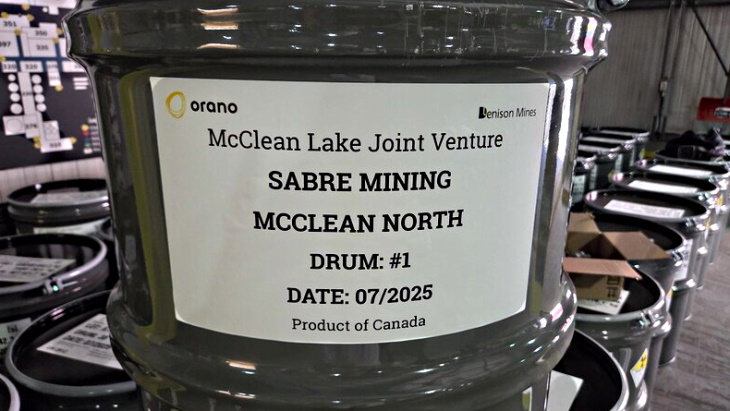
Uranium mining operations have started at the McClean Lake project in Saskatchewan, Canada, using the Surface Access Borehole Resource Extraction mining method, joint venture partners Orano Canada and Denison Mines have announced.
McClean Lake mine resumes production after 17-year hiatus
(Image: Denison Mines)

McClean Lake is in the eastern part of the Athabasca Basin region in northern Saskatchewan, about 750 kilometres north of Saskatoon. The McClean Lake Joint Venture (MLJV) is 77.5% owned by Orano Canada and 22.5% by Denison. Orano Canada is the operator. Mining operations were suspended in 2008 due to declining uranium prices. 

In January 2024, Orano Canada and Denison announced that production was to restart at McClean Lake using their patented Surface Access Borehole Resource Extraction (SABRE) mining method.

At that time, the companies said they intended to begin mining at the McClean North deposit in 2025, targeting production of 800,000 pounds U3O8 (308 tU, 100% basis) in 2025. Around 3 million pounds U3O8 (100% basis) has been identified for potential additional production from a combination of the McClean North and Caribou deposits from 2026 to 2030.

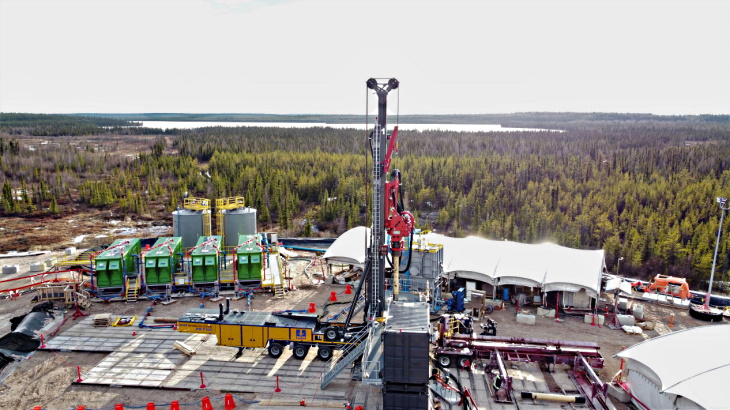
Orano Canada and Denison have now announced that mining of the McClean North deposit using SABRE began last month, with about 250 tonnes of high-grade ore (+10% U3O8) estimated to have been recovered from the first mining cavity. Orano Canada also said it has successfully backfilled the first cavity, advanced the SABRE rig to the planned second mining cavity, and commenced processing of the recovered ore at the McClean Lake mill.


(Image: Denison Mines)

"The first commercial production of uranium with the SABRE technique marks a new chapter, allowing us to access and explore new territories," said Orano Mining President Xavier Saint Martin Tillet. "This innovation reinforces our commitment to delivering a reliable and responsible supply of natural uranium to nuclear power producers worldwide, supporting the generation of low-carbon electricity."

Orano Canada's President and CEO Jim Corman added, "Our long-term investment in R&D within Orano and the MLJV has culminated in the safe mining, milling and packaging of ore that in the past would have been deemed economically challenging to develop ... It truly is an innovative and exciting time to be in the uranium industry."

"The successful commencement of SABRE mining at McClean North marks a significant milestone in the history of the MLJV, as the joint venture returns to active mining operations for the first time since 2008," said Denison President and CEO David Cates.

What is SABRE?

SABRE is a non-entry, surface-based mining method that uses a high-pressure water jet placed at the bottom of a drill hole to excavate a mining cavity. The cuttings from the excavation process are then air lifted to the surface, separated and stockpiled. This innovative mining method can potentially allow economic access to relatively small high-grade orebodies that are either too small or too deep to be mined economically by conventional open-pit and/or underground mining methods, the companies say.


SABRE test at McClean Lake, 2021 (Image: Orano)

SABRE also offers operational and environmental advantages compared with conventional mining techniques. It is selective and scalable, which the companies say makes it suited to changing uranium market conditions, with an expected production ramp-up of months instead of years. It is less intrusive and has a smaller surface footprint than conventional methods, with lower water usage and power consumption, and - as it is a non-entry mining method - minimises radiological exposure for mine workers.

A five-year SABRE test programme was completed at McClean Lake in 2021, excavating some 1,500 tonnes of ore. 

"SABRE is unique in that the mining method can be selective and scalable, which has the potential to provide superior flexibility when compared to conventional mining methods and is thus ideally suited to ever changing uranium market conditions - with an expected production ramp up of months instead of years," according to the McClean Lake Joint Venture partners.

ČEZ and Rolls-Royce SMR sign Temelín early works agreement

Friday, 18 July 2025
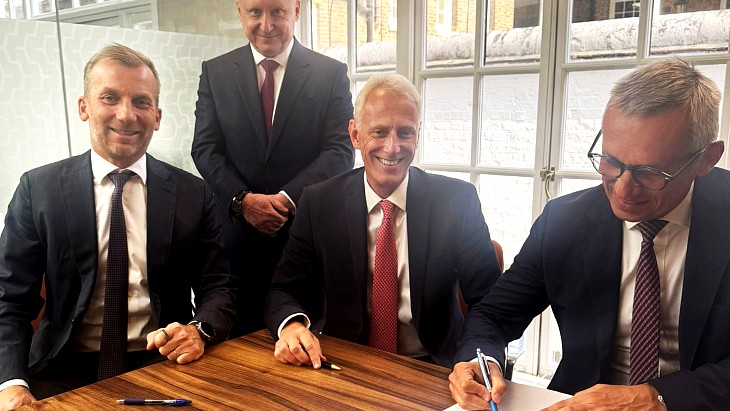
The Czech Republic's ČEZ and UK-based Rolls-Royce SMR have signed an Early Works Agreement to start site-specific work for potential small modular reactors at the Temelin nuclear power plant.
ČEZ and Rolls-Royce SMR sign Temelín early works agreement
From left: Pavel Cyrani, CEZ Vice-Chairman, Daniel Beneš, CEZ Chairman and CEO, Cholerton and Pleskac (Image: CEZ)

Rolls-Royce SMR was selected as technology partner by ČEZ last year for the proposed installation of up to 3 GW of capacity from small modular reactors (SMRs). It also acquired a 20% stake in Rolls-Royce SMR.

The aim is to build the first SMR in the Czech Republic near the existing Temelin nuclear power plant in the mid-2030s. There are also plans being developed for their deployment at the location of current coal-fired power plants.

Tomáš Pleskač, Member of the Board of Directors and Director of the New Energy Division of ČEZ, said: "Modular reactors are a great opportunity for the Czech economy and an essential part of the ongoing energy transition. The cooperation with Rolls-Royce SMR, which we established this year, offers a unique opportunity for growth and prosperity in the field of nuclear energy, also thanks to our participation in the technology development."

Chris Cholerton, Rolls-Royce SMR CEO, said: "This agreement is an important step forward in our partnership with ČEZ, demonstrating our shared ambition to move at pace to deliver reliable, clean nuclear power in the Czech Republic. We are proud to be working alongside ČEZ to deliver a programme that will bring significant industrial and economic benefits to both our nations, while helping to meet critical energy security and decarbonisation goals."

The early works will include regulatory approvals and licensing, an environmental impact assessment and preparatory site work, as well as detailed planning and regulatory engagement.

The Rolls-Royce SMR is a 470 MWe design based on a small pressurised water reactor. It will provide consistent baseload generation for at least 60 years. 90% of the SMR - measuring about 16 metres by 4 metres - will be built in factory conditions, limiting on-site activity primarily to assembly of pre-fabricated, pre-tested, modules which significantly reduces project risk and has the potential to drastically shorten build schedules.

Earlier this week the Czech and UK prime ministers signed a memorandum of cooperation on nuclear energy which included expanding business and industrial collaboration between the two countries.

Bulgaria partners with Citi for financing of new Kozloduy units

Friday, 18 July 2025
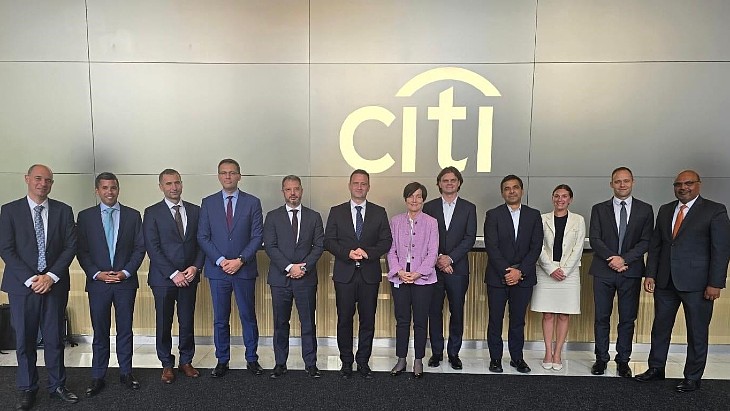
Bulgaria's Ministry of Energy and the US's Citi bank have agreed on a partnership to secure funding for the construction of two new units at the Kozloduy Nuclear Power Plant.
Bulgaria partners with Citi for financing of new Kozloduy units
(Image: Bulgaria Energy Ministry)

Citi's role will be as exclusive coordinator and lead arranger of export credit, with the Bulgarian ministry saying the partnership "is a clear sign of the strong trust that international stakeholders place in Bulgaria and its energy sector".

Energy Minister Zhecho Stankov said: "The agreement with Citi is a significant step toward the successful realisation of this priority energy project for the government. The construction of Units 7 and 8, which will be the first reactors in Europe using Westinghouse’s AP1000 technology, will ensure the country’s energy independence and long-term stability."

Stephanie von Friedeburg, Global Head of Public Sector Banking at Citi, said: "Citi is proud to be at the forefront of financing low-carbon energy solutions. The Kozloduy expansion represents a landmark transaction, one of the first large-scale projects of its kind. This project is pivotal for Bulgaria's energy future, and Citi is committed to providing the financial expertise to make it a reality."

The amount of finance required for the project has not been disclosed, but in December 2023 ministers said that the aim was to achieve a price of about EUR6 billion (USD6.5 billion) for each of the units. According to the energy ministry it will be the bank's largest nuclear financing project in central and eastern Europe.

Background

Kozloduy is home to two operating VVER-1000 reactors that were connected to the grid in 1987 and 1991, respectively, and together provide around a third of Bulgaria's electricity. Both units have been through refurbishment and life-extension programmes to enable extension of operation from 30 to 60 years. Four older VVER-230 units were closed ahead of Bulgaria joining the European Union in 2007.

The USA and Bulgaria signed an intergovernmental agreement to cooperate on the development of Bulgaria's civil nuclear programme, including the plan for the new units at Kozloduy, in early 2024, and Hyundai Engineering & Construction, Westinghouse and Kozloduy NPP-New Builds signed an engineering contract in November. The aim is for unit 7 to be operational in 2035 and unit 8 in 2037.

Containment dome of Hinkley Point C unit 2 installed

Thursday, 17 July 2025
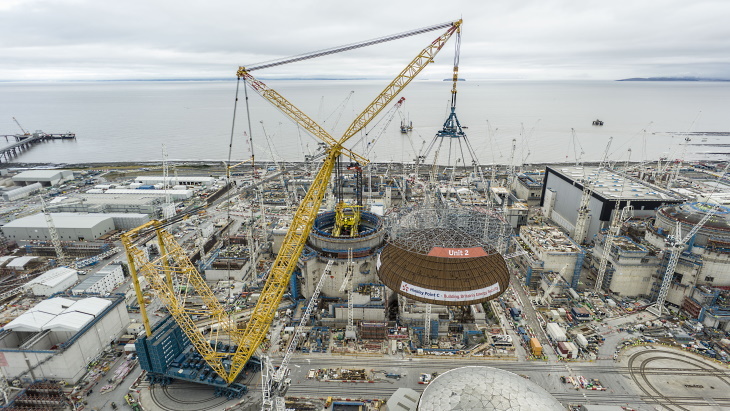
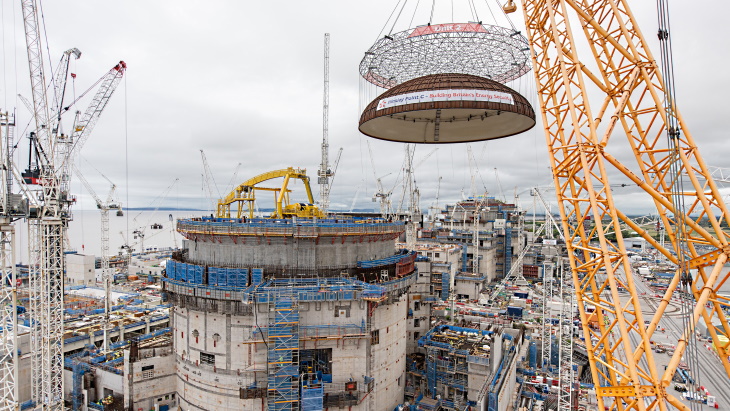
The dome of the containment building has been hoisted into place at the second unit of the Hinkley Point C nuclear power plant under construction in the UK. The milestone marks the end of the major civil engineering works on the plant's reactor buildings.
Containment dome of Hinkley Point C unit 2 installed
(Image: EDF Energy)

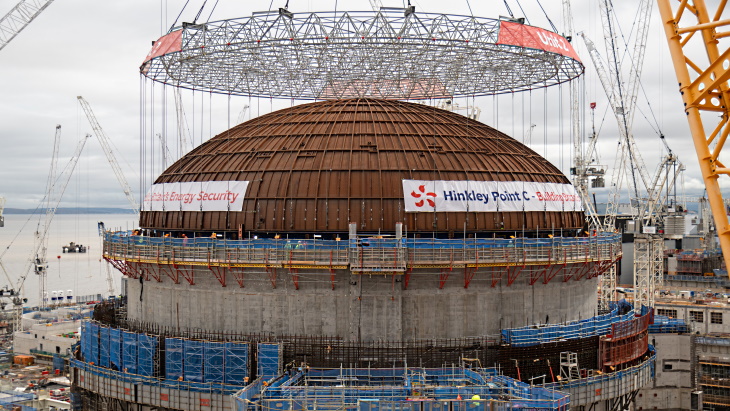
Using one of the world's largest cranes, known as Big Carl, the dome - with a diameter of almost 47 metres, height of 14 metres and weighing 245 tonnes - was lifted and then slowly lowered onto the 44-metre-high reactor building.

The dome is made up of 38 prefabricated panels which were shipped to Hinkley Point C and welded together in an onsite factory.


(Image: EDF Energy)

Work will now begin to weld an air-tight seal around the joint between the dome and the reactor building, which will then be encased with 7000 tonnes of concrete.

Construction of the first of two 1630 MWe EPR reactors at Hinkley Point C began in December 2018, with construction of unit two beginning a year later. The dome of unit 1 was put in place in December 2023.


(Image: EDF Energy)

EDF Energy noted that work on unit 2 was stopped during the Covid-19 pandemic, but teams are catching up on lost time.  Their progress, it said, is helped by innovation and experience from unit 1, which means unit 2 is taking 20-30% less time to build.

Although the second dome was lifted 18 months after the first, unit 2 is further ahead, compared with the same moment for unit 1. On unit 2's civil construction, 30% fewer people achieved 40% more work than on unit 1 with prefabrication of structures now approaching 60%, EDF Energy said. In addition, more equipment has been fitted and 300 tonnes of internal steel installed, compared with just 10 tonnes at the same stage for unit 1.


(Image: EDF Energy)

"Restarting the industry has been hard, but the second of our two identical units shows the big benefits of repeating an identical design," said Stuart Crooks, CEO of Hinkley Point C. "Build and repeat is the best way to build new nuclear with time savings already at 20-30%. All our experience and innovation will benefit Sizewell C from the start."

Sizewell C will feature two EPRs and would essentially be a replica of the Hinkley Point C plant, with the aim of building it more quickly and at lower cost as a result of the experience gained from what is the first new nuclear construction project in the UK for about three decades.

A video of the dome lift can be viewed here.

Framatome to supply nuclear fuel to UAE's Barakah plant


Thursday, 17 July 2025
Framatome and the Emirates Nuclear Energy Company have signed an agreement for the supply of nuclear fuel assemblies and engineering services for the Barakah nuclear power plant in the United Arab Emirates.
Framatome to supply nuclear fuel to UAE's Barakah plant
The Barakah plant (Image: ENEC)

Under the agreement, Framatome will supply complete nuclear fuel assemblies for use at the Barakah plant. The fuel assemblies will be fabricated at Framatome's manufacturing facility in Richland, Washington, USA. Framatome will also provide engineering support services from its US headquarters in Lynchburg, Virginia.

"We are proud to provide our advanced fuel to ENEC, ensuring security of the supply and meeting the UAE's clean energy goals," said Framatome CEO Grégoire Ponchon. "The contract recognises our state-of-the-art technologies and the reliability of our workforce to provide exceptional services to our customers."

Framatome noted it has "over 40 years extensive experience fabricating fuel for Combustion Engineering design reactors like Barakah and has supplied more than 6,000 fuel assemblies of that type".

ENEC Managing Director and CEO Mohamed Al Hammadi added: "Our agreement with Framatome advances our strategy to strengthen the security and reliability of our nuclear fuel supply chain. Diversification is key to ensuring that we continue to deliver safe, clean, and reliable electricity - powering the sustainable growth of the UAE's economy. Framatome's expertise and commitment to international standards adds depth to our operations and reinforces Barakah as a global model for operational excellence in clean energy generation.

"We remain dedicated to advancing Barakah's infrastructure and capabilities, continually striving for excellence in the nuclear power industry. ENEC continues to build on its existing operations through enhanced security, competitive costs, and innovative fuel solutions."

Under a USD20 billion deal announced in December 2009, four Korean-designed APR1400 reactors have been built at the Barakah site by a consortium led by Korea Electric Power Cooperation (KEPCO). First concrete for Barakah 1 was poured in July 2012, while that for units 2-4 was poured in April 2013, September 2014 and July 2015, respectively. The units entered commercial operation between April 2021 and September 2024. The plant provides about 25% of the UAE's electricity needs.

Fuel assemblies are currently manufactured in South Korea by Kepco Nuclear Fuel - part of the prime contractor consortium led by KEPCO - and then shipped to the UAE.

"Today, ENEC continues to explore strategic opportunities that support the growth of the global civil nuclear sector, while ensuring the plant remains a cornerstone of the UAE's energy mix," the company said.

In January 2024, ENEC announced it had launched a tender for a domestic nuclear fuel assembly fabrication facility to produce fuel assemblies for the Barakah plant. It said the facility would be dedicated to the industrial fabrication of fuel assemblies from their various components.


Freeport LNG Granted 40-Month Extension for Delayed Train 4

Freeport LNG’s Texas export terminal was set to increase natural gas intake on Thursday following a shutdown of one of its three liquefaction trains earlier in the week, according to a company filing with state regulators and gas flow data from LSEG, as reported by Energy Now

In a notice to Texas environmental officials on Wednesday, Freeport reported an emissions event after Train 2 went offline Tuesday night due to a compressor system malfunction.

The development comes shortly after the Federal Energy Regulatory Commission on Thursday granted Freeport LNG Development LP an additional 40 months to complete its fourth liquefaction train. The extension moves the deadline to December 1, 2031, allowing the company more time to restart construction following delays caused by the June 2022 explosion that shut down the facility.

Train 4 would add 5 million tonnes per annum of LNG export capacity to Freeport’s existing three-train terminal, which currently operates at 15 mtpa. Once completed, total nameplate capacity would rise to nearly 20 mtpa. The expansion was originally approved in 2019 under Docket CP17-470. According to Natural Gas Intelligence, this marks the third time Freeport has requested an extension for the project.

The 2022 explosion was caused by overpressurized piping and resulted in a fire that shut down all liquefaction operations. Freeport remained offline for more than six months while conducting a root-cause investigation and implementing FERC- and PHMSA-mandated safety upgrades. Partial service resumed in early 2023 under revised regulatory conditions.

Freeport is the second-largest LNG export facility in the United States, accounting for roughly 15 percent of U.S. liquefaction capacity. Hart Energy reports that the company continues to evaluate financing and contractor alignment before issuing a final investment decision on Train 4.

Construction timelines remain dependent on permitting conditions, capital structure, and global LNG demand.

By Charles Kennedy for Oilprice.com


Trump’s AI Action Plan Set to Expand Energy Sources for Data Centers

The Trump Administration is expected to unveil a so-called AI Action Plan to detail policy guidelines, including expanding power sources for data centers and easing regulations, sources briefed by administration officials told Bloomberg on Friday.

The AI Action Plan is expected within days, with a set of measures to accelerate the development of AI in the United States. Some of the policies in the plan will be enacted via executive orders that President Trump will sign, according to Bloomberg’s sources.

In an executive order in his first days in office, President Trump directed in January relevant government agencies and bodies to develop and submit to the President an action plan to achieve the U.S. policy “to sustain and enhance America’s global AI dominance in order to promote human flourishing, economic competitiveness, and national security.”

This week, the Trump Administration announced more than $90 billion worth of AI and energy investments in Pennsylvania. These include Google’s $25 billion investment in data centers and infrastructure, Blackstone’s $25 billion investment in data centers and natural gas plants, and CoreWeave’s $6 billion investment in data center expansion.

President Trump’s agenda for next week includes remarks on AI at an event on July 23, so it’s possible that the AI Action Plan is unveiled around that date.

In the energy sector, U.S. power utilities have announced billions of dollars in capital plans for the next few years and are getting a lot of requests from commercial users, most notably Big Tech, for new power capacity in many areas next to planned data centers.

Onshoring of manufacturing activity and AI-related data centers are driving an increase in U.S. electricity consumption, Goldman Sachs said in a report earlier this year.

U.S. electrical power demand is expected to rise by 2.4% each year through 2030, with AI-related demand accounting for about two-thirds of the incremental power demand in the country, the investment bank said.

The world’s biggest economy will need all energy sources to ensure power demand is met. Natural gas is the biggest near-term winner of AI advancements, but renewables will also play a key role in powering the data centers of next-generation computing, analysts say.

By Tsvetana Paraskova for Oilprice.com