Wednesday, July 23, 2025


Judiciary Committee: FBI Spied On Catholic Priest For Not Divulging Info On Parishioner


By 

By Tyler Arnold


The Richmond office of the Federal Bureau of Investigation (FBI) spied on a priest because he refused to discuss private conversations he had with a parishioner who was converting to Catholicism, according to a July 22 report from the House Judiciary Committee.

According to the report, the Richmond FBI investigated the priest’s background, monitored his travel plans, and looked into his credit card information. This investigation was allegedly launched after the priest became uncomfortable with an FBI agent’s questions about a parishioner and said he would need to speak to the church’s leadership and an attorney before answering questions.

“There appeared to be no legitimate law-enforcement purpose for investigating this priest,” the report determined. “This new information suggests that the FBI’s religious liberty abuses were more widespread than the FBI initially admitted and led the public to believe.”

The report, provided to CNA by Ohio Rep. Jim Jordan’s office, offers more details about theextent to which the FBI investigated so-called “radical traditionalist” Catholics. 

The FBI’s investigation into supposed “radical traditionalist” Catholic ties to “the far-right white national movement” was first revealed to the public through a leaked Richmond FBI memo in February 2023.


Although the FBI under former President Joe Biden quickly disavowed the document when it came to light and asserted it was a single product of a single field agency, information unveiled by the Judiciary Committee shows the investigatory efforts into Catholics was more widespread and that the national FBI headquarters was involved.

In the report, the committee states that the Richmond FBI was working with the national FBI headquarters to develop an agency-wide document on “radical traditionalist” Catholics, which was ultimately shelved. The headquarters and other field offices also coordinated with the Richmond FBI investigation of the previously mentioned priest.

The 2023 memo cited the Southern Poverty Law Center (SPLC) for the definition of “radical traditionalist” Catholicism, but the new committee report says the field office relied on “several radical anti-religious materials” from organizations that “spewed radical, left-leaning ideology” to inform the agency apart from just the SPLC.

CNA reached out to the FBI for comment but did not receive a response by the time of publication.

Spying on a Catholic priest

Emails uncovered by the committee show that the Richmond FBI allegedly coordinated with the national FBI’s Counterterrorism Division, the Louisville FBI field office, and the international London FBI field office in its investigation of the Richmond-area priest who belongs to the Society of Saint Pius X (SSPX).

SSPX is a traditionalist Catholic priestly fraternity that holds an irregular canonical status with the Catholic Church. Its bishops were excommunicated in 1988, though that order was lifted in 2009. The Vatican has worked with SSPX with the intent of eventually reestablishing full communion.

The committee report showed that a Richmond FBI employee interviewed the priest about a parishioner who had recently been arrested.

When the FBI employee asked the priest whether the parishioner had spoken about “desires and plans to commit violence,” the priest “became very uncomfortable and started incoherently stuttering,” according to an email that the employee sent to the counterterrorism unit.

The email stated that the priest “requested to speak with the church’s leadership and attorneys” before continuing. It said the priest then “refused to speak with us any further but has continued to speak with [the parishioner] while in prison, and even attempted to visit him.”

The FBI employee incorrectly asserted in the email that the priest’s communications with the parishioner were “not considered privileged” because he “has not completed his catechism or been baptized in the Church.” Virginia law protects priest-penitent privilege for any confidential communication with a member of clergy related to “spiritual counsel and advice.” 

“The priest-penitent privilege rightly protects communications between a clergy member and an individual seeking spiritual guidance,” the report notes. “It is not dependent on the individual achieving certain milestones in his or her spiritual life.”

In response to the priest’s refusal to disclose confidential information, the Richmond FBI opened a “formal investigative assessment” of the priest. This included an examination of the priest’s ordination history and coordination with the FBI’s London office to monitor the priest’s trip to the United Kingdom. 

In emailed communications, FBI employees discussed the priest’s location, travel plans, and credit card information. The Richmond FBI employee also sought information from other agents about the SSPX more broadly, including the priestly fraternity’s recruitment efforts.

“This new information demonstrates that the FBI not only used its federal law enforcement resources to surveil certain Catholic Americans, but it also used these resources to investigate a clergy member,” the report states.

Richmond FBI briefings on ‘radical traditional Catholics’

The new committee report also details Richmond FBI briefings on traditionalist Catholics and the questionable sources from which they drew their concerns. 

An official Richmond FBI presentation document titled “Traditionalist Catholicism Overview” discussed the “core ideology and beliefs” of traditionalist Catholics and what they view as being “radical-traditionalist Catholicism,” which they abbreviate as RTC. 

Some “core concepts” of traditionalist Catholicism, according to the Richmond FBI presentation, include the Traditional Latin Mass, “conservative family values/roles,” a “rejection of modernity,” and a “tendency toward isolationism.”

The Richmond FBI categorized “radical-traditionalist Catholicism” beliefs to include “belief that mainline Catholicism is illegitimate” and “hardline positions on abortion, LGBTQ matters, and interreligious dialogue.”

It also allegedly includes “apocalyptic overtones,” “rigid fundamentalism [and] integralism,” and an “undertone of antisemitism.”

Some of the sources that FBI analysts cited regarding their concerns include an article in the Atlantic titled “How Extremist Gun Culture Is Trying to Co-opt the Rosary” and another article in Sojourners Magazine titled “The Catholic Church Has a Visible White-Power Faction.” 

The report noted that some of the sources disparage Catholics and the pro-life movement. In the Atlantic article, the author states “the convergence within Christian nationalism is cemented in common causes such as hostility toward abortion-rights advocates.” 

“The FBI analysts who developed the Richmond memorandum relied on literature with an inherent prejudice against people of faith and those with widely-held, deeply personal views of the sanctity of life,” the report notes.

Richmond FBI employees also worked with the FBI national headquarters to develop a “Strategic Perspective Executive Analytic Report” for external use. It notes that the Richmond FBI interacted with the national office about the possibility as early as December 2022, just a month after the Richmond office began to produce the now-retracted memo. Ultimately, this effort was abandoned after the Richmond memo became public. 

The report stated that current FBI Director Kash Patel, who was nominated by President Donald Trump, provided the committee with the documents. It accused the Biden administration and former FBI Director Christopher Wray of withholding information from the public and misleading Congress about the extent of the investigation into Catholics. 

“Under the Biden-Harris administration, the FBI disrespected and potentially violated the constitutionally protected religious liberties of faithful Americans,” the report states. 

“Throughout the committee’s oversight in the 118th Congress, the Biden-Harris administration refused to provide relevant information to the committee,” it adds.

Jordan in a statement to CNA said lawmakers “knew the Biden-Wray FBI was targeting Catholics, but new documents obtained by the committee — thanks to the leadership of FBI Director Patel — shows that it was worse than anyone thought.” 

“Contrary to Director Wray’s statements, the targeting of Catholics went beyond the Richmond Field Office and extended not to just offices across the country but around the world,” Jordan said.

CNA

The Catholic News Agency (CNA) has been, since 2004, one of the fastest growing Catholic news providers to the English speaking world. The Catholic News Agency takes much of its mission from its sister agency, ACI Prensa, which was founded in Lima, Peru, in 1980 by Fr. Adalbert Marie Mohm (†1986).


 

The Potential And Competitiveness Of The Four Major Financial Regions In Asia – Analysis


By 

By Zhao Zhijiang


The world today has shifted from an emphasis on globalization and “integration” to a state of “fragmentation” marked by deglobalization. Long-standing geopolitical tensions and pressures have gradually pushed countries toward regionalism. This structural shift signals a key trend: the global financial industry will become increasingly regional in the future. Asia, with its vast scale and the complex internal structures and institutional ecosystems of its countries, now stands at the forefront of this financial transformation.

A senior researcher at ANBOUND believes that on this basis, it is necessary to further divide Asia into four regions: East Asia, Southeast Asia, South Asia, and Central Asia (note: the Middle East and Russia’s Far East are not considered part of traditional Asia and are therefore excluded). Each of these regions should be systematically analyzed in terms of their potential and competitiveness in the financial industry.

By examining the latest data and trends, it becomes clear that Asia’s financial landscape is evolving into a structure dominated by East Asia, with Southeast Asia and South Asia serving as secondary centers, and Central Asia acting as a bridging hub. This emerging map not only reflects differences in financial maturity and institutional innovation across the regions, but also offers important strategic insights for China’s regional financial cooperation.

East Asia possesses the most mature regulatory systems and capital markets in Asia. According to statistics, by 2024, the number of listed companies in Asia had reached nearly 29,000, accounting for 27% of global market capitalization, with nearly 60% of them located in East Asia. The region also leads in fintech and green finance. A prime example is the rapid development of China’s Cross-Border Interbank Payment System (CIPS). According to the latest data, CIPS has extended its settlement services to 187 countries and regions worldwide, with the number of participating banks surpassing 4,900, a record high. In the field of green finance, China has established a comprehensive green bond standard system. In 2024 alone, a total of RMB 681.433 billion in various types of green bonds were issued domestically. At the same time, newly released standards such as the Specifications for Green Bond Environmental Benefit Information Disclosure Indicators are helping to improve international green finance rules and support China’s role in shaping a new international financial order.

Japan and South Korea, both strong players in the global financial industry, naturally possess significant potential and competitiveness. However, both countries are also facing powerful shocks brought on by demographic shifts. In response to this challenge, their innovative practices in the field of retirement finance have demonstrated strong adaptability and growth potential. Japan’s Government Pension Investment Fund (GPIF) and South Korea’s National Pension Service have adopted distinct investment approaches, achieving a high degree of professional management. Both have also made significant strides in the digitalization of retirement finance, establishing precise disbursement management systems and comprehensive statistical and regulatory frameworks. In fact, they even play critical roles in their respective countries’ monetary defense strategies.


Southeast Asia, as the second-tier sub-center of Asia, is emerging as a pivotal hub for regional capital and institutional development. Singapore, in particular, has long maintained a neutral position among U.S. dollar, Chinese yuan, and euro assets. With its highly developed financial system and regulatory framework, it has become a key destination for global capital and a preferred location for establishing regional headquarters. Meanwhile, countries like Vietnam, Indonesia, and Thailand are experiencing rising domestic financing demand driven by manufacturing shifts and the growth of their middle classes, prompting the evolution of local financial systems. Regional financial mechanisms are also gradually strengthening the financial platforms of these nations. However, significant differences in institutional structures and varying levels of macroeconomic stability among Southeast Asian countries present ongoing challenges to regional integration. Additionally, telecom fraud has become a major risk in the region, not only damaging Southeast Asia’s reputation, but also posing a threat to financial stability and security across the broader region, including East Asia.

It is worth noting that stablecoins are experiencing rapid growth in Southeast Asia. On the practical level, their usage in remittance services and e-wallet systems across the region continues to rise. Successful cases like the Philippines’ Coins.ph demonstrate the strong vitality of digital payment tools in this market. These innovations not only reduce cross-border payment costs and improve access to financial services, but more importantly, offer new financial solutions for populations traditionally underserved by conventional financial systems. As regulatory frameworks gradually improve and technological infrastructure continues to advance, Southeast Asia has the potential to become a major driver of global digital finance development.

The financial sector in South Asia, also part of the second-tier group, is primarily centered around India. As one of the fastest-growing large economies in the world, India has achieved major breakthroughs in fintech, payment systems, and digital identity infrastructure. Its Unified Payments Interface (UPI) system now processes tens of billions of transactions monthly and serves over 400 million users, while the Aadhaar digital identity system provides unified digital identification for 1.2 billion people. Together, these systems form the world’s largest digital financial infrastructure. Notably, India has been reaching out to neighboring countries to integrate them into a budding digital payment network centered around itself. Meanwhile, other South Asian nations are also actively seeking their own paths to financial innovation. For instance, Bangladesh is working to cultivate its domestic capital market through instruments like green bonds; Sri Lanka, having experienced a severe debt crisis, is collaborating with the International Monetary Fund (IMF) to build a more modern financial governance system; and Pakistan has made significant progress in issuing digital banking licenses and promoting mobile payments, with its young population providing a strong foundation for fintech adoption. However, compared to India, these countries remain constrained by structural issues such as smaller market sizes and less transparent institutions.

Lastly, there is the region of the five Central Asian countries. From a geo-economic perspective, Central Asia’s unique geographic location gives it a foundational role as a “bridge” and “corridor” for financial exchanges between Europe and Asia. This bridging role is reflected not only in capital flows, but also in institutional alignment and standards integration. Kazakhstan’s Astana International Financial Centre (AIFC), for example, has adopted a legal framework based on common law, providing a mutually recognized legal structure for both Eastern and Western capital. Meanwhile, Central Asian countries’ efforts in green finance are creating new opportunities for sustainable development financing in the region. Although the overall market size in Central Asia is limited and institutional stability remains a challenge, and while the development of centralized financial hubs will take time, the region’s potential as a Eurasian financial nexus is becoming increasingly evident. In particular, as China’s Belt and Road Initiative advances, Central Asia’s financial development is showing signs of deep integration with participating countries. For China’s development strategy on its western region, the growth of Central Asia’s financial systems holds significant strategic value. The region’s financial environment could become an important financing channel and cooperation platform, enabling China’s western regions to better integrate into global industrial and value chains, and achieve high-quality development.

The formation of Asia’s regional financial landscape is the result of the natural evolution of diverse institutional logics and development paths. In the coming era of deglobalization, increasingly shaped by regionalism, the key to the next stage of financial competition will lie in who can establish institutional paradigms within the region, who can gain pricing power over mobile capital, and who can take the lead in setting cross-regional financial rules. Looking at the current situation, a clear structure has already taken shape in Asia where East Asia leads the way, followed by South Asia and Southeast Asia, with Central Asia emerging as a new bridging hub.

Final analysis conclusion:

Asia’s financial industry is evolving into a tiered structure led by East Asia, with Southeast Asia and South Asia as secondary centers, and Central Asia serving as a bridging hub. This structure reflects not only the differences in financial maturity and institutional innovation across regions, but also offers important strategic insights for countries’ regional financial cooperation.

  • Zhijiang Zhao is a Research Fellow for Geopolitical Strategy programme at ANBOUND, an independent think tank.


Anbound

Anbound Consulting (Anbound) is an independent Think Tank with the headquarter based in Beijing. Established in 1993, Anbound specializes in public policy research, and enjoys a professional reputation in the areas of strategic forecasting, policy solutions and risk analysis. Anbound's research findings are widely recognized and create a deep interest within public media, academics and experts who are also providing consulting service to the State Council of China.


‘Crypto’ Is Silicon Valley Speak For Waste, Fraud, And Abuse – OpEd

Bitcoin Blockchain Cryptocurrency Money Exchange


By 

The Republicans in Congress, along with many Democrats, are rushing ahead with legislation to promote crypto currencies in various ways. Their motivation is not hard to understand; they got hundreds of millions of dollars in campaign contributions from the industry. In terms of economic policy, the effort to promote crypto is taking the country 180 degrees in the wrong direction. The only real question is how bad the results will be.


When we think of finance, we need to think of trucking. Just as we need the trucking industry to transport items to factories and stores, we need the financial sector to make payments and allocate capital. But both finance and trucking are intermediate goods; they don’t directly make us better off, like healthcare or housing.

The fewer resources (labor and capital) we devote to these sectors, the better. If we have fewer people working in these industries, it means that we have more people available to work in sectors that provide the items we value.

Everyone can understand this with trucking. If the size of the trucking sector had quintupled relative to the size of the economy in the last half century, we would probably all be talking about how incredibly inefficient our trucking industry is.

But almost no one complains about the inefficiency of our financial system, even though the share of some components (the securities and commodities trading sector) has quintupled over the last half century. Maybe this is because people in the financial industry teach at elite institutions, have columns in elite media outlets, and hold top positions in administrations of both parties.

But political power does not change reality. An efficient financial sector is a small financial sector, and our financial sector is clearly not small.


This is all essential background for any discussion of crypto. The crypto industry obviously intends to make money by pushing the stuff. The question is what will the rest of us get out of the increased use of crypto?

The answer is at best, not much. The best story from the crypto bros is that it will reduce transactions costs. They focus largely on the high swipe fees charged to retailers by credit cards.

These fees are in fact quite high, but this is the result of policy, not technology. In the European Union (EU) credit card fees are capped at 0.3% and just 0.2 percent for debit cards. The higher fees in the U.S., sometimes over 2.0 percent, is due to the way our system of credit cards is structured.

Credit card issuers offer cardholders a variety of benefits, from frequent flyer miles on airlines to direct cash back on purchases. The high swipe fees cover the cost of these benefits.

If the U.S. government capped fees, like the EU, credit card issuers would stop offering these benefits. Since the banks that issue the cards, as well as their partner companies, and credit card users, are all happy with the current situation, we don’t get regulation, and the cards continue to charge high swipe fees. Perhaps crypto can offer a way around this roadblock, but we should be clear, the savings are at the expense of people’s credit card goodies, not an actual increase in efficiency.

There could be some modest gains in efficiency from transacting in stablecoins, ignoring the regulatory issues and the need to change back to dollars, but these could all be obtained by allowing the Fed to create a digital dollar. The financial industry has lobbied hard to ensure the Fed does not create a digital dollar, or give all us all free digital bank accounts, because they want our money.

Again, the issue is not efficiency; it is a regulatory roadblock created by the financial industry. Effectively, the industry is saying that if we pay them lots of money in fees, they will let us move to a more efficient system of transactions, otherwise they will use their power to block it.

But we also need to get back to the issue of regulating the issuance of crypto currency, since that is what these bills are largely about. Effectively, they want the government to give the Good Housekeeping Seal of Approval to cryptocurrency so that consumers and businesses feel more comfortable using it.

This is most clear with the GENIUS Act and its treatment of stablecoins. These coins are supposed to be backed one to one by highly liquid assets, like dollar reserves. Folks not born yesterday know that issuers will try to find ways to skirt these reserve requirements in order to increase profits.

But don’t worry, we will have Donald Trump’s Commodity Futures Trading Commission watching them like hawks. (Yes, that is sarcastic.) But it gets worse, small issuers with less than $10 billion in stablecoins outstanding, will be regulated by the states.

There is a long history of bank runs in the United States and elsewhere which should be in everyone’s mind as Congress rushes to pay off its campaign contributors. Most of us can remember how the banks and other financial institutions pushed themselves into bankruptcy when the housing bubble collapsed in 2008-09, only to be rescued by government bailouts.

But we don’t need to go back to this ancient history. The Silicon Valley Bank, which had deposits from many of our big crypto promoters, faced bankruptcy in the spring of 2023, because the geniuses who ran it apparently did not know that the value of government bonds falls when interest rates rise. That bailout cost the government around $20 billion.

While it is understandable that the folks who stand to profit from having the government certify the value of their crypto, including Donald Trump and his stablecoin, would want these bills, there is nothing here for the rest of us. We are just looking at more bloat in the financial industry and the likelihood of more costly bailouts.

As has been and will always be the case, there is no use case for crypto other than black market transactions and facilitating ransom payments. But that doesn’t mean lots of rich boys can’t get richer from it.


Dean Baker

Dean Baker is the co-director of the Center for Economic and Policy Research (CEPR). He is the author of Plunder and Blunder: The Rise and Fall of the Bubble Economy.
Italy court says non-biological mother in same-sex union entitled to paternity leave


Copyright AP Photo

By Gavin Blackburn
Published on 22/07/2025 


The court argued that the child’s interest in having time with both parents and the parents responsibilities didn’t depend on their sexual orientation.

Italy's constitutional court has ruled that the non-biological mother in a same-sex union is entitled to paternity leave, equating her role with that of the father and therefore entitled to bonding time with a newborn.

The court found on Monday that a 2001 decree on parental leave was unconstitutional because it didn’t recognise that the non-biological mother in a lesbian civil union was also entitled to Italy's mandatory 10-day paternity leave.

The court argued that the child's interest in having time with both parents and the parents responsibilities didn't depend on their sexual orientation.

It's the second ruling in as many months hailed by LGBTQ+ activists amid efforts by the far-right-led government of Premier Giorgia Meloni to crack down on surrogacy and promote traditional family values.

In May, the constitutional court ruled that two women can register as parents of a child on a birth certificate, saying recognition of parental rights can’t be restricted to the biological mother alone in families with same-sex parents.

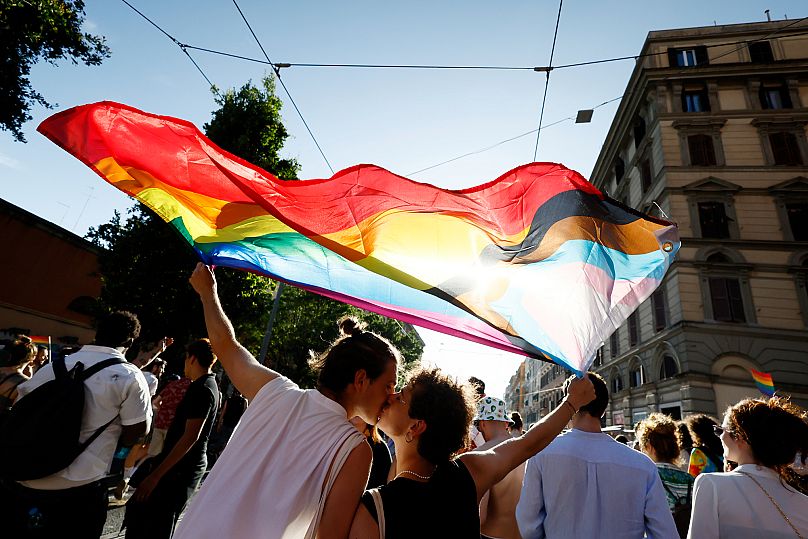
People attend the LGBTQ+ Pride parade in Rome, 10 June, 2023 AP Photo

Italy has strong restrictions on IVF and has had a ban on surrogacy since 2004.

Last year, under the Meloni government, the country expanded the ban to criminalise Italians who go abroad to have children through surrogacy.

Monday's ruling addresses women who have gone abroad for legally procured IVF treatments.

As with the May ruling, the association Pro Life and Family criticised the court's decision as "ridiculous," citing it as further evidence of how "gender craziness" was impacting Italy's social and legal order.

Lawmaker Alessandro Zan, who has long pushed for greater LGBTQ+ rights in Italy, hailed the ruling as an historic end to an "unjust and cruel discrimination."

"Justice reminds the government of a simple principle: love is family, and every boy and girl is entitled to the care and protection of both parents, without discrimination," he said in a social media post.

TikTok content moderators in Germany strike over AI taking their jobs


Copyright AP Photo/Kiichiro Sato, File

By Anna Desmarais
Published on 23/07/2025 


Trade union ver.di says about 150 employees in content moderation and content creator outreach are at risk of losing their jobs as TikTok looks to replace them with AI.

Workers at the social media company ByteDance, TikTok's parent, are on a one-day strike today in Berlin to protest the replacement of staff with artificial intelligence (AI).

Trade union group ver.di said that around 150 employees will be replaced by Chinese-sourced A models, which ByteDance trained on behalf of the company and external service providers.

The job cuts include the phasing out of the entire “Trust and Safety” department, responsible for content moderation and keeping the platform safe, and the Live department, which ver.di says is responsible for contact with content producers.

The workers have also tried but failed to get ByteDance to the negotiating table, the union said.

“It is disrespectful of TikTok to shirk all social responsibility and even refuse to negotiate with us,” said Lucas Krentel, ver.di’s deputy regional head of the media division.

“Today, the employees are sending a clear signal that they will not accept this,” he said in a statement.

What are workers asking for?

TikTok’s employees are the first in Germany to strike against a social media company, the union added. It comes after a small group of 50 employees took to the streets last week in Berlin to raise the alarm over the layoffs, local media reported.

The employees are holding a boat tour down the Spree River and will hold a rally on land later on Wednesday.

The workers on strike are asking for a collective bargain that would include a severance package that “recognises the difficult, vital nature of their roles,” such as prolonged exposure to highly distressing content.

That would include severance payments worth three years’ salary along with an extension period of 12 months for each employee.

Germany’s Dismissal Protection Act says that any employee who is being laid off due to urgent reasons should receive 50 per cent of their monthly earnings for each year that the person worked for the company.

The union says the demands are justified because of TikTok’s high profits and the replacement of content moderators by AI devalues their specific training and expertise.

TikTok’s moderators have in-depth knowledge of cultural and political contexts, which they need to identify problematic content. Getting rid of them increases the risk that the platform supports “manipulative campaigns,” the union said..

The Live department workers who reach out to content creators are “crucial for reach, monetisation and community engagement,” the union added..

The union also said that many of the affected employees are not German citizens, so losing their jobs could affect their rights to stay in the country.

If ByteDance does not come to the bargaining table, ver.di says a longer-term strike could come later this month.

Euronews Next reached out to ByteDance to confirm the incoming layoffs but did not receive an immediate reply.


Ukraine’s key logistical hub of Pokrovsk falls to Russian forces

Ukraine’s key logistical hub of Pokrovsk falls to Russian forces
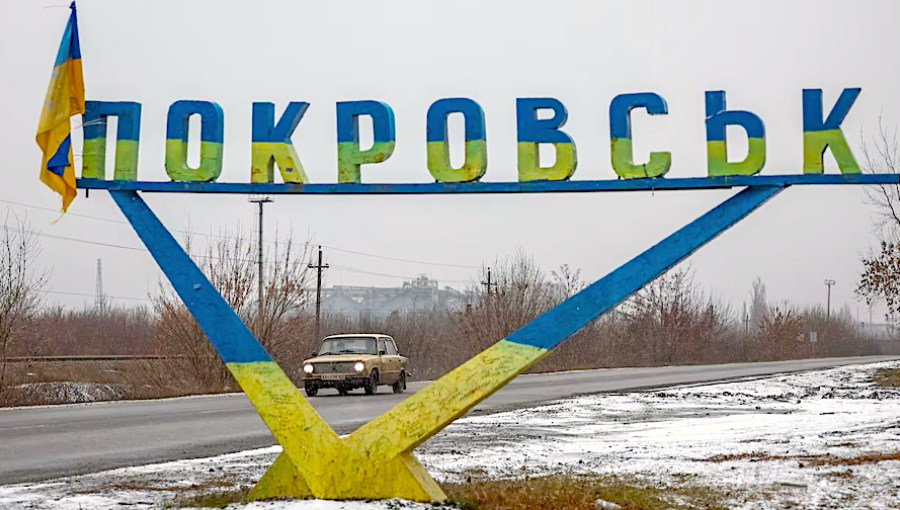
Ukraine’s key logistical hub of Pokrovsk falls to Russian forces Russian troops have entered the key Ukraine’s logistic hub of Pokrovsk. / bne IntelliNews
By Ben Aris in Berlin July 22, 2025

Ukraine’s key logistic hub of Pokrovsk has fallen to the Armed Forces of Russia (AFR) after more than a year of fighting, marking a major strategic defeat for Kyiv.

Russian forces have entered the eastern Ukrainian city of Pokrovsk, one of the fiercest flashpoints along the front line, and are now carrying out search and destroy operations, but have not yet dug in, Anna Fratsyvir of The Kyiv Independent reports.

If Russia consolidates its control of the city it would be a major strategic victory for the AFR and heighten concerns about Kyiv’s ability to hold strategic ground in Donetsk Oblast in the face of the growing momentum of Russia’s summer offensive.

The Ukrainian battlefield monitoring channel DeepState and frontline troops cited by The Kyiv Independent report that Russian troops breached the city from the direction of Zvirove in recent days, exploiting weakened infantry positions and what was described as “inaccurate situational reporting.” The incursion prompted an emergency Ukrainian military response to contain the breach and prevent “the situation from spiralling into disaster,” DeepState said.

The breach of the city's borders by the AFR comes only days after a frontline report by The Kyiv Independent’s Francis Farrell said the city was on the verge of being overrun by Russian troops.

The one time industrial city lies 67km northwest of Russian-occupied Donetsk and was described by Ukraine’s Commander-in-Chief Oleksandr Syrskyi as “the hottest spot along the entire 1,200-kilometre front line.”

While it remains unclear whether Russian troops and how well established Russian positions are within the city limits the fact that they have entered the city after a year of trying bodes badly for Kyiv.

An Ukrainian drone unit operating in the area told The Kyiv Independent that AFR forces were in the city and that Ukrainian troops were trying to organise a defence. Reports posted on social media suggest that intense street fighting is underway.

“Russian units attempted to entrench themselves and gain control over Defenders of Ukraine street,” DeepState said. “Some of them have been killed, others are still being hunted. The search and destruction of these groups is still ongoing.”

Ukraine’s military has yet to issue an official update on the situation in Pokrovsk following the latest incursion.

The battle for control of Pokrovsk in Ukraine’s eastern Donetsk region has been raging for more than a year. A large coalmining town, the city also lies at the nexus of a major rail and road network that are crucial for supplying Armed Forces of Ukraine (AFU) all along the eastern front with Russia’s forces.

The fight intensified significantly in early 2024 as the AFR targeted the city as strategically important and threw huge resources at it. Over 1,000 Russian soldiers have died a day, according to the Ukrainian Defence Ministry reports, although other analysts have put the death toll at a third of that.

Russian forces launched their attack on Pokrovsk as part of a broader offensive in Donetsk Oblast in spring 2024, following strategic gains around Avdiivka and Bakhmut, both of which were similarly won after protected campaigns and the great loss of life.

Similar to today, the fall of Avdiivka in February last year came after the US ran out of money for Ukraine and left the skies open to a massive Russian barrage that made the capture of the city easier. Since taking office in January US President Donald Trump has likewise cut Ukraine off from new funding and weapons supplies. Russian President Vladimir Putin launched a devastating missile barrage in May and the missile war has only intensified since then to record levels.

The fighting for Pokrovsk has been intense, including artillery bombardment, drone strikes, and trench warfare. It lies at a critical junction for the supply and reinforcement of Ukrainian positions along the entire eastern front.

Pokrovsk sits on a major railway line and an interconnected road network that links frontline positions with rear logistics bases in Dnipropetrovsk and central Ukraine. This makes it one of the few functioning railheads still within range to supply Ukrainian troops in the Donetsk direction.

In recent months Pokrovsk has been used by Ukrainian forces to rotate units, repair equipment, and replenish supplies, particularly ammunition and fuel. It acts as a buffer between active front-line sectors and deeper rear areas.It also provides access to key logistics corridors running northward toward Dobropillia and Pavlohrad, and westward toward Dnipro, a major logistics and command centre for Ukraine’s eastern military operations.

If the AFR consolidate control of Pokrovsk, it would hamper Kyiv’s ability to supply forces in Donetsk and eastern Zaporizhzhia as well as complicate troop movements throughout eastern Ukraine.

Pokrovsk is also the last major settlement in Eastern Ukraine before reaching the Dnipro river that cuts the country in half. In theory Russian forces could rapidly advance up to the banks of the Dnipro thanks to the lack of defensive positions for the AFU to occupy.

Ukraine’s military death tolls underestimated, Russia recruits sufficient to cover its frontline losses

Ukraine’s military death tolls underestimated, Russia recruits sufficient to cover its frontline losses
Ukraine's death toll from the war is "vastly understated" French newspaper Le Monde reports. Russia is taking even bigger losses, but is still recruiting more fresh soldiers a month than those killed or wounded in action, according to the official statistics. / bne IntelliNews
By Ben Aris in Berlin July 22, 2025

Ukraine’s official military casualty figures in the war with Russia may be vastly understated, according to a report published by the French newspaper Le Monde on Monday. Russia’s death toll is much higher, but official figures show the Kremlin’s voluntary recruitment drive is replenishing the ranks faster than its soldiers are being killed.

Death tolls in the four-year old war are state secrets on both sides of the conflict and analysts have been reduced to using proxies to estimate the true toll and official estimates from Defence Ministries are almost certainly massaged up or down. However, even these estimates are stark.

Since the start of the conflict over three years ago a total of 46,000 Ukrainian soldiers have been killed and another 380,000 wounded, Ukrainian President Volodymyr Zelenskiy told CBS News in February.

“The real death toll is likely much higher,” Le Monde reported based on Ukraine’s efforts to build military cemeteries. The state has two new national military memorial projects under construction in Kyiv and Lviv, as graveyards for fallen Ukrainian soldiers are nearing capacity. “Construction projects rising across Ukraine say more about the scale of the slaughter than statistics ever could,” Le Monde said, in comments widely shared in Russian media.

Ukraine’s manpower shortage

While the actual numbers remain cloaked in confusion, it is very clear that Ukraine is suffering from an acute manpower shortage, while Russia is not. No men aged 18 to 60 have been allowed to leave the country since February 2022 without special permission.

Russian President Vladimir Putin resorted to a partial mobilisation in September 2022 in the first year of the war, when the Armed Forces of Russia (AFR) faced a temporary manpower shortage. The Kremlin has avoided a general mobilisation at all costs, aware that it could cause a major revolt. And the costs have been high; the Kremlin has been paying out an entire year’s salary or more as signed up fees for voluntary recruits, which takes up a third of the military budget by itself.

Ukrainian President Volodymyr Zelenskiy was forced to order a general mobilisation almost as soon as the war started. Now anger and resentment is rising at the aggressive press-ganging of military-age men into the army – a process known as ‘busification’. Ukraine’s social media is filled with videos of men being snatched from the street and bundled into minivans by recruitment officers, sometimes at gunpoint.

Those forced to fight are fleeing their positions in record numbers. Desertions from the Armed Forces of Ukraine (AFU) is rampant. In the first six months of this year, Ukraine’s Prosecutor’s Office reported that it had opened 107,672 new criminal cases for desertion. Since 2022 some 230,804 such criminal cases have been instigated, suggesting that more soldiers have deserted the Ukrainian army than there are fighting men in today’s British, French and German armies combined, The Spectator reports.

And there is no respite for the members of the AFU. While Russia has sufficient men to be able to rotate them in and out of combat, Ukrainian soldiers serve continuously and are exhausted. A draft law proposed last year releasing military personnel from service after 36 months was squashed by the government for fear exacerbating the labour shortage. Small protests are regularly held by the families of soldiers calling not for the release of their men, but simply to give them a break from the front line occasionally.

Another new law making it possible for men aged 18-26, that are not subject to conscription, to volunteer for military service managed to attract a total of 500 recruits.

Russia fewer deaths, faster recruitment

The numbers of reported Russian dead from the war are clearly higher, but they also don’t add up. Ukraine’s supporters report the Russian death toll practically every day, usually citing the official estimates released by Ukraine’s Defence Ministry, as part of its media campaign to denigrate the AFR and boost support for Ukraine. Currently the numbers coming from the “meat grinder” that is the battle for Donbas sees at least a 1,000 Russian soldiers die a day according to these estimates.

However, other sober estimate put the number far lower. A verified list of dead Russian soldiers maintained by Mediazona and the BBC already exceeds 115,000 -- about 5,000 names are added each month, or 161 deaths per day from the whole of Ukraine, not 1,000.

The actual number of deaths is widely estimated at roughly double the Mediazona estimates, or around 300 dead a day. Washington's Center for Strategic and International Studies (CSIS), for example, puts Russian fatalities at 250,000, the Moscow Times reports. However, due to the incomplete access to information, the real number could be far higher.

Nevertheless, these estimates are still a third of what the Ukrainian Defence Ministry is reporting, and they are low enough to allow Russia to sustain its fight indefinitely as it can replace all the casualties with fresh recruits.

Typically, three times more soldiers on the offensive die than those on the defensive, However, what few numbers have come out on the daily death toll of the AFU are roughly on the same order as the estimate of Russian deaths – and with its smaller population even if fewer Ukrainians are dying than Russians, it can still lose the war by running out of men before Russia does.

While the AFU has the drone advantage, Russia maintains an overwhelming artillery, missile and heavy glide bombs advantage, powerful weapons that can completely destroy Ukraine’s defensive positions.

Much clearer is the information on Putin’s ability to replenish his manpower by recruiting fresh volunteers to fight for Russia.

“Some analysts — including myself — recently thought Putin would be unable to find enough conscripts to cover losses this year and that by late 2025, forcing him to choose between a forced draft and a ceasefire,” said Sergei Shelin in an opinion piece in the Moscow Times. “Unfortunately, the data paints a different picture.”

Ukrainian Commander-in-Chief Oleksandr Syrskyi claimed Russia suffered 32,000 irreversible losses in June alone (100 deaths a day), but official Russian figures suggested Russia added 190,000 volunteer and contract soldiers in the first five months of 2025, or 38,000 per month (1,225 per day). Russia is recruiting more soldiers a month than it is losing on the frontline, even if you believe Syrskyi’s probably inflated number. Monthly inflows exceed losses by roughly 10,000, according to Shelin.

Putin says about 700,000 Russians are currently fighting in Ukraine. His goal is to increase the number of active servicemen to 1.5mn largely through volunteers that draw heavily on Russia’s poorest regions, while the AFU is forced to resort to conscription of the dwindling pool of men left in the country. Russia’s population is at least four-times bigger than that of Ukraine’s, and that calculation is before you count out the roughly six million men that have already fled the country after the war started.