Sunday, July 27, 2025

Kazakhstan–US Tariff Question Indexes A Broader Geopolitical Pattern – Analysis

By  and 

(TCA) — When the United States announced a 25% tariff on selected imports from Kazakhstan, effective August 1, it offered little explanation beyond a vague appeal to restoring the trade balance. At first glance, this seemed routine, indeed almost perfunctory. However, the timing, context, and symbolic weight of the move suggest otherwise. Kazakhstan’s exports to the U.S. are modest, and key commodities are unaffected, yet the signal was received clearly in Astana.

What the Tariff Means in the Broader Picture

In the current phase of the international system’s evolution, tariffs no longer function solely as instruments of commercial redress. They have become vectors of strategic pressure, deployed to influence positions in a broader geopolitical context. From this perspective, Kazakhstan appears less as a trade partner than as a node within a larger and shifting strategic-connectivity network.

To interpret the tariff imposed by the United States on Kazakhstan as a bilateral irritant would be to miss its deeper significance. The target may be marginal in economic scale, but the symbolism is central. What is at stake is not merely the movement of goods, but the movement of expectations. What is at issue is how middle powers such as Kazakhstan read global cues and signal their response. The tariff is a point of entry into an evolving geoeconomic pattern.

Kazakhstan’s answer to the American move thus becomes an exercise in managing uncertainty under shifting rules. Astana has moved quickly by dispatching a delegation, issuing public reassurances, and subtly shifting its narrative. This is not a crisis for Kazakhstan, but it is not something that can be ignored either. What seems to have triggered the tariff is not the trade volume, but the context.

Kazakhstan’s longstanding ties with both Russia and China have complicated its attempts to preserve its autonomous balance in a tightening global field. The U.S. move may be part of a wider American effort to pressure states seen as too hesitant or too exposed. Kazakhstan’s early response is thus less a tactical correction than a move to preempt misunderstanding.

Background: A Cascade of Tariff Announcements

The tariff targeting Kazakhstan came at the end of a months-long sequence of trade announcements that began to accelerate in early 2025; it was not an isolated action. On April 2, under the now-familiar slogan of restoring reciprocity, the Trump administration unveiled a broad tariff package affecting more than 180 countries at a base level of 10%. Russia and Belarus were notably untouched, but Kazakhstan was singled out for a rate of 27%. No one could quite justify why, and Washington did not seem interested in explaining the move.

On July 7, Astana received a second notice: a revised tariff, now fixed at 25%, would take effect on August 1. This replaced the earlier measure and applied to a more specific set of goods. Without mentioning Kazakhstan by name, President Trump followed with a comment on social media about restoring “balanced flows” and correcting “distortions.”

More than twenty other countries — an eclectic list including Brazil, Japan, Laos, Mexico, and others — receivedsimilar notices around the same time. The criteria were opaque, with rates ranging from 20 to 50%. In most cases, there was no known dispute. What these countries seemed to share was some vague perception in Washington that they had failed to realign themselves with evolving U.S. expectations — whether on trade, supply chains, or political posture.

Kazakhstan’s inclusion in this group stood out, all the more so given its limited trade volume with the U.S. In 2024, its total exports to the American market were less than one billion dollars, most of which were concerned with commodities exempted from the new tariff. What remains is a small set of industrial exports, plus the question: Why now? The answer likely lies in the pattern of the American tariff policy, in which Kazakhstan is only one of many parts.

Tariffs, Rules, and Institutional Risk

Kazakhstan’s most significant shipments — crude oil, uranium, ferroalloys, and silver — are exempt from the new tariff. These four categories alone accounted for over 90% of total exports to the U.S. in 2024. The new tariff applies only to a narrow segment of Kazakhstan’s exports to the United States, mainly lesser-known industrial items such as steel pipes, specialty chemicals, and certain machine parts.

The real significance of the tariff lies not in revenue loss but in rules-based issues. Kazakhstan joined the World Trade Organization (WTO) in 2015, and WTO members make commitments to stability, predictability, and non-discrimination in market access. The U.S. tariff, by contrast, was announced unilaterally, without consultation, and without any WTO process. Punitive tariffs targeting specific countries outside a formal dispute resolution framework may be incompatible with the obligations assumed under the WTO’s Most Favored Nation (MFN) principle.

For Kazakhstan, the question becomes a tangible reputational risk. The country has heavily invested in its image as a rules-respecting member of the global trading system, so this is not an abstract concern. The WTO’s Director-General has warned that such selective bilateral tariff approaches threaten the core MFN foundation of global trade law.

The country has spent the past decade cultivating foreign capital, especially in infrastructure, mining, and logistics. If American tariff policy starts to look erratic, then other governments and firms may begin building risk premiums into their Kazakhstan strategy.

Kazakhstan’s Countermoves and Strategic Repositioning

In this context, diplomatic action functions as a counter-signal aimed at re-establishing interpretive control. Within days of receiving the July 7 notice, the government of Kazakhstan announced that it would send a senior delegation to Washington. The purpose of this move was to reframe the situation. Kazakhstan was not looking for a public concession but rather, at a minimum, to be heard.

Part of the delegation’s strategy is to shift the conversation away from tariffs and toward strategic value. Kazakhstan has quietly become a meaningful player in the global supply of critical minerals. Its deposits of rare-earth elements, particularly in the Karaganda region, are not to be neglected. Western companies have already begun exploratory partnerships, and it is not impossible that they can tip the conversation in Kazakhstan’s favor.

At the same time, Astana has already begun to assess potential fallout at the domestic level. The exporters affected by the tariff are relatively few in number, and none appear to be existentially threatened. The government may still offer them targeted relief such as export credits, transport subsidies, or tax offsets. Legal consultations are reportedly underway to explore filing a WTO case; this, however, would be a slow process, and likely only a symbolic one.

Possible Scenarios and Their Implications

The tariff’s immediate impact is modest, but its symbolic threshold is real. It introduces friction at a moment when Kazakhstan is seeking a stable economic and diplomatic orientation without crisis. Three scenarios are plausible:

  1. Astana persuades U.S. policymakers to soften or narrow the tariff, an outcome that would validate Kazakhstan’s geoeconomic relevance and normative alignment.
  2. The tariff persists, prompting Kazakhstan to redirect exports or adapt supply chains; such realignment could accelerate its turn toward Eurasian or Southeast Asian partners, while the U.S. remains a symbolic but not a strategic partner.
  3. If similar pressures are exerted against other middle powers, the tariff pattern may herald a broader strategic realignment, as these states will hedge more aggressively as confidence in the multilateral frameworks erodes.

At present, the unfolding of events will control the narrative. The test for Kazakhstan lies not in reversing the tariff itself, but in managing its constraints with sovereign agency. Its ability to navigate this space will determine the trajectory of its profile as a strategic regional actor.

TCA

TCA is The Times of Central Asia. Founded in Bishkek in 1999 by Giorgio Fiacconi, who served as the First Honorary Consul of Italy to Kyrgyzstan for fifteen years, The Times of Central Asia was the first English language regional publication on the region. Building upon its extensive archive of stories, today the Times of Central Asia continues to cover politics, economics, culture, social issues, justice and foreign affairs across Eurasia.


Taiwanese voters reject attempt to recall China-friendly lawmakers

Issued on: 27/07/2025 - 
© France 24
01:59

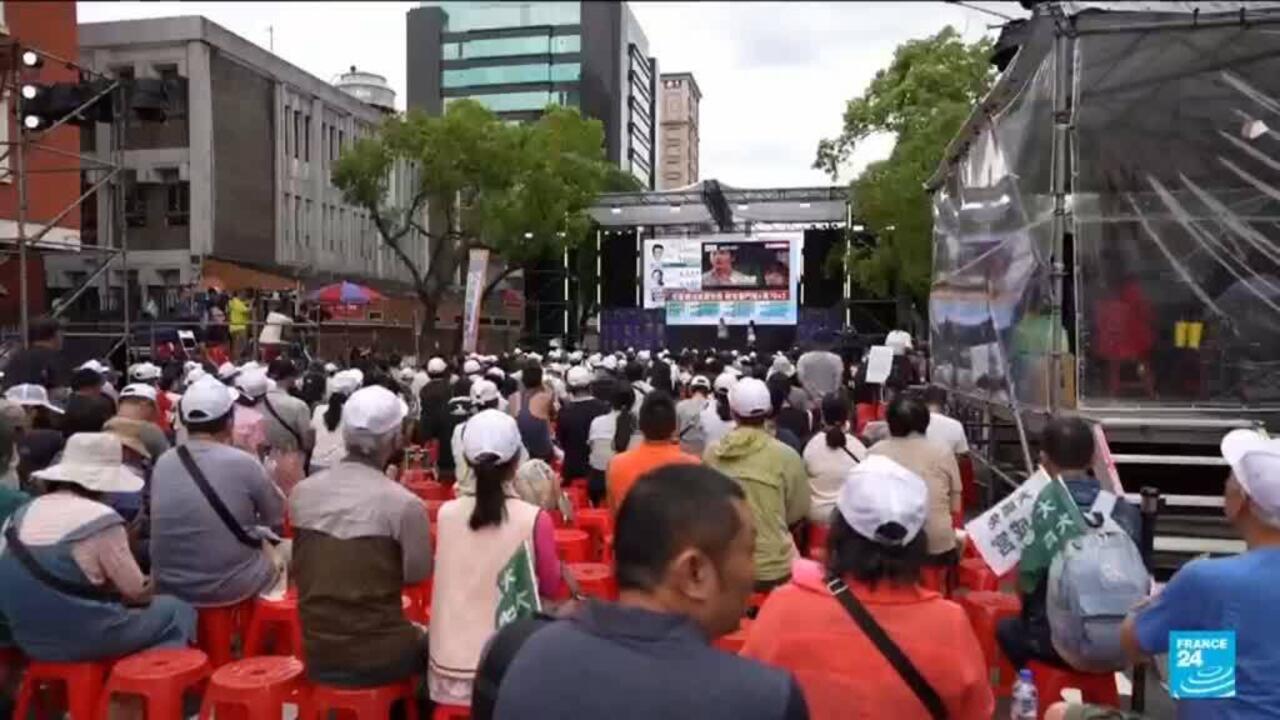
Taiwanese voters rejected an attempt to oust 24 opposition lawmakers on Saturday, an official tally showed, dealing a blow to President Lai Ching-te's party and its hopes for taking control of parliament. Story by Caroline Baum.

Video by:  Caroline BAUM


New Zealand farmers battle pine forests to 'save our sheep'


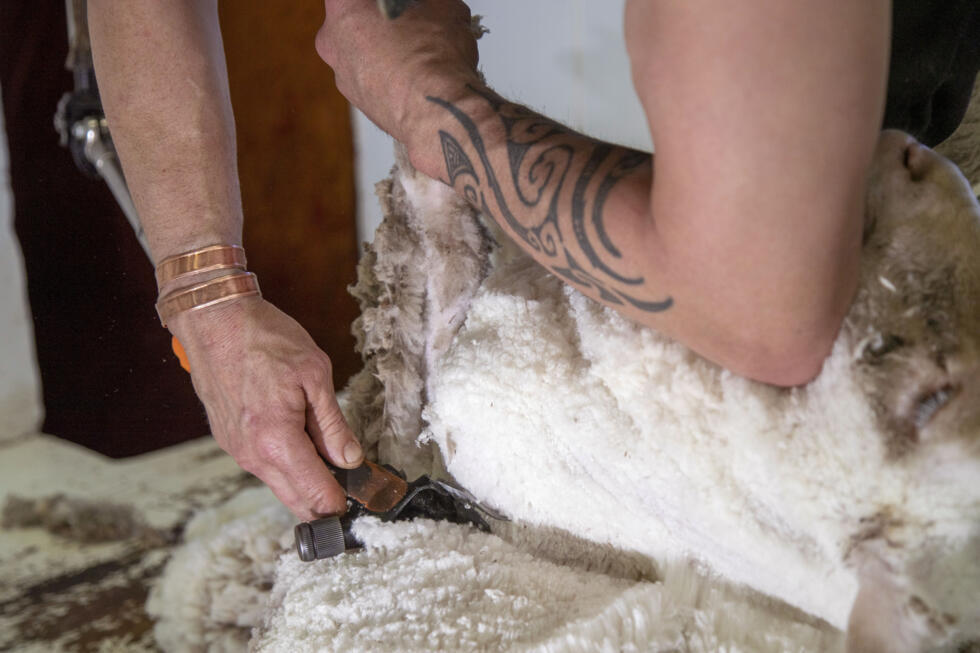
Wellington (AFP) – New Zealand sheep farmers are fighting to stop the loss of pasture to fast-spreading pine plantations, which earn government subsidies to soak up carbon emissions.


Issued on: 27/07/2025 - FRANCE24

New Zealand sheep farmers are fighting to protect grazing land from spreading pine plantations, which earn government subsidies to absorb carbon emissions. © KAVINDA HERATH / AFP

Concern over the scale of the farm-to-forest switch led the government to impose a moratorium in December on any new conversions not already in the pipeline.

But farmers say forestry companies are flouting the clampdown.

Last month, farmers launched a "Save our Sheep" campaign to reverse the loss of productive farmland.

Sheep numbers have plummeted to around 23 million, down from a peak of around 70 million in the 1980s, according to official figures.

Falling wool prices and rising milk and beef costs initially drove the decline, but the emissions trading since 2008 has added to the strain.

The government is now investigating potential breaches of its moratorium by forestry companies, which have been buying up farmland as recently as June.

Federated Farmers -- a lobby group for rural communities -- submitted to the government "a list of properties we believe have been sold for carbon forestry" since the halt, a spokesman said.

The federation is concerned about the sale of more than 15,200 hectares (37,600 acres) of farmland, he told AFP.

Dean Rabbidge, who runs a farm outside the Southland town of Wyndham, said some of the newly purchased farms had already been planted with pine trees.
'Criminal'

"They're just ploughing on ahead, effectively giving the middle finger to the government announcement," Rabbidge told AFP.

Concern over the scale of the farm-to-forest switch led the government to impose a moratorium in December on any new conversions not already in the pipeline © KAVINDA HERATH / AFP

The moratorium had created a "gold rush", he said.

"It's criminal what's happening."

Agriculture and Forestry Minister Todd McClay said the government would change the law by October because it had become more profitable to plant pine forests than to farm sheep.

"The law will include clarity on what qualifies as legitimate evidence of a pre-December investment and enable any specific cases to be properly assessed," McClay said.

"Anyone who has bought land since December 4, 2024, irrespective of whether they also had trees or not, will not be able to register this land into the emissions trading scheme."

Rural New Zealand once abounded with rolling pastures, rickety wire fences hemming in millions of sheep chewing on the green grass.

But Rabbidge said those days were gone.

"You won't see anything now," he said. "You're just driving through long pine tree tunnels -- shaded, wet, and damp."

New Zealand is one of the rare countries to allow 100 percent of carbon emissions to be offset by forestry.

"We're not anti planting trees," sheep farmer Ben Fraser told AFP.

"There are areas of land that should be retired, that aren't necessarily productive."

But the trading scheme had driven an excessive loss of sheep pastures to forestry, he said.

"That's the issue here."


'So short-sighted'

Fraser, who farms near the North Island town of Ohakune, said he had seen an exodus of people from the district in recent years.

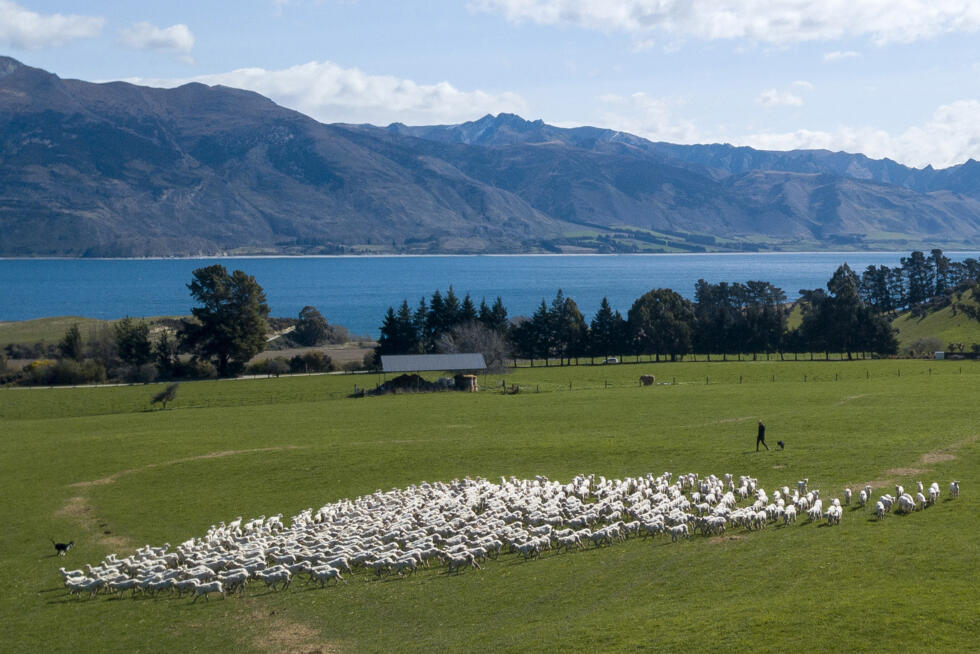
Sheep moving to pasture in the Otago region of New Zealand in September 2023. Rural New Zealand once abounded with rolling pastures, rickety wire fences hemming in millions of sheep chewing on the green grass. © KAVINDA HERATH / AFP

"Since 2018, there've been 17 farms converted to forestry," he said.

"That's about 18,000 hectares gone. So you're looking at about 180,000 sheep gone out of the district, plus lambs."

The loss of sheep impacted the region.

"If the farms thrive, then the towns thrive because people come in and spend their money," he said.

"You've got farm suppliers, your fertiliser guys, your supermarkets, your butchers, all of that stuff struggling.

"The local schools now have less kids in them. The people who stayed are now isolated, surrounded by pine trees."

Rabbidge said the same was happening in Southland.

"This whole thing is just so short-sighted," Rabbidge said.

"Businesses here are forecasting anywhere between a 10 and 15 percent revenue reduction for the next financial year, and that's all on the back of properties that have sold or have been planted out in pine trees," he said.
'Lamb on a plate'

"Think of all the shearers, the contractors, the transporters, the farm supply stores, the workers, the community centres, the schools, rugby clubs. Everything is affected by this."

Government figures from 2023 show agriculture accounted for more than half of New Zealand's total greenhouse gas emissions.

But farmers argue they have been working hard to reduce emissions, down more than 30 percent since the 1990s.

"I could put a leg of lamb on a plate in London with a lower emissions profile, transport included, than a British farmer," Rabbidge said.

"We just use our natural resources. We're not housing animals indoors and carting feed in and manure out.

"Everything's done outside and done at low cost, low and moderate intensity."

© 2025 AFP

Battling tariffs is no trivial pursuit for US games retailer

College Park (United States) (AFP) – At a strip mall in Maryland, a miniature landscape extends across a table between Dash Krempel and his friend as a war game unfolds. But their hobby is becoming more expensive as US tariffs take a toll.

Issued on: 27/07/2025 - FRANCE24

Scott Serrato, 28, has noticed some price increases in the gaming industry but sees them as understandable for now © SAUL LOEB / AFP

Krempel, 29, told AFP the cost of models for tabletop games have surged from inflation, and continued rising since US President Donald Trump imposed sweeping tariffs on trading partners this year.

UK-made figurines that cost $60 around three years ago now go for $94.50, he said.

"Prices have gotten bigger," he added. "It's a very expensive hobby to begin with, so it's maybe pricing a lot of people out."

Instead of buying more products, he now tries to support retailer Game Kastle College Park by renting tables to play in-store.

For the shop's owner, Boyd Stephenson, stocking new board games, paints and hobby supplies has only become more challenging.

To avoid the harshest of Trump's tariffs, some suppliers had to delay shipments or postpone new releases.

As they raised their suggested retail prices, so has Stephenson at Game Kastle.

About a fifth of his store's products have seen cost hikes, with increases ranging from 5 percent to 20 percent.

"If we see higher prices or higher tariffs, I'm going to see higher wholesale prices, and then I have to raise my prices accordingly," he said.

Asked what percentage of his store relies on imports, Stephenson replied: "Almost all of it."

No capacity


A US games retailer has been forced to hike costs as some suppliers raised their wholesale prices due to President Donald Trump's tariffs © SAUL LOEB / AFP


Stephenson estimates some 7,000 board games were released last year from 5,000 different companies.

"You're really looking at 5,000 different approaches (to tariffs)," he said.

"Some producers are saying, 'We're going to eat the cost.' Some producers are saying, 'We're passing the cost through all the way.' And other producers are doing some sort of mix of that."

Like other US retailers, Stephenson could face more cost pressures come August 1, when steeper tariffs are set to hit dozens of economies like the European Union and India.

The elevated rates mark an increase from the 10 percent levy Trump imposed on goods from most economies in April.

US tariffs on China-made products could bounce to higher levels from August 12 if officials fail to extend a current truce © SAUL LOEB / AFP

While China -- a crucial manufacturing hub for games -- is temporarily spared, Trump has separately imposed fresh 30 percent tariffs on products from the world's second biggest economy this year.

US tariffs on Chinese products could return to higher levels from August 12 if officials fail to extend their truce.

Yet, there is no quick fix to return manufacturing to the United States.

"US manufacturers just don't have the capacity to do that anymore," said Stephenson, showing an intricate board game figurine.

"Really, the people that are good at that, that's China," he said. "The best modeling paints come from Spain."

"So if you see tariffs get put up on the EU, then all of a sudden I'm going to have to pay higher prices on modeling paint when I bring it into the country," he added.

Trump has threatened the bloc with a 30 percent tariff.

'Universally bad'

Boyd Stephenson, owner of Game Kastle College Park, says uncertainty is universally bad for business © SAUL LOEB / AFP

Stephenson tries to absorb some cost hikes, but said: "I have to be able to pay the staff, pay the electric company, pay the landlord."

Trump's on-again, off-again approach to duties has also made suppliers' price changes more unpredictable.

"What is always universally bad for business is uncertainty," Stephenson said.

He usually stocks up on inventory ahead of the year-end holiday season, but expects to be more strategic with purchases this year to avoid unwelcome surprises.

Many companies are delaying merchandise imports as they lack certainty, said Jonathan Gold, vice president of supply chain and customs policy at the National Retail Federation.

"When the product is brought into the country and entered into commerce, you have 15 days to pay your tariff bill," he said.

This causes problems when tariff rates change and businesses lack funds to pay for orders.

Some businesses, and industry group the Game Manufacturers Association, have mounted legal challenges against Trump's blanket tariffs hitting various countries, noting nearly 80 percent of tabletop games sold in the US are made abroad.

But such complaints are an uphill battle.

"The damage, especially for small retailers, has been significant," Gold said.

© 2025 AFP
'Welcome to hell': Freed migrants tell of horrors in Salvadoran jail

Maracaibo (Venezuela) (AFP) – Mervin Yamarte left Venezuela with his younger brother, hoping for a better life.


Issued on: 27/07/2025 - FRANCE24

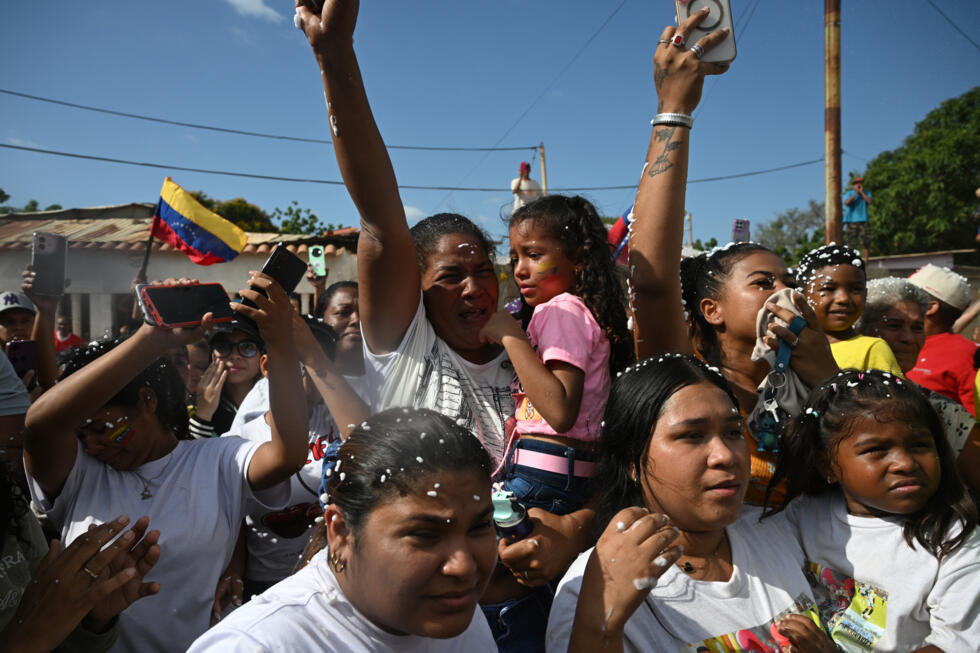
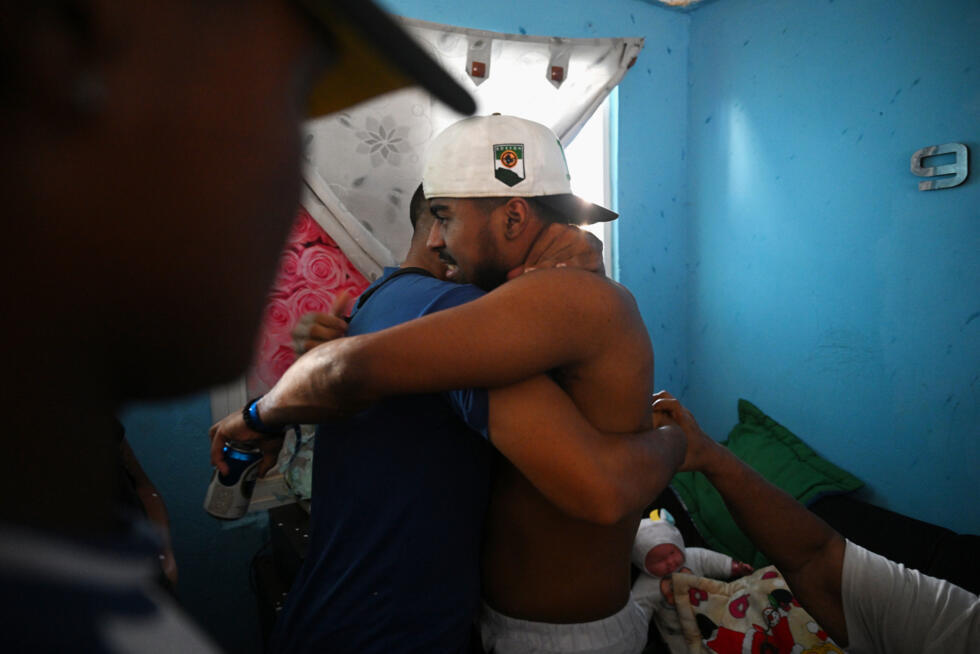
Mervin Yamarte (C), a Venezuelan migrant repatriated from a prison in El Salvador, is welcomed by his family upon arrival at his home in Maracaibo, Venezuela © Federico PARRA / AFP

But after a perilous jungle march, US detention, and long months in a Salvadoran jail surviving riots, beatings and fear, he has returned home a wounded and changed man.

On entering the sweltering Caribbean port of Maracaibo, the first thing Yamarte did after hugging his mother and six-year-old daughter was to burn the baggy white prison shorts he wore during four months of "hell."

"The suffering is over now," said the 29-year-old, enjoying a longed-for moment of catharsis.

Yamarte was one of 252 Venezuelans detained in US President Donald Trump's March immigration crackdown, accused without evidence of gang activity, and deported to El Salvador's notorious Terrorism Confinement Center, known as CECOT.

According to four ex-detainees interviewed by AFP, the months were marked by abuse, violence, spoiled food and legal limbo.

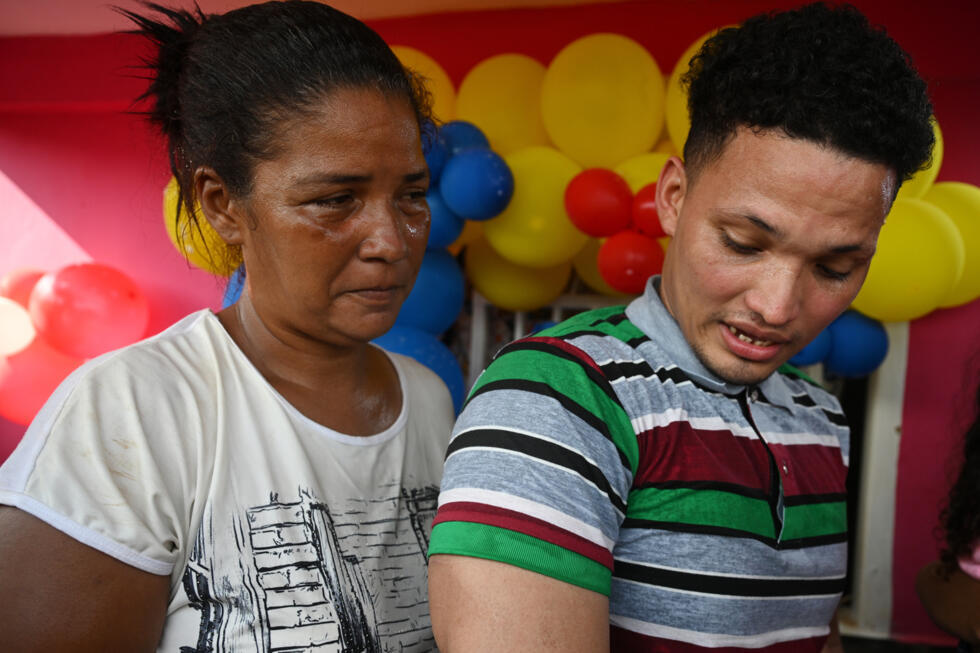
Mercedes Yamarte (C), mother of Mervin Yamarte, a Venezuelan migrant repatriated from a prison in El Salvador, reacts upon his arrival while holding Mervin's daughter in her arms © Federico PARRA / AFP

"You are going to die here!" heavily armed guards taunted them on arrival to the maximum security facility east of the capital San Salvador. "Welcome to hell!"

The men had their heads shaved and were issued with prison clothes: a T-shirt, shorts, socks, and white plastic clogs.

Yamarte said a small tuft of hair was left at the nape of his neck, which the guards tugged at.

The Venezuelans were held separately from the local prison population in "Pavilion 8" -- a building with 32 cells, each measuring about 100 square meters (1,076 square feet).

Each cell -- roughly the size of an average two-bedroom apartment -- was designed to hold 80 prisoners.

'Carried out unconscious'

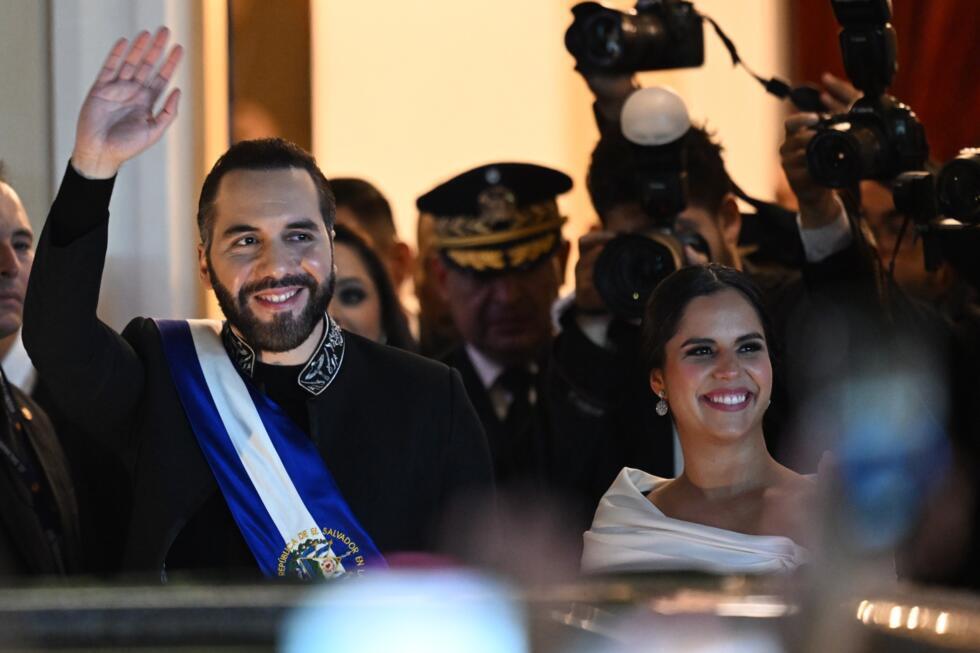
El Salvador's President Nayib Bukele (L) built the maximum security prison known as CECOT to house the country's most dangerous gang members in deliberately brutal conditions, drawing criticism from rights groups © Marvin RECINOS / AFP/File

Salvadoran President Nayib Bukele built the prison to house the country's most dangerous gang members in deliberately brutal conditions, drawing constant criticism from rights groups.

Trump's administration paid Bukele $6 million to keep the Venezuelans behind bars.

AFP has unsuccessfully requested a tour of the facility and interviews with CECOT authorities.

Another prisoner, 37-year-old Maikel Olivera, recounted there were "beatings 24 hours a day" and sadistic guards who warned, "You are going to rot here, you're going to be in jail for 300 years."

"I thought I would never return to Venezuela," he said.

For four months, the prisoners had no access to the internet, phone calls, visits from loved ones, or even lawyers.

At least one said he was sexually abused.

The men said they slept mostly on metal cots, with no mattresses to provide comfort.

There were several small, poorly-ventilated cells where prisoners would be locked up for 24 hours at a time for transgressions -- real or imagined.

Edwuar Hernandez (R), a Venezuelan migrant repatriated from a prison in El Salvador, is welcomed by his family upon arrival at his home in Maracaibo, Venezuela © Federico PARRA / AFP

"There were fellow detainees who couldn't endure even two hours and were carried out unconscious," Yamarte recounted.

The men never saw sunlight and were allowed one shower a day at 4:00 am. If they showered out of turn, they were beaten.

Andy Perozo, 30, told AFP of guards firing rubber bullets and tear gas into the cells.

For a week after one of two riots that were brutally suppressed, "they shot me every morning. It was hell for me. Every time I went to the doctor, they beat me," he said.

Edwuar Hernandez, 23, also told of being beaten at the infirmary.

"They would kick you... kicks everywhere," he said. "Look at the marks; I have marks, I'm all marked."

The detainees killed time playing games with dice made from bits of tortilla dough.

They counted the passing days with notches on a bar of soap.

'Out of hell'

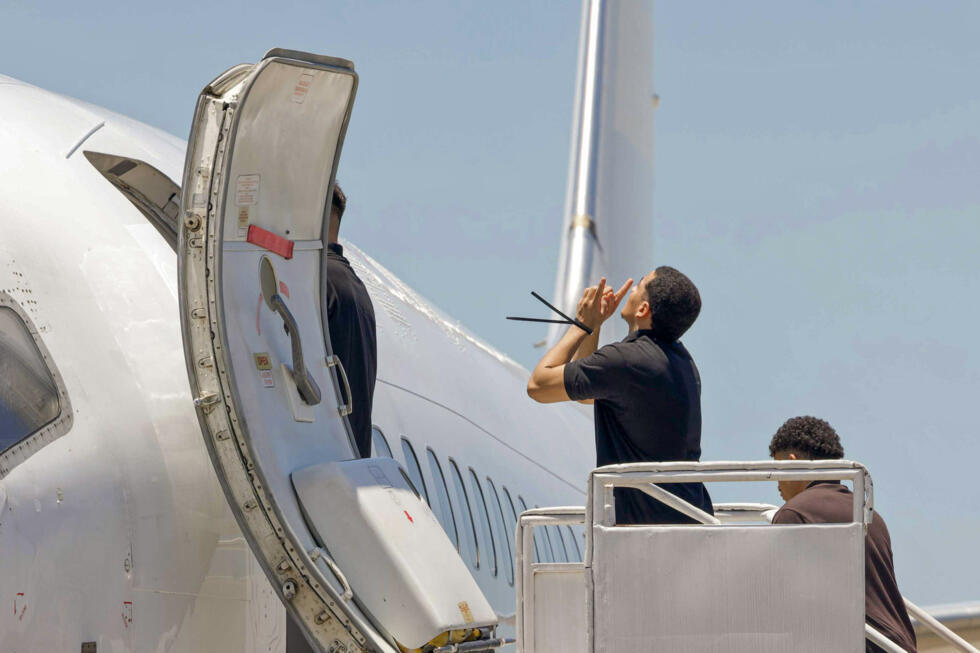
In this handout picture released by El Salvador's presidency, a Venezuelan migrant who was jailed in El Salvador gestures as he boards a plane bound for Venezuela © Handout / EL SALVADOR'S PRESIDENCY PRESS OFFICE/AFP/File

An estimated eight million Venezuelans have fled the political and economic chaos of their homeland to try to find a job in the United States that would allow them to send money home.

Yamarte left in September 2023, making the weeks-long journey on foot through the Darien Gap that separates Colombia from Panama.

It is unforgiving terrain that has claimed the lives of countless migrants who must brave predatory criminal gangs and wild animals.

Yamarte was arrested in Dallas in March and deported three days later, without a court hearing.

All 252 detainees were suddenly, and unexpectedly, freed on July 18 in a prisoner exchange deal between Caracas and Washington.

Now, many are contemplating legal action.

Many of the men believe they were arrested in the United States simply for sporting tattoos wrongly interpreted as proof of association with the feared Tren de Aragua gang.

Yamarte has one that reads: "Strong like Mom."

"I am clean. I can prove it to anyone," he said indignantly, hurt at being falsely accused of being a criminal.

"We went... to seek a better future for our families; we didn't go there to steal or kill."

Yamarte, Perozo, and Hernandez are from the same poor neighborhood of Maracaibo, where their loved ones decorated homes with balloons and banners once news broke of their release.

Yamarte's mom, 46-year-old Mercedes, had prepared a special lunch of steak, mashed potatoes, and fried green plantain.

Mervin Yamarte (R), a Venezuelan migrant repatriated from a prison in El Salvador, is welcomed by his mother, Mercedes Yamarte, upon arrival at his home in Maracaibo, Venezuela © Federico PARRA / AFP


At her house on Tuesday, the phone rang shortly after Yamarte's arrival.

It was his brother Juan, who works in the United States without papers and moves from place to place to evade Trump's migrant dragnet.

Juan told AFP he just wants to stay long enough to earn the $1,700 he needs to pay off the house he had bought for his wife and child in Venezuela.

"Every day we thought of you, every day," Juan told his brother. "I always had you in my mind, always, always."

"The suffering is over now," replied Mervin. "We've come out of hell."

© 2025 AFP


UPDATED

Thai, Cambodian leaders to hold talks in Malaysia after border clashes persist


Fresh artillery clashes erupted on Sunday near a long-contested region between Cambodia and Thailand that has been the scene of recent fighting in which at least 33 people have been killed. Leaders of both countries will meet in Malaysia on Monday for talks to end hostilities, said a Thai government spokesperson.


Issued on: 27/07/2025
By: FRANCE 24
Video by: Matthew HUNT

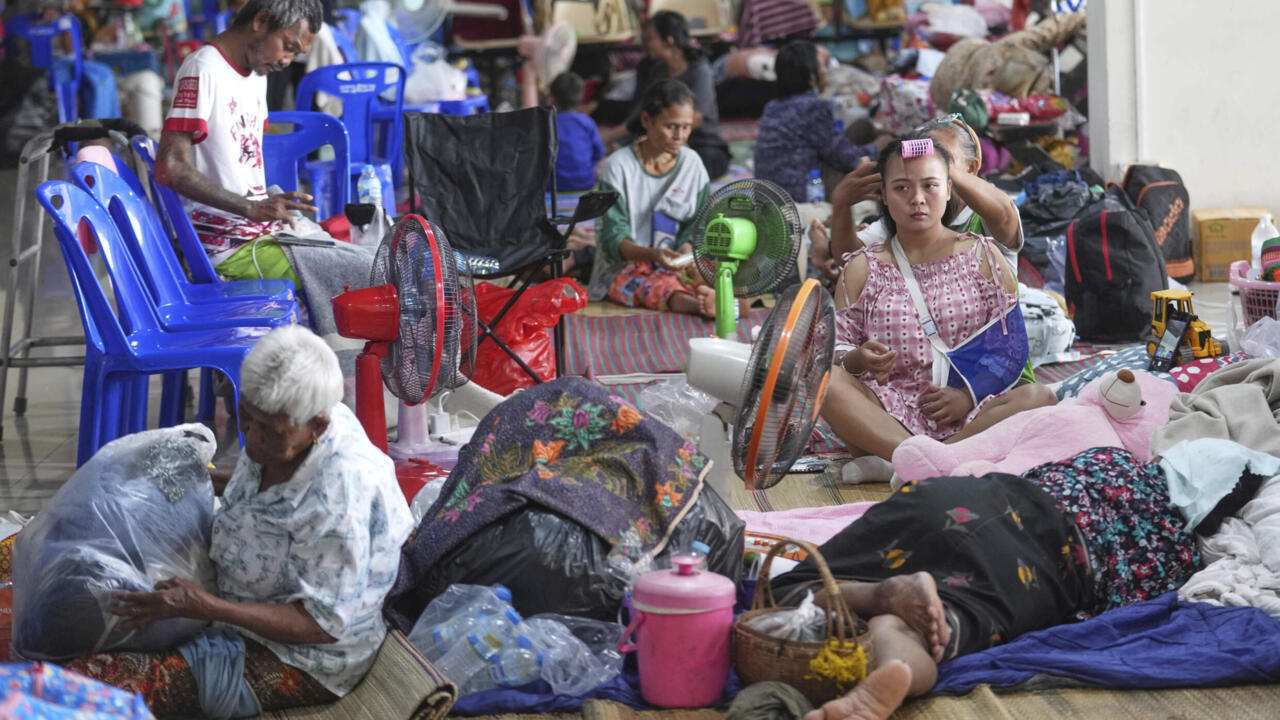
Thai residents who fled homes following clashes between Thai and Cambodian soldiers rest at an evacuation center in Surin province, Thailand, Sunday, July 27, 2025. © Sakchai Lalit, AP
03:14


Thailand and Cambodia clashed for a fourth day Sunday, despite both sides saying they were ready to discuss a ceasefire after a late-night intervention by US President Donald Trump.

Leaders of both countries will meet in Malaysia for talks to end hostilities, a spokesperson for the Thai prime minister’s office said on Sunday.

Jirayu Huangsap said acting Thai Prime Minister Phumtham Wechayachai will attend Monday's talks in response to an invitation from Malaysian Prime Minister Anwar Ibrahim “to discuss peace efforts in the region.”

The spokesperson also said Phumtham’s Cambodian counterpart Hun Manet will also attend the talks, though this was not immediately confirmed by the Cambodian side.


The neighbours, popular destinations for millions of foreign tourists, have been locked in their bloodiest conflict in years over the disputed border, with at least 33 people confirmed killed and more than 200,000 displaced.

Both said they were willing to start talks to end the fighting, after Trump spoke to the two prime ministers late on Saturday and said they had agreed to meet and “quickly work out” a ceasefire.

Read moreTrump says Thailand and Cambodia agree to immediate ceasefire talks

But fresh artillery clashes erupted on Sunday morning near two long-contested ancient temples in the frontier region between northern Cambodia and northeast Thailand that has seen the bulk of the fighting.

Cambodian defence ministry spokeswoman Maly Socheata said Thai forces began attacking areas around the temples at 4:50 am.

The regular thump of artillery rattled windows in the Cambodian town of Samraong, around 20 kilometres (12 miles) from the frontline, AFP journalists said.

Thai Army Deputy Spokesman Ritcha Suksuwanon said Cambodian forces began firing artillery around 4:00 am as the two sides battled for control of strategic positions.
Ceasefire calls

Cambodian Prime Minister Hun Manet on Sunday said his country “agreed with the proposal for an immediate and unconditional ceasefire between the two armed forces”.

He said his Foreign Minister Prak Sokhonn will talk to US Secretary of State Marco Rubio to coordinate with the Thais, but warned Bangkok against reneging on any agreement.

After Trump’s call, Thailand’s acting Prime Minister Phumtham Wechayachai said he had agreed in principle to enter a ceasefire and start talks “as soon as possible”.

While both sides have expressed a desire for talks to end the crisis, neither has so far been willing to back down. On Sunday, they again each blamed the other for undermining peace efforts.

The Thai foreign ministry also accused Cambodian forces of firing shells into civilian homes in Surin province.

“Any cessation of hostilities cannot be reached while Cambodia is severely lacking in good faith and repeatedly violating the basic principles of human rights and humanitarian law,” the foreign ministry said in a statement.

From the Cambodian side, defence ministry spokeswoman Maly Socheata issued a statement denying that they fired first.

The statement accused Thailand of “deliberate and coordinated acts of aggression”.

Read moreThailand and Cambodia clash: A border dispute fuelled by nationalism

A long-running border dispute erupted into combat this week with jets, tanks and ground troops battling in the rural border region, marked by a ridge of hills surrounded by wild jungle and agricultural land where locals farm rubber and rice.

Thailand says seven of its soldiers and 13 civilians have been killed, while Cambodia has confirmed eight civilian and five military deaths.

The conflict has forced more than 138,000 people to be evacuated from Thailand’s border regions, and 80,000 have been driven from their homes in Cambodia.

After an urgent United Nations Security Council meeting Friday in New York, Cambodia’s UN Ambassador Chhea Keo said his country wanted “an immediate ceasefire” and a peaceful resolution of the dispute.

UN chief Antonio Guterres urged both sides Saturday to “immediately agree to a ceasefire” and hold talks to find a lasting solution.

As well as blaming each other for starting the fight, Cambodia has also accused Thai forces of using cluster munitions, while Thailand accused Cambodia of targeting civilian infrastructure, including hospitals.

The fighting marks a dramatic escalation in a long-running dispute between the neighbours over their shared 800-kilometre border where dozens of kilometres are contested.

(FRANCE 24 with AFP)

Thais and Cambodians refuse to quit homes on clash frontier

Surin (Thailand) (AFP) – Under the drumbeat of artillery fire near Thailand's border with Cambodia, farmer Samuan Niratpai refuses to abandon his buffalo herd -- stubbornly risking his life to tend his livestock.


Issued on: 27/07/2025 

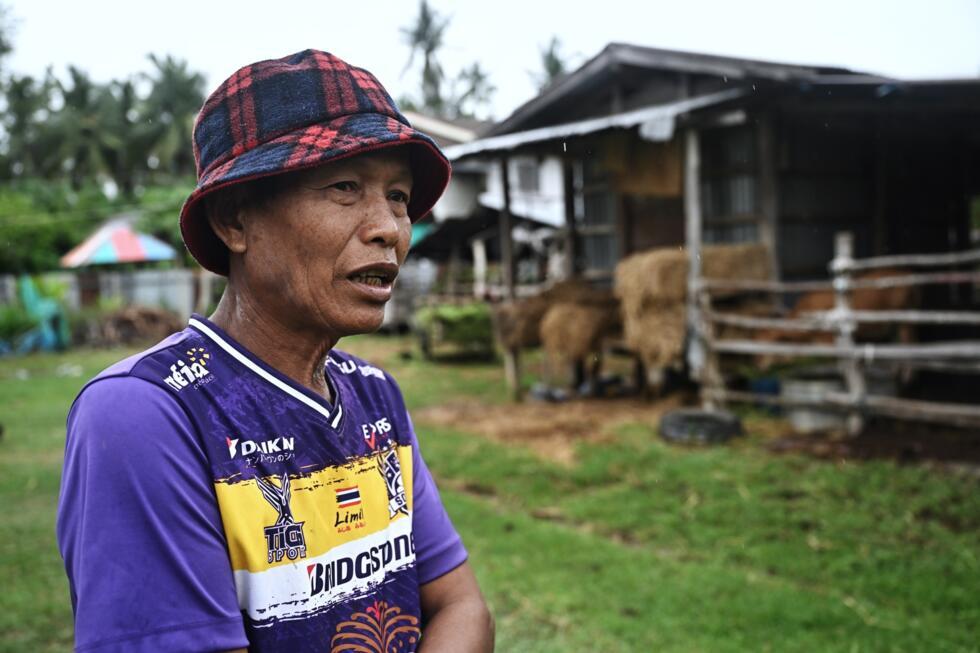
Farmer Samuan Niratpai refuses to evacuate from his village despite clashes on the Thai-Cambodia border © Lillian SUWANRUMPHA / AFP

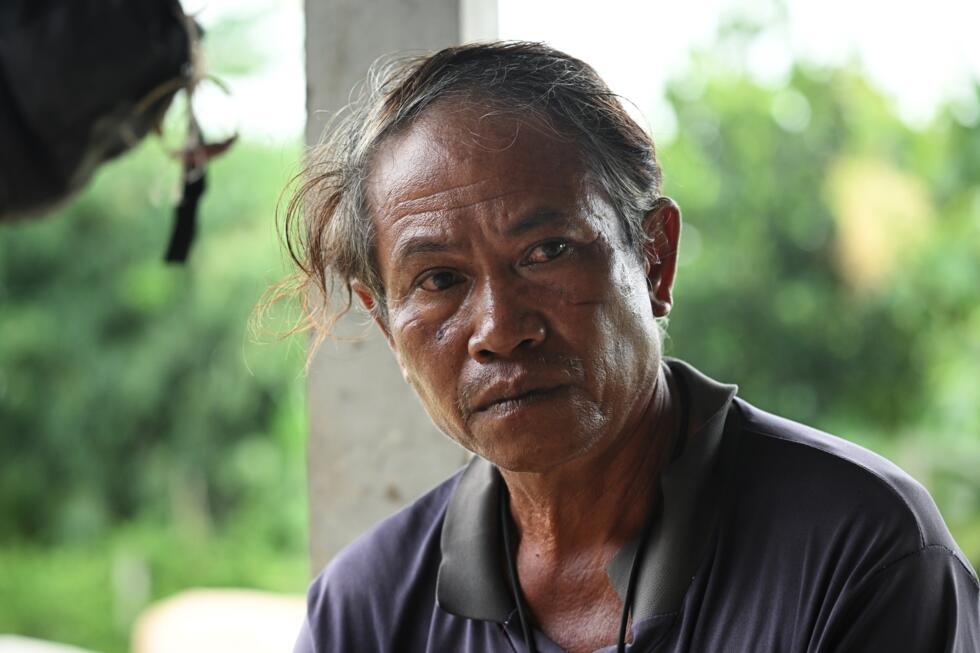
"At 5:00am every day, I hear the loud bangs and booms. Then I run into the woods for cover," the 53-year-old told AFP in the village of Baan Bu An Nong in Surin province, just 40 kilometres (25 miles) from the fraught frontier.

His family of five fled to the capital Bangkok on the first day of clashes on Thursday, but he remains behind with their flock of chickens, three dogs and 14 prized buffalo.

"How could I leave these buffaloes?" he asked, his eyes brimming with emotion.

Samuan Niratpai's village has been designated a "red zone" for artillery strikes © Lillian SUWANRUMPHA / AFP

"I'd be so worried about them. After the strikes I go and console them, telling them 'It's okay. We're together'."

Thailand and Cambodia's clashes have entered their fourth day after a festering dispute over sacred temples ignited into cross-border combat being waged with jets, tanks and group troops.

Peace talks between leaders are scheduled for Monday in Malaysia, the Thai government has said.

In the meantime, at least 34 people have been killed on both sides, mostly civilians, and more than 200,000 have fled their homes along the 800-kilometre border -- a rural area patched with rubber and rice farms.

But on both sides of the tree-clad ridge marking the boundary between the two countries there are many who refuse to evacuate.

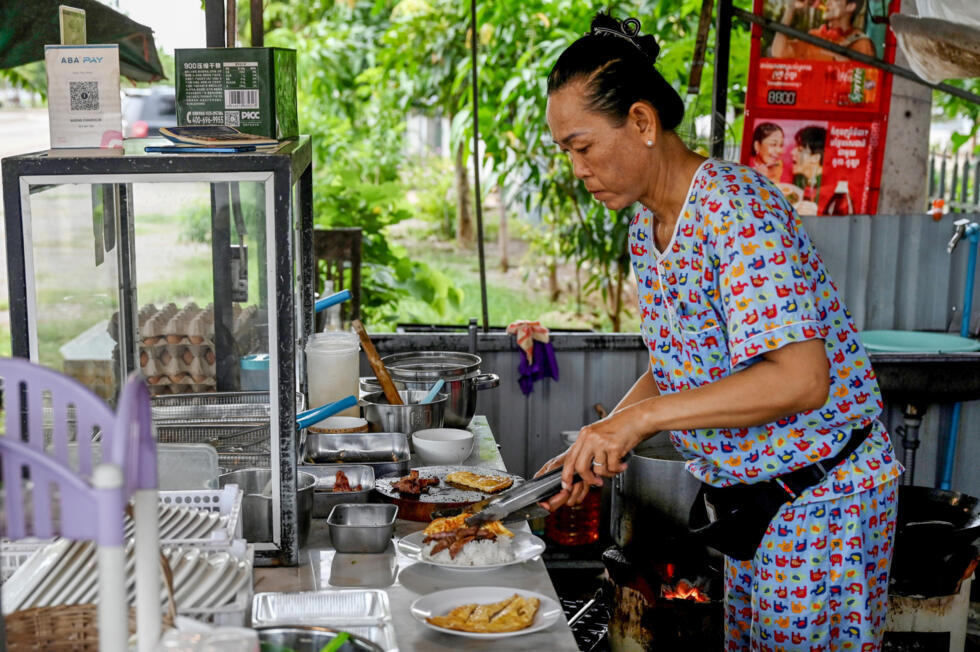
Soeung Chhivling prepares food for customers at her restaurant in Samraong, around 20 kilometres from the border conflict zone © TANG CHHIN Sothy / AFP

As nearby blasts shake Cambodian restauranteur Soeung Chhivling's eaterie she continues to prepare a beef dish, declining to abandon the kitchen where she cooks for troops and medics mobilised to fight Thailand.

"I am also scared, but I want to cook so they have something to eat," said the 48-year-old, near a hospital where wounded civilians and troops are being treated.

"I have no plan to evacuate unless jets drop a lot of bombs," she told AFP in Samraong city, just 20 kilometres from the Thai frontier, where most homes and shops are already deserted.
'I'd rather die at home'

Back on the Thai side, Pranee Ra-ngabpai, a researcher on Thai-Cambodian border issues and a local resident, said many who have chosen to stay behind -- like her own father -- are men who hold traditional and stoic values.

Farmer and village co-leader Keng Pitonam refuses to evacuate from his village despite ongoing clashes © Lillian SUWANRUMPHA / AFP

"He is still there in the house right now and refuses to leave," Pranee said. "There's this mindset: 'If I die, I'd rather die at home' or 'I can't leave my cows'."

Baan Bu An Nong has been designated a "red zone" -- meaning it is high risk for air strikes, artillery barrages and even gun battles between ground troops.

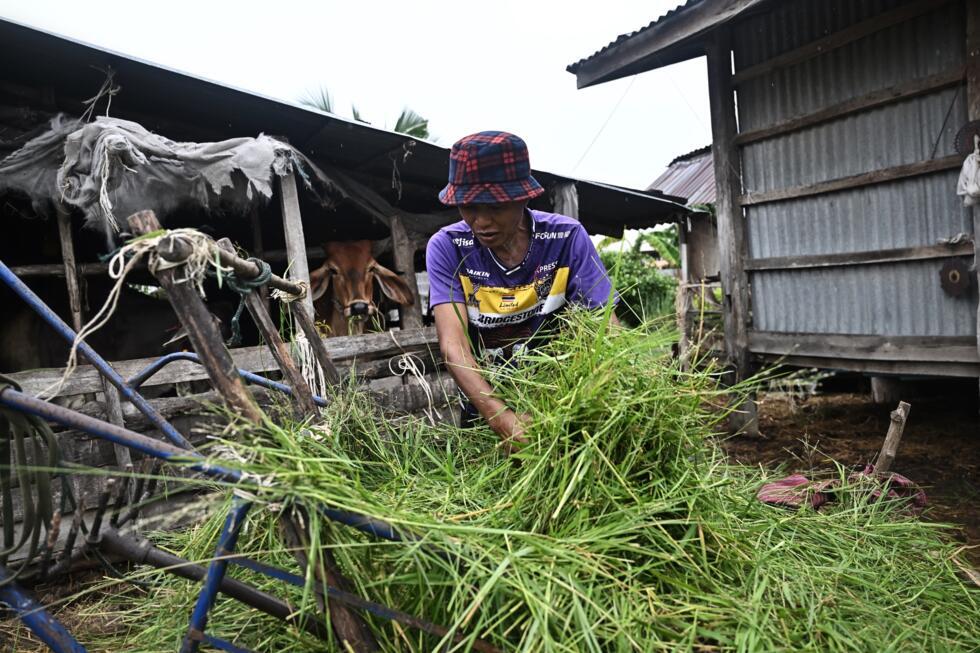
But village co-leader Keng Pitonam, 55, is also reluctant to depart. Loading grass onto his three-wheeled cart to feed his livestock, he is now responsible for dozens of neighbours' animals as well as their homes.

"I have to stay -- it's my duty," Keng told AFP.

"I'm not afraid. I can't abandon my responsibilities," he said.

"If someone like me -- a leader -- leaves the village, what would that say? I have to be here to serve the community, no matter what happens."

Keng Pitonam is now responsible for dozens of neighbours' animals as well as their homes © Lillian SUWANRUMPHA / AFP

His local temple has become a makeshift donation and rescue hub, parked with ambulances inside its perimeter.

"I have to stay -- to be a spiritual anchor for those who remain," said the abbot, declining to give his name. "Whatever happens, happens."

Huddled in a bunker just 10 kilometres from the border, Sutian Phiewchan spoke to AFP by phone, pausing as his words were interrupted by the crackle of gunfire.

He remained behind to fulfil his obligations as a volunteer for the local civil defence force, activated to protect the roughly 40 people still staying there.

"Everyone here is afraid and losing sleep," the 49-year-old said.

"We're doing this without pay. But it's about protecting the lives and property of the people in our village."

burs-jts/dhw

© 2025 AFP

Thai-Cambodian border conflict: 200,000 thousand people displaced


Issued on: 27/07/2025 - FRANCE24

Thailand and Cambodia clashed for a fourth day Sunday, despite both sides saying they were ready to discuss a ceasefire after a late-night intervention by US President Donald Trump. The Southeast Asian neighbours, popular destinations for millions of foreign tourists, have been locked in their bloodiest conflict in years over their disputed border, with at least 34 people confirmed killed and more than 200,000 displaced. Story by Caroline Baum.

Video by: Caroline BAUM


Thai-Cambodian border clashes continue despite Trump's ceasefire call

Issued on: 27/07/2025 - FRANCE24

Artillery fire along the Thai-Cambodia border continued for a fourth day on Sunday despite calls for a ceasefire from US President Donald Trump. France 24's correspondent in Bangkok Matt Hunt provides some background to the conflict.

Video by:  Matthew HUNT


Thai-Cambodian border clashes: Trump threatens to withhold trade deals until ceasefire


Issued on: 27/07/2025 - 

Thai and Cambodian leaders will meet in Malaysia for talks to end hostilities, a spokesperson for the Thai prime minister’s office said on Sunday. This comes following pressure from U.S. President Donald Trump to end a deadly border dispute, now in its fourth day, which has killed at least 34 people and displaced more than 168,000. Details by FRANCE24 correspondent in Si Saket, Tommy Walker  

.

US ‘strongly rejects’ French plan to recognise Palestine, Saudis hail ‘historic decision’


US Secretary of State Marco Rubio blasted French President Emmanuel Macron decision to recognise a Palestinian state as “reckless” while Saudi Arabia described it as “historic” as world reactions to the plan poured in ahead of the UN General Assembly meeting in September.


Issued on: 25/07/2025 
By: FRANCE 24
File photo of French President Emmanuel Macron and Palestinian Authority President Mahmoud Abbas taken on the sidelines of the UN General Assembly on September 25, 2024. © Ludovic Marin, AFP (archive)
01:29


France intends to recognise a Palestinian state in September at the UN General Assembly, President Emmanuel Macron said on Thursday in hopes of bringing peace to the region, but the plan drew angry rebukes from Israel and the United States.

Macron, who unveiled the decision on social media, published a letter sent to Palestinian Authority President Mahmoud Abbas confirming France's intention to press ahead with Palestinian recognition and work to convincing other partners to follow suit.

"True to its historic commitment to a just and lasting peace in the Middle East, I have decided that France will recognise the state of Palestine," Macron said.

"I will make this solemn announcement at the United Nations General Assembly next September."

Home to Europe's largest Jewish and Muslim communities, France will become the first major Western country to recognise a Palestinian state, potentially fuelling a movement so far dominated by smaller nations generally more critical of Israel.

The news sparked anger in Israel and Washington.
© France 24
08:32


Israeli Prime Minister Benjamin Netanyahu condemned the decision by one of Israel's closest allies and a G7 member, saying such a move "rewards terror and risks creating another Iranian proxy."

In a post on X, he added, "A Palestinian state in these conditions would be a launch pad to annihilate Israel — not to live in peace beside it.

"Let’s be clear: the Palestinians do not seek a state alongside Israel; they seek a state instead of Israel."

Read moreFrance bears the brunt of Israel’s isolation ire

Israeli Defence Minister Israel Katz described the move as "a disgrace and a surrender to terrorism," adding that Israel would not allow the establishment of a "Palestinian entity that would harm our security, endanger our existence."

In response, US Secretary of State Marco Rubio said the United States "strongly rejects (Macron's) plan to recognize a Palestinian state at the UN general assembly."

In a post on X, he said, "This reckless decision only serves Hamas propaganda and sets back peace. It is a slap in the face to the victims of October 7th."
"The United States strongly rejects Emmanuel Macron's plan to recognize a Palestinian state at the UN general assembly", Secretary of State Marco Rubio posted on X. © Screenshot, FRANCE 24


France said that its plan to formally recognise a Palestinian state runs counter to the stance held by Palestinian militant group Hamas.

"Hamas has always ruled out a two-state solution. By recognising Palestine, France goes against that terrorist organisation," Foreign Minister Jean-Noel Barrot wrote Friday on X.
"By recognising Palestine, France goes against (Hamas)," Foreign Minister Jean-Noel Barrot said on X. © Screenshot, FRANCE 24

Spain, Saudi Arabia welcome decision

Earlier, Canada also pressed Israel to seek peace, with Prime Minister Mark Carney condemning its "failure to prevent the rapidly deteriorating humanitarian disaster in Gaza" and reiterating support for a two-state solution.

Carney also accused Israel of violating international law over the blocking of Canadian-funded aid to civilians in the war-torn Palestinian enclave.

"Canada calls on all sides to negotiate an immediate ceasefire in good faith," he added.

"We reiterate our calls for Hamas to immediately release all the hostages, and for the Israeli government to respect the territorial integrity of the West Bank and Gaza."

Spanish Prime Minister Pedro Sanchez, whose country already recognises Palestinian statehood, welcomed Macron's announcement.

"Together, we must protect what Netanyahu is trying to destroy. The two-state solution is the only solution," said the Socialist leader and outspoken critic of Israel's offensive in Gaza.

"I welcome the fact that France joins Spain and other European countries in recognising the State of Palestine," Spanish Prime Minister Pedro Sanchez said on X. © Screenshot, FRANCE 24

The Saudi Foreign Ministry welcomed Macron's "historic decision".

"The Kingdom reiterates its call for all countries that have not yet recognised the State of Palestine to take similar positive steps and adopt serious positions that support peace and the legitimate rights of the Palestinian people."

In a diplomatic cable in June, the United States said it opposed steps to unilaterally recognise a Palestinian state, even saying it could go against US foreign policy interests and draw consequences.

In June, Washington's ambassador to Israel, Mike Huckabee, said he did not think an independent Palestinian state remained a US foreign policy goal.

President Donald Trump has himself expressed doubts about a two-state solution, proposing a US takeover of Gaza in February, that was condemned by rights groups, Arab states, Palestinians and the UN as a proposal of "ethnic cleansing".

Read moreTrump says US will take over Gaza Strip, create 'Riviera of the Middle East'

Macron had been leaning towards recognising a Palestinian state for months as part of a bid to keep the idea of a two-state solution alive, despite the pressure not to do so.

French officials initially weighed up the move ahead of a United Nations conference, which France and Saudi Arabia had planned to co-host in June to lay out parameters for a roadmap to a Palestinian state, while ensuring Israel's security.

The conference was postponed under US pressure and after the 12-day Israel-Iran air war began, during which the closure of regional airspace made it hard for representatives of some Arab states to attend.

It was rescheduled and downgraded to a ministerial event on July 28 and July 29, with a second event taking place with heads of state and government on the sidelines of the United Nations General Assembly in September.
Creating momentum

The decision to make the announcement ahead of next week's conference aimed to give the French team at the United Nations a framework to work with other countries that are also considering recognising a Palestinian state or have misgivings in doing so.

Diplomats say Macron has faced resistance from allies such as Britain and Canada over his push for the recognition of a Palestinian state. About 40 foreign ministers will be in New York next week.

Israeli officials have spent months lobbying to prevent what some have called "a nuclear bomb" for bilateral ties.

Sources familiar with the matter say Israel's warnings to France have ranged from scaling back intelligence sharing to complicating Paris' regional initiatives - even hinting at possible annexation of parts of the West Bank.

Israel has been waging a devastating war in Gaza since the Palestinian militant group Hamas' deadly attack on Israel in October 2023 and says recognising a Palestinian state now would be equivalent to rewarding Hamas.

Thanking France, the Palestinian Authority's Vice President Hussein Al Sheikh said on X that Macron's decision reflected "France's commitment to international law and its support for the Palestinian people's rights to self-determination and the establishment of our independent state."

(FRANCE 24 with Reuters and AFP)


Timeline: The state of Palestine’s long road to recognition

Explainer

Despite heavy Israeli pressure, President Emmanuel Macron has announced that France will formally recognise the state of Palestine on the sidelines of the UN General Assembly in New York in September. FRANCE 24 looks back over the state’s long road to widespread diplomatic recognition.


Issued on: 25/07/2025 - 
FRANCE24
By: Marc DAOU
Young Palestinians carry a Palestinian flag through Beit Lahiya in the northern Gaza Strip on 26 November, 2006. © Hatem Moussa, AP

From the Ottoman Empire to the British Mandate


1916 – Concluded in May between France and Great Britain, the Sykes-Picot Agreement marks out the two imperial powers’ future spheres of influence across the Middle Eastern territories of the foundering Ottoman Empire – Palestine and Syria among them.


A map from the British Archives showing the areas of influence outlined in the Sykes-Picot Agreement. © DR


1917 – The Balfour Declaration, named for British foreign minister Arthur Balfour, promises “the establishment in Palestine of a national home for the Jewish people”. The declaration, responding to the campaigning of the growing Zionist movement, follows an earlier pledge from London to Mecca’s Hussein bin Ali al-Hashimi promising the creation of an independent Arab kingdom following the eventual break-up of the Ottoman Empire.

1922 – The League of Nations, the forerunner to the United Nations, grants the United Kingdom a mandate to administer the lands of historic Palestine. The mandate document explicitly references the wording of the Balfour Declaration promoting “the establishment in Palestine of a national home for the Jewish people”, adding that the British would be responsible for enacting a nationality law that would allow “the acquisition of Palestinian citizenship by Jews who take up their permanent residence in Palestine”.


1937 – Following the outbreak of Arab riots the previous year against the British Mandate and rising Jewish immigration, a report by the British Peel Commission recommends the division of historic Palestine into a Jewish state comprised of 33 percent of the territory and an Arab state connected to what was then the British protectorate of Transjordan.

A map taken from the Peel Commission's proposal for the division of historic Palestine. © DR

A ‘Jewish state’ and an ‘Arab state’


1947 – In February, a United Kingdom – increasingly eager to renounce its role as Mandatory – submits the Palestinian question to the newly formed United Nations. In November, the UN General Assembly adopts Resolution 181, which calls for the division of Palestine into a “Jewish state” and an “Arab state”. The resolution, which passes despite the unanimous opposition of the Arab delegations, suggests that Jerusalem and its holy sites be placed under international administration.
The partition of Palestine proposed by the UN in 1947. © DR


1948 – As the British Mandate for Palestine expires, then-National Jewish Council president David Ben Gurion proclaims the independence of the State of Israel on May 14. The creation of the Israeli state, which soon seizes control of 77 percent of Mandatory Palestine, is synonymous for Palestinians and across the Arab world with the Nakba, or “catastrophe”, which saw hundreds of thousands of people driven from their homes and lands by armed force. Today, more than 4 million Palestinians are registered as refugees under the UN.

1949 – A ceasefire brings the first Israeli-Arab war to an end, giving Jordan control over the West Bank of the Jordan River and East Jerusalem and Egypt the Gaza Strip. Israel would henceforth take these lines of demarcation as the country’s official borders – a territory far greater than that envisaged in the original UN resolution.

The same year, the UN General Assembly adopts Resolution 273, admitting Israel into the United Nations. The following year, Israel transfers its capital from Tel Aviv to the western part of Jerusalem.

The Middle East following the first Israeli-Arab war (1948-1949). 
© FRANCE 24


1964 – The Palestine Liberation Organisation (PLO) is founded in Cairo. The group is empowered to negotiate and conclude international treaties in the name of the Palestinian people.


The Six-Day War redraws the map


1967 – The third Israeli-Arab war, or the Six-Day War, is launched by Israel, putting the armed forces of neighbouring Arab states to flight and redrawing the map of the Middle East. Israel now occupies the West Bank, East Jerusalem, the Gaza Strip, the vast Sinai Peninsula and Syria’s Golan Heights. The Israeli government begins a policy of Jewish settlement across these newly conquered territories.

1974 – The UN General Assembly formally recognises the Palestinian people’s right to self-determination and independent and grants the PLO observer status to the international body.

1987 – The First Intifada, or uprising, breaks out in the occupied Gaza Strip and soon spreads to the West Bank. Dubbed the “war of stones”, this revolt against the Israeli occupation will last until 1993 and place the Palestinian cause front and centre of the international agenda. The uprising also gives birth to the Islamist militant group Hamas, which calls for the destruction of the State of Israel.

1988 – Gathered in Algiers, the PLO’s legislative assembly proclaims an independent Palestinian state with East Jerusalem as its capital. The group also implicitly recognises the existence of the State of Israel.


The Oslo Accords


1993 – PLO leader Yasser Arafat and Israeli prime minister Yitzhak Rabin sign the Declaration of Principles on Interim Self-Government Arrangements in Washington, D.C., following secret negotiations in Norway – the first of a series of agreements known as the Oslo Accords. These declarations are intended to lay the groundwork for an end to the Israeli-Palestinian conflict and build the basis for Palestinian autonomy within the borders preceding the Six-Day War.

The first part of the agreements create the Palestinian Authority, an interim body intended to give way to an independent Palestinian state in 1999.

1995 – The Oslo II Accord divides the Israeli-occupied West Bank into three parts: Zone A, administered by the Palestinians, Zone B under dual administration and Zone C – representing more than 60 percent of the territory – which, although intended to pass progressively into Palestinian control, remains for the moment entirely under the administration of the Israeli army.

More sensitive questions, including the status of Jerusalem, Israeli settlers in the occupied territories and the right of Palestinian refugees to return to their homes, remain unresolved.

1996 – Yasser Arafat is elected president of the Palestinian Authority in the first Palestinian elections.

1998 – US President Bill Clinton becomes the first US president to be officially received by a virtual Palestinian state.


Palestinian power struggles

2000 – The Second Intifada, also known as the Al-Aqsa Intifada, erupts following right-wing Likud party leader Ariel Sharon’s provocative visit to the Temple Mount – a holy site for Muslims, Jews and Christians alike.

2002 – The Arab Initiative, adopted in 2002 and relaunched in 2007, foresees the normalisation of ties between Arab states and Israel in return for Israel pulling out of Arab territories occupied since June 1967 and the creation of a Palestinian state with East Jerusalem as its capital. The same year, the UN Security Council adopts Resolution 1397, confirming its support for a two-state solution to the decades-old conflict.

2005 – Mahmoud Abbas is elected president of the Palestinian Authority. After 38 years of armed occupation, Israel withdraws from the Gaza Strip.

2007 – The Islamist group Hamas, which won the 2006 legislative elections, takes control of the Gaza Strip by force, fracturing the Palestinian leadership.


On the world stage

2011 – Palestinian Authority president Mahmoud Abbas formally requests Palestine’s admission into the United Nations. The same year, Palestine becomes a member of UNESCO. Furious, the US – staunch allies of Israel – suspend their donations to the UN agency, which make up almost a quarter of its total budget.

2012 – The UN votes to recognise Palestine as a “Non-Member Observer State” with 138 countries for, nine against and 41 abstaining.

2015 – Faced with an Israeli prime minister – Likud’s Benjamin Netanyahu – who has repeatedly sworn that a Palestinian state will never see the light of day as long as he remains in power, the Palestinian Authority doubles downs on its efforts to integrate itself with UN organisations, as well as the International Criminal Court.

How to break the cycle: From war in Gaza to a two-state solution?


2016 – The UN Security Council adopts Resolution 2334, calling on Israel to “immediately and completely cease all settlement activities in the occupied Palestinian territory, including East Jerusalem”. The resolution underlines that the UN will “not recognise any changes to the June 4 1967 lines, including with regard to Jerusalem, other than those agreed by the parties through negotiations”.

2017 – The administration of US President Donald Trump announces that the US recognises Jerusalem as the capital of the State of Israel and tells the state department to move the US embassy to the contested city.

2019 – The White House unveils Trump’s economic plan for the Palestinians, which despite promising to “fundamentally transform the West Bank and Gaza”, contains no mention of the creation of a Palestinian state.

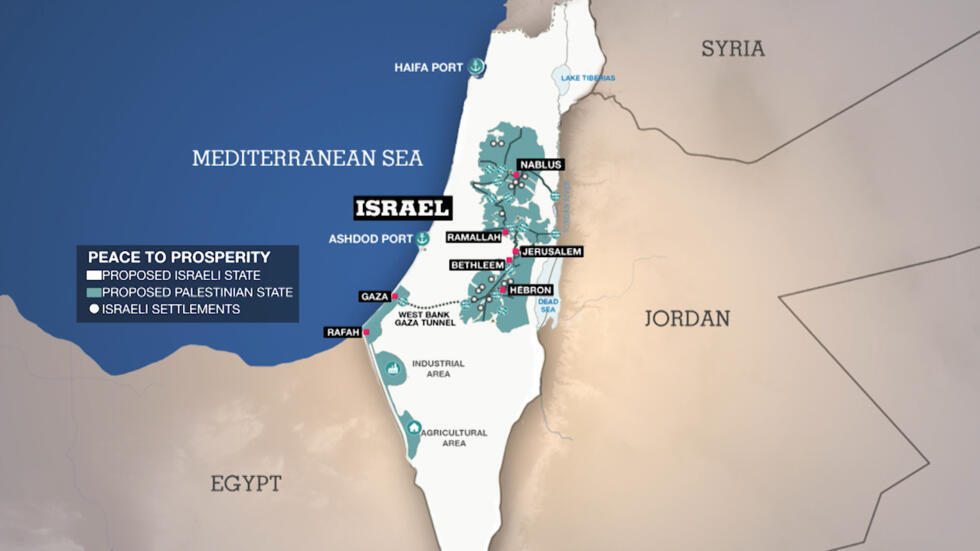
2020 – Trump suggests that the creation of a Palestinian state could be possible if the Palestinians are prepared to give way to the conditions outlined in his own peace plan. His proposal outlines a “contiguous” Palestinian state, connected across stretches of Israeli territory by “an efficient, modern transportation network” of rails and tunnels. The plan also suggests the creation of a Palestinian capital in “Eastern Jerusalem” without providing further details.

The territorial divisions outlined in US President Donald Trump's "Peace to Prosperity" proposal. © FRANCE 24

The aftermath of October 7

2023 – The deadly October 7 attacks launched by Hamas and allied militant groups on Israeli soil and the resulting Israeli onslaught in the Gaza Strip draws the world’s gaze once more to the Israeli-Palestinian conflict. The question of a two-state solution once again enters the discussion, albeit increasingly out-of-reach due to Netanyahu’s hardline policies, Abbas’s growing irrelevance, Hamas’s grip on Gaza and Israel’s renewed settlement of the occupied West Bank.

2024 – The UN General Assembly votes for the admission of the state of Palestine into the United Nations with a crushing majority and raises its status to “Permanent Observer”. SpainIreland and Norway all formally recognise the state of Palestine, and France’s Emmanuel Macron declares himself ready to follow their example.

For its part, the Israeli government – the most right-wing in the nation’s history – announces the seizure and future settlement of the largest parcel of land in the occupied West Bank since the signing of the Oslo Accords.

Israel expands West Bank settlements as Gaza crisis worsens

Israeli settlers in the West Bank look towards their neighboring village on Thursday, May 15, 2025. © Maya Alleruzzo, AP
03:50


2025 – France’s Macron affirms that recognising the state of Palestine is “not just a moral duty, but a political necessity”. He prepares to officially recognise the Palestinian state at a conference in Saudi Arabia in June – a conference postponed following Israel’s unprecedented bombing campaign of Iran.

On July 10, Macron calls for a joint recognition of Palestine between Paris and London during a visit to the United Kingdom.

On July 24, he announces that France will recognise the Palestinian state at the UN General Assembly in September.

This article has been adapted from the original in French.
No evidence Hamas stole Gaza humanitarian aid, USAID report shows

An analysis conducted by the US Agency for International Development (USAID) found no evidence that Hamas systematically stole US-funded humanitarian aid in Gaza, Reuters reported Friday. The findings challenge a justification used by Israel and the US to support a private aid initiative that bypasses the UN system amid deadly distribution chaos in Gaza.


Issued on: 25/07/2025 - 
By: FRANCE 24
Video by: Noga TARNOPOLSKY

Palestinians carry away food parcels donated by the Emirates Red Crescent from a distribution point in Gaza City on June 26, 2025. © Bashar Taleb, AFP
03:28


An internal US government analysis found no evidence of systematic theft by the Palestinian militant group Hamas of US-funded humanitarian supplies, challenging the main rationale that Israel and the US give for backing a new armed private aid operation.

The analysis, which has not been previously reported, was conducted by a bureau within the US Agency for International Development and completed in late June. It examined 156 incidents of theft or loss of US-funded supplies reported by US aid partner organizations between October 2023 and this May.

It found “no reports alleging Hamas” benefited from US-funded supplies, according to a slide presentation of the findings.

A State Department spokesperson disputed the findings, saying there is video evidence of Hamas looting aid, but provided no such videos. The spokesperson also accused traditional humanitarian groups of covering up "aid corruption."


The findings were shared with the USAID's inspector general's office and State Department officials involved in Middle East policy, said two sources familiar with the matter, and come as dire food shortages deepen in the devastated enclave.

Israel says it is committed to allowing in aid but must control it to prevent it from being stolen by Hamas, which it blames for the crisis.

The UN World Food Program says nearly a quarter of Gaza’s 2.1 million Palestinians face famine-like conditions, thousands are suffering acute malnutrition, and the World Health Organization and doctors in the enclave report starvation deaths of children and others.


© France 24
01:40


The UN also estimates that Israeli forces have killed more than 1,000 people seeking food supplies, the majority near the militarized distribution sites of the Gaza Humanitarian Foundation (GHF), the new private aid group that uses a for-profit US logistics firm run by a former CIA officer and armed US military veterans.

Read more'Blood for food': The US soldier-spies sidelining UN aid work in Gaza

The study was conducted by the Bureau of Humanitarian Assistance (BHA) of USAID, which was the largest funder of assistance to Gaza before the Trump administration froze all US foreign aid in January, terminating thousands of programs. It has also begun dismantling USAID, whose functions have been folded into the State Department.

The analysis found that at least 44 of the 156 incidents where aid supplies were reported stolen or lost were “either directly or indirectly” due to Israeli military actions, according to the briefing slides.

Israel's military did not respond to questions about those findings.

The study noted a limitation: because Palestinians who receive aid cannot be vetted, it was possible that US-funded supplies went to administrative officials of Hamas, the Islamist rulers of Gaza.

One source familiar with the study also cautioned that the absence of reports of widespread aid diversion by Hamas “does not mean that diversion has not occurred.”

The war in Gaza began after Hamas attacked Israel in October 2023, killing 1,200 people and capturing 251 hostages, according to Israeli tallies. Nearly 60,000 Palestinians have been killed since the Israeli assault began, according to Palestinian health officials.

Watch moreHumanitarian sector in crisis as USAID cuts force NGOs to prioritise needs
Israel says Hamas diverts humanitarian aid

Israel, which controls access to Gaza, has said that Hamas steals food supplies from UN and other organizations to use to control the civilian population and boost its finances, including by jacking up the prices of the goods and reselling them to civilians.

Asked about the USAID report, the Israeli military said that its allegations are based on intelligence reports that Hamas militants seized cargoes by "both covertly and overtly" embedding themselves on aid trucks.

Those reports also show that Hamas has diverted up to 25% of aid supplies to its fighters or sold them to civilians, the Israeli military said, adding that GHF has ended the militants' control of aid by distributing it directly to civilians.

Hamas denies the allegations. A Hamas security official said that Israel has killed more than 800 Hamas-affiliated police and security guards trying to protect aid vehicles and convoy routes. Their missions were coordinated with the UN.

FRANCE 24 could not independently verify the claims by Hamas and Israel, which has not made public proof that the militants have systematically stolen aid.

GHF also accuses Hamas of massive aid theft in defending its distribution model. The UN and other groups have rejected calls by GHF, Israel and the US to cooperate with the foundation, saying it violates international humanitarian principles of neutrality.

In response to a request for comment, GHF referred to a July 2 Washington Post article that quoted an unidentified Gazan and anonymous Israeli officials as saying Hamas profited from the sales and taxing of pilfered humanitarian aid.
Aid groups required to report losses

The 156 reports of theft or losses of supplies reviewed by BHA were filed by UN agencies and other humanitarian groups working in Gaza as a condition of receiving U.S. aid funds.

The second source familiar with the matter said that after receiving reports of U.S.-funded aid thefts or losses, USAID staff followed up with partner organizations to try to determine if there was Hamas involvement.

Those organizations also would "redirect or pause" aid distributions if they learned that Hamas was in the vicinity, the source said.

Aid organizations working in Gaza also are required to vet their personnel, sub-contractors and suppliers for ties to extremist groups before receiving U.S. funds, a condition that the State Department waived in approving $30 million for GHF last month.

The slide presentation noted that USAID partners tended to over-report aid diversion and theft by groups sanctioned or designated by the US as foreign terrorist organizations - such as Hamas and Palestinian Islamic Jihad - because they want to avoid losing US funding.

Of the 156 incidents of loss or theft reported, 63 were attributed to unknown perpetrators, 35 to armed actors, 25 to unarmed people, 11 directly to Israeli military action, 11 to corrupt subcontractors, five to aid group personnel “engaging in corrupt activities,” and six to “others," a category that accounted for “commodities stolen in unknown circumstances,” according to the slide presentation.

The armed actors “included gangs and other miscellaneous individuals who may have had weapons,” said a slide. Another slide said "a review of all 156 incidents found no affiliations with" U.S.-designated foreign terrorist organizations, of which Hamas is one.

“The majority of incidents could not be definitively attributed to a specific actor,” said another slide. “Partners often largely discovered the commodities had been stolen in transit without identifying the perpetrator.”

It is possible there were classified intelligence reports on Hamas aid thefts, but BHA staff lost access to classified systems in the dismantlement of USAID, said a slide.

However, a source familiar with US intelligence assessments said that they knew of no US intelligence reports detailing Hamas aid diversions and that Washington was relying on Israeli reports.

The BHA analysis found that the Israeli military “directly or indirectly caused” a total of 44 incidents in which US-funded aid was lost or stolen. Those included the 11 attributed to direct Israeli military actions, such as airstrikes or orders to Palestinians to evacuate areas of the war-torn enclave.

Losses indirectly attributed to Israeli military included cases where they compelled aid groups to use delivery routes with high risks of theft or looting, ignoring requests for alternative routes, the analysis said.

(FRANCE 24 with Reuters)