Monday, July 28, 2025

The U.S. Is Falling Behind in the Global EV Race

  • Tesla posted its sharpest revenue and delivery drop in over a decade, as Elon Musk warns of turbulent quarters ahead.

  • The U.S. EV market is slowing dramatically, with sales falling 6.3% in Q2 despite federal incentives.

  • China and Europe continue to dominate EV growth, creating risks for U.S.-based manufacturers and energy infrastructure planners.

Tesla CEO Elon Musk has warned that the end of U.S. government support for electric vehicles could lead to “a few rough quarters,” following the automaker’s steepest revenue and delivery decline in more than a decade. Tesla is now relying on a long-promised affordable model and its autonomous ride-hailing roadmap to regain momentum, but immediate growth prospects look dim in the U.S. market.

The caution comes as global EV sales continue to rise. According to Rho Motion, 9.1 million EVs were sold worldwide in the first half of 2025, up 28% YoY. Not surprisingly, China led, with 5.5 million units, followed by Europe with 2 million. By contrast, North America added just 900,000 units, a modest 3% gain over last year, as reported by Electrek.

In contrast to strong global figures, the U.S. market is faltering. Data from Cox Automotive shows that EV sales in the U.S. fell by 6.3% in the second quarter compared to Q2 2024, totaling 310,839 units. This marked only the third quarterly year-on-year decline since EVs gained mainstream traction. Incentives remained high, averaging $8,500 per vehicle in June (nearly 15% of sticker price), but failed to spark additional demand.

Tesla’s global deliveries dropped to 384,122 vehicles in Q2, down 13.5% YoY, according to Reuters. Meanwhile, BYD reported a 16% increase in global deliveries and a 46% jump in battery-electric sales, overtaking Tesla in global BEV market share for the quarter.

General Motors delivered 46,280 EVs in Q2, more than doubling its volume from a year ago, and is now the second-largest EV seller in the U.S. Ford also increased sales but has slowed EV investment under the weight of cost pressures and revised capital priorities.

The U.S. policy environment is shifting rapidly. The “Big, Beautiful Bill”, signed by President Donald Trump earlier this month, eliminates the $7,500 federal EV tax credit as of October 1. It also ends credits for used EVs and home charger installations. Analysts expect a short-term Q3 bump from consumers rushing to claim benefits before the deadline, followed by a deeper Q4 slump, according to Reuters

Infrastructure gaps are compounding demand risks. As of midyear, fewer than 400 fast-charging ports had been completed under the federal government’s $7.5 billion National Electric Vehicle Infrastructure program, far short of targets. Reuters notes that this shortfall could dampen adoption, especially outside metro areas.

Globally, momentum remains strong. China now accounts for more than 60% of global new energy vehicle output, aided by vertically integrated supply chains and steady model releases. In Europe, Chinese brands are gaining share despite new tariffs, offering low-cost BEVs that undercut traditional automakers.

For the energy sector, this divergence could bode ill. Utilities banking on rising EV-related electricity demand may need to revise projections downward. Battery producers that scaled up U.S. production could face excess capacity if demand softens. At the same time, firms tied to Chinese or European supply chains might just continue to benefit from sustained global growth.

Q3 may deliver a temporary lift in U.S. volumes, but this is now a fairly fragile game. Tesla’s ability to reposition with a lower-cost model, or make good on its robotaxi promises, will be the key thing to watch for observers looking to predict U.S. trajectory. Globally, EVs are increasingly embedded in the mainstream. But for now, the U.S. isn’t taking the lead. Instead, it’s barely managing to keep pace. 

By Michael Kern for Oilprice.com


U.S. EV Makers Pivot to Energy Storage as Trump Targets Incentives

  • BloombergNEF slashed U.S. EV sales projections by 14 million units through 2030 due to policy rollbacks under Trump.

  • Automakers like GM and Tesla are refocusing on battery storage projects to meet rising electricity demands from AI-powered data centers.

  • Repurposing and recycling used EV batteries offers a new revenue stream and extends battery life beyond vehicle use.

The United States electric vehicle industry is facing a rough road ahead. The Trump administration has long promised to walk back a number of Biden administration policies aimed at climate change targets, including those designed to boost electric vehicle adoption. In light of the changing policy climate, BloombergNEF has lowered both its near- and long-term outlooks for EV sales in the United States for the first time ever, while the rest of the world’s numbers continue to climb.

BloombergNEF cut 14 million battery-powered cars from its sales projections through 2030 thanks to changing policies in the United States, which are removing supports from the EV industry as well as pressures to lower emissions. On the very first day of this term, Trump ordered the elimination of EV subsidies, and his administration is now loosening national fuel-economy standards, doing away with EV tax credits, and blocking California’s state-level emissions limits.

“President Donald Trump’s efforts to unravel policies supporting electric vehicles threatens to turn the US into a laggard for years to come,” reports Bloomberg.

As a result, the makers of EV batteries for U.S. markets are scrambling to find new buyers, and they’re increasingly turning to energy storage as a lifeline. Major companies like General Motors and LG are fast-tracking energy storage battery projects as they look to capitalize on a surge of demand on energy grids driven by data centers. 

The proliferation of artificial intelligence is placing unprecedented stress on energy grids, and along with it, unprecedented opportunity for battery storage. In 2024, Tesla’s energy storage revenue jumped 67 percent last year to $4 billion, making it an increasingly central part of the EV company’s portfolio

And now GM has signed a “non-binding memorandum of understanding” with Redwood Energy to sell new and used EV batteries to a recycling firm for reuse in energy storage projects used as a sort of power bank for data centers. These batteries hold onto electricity and excess energy produced by wind and solar when production outpaces demand, which it then feeds back into the grid – or into a connected data center – as needed.

“The market for grid-scale batteries and backup power isn’t just expanding, it’s becoming essential infrastructure,” Kurt Kelty, GM's vice president of batteries, propulsion, and sustainability, said in a recent statement. “Electricity demand is climbing, and it’s only going to accelerate. To meet that challenge, the U.S. needs energy storage solutions that can be deployed quickly, economically, and made right here at home. GM batteries can play an integral role. We’re not just making better cars — we’re shaping the future of energy resilience.” 

In addition to newly manufactured batteries, used EV batteries have potential for new life in energy storage applications. EV batteries are retired when their range drops below a certain threshold, but they still have a lot of life in them that can be used in other applications, according to a recent report released by the Natural Resources Defense Council (NDRC).

“There’s definitely some potential in the utility sector, especially in terms of grid back-up storage … even though [old EV batteries] have lost, say, 20% of their original capacity… when you’re talking about grid storage that can still be a perfectly usable battery for several more years,” says Jordan Brinn, the report’s author.

And even totally used-up batteries can be repurposed for energy storage needs. According to Brinn, 95 percent of the minerals in a dead EV battery can be reused to produce new batteries either for EVs or energy storage systems. Either way, this provides a critical new sector for EV makers, who can sell off new and used products to recycling centers as EV sales continue to slump within a discouraging policy environment.

By Haley Zaremba for Oilprice.com

Sunday, July 27, 2025


How Trump Is Stalling Solar and Wind Projects

  • Trump’s “One Big Beautiful Bill Act” and new executive orders strip financial incentives from wind and solar while boosting coal, gas, and nuclear.

  • Federal permitting for renewables is now subject to expanded political review, creating major delays and uncertainty for developers.

  • Critics warn that these moves will slow clean energy deployment just as U.S. electricity demand surges due to AI and data center growth.


United States President Donald Trump announced plans in July to tighten federal permitting to restrict solar and wind energy development. This follows the passing on Trump’s One Big Beautiful Bill Act, which seeks to expand the fossil fuel and nuclear power sectors while also halting renewable energy progress in the U.S. These moves could lead energy companies to pause investments in renewable energy projects due to the uncertain outlook for the industry, as developers face more red tape and fewer financial incentives in establishing new solar and wind projects. 

It may become even harder to develop solar and wind projects that require federal permitting, as the Trump administration has put Interior Secretary Doug Burgum in charge of deciding which projects may proceed on federal land. Burgum now has the “final review” of leases, rights-of-way, construction plans and all other aspects of the Interior Department’s federal permitting process for wind and solar projects, according to an internal memo

The Interior Department said in a statement that it was “levelling the playing field” for coal and natural gas “after years of assault” by the Biden administration. This follows recent moves by the Trump administration to encourage new coal developments and boost production to supposedly drive down energy costs. 

Burgum’s office will now be responsible for reviewing 68 types of agency actions, including federal permits, environmental reviews, lease sales, site plans, wildlife impact assessments and numerous smaller decisions and consultations related to solar and wind energy developments. This is expected to lead to bottlenecks and delays for many renewable energy projects.

Jason Grumet, the CEO of the lobby group American Clean Power (ACP), said, “The Interior Department adds three new layers of needless process and unprecedented political review to the construction of domestic energy projects.” Grumet added, “This isn’t oversight. It’s obstruction that will needlessly harm the fastest-growing sources of electric power.” Approximately 5 percent of solar projects and 1 percent of wind projects are situated on federal land, according to ACP. 

While only a small percentage of wind and solar projects are developed on federal lands and waters, many projects situated on private lands consult with the Interior Department to determine whether they require federal permits to comply with wildlife protections or other laws. Several industry groups have criticised the move for hindering the development of U.S. solar and wind power, which has accelerated in recent years.

The new measures are expected to restrict the development of solar and wind energy projects and, therefore, slow the speed of new clean electricity generation at a time when the U.S. electricity demand is expected to soar. As tech companies invest heavily in the rollout of data centres to support complex technologies such as artificial intelligence, experts worry that the U.S. will not be able to meet the growing electricity demand. President Trump has regularly been criticised as experts say his restrictions on the development of renewable energy projects are at odds with his claims that the U.S. is facing an energy emergency to meet growing demand for electricity. 

The recent passing of President Trump’s One Big Beautiful Bill Act also threatens green energy progress in the U.S., as it scraps several financial incentives for renewable energy development. Another executive order from July called for the Interior Department to “eliminate preferential treatment for wind and solar facilities compared to reliable, dispatchable energy sources,” referring to coal, natural gas and nuclear power.

Several House Republicans had previously lobbied for the bill to bring an end to green energy subsidies even faster than the final Act stipulates. Upon voting for a watered-down version of the bill, in terms of renewable energy restrictions, some lawmakers said that Trump had promised to address their concerns through executive action.

And it seems like Trump has followed through with his promise by signing an executive order to end market-distorting subsidies for unreliable, foreign-controlled energy sources on July 7. The order directed the Treasury Department to consider revising its guidelines for how and when renewable energy projects would need to commence development in order to be eligible for tax breaks.            

Adam Suess, the acting assistant secretary for lands and minerals management at the Interior Department, said, the “actions further deliver on President Trump’s promise to tackle the Green New Scam and protect the American taxpayers’ dollars.” Suess added, “American energy dominance is driven by U.S.-based production of reliable base load energy, not regulatory favouritism toward unreliable energy projects that are solely dependent on taxpayer subsidies and foreign-sourced equipment.”

In recent months, it seems that Trump has waged a war on renewable energy development in the U.S., while also stating the need to rollout more electricity to meet the rising national demand. Through several executive orders and the Big Beautiful Bill, Trump has favoured fossil fuels and supported a reversal of the U.S. energy agenda, as he aims to move away from renewable energy to oil, gas, coal and nuclear power.

By Felicity Bradstock for Oilprice.com


Vineyard Wind 1 Expects to Reach Full Commercial Operations by End of 2025

offshore wind farm
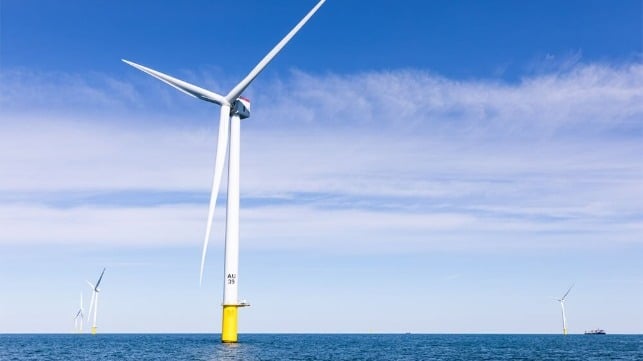
Reports indicate renewed progress with the installation of Vineyard Wind 1 (Avangrid file photo)

Published Jul 25, 2025 3:22 PM by The Maritime Executive


One year after GE Vernova confirmed it had found “materials defects” in the wind turbine blades for the Massachusetts offshore wind farm, new reports reveal the project is making steady progress. Iberdola, parent company of Avangrid, the investors along with Copenhagen Infrastructure Partners, told shareholders it now expects Vineyard Wind 1 to reach its commercial operations date “at the end of  2025.”

Iberdrola said in its mid-year financial presentation that 17 turbines out of 62 planned for Vineyard Wind 1 are already exporting power. It reported that 23 are fully installed, which is up from the four that it highlighted in May 2025. Currently, it says the project is supplying approximately 30 percent (241 MW) of its full capacity of 806 MW.

This marks a significant recovery for the project, which had been stopped in its tracks a year ago due to the manufacturing problem with the blades discovered after one blade failed in July 2024. The local newspaper, New Bedford Light, reports that the pace of activity at the installation site has accelerated this summer. It says that the barges carrying materials out to the installation have made at least 15 trips since June, moving turbine components to the installation vessels. It also reports that the project, however, extended the lease on the New Bedford Marine Commerce Terminal, which is being used as a base and staging area, until June 2026.

A year ago, in June 2024, Vineyard Wind had reported that the offshore wind project had 10 operating turbines and was delivering more than 136 MW to the electric grid in Massachusetts. The companies also said that 47 foundations and transition pieces were installed, as well as 21 turbines, with the installation of the 22nd turbine underway.

The newspaper points out that while it appears 40 of the turbines are now in place, it is unknown how many have completed their inspections and replacement of the blades. As part of the project’s agreement with U.S. regulators, all the blades manufactured at GE Vernoa’s facility in Canada had to undergo inspections after one blade fractured. The company has agreed to replace the blades and is now using blades manufactured in France for the project.

Vineyard Wind 1 is one of the few offshore wind projects underway in the United States, in part due to the Trump administration’s efforts to derail the industry. Nearby, Ørsted’s Revolution Wind (704 MW) is also proceeding with construction, while others planned for the New England region remain stalled.

Iberdrola highlighted to investors that it has all the necessary federal permits for its second project, New England Wind 1 (791 MW), but it still has to conclude agreements with the states and has not indicated a potential timeline for construction. Massachusetts confirmed in March that both New England Wind 1 and SouthCoast Wind, which is being developed by a partnership between EDP Renewables and ENGIE, had not yet completed their power purchase agreements. It said both projects were seeking to delay the timing due to market uncertainties.


Puerto Rico Abandons $20 Billion LNG Deal

  • Puerto Rico's government has canceled a proposed $20-billion LNG supply deal with New Fortress Energy after the island's oversight board declined to approve it, citing concerns about cost, duration, and long-term fuel dependency.

  • The collapse of the agreement leaves a significant void in Puerto Rico's energy planning, with natural gas currently accounting for a substantial portion of the island's electricity generation and questions arising about the future balance between fossil fuels and federally supported renewable energy goals.

  • The canceled deal represents a setback for New Fortress Energy's expansion ambitions in the Caribbean, while Puerto Rico faces critical decisions about its energy mix, grid modernization, and the potential for a new solicitation process for energy supply.

Puerto Rico’s government has pulled the plug on contract talks with New Fortress Energy after the island’s federally appointed oversight board declined to approve a proposed $20-billion LNG supply deal, upending years of negotiations and raising questions about the future shape of its energy transition.

According to a report by Hart Energy, the Financial Oversight and Management Board for Puerto Rico withheld support for the contract earlier this month, citing concerns about cost, duration, and long-term fuel dependency. In response, the Puerto Rico government formally canceled negotiations with New Fortress, despite the company’s dominant position in the island’s LNG market.

New Fortress had been in line to supply fuel for the state-owned Puerto Rico Electric Power Authority (PREPA), whose fleet includes aging oil- and gas-fired plants awaiting conversion or decommissioning. The canceled deal was expected to cover LNG imports for a period of up to 25 years, potentially extending New Fortress’s role as the island’s primary gas supplier well into the 2040s.

The collapse of the agreement leaves a significant vacuum in Puerto Rico’s energy planning. According to the U.S. Energy Information Administration (EIA), natural gas, primarily LNG, accounted for approximately 34% of the island’s electricity generation in 2023, with petroleum making up the majority. Although full-year 2024 data is not yet available, analysts at the Institute for Energy Economics and Financial Analysis (IEEFA) had warned that Puerto Rico’s increasing reliance on LNG contracts could entrench fossil fuel use at the expense of federally supported renewable energy goals.

In parallel, the U.S. Department of Energy is preparing to disburse nearly $1 billion in solar and storage funding through the Puerto Rico Energy Resilience Fund. As of July, however, local permitting constraints and utility interconnection delays had slowed the rollout of community-scale renewable projects.

The New Fortress deal had also come under scrutiny for bypassing competitive procurement rules. While the company already supplies LNG to the San Juan combined-cycle plant and EcoEléctrica’s Peñuelas facility, its attempt to lock in a 25-year sole-source contract drew criticism from public interest attorneys and environmental groups. Legal scholars warned the deal could have violated key provisions of Puerto Rico’s energy reform laws.

For New Fortress, which has not issued any public comment on the deal’s breakdown, the canceled contract represents a setback in its bid to expand LNG operations across the Caribbean. The company is still advancing its Fast LNG project in Mexico, with modular floating liquefaction units aimed at flexible export markets, including potentially Puerto Rico. While one cargo was delivered to Puerto Rico in early 2025, no current-quarter shipments have been confirmed. Without a long-term anchor contract, its foothold on the island may be more vulnerable than previously assumed.

Puerto Rico’s Energy Bureau has not announced whether a new solicitation process will follow. With the island’s debt restructuring still underway and federal funding tied to grid modernization, the question now is whether energy planners will reframe the mix around renewables, or seek a scaled-down LNG alternative.

By Charles Kennedy for Oilprice.com 

GLOBAL WARMING

Global Gas Flaring Surges to 17-Year High

  • Gas flaring released 389 million tonnes of CO? in 2024, with global flaring hitting its highest level since 2007.

  • Weak regulations and limited enforcement continue to allow oil companies to waste gas and pollute the atmosphere.

  • Countries like Kazakhstan and Egypt show progress, but most top flaring nations—including the U.S. and Russia—have made little improvement.


Despite big promises by oil majors to reduce gas flaring, the practice continues to be a major issue, contributing to high levels of greenhouse gas emissions. The International Energy Agency (IEA) and several state governments are aiming to achieve a global green transition, but decarbonising certain sectors, such as the oil industry, is proving extremely difficult. If gas flaring continues to take place, it could compromise the acceleration to green.

Gas flaring is the burning of the natural gas associated with oil extraction. The practice has been carried out by oil companies for over 160 years, as there has been little financial incentive to capture the waste gas. Lax regulations in the sector have allowed companies to long continue flaring even when it was known to be highly polluting. 

Around 151 billion cubic meters (bcm) of gas is flared each year, the equivalent of the amount needed to power the whole of sub-Saharan Africa. Each year, flaring releases around 400 million tonnes of CO2e emissions into the atmosphere, which is more than that released by many entire countries. In addition, flaring releases methane emissions, which contribute heavily to global warming, as methane is over 80 times more powerful than carbon dioxide as a warming gas on a 20-year timeframe. 

Governments and international organisations have put increasing pressure on oil companies to stop flaring gas and instead capture it, to prevent unnecessary pollution into the atmosphere. Oil companies may also use this captured gas for productive purposes, such as generating power. The World Bank’s Zero Routine Flaring (ZRF) by 2030 initiative, launched in 2015, commits governments and oil companies to end routine flaring no later than 2030. Currently, 36 states and 60 oil and gas companies endorse the initiative. The IEA has similarly called for an end to all flaring, except in emergencies, by 2030.

According to a recent World Bank report, which used satellite data to estimate flared gas, the fossil fuel industry released an additional 389 million tonnes of carbon dioxide into the atmosphere in 2024 from gas flaring activities. This represents a huge quantity of fuel waste, as well as unnecessary pollution. Global gas flaring increased for a second consecutive year to reach its highest level since 2007, according to the report. 

Zubin Bamji, the manager of the World Bank’s Global Flaring and Methane Reduction partnership (GFMR), said, “Flaring is needlessly wasteful. [It’s] a missed opportunity to strengthen energy security and improve access to reliable power.”

Many complain that regulations on gas flaring are too weak and poorly enforced, meaning that most companies around the world are not incentivised to invest in gas capture, and, therefore, continue to flare gas. According to the report, nine countries – Russia, Iran, Iraq, the U.S., Venezuela, Algeria, Libya, Mexico, and Nigeria - were responsible for three-quarters of all gas flaring last year. Most of these countries have state-owned oil companies. Meanwhile, flaring intensity in Norway, which has invested heavily in shifting to “low-carbon” oil production, is 18 times lower than in the U.S. and 228 times lower than in Venezuela. 

In Canada’s oil-producing region of Alberta, gas flaring in 2024 was far higher than the province's self-imposed limit for a second year in a row, according to data from Reuters. Alberta's crude oil production set a record last year at 1.5 billion barrels, marking a 4.5 percent increase over 2023, as it attempts to reduce its reliance on the neighbouring United States for energy. In June, Alberta's energy regulator announced it was ending the limit on flaring, following direction from the provincial government. Reuters estimates that Alberta’s oil and gas firms in the province flared roughly 912.7 million cubic metres of natural gas in 2024, which was 36 percent higher than the annual provincial limit of 670 million cubic metres. 

The value of the flared gas from 2024, around $63 billion at last year’s EU import prices, is equivalent to over half the upfront costs required to stop the practice altogether, according to the IEA. However, most countries still lack the political will and regulatory pressure to implement solutions. 

However, some countries have made drastic improvements to their gas flaring levels. Countries such as Angola, Egypt, Indonesia, and Kazakhstan have all reduced gas flaring in recent years. Kazakhstan has managed to reduce flaring by 71 percent since 2012 by introducing steep fines on companies that break the rules.

While several countries and oil companies have committed to reducing gas flaring levels in recent years, many continue to practice flaring activities, with little incentive to invest in alternative solutions. Gas flaring levels will likely only decrease if governments worldwide impose stricter regulations on companies that practice flaring. Meanwhile, the continued practice of gas flaring will contribute heavily to global warming, which will have a knock-on effect on global green transition progress.

By Felicity Bradstock for Oilprice.com

Why Geothermal Energy Is Garnering So Much Attention

FRACKING BY ANY OTHER NAME

  • Geothermal energy, a constant and limitless clean energy source, is poised to become a major disruptor in global energy markets.

  • New technological advancements are making deep geothermal energy extraction more feasible.

  • The widespread adoption of enhanced geothermal technologies could provide abundant, cheap, and clean energy anywhere on Earth.

Geothermal energy holds massive potential to disrupt global energy markets and provide nearly limitless and constant clean energy. Unlike solar and wind energy, which rely on climatic factors outside of human control, the heat from the Earth’s core is a steady and constant commodity. It’s just a matter of tapping into it. And the race is heating up to determine the best technological approach to do just that.

Way back in 2021, Oilprice asked, “Why is the world still ignoring geothermal energy?” In the four years since that report, everything has changed. The promising clean energy source has – at long last – become a very hot topic. Rising from near obscurity, it’s now shaping up to be “the decade of geothermal.” That’s according to Cindy Taff, chief executive of geothermal company Sage Geosystems, in an interview in The Hill published in February of this year.

So what took so long? Geothermal is already easily accessible in places like Iceland, where heat from the Earth’s core already leaks up to the surface and can be easily captured and converted into electricity. But on most of the planet, temperatures useful for creating electricity are trapped far, far under the ground. The Earth's crust varies from about 3 to 47 miles in thickness, and most of those thinnest areas are inconveniently located way out in the deep ocean. 

“The most audacious vision for geothermal is to drill six miles or more underground where temperatures exceed 750 degrees Fahrenheit,” reports the New York Times. “At that point, water goes supercritical and can hold five to 10 times as much energy as normal steam.” This ‘superhot’ geothermal “could provide cheap, abundant clean energy anywhere.”

Drilling a hole deep enough to enable cost-effective and commercial geothermal energy is no easy task. But research and pilot projects trying to figure out the best way to do it are finally taking off. 

One potential method borrows hydraulic fracturing technologies that are already well-tested and widely in use in the oil and gas industry. Using fracking infrastructure, geothermal companies can crack open subterranean layers of rock to inject water into the fractures at high volumes and pressures, resulting in artificially made geothermal reservoirs. This technology is not yet cost-effective enough to be commercially viable, since traditional fracking equipment can’t withstand the necessary levels of heat, but it was one of the first “enhanced” geothermal technologies and is therefore more developed than some of the more nascent alternatives.

Another, more futuristic technological approach involves nuclear fusion. Researchers are currently investigating the utility of gyrotrons, a technology used in nuclear fusion to super-heat and maintain plasma with millimeter waves, to basically melt away rock to drill deeper and more efficiently into the Earth. Mathematical modelling from the Massachusetts Institute of Technology (MIT) suggests that this technology “could blast a basketball-size hole into rock at a rate of 20 meters per hour,” according to IEEE Spectrum. “At that rate, 25-and-a-half days of continuous drilling would create the world’s deepest hole.” And now the gyrotron approach is ready to leave the lab and face real-world testing

A Slovakian company called GA Drilling is also looking to plasma, but rather than using millimeter waves the technology uses a plasma torch for high-temperature drilling, which they say can reach 10-kilometer depths to “provide clean, inexpensive and nonstop available geothermal energy” at “any location on Earth.” 

A geothermal technology breakthrough could reshape global energy industries and shore up energy security – just in the nick of time as energy demand surges on the back of data center growth. A recent report suggests that geothermal energy could meet up to 64 percent of the expected growth in data center energy demand as soon as the early 2030s. Plus, enhanced geothermal drilling technologies would democratize clean energy, as any country could theoretically tap into this universal heat source to become energy independent. 

By Haley Zaremba for Oilprice.com


Explosion Kills Three and Sinks Ukrainian Dredge on a Danube Canal

Ukrainian drdge
An explosion killed three and reportedly sunk the Ukrainian dredge (AMNY)

Published Jul 25, 2025 11:30 AM by The Maritime Executive


The Sea Ports Authority of Ukraine issued a brief statement confirming that there has been an explosion killing three people working on a dredge employed by the authority. Few details were released, but the Ukrainian media is saying it was likely a mine in the Bystre waterway, one of the canals linking the Danube to the Black Sea.

The authority reported that the explosion took place on the evening of July 23 while its dredger was conducting normal work on the channel. There was a total of 11 people aboard, and in addition to the three who were killed, others were reported to be in the hospital.

The Bystre is currently closed, and the emergency authorities are on the scene. The authority said the details were being investigated. It notes that the Sulin Channel to the south, also linking to the Danube, remains open for vessel traffic. Ukraine had reopened the Bystre strait for commercial vessels in July 202 after the liberation of Zmiiniy (Snake) Island from the Russians.

The Ukrainian media outlet Dumskaya is identifying the vessel as the Ingulskiy, a Damen-built dredge operating for the authority since 2012. The vessel, which was 60 meters (197 feet) and could operate at depths up to 15 meters (approximately 50 feet), has reportedly sunk in the waterway. It struck the mine, the media report says, near the town of Vilkovo, which is along the Danube in the Delta region.

The Danube seaports played a critical role for Ukraine after the Russian invasion, being the primary way to maintain water transport. After ports were reopened in the Odesa region, traffic on the Danube declined, but it remains a key waterway for commerce both for Ukraine and neighboring Romania. The Bystre was important during the Soviet era and reopened by Ukraine as an alternative to traveling along the Sulina, which is controlled by Romania. The Bystre is reported open for vessels with a maximum draft of 4.5 meters (approximately 15 feet).


Espionage Arrests Signal Shift in Ukraine-China Relations

  • Ukraine has arrested Chinese nationals on espionage charges and sanctioned Chinese companies, signaling a hardened stance toward Beijing due to its perceived support for Russia's war.
  • Despite China's claims of neutrality, evidence suggests it is providing significant support to Russia, including dual-use technology and military systems, leading Ukraine to abandon hopes of Beijing brokering peace.
  • The growing distance between Kyiv and Beijing is underscored by Ukraine's actions and the US-Ukraine agreement on critical minerals, though Ukraine continues to tread carefully due to China being its largest trading partner.

The arrest of two Chinese nationals in Ukraine on espionage charges this month has punctuated a shift in Kyiv’s tone toward Beijing, whose support for Russia’s war is becoming harder to ignore.

Ukraine’s intelligence service on July 9 said a 24-year-old Chinese man – expelled from a Ukrainian technical school two years ago – tried to obtain classified information about the Neptune missile program by befriending a defense worker. Authorities say he intended to pass the information to his father, who was also arrested, for delivery to Chinese intelligence.

The arrests came just one day after President Volodymyr Zelenskyy imposed sanctions on five Chinese companies for aiding Russia’s war effort, an unusually direct move by Ukraine.

From the outset of Russia’s full-scale invasion, Beijing has claimed neutrality while buying up Russian oil and gas –- Moscow’s financial lifeline –- and supplying dual-use technology to its military. Kyiv, like many in the West, had hoped China would use its leverage over Russian President Vladimir Putin to press for peace.

That hope appears to be fading.

China, once content to provide components like microchips, is now believed to be delivering entire systems. In May, pro-Russian Telegram channels claimed Moscow was using a new Chinese laser weapon to shoot down Ukrainian drones.

This week, Ukraine’s military intelligence agency said Moscow is now launching drone decoys assembled inside Russia but made entirely from Chinese parts.

Meanwhile, Beijing has been welcoming officials from Ukraine’s occupied territories at trade shows while Chinese companies have been selling heavy equipment to Russian companies operating in those territories.

The shift in Beijing’s behavior comes amid reports that China is no longer even pretending to be neutral.

EU officials told RFE/RL that Chinese Foreign Minister Wang Yi told the bloc’s top diplomat Kaja Kallas during a July 3 meeting in Brussels that Beijing does not want Russia to lose the war, fearing it would free up the United States to focus more directly on China. Wang, the officials said, denied that China is backing the war, but his comments marked a departure from Beijing’s previous ambiguity.

At an EU-China summit on July 25, European Commission President Ursula von der Leyen told her Chinese counterpart Xi Jinping that relations between Brussels and Beijing were at an "inflection point" while issuing a thinly veiled warning that China's relationship with Moscow was a "determining factor" in how the ties would proceed.

Ukraine’s recent actions -– from espionage arrests to corporate sanctions –- suggest Kyiv is adjusting its stance as well.

“I think there has been a certain evolution,” said Oleksandr Merezhko, chair of the Ukrainian parliament’s foreign affairs committee.

“At the very beginning, there was some hope China could be involved in the [peace] process. But now we’ve become more realistic and speak more openly: China supports Russia.”

Beijing declined an invitation to attend the Ukraine peace summit in Switzerland last year, which drew representatives from more than 100 nations and organizations.

As recently as December, Zelenskyy had expressed hope of restoring prewar trade levels with China and deepening ties with the country as he accepted Beijing’s new envoy to Ukraine.

But that optimistic tone had changed by June, after China halted exports of drone parts to Ukraine. Days later, Zelenskyy traveled to Singapore and delivered what experts said was his first public criticism of Beijing since the invasion.

In July, at the Ukraine Recovery Conference in Rome, he warned that countries backing Russia would be excluded from postwar reconstruction –- a message widely interpreted as aimed at China.

Growing Distance

Meanwhile, the US-Ukraine agreement signed in June on critical minerals investment also calls for the exclusion of countries supporting Russia, underscoring the growing distance between Kyiv and Beijing.

Still, Ukraine is treading carefully.