Monday, August 04, 2025

The Gilded Lie: Trump’s Ballroom, a Ballooning Deficit, and the Reign of Useful Splendor

Trump’s defenders will call the ballroom symbolic. They are right. It symbolizes a state that has abandoned the moral obligations of government and replaced them with architecture.



Protesters rally near City Hall during an anti-Trump "No Kings Day" demonstration on June 14, 2025 in Los Angeles, California.
(Photo: Mario Tama/Getty Images)


Jesse Mackinnon
Aug 03, 2025
Common Dreams

U.S. President Donald Trump’s $200 million plan to construct a new golden ballroom at the White House is not just a monument to narcissism. It is statecraft by spectacle, financed by national rot. The timing is not subtle. It arrives alongside his “One Big, Beautiful Bill,” a federal budget that slashes Medicaid, food stamps, public housing, and climate programs, all while inflating the national deficit past $40 trillion. In this juxtaposition—architectural self-glorification for the ruling executive, fiscal starvation for the governed—we are not witnessing innovation. We are watching reruns of Versailles.

Louis XVI’s France operated on the principle of dépense utile, or “useful splendor”—the idea that royal extravagance was a form of political investment. Gold leaf and crystal chandeliers weren’t indulgence. They were instruments of authority. Versailles was never merely a residence. It was theater. It showcased the king’s ability to dominate not only his nobles but the metaphysical order of the kingdom itself. Every garden vista, every mirrored hallway, whispered the same thing: Obedience is beautiful, and beauty belongs to the crown.

This logic broke the country.

Calonne, Louis XVI’s finance minister in the 1780s, argued with sincerity that royal pageantry had diplomatic utility. France, he said, could not afford to appear poor. To reduce spending would be to lose face, both at home and abroad. It would risk undermining the delicate myth of royal omnipotence that kept the aristocracy groveling and foreign rivals guessing. So he doubled down. The state borrowed to cover Versailles’ operating costs. The result was a debt spiral so vast that it cracked the ancien régime wide open.

The French monarchy believed it could govern through performance. It fell because people eventually realized they were not guests at the party. They were the bill.

Fast forward to 2025. The United States now faces annual interest payments approaching $2 trillion, nearly one-third of all federal revenue. Unlike France in 1789, America has no tax-exempt aristocracy. Instead, it has tax-exempt billionaires. And instead of court ballet, it has cable news. But the fiscal structure is no less absurd. Trump’s budget performs the same dark magic: redirecting public funds toward elite vanity while accelerating structural collapse

The ballroom is a symptom. A projected $200 million marble-and-gold performance space, modeled loosely on Versailles’ Hall of Mirrors, will sit at the center of Trump’s renovated West Wing. It will host foreign dignitaries, Republican fundraisers, and presidential photo ops. This is how kleptocracy dresses itself—in borrowed grandeur, gilded walls, and florid illusions of permanence.

Meanwhile, Medicaid is being “restructured.” Supplement Nutrition Assistance Program benefits are being “realigned.” These are words chosen to disguise cruelty. The One Big Beautiful Bill is an exercise in anti-governance. It is designed to shrink the public sphere until only the strong, the connected, and the loyal remain. The money isn’t gone. It’s just moved—upwards.

There is bitter historical irony here. The French Revolution did not erupt because peasants lacked bread. Bread shortages had existed for centuries. What changed was the visibility of the farce. The illusion cracked. People saw a monarchy bleeding the treasury dry for glitter and pride, while demanding austerity from everyone else. The palace at Versailles, once a symbol of majesty, began to look grotesque. The line between luxury and insult collapsed.

Today, Americans are watching that same shift in real time. A president calls himself “king” on social media and receives thunderous applause from his base. He designs a ballroom while communities lose clinics. He throws gala dinners while food pantries see record demand. The White House is not a palace, but it is being remade into one.

The parallels to 18th-century France are not metaphorical. They are operational. Royal France justified excess as necessary to preserve order and prestige. Trump’s America justifies it with the language of branding. In both systems, the result is the same: obscene pageantry disguising political decay. The court is televised now. The courtiers wear microphones. And the people foot the bill.

There is no modern equivalent of Calonne’s Assembly of Notables. No gathering of billionaires will be summoned to justify the deficit or explain why America can afford a golden ballroom but not insulin. The rituals of accountability have vanished. The theater remains.

Trump’s defenders will call the ballroom symbolic. They are right. It symbolizes a state that has abandoned the moral obligations of government and replaced them with architecture. It is the spatial embodiment of policy by spectacle. The Roman emperors built circuses. Louis built Versailles. Trump builds ballrooms. The continuity is not ideological. It is psychological.

And it is ending the same way.

History offers no guarantees, but it does offer warnings. The French monarchy believed it could govern through performance. It fell because people eventually realized they were not guests at the party. They were the bill.

The question is not whether America can afford another ballroom. The question is whether it can survive the regime that thinks it should build one.


Our work is licensed under Creative Commons (CC BY-NC-ND 3.0). Feel free to republish and share widely.


Jesse Mackinnon
Jesse MacKinnon is a high school history teacher running for Congress in California’s 10th District. He is challenging a sitting Democratic incumbent in the primary because of congressional Democrats’ unwillingness to meaningfully oppose the Trump administration.    Full Bio >


Behind the bitter historical irony of Trump's new plan for the White House


Donald Trump, accompanied by his wife Melania, attends a New Year's Eve event at Mar-a-Lago in Palm Beach, Florida, U.S., December 31, 2024. REUTERS/Marco Bello

August 04, 2025 | 

U.S. President Donald Trump’s $200 million plan to construct a new golden ballroom at the White House is not just a monument to narcissism. It is statecraft by spectacle, financed by national rot. The timing is not subtle. It arrives alongside his “One Big, Beautiful Bill,” a federal budget that slashes Medicaid, food stamps, public housing, and climate programs, all while inflating the national deficit past $40 trillion. In this juxtaposition — architectural self-glorification for the ruling executive, fiscal starvation for the governed — we are not witnessing innovation. We are watching reruns of Versailles.

Louis XVI’s France operated on the principle of dépense utile, or “useful splendor” — the idea that royal extravagance was a form of political investment. Gold leaf and crystal chandeliers weren’t indulgence. They were instruments of authority. Versailles was never merely a residence. It was theater. It showcased the king’s ability to dominate not only his nobles but the metaphysical order of the kingdom itself. Every garden vista, every mirrored hallway, whispered the same thing: Obedience is beautiful, and beauty belongs to the crown.

This logic broke the country.

Charles-Alexandre Calonne, Louis XVI’s finance minister in the 1780s, argued with sincerity that royal pageantry had diplomatic utility. France, he said, could not afford to appear poor. To reduce spending would be to lose face, both at home and abroad. It would risk undermining the delicate myth of royal omnipotence that kept the aristocracy groveling and foreign rivals guessing. So he doubled down. The state borrowed to cover Versailles’ operating costs. The result was a debt spiral so vast that it cracked the ancien régime wide open.

Fast forward to 2025. The United States now faces annual interest payments approaching $2 trillion, nearly one-third of all federal revenue. Unlike France in 1789, America has no tax-exempt aristocracy. Instead, it has tax-exempt billionaires. And instead of court ballet, it has cable news. But the fiscal structure is no less absurd. Trump’s budget performs the same dark magic: redirecting public funds toward elite vanity while accelerating structural collapse

The ballroom is a symptom. A projected $200 million marble-and-gold performance space, modeled loosely on Versailles’ Hall of Mirrors, will sit at the center of Trump’s renovated West Wing. It will host foreign dignitaries, Republican fundraisers, and presidential photo ops. This is how kleptocracy dresses itself — in borrowed grandeur, gilded walls, and florid illusions of permanence.

Meanwhile, Medicaid is being “restructured.” Supplement Nutrition Assistance Program benefits are being “realigned.” These are words chosen to disguise cruelty. The One Big Beautiful Bill is an exercise in anti-governance. It is designed to shrink the public sphere until only the strong, the connected, and the loyal remain. The money isn’t gone. It’s just moved — upwards.

There is bitter historical irony here. The French Revolution did not erupt because peasants lacked bread. Bread shortages had existed for centuries. What changed was the visibility of the farce. The illusion cracked. People saw a monarchy bleeding the treasury dry for glitter and pride, while demanding austerity from everyone else. The palace at Versailles, once a symbol of majesty, began to look grotesque. The line between luxury and insult collapsed.

Today, Americans are watching that same shift in real time. A president calls himself “king” on social media and receives thunderous applause from his base. He designs a ballroom while communities lose clinics. He throws gala dinners while food pantries see record demand. The White House is not a palace, but it is being remade into one.

The parallels to 18th-century France are not metaphorical. They are operational. Royal France justified excess as necessary to preserve order and prestige. Trump’s America justifies it with the language of branding. In both systems, the result is the same: obscene pageantry disguising political decay. The court is televised now. The courtiers wear microphones. And the people foot the bill.

There is no modern equivalent of Calonne’s Assembly of Notables. No gathering of billionaires will be summoned to justify the deficit or explain why America can afford a golden ballroom but not insulin. The rituals of accountability have vanished. The theater remains.

Trump’s defenders will call the ballroom symbolic. They are right. It symbolizes a state that has abandoned the moral obligations of government and replaced them with architecture. It is the spatial embodiment of policy by spectacle. The Roman emperors built circuses. Louis built Versailles. Trump builds ballrooms. The continuity is not ideological. It is psychological.

And it is ending the same way.

History offers no guarantees, but it does offer warnings. The French monarchy believed it could govern through performance. It fell because people eventually realized they were not guests at the party. They were the bill.

The question is not whether America can afford another ballroom. The question is whether it can survive the regime that thinks it should build one.


Interview

Trump’s Motives Can Be Opaque. I Asked a Feminist Economist to Bare Them.

Trump’s policies cater to the 1 percent, but they don’t neatly align with capitalist interests in the traditional sense.

August 2, 2025

U.S. President Donald Trump joined by women athletes signs an executive order discriminating against transgender athletes in the East Room at the White House on February 5, 2025 in Washington, D.C.Andrew Harnik / Getty Images

In the months since his return to the presidency, Donald Trump has implemented an aggressive and utterly reactionary social and economic agenda that seeks to turn back the clock of the nation’s progress on civil and human rights while further entrenching the power of plutocracy. Understanding what drives Trump’s actions is not an easy task. His approach to power stems from his greedy self-centeredness and self-serving purposes, but his actions also reveal a leader who has nothing but contempt for our democratic institutions and the rule of law, one whose own political support stems from anti-immigrant hatred, racism, and sexism. In that sense, Trump’s actions and policies represent a specific ideological orientation that works hand-in-hand with the implementation of his economic agenda.

In this exclusive interview for Truthout, renowned feminist and socialist economist Nancy Folbre offers a unique and insightful way of looking at who benefits from Trump’s actions, and explaining why those actions are being pursued in the manner that they are. Folbre is professor emerita of economics and director of the Program on Gender and Care Work at the Political Economy Research Institute (PERI) at the University of Massachusetts Amherst. She is the author of several books, including, most recently The Rise and Decline of Patriarchal Systems: An Intersectional Political Economy.

C.J. Polychroniou: The first few months of the Trump administration have brought dramatic changes to government and society through the launching of the most systemic and aggressive assault on federal protections and civil rights, and the pursuit of an economic agenda that is thoroughly anti-environment and specifically designed to widen the gap between rich and poor in the United States. With this in mind, it has often been said that Trump does not have an ideology, yet his actions seem to suggest otherwise. So let’s start by discussing Trump and Diversity, Equity, and Inclusion (DEI). What’s behind the war on DEI programs?

Nancy Folbre: Underlying motives are never perfectly clear, even to those acting on them. Like most economists trying to explain behavior, I tend to first ask, “who benefits?” and it’s certainly clear that Trump’s recent policies delivered Big Beautiful Benefits to the top 1 percent of taxpayers, which include him and his family.

However, many of Trump’s policies — especially those related to his current tariff war — do not seem driven by capitalist interests in the traditional sense. They protect existing wealth and offer speculative opportunities in cybercurrencies but don’t promote the profitable investments that drive capital accumulation.

Related Story

What Do Trump’s Tariffs Really Mean for the US Working Class?
Trump’s challenge to the neoliberal order is aimed at increasing capitalists’ profits, not helping workers. By Schuyler Mitchell , Truthout February 7, 2025


Most people on both the left and the right cling to pretty simplistic class analysis — as in, here are the rich, here are the poor, and here are the people in between. In fact, many other forms of social division come into play, based not only on race, gender, and citizenship, but also on the types of wealth that people do or do not own.

Trump is basically a landlord with a particular fondness for land suited to golf, and a profound understanding of the human preoccupation with relative status exemplified by country clubs. Status can often be obtained simply through methods of exclusion that separate the “in-group” from the “out-group.” Status can often be conveyed by extreme self-confidence and willingness to bully others.

Trump obviously derives enormous personal satisfaction from presenting himself as the Biggest and Best Boss of All Time. This satisfaction depends heavily on the unusual political coalition he has created by directing voters’ attentions to possible gains derived by bullying those below them rather than challenging those above them. He has persuaded many white U.S.-born men (his most loyal constituency) that they can blame affirmative action and DEI for their economic woes.

Since I remain entirely unpersuaded of this point, I must explain why it has gained so much political traction. I believe a major factor is resentment of the economic and cultural privileges conferred by the type of wealth that economists refer to as “human capital,” the educational credentials that afford access to higher-paying jobs.

As Erik Olin Wright observed long ago, the “professional/managerial class” occupies a distinctive niche between those who own considerable financial wealth and no wealth at all. Members of this class (which includes college professors like myself) are not generally rich, but we exercise considerable authority based on a combination of expertise and bureaucratic position, often sanctioned by the state.

The Republican Party has always been strongly influenced by the interests of financial capital, and the Democratic party by the interests of human capital (sometimes described as “opportunity hoarding”).

In recent years, college-educated workers have fared much better economically than other workers and have also claimed more cultural respect. Indeed, the observation that someone failed to complete a college degree became a kind of justification for their economic insecurity.

The Diversity, Equity and Inclusion strategies identified with the Democratic party didn’t seriously threaten white men’s access to the professional/managerial class. However, they did heighten this group’s anxieties about the rocky path to upward mobility for anyone born to a family with little financial wealth.

What about Trump’s ruthless immigration crackdown? Aren’t those actions of his administration fueled purely by racism with the intent to promote white nationhood?

Anti-immigrant racism is the proximate cause, but more important, in my opinion, is Trump’s recognition that these false flags help divide and conquer his political opposition. Whether or not he loves white nationhood, he grabs it as a sales pitch. Among many voters, the fear of losing even small privileges may outweigh the hope of much bigger gains from a different form of solidarity. An even bigger factor was probably the sense of lost control, exacerbated by the enormous complexity of policies regarding refugee status, and a judicial system bogged down in delays.

The Democratic Party seems better at defending principles than accomplishing change. Tragically, this weakened the principles themselves, opening the door to the horrific abuses we see Immigration and Customs Enforcement committing today. The good news is that public opinion is now shifting.

Would you say that Trump’s ideology and policies also help to reinforce the power of patriarchy?

I would go further. Patriarchal backlash is a primordial source of energy behind Trump’s political coalition. Trump both celebrates and invokes masculine power as the path to success. He’s a bully who loves other bullies. He only admires women who dedicate themselves to serving him.

Women have proved more successful than men at acquiring the higher education credentials that are the gateway to professional/managerial status. They have also gained more control over their reproductive lives in ways that enhance their bargaining power in the home and in the polity.

The effort to reverse these gains is apparent not only in coercive restrictions on abortion in many states, but also in continuing efforts to defund Planned Parenthood.

These efforts, however, are much more likely to harm low-income women and their families than the women gearing up to compete for professional/managerial jobs. More harmful for higher-educated women are new restrictions on a valuable amenity for them — the opportunity to engage in employment-related work from home, which affords more flexibility for family care. President Trump issued an executive order requiring federal agencies to discontinue remote work arrangements and require employees to return to in-person employment.

Many private employers are also mandating “RTO” or “return to the office,” despite considerable resistance from employees and job applicants. As one business professor conducting research on this issue explains: “We found return-to-office mandates are more likely in firms with male and powerful CEOs. They are used to working in the office for five days a week. And they feel that they are losing control over their employees who are working from home.”

In today’s economy, control over women is an important component of control over employees.

Trump has also launched a war on higher education and on cultural institutions such as The Smithsonian, the Kennedy Center, PBS, and NPR. To what end?

The take-down of cultural elites provides a shock-and-awe display of his personal power. It also allows Trump to redirect anger from major wealth-holders like himself to the professionals and managers who represent, for many people, the face of daily authority over their work lives.

It is now widely believed that the relative economic return to a college education will decline in the future, partly as a result of increased supply and partly as a result of the growing costs of college (and reduced financial aid). Republicans are particularly likely to hold this view — which corroborates my description above of the biggest difference between the two parties.

Large employers have little to worry about in the labor market. The potential to electronically outsource some technical tasks to relatively low-wage countries has reduced reliance on the home-grown educated work force. Also, the advent of Large Language Models, sometimes referred to as artificial intelligence or AI, has both disrupted education and threatened to displace many “knowledge workers.”

It is entirely possible that the demand for professional/managerial workers will decline, reducing their relative bargaining power. One consequence of such a shift could be a realignment of perceived class interests.

In sum, how should we understand the ideological underpinnings of Trump regime, and is there room for optimism?

The Trump regime is “reactionary” in every sense of the word. Anxieties concerning the future tend to evoke nostalgia for the past. As the folk saying goes, “Better the devil you know than the devil you don’t.” Conservatives are contradicting their own name by denying any concern about conserving our natural environment and climate. They cling to the outdated notion that economic growth can solve all our problems, and that they can deliver that growth by pursuing their own economic self-interest.

I believe they are in for some big surprises. In the meantime, we need to better explain how current economic policies will harm the majority of Americans. More importantly, we need to devise new policies to protect the common good.

I was heartened recently by psychologist Jean Twenge’s take on Generation Z (13-29 year olds), who are often described as conservative because they have lost faith in the Democratic party. She offers a different description: because they are more pessimistic about the future than their forerunners, they long for radical change — anything but the status quo.

According to one voter survey she cites, nearly 2 out of 3 in this age group disagreed that “America is a fair society where everyone can get ahead.” Nor are they romantic about the past. Four out of ten agreed that the founders of the U.S. are “better described as villains” than as heroes.

I, too, suffer from occasional bouts of pessimism and disenchantment. But I’m pretty sure that we can all learn from our mistakes. This is what science, including social science, is all about.

 The Turnberry Turnover

AUGUST 1, 2025

The President of the European Commission’s trade deal with Trump is a humiliating capitulation by the EU, argues Leslie Huckfield.

Ursula von der Leyen is head of the European Union’s civil service. Despite her high profile media presence, that’s all, with her position not very secure. Since the 1990s, much of the European Union has kept going by a cosy consensus of mainland European Christian and Social Democrats, with many displaying only minor differences. So while von der Leyen’s second European Parliament confirmation vote of 401 to 284 on July 18th 2024 looked more comfortable than her first election in 2019, this was only possible through a secret vote concealing last minute support from right wing greens and the centre right.

But, despite this narrow margin, she poses as though still cocooned and protected by a historical centrist coalition, despite its increasing fragility. In a more recent European Parliament vote on July 10th 2025, though 360 out of 720 MEPs voted not to censure her for withholding vaccine texts with her husband at Pfizer during COVID, 175 voted for the censure motion and 167 didn’t vote at all. She herself didn’t even bother to attend.

All this means that, despite mainstream media portrayals, her own position and that of the wider European Union are increasingly precarious.

The EU is now in a similar position to the 1777 original constitution of the United States, with its Articles of Confederation based on 13 states. It took ten years for these to realise that their powers were limited, especially in defence and taxation. It took until 1789 for a new Constitution under George Washington to emerge, providing a more central government by majority rule. Washington had served two terms and stood down – offering a timely lesson for von der Leyen.

The European Union is still at this first stage, with its complex, multi-stakeholder model striving to take decisions beyond traditional state hierarchies. Some Council of Ministers’ voting still requires unanimity, with other Treaty provisions offering only a slender theoretical or practical basis for the operation of EU institutions, especially when the Council of Ministers and Commission seek to intervene within Member States. Much media commentary has already declared her agreement with Donald Trump on Sunday as her “Turnberry Turnover” – “pie in the sky” and ‘impossible to implement.’

The Treaty on the Functioning of the European Union 2007 and the Treaty of Lisbon 2009 were only cobbled together following referenda in France, Ireland and the Netherlands. Gordon Brown signed at the last minute by pretending it wasn’t really a Treaty. He was accused by William Hague MP, a former Tory Leader of the Opposition, of being unwilling to be photographed while signing.

Before this, though a draft Treaty for Establishing a European Constitution had been adopted by the European Council of Ministers on 18th June 2004 and approved by the European Parliament, this was then rejected by France (29th May 2005) and the Netherlands (1st June 2005) in their national referenda.

It was not until two further referenda in Ireland in 2008 and 2009 that the Lisbon Treaty finally emerged as a Guidance Manual on how the EU might work rather than as a supranational European Constitution. Not only is there no overarching European Constitution, but throughout Europe there is no single view of the European Union, with each Member State having different aspirations.

Restricted by the limitations of the 2007 and 2009 Treaties, the EU has invented ‘work around’ bodies, including the European External Action Service, the European Defence Agency, European Union Institute for Security Studies and European Political Community. Effectively these external agencies enable EU policy to progress without democratic oversight or control. When policy emerges into any kind of ‘democratic daylight’, a ‘grand coalition’ of EU Christian and Social Democrats, encouraged by EU Commission Presidents like von der Leyen, has usually enabled its more formal adoption as EU policy. At the pinnacle of all of this sits Antonio Costa, a former Prime Minister of Portugal, as President of the Council of Ministers. Though Costa was present at Turnberry on Sunday, he was probably wise to let the head of his civil service take the limelight, and increasingly, the blame.

Despite its shaky constitutional fabric, the EU’s centrist coalition is fading fast. The main result of the last complete European Parliament Elections in June 2024 was that the combined European People’s Party and S&D (the Christian and Social Democrats) membership of 324 no longer formed a majority out of 720 members. Von der Leyen still sounds as though the European Union was fashioned like the original US Articles of Confederation. This limits her breadth of understanding, especially in external matters. When she visited Beijing for trade talks on Thursday 24th July, the Chinese didn’t even bother to meet her at the airport, instead sending an ordinary Beijing shuttle bus to the airport. Her much vaunted EU-China ‘trade talks’ barely lasted a day and there wasn’t even a joint press conference.

Her meeting with Donald Trump at Turnberry was even more humiliating. She had not followed the advice of some Member States and from the Director General for Trade, Sabine Weyand (who was Michel Barnier’s lieutenant throughout the Brexit negotiations and appeared as the only one not smiling for the media, giving a ‘thumbs up’ throughout von der Leyen’s outright capitulation.

The Trump Administration operates ‘government by deal-making’, with a guaranteed ringside seat for politically favourable and prominent social media influencers. This handpicked audience has helped to sell Trump’s Turnberry ‘deal’ as von der Leyen’s having negotiated 15% tariffs on EU exports to the US rather than 30%, while committing to charge zero tariffs on US imports to the US, though there were no US tariffs at all on EU exports before April 2025!

The EU has also agreed to invest $600 billion in the US, will “purchase hundreds of billions of dollars of American military equipment” and is committing to buying $750 billion dollars’ worth of expensive US liquified natural gas – $250 billion for each of the next three years. All this is despite the EU Commission having no competence in defence matters and total EU fossil fuel imports from the US in 2024 of only $75bn, with a strong internal commitment to reduce fossil fuel dependency.

In exchange for these concessions and extraction of EU wealth, the EU gets… nothing. This is the ‘deal’: the EU not only gets nothing but ensures that through higher energy prices that it will no longer be able to compete with the US and China. Not only does this even remotely resemble an agreement between two equal sovereign powers but the EU’s weakness will only encourage further exploitation. Through von der Leyen, Europe’s is already headlong into a decade of humiliation.

Firstly, as shown above, the EU’s institutional framework is in no position to enforce or implement any of this. Instead of agreeing to such a disadvantageous deal, it would have been better for the EU to have formed a coalition with other affected economies, such as Canada, Mexico, Brazil, and South Korea to create an a more effective counterweight to US tariff threats. As it stands, President Trump’s strategy of pitting other economies against each other has worked – for Trump.

Secondly, the Turnberry Deal is just as devastating for Europe’s energy supplies. A major influential Competitiveness Report (commissioned by von der Leyen) by former European Central Bank President Mario Draghi in September 2024 highlighted EU energy problems. Having depended on cheaper Russian pipeline gas for 45% if its energy supplies in 2021, the EU has already lost more than a year of GDP growth through having to re-direct massive fiscal resources to energy subsidies and building new infrastructure to import liquefied natural gas at a huge cost. As Draghi says, “While energy prices have fallen considerably from their peaks, EU companies still face electricity prices that are 2-3 times those in the US and natural gas prices paid are 4-5 times higher.”

EU power generation falls within the scope of its Emission Trading Scheme, resulting in costs around €20-25/MWh for gas-fired generation in the EU while in California the same cost stands at around €10-15/MWh. So even before Turnberry, the EU faced much higher energy prices.

But neither did von der Leyen show any understanding of Trump’s vaunted EU-US ‘trade imbalance’ which he sought to remedy at Turnberry. By excluding Ireland and its pharmaceutical trade, over 42% of the EU’s goods surplus with the US disappears. The total drops from €198.2 billion to €114.3 billion. None of this shows traditional European manufacturing strength but shows US pharma companies doing tax structuring, profit and intellectual property shifting, which Trump’s own Tax Cuts and Jobs Act 2018 encouraged. Ireland accounted for €50.1 billion of the EU’s trade surplus with the US in 2024, driven by €72.6 billion in exports, much of it in pharmaceuticals. These exports are not really Irish exports but instead are booked through Ireland by US drug giants like Pfizer, AbbVie, Merck, and Johnson & Johnson. American firms have shifted intellectual property and production into Ireland to benefit from its lower tax and flexible accounting regime.

No wonder that the US Heritage Foundation, Hungary’s Mathias Convinus Collegium and Poland’s Ordo Luris Institute for Legal Culture earlier this year published “The Great Reset: Restoring Member State Sovereignty in the European Union as the basis for future debate about Europe.” Instead of the EU moving from its Articles of Confederation to a George Washington constitution, it should instead revert to being a collection of independent Member States. This MAGA view has already been peddled heavily in Europe by JD Vance as US Vice President. The method, process and attempted implementation of von der Leyen’s Turnberry capitulation provides easy ammunition to Vance and his MAGA advocates.

In the meantime, the real goal of Trump and Vance is to reorganize allies and partners along US-centric supply chains, under a broader geoeconomic and geopolitical cloud, and a controlled technological ecosystem – all under Washington’s security and defence umbrella. At Turnberry on Sunday, von der Leyen played a very valued role in this process.

Leslie Huckfield was MP for Nuneaton from 1967 to 1983, a minister from 1976 to 1979, a Member of the European Parliament from 1984 to 1989 and is now active in the EP Former Members’ Association.

Image: Meeting between Ursula von der Leyen, President of the EC, and Donald Trump, President of the United States. Source: Visit of Ursula von der Leyen, President of the European Commission, to Sccotland, Author: Fred Guerdin / European Union, 2025 / EC – Audiovisual Service, licensed under the Creative Commons Attribution 4.0 International license.

Best reactions to Trump’s visit to Scotland

Yesterday
 Left Foot Forward

"I'll be washing my hair"


Donald Trump has now left Scotland after a four-day visit where he met UK and Scottish heads of government in between rounds of golf.

The visit prompted a wave of political reaction and public satire, as the president opened a new golf course at his Menie Estate in Aberdeenshire. While Trump used the trip to weigh in on UK politics and global issues, many British figures didn’t shy away from mocking or challenging him.

Here’s four of the best reactions.

Stephen Flynn – “I’ll be washing my hair”

SNP Westminster leader Stephen Flynn, who is bald, joked that he would do anything to avoid meeting Trump during his UK visit. He said he’d be “busy getting a haircut, or washing my hair” when Trump arrives in Scotland. “I’ll find any excuse possible,” he added.

Sadiq Khan hits back after “nasty man” remark

During a press conference in Scotland, Trump reignited his long-running feud with London Mayor Sadiq Khan, branding him “a nasty person” who has “done a terrible job.” He also said he would “certainly” visit London.

Keir Starmer, who was sitting beside Trump, interjected: “He’s a friend of mine, actually.”

A spokesperson for Khan mockingly responded, saying: “Sadiq is delighted that President Trump wants to come to the greatest city in the world.

“He’d see how our diversity makes us stronger, not weaker; richer, not poorer.

“Perhaps these are the reasons why a record number of Americans have applied for British citizenship under his presidency.”

An ally of Khan also pointed out that the mayor has won all three elections to the position, including in May 2021, months after Trump lost the 2020 US election.

Speaking to the High Performance podcast, Khan said: “It’s personal, let’s be frank. If I wasn’t this colour skin, if I wasn’t a practising Muslim, he wouldn’t have come for me.”

Their feud dates back to Trump’s first term, when Khan publicly condemned his proposed Muslim travel ban. Trump has previously called the London mayor “a stone-cold loser” and “very dumb.”

John Swinney talks whisky and Gaza

First Minister John Swinney held a 15 to 20-minute conversation at the President’s Balmedie Estate. Following the meeting, Swinney tweeted:

“I met with President Trump last night and today. I sought a change to tariffs for Scotland’s whisky industry. I set out the urgent need for a ceasefire in Gaza and for humanitarian aid to flow, as well as the need to support Ukraine. Scotland’s voice was heard loud and clear.”

The National’s front page – “Convicted US felon to arrive in Scotland”

One of the most viral responses came from the National, which led with the front page headline:

“Convicted US felon to arrive in Scotland.”

The front page quickly drew ire from Trump supporters online, but the paper stood by it, posing a question to critics: “Which part is factually inaccurate?”


Confusion and anger in Switzerland - hit by highest tariffs in Europe

Imogen Foulkes
Geneva correspondent, BBC News
AUGUST 2, 2025


39%? For Switzerland, this is a huge shock, and worse than the worst-case scenario – these are the highest tariffs in Europe.

Globally, the fourth highest, behind only Syria, Laos, and Myanmar, (although if President Trump follows through on his 50% tariff threat then Brazil will jump to the top of the list).

It's the one story dominating the news and the airwaves on Friday. One newspaper, Blick, described it as the country's biggest defeat since French victory in the battle of Marignano in 1515.

Just weeks ago, Switzerland's government was exuding confidence.

In May, a Swiss facilitated meeting between the US and China in Geneva, aimed at preventing a trade war between the two economic superpowers, allowed Switzerland's president Karin Keller-Sutter to grab a meeting with US trade secretary Scott Bessent.

She came out smiling. She had been told, she said, that Switzerland was likely to be second on the list after the United Kingdom to strike a trade deal with Washington. 10%, she hinted, was the tempting tariff offer, far lower than the 31% Donald Trump had unveiled for Switzerland on his 'liberation day' in April.

Now, those illusions are shattered. Just hours before the August first deadline, one last telephone call between Ms Keller-Sutter and President Trump yielded nothing. Hours later came the news that the tariffs would not be 31% as originally threatened, but a punitive 39%.


Trump's global tariffs 'victory' may come at high price

Why? Some Swiss politicians are already arguing that Switzerland's negotiating tactics were not up to scratch – but some say too tough, others say too obsequious. The reality may be more straightforward: Trump was keen to make big deals, and Switzerland just isn't that big. It's not even clear how many discussions the Swiss trade negotiators were able to have with their US counterparts.

The sticking point, the Swiss government says now, is the trade deficit it has with the US.

Trump sees trade deficits - when a country sells more to the US than it buys - as inherently a problem for the US, although this is a view not widely shared by economists. He believes tariffs can help protect the US manufacturing sector, which for decades has lost jobs to companies overseas.

The Swiss trade deficit with the US was $47.4 billion in 2024, though if service industries are included, which Trump conveniently ignored, the deficit shrinks to $22 billion. Switzerland sells more (primarily in pharmaceuticals, gold jewellery, watches and machine tools) to the US than it buys.What tariffs has Trump announced and why?
How much cash is the US raising from tariffs?

To try to compensate for that, the Swiss government reduced its own tariffs on US industrial good to zero, and multiple Swiss companies (Nestle, Novartis) promised multibillion dollar investments in US plants. Switzerland is already the world's 6th largest investor in the US, creating, the Swiss say, 400,000 US jobs.

But balancing the deficit looks impossible. The population of Switzerland is just 9 million, and, bluntly, many of them don't want to buy US products. The gas guzzling cars are too big for alpine roads, US cheese and chocolate…well, let's just say they're not really to Swiss taste.


Switzerland's president Karin Keller-Sutter

Jan Atteslander, head of foreign trade at EconomieSuisse which represents businesses, told Swiss broadcasting: "We need reliable relations with the United States."

This could be a signal of frustration that one of Switzerland's most important export markets has adopted an on/off trade policy, stripping Swiss business of the certainty it needs.

So what can Switzerland do now? There is a small window of opportunity, until August 7th, when the tariffs are due to come into force. Until then, the Swiss government will feverishly try to negotiate. Swiss businesses are warning of thousands of job losses if the 39% can't be reduced.

But it's hard to see what the wiggle room is.


With the investment promises, and the zero tariffs, Switzerland had already offered everything it could. The only tactic now would be punitive - withdraw the investment offer, introduce reciprocal tariffs, and, the nuclear option, cancel Switzerland's order for US F35 fighter planes.

Across Switzerland, there is confusion - and anger.

Friday is Swiss national day, the equivalent of July 4th. After giving her traditional speech, Swiss President Karin Keller-Sutter was asked about the US tariffs.

She told reporters the talks with the US went well but that for Donald Trump, the trade deficit was the obstacle. The inference was that the US president was the problem.

Instead of the usual patriotic celebrations, many Swiss feel they are being punished for having one of the world's most competitive and innovative countries.

Others say the country has survived economic shocks before, and will be able to use that innovation to survive this one.


'Art of the Stupid Deal': Trump's Japan Trade Pact Bashed by Automakers, Unions, Economists

“American workers are once again being left behind,” said the United Auto Workers.


U.S. President Donald Trump Front attends a press conference following the NATO summit in The Hague, the Netherlands, on June 25, 2025. (Photo by Zhao Dingzhe/Xinhua via Getty Images)

Brad Reed
Jul 25, 2025
COMMON DREAM

President Donald Trump this week announced that he had cut a deal with Japan that would lower tariffs on Japanese cars to 15%, which was a cut from the 25% tariffs that he'd originally placed on them.

However, many of the parties whom Trump claimed he was trying to help are not happy with the deal, including major automakers and unions representing hundreds of thousands of workers.

Matt Blunt, president of the American Automotive Policy Council that represents America's "Big Three" automakers, told The Associated Press this week that the deal Trump struck with Japan leaves U.S. automakers "at a disadvantage" compared to their Japanese competitors given that "this is a deal that will charge lower tariffs on Japanese autos with no U.S. content."

The United Autoworkers (UAW) similarly blasted the deal, saying it makes clear that "American workers are once again being left behind."

"This deal hands a win to transnational automakers that rely on low-road labor practices: Substandard wages, excessive temps, and union-busting," said UAW in a press statement. "Now, those same companies stand to benefit from lower tariffs, while unionized automakers—who could quickly create tens of thousands of good jobs using existing capacity—are left with fewer incentives to do so. Once again, American workers are being forced to suffer the consequences."

As Nobel Prize-winning economist Paul Krugman explained on his Substack page on Friday, these stakeholders have good reason to feel burned by what he calls Trump's "art of the stupid deal."

In the first place, the current arrangement leaves in place 25% tariffs on car components produced in Canada and Mexico, both of which are vital parts of the American manufacturing chain. Trump has also left in place 50% tariffs on foreign steel and aluminum, which will further drive up U.S. automakers' input costs and leave them at a disadvantage with Japanese competitors who can still access foreign steel and aluminum at much cheaper prices.

"Overall, the interaction between this Japan deal and Trump's other tariffs probably tilts the playing field between U.S. and Japanese producers of cars, and perhaps other products, in Japan's favor," Krugman explained. "If this sounds incredibly stupid, that's because it is."

Krugman then speculated that "Trump's negotiators probably had no idea what they were doing, and didn't realize that in their frantic rush to conclude a deal they were agreeing to tariffs that would be highly unfavorable to U.S. manufacturing." He added that negotiators were under so much pressure due to the ridicule he's faced for "having made big promises about his ability to negotiate trade deals, then coming up empty month after month."

University of Michigan economist Justin Wolfers appeared on MSNBC earlier this week and outlined why Trump's Japan deal was still a net loss for American consumers even though Trump was lowering the earlier tariffs he had set on Japanese cars.

"If you began by saying that [the] tariff on Japan has gone from 25% to 15%, it would feel like he'd negotiated a great deal," Wolfers said. "That's not what happened here."

He then explained that tariffs on Japanese goods before Trump took office were just 2%, which means that "the biggest thing Trump has done is he's raised taxes on Americans who import goods from Japan from 2% to 15%."

Economists Slam Trump’s New Tariffs as US Consumers See Rising Prices

Over 80 percent of Americans are already concerned about the price of groceries and many are struggling to stay afloat.
August 1, 2025

A container ship is seen at the Port of Los Angeles, in Los Angeles, California, on July 31, 2025.ROBYN BECK / AFP via Getty Images

U.S. President Donald Trump on Thursday used emergency authority to impose high tariff rates on imports from dozens of American trading partners, including Canada — a move that economists criticized as a senseless approach to global trade that will further increase costs for consumers who are already struggling to get by.

Trump outlined the new tariff rates in executive orders signed just ahead of his arbitrary August 1 deadline for U.S. trading partners to negotiate a deal with the White House, whose erratic, aggressive, and legally dubious approach has alarmed world leaders.

Under the president’s new orders, Canadian goods that are not covered by the U.S.-Mexico-Canada Agreement (USMCA) will face 35% import duties, while steel and aluminum imports will face a 50% tariff rate.

Trump claimed Canada “has failed to cooperate in curbing the ongoing flood of fentanyl and other illicit drugs.” But Canadian Prime Minister Mark Carney hit back in a statement early Friday, noting that Canada “accounts for only 1% of U.S. fentanyl imports and has been working intensively to further reduce these volumes.”

“While we will continue to negotiate with the United States on our trading relationship, the Canadian government is laser-focused on what we can control: building Canada strong,” Carney added. “Canadians will be our own best customer, creating more well-paying careers at home, as we strengthen and diversify our trading partnerships throughout the world.”

Related Story

Experts See Echoes of the 1930s Amid Trump’s Tariff Tantrums
If a US-European tariff war really does kick off in earnest, the consequences could be hugely damaging. By Sasha Abramsky , Truthout July 24, 2025


Economist Brad Setser said that while the impact of the higher tariff on Canadian imports could be muted because of the exemption of USMCA-covered products such as oil, the 35% rate is still “insane” and “dumb.”

“Same with the high tariff on Switzerland. Crazy,” Setser wrote, pointing to the 39% rate for Switzerland imports. “This isn’t just protectionism, it is bad protectionism — and will have all sorts of unintended consequences.”

The new tariff rates for Canadian goods will take effect Friday while the higher rates for other nations such as Brazil (50%), India (25%), and Vietnam (20%) won’t kick in until next week “to give Customs and Border Protection officials time to prepare,” The Washington Post reported. Customs and Border Protection collects tariffs, which are effectively taxes paid by importers — who often pass those costs onto consumers in the form of higher prices.

“Trump’s definition of ‘winning’ is hitting the American people with ever-higher taxes,” Dean Baker, senior economist at the Center for Economic and Policy Research, wrote late Thursday.

Recent U.S. economic data indicates that Trump’s tariffs are already putting upward pressure on prices — and companies are using the president’s trade chaos as an excuse to drive up prices further and pad their bottom lines.

The Tax Foundation noted earlier this week that “a variety of food imports” will be impacted by Trump’s tariffs, likely leading to “higher food prices for consumers.” More than 80% of Americans are already concerned about the price of groceries and many are struggling to stay afloat, according to survey data released Thursday by The Century Foundation.

Baker warned Thursday that even nations that have agreed to trade frameworks with the U.S. are not out of the woods.

“Deals are meaningless to Trump. He’ll break them in a second any time he feels like it,” Baker wrote. “I trust everyone negotiating with Trump understands that fact.”


Most Americans say Trump responsible for rising prices and high cost of living: report


FILE PHOTO: People shop for groceries at a store in New York City, U.S., July 15, 2025. REUTERS/Jeenah Moon/File Photo
THE NEW CIVIL RIGHTS MOVEMENT
August 01, 2025 |

With inflation and unemployment rising, a majority of Americans say President Donald Trump is to blame for increased prices and the high cost of living, as many turn to credit cards and other high-interest vehicles to pay for their purchases, a new poll finds. Some are skipping meals just to make ends meet, some spend time daily worrying about how they are going to pay their bills, and many are forced to turn to friends and family for financial support.

“American families are struggling financially, and 6 in 10 place blame on Donald Trump for driving up their cost of living,” reported progressive think tank The Century Foundation, with data from a Morning Consult poll that it sponsored. “More than half believe that billionaires, corporations, and congressional Republicans have made their lives harder,” while the “majority of voters feel the Trump administration’s actions are making their problems and anxieties worse—not better.”

Overall, a staggering four out of five Americans (83%) are concerned about the cost of groceries, including 46% who say they are “very concerned.”

Almost half (47%) worry about being able to pay their rent or mortgage, almost one in four say it would be difficult to pay for an unexpected home or medical emergency—and many would have trouble paying even a $500 expense.

“This financial insecurity is widespread across demographic and income groups—although it is more pronounced among groups such as younger Americans, Americans of color, women, and lower-income Americans,” the report stated.

For many Americans, anxiety about money is a daily experience, and a large majority worry that things are going to get worse.

“A shocking 1 in 4 Americans (24 percent) say they spend at least three hours on a typical day worrying about their finances and ability to afford basic necessities. More than 4 in 10 spend at least one hour per day,” according to the report. “While low- and middle-income Americans express the strongest financial concerns, one-third of those with incomes above $100,000 also spend at least an hour concerned about their finances on a typical day.”

President Donald Trump’s tariffs are a major concern for many Americans as well.

49% believe Trump’s tariffs will make the cost of goods made overseas more expensive, and nearly seven in ten say they believe Trump’s tariffs will increase prices.

The Century Foundation published video detailing its findings.

Watch the video below or at this link.


Analysis Shows Big Corporations Are Using Trump Trade Chaos as 'Cover' to Jack Up Prices


"While Trump's tariffs continue to cause economic upheaval, corporations are exploiting the chaos and working families are left to foot the bill," said one analyst.

Brad Reed
Jul 29, 2025
COMMON DREAMS

The effects of U.S. President Donald Trump's tariffs are winding their way through the American economy, and a new piece of analysis claims that corporate America is using them as "cover" to further jack up prices.

Progressive advocacy group Groundwork Collaborative issued a new report on Tuesday that uses corporate executives' own words to show how many firms are taking advantage of the tariff situation by using it as an all-purpose justification for price increases. The report found many of these executives' admissions through quarterly earnings calls in which they discussed plans to increase costs even if their inputs were not being significantly affected by the tariffs.

Among others, the report cited a statement made earlier this year by Aaron Jagdfeld, the CEO of power generation products manufacturer Generac Power Systems, who said on an earnings call that "even if we have metals that weren't impacted directly by tariffs, the indirect effect of tariffs is that it gives steel producers and the mills and other fabricators... great cover for increased pricing in some cases."

Another executive quoted in the report was Matthew Stevenson, the CEO of auto parts manufacturer Holley, who said that "in the marketplace we have seen price increases well in excess of what we put out into the market" and added that "we've seen increases as high as 30% or more on some categories from some competitors."

Thomas Robertson, the CFO of footwear company Rocky Brands, flat-out said during an earnings call that his company planned to raise prices even as Trump had backed off his most strident trade-war threats with China.

"We certainly welcome a reduction in the Chinese tariffs, but we'll be announcing a price increase here regardless of any changes of the Chinese tariffs over the next week or two to go into effect in June," he said.

While the report names and shames corporations for price increases, Groundwork Collaborative executive director Lindsay Owens did not absolve Trump of responsibility for the situation.

"President Trump's turbulent trade policy has created a perfect storm of market chaos, giving corporations a golden opportunity to jack up prices, pad profit margins, and fleece Americans simply because they can," said Owens. "While Trump's tariffs continue to cause economic upheaval, corporations are exploiting the chaos and working families are left to foot the bill."


Marlo Ramirez helps Lisa Lungaro shop in the meat aisle in a grocery store on July 22, 2025 in Miami, Florida.
(Photo: Joe Raedle/Getty Images)

The Groundwork Collaborative report was released on the same day that consumer goods giant Procter & Gamble announced that it would be raising prices on roughly one-quarter of its products due to Trump's tariffs. As reported by CNBC, the company said during its quarterly earnings call that it expects "mid-single-digit price increases" on a wide range of products over the next quarter to help offset what it projects to be a $1 billion hit from the tariffs levied against major trading partners such as Canada and China.

A report by the Tax Foundation on Monday estimated that the Trump tariffs would affect 75% of all food imported from other countries, which would add even more burden to American consumers. What's particularly troubling about the food tariffs, the Tax Foundation explained, is that they will fall on products such as bananas and coffee that are simply not capable of being grown on a mass scale in the United States.

"In 2024, the U.S. imported about $221 billion in food products, 74% of which ($163 billion) faced the Trump tariffs," wrote the Tax Foundation. "While these imports currently face tariff rates ranging from 10% to 30%, they will exceed 30% for some countries if the reciprocal tariffs go into effect on August 1. The top five exporters of food products to the U.S., in order, are Mexico, Canada, the E.U., Brazil, and China, accounting for 62% of total U.S. food imports."


As White House Touts 'Economic Boom,' Americans Say They're Barely Scraping By

Amid intensifying tariffs, just 30% of Americans say they can afford the cost of living, according to a poll from Data for Progress.


U.S. President Donald Trump walks with Federal Reserve Chair Jerome Powell (R) and US Sen. Tim Scott (L), Republican of South Carolina, as he visits the Federal Reserve in Washington, D.C., on July 24, 2025.
(Photo: Andrew Caballero-Reynolds/AFP/Getty Images)

Stephen Prager
Jul 25, 2025
COMMON DREAMS

The White House says the U.S. is in the midst of an "economic boom" under President Donald Trump. But voters aren't feeling it in their wallets.

Polling released by Gallup Thursday found the president's approval rating at just 37%, the lowest point of his second term so far, with an all-time low approval rating of 29% among independents.
This precipitous decline has been helped along by sagging approval on the economy, which has historically been the issue where he gets the most support. After a high of 42% in February, approval for his handling of the economy is likewise down to just 37%.

An uptick in inflation seen over the past month has exacerbated the cost of living crisis Trump promised to abate on the campaign trail.

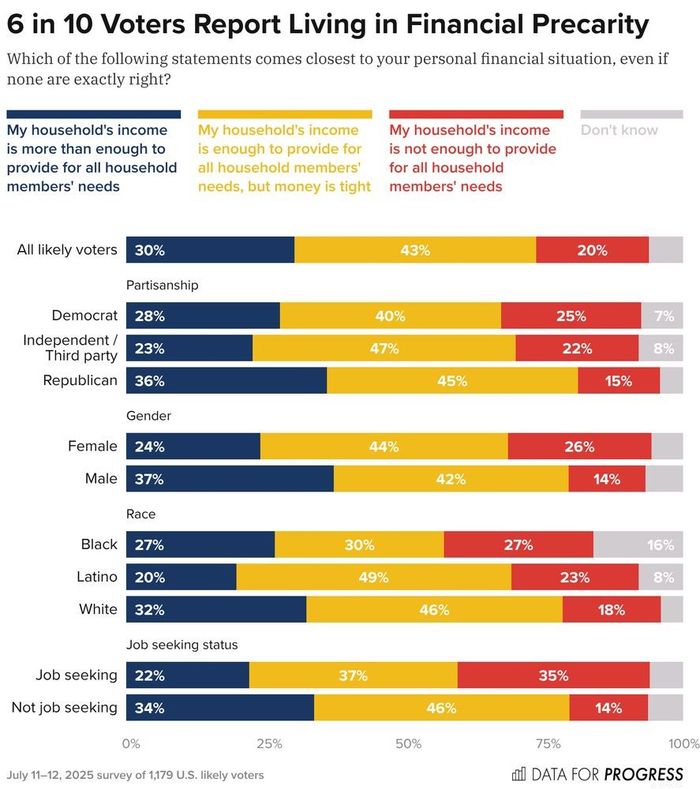
A poll released Friday by Data for Progress found that, "Only 30% of likely voters report having enough income to be able to comfortably provide for their household's needs, while a plurality of voters (43%) say they have enough income but money is tight, and 20% say they do not make enough to provide for all household members' needs."


(Graphic: Data for Progress)

"As his approval tanks, President Trump has finally lost voters on the one issue where they've historically trusted him: the economy," said Lindsay Owens, the executive director of the Groundwork Collaborative. "Not only has Trump shirked his promise to lower prices, he's made the situation substantially worse as his tax and tariff policies have landed a double blow to household budgets."

According to data from Indeed, cited by Forbes, 43% of Americans have seen their wages lagging behind the cost of living over the past year. The jobs feeling the worst crunch are those "at the low-to-middle end of the pay spectrum."

Trump has imposed the highest tariffs on imported goods since the Great Depression. After months of relative quiet, they began to make their impact felt this past month, with consumer prices up 2.7% from the previous year, compared with just 2.4% in May.

While rising rent costs were the top driver of inflation in June, prices for clothing, toys, and consumer appliances all rose, as did food and energy.

The president was elected on promises to tackle the cost of living. But now 70% say that he is not focused enough on lowering prices, according to polling released Sunday by CBS News. Meanwhile, 61% say Trump is focusing too much on his tariff policy, which remains broadly unpopular.

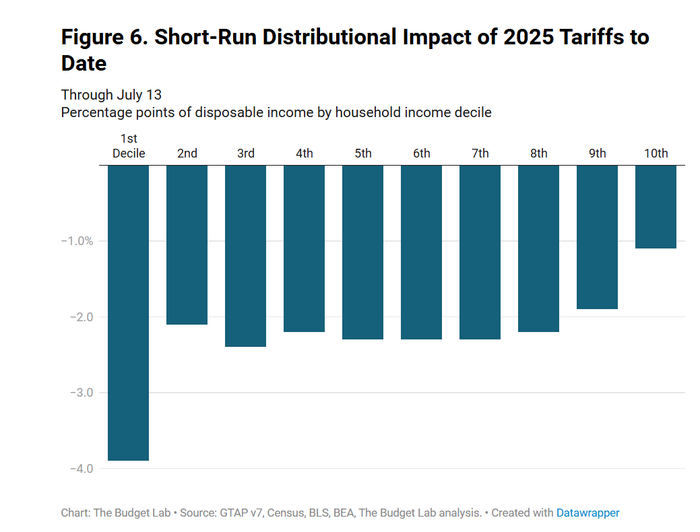
Yale's Budget Lab estimates that it would cost the average household $2,770 worth of disposable income per year if tariffs stayed at their current rate indefinitely, with the worst impact—especially in the short term—on the poorest Americans.


(Graphic: Yale Budget Lab)


But they are set to grow more intense beginning on August 1, when Trump has said he'll roll out new levies on imports from some of America's top trading partners, including Canada, the European Union, Mexico, Brazil, and South Korea.

According to economists who spoke with Vox, the worst effects are likely yet to come. Preston Caldwell, chief U.S. economist for Morningstar, said inflation would likely peak in 2026 rather than 2025.

"Companies have started paying tariffs on their imported goods, but as far as the goods that are being sold in stores right now, those are primarily being drawn from the inventory of goods that were brought in before the tariffs," Caldwell said. "So most companies are still not really having to recognize the loss of tariffs yet to a great degree."

"The more that it becomes clear that tariffs are here for at least the foreseeable future," he continued, "the more that they are going to have to eventually adjust to this new reality, which will entail increasing their prices."

Owens said that will likely translate to even fiercer backlash against Trump.

"Working families," she said, "know exactly who to blame as they pay higher prices on everything from groceries and electricity bills to school supplies and appliances."

Bernie Sanders Launches Investigation of RFK Jr.’s Attacks on Vaccine Access


By firing all 17 members of the CDC’s vaccine panel, RFK Jr. has imperiled vaccine access in the US, critics say.
July 30, 2025

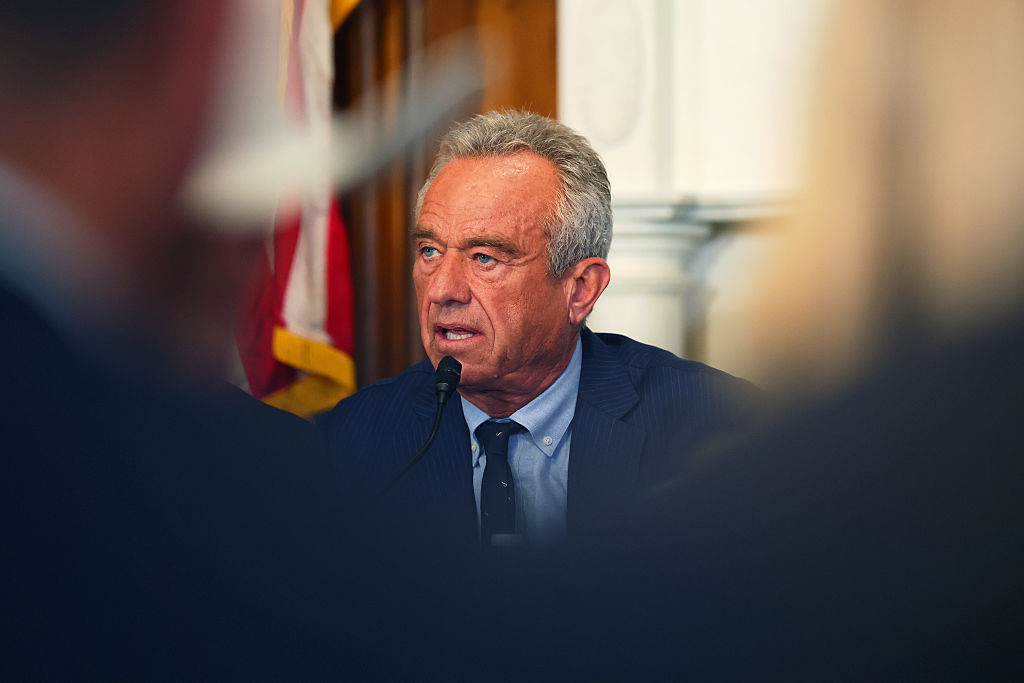
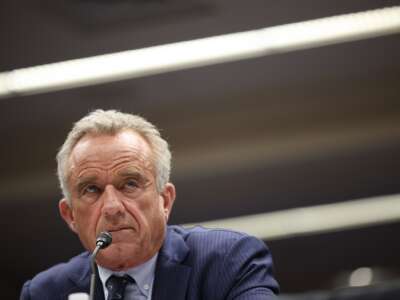
U.S. Health and Human Services (HHS) Secretary Robert F. Kennedy Jr. speaks during a roundtable discussion on soil health in the Mike Mansfield Room at the U.S. Capitol on July 15, 2025, in Washington, D.C.Michael M. Santiago/ Getty Images

Sen. Bernie Sanders (I-Vermont) and top Democrats on the Senate HELP Committee have launched an investigation into Health Secretary Robert F. Kennedy Jr. and his decision to fire all 17 members of a key recommendation panel that sets federal vaccine policy. After firing the experts, Kennedy replaced them with vaccine skeptics who critics say are putting the health of millions at risk.

Sanders is the ranking member on the Senate Committee on Health, Education, Labor and Pensions (HELP), but Democrats remain in the minority, and the investigation is not backed by a full committee vote. However, the probe puts additional pressure on HELP Committee Chairman Sen. Bob Cassidy, a longtime physician who previously promoted vaccination for low-income families in his home state of Louisiana. Cassidy is now under fire for casting a key vote in favor of installing Kennedy, a conspiracy theorist and celebrity of the anti-vaxxer movement, at the helm of the Department of Health and Human Services (HHS).

Sanders said on Tuesday that Kennedy has upended decades of scientific research and vaccine policy by gutting the Centers for Disease Control’s Advisory Committee on Immunization Practices (ACIP) and replacing 17 nonpartisan medical experts with “ideologues” and “conspiracy theorists” who threaten to undermine public confidence in vaccines that have prevented deadly outbreaks of disease for decades.

Democrats have accused Kennedy of lying to Cassidy about his intentions for the vaccine committee during a heated confirmation hearing in January, which both Kennedy and Cassidy have denied. ACIP meets about three times a year to set policies for the CDC’s vaccine schedule, which can determine the availability and cost of various vaccines for millions of people.

“Secretary Kennedy has spread lies about safe and effective vaccines for decades,” Sanders said in a statement. “Unfortunately, since he was confirmed, Secretary Kennedy has doubled down on his disinformation campaign and war on science. This will lead to preventable illness and death.”

Related Story

RFK Jr. Bans Thimerosal in Vaccines, Despite Experts, Studies Noting Its Safety
“Banning vaccine ingredients without cause increases the perceived risk of vaccines,” one prominent health group said. By Chris Walker , Truthout July 25, 2025


During Kennedy’s confirmation hearing, Cassidy pressed Kennedy for answers on his approach to vaccines and was torn over how to vote on the nomination. Cassidy and Senate Republicans were under intense pressure from President Donald Trump to approve Kennedy along with a controversial list of cabinet members — including former TV star-turned Medicare czar Mehmet Oz — that watchdog groups say are now destabilizing the nation’s already struggling health system.


Cassidy said he voted to confirm Kennedy after the nominee pledged to “maintain” the CDC’s vaccine committee “without changes.”

In a February 4 speech on the Senate floor, Cassidy affirmed decades of scientific research in asserting the widely held medical consensus that vaccines are “safe,” “save lives,” and “do not cause autism.” His restatement of these scientific facts was a direct rebuke to the anti-vaccine conspiracy theories that went viral during pandemic lockdowns and have long been championed by Kennedy and his allies. However, Cassidy said he voted to confirm Kennedy after the nominee pledged to “maintain” the CDC’s vaccine committee “without changes” and consult with Cassidy about hiring decisions at HHS. The Senate confirmed Kennedy as health secretary with a 52-48 vote along party lines.

Since taking office, Kennedy has launched what critics call a war on vaccines. In June Kennedy appointed Lyn Redwood, former director of the anti-vaxxer group that later became Kennedy’s Children’s Health Defense, to the CDC’s Immunization Safety Office, where she has cited research that does not exist.

Amid the worst outbreak of measles in 33 years, which radiated from communities in Texas with low vaccination rates, Kennedy described the decision to vaccinate as a “personal one” and promoted unproven treatments such as cod liver oil. Experts liken Kennedy’s approach to medicine to the ancient “miasma theory,” which predates our modern understanding of germs.

On June 9, Kennedy gutted the CDC’s vaccine committee and replaced the 17 nonpartisan medical experts with eight individuals who Sanders and Democrats say were handpicked to advance an anti-vaccine agenda. The vaccine committee’s new members include a business school professor who spread misinformation about COVID-19 vaccines online, a nurse and former research director of an anti-vaccine group with links to Kennedy, and researchers who were paid to testify in court against vaccine makers.

In late June, Cassidy pushed back on the decision to gut the vaccine committee and move ahead with a regularly scheduled meeting despite the shakeup, which left ACIP with far fewer members. The committee has quietly worked behind the scenes to advise the CDC for 60 years but was caught up in the controversy around vaccines that exploded during the COVID-19 pandemic.

“Of course, now the fear is that the ACIP will be filled up with people who know nothing about vaccines except suspicion,” Cassidy said on X in June.

Citing Cassidy’s post on X, Sanders penned a letter to the physician and senator requesting that the Senate HELP Committee launch a bipartisan investigation into the details around Kennedy’s decision to abruptly dismiss the ACIP members and replace them with vaccine skeptics. Senate Republicans have been unable to stand up to Trump on a host of issues, and it’s no surprise that a bipartisan investigation never materialized.

A spokeswoman at Cassidy’s office in the Capitol declined to comment on Kennedy’s vaccine policies and the investigation launched by Sanders.

Along with Senators Tim Kaine (D-Virginia), John Hickenlooper (D-Colorado), Maggie Hassan (D-New Hampshire) and four other Democrats, Sanders is now launching a partisan probe of Kennedy’s vaccine policies. In a letter to Kennedy on Tuesday, the senators demanded answers about the process behind Kennedy’s gutting of the CDC’s vaccine committee and other policies.

“As your new ACIP makes recommendations based on pseudoscience, fewer and fewer Americans will have access to fewer and fewer vaccines,” the senators wrote. “And as you give a platform to conspiracy theorists, and even promote their theories yourself, Americans will continue to lose confidence in whatever vaccines are still available.”

Lower vaccination rates are predicted to cause a resurgence of vaccine-preventable diseases such as hepatitis, meningitis, mumps, pertussis, pneumonia, tetanus, and chickenpox, the senators wrote. However, without the full Senate HELP Committee behind Sanders and the Democrats, Kennedy may choose to ignore the investigation and the senators’ inquiries. Democrats clearly see an opening for attacking the Trump administration when Kennedy’s policies cause real-world harms — but these harms are easily prevented in the first place.