Thursday, August 28, 2025

PALEONTOLOGY

An ancient signpost: Minute fossils tell big story about arthropod evolution


A research team led by Nick Strausfeld at the University of Arizona discovered an extinct creature whose brain is very similar to that of living crustaceans, rather than spiders and their relatives, as was previously assumed.


University of Arizona

Jianfengia fossil 

image: 

One of several Jianfengia fossil specimens: The animal's body plan is extremely simple, consisting of numerous identical segments. However, its head is like that of a more modern crustacean, with eyes on stalks and frontal simple eyes. The head is about 2 millimeters wide (less than one tenth of an inch). 

view more 

Credit: Nick Strausfeld, University of Arizona


A tiny fossil of a sea creature that lived more than half a billion years ago sheds new light on the evolution of arthropods, the most species-rich and successful group of animals to inhabit the Earth, according to a study published in Nature Communications. One of the last remaining enigmas surrounding arthropod evolution has been the split of the tree of life separating the two largest groups of arthropods: mandibulates, the group including insects, crustaceans, millipedes and centipedes; and chelicerates, the group that includes spiders, scorpions and their kin. New analyses of fossils of an extinct segmented creature known as Jiangfengia multisegmentalis reveal that the specimen is crucial in separating the earliest mandibulates from chelicerates.

Led by Nicholas Strausfeld at the University of Arizona's Department of Neuroscience, a team has revealed minute details of the fossilized brain of Jiangfengia that places it squarely in the ancestry of mandibulates, not chelicerates, as had been previously assumed. Jiangfengia's classification as an ancestral chelicerate had been based on its paired grasping appendages that extend from its head. That feture had placed it into an assemblage of extinct creatures known as megacheirans — Greek for "large hands." Two of the most exquisitely preserved megacheiran specimens that lived about 525 million years ago were Jianfengia which alsohad compound eyes and Alalcomenaeu which had fewer segments and two pairs of single lens eyes. Both had been traditionally lumped together as megacheirans with the assumption that their head appendages are the precursors of what became fangs in spiders and their relatives.

According to the research team, the story is more nuanced and complicated. Strausfeld, a Regents Professor at the University of Arizona and a Royal Society Fellow, called their discovery a possible game changer. "These megacheirans didn't have antennules, which are antenna-like appendages that are common to crustaceans, insects and centipedes," Strausfeld said. "Instead we see these strange, quite sturdy head appendages that were specialized for reaching and clasping things."

Paleontologists refer to these hallmark structures of megacheiran fossils as "great appendages." Their pincer-like ends suggested their similarity with the clasping appendages of Limulus, commonly known as the horseshoe crab, Strausfeld added. Accordingly, the Megacheira were classified as chelicerates, to which Limulus and arachnids also belong.

The research revealed that the fossilized brains of Jianfengia and Alalcomenaeus were in fact not only morphologically distinct from each other but that they typified ancestors of two major arthropod groups, not just one.

Jianfengia's tiny head, measuring only two millimeters across, is defined by a short, shell-like covering from which extend its pair of "great appendages." Just in front of these are paired eyestalks, one on each side of the head, which are capped by a small but obvious compound eye like those of insects and crustaceans. The front of Jianfengia's head also had at least three single lens "eyes" much like the simple eyes found in many insects and crustaceans.

When Strausfeld's team reconstructed the fossilized remains of Jianfengia's nervous system in four fossil specimens, it found a brain, the shape of which corresponds to that of a modern shrimp or crayfish. In addition, it showed elements of the simpler arrangements seen in small freshwater crustaceans such as brine shrimps, also known as "Sea Monkeys," popular pets that have provided many a child with their first view of a real live crustacean. Taken together, these findings led the researchers to conclude that Jianfengia had previously been misclassified as an early chelicerate, whereas Alalcomennaeus had already been shown to have a Limulus-like brain.

"Our results demonstrate that close examination of fossilized neural remains can provide powerful data indicating evolutionary relationships impossible to obtain just from features of the exoskeleton," Strausfeld said. "One needs to know what to look for in the fossil brain because it tells us a lot about a fossil's identity."

Frank Hirth, a co-author and professor at the University of London's King's College, emphasized a crucial aspect of these fossils: "The organization of their fossilized brains perfectly aligns with that of living arthropods, suggesting that their ancient genetic and developmental constituents are extraordinarily robust, yet diverse, which may explain why arthropods are the most successful inhabitants of this planet."

Co-author Xianguang Hou, professor at the Yunnan Key Laboratory for Palaeobiology of Yunnan University in Kunming, China discovered the first fossil of Jianfengia in 1984. One of the most famous fossil beds documenting life in the Cambrian period, which lasted from about 540 to 480 million years ago, the area in the vicinity of Kunming in China's Yunnan province was once a shallow sea. Its bounty of ancient life forms very rarely shows evidence of soft tissues, especially neural remains. Since then, about a dozen additional specimens have been found.

Strausfeld pointed out that a fossil's neural traces can be very subtle, but can be amplified by enhancing the contrast and width of the darkest deposits standing out against the gray granular rock in which the fossil was embedded.

"What we saw was unexpected: the brain looks really modern, comparable to that of a living crustacean," he said. "In one specimen we even could peer into the compound eyes and look down some of its facets to see fossilized 'cone cells' that supported the photoreceptors."

To further confirm the evolutionary position of Jianfengia, co-author David Andrew of Lycoming College in Williamsport, Pennsylvania used statistical methods to construct so-called phylogenetic trees — essentially family trees — based on neuronal traits, to determine where in the tree of life Jianfengia should be placed.

"Many repeats of these comparisons revealed that in the arthropod tree of life, Jianfengia sat at or near the root of all mandibulates, whereas its putative cousin, Alalcomenaeus, has the same status, but within the chelicerate branch of the tree of life," Andrew said.

The team concluded that the "great appendages" belonging to Jianfengia later became modified as antennules typifying today's mandibulates, whereas the "great appendages" of Alalcomenaeus later became modified as the pincer-like fangs typical of today's chelicerates.

"In chelicerates, these 'great appendages' shrunk, so they eventually became the spider fangs," Strausfeld said. "In mandibulates, evolution modified them into segmented antennules."

According to Strausfeld, living support for this view comes from the living ostracods, small marine crustaceans sporting antennules tipped with claspers. "It appears that the ’great appendages‘ that we see in our fossils from more than a half billion years ago weren't completely lost."

Artist's rendition of the reconstructed brain of Jianfengia showing the creature's claw-like ‘great appendages’, compound eyes and the three simple eyes at the front of the head. 

Credit

Nick Strausfeld, University of Arizona


Two "great appendage" arthropods and their reconstructed brains: Alalcomenaeus (left) is at the root of Chelicerata, which includes scorpions, spiders, and their relatives. Jianfengia (right) is shown to be basal to Mandibulata, the group that includes crustaceans, insects, centipedes and millipedes, according to the new study. The findings challenge the traditional grouping of the two as related based on their pincer-like ‘great appendages’ that extend from their heads.

Credit

Nick Strausfeld, University of Arizona


In search of the perfect raspberry


Pioneering genome editing technique could be the future of fruit and farming


Cranfield University

Raspberry plantlet used as protoplast 

image: 

Ryan Creath holding a raspberry plantlet used as protoplast

view more 

Credit: Ryan Creeth, Cranfield University


One of our most popular summer soft fruits could last longer in the fridge thanks to pioneering new research conducted at Cranfield University. Researchers have recently published a new method to edit the DNA of raspberries, with the goal of creating more sustainable raspberry production and less food waste.

A first for gene editing in raspberry

The new study details a novel method for the isolation of single cells (protoplasts) from the leaf tissue of raspberry microplants grown in sterile tissue culture.

The protoplasts were then gene edited with CRISPR-Cas9, a revolutionary biotechnology that can be programmed to target any region of the genome and introduce changes to the DNA. This study is the first time CRISPR gene editing has been validated in red raspberry (Rubus idaeus) in a peer-reviewed publication.

Now that DNA-free gene editing has been validated in raspberry, it could enable much faster, more efficient and precise breeding of new raspberry cultivars with enhanced traits – this could mean tastier and more sustainable raspberries on supermarket shelves in the future.

For example, one of the genes edited in this study, NPR1, when edited in tomato, resulted in increased resistance to grey mould. In future, it may be possible to use this to create raspberry varieties with a longer shelf-life, reducing food waste and improving sustainability. These techniques could also lead to raspberry fruits that are sweeter, larger, seedless, or enable higher crop yields and greater resilience to heatwaves arising from climate change.

Crucially, gene editing will speed up variety improvement: precisely-improved versions of elite raspberry cultivars could be produced in approximately 12 months, ready for propagation and on-farm trialling. In comparison, traditional plant breeding relies on cross-pollination and the luck of random gene shuffling followed by a decade or more of field selection before near-market evaluation starts.

The final step is to find ways to regenerate whole raspberry plants from the gene-edited single-celled protoplasts, which is possible in many crops, but can be tricky in others. The regenerated plants would then go on to produce gene edited raspberries with beneficial traits like greater resistance to mould.

New opportunities in a new regulatory environment

Importantly, DNA-free gene editing does not result in the production of a genetically modified (GM) organism. The changes to the DNA in this study are indistinguishable on a genetic level to those that result from natural mutation over time or from those produced through traditional plant breeding. This is because there is no introduction of non-native (i.e., non-raspberry) DNA into the raspberry genome.

Instead, CRISPR is introduced into the raspberry protoplasts as Cas9 protein and guide RNA, which cause editing to the DNA but do not become physically inserted into the raspberry genome. This is crucial for compliance with the new Genetic Technology (Precision Breeding) Act (2023) that only permits non-transgenic changes to DNA in crop species for production and consumption in England.

“Precision breeding techniques are essential for tackling food waste, improving food sustainability and nutrition, and lowering the cost of food,” said Ryan Creeth, the PhD student who developed the new method alongside co-authors Dr. Zoltan Kevei and Prof. Andrew Thompson.

“It’s really important that we fully utilise cutting-edge techniques like DNA-free gene editing in a wider variety of crop species to successfully transfer research from academia into the real world. More research is required, particularly with the regeneration of gene edited raspberry plants. But it is a promising start for one of the nation’s favourite soft fruits”.

The research paper DNA-free CRISPR genome editing in raspberry (Rubus idaeus) protoplast through RNP-mediated transfection is published in Frontiers in Genome Editing.

Raspberry Plant in Glasshouse 

Ryan Creeth holding a raspberry plant in Cranfield University's Glasshouse plant growth facility

Protoplast stained with fluorescent viability stain white light

Protoplast stained with fluorescent viability stain

Ryan Creeth viewing protoplast using fluorescent microscope 

Ryan Creeth working in sterile cabinet with raspberry canes

Credit

Ryan Creeth, Cranfield University


No strong evidence for alternative autism treatments, study finds


University of Southampton


The most comprehensive quantitative review of research into complementary and alternative treatments for autism has found no strong evidence to support their use, and that the safety of these treatments was rarely assessed.

A new study from Paris Nanterre University, Paris Cité University and the University of Southampton, published today [28 August] in Nature Human Behaviour, assessed 248 meta-analyses, including 200 clinical trials involving over 10,000 participants.

Researchers were investigating the efficacy and safety of complementary, alternative and integrative medicines (CAIMs) to treat autism. They looked at 19 types of treatment, including animal-assisted interventions, acupuncture, herbal medicine, music therapy, probiotics and Vitamin D.

The team also created an online platform to make it easier for people to see the evidence they generated on different CAIMS.

Autistic people can find it hard to communicate, understand how people think or feel, be overwhelmed by sensory information, become anxious in unfamiliar surroundings and carry out repetitive behaviours.

All of this can interfere with their quality of life, and up to 90% report having used CAIMs at least once in their lifetime.

“Many parents of autistic children, as well as autistic adults, turn to complementary and alternative medicines hoping they may help without unwanted side effects,” says Professor Richard Delorme, Head of the Child and Adolescent Psychiatry Unit at Robert Debré Hospital in Paris.

“However, it is necessary to carefully consider evidence from rigorous randomised trials before concluding that these treatments should be tried.”

Researchers carried out an umbrella review – a type of study that pulls together evidence to give an overall ‘big picture’ summary.

Dr. Corentin Gosling, Associate Professor at the Paris Nanterre University and first author of the study, explains: “Rather than looking at individual trials, we reviewed all the available meta-analyses, which are a compilation of many trials. This allowed us to evaluate the full body of evidence across different treatments.

“Importantly, we also developed a free and easy-to-use online platform, which we will continue to test. Ultimately, we hope this tool will support autistic people and practitioners in choosing together the best treatment.”

While some treatments showed potential, most studies were supported by weak or poor-quality evidence, so the effects are not reliable. Concerningly, safety assessments were missing for most treatments, with less than half of CAIMs having had any evaluation of the acceptability, tolerability or adverse events.

Professor Samuele Cortese, NIHR Research Professor at the University of Southampton and co-senior author, concluded: “This study shows that when people want to know whether a treatment is effective, they shouldn’t just look at one single study. It’s essential to consider all the available evidence and how good that evidence is. Drawing conclusions from one low-quality study can be misleading.”

The study Complementary, alternative and integrative medicine for autism: an umbrella review and online platform is published in Nature Human Behaviour and is available online.

The online platform is available at: https://ebiact-database.com

The research was funded by Agence Nationale de la Recherche (ANR).

Ends

Contact

Steve Williams, Media Manager, University of Southampton, press@soton.ac.uk or 023 8059 3212.

Notes for editors

  1. The study Complementary, alternative and integrative medicine for autism: an umbrella review and online platform is published Nature Human Behaviour. An advanced copy is available on request.
  2. For Interviews please contact Steve Williams, Media Manager, University of Southampton press@soton.ac.uk or 023 8059 3212.

Additional information

The University of Southampton drives original thinking, turns knowledge into action and impact, and creates solutions to the world’s challenges. We are among the top 100 institutions globally (QS World University Rankings 2025). Our academics are leaders in their fields, forging links with high-profile international businesses and organisations, and inspiring a 22,000-strong community of exceptional students, from over 135 countries worldwide. Through our high-quality education, the University helps students on a journey of discovery to realise their potential and join our global network of over 200,000 alumni. www.southampton.ac.uk

www.southampton.ac.uk/news/contact-press-team.page

Follow us on X: https://twitter.com/UoSMedia

Bully-in-Chief Trump Delights in Cruelty

Violent imagery helped launch this made-for-TV president on his journey into the Oval Office. Now, he’s using it to govern with fear.


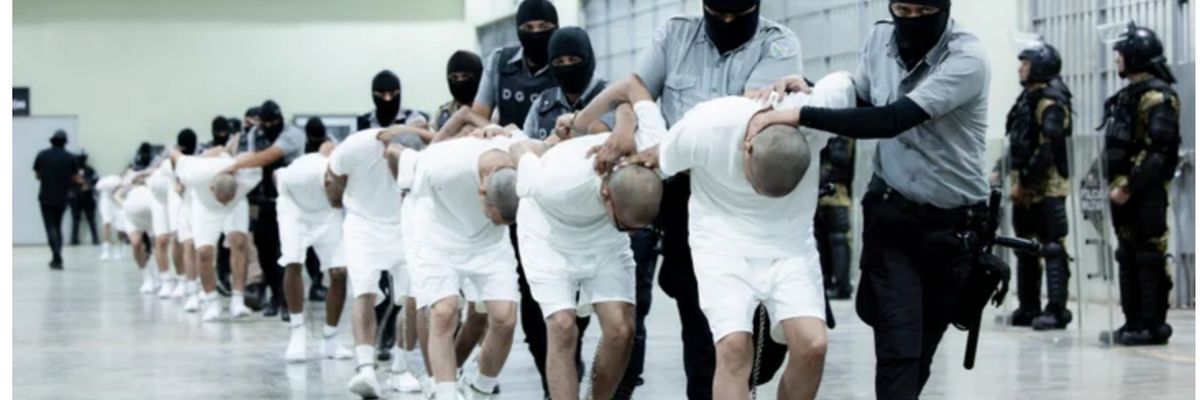
Some of the 260 Venezuelans illegally deported arrive at an El Salvador prison.
(Screenshot)

Andrea Mazzarino
Aug 27, 2025
TomDispatch

US President Donald Trump, his cabinet, and those who have profited from his rise seem to revel in public displays of cruelty.

Take former Department of Government Efficiency (DOGE) head Elon Musk, holding a chainsaw at a televised event to celebrate the firing of civil servants. Or Trump’s White House sharing a video featuring Immigration and Customs Enforcement (ICE) officers marching handcuffed immigrants onto a deportation flight, with Jess Glynne’s musical hit “Hold My Hand” playing in the background. Or how about ICE allowing right-wing TV host Dr. Phil to film its sweeping immigration raids for public consumption? And don’t forget those federal agents tackling Democratic California Sen. Alex Padilla to the floor (and handcuffing him!) when he asked a question at a Department of Homeland Security press conference. Or what about during the first Trump presidential campaign, when the then-candidate boasted that he could shoot someone on Fifth Avenue in New York City and he wouldn’t lose a voter?

Violent imagery helped launch this made-for-TV president on his journey into the Oval Office. Now, he’s using it to govern with fear.

As journalist Adam Serwer put it, “Cruelty is the point.” Physical attacks and threats serve both to dehumanize vulnerable Americans (especially people of color) and to suggest what could happen to individuals who speak out against the wealth gaps and other problems of our times.

The underbelly of MAGA malice is, of course, greed. Compare the scenes I’ve just mentioned to the president welcoming to his inauguration not public figures who had done positive things for the welfare of Americans, but billionaires who made seven-figure donations to that very event. At the Oval Office, he also loves to host those who have presented him with shiny baubles—like Apple CEO Tim Cook, who had given him a gold trophy with his company’s logo on it. (Even then, Trump used the occasion to mock his visitor’s slight frame.)

We have long lived in a country where unfettered capitalism at the expense of so many of us thrives on violence meant specifically to silence people at the bottom.

Or consider Vice President JD Vance, who got the U.S. military to raise the level of a river so he could take a birthday boat trip on it. And that, tellingly, was only weeks after a real flood in Texas had killed more than 100 people, while the administration slow-walked aid in response to the disaster. And don’t forget that the president spent about $45 million taxpayer dollars on a military parade on his birthday in Washington, the very city in which he’s decried the homeless population as “unsightly” (and has now sent the National Guard into its streets). Those same funds could have paid for a significant amount of housing for hundreds of people in that same city.

America’s leadership has come unmoored from the values of equality and self-determination outlined in this country’s founding documents. They would prefer to display a let-them-eat-cake America that today boasts more than 800 billionaires (compared with around 60 in 1990), one where the average hourly wage has risen just 20% over the past 35 years—less than half what working people need to afford basic necessities like housing, food, and healthcare.

Mind you, Donald Trump is anything but solely responsible for creating such steep inequalities. However, he’s shown us how little he cares to make things right by cutting spending on health insurance, schools, farm subsidies, and so much more, while attacking the working poor and those who stand up for them.
American Carnage

Violence against people of color—especially workers of color who dare strive for better conditions—was already baked into American history. After all, we’re a nation that supersized our economy by using free or low-wage work. For example, the lynching of Black slaves and later Black Americans was one way that American leaders showed marginalized groups what they might expect if they spoke out.

In thousands of documented incidents in the history of this country, White mobs, often led by wealthy landowners, whipped, beat, hung, or otherwise murdered Black people in public places. (No surprise, then, that to this day, police violence against Blacks is all too commonplace.) Historically, in many lynchings, law enforcement either carried out the violence directly, organized the mobs who did, or at least stood by and watched without intervening.

With recent police crackdowns on protesters in LA and on people simply showing up to work, it should hardly come as a surprise that many Black Americans are now being punished for incidents when all they did was exercise the sorts of rights that many of us take for granted like going to school, writing, or gathering without the permission of whites. Once upon a time, in places like pre-Civil War Virginia and North Carolina, the law forbade enslaved people from gathering for any reason, even to worship. Nor, in the post-Civil War South, were whites subtle in their condemnation of Americans of color who managed to advance economically or challenged the status quo.

In 1892, for example, the Memphis office of Black journalist Ida B. Wells was destroyed by a mob whose members threatened to kill her after she wrote an article condemning the lynching of three Black men who owned a successful grocery store. Incidents like that may look very different from the sorts of confrontations Americans are now witnessing on their streets, but they remind me that we have long lived in a country where unfettered capitalism at the expense of so many of us thrives on violence meant specifically to silence people at the bottom.

The point was driven home for me by a scene in Percival Everett’s timely 2024 novel James, a rendition of Mark Twain’s Huckleberry Finn told from the perspective of the title character, an escaped slave. The narrator watches a slave owner beat and hang a Black man who stole a pencil so that James could write something. As I read, it was easy for me to imagine life leaving the man’s body as he endured the lashes, and to feel his community’s terror. The lynched man’s last exchange during the beating involves him mouthing the word “Run!” to James, who is hiding in the bushes nearby.

The message of that scene should resonate today: If you want to express yourself or even just live in certain American towns and cities (including our capital!) in Donald Trump’s America, you’d better know that you’re risking your neck. Considered against such a historical backdrop, Trump and his followers could be thought to come by their moments of cruelty—as the saying goes—honestly (although if that’s honest emotion, what a world we’re now living in).
Our Contemporary Public Square

Since the president’s second inauguration, millions of Americans have turned out to stand up for fired federal workers, women, and LGBTQ+ people, as well as immigrants and people of color who have been the focus of ICE raids and extrajudicial detentions. The vast majority of those demonstrators have been peaceful, showing up in the streets or at immigration courts where they take down the information of those being detained so ICE can’t simply “disappear” them. Some have even waved Mexican flags to show solidarity with immigrant families hailing from that and other countries. Most importantly, such demonstrators committed their own bodies, including their eyes and ears, to ensure that people facing increasing state violence in Donald Trump’s America don’t always have to experience it alone.

In the Los Angeles area this spring and summer, ICE raids drew national attention for the frequent way they targeted Latino neighborhoods, with masked federal agents swarming public places and chasing workers based on skin color, type of job, and language. From just early to mid-June, tens of thousands of people actively protested such raids in Los Angeles, expressing solidarity with the people and neighborhoods targeted.

Imagine fearing getting tackled by the police and sustaining injuries, particularly in a country where nearly half of all adults are either uninsured or underinsured.

To be sure, a handful of those protesters made the demonstrations less productive by setting police and private vehicles on fire and vandalizing storefronts, causing significant damage. However, it just may be the understatement of the year to say that the law enforcement response to those protests was disproportionate to the threat. In addition to the Los Angeles Police Department (LAPD) and other local police responses, Trump ordered 2,000 National Guard members and 600 Marines into Los Angeles, despite the warnings of local leaders that doing so would only escalate the confrontations between protesters and law enforcement.

And those concerns turned out to be all too well-founded. The police violently attacked at least 27 journalists, using supposedly non-lethal crowd-control munitions and tear gas. All too sadly, for instance, an LAPD officer struck a photographer in the face with a rubber bullet, fracturing his cheek and tearing open his eye, forcing him to undergo five hours of emergency surgery and potentially leading to permanent vision loss. ICE agents typically shoved David Huerta, a labor union leader, to the ground while he was observing raids in the city’s fashion district. Huerta would be hospitalized for his injuries. State police shot a New York Post journalist in the forehead with a rubber bullet as he filmed anti-ICE protests from the side of the highway, causing him to fall and leaving him with severe bruising and neck injuries. The journalist said he thinks he was shot because he was isolated and so “an easy target.”

Meanwhile, at least five police officers were treated on the scene for injuries sustained when a few of the protesters threw rocks from highway overpasses onto cars and one fired paintballs at officers. They were also harmed by their own flash-bang grenades and tear gas. Numerous protesters were, of course, injured, some by being tackled by police officers and others by tear gas and “non-lethal munitions.” Hundreds were arrested then (and continue to be), including peaceful observers and legal monitors attempting to track “disappeared” immigrants through the system.

Not surprisingly, I found it hard to get anything like a full count of people injured or detained in those demonstrations, which leads me to think that one future project of the Costs of War Project that I’ve long been associated with might be to tally up injuries and possible deaths among Americans whose streets are clearly going to be increasingly overrun by law enforcement and National Guard troops in this new Trumpian era. With the president already sending federal law enforcement officers and the National Guard into this country’s capital, surely, in the months to come, he’ll do the same into minority-led Democratic-majority cities (including, undoubtedly, New York, should Zohran Mamdani be elected mayor there in November). In my own backyard—I live near Washington, DC—it’s likely that we’ll see an increase in violent confrontations, too.

The rhetoric of the president and his followers has played no small role in the escalations we’ve witnessed in Los Angeles and elsewhere as he focuses the anger of Americans against each other. For instance, before he deployed troops in LA, Trump stated, “We will liberate Los Angeles and make it free, clean, and safe again,” while describing protesters as “animals” and “a foreign enemy.” His close advisor Stephen Miller wrote on X, “Deport the invaders, or surrender to insurrection.” And note the ambiguity there. It’s not clear whether the invaders are immigrants, protesters, or both. Such statements give new meaning to the term “the bully pulpit” and the tacit permission the administration gave the police to hurt civilians (or else).

Imagine going to a protest and having to worry about some version of those crowd-control munitions or even a bullet getting lodged in your body. Imagine fearing getting tackled by the police and sustaining injuries, particularly in a country where nearly half of all adults are either uninsured or underinsured. Egged on by the highest office in the land, police violence makes a distinct point: it shows that, in the era of Donald Trump, Americans like you or me, should we decide to speak out, could find ourselves in danger.
Violence in Unexpected Places

These days, state violence (or the threat of it) arises even in places you might not expect. Recently, for instance, the Texas Senate attempted an untimely gerrymander meant to recarve that state’s electoral maps, diluting districts with large minority populations and so possibly delivering five more House seats to Trump’s Republicans in the 2026 midterm elections.

In a move of creative civil disruption, dozens of Texas Democratic senators, including significant numbers of women and minorities, promptly fled the state to ensure that there would be no quorum possible in that state’s senate and so delay a vote on the proposed new electoral map. The response from Texas Gov. Greg Abbott? To urge Trump to have the Federal Bureau of Investigation find and arrest those senators and force them back to Texas.

That Texas attempted gerrymander is exactly the sort of escalation of tactics that will only normalize the bullying of law-abiding Americans and could lead to the sort of democratic backsliding that, in 2028, might land us all in a full-fledged military dictatorship.

To counter such heavy-handed tactics, we should be ever clearer and more public about the violence that MAGA leaders are likely to commit against anyone who crosses their ravenous path. Sadly enough, television images of chainsaws, handcuffed migrants, and ICE raids don’t simply speak for themselves in the United States of 2025. They could just as easily offer the message that we should indeed hate minorities, poor workers, and homeless people as suggest that this president is violating basic freedoms guaranteed by our Constitution. While Trump and his followers may not always have the courage to say what they really mean, those of us who care about freedom of speech and assembly and other basic American freedoms certainly should—as loudly as we can.

If you have a few minutes, grab a pencil, a pen, or your laptop and make some noise about what you see “our” government doing, particularly when it involves such contempt for human life and dignity. Write your lawmaker, or a letter to the editor, or post something on social media. Make a sign and go to a protest. Stand up for America and against terror. After all, at this point in our history, what choice do we have? Where is there to run to?


© 2023 TomDispatch.com


Andrea Mazzarino
Andrea Mazzarino co-founded Brown University's Costs of War Project. She is an activist and social worker interested in the health impacts of war. She has held various clinical, research, and advocacy positions, including at a Veterans Affairs PTSD Outpatient Clinic, with Human Rights Watch, and at a community mental health agency. She is the co-editor of "War and Health: The Medical Consequences of the Wars in Iraq and Afghanistan" (2019).
Full Bio >
'Evil': Critics Recoil as Trump DHS Moves to Bar Disaster Aid for Undocumented Immigrants

"This is unfathomable discrimination against immigrants that will cost our country lives," said Rep. Pramila Jayapal.


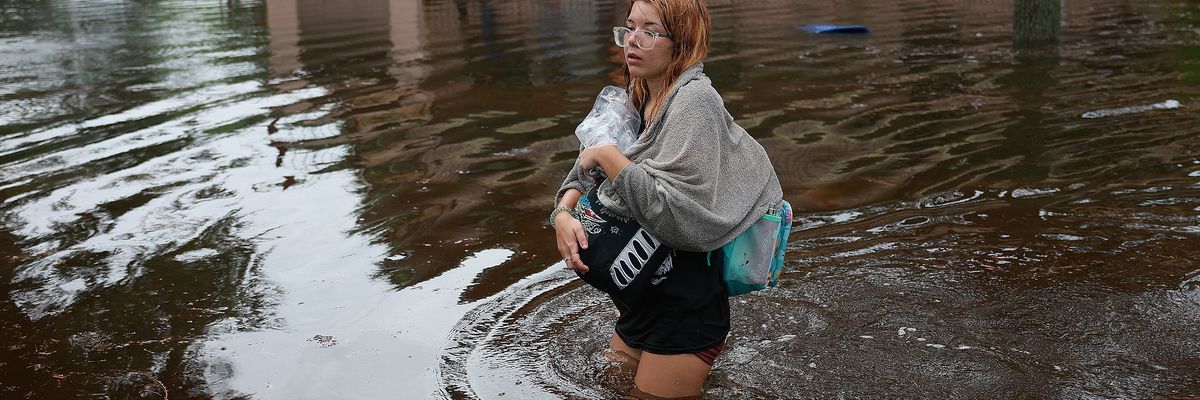
Makatla Ritchter wades through floodwaters after having to evacuate her home when Hurricane Idalia inundated it on August 30, 2023 in Tarpon Springs, Florida.
(Photo by Joe Raedle/Getty Images)


Brad Reed
Aug 27, 2025
COMMON DREAMS

The Trump administration is reportedly putting new restrictions on nonprofit organizations that would bar them from helping undocumented immigrants affected by natural disasters.

The Washington Post reported on Wednesday that the Department of Homeland Security (DHS) is "now barring states and volunteer groups that receive government funds from helping undocumented immigrants" while also requiring these groups "to cooperate with immigration officials and enforcement operations."

Documents obtained by the paper reveal that all volunteer groups that receive government money to help in the wake of disasters must not "operate any program that benefits illegal immigrants or incentivizes illegal immigration." What's more, the groups are prohibited from "harboring, concealing, or shielding from detection illegal aliens" and must "provide access to detainees, such as when an immigration officer seeks to interview a person who might be a removable alien."

The order pertains to faith-based aid groups such as the Salvation Army and Red Cross that are normally on the front lines building shelters and providing assistance during disasters.

Scott Robinson, an emergency management expert who teaches at Arizona State University, told The Washington Post that there is no historical precedent for requiring disaster victims to prove proof of their legal status before receiving assistance.

"The notion that the federal government would use these operations for surveillance is entirely new territory," he said.

Many critics were quick to attack the administration for threatening to punish nonprofit groups that help undocumented immigrants during natural disasters.

Rep. Pramila Jayapal (D-Wash.) lashed out at the decision to bar certain people from receiving assistance during humanitarian emergencies.

"When disaster hits, we cannot only help those with certain legal status," she wrote in a social media post. "We have an obligation to help every single person in need. This is unfathomable discrimination against immigrants that will cost our country lives."

Aaron Reichlin-Melnick, senior fellow at the American Immigration Council, said that restrictions on faith-based groups such as the Salvation Army amounted to a violation of their First Amendment rights.

"Arguably the most anti-religious administration in history," he wrote. "Just nakedly hostile to those who wish to practice their faith."

Bloomberg columnist Erika Smith labeled the new DHS policy "truly cruel and crazy—even for this administration."

Author Charles Fishman also labeled the new policy "crazy" and said it looks like the Trump administration is "trying to crush even charity."

Catherine Rampell, a former columnist at The Washington Post, simply described the new DHS policy as "evil."