FOR WHITE STR8 MALES
(RNS) — Speakers and organizers alike worked to craft a vision for a Christian America that steers clear of anti-Catholicism and, especially, antisemitism.
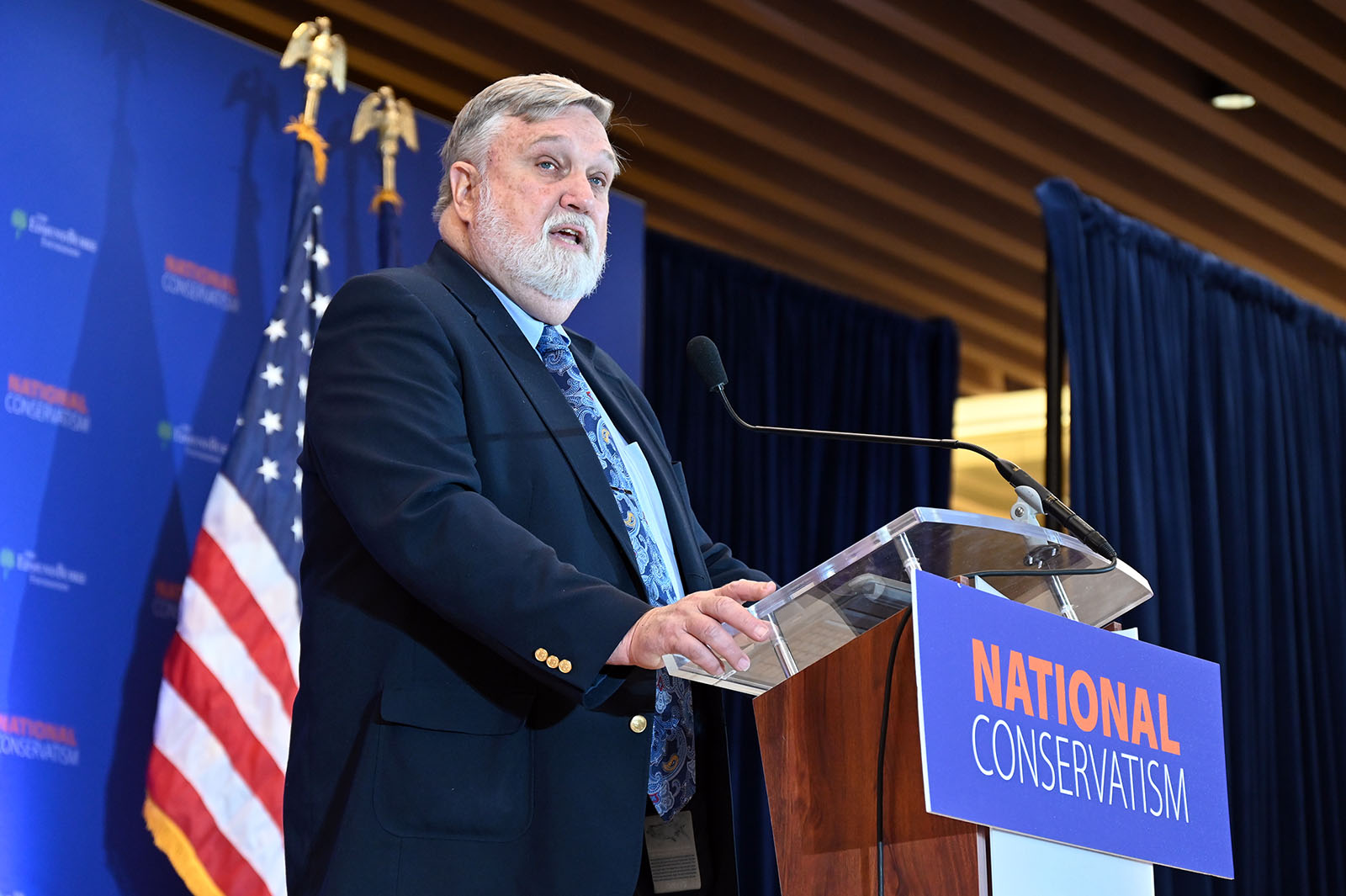
Pastor Doug Wilson addresses the National Conservatism Conference, Sept. 4, 2025, in Washington. (RNS photo/Jack Jenkins)
Jack Jenkins
September 5, 2025
WASHINGTON (RNS) — During the “Bible and American Renewal” breakout session at this week’s National Conservatism Conference, Josh Hammer stood out as the lone Jewish person on the panel of otherwise conservative Christian activists: a pastor, the editor of an online Christian magazine and a self-described Christian nationalist.
Yet, it was Hammer who told an audience member that “America was founded as a Christian country.”
“I’ll be the first to say that,” Hammer added. “There is very little doubt in my mind about that.”
The exchange was a window into a curious dynamic that permeated “NatCon,” as attendees call the conference, where speakers and organizers alike worked to craft a vision for a stridently conservative Christian America that somehow steers clear of anti-Catholicism and, especially, antisemitism.
A right-wing gathering that was once considered fringe, NatCon now boasts among its alumni Vice President JD Vance and this year featured a number of Trump appointees and allies, including Russell Vought, Office of Management and Budget director; Kelly Loeffler, director of the Small Business Administration; and Steve Bannon, a longtime podcast host and former chief strategist for President Donald Trump.
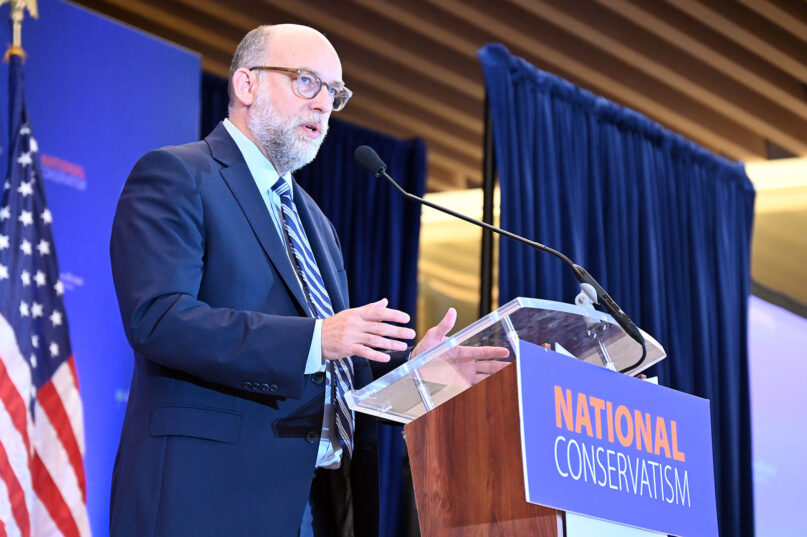
Office and Management and Budget Director Russell Vought speaks during the National Conservatism Conference, Sept. 3, 2025, in Washington. (RNS photo/Jack Jenkins)
Hammer was hardly alone in appealing to America’s Christian roots at the three-day conference, held in downtown Washington from Sept. 2-4. Idaho Pastor Doug Wilson, a self-described Christian nationalist, declared from the main stage, “We were in fact a Christian republic at the founding.” At a breakout session on “The Threat of Islamism in America,” one panelist declared “we are a Christian nation,” and another titled his talk, “Creating Islamic Communities in Christian America.”
But those declarations were made even as speakers openly voiced concern about the potential fracturing of NatCon’s fragile right-wing coalition. In an opening plenary session, Yoram Hazony, the Jewish chairman of the Edmund Burke Foundation, said early supporters of NatCon skewed heavily Catholic, so he brought in more Protestants — only for Catholics to fret that the movement had, in turn, become anti-Catholic. He has since wanted to bring in more Orthodox Jewish leaders, but is facing a problem: a rise in virulent antisemitism on the right, especially after the attack by Hamas militants on Oct. 7, 2023, in southern Israel.
“I didn’t think it would happen on the right, and I was mistaken,” Hazony said. He pleaded with the group to avoid antisemitism, noting that he is still willing to negotiate disagreement about Israel’s policies as well as have an “honorable conversation” about rethinking “the relationship between Jews and Christians in America.”
Hazony didn’t detail what that relationship looks like, exactly, but several conference speakers appeared to navigate the divide by referring to shared “Judeo-Christian” principles. Vought declared that the U.S. was founded on “Judeo-Christian worldviews.” Gene Hamilton, head of America First Legal, similarly described the U.S. as a “country based on Judeo-Christian values,” and Loeffler referred to “the moral foundations that built this country” — namely, “Judeo-Christian values.”
What’s more, Southern Baptist theologian Albert Mohler insisted that a conservatism that honors “prophets and apostles and patriarchs” can “unite Jewish conservatives and Christian conservatives, Catholic conservatives and Protestant conservatives, Eastern Orthodox conservatives, all in a shared conservatism of principle and conviction, mutual respect and mutual assistance, mutual commitment and commitment to shared conservative principles.”
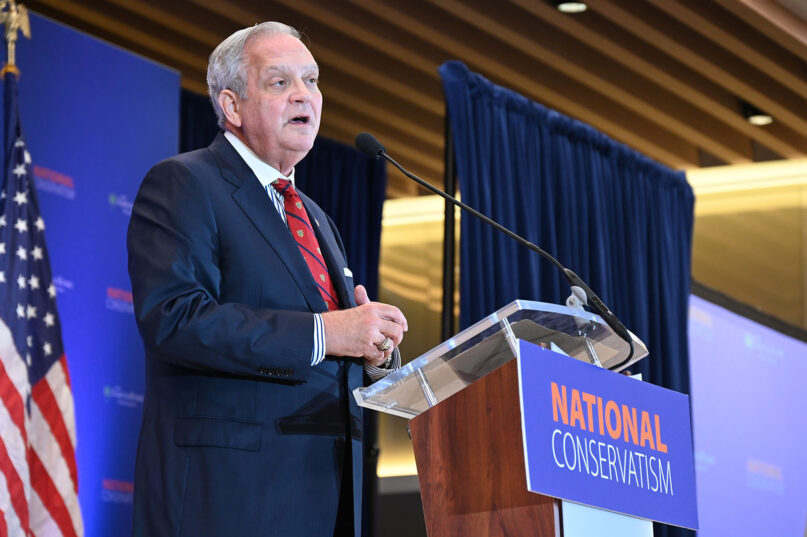
The Rev. Albert Mohler speaks during the National Conservatism Conference, Sept. 4, 2025, in Washington. (RNS photo/Jack Jenkins)
But more often, NatCon attendees seemed to mitigate their differences by trying to find common cause. Asked about the dynamic, Wilson derided antisemitism but acknowledged the tension between advocating for a Christian America and holding together a coalition that includes Jewish people.
“Jesus either rose from the dead or he didn’t — I’m a Christian,” he said.
But in the “political sphere,” Wilson said, there are pathways for extreme right Christians to find commonality with Jewish conservatives.
“I think it’s good for them to see that there are Orthodox Jews who hate pornography as much as they do,” he offered by way of example.
But in practice, the common enemy that emerged to unite Christian nationalists and Jewish allies at NatCon wasn’t pornography, but Muslims. Several speakers made a point to single out Zohran Mamdani, a Muslim American and leading New York City mayoral candidate.
“New York, our greatest city, is on the precipice of being run by a Zohran Mamdani — I think we realize that something has gone absolutely wrong,” Jack Posobiec, an alt-right political activist who has promoted Christian nationalism in the past, told the crowd. He then added: “As I stand here today, we are less than 10 years away from one of America’s great cities being run by a Muhammad.”
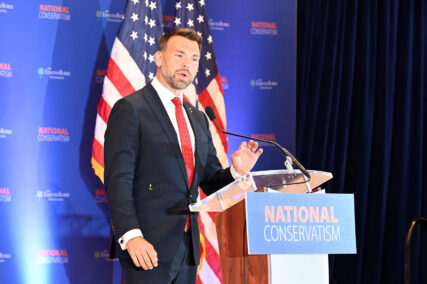
Jack Posobiec speaks during the National Conservatism Conference, Sept. 4, 2025, in Washington. (RNS photo/Jack Jenkins)
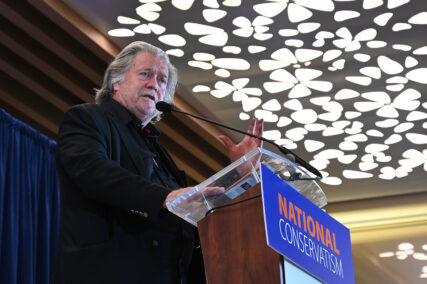
Steve Bannon addresses the National Conservatism Conference, Sept. 4, 2025, in Washington. (RNS photo/Jack Jenkins)
Posobiec was echoed later that day by Bannon, the onetime adviser to Trump. Referring to Mamdani, Bannon insisted “the existential threat to Israel — the Jewish people — is not in Tehran,” but rather “is right in New York City.” He then denounced Mamdani as “a Marxist and a jihadist,” while acknowledging Mamdani is likely to win the election.
Whether a return to the anti-Muslim sentiment — a flavor of vitriol that once helped bolster Trump’s 2016 election coalition — will be enough to help NatCon is an open question. But if this year’s gathering is any indication, it appears to be the chosen path forward for Christian nationalists hoping to expand their tent: In his own address, Wilson argued that while America was “deeply Christian and Protestant at the founding,” it also “did successfully adapt to the presence of Catholics and Jews.”
But accepting large numbers of Muslim immigrants in the U.S., he said, is a bridge too far.
“Millions of Muslims without any commitment to, or mechanism of, assimilation is another matter,” said Wilson, who has previously said that Muslims would be barred from holding office in his version of a Christian America. “There’s only so much white sand you can put in the sugar bowl before it isn’t the Sugar Bowl anymore.”
Posobiec was echoed later that day by Bannon, the onetime adviser to Trump. Referring to Mamdani, Bannon insisted “the existential threat to Israel — the Jewish people — is not in Tehran,” but rather “is right in New York City.” He then denounced Mamdani as “a Marxist and a jihadist,” while acknowledging Mamdani is likely to win the election.
Whether a return to the anti-Muslim sentiment — a flavor of vitriol that once helped bolster Trump’s 2016 election coalition — will be enough to help NatCon is an open question. But if this year’s gathering is any indication, it appears to be the chosen path forward for Christian nationalists hoping to expand their tent: In his own address, Wilson argued that while America was “deeply Christian and Protestant at the founding,” it also “did successfully adapt to the presence of Catholics and Jews.”
But accepting large numbers of Muslim immigrants in the U.S., he said, is a bridge too far.
“Millions of Muslims without any commitment to, or mechanism of, assimilation is another matter,” said Wilson, who has previously said that Muslims would be barred from holding office in his version of a Christian America. “There’s only so much white sand you can put in the sugar bowl before it isn’t the Sugar Bowl anymore.”
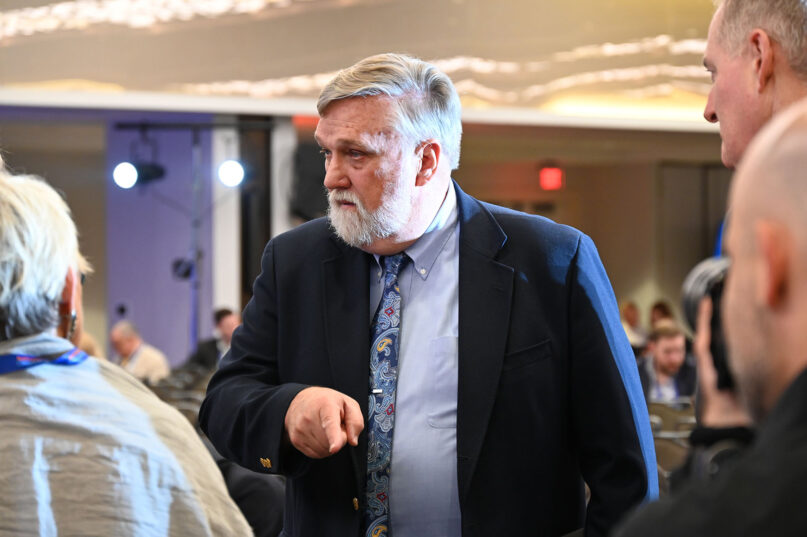
Pastor Doug Wilson attends the National Conservatism Conference, Sept. 4, 2025, in Washington. (RNS photo/Jack Jenkins)
At NatCon, a confusing resurgence of anti-Muslim sentiment
WASHINGTON (RNS) — NatCon’s negative focus on Islam makes for a potential preview of what conservatives will be concerned with in the next year.
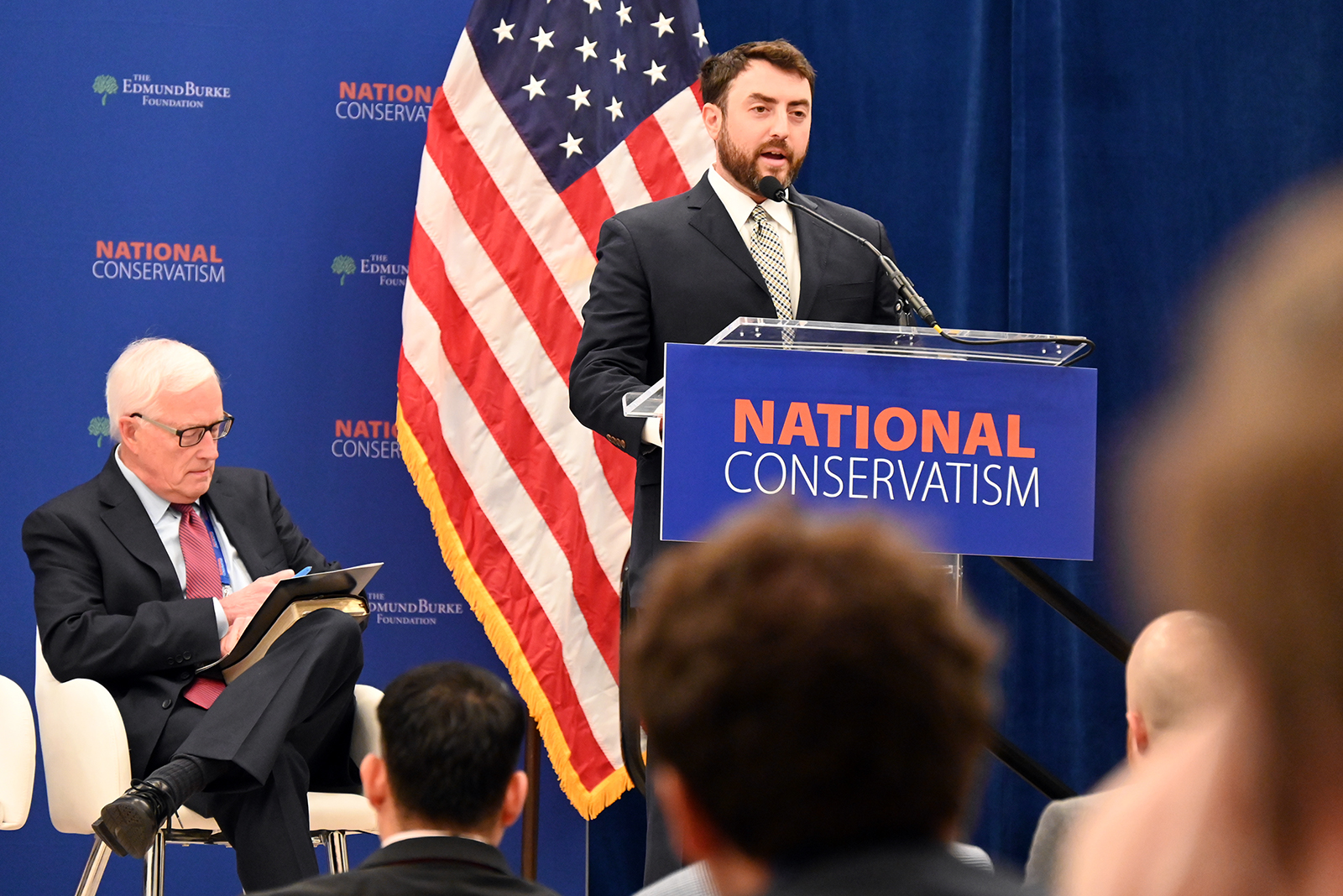
Josh Hammer, right, addresses the National Conservatism Conference, Sept. 3, 2025, in Washington. (RNS photo/Jack Jenkins)
Jack Jenkins
September 3, 2025
WASHINGTON (RNS) — During a breakout session at this year’s National Conservatism Conference on Wednesday (Sept. 3), one group of panelists was asked an unusual question: Did they consider the U.S. to be a “Protestant tree” in which “Jews and Catholics are allowed, as birds, to nest in the branches”?
Josh Hammer, the only Jewish member of the panel, eschewed the arborial analogy but replied that he believes Jews and Catholics “have always been a part of the American story.” A “more interesting question,” he offered, is what Founding Fathers had to say about “Mohammedism” — a reference to Islam.
Fellow panelist William Wolfe, head of the Center for Baptist Leadership and a self-described Christian nationalist, interjected: “I’m happy to cut that branch off, Josh.”
The crowd burst into laughter.
The episode was one of several derogatory mentions of Islam at the conference, a three-day convening at a hotel in downtown Washington. Once considered a far-right fringe gathering and still deeply associated with Christian nationalism, NatCon, as it’s known among its regular attendees, has become a major waypoint in the conservative calendar. The ideas germinated here increasingly shape the ideological framework of the Trump administration, as speakers at past conferences have gone on to become MAGA stars, including Vice President JD Vance.
This year’s lineup had no lack of administration officials, from Office of Management and Budget Director Russell Vought to border czar Tom Homan.
NatCon’s negative focus on Islam, therefore, makes for a potential preview of what conservatives will be concerned with in the next year, especially in midterm election campaigns. Already, New York’s mayoral election in November has attracted dire predictions in conservative circles about the front-runner, Zohran Mamdani, and his Muslim faith, should he win.

William Wolfe speaks during the National Conservatism Conference, Sept. 3, 2025, in Washington. (RNS photo/Jack Jenkins)
The topic was a focus of the conference’s first panel on Tuesday, titled “The Threat of Islamism in America.” Ryan Girdusky, a onetime CNN commentator who was banned from the network last year after he jocularly implied that Muslim journalist Mehdi Hasan had ties to terrorist groups, was among the panelists. (“I hope your beeper doesn’t go off,” he said on air, in an apparent reference to the 2024 attack directed at Lebanon-based militant group Hezbollah, when beepers across the country, planted with explosive charges, suddenly ignited.)
At NatCon, Girdusky argued against mass immigration generally (“The best part of immigration is scarcity,” he said), and Muslim immigration in particular. Echoing a theme aired in speeches in recent months by Vance, Girdusky said Mamdani, a naturalized U.S. citizen, drew crowds at his rallies whose “ancestors did not come on the Mayflower. Most did not come on Ellis Island. Most didn’t come in the past 30 years.”
Another panelist, Wade Miller of the Center for Renewing America, a think tank founded by OMB Director Vought, was even more explicit. “Islam is anti-Christianity, authoritarian and against our entire constitutional order,” Miller said. He insisted the progressive left in the United States has embraced a “woke-Islamist alliance,” pointing to the pro-Palestinian activism that swept college campuses as Israel invaded the Gaza Strip. He later declared that “we are a Christian nation.”
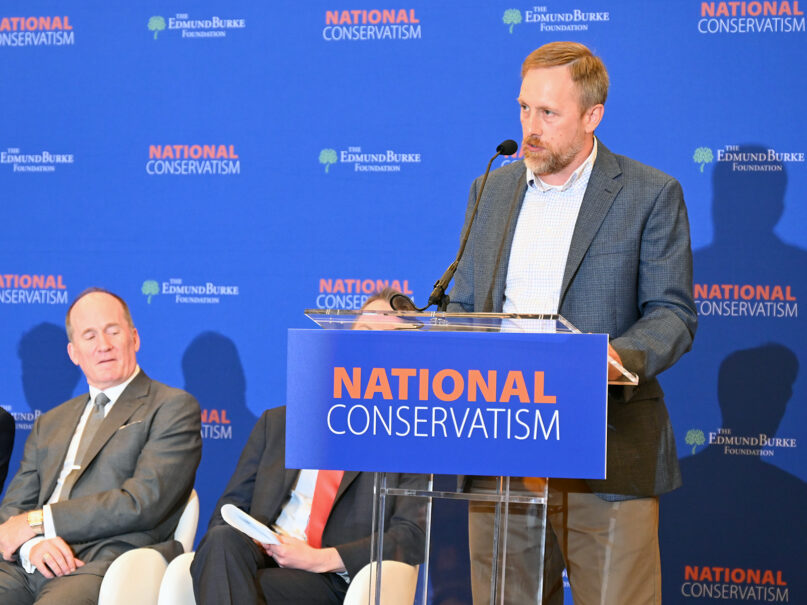
Wade Miller speaks during the National Conservatism Conference, Sept. 2, 2025, in Washington. (RNS photo/Jack Jenkins)
Another CRA activist, senior fellow Nathan Pinkoski, warned that the U.S. could become like Europe, where, he argued, the continent’s “trashed civilizational immune system” allowed “Islamists to make inroads into European nations.”
Anti-Muslim sentiment is hardly new among American conservatives, nor is it unusual for it to appear at NatCon — the 2024 iteration of the conference also featured a talk on “The Islamic Supremacist Challenge to America.”
But when questioned about the urgency of their message, at least one of the panelists could give no rationale for the timing of their warnings, or why Islam was on the agenda at all. Miller said he wasn’t sure, guessing only that “maybe” it was because of recent U.S. strikes in Iran.
Nonetheless, Islam was a recurring component of the larger discussion of immigration. Bo French of Fort Worth, Texas — who chairs the Tarrant County Republican Party and has himself been accused of anti-Muslim comments — said he came to the Islamism panel out of concern that the U.S. will end up with an influx of Muslim immigrants such as countries in Europe, especially the United Kingdom, have experienced. “I think we’re probably 10 years behind where they are, but I think it is accelerating,” French said.
Hammer, senior editor-at-large at Newsweek, also tied his concern to immigration but insisted the issue is of immediate importance. “I think that Islamic immigration should be zero today,” Hammer told RNS. “It is a pressing concern.”
Muslims represent around 1% of the U.S. population, according to Pew Research, and the Trump administration has dramatically restricted immigration in various ways that include banning entry from many Muslim-majority countries. A 2022 poll from the Public Religion Research Institute found that while a slim majority of white evangelicals believe the U.S. should “prevent people from some Muslim majority countries from entering the U.S.,” majorities of every other religious group polled said the reverse.
Trump courted Muslim votes in his 2024 presidential campaign, capitalizing on Muslim disenchantment with the Biden administration’s support for Israel.
Miller acknowledged the growing Muslim interest in Republican ideas in his panel presentation, saying, “Some on our side … insist that we should see Islam and Muslims as political allies,” he said. But Muslims, he summed up, “are not our friends.”
The degeneracy of Christian nationalism and the demolition of culture
(RNS) — Trump's assault on art and culture is only outdone by his debasement of his fellow humans.

Rigoberto Gonzalez’s “Refugees Crossing the Border Wall into South Texas.” Photo by Difference Engine/Wikimedia Commons
Phyllis Zagano
August 29, 2025
(RNS) — The United States exists in a new-old universe. After nearly 250 years of democracy, it seems infected with totalitarianism, racial superiority, anti-communism and all the petrified theories advanced by another populist politician, Adolph Hitler.
Donald Trump did say he would be a dictator on day one.
History will be the judge, but things look rather bleak right now for the democracy side of the equation.
Take art and culture.
During the 12 years of Hitler’s corruption of the concepts of law and order, he also attacked what we now call “creatives” and cultural institutions. The backlash against artistic Modernism had begun earlier in Germany’s Weimar era, but the Führer fully enforced his own ideas of what comprised art. He banned “degenerate art”: Bauhaus, Cubism, Dada, Expressionism, Fauvism, Impressionism and Surrealism. And the regime supported only official painters, sculptors, architects, writers and even actors.
Things are trending in the same direction in the 21st-century United States. Trump, having gotten himself elected chair of the John F. Kennedy Center for the Performing Arts, has vowed to end “woke political programming” at Washington’s premier arts venue.
As an example of what this means, the Kennedy Center hosted a screening this week of “The Revival Generation,” a documentary about a “nationwide campus revival movement” drawing Gen Z Americans. Billed as a “call to faith and a message of hope” that “(c)aptures a spiritual awakening among today’s youth,” the program included a one-hour worship service with “a local worship collective.”
Next Trump ordered a review of exhibits at the Smithsonian Museums that has sent curators scrambling to “fix” exhibits Mr. Trump finds too woke. The list of things needing repair at the National Museum of African American History and Culture, the National Portrait Gallery and the National Museum of the American Latino focuses on mentions of race, slavery, immigration and sexuality.
The artwork that offends the curator-in-chief is not Cubism or Dadaism or Impressionism. Unlike Hitler, Trump has not put Picasso, Duchamp and Monet on the banned lists. Rather, it is Rigoberto Gonzalez’s extraordinary “Refugees Crossing the Border Wall into South Texas.”
The list goes on. Some of it is, well, edgy. But it is not of the order of “Immersion (Piss Christ),” Andres Serrano’s 1987 photograph of a crucifix submerged in a container of his own urine. Despite an outcry from politicians who tried to defund its sponsors, the piece won an award in a competition partly sponsored by the National Endowment for the Arts. Ronald Reagan was president then.
If only Trump would confine his new strictures to art and culture, his populism would be an affront only to the pursuit of beauty. But they cross several lines, assaulting truth as well.
As several mainline faith leaders and the U.S. Catholic bishops have pointed out, the derisive oppression of poor immigrants by members of the current administration is sickening. That some administration officials continue to publicly espouse Christian ethics is mind-boggling.
Government spokespeople bend the truth and present an alternate reality. Then, there are the humorless bureaucrats who can change numbers to suit the master’s will. The administration is efficient and punctual, and its leader can do no wrong.
The American republic is aiming for a head-on collision with democracy, and not incidentally is becoming an enigma, if not a laughingstock, to the rest of the free world.
It has to stop.
EVEN THE CRITICS OF PATRIARCHY ARE PATRIARCHS
After challenging Doug Wilson, podcaster’s confession shakes anti-patriarchy movement
“Women have been declaring the damage for years,” she said. “But something about a man holding the mic — even when it was women survivors talking into it — made the warnings more palatable to people who were steeped in Christian patriarchy.”
(FāVS News) — Podcast host Peter Bell’s admission came shortly after a Moscow, Idaho, community event where he and others spoke about the impact of Wilson’s teachings.
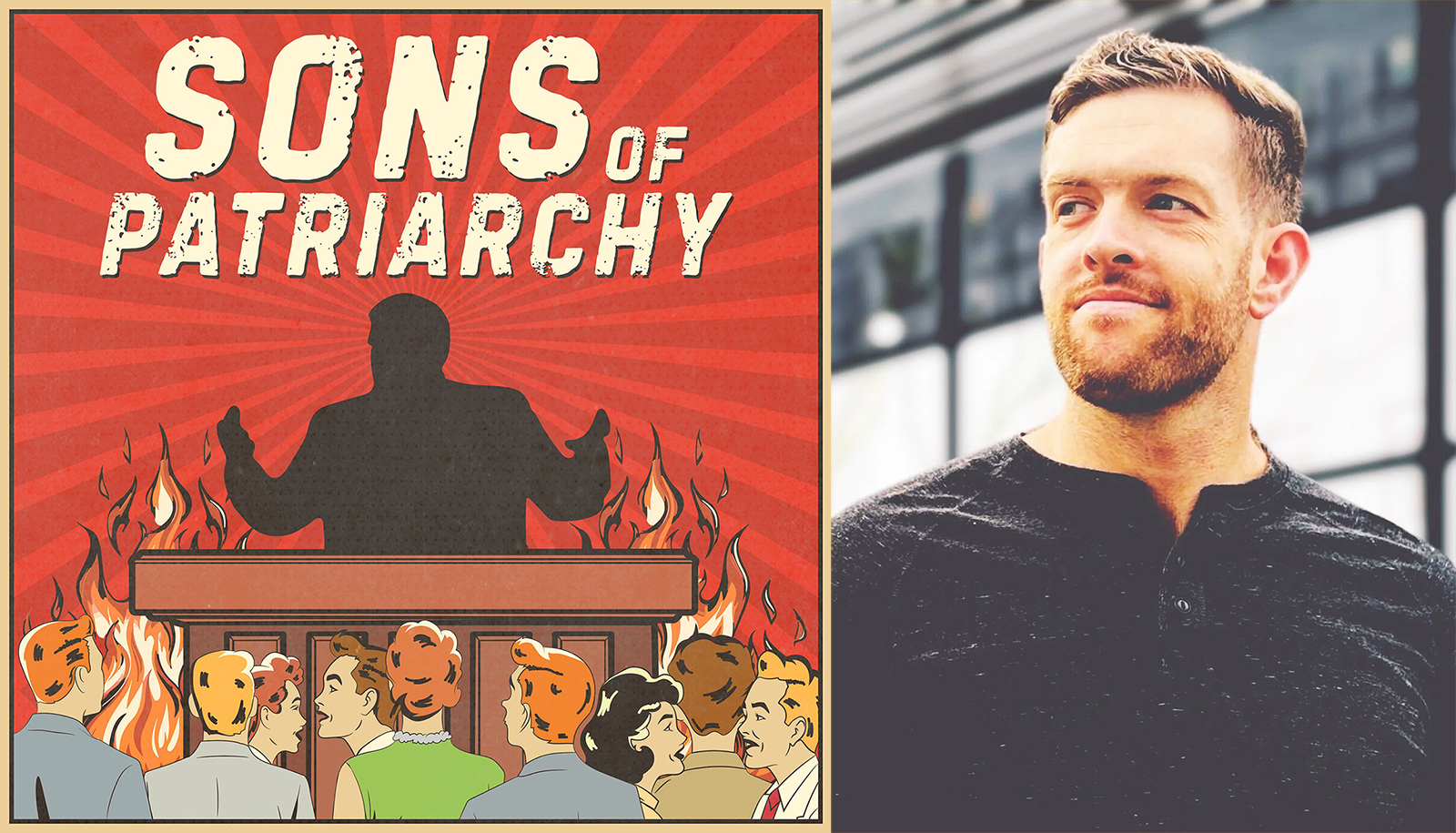
“Sons of Patriarchy” podcast logo and host Peter Bell. (Courtesy images)
Tracy Simmons
September 4, 2025
(FāVS News) — Days after challenging Pastor Doug Wilson to a public debate, Peter Bell, producer and host of the podcast “Sons of Patriarchy,” made a social media confession that has forced a reckoning within the community he helped build around exposing abuse in patriarchal churches.
Bell, whose podcast investigates Wilson’s Moscow, Idaho-based church movement, said in a since-deleted Aug. 23 Facebook post that he struggled with pornography addiction for nearly two decades, was fired from multiple jobs for lying and experienced marital separation during his podcast’s first season last year.
The confession came shortly after Bell appeared at a Moscow community event Aug. 8 at the Kenworthy Performing Arts Center, where he and others spoke about the impact of Wilson’s teachings. The podcast producers scheduled their first Moscow visit to coincide with Grace Agenda, a weekend conference hosted by Wilson’s Christ Church that serves as a major recruiting event for the church. After the Kenworthy event, Bell and “Sons of Patriarchy” staff approached Wilson at the conference, and Wilson agreed to a one-on-one conversation with the podcast host, who has spent months documenting abuse allegations within Wilson’s Communion of Reformed Evangelical Churches.
Bell acknowledged to FāVS News that the timing of his Facebook post was deliberate.
“With the recent airing of the CNN interview with Doug Wilson” — a profile that examined Wilson’s Christian nationalist movement and connections to U.S. Defense Secretary Pete Hegseth — “our team began receiving far more media inquiries, survivor stories and ‘interest’ after Doug agreed to a one-on-one with me,” Bell said in an interview.
“This compounded with the kinds of messages we were receiving, mostly coming from women, who were praising me. They wanted to let me know that they wished their husbands could be like me, their sons would grow up to be like me, and their pastors cared like me,” Bell said. “I couldn’t handle the praise, knowing that if those who were messaging us knew the truth about me, maybe they’d be less inclined. I had told parts of it before, but I needed everything out there.”
September 4, 2025
(FāVS News) — Days after challenging Pastor Doug Wilson to a public debate, Peter Bell, producer and host of the podcast “Sons of Patriarchy,” made a social media confession that has forced a reckoning within the community he helped build around exposing abuse in patriarchal churches.
Bell, whose podcast investigates Wilson’s Moscow, Idaho-based church movement, said in a since-deleted Aug. 23 Facebook post that he struggled with pornography addiction for nearly two decades, was fired from multiple jobs for lying and experienced marital separation during his podcast’s first season last year.
The confession came shortly after Bell appeared at a Moscow community event Aug. 8 at the Kenworthy Performing Arts Center, where he and others spoke about the impact of Wilson’s teachings. The podcast producers scheduled their first Moscow visit to coincide with Grace Agenda, a weekend conference hosted by Wilson’s Christ Church that serves as a major recruiting event for the church. After the Kenworthy event, Bell and “Sons of Patriarchy” staff approached Wilson at the conference, and Wilson agreed to a one-on-one conversation with the podcast host, who has spent months documenting abuse allegations within Wilson’s Communion of Reformed Evangelical Churches.
Bell acknowledged to FāVS News that the timing of his Facebook post was deliberate.
“With the recent airing of the CNN interview with Doug Wilson” — a profile that examined Wilson’s Christian nationalist movement and connections to U.S. Defense Secretary Pete Hegseth — “our team began receiving far more media inquiries, survivor stories and ‘interest’ after Doug agreed to a one-on-one with me,” Bell said in an interview.
“This compounded with the kinds of messages we were receiving, mostly coming from women, who were praising me. They wanted to let me know that they wished their husbands could be like me, their sons would grow up to be like me, and their pastors cared like me,” Bell said. “I couldn’t handle the praise, knowing that if those who were messaging us knew the truth about me, maybe they’d be less inclined. I had told parts of it before, but I needed everything out there.”
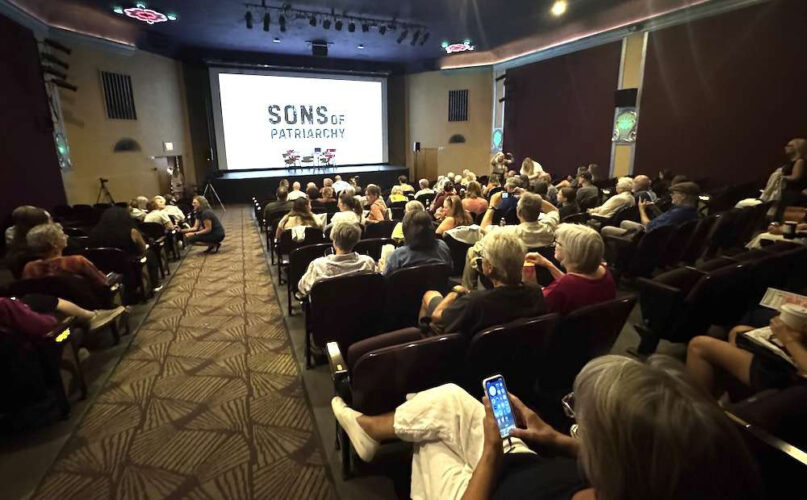
A crowd attends a “Sons of Patriarchy” live event at the Kenworthy Performing Arts Center, Aug. 8, 2025, in Moscow, Idaho. (Photo by Tracy Simmons/FāVS News)
The confession sparked tension within the “Sons of Patriarchy” team. Bell’s co-host and majority owner of the podcast, Sarah Bader, responded with a social media statement distancing the team from Bell’s post.
“He did not run this post by the team. And we are holding him to account for it,” Bader posted. “We apologize to our survivor community for his actions and are putting measures and controls into place so that it can’t happen again.”
RELATED: Doug Wilson agrees to debate ‘Sons of Patriarchy’ after dueling events in Moscow, Idaho
In Bell’s confession, he revealed he had been “addicted to porn for a little less than 20 years” and continues to struggle “to this day.” He also said he was “fired from two or three full-time ‘secular’ jobs … for lying, and covering up other things, in rather large ways” and was “kicked out” of ministry positions for dishonesty.
The issues led to separation from his wife during the production of his podcast’s first season just about a year ago, Bell wrote. The couple has since reconciled.
“I write it both to get it off my chest, to give Doug Wilson and his people the dirt they’re probably looking for, and to dissuade anyone from thinking I’m the ‘anti-patriarchy’ hero they might think I am,” Bell wrote in the Facebook post, which garnered hundreds of comments. “There was this picture/aura forming about and around me, that I was the ‘anti-patriarchy hero’ so many in these circles were looking for.”
The confession particularly stung trauma survivors who trusted Bell with their stories of abuse within patriarchal church systems, several alleged survivors wrote on social media. As Bell interviews women who have left these environments, his admission raised questions about his fitness for the role.
“I totally and completely understand if survivors no longer desire to be interviewed by me,” Bell said. “My goal isn’t to get someone behind a microphone — my goal is for them to be heard.”

Peter Bell, left, and Doug Wilson, right. (Video screen grabs)
However, Bell defended his continued involvement.
“I haven’t had the chance to interview survivors” since the confession, he said, “but to be transparent, it hasn’t changed much. I didn’t change after the confession. I said what I said because I’ve already come to terms with everything.”
Bell described how leaders can maintain public ministries while struggling privately — an insight that parallels cases his podcast has investigated.
The issue of pastors struggling with pornography while maintaining public ministries has been a recurring theme in allegations documented by “Sons of Patriarchy.” Tim Meshginpoosh, a longtime observer of these churches, wrote in a Substack post that when such issues have surfaced, “the response of the elders was soft, and when the marriages blew up, the wife got blamed, shunned, and ostracized.”
Bell said churches often handle these issues differently based on one’s status.
“A high-ranking leader with decades of experience and beloved by the congregation? You get a slap on the wrist, a cover-up and pass right on through,” Bell said. “A no-name member who will put a blot on your reputation? You’ve got two choices: Make sure no one ever hears about it and your ‘sterling’ reputation is saved … or, strike them down with the fury of the Lord as an example to those watching.”
Patterns of institutional response Bell described played out in reaction to his own disclosure. Bader’s response seemed to split the podcast’s following, with some calling her statement “woke” while others said they appreciated her consideration for triggered survivors.
Meshginpoosh questioned whether Bell should have been the face of the anti-patriarchy effort given his recent struggles.
“The concern I have — it was way too soon,” Meshginpoosh said in an interview. “He recorded the first season while he was still separated from his wife. … If you have that kind of recent past, you need to take some time to do the hard work.”
Meshginpoosh also noted a tactical disadvantage, should there be a debate with Wilson.
“If you’re going to go up against Wilson, you’re going to have a hard time grilling him about the Steven Sitler disaster if you’re trying to pick up the pieces of multiple integrity fails on the job and a 20-year porn addiction,” he said
The Sitler case has long been a source of controversy for Wilson. In 2005, Sitler, a student at New St. Andrews College, a private college founded by Christ Church, confessed to molesting multiple children. Sitler pleaded guilty to lewd conduct with a minor and was sentenced to prison. Wilson wrote a letter to the sentencing judge describing Sitler as “most responsive” and “completely honest” and asking for leniency, according to a Southern Poverty Law Center report — despite Wilson’s own writings advocating death penalties for such crimes. Wilson officiated Sitler’s wedding, and Sitler was eventually found to have sexually abused his infant son, leading to legal protections.
Cases like Sitler’s are what “Sons of Patriarchy” was created to expose. But some worried Bell’s confession overshadowed that mission. Author Sarah Stankorb, who has covered Wilson’s movement and was on stage at the Moscow event, wrote in a statement to Baptist News Global that the confession was problematic in its timing.
“I worry, in light of Peter Bell’s post, we’re losing the thread,” Stankorb wrote. “It blindsided a lot of survivors and other advocates whose trust is already fragile. It also has created a huge distraction from the work of making Wilson’s impact visible.”
Stankorb also noted a troubling pattern in responses to abuse allegations.
“Women have been declaring the damage for years,” she said. “But something about a man holding the mic — even when it was women survivors talking into it — made the warnings more palatable to people who were steeped in Christian patriarchy.”
Bell acknowledged uncertainty about his continued role as the podcast’s host, saying he serves “at the behest of the volunteers and those who support the work.” He suggested Bader could lead the podcast.
“Whether or not I lead this podcast in the future has no bearing on my own personal desire to see movements founded and influenced by Doug Wilson to be toppled,” he said. “This is personal for me, and I care, regardless of a microphone being in front of me or not.”
However, supporters believe the “Sons of Patriarchy” mission remains vital. Meshginpoosh said the podcast serves as a “force multiplier” for survivors who have waited years for someone to advocate for them.
“Ultimately, they are doing good work,” he said. “They are exposing the abuses and systemic dynamics within the Presbyterian/Presbyterian-ish world. I want SoP to continue to do good work.”
Attempts to reach Bader for comment were unsuccessful.


