Sunday, September 07, 2025

GOP senator comes out swinging against JD Vance over 'despicable and thoughtless' comments

David McAfee
September 6, 2025 
RAW STORY
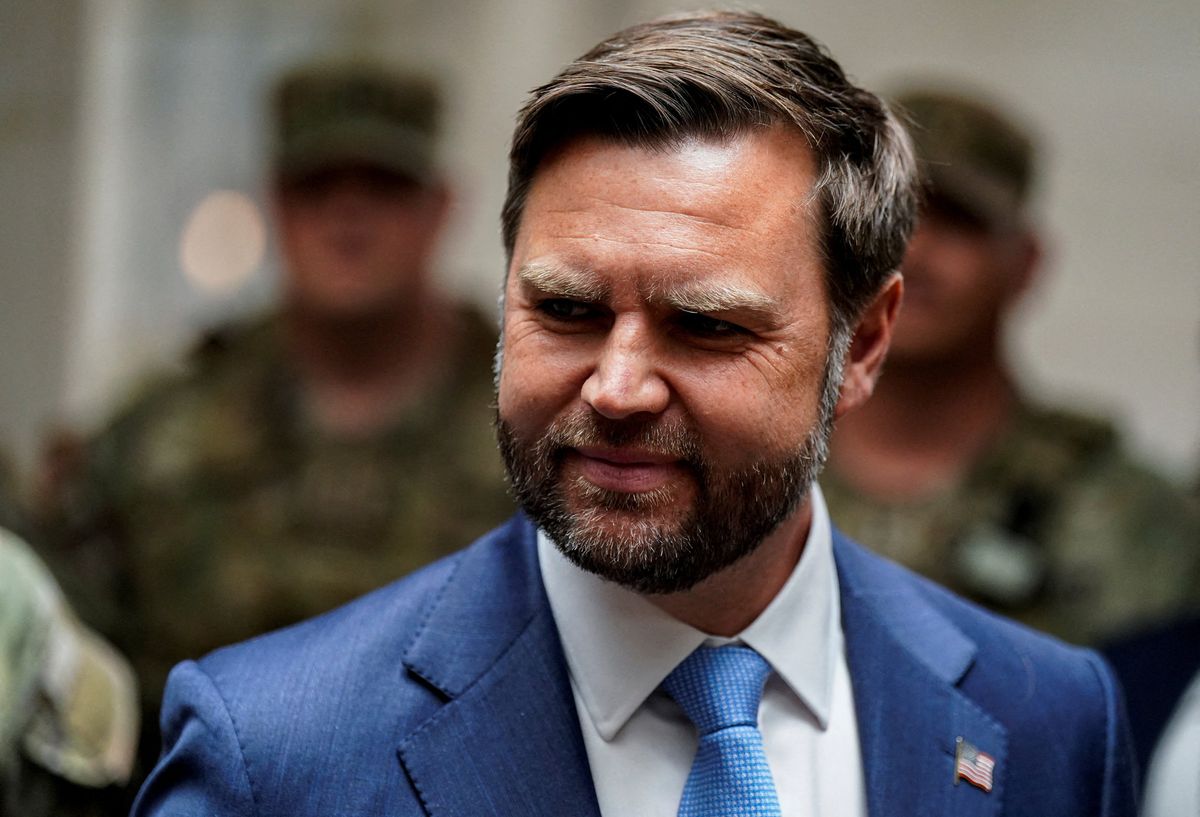

U.S. Vice President JD Vance meets members of the National Guard, at Union Station in Washington, D.C., U.S., August 20, 2025. REUTERS/Al Drago/Pool

Republicans have been more united than ever, but on Saturday a Republican senator came out swinging against the vice president.

It started with a comment from JD Vance, who wrote over the weekend, "Killing cartel members who poison our fellow citizens is the highest and best use of our military." This led Brian Krassenstein to respond, "Killing the citizens of another nation who are civilians without any due process is called a war crime."

Vance replied, "I don’t give a s--- what you call it," and set off outrage online.

Late on Saturday, Republican Senator Rand Paul joined the chorus of those opposing Vance's weekend comment.

"JD 'I don’t give a s---' Vance says killing people he accuses of a crime is the 'highest and best use of the military.' Did he ever read To Kill a Mockingbird?" Paul asked. "Did he ever wonder what might happen if the accused were immediately executed without trial or representation??"

Paul then added, "What a despicable and thoughtless sentiment it is to glorify killing someone without a trial."


'Wow': Onlookers stunned as Rand Paul 'takes JD Vance to school' with brutal takedown

David McAfee
September 7, 2025 
RAW STORY
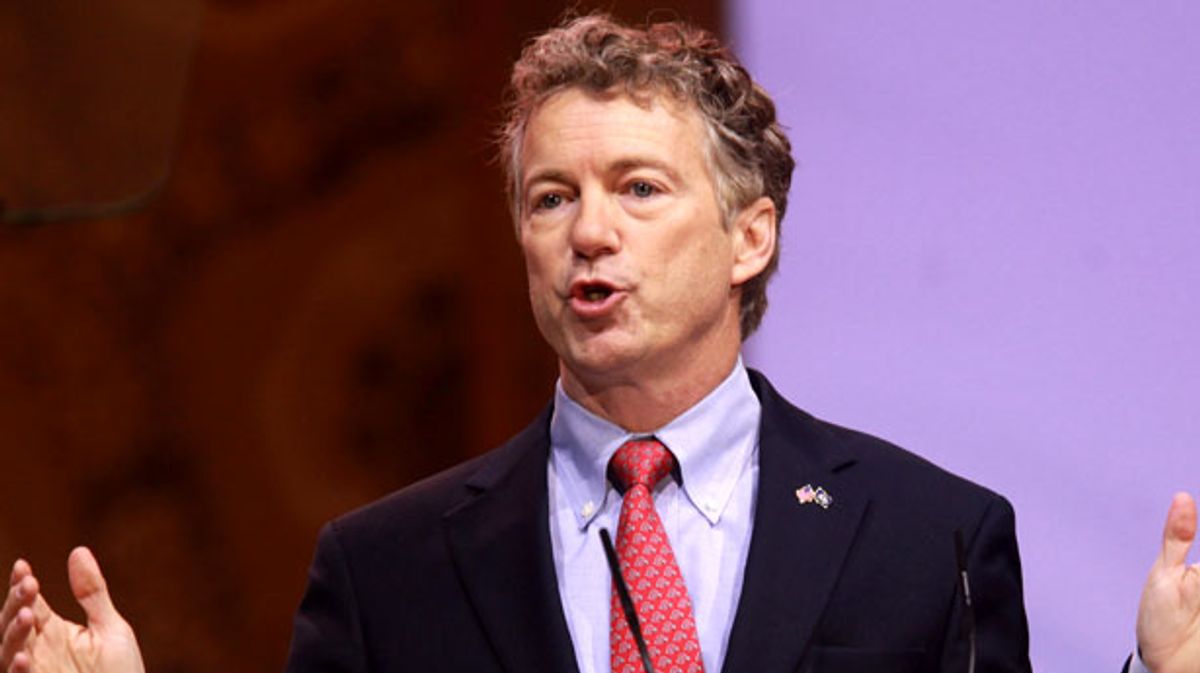

Rand Paul (Gage Skidmore/Flickr)

Observers were shocked this weekend after Rand Paul, a Republican senator, delivered a brutal takedown of Vice President JD Vance.

Raw Story reported late Saturday that Paul took on Vance, who claimed he doesn't "give a s---" when someone said Vance might have been inadvertently endorsing war crimes on social media.

Paul replied to Vance's statement in part by writing, "What a despicable and thoughtless sentiment it is to glorify killing someone without a trial."

The attack on his own Republican ex-colleague had the internet abuzz, with New York Times journalist Glenn Thrush replying on Sunday with, "Wow."

Republicans against Trump wrote, "Thank you for your moral clarity on this. JD Vance is a despicable and cynical politician."

PatriotTakes, which purports to track right-wing extremism, asked Paul, "How do we know there were not any human trafficking victims on that boat?"

Former prosecutor Ron Filipkowski commented, "When even Rand Paul thinks you’re despicable."

Veteran John Jackson chimed in, "Getting called out by Rand Paul is a helluva thing."

"He’s totally correct," Jackson added.

Former Republican declared, "Rand Paul is right."

"The Trump administration must be held accountable for murder," they added.

Devin Duke said, "I don't usually agree with Rand Paul but he takes JD Vance to school here."

"JD has become a rabid power lusting maniac since becoming VP," Duke then added.

Conservative attorney and anti-Trump activist George Conway said, "You are absolutely correct, Senator. Thank you for speaking with such moral clarity here."
Overcrowding kills infant gorillas in Rwanda habitat


By AFP
September 7, 2025


Around half of the babies will fall victims to vicious inter-family fights, experts say - Copyright AFP/File Lillian SUWANRUMPHA


Moses GAHIGI

Celebrities, politicians and conservationists took turns to announce names for 40 infant gorillas in a glamorous ceremony in Rwanda, where the endangered creatures face a deadly threat from overcrowding.

Around half of the babies will not make it to adulthood due to vicious inter-family fights that are threatening decades of conservation work, experts say.

Efforts over the past half-century have helped the gorilla population recover from critical levels in the Virunga Massif that spans Rwanda, Uganda and the Democratic Republic of Congo.

But increased numbers also make the adult male gorillas, known as silverbacks, clash more frequently, with devastating results.

“Silverbacks fight as they try to protect their territories,” said Eugene Mutangana, conservation management expert at the Rwanda Development Board.

“The infants end up dying because the silverback that wins eliminates the young ones,” he told AFP.

He said around half of all young gorillas born over the past decade have been killed in this way.

None of that was mentioned as celebrities such as Hollywood actor Michelle Yeoh and “Transformers” director Michael Bay enjoyed the naming ceremony in the foothills of Volcanoes National Park.

“I hear he is such a good-looking baby gorilla, and being a movie director I promise I am going to make him a famous gorilla movie star,” said Bay, who named his gorilla Umurage, meaning “heritage”.


– Short but vicious fights –


Rwanda has launched an ambitious programme to expand the gorillas’ habitat by 23 percent that will see around 3,400 human households relocated from the edge of Volcanoes National Park.

But the programme will take more than 10 years to complete, Mutangana acknowledged.

And in the meantime, scarcity of land causes the deadly incidents to continue.

A ranger in the park, who asked not to be named, said he had taken tourists to see gorillas only to come across dead infant ones.

“When families meet, which is not frequent… the males often fight,” he told AFP.

“We leave them to fight. They are normally short but vicious fights. The silverback which wins ends up hitting the infant on hard surfaces until it dies.”

He said grieving mothers will often isolate themselves from the new dominant male.

“It is a sad sight,” the ranger said.

Extreme temperatures were also a cause of death for infant gorillas, he added.

Julius Nziza, lead medic at Rwanda’s Gorilla Doctors Office, said many infants were also left injured by the fights.

“We don’t intervene because it is a natural phenomenon. We only intervene when it is human-induced or life-threatening infections like a serious respiratory disease,” he said.

“The problem can be dealt with through expanding the habitat.”


– Recovery, revenue –


The number of gorillas in Rwanda fell to just 242 in 1981, according to a study by the late conservationist Dian Fossey.

Conservation efforts, including anti-poaching patrols, community engagement, veterinary care, habitat protection and monitoring led to a gradual recovery, though they are still classed as endangered by the International Union for Conservation of Nature.

The population has lately climbed to over 1,000 and is rising by four percent annually, though it could be double that without the infant deaths, Nziza said.

Conservation work is also undermined by the presence of numerous armed groups in the remote hills of Virunga, and illegal mining and logging operations.

Humans have encroached on more than half of the protected region, and around 130 rangers have been killed over the years trying to protect it.

The armed clashes have disrupted gorilla feeding and breeding patterns.

The naming ceremony was a high-profile event highlighting the relative success of the country’s conservation efforts.

The gorillas have also become a valuable source of tourism revenue, bringing in around $200 million last year, according to the Rwanda Development Board — with visitor numbers limited by high permit prices of around $1,500.
Seoul says over 300 South Koreans detained in US to be released


By AFP
September 7, 2025


Hyundai has announced billions of dollars of investment in US manufacturing 
- Copyright AFP Jung Yeon-je


Kang Jin-kyu

Seoul said Sunday that negotiations with the United States to secure the release of South Korean workers detained in an immigration raid have been “concluded” and they would soon be freed and flown home.

It follows the arrest of more than 300 South Korean workers at a Hyundai-LG battery plant being built in the southern state of Georgia on Thursday.

The operation, carried out in the town of Ellabell, was the largest single site raid implemented so far under US President Donald Trump’s nationwide anti-migrant drive, catching Seoul officials off guard.

“As a result of the swift and united response… negotiations for the release of the detained workers have been concluded,” Kang Hoon-sik, chief of staff to President Lee Jae Myung, said on Sunday.

“Only administrative procedures remain. Once these are completed, a chartered flight will depart to bring our citizens home,” he added.

Footage of the raid released by US authorities showed detained workers, in handcuffs and with chains around their ankles, being loaded onto an inmate transportation bus.

Scrambling to contain the fallout, a senior executive at electric vehicle battery maker LG Energy Solution flew to Georgia on Sunday morning.

“The immediate priority now is the swift release of both our LG Energy Solution employees and those of our partner firms,” executive Kim Ki-soo told reporters before boarding a plane.


– $350 bn pledge –


LG Energy Solution has said 47 of its employees had been arrested — 46 South Koreans and one Indonesian.

The company has also said about 250 of those arrested were believed to be employed by its contractor, and most of them were South Koreans.

An official at a partner firm of LG Energy Solution who spoke with one of the detained workers told Yonhap news agency that conditions at the detention centre were poor.

“They are given food and allowed to shower, but the conditions are substandard,” the official was quoted as saying, adding they were not being handcuffed.

The battery maker said it has suspended all business trips to the United States, except for client meetings, and instructed those already there to either “return immediately or standby at their accommodations”.

Hyundai has said none of those arrested are its employees.

South Korea, Asia’s fourth-biggest economy, is a key automaker and electronics producer with multiple plants in the United States.

Its companies have invested billions of dollars to build factories in the United States in a bid to access the US market and avoid tariff threats from Trump.

President Lee met Trump during a visit last month, and Seoul pledged $350 billion in US investment in July.

Trump has promised to revive the US manufacturing sector, while also vowing to deport millions of undocumented migrants.
Coral reveals the rate of global warming


By Dr. Tim Sandle
EDITOR AT LARGE SCIENCE
DIGITAL JOURNAL
September 7, 2025


This underwater photo taken on April 5, 2024, shows bleached and dead coral around Lizard Island on the Great Barrier Reef, 270 kilometres (170 miles) north of the city of Cairns - Copyright AFP/File DAVID GRAY

Scientists from Ohio State University have found that Red Sea corals can endure warming seas but grow much smaller and weaken under long-term heat stress. This provides additional evidence as to the adverse impact of climate change upon the world’s oceans.

Whilst recovery is possible in cooler months, rising global temperatures may outpace their resilience, thereby endangering reefs and the people who depend on them.

By studying how six months of elevated ocean temperatures would affect a species of coral from the northern Red Sea called Stylophora pistillata, scientists found that although these organisms can certainly survive in conditions that mimic future warming trends, they do not thrive.

Corals bleach in warm ocean waters, making them particularly vulnerable as global temperatures rise due to climate change. — © AFP

Coral in decline


S. pistillata corals tend to be tolerant of high ocean temperatures, but when continuously exposed to temperatures of 27.5 and 30 degrees Celsius (81.5 and 86 degrees Fahrenheit) — baseline warming expected in tropical oceans by 2050 and 2100 — scientists saw various changes in coral growth, metabolic rates, and even energy reserves.

Stylophora pistillata, commonly known as hood coral or smooth cauliflower coral, is a species of stony coral in the family Pocilloporidae. It is native to the Indo-Pacific region and is commonly used in scientific investigations.

For instance, coral in 27.5 degrees Celsius waters survived, but were 30% smaller than their control group; those placed in 30 degrees Celsius waters wound up being 70% smaller.

According to lead researcher Ann Marie Hulver: “In theory, if corals in the wild at these temperatures are smaller, reefs might not be as diverse and may not be able to support as much marine life…This could have adverse effects on people that depend on the reef for tourism, fishing or food.”

Adverse impact

The research results suggest that even the most thermally tolerant coral species may suffer in their inability to overcome the consequences of warming seas.

The reseachers paint a more detailed picture of how coral reefs may look and function in the next 50 years. Ocean temperatures are expected to increase by 3 degrees Celsius by 2100, expecting coral reefs to predictably bend to projected climate models can be difficult, according to the researchers.

Redressing the impact

Gaining a more complex understanding of how warming waters can alter coral growth and feeding patterns may also better inform long-term conservation efforts.

Research paper


The findings appear in the journal Science of the Total Environment, titled “Thermally resistant coral Stylophora pistillata survives but does not thrive under chronic elevated baseline temperature.”
Research: Personalising data can overcome climate change apathy


By Dr. Tim Sandle
EDITOR AT LARGE SCIENCE
DIGITAL JOURNAL
September 7, 2025


Wildfires across Turkey over the past week have led to at least 14 deaths - Copyright AFP Lillian SUWANRUMPHA

Whilst the majority are accepting of climate change, especially those with rudimentary education, there remains in every society a cohort who are resistant to scientific fact. How can scientists and policy makers challenge this?

Certainly, the slow upward creep of global temperatures contributes to apathy among people who do not experience regular climate-driven disasters.

A new study finds that presenting the same continuous climate data, such as incremental changes in temperature, in binary form — such as whether a lake did or did not freeze in the winter — significantly increases people’s ability to see the impact of climate change. This is in the context of displaying data about the same town or other location, especially one that resonates with people personally.

According to lead researcher, UCLA communications professor and cognitive psychologist Rachit Dubey: “People are adjusting to worsening environmental conditions, like multiple fire seasons per year, disturbingly fast…When we used the same temperature data for a location but presented it in a starker way, it broke through people’s climate apathy. Unfortunately, compared to those who looked at a clearer presentation of the same information, those who only looked at gradual data perceived a 12% smaller climate impact and cared less.”

Dubey’s studies how people reason about climate change, how to communicate about it and how to improve climate communications. The academic noted how heavily political and personal experiences influence risk perceptions around climate change, and how quickly people redefine “normal.”

For the past five years, Dubey has been looking more deeply into the human tendency to adjust to change, even as science has proven that humans’ greenhouse gas emissions are causing climate change and increasing disasters like wildfires, droughts, floods, hurricanes, and sea-level rise.

Research

For the study, Dubey asked study participants about the climate in a fictional city they named “Townsville,” and later asked a second group about five real lakeside cities around the world, including Lake George in New York and Grand Traverse Bay in Michigan.

In both versions of the experiment, he showed half of the study participants a graph of temperature increases from 1940-2020, and the other half a graph showing whether temperatures caused the lake to freeze each winter. Whether charting temperatures or lake freezes, each pair of charts drew from the same slowly warming weather information.

As temperatures gradually climbed, the lakes stopped freezing as often. For the real towns, study participants hearing about the lake also learned about the decline of activities like ice skating and ice fishing.

When Dubey asked participants to rate from 1 to 10 how much climate change impacted the town, people who learned about a range of temperatures responded lower than people who learned whether the lake froze — on average, 6.6, compared to 7.5, or 12% higher.

Another inference suggests that by making the emotional connection to local traditions, whether ice skating in the winter or freedom from wildfire smoke in the summer, may also contribute to overcoming apathy.

Analysis

“For years, we assumed that if the climate worsened enough, people would act, but instead, we’re seeing the ‘boiling frog’ effect, where humans continuously reset their perception of ‘normal’ every few years,” Dubey adds. “People are adjusting to worsening environmental conditions, like multiple fire seasons per year, disturbingly fast. My research examines how people are mentally adapting to the negative changes in our environment.”

Next steps

Dudley hopes these results will aid anyone designing visual representations of climate change graphics or those seeking to clarify gradual changes, from climate generalists and data visualization professionals to policymakers and journalists.

“People working in these fields have a sense that binary data is more effective, and our study adds theoretical rigor, using careful cognitive experiments,” Dubey explains. “Our study also helps explain why the ‘Show Your Stripes’ visualization is so compelling because it takes continuous data and presents it in a more binary format.”

Study

The research appears in the journal Nature Human Behaviour, titled “Binary climate data visuals amplify perceived impact of climate change.”


Thai cannabis-championing tycoon takes office as PM


By AFP
September 7, 2025


Image:— © AFP/File John MACDOUGALL


Thanaporn PROMYAMYAI

Thai tycoon Anutin Charnvirakul took office as prime minister on Sunday, with the cannabis-championing conservative ousting the nation’s dominant political dynasty and setting course for elections early next year.

Since 2023 elections, Thailand’s top office has been monopolised by the Pheu Thai party of the Shinatawatra dynasty — a populist force which has long sparred with the pro-monarchy, pro-military establishment.

But dynasty heiress Paetongtarn Shinawatra was last month sacked by court order, and Anutin rushed to piece together his own coalition government — winning a Friday parliament vote to shut Pheu Thai out of office.

Anutin previously served as deputy prime minister, interior minister and health minister — but is perhaps most famous for being the architect of Thailand’s 2022 cannabis decriminalisation.

The construction magnate becomes the kingdom’s third leader in two years, but has taken power with coalition backing conditional on him dissolving parliament within four months to hold fresh elections.

“I will work at my full capacity with honesty and morality worthy of His Majesty’s trust, for the benefit of the people and for the country,” Anutin said immediately after taking office.


Anutin Charnvirakul, a former minister who championed Thailand’s decriminalisation of cannabis, becomes the kingdom’s third prime minister in two years
 – Copyright AFP/File Lillian SUWANRUMPHA

His term officially began after the royal endorsement of King Maha Vajiralongkorn, read aloud in a formal ceremony at Anutin’s Bhumjaithai Party headquarters in Bangkok.

“His Majesty the King has endorsed Mr. Anutin Charnvirakul to be prime minister from now onwards,” said secretary-general of the lower house of parliament Arpath Sukhanunth, reading out the royal command.

– Dynasty in decline –

Anutin is also known for managing tourism-dependent Thailand’s Covid-19 response and causing a backlash after accusing Westerners of spreading the virus.

He was once an ally of the Shinawatras — who have been a dominant force in Thai politics since the turn of the century, but are increasingly faltering after a succession of legal and political setbacks.

Anutin abandoned his coalition with their Pheu Thai Party this summer in apparent outrage over Paetongtarn’s conduct during a border row with neighbouring Cambodia.

Thailand’s Constitutional Court found on August 29 that conduct had breached ministerial ethics and fired her after only a year in power.

Thaksin Shinawatra, the dynasty patriarch, flew out of the kingdom in the hours ahead of the Friday parliament vote confirming Anutin — bound for Dubai, where he said he would visit friends and seek medical treatment.

The Supreme Court is due to rule on Tuesday in a case over Thaksin’s hospital stay following his return from exile in August 2023, a decision that could affect the validity of his early release from prison last year.

While his guilt is not the subject of the case, some analysts say the verdict could see him jailed.

Thaksin on social media promised to return from Dubai to attend the court date “in person”, while Anutin has said his administration will show “no favouritism, no persecution, and no revenge”.


Immigration: The end of the Canadian dream?

From the show
Reporters

Long considered a welcoming country for immigrants, Canada is putting an unprecedented halt to its open immigration policy. Mark Carney, the new prime minister, confirmed the move by freezing targets for welcoming new arrivals. What's behind this shift? FRANCE 24's François Rihouay and Joanne Profeta report.

The decision to tighten Canada's immigration policy seems to have been largely dictated by polls in recent months. Fifty-eight percent of Canadians now consider immigration to be "too high" in the country, up from 27 percent in 2022. The reasons cited are a creeping housing crisis and the strain on social and health services.

Back in 2023, in the midst of a labour shortage, the world's second-largest country welcomed more than 1.27 million new residents – the highest number since 1957. Today, nearly one in four people in Canada were born abroad, a unique situation among G7 countries.

As anti-immigration movements such as "Take Back Canada" gain ground and public opinion suddenly rejects the once-cherished model of welcoming immigrants, foreign workers remind us that they are indispensable to Canada's economy and its future.

Young, politicised, far left: Who are France's ‘Block Everything’ protesters?

Analysis

Supporters of France's “Block everything” (“Bloquons tout”) movement have been preparing for their day of action on September 10, vowing to shut down the country. While their online call to protest echoes the Yellow Vests uprising of 2018, their profile is markedly different, according to a recent study.


Issued on: 06/09/2025 - 
By: Romain BRUNET
Posts on social media calling for France to be shut down on September 10, 2025. © Bertrand Guay, AFP

Anger is brewing in France over Prime Minister François Bayrou’s draft 2026 budget, which includes scrapping two national holidays, freezing pensions and cutting €5 billion from health spending. Out of that discontent, a new protest movement dubbed “Block everything” ("Bloquons tout") has emerged, calling for nationwide demonstrations on September 10.

Launched on social media in July, the campaign has drawn early comparisons to the 2018-2019 Yellow Vest ("Gilets jaunes") protests – a grassroots revolt that began over fuel taxes and ballooned into a nationwide uprising against inequality, economic hardship and a political establishment seen as out of touch.

With Bayrou’s government facing a no-confidence vote on September 8, authorities are watching closely to see whether “Block Everything” can mobilise significant numbers.

A radical-left base


Unlike the Yellow Vests, who claimed to be apolitical, supporters of "Block Everything" lean heavily to the left, according to research published by the Jean Jaurès Foundation.

Nearly three-quarters of those surveyed said they were very interested in politics, compared with less than one in five of the general population. Some 69 percent voted for hard-left leader Jean-Luc Mélenchon in the 2022 presidential first round (versus 22 percent nationally), and 10 percent backed anti-capitalist candidate Philippe Poutou (against just 1 percent). By contrast, only 2 percent supported President Emmanuel Macron (28 percent nationwide) and 3 percent far-right leader Marine Le Pen (23 percent).

More than half of respondents (51 percent) placed themselves at the far left of the political spectrum, compared to just 3 percent of the French public. "If you broaden the scope, 86 percent describe themselves as belonging to the radical left," the study said.

A confidential police intelligence report, leaked by newspaper Le Parisien on Wednesday, described the movement’s current momentum as "mainly driven by political and civil-society activists from the far-left milieu and some union factions".

Social justice and climate at the core


Telegram chat groups linked to the campaign are filled with calls for a general strike and attacks on "ultra-rich capitalists", the foundation said.

The study showed that 54 percent of supporters cited rising inequality as a top concern, compared with 13 percent nationally. Other priorities included the environment (43 percent vs. 23 percent) and the health system (30 percent vs. 19 percent).

Immigration and crime – frequent themes in French politics – ranked low, with just 4 percent and 3 percent citing them, compared with 21 percent and 22 percent nationwide.

Supporters overwhelmingly endorsed redistribution: 91 percent agreed with the statement “To establish social justice, the rich should give to the poor” (versus 63 percent). Just 11 percent agreed that "Unemployed people could find work if they really wanted to" (60 percent nationally), and only 15 percent supported the idea that "There are too many foreigners in France" (against 65 percent nationally).

Read moreFrance’s far-right party urges snap elections after talks with PM Bayrou yield ‘no miracle’


Young, highly educated protesters

The profile of supporters also differs from the Yellow Vests, who had a strong base among retirees and rural workers.

A quarter of "Block Everything" backers are aged 25 to 34, far above the national average. Only 4 percent are over 70.

"This data suggests the movement is primarily structured by younger generations often at the heart of left-wing social mobilisation, while retirees – who played a significant role among the Yellow Vests – are largely absent here," the study said.

Education is another marker: more than half hold university degrees at bachelor level or higher. Students, professionals and managers are over-represented, while blue-collar workers and pensioners are under-represented.

Echoes of the Yellow Vests

Still, there are overlaps. Some 27 percent of respondents said they had taken part in the Yellow Vest movement, and another 61 percent said they had supported it.

Both groups are united by hostility towards Macron. In the 2022 presidential run-off between Macron and Marine Le Pen, 68 percent of "Block Everything" supporters abstained, cast blank votes or spoiled their ballots, compared with 35 percent of the wider public.

Another similarity is the call for direct democracy. While the Yellow Vests pushed for the "Citizens' Initiative Referendum" (abbreviated RIC), more than 80 percent of "Bloquons tout" supporters favoured referendums or citizens’ assemblies to decide laws, compared with 37 percent of the general population.

It remains unclear how large next week’s protests will be.

"The prospect of the government’s resignation has strengthened protesters’ determination," the police intelligence note cited by Le Parisien said, estimating that up to 100,000 people could mobilise across France on September 10.

This article was adapted from the original in French by Anaëlle Jonah.
Recognising Palestinian state could trigger 'unilateral' action, Israel warns


Israeli Foreign Minister Gideon Saar said on Sunday that moves by the UK, France and other countries to recognise a Palestinian state was a “tremendous mistake” that would make it harder to reach peace in the Middle East. “It will destabilise the region. It will push Israel also to have unilateral decisions,” he added.


Issued on: 07/09/2025 - 
By: FRANCE 24

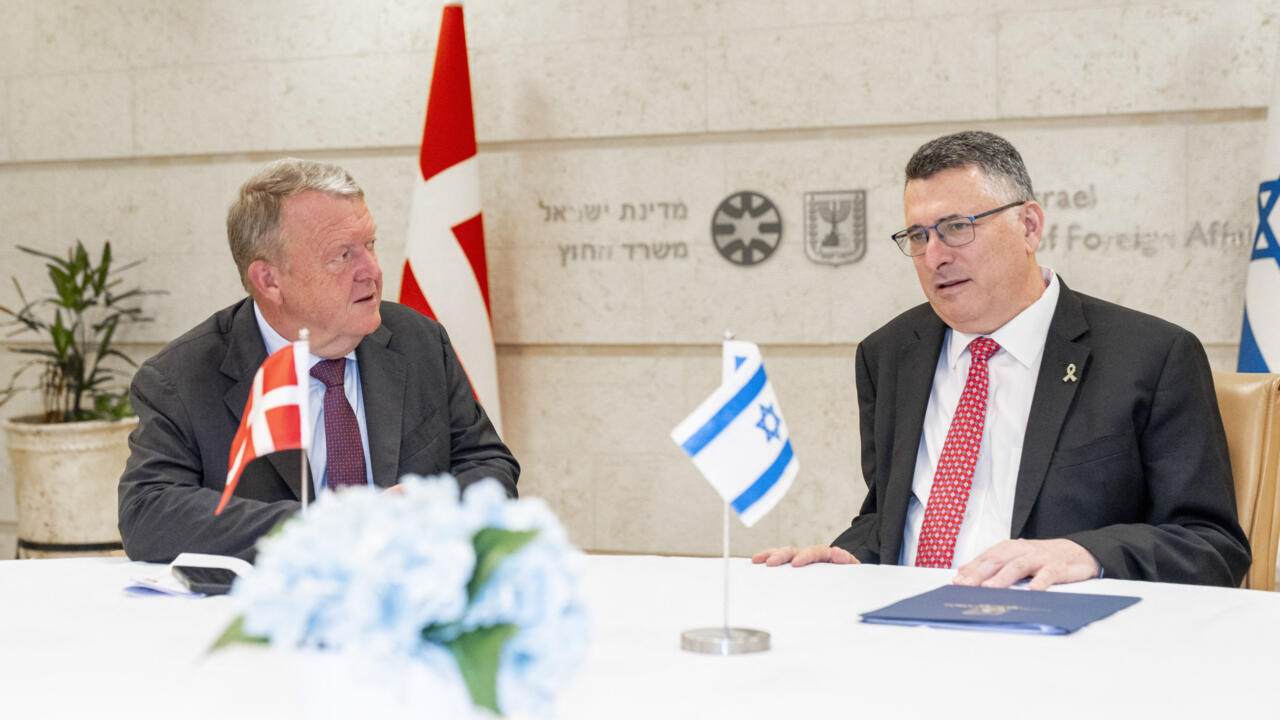
Denmark's Foreign Minister Lars Loekke Rasmussen (L) and Israel's Foreign Minister Gideon Saar have taken seat for talks as they meet in Jerusalem, Israel, on September 7, 2025. © Ida Marie Odgaard, AFP


Israel’s foreign minister branded a recent international push to recognise Palestinian statehood a “mistake” on Sunday and warned it could trigger an unspecified unilateral response, after reports that Israel plans to annex parts of the occupied West Bank.

Several countries, including France and Britain, have pledged to recognise a Palestinian state on the sidelines of the 80th UN General Assembly this month.

Franco-Israeli relations have been particularly strained since French President Emmanuel Macron announced his country’s plans and co-hosted with Saudi Arabia a conference on the two-state solution at the UN in July.

British Prime Minister Keir Starmer last month said the UK would follow suit in recognising a Palestinian state if Israel failed to agree to a truce in the Gaza war, triggered by Hamas’s attack on Israel in October 2023.

“States like France and the UK that pushed the so-called recognition had made a tremendous mistake,” Israeli Foreign Minister Gideon Saar said at a joint press conference with his visiting Danish counterpart Lars Lokke Rasmussen.

Western powers denounce Israel’s settlement plan dividing future Palestinian state

01:33


Following through on the plans would make it “harder to get to the peace”, he added.

“It will destabilise the region. It will push Israel also to have unilateral decisions.”

Saar’s remarks come after Israel approved a slew of new West Bank settlements, including a major project just east of Jerusalem known as E1, which the international community has warned threatens the viability of a future Palestinian state.

All Israeli settlements in the occupied Palestinian territory are considered illegal under international law.

Israel’s far-right Finance Minister Bezalel Smotrich has said the E1 project intends to “bury the idea of a Palestinian state”.

Read moreIsrael approves major settlement project that would divide West Bank

On Wednesday, he said annexing large parts of the West Bank would “take the idea of dividing our tiny land and establishing a terrorist state at its centre off the agenda once and for all”.

Even as the war in Gaza rages, violence has also rocked the West Bank.

Since Hamas’s attack on Israel on October 7, 2023, at least 973 Palestinians, including militants, have been killed by Israeli forces or settlers, according to figures from the Palestinian health ministry in Ramallah.

During the same period, at least 36 Israelis, including soldiers, have been killed in Palestinian attacks or during Israeli military operations, according to official Israeli figures.

(FRANCE 24 with AFP)
UK police make nearly 900 arrests at Palestine Action demo in London

London (AFP) – A total of 890 people were arrested in London during a protest this weekend in support of the banned group Palestine Action, the capital's Metropolitan Police said Sunday. But supporters say the ban is an unwarranted curb on free speech and the right to protest.


Issued on: 07/09/2025 - RFI

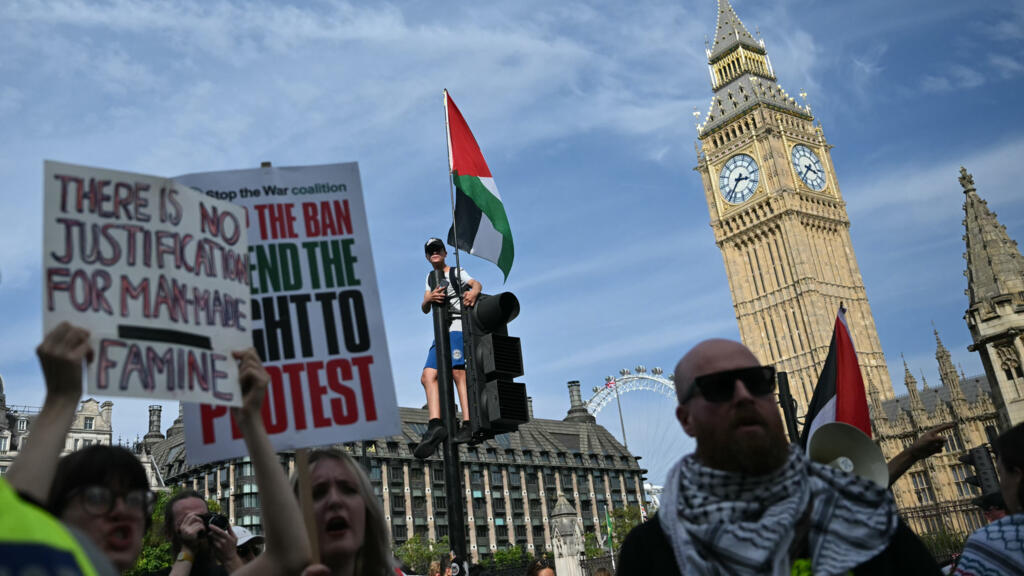
An estimated 1,500 people attended the protest
 © JUSTIN TALLIS / AFP

The force said 857 people had been arrested under anti-terror laws for supporting a proscribed group during Saturday's demonstration, with an additional 33 arrested for other offences including assaults on police officers.

"We have a duty to enforce the law without fear or favour. If you advertise that you are intending to commit a crime, we have no option but to respond accordingly," deputy assistant commissioner Claire Smart said in a statement.

The government in July proscribed Palestine Action under the UK's Terrorism Act of 2000 following several acts of vandalism, including against two planes at a Royal Air Force base, which caused an estimated £7 million (€8 million) in damage.

Critics, including the United Nations, have condemned the ban as legal overreach and a threat to free speech, but ministers insist that people are still able to attend pro-Palestinian marches.

"The contrast between this demonstration and the other protests we policed yesterday, including the Palestine Coalition march attended by around 20,000 people, was stark," added Smart.

"You can express your support for a cause without committing an offence under the Terrorism Act or descending into violence and disorder, and many thousands of people do that in London every week."
Serious concerns

Palestine Action has won approval from the High Court to challenge the ban, a ruling the government is seeking to overturn. The case is ongoing, with a hearing scheduled for 25 September.

The UN human rights chief has criticised the British government’s stance, saying the new law "misuses the gravity and impact of terrorism".

The decision to designate Palestine Action as a terrorist group "raises serious concerns that counterterrorism laws are being applied to conduct that is not terrorist in nature, and risks hindering the legitimate exercise of fundamental freedoms across the UK", Volker Türk warned.


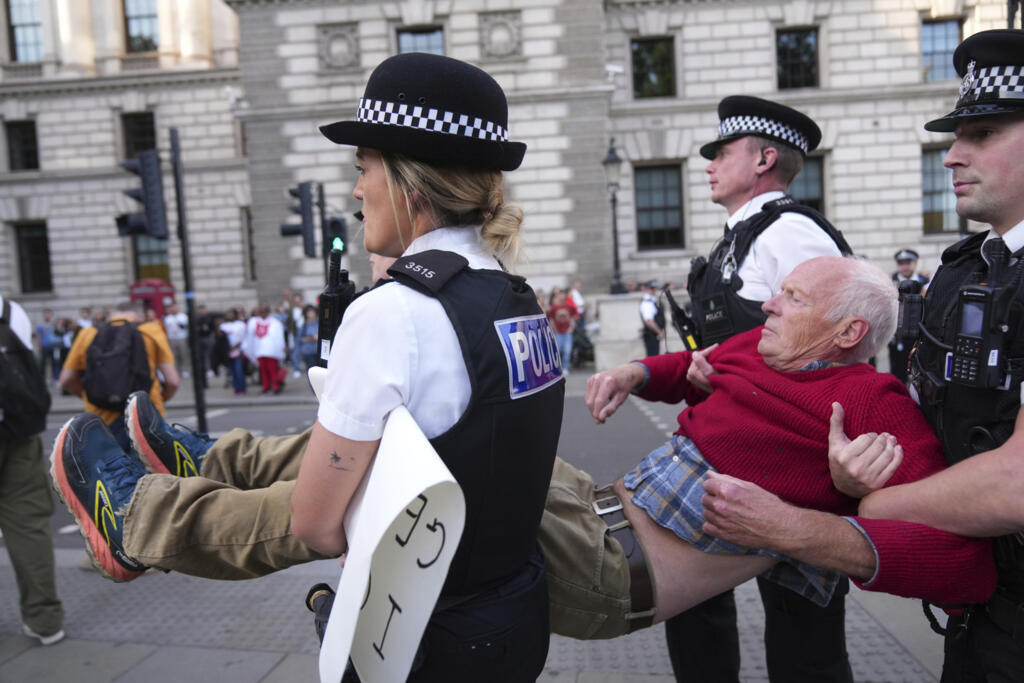
Police officers carry a protester during a protest to support Palestine Action in London, Saturday, 6 September, 2025. © Joanna Chan / AP

Police officers assaulted


An estimated 1,500 took part in the Palestine Action protest outside parliament, with some holding placards that read: "I oppose genocide. I support Palestine Action."

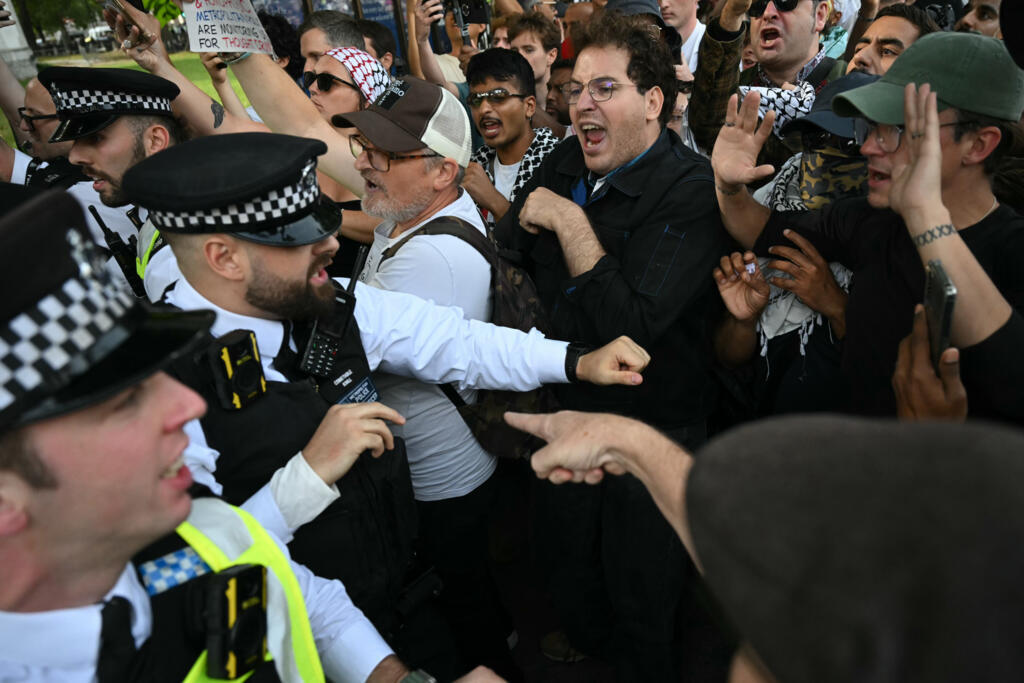
Of the 33 people arrested for non-terror offences, 17 were for "intolerable" assaults on police officers, the force said.

The organisers of the protest, the campaign group Defend Our Juries (DOJ), said the "Lift the Ban" rally had been "the picture of peaceful protest".

Many of those detained for showing support for Palestine Action appeared to be older people.

Most face six months in prison if convicted but organisers of the rallies could be sentenced to up to 14 years if found guilty.

Five members of Defend our Juries were arrested earlier this week ahead of the protest.

Ex-interior minister Yvette Cooper, who oversaw the ban, has accused Palestine Action of orchestrating "aggressive and intimidatory attacks against businesses, institutions and the public".


The police said 890 people were arrested © JUSTIN TALLIS / AFP


Cooper has also suggested that some supporters of Palestine Action "don't know the full nature of this organisation, because of court restrictions on reporting while serious prosecutions are under way".

The ban does seem to have increased support for what was previously a little-known organisation.

"It's so important for me that groups that are called terrorist groups must be terrorist groups," said 60-year-old greengrocer Philip Hughes, holding a placard that read, "I oppose genocide. I support Palestine Action".

"You cannot go and use terrorism laws to go and stop an organisation who object to something that you have done," he told AFP.

The rallies came as Israel launched new strikes on Gaza, with the stated aim of seizing Gaza City to defeat the militant group Hamas.

Several countries, including France and Belgium, have pledged to recognise a Palestinian state during the UN General Assembly later this month.

Britain said it would recognise a Palestinian state if Israel failed to agree to a truce in the Gaza war, triggered by Palestinian group Hamas's October 2023 attack.

Israel's retaliatory offensive has killed at least 64,368 Palestinians, most of them civilians, according to figures from the health ministry in Hamas-run Gaza that the United Nations considers reliable.

(with AFP)