It’s possible that I shall make an ass of myself. But in that case one can always get out of it with a little dialectic. I have, of course, so worded my proposition as to be right either way (K.Marx, Letter to F.Engels on the Indian Mutiny)
Tuesday, October 14, 2025
N.S. creates portal aimed at making it easier for mining companies to track permits
Nova Scotia's provincial flag flies on a flagpole in Ottawa
THE CANADIAN PRESS/Adrian Wyld
HALIFAX — Nova Scotia has created a new online portal it says would eventually allow mining companies to apply for and track their permit applications online.
The provincial government says this move is part of its efforts to make it easier for mining firms to do business in Nova Scotia.
The first phase of the project will allow firms to check the status of their applications for licences and permits.
An official with the department says it has spent $60,000 on this initial phase.
The province says it anticipates the portal will become a “one-stop shop” for mining companies.
Natural Resources Minister Tory Rushton says simplifying the permitting process in this way will give industry better access to important information about their projects.
The creation of the portal “further shows that Nova Scotia is open for responsible resource development,” Rushton says.
This report by The Canadian Press was first published Oct. 14, 2025.
The Canadian Press
Bell to resell fibre internet in Western Canada as it announces three-year outlook
TORONTO — BCE Inc. will begin offering fibre internet services in Western Canada using its rivals’ networks under rules it has long opposed, as it seeks to grow its customer base and push for more bundled subscriptions.
That was among a list of plans shared by the parent company of Bell Canada during its investor day event on Tuesday. It included a three-year growth outlook focused on fibre, wireless, AI-powered enterprise solutions and digital media.
Bell announced a number of initiatives on those fronts, such as the introduction of new tiered wireless plans, a new backup option in spring 2026 that will maintain service during power outages, the eventual elimination of TV set-top boxes, and expanded streaming bundles in certain markets.
In the near term, Bell said it will launch home internet service next month in B.C. and Alberta, where rivals Telus Corp. and Rogers Communications Inc. dominate the market.
To do so, it will resell fibre internet using Telus’ network under the CRTC’s wholesale fibre framework. The contentious rules — having been the source of disagreement between the telecoms for the past two years — allow the Big 3 to resell internet on each other’s existing fibre networks, in exchange for a fee, as long as they do so outside their core serving regions.
Blaik Kirby, BCE’s group president of consumer and small business, said Bell will resell fibre internet in the west “where necessary for the highest value customers.” He said the offering will initially be available to Bell’s mobile customers in those provinces, with special pricing for bundled packages.
“Being more competitive in the west will significantly improve customer consideration of Bell, particularly for wireless,” Kirby said in a presentation.
“With a strong focus on cross-sell and mobility and internet content bundling nationally, we expect this to translate to continued strong retail market share and overall better network penetration in the east and gains in wireless performance in the west.”
The plan marks a shift for Bell, which has argued vehemently against the wholesale framework.
Bell has previously said the policy discourages major providers from investing in their own infrastructure and slashed $500 million in investment plans this year in response to the CRTC’s direction. In August, Industry Minister Mélanie Joly said Ottawa wouldn’t overturn the CRTC’s wholesale policy following a federal review.
“Imagine spending billions of dollars in order to generate a return, and then a regulator tells you that you have to give that asset to somebody else so they can make a return instead,” Bell president and CEO Mirko Bibic said at the time.
Bibic struck a different tone Tuesday when asked by an analyst about the company’s latest view on the regulatory environment.
“Our position on the policy was quite clear and remains quite clear, but the decision’s been made, so the job of this team here is to execute against that background,” he said.
“We continue to urge the commission to make sure that those who build networks in Canada are fully and appropriately compensated for the full cost of building those networks and maintaining them.”
Telus, the lone major telecom that supported the policy, began offering fibre internet service through Bell’s network in Ontario and Quebec close to a year ago under the wholesale regime and has said it plans to extend its offerings to the Atlantic provinces too. This past summer, Telus announced it would spend $2 billion to deliver broadband services across Ontario and Quebec over the next five years, attributing the move to the CRTC’s wholesale fibre framework.
Bibic said Tuesday that fibre “will continue to fuel our growth for years to come,” calling it the “best broadband technology available, bar none.”
He said Bell is continuing to phase out copper “in a smart and balanced way.”
That’s one of the ways BCE also hopes to find $1.5 billion in total cost savings by 2028 — around double its previous goal — through a “companywide transformation and continued focus on operational efficiencies.”
“We’ll save costs by upgrading to fibre, reselling salvaged copper and making the most of our real estate footprint,” said Bibic.
“Our systems have grown too complex over time as technologies evolved and as we’ve completed multiple acquisitions. But we’ve been simplifying to provide a smoother customer journey at lower cost. So, think: one billing system, one ordering platform and a unified customer profile.”
Kirby said the company would also streamline its brand portfolio, making Bell its only option for mobile and internet bundling. It will stop selling Virgin Plus internet and TV in Ontario in January, while maintaining Virgin and Lucky Mobile as discount options for stand-alone wireless services.
The company expects revenue growth at a compound annual growth rate of two to four per cent between this year and the end of 2028. It also anticipates paying approximately $5 billion in dividends to shareholders over the next three years.
BCE’s compound annual growth rate of its adjusted earnings before interest, taxes, depreciation and amortization is expected to be two to three per cent between this year and the end of 2028.
Analyst sentiment was positive in response to BCE’s outlook, with the implied revenue growth trajectories above forecast, according to RBC’s Drew McReynolds.
“Although the focus now shifts to execution ... across the many moving parts, we are encouraged by the sustained return-to-growth expectation and view the 2025-2028 outlook as achievable,” he said in a note.
Bibic also said BCE is bullish on its recent expansion of technology and artificial intelligence services.
In a series of announcements this year, Bell launched a portfolio of AI-powered enterprise solutions, including tech services brand Ateko, an AI compute project known as Bell AI Fabric, and cybersecurity brand Bell Cyber.
Bibic said Bell expects around $1.5 billion in revenue from those services over the next three years.
This report by The Canadian Press was first published Oct. 14, 2025.
CTV News, BNN Bloomberg and CP24 are owned by Bell Media, which is a division of BCE.
Beyond Meat shares drop below US$1 on investor concerns
A file photo a meatless burger patty called Beyond Burger made by Beyond Meat is displayed at a grocery store in Richmond, Va. (AP Photo/Steve Helber, File)
Beyond Meat’s shares were trading below US$1 Tuesday as investors fretted over the company’s plans to cut its debt by issuing more shares.
It was further bad news for the plant-based meat maker, which has been struggling with weak demand for its burgers, sausages, tenders and other products. Beyond Meat’s net revenue was down 15 per cent in the first six months of this year.
El Segundo, California-based Beyond Meat said Monday that most of the holders of its convertible notes had agreed to a plan to help the company reduce its debt load by $800 million and extend the time until that debt matures.
Under the plan, Beyond Meat exchanged debt due in 2027 for $202.5 million in debt maturing in 2030. The company also said it would issue up to 326 million shares of new stock. That rattled investors, since it will dilute the value of current shares.
Beyond Meat’s stock closed Monday at $1.04 per share. On Tuesday, Beyond Meat’s shares opened at 92 cents and were down 12 per cent in mid-day trading.
Nasdaq-listed companies must not let their stock drop below $1 for 30 consecutive days or they could eventually see the stock delisted. Beyond Meat’s shares are down 73 per cent from the start of this year.
Beyond Meat was the darling of the plant-based meat industry when it went public on the Nasdaq stock exchange in 2019. The company had attracted celebrity investors like Microsoft co-founder Bill Gates and actor Leonardo DiCaprio and had big plans to expand overseas.
But U.S. demand for its products never really took off. Consumers weren’t excited about the taste or the long list of ingredients, and inflation-related cost increases further hurt the company. Beyond Meat introduced a healthier version of its signature burgers in 2024, but that didn’t boost U.S. sales.
Demand has been higher in Europe, where McDonald’s sells Beyond Meat’s plant-based burgers and nuggets. But U.S. fast food chains have been reluctant to add Beyond Meat’s products to their menus. Beyond Meat also suspended its operations in China earlier this year due to poor sales.
During a conference call with investors in August, Beyond Meat founder and CEO Ethan Brown said the company planned to increasingly use “Beyond” as its primary brand and move beyond animal meat replicas and into other protein offerings.
Dee-ann Durbin, The Associated Press
Canadian Tire says recent breach of e-commerce database involved customer info
Canadian Tire says customer information like names, email addresses and in some cases incomplete credit card information was exposed in a data breach.
TORONTO — Canadian Tire Corp. Ltd. says it has identified a data breach involving personal information belonging to customers, which was stored in an e-commerce database.
The retailer says the breached information belongs to shoppers who had an e-commerce account with Canadian Tire or its other banners, SportChek, Mark’s/L’Équipeur and Party City.
The breached data included names, addresses, emails and birth years as well as encrypted passwords and in some cases, incomplete credit card numbers.
Canadian Tire says the full dates of birth for fewer than 150,000 account holders was also part of the breach.
The company says the information breached is not enough to access accounts and make purchases and the incident did not impact its ability to facilitate in-store transactions.
Canadian Tire says it has resolved the vulnerability it identified on Oct. 2 and is working with experts to enhance its security.
Federal Housing Minister Gregor Robertson makes an announcement in Toronto with Mayor Olivia Chow Tuesday October 14, 2025.
Federal Housing Minister Gregor Robertson says there are “active” discussions underway on the Liberal government’s promise to lower development charges and more news is expected in the coming weeks.
“We want to see that combination of infrastructure investment and reduced building costs with development charges, and stay tuned. We’ll have more on that in the weeks ahead,” Robertson said during an announcement alongside Mayor Olivia Chow in Toronto Tuesday.
He made the comment as the federal government announced it will provide $283 million to help the City of Toronto upgrade sewer infrastructure in the Black Creek area, allowing for the construction of some 63,000 new homes.
“Infrastructure for cities is a huge part of (building) cost. Development charges – certainly here in Toronto and Vancouver, my hometown – are very closely connected to that infrastructure cost,” Roberston said. “That’s part of why we’re investing as Canada in Downsview and these major infrastructure opportunities that unlock tens of thousands of housing units.”
During the federal election campaign, the Liberals promised to cut municipal development charges in half for multi-unit residential housing for five years. They said they would do it by funding some of the municipal infrastructure development charges normally support.
“We initially were looking at 50 per cent reduction in partnership with provinces and territories. We’re working through that process now across the country,” Robertson said. “Certainly you’ll see some forward movement here this fall – the budget is November 4 – and I’m anticipating some next steps related to the budget. We’re really focused on bringing the cost of building down, that’s the goal here.”
The Black Creek trunk sewer was built in the 1960s and now serves more than 350,000 residents, according to a news release. But officials say population growth has stretched its usage to capacity, capping home permits in the area.
Chow said the city has long known the sewer is a problem for the York-South Weston area and upgrading the infrastructure will allow more homes to be built and do a better job of mitigating against extreme weather.
“We’ve been talking about it for a long time, and finally today, this project will finally expand the capacity, start the construction, protect homes, schools and small businesses from the impact of extreme weather,” Chow said. “It will also keep our western waterfront beaches clean after major storms.”
The city will be contributing $425 million toward the sewer upgrade. No word on shelter money
Asked whether the federal government will put forward more cash to support Toronto’s shelter system, he said the federal government is already providing “an enormous investment in homelessness.”
Chow said recently that the city is facing a $107 million shortfall in providing shelter for asylum seekers and refugees on account of receiving less federal funding than expected.
Robinson said while he had nothing to add on shelter funding, he knows Chow has been in discussions with Immigration, Refugees and Citizenship Minister Lena Metlege Diab.
“My colleague, Minister Metlege Diab is focused on that issue, working with Mayor Chow,” Robinson said. “I know they’ve got an active dialog on that, so I’ll leave it to her to update on that front.”
Still, Robinson acknowledged “we’ve got work to do in the months ahead before the winter hits.”
Chinese ambassador to Canada Wang Di discusses the China-Canada trade relationship and the ongoing tariffs between the two nations.
Ontario Premier Doug Ford came out hard against the idea of Canada lifting its tariffs on Chinese electric vehicles (EVs) on Tuesday, voicing his disagreement with two western premiers who are calling on Ottawa to do so.
“(Saskatchewan Premier) Scott (Moe) called me up and said, ‘Hey, I’ve got to protect my province’. I get it. I get why (Manitoba Premier) Wab Kinew and Scott are saying ‘drop the tariffs,’” Ford said during a fireside chat at the Empire Club of Canada. “But I have to do the same thing.”
“I respect what they’re doing, but there’s no damn way we should drop tariffs on China, I’ll tell you that,” Ford said. “Absolutely not.”
Canada has had 100 per cent tariffs on all EVs imported from China since last October. It also has 25 per cent tariffs in place on Chinese steel and aluminum.
China has since levied tariffs of its own on Canadian agriculture, notably on canola products, with a 100 per cent tariff on Canadian canola oil and meal and a 75.8 per cent tariff on canola seed.
The decision by the previous Canadian government to tariff Chinese EVs followed the United States’ lead, and was framed as protecting domestic manufacturing and national security.
The prospect of a potential lifting of tariffs arose after China’s Ambassador to Canada Wang Di – in an exclusive interview with CTV Question Period on Sunday – told host Vassy Kapelos that China would remove its tariffs on Canadian agriculture — including on canola products — if Canada scrapped its levies on Chinese EVs.
The ambassador’s comments prompted some premiers, including Kinew and Moe, to call on Ottawa to drop the tariffs. Farmers in their provinces have been hit particularly hard by China’s levies on canola products.
Moe said this is “a clear signal of how Canada can act this week.” And, Kinew called this a “critical moment” in a letter to Prime Minister Mark Carney, posted on the social media platform X.
Ford said while he respects Kinew and Moe trying to protect the agriculture sector in their provinces, he has to think about the auto sector in his province.
Foreign Affairs Minister Anita Anand is set to visit China later this week and trade is expected to be a focal point amid recent tensions between the two countries.
The EV tariffs fall under the Department of Finance. In a statement to CTV News when asked about the ambassador’s comments, a spokesperson from Finance Minister Francois-Philippe Champagne’s office said, “Canada’s focus has always been protecting Canadian workers and key sectors, including our farmers, and defending our national interests in a rapidly changing global economy.”
“In fact, the prime minister has recently signalled his intent to meet with China’s president, at the appropriate time, to explore ways to stabilize and deepen our trade relationship,” the statement added. “Canada will always stand up for its workers and industries, and we’ll continue to act with determination and foresight to safeguard our long-term economic resilience.”
CTV News has also reached out to the Prime Minister’s Office for comment on the ambassador’s remarks, but has not received a response.
With files from CTV News’ Jeremie Charron and Stephanie Ha Spencer Van Dyk
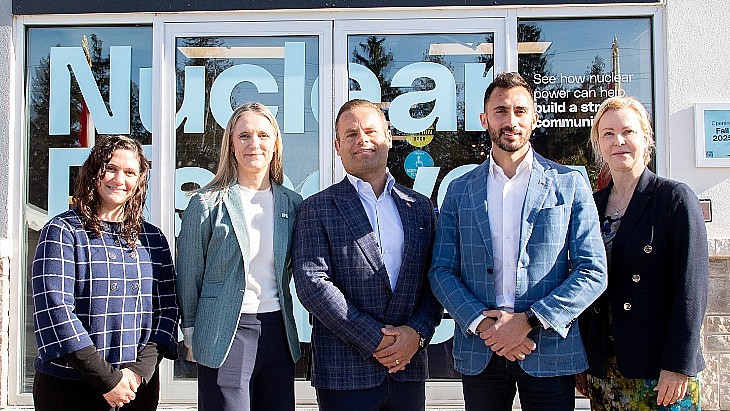
The new Port Hope Nuclear Discovery Centre will give visitors the opportunity to learn about nuclear power and energy demand, as well as Ontario Power Generation's proposed Wesleyville nuclear power project.
Minister Stephen Lecce at the Discovery Centre (Image: Stephen Lecce)
In January, the Ontario government formally asked Ontario Power Generation (OPG) to explore opportunities for new nuclear energy generation at the Wesleyville site, near Port Hope, following expressions of interest from the Municipality of Port Hope and the Williams Treaties First Nations.
The Discovery Centre, described by OPG as a new hub for learning, exploration, and community engagement related to potential new nuclear generation at the Wesleyville site, will serve as a venue for community members and Indigenous Nations to access up-to-date information, participate in activities, and share their feedback, the company said.
At an opening ceremony held on 10 October, Ontario Minister of Energy and Mines Stephen Lecce described the centre as a "significant step forward" for Ontario's clean energy future. "This nation-building project represents our sense of ambition and plan for self-reliance by creating 10,500 jobs and adding CAD235 billion to the Canadian economy. This project and new Centre will be the frontline for learning, jobs, and economic growth as we lead the largest nuclear expansion on the continent," he said.
New nuclear capacity - both small modular reactors and large-capacity plants - is a key part of the Energy for Generations strategy launched by Lecce in June, which aims to ensure Ontario - which already gets more than half of its electricity from nuclear plants - has the affordable, secure, reliable and clean energy it needs. The province is supporting the development and deployment of small modular reactor units at OPG's Darlington site, and pre-development work has already begun to site the first large-scale nuclear build in the province since 1993 at the existing Bruce nuclear site. This is in addition to the ongoing refurbishments of Ontario's existing nuclear power plants, extending their operating periods by a further 30-35 years each.
Lauritsen (second from left) and Lecce (second from right) pictured at the opening of the new centre (Image: Stephen Lecce)
The 1,300 acres (more than 5 square kilometres) Wesleyville site covers is located near existing transmission, road, and railway infrastructure, and is already zoned for new electricity generation. Early assessments by OPG have suggested the site could host up to 10,000 MW of new nuclear generation - which the company says would make it the largest nuclear generating station in the world. The site has been maintained by OPG for more than 50 years, specifically for the purpose of hosting new electricity generation.
According to information from OPG, Wesleyville was prioritised for site work over two other potential locations at Lambton and Nanticoke because the First Nations and the municipality have expressed interest in exploring nuclear generation development there, although discussions with the two other communities are still continuing.
Several years of work by OPG, in collaboration with the host community and Indigenous Nations, will be needed before it can be determined whether the Wesleyville site can proceed to support new power generation. Regulatory and licensing actions would then need to be completed before site preparations could begin. According to OPG, it could take around 15 years before the first generating unit is connected to the grid: a potential development roadmap shared by the company envisages units entering service in the early to mid 2040s.
"OPG is committed to building strong, collaborative partnerships with both the local community and the Michi Saagiig First Nations," said Kim Lauritsen, SVP Enterprise Strategy & Growth. "The Nuclear Discovery Centre will act as a welcoming space for information-sharing, meaningful participation, and open dialogue that guides the project's progress."
Contracts awarded for Sellafield infrastructure work
Sellafield Ltd has awarded contracts worth a total of GBP2.9 billion (USD3.8 billion) to a partnership comprising Morgan Sindall Infrastructure, Costain Limited, and HOCHTIEF (UK) Construction Ltd for non-nuclear infrastructure works at the Sellafield site in Cumbria, northwest England.
The Sellafield site (Image: Costain)
The three companies will be part of a long-term arrangement called the Infrastructure Delivery Partnership (IDP), which is a key element of Sellafield Ltd's Overarching Acquisition Strategy and replaces the existing Infrastructure Strategic Alliance. The IDP will deliver projects and tasks to support essential services at Sellafield like electricity distribution, water, road and rail networks, bridges, foundations and security installations.
The contracts will be for an initial nine years with an option for a further six years, through to 2040. The work is split into three lots: electrical distribution partner; utilities partner; and civils partner. Under the contracts, the companies will complete detailed design plus all procurement, installation, construction, commissioning, and handover activities that form part of project delivery. The companies will also develop a joint sustainability plan to ensure a joined-up approach which is aligned to local priorities and delivers maximum impact and return on investment.
As the Electrical Distribution Partner, Morgan Sindall Infrastructure will lead on maintaining and upgrading the Sellafield site's electrical network. It will be supported in this by its design partners Baker Hicks and GHD.
Costain has been confirmed as Utilities Delivery Partner, worth up to GBP1 billion to the company. Costain’s responsibilities will involve refurbishing and replacing a variety of on-site and off-site utility distribution systems and services, including steam, water supply, water treatment, compressed gas and other essential utilities serving Sellafield.
HOCHTIEF (UK) Construction will deliver a major nuclear and civil works framework contract worth up to GBP595 million as part of the IDP. The contract involves design, engineering, and delivery of civil infrastructure works in support of nuclear operations and decommissioning in collaboration with Sellafield and its partners.
The Sellafield site - which houses more than 1000 buildings - is the largest nuclear complex in Western Europe. Sellafield's nuclear facilities include those connected with the Magnox reprocessing programme, the Sellafield mixed-oxide fuel plant, the Thermal Oxide Reprocessing Plant, and nuclear waste treatment plants. It is also home to redundant facilities from defence work in the 1950s, which included making plutonium for nuclear weapons.
"Our job at Sellafield is to create a clean and safe environment for future generations," said James Riddick, Sellafield Ltd chief supply chain officer. "That means safely, securely, and cost-effectively dealing with the legacy of historic operations on our site. To deliver this we need robust and reliable infrastructure to support our nuclear decommissioning and waste management activities. IDP is a long-term strategic partnership designed to provide that support while unlocking investment and opportunities for our local community and delivering sustainable value for money to the taxpayer."
Costain CEO Alex Vaughan added: "This new contract award with Sellafield, with whom we have been working with since 2005, is testament to our strategy of developing long-term relationships with tier 1 customers, building strong and collaborative partnerships, broadening our service offering, and maintaining consistency and continuity of workflows. This long-term award further demonstrates our integral position in the UK's civil nuclear energy market. The government is clear that the safe and responsible decommissioning of the UK's nuclear legacy is a critical part of creating a sustainable future and delivering local and national economic prosperity. As one of Sellafield's trusted partners we will deliver safe, high-quality utilities upgrades in a complex working environment."
"We have been delivering in West Cumbria for over 15 years, and we are delighted to build on this further with the award of the Infrastructure Delivery Partnership," said Morgan Sindall Infrastructure Managing Director Simon Smith. "This long-term programme is not only nationally significant for Sellafield and its decommissioning programme, but we know first-hand the benefits to local communities and the region from an award of this nature. This award reflects the brilliant work our teams have delivered and continue to deliver."
Juan Santamaría Cases, CEO of HOCHTIEF said: "HOCHTIEF has an unbroken legacy in the nuclear sector since the 1950s and is a trusted partner in engineering and construction for some of the world's most critical nuclear programmes. Together with Sellafield and its delivery partners, we have secured this strategic, long-term partnership. The award builds on HOCHTIEF's expanding portfolio of long-term delivery contracts with globally significant clients across the nuclear and infrastructure sectors."
Romania’s Feldioara to deliver uranium dioxide to Argentina
Feldioara Uranium Concentrate Processing Plant, part of Nuclearelectrica, has won an international tender it says will see it supply the uranium dioxide to cover the needs of Argentina’s nuclear power plants for a year.
The Embalse CANDU is one of Argentina's three operable nuclear power reactors (Image: Nucleoelectrica)
Cosmin Ghita, General Manager of Nuclearelectrica, said: "The fact that we are delivering nuclear raw materials for the first time to another country that owns and operates pressurised heavy water reactors is a source of pride and achievement for Nuclearelectrica and its subsidiary, FPCU Feldioara, but also for the development of the Romanian fuel cycle, given that Nuclearelectrica took over the processing assets in December 2022, operationalised Feldioara in 2023 and continues to modernise. Such an agreement is a confirmation of the quality of the raw material processed at Feldioara."
Gelu Agafiel Maracineanu, General Manager of FPCU Feldioara, said that as well as supplying the raw material needed to manufacture fuel assemblies at Pitesti for units 1 and 2 at Cernavoda Nuclear Power plant, "we have set out to develop, expand our supply network and offer the nuclear fuel cycle in Romania a new dimension: the international one".
Background
In 2021 Romania's competition commission cleared Nuclearelectrica's purchase of the uranium processing line assets of Compania Nationala a Uraniului (CNU) at Feldioara - a state company that manages Romania's uranium resources and reserves, historically mining uranium at Crucea-Botusana and refining it at Feldioara before supplying it to the Pitesti facility where it was used in the manufacture of fuel bundles for Nuclearelectrica's CANDU reactors at the Cernavoda power plant.
Nuclearelectrica said that its aim was to "preserve and develop the integrated Romanian nuclear fuel cycle, the integrated production capacities … ensuring the production of fuel assemblies and the optimal operation of FCN Pitești and CNE Cernavodă, at an advantageous transaction cost".
It says that two years after work undertaken to become operational "Nuclearelectrica, through its subsidiary FPCU Feldioara, will deliver uranium dioxide internationally, a variable of development and diversification that will add value and financial benefits".
Cernavoda is the only nuclear power plant in Romania and consists of two 650 MWe Candu reactors. Unit 1 went into commercial operation in 1996 and unit 2 in 2007. Candu units are pressurised heavy water reactors designed to operate for 30 years, with a further 30 years available subject to refurbishment. Argentina has three operable nuclear power reactors, all pressurised
Fuel loading under way at second Zhangzhou unit
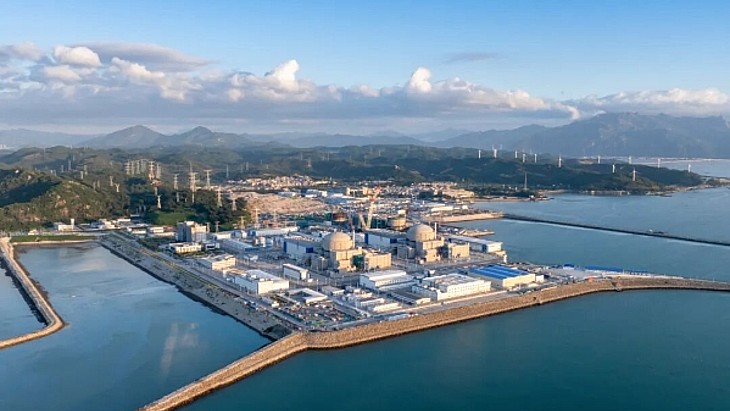
The process of loading 177 fuel assemblies into the core of unit 2 at China's Zhangzhou nuclear power plant has begun, China National Nuclear Corporation announced. The unit is the second of four Hualong One (HPR1000) reactors under construction at the site.
Fuel being loaded into Zhangzhou 2 (Image: CNNC)
China's Ministry of Ecology and Environment issued an operating licence for Zhangzhou Nuclear Power Unit 2 on 11 October. Dong Baotong, Vice Minister of Ecology and Environment and Director of the National Nuclear Safety Administration, issued a licence to Zhangzhou Energy, and Zhang Kai, member of the Party Group and Deputy General Manager of China National Nuclear Corporation (CNNC), attended the event. At 16:13 on the same day, workers began to load the first reactor nuclear fuel into Zhangzhou 2.
CNNC said the milestone marked "that the unit has entered the stage of commissioning the main system with nuclear power, laying a solid foundation for the subsequent unit criticality and grid-connected power generation". It noted the unit was scheduled to be put into operation in the fourth quarter of 2025.
China's Ministry of Ecology and Environment issued construction licences for Zhangzhou units 1 and 2 on 9 October 2019 to CNNC-Guodian Zhangzhou Energy Company, the owner of the Zhangzhou nuclear power project, which was created by CNNC (51%) and China Guodian Corporation (49%) in 2011. Construction of unit 1 began one week after the issuance of the construction licence, with that of unit 2 starting in September 2020.
Zhangzhou units 1 and 2 (Image: CNNC)
In September 2022, China's State Council approved the construction of two further Hualong One units as Phase II of the Zhangzhou plant. First concrete for the nuclear island of unit 3 was poured in February last year, with that for unit 4 following in September.
Six Hualong One units are planned for the Zhangzhou site, in China's Fujian province.heavy water reactors, including a CANDU unit at Embalse.
South Korea’s embrace of SMRs as a pillar of nuclear policy
South Korea’s nuclear energy strategy is undergoing a transformative shift, with small modular reactors (SMRs) at the forefront. Spearheaded by Korea Hydro & Nuclear Power (KHNP), these compact reactors are increasingly being seen as central to the nation's energy policy, offering flexibility, scalability, and ultimately a pathway to carbon neutrality.
KHNP’s SMR vision
KHNP's commitment to SMRs is exemplified by the development of the SMART100 (System-integrated Modular Advanced Reactor 100), which received standard design approval as was reported by World Nuclear News in September 2024, from the Nuclear Safety and Security Commission. This advanced version of the original SMART design is a 330 MWt pressurised water reactor capable of generating up to 100 MWe and is designed for both electricity generation and thermal applications such as seawater desalination.
The SMART100's design integrates advanced safety features and modular construction techniques, enabling rapid deployment and reduced capital costs – key in aiding many of the multi-island nations across Asia where a number of hitherto nuclear free nations are known to be considering the future deployment of SMRs.
The i-SMR meanwhile, another KHNP initiative, is tailored to replace ageing coal-fired power plants, aligning with South Korea's carbon neutrality goals. It is designed to be economically competitive with even the largest of nuclear power plants while offering operational flexibility. Essentially a compact nuclear power plant designed to generate up to 300 MW of electricity per unit, unlike traditional large-scale reactors, SMRs are built using modular, factory-fabricated components, allowing for much faster construction, lower upfront costs, and a greater degree of flexibility in deployment. The i-SMR's modular design - with the ‘i’ standing for intelligent – also allows for incremental deployment, making it adaptable to varying energy demands and facilitating integration with renewable energy sources, KHNP says.
Domestic policy alignment
In 2022, the South Korean government unveiled a new energy policy aiming to maintain nuclear energy's share in the national energy mix at a minimum of 30% by 2030. This policy, subsequent political shifts in South Korea notwithstanding, also set the ambitious goal of exporting 10 nuclear power plants by 2030, underscoring the strategic importance of nuclear energy in national policy. KHNP's SMR initiatives to date have seemingly fallen in line with this policy, positioning the company as a key player in both domestic energy security and international nuclear energy markets, NUCNET has said - and as was evident at the late-August Korea Energy Show in Busan, South Korea with KHNP establishing a commanding presence in the form of one of the most prominent booths at the event.
Scalability
One of the most compelling features of SMRs is their flexibility. Unlike traditional large-scale reactors, SMRs – as the i-SMR demonstrates - can be deployed incrementally, allowing for a modular approach to energy generation. This scalability means that power plants can be expanded as demand grows, reducing the risk of overcapacity and enabling more precise alignment with energy needs.
Moreover, SMRs can operate in tandem with renewable energy sources, providing a more stable and reliable power supply that complements the intermittent nature of solar at nighttime, and wind energy whenever a region is becalmed. This synergy is crucial for successfully achieving carbon neutrality and enhancing energy resilience.
KHNP's SMR expertise is thus gaining international recognition, and earlier in 2025, KHNP and Oklo, a US-based nuclear technology company, announced plans to collaborate on the standard design development and licensing strategy for Oklo's planned Aurora powerhouse. This partnership aims to advance the deployment of advanced nuclear technologies in the United States at a time significant moves in nuclear power proliferation are being seen.
KHNP is also exploring SMR options with Thailand's EGAT, focusing at present, sources indicate, on technical information exchange and personnel training to one day facilitate the introduction of SMRs in Thailand; one of multiple Southeast Asian nations looking to move into SMR use in the years ahead.
These collaborations not only bolster South Korea's position in the global nuclear energy tech market but also contribute to the international proliferation of safe and sustainable nuclear technologies with Korea seen as a figurehead in that regard.
Other domestic applications
KHNP's vision, however, extends beyond traditional power generation. The company is already understood to be developing the Smart Net Zero City (SSNC) concept according to its own site, in the process integrating SMRs with renewable energy sources to create self-sustaining, carbon-neutral urban environments. The SSNC model when up and running aims to reduce energy production costs by up to 30% compared to conventional cities, offering a blueprint for future urban development in line with sustainability goals.
Challenges ahead
Despite the promising deals made and concepts in place, the deployment of SMRs still faces a number of challenges. Regulatory hurdles in some areas, public acceptance, and the need for skilled workforce development are critical factors that could – and will – in the end influence the pace of SMR adoption. As such, addressing these challenges requires transparent and effective communication, more than adequate safety protocols, and comprehensive training programs to ensure the successful integration of SMRs into societies across Korea and Asia.
To this end, KHNP's focus on SMRs represents an alignment of technological innovation with national energy policy objectives that can be put in place anywhere across Asia, and by embracing SMRs in South Korea, the nation is not only enhancing its own domestic energy security but is also positioning itself as a leader in the regional and global nuclear energy market to allow others to follow suit.
Saudi Aramco CEO Declares the Energy Transition a Failure as Oil Demand Surges
By Irina Slav - Oct 14, 2025The energy transition has failed to live up to its promise, and now the pendulum is swinging back to traditional energy, according to a statement by the chief executive of Saudi Aramco, quoted by Zawya.
Speaking at the Energy Intelligence Forum in the UK, Amin Nasser said that “Much of the promised progress has not been delivered, with many unintended consequences. Thankfully, it is finally shifting the narrative in three key ways.”
The shift concerns, first, the fact that alternative energy sources have added to rather than replaced oil and gas, and second, that “every major forecaster is revising scenarios, with oil and gas locked in for decades”, Nasser said, saying he hoped the outlook for long-term oil and gas investment had changed for the better.
The third aspect of the shift in the energy narrative, per Nasser, is the growing number of political U-turns in energy as politicians acknowledge that the realities of the energy transition are very different from the theory.
Global energy demand has grown by 40 million barrels of oil equivalent daily over the last ten years, Nasser also said at the gathering. Some 66% of this new demand has been covered by oil, gas, and coal, he noted, as quoted by Zawya. To date, total global primary energy consumption translates into 340 million barrels of oil equivalent, of which 80% comes from hydrocarbons - despite some $11 trillion being spent on alternative sources of energy such as wind and solar.
“This is not a phase-down of hydrocarbons, let alone a phase-out,” Nasser noted, with data consistently showing that even coal demand is on the rise despite efforts to curb it in many parts of the world. Aramco’s top executive also issued a warning about energy demand, which is currently experiencing a growth spurt driven by AI.
“By 2030, the entire data centre ecosystem could be consuming up to four times more electricity than the entire global battery EV fleet,” Nasser said.
By Irina Slav for Oilprice.com
Why Lithium-ion Batteries Still Dominate the Tech World
Despite their widespread use, many aspects of lithium-ion battery design have been based on trial and error, with a limited understanding of the underlying physical and chemical processes.
A recent MIT study has identified coupled ion-electron transfer as the governing process for lithium-ion intercalation during charging, a discovery that could lead to the development of faster-charging and more controlled battery models.
While lithium-ion batteries face environmental and geopolitical challenges, and alternative technologies are emerging, scientific advancements like those at MIT are helping to maintain lithium's dominance due to its energy density and performance.
Lithium-ion batteries power the world. You probably have at least one – but probably two or three – within reach right this very moment. Lithium-ion batteries power a whopping 70 percent of all rechargeable devices, ranging in size and scope from electric vehicles to smartphones to utility-scale energy storage. But while the technology has become nearly ubiquitous in our daily lives, there is still a lot that we still don’t understand about the physical and chemical processes that power lithium-ion batteries.
Until now, many aspects of lithium-ion battery design have been arrived at through trial and error. Researchers have tweaked electrodes and electrolytes and taken note of which configurations produce increased energy, power, charge speed, and battery life, and used these discoveries to lead design processes without fully understanding the science behind them.
While we understand on a basic level what happens when a lithium-ion battery recharges, there is a lot about the reaction that remains unknown. The reaction itself is relatively simple, and can take place in a liquid solution or a solid electrode. Either way, lithium ions start in electrolyte form and then “intercalate” or insert themselves into the solution or the electrode, as the case may be, while the battery is discharging. When charging, the ions de-intercalate and return to the electrolyte. This process repeats itself thousands of times over the lifespan of a battery.
“The amount of power that the battery can generate, and how quickly it can charge, depend on how fast this reaction happens,” says MIT News in an article published earlier this month. “However, little is known about the exact mechanism of this reaction, or the factors that control its rate.”
But a new MIT study is trying to change that by observing rates of intercalation in varying battery types and meticulously documenting the specific conditions that facilitate these reactions. The scientists have found that the intercalation process that charges lithium-ion batteries is governed by yet another process – coupled ion-electron transfer. This means that an electron travels alongside the lithium-ion into the electrode. This finding could help scientists design better and faster charging battery models.
“What we hope is enabled by this work is to get the reactions to be faster and more controlled, which can speed up charging and discharging,” Martin Bazant, Chevron Professor of Chemical Engineering and a professor of mathematics at MIT, told MIT News. In combination with other work on lithium-ion batteries’ power and lifespan, these findings could lead to much more sophisticated battery design.
This breakthrough could potentially ensure that lithium-ion batteries maintain their dominance in the tech industry at a time when other technologies are quickly gaining ground. Lithium-ion batteries, while incredibly useful, are associated with a litany of negative externalities. Extraction and production of lithium is environmentally damaging and resource-intensive. It’s also geopolitically fraught, as China controls a huge portion of global lithium supply chains. Because of these downsides, investment has been increasing in research and development of alternative battery types, including proton batteries, sodium ion batteries, and quantum batteries.
But unseating lithium will be hard to do, especially with scientific advancements like those playing out at MIT. Lithium is just too useful to get rid of. The element is extremely energy-dense and performs well in cold weather, making it “indispensable for high-performance applications” according to EV World. As such, some of the most promising lithium-ion alternatives are still lithium-based, like lithium-iron and solid state batteries.
Ultimately, it’s likely that the green energy transition will rely on an all-of-the-above approach to battery design. As EV World sums up, “the future isn’t lithium or sodium—it’s both, deployed strategically across sectors…the result is a diversified, resilient battery economy.”


_98657.jpg)
_65986.jpg)
_25129.jpg)
(1)_18573.jpg)