Thursday, October 16, 2025


Kenya in talks with BOE to store gold it seeks to purchase
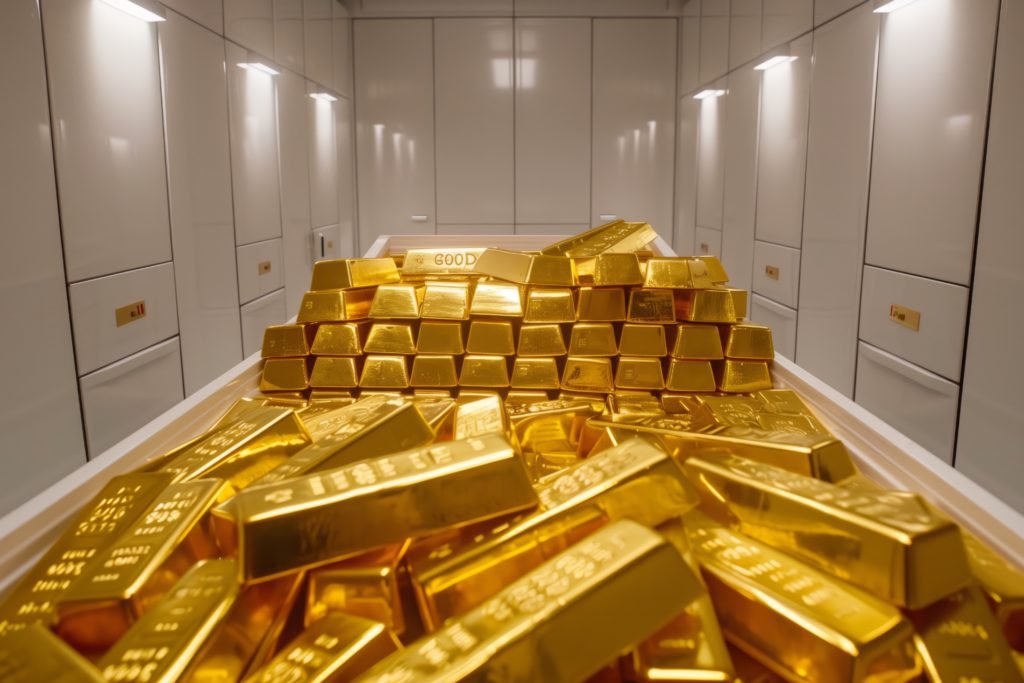
Stock image.

Kenya plans to buy gold to diversify its reserves and has held talks with the Bank of England on topics including bullion storage, the East African nation’s central bank governor said.

The country is among the latest looking to bulk up holdings of the precious metal that’s more than doubled in price over the past two years, with some investors viewing it as safer than the dollar. Others in the region including Zambia and Ghana are already building reserves, while Rwanda and Uganda plan to follow suit.

“We’ve talked to the Bank of England and other banks to see how we go about it — where it will be stored, those kind of things,” Central Bank of Kenya Governor Kamau Thugge said in an interview in Washington. “I’m hoping that we can do it as soon as is practical because we’re ready to move.”

Kenya’s plans to add gold “is not an intention to diversify away from dollars per se, but basically to diversify our foreign holdings,” he said.

Gold’s record run has benefitted from investors expecting further Federal Reserve interest-rate cuts, while rising debt levels in the developed world have also triggered concerns. The surging prices that have topped $4,200 an ounce prompted some caution from Thugge.

“Those who got in early have made a killing,” he said. “Those who get in late can also be killed. So it’s important that we hold a level where, should there be a reversal in the price of gold, it doesn’t really have a huge impact on our holdings.”

The central bank head declined to say how much of Kenya’s $11 billion foreign reserves it could convert to gold.

Yuan reserves

Kenya’s record reserves now also mean the country is “able to face any debt-service payments that may come our way,” Thugge said. The government is rearranging its liabilities to push out maturities of dollar bonds, albeit at higher interest rates.

Kenya has also swapped dollar-denominated loans from China into yuan, which it says will help lower the interest rate on the debt. The central bank already holds yuan reserves, and “there’s been no conversation of increasing yuan at the expense of dollar holdings,” Thugge said.

The nation’s economic stability has improved since last year, with inflation cooling and the shilling having stabilized in value since August 2024. The government aims to cement those gains with a new financed program with the International Monetary Fund, Thugge said.

Kenya could access a “normal” level of additional financing from the Washington-based lender, having already tapped about 536% of its quota, he said. It could still access about $472 million, according to calculations by Bloomberg.

Yet Thugge cautioned that a new deal must avoid aggressive reforms, taking lessons from a previous program that pushed fiscal consolidation but stoked deadly social unrest in 2024.

“Sometimes it’s better to be ambitious, but not overly ambitious so that an adjustment that you want can be done in two years instead of one,” he said. “If you miss the one year because of social unrest, then possibly you will not be able to achieve it in the second or third year, because nobody wants to go back to where there’s social unrest.”

(By Jennifer Zabasajja and Matthew Hill)

EU’s Ukraine funding plan could further boost central bank gold buying, analysts say
Stock image.

The European Commission’s proposal to tap frozen Russian state assets for financial aid to Ukraine is rattling some central banks, which could further accelerate gold purchases for storage outside Western jurisdictions, analysts say.

The Commission’s plan would allow EU governments to use up to 185 billion euros ($214 billion) of Russian sovereign assets currently frozen in Europe without confiscating them – a red line for many countries and the European Central Bank.

China and some developing countries have already been diversifying their reserves away from Western currencies and government debt into gold after sanctions linked to the Ukraine war froze $300 billion of Russia’s foreign currency reserves.

“The EU can mince words as much as they like, but it does not change the reality,” veteran gold industry analyst and former bullion dealer Ross Norman said.

“The effect is the same – Russia has been denied access to its own money. Central bankers around the world know this and they are acting accordingly. And that is acquiring more gold.”

Central banks keep buying

Central banks’ annual net gold purchases since 2022 have been more than double the average of the previous five years, consultancy Metals Focus says, topping 1,000 tons a year. That helped push prices to record highs above $4,000 an ounce this month.

Metals Focus forecasts further purchases of a net 900 tons this year.

With stronger buying and bullion’s price growth, gold overtook the euro as the second biggest reserve asset in 2024 after the US dollar, an ECB report showed in June. The value of central banks’ bullion holdings is now higher than that of US Treasury bonds.

China – which has never officially commented on its reasons for buying gold – has been adding gold to its reserves for 11 months. Poland has been buying gold as well, but for a different reason, with war in neighbouring Ukraine a risk to its economy.

“Because gold is no one’s liability and nobody’s debt, its appeal is shining for central banks worried about the political security of their reserves,” said Adrian Ash, head of research at online marketplace BullionVault.

If the EU does tap frozen Russian state assets to help provide financial aid to Ukraine, it is “very possible” central bank gold purchases will accelerate, he said.

Repatriating gold reserves

Measures taken against Russia also sparked an increase in the number of countries repatriating gold reserves away from Western hubs, with 68% of respondents in a 2023 Invesco survey keeping gold reserves at home compared to 50% in 2020.

“The EU can only use frozen Russian assets because it has access to them, i.e. they are booked/stored with banks outside of Russia,” said Julius Baer analyst Carsten Menke.

“Emerging market central banks could opt to store the assets at home,” Menke said.

In Germany, US President Donald Trump’s confrontations with allies over trade and his criticism of the Federal Reserve revived some calls for gold repatriation this year. The Bundesbank has said the New York Fed remains a trustworthy partner for its gold storage.

($1 = 0.8654 euros)

(By Polina Devitt and Ashitha Shivaprasad; Editing by Pratima Desai, Veronica Brown and Jan Harvey)

 

Botswana’s ODC sets first contract diamond sales for November

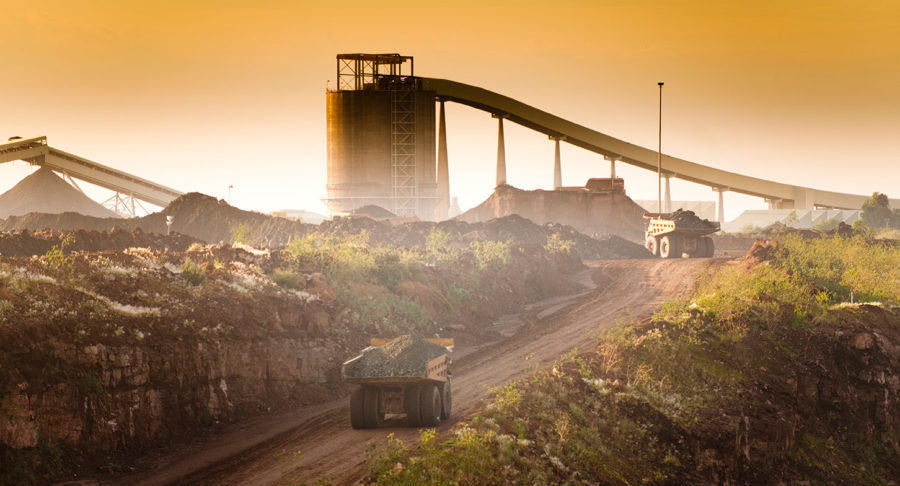
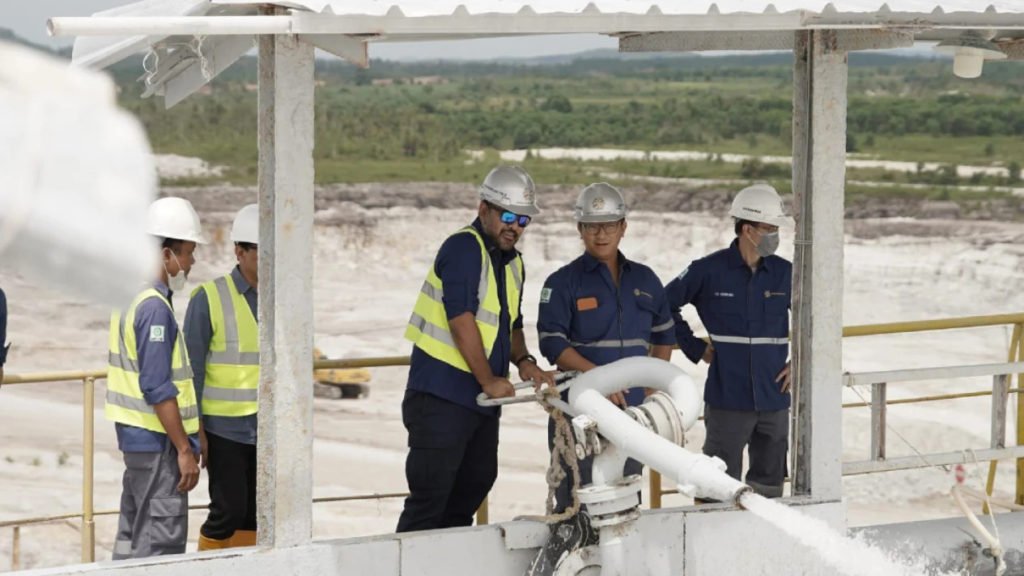
Debswana is a major contributor to the national economy of Botswana. (Image courtesy of Debswana.)

Botswana’s state-owned Okavango Diamond Company will start selling diamonds to contracted buyers next month, as it diversifies its sales channels under the government’s new deal with De Beers, managing director Mmetla Masire said on Wednesday.

ODC’s allocation in the production of Debswana – the government’s 50-50 joint venture with De Beers – was increased to 30% from 25% in the new ten-year deal signed in February, with its share to reach 40% at the end of the agreement.

A clause in the previous deal, which prevented ODC from directly competing with De Beers on contract sales, has fallen away.

“We are targeting our first sales through this channel in November, with our first two being pilot sales before we go full scale on the third,” Masire told a mining conference.

Struggling diamond market

Masire told Reuters in May that ODC aimed to sell about 40% of its supply through contract sales, with the balance to be sold through auctions, strategic partners and Botswana-based companies.

The global diamond market is in a protracted downturn, with demand declining amid a supply glut and the rising popularity of lab-grown diamonds weighing on rough diamond prices.

ODC in 2023 temporarily halted its rough stone sales as part of an industry-wide drive to reduce the glut. The company held an auction on September 25 but decided to hold on to its gems, citing “conditions that could have resulted in a significant negative impact on the market”.

ODC’s revenues in 2024 were about 60% of the previous year due to the downturn, according to Masire, but the company was seeing some stability in the market. Its last three auctions delivered small positive margins, up from the double-digit losses at the same time last year.

Botswana gets 30% of its revenues and 75% of its foreign exchange revenues from diamonds and the current market downturn saw the economy contract by 3% in 2024, with the IMF forecasting a further 1% contraction this year.

(By Brian Benza; Editing by Nelson Banya and Mark Potter)

Indonesian tin miner eyes mining asset in Canada


Indonesia’s PT Arsari Tambang, a tin mining company controlled by the family of President Prabowo Subianto, is in discussions to acquire a mining asset in Canada, its chief executive told reporters on Wednesday.

The company will take advantage of an economic partnership deal Indonesia signed with Canada last month to invest in a mining asset there, Aryo Djojohadikusumo said.

Djojohadikusumo, who is Prabowo’s nephew, declined to give further details of the acquisition target, citing ongoing negotiations, but said the acquisition value is around 7 trillion rupiah ($422.71 million) and the company aims to close the transaction in June 2026.

With the recent trade deal, Canada is aiming to double its trade with Southeast Asia’s biggest economy in six years.

Arsari Tambang works mainly in the Bangka Belitung region, the tin hub of the world’s second largest producer of the metal. Among Arsari’s subsidiaries is Mitra Stania Prima, which has 3,811 metric tons of smelting capacity as of 2024.

($1 = 16,560.0000 rupiah)

(By Fransiska Nangoy; Editing by Kirsten Donovan)


Explosive attacks hit bridges in Ecuador days after illegal mining crackdown

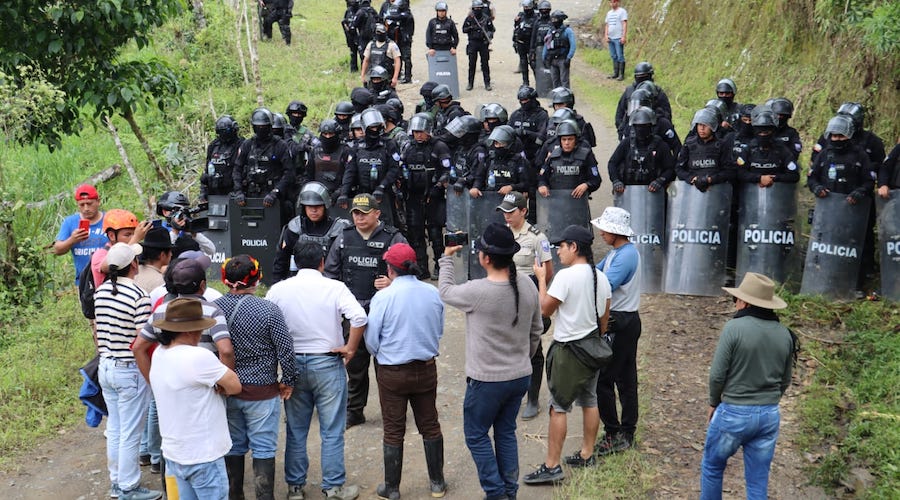
Confrontation between police and anti-mining protesters in Palo Quemado, Ecuador, on March 20, 2024. (Image by Conaie, Twitter/X.)

Explosive devices detonated on two bridges in Ecuador on routes between the coast and mountains early on Wednesday, in what the country’s interior minister described as acts of retaliation after a major military operation against illegal miners.

“The line we are pursuing is one of retaliation for what we have been doing in Imbabura (province), in terms of controlling the strike and cracking down on illegal mining,” Interior Minister John Reimberg told a press briefing in the northern city of Otavalo.

No injuries were reported and no one has been arrested so far over the explosions.

Reimberg said authorities were pursuing the theory that a criminal group known as Los Lobos was behind the attack. Washington designated the group a terrorist organization following a meeting with Ecuador’s president last month.

One of the explosions damaged part of the base of a bridge, Reimberg added, while the other explosion only partly detonated. Infrastructure Minister Roberto Luque said on X that he believed the explosive attacks aimed to disrupt traffic.

The explosions follow a major military and airforce operation on Monday that destroyed several illegal mine entrances, which the army said were operated by organized crime groups, in an effort to hit one of their top sources of income.

Seven people were arrested in the operation. Reimberg said some of these belonged to a dissident Revolutionary Armed Forces of Colombia (FARC) group.

Diesel protests

Otavalo, near where the operation took place in Imbabura province, has been the scene of a series of protests organized since late September by CONAIE, Ecuador’s largest Indigenous organization, over President Daniel Noboa ending diesel subsidies by decree.

Noboa said the subsidized diesel was being diverted to illegal mining and smuggling operations. The province has been isolated since the protest began, though the government has sought to open up roads by sending aid convoys.

On Tuesday, clashes broke out in Otavalo between protesters and security forces. Indigenous groups reported that at least 50 were injured, while the government said 13 military officers had been injured by machetes and firecrackers.

Wednesday’s explosions occurred just hours after a car bomb went off outside a shopping mall in Ecuador’s largest city Guayaquil late on Tuesday, leaving one person dead and several more injured.

A second vehicle containing explosives was found nearby, but it did not detonate and was deactivated.

Last week, Noboa was traveling in a convoy in a rural town when his car was attacked by people throwing rocks. The government called it an assassination attempt and arrested five people on charges of terrorism. CONAIE denounced orchestrated police violence.

The five people were released soon after when a judge ruled their detention illegal.

Noboa spoke on Wednesday at an event in Guayaquil, where he said criminal groups were seeking to destabilize the government and prevent them from attending to Ecuadoreans’ needs.

“We cannot back down in the face of mafias, people who want to terrorize Ecuadorean families,” he said.

(By Alexandra Valencia and Aida Pelaez-Fernandez; Editing by Brendan O’Boyle, Sarah Morland and Nia Williams)


G-7 set to discuss joint response to China curbs on rare earths

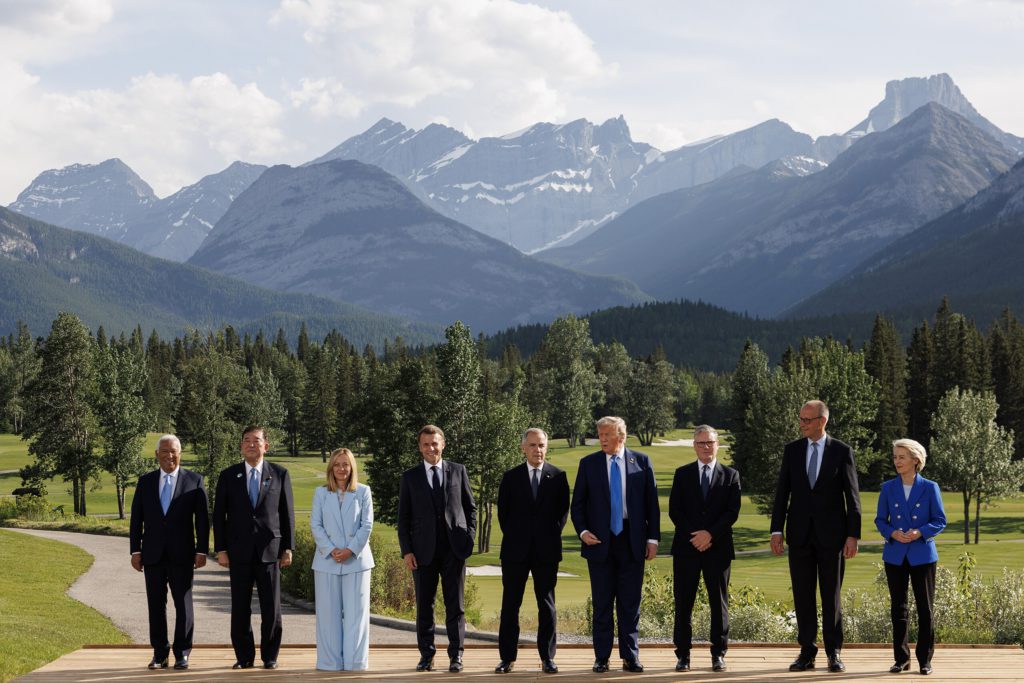
Leaders at the G7 Summit in Canada earlier this year. Credit: Number 10, Wikimedia Commons, under licence CC BY 2.0.

Finance chiefs from the Group of Seven industrial nations will consider a joint response to discourage China’s planned move to control the global supply of rare earths, officials said on Wednesday.

Germany Finance Minister Lars Klingbeil told reporters that the G-7 gathering later today will include a discussion of a common approach to address China’s actions with targeted measures, while cautioning against taking any steps that backfire on their economies.

Treasury Secretary Scott Bessent indicated the US would seek wider support beyond the G-7 — which also includes Canada, Japan, France, Italy and the UK — noting that finance ministers from around the world are visiting the US capital for the annual meetings of the International Monetary Fund and World Bank this week.

“We’re going to be speaking with our European allies, with Australia, with Canada, with India and the Asian democracies,” Bessent said at a CNBC-hosted forum in Washington. “We’re going to have a fulsome, group response to this, because bureaucrats in China cannot manage the supply chain or the manufacturing process for the rest of the world.”

China’s new rules, announced last week, require overseas firms to obtain Chinese government approval before exporting products containing even trace amounts of certain rare earths that originated in China.

That came as a surprise to US officials who thought they had agreed, as part of a tariff truce negotiated over several rounds, that China’s critical minerals should be allowed to flow to companies globally with minimal restrictions.

The Treasury chief also said that as far as he’s aware, President Donald Trump “is a go” on meeting President Xi Jinping later this month in South Korea. Bessent said there’s a “very good chance” that he heads out to Asia before Trump and meets with his Chinese counterpart, Vice Premier He Lifeng.

The latest spat between the world’s two largest economies has rattled markets in recent days. US stocks only partly recovered this week from a plunge Friday after Trump threatened massive tariffs on Chinese goods in response to China’s rare earth curbs.

Bessent also said the tariff truce could be extended if China postpones its rare earth restrictions. Since earlier this year, the US and China have agreed to 90-day truces on import duties of as high as 145%, with the next deadline looming in November.

Asia trip

Bessent said he expected trade announcements being made during Trump’s Asia tour. The president is expected to attend a summit with Association of Southeast Asian Nations in Malaysia before going on to Japan and South Korea, which will be hosting the annual Asia Pacific Economic Cooperation leaders meeting.

The US is “about to finish up” negotiations with South Korea, Bessent added. Those talks have lately revolved around the contours of a giant investment program. US-Canada talks are “back on track,” Bessent also said. He also indicated progress with India.

Bessent dismissed the notion that a slide in the stock market would force the Trump administration into a negotiating position with Beijing, saying that what spurs such talks is instead the economic interest of the nation. The US won’t negotiate with China “because the stock market is going down,” he said.

At the G-7 discussions Wednesday in Washington, officials will also discuss how to increase pressure on the Kremlin, particularly steps to expand the use of frozen Russian assets to help Ukraine, according to Germany’s Klingbeil.

(By Daniel Flatley and Kamil Kowalcze)


EU seeks US alliance to counter China rare earth crackdown

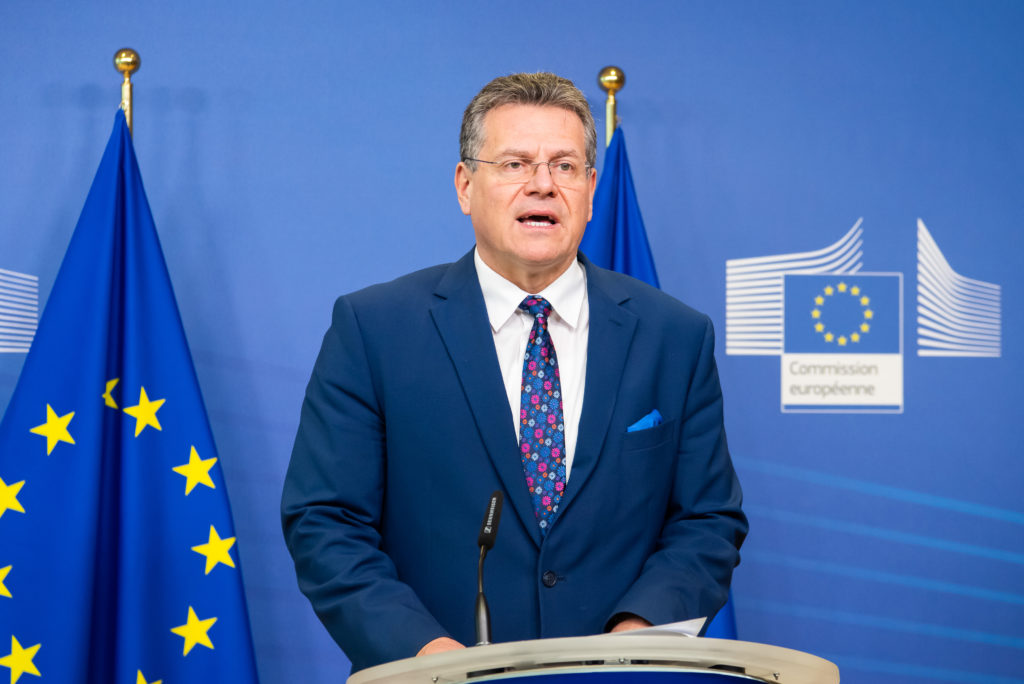
European Trade Commissioner Maroš Šefčovič. Image source: European Commission, Wikimedia Commons, under licence CC BY 4.0.

The European Union is seeking to coordinate with the United States and other G7 partners a response to tighter Chinese controls on the export of rare earth minerals, trade ministers and officials from the bloc said on Tuesday.

China, the world’s largest rare earth producer, dramatically expanded controls last week, adding new elements, refining technology and extra scrutiny for semiconductor users ahead of planned talks between Presidents Donald Trump and Xi Jinping.


European Trade Commissioner Maros Sefcovic called the measures unjustified and said EU ministers meeting in Denmark to discuss trade issues described them as a “critical concern”.

Previous Chinese controls announced in April caused shortages around the world, such as for carmakers, before a series of deals with Europe and the US eased the supply crunch.

Sefcovic said G7 finance ministers were likely to discuss options on Wednesday and added he had discussed the issue with US Commerce Secretary Howard Lutnick.

“We brainstormed yesterday that it would be advisable after this first discussion to have a G7 video call pretty soon,” he said before the EU ministers’ meeting.

Sefcovic said he was also likely to speak to his Chinese counterpart early next week.

Danish Foreign Minister Lars Rasmussen said the EU needed a united and “tough” response and to flex its muscles as “the world’s biggest trading bloc”.

“But we also need to be realistic. This is actually an area of common interest with our friends in the US. If we stick together we can much better pressure China to act in a fair way,” he said.

Trump’s immediate response was to threaten China with 100% tariffs, sparking a Wall Street sell-off.

Rasmussen did not favour tariffs, advocating instead frank and open discussions with Beijing.

Sefcovic also said that coordination with G7 partners could take the form of seeking to diversify supply, such as advancing joint projects to extract or process critical minerals.

“Of course these projects take time, but with this signal we got from China it’s clear we have to focus on accelerating these processes as much as possible,” he said.

(By Philip Blenkinsop; Editing by Susan Fenton)


BHP eyes revival of long-closed copper mines in Arizona

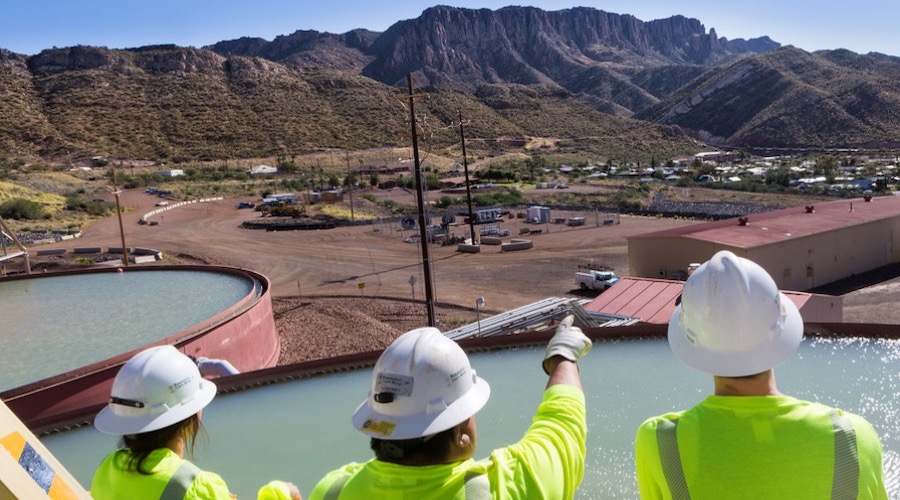
Resolution copper project in Arizona. (Image courtesy of Rio Tinto via Flickr.)

BHP (ASX: BHP), the world’s largest miner, is considering reopening four long-closed copper mines in Arizona, the centre of the copper industry in the United States.

Chief executive officer Mike Henry said that policy changes introduced by president Donald Trump encouraged BHP to expand its exploration efforts and review dormant assets in the state.

The potential restart would focus on the Globe–Miami region, where BHP also intends to reprocess tailings from the shuttered operations. Among the sites is the Magma mine, acquired through BHP’s 1996 purchase of Magma Copper. The mine was later shut down, with its surface area converted into the base for the Resolution joint venture with Rio Tinto (ASX: RIO).

Henry credited the renewed push to what he described as a “breathtaking level of ambition and urgency” in the US drive to secure supplies of critical minerals and reduce its reliance on China.

“The more supportive attitude towards mining and the urgency behind getting mining up and going, is a very welcome shift,” Henry told the Financial Times. “The sector has never been more in the spotlight.”

The state’s most significant copper project remains Resolution Copper, held by BHP and Rio Tinto. The $2-billion development has been stalled for more than two decades while awaiting court rulings and final permits. Once operational, it could produce up to 1 billion pounds of copper a year, enough to meet roughly 25% of US demand.

Rio Tinto, which holds a 55% stake in Resolution, remains confident that Trump’s administration will grant the necessary approvals to move the project forward.

Demand to soar

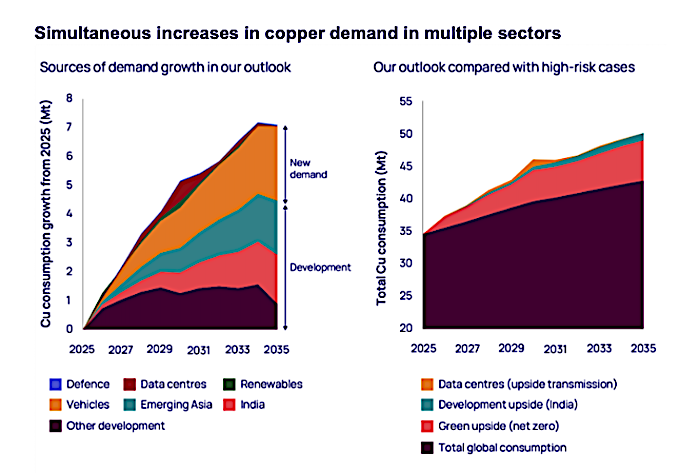
Henry’s comments come as copper demand is forecast to surge 24% by 2035, rising 8.2 million tonnes per annum (Mtpa) to 42.7 Mtpa, according to Wood Mackenzie. The consultancy’s new Horizons report warns that several powerful disruptors could amplify both demand and price volatility beyond expectations.

Among these disruptors, data centres represent the most unpredictable variable in copper demand forecasting. Beyond AI-driven demand, the broader energy transition is fundamentally reshaping copper consumption patterns. India and Southeast Asia are emerging as key growth engines, with their rapid industrialization expected to add 3.3 Mtpa of demand by 2035.

A fourth disruptor lies in shifting geopolitical priorities. Europe’s decision to raise defence spending to 3.5% of gross domestic product (GDP) in response to Russia’s invasion of Ukraine adds a modest direct copper demand of 25,000 to 40,000 tonnes per year over the next decade. However, the broader impact will be felt through infrastructure resilience and modernization.

Together, these factors could add an extra 3 Mtpa, or about 40% of total copper demand growth, by 2035, Wood Mackenzie says.


Japan, Spain and South Korea warn over unsustainable copper processing fees

Stock image.

Japan, Spain and South Korea issued a rare joint statement on Wednesday expressing deep concerns over tumbling copper treatment and refining charges (TC/RCs), warning both smelters and miners cannot develop sustainably under current conditions.

Copper smelters worldwide are grappling with falling processing fees and shrinking margins amid tight concentrate supply and expanding smelting capacity in China. In June, some Chinese smelters agreed to process copper for Chilean miner Antofagasta at no charge.

“We are deeply concerned that this deterioration in TC/RCs is prompting a reassessment of copper smelting operations worldwide, with several companies already indicating intentions to scale down or withdraw from copper concentrate smelting,” the three countries’ industry ministries said after an online meeting.

TC/RCs, a key source of revenue for smelters, are fees paid by miners when they sell concentrate, or semi-processed ore, to be refined into metal. But in some spot deals this year, TC/RCs have turned negative, forcing smelters to pay miners to provide smelting services.

The ministries said the current market environment prevents copper smelting from developing sustainably alongside mining in resource-producing countries and warned that growing dependence on specific countries is undesirable for both resource-producing and smelting countries.

“We hope TC/RCs will return to sustainable levels for copper concentrate trading,” they said, adding they will continue engaging with relevant countries and stakeholders to establish a resilient and sustainable copper supply chain.

Naoki Kobayashi, deputy director of the mineral resources department at Japan’s industry ministry, said the three countries — all importers of copper concentrate with domestic smelting operations — wanted to raise the issue during the metals industry gathering LME Week in London.

Japan’s major copper smelters, JX Advanced Metals and Mitsubishi Materials, have said they plan to scale back copper concentrate processing as declining fees erode margins.

(By Yuka Obayashi; Editing by Sharon Singleton)


Supply problems may force Freeport Indonesia to halt Manyar smelter

Freeport’s Indonesia copper smelter. (File image.)

Freeport Indonesia may be forced to suspend operations at its Manyar smelter at the end of October due to a lack of copper concentrate following a mud-flow incident at its Grasberg mine, media outlet Kontan reported on Tuesday, citing an energy ministry official.

Freeport Indonesia did not immediately respond to a request for comment.

Tri Winarno, an official at the country’s mining ministry, estimated that copper concentrate supplies from Grasberg would only be sufficient until the end of this month, Kontan reported.

“(Freeport) will face a lack of supply by the end of October. Temporarily halted,” Tri told reporters.

The mud-flow disaster had killed seven workers and operations at the Grasberg mine have been halted for nearly a month.

Grasberg may not return to its pre-accident operating rates until at least 2027, the company had said.

The $3.7 billion Manyar smelter only resumed operations in May after a fire broke out in October last year, damaging the plant.

(By Bernadette Christina and Ananda Teresia; Editing by John Mair and David Stanway)


Top 50 mining companies surge to new record near $2 trillion valuation


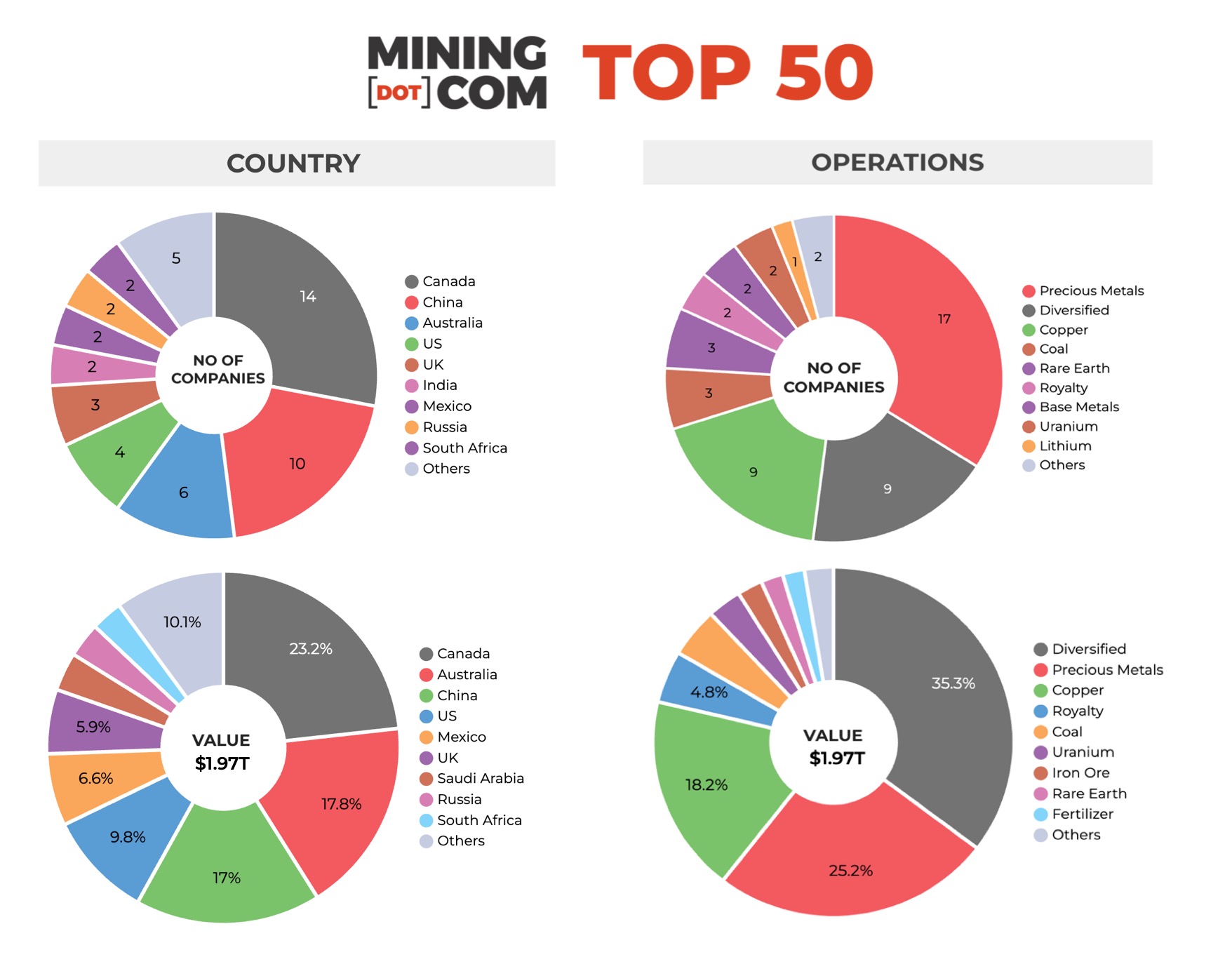
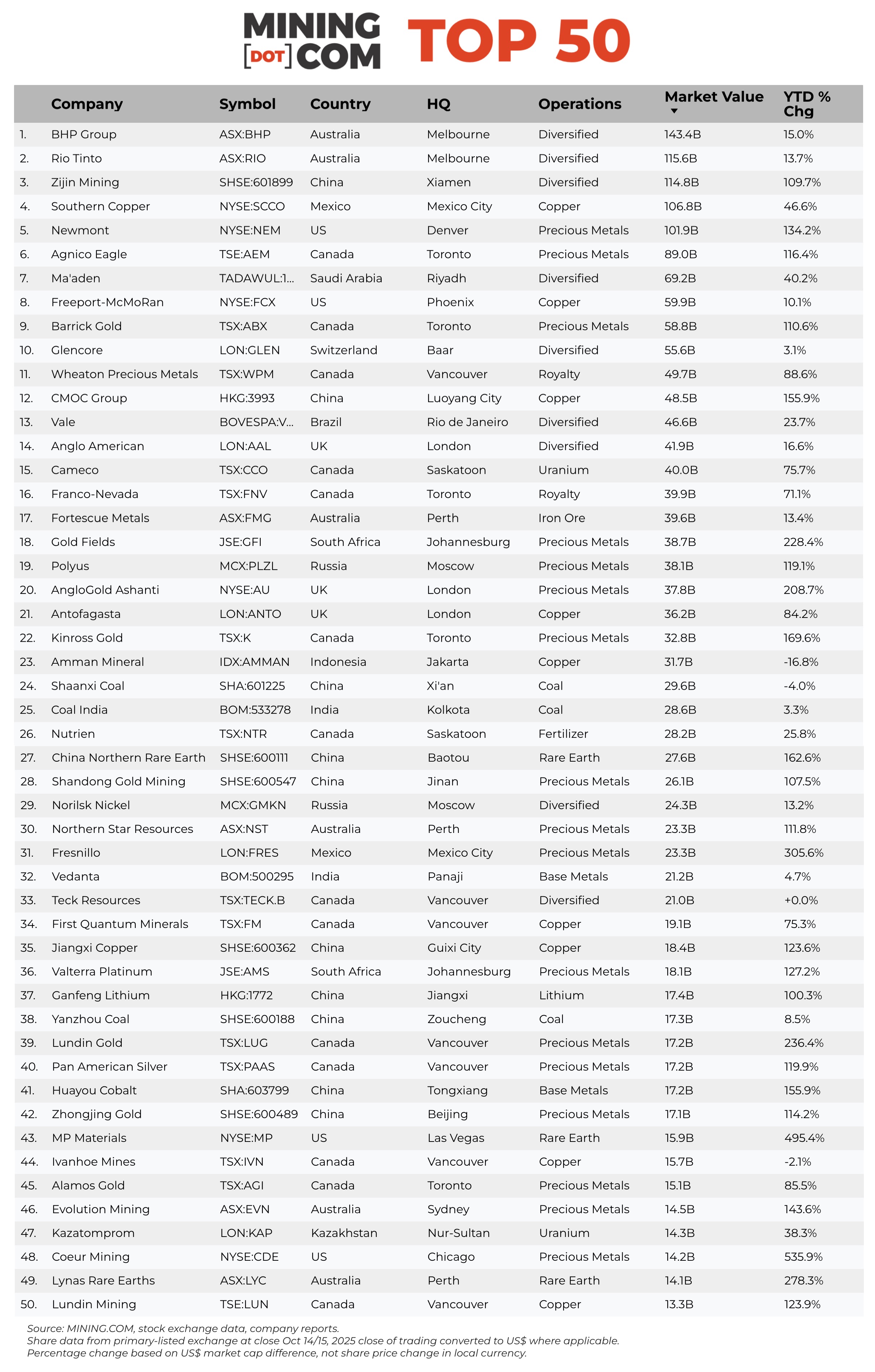
At the end of the third quarter the MINING.COM TOP 50* ranking of the world’s most valuable miners had a combined market capitalization of just under $1.97 trillion, up nearly $700 billion so far in 2025 with most of the gains accumulated in the third quarter. 

The total stock market valuation of the world’s biggest mining companies has finally surpassed the previous record high reached more than three years ago and in the process transformed the ranking of the upper echelons. 

Trends in the global mining industry that have been documented in these pages for more than a decade have finally broken through to the mainstream with critical minerals suddenly on everybody’s lips – from the US president down to the proverbial taxi driver sharing stock picks.

The weakness in the greenback played a part in the blowout quarter – the ranking is based on a company’s market capitalization in local currency on its primary exchange and then converted to USD where applicable. 

Rampant precious metals prices, including the thoroughly revived platinum group metals, can take much of the credit, although amid the general buoyancy the 60-plus percentage gains in PGM prices were not enough to see producers re-enter the ranking.

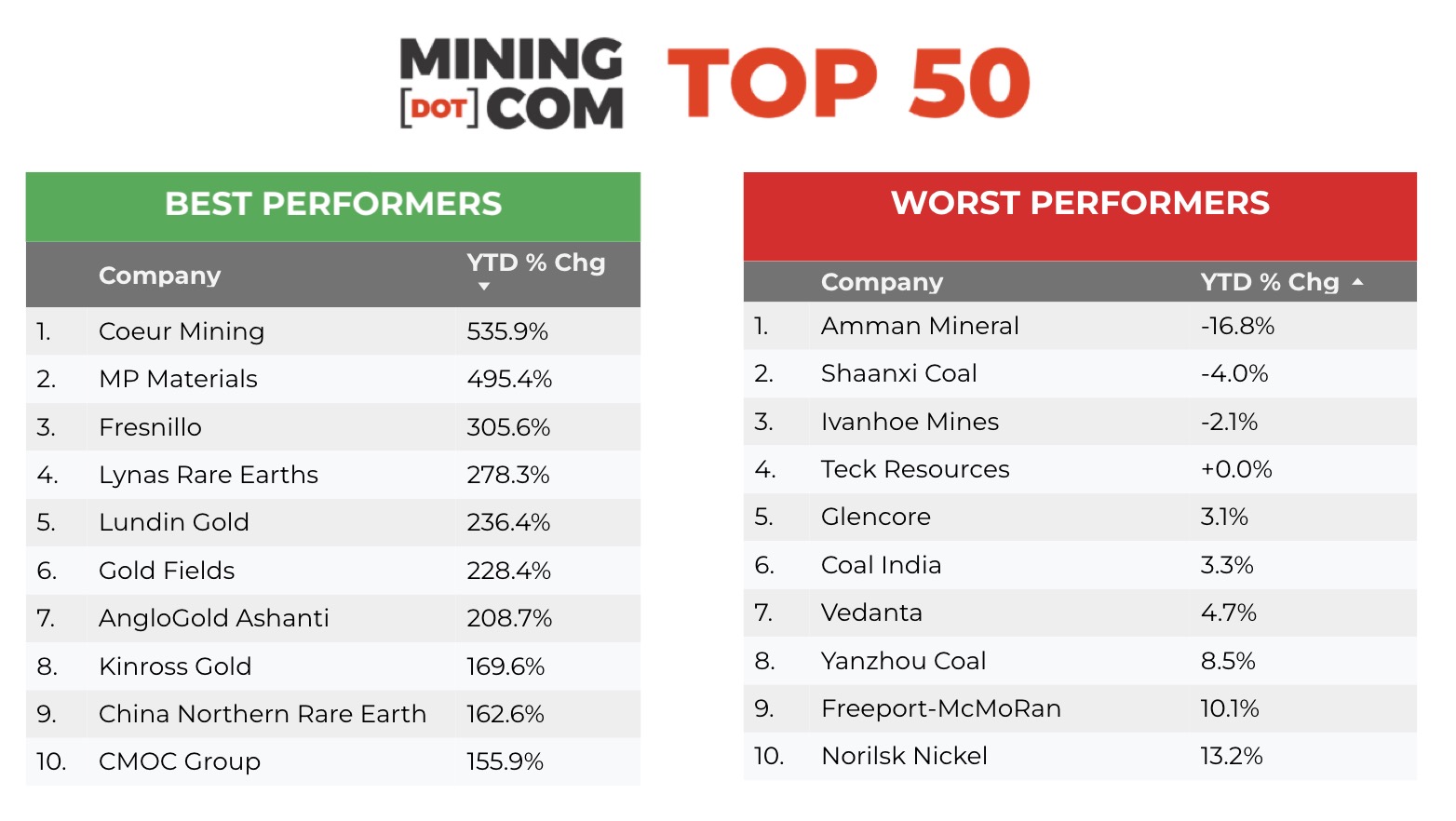
The best performing list shines with gold and silver counters, including an eye-popping six-fold increase for erstwhile minnows like Coeur Mining (which timed its acquisition of Mexican silver mines to perfection) and a 305% jump for Fresnillo, the London-listed silver miner controlled by Mexico’s Peñoles.

Apart from gold and silver, rare earths have been the standout sector. Squeaking in at no. 49 after soaring by 280%, Perth’s Lynas Rare Earth joins Las Vegas-based MP Materials, which rocketed up the charts in Q2 after a groundbreaking deal with the Pentagon. 

MP Materials is now up nearly 500% and China Northern Rare Earth, the only rare earth stock to ever feature in the top 50, in sympathy is up 160% since the start of the year. 

Changes in the top tier dominated by diversified giants and gold and copper specialists have also seen a thorough reshuffle. 

The global mining industry is trying to consolidate to attract more large-scale investors to the sector but so far the results have been mixed at best. 

Since inception, the MINING.COM TOP 50 was headed by two firms  – BHP and Rio Tinto – the only miners with consistent market capitalizations above $100 billion (with a wobble here and there).  Now there are five firms with the distinction and likely more to come. 

Attempted combinations by the two Melbourne-based companies (including of the two of them in 2008) have gone nowhere.  BHP’s failure to buy Anglo American last year saw the company pivot to organic copper growth with up to $10B being spent on Escondida alone, the world’s largest copper mine (for now).  

The chances of Rio Tinto’s off-again on-again love affair with Glencore being consummated, looks slim and new CEO Simon Trott’s restructuring looks more like preparation for spin-offs than company level M&A, particularly after the head-scratching Arcadium Lithium buy.  The now 20-year old Alcan deal probably also still haunts boardrooms in Melbourne.

While BHP still has a clear lead of nearly $30 billion to the nearest competitor, Rio Tinto was for a few trading sessions this week pushed from its usual slot by Chinese champion Zijin Mining.

The diversified giant gained 61% in value over the course of the third quarter alone and is now worth $114.8 billion compared to Rio’s $115.6 billion.  In a less frenzied environment Rio Tinto’s more than respectable 14% advance over three months would’ve drawn praise. Now it’s a laggard.

Xiamen-based Zijin, with a string of investments in gold, copper and more recently lithium made over the last few years became only the fourth company to top $100 billion in market value (Vale climbed above that level – briefly – in 2022). 

Southern Copper, the NYSE-listed mining arm of Grupo Mexico, also joined the rarified atmosphere of triple digits during the quarter thanks to a 38% jump in Q3.  

Like other copper majors Southern Copper is looking to add to its operating assets with an aggressive investment strategy north of $10 billion in Mexico alone, but the company’s valuation is probably now too rich for any would-be acquirer. 

Newmont also joined the triple digit club this week. Unlike its acquisitive peers, shortly after swallowing Australia’s Newcrest Mining at the end of 2023 for $17 billion, Newmont embarked on a multi-billion dollar divestiture program.

Agnico Eagle and Kirkland Lake Gold combined in 2022 and the Toronto-based group continues to bolt on assets, making it a candidate for the $100 billion mark should gold continue its death defying rally. Agnico has doubled in value this year and is worth $89.0 billion. 

Of the recent mega-deal announcements, the one between Anglo and Teck Resources looks most feasible, but this agreement has also run into trouble, even before regulators get a hold of it.  

Teck Resources sharply lowered its 2025 copper guidance due to operational hiccups at its Quebrada Blanca and Highland Valley mines, testing Anglo’s commitment. Particularly after Anglo’s careful concession on headquarters for the merged entity under pressure from Ottawa.  

Teck is one of the worst performers for the quarter and as of now, an Anglo-Teck would hardly crack the top 10 with a combined value of a shade under $63 billion, placing it just ahead Freeport-McMoran at number eight.  

Freeport, often mentioned as a takeover target, has run into its own copper production problems. Last month a catastrophic mud rush at its Grasberg mine in Indonesia released approximately 800,000 tonnes of material into underground workings, forcing the Phoenix-based company to slash production forecasts. 

Freeport is now relatively cheap for a 1.3 million attributable tonnes of copper per year operation (before Grasberg suspension) after being one of only a handful of stocks showing declines over the three months. But companies that have kicked tires, may wait until operations in Indonesia get back on track.

Glencore, which tried and failed to acquire Teck a couple of years ago and only ended up with its coal assets, has also been another perennial underperformer and ended up on the worst performer table again this quarter.

The Swiss miner and commodities trader and no. 4 copper producer behind Freeport, just holds onto the top 10 but is still trading well below its 2011 IPO price in London.  

Since the transformative 2013 Glencore–Xstrata merger of equals that was anything but  – still the biggest mining deal in history  – Baar has always been the bridesmaid but never the bride

No mining M&A conversation is complete without Glencore.  The Ivan Glasenberg and Mick Davis boardroom brawl born out of the mean streets of Johannesburg, was also one of the most entertaining in and outside mining. 

Will Glencore and Rio Tinto finally tie the knot? You’d love to see it.   

NOTES:

Source: MINING.COM, stock exchange data, company reports. Share data from primary-listed exchange on October 14/15, 2025 close of trading converted to US$ where applicable. Percentage change based on US$ market cap difference, not share price change in local currency.

As with any ranking, criteria for inclusion are contentious. We decided to exclude unlisted and state-owned enterprises at the outset due to a lack of information. That, of course, excludes giants like Chile’s Codelco, Uzbekistan’s Navoi Mining (the gold and uranium giant may list later this year), Eurochem, a major potash firm, and a number of entities in China and developing countries around the world.
Another central criterion was the depth of involvement in the industry, and how far upstream is the bulk of its revenue, before an enterprise can rightfully be called a mining company.

For instance, should smelter companies or commodity traders that own minority stakes in mining assets be included, especially if these investments have no operational component or even warrant a seat on the board? This is a common structure in Asia and excluding these types of companies removed well-known names like Japan’s Marubeni and Mitsui, Korea Zinc and Chile’s Copec.

Levels of operational or strategic involvement and size of shareholding were other central considerations. Do streaming and royalty companies that receive metals from mining operations without shareholding qualify or are they just specialised financing vehicles? We included Franco Nevada, Royal Gold and Wheaton Precious Metals on the basis of their deep involvement in the industry.

Vertically integrated concerns like Alcoa and energy companies such as Shenhua Energy or Bayan Resources where power, ports and railways make up a large portion of revenues pose a problem. The revenue mix also tends to change alongside volatile coal prices. Same goes for battery makers like China’s CATL which is increasingly moving upstream, but where mining will continue to represent a small portion of its valuation.

Another consideration is diversified companies such as Anglo American with separately listed majority-owned subsidiaries. We’ve included Angloplat in the ranking but excluded Kumba Iron Ore in which Anglo has a 70% stake to avoid double counting. Similarly we excluded Hindustan Zinc which is listed separately but majority owned by Vedanta.

With other groups like Mexico’s Penoles where refining and chemicals make up a substantial part of the business where possible the Top 50 would include separately listed operating subsidiaries that are dedicated to mining. This is also why Southern Copper represents Grupo Mexico in the ranking.
Many steelmakers own and often operate iron ore and other metal mines, but in the interest of balance and diversity we excluded the steel industry, and with that many companies that have substantial mining assets including giants like ArcelorMittal, Magnitogorsk, Ternium, Baosteel and many others.

Head office refers to operational headquarters wherever applicable, for example BHP and Rio Tinto are shown as Melbourne, Australia, but Antofagasta is the exception that proves the rule. We consider the company’s HQ to be in London, where it has been listed since the late 1800s.

Please let us know of any errors, omissions, deletions or additions to the ranking or suggest a different methodology: email Frik Els at fels@mining.com with Top 50 in the subject line.