Sunday, February 15, 2026

ABOLISH
Private Prison Firm GEO Group Reports Record $254 Million Profit After New ICE Contracts

“Trump’s donors are making money from this violent separation of our immigrant families,” said Rep. Rashida Tlaib. “This is corruption.”
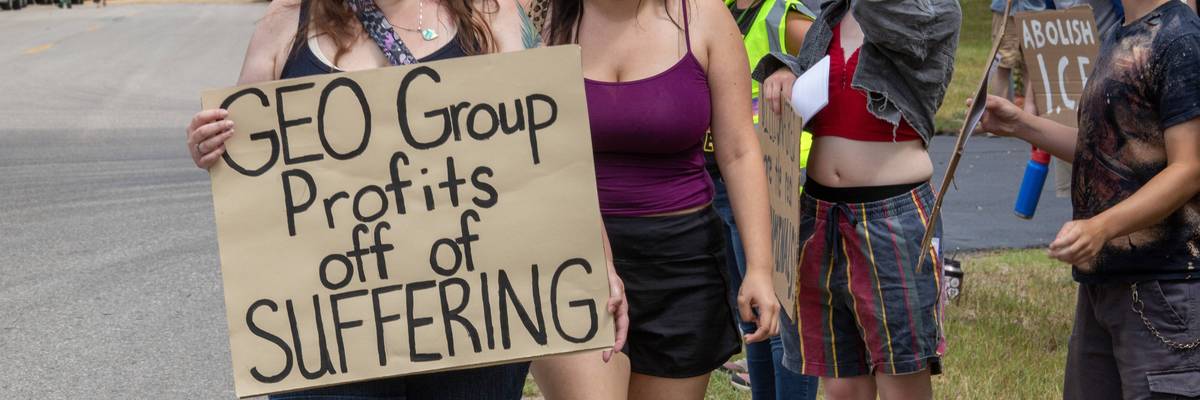

People rally against the US Immigration and Customs Enforcement detention center at North Lake Correctional Facility in Baldwin, Michigan—which is operated by the private prison company GEO Group—on July 4, 2025.
(Photo by Jim West/UCG/Universal Images Group via Getty Images)

Brett Wilkins
Feb 13, 2026
COMMON DREAMS

Private prison company GEO Group on Thursday reported a company record of $254 million in profit last year—a roughly 700% increase over 2024—driven by asset sales and contracts with the Trump administration to build several new US Immigration and Customs Enforcement detention facilities across the US.

GEO Group secured approximately $520 million in new or expanded contracts in 2025, based on annualized revenue, according to company founder and executive chairman George Zoley.

“This represents the largest amount of new business we have won in a single year in our company’s history,” Zoley said during an earnings call on Thursday. “We have entered into new contracts to house ICE detainees at four facilities totaling approximately 6,000 beds.”

Those facilities are: Delaney Hall in Newark, New Jersey; North Lake Processing Center in Baldwin, Michigan; Folkston Processing Center at the D. Ray James Correctional Institution in Georgia; and a so-called “deportation depot” at the Baker Correctional Institution in Sanderson, Florida.

“The census across our active ICE facilities has continued to steadily increase from the third quarter at approximately 22,000 to presently approximately 24,000, which is the highest level of ICE populations we have ever had,” Zoley said. “This past year, we also significantly expanded the delivery of our secure transportation services on behalf of both ICE and the US Marshals Service, valued at approximately $60 million in incremental annualized revenue.”

“We continue to be optimistic about the importance and growth potential of the ICE contract,” he added. “The new two-year contract includes pricing for 361,000 participants in year one and 465,000 participants in year two. With the capital investment we made in 2025, we believe we have the capability in scaling monitoring devices and case management services to achieve those significantly increased participation levels and far beyond if desired by ICE.”

The so-called One Big Beautiful Bill Act signed last July by President Donald Trump contained a massive increase in funding for the Department of Homeland Security (DHS), ICE’s parent agency, including about $45 billion for expanding immigrant detention capacity.

Days after Trump’s 2024 reelection—which private prison companies funded to the tune of over $1 million—Zoley hailed the “unprecedented opportunity” of the incoming administration’s mass deportation campaign.

“The GEO Group was built for this unique moment in our company’s [and] country’s history, and the opportunity that it will bring,” he beamed.


Unlike state prisons or county and local jails, which are accountable to oversight agencies, privately operated ICE detention centers are not subject to state regulation or inspection. These facilities are plagued by a history of abuse, often sexual in nature, and sometimes alleged deadly medical neglect—problems that carried over from previous administrations.

Thirty-two people died in ICE custody last year, the agency’s deadliest in two decades. Most of these deaths reportedly occurred in privately operated detention centers, and 10 immigrants died in GEO Group facilities, according to data collected by attorney and independent journalist Andrew Free.

GEO Group’s earnings call came just days after three detainees at one of the company’s facilities in Washington state filed a lawsuit accusing two guards there of sexually assaulting and beating them, and then trying to cover it up. The company has been previously sued for alleged inadequate medical care, wrongful deaths, and forced labor.

This, in a system in which immigrant detention is meant to be nonpunitive and in which only a tiny fraction of those detained have been charged or convicted of any violent crime, according to a leaked DHS document exposed earlier this week.

Another private prison company, CoreCivic, on Thursday reported $116.5 million in 2025 profits, a nearly 70% increase from the previous year. The operator of ICE facilities including the notorious Dilley Immigration Processing Center in Texas—which detainees describe as a measles-infested “living hell” where they’ve been served moldy food full of worms and forced to drink putrid water—said it expects 2026 to be even more profitable.

Some private prison investors expressed frustration that ICE isn’t jailing enough people to generate even more revenue.


“One of the big questions, I think... has been the pace of detention by ICE, that it’s been below what people... thought [it] was going to be,” Joseph Gomes of NOBLE Capital Markets, Inc. said on Thursday’s CoreCivic earnings call. “I think... people thought we’d be at that 100,000 level. We’re at... a little over 70,000.”
US cattle farmers caught between high costs and weary consumers


By AFP
February 14, 2026


Chris Stem warns that the cost of doing business is almost outpricing his ability to raise cattle in the United States - Copyright AFP ANDREW CABALLERO-REYNOLDS


Beiyi SEOW

In rural Virginia, dozens of young cows belonging to Chris Stem graze by a frozen pond. He is living his childhood dream of being a farmer — but reality is starting to bite.

Despite soaring beef prices as the US cattle population hit a 75-year low, farmers like Stem are feeling the squeeze from steeper business costs, budget-conscious consumers and President Donald Trump’s trade policy.

“The cost of doing business is almost outpricing (our ability) to continue to raise cattle,” Stem told AFP.

“From cutting hay to feeding the cattle to maintaining equipment, maintaining staff, feed, everything has gone up,” he said. “When does that stabilize and stop?”

Trump’s latest move to boost Argentine beef imports is adding to concerns, vexing a key support base of the Republican president as midterm elections approach.

Stem, 40, has a herd of around 250 cattle in Ashland, Virginia.

Most are sold at larger markets where they are purchased and fed to slaughter weight, while around 15 percent is processed nearby and sold at Stem’s butcher shop.

For him, higher beef prices have been a double-edged sword.

His revenue from selling cattle has risen, but so have operational costs.

And there are limits to how much he can hike consumer prices at his shop to make up the margins.

“They will only spend but so much on a cut of beef, especially when you have imported meats that you can purchase for 50 percent to 60 percent less at a larger store,” Stem said.

Already, ribeye that sold for $14.99 a pound in 2019 now sells for $32.99, he said. His customer sales have dropped by 30 percent.

To afford the property, he has diversified operations at Oakdale into winemaking and hosting events like weddings.


– ‘State of crisis’ –


Steeper beef prices have become a symbol of high living costs in the world’s biggest economy, which has fueled voter frustration. Last fall, Trump demanded that ranchers slash their prices.

Trump has since exempted Brazilian beef from sharp tariffs, and moved this month to expand imports of trimmings from Argentina to cool ground beef prices.

Yet, officials predict costs will keep creeping up.

Beef and veal prices were up 15 percent year-on-year in January while ground beef prices, which hit a new high in December, have continued climbing.

Costs will likely stay elevated as consumer demand remains robust, while it takes years to rebuild American herds depleted by drought and import restrictions over a parasite.

Meanwhile, American farmers and ranchers fear Trump’s policies will undercut their production and profits.

“We do need to feed the people of the United States,” said Stem. “But we’re opening a door that’s going to, I think, significantly harm farmers.”

“I’m a supporter of the Republican administration,” he added. “I’m not a supporter of the of the unknowns that we get right now.”

The Ranchers Cattlemen Action Legal Fund United Stockgrowers of America warned recently: “Our industry is in a state of crisis and needs protection against price-depressing imports.”

Iowa farmer Lance Lillibridge told AFP that cattle producers have been “living off very skinny margins” for years.

“People are getting tired of working this hard for nothing,” he added. “Right now, our cattle prices are exactly where they should be.”


– ‘Cut back’ –


But households are feeling the pinch.

Endawnson Nungo, 56, a South Carolinian in the railroad industry, told AFP “we’ve cut back a lot” due to beef prices.

At a butcher shop in Washington, scientist Caleb Svezia, 28, said he started noticing higher meat prices around six months ago.

He has cut back on snacks when grocery shopping, to save up for better quality meats.

Jamie Stachowski, who runs Stachowski’s Market, said customers have pulled back. Like Stem, he has had to raise prices, lifting them by 30 percent over the past year.

In turn, his sales dropped by 15 percent.

Some consumers also pivoted from prime cuts to secondary ones — or buy other meats altogether.

“The beef industry is billions and billions of dollars,” he said. “Yet everybody just makes pennies on the pound.”

GOP Ripped for ‘Grotesque’ Farm Bill Full of ‘Industry-Backed Poison Pills’

“Chairman Thompson appears poised to check off industry’s cruel wish list,” one critic warned.


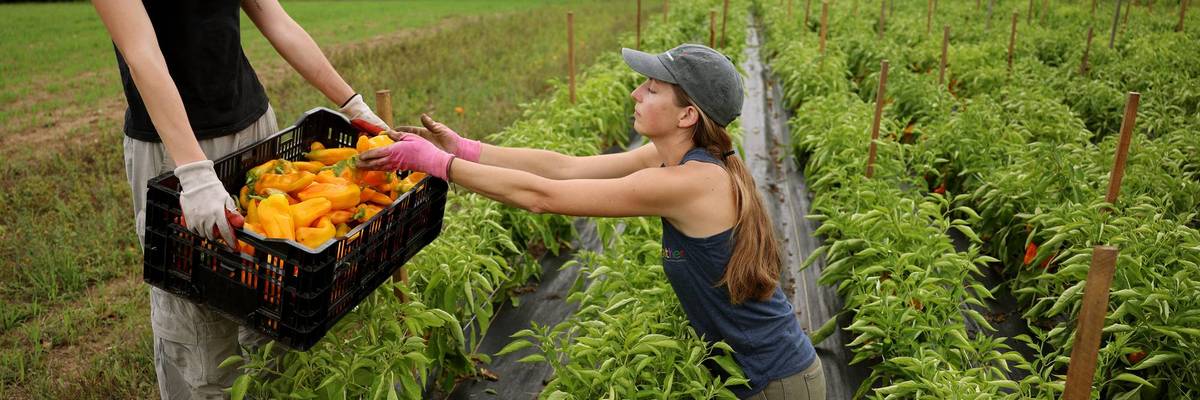
Farmers gather sweet peppers at Hungry Heart Farm in Kingston, New Hampshire, on September 23, 2025.
(Photo by Jessica Rinaldi/The Boston Globe via Getty Images)

Jessica Corbett
Feb 13, 2026
COMMON DREAMS

Advocates for animal welfare, environmental protection, public health, and small family farms fiercely condemned various “industry-backed poison pills” in the long-awaited Farm Bill draft unveiled Friday by a key Republican in the US House of Representatives.

“A new Farm Bill is long overdue, and the Farm, Food, and National Security Act of 2026 is an important step forward in providing certainty to our farmers, ranchers, and rural communities,” said House Committee on Agriculture Chair Glenn “GT” Thompson (R-Pa.) in a statement.


Agriculture Experts Warn of ‘Widespread Collapse’ in US Farms Thanks to Trump Policies


While Thompson has scheduled a markup of the 802-page proposal for February 23, critics aren’t waiting to pick apart the bill, which aligns with a 2024 GOP proposal that was also sharply rebuked. The panel’s ranking member, Rep. Angie Craig (D-Minn.), said that from what she has seen so far, the new legislation “fails to meet the moment facing farmers and working people.”

“Farmers need Congress to act swiftly to end inflationary tariffs, stabilize trade relationships, expand domestic market opportunities like year-round E15, and help lower input costs,” Craig stressed. “The Republican majority instead chose to ignore Democratic priorities and focus on pushing a shell of a farm bill with poison pills that complicates if not derails chances of getting anything done. I strongly urge my Republican colleagues to drop the political charade and work with House Democrats on a truly bipartisan bill to address the very real problems farm country is experiencing right now—before it’s too late.”

Brett Hartl, government affairs director at the Center for Biological Diversity, similarly blasted the GOP legislation on Friday, declaring that “this Republican Farm Bill proposal is a grotesque, record-breaking giveaway to the pesticide industry that will free Big Ag to accelerate the flow of dangerous poisons into our nation’s food supply and waterways.”

“This bill would block people suffering from pesticide-linked cancers from suing pesticide makers, eviscerate the EPA’s ability to protect rivers and streams from direct pesticide pollution, and give the pesticide industry an unprecedented veto over extinction-preventing safeguards for our nation’s most endangered wildlife,” he said, referring to the Environmental Protection Agency.

“If Congress passes this monstrosity, it will speed our march toward the dawn of a very real silent spring, a day without fluttering butterflies, chirping frogs, or the chorus of birds at sunrise,” Hartl warned. “No one voted for Republicans to allow foreign-owned pesticide conglomerates to dominate the policies that impact the safety of the food every American eats. But this bill leaves no doubt that’s exactly who is calling all the shots.”

Food & Water Watch (FWW) managing director of policy and litigation Mitch Jones also sounded the alarm about industry-friendly poison pills, arguing that any draft containing the “Cancer Gag Act” that would shield pesticide companies from liability or the Ending Agricultural Trade Suppression Act—which would block state and local policies designed to protect animal welfare, farm workers, and food safety—“must be dead on arrival.”

Sara Amundson, president of Humane World Action Fund—formerly called Humane Society Legislative Fund—also made a case against targeting state restrictions for animals like Proposition 12 in California, which the US Supreme Court let stand in 2023, in response to a challenge by the National Pork Producers Council and the American Farm Bureau Federation.

“Once again, the House Agriculture Committee Republican majority is bending to the will of a backwards-facing segment of the pork industry by trying to force through a measure to override the preferences of voters in more than a dozen states, upend the decisions of courts all the way up to the Supreme Court, and trample states’ rights all at the same time,” Amundson said Friday.


The National Family Farm Coalition highlighted that “instead of addressing the widespread concerns of family-scale farmers—ensuring fair prices for farmers, improving credit access, addressing corporate land consolidation, and creating a trade environment that benefits producers—this draft perpetuates the status quo that enriches and empowers corporate agribusiness. The result is an accelerating farm crisis that continues to hollow out rural communities across the US.”

Thompson also faced outrage over other policies left out of the GOP legislation—particularly from those calling for the restoration of $187 billion in cuts to the Supplemental Nutrition Assistance Program (SNAP) that congressional Republicans and President Donald Trump forced through last year with their so-called One Big Beautiful Bill Act (HR 1).

“HR 1 shifts unprecedented costs to already cash-strapped states, expands time limits, and strips food benefits away from caregivers, veterans, older workers, people experiencing homelessness, and humanitarian-based noncitizens,” noted Crystal FitzSimons, president of the Food Research & Action Center.

“HR 1 is an unforgiving assault on America’s hungry, deliberately dismantling our nation’s first line of defense against hunger,” she continued. “Yet, when given the opportunity to correct this harm in the latest Farm Bill proposal, Chairman Thompson unveiled a package that will only deepen hunger instead of fixing it. Hunger is not something Congress can afford to ignore.”


Jones of FWW said that “families and farmers are hungry for federal policy that supports small- and mid-sized producers and keeps food affordable. Instead, Chairman Thompson appears poised to check off industry’s cruel wish list.”

“America needs a fair Farm Bill,” he emphasized. “It is imperative that this Farm Bill repeal all Trump SNAP cuts and restore full funding to this critical nutrition program; stop the proliferation of factory farms; and support the transition to sustainable, affordable food.”
No Concessions’: San Francisco Teachers End 4-Day Strike After Winning Raise, Family Healthcare

“This historic strike built an unbreakable solidarity across our city, among families, students, educators, and community,” said San Francisco’s teachers union.


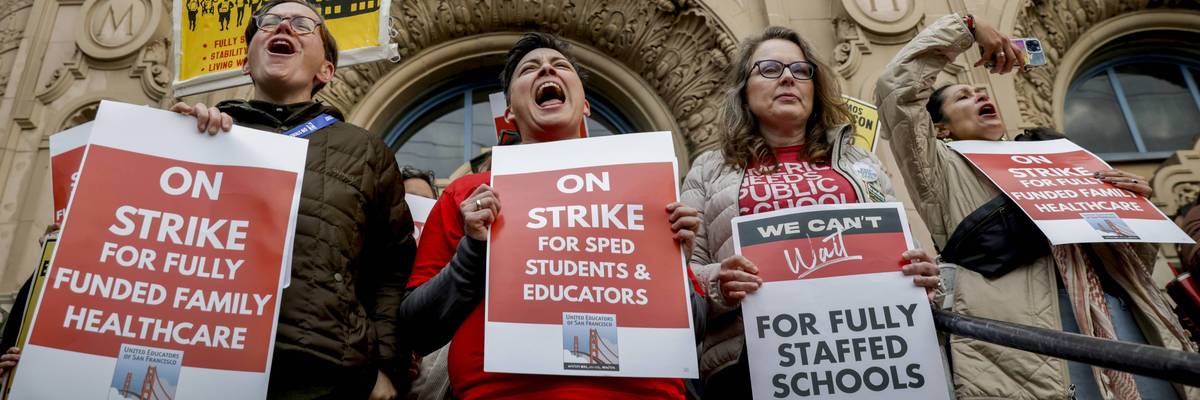
San Francisco teachers and allies rally for a fair contract that includes fully funded family healthcare outside Mission High School on February 9, 2026.

(Photo by Brontë Wittpenn/San Francisco Chronicle via Getty Images)


Brett Wilkins
Feb 13, 2026

San Francisco public school teachers and their union celebrated Friday after negotiating a tentative agreement for a new contract with higher pay and fully funded family healthcare, ending a four-day walkout that was the city’s first educator strike in nearly half a century.

United Educators of San Francisco (UESF) said its bargaining team reached a two-year tentative deal with the San Francisco Unified School District (SFUSD) at around 5:30 am local time Friday. The 120 public schools that were closed due to the walkout by around 6,000 teachers are set to reopen for classes next Wednesday.


31,000 Kaiser Nurses Strike as Their Union Says Employer Puts ‘Profit Over Patients’


‘Now Is Your Time of Need’: Bernie Sanders, Mayor Mamdani Join Striking Nurses in NYC

“This historic strike built an unbreakable solidarity across our city, among families, students, educators, and community,” UESF said in a statement. “This strike has made it clear what is possible when we join together and fight for the stability in our schools that many have said was out of our reach.”


The tentative agreement, which follows 11 months of bargaining, includes the union’s main demand for fully funded health coverage for dependents; raises of between 5-8.5%; caseload reductions for special educators; sanctuary protections for students and staff; limits on the use of artificial intelligence; preservation and expansion of the Stay Over program for unhoused students and their families; and better working conditions for librarians, substitute teachers, counselors, and other staff.

“By forcing SFUSD to invest in fully funded family healthcare, special education workloads, improved wages, sanctuary and housing protections for San Francisco families, we’ve made important progress towards the schools our students deserve,” said UESF president Cassondra Curiel “This contract is a strong foundation for us to continue to build the safe and stable learning environments our students deserve.”

SFUSD Superintendent Maria Su said in a statement: “I recognize that this past week has been challenging. Thank you to the SFUSD staff, community-based partners, and faith and city leaders who partnered with us to continue centering our students in our work every day.”

“I am so proud of the resilience and strength of our community,” Su added. “This is a new beginning, and I want to celebrate our diverse community of educators, administrators, parents, and students as we come together and heal.”

However, Su also warned that “we do not have enough funds to pay for this year and the next two years,” citing SFUSD’s over $100 million budget deficit.

The striking teachers enjoyed widespread support and solidarity across the city, including at a massive rally outside City Hall on Monday.


San Francisco teachers cheered the tentative agreement—especially its coverage of 100% of premiums on family health plans, which run about $1,500 per month, beginning next January.

“That amount of money is life-changing to us,” Balboa High School English teacher Ryan Alias said during a Thursday press conference.

“If we had that in our pocket, we would be able to save for retirement,” added Alias, who has two children in SFUSD schools. “We would be able to save for college funds. We’d be able to save for student loans. We’d be able to pay for art classes for our kids. This is the thing that is going to keep educators in the city.”
As US Firms Secure Deals for Congo’s Minerals, Its Citizens Fight Back in Court

This legal challenge in the Congo highlights the stakes for millions of people around the world, including many Indigenous communities, who find their lands targeted by big powers for mineral extraction.


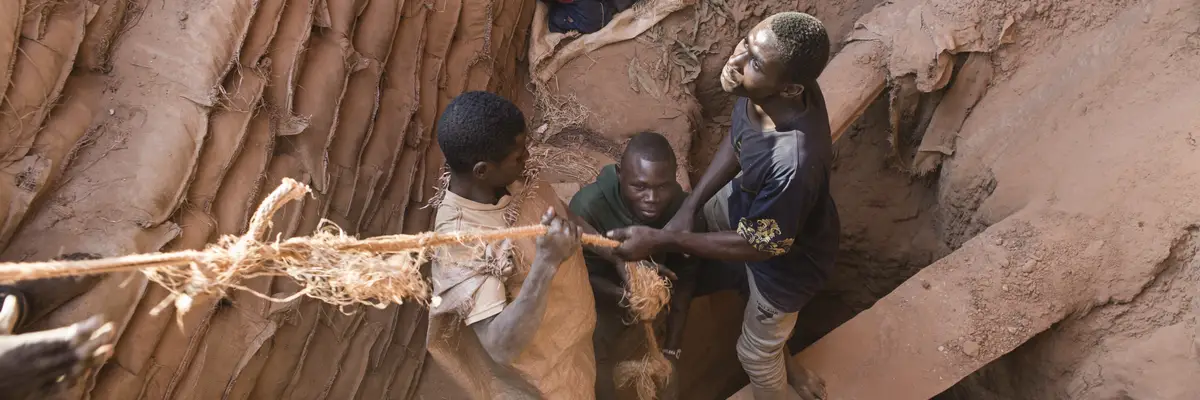
Miners pull up a bag of cobalt their colleague is digging underground inside the CDM (Congo DongFang Mining) Kasulo mine.
(Photo by Getty Images)

Frederic Mousseau
Feb 14, 2026
Common Dreams

President Donald Trump hailed “historic” the agreement signed in Washington on December 4, 2025, between President Félix Tshisekedi of Congo and Rwanda’s President Paul Kagame. Brokered by the US administration, this Washington Accord was supposed to end the devastating conflict in Congo that has taken millions of lives over the past three decades.

Alongside this deal, a Strategic Partnership Agreement was signed between the US and Congo. The agreement gives the US preferential access to Congolese mineral reserves, requires Congo to amend its laws and potentially its Constitution, and gives Washington a level of control over the management of mining resources through the establishment of a joint mechanism involving the two governments.

In October 2025, analyzing the pre-accord signed in June 2025 and a Regional Economic Integration Framework between Rwanda and Congo negotiated in the following months, the Oakland Institute released Shafted: The Scramble for Critical Minerals in the DRC. The report raised serious concerns about US maneuvers to control Congolese critical minerals under the guise of bringing peace to the region.

The Partnership Agreement signed in December makes these concerns legitimate. The Congolese people have been sidelined, with an agreement focused on extraction and exploitation of critical minerals and a peace deal that shockingly overlooks the need for justice and for holding perpetrators accountable. Soon after the signing of the deal, the US mining firms were already striking deals, while promises of peace and security remain wishful thinking with Rwanda and its proxy M23 continuing to occupy large swaths of land in mineral-rich eastern Congo. As a matter of fact, fighting has continued to rage with a fresh offensive launched by Rwanda and M23 in the days that followed the agreement, resulting in thousands of people killed and the capture of the strategic city of Uvira.

The lawyers and human rights defenders who have filed the case are urging the mobilization of Congolese people to preserve the sovereignty of their nation and calling on the international community to support their action and defend international law at a time it is under unprecedented threat.

While the prospect of peace remains uncertain, the government of Congo has not waited to take significant steps in the implementation of the agreement. Mid-January, it provided Washington with a shortlist of state-owned assets—including manganese, copper-cobalt, gold, and lithium projects—available to US investors. A major deal was announced soon after with US government-backed Orion Critical Mineral Consortium acquiring 40% of Glencore’s DRC copper and cobalt.

Congolese may legitimately wonder whether they are being fooled by the deal, seeing their mineral resources offered to the “peacemaker” whereas Rwanda, undeterred, continues its aggression and the extraction of Congolese minerals in Eastern Congo. This has led some to act.

On January 21, 2026, a collective of Congolese lawyers and human rights defenders filed a petition at the Constitutional Court of the Congo to challenge the constitutionality of the agreement. The lawyers argue that the partnership violates the Constitution since amendment of laws or the Constitution requires a democratic review and approval by the Congolese parliament or citizens through referendum. Specifically, it contravenes Article 214 of the Congo’s Constitution, which sets out the ratification process for international agreements that involve amending national laws. The petition also contends that the agreement violates Articles 9 and 217, which uphold the principle of Congo’s sovereignty over natural resources, and Article 12, which upholds the principle of equality before the law.

According to Attorney Jean-Marie Kalonji, one of the plaintiffs: “By filing this case with the Constitutional Court, we are assuming our responsibility as Congolese citizens to protect the sovereignty of our country and safeguard our patrimony for future generations.” The lawyers and human rights defenders who have filed the case are urging the mobilization of Congolese people to preserve the sovereignty of their nation and calling on the international community to support their action and defend international law at a time it is under unprecedented threat.

This legal challenge has major significance for Congo, a country that has large reserves of several critical minerals, such as copper and cobalt, and a long history of mineral extraction plagued by corruption, embezzlement, and predatory wars. The country’s mineral wealth has hardly benefited its people—still lagging behind most countries in terms of human development indicators such as access to health, education, and other standards of living. It is therefore totally legitimate for citizens to stand up for their basic rights and ensure that mining operations actually benefit the population.

Beyond Congo, this legal action has implications for other mineral-rich countries as global competition for the control of critical minerals intensifies and projections indicate steep increases in demand as well as shortfalls to be expected for some key minerals such as copper and lithium as early as the 2030s. Whereas China dominates both extraction and refinery activites, the US and other industrialized countries have set the supply of critical minerals as a vital priority for so-called green technologies as well as defense.

The 2022 Intergovernmental Panel on Climate Change report warned that mining has “severe environmental impacts” with “often […] few if any redistributive benefits for communities in regions where extraction takes place,” and instead of local development, the extraction of strategic minerals is often linked to violence, human rights abuses, and conflict. This legal challenge in the Congo highlights the stakes for millions of people around the world, including many Indigenous communities, who find their lands targeted by big powers for mineral extraction. It is essential that their rights are recognized and that they have a say in the future of their land—which is intertwined with their own future.


Our work is licensed under Creative Commons (CC BY-NC-ND 3.0). Feel free to republish and share widely.


Frederic Mousseau
Frederic Mousseau is policy directory of the Oakland Institute.
Full Bio >


We Need to Break Free From the Cage of Nationalism

The possibility of nuclear war plus the continuing reality of climate change ought to push all of us beyond the borders of our minds. These matters will only be solved collectively: trans-nationally. And we must solve them.


Migrant people cross on the banks of the Rio Grande as they wait to be processed by the Border Patrol of El Paso Sector, Texas, after crossing from Ciudad Juarez, Mexico on May 11, 2023.
(Photo by Herika Martinez / AFP via Getty Images)

Robert C. Koehler
Feb 14, 2026
Common Dreams

“While there is broad support across the political spectrum for removing criminal aliens...”

Screech! My connection to the words I’m reading grinds to a sudden halt, an inner alarm goes off, I look away from my computer screen and briefly clutch my soul. Oh God...

The words are from a Forbes article highly critical of Stephen Miller, President Donald Trump’s deporter-in-chief. I was mostly in sync with it as I read. Indeed, the above sentence continues, pointing out that “the vast majority of individuals in the country without legal status have not committed serious crimes.”

Yeah, absolutely. So what’s my problem here? It amounts to this: A false, unchallenged assumption quietly emerged, manifested in the word “aliens.” Do we support the rights of aliens or do we just want them (and their children) dragged out of the United States, especially if they’re non-white? Apparently, this is the context of the major debate of the moment. Who belongs here? What remains unquestioned in the article is the significance of an imaginary line, known as the border, without which there would be no such thing as aliens. The line separates “us” from the rest of the world and severely trivializes the scope of the debate.

My call in this moment is for humanity, especially those who define themselves as Americans, to stand up not just to Trump and Miller and Immigration and Customs Enforcement, but to the false reality of nationalism itself.

But a planet divided into nations is just the way things are, right? This is certainly not questioned politically. But my scream in this moment is for the media, mainstream or otherwise, to look beyond the assumed certainty of nationalism, however discomforting that may seem, and acknowledge that the human race has no “aliens.”

The larger reality here—understood by anyone with a brain—is that this is one planet. One planet! We are a collective whole. All of us are connected. I do not write these words with naïveté. Knowing this is simply the starting point, as we continue to evolve. I’m not downplaying the need we all feel for security, just eliminating the word “national” from the phrase.

As Karabi Acharya writes: “In fact, over half of all national borders were created in the 20th century. The creation of borders is for the most part a sad history marked by conflict, colonialism, and war. Borders create unnecessary and harmful barriers not just between people and resources but also ideas.”

Yeah, war—in the nuclear age. The Bulletin of the Atomic Scientists recently moved its metaphorical Doomsday Clock to 85 seconds to midnight, as close to the zero hour as it’s ever been. The possibility of nuclear war plus the continuing reality of climate change ought to push all of us beyond the borders of our minds. These matters will only be solved collectively: trans-nationally. And we must solve them.

Acharya goes on:
Finally, and perhaps most importantly, there is a moral imperative to be open to new ideas from around the world and to question the origins of old ideas we take for granted. Global learning provides an important inflection point to question the morality of how and who decides what knowledge others see and share.

Not only have borders been historical constructs of wealth and power; they unfairly reflect whose ideas have mattered, what languages have been preferred. As places throughout history have been colonized, people were told that their own traditions don’t matter and what’s important, what is to be prioritized, are the norms and concepts of the colonizers. Part of the process of setting up borders includes erasing not only people but other knowledge traditions.

I understand that national governments need borders to continue to exist, at least as they understand themselves. The world’s governments—in particular, the American government—need the help of we the people. My call in this moment is for humanity, especially those who define themselves as Americans, to stand up not just to Trump and Miller and Immigration and Customs Enforcement, but to the false reality of nationalism itself. How do we open the borders of this planet? How do we start acknowledging, and healing, the consequences of two-plus millennia of colonial land theft? How do we start valuing—and learning from—those who are different from us?

What if we began opening our borders? What if we began governing nonviolently... with respect and awe for our world and its occupants? Perhaps we’d start freeing ourselves from the suicidal hell we’re caught in today. We’d definitely start pushing the hands of the Doomsday Clock backwards.


Oct 23, 2020 ... Source: Digital Library of IndiaScanning Centre: Allama Iqbal Library, University of KashmirSource Library: Allam Iqbal Library Kashmir ...


concession to nationalism; it appealed to them as workers not as Poles. She knew that a campaign to establish an independent Poland would unleash ...


Trump Is Turning the US Into the World’s Rogue Policeman

The United States has long been tempted to play good cop-bad cop with the world. President Trump is simply taking things to the next distinctly psychopathic level.


Nicolas Maduro is seen in handcuffs after landing at a Manhattan helipad, escorted by heavily armed Federal agents as they make their way into an armored car en route to a Federal courthouse in Manhattan on January 5, 2026 in New York City.
(Photo by XNY/Star Max/GC Images)

John Feffer
Feb 14, 2026
Common Dreams

A mere 15 years ago, during an epoch that now seems as distant as the Paleozoic era, an American president attempted to use military power to prevent a dictator from slaughtering his own citizens. Barack Obama billed the action in Libya as a humanitarian intervention, citing the new United Nations doctrine of “responsibility to protect,” or R2P. The president hoped to avert a massacre by Libyan dictator Muammar Qaddafi rather than, as usual, coming in afterwards to count the dead and try to bring the malefactors to justice.

Obama intervened like a global police officer, following the letter of the (international) law. Eager to be seen as a “good cop,” the president even promised to “lead from behind.” It’s impossible to know if the US-led action did indeed prevent massive war crimes. However, the disastrous aftermath of that Libyan campaign—the summary execution of Qaddafi and a civil war that would kill tens of thousands—was yet more evidence that Washington’s attempts to police the world are quixotic at best.

Public support for the Libyan action was decidedly mixed, with criticism of the president coming from all sides of the political spectrum. On the left, former Congressman Dennis Kucinich thundered that “we have moved from President Bush’s doctrine of preventive war to President Obama’s assertion of the right to go to war without even the pretext of a threat to our nation.” Steven Groves of the Heritage Foundation complained that Obama was too scrupulous in his adherence to the principles of R2P, which might only raise the bar for future US interventions.

Ah, the good old days, when the left and the right both took international law seriously enough to argue over how a US president should engage with it!

That’s exactly the kind of police officer that Donald Trump aspires to be, wielding power not on behalf of principle but in the service of personal gain and autocratic control.

Donald J. Trump has shown no such scruples. He considers international law nothing more than a trifling impediment by which the weak try to drag down the strong. He boasts that he didn’t even bother to consult the UN when pursuing his trumped-up peace plans and creating his laughably ill-named “Board of Peace.” He certainly didn’t consider international law recently when he bombed Nigeria, seized Venezuela’s President Nicolás Maduro, and threatened to annex Greenland. He may be the first American president to treat international law as if it were as fictional as intergalactic law.

By contrast, the only principle that Trump now invokes in his foreign policy is the infamous law of the jungle. He believes that power—its threat and its exercise—is all that matters for apex predators like the United States (and himself). The rest is just the chittering of potential prey.

“My own morality. My own mind. It’s the only thing that can stop me,” the amoral Trump told the New York Times in a recent (and terrifying) interview. “I don’t need international law.”

Global cop, then, would not seem to be a suitable aspiration for the likes of Donald Trump. Unlike Obama, he’s not interested in making sure that laws are observed and miscreants punished. Instead, Trump practically fawns over the miscreants: Russia’s Vladimir Putin, Israel’s Benjamin Netanyahu, Saudi Arabia’s Mohammed bin Salman. The duties of policing the planet—both the adherence to law and the expenditure of resources—simply don’t appeal to him.

“We’re spending tremendous amounts of money for decades policing the world, and that shouldn’t be the priority,” Trump said back in 2018. “We want to police ourselves and we want to rebuild our country.”

That was the old Trump. The new Trump looks at things quite differently.
How Real Cops Operate

Maybe when you hear the expression “world’s policeman,” you think of Officer Clemmons on the once-popular children’s TV show Mister Rogers’ Neighborhood: a genial upholder of community morals, but on a global scale.

Or maybe you’re like former NATO head Anders Fogh Rasmussen who, in 2023, pined for an upright world policeman with superpowers and lofty principles. “We desperately need a US president who is able and willing to lead the free world and counter autocrats like President Putin,” he wrote. “The world needs such a policeman if freedom and prosperity are to prevail against the forces of oppression, and the only capable, reliable, and desirable candidate for the position is the United States.”

Donald Trump doesn’t want either of those jobs.

But let’s face it, that’s not how a large number of police officers actually operate. In 2025, police across the United States killed 98 unarmed people, the majority people of color. The misconduct of more than 1,000 dirty cops in Chicago—ranging from false arrests to the use of excessive force—cost that city nearly $300 million in court judgments between 2019 and 2022 alone, a pattern repeated at different magnitudes across the country and still ongoing, given the recent killings by federal immigration officers in Minneapolis.

Elsewhere in the world, the police suppress dissent and fill prisons at the behest of dictators from Russia and North Korea to Saudi Arabia and El Salvador.

In democracies, the police break laws, often with impunity; in autocracies, they follow unjust laws while systemically violating human rights.

A globocop embracing that kind of outlaw justice would disregard international law, make a mockery of institutions like the United Nations and the International Criminal Court, and attempt to establish alternative bodies that privilege the powerful. That’s exactly the kind of police officer that Donald Trump aspires to be, wielding power not on behalf of principle but in the service of personal gain and autocratic control.

The United States has long been tempted to play good cop-bad cop with the world. President Trump is simply taking things to the next distinctly psychopathic level.
Upholding the Law?

The first American president to dream of raising his country to the status of world policeman was Teddy Roosevelt. As a former police commissioner of New York City, he ardently believed that the federal government needed to use its constabulary power to intervene in society to maintain order, including suppressing labor unrest.

At the international level, like Trump, Roosevelt articulated his vision as a corollary to the Monroe Doctrine. In a 1904 address to Congress, he laid out his vision this way:
Chronic wrongdoing, or an impotence which results in a general loosening of the ties of civilized society, may in America, as elsewhere, ultimately require intervention by some civilized nation, and in the Western Hemisphere the adherence of the United States to the Monroe Doctrine may force the United States, however reluctantly, in flagrant cases of such wrongdoing or impotence, to the exercise of an international police power.


Roosevelt believed that the United States—and other major powers—had to step in to right wrongs in the absence of robust international institutions. He proposed a global “League of Peace” to prevent wars and end conflicts. In the meantime, according to his problematic take on “civilized” behavior, Roosevelt justified US interventions not only in the Western Hemisphere but also farther afield. In fact, Roosevelt won a Nobel Prize for his mediation of the Russo-Japanese War where, in a secret agreement, he gave Japan control of Korea in exchange for US control over the Philippines.

Trump has borrowed much from Roosevelt in his approach to global affairs, now aptly known as the Donroe Doctrine. The “League of Peace” has become Trump’s “Board of Peace.” Roosevelt’s interventions in the Western Hemisphere to keep out European powers have become selective moves to push out the Chinese and (less so) the Russians in Venezuela and elsewhere. Roosevelt’s “civilizing mission” has become an equally abhorrent commitment by the Trump administration to advancing the interests of white people, as in the preferential treatment of white South Africans when it comes to immigration to this country. Like Roosevelt, Trump considered a “spheres of influence” swap with Russia, exchanging Ukraine for Venezuela, before ultimately rejecting the deal.

By now, all of America’s historical justifications for acting as the world’s policeman have fallen away, including the assertion of self-determination (Woodrow Wilson), the mobilization against fascism (Franklin Delano Roosevelt), the crusade against communism (Harry Truman et al), and all talk of global democracy and human rights (the post-Cold War-era presidents). Trump has instead quite openly embraced Teddy Roosevelt, big stick and all, along with Roosevelt’s tendency to link the suppression of conflict at home and abroad. In Donald Trump’s world, federal immigration agents killing protesters Renée Good and Alex Pretti, and Special Forces kidnapping Nicolás Maduro are two sides of the same impulse: the use of constabulary force to extinguish dissent and maintain a pyramidic order nationally and hemispherically, with Donald Trump on top of it all.

Like Roosevelt, Trump showed no regard for the principles of sovereignty in his intervention in Venezuela. Roosevelt didn’t think Filipinos were civilized enough for self-government and Trump, by insisting that Greenlanders must submit to US control, repeats the colonialist pattern. Trump’s major innovation: Speak loudly and carry that big stick.

The trajectory of the world order over the last 75 years has been in the direction of safeguards for weaker nations and controls on the exercise of power by stronger nations. An elaborate system of international agreements governing human rights has been designed to protect individuals and groups from the predations of states and corporations.

Trump wants to reverse that trajectory, just as he wants to roll back all the gains social movements have made within the United States, from civil rights and feminism to the victories of the LGBTQ community.

In TrumpWorld, those with the guns make the rules. They take Crimea, Gaza, and Greenland—at gunpoint, if necessary.
Profiting Off Policing

Corrupt cops have long been involved in protection rackets, shaking down gambling establishments, prostitutes, and drug dealers. Trump, a shady businessman at heart, thrills to that side of the globocop business. All of his “peace deals” cut him or his cronies in on a piece of the action.

Take, for instance, last year’s deal between Armenia and Azerbaijan. It includes a “Trump Route for International Peace and Prosperity” that connects Azerbaijan with its enclave of Nakhichevan. In addition to naming rights, Trump negotiated as part of the agreement a TRIPP Development Company to construct the corridor, with the United States owning 74% of its shares for the first 49 years.

There’s no word yet on who the members of the US-Armenian steering committee will be for that project. If Gaza is any indication, however, it will be yet one more goodie to be distributed to friends and CEOs through Trump’s patronage system. The Gaza peace deal established a Board of Peace whose executive committee is dominated by Trump cronies, including Secretary of State Marco Rubio, diplomatic emissaries Steve Witkoff and the president’s son-in-law Jared Kushner, billionaire businessman Marc Rowan, and Trump security advisor Robert Gabriel.

For all of us who found fault with the “good cop” approach of Obama in Libya—and there was much fault to be found—it’s once again time to get a taste of America as the “bad cop.”

An even more audacious profit-seeking deal was his recent multipoint proposal to end the war in Ukraine. In it, Witkoff and his Russian counterpart imagined a scenario in which US businesses would profit by gaining access to frozen Russian funds for the reconstruction of Ukraine, while also making billions from restarting business relations with Russia. Again, it’s not difficult to imagine who would profit from such arrangements. After all, Jared Kushner, architect of the Abrahamic Accords that normalized diplomatic relations between Arab countries and Israel, became a billionaire thanks to contacts in and investments from the Gulf States.

Trump is all about extraction. If he has his way, the Venezuelan operation will net billions of dollars in oil revenues for major US companies. Similarly, his obsession with Greenland is driven, at least in part, by his lust for the reputed mineral wealth that lies beneath that giant island’s snow and ice. The United States is dependent on imports of critical minerals, many now controlled by China. Like a cop who eyes the riches generated by someone else’s protection racket, Trump is desperate to muscle in to grab some of the profits.

Perhaps the most vulgar expression of his desire to run a global protection racket is that Board of Peace of his. Countries that want to have permanent seats on it have to pony up a billion dollars apiece. Warmongers like Russia, Saudi Arabia, and the United Arab Emirates are welcome as members as long as they’re willing to fork over the money. On the other hand, Canada has been banned from it because, in a speech at Davos, its prime minister, Mark Carney, tried to rally the globe’s middle powers against the United States and other rule-breaking great powers.

Originally established to administer the Gaza peace deal, the board seems to have much greater ambitions. As its “president for life,” Trump has promised to cooperate with the United Nations. But the board’s membership, with the United States first among unequals, suggests a rival body with no interest in abiding by international law. Think of it as the UN’s evil twin and its creation as a signal that the United States has officially gone rogue cop.
The Future of US Foreign Policy

Not everyone in the MAGAverse is happy with America as a globocop.

Some isolationist remnants of the Republican Party have criticized the operations in Venezuela, though not enough to make a difference in Congress. Marjorie Taylor Greene, once Trump’s greatest congressional advocate, parted ways with the president on a number of issues, including the Venezuela intervention, and decided to step down early from her position rather than face his political vengefulness.

Trump has insisted that, the attacks on Venezuela’s sovereignty notwithstanding, the United States is not at war with that country. He ruled out any alternative interpretations of MAGA doctrine. “MAGA is me,” he said. “MAGA loves everything I do, and I love everything I do, too.”

Trump has made some noises about a spheres-of-influence approach with his Donroe Doctrine, prioritizing US control over the Western Hemisphere. He has been happy to reward Russia for its “policing” of neighboring Ukraine, and he’s been ambiguous at best about coming to the defense of Taiwan, should China threaten it. Indeed, he has been more than happy to delegate such responsibilities to others, whether it’s Israel in the Middle East or acting president Delcy Rodríguez in Venezuela. In a complex world as full of nukes and conventional missiles as the United States is of handguns, globocops need their deputies.

However, neither isolationism nor the idea of global spheres of influence has truly captured Trump’s imagination. In the first year of his second term, he has instead driven a stake through the very idea of isolationism by launching military operations in Venezuela, Nigeria, Iran, Yemen, Somalia, Iraq, and Syria. Nor has he shown any deep interest in confining his ambitions to the Western Hemisphere. Instead, he has continued to build the Pentagon budget to counter China, while fancying himself a peacemaker across the Global South. Wherever his critics continue to dance beyond his grasp, as in Cuba and Iran, and wherever valuable resources can be extracted for personal and political gain, as in Greenland and the Congo, Trump will try to press any military advantage he might have.

For all of us who found fault with the “good cop” approach of Obama in Libya—and there was much fault to be found—it’s once again time to get a taste of America as the “bad cop.” So far, Trump’s targets have been weak (Venezuela) or easy to attack (Iran, after Israel destroyed its air defenses). The grave danger is that, encouraged by such “successes,” Trump may move on to larger targets like China or the 60% of American citizens who oppose his policies.

Cops, protected by their badges and their guns, think they’re invincible. Taken to court over their crimes and corruption, they suddenly discover that they’re not in fact above the law. Trump is now turning the United States into a “bad cop.” Let’s hope that he learns a lesson about the limits of his power before he goes apocalyptically rogue.

Our work is licensed under Creative Commons (CC BY-NC-ND 3.0). Feel free to republish and share widely.


John Feffer
John Feffer is the author of the dystopian novel "Splinterlands" (2016) and the director of Foreign Policy In Focus at the Institute for Policy Studies. His novel, "Frostlands" (2018) is book two of his Splinterlands trilogy. Splinterlands book three "Songlands" was published in 2021. His podcast is available here.
Full Bio >
It’s Time to Bully Back the Bully-in-Chief


Hearing his own unsettling, repeated false salvos may make Trump decide to stop the daily froth from his MOUTH.


Ralph Nader
Feb 14, 2026
Common Dreams

The most remarkable realization about Donald J. Trump’s rise to becoming America’s elected dictator is that it all came out of his MOUTH. Understanding that politics has become a performative exercise, Trump discovered that he could win the battle of words without having a record of achievement or any trusted experience in the business, government, or civic arena.

His lies sugarcoated his failed businesses. He wildly exaggerated his wealth (asserting that the Trump brand was worth $11 billion). He tried to explain away his numerous corporate bankruptcies as a business strategy, and blamed everyone for his commercial collapses—the banks, the workers, the students (Trump University, anyone?)—the government. This failed gambling casino czar never admitted he was ever wrong, ever sorry, and boasted he knew more than anyone because he was “right about everything.”

His MOUTH went into high gear during his introductory presidential debates with 16 Republican challengers during the 2016 GOP primaries. In retrospect, it is astonishing to see how, using his snarling mouth, he wrested control from those on the stage from the outset, targeting immigrants as invaders, criminals, rapists, and destroyers of America. Without rebuttals, he would repeat over and over again his sweeping bigotry.

Then Trump would move on to repeat how foreign countries have taken advantage of the US in trade, ignoring our Empire’s bleeding poorer nations, brain-draining their skilled people, and allowing giant US corporations to export millions of jobs to take advantage of serf labor and corruptible dictatorial regimes. He ignored the way the US-facilitated, corporate-driven trade deals pulled down worker and environmental protections in the US and devastated American workers and communities.

So many of Trump’s epithets fit him perfectly. So, throwing them back on him repeatedly rings the truth bell.No matter, the MOUTH opened wider, slandering specific people, including selected politicians, judges, authors, reporters and editors, professors, and anyone who dared criticize his daily fabrications.
RECOMMENDED...


Racist Trump Denounced for Sharing Vile Video Depicting Obamas as Monkeys


From Business Closures to Student Walkouts, Communities Across US Demand: ‘ICE Out!’


The MOUTH got major coverage in the mainstream media, including publishing his CAPITAL LETTERS OF CONDEMNATION, and because his targets were not given the right of reply, many people were inclined to believe him. This accelerated and entrenched his violent politics of intimidation. Again and again, he had the media field to himself, which deterred many of his critics from giving him a taste of his own medicine.


Trump—by far the most impeachable of presidents and the least negatively branded by his opponents—must wonder about his luck. Consider, he is a convicted felon; a chronic liar; a serial law violator; a repeated sexual abuser of women; a crooked extortionist; a hugely corrupt user of the White House to enrich the Trumpsters; a shatterer of the social safety net for tens of millions of Americans; a slasher of safeguards and scientific research against catastrophic climate violence and pandemics, leaving America rapidly defenseless; and a crazed suppressor of solar energy and wind power while boosting the omnicidal oil, gas, and coal industries. Moreover, he pathologically breaks his promises and pledges, presiding over record waste, shutdowns, and censorship, ushering in the DARK AGES for America.


His dictatorial rule—“Nothing can stop me”—dishonors the American Revolution and violates the Constitution’s defenses against one-man rule. He epitomizes “big government” against the people, suppressing free speech; piling up huge deficits; advocating mass arbitrary arrests; and shutting down the enforcement of laws to protect the health, safety, and economic well-being of Americans, endangering them in both red and blue states.


A deficit-funded tax cutter for the already under-taxed rich, the powerful, and big corporations, he illegally takes tax revenue from necessities of the people and loads deficits on the backs of the next generation while starving the IRS budget and undermining the collection of taxes due. He spends or refuses to spend at his whim, flouting the exclusive appropriations authority of Congress. He is “a fascist to his core,” said his former chief of staff, retired general John Kelly, and a full-blown RACIST in what he says, does, and portends.

It should be easy to label Trump “America’s Number One Outlaw,” given all these dangerous, deranged delusions. He is openly and visibly wrecking and weakening our country rapidly with his entrenched dictatorship and his masked storm troopers who are on the rampage in large US cities.

He has hollowed out the federal government’s critical civil service except for the omnivorous military-industrial complex with its bloated budget that is devouring our best lifesaving programs abroad and at home, and fueling his Empire’s illegal military raids abroad.

Now he is starting to plan the subversion of our elections come November with fake ads and the attempted seizure of voter rolls and people’s personal identification data. Conducting elections is reserved exclusively to the states under our Constitution. Trump’s present obsession is rigging the midterm elections through selective voter suppression, especially as his poll numbers drop.

So, what can be done about Trump’s hyperactive MOUTH and his assault on our democracy? Fact-checking, as was done by a leading fact-checker for the Washington Post, Glenn Kessler. He now concedes that fact-checking did not deter Trump. In Trump’s first term, Kessler documented more than 30,000 false or misleading claims. He gave up this reporting last year and left the Post, concluding that Trump’s fabrications over reality—lies about serious matters such as claiming the unemployment rate was 42% when it was 4.9%, or asserting that there was widespread voter fraud in 2020—were not slowing down the FAKER IN CHIEF and his ditto-head network. However, setting the record straight has its own value in reasserting a truthful society.

There is another part of the MOUTH—the tsunami of invectives hurled at named public figures and his private victims. He calls prosecutors and judges “deranged” and “traitors.” Other opponents are described as “lunatics,” “communists,” “crooked,” “crazy,” “lying,” “corrupt,” “murderers,” and “low IQ.” The latter is mainly reserved for African Americans. Lately, he has gone berserk, instantly libeling the two innocent American citizens shot and killed in Minneapolis by federal immigration agents as “domestic terrorists.”

Then there are his disparaging nicknames of critics—that are too numerous to mention. Trump’s bullying expletives are relayed by the mainstream media to the broad public, which helped make Trump the Supreme Foul-Mouth Soliloquist. For years, to their detriment, the Democrats and other critics did not respond in kind and with frequency, with the truth on their side.

They could have defined him with memorable depictions such as Tyrant Trump, Dictator Donald, Crooked Donald, Deranged Donald, Lying Donald, Crazy Donald, Dangerous Donald, Corrupt Donald, Lunatic Donald, Cruel Trump, and Terrorist Trump. These on-point adjectives would have unsettled the thin-skinned Prevaricator-In-Chief, making him rethink what his daily false salvos are provoking in return. No more free rides would sober up his MOUTH. Hearing his own unsettling, repeated false salvos may make Trump decide to stop the daily froth from his MOUTH.

So many of Trump’s epithets fit him perfectly. So, throwing them back on him repeatedly rings the truth bell. It so happens that bullies, including Trump, stop their smears when they realize what they have provoked in return. Attending a Washington Nationals baseball game in his first term, the crowd started chanting “Lock Him Up,” a phrase he goaded his base to use for months against his political opponents. Trump and his followers lost their enthusiasm for this chant when he started getting a taste of his own medicine from anti-Trump crowds.

Since Minneapolis, some Democrats in Congress are describing Trump as “deranged,” and after the animal caricature of the Obamas, more Democrats are ending a much-delayed labeling of Trump as a many-sided RACIST. Because the Democrats have had a low expectation level for Trump and hitherto have satisfied themselves with derision, he has gotten away with the lies about his alleged successful economic policies, with enough voters—seeing no strong responders—to have him squeak through the 2024 election.

The one word Trump cannot stand to hear is a power neither he nor his toady six Injustices on the Supreme Court can control—IMPEACHMENT. We’re starting to hear it more these days from the Democrats, despite the political foolish leaders Rep. Hakeem Jeffries (D-NY) and Sen. Chuck Schumer (D-NY), who are willing to remain silent on this one last resort against monarchy put exclusively in the hands of Congress by our far-seeing Founders. A majority of voters now appreciate the insights of our Founders. With Trump, IT IS ONLY GOING TO GET WORSE, MUCH WORSE. In the coming weeks, the polls should show over 60% of Americans want Trump Impeached.

Leave it to Trump to dictate ever more crazed, distracting actions to save himself.

As with the GOP revolt in 1974 against former President Richard Nixon for transgressions far, far less than Trump’s daily crimes and constitutional usurpation, so too today’s congressional GOP may well move to protect their own sinking fortunes this November by unloading the baggage of the Trump Dump.


An Urgent Message From Our Co-Founder


Dear Common Dreams reader,

The U.S. is on a fast track to authoritarianism like nothing I've ever seen. Meanwhile, corporate news outlets are utterly capitulating to Trump, twisting their coverage to avoid drawing his ire while lining up to stuff cash in his pockets.

That's why I believe that Common Dreams is doing the best and most consequential reporting that we've ever done.

Our small but mighty team is a progressive reporting powerhouse, covering the news every day that the corporate media never will. Our mission has always been simple: To inform. To inspire. And to ignite change for the common good.

Now here's the key piece that I want all our readers to understand: None of this would be possible without your financial support.

That's not just some fundraising cliche. It's the absolute and literal truth. We don't accept corporate advertising and never will. We don't have a paywall because we don't think people should be blocked from critical news based on their ability to pay. Everything we do is funded by the donations of readers like you.

Will you donate now to help power the nonprofit, independent reporting of Common Dreams?

Thank you for being a vital member of our community. Together, we can keep independent journalism alive when it’s needed most.

- Craig Brown, Co-founder


Our work is licensed under Creative Commons (CC BY-NC-ND 3.0). Feel free to republish and share widely.


Ralph Nader
Ralph Nader is a consumer advocate and the author of "The Seventeen Solutions: Bold Ideas for Our American Future" (2012). His new book is, "Wrecking America: How Trump's Lies and Lawbreaking Betray All" (2020, co-authored with Mark Green).
Full Bio >