GOOD MORNING, NEW YORK
Zohran Mamdani: NYC's young mayoral hopeful rattles the Democratic establishment
Upstart progressive candidate Zohran Mamdani stunned veteran candidates on Tuesday night after gaining a significant lead over former governor Andrew Cuomo in New York City’s Democratic mayoral primary.
Issued on: 25/06/2025
By: Vitoria Barreto
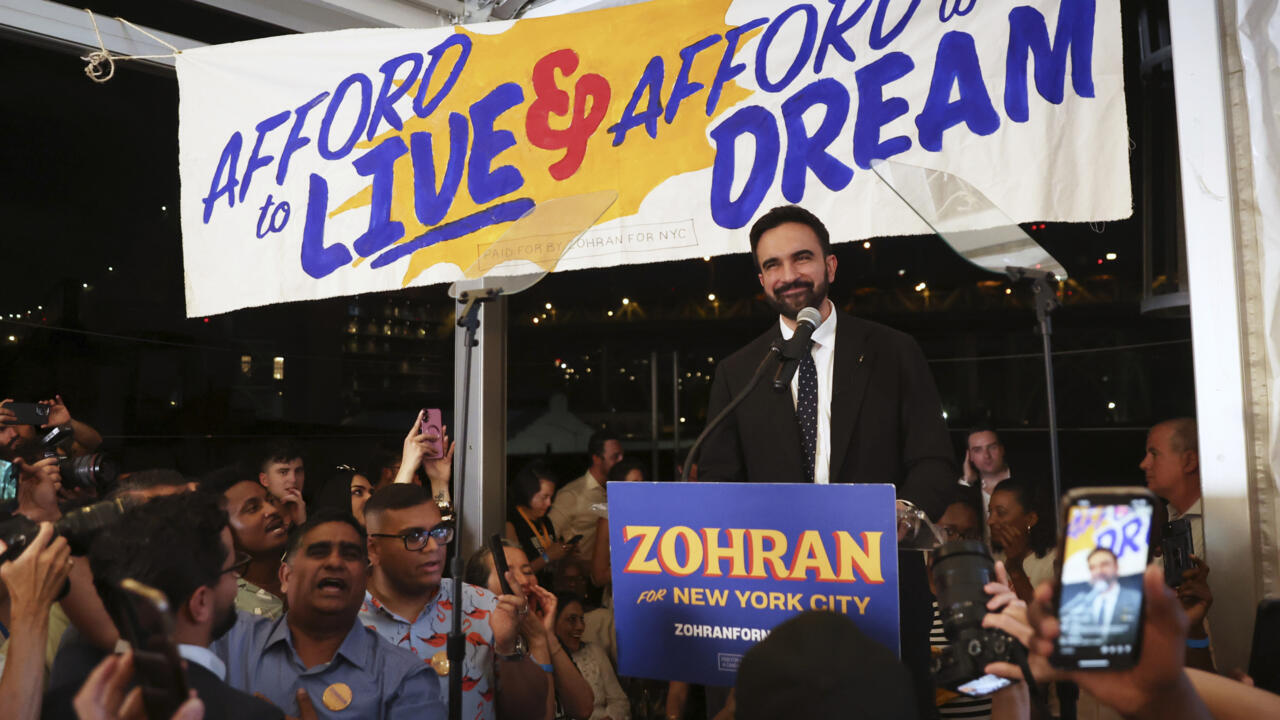
He was a relative unknown in New York City establishment circles, dismissed for his popularity on social media and lack of experience in the tough world of Big Apple politics.
That was until Tuesday night when Zohran Mamdani, 33, closed in on victory in the city’s Democratic mayoral primary, stunning his opponent, former New York governor Andrew Cuomo, in what appears to be the liberal city's rebuke of the party’s veteran moderates.
Watch more
Mamdani had already made history as the city’s first Muslim mayoral nominee. If he’s elected, the current member of the State Assembly would become NYC’s first Muslim, South-Asian mayor, and also the youngest since 1917.
The final outcome will be decided by a ranked choice tabulation, which allows people to pick up to five candidates in order of preference. If no candidate wins 50% percent of the vote, lowest-ranking members are eliminated and the votes are reallocated.
Current NYC Mayor Eric Adams skipped the primary, as he is running as an independent candidate. Cuomo – who has ferociously tried to make a comeback after he resigned in 2021 over a sexual harassment case involving 11 women – conceded defeat on Tuesday night.
“Tonight is his night. He deserved it. He won," Cuomo told supporters.
The millennial candidate from Queens was born in Kampala, Uganda, to renowned Indian-Ugandan academic Mahmood Mamdani and Indian-born film director Mira Nair – both Harvard alumni.
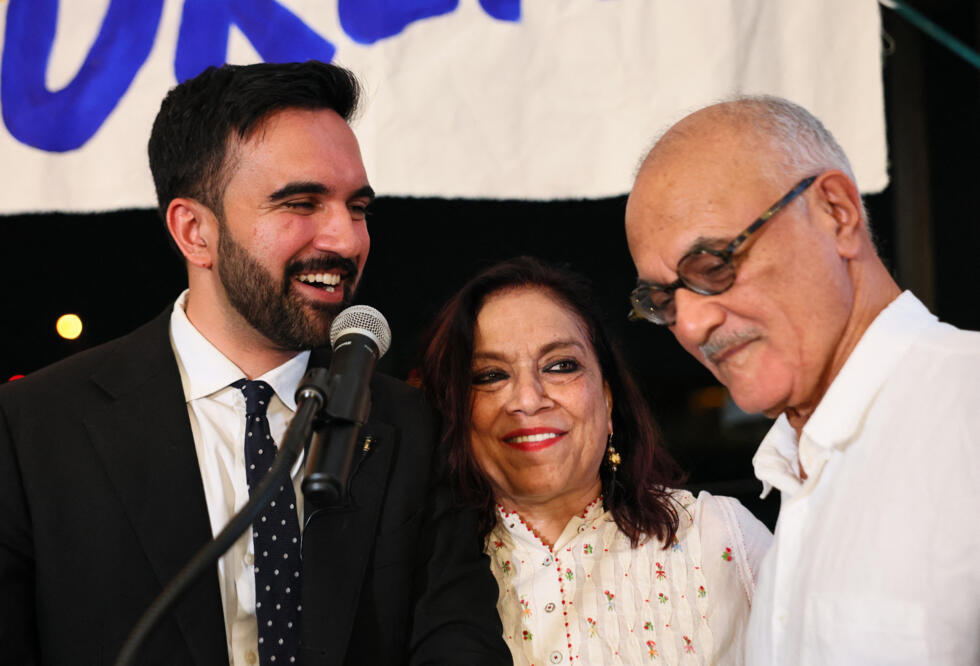
Mamdani is a graduate of the city’s public school system, having attended the Bronx High School of Science and earning a degree in Africana Studies from Bowdoin College in 2014 – where he co-founded his college’s first Students for Justice in Palestine chapter.
He helped low-income Queens homeowners fight eviction as a housing counsellor before going into politics, and this labour-driven political spirit has persisted throughout his career.
Mamdani’s Assembly member profile states that "he believes that the future we deserve is one where housing, energy, and justice are for the many, not just the few”.
His campaign policies include: universal childcare for children aged 6 weeks to 5 years old; a chain of city-owned grocery stores focusing on affordability; rent freezes and stricter accountability for careless landlords; tripling the production of rent-stabilised, union-built housing; and free citywide bus service.
Viral candidate
Barely six months ago, many political insiders had dismissed out of hand the millennial candidate from Queens, one of the most diverse neighbourhoods in the US. On social media though, he was a rising star for the city’s younger, more plugged-in generation.
Mamdani has posted on TikTok in both Spanish and Urdu including rap-filled, cinematic, vertical short videos where he speaks to the camera while strolling New York's streets, appealing to a younger demographic.
Comments on TikTok include things like, "Girl, I'm not even from New York, but I hope he wins."
He also walked the whole length of Manhattan a few days prior to the primary, stopping to take selfies with voters, and broke his Ramadan fast on the subway with a burrito to highlight food insecurity.
The democratic socialist has appeared on various podcast shows, including American socialist influencer Hasan Piker's.
Mamdani also talked in popular social media shows with TikTok host Kareem Rahma on “Keep The Meter Running” at the back of a classic New York City yellow cab, where he talked about his support for the city’s drivers.
In “Subway Takes”, he responded to questions about his campaign, covering his proposal to hike taxes on the rich, debunking allegations about wanting to defund the police and taking questions on the rising prices of matcha lattes. He covered it all in under three minutes.
The candidate also appeared on The Late Show With Stephen Colbert on Monday, where he responded to oft-repeated questions about his stance on the Israel-Palestine conflict.
He stated that he believes Israel "has a right to exist and a responsibility also to uphold international law, like all nations". However, anti-Semitism, he stressed, had no place in the city and he vowed to increase funding to combat hate crimes.
As a Muslim, Mamdani has openly talked about receiving Islamophobic threats daily. The NYPD is currently investigating the threats.
What his critics say
While Mamdani insists on ways to make life in the city more affordable, critics question his lack of experience and ability to deliver on his promises.
Cuomo and others believe Mamdani is too radical to administer a city with a $115 million budget and more than 300,000 municipal workers.
Centrist think-thank Third Way agenda released a statement last week saying Mamdani’s win could be a “devastating blow to fight Trumpism”.
Cuomo also suggested that Mamdani wouldn’t be able to handle President Donald Trump, a veteran New York real estate magnate.
“He’s never done any of the essentials. And now you have Donald Trump on top of all of that,” Cuomo said during a recent debate.
In response, Mamdani brought up the former governor's billionaire backers and sexual harassment scandal.
“I’ve never had to resign in disgrace,” Mamdani said during one debate. “I have never hounded the 13 women who credibly accused me of sexual harassment. I have never sued for their gynaecological records. And I have never done these things because I am not you, Mr. Cuomo.”
Noting that corporations, large landlords, developers, and donors "want to keep him out of the mayor's office," India Walton urged Zohran Mamdani's campaign to "stay ahead of the messaging and stay on doors."
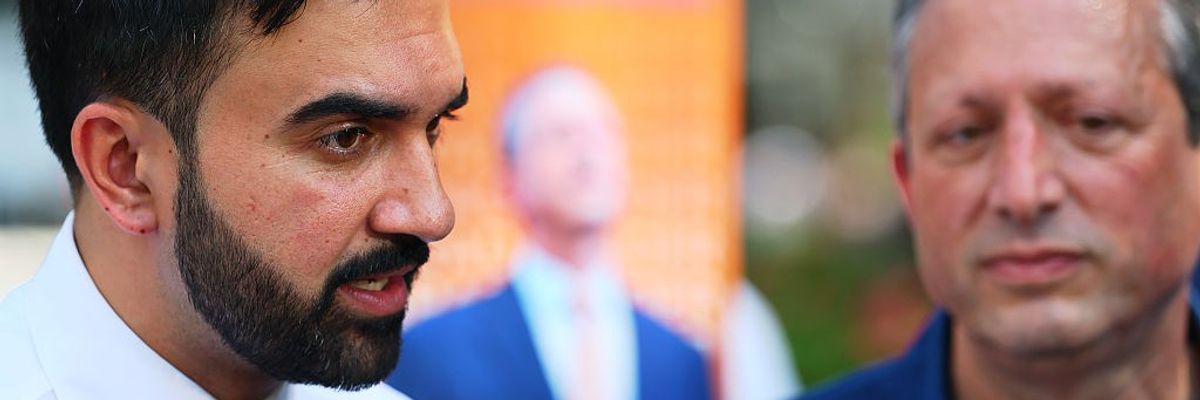
New York mayoral candidate Zohran Mamdani speaks with members of the press on June 24, 2025 in New York City.
(Photo: Michael M. Santiago/Getty Images)
Jessica Corbett
Jun 26, 2025
Democratic socialist Zohran Mamdani on Tuesday beat disgraced former New York Gov. Andrew Cuomo in the Democratic NYC mayoral primary—but progressives within and beyond the city don't expect the billionaire class and party establishment that lined up against him to give up so easily. Going into the general election, those who believe in Mamdani's vision are encouraging him and his supporters to maintain the momentum of the movement they've built.
"This is a foot-on-the-gas kind of moment," RootsAction senior strategist India Walton told Common Dreams.
Walton knows about what she speaks. In June 2021, the community activist and healthcare worker defeated incumbent Byron Brown in the Democratic primary for mayor of Buffalo, New York's second-largest city. However, following a bruising general election race, Brown won in November as a write-in candidate—dashing the hopes of Walton's working-class agenda.
"Folks like myself and Zohran have not fallen out of the sky," Walton said. "We have our roots in organizing, and to be able to turn out 40,000 volunteers speaks volumes about how Zohran has been on the frontlines of movements and of issue-based campaigns. And when people know that you have a moral compass and you are fighting for them, they are motivated to come out for you—not only to vote but to volunteer, and I think that we have to believe for ourselves, as progressives, that not only is our message resonant, but our relationships are vital to continuing to see these kinds of wins."
"The way that you combat fear and lies is by having one-on-one conversations with people, because if it comes on a glossy mailer, it's easy to believe."
As Mamdani and his supporters—in New York City and across the country—turn their focus to the general election, Walton said, "we need more people out, more people in the media, cheering him on, congratulating him, and talking about how progressive values do win elections."
"Do what is in your lane to do right: if you can donate five dollars, then donate five dollars; if you can spend an hour phone banking then spend an hour phone banking; if you can make a piece of original art and send it to the campaign to be used on campaign materials, do that," she said. "Whatever it is in your spirit, whatever time, talent, and treasure you have, do that, because this is gonna take all of us in order to make sure that he makes it over the finish line, and it's gonna send a resounding message in November, what this country wants, what this country needs, and what a city that really sets the stage for the tone of the rest of the nation could be."
Walton also cautioned that "I think that we should have every reason to be suspicious of people who endorsed Andrew Cuomo and now want to jump on the Zohran train, because they're only there for their own self-interest."
"I think that a part of where I made a mistake was trying to cozy up to the corporate Democrats who rejected me in the first place," she said, reflecting on her 2021 loss. Mamdani can "keep the tent big," because "we know other people are gonna wanna come along when the train is moving," she noted, "but you don't have to put them in your inner circle."
Billionaires, including former New York City Mayor Michael Bloomberg, and corporate interests, such as DoorDash, poured money into Cuomo's primary race. "There's gonna be more of that," as well as attacks on Mamdani from "folks who traditionally donate to Republicans," Walton warned. "It's corporations. It's large landlords. It's developers. It's the donor class. It's the billionaires and the 1% who want to keep him out of the mayor's office."
As Common Dreams has reported, members of the U.S. oligarchy—including Republican President Donald Trump, an erstwhile New Yorker who publicly melted down about Mamdani's primary win, and billionaires like Bill Ackman—are "terrified" that the democratic socialist may be the city's next mayor.
Walton urged Mamdani's campaign to "stay ahead of the messaging and stay on doors. The way that you combat fear and lies is by having one-on-one conversations with people, because if it comes on a glossy mailer, it's easy to believe and people don't have time to go doing their own research, but if someone knocks on your door and has a three-minute conversation with you about who Zohran is, what he's done, and why you should vote for him, that's so much more meaningful than getting a piece of mail."
It's not yet clear exactly who Mamdani, a current member of the New York State Assembly, will face in the general election. Cuomo is considering his next move after conceding Tuesday night—but the ex-governor, who resigned from that post during a sexual harassment scandal, is openly teasing a potential independent run.
"I said he won the primary election," Cuomo toldThe New York Times in a phone call shortly after his concession speech. "I said I wanted to look at the numbers and the ranked-choice voting to decide about what to do in the future, because I'm also on an independent line. And that's the decision, that's what I was saying. I want to analyze and talk to some colleagues."
The city's current controversial mayor, Eric Adams, is already running as an independent for another term—and, as Semaforreported Wednesday, in the wake of Mamdani's win, the ex-cop has suddenly found "'overwhelming support' from NYC's desperate business elites."
As Gothamistdetailed Wednesday, the other candidates are the Republican nominee, Guardian Angels founder Curtis Sliwa, who "is back on the GOP ballot line four years after Adams trounced him in the general election," and defense attorney Jim Walden, a former federal prosecutor "running a centrist campaign on yet another independent line."
Tuesday's results may be enough to deter Cuomo from launching another campaign for this cycle. As progressive Democratic strategist Waleed Shahid wrote Wednesday for Zeteo:
Mamdani's victory redrew the map of what's possible in New York City politics. He didn't win on the backs of white gentrifiers alone; he built a multiracial, cross-class coalition that reached from the brownstones of Park Slope in Brooklyn to the apartment towers of Jackson Heights in Queens. He ran up margins in progressive enclaves like Park Slope, East Village, and Cobble Hill, but also won working-class, immigrant-heavy neighborhoods across Queens and Brooklyn—Bangladeshi, Chinese, Latino, Arab, Indo-Caribbean. He was the highest performer in Queens among Latino and South Asian precincts and carried South Asian strongholds like Richmond Hill and Jackson Heights, and East Asian precincts like Sunset Park, Chinatown, and Flushing. Most strikingly, he flipped Oakland Gardens, a swing district in Queens... long seen as part of Cuomo's base. Mamdani didn't just activate the left; he broke into communities that conventional wisdom says don't vote socialist. And he did it with a disciplined message on public goods and affordability, backed by a massive, relentless volunteer field operation.
During the primary race, Mamdani battled Islamophobic threats and unfounded allegations of antisemitism. The Muslim victor and fellow candidate Brad Lander, who is Jewish, also endorsed each other—encouraging voters to take advantage of the city's rank choice voting system by listing both men on their ballots and leaving Cuomo unranked.
Other prominent Jewish people and groups also backed Mamdani—including Jewish Voice for Peace (JVP) Action, which "endorsed Zohran on the first day he launched his campaign because we knew this would be a historic opportunity for our movements," the group's political director, Beth Miller, said in a Wednesday statement.
"Trump-supporting billionaires and hateful politicians spent millions of dollars trying to smear Zohran and use the New York Jewish community as a political pawn to drive division. They failed," Miller continued. "Jewish New Yorkers joined the broad and diverse coalition of this campaign to elect a mayor who will fight with us for the humanity, dignity, and freedom of all people—from NYC to Palestine."
"For decades, traditional political wisdom said that in order to win elections, politicians shouldn't speak about Palestinian rights, or hold the Israeli government accountable to international law," she pointed out. "But Zohran's historic victory last night that toppled a political dynasty shows that people are done with that tired, racist, and hateful old version of politics. Our future is not about any one politician. It's about all of us. It's about our movements and what everyday people can build when we come together."
"He is among the many young people inspired by Bernie Sanders' 2016 presidential campaign," Davis wrote. "Mamdani was built by the DSA and the young left-wing milieu that emerged after the Sanders campaign. They cannot be separated. Not his charisma or campaign style. He is a product of the movement."
Sanders endorsed Mamdani last week and toldPolitico after the primary election: "Look, he ran a brilliant campaign. And it wasn't just him. What he understood and understands—campaign's not over—is that to run a brilliant campaign, you have to run a grassroots campaign. So instead of taking money from billionaires and putting stupid ads on television, which the people increasingly do not pay attention to, you mobilize thousands and thousands of people around the progressive agenda that speaks to the needs of working-class people, and you go out and you knock on doors."
"You cannot run a grassroots campaign unless you excite people. You cannot excite people unless you have something to say. And he had a lot to say," Sanders explained. "He said that he wants to make New York City livable, affordable for ordinary people, that the wealthiest people in New York City are going to start to have to pay their fair share in taxes so that you can stabilize the outrageously high costs of housing in New York, which, by the way, is a crisis all over this country. That you could deal with transportation in a sensible way, deal with childcare, deal with healthcare, deal with the needs of ordinary working-class people."
Sanders—who has responded to Trump's second term and Republican control of Congress by taking his Fighting Oligarchy Tour around the country—framed Mamdani's win as an opportunity for Democratic Party leaders to learn important lessons after devastating losses during the last cycle: "We need an agenda that speaks to working-class people, activates millions of people around this country to get involved on that agenda. Take on the billionaire class, take on oligarchy. That's how you win elections."
"I think they have a lesson to learn, and whether or not they will, I have my doubts," the senator said of Democratic leadership. "If you look at the dynamics of this campaign, what you have is older folks voting for Cuomo, the billionaire class putting in millions of dollars into Cuomo, all of the old-time establishment candidates and politicians supporting Cuomo, and he lost."
In an early signal that Sanders may be right about the party leadership not learning any new lessons, Axiosreported Thursday that "many Democratic leaders and donors are panicking" about Mamdani's win—noting that some party leaders have congratulated but not endorsed him, while other officials continue to speak out against him.
Responding to that report on social media, Nina Turner, a former progressive congressional candidate from Ohio, and David Hogg, a gun violence prevention advocate recently ousted as vice chair of the Democratic National Committee after pushing for primary challenges to "asleep-at-the-wheel" Democrats in blue districts, both pointed in jest to a longtime part line: "Vote blue no matter who."
Hogg this week also joined a growing chorus of progressives using Mamdani's victory to call for primary challenges against the Democratic establishment, and to launch campaigns prioritizing working-class priorities.
Victor Rivera, co-founder and executive director of Beyond the Ballot, another organization backing Mamdani, said in a statement that "America's largest city just sent a clear message: Billionaire rule is on borrowed time."
"New Yorkers are done with a politics that serves luxury developers, hedge fund landlords, and police lobbyists. Zohran's victory proves that ordinary people, tenants, workers, students, and immigrants, are reclaiming power for the people," added Rivera, whose group is made up of Gen Z organizers fighting "both far-right extremism, and the corporate wing of the Democratic Party."
In a Wednesday fundraising email with the subject line "Zohran Mamdani," Sanders argued that "we cannot stop with just one primary victory in New York City," and promoted candidates including Abdul El-Sayed, a U.S. Senate hopeful in Michigan, and Troy Jackson, who is running for governor of Maine.
The senator also highlighted four candidates seeking seats in the U.S. House of Representatives: Rebecca Cooke in Wisconsin, Adelita Grijalva in Arizona, Donavan McKinney in Michigan, and Robert Peters in Illinois.
"The political future of our country rests upon the very simple principles that working people need to stand together EVERYWHERE to fight back against corporate greed and create an economy that works for all of us, and not just billionaires and large corporations," he said. "We need to elect people up and down the ballot who have the guts not only to stand up to Trumpism, but to take on the monied interests and fight for a working class that has been ignored for far too long."
The lesson learned from Mamdani’s success is that voters want strong policy positions that will actually produce change.
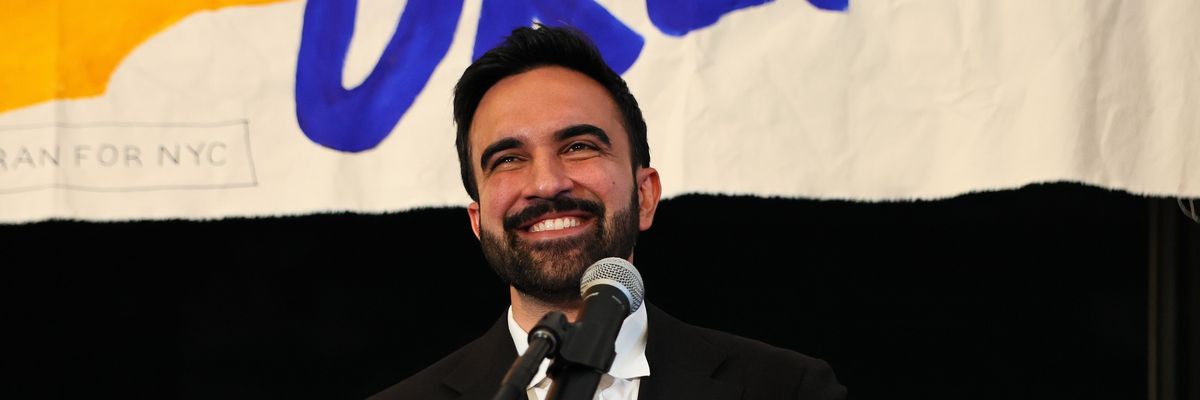
New York mayoral candidate, State Assemblymember. Zohran Mamdani (D-36) speaks to supporters during an election night gathering at The Greats of Craft LIC on June 24, 2025 in the Long Island City neighborhood of the Queens borough in New York City.
(Photo: Michael M. Santiago/Getty Images)
Sam Levine
Jun 26, 2025
Thirty-three year old democratic socialist Zohran Mamdani’s victory over scandal-ridden and disgraced former New York Gov. Andrew Cuomo paves the way for a future apart from tired Democratic establishment rhetoric, giving Americans hope for the left after the election of President Donald Trump.
Cuomo was the darling of the corporate PACs, who have held the Democratic Party in a stranglehold for decades; he was endorsed by former President Bill Clinton, funded by former New York City Mayor Mike Bloomberg, and took money from Republican-backed super PACs. His campaign strategy rested entirely on name recognition rather than grassroots organizing that connects with everyday New Yorkers.
Mamdani’s campaign was the opposite of all of that: He started out polling 1% in February with little funding, being a relatively unknown state assemblymember. His campaign was truly a grassroots effort—being outspent multiple times over by Cuomo, Mamdani relied upon an army of tens of thousands of volunteers who spent months leafleting and knocking on doors.
For the Democrats who will continue to stick to the line of their corporate sponsors: Watch out for progressives like Mamdani who are coming to challenge you.
Since Trump’s election, establishment Democrats have suggested a number of ideas for how to win back the country, attempting to recapture the working class who have been ignored by both parties. Suggestions include Rep. Seth Moulton’s (D-Mass.) to throw trans people under the bus, California Gov. Gavin Newsom’s to reach out to far-right commentators like Charlie Kirk, and James Carville’s idea that Democrats should “play dead.” Mamdani’s election was voting Democrats rejecting all those ideas in favor of an aggressive and progressive platform to resist Trump.
Mamdani’s lack of seniority, both in age and years in office, represent a crack opening in the gerontocracy and nepotism in American politics. Cuomo represents the ways of the past. He’s not just an elderly lifelong politician, but the son of a former governor. Mamdani’s nomination signals that the Democratic Party is hungry for new leadership with fresh ideas. However, a fresh face can also sometimes be a Trojan Horse for old and tired ideas.
One such case is Rep. Jake Auchincloss (D-Mass.), the young Massachusetts congressman with ambitions for higher office who may seem promising because of his age and supposed charm, but is no more than a vessel for the same old neoliberal order that got us in this mess. Auchincloss and others have promoted the “abundance movement”—basically a repackaging of neoliberal ideas under a new banner. What separates Mamdani from Auchincloss is that Mamdani is more than a pretty face with “refreshing” words; he is an authentic populist in the best sense of the word, with bold policies garnering mass appeal.
Mamdani’s plan to make buses fast and free, freeze the rent, and make childcare universal deeply resonates with New Yorkers facing a crippling affordability crisis. Mamdani’s policies are widely popular, but you would never see them come out of the mouths of politicians like Cuomo and Auchincloss whose corporate backers have them on a leash. Because he couldn’t compete with Mamdani on policies that improve the lives of New York City’s residents, Cuomo tried making the race about something thousands of miles away.
Cuomo tried to use Mamdani’s principled support for Palestinian human rights as a weapon against him, as if calling for equal rights between Israelis and Palestinians is a scandal equivalent to Cuomo’s harassing 13 women. Ironically, one of Cuomo’s ads accusing Mamdani of antisemitism was blatantly Islamophobic, depicting Mamdani’s beard edited to appear darker and thicker. The media joined forces with Cuomo in a debate by singling out Mamdani with a question on where the candidates’ first foreign trip as mayor would be. Cuomo and three other candidates said Israel, while Mamdani stated he would stay in New York City to address city issues. The moderators then jumped on Mamdani, questioning him on “Israel’s right to exist as a Jewish state,” to which he replied that he believes it has the right to exist “as a state with equal rights,” an idea unacceptable to an unapologetic supporter of Israel’s racist policies like Cuomo.
What Cuomo fails to understand is that the issues most relevant to Jewish New Yorkers are the same issues important to all New Yorkers. The real antisemitism in this race is Cuomo’s belief that New York City Jews care more about Israel than their fellow New Yorkers.
Mamdani was endorsed by a number of Jewish organizations and prominent Jewish individuals including Jewish Voice for Peace Action; Sen. Bernie Sanders (I-Vt.); and his fellow candidate and highest-ranking Jewish official in the city, Brad Lander. Hopefully the lesson learned from Mamdani’s victory is that voters want strong policy positions that will actually produce change, and that will embolden other Democrats to adapt some of the messages and policies central to his campaign. For the Democrats who will continue to stick to the line of their corporate sponsors: Watch out for progressives like Mamdani who are coming to challenge you.
For Mamdani, his race for mayor is not yet over. In the general election he faces off with corrupt incumbent Mayor Eric Adams who is running as an independent and the Republican nominee, right-wing vigilante Curtis Sliwa. There is a possibility that Cuomo will also run as an independent, but his concession in the primary likely means he has given up his bid for mayor.
The failure of Cuomo’s bid is a signal to establishment Democrats across the country that their voters no longer tolerate support for Israel or buy into the allegations of antisemitism thrown at anyone who opposes Israel’s policies.
In these difficult times where we are facing a potential new forever war in the Middle East, the immoral kidnappings of immigrants, and increased repression of our movements, this seemingly underdog victory in New York City is a beacon of hope for all us who still believe a better world is possible.
Mamdani Shows Pro-Palestine Politics Can Win, Activists and Writers Say
Zohran Mamdani's opponents "made it a referendum on anti-Zionism being antisemitism," said journalist Spencer Ackerman. "They lost."
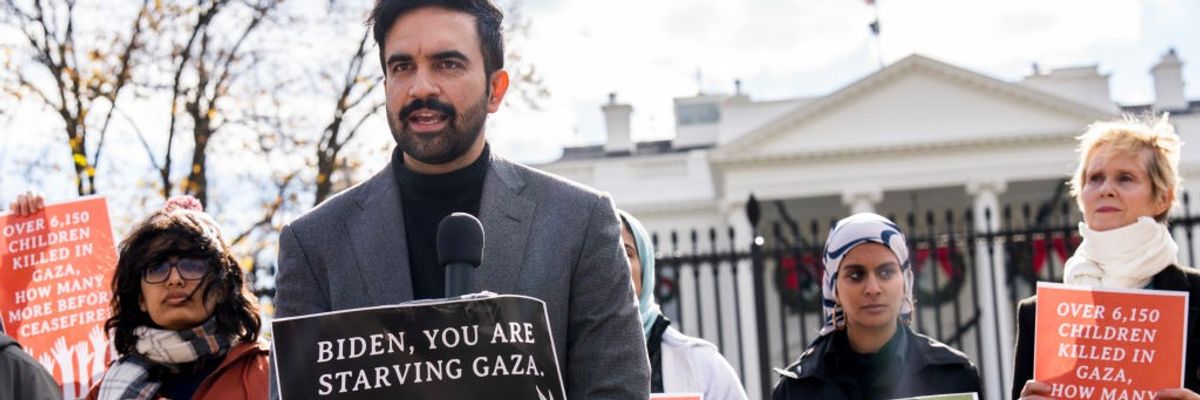
New York state Rep. Zohran Mamdani (D-36) speaks outside the White House to announce a hunger strike to demand that President Joe Biden "call for a permanent cease-fire and no military aid to Israel," on November 27, 2023.
(Photo: Tom Williams/CQ-Roll Call, via Getty Images)
Stephen Prager
Jun 26, 2025
Common Dreams
Following state Assemblymember Zohran Mamdani's upset victory in New York's Democratic mayoral primary on Tuesday, progressive writers and activists are making the case that strident support for Palestine was one of his key assets.
In the weeks leading up to Election Day, the 33-year-old democratic socialist was peppered with accusations of "antisemitism" from supporters of his centrist opponent, former New York Gov. Andrew Cuomo.
They singled out Mamdani's past calls to boycott Israel over human rights violations, his criticisms of Israel following the October 7, 2023 attacks, and his sponsorship of legislation to penalize nonprofits that fund illegal Israeli settlements in the West Bank.
But contrary to expectations that this would make his campaign a dead letter in the city with America's largest Jewish population, he not only defeated Cuomo by more than seven points on the first ballot, but did so with large amounts of Jewish support.
"Cuomo was counting on the idea that Zohran's support for Palestinian rights would be a liability for him, but what last night showed was that that's not true," said Beth Miller, the political director of Jewish Voice for Peace (JVP) Action in comments to Al Jazeeraon Wednesday.
Mamdani's victory came at a historic nadir for pro-Israel sentiment among Democratic voters. In a Quinnipiac poll conducted from June 22 to 24, 63% of Democratic voters said they felt the U.S. was "too supportive of Israel," an all-time high.
That translated to how New Yorkers viewed the primary. In a May 28 poll from Emerson College, 46% of the Democrats surveyed said they did not think it was important for the city's next mayor to have pro-Israel views, compared to just 33% who said they believed it was.
Mamdani's view of Israel's actions in Gaza, which he has described as "genocide" and "war crimes," increasingly reflects that of Democratic voters. Cuomo, who previously served as part of the legal team defending Israeli Prime Minister Benjamin Netanyahu against war crimes charges, insisted that using such harsh language toward Israel's human rights abuses was fueling anti-Jewish hate crimes at home.
"They made it a referendum on anti-Zionism being antisemitism," journalist Spencer Ackerman, a supporter of Mamdani, told The Forward, a Jewish publication. "They lost."
Despite repeated questioning about his foreign policy stances on the campaign trail, Mamdani did not apologize or back off his stances. In comments to Al Jazeera, Heba Gowayed, a sociology professor at the City University of New York, said that his unwillingness to flip on his past stances only bolstered his sense of authenticity.
"The fact that he refused to back down from his position on Palestine is huge," Gowayed said. "In an atmosphere where we've been told that holding that position is politically disqualifying, it was a movement that not only insisted on this position but was, in a sense, predicated on it."
Mamdani's victory was not simply despite Jewish voters. He won in large part because of Jewish support. A poll from May showed him to be the second-most popular candidate among Jewish New Yorkers, behind only Cuomo.
He also forged a critical alliance with New York's highest-ranking Jewish elected official, Comptroller Brad Lander. Not only did Lander encourage his chunk of supporters to rank Mamdani, but he helped him fight back against the spurious accusations from the Cuomo camp, accusing the former governor, who has come under fire in the past for making negative remarks about Jews, of "trying to weaponize antisemitism for his own political gain."
Mamdani also received endorsements from influential progressive Jewish groups, including JVP Action and Jews for Racial and Economic Justice (JFREJ), who said the Democratic establishment took for granted that Jewish voters cared only about Israel.
Sophie Ellman-Golan, a spokesperson for JFREJ, a New York-based group with more than 6,000 members, said that Jewish New Yorkers were galvanized by Zohran's optimistic message about making the city affordable and prosperous for everyone.
"There's a fixation on, because we are Jews, we must be primarily focused on Israel," she told The Times of IsraelWednesday. "This is not to say these issues don't matter to Jews, of course they do, but we are also New Yorkers, and we are dealing with the same material conditions that other New Yorkers are."
Ellman-Golan elaborated in comments to the independent publication The Handbasket.
"Jewish New Yorkers are just like other New Yorkers. We also want affordable housing and childcare, and excellent public transit, and for this city to be a place where we can build a future," she said. "That's what Zohran ran on, and that's why New Yorkers—Jewish and non-Jewish alike—voted for him!"
Don’t Mess with the Zohran
June 26, 2025
He knows
He’s a socialist
He knows the newest media
He froze his ass off at Coney Island just so you could feel secure in your rent-stabilized unit, he knows where you can buy 3 suits for 50 bucks, he knows
New York is just a state of mind
Like Coney island, come to think of it,
where the wind howls like the laughter of children disappeared
in the endless summer sunlight, mental as,
ask me
Don’t Mess with the Zohran
He knows the up and down in Uganda
‘a killer and clown, big-hearted buffoon and strutting martinet’
And SNL will be calling
Atlantic says he’s a magical realist
says it with a straight face
here in America
just because he rides pachyderms through tiger-infested jungles of the night
in India
where it rains
and (picnic lightning)s
Don’t Mess with the Zohran
He raps raps raps
Like E A Poe’s raven
at the window with a broken wing
Never More
The Brits are already taking bets
The day and hour the Zionists will
take him out
(Busy on two fronts right now)
Take him out
Take the goddamned self-loather out
Send in Zohan
Let them rumble
From cab roof to cab roof
down off Broadway
The living proof
That our flag was still there
When he pretzels the z from z-land
O say can you see?
The Master’s Hand
Don’t Mess with the Zohran
He might get rid of student loans, too
Hey, what if the raging weatherman clouds
Turn Rorschach red and black on our ass?
And we read the writing on the bat-stained wall?
Don’t Mess with
Don’t Mess with him
If you see him on a freedom bus
on his way to freelunchville,
up Donald Trump way
give him an emoji thumbs up
and smile like the whitest picket fence of all time
beam
it will take a little while
Alexander Willis
June 26, 2025
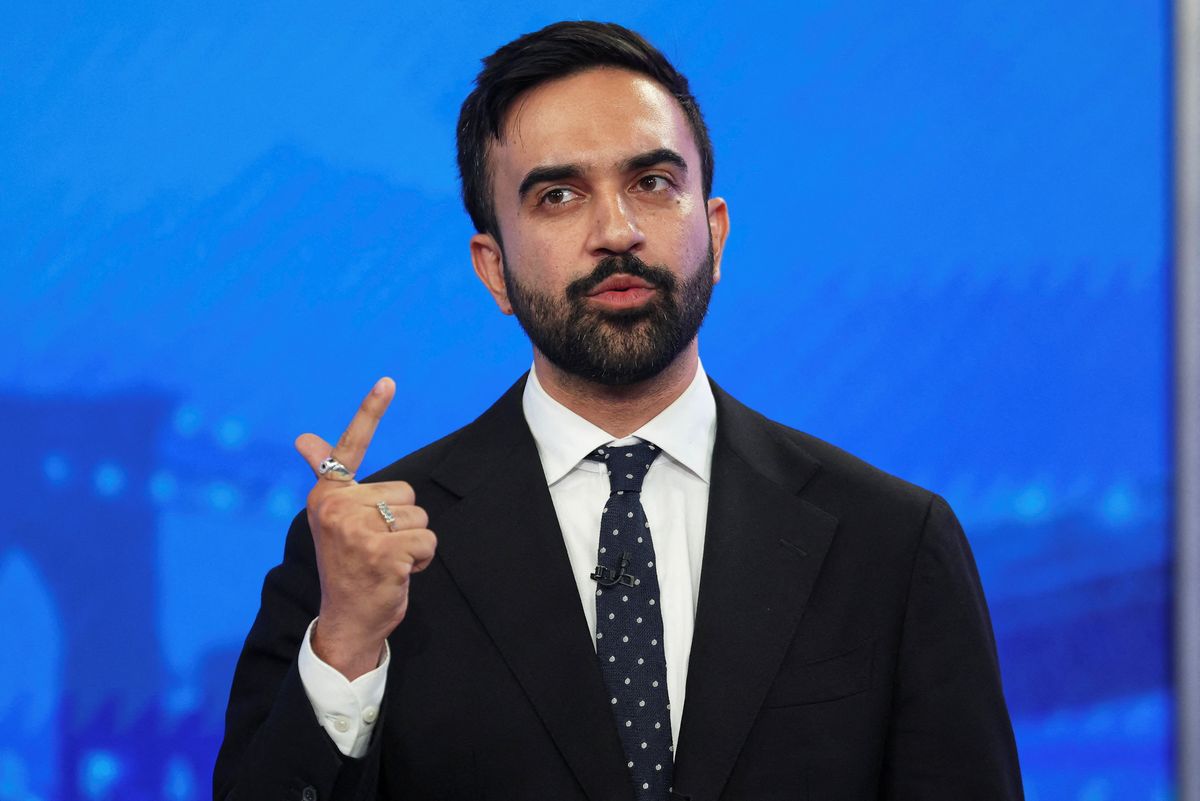
Candidate Zohran Mamdani speaks during a Democratic mayoral primary debate, June 4, 2025, in New York, U.S. Yuki Iwamura/Pool via REUTERS
After the stunning upset that was Zohran Mamdani’s victory in the New York City mayoral Democratic primary election, one Republican lawmaker is now calling for his deportation.
“Zohran ‘little muhammad’ Mamdani is an antisemitic, socialist, communist who will destroy the great City of New York,” railed Rep. Andy Ogles (R-TN) in a Thursday post on X. “He needs to be deported. Which is why I am calling for him to be subject to denaturalization proceedings.”
Mamdani’s victory, achieved in part by running on a progressive policy agenda that includes rent freezes and increasing the minimum wage, has caused panic among Wall Street financiers, Republicans and many in the Democratic establishment. For Ogles, however, that panic has reached a level that compelled him to officially request that the Department of Justice consider revoking Mamdani’s citizenship.
Specifically, Ogles singled out lyrics to a song performed by Mamdani more than a decade ago, in which he rapped “free the holy land Five, my guys,” referring to leaders of the Holy Land Foundation for Relief and Development, a United States-based Islamic charity, some of whom were indicted on charges of providing material support to Hamas, the political and military body of Palestine.
“While I understand that some may raise First Amendment concerns about taking legal action based on expressive conduct, such as rap lyrics, speech alone does not preclude accountability where it reasonably suggests underlying conduct relevant to eligibility for naturalization,” Ogles wrote to Attorney General Pam Bondi.
“... I respectfully urge the Department of Justice to determine whether Mr. Mamdani’s conduct prior to naturalization warrants formal review under applicable law.”
While he's the first lawmaker to call for Mamdani's deportation following his victory, he is not the first Republican to do so. The New York Young Republican Club in a social media post on Wednesday called on Deputy Chief of Staff Stephen Miller and Border Czar Thomas Homan to revoke Mamdani's citizenship and have him deported, warning that his "radical" policies would "destroy our beloved city of New York."
"Trump attacking Mamdani is basically an endorsement at this point," said one social media user.
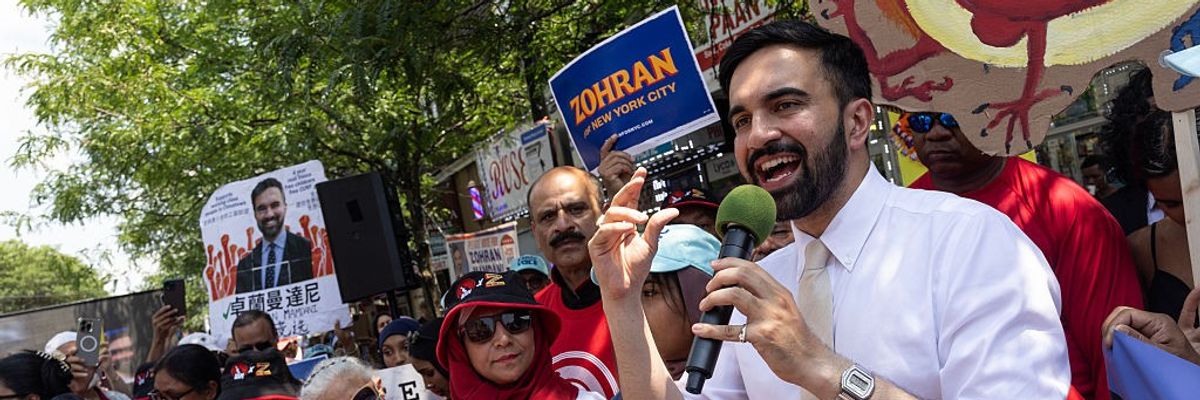
New York City mayoral candidate Zohran Mamdani attends a campaign rally on June 21, 2025, in Diversity Square in the Jackson Heights neighborhood of the borough of Queens.
(Photo: Andrew Lichtenstein/Corbis via Getty Images)
Jun 25, 2025
Democratic socialist Zohran Mamdani won New York City's Democratic mayoral primary on Tuesday by campaigning on issues including affordable housing, fare-free buses, no-cost childcare, green schools, and raising the minimum wage—a platform that has "terrified" oligarchs, including Republican U.S. President Donald Trump, who weighed in Wednesday afternoon.
In a pair of posts on his Truth Social network, Trump—an erstwhile New Yorker—called Mamdani "a 100% Communist Lunatic," said that "we've had Radical Lefties before, but this is getting a little ridiculous," and attacked the winner's appearance, voice, intelligence, and supporters, including Congresswoman Alexandria Ocasio-Cortez (D-N.Y.).
"I have an idea for the Democrats to bring them back into 'play.' After years of being left out in the cold, including suffering one of the Greatest Losses in History, the 2024 Presidential Election, the Democrats should nominate Low IQ Candidate, Jasmine Crockett, for President," Trump wrote of a Democratic Texas congresswoman willing to call out him and his allies in Congress.
"AOC+3 should be, respectively, Vice President, and three High Level Members of the Cabinet," Trump continued, referring to progressive Reps. Ilhan Omar (D-Minn.), Ayanna Pressley (D-Mass.), and Rashida Tlaib (D-Mich.). "Added together with our future Communist Mayor of New York City, Zohran Mamdani, and our Country is really SCREWED!"
Critics of Trump took the comments as a clear signal that the second-term president is scared of Mamdani and other progressive political leaders fighting for policies that would improve the lives of working people.
"Trump attacking Mamdani is basically an endorsement at this point," wrote a Bluesky user called The Vivlia.
Georgia state Rep. Ruwa Romman (D-97)—known nationally as the Palestinian American barred from speaking at last year's Democratic National Convention—said: "...is Trump jealous of Zohran??? The focus of his posts is... something."
In an opinion piece published by Common Dreams before Trump's afternoon comments, political organizer Corbin Trent wrote that Mamdani beat disgraced former Gov. Andrew Cuomo "by acknowledging what everyone already knows—life has become unaffordable—and saying we're going to build our way out of it. Housing that teachers can afford. Transit that actually works. Childcare centers so parents don't have to choose between working and raising their kids. And that the ultrawealthy are going to pay their fair share."
Trent argued that other Democrats, and especially the party leadership, have much to learn from Mamdani—both in style and substance—if they want to win back voters who have gravitated to Trump and his right-wing MAGA worldview.
"Mamdani hasn't even been elected yet," Trent noted. "But he's shown us how to stop lying about what needs fixing. He's shown that you can win by promising to build for everyone, not just donors."
All Politics Is Global: The Meaning of Zohran Mamdani’s Insurgent Victory
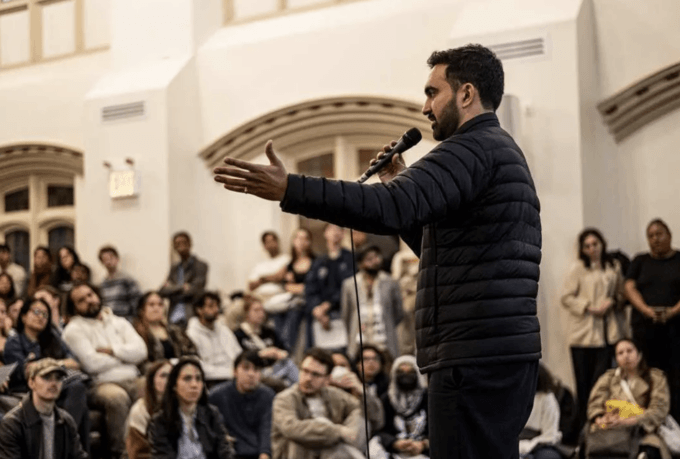
Photo by Bingjiefu He via Wikimedia Commons.
Andrew Cuomo’s attempt at a comeback served as a case study in civic fragility, hypocrisy, party loyalty, and political amnesia. Aside from the credible allegations that once had the establishment calling for him to step down, Cuomo ensured the maintenance of structures for political reentry, channeled pandemic funds for personal gain, and facilitated a GOP-led state senate through backroom deals. Further, he joined the legal team defending Benjamin Netanyahu against genocide charges, a catastrophic error. While many union members and elected officials may be quietly ashamed of their recent self-serving endorsements, Cuomo’s entire calculus was based on a cynical reliance on strategic soft power in the locale. His reemergence wasn’t based on a political comeback per se; it was more of a revealed assumption that New Yorkers would accept a “race to the bottom” that trumped (ahem) our civic expectations.
Cuomo thought of himself as a formidable incumbent of sorts and had a campaign powered by Super PACs, landlord money, and the strategic use of name recognition. Cuomo also perceived that many voters, worn down and disengaged, would simply vote along party lines. Insurgents like Zohran Kwame Mamdani, who stood for justice and equity, initially struggled for visibility while Cuomo enjoyed disproportionate support in a race he’d lose even more convincingly, if based on a democracy instead of a polyarchy. All throughout the primary season, Cuomo enjoyed a high number of African American and women potential voters, despite his record. His campaign in my opinion, however, was not based on a return to leadership, but rather a cynical power grab rooted in his own knowledge of the structural elements of the Democratic Party machine, still designed to dismiss any past transgressions.
In an era where global conflict, migration patterns, and economic interdependence impacts local politics, the assertion that “all politics is global” has rarely felt more accurate. Mamdani’s bid for New York City mayor exemplified how international solidarity, racial identity, and transnational justice can energize a municipal campaign in direct confrontation with Cuomo’s establishment-backed approach. Operating simultaneously at the city, state, national and global levels of analysis, Mamdani’s insurgency showed how local governance has become an important place for world politics.
Levels of Analysis
Mamdani’s identity as a Ugandan-born, Indian, and Muslim-American enhanced his appeal within New York City’s diverse electorate. As one of the first South Asians in the New York State Assembly, Mamdani, a visible Muslim leader, used his lived experiences of migration, racialization, and diasporic belonging to connect with voters. Born in 1991 in Kampala, and naturalized in the United States in 2018, Mamdani successfully integrated his racial and religious identity openly into his own form of political messaging. He rather famously stated that politics shouldn’t require translation and emphasized the need for authentic representation of communities historically marginalized by traditional power structures. In this sense, Mamdani was not merely a liberal or idealist candidate, but a realistic representative of global citizenship rooted in local struggle against the forces of Blue MAGA.
Mamdani also demonstrated a strong commitment to frontline economic justice. He notably championed the rights of New York City’s taxi drivers during their fight to preserve their medallions. Recognizing the system’s failure as a symbol of the ever-increasing economic precariat, he organized and supported strikes that highlighted the drivers’ struggles against predatory lending and regulatory neglect, according to the Institute for Policy Studies. This leadership extended beyond local issues. In 2023, Mamdani led a high-profile hunger strike demanding a ceasefire in Gaza, acting on a readiness to join local and global politics with urgent human rights concerns. As a New York State Assemblyperson, Mamdani earned praise for his effective budget management, notably tackling debt responsibly while prioritizing community investments. He proved that progressive governance can be both principled and fiscally sound.
At the individual level, Mamdani’s personal story and moral clarity were in rather stark contrast to Cuomo’s gold-plated and shallow establishment Trump-Berlusconi type persona. Mamdani stood out. His background as a foreclosure counselor allowed him to work intimately with immigrant communities. He often spoke Hindi and Urdu. His resume reflected his background in crisis resolution with stakeholders rather than political pedigree and stockholders. His principled international solidarity was something rarely seen in local campaigning efforts. Zohran’s first-name recognition, combined with impressive small-donor fundraising, helped raise in the upwards of $3.8 million early on, and he surpassed $8 million in total. Liza Featherstone wrote about the Mamdani model and how it revealed a grassroots resonance capable of dwarfing Cuomo’s dependence on donor-lobbyist networks. The victorious campaign (an ongoing one to go well beyond June) shows signs of being the most impressive ground game for a progressive in New York since Julia Salazar in 2018. Nathan Robinson also noticed Mamdani’s high-quality, relatable messaging, suggesting it was an inspiration amidst organized cynicism.
In effect, Mamdani’s campaign operated as a coordinated economic populist movement from the left, built on community resilience. He introduced legislation like Assembly Bill A6943A: the “Not on Our Dime” Act, intended to revoke tax exemptions from nonprofits complicit in funding Israeli settlements. His ambitious housing and transit proposals, rent freezes (that affect over two million residents), free buses across all boroughs, city-owned grocery stores, universal childcare, and a $30 minimum wage, indicated his infrastructure-first focused economic model rather than trickle-down and incremental reforms. In another Featherstone article/study, where she combined bottom-up journalism and election ethnography, a closer look at canvassing operations helped her uncover that Mamdani attracted an unprecedented scale of volunteers; one that activated thousands to conduct door knocking and phone banking.

Image courtesy JVP Action.
Human Rights and Development
A fundamental and defining difference between Mamdani and Cuomo was seen in their opposing conceptions of development. Cuomo’s development framework aligned closely with neoliberal orthodoxies that equated progress with the expansion of capital, real estate development, and finance. His approach relied on technocrats and the maintenance of elite networks, seen in figures like Bill Clinton and Michael Bloomberg. While these endorsements were meant to convey power and legitimacy, I suggest the opposite. Relying heavily on establishment backing indicates insecurity and weak grassroots connections. Cuomo’s reliance on power acknowledged it as his race to lose, not to win, and at some point (especially in 2028), all Democrats will be called on to respond to fractures emerging within the Party.
Mamdani’s vision of development, on the other hand, was one with much more promise in the long run than Cuomo’s. It was more or less rooted in the capabilities approach championed by Amartya Sen and elaborated by Susan Marks and Andrew Clapham in their International Human Rights Lexicon. It was Sen and scholars like Arturo Escobar who famously asserted that true development was “the expansion of real freedoms that people enjoy,” extending beyond mere economic indicators to include education, health, political participation, and dignity. Human rights are not a luxury, but the foundation for sustainable development ,and Mamdani’s platform exemplified this principle. Unlike Cuomo, politicians like AOC, Tiffany Caban, and Salazar before him, Mamdani did not treat development as a byproduct of capital but as an active expansion of human capability. Local leaders, more often, can create space in addressing the failures of capitalism. Mamdani’s human rights-centered development was also seen in his push to address historic racial and economic injustices.
These two distinctions between development, one as capital accumulation (Cuomo) versus two, expanded human rights and freedoms (Mamdani), will be critical features and binaries for potential candidates moving forward, suffering through the Trump era of fascism. Cuomo’s approach brazenly reinforced a predictable status quo, while Mamdani fostered a more participatory, rights-based, and identity-conscious vision of development. He prioritized local governance and public virtue (not private vices) despite the current uphill battle with POC voting blocs wedded to long-standing political traditions. It was all admittedly very complicated, but Cuomo’s reliance on the establishment revealed his inability to fight fairly on the terrain of democracy. He managed to hold onto enough soft power and forms of influence that traditionally legitimized political authority found in capital, but at the expense of citizen control. The Cuomo industrial complex, however, showed great signs of weakness in the past two weeks, especially after AOC’s role in king-making. Dozens of “amnesia endorsements” compiled Cuomo’s main strategy of political reconstruction along with the people that depended on them, thereby showing a lack of true structural integration. This fragility was demonstrated by the advent of “Frankenstein PACs” such as #DREAM, which started the “Don’t Rank Evil Andrew” campaign, splintering a once unified front.
Mamdani’s legitimacy, by contrast, began with the grassroots, leftist identity politics and a commitment to fairness. His alliance included young voters, (52 percent are under the age of 45), as well as immigrants, working-class families, Muslims, and South Asians, and bypassed traditional Democratic gatekeeping.
Epilogue
On election eve, the savvy political analyst Michael Kinnucan reflected on the remarkable progress of socialist politics in New York, noting how far the movement has come since the early campaigns of Julia Salazar and Alexandria Ocasio-Cortez. He acknowledged the emotional stakes of Mamdani’s race. Still, he emphasized that, win or lose, the campaign represented a decisive rejection of establishment centrism and an inspiring outpouring of subsequent political energy. Mamdani, likely to win on July 1st and certified as the Democratic candidate in mid-July, reshaped City politics, using identity as a foundation, not as a technology of the self, while blending global solidarity around peace with local grassroots organizing. He exposed the fragility of Cuomo’s establishment-backed soft power and emphasized the importance of human rights and social movements in defining real development, the capability to live the life you value, and legitimacy, a group or community’s local recognition. Aside from the Mamdani miracle, Alexa Aviles kept her city council seat and progressive Shahana Hanif was also victorious. It was a good night for the left.
Moving forward, newer candidates must reclaim political language from distortion. Phrases like “from the river to the sea” and “globalize the intifada” have been deliberately weaponized. Politicians need to reframe these as calls for secular democracy and equal rights across historic Palestine and transnational resistance to colonialism through civil action. As Stephen Zunes once noted to me, misinformation only breeds fear, clarity disarms it, and if you don’t clarify these statements, they are indeed very problematic.
It is also vital that Mamdani continues to skillfully redefine what “existence” means in local/global politics to avoid rhetorical traps. When asked if Israel has a right to exist, progressives should never hesitate to say yes. But even further, as UN Special Rapporteur Francesca Albanese stated, the issue is not just existence (for Israel already exists, as does Italy or Denmark), but whether any state has the right to exist as a settler-colonial apartheid regime.
Just as Kinnucan suggested, one of Mamdani’s great achievements was forcing the establishment to show its hand. Cuomo’s comeback, powered by billionaire donors and political nostalgia, revealed the fragility of establishment politics, and everyone witnessed it happen. Mamdani’s rise, backed by people, showed how justice-oriented legitimacy can displace monied legitimacy. Democrats also need to be ready to always push beyond the ballot line. Cuomo’s capital-centric approach exposed the limits of traditional power in an era where insurgent localism forges global interconnectedness. Mamdani’s campaign very powerfully illustrates the premise that all politics is global.

No comments:
Post a Comment