VATICAN CITY (RNS) — Po-Shen Loh never expected the pope to be part of the debate over artificial intelligence. But when Pope Leo XIV began urging AI developers to prioritize moral discernment — and was seemingly mocked online by a Silicon Valley investor — the Carnegie Mellon mathematician took notice.
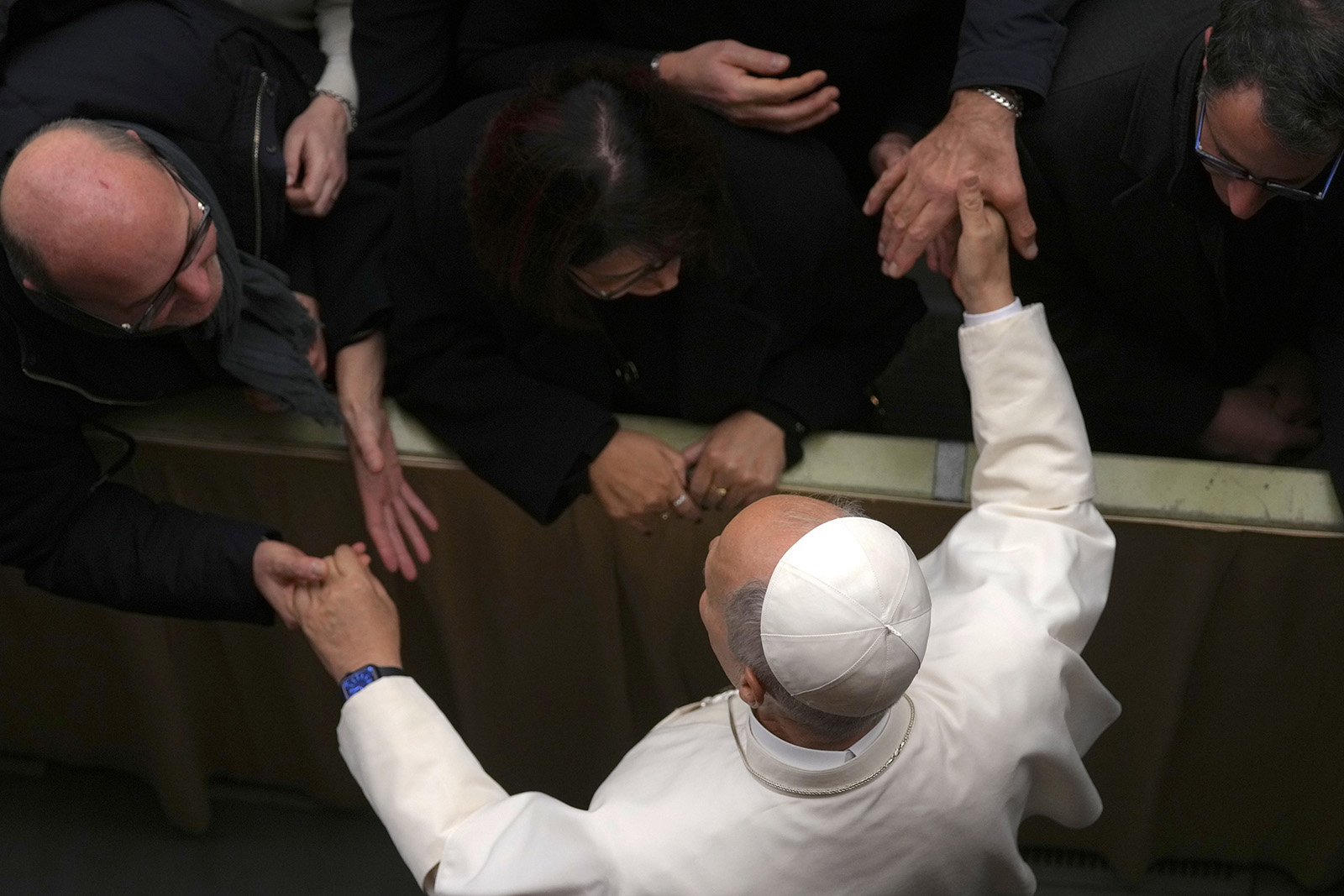
Pope Leo XIV attends an audience with Vatican employees in the Paul VI Hall at the Vatican to exchange Christmas greetings, Dec. 22, 2025. (AP Photo/Domenico Stinellis
Claire Giangravé
December 23, 2025
RNS
VATICAN CITY (RNS) — Po-Shen Loh, a U.S.-born mathematician and inventor, didn’t have the leader of the world’s 1.4 billion Catholics weighing in on the future of artificial intelligence on his 2025 bingo card. Nor did he think that a new pope would be involved in a meme war with a Silicon Valley investor.
A Catholic and the father of three, Loh, 43, has watched the development of AI with concern for its profound impact on society, especially on young people. Since the launch of ChatGPT in 2022, Loh has traveled around the country trying to prepare the next generation. The Vatican is his latest stop.
“I’m here because I’ve been running around the world trying to figure out how to help humanity survive AI,” said Loh, a professor at Carnegie Mellon University in Pittsburgh.
Loh is among a growing number of mathematicians, tech experts and entrepreneurs who have expressed interest in the Catholic Church’s moral leadership on AI. With the new pope’s vocal interest in the subject, Loh hopes the church can use its resources to promote a model of critical thinking and kindness.
In a November post on X, Pope Leo XIV urged the builders of AI to “cultivate moral discernment as a fundamental part of their work — to develop systems that reflect justice, solidarity, and a genuine reverence for life.” That post brought on the meme war Loh referred to, when billionaire and AI enthusiast Marc Andreessen reacted to the pope’s appeals for an ethical approach to AI with apparent skepticism. Andreessen, in a since-deleted post, replied to Leo’s post with an image of a seemingly confused journalist interviewing actress Sydney Sweeney about her controversial American Eagle advertisement.
Loh will be at the Vatican until Saturday (Dec. 27), meeting with people with ties to the Vatican and concerned with AI. He hopes to collaborate with the Catholic Church on its related efforts.
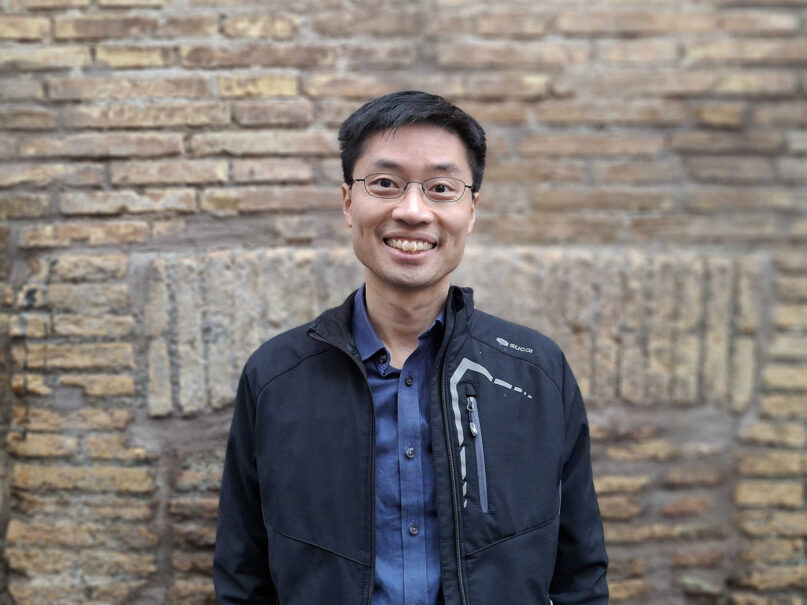
Po-Shen Loh at the Vatican. (RNS photo/Claire Giangravé)
Especially struck by Leo’s degree in mathematics from Villanova University in Pennsylvania, Loh said, “It occurred to me, maybe this pope’s background is making him see the future and see the big danger in artificial intelligence in a way that’s making him take action.”
Loh won a silver medal at the International Math Olympiad for Team USA in 1999 and went on to be the team’s coach for 10 years between 2014 and 2023. In December 2021, he launched his Live program, where gifted high schoolers or “math streamers” livestream to teach younger students.
Meanwhile, his experience teaching in K-12 classrooms led Loh to realize that young people today care a lot about their phones and social media. “I looked at this and I saw, oh boy, this is creating a whole generation of people who are pretty self-absorbed,” he said.
And in the tech world, Loh said he found that ruthless development of AI risked shattering the job market.
“If AI can make every worker able to do even 50% more work, then you only need two-thirds as many people,” he said. “The worldwide labor market is not prepared for a shock of laying off one-third of the people.”
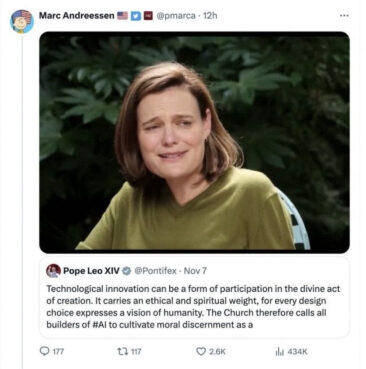
Marc Andreessen’s social media meme reaction to Pope Leo. (Screen grab)
Loh’s solution to these issues is rooted in his Catholic faith, he said, but aimed at helping people from all faith backgrounds. He calls his approach “Thought + Full,” and he intends to inspire a new generation to delight in making others happy and to become independent, critical thinkers ready to face the challenges of the future. His livestreamed math classes have talented high-school students sit on gaming chairs with colorful lights in the background, resembling Twitch gaming streams.
“The only way to become one of these high schoolers is to not only be good at mathematics, you also have to care about other people, like being a nice person — you have to want to make other people’s lives brighter,” he said.
In exchange for teaching math, the student teachers get paid and the chance to be coached in “charisma” — such as learning public speaking skills or how to ask someone on a date — by paid professional actors and improvisers. “You stream math, we teach rizz,” he said, using the Generation Z shorthand for charisma.
Four years in, the project counts roughly 200 high schoolers involved and about 2,000 middle schoolers learning from the live videos. But Loh hopes that the ecosystem he created will expand and promote a renewed interest for math and critical thinking in the world.
The issues Loh considers in his teaching models seem to be reflected by the pope’s interests, too.
“The advent of artificial intelligence is accompanied by rapid and profound changes in society, which affects essential dimensions of the human person, such as critical thinking, discernment, learning and interpersonal relationships,” Leo told participants of a Vatican-sponsored conference called “Artificial Intelligence and the Care of Our Common Home” on Dec. 5.
And when the cardinals elected him in May, the pope said he chose the name Leo to honor the legacy of his predecessor Pope Leo XIII, best known for his encyclical “Rerum Novarum” (“On Revolutions”), which tackled transformations and challenges associated with the Industrial Revolution in the 1800s. “Today, the church offers to all her treasure of social teaching in response to another industrial revolution and the developments in the field of artificial intelligence that pose new challenges for the defense of human dignity, justice and labor,” Leo said.

Opinion
AI comes with a built-in worldview. Christians need to understand it.
(RNS) — Christians must engage to remain a cultural force for good in our technology-infused world.

(Photo by Andrew Ruiz/Unsplash/Creative Commons)
Nick Skytland
December 23, 2025
RNS
(RNS) — It’s one thing to steer clear of doing harm. It’s something else entirely to pursue what’s genuinely good. Right now, most artificial-intelligence model companies are focused on establishing a moral floor, making sure their models don’t do anything illegal, immoral or destructive. That’s important work, especially in the short term. The harder and far more important challenge is figuring out how to make sure AI works to affirm and further humankind.
That’s not simple. AI is trained on the vast content of the internet, which means it comes with a built-in worldview, whether we acknowledge it or not. As long as users use AI to write emails, there would be little cause for alarm. But people are increasingly asking AI questions once reserved for their most trusted relationships, like spouses and pastors. As a result, people continue to experience psychological breaks, suicidal ideation and other forms of self-harm and relationship breakdown in the course of their unguided and untutored interaction with chatbots.
AI is the most influential technology of our lifetime. Christians have a responsibility to live in and reach the world. AI is part of that world and is not something to fear. We have the capacity to shape how this technology grows, rather than passively accept the ways it might shape us. We have the agency, and for now, we have the time.
So, stand firm instead of shrinking back. Engage AI with wisdom, courage and conviction. Use this moment — and your place in the church — to help build a future that strengthens humanity rather than confuses it.
(Nick Skytland is vice president of AI research at Gloo. The views expressed in this commentary do not necessarily reflect those of Religion News Service.)
AI comes with a built-in worldview. Christians need to understand it.
(RNS) — Christians must engage to remain a cultural force for good in our technology-infused world.
(Photo by Andrew Ruiz/Unsplash/Creative Commons)
Nick Skytland
December 23, 2025
RNS
(RNS) — It’s one thing to steer clear of doing harm. It’s something else entirely to pursue what’s genuinely good. Right now, most artificial-intelligence model companies are focused on establishing a moral floor, making sure their models don’t do anything illegal, immoral or destructive. That’s important work, especially in the short term. The harder and far more important challenge is figuring out how to make sure AI works to affirm and further humankind.
That’s not simple. AI is trained on the vast content of the internet, which means it comes with a built-in worldview, whether we acknowledge it or not. As long as users use AI to write emails, there would be little cause for alarm. But people are increasingly asking AI questions once reserved for their most trusted relationships, like spouses and pastors. As a result, people continue to experience psychological breaks, suicidal ideation and other forms of self-harm and relationship breakdown in the course of their unguided and untutored interaction with chatbots.
Indeed, when it comes to how Christianity itself is being represented, we’re finding that none of the frontier models are particularly well-trained, consistent or accurate when it comes to providing explicitly Christian answers. That’s why it’s critically important that Christians understand both how AI is drawing from the world, and the technology itself.
Christians have the chance to influence AI for the good. I’d even argue that the church is uniquely well positioned to provide a rigorous, comprehensive vision of human flourishing — an essential component of ethical AI development.
At Gloo, a technology platform for the faith and flourishing ecosystem, we’ve developed a benchmark that evaluates whether AI models support human flourishing from a Christian perspective. We can measure how well the answers from various AI models promote wisdom, purpose and, yes, biblically grounded guidance.
What we have found is that AI has a hidden worldview. Most AI models operate from a secular, therapeutic and pluralistic framework that prioritizes neutrality, often erasing theological perspectives. Even when asked explicitly Christian questions, they default to secular or generic spiritual guidance. We found that the AI models avoid theological reasoning unless forced to do so. They rarely refer to Scripture, Christian practices or theological reasoning unless prompted.
This requires thoughtfulness and wisdom about the AI we let into our lives, informing our thoughts, beliefs and decisions. We must pay attention. We must use discernment. We must engage to remain a cultural force for good in our technology-infused world.
Shaping AI isn’t just the work of tech companies. Individual users have the capacity to make powerful change, if they use technology wisely. Equipping users at every level of the church with the knowledge and tools they need to use AI well will help bring about important change today and flourishing in the long term.
Christians have the chance to influence AI for the good. I’d even argue that the church is uniquely well positioned to provide a rigorous, comprehensive vision of human flourishing — an essential component of ethical AI development.
At Gloo, a technology platform for the faith and flourishing ecosystem, we’ve developed a benchmark that evaluates whether AI models support human flourishing from a Christian perspective. We can measure how well the answers from various AI models promote wisdom, purpose and, yes, biblically grounded guidance.
What we have found is that AI has a hidden worldview. Most AI models operate from a secular, therapeutic and pluralistic framework that prioritizes neutrality, often erasing theological perspectives. Even when asked explicitly Christian questions, they default to secular or generic spiritual guidance. We found that the AI models avoid theological reasoning unless forced to do so. They rarely refer to Scripture, Christian practices or theological reasoning unless prompted.
This requires thoughtfulness and wisdom about the AI we let into our lives, informing our thoughts, beliefs and decisions. We must pay attention. We must use discernment. We must engage to remain a cultural force for good in our technology-infused world.
Shaping AI isn’t just the work of tech companies. Individual users have the capacity to make powerful change, if they use technology wisely. Equipping users at every level of the church with the knowledge and tools they need to use AI well will help bring about important change today and flourishing in the long term.
AI is the most influential technology of our lifetime. Christians have a responsibility to live in and reach the world. AI is part of that world and is not something to fear. We have the capacity to shape how this technology grows, rather than passively accept the ways it might shape us. We have the agency, and for now, we have the time.
So, stand firm instead of shrinking back. Engage AI with wisdom, courage and conviction. Use this moment — and your place in the church — to help build a future that strengthens humanity rather than confuses it.
(Nick Skytland is vice president of AI research at Gloo. The views expressed in this commentary do not necessarily reflect those of Religion News Service.)


No comments:
Post a Comment