The decision to halt new wind projects should leave no doubt in anyone’s mind as to who this administration actually cares about. Hint: It’s not you and me.
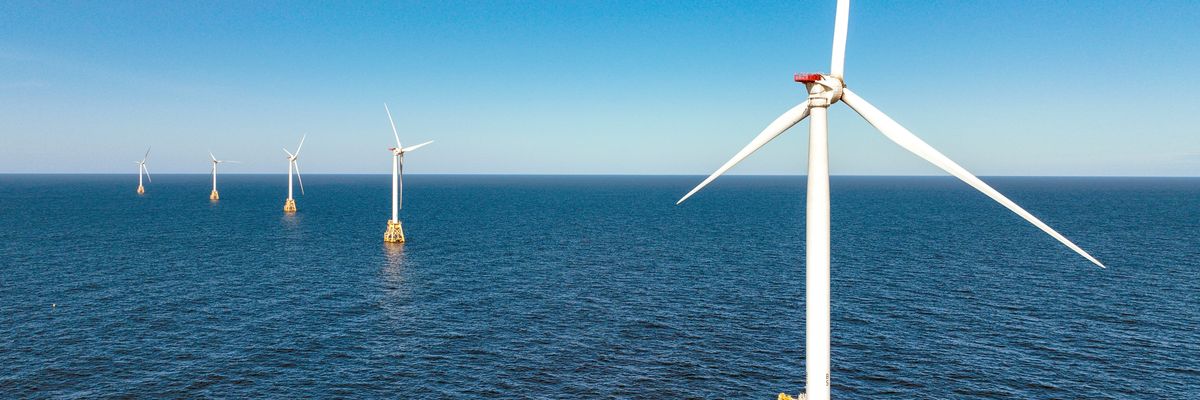
In an aerial view, wind turbines generate electricity at the Block Island Wind Farm on July 7, 2022 near Block Island, Rhode Island.
(Photo by John Moore/Getty Images)
Sabine von Mering
Dec 24, 2025
On Monday morning we woke up to the news that the Trump administration had halted five wind farms in the Northeastern USA, because they supposedly pose a “security risk”. The exact opposite is true: Not expanding wind power poses the security risk. Even the military had been calling climate change a “threat multiplier” for decades—until the Trump administration told them to stop considering climate change.
The truth is, wind power equals freedom power. Wind power means freedom from fossil fuels; freedom from extraction; freedom from pollution; freedom from billions of healthcare costs; freedom from dangerous jobs in coal, oil, and gas. Shutting down wind power projects equals shutting down all these freedoms. It equals shutting down your freedom and mine for the benefit of the freedom of a few fossil fuel billionaires and their wealth. The decision to halt these wind projects should leave no doubt in anyone’s mind as to who this administration actually cares about. Hint: it’s not you and me.
2026 is just days away. That leaves exactly four years to 2030, by which, scientists say, we must cut greenhouse gas emissions in half. Instead, as emissions continue to rise, the president of the most economically powerful country with the highest per capita emissions is not only taking away our very ability to protect ourselves from climate catastrophe. He is doubling down on exacerbating the problem by prioritizing fossil fuel expansion instead, also right here in the Northeast, and pressuring others to do the same. Thus actively reducing the likelihood of a livable future not only for all Americans but for humans around the world.
To be sure, this should not come as a surprise to anyone. As this administration is eagerly checking off the to-do lists of its “Project 2025,” it has done everything in its power since January to destroy any shred of American climate leadership. None of us who have been working tirelessly for climate action over the past years are surprised by the wrath behind this destruction. It fits perfectly with the fact that the administration is in bed with a desperate industry fighting for survival. They are desperate, because for years now, renewable energies have become cheaper and cheaper. In fact, they are already far cheaper than fossil fuel projects. The only thing that should still surprise us is how many people they are still able to lull into their myths of climate denial, given the mountains of evidence that are literally growing by the minute. Nobody has to look very far from their home to see an extreme weather disaster that was made worse by global warming.
Our 250th birthday is just the right moment for the people to wake up and stare down the fossil fuel industry and their political lackeys in power.
By halting these wind projects, the administration is therefore not only engaging in what Bill McKibben calls “solutions denial” (in Here Comes the Sun. The Last Chance for the Climate and a Fresh Chance for Civilization, 2025), it is also adding to our costs, thereby further threatening yet another freedom that is already greatly in peril: the affordability of our basic needs. In fact, with costs totaling $101.4 billion associated with extreme weather events, the first half of 2025 was the costliest ever. And the job losses are piling up as well.
The fact that a growing number of Americans is concerned about climate change is likely another reason for the speed at which this administration is proceeding with its dismantling of climate protection. They know the sleeping giant, i.e., the American people, once fully awakened, will not view these actions kindly.
You can gaslight people and spread lies for a few more years, but there will come the time when people start paying attention to the increasingly urgent warnings by those who understand the science best. People will wake up and understand that they are indeed being harmed by the greedy fossil fuel companies that brought us air pollution and black lung disease, and made us pay for the consequences, and not by renewable energy powered by the sun that is shining for free and will never send a bill.
The United States is a country built on the fight for freedom. Renewable energies are freedom energies. What stands between us and our freedoms therefore poses the true security risk. Our 250th birthday is just the right moment for the people to wake up and stare down the fossil fuel industry and their political lackeys in power. Because if they are not giving us liberty, they are giving us death.
Our work is licensed under Creative Commons (CC BY-NC-ND 3.0). Feel free to republish and share widely.
Sabine von Mering is a 2023 public voices fellow on the climate crisis with The OpEd Project, in partnership with the Yale Program on Climate Change Communication, a climate activist with 350MAss, and the director of the Center for German and European Studies at Brandeis University.
Full Bio >
U.S. Offshore Wind Developers Stop Work and Explore Next Steps
From New England to the Mid-Atlantic regions, offshore wind developers reported they were complying with the government order to suspend offshore installation work while also expressing frustration. The Bureau of Ocean Energy Management followed up the public announcement with a written notification to the developers of the five projects ordering them to stop their offshore work on the Outer Continental Shelf while the government conducts a review.
Several of the projects highlighted that they were just weeks away from beginning to deliver power under their respective power agreements. Ørsted said that its Revolution Wind project was expected to begin generating power in January, while Dominion Energy said its project was “within months” of generating power. Vineyard Wind 1 has already started delivering power as it was proceeding with its commissioning process.
Canary Media obtained a copy of the BOEM letter and reports that it says the Department of War and the Department of the Interior would be reviewing whether the risks posed by the projects can be mitigated. The companies confirmed the notice says it is a 90-day suspension, but that BOEM can extend it for additional 90-day intervals. In the past, the federal courts have been critical of the open-ended nature of the review ordered by Donald Trump in January 2025 and, in one case, set a timeline for BOEM to report back to the court on progress.
“Based on BOEM’s initial review of this classified information, the particularized harm posed by this project can only be feasibly averted by suspension of on-lease activities,” the letter asserts, according to Canary Media. “BOEM will consider all feasible mitigation measures before making a decision as to whether the project must be canceled.”
Each of the projects highlighted that they had gone through years of review. Ørsted specifically noted that Revolution Wind and Sunrise Wind consulted closely and directly with the U.S. Department of Defense Military Aviation and Installation Assurance Siting Clearinghouse to “evaluate and address potential impacts to national security and defense capabilities,” from the construction and operation of the two wind farms.
Equinor, which is developing Empire Wind, highlighted that it is complying with relevant national security-related requirements. It said it plans to continue to work with BOEM and other federal agencies to continue to implement all necessary mitigation for the project. Equinor also highlighted that it has extensive experience in the U.S. and around the world operating offshore energy infrastructure and working with military and civilian authorities to ensure compliance with national security requirements.
Dominion Energy responded by saying Coastal Virginia Offshore Wind is “essential for American national security,” noting that Virginia is the home to major military installations as well as the largest warship manufacturer. It noted that Virginia’s demand for electricity is doubling, and the project is one key element in the plan to meet energy needs, which include AI operations and the largest concentration of data centers.
The Virginia project highlights that it is located 27 to 44 miles offshore and its review and approval involved close coordination with the military.
The impact of the Trump administration order, analysts noted, goes far beyond the projects themselves. They involve multiple subcontractors and have placed orders for shipbuilding, have contracts for support services, and have committed to investments in ports and manufacturing capabilities. Equinor highlights that Empire Wind has dozens of vessels and around 1,000 people who have been working in conjunction with the project.
Commentators noted that one commercial-scale offshore wind farm, South Fork Wind off New York, delivered its first power in 2023 and completed commissioning in July 2024. It, along with two smaller pilot projects, two wind turbines for Dominion operating for the past five years, and the Block Island Wind Farm, which has been operating since 2016, were not included in the order and continue normal operations.
The companies each said they would be engaging with BOEM and the other agencies to resolve the concerns. Ørsted said that in addition to engaging with the BOEM and the permitting agencies, it would evaluate potential legal proceedings.
U.S. Suspends Licenses for Five Under Construction Offshore Wind Farms
In its latest moves to stop the development of offshore wind energy projects, the Trump administration on Monday, December 22, announced it is suspending all the licenses for under-construction offshore wind farms. It impacts five projects, many of which are nearing completion, with a generating capacity for 5.8 GW of energy, and sent shock waves through the industry.
In a statement from the Department of the Interior, the administration says the pause is due to “national security risks identified by the Department of War in recently completed classified reports.” It said that the pause would give the Department of the Interior, Department of War, and other relevant agencies “time to work with leaseholders and state partners to assess the possibility of mitigating the national security risks posed by these projects.”
The non-profit Oceantic Network, which lobbies in support of the industry, quickly issued a statement calling the move “another veiled attempt to hide the fact that the President doesn’t like offshore wind.”
Trump, immediately after returning to the office, issued an Executive Order pausing the leasing and approvals and ordering a review of the industry. Since then, it has been reported that he directed all government agencies to work together to stop the development of wind farms, and the administration has gone to court to challenge the approvals of several projects. It also attempted to stop construction work on both the Empire Wind project in New York and Revolution Wind off the coast of Rhode Island.
The five projects impacted by today’s actions are Vineyard Wind 1, Revolution Wind, Coastal Virginia Offshore Wind, Sunrise Wind, and Empire Wind 1. Many of the projects are nearing completion, and in the case of Vineyard, are already generating power, or are due to begin delivering power in 2026.
“Today’s action addresses emerging national security risks, including the rapid evolution of the relevant adversary technologies, and the vulnerabilities created by large-scale offshore wind projects with proximity near our east coast population centers,” said Secretary of the Interior Doug Burgum.
According to the Department of the Interior, unclassified reports from the government have “long found that the movement of massive turbine blades and the highly reflective towers create radar interference called ‘clutter.’ The clutter caused by offshore wind projects obscures legitimate moving targets and generates false targets in the vicinity of the wind projects.”
They continue by saying the Department of Energy in 2024 stated that a radar’s threshold for false alarm detection can be increased to reduce some clutter. They assert that those steps could cause radar to miss actual targets.
“The U.S. offshore wind industry has continuously worked with the Department of Defense to address national security concerns, and its own Clearinghouse has signed off on every offshore wind lease ahead of construction,” noted Liz Burdock, CEO of Oceantic Network. “This newest claim contradicts years of rigorous, interagency reviews, as these projects have already passed explicit clearances from the Department of Defense and the Pentagon before construction began.”
This action comes just two weeks after a U.S. District Court found that the presidential executive order suspending the industry was unlawful because it violates the Administrative Procedures Act that governs how agencies administer programs. In the opinion, the court wrote that the order was “arbitrary and capricious.” It was the result of a lawsuit filed by 17 states and the District of Columbia challenging the executive order. The order has been used as the basis for many of the actions to challenge projects in 2025.
Federal courts have permitted the administration to proceed with its review of the approval process for projects off the New England coast and Maryland. However, another district court issued an injunction when the administration issued a stop work order for the Revolution Wind project. The dispute, just as offshore work was due to start for the Empire Wind project, was settled with an agreement between the federal government and New York State.
Experts are predicting that today’s action will be quickly challenged in the courts.


No comments:
Post a Comment