It’s possible that I shall make an ass of myself. But in that case one can always get out of it with a little dialectic. I have, of course, so worded my proposition as to be right either way (K.Marx, Letter to F.Engels on the Indian Mutiny)
French unions take Israel to court for restricting media access to Gaza
Two major journalism organisations have filed a legal complaint in Paris accusing the Israeli authorities of blocking French reporters from covering the war in Gaza – a move that could test how France applies its own press-freedom protections in an international conflict.
The National Union of Journalists (SNJ) and the International Federation of Journalists (IFJ) confirmed on Tuesday that they had lodged a complaint for “obstruction of the freedom to practise journalism” at a Paris court.
They argue that Israel’s restrictions on media access, along with reported intimidation and violence against French journalists working in the region, amount not only to a breach of press freedom but potentially to war crimes.
Because the allegations concern French citizens, the national anti-terrorism prosecutor’s office (PNAT) is authorised to open an investigation.
In a 100-page submission – made public by FranceInfo – the unions say the case is the first to lean on France’s specific offence of obstructing journalistic freedom, and the first to urge prosecutors to consider its application in an international setting where, they argue, attacks on the media have become “structural”. 'Violation of humanitarian law'
“This complaint denounces a concerted, sometimes violent, obstruction preventing French journalists from working in the Palestinian Territories and undermining press freedom,” said lawyer Louise El Yafi, one of the legal representatives behind the filing.
Her colleague, solicitor Inès Davau, said the complaint also draws attention to rising risks faced by French reporters in the West Bank. “These attacks, which violate international humanitarian law, also constitute war crimes,” she added.
The unions’ action is further supported by a French journalist – working across several French-language outlets and requesting anonymity – who has filed his own complaint after allegedly being assaulted by settlers while reporting in the occupied territories. Multiple cases linked to Gaza
This comes as Reporters Without Borders (RSF) says more than 210 media workers have been killed since Israel launched its military operation in Gaza following the Hamas attacks of 7 October 2023.
Press groups have repeatedly criticised Israel’s longstanding refusal to allow foreign journalists to enter Gaza independently, with only a small number permitted to join Israeli troops under tight supervision.
The Paris complaint arrives amid a swathe of other France-based legal actions linked to the conflict.
These include cases concerning Franco-Israeli soldiers serving in an elite IDF unit, the French arms manufacturer Eurolinks, and several Franco-Israelis accused of complicity in the crime of colonisation.
Separately, PNAT has already asked an investigating judge to examine potential war crimes in the deaths of two French children killed during Israeli airstrikes in Gaza in October 2023.
(with newswires)
Wednesday, November 26, 2025
Trump Gaza Plan Condemned as ‘Concentration Camps Within a Mass Concentration Camp’
After previous plans by Israel for the mass expulsion of Palestinians, onlookers fear the proposal to house some displaced Palestinians in “compounds” they may not be allowed to leave.
Displaced Palestinians warm up by the fire after their homes were destroyed following heavy rain in Gaza City, on November 25, 2025. (Photo by Omar al-Qattaa/AFP via Getty Images)
A new Trump administration plan to put Palestinians living in the Israeli-occupied parts of Gaza into “residential compounds” is raising eyebrows among international observers, who fear it could more closely resemble a system of “concentration camps within a mass concentration camp.”
Under the current “ceasefire” agreement—which remains technically intact despite hundreds of alleged violations by Israel that have resulted in the deaths of over 300 Palestinians—Israel still occupies the eastern portion of Gaza, an area greater than 50% of the entire strip. The vast majority of the territory’s nearly 2 million inhabitants are crammed onto the other side of the yellow line into an area of roughly 60 square miles—around the size of St Louis, Missouri, or Akron, Ohio.
As Ramiz Alakbarov, the United Nations’ deputy special coordinator for the Middle East Peace Process, explained Monday at a briefing to the UN Security Council: “Two years of fighting has left almost 80% of Gaza’s 250,000 buildings damaged or destroyed. Over 1.7 million people remain displaced, many in overcrowded shelters without adequate access to water, food, or medical care.”
The New York Timesreported Tuesday that the new US proposal would seek to resettle some of those Palestinians in what the Trump administration calls “Alternative Safe Communities,”on the Israeli-controlled side of the yellow line.
Based on information from US officials and European diplomats, the Times said these “model compounds” are envisioned as a housing option “more permanent than tent villages, but still made up of structures meant to be temporary. Each could provide housing for as many as 20,000 or 25,000 people alongside medical clinics and schools.”
The project is being led by Trump official Aryeh Lightstone, who previously served as an aide to Trump’s first envoy to Jerusalem. According to the Times: “His team includes an eclectic, fluctuating group of American diplomats, Israeli magnates and officials from the Department of Government Efficiency (DOGE)—the sweeping Washington cost-cutting effort overseen earlier this year by Elon Musk.”
The source of funding for the project remains unclear, though the cost of just one compound is estimated to run into the tens of millions. Meanwhile, the newspaper noted that even if ten of these compounds were constructed, it would be just a fraction of what is needed to provide safety and shelter to all of Gaza’s displaced people. It’s unlikely that the first structures would be complete for months.
While the Times said that “the plan could offer relief for thousands of Palestinians who have endured two years of war,” it also pointed to criticisms that it “could entrench a de facto partition of Gaza into Israeli- and Hamas-controlled zones.” Others raised concerns about whether the people of Gaza will even want to move from their homes after years or decades of resisting Israel’s occupation.
But digging deeper into the report, critics have noted troubling language. For one thing, Israeli officials have the final say over which Palestinians are allowed to enter the “compounds” and will heavily scrutinize the backgrounds of applicants, likely leading many to be blacklisted.
In one section, titled “Freedom of Movement,” the Times report noted that “some Israeli officials have argued that, for security reasons, Palestinians should only be able to move into the new compounds, not to leave them, according to officials.”
This language harkens back to a proposal earlier this year by Israeli Defense Minister Israel Katz, who called for the creation of a massive “humanitarian city” built on the ruins of Rafah that would be used as part of an “emigration plan” for hundreds of thousands of displaced Palestinians in Gaza.
Under that plan, Palestinians would have been given “security screenings” and once inside would not be allowed to leave. Humanitarian organizations, including those inside Israel, roundly condemned the plan as essentially a “concentration camp.”
Prior to that, Trump called for the people of Gaza—“all of them”—to be permanently expelled and for the US to “take over” the strip, demolish the remaining buildings, and construct what he described as the “Riviera of the Middle East.” That plan was widely described as one of ethnic cleansing.
The new plan to move Palestinians to “compounds” is raising similar concerns.
“What is it called when a military force concentrates an ethnic or religious group into compounds without the ability to leave?” asked Assal Rad, a PhD in Middle Eastern history and a fellow at the Arab Center in Washington, DC.
Sana Saeed, a senior producer for AJ+, put it more plainly: “concentration camps within a mass concentration camp.”
The Times added that “supporters insist that this would be a short-term arrangement until Hamas is disarmed and Gaza comes under one unified government.” Lightstone has said that reconstruction of the other parts of Gaza, where the vast majority of the population still lives, will not happen unless Hamas, the militant group that currently governs the strip, is removed from power.
But while Hamas has indicated a potential willingness to step down from ruling Gaza, it has rejected the proposal that it unilaterally disarm and make way for an “International Stabilization Force” to govern the strip, instead insisting that post-war governance should be left to Palestinians. That plan, however, was authorized last week by the UN Security Council.
In addition to raising concerns that “those moving in would never be allowed to leave,” the Beirut-based independent journalist Séamus Malekafzali pointed to other ideas Lightstone and his group want to implement. According to the Times, “It has kicked around ideas ranging from a new Gaza cryptocurrency to how to rebuild the territory in such a way that it has no traffic.”
Malekafzali said, “Former DOGE personnel are attempting to make Gaza into yet another dumb tech experiment.”
Like Katz’s plan months ago, the new Trump proposal calls for a large compound to be built in Rafah, which Egyptian officials warned, in comments to the Wall Street Journal, could be a prelude to a renewed effort to push Palestinians across the border into the Sinai Peninsula.
But even if not, Jonathan Whittall, the former head of the UN Office for the Coordination of Humanitarian Affairs in Palestine, said it hardly serves the humanitarian role the Trump administration and its Israeli co-administrators seek to portray.
“If plans for these ‘safe communities’ proceed, they would cement a deadly fragmentation of Gaza,” he wrote in Al Jazeera. “The purpose of creating these camps is not to provide humanitarian relief but to create zones of managed dispossession where Palestinians would be screened and vetted to enter in order to receive basic services, but would be explicitly barred from returning to the off-limits and blockaded ‘red zone.’”
He noted that there is a conspicuous lack of any clear plan for what happens to those Palestinians who continue to live outside the safe communities, warning that Israel’s security clearances could serve as a way of marking them as fair targets for even more escalated military attacks.
“Those who remain outside of the alternative communities, in the ‘red zone,’” he said, “risk being labelled ‘Hamas supporters’ and therefore ineligible for protection under Israel’s warped interpretation of international law and subject to ongoing military operations, as already seen in past days.”
Obstacles to Gaza plan
It would be a mistake for Pakistan to send troops for the stabilisation force in Gaza.
Published November 24, 2025 DAWN The writer is a former ambassador to the US, UK and UN.
BY approving a US-sponsored resolution, the UN Security Council handed an international mandate to President Donald Trump’s 20-point ‘peace plan’ for Gaza. But it did this without any input from Palestinians. Hamas rejected the resolution saying it fails to meet Palestinian rights and demands and “imposes a mechanism to achieve the [Israeli] occupation’s objectives”.
The resolution can only be implemented if Hamas signs up to it. This means complex negotiations lie ahead if the plan is to progress beyond the present ceasefire, which is being violated daily by Israeli forces, who have also been crossing the ‘yellow line’. This has taken the Palestinian death toll to almost 70,000 in the two-year genocidal war imposed by Israel.
The UNSC resolution is short on specifics and ambiguous in key areas. It ignores all previous resolutions on Palestine. It authorises the creation of a vaguely defined transitional governance body, the Board of Peace, chaired by Trump and members decided by him, to oversee a Palestinian “technocratic” committee responsible for day-to-day running of Gaza. It also authorises the BoP to establish a temporary multinational international stabilisation force (ISF) “to deploy under unified command acceptable to the BoP”.
This will not be a UN peacekeeping mission nor be overseen by the UN. Its mandate is unclear and details are lacking on its scope and structure. It is however tasked to “demilitarise the Gaza Strip” and carry out “permanent decommissioning of weapons from non-state armed groups”, including Hamas.
The original US draft made no reference to Palestinian statehood. But at the insistence of Muslim countries, the final resolution mentions a “credible pathway to Palestinian self-determination and statehood”. But this is wrapped in so many conditions that it denudes it of real meaning. Weak Arab negotiators failed to get a firm commitment to a Palestinian state in the resolution. Meanwhile, Israeli Prime Minister Benjamin Netanyahu remains firmly opposed to any Palestinian state.
The UNSC resolution was welcomed across the world as a step towards peace despite concerns of many countries and Council members, including Pakistan, about its lack of clarity in core areas. China and Russia, who abstained on the vote, both voiced concern about the vague nature of key elements, lack of Palestinian participation and absence of commitment to a two-state solution.
China’s ambassador to the UN, Fu Cong, said the resolution “does not [reflect] the fundamental principle of Palestinians governing Palestine”. Russia’s UN envoy, Vassily Nebenzia, described the stabilisation force as “reminiscent of colonial practices”. In a scathing critique, the UN special Rapporteur for Palestine said, “Rather than charting a pathway towards ending the occupation and ensuring Palestinian protection, the resolution risks entrenching external control over Gaza’s governance, borders, security, and reconstruction. The resolution betrays the people it claims to protect.”
In Gaza itself, the UNSC resolution’s main provisions were viewed with great scepticism, according to Al Jazeera reporters on the ground. One resident told the news outlet “Our people … are able to rule ourselves. We don’t need forces from Arab or foreign countries to rule us”. The transitional governing arrangement is seen as outsiders deciding the fate of Palestinians. The international stabilisation force is viewed with deep suspicion — “not as a guarantee of protection but rather a foreign security arrangement imposed without their consent”.
Of course, it is the stance of Hamas and other Palestinian factions that is consequential for the resolution’s enforcement. Hamas still controls Gaza up to the ‘yellow line’ held by Israel. Its popularity has risen since the ceasefire, according to the latest poll by the West Bank-based Palestinian Centre for Policy and Survey Research. Hamas has rejected the UN resolution on a number of grounds. It said the resolution “imposes an international guardianship mechanism on the Gaza Strip”. Assigning the international force to disarm groups resisting the occupation “strips it of its neutrality, and turns it into a party to the conflict in favour of the occupation”.
Hamas has argued that any international force, if established, “must be deployed only at the borders to separate forces, monitor the ceasefire, and be fully under UN supervision”. “It must also operate exclusively in coordination with official Palestinian institutions.” “Resisting the occupation by all means is a legitimate right guaranteed by international laws and conventions.” Hamas also said disarmament is an “internal matter” linked to the end of occupation and creation of a Palestinian state.
It is possible Hamas may be prepared to disarm in exchange for total Israeli withdrawal from Gaza, which would end its occupation. But that can only be tested in serious negotiations that have to take place if the UN-endorsed Trump plan is not to collapse.
The expectation from the stabilisation force to demilitarise Gaza and disarm resistance groups is likely to deter several Muslim countries from joining it. Some of them are engaged in talks to contribute to the force. Israel has to approve countries that can be part of the force. So far it has rejected Turkiye’s participation. The international force will be answerable to the BoP and is intended to work with Egypt and Israel to demilitarise the Gaza Strip. That means it can get caught in a shooting war and act like an enforcement force rather than a peacekeeping one. Its task will also be to secure the borders and train the Palestinian police.
There are at least three reasons why Pakistan should not join ISF. One, it should not be part of a force whose key task is to police Hamas, not protect Palestinians. The implications for Pakistan, for example, of any clash between its troops and Palestinians would be serious. Two, deployment would involve close cooperation with Israel and arguably lure Pakistan into a trap to recognise Israel and join the Abraham Accords. Moreover, Israel’s continuing ceasefire violations and occupation of over half of Gaza pose major obstacles to Trump’s plan. In these circumstances, Hamas will not disarm. Walking into such a quagmire would therefore be a mistake for Pakistan.
The challenges facing implementation of the Gaza peace plan are formidable. At this inflection point for the plan, it is uncertain whether it will be able to deliver peace or meet the same fate as so many failed plans for Palestine have in the past.
The writer is a former ambassador to the US, UK and UN.
Published in Dawn, November 24th, 2025
NAKBA II
Israeli army launches new operation in West Bank
Tubas (Palestinian Territories) (AFP) – Israel's military on Wednesday launched a new operation against Palestinian armed groups in the occupied West Bank, where a local governor told AFP that Israeli forces had raided several towns.
The Israeli military, police and internal security service said in a joint statement that they had begun "a broad counter-terrorism operation" in the north of the Palestinian territory after they received intelligence about "attempts to establish terrorist strongholds".
The military said the operation began with air strikes to isolate the area, which were followed by "searches" on the ground, during which suspects were apprehended and funds were confiscated.
The Israeli army confirmed to AFP that it was a new operation, and not part of the one launched in January 2025, which primarily targeted Palestinian refugee camps in the northern West Bank.
Israel has occupied the West Bank since 1967.
The operation, which began overnight, was taking place in predominantly agricultural Tubas, the northeasternmost of the 11 governorates in the West Bank.
Ahmed al-Asaad, governor of the Tubas region, told AFP: "This is the first time that the entire governorate is included -- the whole governorate is now under Israeli army operations."
Asaad said Israeli forces raided the towns of Tammun and Tayasir, and the Al-Faraa Palestinian refugee camp.
"The army has closed the city entrances with earth mounds, so there is no movement at all," he added.
He told AFP that "an Apache helicopter" was involved in the operation, and claimed it had fired in the direction of residential areas.
"This is a political operation, not a security one," he said. Injuries reported
An AFP photographer saw some soldiers walking around inside Tubas city, with a few armoured cars driving through and a surveillance aerial vehicle buzzing overhead. Most shops were closed.
The road entrance to nearby Tammun had been closed off by a military vehicle.
An ambulance was allowed to go through but citizens were not. Armoured cars were driving around at the scene.
The Palestinian Red Crescent Society said its teams in the governorate had treated 10 injured people, four of whom had to be transferred to hospital.
It added that some of its teams were "facing obstruction in transporting patients in the city of Tubas and the town of Tammun since dawn", and were still responding to calls for help following the raids.
Hamas and Islamic Jihad, two Palestinian militant groups proscribed as terror organisations by many countries, condemned the Israeli operation.
Hamas said in a statement that it was part of a policy "aimed at crushing any Palestinian presence in order to achieve complete control over the West Bank".
Violence in the West Bank has soared since Hamas's October 2023 attack on Israel triggered the Gaza war, and has not ceased despite the fragile truce between Israel and Hamas coming into effect last month.
Israeli troops or settlers have killed more than 1,000 Palestinians, many of them militants, but also scores of civilians, in the West Bank since the start of the Gaza war, according to an AFP tally based on Palestinian health ministry figures.
At least 44 Israelis, including both soldiers and civilians, have been killed in Palestinian attacks or Israeli military operations, according to official Israeli figures.
The West has spent two years partnering Israel in its campaign of wanton destruction in Gaza. Now the United States – with the permission of a cowed United Nations Security Council – has appointed Donald Trump to preside over the ruins.
Like a Roman emperor, the US president will be able to dictate the fate of Gaza’s people with a simple gesture. Whatever he decides – whether the thumb turns up or down – it will be called “peace”.
Trump’s most likely side-kick in this depraved charade will be Tony Blair, the former British prime minister. He won his war-crime spurs more than 20 years ago, when he joined one of Trump’s predecessors, George W Bush, in launching an illegal invasion of Iraq and a subsequent, catastrophic occupation that left that country in ruins too.
Satire cannot do justice to this moment.
The eradication of Gaza could be achieved only with the complete hollowing out of international law – the legal global order that was established many decades ago to prevent a third world war and the horrors of the Holocaust.
Marking the demise of that era, the Security Council voted 13-0 this week to endorse Trump’s “peace plan” for Gaza, with only Russia and China daring to abstain.
The dissenting representatives of the crumbling legal order – from the judges of the International Criminal Court (ICC) to Francesca Albanese, the UN’s legal expert for the occupied territories – have been isolated, vilified and sanctioned by the Trump administration. No one appears to be willing to come to their defence.
Quite the contrary. Germany, whose own genocidal rampage across Europe more than 80 years ago once left it a pariah state and drove the creation of the new legal order, now confidently leads the way in flouting those very rules.
It has resumed supplying Israel with the weapons it needs to continue the slaughter, justifying the decision on the grounds that Israel is murdering fewer Palestinians during Trump’s duplicitous “ceasefire”.
On Wednesday, Israel broke the ceasefire once again, killing more than 30 people in a series of air strikes, including 20 women and children.
Even the current “peace” allows Israel to occupy some 58 percent of Gaza in a depopulated “Green Zone”, effectively partitioning the territory for the forseeable future. Daily, Israel bombs families sheltering in the wreckage of the enclave’s interior, declared a “Red Zone”. And Israel continues to block the entry of food and medicines, including the temporary housing needed as winter rains deluge the territory.
Is this what, 19 years ago, Condoleezza Rice, Bush’s secretary of state, meant when she spoke of the coming, painful “birth pangs of a new Middle East”?
Now, it seems, they have arrived in full force – and the region has never looked more terrifying.
A joint US-Israeli occupation
UN Resolution 2803 makes Trump the debauched feudal overlord of Gaza. His lackeys on a so-called “Board of Peace” will “include the most powerful and respected Leaders throughout the World”, according to the US President.
They will have sovereign power over the enclave’s ruins for at least the next two years – and undoubtedly long beyond that. The Board will decide how Gaza is governed, what constitutes its borders, how or whether it is rebuilt, and what economic life is permitted.
In effect, oversight of the system of colonial control and abuse Israel has exercised over the territory since the late 1960s – which the International Court of Justice (ICJ) ruled illegal last year – will be transferred to the United States, with the Security Council’s blessing.
This is now formally a joint US-Israeli occupation.
The US that now holds Gaza’s fate in its hands is the same US that has spent the past two years arming Israel.
Those weapons made possible the levelling of Gaza, the ethnic cleansing of 2 million people from their homes, and a mass slaughter identified by every major human rights group and international legal body as a genocide.
Trump’s “peace plan” is the international order’s equivalent of putting a convicted serial child abuser in charge of a primary school.
There will be no UN peacekeeping force in Gaza to try to protect its people. That would too readily expose the masquerade of Trump’s version of “peace”.
The UN force in Lebanon, Unifil, has reported thousands of Israeli violations of a supposed year-old “ceasefire” there. Israel is not just bombing Lebanese families, but this week shot at Unifil peacekeepers too.
Rather, the Board – meaning Trump and the Pentagon – will supervise an “International Stabilisation Force” (ISF) in Gaza, supposedly to be in place by January.
Disarming Hamas
Last year the ICJ ruled that Israel must end its occupation and pull out of all Palestinian territories “as rapidly as possible”, including Gaza. Apparently in line with that ruling, Britain and France led a handful of other western states in recognizing a Palestinian state a few months ago.
But in supporting UN Resolution 2308, both have, entirely predictably, reneged on their promise. Although at the insistence of Arab states, the resolution makes a vague nod to a possible “pathway” to statehood, the “Board of Peace” – that is, the US and Israel – gets to decide when, or if, that actually happens.
A precondition is that Mahmoud Abbas’ supine Palestinian Authority (PA) submits to an undefined “reform programme”. The PA already serves as Israel’s reliable security sub-contractor in the Occupied West Bank, having turned itself into a modern-day Vichy regime.
It was the PA’s endorsement of Trump’s “peace plan” that gave Russia and China the cover to abstain at the Security Council rather than scuttle the resolution with their vetoes.
The reality is that nothing the PA can do – even colluding in its own evisceration – will make Israel view it as a suitable Palestinian government. Israeli Prime Minister Benjamin Netanyhau reiterated as much this week, shortly after the resolution was passed, saying he would never allow a Palestinian state.
Instead, Israel will simply stay on in Gaza. It is not required to withdraw until the multinational force is deployed and the Israeli military agrees that it has enforced “demilitarization milestones” in the enclave. Yet it is hard to imagine who will be willing to take on disarming Hamas.
Trump has ruled out deploying US soldiers or funding Gaza’s reconstruction. “The US has been very clear they want to set the vision and not pay for it,” a diplomatic source told the Guardian.
The US regional military command, CENTCOM, initially drew up plans for thousands of British, French and German soldiers to form the core of the ISF, according to documents seen by the paper. A source described the plans as “delusional”.
No European state will wish to risk its soldiers in the Gaza hellscape, caught between Hamas’ battle-hardened guerrilla fighters and an Israeli military continuing to treat much of the enclave as an effective free-fire zone.
Instead, the White House is reported to have approached Egypt, Indonesia, Azerbaijan, Qatar, Turkey and the United Arab Emirates.
But Arab and Muslim states, having already sickened their publics by mutely colluding in the genocide, are unlikely to want to be seen being dragged into disarming the only practical resistance to that genocide.
Astonishingly, it was left to Hamas to remind the world of what international law actually requires. In a statement after the UN vote, the group noted: “Assigning the international force [ISF] with tasks and roles inside the Gaza Strip, including disarming the resistance, strips it of its neutrality, and turns it into a party to the conflict in favour of the occupation.”
In the meantime, Israel will continue to fill the breach unhindered.
Ties to crime gangs
In fact, the ISF is a consolidation of Israel’s long-running campaign to oust the UN from any role in monitoring its illegal occupation of Palestine.
In that sense, it is a continuation of the same sham cooked up earlier this year by Israel and the US in establishing the “Gaza Humanitarian Foundation” (GHF). That “charity”, staffed by mercenaries, forcibly replaced UN aid agencies that for decades had been responsible for distributing food.
The Foundation’s handful of “aid hubs” rapidly became killing grounds, with starving Palestinians lured into these traps like mice seeking cheese. More than 2,600 desperate Palestinians were gunned down in its queues, and at least 19,000 wounded.
UG Solutions, the military subcontractor that supplied mercenaries for the GHF, is recruiting again – this time, one of its officials told Drop Site News, “in support of humanitarian aid delivery and possible technical assistance to the International Security [Stabilisation] Force”.
Previously, UG Solutions was found to have hired members of an anti-Muslim US biker gang to serve as security guards in Gaza.
The job of the ISF will not be to keep Israel’s genocidal army in check. It will be to “disarm” all Palestinian resistance to Israel’s continuing – and now Security Council-approved – illegal occupation of Gaza.
While the international community is dragooned into helping Israel crush resistance to its criminal occupation, Israel will be given cover to further cultivate ties to Palestinian crime gangs.
For the past year it has armed those gangs so they could steal the trickle of aid Israel allowed into Gaza. Israel then blamed Hamas for the thefts. This self-rationalizing narrative allowed Israel to conceal the fact it was the party responsible for depriving ordinary Palestinians of food, while also giving it a military pretext to refuse to allow in more aid.
This alliance will now grow more sophisticated. The gangs can be sheltered and trained inside the “Green Zone” before heading out on operations, backed by Israeli air power, into the ruins of the “Red Zone” to fight Hamas.
Hebrew media has already reported that the Israeli army has been “guarding” the gangs behind a “yellow line” separating the Green and Red Zones. Any other Palestinians who approach this cordon are shot on sight.
By looting aid from Gaza’s starving population, the gangs have proved they have no interest in protecting civilians – or any compunction about helping Israel to tear apart their own society.
There is already a model – if a failed one – for Israel to draw on. For years, until it was forced out in 2000, Israel protected Christian-led paramilitaries that helped enforce its illegal, brutal two-decade occupation of south Lebanon.
Behind the curtain
This week, hand-picked members of the media were given a peek behind the curtain to see who will be running Gaza.
The New York Times reported that a warehouse in the Israeli town of Kiryat Gat, north-east of Gaza, was serving as the headquarters of a new “Civil-Military Coordination Center”.
It is filled with Israeli, US and European military officials, Arab intelligence agents, diplomats and aid workers. There was, the paper noted, no one representing Palestinian interests.
The same building was used earlier to house the Gaza Humanitarian Foundation, the US and Israeli-backed mercenary group that pretended to be an aid agency until it was wound up last month.
The new centre is led by Aryeh Lightstone, who served in Trump’s first term under the then US ambassador to Israel, David Friedman, an outspoken, pro-Israel zealot whose main mission was to get the US embassy moved – in violation of international law – to the Israeli-occupied city of Jerusalem.
Lightstone is likely to emerge as the new Paul Bremer, the hugely unqualified US-appointed governor of Iraq following the illegal 2003 invasion.
Bremer gutted what was left of Iraqi national institutions and civil society after a US “shock and awe” bombing campaign. The resulting lawlessness made the Iraqi population prey to sectarian death squads, while US firms sought to plunder Iraq’s wealth.
The profits from untapped oil and gas now beckon off Gaza’s coast – a prize Palestinians have been denied for decades, not least by Blair when he served as the Quartet’s Middle East envoy. It is hard to imagine Trump will not now be eyeing Gaza’s riches.
So clueless are many of the center’s officials about Gaza that it had to hold a primer for newcomers on “What is Hamas?”, according to the New York Times.
To keep things light, each day is reportedly themed on one of the catastrophes facing the people of Gaza: “Wellness Wednesdays” deal with the issues thrown up by Israel’s eradication of hospitals and schools, while “Thirsty Thursdays” concern Israel’s destruction of the enclave’s water infrastructure.
Nowhere safe
Shortly before the UN vote, the Guardian reported that the US had decided only to rebuild in the “Green Zone”, the section of Gaza under Israeli control. The Red Zone is to be left in ruins for the time being.
A US official told the paper of the Gaza plan: “Ideally you would want to make it all whole, right? But that’s aspirational. It’s going to take some time. It’s not going to be easy.”
According to reports, the US will build what are to be called “alternative safe communities” – a polite way to refer to the construction of holding pens for Palestinians – in the areas under Israeli control. There is no indication yet that these will be permanent communities.
The Green Zone is where ISF troops will be stationed too, presumably alongside the Israeli military. They are expected to man crossing points along the yellow line, the death zone separating the Green and Red Zones.
“You’re not going to leave [the Green Zone],” a US official told the Guardian of the multinational force, in an all-too-obvious echo of US experiences in Iraq two decades ago. Then, the US had to build a giant garrison town in the center of Baghdad called the Green Zone, from which its soldiers rarely ventured unless on military operations.
Palestinians will supposedly be permitted into these “safe communities”, but only if they can prove they or their extended families have no connections to Hamas, Gaza’s government for nearly two decades. That will necessarily exclude large chunks of the population.
Everywhere else in Gaza will presumably remain “unsafe” – meaning Israel will have a free hand to bomb it, as now, under the pretext that these areas remain Hamas strongholds.
This will play to all of Israel’s devious strengths. It will pressure Palestinian families to serve as informers and collaborators to gain an exit from the Red Zone – replicating a system of control Israel has specialized in for decades.
In pre-genocide Gaza, Israel notoriously achieved the same by tapping phone calls and blackmailing anyone who had a secret – such as their sexual orientation, an affair, or mental health issues. Israeli authorities also often demanded collaboration before they would issue a medical travel permit out of Gaza for the sick or injured.
Its recruitment of informers is primarily designed to fragment Palestinian society, and spread distrust and discord.
Via a system of patronage and privilege, these new “safe communities” will also serve to further incentivize crime gangs to collude with Israel, helping it sustain a civil war in Gaza to make the territory permanently ungovernable – and justify Israel’s refusal to countenance Palestinian statehood.
In any other context, what all of this amounts to would be clear: a protection racket now headed by the US gangster-in-chief.
Living hell
The reality, however, is that Trump’s “peace plan” is never going to be meaningfully realized – and is not intended to be.
Gaza was already one of the most densely populated places on earth. How is its surviving population of two million or so to be crammed into half the space, with no homes and all its hospitals and schools either bombed into rubble or out of reach?
In truth, this is simply a way to justify prolonging a living hell for Gaza’s population under cover of a “peace plan”.
Israel had exhausted world sympathy to the point where western leaders’ complicity in the genocide had become too visible to conceal.
Now rather than having Israeli military officials on air spouting self-evident lies about only targeting Hamas fighters, we will have US officials explaining – with the help of far more savvy public relations teams – how they are struggling under insuperable odds to improve the situation of Palestinians.
Anyone refused entry into the Green Zone will be presented as Hamas or an ally of Hamas. Families in the Red Zone killed with US-supplied bombs will be terrorists by definition. The new “barbarians at the gate”.
The western media will finally be placated, as its genocide-complicit correspondents are ushered into Gaza – but only into the Green Zone. There, they will be guided around model “safe communities”, where they can busy themselves airing footage of afflicted Palestinians fleeing Hamas and offered respite.
Meanwhile, the vast majority of Palestinians will struggle to survive the winter without shelter and significant aid, with no hospitals and no schools for their children. All while being indiscriminately bombed by Israel.
This is the only “peace” Trump is offering.
Gaza Humanitarian Foundation ends controversial mission in Palestinian enclave
Gaza Humanitarian Foundation on Monday announced the end of its mission in the war-torn Palestinian enclave. The US- and Israeli-backed organisation controversially took over aid distribution at the height of Israel's military operation in Gaza blocking out traditional aid organisations including the UN.
The US- and Israel-backed Gaza Humanitarian Foundation, set up to distribute aid to Gaza as an alternative to the United Nations but which Palestinians said endangered the lives of civilians as they tried to get food, said Monday it would shutter operations.
The company had already closed distribution sites after a US-brokered ceasefire took effect six weeks ago in Gaza. It announced Monday that it was permanently shutting down, claiming it had fulfilled its mission. “We have succeeded in our mission of showing there’s a better way to deliver aid to Gazans,” GHF director John Acree said in a statement.
The operations of the GHF were shrouded in secrecy during its short time in operation. Launched with US and Israeli backing as an alternative to the United Nations, the group never revealed its sources of funding and little about the armed contractors who operated the sites. It said its goal was to deliver aid to Gaza without it being diverted by Hamas.
Palestinians, aid workers and health officials have said the system forced aid-seekers to risk their lives to reach the sites by passing Israeli troops who secured the locations.
Soldiers often opened fire, killing hundreds, according to witnesses and videos posted to social media. The Israeli military says it only fired warning shots as a crowd-control measure or if its troops were in danger.
GHF said there was no violence in the aid sites themselves but acknowledged the potential dangers people faced when traveling to them on foot.
However, contractors working at the sites, backed by video accounts, said the American security guards fired live ammunition and stun grenades as hungry Palestinians scrambled for food.
Acree said that GHF would hand off its work to the US-led center in Israel overseeing the Gaza ceasefire, called the Civil-Military Coordination Center.
“GHF has been in talks with CMCC and international organisations now for weeks about the way forward and it’s clear they will be adopting and expanding the model GHF piloted,” he said.
GHF began operating in late May, after Israel had halted food deliveries to Gaza for three months, pushing the population towards famine.
Israel intended for the private contractor group to replace the UN food distribution system, claiming Hamas was diverting large amounts of aid. The UN denied the claims.
The UN opposed the creation of GHF, saying the system gave Israel control over food distribution and could force the displacement of Palestinians.
In the release, GHF said it had delivered over 3 million food boxes to Gaza, totalling 187 million meals.
(FRANCE 24 with AP)
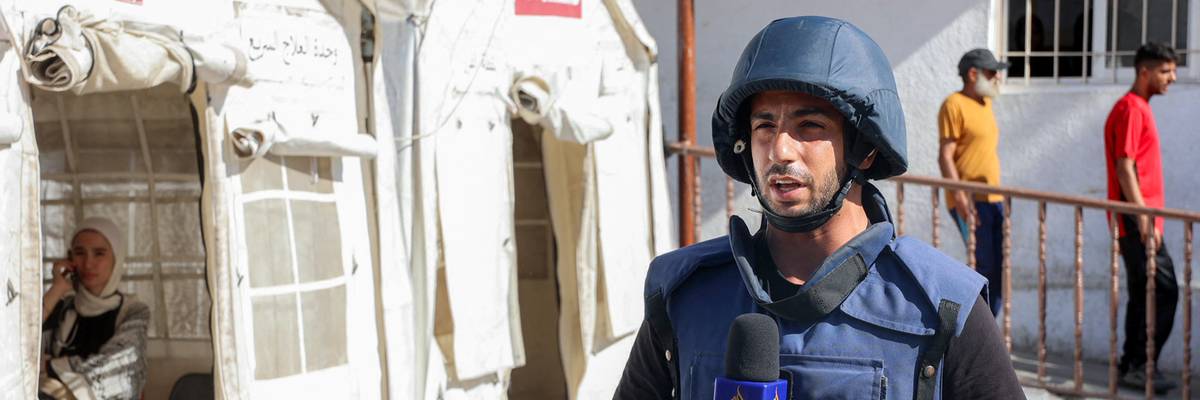
Israel’s Slaughter of Journalists Can’t Go Unpunished
Israel’s killing of at least 225 Palestinian journalists since 7 October 2023 briefly attracted international attention after it was calculated that more journalists have died in Gaza than in the US Civil War, World Wars I and II, the Korean War, the Vietnam War, the wars in Yugoslavia in the 1990s and 2000s, and the post-9/11 war in Afghanistan combined.
As part of its effort to eliminate witnesses and control the narrative, Israel has, as one commentator wrote, transformed Gaza into journalism’s graveyard.
It has used drones to hunt down media workers from afar, such as when it targeted Al Jazeera reporter Anas al-Sharif alongside Mohammed Qreiqeh, Ibrahim Zaher, Mohammed Noufal, Moamen Aliwa and Mohammed al-Khalidi, in a tent housing journalists near al-Shifa Hospital in Gaza.
Israeli forces have also executed journalists at close range, such as when a sniper killed Saed Abu Nabhan in central Gaza’s Nuseirat area.
Many other journalists have been injured, detained or disappeared, while Israeli forces have systematically damaged or destroyed more than 100 governmental and non-governmental media institutions and offices, including television, satellite and radio stations; broadcasting towers; media service offices; and newspaper headquarters.
Assassinating journalists constitutes a war crime and crime against humanity, because under the laws of armed conflict, journalists are considered civilians, and it is thus illegal to deliberately target them. But journalists are not afforded any other special protections, despite the high risks associated with their job.
The drafters of these laws, most recently in formulating the 1977 additional protocols to the Geneva Conventions, recognised the difference between civilians and journalists, understanding that the latter are frequently present on the front lines; yet inexplicably, they failed to afford them any additional protections beyond those already bestowed upon civilians.
Western media bias
The limited legal protections afforded to journalists leave them exposed to Israel’s systematic targeting. Israel has been further emboldened by western media and the role it has played in undermining perceptions of Palestinian journalists’ professionalism and credibility.
Israel has a long history of defaming Palestinian journalists, even using the government’s advertising agency to produce YouTube ads claiming that reporters from Gaza are integral to “Hamas propaganda”, and are thus legitimate targets.
It is unclear whether such insidious campaigns have influenced western media outlets, or whether their own longstanding biases shape how they cover the assassinations of Palestinian journalists. Either way, they often repeat Israel’s fabrications.
When Israel killed Middle East Eye journalists Mohamed Salama and Ahmed Abu Aziz at Nasser Hospital – along with Reuters photojournalist Hussam al-Masri, and freelancers Moaz Abu Taha and Mariam Dagga, who had done work for the Associated Press – western news agencies whose own reporters were killed in the attack, repeated Israel’s claim that it had targeted a “Hamas camera”, thus casually associating the five slain journalists with Hamas.
The neologism “Hamas camera” was undoubtedly formulated by Israel, and yet scores of media outlets repeated it without pausing to ask what a “Hamas camera” – as opposed to a Nikon or Canon – might be. The mere repetition of the phrase helped to legitimise Israel’s deliberate attack on the journalists, carried out at a hospital complex where medical staff and patients were also killed.
This strike took place in late August, more than a year and 10 months into the genocide. By then, it was evident that Israel was methodologically targeting journalists, having already killed more than 200 media workers, often along with their families.
Moreover, it is highly unlikely that major western media outlets would have aped Israel’s legitimising narratives had white European journalists been killed on the rooftop of Nasser Hospital.
What is clear, as author Chris Hedges points out, is that such narratives “discredit the voices of the victims and exonerate the killers”, reinforcing the impunity that enables the continued targeting of Palestinian journalists.
Rhetoric of incitement
The accusation that Palestinian journalists are ideologically motivated and cannot be objective comes from media outlets that circulated insidious reports about beheaded babies and infants cooked in ovens. It comes from outlets that repeated lies about the existence of a command centre under al-Shifa Hospital, alongside the false accusation that Palestinian journalists directed Hamas rocket units from the rooftops of hospitals.
Indeed, dehumanising Palestinians helps to normalise not only genocide, but also the incitement to commit genocide that Israeli journalists have spewed from day one.
Already on 7 October 2023, Shimon Riklin from Channel 14 wrote that “Gaza has to be wiped off the face of the earth”, and later rhetorically asked: “Why exactly do we have an atomic bomb?”
A few days later, Naveh Dromi, who also worked for Channel 14 and is now an anchor on i24 News, rhetorically quipped on the television programme The Patriots: “There are no innocents,” adding that Palestinians “brought the Nakba on themselves” in 1948 and “now they will have a second, real Nakba, to finish [former Israeli Prime Minister David] Ben-Gurion’s work.”
Roy Sharon, a correspondent for Channel 11, explicitly justified the prospect of “a million bodies”, noting on social media: “I spoke about a million bodies not as a goal. I said that if, in order to finally eliminate the military capabilities of Hamas, including [Yahya] Sinwar and [Mohammed] Deif, we need a million bodies, then let there be a million bodies.”
Arnon Segal, who writes for the newspaper Makor Rishon, was not at all apologetic, publishing a map where he explained: “This is how we will return to Gaza: the full plan for destroying the enemy, liberating the Gaza Strip, and establishing Jewish cities there.”
In an interview for Walla, long-time journalist and presenter Yaron London repeated his earlier statements that “Gaza must be flattened, even at the cost of harming innocents,” adding: “If you cannot distinguish between the population and the authorities because the authorities deliberately hide in hospitals or monasteries, then you have no choice and must be much less ‘vegetarian’… In my view, we were very ‘vegetarian’… the punishment for Hamas’s provocations should have been much more severe. Unfortunately, that punishment must also fall on the population”.
Some Israeli journalists directly incited against their counterparts in Gaza. Hagai Segal, the former editor-in-chief of Makor Rishon, wrote: “All journalists in Gaza are Hamas operatives or supporters, fabricators of blood libels … Perhaps there are a few people in Gaza wearing PRESS vests who, in their hearts, somewhat disapprove of Hamas, but even they are not deserving of the journalists’ association’s protection.”
And i24 Arab affairs analyst Zvi Yehezkeli said: “If Israel has decided to eliminate the journalists, better late than never.”
Legal precedents
Such statements could amount to direct and public incitement to commit genocide, an act punishable under Article 3 of the 1951 Convention on the Prevention and Punishment of the Crime of Genocide. In a similar vein, Article 25 of the 1998 Rome Statue of the International Criminal Court provides that a person who “directly and publicly incites others to commit genocide” bears individual criminal responsibility.
There are precedents for holding Israeli journalists and other media outlets accountable for incitement. In the Nuremberg trials, German publicist Julius Streicher was found guilty in 1946 for inciting to exterminate Jews in his newspaper Der Sturmer.
Similarly, in 2003, the International Criminal Tribunal for Rwanda convicted three media leaders for direct and public incitement to commit genocide. Speaking to the defendants, the chief justice explained that “without a firearm, machete or any physical weapon, you caused the death of thousands of innocent civilians”, while emphasising that their broadcasts and publications could not be protected under the right to freedom of expression.
Despite Israel’s attempt to cast Palestinian journalists as inciters to violence, the great and tragic irony, as the Rwanda case highlights, is that a not-insignificant number of Israeli journalists are guilty of precisely this crime.
It is therefore time for each and every signatory to the Geneva Conventions and the Genocide Convention to ensure that all journalists and media managers who have used the rhetoric of incitement are held accountable – by arresting them when they travel abroad and prosecuting them in national courts, which have universal jurisdiction.
What we have seen instead are numerous media outlets undermining the credibility of those who bear witness to Israel’s crimes – while, at times, facilitating the transformation of journalism into a vehicle that aids and abets genocide and crimes against humanity.