
Failing Solidarity: How Cultural Prejudice Shapes Leftist Narratives on the War Against Iran
The so-called progressive political and media elites have cynically normalized the assassination of Iran’s leader, dressing up regime change as a moral necessity while denying Iranians the right to self-determination. In doing so, they expose a racist double standard that humanizes Israeli victims, dehumanizes Iranian lives, and buries the very principles of freedom, dignity and international law they claim to defend.
Just imagine the uproar if Iran had killed more than 150 Israeli schoolgirls.
The ritual is immutable:
1) condemn the Iranian “regime” and more or less explicitly welcome the “death” (above all, never say “assassination”) of Ali Khamenei;
2) having thus provided justification for the US-Israeli war of aggression — the supreme crime according to the Nuremberg Tribunal — and validated the grotesque and abject talking points of the criminals against humanity that Trump and Netanyahu are regarding the alleged “dictatorship of the mullahs,” proclaim, hand on heart, that one does not condone war and artificially dissociate the other victims of these strikes, while affirming solidarity with the Iranian people;
3) finally and above all, make no reference to the fact that this same people took to the streets by the millions to support their “regime” in January, and are doing so again today, despite the bombs; it is not the real aspirations of the Iranian people that matter — deeply rooted as they are in their own history, values, and spirituality, infusing every aspect of their life with the teachings of Twelver Shia Islam and a deep attachment to the Prophet and his progeny — but rather those that the “civilized West” determines for them, seeking to shape them in its own godless image. Colonial mentality obliges — the same mentality that led Jules Ferry to declare that “the superior races have the duty to civilize the inferior ones.”
It is absolutely sickening to see that more than two years of genocide in Gaza have done nothing to change the crass ignorance, steeped in racism and Islamophobia, of our so-called progressive Left, whose hyperbolic reaction of solidarity we witnessed when it came to the 40 Israeli babies “beheaded” — existing solely in the putrid imagination of propagandists. In France, even La France Insoumise (LFI, main leftist party headed by Jean-Luc Mélenchon), which had managed to distance itself from the inept and complicit “neither-Maduro-nor-Trump” discourse on Venezuela, is now revelling in the war crime constituted by the assassination of a foreign leader, servilely described by Mélenchon as “the executioner of his people,” parroting US-Zionist propaganda and dismissing the millions of Iranians who hold him in reverence and regard him as their political and spiritual leader. Let us therefore listen to Mélenchon, the “Tribune of the plebs”:
This is the first time there has been a war with no good guys. This is the first time there has been a war with only people we don’t like, I mean governments we don’t like. The government of Iran inspires no sympathy in me: for my part, I have opposed it from the very beginning. When its leader Ali Khamenei dies, I am obliged to say that I feel no sadness.
Mélenchon then claims that just as Nazism was a form of supremacism, the governments of Trump, Netanyahu and Khamenei are each in their own way supremacist powers competing for domination — going so far as to suggest that Khamenei proclaims Iran’s “superiority within Islam and over the Middle East,” an absurd characterization that serves only to justify equating aggressors with the attacked. He concludes: “Neither Shah nor Mullahs.”
No sadness, then, for Khamenei, nor for his wife, nor for his daughter, nor for his son-in-law, nor for his 14-month-old granddaughter, murdered alongside him — except insofar as one adopts the Israeli logic whereby, in order to assassinate one person, dozens or even hundreds are killed with him, invoking “collateral damage,” or even consigning them to oblivion by denying their very existence.
No sadness either for international law, the purposes and principles enshrined in the Charter of the United Nations, the fundamental norms governing relations between States, global peace and stability. Nor for the more than 100 million Iranians and Shiite Muslims throughout the world (including in France and in the other European and Western countries) who mourn the loss of their Guide — whose popularity is questioned only by the ignorant and the ideologues, as for his followers, he is more than the Pope is to Catholics — because they do not embrace the model of society promoted by Mélenchon, who opposes the Islamic Republic on principle, even were it massively supported by the Iranian people, simply because the very principle of a theocracy repels him.
Iran must be regime-changed, even if that means sending it back to the Stone Age, like Syria and Libya, destroying all its incredible accomplishments since 1979 in fields such as healthcare, education, and the sciences — achievements made despite crippling sanctions and persistent external pressures, just like Cuba, from dramatic improvements in life expectancy to the expansion of medical and higher education, rapid growth in research output and scientific innovation, and self-sufficiency in pharmaceutical and high-tech sectors. Iranian women are 70% of Iran’s STEM graduates (Science, Technology, Engineering and Mathematics), but one must guess they are not “free” until they wear miniskirts. Such blindness and the outright denial of the right to political and cultural self-determination are outrageous.

Although Western tradition humanizes only Israeli victims, deemed alone worthy of compassion, let us defy convention and give a name and a face to the martyrs: above, Zahra Mohammadi Golpayegani, 14 months old, Khamenei’s granddaughter, murdered with her family. No sadness, really? And below, several faces of the victims of the strike on a girls’ primary school — how abominable single-gender education must seem in your eyes — whose wearing of the veil, which Mélenchon once described as a “rag on the head,” may perhaps shock you.
All the students seen in this video, at Shajareh Tayyebeh School, were martyred
Mélenchon, whose condemnations and impassioned outbursts after October 7 are well remembered — when the Palestinian Resistance had merely exercised its right to struggle against occupation (and Israel responded with the Hannibal doctrine and genocide) — would he dare to say “I feel no sadness” if Trump or Netanyahu had been killed along with their wife, children, and grandchildren, without provocation, triggering a regional war that could quickly become World War III? Never in a million years. He would have condemned the very act of international terrorism constituted by the aggression and assassination of a foreign leader, evoked all its potentially cataclysmic ramifications, and explicitly mentioned the victims. But when it comes to Iran, none of this matters. Iranian and Israeli lives are not equal in the eyes of the “supremacists,” whether ethnic, political, or civilizational — are they, Mr. Mélenchon?
As for Mediapart, long regarded as one of France’s leading left-leaning media outlets, it no longer even bothers to conceal its Atlanticist and Zionist allegiances, openly embracing them. It congratulated Israel on the “tactical stroke of genius” represented by the mass terrorist beeper attack against Lebanon (later discreetly revising the description to a “strategic success” once it recognized that the original wording was apologetic), and is now explicitly turning the victim into the culprit, daring to claim that Iran had it coming because it refused to “capitulate on its foundations,” namely its defense capabilities (nuclear weapons being nothing more than a crude pretext), and refused to allow itself to be carved up (see the surreal article “Rather than Capitulate on Its Foundations, the Iranian Regime Prefers to Endure War,” torn to pieces by the comments of Mediapart subscribers themselves, who are increasingly turning their backs on this vile NATO bootlicking). France remains, without a doubt, the daughter of Jules Ferry the colonialist and Pétain the collaborationist.
If our grandees truly cared about international law, the rights of peoples, and global peace and security, the assassination of Khamenei would be unanimously condemned with horror and indignation, both in itself and for the cataclysmic consequences it could entail, from a global economic crisis to a third world war. If “human animals” possessed as much dignity as Western and Israeli lives in the eyes of our self-proclaimed “feminists,” the Iranian schoolgirls targeted by Israel would make every front page — and draw condemnations dwarfing those provoked by the fake story of 40 decapitated babies. Instead of ludicrous accusations of expansionism or imperialism toward Iran, we would be reminded at every second that Israel — the intergalactic champion of killing children and destroying schools and hospitals — dreams of turning the entire Middle East into Gaza, and wants to ensure Trump follows through on “Operation Epstein’s Fury” to the very end.
The great historical tradition of international solidarity, which once led French men and women to risk their lives and endure torture in support of the Algerian FLN, is no more. At best, one can expect the “progressives” and other self-styled “revolutionaries” to place aggressor and victim on the same footing. Far from those who claim neutrality in situations of injustice, and who, as Desmond Tutu said, merely play the game of the oppressor, we affirm our genuine internationalist solidarity with the Islamic Republic of Iran in the face of imperialist and Zionist aggressors, and affirm not only its right to defend itself, but its right to choose its model of society, including that of a “theocracy,” which is only a dirty word for fanatic secularists.

Villainous lunacy is abundant these days as the bombing of Iran by Israel and the United States continues. The rationale for this illegal preemptive war that not only lacks legitimacy but should land its perpetrators in the docks of the International Criminal Court continues to get increasingly muddled. With US President Donald Trump now given to giving press conferences on the conflict, loony bin mutterings are becoming the norm increasingly.
A common assumption behind these attacks is Israel’s firm, unremitting stranglehold on the US President. Combined with the considerable influence of what John Mearsheimer and Stephen Walt called the “Israeli Lobby”, American foreign policy in the Middle East has been tenanted by Israeli interests. And Israel has shown itself to be a particularly bruising tenant in this regard.
While the central rationale is both fantastic and mendacious – namely, the destruction of a nuclear capability that had been, in any case, apparently obliterated last June – the view that Iran was going to unilaterally strike either Israel, the United States, its allies, or all of the above is fascinatingly absurd.
In a classified briefing with Republican and Democratic lawmakers on Capitol Hill on March 2, senior administration officials put forth the position that Israel had already planned to strike Iran, with or without US support. Present were Secretary of State Marco Rubio, the increasingly deranged Secretary of Defense Pete Hegseth, CIA Director John Ratcliffe and the Chair of the Joint Chiefs of Staff Gen. Dan Caine. Prior to the briefing, Rubio put forth the view that “there was going to be an Israeli action. We knew that that would precipitate an attack against American forces, and we knew that if we didn’t pre-emptively go after them before they launched those attacks, we would suffer high casualties.” Israeli impulsiveness proved the heaviest of tails in wagging the dimmest of dogs.
This less-than-convincing explanation worried Virginia Democratic Senator Mark Warner, who serves as vice chair of the Senate Intelligence Committee. “This is still a war of choice that has been acknowledged by others that it was dictated by Israel’s goals and timeline.” He questioned whether American lives should be put at risk when an alleged imminent threat was directed at an ally. “Israel is a great ally of America. I stand firmly with Israel. But I believe at the end of the day when we are talking about putting American soldiers in harm’s way and we have American casualties and expectations of more, there needs to be the proof of an imminent threat to American interests. I still don’t think that standard has been met.” Had Iran actually posed an imminent threat to the US, “better planning” should have been in place.
An even clearer statement of the foolish rationale was allegedly put to conservative broadcaster and commentator Tucker Carlson by Trump himself, suggesting that Israel had essentially painted him into the smallest of corners. Carlson, according to The New York Times, had attempted no fewer than three times in meetings at the Oval Office to argue why the US should not go to war with Iran. Reasons for not doing so included risks to US military personnel, the soaring effects of war on energy prices, and concern about how Washington’s Arab partners would react. He surmised that it was Prime Minister Benjamin Netanyahu’s desire to strike Iran that was the sole reason the president was considering a military effort. It would be prudent, suggested Carlson, if the Israeli PM were restrained in his bellicosity.
Carlson has also personally expressed the view that the war took place “because Israel wanted it to happen. This is Israel’s war. This is not the United States War.” It had been launched on a freight of “lies” and orchestrated by Netanyahu’s beguiling approach. “The point is regional hegemony.” Israel wanted “to control the Middle East” and “sow chaos and disorder” in the Gulf.
Another right-wing commentator, Megyn Kelly, reiterated what had been a central, even canonical line of MAGA: “No one should have to die for a foreign country.” The four servicemembers (there were actually six) who had given their lives for the US “died for Iran or for Israel.” The war was clearly Israel’s and was based on a fictional threat. “Does it make any sense to you that Iran was planning pre-emptive strikes against us? Obviously, it doesn’t.”
Trump was dismissive of both Carlson and Kelly, slipping into that habit common to megalomaniacs humming before a mirror: he referred to himself in the third person. “I think MAGA is Trump – not the other two.” The movement wished “to see our country thrive and be safe, and MAGA loves what I’m doing.” Carlson could say whatever he wants. It has no impact on me.”
Israel, however, did and does, though Trump, in what can only be regarded as piffling nonsense, is now promoting the view that Israel was the second hitter, with the US taking the bold lead. “We were having negotiations with these lunatics, and it was my opinion that they were going to attack first,” he reasoned at a bilateral meeting with Germany’s Chancellor Friedrich Merz. As he “didn’t want that to happen”, Trump thought he “might have forced Israel’s hand, but Israel was ready and we were ready.”
Hegseth, in another mad, uneven display before the press, also laid the entire blame for the war on Iran itself. “We didn’t start this war, but under President Trump, we are finishing it.” Not that the facts even mattered. International law did not exist. “No stupid rules of engagement, no national-building quagmire, no democracy building exercise, no politically correct wars.” (What do politically correct wars look like?) He sums up the jungle attitude to conflict, a deranged, semi-literate Tarzan whose views would sit well with the state machinery of Nazi Germany, one that showed the world how best to avoid international protocols and violate the laws of war in the name of streaky fantasy and monstrous ego.
Last Frontier for US-Israel World
Hegemony
Thinking the unthinkable

The goal of US-Israel is to wipe out the ‘Shia axis’, Israel’s only real barrier to seizing all Arab lands ‘from the river [Nile] to the [Arabian sea]’. All the Arab stateS except Ansar Allah’s Yemen are what we can call Arab Zionists, i.e., subservient to Israel. In a sense Israel already has hegemony over them all. Only an anti-US-Israel revolution similar to the Arab Spring of 2011 can shake this unholy alliance.
10/7 has provided the pretext for this plan to accelerate, giving Israel free rein to obliterate Gaza, killing more than 100,000 Palestines, destroying Palestinian homes and fields, poisoning their wells in the West Bank, with the open vow to forcibly resettle any remaining Palestinians, Christians and Muslims, still alive to Somaliland, Sinai, Saudi Arabia, Jordan, Iraq. The details are still unsettled.
Iran is the only real supporter of resistance to US-Israel, exposing the hypocrisy of the Arab quislings. The latter have all dutifully declared war on Iran for daring to target US basis that try to hide under quisling auspices. This pathetic show of treachery to Islam is a sign for all sincere Muslims to rise up and overthrow them. Ayatollah Sistani vowed to issue a fatwa for jihad if Ayatollah Khamenei was assassinated. So far he hasn’t issued this, but Iraqi Shia have shelled US forces and Hezbollah have renewed shelling Israel. The Arab quislings will never rest in peace when Israel makes its next move to actually take physical control of their lands.
Iran is the last ‘low hanging fruit’ for the US post-9/11. Having seized control of first Iraqi oil, then Libyan oil, then Venezuelan oil, the US has only to sezie Iran’s oil to halt China and the world’s attempt to establish a non-US financial mechanism for world trade. The importance of maintaining US world financial hegemony is reflected in these countries being targetted.
Iran has been sanctioned to death since the Islamic revolution, with waves of Mossad scheming to foment unrisings to induce regime change, as Iran is too big to invade. The intricacies of world finance mean that Russia benefits in the short term from high oil prices during the war against Iran, but the war in Ukraine continues unabated, weakening Russia regardless of oil prices. Russia is already short of manpower, and unrest with the already 5-year costly war and unremitting sanctions will create a scenario much like the desperation of Iranians.
US practice of inducing colour revolutions, soft-power regime, change will continue unabated, leaving Russia fatally weakened and only China as the last firm bulwark of anti-US imperialism. China will have to step up to the challenge, stop pussy-footing with US-Israel, which it has refused to do so far. Commentators are urging China to blockade Taiwan, emulating US blockades of Iran, Russia, Venezuela, and Cuba. China has this ace: it controls the seas of southeast Asia, and now has no reason not to confront US-Israel head-on before it has incapacitated Russia and encircled China.
We Are Someone’s Dirty Work
A voice of true peace and human rights in Iran

“Love In Tehran” © Jan Oberg
“We are someone’s dirty work. And by “us,” I mean Iranians actually living in Iran. It doesn’t matter what group you think you belong to or what you believe; at the end of the day, our lives are just a resource for someone else’s agenda. We are the currency used in a game we didn’t ask to play.”
[This piece was written after the recent deadly protests in Iran in January and before the new invasion by Israel and the USA in February and March 2026. One more will follow.]

The author
We are someone’s dirty work. And by “us,” I mean Iranians actually living in Iran. It doesn’t matter what group you think you belong to or what you believe; at the end of the day, our lives are just a resource for someone else’s agenda. We are the currency used in a game we didn’t ask to play.
If you are a protester, you are labelled “filthy” and unfaithful to the state, providing the justification to kill you in the streets or throw you in a cell. To the regime, your life is only useful if it’s silent; if it’s not, you become the “dirty work” used to send a message of deterrence to everyone else. If you engage in civil work or join a political party, you are labelled a spy or an enemy of the state, making your elimination desirable. Even a simple social media post can be enough to have your livelihood stripped away.
Then there is the shadow of the “West.”
You go to your hometown, to your parents’ house for a big family gathering, and you wake up to a full-blown war instigated by Israel and joined by the USA. After ten days of being unable to return home, unsure if your job will even exist when you get back, you are forced to accept that you are now a displaced person.
This is not a “conflict”; it is an unlawful invasion of Iranian territory. More than a thousand Iranians have been killed—the vast majority of them civilians. Yet, the German Chancellor calls this “dirty work”1 that had to be done. To these powers, the slaughter of a thousand people is just a tactical necessity to “delete” a regional actor for their own political interests, justified as merely eliminating a “regime.”
You are even considered dirty work by Iranians living abroad. If you don’t support a former Prince or follow the propaganda funded by foreign powers, you are seen as the enemy. There is a whole industry of “opposition” that exists only because of foreign government funds. Even those who aren’t pro-Pahlavi still believe that only they have the answers.
When you ask acquaintances in the diaspora on LinkedIn about the goals or organisers of a demonstration, they tell you to “move on” from their post because you are not the “audience.” They pretend to be your voice, but to them, you are just a subject. They are not the ones who have to live with the consequences. They talk about democracy, but they are looking for another “Spring” that would leave the country destabilised and broken.
If you believe in gradual change, non-violence, or a peaceful transition, you are nobody’s “good guy.”
You are targeted by both sides because violence and extremism are more profitable. They speak of freedom, but they show no respect for freedom of speech or diversity; they believe only they are righteous. When you refuse to pick a side on the far ends of the spectrum, you are rejected by everyone who benefits—politically, financially, or emotionally—from the chaos and polarisation.
So yes, just by being an Iranian in Iran, your blood, suffering, and loss are seen as a “justified” sacrifice for some “greater goal.” The most terrifying part is that every actor – the regime, the invading foreign powers, the diaspora opposition, and even ordinary people who have given up on a better future – claims to be fighting for peace and human rights. They all claim they are doing the right thing.
And that is exactly why they feel so comfortable using our suffering as their dirty work. We are just their dirty work.

People At A Fountain © Jan Oberg
ENDNOTE:
Israel and the United States Cannot Win the War against Iran
In the middle of negotiations, the United States and Israel launched a new attack against Iran based on an old, and false, argument: that Iran was going to build nuclear weapons.
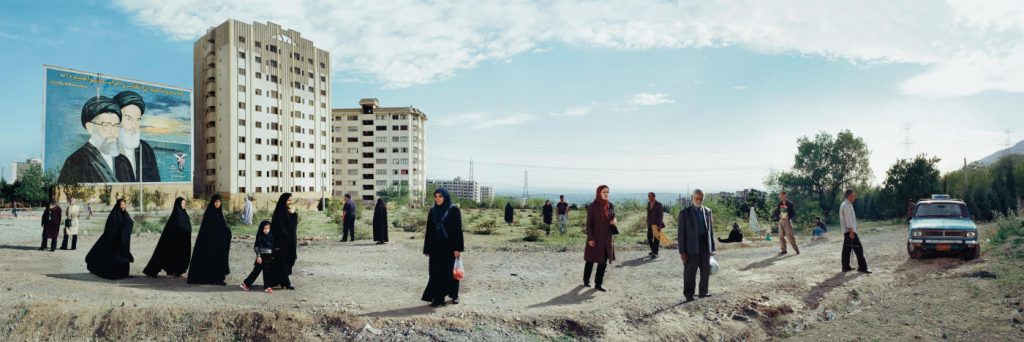
Mitra Tabrizian (Iran), Tehran, 2006.
To the girls of the Shajarah Tayyebeh elementary school in Minab, Hormozgan Province, Iran, who were killed by the illegal Israeli-US war of aggression.
On 28 February, a few hours after negotiators said that Iran had accepted many of the demands regarding its nuclear programme, the United States and Israel launched strikes on Iran. This was the second strike since the United States and Israel attacked Iran in June 2025. Both strikes are illegal, since they violate Iran’s sovereignty, which is guaranteed by the United Nations Charter.
Iran is a sovereign country and, just like the United States, a founding member of the United Nations. It is therefore entitled to all the benefits and responsibilities of the UN Charter. The United States signed and ratified the UN Charter, which means that the US government has a treaty obligation to the Charter and to the other member states. After President George W. Bush violated the UN Charter to start a war of aggression against Iraq, US President Donald Trump told Howard Stern on 16 April 2004, ‘I think Iraq is a terrible mistake. And to think that when we leave, it’s gonna be this nice democratic country. I mean give me a break’. Trump is not taking his own advice.
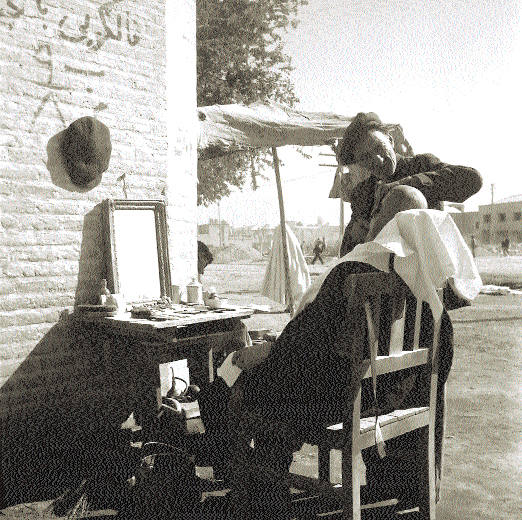
Mahmoud Pakzad (Iran), Barber Shop, 1958.
Why did the United States want to attack Iran, a country with nearly a hundred million people and a centuries-long tradition of patriotism, first in 2025 and then in 2026? In his last State of the Union address, Trump said that the main reason was that he believed that Iran has a nuclear weapons programme. Yet Iran has repeatedly said that it does not have a nuclear weapons programme. This was laid out clearly by Ayatollah Seyed Ali Khamenei in a fatwa (judgment) that he first made public in 2003, but which had been written a decade earlier. In that fatwa, Ayatollah Khamenei noted that Iran’s soldiers suffered from the use of illegal mustard gas and other chemical weapons by Iraq (supplied by the United States and West Germany), and that this experience and his reading of Islamic ethics made it unconscionable to use weapons of mass destruction. Leader after leader in Iran has reiterated the same view.
In the State of the Union address on 24 February, Trump said, ‘We haven’t heard those secret words, we will never have a nuclear weapon’. But this is precisely what Ayatollah Khamenei had said. In fact, a few hours before Trump’s address, this is exactly what Iran’s foreign minister Seyed Abbas Araghchi tweeted: ‘Iran will under no circumstances ever develop a nuclear weapon’. On 17 February, Iran’s President Masoud Pezeshkian said, ‘Based on the fatwa of the Supreme Leader, from an ideological standpoint we are absolutely not pursuing nuclear weapons, and however they wish to verify it, we are prepared’. He asked, ‘In what language should we say we don’t want nuclear weapons?’. His statement, in Farsi, was translated into a range of languages. Yet it seems that news of this did not reach the White House.
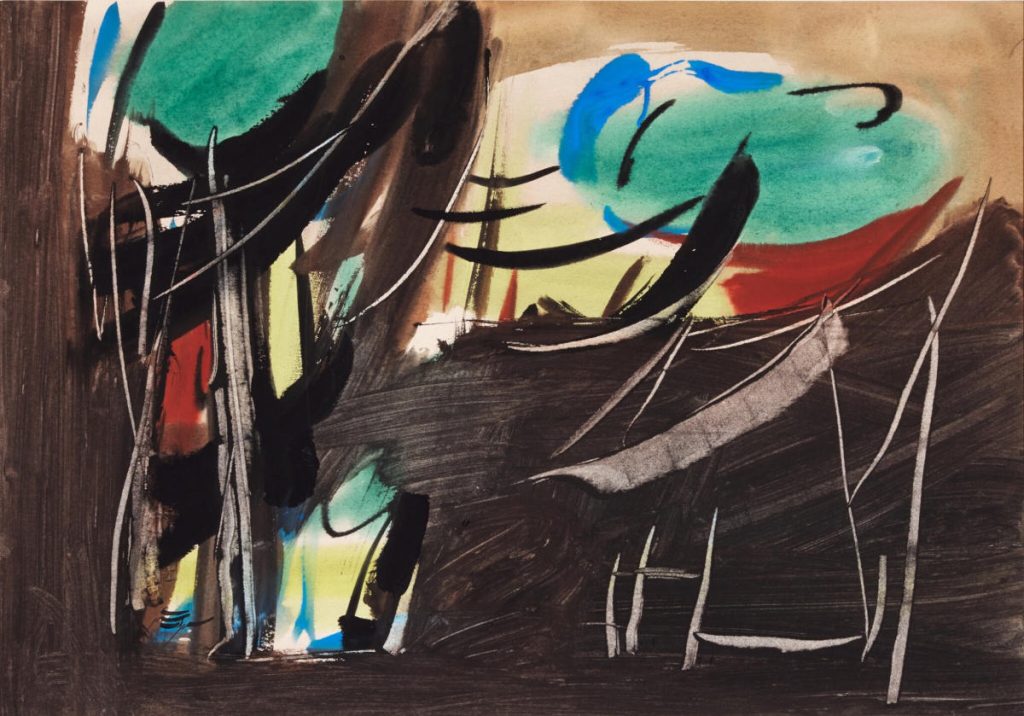
Sohrab Sepehri (Iran), Untitled, 1960s.
In 1957, Iran and the United States signed the Agreement for Cooperation Concerning Civil Uses of Atomic Energy, which allowed the US to transfer nuclear technology and materials through the Atoms for Peace programme created by President Dwight D. Eisenhower. In 1959, the Iranian government – then controlled by the last Shah of Iran, Mohammad Reza Pahlavi – opened the Tehran Nuclear Research Centre. Several years later, the US provided Iran with a 5-megawatt thermal nuclear reactor that was designed for medical radioisotope production and scientific research.
After the Iranian Revolution of 1979, the new government shut down the nuclear energy research programme. Following the war with Iraq, which ended in 1988, and the death of Ayatollah Ruhollah Khomeini in 1989, Iran restarted its nuclear energy programme for electricity generation, medical isotope production, and scientific training. In 1995, Iran signed a deal with Russia to rebuild the Bushehr Nuclear Power Plant in Iran (built in 1975 by the West Germans and bombed by the Iraqis using West German intelligence). Again, Iranian officials have repeatedly said, we do not want nuclear weapons ever. The US did not seem to disbelieve the Iranians when it restarted nuclear energy programmes for these purposes.
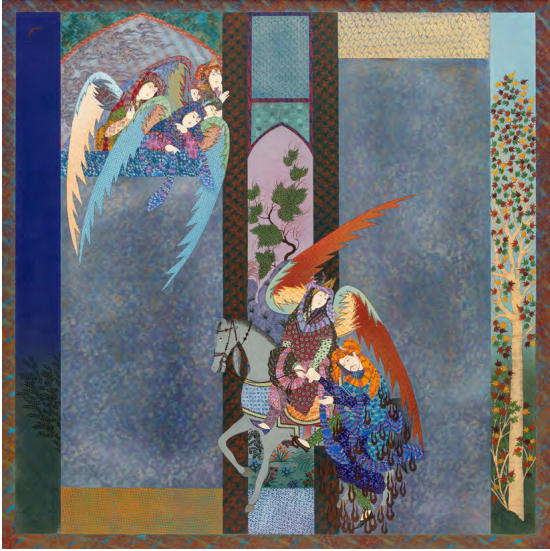
Farah Ossouli (Iran), Untitled, 2003.
Everything changed after the US attacked Afghanistan in 2001 and Iraq in 2003, removing Iran’s two historical adversaries (the Taliban and Saddam Hussein’s government). Iran, which was previously hemmed in by its neighbours, now had the opportunity to build relations with Iraq, Syria, and Lebanon. This was a shock to Washington, which had not clearly understood the ramifications of its illegal wars. To isolate Iran, the Bush administration concocted the myth of Iran’s nuclear weapons ambitions and cynically used the International Atomic Energy Agency (IAEA) for its campaign.
Bush, as he often did, ignored the facts before him. What were these facts?
- In 2007, the US intelligence community’s National Intelligence Estimate concluded, ‘We judge with high confidence that in fall 2003, Tehran halted its nuclear weapons programme’. Whether Iran actually had a nuclear weapons programme before this date is not the issue; the CIA and other agencies agreed that there was no programme after 2003.
- In 2011, an IAEA report suggested that Iran’s actions to procure various kinds of materials (‘nuclear related and dual use equipment’) indicated a ‘possible military dimension’, but with no evidence. Each of the accusations came with caveats. It seemed that the IAEA was under immense pressure from the US government and its European allies. The report bore all the marks of political influence.
- In 2015, the IAEA released its Final Assessment on Past and Present Outstanding Issues regarding Iran’s Nuclear Programme, written by its director general, Yukiya Amano. This report conclusively says that there are ‘no credible indications’ of any activities relevant to a nuclear explosion device after 2009 and no credible evidence of diversion of nuclear material for weapons.
- In 2025, IAEA Director General Rafael Mariano Grossi told Al Jazeera definitively, ‘We did not find in Iran elements to indicate that there is an active, systematic plan to build a nuclear weapon’.
There can be no clearer statement than that of Grossi: ‘we did not find’. Put that beside the statement from President Pezeshkian: ‘in what language should we say we don’t want nuclear weapons?’.
There are no nuclear weapons in Iran. To go to war on that pretext is to follow the example of Bush and his ‘weapons of mass destruction’ in Iraq. Where were those weapons? In his imagination.
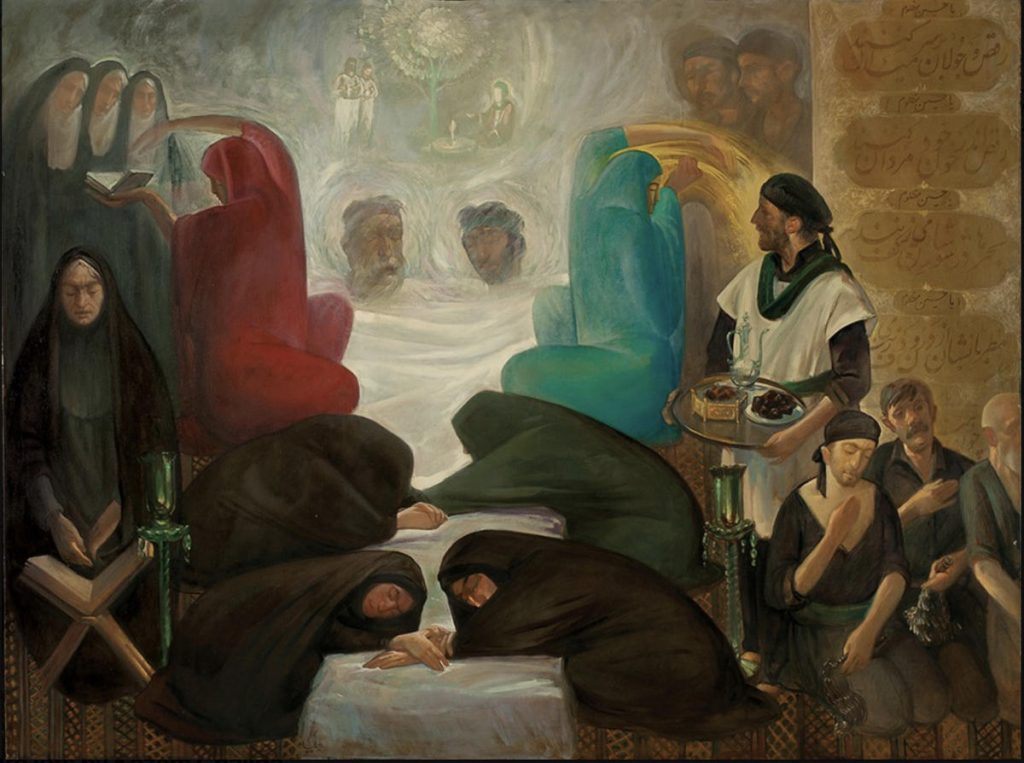
Kazem Chalipa (Iran), Reunion, n.d.
Certainly, there are great problems within Iran. A combination of the attempt by the United States and Europe to make Iran’s economy scream and poor economic management by Minister of Economic Affairs and Finance Seyed Ali Madanizadeh (trained at the University of Chicago) have created serious problems for Iran’s working people. But Iran cannot solve its problems without an end to the US-imposed hybrid war that suffocates its economy and its peoples.
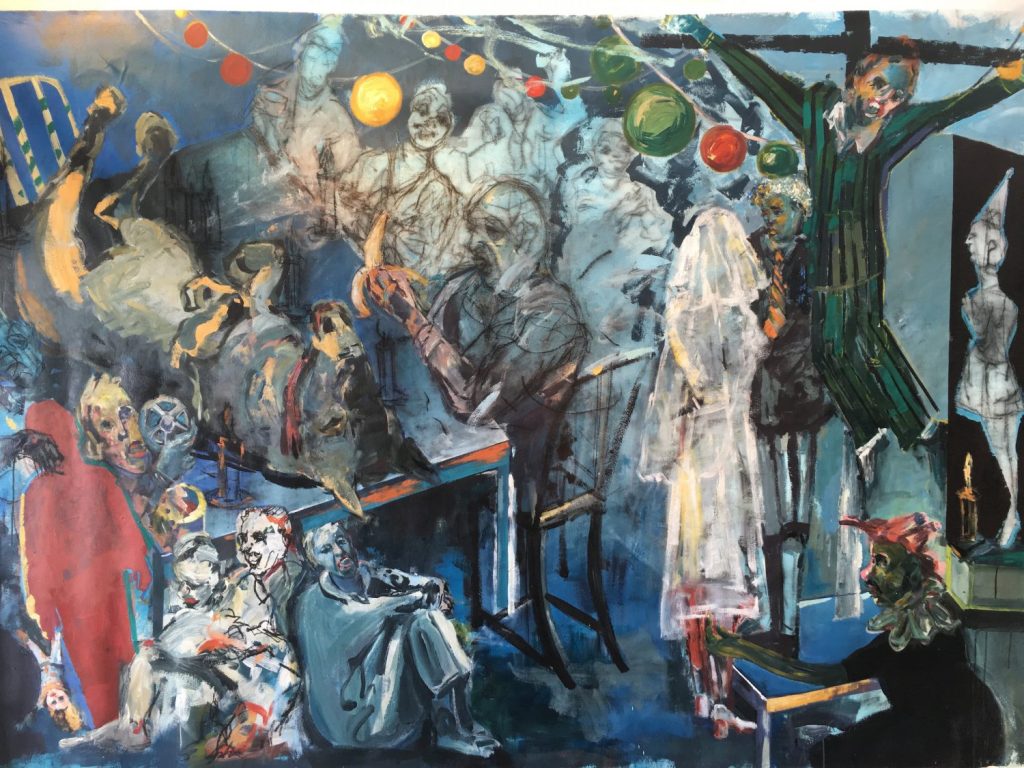
Sarah Issakharian (Iran), The First Supper, 2016.
The Iranian people know war very well. It has been imposed on them repeatedly, from the Anglo-Persian War (1856–1857) to the Iraqi invasion (1980) to the current hybrid war.
In the poem ‘Lidless Coffins with No Bodies’, the Iranian poet Behzad Zarrinpour (born 1968) wrote about the terror of war, a terror that was inflicted by Bush’s ‘terrible mistake’. I want to share a part of that beautiful and impactful poem with you:
The Wind has filled the city’s nostrils
with destruction’s odour.
No one flees the harsh sun
For the gentleness of unstable walls.
Spread-out inhospitable tablecloths,
Empty promises,
Stomachs that instead of bread
Eat bullets,
And bankrupt salt sellers
Who have dispatched their gunnysacks
To the war front to be swelled with sand.
Grandmother’s tongue is so terror-struck
She cannot remember her prayers.
First published as the Tenth Newsletter (2026) of the Tricontinental: Institute for Social Research (https://thetricontinental.org/newsletterissue/us-israel-iran-attack/)
The Mirage of Preemption
The Constitutional and Strategic Costs of Trump’s New War in Iran
The Mirage of Preemption

A Presidential Declaration Without Congressional Approval
“A short time ago, the United States military began major combat operations in Iran,” President Donald Trump declared in a video released on the morning of February 28, 2026. Without a single vote from Congress, and in clear defiance of the constitutional requirement for a declaration of war, the President announced that the United States and Israel have launched a massive, coordinated assault on Iran. The justification offered was the familiar, haunting refrain of “imminent threats,” a phrase that has served as the preamble to nearly every foreign policy disaster of the last quarter-century.
The strength of a republic is measured by its adherence to law during times of crisis. However, for the past quarter-century, the halls of Congress have grown increasingly silent as the Executive Branch has seized the sole prerogative to initiate global conflict. We are not merely witnessing a lapse in judgment, but a stark reminder that the modern presidency now operates with the unilateral authority of the very monarchy this nation was founded to overrule. By bypassing the constitutional requirement for a declaration of war, the administration risks not only the lives of our service members but the very republican foundation it claims to defend.
The Language of Inevitability and the Narrative of Preemptive War
The Preemptive Strike Narrative
Arguing that the path of diplomacy had been exhausted, President Trump defended the escalation by pointing to Israeli intelligence that purportedly showed Tehran poised for an immediate strike against U.S. interests. While the administration frames the operation as a “preemptive strike” to stop an immediate threat, some lawmakers and international organizations such as the European Council on Foreign Relations argue it lacks a strategic endgame and may instead be a “preventive war” or a “war of choice.” Earlier this week Trump claimed that Iran was “working to build missiles that will soon reach the United States of America,” but US intelligence agencies argue that Iran is years away from such a capability.

Media Amplification of War Narratives
Nonetheless, the preemptive strike narrative was immediately amplified by media figures like Scott Jennings on CNN. The spectacle of news anchors echoing unverified government sources explains why the American public remains so dangerously disinformed. History reminds us that “preemptive strikes,” most notably the 2003 invasion of Iraq, are almost always wars of choice built on a foundation of false pretenses.
Regime Change Rhetoric and Historical Context

The President’s rhetorical gymnastics reached a fever pitch when he and other Republicans claimed the strikes were an act of solidarity with Iranian protesters, an effort to help them “take their country back” from a “wicked, radical dictatorship.” Such concern for human rights rings hollow from an administration that has presided over the aggressive policing and murder of protesters in American streets and the mass incarceration of undocumented individuals and American citizens. Critics have pointed out the bitter irony of the President decrying Iranian authoritarianism while his own administration constructs a network of massive “holding facilities” across the U.S. heartland, warehouses so grim in their design that some commentators have compared their schematics to the horrific efficiency of slave ships.

The Legacy of the 1953 Iranian Coup
Furthermore, the “regime change” fantasy ignores the very history that brought us here. In 1953, the U.S. and U.K. overthrew Iran’s democratically elected Prime Minister, Mohammad Mossadegh, simply because he sought to nationalize Iranian oil for the benefit of his people. By installing the autocratic Shah, the West planted the seeds of the 1979 Revolution. The current theocracy is a direct result of Western meddling, not a justification for more of it. Furthermore, the U.S. has attempted regime change around the world nearly 100 times, and the vast majority of these efforts have resulted in prolonged instability, humanitarian crises, or the rise of even more hostile governments.
The Nuclear Shell Game

Contradictions in Nuclear Threat Claims
The secondary excuse for this war, nuclear proliferation, is riddled with contradictions. For over a decade, Israeli Prime Minister Benjamin Netanyahu has claimed Iran was “months away” from a bomb. These alarms were sounded in 2012, 2015, and 2018, each time proving to be exaggerated or based on outdated data.
The Collapse of the Iran Nuclear Agreement
The administration’s own record is a labyrinth of contradictions. In 2011, Donald Trump famously derided then-President Barack Obama for a perceived lack of diplomatic skill, warning, “Our president will start a war with Iran because he has absolutely no ability to negotiate. He’s weak and he’s ineffective.” Yet, when Obama successfully negotiated the Joint Comprehensive Plan of Action (JCPOA) in 2015, a landmark agreement that saw Iran limit uranium enrichment and submit to rigorous international inspections, it was Trump who ultimately tore it up upon taking office.
The confusion has only deepened in the last year. On June 21, 2025, following the conclusion of Operation Midnight Hammer, President Trump triumphantly declared that U.S. forces had “completely and totally obliterated” Iran’s enrichment capabilities. This leads to a glaring logical deficit: if those facilities were truly reduced to rubble six months ago, the administration has yet to explain how they could possibly pose an “imminent” nuclear threat today.
If the threat to the U.S. is manufactured, whose interests are being served? Economist Jeffrey Sachs argues that the answer is regional hegemony for Israel, not American security. Sachs notes that toppling the Iranian regime has been an explicit Israeli policy for years. He muses that the U.S. has abandoned its own interests due to evangelical political pressure, or “it may be blackmail, it may be corruption, it may be many other things, but it is not about America’s interests.”
The Neoconservative Restoration

Media Panels and War Messaging
Meanwhile, the media environment remains a “rhetorical unit” for the administration. The day the bombings were announced, Jake Tapper’s CNN guests were seemingly required to perform a ritualistic condemnation of the late Ayatollah Khamenei, who was reportedly killed in today’s strikes, as a prerequisite for appearing.
The Crisis of the America First Movement
The homogeneity of the media’s “expert” analysis was staggering. CBS’s afternoon panel featured a relentless parade of hawks: Senator Tom Cotton, who has long advocated for military action against Tehran; Representative Josh Gottheimer, a staunch supporter of the escalation; and retired General Frank McKenzie, who previously oversaw strikes against Iranian interests. They were joined by Alireza Akhondi, a dissident with a personal vendetta against the regime, and National Security Council veteran Samantha Vinograd, another vocal proponent of the bombardment. It was less a news panel and more a Council of War, devoid of a single voice questioning the constitutional or strategic sanity of the mission.
One casualty of this morning’s announcement may be the “America First” movement itself. Trump’s original political ascent was fueled by his visceral rejection of the 2003 Iraq War as a bipartisan catastrophe, a stance that defined the MAGA base. Today, that same base finds itself bitterly divided. There is a palpable fear that “regime change” will inevitably necessitate U.S. boots on the ground, mirroring the very quagmire in Iraq that Trump once denounced. For years, influential figures like Charlie Kirk lobbied the President to avoid a full-scale confrontation, particularly following the volatile 12-Day War between Iran and Israel in June 2025. But with Kirk’s death last year, the most prominent anti-war guardrails within the movement have been silenced or dismantled, leaving the “America First” doctrine indistinguishable from the neoconservative interventionism it once sought to replace.
By launching this illegal war, the President has not protected the American people; he has invited a regional conflagration that will drain our treasury and cost the lives of our youth. The “freedom” promised to the people of Iran will likely look much like the “freedom” we brought to Iraq and Libya: a landscape of rubble, resentment, and endless war.
The Populism Cure: Fighting Oligarchy and Reclaiming Democracy


No comments:
Post a Comment