They Are Still Lying About Iraq
They are still lying about the Iraq War.
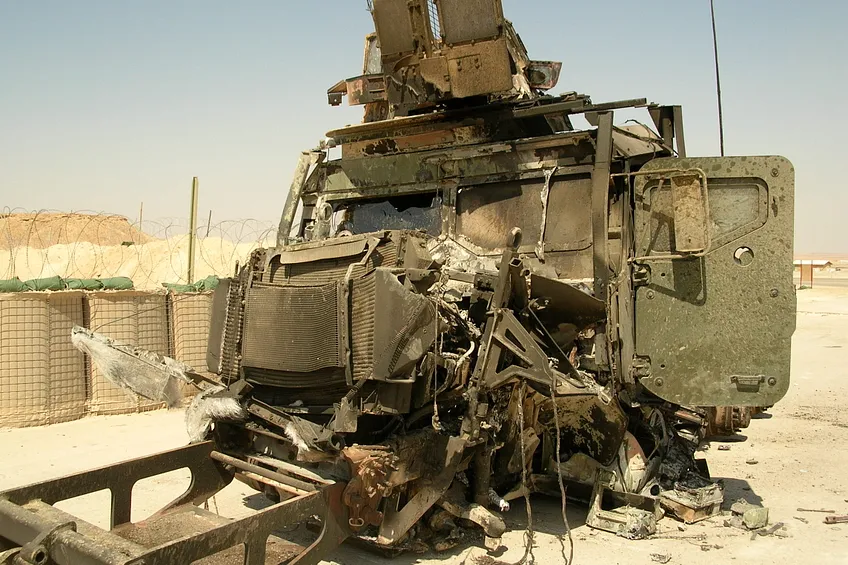
The lack of shame exhibited by the US government as it lies about Iraqi improvised explosive device (IED) attacks that killed thousands of American service members to justify its new war on Iran is breathtaking. President Trump led off his press conference today, the first since the attacks began Saturday morning, with this lie. Trump’s proxies on cable news, in the newspapers and online have been repeating it non-stop.
The lie is essentially that American soldiers were killed and wounded in Iraq at the orders of the Iranians. That the people responsible for blowing up American vehicles and sending home US soldiers in caskets or without body parts were Iranians, not Iraqis. The reality, of course, is that responsibility for those deaths and mutilations belongs to George W. Bush and every politician, general, government official, journalist, pundit and citizen who supported that war. I put myself into that disgraceful camp as someone who twice went voluntarily to that war.
This lie gets recycled whenever the prospect of war with Iran is present. For example, in 2019, the allegation appeared as the US imposed severe sanctions on Iran and labeled the Iranian Revolutionary Guards Corps a terrorist organization (the first time the US government designated a government or a military as a terrorist organization). These actions, following the unilateral abrogation of the 2015 nuclear deal with Iran by the US, led to year-long tensions that culminated in the US assassination of Iranian general Qasem Soleimani, who the American government and press labeled as having “American blood on his hands”, and retaliatory Iranian missile attacks on US forces in Iraq.
To begin with, the majority of US service members killed and wounded in the occupation of Iraq were killed by Sunni resistance groups, NOT Shia resistance groups. Sunni groups accounted for more than 80% of American deaths. These Sunni groups did not receive any support from Iran. These Sunni groups, like the Taliban in Afghanistan, did get a great deal of support from persons and institutions throughout Sunni countries in the Middle East, especially from the Gulf monarchies, Saudi Arabia chief among them. Yet, in Washington, DC’s calculus, these states don’t have the blood on their hands that Iran does, even as 4 out of 5 Americans were killed by Iraqi Sunni groups.
Sunni groups did fight against Shia groups that may have had a relationship with Iran. The Shia groups also fought against each other. Some Shia groups fought against the Americans. The Americans killed and wounded by Shia groups using IEDs were killed and wounded by Iraqis, not Iranians. Yes, there was a small Iranian presence in Iraq, acting as advisors to the Shia groups. However, the Iranian role was dwarfed by organic Iraqi resistance to occupation and sectarian commitments to one side or the other in intra-Iraqi fighting.
Throughout the Iraq war, American authorities and apologists offered multiple explanations for the violent resistance to occupation, other than as an expression of resistance to occupation. Both Sunni and Shia groups that were killing Americans, along with their supporters (in the Sunni case, at least 75% of the population by 2006), were explained away as Saddam Hussein loyalists, criminals, jihadists, co-opted, desperate and jobless, dead-enders or nearly anything other than as men who were picking up a rifle because their country was occupied and their communities and families threatened. As an example, this insipid 2005 study from the US Institute of Peace stated that Iraqi patriotism was only a fig-leaf to disguise Sunni attempts to upset the fully representative aspirations of Iraq’s nascent democracy. Were there elements of the Iraqi resistance groups that were motivated by something other than resistance to occupation? There were. But the predominant motivation in fighting the Americans was occupation. That Iraqis were killing Americans under Iranian orders not only helped justify a longed-for war with Iran but also bolstered the fiction of the American occupation as a benevolent and liberating one.
The claim is offered that Shia groups used a type of IEDs called explosively formed penetrators (EFPs), which were devastating against American vehicles. Sunni groups did not use EFPs in any significant manner. The lie told was that Shia groups exclusively got EFPs from Iran. That the knowledge, technology and production of EFPs was too great for Iraqis. That is not true. Anyone with a simple understanding of explosive principles and a half-decent machine shop can make an EFP. Shia forces were able to mass-produce EFPs in Iraq. Smuggling in EFPs from Iran was unnecessary. Just as in general it was not necessary to bring weapons, ammunition and munitions into Iraq to support either Sunni or Shia insurgents, as there were plenty of such things already in Iraq.
To be clear, Shia groups did receive support from Iran, but nowhere near the amount necessary to describe those groups as Iranian proxy groups rather than Iraqi nationalists fighting against occupation or sectarians fighting for control of their country. In terms of material assistance, the biggest supplier of weapons and munitions to Shia groups, particularly the Badr Corps, was the US military itself. US forces trained and supplied Shia groups; under General David Petraeus’ command, the US “lost” nearly 200,000 weapons while training these forces.
Those Shia groups trained by the US became the basis for Iraqi military and police units during the occupation. The police units were principal actors in the slaughter and torture of Sunnis and fellow Shia Iraqis that defined the opening months of the Iraqi civil war (the Iraqi civil war was a subset of the American occupation). The Badr Corps was supported by the US even though it was the militia arm of the Supreme Council for Islamic Revolution in Iraq or SCIRI. SCIRI was not nominally Iranian-aligned. The Iranians hosted SCIRI in exile for decades before 2003, and the relationship between Iran and SCIRI, and its Badr Corps forces, was well understood in 2003. That didn’t stop the Americans from integrating the Badr Corps into Iraqi security forces under the control of the US. [I had personal experience with the transfer of $20 million from the US to SCIRI/Badr in 2004 but I am running out of time to get this done, so I will have to relay that another time.] It needs to be emphasized that the Iraqi group most connected in 2003 to Iran was the group that the US filled out Iraq’s government and security forces with.
The lie about Shia groups having to get EFPs from Iranians comes from the fabrications of the George W. Bush administration and others in the US foreign policy establishment assembling justification for a war with Iran, as well as trying to excuse away violent resistance to the US occupation. The lie, for more than 20 years now, has been that Iran has American blood on its hands in Iraq. The reality always was that American blood was on the hands of those American leaders who sent American troops to invade and occupy Iraq, and all those who went along with it.
Now that lie, a lie I know to be false, and one that defiles and mocks the truth of the men I know who were killed and maimed by IEDs in Iraq, is being used to justify this war on Iran.
My knowledge of this is firsthand, based on my experience, including the intelligence I had access to, when I led counter-IED efforts in Iraq and at the Joint IED Defeat Organization from 2006-2009.
Reprinted with permission from Matt’s Thoughts on War and Peace.
Matthew Hoh is the Associate Director of the Eisenhower Media Network. Matt is a former Marine Corps captain, Afghanistan State Department officer, a disabled Iraq War veteran and is a Senior Fellow Emeritus with the Center for International Policy. He writes at Substack.
The cover photo credit goes to Scott Miller, who was my Company First Sergeant in Iraq in 2006-7. The picture is of one of our armored 7-ton trucks hit by an IED. All three Marines survived. The carriage on the front of the truck is what is left of a mine roller.
My unit did route clearance, i.e., we drove around looking for IEDs. In this case, the way we found them was to detonate them by driving over them. This attack occurred in early 2007, roughly 4 years after the invasion. At that point, 4 years in, WWI technology was what we had to find IEDs.
As he burns in hell, may the demons chant to Donald Rumsfeld: “You go to war with the army you have, not the one you want.”
If you are interested in my daily commentary on the war in Iran, please go to my X account or follow here via my Notes. You can also follow my commentary on Upscrolled (@matthewphoh).
I am on weekly with Judge Napolitano at 2 pm Eastern on Tuesdays and with Nima Alkorshid at 4 pm Eastern on Wednesdays.
My appearance on Saturday morning with Danny Davis on Daniel Davis Deep Dive:
And my appearance with Judge Napolitano last week, where I discussed my Substack post from last week, Annexing Tehran through the West Bank:
Thank you for reading, watching and supporting.
Reprinted with permission from Matt’s Thoughts on War and Peace.
Matthew Hoh is the Associate Director of the Eisenhower Media Network. Matt is a former Marine Corps captain, Afghanistan State Department officer, a disabled Iraq War veteran and is a Senior Fellow Emeritus with the Center for International Policy. He writes at Substack.
Your Children’s War
The United States and Israel initiated joint strikes across Iran with President Trump now advocating for regime change in the country. The strikes are largely reminiscent both in preparation, scale, and execution of Operation Desert Fox, a 1998 American bombing campaign in Iraq which claimed to prevent further proliferation of weapons of mass destruction by the Saddam regime. Desert Fox was the final series of military strikes against Iraq in the 90s, following nearly a decade of varying conflicts including Operation Desert Storm in 1991, strikes in 1993, and Operation Desert Strike in 1996.
In addition to kinetic strikes, the United Nations Security Council imposed economic sanctions against Iraq in the ‘90s; the U.N previously found that this led to the starvation of up to 500,000 children in the country, although studies since have found a lower total. American political and military leaders acted as though they could attack the small Middle Eastern country with impunity. For many years, this proved to be true, as Iraq was largely unable to compete with American military power. However, these strikes, sanctions, and conflicts throughout the 1990s fueled Islamic radicalism in the region and were directly cited by Osama bin Laden in his Letter to America. American intervention in the Middle East directly caused the rise of militant Islam, and was essential to both the attacks on 9/11 and the insurgencies in the years that followed.
Sadly, both the propaganda surrounding the strikes and the execution of the strikes themselves resemble an all too familiar playbook. Stopping Iran’s nuclear proliferation sounds much like the earlier claims about Iraq’s weapons of mass destruction. Striking political and military leadership and calling for regime change is nearly identical to what we saw in the 1990s. And while those strikes appeared successful in the short term, they spawned movements that would drag the United States into multiple wars, causing thousands of American casualties and costing taxpayers trillions of dollars.
So, the question now is not whether or not the strikes are successful in the short term. The question now is “what comes next”? American bombing campaigns occurred during 1991, 1993, 1996, and 1998. I was born in 1993 and I deployed to Iraq. We may not see the consequences of these strikes immediately. But if history tells us anything, our children certainly will.

No comments:
Post a Comment