
Feminism
Defending women’s rights against the far‑right
Sunday 8 March 2026, by Liz Lawrence
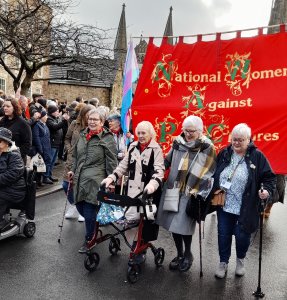
With the far right on the rise, it is vital to defend and extend women’s rights. What does the spread of nostalgia politics mean for women?
Women today need to be aware of the threats to our hard-won rights, which are coming from the far right. The struggle against the far-right and fascism must include support for women’s liberation. Many people, even those who may have contemplated voting for Reform UK, do not wish to see the total repeal of equality laws or the clock put back more than 50 years in terms of the type of families that exist or the equal rights women (and men) enjoy.
Defending women’s rights against the far‑right
Sunday 8 March 2026, by Liz Lawrence
With the far right on the rise, it is vital to defend and extend women’s rights. What does the spread of nostalgia politics mean for women?
Women today need to be aware of the threats to our hard-won rights, which are coming from the far right. The struggle against the far-right and fascism must include support for women’s liberation. Many people, even those who may have contemplated voting for Reform UK, do not wish to see the total repeal of equality laws or the clock put back more than 50 years in terms of the type of families that exist or the equal rights women (and men) enjoy.
Romanticism and common sense
Sometimes the far-right appeals to nostalgia and paints a romanticised image of families in the past or to ‘common sense’ ideas about the roles of women and men in society. These ideas may appear attractive when working people and working-class families are struggling with financial pressures, stressful work, long working hours, and housing problems.
The absence of a strong trade union presence in many workplaces can make things worse. The lack of affordable social housing and the insufficient regulation of the private rented sector also hit working people hard.
What is left out of this picture is that the traditional family, which is presented as desirable, was often oppressive to its members in many ways, with rigid gender roles, coercive control, and domestic violence concealed within the privacy of the home.
The traditional nuclear family, in which men had all the responsibilities of financial provision and women all the responsibilities for domestic labour and childcare, divided the working class and put women in a vulnerable position of economic dependence. The myth of the male breadwinner also undermined women workers’ struggles for equal pay.
Sometimes the far-right appeals to nostalgia and paints a romanticised image of families in the past or to ‘common sense’ ideas about the roles of women and men in society. These ideas may appear attractive when working people and working-class families are struggling with financial pressures, stressful work, long working hours, and housing problems.
The absence of a strong trade union presence in many workplaces can make things worse. The lack of affordable social housing and the insufficient regulation of the private rented sector also hit working people hard.
What is left out of this picture is that the traditional family, which is presented as desirable, was often oppressive to its members in many ways, with rigid gender roles, coercive control, and domestic violence concealed within the privacy of the home.
The traditional nuclear family, in which men had all the responsibilities of financial provision and women all the responsibilities for domestic labour and childcare, divided the working class and put women in a vulnerable position of economic dependence. The myth of the male breadwinner also undermined women workers’ struggles for equal pay.
Only two genders
This is a theme taken up by Trump, Putin, Orban, and other deplorable men. They deny the existence of intersex and non-binary people. The far-right also talks about ‘gender ideology’ by which they mean any attempt to explain differences between the lives of women and men in terms of social factors. This rejects an important concept in the social sciences: that gender is not the same as biological sex. Comparative analysis of societies and historical periods shows that gender roles vary and change over time.
The distinction that Second Wave Feminism in the 1960s and 1970s made between sex and gender was an attempt to free both women and men from rigid gender roles and to allow people to explore their full humanity. This distinction was necessary in a society in which arguments based on biological essentialism were widespread, and women were deemed incapable of doing a whole range of jobs, simply because we were women.
The talk of only two genders and rejection of ‘gender ideology’ is part of a moral panic the far-right tries to create around feminism, homosexuality, and trans rights. It also seeks to imply inaccurately that people’s right to live as married heterosexuals is under attack, simply because some people live differently, showing the far-right’s hostility to diversity.
This is a theme taken up by Trump, Putin, Orban, and other deplorable men. They deny the existence of intersex and non-binary people. The far-right also talks about ‘gender ideology’ by which they mean any attempt to explain differences between the lives of women and men in terms of social factors. This rejects an important concept in the social sciences: that gender is not the same as biological sex. Comparative analysis of societies and historical periods shows that gender roles vary and change over time.
The distinction that Second Wave Feminism in the 1960s and 1970s made between sex and gender was an attempt to free both women and men from rigid gender roles and to allow people to explore their full humanity. This distinction was necessary in a society in which arguments based on biological essentialism were widespread, and women were deemed incapable of doing a whole range of jobs, simply because we were women.
The talk of only two genders and rejection of ‘gender ideology’ is part of a moral panic the far-right tries to create around feminism, homosexuality, and trans rights. It also seeks to imply inaccurately that people’s right to live as married heterosexuals is under attack, simply because some people live differently, showing the far-right’s hostility to diversity.
AWFULs
The label ‘AWFULs’ is a good example of how sections of the far-right, including the MAGA (Make America Great Again) Republicans in the USA, object to any degree of female emancipation. This is a name given to women like Renee Nicole Good, who was shot by ICE agents in Minneapolis.
AWFULs stands for affluent, white, female, urban liberals. What is the reality behind this label?
Affluent: this does not necessarily mean rich, merely that the woman can afford a smartphone to record ICE agents breaking the US Constitution and can afford to live independently of men. This is deeply offensive to ultra-conservatives whose ideal family is one in which men have all the paid work, and women do all the unpaid work, and hence men have all the power and women have none.
These types think any wage above a pittance is too high a wage for a woman. They define female economic independence as a threat to the family.
White: The MAGA right view is that white people ought to be racist and are deviant if they believe in racial equality and rights for migrants and refugees.
Female: These people do not think women belong in the public sphere or should have any political opinions. Hence, it is improper or offensive for a woman to be politically active or take an interest in current affairs.
Urban: For some ultra conservatives, the countryside is a place of virtue where rural workers are deferential to their betters and cities are hotbeds of radical ideas, alternative lifestyles, and freedom to explore one’s identity, which they find threatening.
Liberals: The far-right really do not like contemplating the other person’s point of view. They do not see toleration or acceptance of diversity as virtues.
The label AWFULs sums up how feminists and independent women are everything the far-right detests.
The label ‘AWFULs’ is a good example of how sections of the far-right, including the MAGA (Make America Great Again) Republicans in the USA, object to any degree of female emancipation. This is a name given to women like Renee Nicole Good, who was shot by ICE agents in Minneapolis.
AWFULs stands for affluent, white, female, urban liberals. What is the reality behind this label?
Affluent: this does not necessarily mean rich, merely that the woman can afford a smartphone to record ICE agents breaking the US Constitution and can afford to live independently of men. This is deeply offensive to ultra-conservatives whose ideal family is one in which men have all the paid work, and women do all the unpaid work, and hence men have all the power and women have none.
These types think any wage above a pittance is too high a wage for a woman. They define female economic independence as a threat to the family.
White: The MAGA right view is that white people ought to be racist and are deviant if they believe in racial equality and rights for migrants and refugees.
Female: These people do not think women belong in the public sphere or should have any political opinions. Hence, it is improper or offensive for a woman to be politically active or take an interest in current affairs.
Urban: For some ultra conservatives, the countryside is a place of virtue where rural workers are deferential to their betters and cities are hotbeds of radical ideas, alternative lifestyles, and freedom to explore one’s identity, which they find threatening.
Liberals: The far-right really do not like contemplating the other person’s point of view. They do not see toleration or acceptance of diversity as virtues.
The label AWFULs sums up how feminists and independent women are everything the far-right detests.
Healthcare and race
Part of the current offensive on women’s rights is an attack on healthcare. The repeal of Roe versus Wade in the USA in 2022 has created a situation where safe, legal abortions are available in some states, but not others. Women in some states are being denied necessary healthcare after miscarriage because doctors fear prosecution.
Internationally, cuts to aid budgets by the US and other governments are costing the lives of women in the Global South, through lack of access to contraception and safe maternity care.
In the UK, abortion is currently available under the Abortion Act (1967), but we should be alert to the danger that a far-right government would seek to restrict this act and cut funding for women’s healthcare.
There is currently a crisis in maternity care in the UK. This is partly a result of understaffing, but for Black women, the crisis in maternity care also arises from racism, with significantly worse health outcomes for Black women during pregnancy and childbirth.
Racism presents a threat to healthcare for all women and to our rights to bodily autonomy. Racists who believe in the ‘great replacement’ theory and want to impose ‘remigration’ on immigrant communities and bring about an all-white society want to force some women to have children, denying access to birth control, and to force sterilisation on others.
Part of the current offensive on women’s rights is an attack on healthcare. The repeal of Roe versus Wade in the USA in 2022 has created a situation where safe, legal abortions are available in some states, but not others. Women in some states are being denied necessary healthcare after miscarriage because doctors fear prosecution.
Internationally, cuts to aid budgets by the US and other governments are costing the lives of women in the Global South, through lack of access to contraception and safe maternity care.
In the UK, abortion is currently available under the Abortion Act (1967), but we should be alert to the danger that a far-right government would seek to restrict this act and cut funding for women’s healthcare.
There is currently a crisis in maternity care in the UK. This is partly a result of understaffing, but for Black women, the crisis in maternity care also arises from racism, with significantly worse health outcomes for Black women during pregnancy and childbirth.
Racism presents a threat to healthcare for all women and to our rights to bodily autonomy. Racists who believe in the ‘great replacement’ theory and want to impose ‘remigration’ on immigrant communities and bring about an all-white society want to force some women to have children, denying access to birth control, and to force sterilisation on others.
Equality Act (2010)
Before the 2024 General Election and again now, Reform UK has declared its intention to repeal the Equality Act (2010). They claim to do this on grounds of meritocracy, thus implying that if women, ethnic minorities, and other minority groups are hired, this is on a quota basis, rather than merit.
The reality is the opposite. Legislation was introduced in the 1970s (Sex Discrimination Act, 1975, Race Relations Act, 1976) to ensure selection on merit, rather than denying women and other oppressed groups the right to apply for jobs or be considered seriously as candidates.
• The Equality Act 2010 incorporated (and hence repealed):
• Equal Pay Act 1970
• Sex Discrimination Act 1975
• Race Relations Act 1976
• Sex Discrimination Act 1986
• Race Relations (Remedies) Act 1994
• Disability Discrimination Act 1995
And parts of many other acts dealing with matters of equality.
So, abolishing the Equality Act (2010) would remove protection against discrimination for many groups of people. The Equality Act (2010) defines nine protected characteristics: age; disability; gender reassignment; marriage or civil partnership (in employment only); pregnancy and maternity; race; religion or belief; sex; sexual orientation.
Abolishing the Equality Act (2010) would give bigots an opportunity to voice their prejudices openly. In this sense, it would be a re-run of the hatred unleashed by the Brexit vote. It would mean people in the UK had no legal recourse against unfair discrimination in education, training, employment, promotion, pay, pensions, and the provision of goods and services. This could mean:
- An employer choosing to pay men and women different rates of pay for doing the same job.
- Job advertisements specifying the sex of the worker whom the employer wishes to recruit, without any justifiable reason.
- Workers sacked for becoming pregnant.
For people who have grown up with legal equality as normal, such a world would be something of a shock, but this is what a vote for Reform UK at the next general election could mean. Already, Reform-controlled councils have abolished posts concerned with promoting equality and diversity.
Before the 2024 General Election and again now, Reform UK has declared its intention to repeal the Equality Act (2010). They claim to do this on grounds of meritocracy, thus implying that if women, ethnic minorities, and other minority groups are hired, this is on a quota basis, rather than merit.
The reality is the opposite. Legislation was introduced in the 1970s (Sex Discrimination Act, 1975, Race Relations Act, 1976) to ensure selection on merit, rather than denying women and other oppressed groups the right to apply for jobs or be considered seriously as candidates.
• The Equality Act 2010 incorporated (and hence repealed):
• Equal Pay Act 1970
• Sex Discrimination Act 1975
• Race Relations Act 1976
• Sex Discrimination Act 1986
• Race Relations (Remedies) Act 1994
• Disability Discrimination Act 1995
And parts of many other acts dealing with matters of equality.
So, abolishing the Equality Act (2010) would remove protection against discrimination for many groups of people. The Equality Act (2010) defines nine protected characteristics: age; disability; gender reassignment; marriage or civil partnership (in employment only); pregnancy and maternity; race; religion or belief; sex; sexual orientation.
Abolishing the Equality Act (2010) would give bigots an opportunity to voice their prejudices openly. In this sense, it would be a re-run of the hatred unleashed by the Brexit vote. It would mean people in the UK had no legal recourse against unfair discrimination in education, training, employment, promotion, pay, pensions, and the provision of goods and services. This could mean:
- An employer choosing to pay men and women different rates of pay for doing the same job.
- Job advertisements specifying the sex of the worker whom the employer wishes to recruit, without any justifiable reason.
- Workers sacked for becoming pregnant.
For people who have grown up with legal equality as normal, such a world would be something of a shock, but this is what a vote for Reform UK at the next general election could mean. Already, Reform-controlled councils have abolished posts concerned with promoting equality and diversity.
Equality monitoring
Equality monitoring is an important tool for implementing equality policies. It enables assessment of how equal organisations are (or are not) in areas such as employment and the provision of public services. At present there is too little equality monitoring by employers. If the Equality Act (2010) were abolished, there would be no legal pressure to undertake equality monitoring.
Why does monitoring matter? Firstly, it provides a statistical basis for measuring the extent of discrimination. This means that claims of discrimination cannot be dismissed simply as “that’s your opinion” or “that was only your experience”. Monitoring provides an overview that indicates whether some groups are experiencing inequality.
In addition to demonstrating the extent of inequality, equality monitoring can also be used to set equality targets and measure progress towards them.
Equality monitoring is an important tool for implementing equality policies. It enables assessment of how equal organisations are (or are not) in areas such as employment and the provision of public services. At present there is too little equality monitoring by employers. If the Equality Act (2010) were abolished, there would be no legal pressure to undertake equality monitoring.
Why does monitoring matter? Firstly, it provides a statistical basis for measuring the extent of discrimination. This means that claims of discrimination cannot be dismissed simply as “that’s your opinion” or “that was only your experience”. Monitoring provides an overview that indicates whether some groups are experiencing inequality.
In addition to demonstrating the extent of inequality, equality monitoring can also be used to set equality targets and measure progress towards them.
The public sphere
Feminists such as Mary Wollstonecraft, from the eighteenth century onwards, argued for the right of women to education and to a place in the public sphere. Feminists such as John Stuart Mill proposed legislation to give women the right to vote. The history of First Wave Feminism is a history of the struggle for the vote, for education, and the right to enter spheres of employment from which women were barred (e.g., medicine).
It is also a history of struggle for women’s right to be citizens, to be political people, eligible to stand for public office and take part in political debate, rather than being confined to a domestic and private sphere.
If we look at the far right in the world today, we must ask how far women’s place in the public sphere is under threat. Far-right governments often have very few or no women ministers, unlike the much more gender-balanced cabinets of liberal democracies. They attack reproductive rights, employment rights, and anti-discrimination laws.
Sometimes, far-right governments are underpinned by religious fundamentalists who advocate openly for patriarchy and unequal families in which men assume the role of ‘head of the household’, a concept the UK census has now abandoned as outdated.
In this context, we must salute the victims of sex trafficking who are speaking out about their experiences of being trafficked by Epstein and his associates. It is often a struggle for women’s voices to be heard, especially when reporting the crimes of the powerful.
Feminists such as Mary Wollstonecraft, from the eighteenth century onwards, argued for the right of women to education and to a place in the public sphere. Feminists such as John Stuart Mill proposed legislation to give women the right to vote. The history of First Wave Feminism is a history of the struggle for the vote, for education, and the right to enter spheres of employment from which women were barred (e.g., medicine).
It is also a history of struggle for women’s right to be citizens, to be political people, eligible to stand for public office and take part in political debate, rather than being confined to a domestic and private sphere.
If we look at the far right in the world today, we must ask how far women’s place in the public sphere is under threat. Far-right governments often have very few or no women ministers, unlike the much more gender-balanced cabinets of liberal democracies. They attack reproductive rights, employment rights, and anti-discrimination laws.
Sometimes, far-right governments are underpinned by religious fundamentalists who advocate openly for patriarchy and unequal families in which men assume the role of ‘head of the household’, a concept the UK census has now abandoned as outdated.
In this context, we must salute the victims of sex trafficking who are speaking out about their experiences of being trafficked by Epstein and his associates. It is often a struggle for women’s voices to be heard, especially when reporting the crimes of the powerful.
Conclusion
The experiences of women worldwide show that equal rights can never be taken for granted. Women today, and others who support women’s equality, need to be active in defending equality laws and policies, as well as reproductive rights.
We must oppose moves to force a return to narrow and rigid gender roles and continue to advocate the feminist vision of a fully human existence for women, men, and non-binary people. The struggle against the far-right needs to address its sexism and misogyny, as well as its racism and authoritarianism.
5 March 2026
Source: Anti*Capitalist Resistance.
The experiences of women worldwide show that equal rights can never be taken for granted. Women today, and others who support women’s equality, need to be active in defending equality laws and policies, as well as reproductive rights.
We must oppose moves to force a return to narrow and rigid gender roles and continue to advocate the feminist vision of a fully human existence for women, men, and non-binary people. The struggle against the far-right needs to address its sexism and misogyny, as well as its racism and authoritarianism.
5 March 2026
Source: Anti*Capitalist Resistance.
Attached documents
Liz Lawrence
Weaponising gender: How gender became the perfect scapegoat for far-right and authoritarian actors
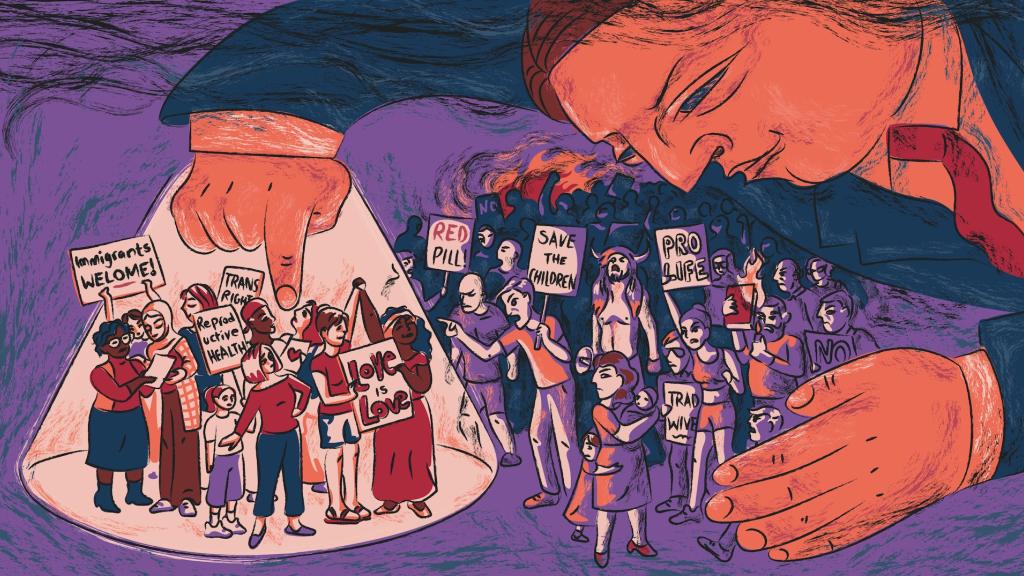
First published at Transnational Institute.
Anti-gender mobilisation has become a defining feature of far-right movements since around 2015; and is now a tactic widely adopted by authoritarian governments across the political spectrum. From overturning abortion rights in the United States (US) to rescinding protection against domestic violence in Türkiye, institutions that defend women’s rights are being systematically dismantled. These patterns align with a global decline in democracy, with over 75% of the world’s population now living under restricted freedom. The correlation is not coincidental. As democratic institutions weaken, attacks on gender-based rights accelerate the decline and provide a roadmap for it.
Understanding this dynamic requires distinguishing between authoritarianism, a political mode that concentrates power and erodes democratic checks; and the far-right, defined by ultranationalism, rigid social hierarchies, and the belief that progressive values threaten civilisation. The two increasingly converge through shared anti-gender politics. Although anti-gender ideology is rooted in far-right worldviews, its tactics are attractive to authoritarian leaders of varying orientations because they offer emotionally charged justifications for centralising power and suppressing civil society.
For the far-right, patriarchal control is foundational. Fascist and ultranationalist movements have long treated the heteronormative family as a microcosm of the hierarchical society they seek to build. Women’s reproductive role, the policing of sexuality, and the ideal of demographic renewal are not peripheral policies but core ideological commitments. Yet the political convenience of anti-gender positions extend beyond this. For authoritarian leaders and other opportunistic actors, ‘gender ideology’ functions as an empty signifier: a deliberately ambiguous term into which diverse groups can pour their grievances while mobilising around a shared enemy.
This dual nature — an ideological bedrock for some, opportunistic tool for others — helps explains the power of the backlash. Framing gender justice as a threat to ‘tradition’ simultaneously mobilises far-right constituencies, supplies authoritarian leaders with a convenient wedge issue, and legitimises the dismantling of institutional checks and the protection of minorities. Once it becomes possible to restrict the rights of women and lesbian, gay, bisexual, trans, queer and other non-binary (LGBTQ+) people in the name of protecting families or children, the precedent is set for targeting any group that challenges authority.
This dynamic has enabled an unusually broad coalition. Religious fundamentalists provide moral legitimacy, mobilising believers through claims of divine order and their transnational networks. Far-right populists and authoritarian leaders weaponise the language of tradition to portray themselves as defenders of ‘ordinary people’ while using state power to erode rights. Gender-critical activists offer insider credibility, laundering extreme positions through the language of women’s safety. At the cultural level, social media influencers romanticise women’s domestic submission, while the online manosphere radicalises young men via viral misogyny and unfounded conspiracies. Underpinning these currents are billionaire funders and oligarchs who channel resources into think tanks, legal campaigns, and media ecosystems, transforming moral panic into concrete policy outcomes.
These narratives resonate because they redirect public anxieties during a period of overlapping crises, from economic precarity to declining political trust, towards convenient scapegoats. Rising inequality has created fertile ground for reactionary thinking, and demagogues both capitalise on these sentiments and actively cultivate them. Rather than confronting capitalism and democratic decay, they channel public frustration into moral panic, casting women, LGBTQ+ people, and the activists who defend them, as the source of social breakdown. The result is a systematic assault on the foundations of an open society, with women’s rights serving both as the initial target and the testing ground for broader authoritarian strategies.
This essay maps the contemporary anti-gender playbook: who is using it, the myths they deploy, and the tactics that move it from meme to ministry. It also traces the consequences for democracy and examines how feminist movements are building counterpower to resist its advance.
First published at Transnational Institute.
Anti-gender mobilisation has become a defining feature of far-right movements since around 2015; and is now a tactic widely adopted by authoritarian governments across the political spectrum. From overturning abortion rights in the United States (US) to rescinding protection against domestic violence in Türkiye, institutions that defend women’s rights are being systematically dismantled. These patterns align with a global decline in democracy, with over 75% of the world’s population now living under restricted freedom. The correlation is not coincidental. As democratic institutions weaken, attacks on gender-based rights accelerate the decline and provide a roadmap for it.
Understanding this dynamic requires distinguishing between authoritarianism, a political mode that concentrates power and erodes democratic checks; and the far-right, defined by ultranationalism, rigid social hierarchies, and the belief that progressive values threaten civilisation. The two increasingly converge through shared anti-gender politics. Although anti-gender ideology is rooted in far-right worldviews, its tactics are attractive to authoritarian leaders of varying orientations because they offer emotionally charged justifications for centralising power and suppressing civil society.
For the far-right, patriarchal control is foundational. Fascist and ultranationalist movements have long treated the heteronormative family as a microcosm of the hierarchical society they seek to build. Women’s reproductive role, the policing of sexuality, and the ideal of demographic renewal are not peripheral policies but core ideological commitments. Yet the political convenience of anti-gender positions extend beyond this. For authoritarian leaders and other opportunistic actors, ‘gender ideology’ functions as an empty signifier: a deliberately ambiguous term into which diverse groups can pour their grievances while mobilising around a shared enemy.
This dual nature — an ideological bedrock for some, opportunistic tool for others — helps explains the power of the backlash. Framing gender justice as a threat to ‘tradition’ simultaneously mobilises far-right constituencies, supplies authoritarian leaders with a convenient wedge issue, and legitimises the dismantling of institutional checks and the protection of minorities. Once it becomes possible to restrict the rights of women and lesbian, gay, bisexual, trans, queer and other non-binary (LGBTQ+) people in the name of protecting families or children, the precedent is set for targeting any group that challenges authority.
This dynamic has enabled an unusually broad coalition. Religious fundamentalists provide moral legitimacy, mobilising believers through claims of divine order and their transnational networks. Far-right populists and authoritarian leaders weaponise the language of tradition to portray themselves as defenders of ‘ordinary people’ while using state power to erode rights. Gender-critical activists offer insider credibility, laundering extreme positions through the language of women’s safety. At the cultural level, social media influencers romanticise women’s domestic submission, while the online manosphere radicalises young men via viral misogyny and unfounded conspiracies. Underpinning these currents are billionaire funders and oligarchs who channel resources into think tanks, legal campaigns, and media ecosystems, transforming moral panic into concrete policy outcomes.
These narratives resonate because they redirect public anxieties during a period of overlapping crises, from economic precarity to declining political trust, towards convenient scapegoats. Rising inequality has created fertile ground for reactionary thinking, and demagogues both capitalise on these sentiments and actively cultivate them. Rather than confronting capitalism and democratic decay, they channel public frustration into moral panic, casting women, LGBTQ+ people, and the activists who defend them, as the source of social breakdown. The result is a systematic assault on the foundations of an open society, with women’s rights serving both as the initial target and the testing ground for broader authoritarian strategies.
This essay maps the contemporary anti-gender playbook: who is using it, the myths they deploy, and the tactics that move it from meme to ministry. It also traces the consequences for democracy and examines how feminist movements are building counterpower to resist its advance.
The myths and the machine
Across disparate political movements, three core myths have emerged, casting gender justice as a danger to the traditional family, the innocent child, and to ethnonationalism. These narratives overlap and reinforce each other, giving different actors a common vocabulary of fear without any need for coordination.
Across disparate political movements, three core myths have emerged, casting gender justice as a danger to the traditional family, the innocent child, and to ethnonationalism. These narratives overlap and reinforce each other, giving different actors a common vocabulary of fear without any need for coordination.
The natural family
A common myth across all anti-gender movements is that the nuclear family is the foundation of civilisation and is under systematic attack from feminism, LGBTQ+ rights, and progressive reforms.
Religious fundamentalists provide the ideological foundation for this myth, framing heterosexual, cisgender, nuclear families as the only ‘natural’ family structure. In the 1990s, the Vatican and conservative evangelical groups began advancing the spectre of ‘gender ideology’, the term used to describe ideas that separate gender from biological sex, challenge the ‘natural’ complementarity of men and women, and undermine a God-ordained family structure. Anti-trans and gender-binary arguments flow from this because they insist that ‘real men and women’ are fixed, binary, and essential for reproducing the natural family. Today, transnational networks like the World Congress of Families and their digital campaign allies such as CitizenGo coordinate messages from Eastern Europe to countries across the African continent: pumping money into Romania's 2018 referendum to ban same-sex marriage and lobbying for harsh anti-LGBTQ laws in Ghana, Nigeria, Kenya, and Uganda.
Populist ‘strongmen’ exploit the myth of the ‘family under siege’ to justify authoritarian measures as the defence of tradition. Leaders such as Hungary’s Viktor Orbán promote pro-natalist, ‘family-first’ policies, weaponising social security by rewarding heterosexual married couples for having children. Yet he bans gender studies, undermines educational freedom, and stops funding women’s shelters, thus increasing women’s economic dependence on men and the home, all under the guise of protecting tradition.
In Kenya, for example, a rising campaign against gender and sexual minority rights has been framed as defending ‘African values’ and protecting children, even as it follows a script written by US evangelical organisations such as Family Watch International and the American Center for Law and Justice (ACLJ), both active across East Africa. During the 2025 Pan-African Conference on Family Values, Kenyan officials and ultra-conservatives decried ‘gender ideology’ and sexual rights as an assault on African culture.
This ‘natural gender hierarchy’ is promoted and amplified online. On social media tradwife influencers romanticise ultra-traditional gender roles such as submission, domesticity, and motherhood as aspirational lifestyles, aestheticising conservative ideology using the imagery of care and femininity. They tap into people’s frustrations with capitalism; the overwork, isolation, and devaluation of care by retreating into dependency on men and framing patriarchy as the illusion of stability, while leaving the economic and gender inequalities that produced the crisis untouched.
Meanwhile, the manosphere tells disaffected young men that feminists and ‘modern women’ are to blame for their problems. Male influencers, sometimes called ‘alpha males’ or ‘red-pilled’ gurus, offer a steady diet of misogyny and conspiracy theories, from rants about women being intrinsically manipulative to claims that society oppresses men and favours women. They prey on economic anxieties (unemployment, frustrations about being unable to find a long-term partner) and redirect this anger towards feminism as the villain, encouraging a return to male dominance as the answer.
The manosphere and ‘tradwives’ reinforce the same political goal: retraining citizens in patriarchal hierarchy. As the seventeenth-century philosopher Thomas Hobbes argued, people must be conditioned to accept unquestioning authority through the paterfamilias — the father as absolute head of the household. This extends to democratic participation itself — echoing sentiments like those recently amplified by Trump's Defence Secretary Pete Hegseth, where pastors argue that votes should be made by fathers for their household, further silencing women and eroding democratic values.
A common myth across all anti-gender movements is that the nuclear family is the foundation of civilisation and is under systematic attack from feminism, LGBTQ+ rights, and progressive reforms.
Religious fundamentalists provide the ideological foundation for this myth, framing heterosexual, cisgender, nuclear families as the only ‘natural’ family structure. In the 1990s, the Vatican and conservative evangelical groups began advancing the spectre of ‘gender ideology’, the term used to describe ideas that separate gender from biological sex, challenge the ‘natural’ complementarity of men and women, and undermine a God-ordained family structure. Anti-trans and gender-binary arguments flow from this because they insist that ‘real men and women’ are fixed, binary, and essential for reproducing the natural family. Today, transnational networks like the World Congress of Families and their digital campaign allies such as CitizenGo coordinate messages from Eastern Europe to countries across the African continent: pumping money into Romania's 2018 referendum to ban same-sex marriage and lobbying for harsh anti-LGBTQ laws in Ghana, Nigeria, Kenya, and Uganda.
Populist ‘strongmen’ exploit the myth of the ‘family under siege’ to justify authoritarian measures as the defence of tradition. Leaders such as Hungary’s Viktor Orbán promote pro-natalist, ‘family-first’ policies, weaponising social security by rewarding heterosexual married couples for having children. Yet he bans gender studies, undermines educational freedom, and stops funding women’s shelters, thus increasing women’s economic dependence on men and the home, all under the guise of protecting tradition.
In Kenya, for example, a rising campaign against gender and sexual minority rights has been framed as defending ‘African values’ and protecting children, even as it follows a script written by US evangelical organisations such as Family Watch International and the American Center for Law and Justice (ACLJ), both active across East Africa. During the 2025 Pan-African Conference on Family Values, Kenyan officials and ultra-conservatives decried ‘gender ideology’ and sexual rights as an assault on African culture.
This ‘natural gender hierarchy’ is promoted and amplified online. On social media tradwife influencers romanticise ultra-traditional gender roles such as submission, domesticity, and motherhood as aspirational lifestyles, aestheticising conservative ideology using the imagery of care and femininity. They tap into people’s frustrations with capitalism; the overwork, isolation, and devaluation of care by retreating into dependency on men and framing patriarchy as the illusion of stability, while leaving the economic and gender inequalities that produced the crisis untouched.
Meanwhile, the manosphere tells disaffected young men that feminists and ‘modern women’ are to blame for their problems. Male influencers, sometimes called ‘alpha males’ or ‘red-pilled’ gurus, offer a steady diet of misogyny and conspiracy theories, from rants about women being intrinsically manipulative to claims that society oppresses men and favours women. They prey on economic anxieties (unemployment, frustrations about being unable to find a long-term partner) and redirect this anger towards feminism as the villain, encouraging a return to male dominance as the answer.
The manosphere and ‘tradwives’ reinforce the same political goal: retraining citizens in patriarchal hierarchy. As the seventeenth-century philosopher Thomas Hobbes argued, people must be conditioned to accept unquestioning authority through the paterfamilias — the father as absolute head of the household. This extends to democratic participation itself — echoing sentiments like those recently amplified by Trump's Defence Secretary Pete Hegseth, where pastors argue that votes should be made by fathers for their household, further silencing women and eroding democratic values.
The innocent children
Building on the narrative of the natural family, anti-gender movements whip up moral panic by portraying children as being under constant threat. Few myths are more emotionally resonant: after all, who would oppose protecting children? This narrative claims that only traditional patriarchal families can properly safeguard children from external corruption, making the family structure a matter of child survival. Religious and populist movements have strategically and deliberately elevated parenthood as a political identity and the child as a sacred figure around which coalitions can be built. While this framing also fuels racialised panics, such as recent attacks on migrants in the United Kingdom (UK) under the banner of ‘protecting children’, here it functions to recast women’s reproductive rights as a battle over children’s safety. Access to contraception and abortion gets framed not as health care or autonomy, but as selfish women ‘killing babies’ or betraying motherhood. Anti-abortion campaigns frequently deploy images of infant faces and hearts, implying that women who do not wish to or might be advised against, or are unable to carry a pregnancy to term are cruelly choosing their career or convenience over a child’s life. In this way, women’s bodily autonomy is painted as a form of callousness towards innocent life.
The flipside is that forced childbirth is promoted as ‘rescuing’ the unborn child — regardless of the cost to the real, living woman. In countries from the US to Poland to El Salvador, where abortion laws are among the most restrictive, proponents explicitly invoke ‘saving children’ to justify banning abortion, even when this threatens women’s lives.
Psychoanalysts such as Erica Komisar popularise a more subtle version of this myth, arguing that mothers who return to work too soon after giving birth harm their children’s mental health. By cloaking traditional gender roles in the language of psychology and child development, such narratives guilt-trip women for seeking autonomy and blame feminism for family breakdown.
Once the narrative of endangered children is established, it can expand in multiple directions. Autocrats have revived the archaic homophobic conflation of homosexuality with paedophilia, systematically painting LGBTQ+ people as inherent threats to children. Hungary’s government made adoption illegal for same-sex couples and effectively outlawed trans people from legally changing gender, claiming these measures keep children safe. Poland’s government deployed a propaganda film splicing a child’s cry for help directly after footage of Warsaw’s mayor signing the LGBT+ Charter. The implicit message was that queer rights are a direct danger to children. We see similar tactics elsewhere: sex education in schools is labelled as ‘grooming’ or ‘sexualisation’ of children; inclusive children’s books are denounced as pornography and banned, transforming abstract policy debates into visceral parental concerns.
Building on the narrative of the natural family, anti-gender movements whip up moral panic by portraying children as being under constant threat. Few myths are more emotionally resonant: after all, who would oppose protecting children? This narrative claims that only traditional patriarchal families can properly safeguard children from external corruption, making the family structure a matter of child survival. Religious and populist movements have strategically and deliberately elevated parenthood as a political identity and the child as a sacred figure around which coalitions can be built. While this framing also fuels racialised panics, such as recent attacks on migrants in the United Kingdom (UK) under the banner of ‘protecting children’, here it functions to recast women’s reproductive rights as a battle over children’s safety. Access to contraception and abortion gets framed not as health care or autonomy, but as selfish women ‘killing babies’ or betraying motherhood. Anti-abortion campaigns frequently deploy images of infant faces and hearts, implying that women who do not wish to or might be advised against, or are unable to carry a pregnancy to term are cruelly choosing their career or convenience over a child’s life. In this way, women’s bodily autonomy is painted as a form of callousness towards innocent life.
The flipside is that forced childbirth is promoted as ‘rescuing’ the unborn child — regardless of the cost to the real, living woman. In countries from the US to Poland to El Salvador, where abortion laws are among the most restrictive, proponents explicitly invoke ‘saving children’ to justify banning abortion, even when this threatens women’s lives.
Psychoanalysts such as Erica Komisar popularise a more subtle version of this myth, arguing that mothers who return to work too soon after giving birth harm their children’s mental health. By cloaking traditional gender roles in the language of psychology and child development, such narratives guilt-trip women for seeking autonomy and blame feminism for family breakdown.
Once the narrative of endangered children is established, it can expand in multiple directions. Autocrats have revived the archaic homophobic conflation of homosexuality with paedophilia, systematically painting LGBTQ+ people as inherent threats to children. Hungary’s government made adoption illegal for same-sex couples and effectively outlawed trans people from legally changing gender, claiming these measures keep children safe. Poland’s government deployed a propaganda film splicing a child’s cry for help directly after footage of Warsaw’s mayor signing the LGBT+ Charter. The implicit message was that queer rights are a direct danger to children. We see similar tactics elsewhere: sex education in schools is labelled as ‘grooming’ or ‘sexualisation’ of children; inclusive children’s books are denounced as pornography and banned, transforming abstract policy debates into visceral parental concerns.
The great replacement and its global mirrors
Another persistent myth circulating in far-right discourse is the claim that white populations are being systematically replaced through declining birth rates and immigration. While it is true that birth rates are declining in almost every country, this shift is not itself a crisis. It reflects multiple factors, including the increase of women’s bodily autonomy, as well the conditions that shape people’s decisions about having children, such as economic precarity, inadequate care systems, and climate breakdown. Rather than confronting the structural causes, far-right movements misattribute falling birth rates to feminism, LGBTQ+ rights, and (non-white) immigration, reframing demographic change as evidence of social ‘decay’ or even a coordinated plot to destroy white civilisation. Within the digital ecosystem, the manosphere amplifies these conspiracies, feeding racialised and gendered fears and, in their most extreme forms, inciting violence in the name of ‘defending’ national or cultural purity.
This conspiracy has become a strategic link between anti-gender politics and white nationalist agendas, revealing how attacking women's rights functions as a gateway to attacking other minorities. Governments and populist or authoritarian leaders have contributed to its mainstreaming. In Italy, for example, politicians such as Matteo Salvini deploy replacement rhetoric to justify anti-migration agendas and to discredit feminist movements. During the ‘Unite the Kingdom’ rally in September 2025, a mobilisation of hundreds of thousands of far-right supporters, Tommy Robinson (whose real name is Stephen Yaxley-Lennon) and his allies frequently used language about ‘losing’ Britain (essentially England), being ‘taken over’ or ‘changed’ in ways that are irreversible. The adaptability of this narrative heightens its policy relevance.
Paradoxically, this narrative also operates in reverse in Global South countries, while keeping ‘replacement’ logic at its centre. As we saw in the example of Kenya, feminism is recast as Western or a white ideological project that threatens ‘African values’, and a similar narrative is used in countries across the North Africa and Middle East (MENA) region, such as Algeria and Egypt, as well as in religious nationalist movements like Hindutva in India.
Another persistent myth circulating in far-right discourse is the claim that white populations are being systematically replaced through declining birth rates and immigration. While it is true that birth rates are declining in almost every country, this shift is not itself a crisis. It reflects multiple factors, including the increase of women’s bodily autonomy, as well the conditions that shape people’s decisions about having children, such as economic precarity, inadequate care systems, and climate breakdown. Rather than confronting the structural causes, far-right movements misattribute falling birth rates to feminism, LGBTQ+ rights, and (non-white) immigration, reframing demographic change as evidence of social ‘decay’ or even a coordinated plot to destroy white civilisation. Within the digital ecosystem, the manosphere amplifies these conspiracies, feeding racialised and gendered fears and, in their most extreme forms, inciting violence in the name of ‘defending’ national or cultural purity.
This conspiracy has become a strategic link between anti-gender politics and white nationalist agendas, revealing how attacking women's rights functions as a gateway to attacking other minorities. Governments and populist or authoritarian leaders have contributed to its mainstreaming. In Italy, for example, politicians such as Matteo Salvini deploy replacement rhetoric to justify anti-migration agendas and to discredit feminist movements. During the ‘Unite the Kingdom’ rally in September 2025, a mobilisation of hundreds of thousands of far-right supporters, Tommy Robinson (whose real name is Stephen Yaxley-Lennon) and his allies frequently used language about ‘losing’ Britain (essentially England), being ‘taken over’ or ‘changed’ in ways that are irreversible. The adaptability of this narrative heightens its policy relevance.
Paradoxically, this narrative also operates in reverse in Global South countries, while keeping ‘replacement’ logic at its centre. As we saw in the example of Kenya, feminism is recast as Western or a white ideological project that threatens ‘African values’, and a similar narrative is used in countries across the North Africa and Middle East (MENA) region, such as Algeria and Egypt, as well as in religious nationalist movements like Hindutva in India.
The money behind the machine
How did these narratives and the concrete changes in policies become so prevalent worldwide? Hidden behind them is a sophisticated yet shadowy funding infrastructure, transforming the narratives from fringe ideas into mainstream policy. In the US, conservative foundations began building this apparatus in the 1970s and 1980s, but the effort intensified dramatically in the 2000s, both in response to United Nations declarations advancing gender equality and as part of broader far-right mobilisation following Obama's election. The infrastructure spans from universities to courtrooms, creating what amounts to an ideological assembly line. In the US, networks like the Koch foundation, Heritage Foundation, and Federalist Society have systematically captured institutions through decades of strategic funding. The majority of federal judges appointed by President Trump are products of the Federalist Society, including six Supreme Court justices who overturned Roe v. Wade. These networks fund law schools, groom conservative legal scholars, and create the intellectual scaffolding that makes reversing rights seem legally sound rather than ideologically motivated. The Alliance for Defending Freedom — a US-based conservative Christian legal group instrumental in the overturning of Roe v. Wade — set up a UK branch in 2015, where its expenditure surged by 187% between 2019 and 2023 (to £3.9 million).
Outside the US, the anti-gender ecosystem is bankrolled by a mix of religious networks, far-right oligarch philanthropy, and even mainstream corporate and government budgets. In Latin America, for example, core streams include the Catholic Church, private wealth and companies such as Mexico’s Grupo Bimbo, and spending through ministries of health or education, while significant European funders also resource campaigns across the region. Spain’s HaxteOir/CitizenGo has become a global petition and mobilisation hub with its Africa office based in Nairobi. The Brazilian-founded Tradition, Family and Property (Tradição, Família, Propriedade) operates an international network of groups advancing ultra-conservative family and property doctrines. Russian donors aligning with the Orthodox Church, such as the oligarchs Vladimir Yakunin and Konstantin Malofeev, financed transnational advocacy against gender justice. In the Gulf, the Qatari government funds the Doha International Family Institute, part of a broader pattern of Organisation of Islamic Cooperation that linked investments in ‘pro-family’ research and lobbying. Overall, the global revenue reached an estimated , channelled to countries across Africa, Asia-Pacific, Europe and Latin America and the Caribbean, highlighting how non-US donors and venues are equally central and deeply embedded in the global infrastructure.
How did these narratives and the concrete changes in policies become so prevalent worldwide? Hidden behind them is a sophisticated yet shadowy funding infrastructure, transforming the narratives from fringe ideas into mainstream policy. In the US, conservative foundations began building this apparatus in the 1970s and 1980s, but the effort intensified dramatically in the 2000s, both in response to United Nations declarations advancing gender equality and as part of broader far-right mobilisation following Obama's election. The infrastructure spans from universities to courtrooms, creating what amounts to an ideological assembly line. In the US, networks like the Koch foundation, Heritage Foundation, and Federalist Society have systematically captured institutions through decades of strategic funding. The majority of federal judges appointed by President Trump are products of the Federalist Society, including six Supreme Court justices who overturned Roe v. Wade. These networks fund law schools, groom conservative legal scholars, and create the intellectual scaffolding that makes reversing rights seem legally sound rather than ideologically motivated. The Alliance for Defending Freedom — a US-based conservative Christian legal group instrumental in the overturning of Roe v. Wade — set up a UK branch in 2015, where its expenditure surged by 187% between 2019 and 2023 (to £3.9 million).
Outside the US, the anti-gender ecosystem is bankrolled by a mix of religious networks, far-right oligarch philanthropy, and even mainstream corporate and government budgets. In Latin America, for example, core streams include the Catholic Church, private wealth and companies such as Mexico’s Grupo Bimbo, and spending through ministries of health or education, while significant European funders also resource campaigns across the region. Spain’s HaxteOir/CitizenGo has become a global petition and mobilisation hub with its Africa office based in Nairobi. The Brazilian-founded Tradition, Family and Property (Tradição, Família, Propriedade) operates an international network of groups advancing ultra-conservative family and property doctrines. Russian donors aligning with the Orthodox Church, such as the oligarchs Vladimir Yakunin and Konstantin Malofeev, financed transnational advocacy against gender justice. In the Gulf, the Qatari government funds the Doha International Family Institute, part of a broader pattern of Organisation of Islamic Cooperation that linked investments in ‘pro-family’ research and lobbying. Overall, the global revenue reached an estimated , channelled to countries across Africa, Asia-Pacific, Europe and Latin America and the Caribbean, highlighting how non-US donors and venues are equally central and deeply embedded in the global infrastructure.
From myths to mobilisation
When anti-gender actors gain government influence, they systematically dismantle human rights infrastructure. Agencies and laws to protect women’s and minority rights are defunded, rebranded, or abolished. Domestic violence initiatives are reframed as ‘anti-family’ and defunded on the grounds that they promote divorce. Brazil’s former president, Jair Bolsonaro, closed the national women’s ministry and LGBTQ+ councils as part of his crusade against ‘gender ideology.’ The goal is clear — remove gender from the policy agenda by erasing the machinery that enforces it and eliminate spaces that empower women or question patriarchy.
Simultaneously, other actors co-opt the language of rights to legitimise exclusionary agendas. Sweden’s far-right deploys ‘femonationalism’, using gender equality rhetoric to attack immigration, claiming to protect white women from dangerous immigrant men. France invokes feminism to oppose Islamic dress. Groups identifying as gender-critical or TERF (trans-exclusionary radical feminists) increasingly distance themselves from the feminist language of women’s liberation altogether. Instead, they frame their positions through vocabularies of ‘rights’ and ‘protection’ — claiming to defend ‘women’s rights,’ ‘free speech,’ or ‘child safety’. This rhetorical shift mirrors the far-right and religious fundamentalist tactics of invoking protection to justify oppression. By appropriating the moral and legal language of human rights, these actors blur the boundaries between liberation and restriction. What sounds like the defence of rights becomes, in practice, the defence of hierarchy — a linguistic sleight of hand allowing authoritarian politics to masquerade as common sense.
Educational materials face heavy monitoring, with books being rewritten or banned if they acknowledge transgender people or historical sexism. Gender, race and sexuality studies, as well as comprehensive sex education, are being banned from primary schools to universities. The strategy is twofold: suppress knowledge that challenges patriarchal and majoritarian narratives and send a chilling message that even discussing gender or sexual diversity is unacceptable and dangerous. This is a direct assault on intellectual freedom, inclusive education and pluralism, the key pillars of any democracy.
Perhaps the most rapidly evolving tactic is the use of digital platforms and information warfare. Far-right actors exploit social media algorithms that amplify the most extreme, polarising material, creating radicalisation pipelines whereby users progress from seemingly harmless memes to hardcore misogynist beliefs. The manosphere churns out viral content attacking ‘feminazis’ and glorifying male dominance, while disinformation campaigns conflate sex education with pornography and homosexuality with paedophilia to stoke moral panic. What begins as memes framed as jokes or edgy contrarianism quickly becomes a channel to harder ideology.
Particularly vicious is the use of deepfakes and AI-generated sexual imagery to silence women and gender-diverse activists, especially those engaged in critique of powerful actors. One in six US congresswomen and over 30 female politicians in the UK have faced AI-generated sexual imagery designed to humiliate and silence them; 73% of women journalists worldwide experience online violence, with women of colour facing the worst abuse. An Amnesty International ‘Troll Patrol’ study found that female public figures received over one million abusive tweets in a single year — roughly one every 30 seconds. Many of these attacks are highly coordinated, suggesting the involvement of organised ‘troll farms’ often aligned with extremist or state interests. These attacks do not harm only the individual victims (and their families) but create a broader ‘chilling effect’, undermining democracy by intimidating half the population into withdrawing from public debate.
These digital tactics — algorithmic radicalisation, disinformation, harassment, and deepfakes — are not random but part of a broader authoritarian strategy: to bypass democratic deliberation and rule through fear and confusion. By ‘flooding the zone’ with emotionally charged falsehoods, they ensure that public discourse revolves around invented threats (e.g. ‘Save our kids from gay paedophiles!’) rather than real policy issues. By targeting and terrorising dissenters, they drastically narrow whose voices are heard, creating skewed ‘common sense’ where many citizens genuinely believe that legislation on domestic violence is anti-family or that feminism has made men the real victims. Once hate and misinformation are normalised, it becomes easier for authoritarians to take the next concrete steps, which are indeed their objectives: passing laws that majorities might otherwise question, and dismantling checks and balances that seem abstract compared to the fiery cultural battles consuming public attention.
When anti-gender actors gain government influence, they systematically dismantle human rights infrastructure. Agencies and laws to protect women’s and minority rights are defunded, rebranded, or abolished. Domestic violence initiatives are reframed as ‘anti-family’ and defunded on the grounds that they promote divorce. Brazil’s former president, Jair Bolsonaro, closed the national women’s ministry and LGBTQ+ councils as part of his crusade against ‘gender ideology.’ The goal is clear — remove gender from the policy agenda by erasing the machinery that enforces it and eliminate spaces that empower women or question patriarchy.
Simultaneously, other actors co-opt the language of rights to legitimise exclusionary agendas. Sweden’s far-right deploys ‘femonationalism’, using gender equality rhetoric to attack immigration, claiming to protect white women from dangerous immigrant men. France invokes feminism to oppose Islamic dress. Groups identifying as gender-critical or TERF (trans-exclusionary radical feminists) increasingly distance themselves from the feminist language of women’s liberation altogether. Instead, they frame their positions through vocabularies of ‘rights’ and ‘protection’ — claiming to defend ‘women’s rights,’ ‘free speech,’ or ‘child safety’. This rhetorical shift mirrors the far-right and religious fundamentalist tactics of invoking protection to justify oppression. By appropriating the moral and legal language of human rights, these actors blur the boundaries between liberation and restriction. What sounds like the defence of rights becomes, in practice, the defence of hierarchy — a linguistic sleight of hand allowing authoritarian politics to masquerade as common sense.
Educational materials face heavy monitoring, with books being rewritten or banned if they acknowledge transgender people or historical sexism. Gender, race and sexuality studies, as well as comprehensive sex education, are being banned from primary schools to universities. The strategy is twofold: suppress knowledge that challenges patriarchal and majoritarian narratives and send a chilling message that even discussing gender or sexual diversity is unacceptable and dangerous. This is a direct assault on intellectual freedom, inclusive education and pluralism, the key pillars of any democracy.
Perhaps the most rapidly evolving tactic is the use of digital platforms and information warfare. Far-right actors exploit social media algorithms that amplify the most extreme, polarising material, creating radicalisation pipelines whereby users progress from seemingly harmless memes to hardcore misogynist beliefs. The manosphere churns out viral content attacking ‘feminazis’ and glorifying male dominance, while disinformation campaigns conflate sex education with pornography and homosexuality with paedophilia to stoke moral panic. What begins as memes framed as jokes or edgy contrarianism quickly becomes a channel to harder ideology.
Particularly vicious is the use of deepfakes and AI-generated sexual imagery to silence women and gender-diverse activists, especially those engaged in critique of powerful actors. One in six US congresswomen and over 30 female politicians in the UK have faced AI-generated sexual imagery designed to humiliate and silence them; 73% of women journalists worldwide experience online violence, with women of colour facing the worst abuse. An Amnesty International ‘Troll Patrol’ study found that female public figures received over one million abusive tweets in a single year — roughly one every 30 seconds. Many of these attacks are highly coordinated, suggesting the involvement of organised ‘troll farms’ often aligned with extremist or state interests. These attacks do not harm only the individual victims (and their families) but create a broader ‘chilling effect’, undermining democracy by intimidating half the population into withdrawing from public debate.
These digital tactics — algorithmic radicalisation, disinformation, harassment, and deepfakes — are not random but part of a broader authoritarian strategy: to bypass democratic deliberation and rule through fear and confusion. By ‘flooding the zone’ with emotionally charged falsehoods, they ensure that public discourse revolves around invented threats (e.g. ‘Save our kids from gay paedophiles!’) rather than real policy issues. By targeting and terrorising dissenters, they drastically narrow whose voices are heard, creating skewed ‘common sense’ where many citizens genuinely believe that legislation on domestic violence is anti-family or that feminism has made men the real victims. Once hate and misinformation are normalised, it becomes easier for authoritarians to take the next concrete steps, which are indeed their objectives: passing laws that majorities might otherwise question, and dismantling checks and balances that seem abstract compared to the fiery cultural battles consuming public attention.
The toll of anti-gender politics
The repercussions of this coordinated backlash are felt intimately in people’s lives and broadly in political systems. One of the clearest effects of the attack on gender has been the constriction of who participates in politics and civic life. Numerous women politicians around the world have resigned or retired early citing unbearable levels of harassment, including Finland’s former prime minister, Sanna Marin. Outspoken women journalists like Michelle Mendoza from Guatemala and Rana Ayyub from India have retreated from social media or investigative reporting after rape threats against them or their families. In some places, female activists must operate anonymously or risk arrest under religious morality laws.
When more than half the population is silenced or side-lined, driven out through online abuse, legal barriers, or physical threats, decision-making spaces lose not only those individuals but also the perspectives and priorities they represent, and democracy itself is weakened. Parliaments and councils become less representative. Policies that might have addressed women’s needs or rights are never considered, because fewer advocates remain at the table. The result is a thinner democracy, a system with fewer people heard, fewer rights secured, and fewer limits on those in power.
Rolling back protections correlates with increases in gender-based violence and attacks on the rights of marginalised groups. Indeed, countries that have tightened abortion restrictions or weakened domestic violence laws often see spikes in femicides and assaults, as reported in Indonesia by the Indonesia Femicide Watch. LGBTQ+ people, when stigmatised by law, face surging hate crimes — such as recent horrific attacks on queer spaces in Kenya, Nigeria and Uganda. When leaders signal that women’s rights are not a priority (or suggest that domestic abuse is not a crime), it emboldens abusive behaviour at home and in the streets.
Health systems suffer too. Restrictions on access to reliable contraception combined with abortion bans drive higher maternal mortality and trauma. Women with pregnancy complications may delay seeking care for fear of the legal consequences, sometimes dying as a result (as has happened in Poland, El Salvador, Ireland, and some). HIV prevention and treatment programmes have been disrupted — clinics serving gay men have been raided or shut, outreach workers arrested, and trust between providers and patients destroyed. Even where medical care is still available, trans people avoid seeking it for fear of mistreatment or being outed.
At the same time, as civic space shrinks, it becomes harder for communities to respond to these challenges. If an authoritarian government won’t address a rise in domestic violence, normally non-government organisations (NGOs) or grassroots groups would step in with hotlines, shelters, and awareness campaigns. But if those organisations are defunded or criminalised (accused of ‘promoting divorce’ or ‘spreading Western ideas’), then there’s no one left to tackle the problem. In open societies, women’s organisations and local governments expanded services and ran public messaging to help. In more repressive settings, activists struggle to even get permission to keep shelters open, and some have been arrested for violating public-order rules when they tried to protest against femicides.
Societies grow harsher and more divided under these conditions. Trust between groups declines because the authoritarian narrative thrives on pitting ‘us’ against ‘them’. And so social cohesion frays, making it even easier for authoritarians to push the notion that only a strong hand (theirs) can maintain order.
The impact on the lives and bodies of women and girls is immediate and intimate. Traditionalist policies and cultural pressure channel women back into unpaid care roles, undermining their economic independence and reducing household incomes. Pronatalist incentives and restrictions on reproductive autonomy strip away choice, binding women’s futures to demographic or political agendas rather than personal aspirations. Violence and harassment, both online and offline, exacerbate these constraints, silencing voices and constricting possibilities. LGBTQ+ communities face exclusion from jobs, education, and health care, which in turn produces poverty, marginalisation, and heightened vulnerability to abuse.
The repercussions of this coordinated backlash are felt intimately in people’s lives and broadly in political systems. One of the clearest effects of the attack on gender has been the constriction of who participates in politics and civic life. Numerous women politicians around the world have resigned or retired early citing unbearable levels of harassment, including Finland’s former prime minister, Sanna Marin. Outspoken women journalists like Michelle Mendoza from Guatemala and Rana Ayyub from India have retreated from social media or investigative reporting after rape threats against them or their families. In some places, female activists must operate anonymously or risk arrest under religious morality laws.
When more than half the population is silenced or side-lined, driven out through online abuse, legal barriers, or physical threats, decision-making spaces lose not only those individuals but also the perspectives and priorities they represent, and democracy itself is weakened. Parliaments and councils become less representative. Policies that might have addressed women’s needs or rights are never considered, because fewer advocates remain at the table. The result is a thinner democracy, a system with fewer people heard, fewer rights secured, and fewer limits on those in power.
Rolling back protections correlates with increases in gender-based violence and attacks on the rights of marginalised groups. Indeed, countries that have tightened abortion restrictions or weakened domestic violence laws often see spikes in femicides and assaults, as reported in Indonesia by the Indonesia Femicide Watch. LGBTQ+ people, when stigmatised by law, face surging hate crimes — such as recent horrific attacks on queer spaces in Kenya, Nigeria and Uganda. When leaders signal that women’s rights are not a priority (or suggest that domestic abuse is not a crime), it emboldens abusive behaviour at home and in the streets.
Health systems suffer too. Restrictions on access to reliable contraception combined with abortion bans drive higher maternal mortality and trauma. Women with pregnancy complications may delay seeking care for fear of the legal consequences, sometimes dying as a result (as has happened in Poland, El Salvador, Ireland, and some). HIV prevention and treatment programmes have been disrupted — clinics serving gay men have been raided or shut, outreach workers arrested, and trust between providers and patients destroyed. Even where medical care is still available, trans people avoid seeking it for fear of mistreatment or being outed.
At the same time, as civic space shrinks, it becomes harder for communities to respond to these challenges. If an authoritarian government won’t address a rise in domestic violence, normally non-government organisations (NGOs) or grassroots groups would step in with hotlines, shelters, and awareness campaigns. But if those organisations are defunded or criminalised (accused of ‘promoting divorce’ or ‘spreading Western ideas’), then there’s no one left to tackle the problem. In open societies, women’s organisations and local governments expanded services and ran public messaging to help. In more repressive settings, activists struggle to even get permission to keep shelters open, and some have been arrested for violating public-order rules when they tried to protest against femicides.
Societies grow harsher and more divided under these conditions. Trust between groups declines because the authoritarian narrative thrives on pitting ‘us’ against ‘them’. And so social cohesion frays, making it even easier for authoritarians to push the notion that only a strong hand (theirs) can maintain order.
The impact on the lives and bodies of women and girls is immediate and intimate. Traditionalist policies and cultural pressure channel women back into unpaid care roles, undermining their economic independence and reducing household incomes. Pronatalist incentives and restrictions on reproductive autonomy strip away choice, binding women’s futures to demographic or political agendas rather than personal aspirations. Violence and harassment, both online and offline, exacerbate these constraints, silencing voices and constricting possibilities. LGBTQ+ communities face exclusion from jobs, education, and health care, which in turn produces poverty, marginalisation, and heightened vulnerability to abuse.
The counterpower: Feminist resistance
The backlash is global, but so is the counter-mobilisation. Operating under severe constraints, from chronic underfunding, legal harassment, to blatant violence, feminist movements continue to defend and expand freedoms. They are not only resisting but also adapting and innovating. Understanding this resistance is crucial as it offers a blueprint for countering far-right actors and authoritarianism. In coalition with other social justice movements, feminist actors show what it takes to confront an existential threat to open society and human rights.
Equal Measures 2030 (EM2030) has tracked how democratic backsliding and setbacks to gender equality reinforce each other: 44 countries have stagnated or regressed. The direct attacks on feminist movements are real. Over 70% of United Nations Trust Fund grantees reported experiencing a backlash in 2024, ranging from systemic obstruction (budget cuts, policy freezes) to denial and distortion (token reforms, misinformation) and outright repression (evictions, criminalisation, cyber-attacks). In Bangladesh, groups that led the creation 2010 Domestic Violence Act faced shrinking civic space and were forced into safer service roles, while Nicaraguan feminists continue advocacy and care work in exile after mass crackdowns on activists and organisations. In Zimbabwe, years of repressive laws and volatile funding have fragmented what was once a strong women’s movement.
Far-right attacks are persistent and well-resourced. This is in stark contrast to the scarcity of resources for feminist resistance: only 3.9% of Official Development Assistance (ODA) has gender equality as a principal objective, and just 0.2% goes directly to feminist movements. Combined with shrinking civic space, sustained resistance can seem nearly impossible. Yet, as history has proven, feminist movements persist. Grassroots groups, lawyers, health workers, students, unions, and survivor-led networks build a repertoire blending lawfare, mass mobilisation, mutual aid, and transnational coordination. This is anchored in evidence because data and stories drive policy traction. These forces demonstrate that even under repression, feminist movements keep innovating strategies to safeguard not only rights but open society itself.
The backlash is global, but so is the counter-mobilisation. Operating under severe constraints, from chronic underfunding, legal harassment, to blatant violence, feminist movements continue to defend and expand freedoms. They are not only resisting but also adapting and innovating. Understanding this resistance is crucial as it offers a blueprint for countering far-right actors and authoritarianism. In coalition with other social justice movements, feminist actors show what it takes to confront an existential threat to open society and human rights.
Equal Measures 2030 (EM2030) has tracked how democratic backsliding and setbacks to gender equality reinforce each other: 44 countries have stagnated or regressed. The direct attacks on feminist movements are real. Over 70% of United Nations Trust Fund grantees reported experiencing a backlash in 2024, ranging from systemic obstruction (budget cuts, policy freezes) to denial and distortion (token reforms, misinformation) and outright repression (evictions, criminalisation, cyber-attacks). In Bangladesh, groups that led the creation 2010 Domestic Violence Act faced shrinking civic space and were forced into safer service roles, while Nicaraguan feminists continue advocacy and care work in exile after mass crackdowns on activists and organisations. In Zimbabwe, years of repressive laws and volatile funding have fragmented what was once a strong women’s movement.
Far-right attacks are persistent and well-resourced. This is in stark contrast to the scarcity of resources for feminist resistance: only 3.9% of Official Development Assistance (ODA) has gender equality as a principal objective, and just 0.2% goes directly to feminist movements. Combined with shrinking civic space, sustained resistance can seem nearly impossible. Yet, as history has proven, feminist movements persist. Grassroots groups, lawyers, health workers, students, unions, and survivor-led networks build a repertoire blending lawfare, mass mobilisation, mutual aid, and transnational coordination. This is anchored in evidence because data and stories drive policy traction. These forces demonstrate that even under repression, feminist movements keep innovating strategies to safeguard not only rights but open society itself.
Legal and judicial resistance
The far-right's greatest success is in building permanent institutions beyond election cycles. Pro-democracy and feminist movements have begun to adopt similar long-term thinking. Legal advocacy has produced some of the most durable countermeasures. In Latin America, a region facing a strong backlash from religious conservatives, feminist litigation has fuelled landmark court rulings: a strategic lawsuit by coalition led to Colombia’s Constitutional Court decriminalising first-trimester abortion in 2022, citing women’s rights and equality; Mexico’s Supreme Court followed in 2023, striking down all criminal penalties for abortion. These victories expanded rights and set precedents inspiring activists elsewhere (the so-called ‘Green Wave’ for abortion rights across Latin America).
In France, women’s rights groups successfully pushed for a constitutional amendment in 2024 to enshrine the right to abortion and safeguard this against future far-right governments. In Indonesia, women’s legal aid organisations played a crucial role in drafting and passing the Sexual Violence Crimes Law in 2022; and now focus on training police and assisting survivors to ensure the law is implemented, effectively using the system to force reluctant authorities to act.
EM2030 case studies show that when movements are resourced, they build systems that outlast election cycles: In Canada, feminist coalitions secured a 10-year National Action Plan on Gender-based Violence (GBV) and the first national survey of trans and gender-diverse people, ensuring evidence-backed budgets. Traditional leaders in Malawi allied with girls’ rights groups to annul 3,500 child marriages and align the Constitution to set 18 as the legal minimum. Activists in Nepal managed to push women’s quotas to over 40% in local elections, and in Uruguay, the National Integrated Care System reframes care as a right and has expanded access, thanks to years of feminist coalition-building.
These legal efforts, while slow, technical, and under-recognised, create durable change. They outlast a given administration and affirm that women and men are equal citizens and that violence is unacceptable, influencing social norms over time.
The far-right's greatest success is in building permanent institutions beyond election cycles. Pro-democracy and feminist movements have begun to adopt similar long-term thinking. Legal advocacy has produced some of the most durable countermeasures. In Latin America, a region facing a strong backlash from religious conservatives, feminist litigation has fuelled landmark court rulings: a strategic lawsuit by coalition led to Colombia’s Constitutional Court decriminalising first-trimester abortion in 2022, citing women’s rights and equality; Mexico’s Supreme Court followed in 2023, striking down all criminal penalties for abortion. These victories expanded rights and set precedents inspiring activists elsewhere (the so-called ‘Green Wave’ for abortion rights across Latin America).
In France, women’s rights groups successfully pushed for a constitutional amendment in 2024 to enshrine the right to abortion and safeguard this against future far-right governments. In Indonesia, women’s legal aid organisations played a crucial role in drafting and passing the Sexual Violence Crimes Law in 2022; and now focus on training police and assisting survivors to ensure the law is implemented, effectively using the system to force reluctant authorities to act.
EM2030 case studies show that when movements are resourced, they build systems that outlast election cycles: In Canada, feminist coalitions secured a 10-year National Action Plan on Gender-based Violence (GBV) and the first national survey of trans and gender-diverse people, ensuring evidence-backed budgets. Traditional leaders in Malawi allied with girls’ rights groups to annul 3,500 child marriages and align the Constitution to set 18 as the legal minimum. Activists in Nepal managed to push women’s quotas to over 40% in local elections, and in Uruguay, the National Integrated Care System reframes care as a right and has expanded access, thanks to years of feminist coalition-building.
These legal efforts, while slow, technical, and under-recognised, create durable change. They outlast a given administration and affirm that women and men are equal citizens and that violence is unacceptable, influencing social norms over time.
Protest and mobilisation
The tradition of feminist street protest remains strong. For example, Spain’s 8M marches continue to tie reproductive justice, care, and labour equality together. In Kenya, the largest anti-femicide protests in the country’s history forced femicide onto the national agenda, despite violent police crackdowns. In Türkiye, the We Will Stop Femicides Platform documents killings and continues its protests despite government withdrawal from the Istanbul Convention, detentions, and a looming closure case. And in Argentina, Ni Una Menos (Not One (Woman) Less) redefined the discourse on violence, forcing femicide and state accountability into the mainstream, even as the Milei government dismantles gender institutions.
Where authoritarianism closes civic space, resistance adapts. After the Taliban banned girls’ education and women’s work, Afghan women ran underground schools and online classes. Despite new surveillance and penalties for unveiled women, Iranian women and girls persist in ‘Woman, Life, Freedom’ defiance. Ugandan feminists and queer activists document and challenge the sweeping 2023 Anti-Homosexuality Act, even as it raises the risks of public organising.
These protests visibly manifest public support for equality. They inspire people, draw in the unconverted, and make it harder for leaders to pretend that opposition is just a few ‘NGO feminists’.
The tradition of feminist street protest remains strong. For example, Spain’s 8M marches continue to tie reproductive justice, care, and labour equality together. In Kenya, the largest anti-femicide protests in the country’s history forced femicide onto the national agenda, despite violent police crackdowns. In Türkiye, the We Will Stop Femicides Platform documents killings and continues its protests despite government withdrawal from the Istanbul Convention, detentions, and a looming closure case. And in Argentina, Ni Una Menos (Not One (Woman) Less) redefined the discourse on violence, forcing femicide and state accountability into the mainstream, even as the Milei government dismantles gender institutions.
Where authoritarianism closes civic space, resistance adapts. After the Taliban banned girls’ education and women’s work, Afghan women ran underground schools and online classes. Despite new surveillance and penalties for unveiled women, Iranian women and girls persist in ‘Woman, Life, Freedom’ defiance. Ugandan feminists and queer activists document and challenge the sweeping 2023 Anti-Homosexuality Act, even as it raises the risks of public organising.
These protests visibly manifest public support for equality. They inspire people, draw in the unconverted, and make it harder for leaders to pretend that opposition is just a few ‘NGO feminists’.
Direct service provision
When states abandon services, feminist groups step in, providing care and building forms of mutual aid that function as political resistance. The US, since the overturn of Roe v. Wade, exemplifies this: with abortion banned or severely restricted in many states, a network of abortion funds and practical support groups expanded overnight to secure access through travel and medication sent by mail. They raised millions through grassroots donations, set up hotlines, and coordinated volunteer drivers and hosts across state lines. By 2023, medication-induced abortions accounted for 63% of all US abortions, much of it enabled by these networks quietly working around new laws.
In Poland, cross-border pill-sharing networks and hotlines run by Abortion Without Borders keep care accessible under a near-total ban. Feminist groups also keep domestic violence shelters and rape crisis centres open when governments defund them. In many countries, the only services for survivors are run by women’s NGOs. In parts of sub-Saharan Africa or South Asia, feminist NGOs operate the only hotline or shelter in an entire region, scraping by on foreign grants or donations, especially when governments either do not allocate funds or actively cut them. This kind of work does not make the international headlines, but it is lifesaving and community-building. It quietly builds a constituency — every woman who gets help becomes a potential supporter for the cause, even if silently. Some feminist scholars call ‘the resilience of the infrastructure of dissent’.
When states abandon services, feminist groups step in, providing care and building forms of mutual aid that function as political resistance. The US, since the overturn of Roe v. Wade, exemplifies this: with abortion banned or severely restricted in many states, a network of abortion funds and practical support groups expanded overnight to secure access through travel and medication sent by mail. They raised millions through grassroots donations, set up hotlines, and coordinated volunteer drivers and hosts across state lines. By 2023, medication-induced abortions accounted for 63% of all US abortions, much of it enabled by these networks quietly working around new laws.
In Poland, cross-border pill-sharing networks and hotlines run by Abortion Without Borders keep care accessible under a near-total ban. Feminist groups also keep domestic violence shelters and rape crisis centres open when governments defund them. In many countries, the only services for survivors are run by women’s NGOs. In parts of sub-Saharan Africa or South Asia, feminist NGOs operate the only hotline or shelter in an entire region, scraping by on foreign grants or donations, especially when governments either do not allocate funds or actively cut them. This kind of work does not make the international headlines, but it is lifesaving and community-building. It quietly builds a constituency — every woman who gets help becomes a potential supporter for the cause, even if silently. Some feminist scholars call ‘the resilience of the infrastructure of dissent’.
Transnational solidarity
While authoritarian leaders and far-right movements promote nationalism and isolationism, feminists leverage international connections to outflank them. As the anti-gender groups coordinate globally, the resistance does too, albeit with far less money.
Some of the starkest resistance come from cross-border organising. In The Gambia, coalitions of survivors and rights groups successfully defeated a 2024 parliamentary attempt to repeal the national ban on female genital mutilation/cutting (FGM/C). In neighbouring Sierra Leone, activists and survivors took their case to the ECOWAS Court, which in July 2025 ordered the government to criminalise FGM, declaring it a form of torture. These regional rulings show how feminist actors use transnational forums and solidarity networks to block or reverse regression. ODI Global’s research shows that transnational civic space and support from diaspora activists enable women’s voices to be heard despite domestic constraints.
These examples show that just as authoritarian and far-right actors build coalitions to erode rights, feminist movements build alliances to defend gains, support those being harmed, and resist backsliding. The intensity of anti-gender mobilisation is itself evidence of progress: patriarchal and far-right actors push harder when feminist ideas have taken root, and real political change has begun.
Feminist movements recognise that authoritarianism and fascism do not falter through symbolic representation or superficial inclusion, but through sustained struggles for justice, material security, and equality. Far-right ideas thrive on division, scapegoating, and manufactured fear — they weaken when people have rights, protections, and the social conditions that make solidarity possible. If the rights of one group can be dismantled, all are at risk. Resisting this therefore requires strengthening the political, social, and economic foundations that allow every group, every woman, to live with dignity and without fear. Feminist resistance that is diverse, intersectional, and grounded in care and justice, offers a clear path to confronting far-right movements
While authoritarian leaders and far-right movements promote nationalism and isolationism, feminists leverage international connections to outflank them. As the anti-gender groups coordinate globally, the resistance does too, albeit with far less money.
Some of the starkest resistance come from cross-border organising. In The Gambia, coalitions of survivors and rights groups successfully defeated a 2024 parliamentary attempt to repeal the national ban on female genital mutilation/cutting (FGM/C). In neighbouring Sierra Leone, activists and survivors took their case to the ECOWAS Court, which in July 2025 ordered the government to criminalise FGM, declaring it a form of torture. These regional rulings show how feminist actors use transnational forums and solidarity networks to block or reverse regression. ODI Global’s research shows that transnational civic space and support from diaspora activists enable women’s voices to be heard despite domestic constraints.
These examples show that just as authoritarian and far-right actors build coalitions to erode rights, feminist movements build alliances to defend gains, support those being harmed, and resist backsliding. The intensity of anti-gender mobilisation is itself evidence of progress: patriarchal and far-right actors push harder when feminist ideas have taken root, and real political change has begun.
Feminist movements recognise that authoritarianism and fascism do not falter through symbolic representation or superficial inclusion, but through sustained struggles for justice, material security, and equality. Far-right ideas thrive on division, scapegoating, and manufactured fear — they weaken when people have rights, protections, and the social conditions that make solidarity possible. If the rights of one group can be dismantled, all are at risk. Resisting this therefore requires strengthening the political, social, and economic foundations that allow every group, every woman, to live with dignity and without fear. Feminist resistance that is diverse, intersectional, and grounded in care and justice, offers a clear path to confronting far-right movements
From Shakti To Sovereignty: India’s Long Walk With Womanhood – Analysis
March 8, 2026
By Lucky Sharma
A reflection on the civilisational arc — from Vedic glory to constitutional promise, from colonial wounds to contemporary calling
I. The World’s Call & India’s Moment: Setting the Stage
The United Nations theme for International Women’s Day 2026 — ‘ Rights. Justice. Action. For All Women and Girls, complemented by the campaign ‘Give to Gain‘, is not merely a slogan. It is an urgent recognition that at the current pace of progress, full gender parity is still decades away. Globally, the World Economic Forum’s Gender Gap Report estimates that the overall gender gap will take over 130 years to close. For a nation like India — ancient in civilisation, young in democracy, and vast in aspiration — this call to accelerate resonates with depth.
The Government of India has anchored its response to this call through a constellation of schemes and policy thrusts. The Beti Bachao, Beti Padhao campaign continues its outreach across 405 districts. The PM Ujjwala Yojana has liberated over 10 crore women from the tyranny of smoke-filled hearths. The Mahila Samman Savings Certificate offers women direct stakes in financial instruments. In 2023, the Nari Shakti Vandan Adhiniyam reserved 33% of seats in Parliament and State Assemblies for women — a constitutional landmark. State governments, too, have joined the chorus: Rajasthan’s Indira Gandhi Free Smartphone Yojana, Maharashtra’s Majhi Ladki Bahin scheme, and Odisha’s Subhadra Yojana exemplify grassroots intent. Yet policy and proclamation tell only part of the story. To truly understand where India must go, one must first understand where she has been — and how gloriously, and how painfully, that journey has unfolded.
II. Daughters of the Cosmos: Women in Ancient India
Before the weight of centuries pressed its thumb upon her, the Indian woman stood sovereign. In the civilisational imagination of ancient Bharata, woman was not merely a social being — she was the very architecture of the cosmos. The Devi was not a metaphor; she was a theology. Shakti was not a symbol of fragility to be protected — she was the primal force without which even Shiva was inert.
The Rigveda speaks of women seers — Rishikas — who received and composed hymns. Lopamudra, wife of the sage Agastya, composed the famous Lopamudra Sukta (Rigveda 1.179). Gargi Vachaknavi challenged the greatest philosopher of her age, Yajnavalkya, in open debate at the court of King Janaka — a public intellectual combat that any modern academic forum would envy. Maitreyi famously chose the knowledge of Brahman over inherited wealth, asking: ‘What shall I do with that which will not make me immortal?’
The ancient texts consecrated this reverence in verse that has echoed across millennia:
Yatra naryastu pujyante, ramante tatra devatah |
(Where women are honoured, there the gods rejoice — Manusmriti 3.56)
Ya Devi sarvabhuteshu, Shakti rupena samsthita |
(That Goddess who resides in all beings in the form of power — Devi Mahatmya, Markandeya Purana)
Ashtadashavidyasthane striyo’pi adhikrtah |
(Women are entitled to all eighteen branches of learning — Harita Dharmasutra)
On the battlefield, too, women were not strangers to valour. The Mahabharata speaks of Shikhandi, who played a pivotal role in the Kurukshetra war. Inscriptions from the Satavahana and Gupta periods record female donors, merchants, guild leaders, and even administrators. In South India, the Sangam literature is replete with women poets — Avvaiyar, Nakkirar’s companion-poets — who wrote with philosophical and martial authority. The Chola and Vijayanagara empires saw women commanding armies, managing temples, and governing provinces. Rani Rudramadevi of the Kakatiya dynasty (13th century) ruled openly as a queen-regnant, her administrative genius acknowledged across the Deccan. In antiquity, India was not a society that merely tolerated women’s participation — it institutionalised it.
III. The Long Eclipse: How Invasions Unmade a Civilisation’s Promise
History, alas, is not always a story of ascent. The arrival of successive waves of external conquest — first the Ghaznavid raids, then the Delhi Sultanate, and subsequently the Mughal empire — introduced social codes that, over time, corroded much of what ancient India had built for its women.
The purdah system, the strictures on women’s movement in public space, the declining age of marriage, and the gradual shrinkage of women’s inheritance rights were not indigenous to Hindu civilisation in their extreme forms — they intensified under the cultural influence of medieval Islamic jurisprudence as interpreted and applied in the Indian subcontinent. The fear of raids drove communities to withdraw their daughters from public life. The logic of survival calcified into the logic of tradition.
The Sharia-based legal systems that governed Muslim subjects under the Sultanate and Mughal rule institutionalised gender asymmetry in law. The law of testimony — derived from classical fiqh — held that in financial and certain legal matters, the testimony of two women was required to equal that of one man. This was not an informal prejudice but a codified legal norm. Even under Akbar — celebrated for his religious syncretism, his Ibadat Khana debates, and his relatively enlightened reign — the courts of the Mughal empire continued to operate under this framework of evidentiary asymmetry. A woman who appeared in court to testify against a man required a corroborating female witness; a man stood alone. The injustice was not of temperament but of jurisprudence, and it shaped social psychology for generations.
In parallel, certain practices that had older roots — sati, child marriage, restrictions on widow remarriage — became more entrenched and geographically widespread during this period. The social logic was circular and cruel: women were rendered vulnerable by the law, and their vulnerability was then cited as justification for further restriction. By the eighteenth century, the Indian woman had been, in many communities, reduced from the cosmic sovereign of the Rigveda to a ward of her nearest male relative, from birth to death.
IV. The Nineteenth Century: Reform as Revolution
It is one of the great ironies of Indian history that the colonial encounter — which brought its own oppressions — also sparked a renaissance of social conscience. The nineteenth century witnessed a generation of reformers who looked at their own society with unflinching honesty and chose transformation over comfort.
Ishwar Chandra Vidyasagar fought for the right of widows to remarry. His relentless advocacy produced the Hindu Widows’ Remarriage Act of 1856. His study of Sanskrit texts led him to argue, as Roy had done, that scripture itself had been misread to serve patriarchal convenience. Jyotirao Phule and his wife Savitribai Phule — she arguably the greater revolutionary, as India’s first woman schoolteacher — opened schools for girls from lower castes in Pune in 1848, defying social ostracism with daily courage.
Pandita Ramabai founded the Mukti Mission and Sharada Sadan, providing refuge and education to widows and abandoned women. Sir Syed Ahmed Khan’s Aligarh movement, though initially male-focused, eventually expanded to include advocacy for women’s education among Muslim communities. By the early twentieth century, Annie Besant, Sarojini Naidu, and later Kamaladevi Chattopadhyay had woven women’s liberation into the very fabric of the independence movement. The Indian woman was returning, step by arduous step, to her ancient station.
V. We the People: Women and the Making of the Constitution
When India sat down to write its fundamental law, it did something that much of the so-called ‘advanced’ world had only recently, reluctantly, done — it gave women the vote without a fight.
In Britain, women over 30 had to wage a decades-long suffragette campaign, enduring imprisonment, force-feeding, and death, before winning limited suffrage in 1918 — and full equal suffrage only in 1928. In the United States, the 19th Amendment was adopted in 1920 after 72 years of organised struggle. France did not grant women the vote until 1944. Switzerland — self-proclaimed haven of democracy — held out until 1971.
India’s Constituent Assembly, by contrast, assumed women’s suffrage as a matter of course. When the sub-committee on Fundamental Rights was constituted, women members like Hansa Mehta, Ammu Swaminathan, Durgabai Deshmukh, Rajkumari Amrit Kaur, and Sucheta Kripalani were not supplicants petitioning for inclusion — they were architects at the table. Hansa Mehta fought to change the Universal Declaration of Human Rights’ phrase ‘all men are born free’ to ‘all human beings are born free,’ and succeeded. Dr Ambedkar’s Constitution outlawed discrimination on grounds of sex (Article 15), guaranteed equal opportunity in public employment (Article 16), and directed the state to provide for maternity relief (Article 42). Article 51A(e) declared it a fundamental duty to renounce practices derogatory to the dignity of women.
No amendment was needed. No special struggle was waged. The founding generation understood, perhaps better than we sometimes remember, that India’s freedom was indivisible — that a republic which diminished half its people was no republic at all. This was the constitutional inheritance. The question before each generation is whether it is being honoured.
VI. The Call of 2026: Data, Gaps, and the Ground Beneath Our Feet
The most honest accounting of where India stands today requires us to look at numbers — not to celebrate or despair, but to diagnose and act. The data reveal a paradox: significant gains at the institutional apex, persistent gaps at the grassroots.
Women’s Political Representation in India (2024–25)
Level Total Seats Women Members % Representation
Lok Sabha (2024) 543 74 13.6%
Rajya Sabha 245 34 13.9%
State Assemblies (avg.) ~4,120 ~490 ~9.0%
Panchayati Raj Institutions ~31 lakh ~14.4 lakh 46.7%
Urban Local Bodies ~1 lakh ~38,000 ~38%
Key Social & Economic Indicators for Women
Indicator Figure Benchmark / Context
Female Labour Force Participation Rate (2023–24) 41.7% Up from 23.3% in 2017–18
Literacy Rate — Women (Census 2011) 65.5% Men: 82.1%
Women with Bank Accounts (PM Jan Dhan) ~30 crore 55% of all Jan Dhan accounts
Women-led SHGs (NRLM) ~90 lakh SHGs ~12 crore women members
Maternal Mortality Rate (SRS 2020) 97 per lakh live births Target: <70 by 2030
Child Sex Ratio (0–6 yrs, Census 2011) 918 per 1000 boys Improved under BBBP
Women in IAS (2023) ~23% From <5% in the 1970s
Women Entrepreneurs (MSME, 2023) ~20.5% of MSMEs 2 crore+ enterprises
The data tells a story that should unsettle our complacency. The paradox of India in 2026 is this: at the level of the Gram Sabha and the self-help group, women’s participation is arguably among the highest in the world. Nearly half of all panchayat representatives are women. Twelve crore women are enrolled in self-help groups. Yet at the national legislature, India ranks 143rd globally in women’s political representation — below even the global average of 26.9%.
The barriers are not merely structural — they are internal. Research by SEWA, Pratham, and the Centre for Economic Data and Analysis consistently shows that, when surveyed, women in rural India report lower financial literacy than men of the same educational background. A 2022 survey found that less than 30% of rural women could independently operate a bank account, explain the difference between fixed and recurring deposits, or understand loan interest calculations. A 2023 NCAER study showed that women heading SHGs — managing group accounts of lakhs of rupees — often could not independently navigate individual financial products. This is not a failure of intelligence. It is a failure of exposure and confidence born of generations of exclusion.
The ‘Rights. Justice. Action. For All Women and Girls’ imperative, therefore, must target not only legislatures and boardrooms — though those matter — but the more invisible theatre: the kitchen where a woman does not know she can open a fixed deposit in her own name; the village where a woman does not know that the land she cultivates can be jointly registered; the clinic where a woman does not know she can demand a maternal health entitlement. The revolution that matters most in 2026 India is the revolution of informed agency at the grassroots.
Where Action Must Accelerate: A Diagnostic
Domain Current Gap Recommended Action
Financial Literacy < 30% rural women are financially self-reliant Mandatory literacy modules via SHG networks
Digital Access ~40% women own smartphones vs 67% men Gender-targeted digital schemes, safety features
Land Ownership Only 14% of landholdings have a women’s name Incentivise joint registration, reform succession
STEM Education Women: 43% of STEM students, but <15% in the tech workforce Bridge programmes, returnee fellowships
Workplace Safety POSH Act compliance is <40% in the informal sector Mandatory ICC in all establishments >10 workers
Mental Health Underreported; stigma acute in rural areas Gender-sensitive counselling via ASHA workers
VII. Beyond Binary: The Horizon Ahead
Any honest conversation about gender justice in India must eventually expand its horizon. The discourse that has, rightly, centred women cannot remain frozen at that boundary forever. Two directions demand our attention as the next chapter unfolds.
The first concerns the third gender — the transgender and intersex communities whose existence India’s Supreme Court recognised in the landmark NALSA judgment of 2014. The Transgender Persons (Protection of Rights) Act 2019 and its subsequent rules have created a legal framework, but implementation remains uneven. Social stigma, exclusion from family, vulnerability to violence, and near-total absence from formal employment continue to define the lived reality of most transgender Indians. The next phase of gender justice advocacy must make space for these voices, not as a footnote but as a central chapter.
The second concerns a more politically difficult truth: that the machinery of gender-protective law, built with genuine necessity to shield women from violence and exploitation, has in some instances been weaponised in ways that cause grave injustice to men. Documented misuse of Section 498A (cruelty by husband/in-laws), the Domestic Violence Act, POCSO, and maintenance provisions has produced a class of cases — acknowledged by the Supreme Court itself in Arnesh Kumar v. State of Bihar (2014) and Rajesh Sharma v. State of UP (2017) — where legal processes become instruments of harassment and extortion in matrimonial disputes. The acknowledgement of this reality is not an attack on women’s rights — it is a prerequisite for their credibility. Laws that can be misused corrode trust in the legal system, and that erosion ultimately harms genuine victims the most.
India is mature enough as a democracy to hold both truths simultaneously: that women continue to face systematic discrimination and violence that demands strong legal protection, and that a small but significant number of cases involve the misuse of protective laws that demand procedural reform. The former does not negate the latter, and the latter does not delegitimise the former.
Conclusion: From Ceremony to Civilisation
The woman who debated cosmology with sages in the courts of Janaka, who composed hymns that entered the Veda, who commanded armies under the Kakatiya sky — she is not a historical curiosity. She is a standard. Every girl in a government school in Chhattisgarh who is the first in her family to read, every woman in an SHG in Tamil Nadu who is learning to calculate interest, every transgender activist in Bengaluru who is demanding recognition — they are all engaged in the same ancient, ongoing act of restoration. International Women’s Day in the Indian context is not just a day of celebration. It is a day of reckoning — with our glorious past, our painful interruptions, our constitutional promise, and our incomplete present. The UN calls us to accelerate. Our Constitution calls us to honour. Our civilisation calls us to remember. The road from Gargi’s court to gender parity in Parliament is long. But it runs in one direction. And India, when she chooses to, has always known how to walk it with both fierceness and grace. So,
‘India does not need to borrow its feminist imagination from elsewhere. It needs to recover on its own.’
Works Cited
Primary Texts and Classical Sources
Brihadaranyaka Upanishad. The Principal Upanishads. Translated by S. Radhakrishnan. George Allen and Unwin, 1953.
Harita Dharmasutra. Quoted in Kane, Pandurang Vaman. History of Dharmashastra, vol. II, part I. Bhandarkar Oriental Research Institute, 1941, pp. 290–95.
Manusmriti (Manava Dharmashastra). Manu’s Code of Law: A Critical Edition and Translation of the Manava-Dharmasastra. Translated by Patrick Olivelle. Oxford UP, 2005.
Markandeya Purana: Devi Mahatmya. Devi Mahatmyam. Translated by Swami Jagadiswarananda. Ramakrishna Math, 1953.
Rigveda. Rig-Veda-Sanhita: A Collection of Ancient Hindu Hymns. Translated by H. H. Wilson. 6 vols. Trubner, 1866.
Historical and Medieval Studies
Altekar, Anant Sadashiv. The Position of Women in Hindu Civilisation: From Prehistoric Times to the Present Day. Motilal Banarsidass, 1938. Repr. 1983.
Chattopadhyaya, Brajadulal. Studying Early India: Archaeology, Texts and Historical Issues. Permanent Black, 2003.
Fyzee, Asaf Ali Asghar. Outlines of Muhammadan Law: 4th ed., Oxford UP, 1974.
Goswami, Meghna. “Women in the Mughal Empire: Status, Role and Agency.” Proceedings of the Indian History Congress, vol. 73, 2012, pp. 416–25.
Sherwani, Haroon Khan, and P. M. Joshi, editors. History of Medieval Deccan (1295–1724), vol. I. Government of Andhra Pradesh, 1973.
Nineteenth-Century Reform and Nationalist Movement
Deshpande, G. P., editor. Selected Writings of Jotirao Phule. LeftWord Books, 2002.
Kopf, David. The Brahmo Samaj and the Shaping of the Modern Indian Mind. Princeton UP, 1979.
Kosambi, Meera. Pandita Ramabai’s American Encounter: The Peoples of the United States (1889). Indiana UP, 2003.
Murshid, Ghulam. Reluctant Debutante: Response of Bengali Women to Modernisation, 1849–1905. Rajshahi UP, 1983.
Constitutional History and Political Rights
Austin, Granville. The Indian Constitution: Cornerstone of a Nation. Clarendon Press, 1966.
Basu, Aparna, and Bharati Ray. Women’s Struggle: A History of the All India Women’s Conference, 1927–1990. Manohar, 1990.
Constituent Assembly of India. Constituent Assembly Debates: Official Report. 12 vols. Lok Sabha Secretariat, 1949. Repr. 2003. cadindia.clpr.org.in.
Government of India. The Constitution of India. Ministry of Law and Justice, 1950. Articles 14, 15, 16, 21, 39(a), 42, 51A(e).
Government Reports and Policy Documents
Election Commission of India. Statistical Report on General Elections to the House of the People (18th Lok Sabha), 2024. ECI, 2024.
International Institute for Population Sciences (IIPS) and ICF. National Family Health Survey (NFHS-5), 2019–21. IIPS, 2022.
Ministry of Panchayati Raj, Government of India. Report on the Status of Women Representatives in Panchayati Raj Institutions. MoPR, 2023.
Ministry of Women and Child Development, Government of India. Annual Report 2023–24. MoWCD, 2024.
Ministry of Statistics and Programme Implementation (MoSPI), Government of India. Periodic Labour Force Survey (PLFS) Annual Report 2023–24. MoSPI, 2024.
Research Studies and Survey Reports
National Council of Applied Economic Research (NCAER). Women and Financial Literacy in Rural India. NCAER, 2023.
Nussbaum, Martha C. Women and Human Development: The Capabilities Approach. Cambridge UP, 2000.
Pratham. Annual Status of Education Report (ASER) 2023: Beyond Basics. Pratham, 2023.
Self-Employed Women’s Association (SEWA). Annual Report 2022–23. SEWA, 2023.
United Nations. The Beijing Platform for Action: 25-year Review (Beijing+25). UN Women, 2020.
UN Women. International Women’s Day 2026: Accelerate Action — Concept Note. United Nations, 2025.
World Economic Forum. Global Gender Gap Report 2024. WEF, 2024.
Inter-Parliamentary Union (IPU). Women in National Parliaments: World Classification. IPU, Mar. 2025. www.ipu.org.
Judicial References
Arnesh Kumar v. State of Bihar and Anr. (2014) 8 SCC 273. Supreme Court of India. 2 July 2014.
National Legal Services Authority v. Union of India and Ors. AIR 2014 SC 1863. Supreme Court of India. 15 Apr. 2014.
Rajesh Sharma and Ors. v. State of U.P. and Anr. (2017) 6 SCC 291. Supreme Court of India. 27 July 2017.
Lucky Sharma
Lucky Sharma is an Assistant Professor at IMS UNISON University, Dehradun
March 8, 2026
By Lucky Sharma
A reflection on the civilisational arc — from Vedic glory to constitutional promise, from colonial wounds to contemporary calling
I. The World’s Call & India’s Moment: Setting the Stage
The United Nations theme for International Women’s Day 2026 — ‘ Rights. Justice. Action. For All Women and Girls, complemented by the campaign ‘Give to Gain‘, is not merely a slogan. It is an urgent recognition that at the current pace of progress, full gender parity is still decades away. Globally, the World Economic Forum’s Gender Gap Report estimates that the overall gender gap will take over 130 years to close. For a nation like India — ancient in civilisation, young in democracy, and vast in aspiration — this call to accelerate resonates with depth.
The Government of India has anchored its response to this call through a constellation of schemes and policy thrusts. The Beti Bachao, Beti Padhao campaign continues its outreach across 405 districts. The PM Ujjwala Yojana has liberated over 10 crore women from the tyranny of smoke-filled hearths. The Mahila Samman Savings Certificate offers women direct stakes in financial instruments. In 2023, the Nari Shakti Vandan Adhiniyam reserved 33% of seats in Parliament and State Assemblies for women — a constitutional landmark. State governments, too, have joined the chorus: Rajasthan’s Indira Gandhi Free Smartphone Yojana, Maharashtra’s Majhi Ladki Bahin scheme, and Odisha’s Subhadra Yojana exemplify grassroots intent. Yet policy and proclamation tell only part of the story. To truly understand where India must go, one must first understand where she has been — and how gloriously, and how painfully, that journey has unfolded.
II. Daughters of the Cosmos: Women in Ancient India
Before the weight of centuries pressed its thumb upon her, the Indian woman stood sovereign. In the civilisational imagination of ancient Bharata, woman was not merely a social being — she was the very architecture of the cosmos. The Devi was not a metaphor; she was a theology. Shakti was not a symbol of fragility to be protected — she was the primal force without which even Shiva was inert.
The Rigveda speaks of women seers — Rishikas — who received and composed hymns. Lopamudra, wife of the sage Agastya, composed the famous Lopamudra Sukta (Rigveda 1.179). Gargi Vachaknavi challenged the greatest philosopher of her age, Yajnavalkya, in open debate at the court of King Janaka — a public intellectual combat that any modern academic forum would envy. Maitreyi famously chose the knowledge of Brahman over inherited wealth, asking: ‘What shall I do with that which will not make me immortal?’
The ancient texts consecrated this reverence in verse that has echoed across millennia:
Yatra naryastu pujyante, ramante tatra devatah |
(Where women are honoured, there the gods rejoice — Manusmriti 3.56)
Ya Devi sarvabhuteshu, Shakti rupena samsthita |
(That Goddess who resides in all beings in the form of power — Devi Mahatmya, Markandeya Purana)
Ashtadashavidyasthane striyo’pi adhikrtah |
(Women are entitled to all eighteen branches of learning — Harita Dharmasutra)
On the battlefield, too, women were not strangers to valour. The Mahabharata speaks of Shikhandi, who played a pivotal role in the Kurukshetra war. Inscriptions from the Satavahana and Gupta periods record female donors, merchants, guild leaders, and even administrators. In South India, the Sangam literature is replete with women poets — Avvaiyar, Nakkirar’s companion-poets — who wrote with philosophical and martial authority. The Chola and Vijayanagara empires saw women commanding armies, managing temples, and governing provinces. Rani Rudramadevi of the Kakatiya dynasty (13th century) ruled openly as a queen-regnant, her administrative genius acknowledged across the Deccan. In antiquity, India was not a society that merely tolerated women’s participation — it institutionalised it.
III. The Long Eclipse: How Invasions Unmade a Civilisation’s Promise
History, alas, is not always a story of ascent. The arrival of successive waves of external conquest — first the Ghaznavid raids, then the Delhi Sultanate, and subsequently the Mughal empire — introduced social codes that, over time, corroded much of what ancient India had built for its women.
The purdah system, the strictures on women’s movement in public space, the declining age of marriage, and the gradual shrinkage of women’s inheritance rights were not indigenous to Hindu civilisation in their extreme forms — they intensified under the cultural influence of medieval Islamic jurisprudence as interpreted and applied in the Indian subcontinent. The fear of raids drove communities to withdraw their daughters from public life. The logic of survival calcified into the logic of tradition.
The Sharia-based legal systems that governed Muslim subjects under the Sultanate and Mughal rule institutionalised gender asymmetry in law. The law of testimony — derived from classical fiqh — held that in financial and certain legal matters, the testimony of two women was required to equal that of one man. This was not an informal prejudice but a codified legal norm. Even under Akbar — celebrated for his religious syncretism, his Ibadat Khana debates, and his relatively enlightened reign — the courts of the Mughal empire continued to operate under this framework of evidentiary asymmetry. A woman who appeared in court to testify against a man required a corroborating female witness; a man stood alone. The injustice was not of temperament but of jurisprudence, and it shaped social psychology for generations.
In parallel, certain practices that had older roots — sati, child marriage, restrictions on widow remarriage — became more entrenched and geographically widespread during this period. The social logic was circular and cruel: women were rendered vulnerable by the law, and their vulnerability was then cited as justification for further restriction. By the eighteenth century, the Indian woman had been, in many communities, reduced from the cosmic sovereign of the Rigveda to a ward of her nearest male relative, from birth to death.
IV. The Nineteenth Century: Reform as Revolution
It is one of the great ironies of Indian history that the colonial encounter — which brought its own oppressions — also sparked a renaissance of social conscience. The nineteenth century witnessed a generation of reformers who looked at their own society with unflinching honesty and chose transformation over comfort.
Ishwar Chandra Vidyasagar fought for the right of widows to remarry. His relentless advocacy produced the Hindu Widows’ Remarriage Act of 1856. His study of Sanskrit texts led him to argue, as Roy had done, that scripture itself had been misread to serve patriarchal convenience. Jyotirao Phule and his wife Savitribai Phule — she arguably the greater revolutionary, as India’s first woman schoolteacher — opened schools for girls from lower castes in Pune in 1848, defying social ostracism with daily courage.
Pandita Ramabai founded the Mukti Mission and Sharada Sadan, providing refuge and education to widows and abandoned women. Sir Syed Ahmed Khan’s Aligarh movement, though initially male-focused, eventually expanded to include advocacy for women’s education among Muslim communities. By the early twentieth century, Annie Besant, Sarojini Naidu, and later Kamaladevi Chattopadhyay had woven women’s liberation into the very fabric of the independence movement. The Indian woman was returning, step by arduous step, to her ancient station.
V. We the People: Women and the Making of the Constitution
When India sat down to write its fundamental law, it did something that much of the so-called ‘advanced’ world had only recently, reluctantly, done — it gave women the vote without a fight.
In Britain, women over 30 had to wage a decades-long suffragette campaign, enduring imprisonment, force-feeding, and death, before winning limited suffrage in 1918 — and full equal suffrage only in 1928. In the United States, the 19th Amendment was adopted in 1920 after 72 years of organised struggle. France did not grant women the vote until 1944. Switzerland — self-proclaimed haven of democracy — held out until 1971.
India’s Constituent Assembly, by contrast, assumed women’s suffrage as a matter of course. When the sub-committee on Fundamental Rights was constituted, women members like Hansa Mehta, Ammu Swaminathan, Durgabai Deshmukh, Rajkumari Amrit Kaur, and Sucheta Kripalani were not supplicants petitioning for inclusion — they were architects at the table. Hansa Mehta fought to change the Universal Declaration of Human Rights’ phrase ‘all men are born free’ to ‘all human beings are born free,’ and succeeded. Dr Ambedkar’s Constitution outlawed discrimination on grounds of sex (Article 15), guaranteed equal opportunity in public employment (Article 16), and directed the state to provide for maternity relief (Article 42). Article 51A(e) declared it a fundamental duty to renounce practices derogatory to the dignity of women.
No amendment was needed. No special struggle was waged. The founding generation understood, perhaps better than we sometimes remember, that India’s freedom was indivisible — that a republic which diminished half its people was no republic at all. This was the constitutional inheritance. The question before each generation is whether it is being honoured.
VI. The Call of 2026: Data, Gaps, and the Ground Beneath Our Feet
The most honest accounting of where India stands today requires us to look at numbers — not to celebrate or despair, but to diagnose and act. The data reveal a paradox: significant gains at the institutional apex, persistent gaps at the grassroots.
Women’s Political Representation in India (2024–25)
Level Total Seats Women Members % Representation
Lok Sabha (2024) 543 74 13.6%
Rajya Sabha 245 34 13.9%
State Assemblies (avg.) ~4,120 ~490 ~9.0%
Panchayati Raj Institutions ~31 lakh ~14.4 lakh 46.7%
Urban Local Bodies ~1 lakh ~38,000 ~38%
Key Social & Economic Indicators for Women
Indicator Figure Benchmark / Context
Female Labour Force Participation Rate (2023–24) 41.7% Up from 23.3% in 2017–18
Literacy Rate — Women (Census 2011) 65.5% Men: 82.1%
Women with Bank Accounts (PM Jan Dhan) ~30 crore 55% of all Jan Dhan accounts
Women-led SHGs (NRLM) ~90 lakh SHGs ~12 crore women members
Maternal Mortality Rate (SRS 2020) 97 per lakh live births Target: <70 by 2030
Child Sex Ratio (0–6 yrs, Census 2011) 918 per 1000 boys Improved under BBBP
Women in IAS (2023) ~23% From <5% in the 1970s
Women Entrepreneurs (MSME, 2023) ~20.5% of MSMEs 2 crore+ enterprises
The data tells a story that should unsettle our complacency. The paradox of India in 2026 is this: at the level of the Gram Sabha and the self-help group, women’s participation is arguably among the highest in the world. Nearly half of all panchayat representatives are women. Twelve crore women are enrolled in self-help groups. Yet at the national legislature, India ranks 143rd globally in women’s political representation — below even the global average of 26.9%.
The barriers are not merely structural — they are internal. Research by SEWA, Pratham, and the Centre for Economic Data and Analysis consistently shows that, when surveyed, women in rural India report lower financial literacy than men of the same educational background. A 2022 survey found that less than 30% of rural women could independently operate a bank account, explain the difference between fixed and recurring deposits, or understand loan interest calculations. A 2023 NCAER study showed that women heading SHGs — managing group accounts of lakhs of rupees — often could not independently navigate individual financial products. This is not a failure of intelligence. It is a failure of exposure and confidence born of generations of exclusion.
The ‘Rights. Justice. Action. For All Women and Girls’ imperative, therefore, must target not only legislatures and boardrooms — though those matter — but the more invisible theatre: the kitchen where a woman does not know she can open a fixed deposit in her own name; the village where a woman does not know that the land she cultivates can be jointly registered; the clinic where a woman does not know she can demand a maternal health entitlement. The revolution that matters most in 2026 India is the revolution of informed agency at the grassroots.
Where Action Must Accelerate: A Diagnostic
Domain Current Gap Recommended Action
Financial Literacy < 30% rural women are financially self-reliant Mandatory literacy modules via SHG networks
Digital Access ~40% women own smartphones vs 67% men Gender-targeted digital schemes, safety features
Land Ownership Only 14% of landholdings have a women’s name Incentivise joint registration, reform succession
STEM Education Women: 43% of STEM students, but <15% in the tech workforce Bridge programmes, returnee fellowships
Workplace Safety POSH Act compliance is <40% in the informal sector Mandatory ICC in all establishments >10 workers
Mental Health Underreported; stigma acute in rural areas Gender-sensitive counselling via ASHA workers
VII. Beyond Binary: The Horizon Ahead
Any honest conversation about gender justice in India must eventually expand its horizon. The discourse that has, rightly, centred women cannot remain frozen at that boundary forever. Two directions demand our attention as the next chapter unfolds.
The first concerns the third gender — the transgender and intersex communities whose existence India’s Supreme Court recognised in the landmark NALSA judgment of 2014. The Transgender Persons (Protection of Rights) Act 2019 and its subsequent rules have created a legal framework, but implementation remains uneven. Social stigma, exclusion from family, vulnerability to violence, and near-total absence from formal employment continue to define the lived reality of most transgender Indians. The next phase of gender justice advocacy must make space for these voices, not as a footnote but as a central chapter.
The second concerns a more politically difficult truth: that the machinery of gender-protective law, built with genuine necessity to shield women from violence and exploitation, has in some instances been weaponised in ways that cause grave injustice to men. Documented misuse of Section 498A (cruelty by husband/in-laws), the Domestic Violence Act, POCSO, and maintenance provisions has produced a class of cases — acknowledged by the Supreme Court itself in Arnesh Kumar v. State of Bihar (2014) and Rajesh Sharma v. State of UP (2017) — where legal processes become instruments of harassment and extortion in matrimonial disputes. The acknowledgement of this reality is not an attack on women’s rights — it is a prerequisite for their credibility. Laws that can be misused corrode trust in the legal system, and that erosion ultimately harms genuine victims the most.
India is mature enough as a democracy to hold both truths simultaneously: that women continue to face systematic discrimination and violence that demands strong legal protection, and that a small but significant number of cases involve the misuse of protective laws that demand procedural reform. The former does not negate the latter, and the latter does not delegitimise the former.
Conclusion: From Ceremony to Civilisation
The woman who debated cosmology with sages in the courts of Janaka, who composed hymns that entered the Veda, who commanded armies under the Kakatiya sky — she is not a historical curiosity. She is a standard. Every girl in a government school in Chhattisgarh who is the first in her family to read, every woman in an SHG in Tamil Nadu who is learning to calculate interest, every transgender activist in Bengaluru who is demanding recognition — they are all engaged in the same ancient, ongoing act of restoration. International Women’s Day in the Indian context is not just a day of celebration. It is a day of reckoning — with our glorious past, our painful interruptions, our constitutional promise, and our incomplete present. The UN calls us to accelerate. Our Constitution calls us to honour. Our civilisation calls us to remember. The road from Gargi’s court to gender parity in Parliament is long. But it runs in one direction. And India, when she chooses to, has always known how to walk it with both fierceness and grace. So,
‘India does not need to borrow its feminist imagination from elsewhere. It needs to recover on its own.’
Works Cited
Primary Texts and Classical Sources
Brihadaranyaka Upanishad. The Principal Upanishads. Translated by S. Radhakrishnan. George Allen and Unwin, 1953.
Harita Dharmasutra. Quoted in Kane, Pandurang Vaman. History of Dharmashastra, vol. II, part I. Bhandarkar Oriental Research Institute, 1941, pp. 290–95.
Manusmriti (Manava Dharmashastra). Manu’s Code of Law: A Critical Edition and Translation of the Manava-Dharmasastra. Translated by Patrick Olivelle. Oxford UP, 2005.
Markandeya Purana: Devi Mahatmya. Devi Mahatmyam. Translated by Swami Jagadiswarananda. Ramakrishna Math, 1953.
Rigveda. Rig-Veda-Sanhita: A Collection of Ancient Hindu Hymns. Translated by H. H. Wilson. 6 vols. Trubner, 1866.
Historical and Medieval Studies
Altekar, Anant Sadashiv. The Position of Women in Hindu Civilisation: From Prehistoric Times to the Present Day. Motilal Banarsidass, 1938. Repr. 1983.
Chattopadhyaya, Brajadulal. Studying Early India: Archaeology, Texts and Historical Issues. Permanent Black, 2003.
Fyzee, Asaf Ali Asghar. Outlines of Muhammadan Law: 4th ed., Oxford UP, 1974.
Goswami, Meghna. “Women in the Mughal Empire: Status, Role and Agency.” Proceedings of the Indian History Congress, vol. 73, 2012, pp. 416–25.
Sherwani, Haroon Khan, and P. M. Joshi, editors. History of Medieval Deccan (1295–1724), vol. I. Government of Andhra Pradesh, 1973.
Nineteenth-Century Reform and Nationalist Movement
Deshpande, G. P., editor. Selected Writings of Jotirao Phule. LeftWord Books, 2002.
Kopf, David. The Brahmo Samaj and the Shaping of the Modern Indian Mind. Princeton UP, 1979.
Kosambi, Meera. Pandita Ramabai’s American Encounter: The Peoples of the United States (1889). Indiana UP, 2003.
Murshid, Ghulam. Reluctant Debutante: Response of Bengali Women to Modernisation, 1849–1905. Rajshahi UP, 1983.
Constitutional History and Political Rights
Austin, Granville. The Indian Constitution: Cornerstone of a Nation. Clarendon Press, 1966.
Basu, Aparna, and Bharati Ray. Women’s Struggle: A History of the All India Women’s Conference, 1927–1990. Manohar, 1990.
Constituent Assembly of India. Constituent Assembly Debates: Official Report. 12 vols. Lok Sabha Secretariat, 1949. Repr. 2003. cadindia.clpr.org.in.
Government of India. The Constitution of India. Ministry of Law and Justice, 1950. Articles 14, 15, 16, 21, 39(a), 42, 51A(e).
Government Reports and Policy Documents
Election Commission of India. Statistical Report on General Elections to the House of the People (18th Lok Sabha), 2024. ECI, 2024.
International Institute for Population Sciences (IIPS) and ICF. National Family Health Survey (NFHS-5), 2019–21. IIPS, 2022.
Ministry of Panchayati Raj, Government of India. Report on the Status of Women Representatives in Panchayati Raj Institutions. MoPR, 2023.
Ministry of Women and Child Development, Government of India. Annual Report 2023–24. MoWCD, 2024.
Ministry of Statistics and Programme Implementation (MoSPI), Government of India. Periodic Labour Force Survey (PLFS) Annual Report 2023–24. MoSPI, 2024.
Research Studies and Survey Reports
National Council of Applied Economic Research (NCAER). Women and Financial Literacy in Rural India. NCAER, 2023.
Nussbaum, Martha C. Women and Human Development: The Capabilities Approach. Cambridge UP, 2000.
Pratham. Annual Status of Education Report (ASER) 2023: Beyond Basics. Pratham, 2023.
Self-Employed Women’s Association (SEWA). Annual Report 2022–23. SEWA, 2023.
United Nations. The Beijing Platform for Action: 25-year Review (Beijing+25). UN Women, 2020.
UN Women. International Women’s Day 2026: Accelerate Action — Concept Note. United Nations, 2025.
World Economic Forum. Global Gender Gap Report 2024. WEF, 2024.
Inter-Parliamentary Union (IPU). Women in National Parliaments: World Classification. IPU, Mar. 2025. www.ipu.org.
Judicial References
Arnesh Kumar v. State of Bihar and Anr. (2014) 8 SCC 273. Supreme Court of India. 2 July 2014.
National Legal Services Authority v. Union of India and Ors. AIR 2014 SC 1863. Supreme Court of India. 15 Apr. 2014.
Rajesh Sharma and Ors. v. State of U.P. and Anr. (2017) 6 SCC 291. Supreme Court of India. 27 July 2017.
Lucky Sharma
Lucky Sharma is an Assistant Professor at IMS UNISON University, Dehradun
Women Workers Won’t Settle for Less

International Women’s Day and the TUC Women’s Conference are opportunities for women in the labour movement to come together and discuss the challenges ahead for working-class women.
Women make up the majority of the public service workforce, yet we bear the brunt of unsafe staffing levels, low pay, discrimination and impossible workloads.
The average pay disparity between men and women is a massive 12.8 per cent. In education and for the health and social care sector, where women outnumber men, the gender pay gap is 17 per cent and 12.8 per cent.
Meanwhile young people are seeing a wave of misogyny across society. One study has shown nearly three quarters (73 per cent) of young social media users have witnessed misogynistic content online.
It’s not enough for us just to oppose the “glass ceilings” that prevent the individual advancements of some women in the workplace, important though that is.
No, we have to demand better for all women. That means standing alongside the migrant women who are currently being threatened with changes currently being pushed through by the government. These would see low-paid public-sector workers, including social care staff, forced to wait 15 years before being given settlement rights in the UK.
It also means standing proudly and unequivocally in defence of LGBT+ rights. So when transgender women are threatened by the Supreme Court’s ruling on the definition of “sex” in the Equality Act, we have to stand alongside them. We cannot hide from the legal implications. But we can fight to change the law when it comes to legal gender recognition. Just like we’ve always fought to amend legislation attacking our class.
And we need to challenge a system that enforces cuts and chronic underfunding to the services and people we care about. When governments fail to invest in childcare, families and public services, women are first to feel the impact. We can’t wait for anyone else to fight these battles for us.
Our basic rights as workers are fundamental to improving our rights as women. So we shouldn’t be thinking it’s job done with the limited improvements the government’s making to workers’ rights.
There’s no doubt the Employment Rights Act is delivering important changes and that’s testament to our movement. We have to see the act takes effect without any further dilutions. But we can’t ignore the omissions of the ERA. They include the failure to re-establish collective sectoral bargaining or create a single status of worker.
And we are yet to see the detail of the improvements to maternity pay and leave, and parental leave that the Act promises. It’s not good enough to just tell ourselves that focusing on correct implementation is enough in itself.
I truly believe if we’re serious about making advances as women and as workers, we have to be on the front foot. Our role isn’t to simply focus on the “the art of the possible,” but rather to turn what seems impossible into a reality.
So this International Women’s Day, let’s reject efforts to divide us. We shouldn’t settle for anything less than we’re worth. We must stand together as women trade unionists and fight for a transformation of society that uplifts the rights and dignity of all women.
Andrea Egan is general secretary of Unison.
Yanar Mohammed, Flame That Will Never Die, and the Women’s Revolution Continues

With fierce anger burning in our hearts and an unbreakable resolve, we mourn the assassination of the courageous feminist and leftist leader and fighter Yanar Mohammed, president of the Organization of Women’s Freedom in Iraq, who was struck down by the hand of darkness in Baghdad on the morning of March 2, 2026 — as though they believed a bullet could extinguish the fire of feminist struggle and liberation. Two gunmen on motorcycles opened fire on her in front of her residence in the Al-Shaab district, in a crime whose perpetrators we all know.
The assassination of Yanar is a fully premeditated political crime targeting the feminist and leftist movements and every voice demanding justice and equality. It is a declaration of war against free women and against all who refuse to submit to the power of repression, sectarianism, and savage patriarchy.
Yanar: An Idea That Took Human Form
Yanar embodied a profound idea at the heart of class and social struggle — the idea that women’s liberation is central to any project of justice. The idea that no true equality exists without dismantling the structures of patriarchal violence protected by political, religious, and tribal authority. The idea that socialism without feminism remains incomplete, and that feminism which fails to confront class exploitation remains limited in its impact.
Yanar opened the doors of her organization to dozens of Iraqi women who sought refuge from domestic and social violence, enabling many of them to break free from forced marriage, denial of education, and deprivation of their rights. Her organization was never merely a human rights office issuing reports and statements — it was a frontline of daily life, receiving hundreds of distress calls every year from women living under crushing violence.
They Targeted Her Because She Was Dangerous to Oppression
They targeted her because she exposed violence, uncovered human trafficking networks, and opened the doors of safe houses to those cast aside by society. They targeted her because she said what no one wanted to hear: that the situation of Iraqi women has been deteriorating for decades, and that occupation and political Islam are two faces of the same coin in producing oppression. Yanar saw that the American invasion had turned Iraqi streets into zones without women, and she exposed the false choice between two options with no third alternative — either occupation or political Islam — insisting that choosing between them meant a life neither free nor dignified.
Her organization faced a campaign by the state media labeling them “those who humiliate Iraqi women,” because she openly raised the issue of human trafficking and demanded that the state recognize victims and ensure their protection. This is a familiar pattern: when a crime is exposed, those who expose it are attacked; when killing goes unaddressed, those who demand justice are accused of damaging the national reputation.
They wanted to intimidate activists and drive women back into the cage of silence. They ignored the reality that Yanar’s voice was never a single voice. It was the echo of tens of thousands of women who learned from her that freedom is seized, not granted.
The Climate That Bred the Crime: Power Is Complicit in Blood
The sectarian, nationalist, and patriarchal government of Iraq bears direct political and moral responsibility for the climate that produced this crime. The quota system that entrenched sectarian and ethnic division, shielded militias, and turned a blind eye to hate speech and violence against women is the incubator for targeting defenders of freedom.
This climate does not produce violence by accident — it manufactures it systematically through three intertwined channels: first, the religious pulpit, which reinforces the image of woman as a dependent being requiring a male guardian to govern and decide on her behalf. Second, the patriarchal media, which distorts the image of activists and portrays them as enemies of religion, family, and nation — thereby granting moral justification for killing in the minds of those who carry it out. Third, the culture of impunity that protects militias and makes political assassination a cost-free instrument.
When feminists are incited against and their reputations smeared without accountability, the bullet becomes an extension of that incitement. The killer executes what the culture of hatred produces daily from pulpits, screens, and mosques.
Impunity: Complicity in Blood
We condemn this cowardly crime and demand the killers be identified and publicly held accountable. The Iraqi Interior Minister has ordered the formation of a specialized investigative team to determine the circumstances of the crime — a step we acknowledge in form, though we will not forget that dozens of human rights and women’s rights defenders were killed in Iraq before Yanar without their killers ever being identified. Impunity is not merely a failure of the judicial system; it is a deliberate political message: activists can be killed, and no one will be held responsible.
There is no justice in a homeland where fighters are assassinated while sectarian and patriarchal structures continue to reproduce violence. Protecting activists is a political obligation that tolerates no delay, and cannot be satisfied by forming investigative committees that save face and bury files.
The Idea That Does Not Die
A bullet pierces the body. The idea endures. Yanar Mohammed was born in Baghdad and was known for her defining words: “We women are capable of knowing what is best for us, our families, and our communities.” This simple sentence is, at its core, a complete revolution against every logic of guardianship and exclusion that governs women within a patriarchal sectarian context that claims to protect them while imprisoning them.
The idea Yanar planted — the idea of liberation, full equality for women, and a socialist future — will take deeper root. It will transform into collective action, into a feminist movement more resolute in confronting violence, discrimination, exploitation, and the system that sustains them. Because every fighter who has fallen throughout the history of feminist and human struggle has not extinguished the movement — she has ignited within it a deeper anger and a stronger resolve. A single bullet does not stop a movement. It kindles within it a new conviction: that what she fought for is worth the sacrifice.
Yes to the Women’s Revolution
A revolution that links women’s liberation to the liberation of society from sectarianism, tyranny, and corruption. A revolution that insists no true equality exists as long as the sectarian constitution elevates religious law above civil law, and as long as women in Iraq lose their rights to custody, marriage, divorce, and inheritance through the decrees of clerics rather than through equal civil law. A revolution that affirms that women’s liberation is the measure of society’s progress and development.
Today we stand at a defining moment: either the movement breaks under the weight of shock, or it reorganizes itself and raises its hand higher. We choose the second. We choose organized anger over helpless despair. We choose to continue until the name Yanar Mohammed becomes a reference point for every Iraqi girl learning the meaning of resistance.
They will not silence our voices. We will raise them higher. We will not be afraid. We will not be silent. We will not compromise on the freedom of women.
Yanar did not die. Death claims bodies — but she who planted freedom in the hearts of thousands walks among us every time a woman raises her voice and refuses silence.
[Yanar Mohammed (1960 — March 2, 2026): architect, founder of the Organization of Women’s Freedom in Iraq, editor-in-chief of Al-Musawa newspaper, protector of hundreds of women in safe houses, recipient of the Gruber Foundation Women’s Rights Prize in 2008 and other international awards. She fell to the bullets of darkness — and darkness will never extinguish what she lit.]
When Centering and Silencing Women No Longer Work
Pam Bondi, International Women’s Day, and the Tools of Patriarchy
The March 8, 2026, celebration of International Women’s Day feels loaded. A celebration born of the early twentieth-century women’s labor movement to bolster gender equality and reproductive rights while stopping violence and abuse against women feels hollow and in need of a massive resurgence, given current US politics. With the dissolution of women’s reproductive autonomy, the rise of pronatalism, the silencing of women harmed by sexual assault, and the ultimate silencing of women through state-sanctioned murder, it is an understatement to say we are living in dark times. Simultaneously, however, we are seeing women push back against their mistreatment; women harmed in this current environment refuse to stay silent and are swiftly and publicly speaking out against the injustices put upon them.
In the timeline of public harms against women, the most recent point (as of this writing) can be broadly located on the Epstein files and, more specifically, on Attorney General Pam Bondi’s disastrous management of the files and her cruel disregard for the women named in them. On February 11, 2026, Bondi testified at a House Judiciary Committee hearing, where she repeatedly refused to answer questions about the Epstein files, a performance widely interpreted as demonstrating fealty to her boss, President Trump.
Bait-and-switch: The Epstein Files
This was neither Bondi’s first muddled foray into the Epstein files nor her first time harming the women—many of them minors at the time of their assaults—named in the files. Releasing the Epstein files was long a rallying cry of the Republican party during the Biden presidency, centered on the notion that prominent Democrats would be named and, thus, irreparably damaged. Indeed, Trump was a repeated, vocal advocate of releasing the files. In September 2025, Bondi promised to share a “mountain of evidence,” and she released several binders, labeled The Epstein Files, Phase 1, exclusively to conservative influencers. Presumably, the intent was to curry favor with friendly journalists and pundits while also setting up prominent Democrats for humiliation. This almost immediately backfired because there was nothing of consequence in these binders; all the information in them was already publicly available. Bondi’s Phase 1 was such a debacle that other members of the Trump inner circle criticized her for it, illustrating the competitiveness of Trump’s sycophants to reach top favor.
Over the next several months, the White House, and particularly Bondi, faced unrelenting scrutiny about the files. Given how many hundreds of times the word “Trump” is named in the files, the efforts to pivot the national narrative to any other story were mostly unsuccessful. Largely bowing to press pressure, in January 2026, Trump’s Department of Justice released approximately 3.5 million additional files, and once again, it was a disaster for the White House and Bondi. Although several new names surfaced and many public figures faced increased scrutiny, the release failed to redact the names of many victim-survivors even as many attackers’ names were redacted, resulting in a whole new level of harm for the victim-survivors and impunity for attackers, who remained nameless and therefore, protected.
Bondi bamboozles the House Judiciary Committee
All of this resulted in the February testimony, when Bondi repeatedly lashed out at various members of the panel. When asked if she would apologize to the victim-survivors present in the chamber, she demurred; when pressed further, she accused the panel of theatrics; and, perhaps most egregiously, she attempted to pivot to the stock market as evidence of the Trump administration’s success, demanding that the panel owed an apology to Trump for its horrid behavior. Bondi played her hand openly, stating, “I’m going to answer the question the way I want to answer the question,” signalling to everyone her partisan contempt for the committee’s members, her disregard for Epstein’s victim-survivors, and her loyalty to Trump.
Although it may seem surprising that a woman could be so baldly insensitive to survivors of sexual assault, Bondi’s audience of one—Trump—puts her insensitivity in a larger context. Bondi is very clearly following the playbook of her boss and his mentor, Roy Cohn: Attack aggressively, never admit wrongdoing, and always claim victory. While Bondi may very well have been uncomfortable in the same physical space as Epstein’s victim-survivors, she most likely believed that as long as she was loyal to her boss, she would remain shielded from any actual retribution. We cannot assume that women will have empathy or compassion for other women just because they are women; Bondi is part of the larger patriarchal culture and therefore subject to its tenets, particularly the cruelty towards anyone deemed threatening to it.
Bondi’s disastrous performance at the hearing is an opportunity to look at the Epstein saga in a new way and may be an opportunity to reimagine International Women’s Day and the treatment of women more broadly. If we peel back the curtain of patriarchy, what we see is not a terrifying monster but rather a fearful ideology running out of gas.
To maintain dominance, those working within the context of patriarchy must lash out at anything deemed threatening. Although this is frightening and often quite harmful, we can look at it in a new way: Whatever the patriarchy and its agents deem threatening must possess some degree of agency and the capacity for power, especially to create systemic change.
The women in the gallery, sitting and standing behind Bondi, were there to represent all victim-survivors of sexual assault. Their silence in this space spoke volumes: They were present, undeterred, and not backing down. Having been harmed and marginalized for years, they are now resolutely standing strong until justice is served.
One of Epstein’s bravest victim-survivors, Virginia Giuffre, took a great risk speaking out against Epstein and his companion Ghislaine Maxwell’s abuse. Giuffre publicly named (then) Prince Andrew, leading directly to the stripping of his royal title. As of this writing, Andrew Mountbatten-Windsor is once again under investigation for crimes while in public office; pointedly, his brother, King Charles, has sought to distance himself from him, and while Mountbatten-Windsor has had his royal title and its associated trappings removed, he remains eighth in the line of succession. Giuffre worked to advocate for victims of sexual assault. After her death by suicide in 2025, her family took up her fight, and they continue to push for a law that would eliminate the statute of limitations for sexual assault.
The legal response to sexual assault is further evidence of how fundamentally women are silenced. Murder, for comparison, has no statute of limitations; it is considered such a serious offense that there are no legal time limits on bringing those who commit murder to justice, for the sake of the victim, their loved ones, and society at large. By contrast, the statute of limitations for charges of sexual assault, including the sexual assault of minors, varies by state. This poses two threats to women and girls. First, statutes of limitation send the message to all that sexual assault is legally less offensive than murder. Second, because sexual assault statutes vary by state, victim-survivors are responsible not just for their healing, but also for being aware of the vagaries of a legal system that provides them with variable rights, depending on when and where they were assaulted. This makes the conflation of sexual assault and trafficking even more harmful for those involved. In her death, Giuffre will force us to consider how we conceptualize sexual assault, including, especially, how seriously we expect our legal system to take it.
These women maneuver their vulnerability as a strength, as a way to push back against and introduce new ways to fight for women’s rights. This should serve as a crystal clear warning to Bondi, Maxwell, and Epstein’s friends.
The double-edge of patriarchal power
In Bondi’s embrace of Trump and of his deny-and-deflect ethos, she should be wary that those tools of patriarchy can be turned against her. Trump has a long history of destroying relationships with individuals who no longer serve him; while Bondi is loyal to him, what makes her think he will be loyal to her? Trump’s very public attack on Marjorie Taylor Greene is evidence enough that his loyalty is fickle, at best. When (not if) Trump dumps Bondi, the tools of patriarchy will no longer work to her advantage.
Ghislaine Maxwell, who is arguably paying Epstein’s moral and ethical debts via her prison sentence, may also be harmed further by the tools of patriarchy. Maxwell is believed to possess a great deal of information, including but not limited to Epstein’s lengthy client list, that could harm many public individuals (including Trump). When Maxwell was compelled to speak with Deputy Attorney General Todd Blanche, she was moved to a minimum-security prison in exchange. When compelled a second time, Maxwell requested clemency and, when denied, invoked her Fifth Amendment rights against self-incrimination. Thus far, Maxwell’s attempts to game the legal system are not working. Her silence also speaks volumes, especially as a warning to Trump and his administration: Let me go or continue to fight this losing battle.
What if, instead, Maxwell embraced the bravery and vulnerability of her and her former partner’s victim-survivors? She might then have the courage to speak a truth that remains unspoken. Will powerful people—Democrat and Republican alike—be taken down? Perhaps. But her continued silence is evidence that, as a nation, many remain indifferent to Maxwell’s invocation of her Fifth Amendment rights as a bargaining chip for her own self-protection.
The corporate media regularly repeat the point that being named in the Epstein files and being close to Epstein are not evidence of wrongdoing (where “wrongdoing” is limited to the sexual assault and trafficking of minors). However, it stands to reason that those who turned to Epstein for financial advice, or who socialized with him because they were in the same geographic, class, and social circles, must have, to some degree, been aware of his actions. Too many sly comments, public photographs, and email chains have been shared for those implicated to be able to deny, at the very least, any superficial awareness. This means that their own personal, professional, and financial goals were more important than the lives and well-being of dozens of young women. Many of these powerful individuals—men and women—had platforms from which they could have spoken, reached out to law enforcement, pulled some strings—and they chose not to. They chose to look away or to maneuver a plausible deniability for their own selfish gains.
Reimagining International Women’s Day
This March, I strongly urge us to celebrate women in new and different ways. The history of International Women’s Day has ebbed and flowed since it was first celebrated in February 1909, including several years when it was mostly forgotten. This trajectory is not unlike how our society has viewed women over the generations: Capable of work, of autonomy, and of peace until any of those get in the way. Celebrating women can be a superficial balm to calm people’s nerves in highly stressful times, or it can be an opportunity to reflect more deeply on what our society values and how we might explore and enrich those values in new and different ways.
Let us take this auspicious day to center and amplify women. Yes, let us celebrate women’s labor, let us continue to fight for women’s reproductive autonomy, let us continue to fight violence against women—and let us also acknowledge that the very fact that we still have to fight for these basic rights is a travesty. In addition, let us fight the very ideology of patriarchy by highlighting women’s unique strengths. Let us give more oxygen to the women who speak up and speak out in the face of injustice, and who do so with vulnerability as an act of bravery. I have no doubt that women will prevail and bring down patriarchy. The question, though, is how long it will take and at what cost? If we work to do things differently, maybe we can make that time shorter and that cost less disastrous.
Editor’s note: The Judgment of Gender: How Women Are Centered and Silenced in Pop Culture, by Allison T. Butler, will be published by The Censored Press, later this month.
First published on https://www.projectcensored.org/centering-silencing-women-pam-bondi/

On International Working Women’s Day in 2025, Cilia Flores, the wife of Venezuelan President Nicolás Maduro, read a poem she wrote highlighting the historic role played by Latin American women in the fight against imperialism.
We’re not flowers the wind can pluck,
Cilia Flores, International Working Women’s Day 2025
we’re roots of rebel and loyal land,
we’re grandmothers, mothers, daughters, granddaughters;
we are woman.
Our blood pulses with the Manuelas,
Luisas, Josefas, Juanas, Cecilias,
Apacuanas, Bartolinas, Eulalias,
Martas, Anas Marías, Barbaritas
and so many others who legacy inspires,
commits, and strengthens us
to continue walking and traveling our path.
And in our hands and chests
a light is on that nobody will ever turn off:
love, peace and liberty.
One year later, she languishes in a cell in New York City, having been dragged out of her room and kidnapped by U.S. forces on the January 3 attack on Venezuela. The first images after her abduction showed her face bruised. We later learned she had broken ribs, 23 stitches in her forehead, and deteriorating health inside U.S. custody.
Flores is no ordinary first lady. She first rose to prominence in 1992 as a defense lawyer for a group of Venezuelan military officers who rose up against the government of Carlos Andrés Pérez, which had massacred thousands of people in the Caracazo of 1989–nationwide riots following the imposition of neoliberal austerity measures. Key among those officers was Hugo Chávez, the founder of the Bolivarian Revolution.
In 1993, Cilia founded the Bolivarian Circle of Human Rights and aligned herself with Chávez’s revolutionary movement. In 2000, having helped Chávez win consecutive presidential elections, she was elected to the legislature. By 2006, she became the president of the National Assembly, the first woman in Venezuela’s history to occupy the post. Flores held important positions in the United Socialist Party of Venezuela and became the country’s Solicitor General in 2012, a post she left to run Nicolás Maduro’s presidential campaign after President Chávez’s passing.
Cilia married Nicolás, her longtime partner, following the election. Feeling that the title of “first lady” could not capture her importance to the Bolivarian Revolution, her husband dubbed her the primera combatiente, or first combatant.
After working behind the scenes as a key advisor to President Maduro, she ran for election to the National Assembly and won in 2015, 2020, and 2025.
Today, she faces charges of conspiracy to import cocaine, along with possession of machine guns and destructive devices. The charges are absurd.
In the early 1990s, back when Venezuela was a key ally of the United States, over 50% of the world’s cocaine was trafficked through the country. By 2025, as Venezuela was considered an “unusual and extraordinary threat” to the United States, that number was down to 5%. Trump’s rhetoric of Venezuela flooding the U.S. with cocaine, and his constant conflation of cocaine with fentanyl (which is neither trafficked through nor produced in Venezuela), has no basis in reality.
Now that the Trump administration controls Venezuela’s oil trade, the rhetoric on drugs has flipped. Following a visit to Venezuela, the head of U.S. Southern Command touted a new counternarcotics cooperation agreement. Was the abduction of Nicolás and Cilia sufficient to end whatever alleged narcotics operation the Venezuelan government was accused of running? It’s more likely that such operations never existed in the first place. The allegations of drug trafficking served not only to discredit the Venezuelan government and its leaders but also paved the way for the January 3 attack.
Cilia Flores is one of the most prominent political prisoners in the world, yet most women’s rights organizations have not said a word in her defense. She is a sitting member of Venezuela’s National Assembly and played an instrumental role in the movement that greatly expanded democratic, economic, and social rights in the country.
Cilia stands with Palestine. In a November 2023 conference in Turkey, she said, “We are witnessing a genocide… We see the victims in Gaza. We see the death of children, women, the elderly, and civilians. We see civilian victims coming out of their destroyed homes, but unable to leave the city because they are in an open-air prison.”
Cilia brought feminism to the Bolivarian Revolution. On International Working Women’s Day in 2023, she helped launch a social mission aimed at protecting women from the worst of the economic war. At the time, she said, “Venezuelan women have shown they are the vanguard. Women make up more than half the population, but we are also mothers of the other half, so we form a whole. And in this war that Venezuela has endured, we achieved victory and are standing firm thanks to the participation of Venezuelan women, who did not just stay home taking care of children, building their families, but also took to the streets to defend the nation. Our women are patriots… and in the next scenario, whatever it may be, we will be victorious because women will be at the forefront of any battle.”
Little did she know that the next scenario would be a prison cell in the United States. Out of solidarity with Cilia, with Venezuelan women in general, we must make it our cause to fight for her freedom.
Recalling her beautiful poem above, today our blood pulses with Cilia.


No comments:
Post a Comment