
Jayapal Rips ‘Cruel and Failing’ US Policy After Trump Says ‘Cuba Is Gonna Fall’
Trump’s threats against Cuba are “just a plain attempt to open up Cuban markets to his billionaire buddies,” warned the Washington Democrat.
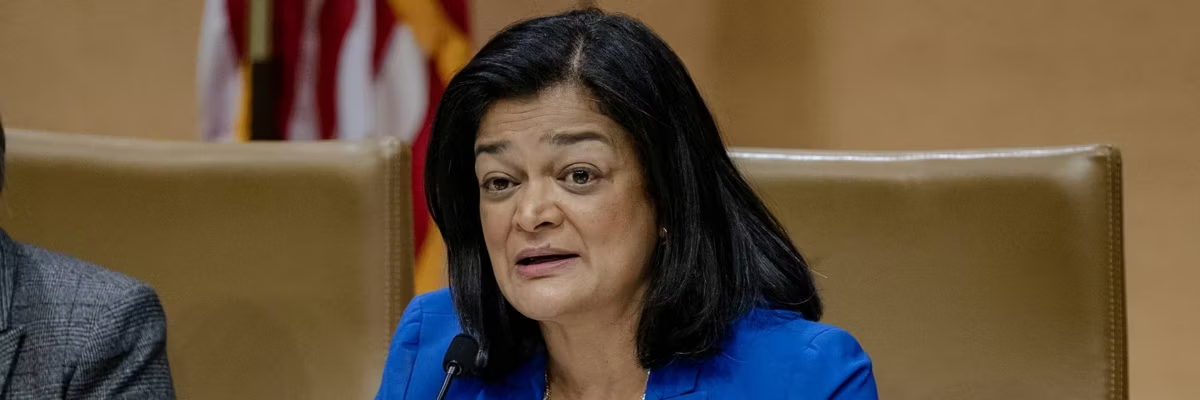
US Rep. Pramila Jayapal (D-Minn.) attends a field hearing at the Minnesota Senate building on January 16, 2026 in St. Paul, Minnesota.
(Photo by Jim Vondruska/Getty Images)
Julia Conley
Mar 06, 2026
C0MMON DREAMS
As the Trump administration celebrates its broadly unpopular war on Iran—one in which an estimated 1,332 people have been killed in the country, including nearly 200 children at a girls’ school—US Rep. Pramila Jayapal noted that President Donald Trump is still imposing a blockade on Cuba and denounced his stated plan to take over the island.
“The US maximum pressure campaign on Cuba is a cruel and failing policy that has caused incredible harm to the Cuban people,” said Jayapal (D-Wash.).
Trump Now ‘Boasting of a War Crime’ as Cuba Suffers Under Oil Blockade
Trump’s oil blockade on Cuba in recent weeks and his threats to push out its communist government are “just a plain attempt to open up Cuban markets to his billionaire buddies,” said Jayapal.
Trump announced last week that US companies would be permitted to sell small amounts of oil to Cuba if they circumvent the government and that Venezuelan fuel could be sold to private businesses in the communist country.
That decision came after weeks of a worsening fuel crisis on the island, triggered by Trump’s push to take control of Venezuelan oil and his threat to hit any country that provided oil to Cuba with tariffs. In January, he issued an executive order accusing the country of supporting terrorism and posing a security threat to the US.
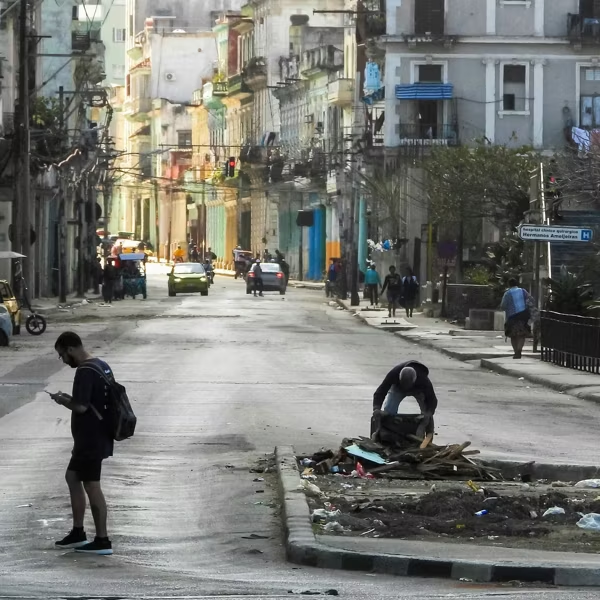
The blockade has left cities struggling to provide sanitation services and pushed Cuba’s healthcare system to the brink of collapse, according to the country’s health minister. Officials blamed the US this week for a blackout that plunged millions of people into darkness for 16 hours.
On Friday, as Trump’s Iran war sent US oil prices soaring and the attack on girls’ school was found by numerous investigations to have “likely” been carried out by the US, the president attempted to change the subject to his plans for Cuba, telling CNN, “Cuba is gonna fall too.”
He told the outlet that Secretary of State Marco Rubio, who has long advocated for regime change in Cuba, would turn his attention to pushing out the country’s government after the war in Iran—which the president and his officials have estimated could take anywhere from four weeks to six months.
“Your next one is going to be, we want to do that special Cuba,” Trump told CNN. “[Rubio]'s waiting. But he says, ‘Let’s get this one finished first.’ We could do them all at the same time, but bad things happen. If you watch countries over the years, you do them all too fast, bad things happen. We’re not going to let anything bad happen to this country.”
The president made similar comments to Politico on Thursday, saying the US is “talking to Cuba” and that his decision to cut off the island’s crucial Venezuelan oil supply is pressuring the government.
“Well, it’s because of my intervention, intervention that is happening,” Trump said. “Obviously, otherwise they wouldn’t have this problem.”
Sen. Lindsey Graham (R-SC) also warned this week that “Cuba’s next.”
Jayapal said Friday that Trump’s takeover of Venezuela, after which administration officials admitted the White House was after the country’s oil supply and claimed the administration has the right to take over any country if doing so serves US interests, “is a clear example that Trump doesn’t care about democracy or civil society.”
Trump’s threats against Cuba, she said, are “just a plain attempt to open up Cuban markets to his billionaire buddies.”
Mar 06, 2026
C0MMON DREAMS
As the Trump administration celebrates its broadly unpopular war on Iran—one in which an estimated 1,332 people have been killed in the country, including nearly 200 children at a girls’ school—US Rep. Pramila Jayapal noted that President Donald Trump is still imposing a blockade on Cuba and denounced his stated plan to take over the island.
“The US maximum pressure campaign on Cuba is a cruel and failing policy that has caused incredible harm to the Cuban people,” said Jayapal (D-Wash.).
Trump Now ‘Boasting of a War Crime’ as Cuba Suffers Under Oil Blockade
Trump’s oil blockade on Cuba in recent weeks and his threats to push out its communist government are “just a plain attempt to open up Cuban markets to his billionaire buddies,” said Jayapal.
Trump announced last week that US companies would be permitted to sell small amounts of oil to Cuba if they circumvent the government and that Venezuelan fuel could be sold to private businesses in the communist country.
That decision came after weeks of a worsening fuel crisis on the island, triggered by Trump’s push to take control of Venezuelan oil and his threat to hit any country that provided oil to Cuba with tariffs. In January, he issued an executive order accusing the country of supporting terrorism and posing a security threat to the US.
The blockade has left cities struggling to provide sanitation services and pushed Cuba’s healthcare system to the brink of collapse, according to the country’s health minister. Officials blamed the US this week for a blackout that plunged millions of people into darkness for 16 hours.
On Friday, as Trump’s Iran war sent US oil prices soaring and the attack on girls’ school was found by numerous investigations to have “likely” been carried out by the US, the president attempted to change the subject to his plans for Cuba, telling CNN, “Cuba is gonna fall too.”
He told the outlet that Secretary of State Marco Rubio, who has long advocated for regime change in Cuba, would turn his attention to pushing out the country’s government after the war in Iran—which the president and his officials have estimated could take anywhere from four weeks to six months.
“Your next one is going to be, we want to do that special Cuba,” Trump told CNN. “[Rubio]'s waiting. But he says, ‘Let’s get this one finished first.’ We could do them all at the same time, but bad things happen. If you watch countries over the years, you do them all too fast, bad things happen. We’re not going to let anything bad happen to this country.”
The president made similar comments to Politico on Thursday, saying the US is “talking to Cuba” and that his decision to cut off the island’s crucial Venezuelan oil supply is pressuring the government.
“Well, it’s because of my intervention, intervention that is happening,” Trump said. “Obviously, otherwise they wouldn’t have this problem.”
Sen. Lindsey Graham (R-SC) also warned this week that “Cuba’s next.”
Jayapal said Friday that Trump’s takeover of Venezuela, after which administration officials admitted the White House was after the country’s oil supply and claimed the administration has the right to take over any country if doing so serves US interests, “is a clear example that Trump doesn’t care about democracy or civil society.”
Trump’s threats against Cuba, she said, are “just a plain attempt to open up Cuban markets to his billionaire buddies.”
Cuba’s fall would hurt all radical projects
First published at Mexico Solidarity Network.
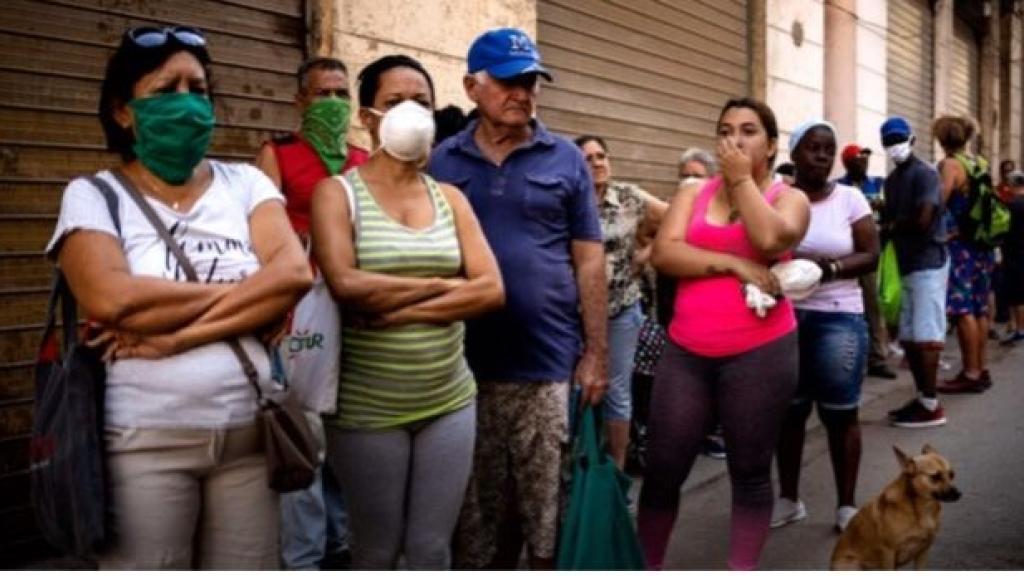
Ninety miles from the US shore, Cuba’s people are staring at an impending US-made catastrophe. Next to water, the liquid most necessary for life as we know it is oil. Trump’s “Donroe” doctrine has forced Venezuela and Mexico, the two major suppliers of oil to Cuba, to stop oil shipments. In two weeks, Cuba could well be without electricity. The intended result: the end of a socialist experiment that has inspired anti-capitalist resistance around the world.
As Pedro Gellert, a longtime activist in solidarity with Cuba, tells us below, Mexico is the one nation that has never blinked in its support for Cuba. It understands that if Cuba loses its sovereignty, Mexico will find it harder to defend its own.
Why does the US hate Cuba? Unlike Venezuela, Cuba doesn’t have any natural resources that interest the US. But Cuba has against all odds withstood US military and economic pressure since 1959. Punishment is not enough; it must be destroyed. Just as Haiti must pay in dollars and blood in perpetuity for having the gall to overthrow the slave-owning class, Cuba’s destruction must serve as a lesson to Latin America and the Caribbean: resistance to US domination is futile.
Like Cuba, Mexico has a revolutionary project of social transformation. Corrupt oligarchs finally have been made to pay back taxes, an amount huge enough to uplift the poor. Nationalization of energy puts the government in control of Mexico’s own natural resources. But its radical experiment is also being threatened.
The sovereign right of Cuba and Mexico to determine their own path must be defended — and not just for their sake. There is no line between the fight against ICE brutality in the US and the resistance to white imperialist domination in Latin America. If the Cuban revolution is defeated, Mexico and the people of the US will find it harder to win their own transformational demands.
Why Mexico stands up for Cuba
Pedro Gellert, a rank-and-file Morena activist, has been involved in international solidarity efforts with nations that range from Cuba to Vietnam to Palestine. Gellert formerly edited the Morena Internacional newsletter and has been summarizing and translating the presidential mañaneras for seven years. Active with the Mexico Solidarity Project since it began, he has helped it broaden its reach.
We’re seeing a humanitarian catastrophe. What do you hear from Cubans?
The savage US blockade cuts off oil and thus electricity, making life unbearable in Cuba, almost impossible.
Desperately needed food, medicine and medical equipment from the US get to the Cuban people during a historic crisis: (Photo courtesy of US Embassy in Italy)
They have closed schools, and teachers are attempting to teach virtually, with students tuning in by cellphone. But in some areas you can only get electricity to charge your cellphones for four hours a day — and those hours might be in the middle of the night. Families have to get up and accomplish everything that requires electricity for the whole day in that four-hour window: charge phones, wash clothes, prepare food and so on.
If you live anywhere above the first floor, it takes electricity to pump water upward. So you can’t use a toilet, shower or faucet. In Havana, garbage collection isn’t the highest priority for energy use, so garbage is overflowing. That brings rats, mosquitoes — and disease. This is a conscious US policy designed to inflict misery on the people.
The larger economy? A big source of revenue was tourism, particularly from Canada. But now, Canada has canceled flights because they can’t refuel in Cuba for the flights back. And if you go as a tourist, the hotels are also experiencing blackouts — and forget getting transportation to go anywhere!
In addition, the White House has made pawns out of tourists to the US. Because of the Visa Waiver Program, citizens of France, Spain, Great Britain and many other countries haven’t needed a US visa to visit. But now, if they have visited Cuba, they must navigate the red tape of the visa process.
It’s dire. As of February 20, Cuba has about two weeks left of electricity.
When the Cuban socialist revolution took power in 1959, what was the reaction in Mexico?
Mexico knew about the dictator Fulgencio Batista, who tortured and killed his opposition and who had ties with the US Mafia and US corporations. Everyone welcomed his defeat. The Cuban Revolution gave rise to a new generation of Mexican radicals, who saw a small country that faced down US imperialism and that was building a society to serve the common people. Even the Mexican bourgeoisie and its party, the PRI, were glad to see Batista overthrown.
When US President Kennedy ordered the invasion of Cuba in 1961, Mexico opposed the invasion.
Mexico is exemplary in its defense of Cuba. It’s the only country in Latin America that has never broken relations with Cuba. When the US moved to expel Cuba from the Organization of American States in 1962, Mexico disagreed. When Biden didn’t invite Cuba to his Summit of the Americas in 2022,
President Lopez Obrador refused to participate.
But the reactionary PRI party, which willingly collaborated with the US, ruled Mexico. Why did they always support Cuba?
The Mexican-American War of 1846 to 1848, which is called the Intervención Estadounidense en México, or the US Intervention in Mexico, ended with the annexation of nearly half of Mexico’s territory. Since then, the annexation has been a part of Mexicans’ deep-rooted anti-imperialist consciousness, and that’s true for the whole population. It sees the defense of Cuba’s sovereignty, from 1959 to now, as the defense of Mexico’s own sovereignty.
Generally, the PRI was progressive in foreign policy while reactionary in domestic policy. Their defense of Latin American revolutionary nationalism was popular — some sections of the Mexican left viewed the PRI as the progressive wing of the bourgeoisie. It brought them support from the global left as well.
But that policy was a fig leaf for their own suppression of any dissent to their corrupt authoritarian rule and their support for US capital.
Did Mexico provide more than statements of support for Cuba? And how has Cuba helped Mexico?
Let me start with the second question. First, for years Cuba has sent doctors to underserved parts of Mexico, particularly indigenous communities in the southern region.
Cuban doctors risked their lives in Mexico during the COVID crisis. Cuba also opened its medical schools to Mexican students. This medical assistance was not only for Mexico but for many countries of the global South, earning admiration, gratitude and political support. It was said, “The US sends soldiers, Cuba sends doctors.”
An exemplary program was Operación Milagro, or Operation Miracle, begun in 2004 in partnership with Venezuela’s socialist government under Hugo Chávez. The program sent Cuban doctors to the global South, where 90% of visually impaired people live, providing free eye care. They served over four million people in 34 countries.
Second, Cuban educators conducted literacy campaigns in poor areas of Mexico. These programs consolidated support for Cuba; the people saw Cuba as representing a new kind of society that cares for the poor.
Mexico helping Cuba’s economy? They paid for those doctors and educators. The health and literacy programs are free to the people served, but the governments pay for them.
But under Trump’s threats, countries in Latin America and the Caribbean are canceling the agreements that bring in Cuban doctors —another blow to the Cuban economy and to the health of those countries’ populations.
Given that Mexicans are in solidarity with Cuba, how did they react to president Sheinbaum's decision to stop the shipment of oil?
The people blame Trump, not Sheinbaum. She’s made clear that she wants to send oil, but Trump’s threatened 80% tariffs on Mexican exports would devastate Mexico’s economy, and she cannot take that risk.
Instead, Mexico has embarked on a massive campaign of humanitarian aid. In Mexico City, under Mayor Clara Brugada’s leadership, all city legislators will donate one month’s salary to support Cuba.
Morena offices in every state are collection points for donations — and the Mexican government has guaranteed shipment. The government itself donated and sent the first shipment, and more is on the way.
Mexico’s three interventions in this Cuban crisis include providing humanitarian aid, pressuring for no US interference and pushing other countries, particularly Spain, to send oil. Sheinbaum has also offered to mediate between the US and Cuba on the condition that Cuban sovereignty is not negotiable.
What does the US want?
Cuba’s main revenue-generating “exports” are tourism and medical and professional services. Cuba isn’t Venezuela; it doesn’t have a lot of natural resources the US wants — this economic asphyxiation is purely political. Since 1959, Washington has punished this small nation, which has the courage, the creativity and the staying power to refuse to buckle under to US imperialism. The US can’t allow this rejection of capitalism and imperialism — its destruction is the price it must pay for thumbing its nose at the US behemoth.
And that’s why those of us on the left must do all we can to defend Cuba.
Cuba: US moves in for the kill
First published at Arguing for Socialism.
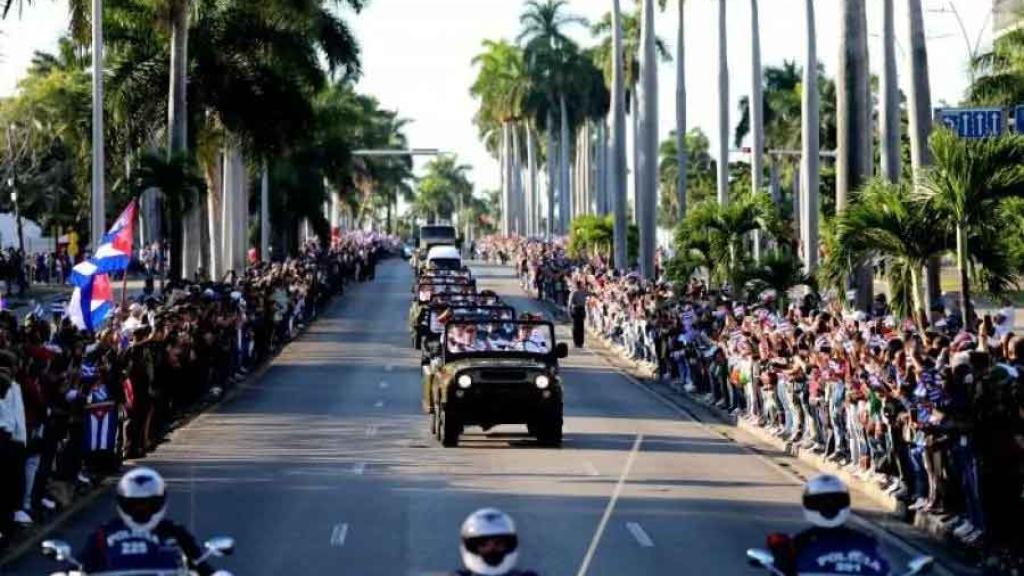
Sixty seven years after the initial victory of the Cuban Revolution, it faces perhaps its greatest ever challenge as Washington moves in for the kill.
The January 1, 1959 triumph of the Revolution and its victory over the US-led counterrevolution at Playa Giron (Bay of Pigs) in April 1961 electrified progressive and popular forces in Latin America. The revolution and the bold, dynamic new leadership around Fidel and Che had a huge impact.
Relations with Washington quickly deteriorated as it became clear that the Cuban leadership was dead serious about carrying out its radical promises (especially the agrarian reform) and supporting revolutionary forces across Latin America.
An April 6, 1960 memorandum by Lestor Mallory, US Deputy Assistant Secretary of State for Inter-American Affairs, laid out Washington’s thinking. The memo was headed “The Decline and Fall of Castro”. It said:
Salient considerations respecting the life of the present Government of Cuba are:
1. The majority of Cubans support Castro (the lowest estimate I have seen is 50 percent).
2. There is no effective political opposition.
3. Fidel Castro and other members of the Cuban Government espouse or condone communist influence.
4. Communist influence is pervading the Government and the body politic at an amazingly fast rate.
5. Militant opposition to Castro from without Cuba would only serve his and the communist cause.
6. The only foreseeable means of alienating internal support is through disenchantment and disaffection based on economic dissatisfaction and hardship.
Mallory then concludes:
… that every possible means should be undertaken promptly to weaken the economic life of Cuba. If such a policy is adopted, it should be the result of a positive decision which would call forth a line of action which, while as adroit and inconspicuous as possible, makes the greatest inroads in denying money and supplies to Cuba, to decrease monetary and real wages, to bring about hunger, desperation, and overthrow of government.
66 years later, nothing has really changed.
Move & countermove
Wikipedia outlines how things quickly escalated:
In May 1960 the Cuban government began regularly and openly purchasing armaments from the Soviet Union, citing the US arms embargo. In July 1960 the U.S. reduced the import quota of sugar from Cuba to 700,000 tons under the Sugar Act of 1948; the Soviet Union responded by agreeing to purchase the sugar instead.
In June 1960, Eisenhower's government refused to export oil to the island, leaving Cuba reliant on Soviet crude oil. Cuba and the Soviet Union signed a trade agreement according to which the Soviet Union would provide 900,000 tons of oil to Cuba. The US viewed the agreement as a provocation, and successfully urged Esso, Texaco, and Shell to refuse to process Soviet crude in their Havana and Santiago de Cuba refineries. On June 29 and July 1, 1960, Cuba confiscated the refineries. The US responded by canceling its quota of sugar purchases from Cuba …
In response to sanctions, on August 30, 1960, the Cuban government nationalized three American-owned oil refineries as well as … the Cuban Telephone Company, and 36 sugar mills. The refineries became part of the state-run company … This prompted the Eisenhower administration to launch the first trade embargo — a prohibition against selling all products to Cuba outside of humanitarian aid.
In October 1960, the Cuban administration responded by nationalizing all American businesses and most American privately owned properties on the island. Castro promised to separate Americans in Cuba from all of their possessions "down to the nails in their shoes" …
The second wave of nationalisations prompted the Eisenhower administration, in one of its last actions, to sever all diplomatic relations with Cuba in January 1961.
Bay of Pigs & the Cuban Missile Crisis
In April 1961 the US organised an invasion of Cuba by a small army of CIA-trained counterrevolutionaries. The landing site chosen was Playa Giron (the Bay of Pigs) on Cuba’s southern coast. The invasion was defeated within 72 hours. Some 1200 contras were captured (later ransomed for medical supplies).
In the midst of the struggle, for the first time Fidel proclaimed the revolution to be a socialist one.
In April 1962 the US amassed a huge naval armada for manoeuvres involving 40,000 marines culminating in a mock invasion of an island off Puerto Rico. The revolutionary government feared an invasion was imminent. Che Guevara was sent to Moscow to request nuclear missiles to defend Cuba. Moscow agreed and the missiles started to arrive in the middle of the year.
In October the US discovered them. The US imposed a naval blockade of the island. After some tense moments, eventually the missiles were withdrawn. The US publicly promised not to invade Cuba again and a secret agreement was made to withdraw US nuclear missiles in Turkey.
The blockade
The precise scope of the blockade has varied over the years but it has never been lifted. The blockade has done immense damage to Cuba over the decades. Wikipedia reports:
The United Nations estimated in 2023 the total economic damage to the Cuban economy to be in the "trillions of dollars" since inception. A 2015 report in Al Jazeera estimated that the embargo had cost the Cuban economy $1.1 trillion in the 55 years since its inception, once inflation is taken into account. The Cuban government assessed the cost in 2018 to be around $933 billion since inception.
Apart from the US and Israel the embargo has had almost no international support. Wikipedia summarises:
Every year since 1992, except for 2020 due to the COVID-19 pandemic, the U.N. General Assembly has passed a non-binding resolution that condemns the ongoing impact of the embargo and declares it in violation of the Charter of the United Nations and of international law. Israel is the only country that routinely joins the U.S. in voting against the resolution.
Other countries that voted against the resolution in the past include Romania in 1992, Albania and Paraguay in 1993, Uzbekistan from 1995 to 1997, Marshall Islands from 2000 to 2007, Palau from 2004 to 2009 then once in 2012, and Brazil in 2019. 187 countries voted in favor of the resolution in 2024, with only the United States and Israel voting against it and Moldova abstaining.
In 2025, five countries joined the United States and Israel in voting against the resolution: Argentina, Paraguay, Hungary, North Macedonia, and Ukraine. Additionally, twelve countries abstained from the vote: Albania, Bosnia and Herzegovina, Costa Rica, the Czech Republic, Ecuador, Estonia, Latvia, Lithuania, Morocco, Poland, Moldova, and Romania.
Cuba’s relations with US over the years
There is a very interesting article on the blockade in Orinoco Tribune by Cuban academic Jose Ramon Cabanas. He points out that, despite everything, there have been many practical agreements for US-Cuba cooperation over the years (search and rescue, against drug trafficking, etc.). They have worked well.
He says that increased tourism led to public perceptions of Cuba in the US becoming more positive and that this led the Miami right wing to lobby Trump for harsher sanctions (which duly came).
He ends with a sharp point. He asks “What is sovereignty for Cuba?”.
I would say it is the axis of a multilateral existence, of continuing to live as human beings, that we respect the sovereign independence and freedom of each country. If we are asked today, I would say that Cuba does not share many visions and many political systems that exist in the world. I will not go into examples, but let us say systems where politics depends on who buys which candidate; obviously, that is not how it should work.
And there are other countries with political systems with which we do not agree. However, we have respect for those authorities, we have respect for those countries, and what it is about for us to continue living as humanity is to negotiate our differences and try to solve them by peaceful means. This is reflected in our Constitution, which was voted on by the population in a referendum that approved it.
That country that wants to give Cuba lessons in democracy has never voted for a Constitution. In the US, the constitutional text that begins by saying “We the People” was negotiated by 57 individuals and signed by 39. There have been a host of constitutional amendments, but the US as a country has never voted for a Constitution.
Trump moves in for the kill
Even before Trump’s latest escalation, Cuba was beset with serious problems. There was not only the embargo, but rising social inequality due to unequal access to dollar remittances from the Cuban diaspora (mainly in Florida).
In recent years large numbers of Cubans have emigrated due to financial pressures. As a result, the population has plateaued and even declined a little. It currently stands at 10.9 million.
This year Trump has dramatically intensified the pressure on Cuba. On January 29 he issued one of his utterly preposterous executive orders that declared Cuba to be “an unusual and extraordinary threat” to the US. Trump said that he would impose punitive tariffs on states that deliver fuel to Cuba. (Since the Supreme Court has struck down Trump’s tariffs, this last threat remains moot.)
Under the US diktat, Venezuela has cancelled its oil supplies to Cuba as has Mexico. The US continues to intercept oil supplies heading to Cuba, i.e., to blockade the island.
The aim is the same as for Lester Mallory in April 1960: To increase social discontent, achieve regime change and bring back the good old days of US corporate-mafia domination.
Things are indeed grim. Hospitals, schools and factories are shutting down. Health care is in crisis as ambulances are immobilised, medicines are running out, and dialysis machines can’t function. There is real hunger. Planes can’t land there because they can’t refuel, garbage is piling up in the streets as lack of fuel cripples the garbage truck fleet.
Cuban response & solidarity
Cuba produces a small amount of oil (30-45,000 barrels per day).
It is installing solar panels and setting up solar farms; China and Vietnam are helping here. This has been happening for some years but now the urgency is absolutely acute. A related problem is storage batteries so power generated during the day can be used at night: Solar panels may be cheap but storage is not.
Solidarity aid from both countries and social groups is coming in. The Nuestra América Convoy has called for people from around the world to converge in Havana on March 21.
Despite the small size of the country, the Cuban Revolution is one of the greatest events of the modern era. Cuba’s subsequent development shows the world what is possible when capitalism and the profit motive is removed. Yes, Cuba has a great many problems due to the blockade and the isolation of the revolution but its defence must be a priority for all socialist and progressive forces.
Ramadan Under the Blockade: The Women of Havana’s Only Mosque
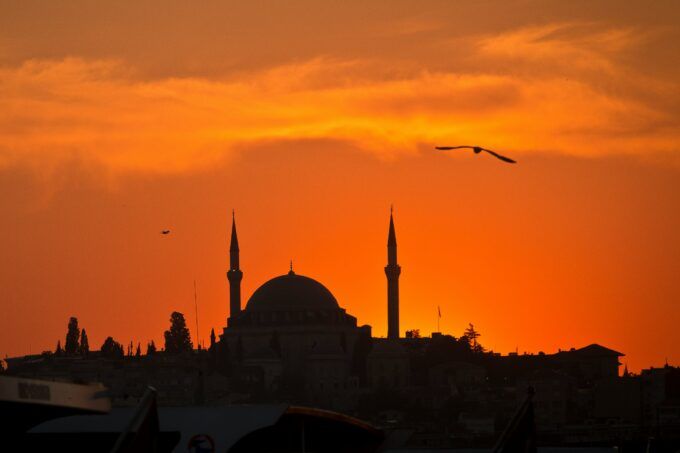
Image by Simon Infanger.
In the Spring of 2022, I spent the last nights of Ramadan and Eid al-Adha in Havana, Cuba. I made it to Mezquita Abdallah, the only mosque in the whole country, before the sun went down — I’d missed the Eid prayer entirely, but I was able to sit around a table and talk with some of the women there. They told me what it was like to be Muslim in Cuba; many of them were converts like me, and few had Muslim families aside from the ones they made from scratch. Since I left Cuba in 2022, life there has gotten a lot worse.
International Women’s Day is coming up on March 8th. Around the world, women and families are bearing the brunt of brutal U.S. sanctions and militarism, and Cuba is no different. I’ve kept in touch with the women of the Havana mosque through a collection of WhatsApp messages, phone calls, and voice notes. This year, in the days leading up to the holy month of Ramadan, I conducted a series of interviews with them. In the wake of Trump’s complete blockade of oil to the island, these women face an intensifying struggle to survive and provide for their families. Muslims in Cuba are entering one of the most beloved times of the year while grappling with a level of scarcity that is unimaginable to most. The women I talked to will ring in International Women’s Day trying to balance the strains of living under a blockade while fasting for Ramadan.
For Cuba’s tiny Muslim community, the electricity blackouts, the food shortages, and the sharp reduction of public transportation make it increasingly difficult to participate in all the traditions that come with Ramadan.
“For most people, it’s very difficult to access the mosque during Ramadan,” said a thirty-six-year-old mother. “There is no reliable transportation due to the lack of fuel. Many of us will have to stay home to break our fast because we live far away from the mosque. Without transportation, it becomes almost impossible to get there.”
Muslims who don’t live at the center of Havana’s old city (and most of them don’t) can’t pray at the mosque during the holiest month of the year. Lack of access to food on the island as a whole naturally leads to less access to non-pork options and halal meats, and the mosque is generally a place where halal foods would be distributed.
A single woman from the Mosque remarked that oftentimes, Muslims in Cuba practice their faith without any family support. “Cuban Muslim women face big challenges every day. Maintaining our religion in the correct way and surviving in the difficult economic situations,” she said, “This is difficult for Muslim women who live by themselves, who are sick or don’t get support from their families and society. And those who are elderly and alone.”
She mentioned that she is the sole caretaker for her elderly mother, who is very sick. “I’m taking care of her, Alhamdulillah,” she said, which means “Praise to God” or “Thank God.”
The world has become somewhat familiar with the concept of blockades by watching what’s happening in Gaza. While the blockade on Gaza is enforced physically by the heavily-armed Israeli military, the blockade on Cuba has been imposed economically, relying on trade threats and sanctions by the United States. Both types of blockades lead to food and medicine shortages, spiked prices, and widespread inaccessibility, causing hunger and the worsening of treatable medical conditions. Without access to proper nourishment and equipment, people die. Economic sanctions alone kill half a million people every single year. Cuba has some of the best and most capable doctors in the world, and there is no shortage of manpower — but the blockade increasingly restricts medical equipment coming into the country.
Around the world, it’s not uncommon for the responsibility of childcare and eldercare to fall on women. And when food and medicine are scarce, women carry the weight of keeping their families healthy, often faced with impossible choices.
Mayerci, another mother from the mosque, has two young children. Her son has struggled with his health for the last four years. Previously, the family was given nutritional support like supplementary milk and chicken rations, but the food shortages caused by the blockade effectively ended that extra assistance. Hospitals have run out of the zinc sulfate and asthma medication that he needs to remain healthy. On top of that, Mayerci herself is in need of surgery to treat her cystic fibrosis — but the hospitals no longer have the equipment for it. While dealing with her own illness, she has to try to make sure her children survive under increased scarcity.
“This is the life of Cubans today: if you buy food, you cannot afford clothing or medicines, and if you buy medicines, you cannot afford food,” said Mayerci.
These interviews all took place about a week after the Trump Administration implemented the total blockade on fuel. The conditions have only gotten worse since then, and will likely continue to decline for the foreseeable future. The effects compound for women, and evidently even more so for Muslim women at this time of the year.
While the women didn’t express any optimism for the near future, when I asked about Trump and Rubio’s talking points on Cuba, one of them remarked to me, “Personally, I don’t believe capitalism is the solution.”
There is a glimmer of hope, though — much like we saw with Gaza, the world is mobilizing in solidarity with Cuba. In March, Cuba will receive massive shipments of solar panels that were crowdsourced by people near and far. Caravans and flotillas are also traveling to Cuba during the springtime, carrying suitcases stuffed with food and medicines to aid the Cuban people. By air, by land, and by sea, organizations like The People’s Forum, CODEPINK, Progressive International, and others will attempt to provide some semblance of relief to the Cuban people.
This act of solidarity is powerful, but it won’t be enough. The solar panels won’t be able to power the entire Cuban electrical grid, and individual people can only fit so many supplies in their personal suitcases. Much like the genocide in Gaza, an end to the suffering in Cuba would require the people of the United States to rise up and fervently resist the warfare being carried out in their name by the likes of Marco Rubio and Donald Trump. With the U.S. military intercepting ships bringing fuel to Cuba, and considering the violent history of US intervention, one cannot rule out some sort of armed U.S. attack on Cuba. After the world set such an alarming precedent in Gaza, I can’t help but worry for my friends in Cuba — what will happen to the women living under the boot of the U.S. empire if women here sit back and merely wait for the next election cycle?
History shows us the resilience of the Cuban people. My friends are surviving by cooking on coal, strategically using the limited hours of electricity to take care of their families — but how long can that last?


No comments:
Post a Comment