It’s possible that I shall make an ass of myself. But in that case one can always get out of it with a little dialectic. I have, of course, so worded my proposition as to be right either way (K.Marx, Letter to F.Engels on the Indian Mutiny)
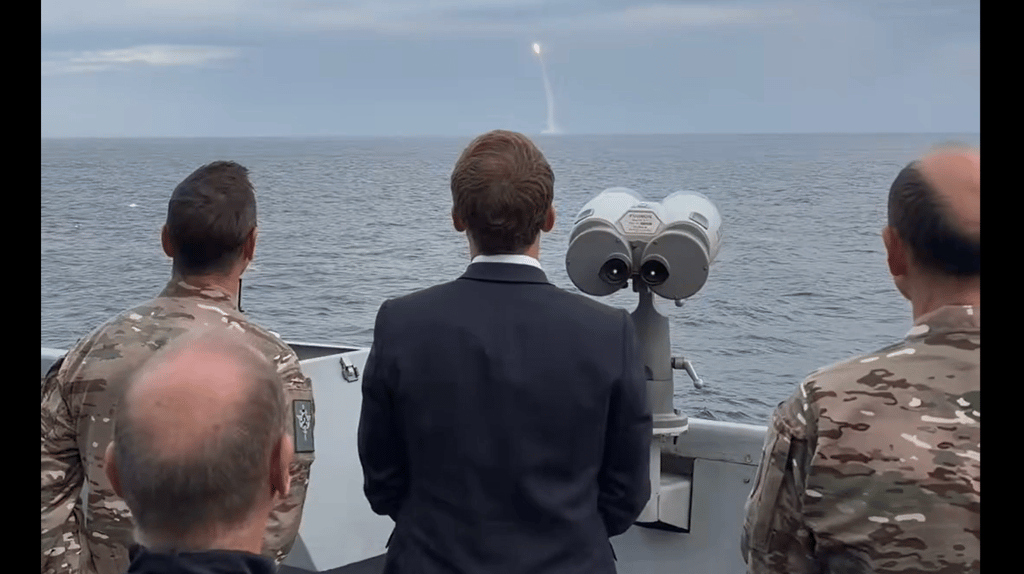
The administration of French President Emmanuel Macron is putting new emphasis on France's nuclear deterrent, and specifically on its nuclear ballistic missile submarine fleet. In March, Macron used a launch ceremony at the L'Île Longue submarine base to announce that France would expand its arsenal and cooperate with other European countries on a broader nuclear deterrence system. On Tuesday, he made an unannounced trip to a frigate off Brittany for the first seagoing test-launch of an M51.3 ballistic missile - and he reiterated that message.
"To be free, one must be feared. And to be feared, one must be powerful," Macron said in a ship-wide PA address to the crew. "Our nuclear deterrence protects us and will continue to protect us. Long live the Republic, and long live France."
The launch was a post-drydocking test shot for Le Vigilant, one of France's four Le Triomphant-class ballistic missile submarines, as well as the first sub-launched test of the third variant of France's M51 sub-launched ballistic missile. Macron's attendance was not expected at the routine test, according to Le Monde, but the launch provided a powerful and somber visual to accompany his message: that France can respond to nuclear threats.
The rationale for Macron's newly-serious focus on nuclear arms can be found in Russia's increasingly aggressive stance towards NATO. Last month, the Russian government sent a diplomatic note to NATO (later shared with Reuters) that threatened "Russian strikes against decision-making centers" in Europe at the very start of any conflict. Exercises near the Baltic Sea exclave of Kaliningrad are of particular concern, Moscow suggested.
"Russia will be ready to use the entire arsenal of forces and capabilities at its disposal, including nuclear weapons, in order to defend its territory should NATO countries undertake any attempt aimed at isolating the Kaliningrad Region from the ?rest of the country," the Kremlin warned in the note.
France has been upgrading its ballistic missile inventory to account for increasingly capable air defense technology. U.S. and Israeli systems managed a 90-percent interception rate against Iranian ballistic missiles in 2024, and sustained a high success rate throughout the more recent Mideast conflict from March 2026 onwards. According to Sidharth Kaushal of the Royal United Services Institute, Russia's investments in similar air defense systems could render the French deterrent - reliant upon the nuclear missiles fielded by its subs and strike fighters - somewhat less effective. ArianeGroup is developing a fourth generation variant of the missile with "enhanced range, precision and penetration capabilities" to counteract these developments.
A look at how Messi and Ronaldo’s international careers compare
07.10.2026, DPA
Photo: Patrick Seeger/dpa
Lionel Messi has retired from international football and marked his final game for Argentina with a farewell goal and two assists in a 3-0 friendly win against Benin in Buenos Aires.
Messi, 39, stands alongside Pele and Diego Maradona as one of football’s all-time greats, while of the modern-day players, only Cristiano Ronaldo can compare.
The 41-year-old’s international future is uncertain after he walked out on Portugal last week after being left on the bench against Norway.
Here, the Press Association takes a look at how the two players’ extraordinary international statistics stack up.
Debuts
Messi was 18 years, one month and 24 days old when he made his senior debut for Argentina in a 2-1 win against Hungary in Budapest in 2005.
Ronaldo was 18 years, six months and 15 days old when he made his first senior appearance for Portugal in a 1-0 win against Kazakhstan in 2003.
Appearances and goals
Messi scored 126 goals, including 11 hat-tricks, in 206 appearances for his country over an international career which spanned over 21 years.
Ronaldo has scored 146 goals, including 10 hat-tricks, in 234 appearances for Portugal, with his international career so far stretching over 23 years.
Goals per minute
Messi’s average strike-rate was one goal every 136 minutes and excluding penalties that extended to one goal in every 172 minutes.
Ronaldo was more prolific, averaging a goal every 127 minutes and one every 151 minutes when penalties are excluded.
Goals contribution
Messi was the more creative, making 69 goal assists for a total goals contribution of 195, averaging a goal or assist every 88 minutes.
Ronaldo made 45 goal assists for an overall goals contribution of 191, averaging a goal or assist every 97 minutes.
World Cup tournaments
Messi appeared at six World Cups (2006, 2010, 2014, 2018, 2022, 2026), scoring 21 goals in 34 appearances.
Ronaldo also appeared at six World Cup tournaments (2006, 2010, 2014, 2018, 2022 and 2026), scoring 11 goals in 27 appearances.
Major trophies
Messi won the World Cup with Argentina in Qatar in 2022 and the Copa América twice (2021 and 2024).
Ronaldo won the European Championship with Portugal in France in 2016 and two Nations Leagues (2019 and 2025).
(c) 2026 dpa Deutsche Presse Agentur GmbH
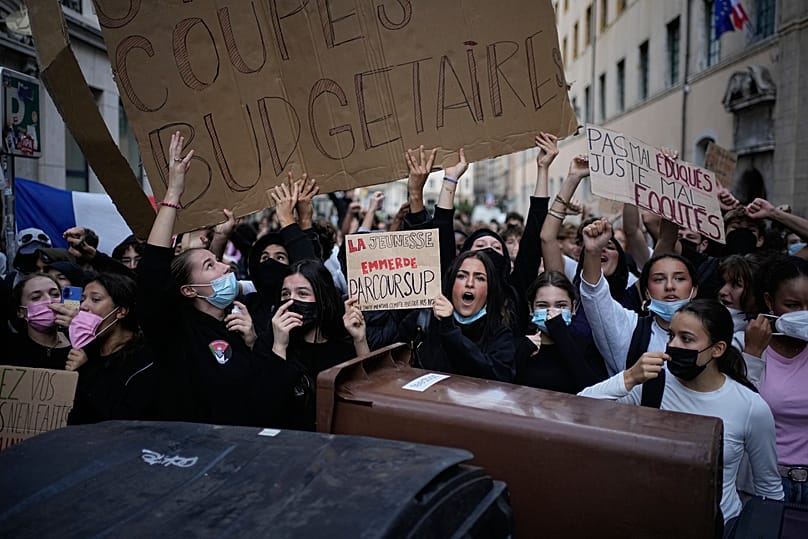
French PM slams violence at student protests and promises 'timeout' for democracy French Prime Minister Sébastien Lecornu said there can be "no room for tolerance of violence", as tens of thousands of students took to the streets nationwide on Tuesday to protest over the state of schools. He told parliament that high schools would clear their schedules for the rest of the week to create space for democratic debate and air grievances.
Addressing parliament during a question session on Tuesday, Lecornu condemned the level of violence seen in recent days during the student-led protests.
The government says at least 215 students and 715 police officers have been injured since the start of the movement.
"Ultra-violence has arrived at the doorstep of high schools. It must be condemned unconditionally. In a functioning democracy, we cannot allow any room for tolerance of violence," he told lawmakers.
"Burning down a high school does not improve the state of high school buildings. Lynching a teacher does not help replace teachers," Lecornu said.
Tens of thousands of demonstrators marched in cities across France in support of protests by school pupils demanding more education funding, increasing pressure on the government of outgoing President Emmanuel Macron.
A total of 891 high schools out of the 3,700 across France had their lessons "suspended, either completely or partially, for various reasons" on Tuesday, the French education ministry said.
The student union organisers of Tuesday's mass protests say 450,000 people – including 100,000 in Paris – have participated in protests across France.
The Interior Ministry put the figure at 256 000 across France, some 56 000 in Paris.
Placards at the student protests in Paris 6 October, 2026, including one reading "The future belongs to the young (not to retirees)" and another showing a caricature of French Interior Minister Laurent Nunez (L) and President Emmanuel Macron (R) with the text "Does the government really listen properly?". AFP - GEOFFROY VAN DER HASSELT
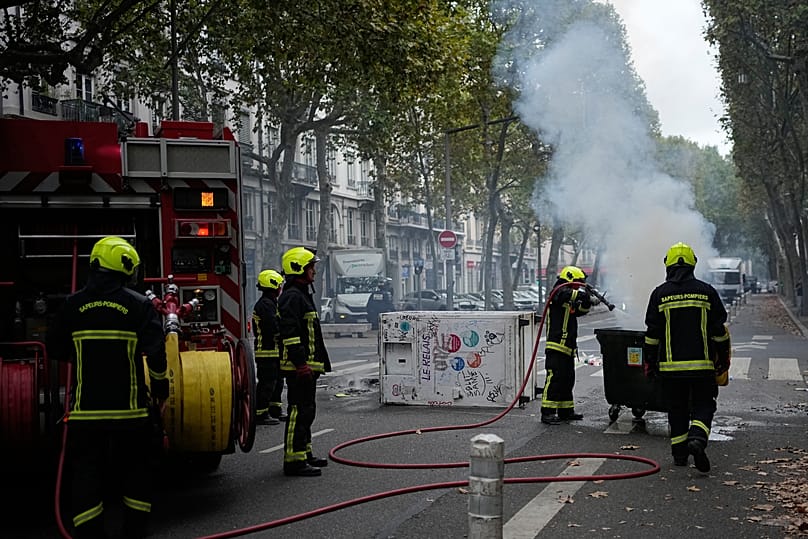
Riot police used water cannons to disperse students during a protest in Rennes, western France, and clashes were reported in Lyon and Strasbourg.
Lecornu accused the hard-left party France Unbowed (LFI) of having a "political agenda" to "throw the country into chaos" ahead of the 2027 presidential election and of "sowing chaos" since the start of the high school blockade movement last month.
In response to accusations of police violence, he said suggesting such a thing "cast a slur" on the Republic's police force.
"Can accidents occur during such a sensitive public order operation? The answer is yes. And I say 'accidents' because I also see the term 'police violence' being used. 'Police violence' would imply the existence of political directives for police repression. That is false; it is a lie."
Spaces for debate
In order to calm the situation, Lecornu announced the suspension of high school classes at the end of the week to organise a "period of internal democracy" with students.
This is coupled with an online consultation platform for high school students launched by Education Minister Edouard Geffray on Monday, available until 23 October.
Geffray said on Tuesday that he was addressing the demands of the protestors – including replacement teachers – and would deliver a response by next week.
Paris’s socialist mayor, Emmanuel Grégoire, said the capital's town halls are expected to open their doors in the coming days so high school students can come "to gather, debate, and democratically organise" their movement, Grégoire wrote in an open letter to the students sent to French news agency AFP.
"We cannot lament the lack of organisation among these young protestors while at the same time closing high schools and the venues where [their] general assemblies are held," he wrote.
University presidents also called on Tuesday for a "national forum on youth," arguing that it is "urgent to recognise young people" as "key players" in public debate.
This move comes just over six months before the presidential election, amidst a tense social and political climate marked by rising prices and a push for budget cuts – some of which, such as housing benefits, affect young people.
Two student unions L'Union étudiante and the USL (Union syndicale lycéenne) are calling for a new day of action on Thursday.
What France's student protesters want – and what the government is offering
Staff shortages, rats in the corridors, and a university admissions system that feels like a lottery: As protests sweep France, high school students have drawn up a list of demands to deal with these and other issues. Prime Minister Sébastien Lecornu has promised a government response by the end of October, but whether he can quell the unrest remains to be seen.
Mass protests across France’s high schools roiled the country again on Tuesday, with hundreds of thousands joining the biggest day of the movement so far. Demonstrations began in late September, with the first protest traced back to Saint-Exupéry high school in Créteil, a southern Parisian suburb.
A handful of teachers at Saint-Exupéry went on strike September 17 to lament staff shortages. “We were short a maths teacher, a French teacher, a literature professer, a history teacher and an assistant professor. The school nurse was on sick leave,” Laurent Bessiere, a maths teacher, told French radio station France Inter.
That same evening, students gathered to join the fight and planned a protest for the next morning. Stacking a few bins in front of the school entrance and holding placards, they rose up to make demands alongside their teachers.
“We’re asking for the bare minimum,” a student told France Inter.
Their demands struck a chord with other high schools across the nation, which are suffering from a lack of funding and understaffing.
In response to the protests, Prime Minister Sébastien Lecornu has ordered his ministers to tackle their demands and send in proposals by the end of the month. But finding spare funds to implement educational reforms will be complicated, given heated debates over France’s already strained 2027 budget.
Staff shortages
A union of high school and university students on Monday published a list of 10 “emergency measures” they say could serve as a basis for working with the government, whose response so far has been “repression”, they write.
High on the list is the issue of staff shortages. Students are demanding a large-scale recruitment drive to create additional teaching posts so that each classroom has a person to lead it. They also want to ensure that every establishment has at least one nurse, a psychologist and a career adviser for every 500 students.
More than half of France’s middle and high schools lack at least one teacher, a major trade union representing public school staff found. And 69 percent of schools are short of at least one member of their teaching and support staff. Understaffing means classrooms are overcrowded, regularly packing in 35 students at a time.
The numbers do not reflect the optimism that French Education Minister Édouard Geffray expressed before the September start of the new academic year. Speaking on France Inter at the end of August, he insisted that teacher shortages would be “minimal” and that “all indicators” were that things were on track to be “much better” than in previous years.
To meet the demand for teacher replacements, Lecornu referred to a scheme from 2023 encouraging teachers to cover for the short absences of colleagues in a statement published Sunday. As for long-term absences or unfilled posts, Lecornu said he ordered his ministers to prioritise filling them in every regional education authority.
Run-down buildings
Students have also repeatedly sounded the alarm on the dire state of their school buildings. A wave of viral Instagram videos posted by students resurfaced when the protests began. “I’m a student at the Blaise Cendrars high school in Seine-Saint-Denis (a northern suburb of Paris). Of course, I don’t have a roof over my head when I’m in class,” one student ironically said in a video showcasing the deplorable state of her establishment. Others have reported seeing rats and cockroaches scurrying through school corridors and flooded toilets.
Speaking to French radio ICI on Wednesday, vice president of the Île-de-France region James Chéron rejected the criticism. He said the region’s €6.6 billion, 10-year plan covers almost every public high school and that nearly 400 of its 468 establishments are already new or renovated, with the rest either under works or “being studied”. Chéron added that Seine-Saint-Denis has received the “most investment”.
But students are not convinced. During the successive heatwaves that scorched parts of France this summer, some classrooms reached 38° celsius. Two-thirds of the country’s elementary, middle and high schools have been built before 1970 and cannot withstand rising temperatures brought on by climate change.
The maintenance of school and university buildings is number one on the list of demands published by the student union. They are asking that an “emergency plan” be implemented to renovate dilapidated buildings and adapt them to heatwaves by installing air conditioners or cooling systems. They also want the buildings to be well-insulated to face cold spells. Providing “clean and functional toilets” is a key tenet of the request.
On this point, Lecornu said in his statement that the upkeep of public high school buildings, equipment and canteens is the responsibility of regional councils, but that the state would “support” them. Ministers are tasked with setting a timetable on urgent needs and clarify who is responsible for what.
“Studying in run-down premises is an obstacle to education,” Lecornu acknowledged. Long hours
Timetables have also come under scrutiny. Students say school days are too long, sometimes running from 8am to 6pm due to gaps in their schedule where they don’t have class. They point to a reform adopted in 2019 that allows high school students to choose specialisation courses in their final years as one of the reasons timetables can be disrupted.
“When I was in high school I would start at 8am and finish at 6pm,” recalled Julie, who is now in university. “My schedule was packed, and I still had extracurricular activities on the side.”
“I wake up at 6am because I live far from my high school. It takes me one hour to get home and then I have a tonne of homework to do. I barely spend time with my family,” one student told France 2 in an interview on Sunday.
Lecornu has asked for improvements to timetables and independent study conditions to be reviewed with public school staff, student representatives and even local transport authorities. He encouraged them to use artificial intelligence to refine the software used to build timetables ahead of the next school year.
A citizen’s convention submitted a proposal to the government in November last year on how to reform public school timetables, but the proposal has so far gone unheeded. Issues with the Parcoursup platform
France’s national online platform for applying to higher education institutions, Parcoursup, is also in the firing line. A bit like UCAS in the UK, final-year high school students use it to apply to university courses and other programmes, receiving offers based on their school records and applications.
Students argue that the system is opaque and seems arbitrary. Each university course ranks applicants with its own local algorithm and criteria, and students say they cannot see how decisions are made or why they were turned down. Many suspect their applications, including cover letters they spend hours writing, are never really read.
“I wrote about a dozen cover letters without using ChatGPT, but I feel like my applications were not even looked at. When I see people accepted onto the course I wanted with lower grades than mine, it seems completely illogical to me,” Ghjulia told FRANCE 24. The 18-year-old was hoping to start medical school but none of her applications were accepted, despite having solid grades.
But students also say Parcoursup entrenches inequality. A February 2026 report concluded that it helps keep sociocultural inequalities in place. One reason is that courses can see which high school an applicant attended, which can disadvantage students from less prestigious schools or poorer areas. The report drew out 51 proposals to address these issues, including dropping cover letters, hiding the applicant’s school and sharing local algorithms.
Lecornu is promising to make Parcoursup more transparent. Under his plan, students would be told exactly how courses weigh their grades and specialised subjects, how applicants are ranked, and why they were accepted or rejected. Ministers Édouard Geffray and Philippe Baptiste have until the end of October to propose changes for the 2027 admissions round, which opens in January.
The other demands listed by students include financial help, including guaranteeing that students meals are capped at €1, and ending the police violence that has run rampant during the protests.
500 arrested as French police clashes with protesters on third day of national action by high school students
Eyewitnesses say police deployed tear gas to quell unrest and disperse crowds in major cities including the capital, Paris, Marseille and Lyon. Officials figures reflected a nationwide participation exceeding a quarter million students in the protests that have rocked Macron's government.
Police fired tear gas to control crowds in Paris and elsewhere in France on Tuesday as more than a quarter of a million people rallied nationwide to support high school students demanding more education funding, according to government figures.
The protests increased pressure on the administration of outgoing President Emmanuel Macron. As pupils blockaded high schools, large crowds waving flags and placards gathered in Marseille, Strasbourg and other cities.
The demonstrations showed how protests that began at a high school in the Paris region in mid-September have grown into a nationwide movement — the latest of many that have marked Macron’s nearly decade-long tenure.
Official government figures put the number of demonstrators at over a quarter of a million nationwide on this third day of protest and arrests at more than 500.
In Paris 56.000 took to the streets and small groups clashed with riot police at the end of a largely peaceful march.
Students have drawn attention to rundown classrooms that lack basics such as desks and chairs, become sweltering in summer without air conditioning and, in some cases, are infested with rats.
Other common complaints include staff shortages and exhausting workloads. French high school students’ compulsory classroom hours are among the highest in Europe.
Classes suspended in 891 schools
Nearly 500 people were detained Tuesday, the interior ministry said. Classes were suspended “either completely or partially” in roughly 891 out of the 3,700 schools across the country.
The widespread use of arrests, tear gas and riot-control weapons against teenagers is fuelling defiance and angering some parents and teachers. Some student groups called for new protests on Thursday.
More than two weeks of class boycotts and school blockades, and policing that has led to more than 6,500 arrests, mostly of minors, have become a flashpoint in the early days of the presidential election campaign.
These protests are taking place against a backdrop of tension. The Minister for Education, Édouard Geffray, has stated that since the start of the protests, 85 members of teaching staff have been injured, as have 215 pupils and 715 members of the police force.
Questioned in parliament on Tuesday about the protest movement, Prime Minister Sebastien Lecornu denounced “ultra violence” threatening schools.
Responding to criticism of police tactics, he pledged that any “accidents” would be investigated and described allegations that the police are racist as a “lie".
Lessons were suspended “either completely or partially” in 891 schools out of the 3,700 across the country.
Monday, October 05, 2026
Afghanistan And The Terrorism Question Before The United Nations – OpEd
A closed Security Council meeting on Sept. 16, 2026, days before the General Debate, was briefed that terrorist groups in Afghanistan still threaten the region; France pressed the Taliban on security as well as rights, and Afghanistan’s own envoy called terrorism a serious threat.
The piece says the worry is wider than Pakistan’s TTP-sanctuary claims, which Kabul denies, and points to the February Monitoring Team report, the secretary-general’s reporting, and the Sept. 11 counterterrorism session.
The author’s ask is measurable checks on movement, recruitment, finance, and training, plus Pakistani intelligence through U.N. channels, not isolation of Afghans.
At a highly significant diplomatic juncture, Afghanistan is back at the heart of international security issues. The United Nations Security Council held a closed-door meeting on the situation in Afghanistan on 16 September 2026, just days before world leaders will arrive in New York for the 81st United Nations General Assembly’s General Debate. The timing matters. No longer is Afghanistan only talked of as a humanitarian crisis or uneventful political transition. Terrorist groups have become a recurring theme in debates on security in the region and indeed in the international community. The Security Council meeting record shows that the Council was briefed separately on Afghanistan and the UNAMA briefing explicitly stated that Afghanistan remains the victim of the threats of terrorist groups and the situation in the region and international peace and security is at threat.
That is the wording which needs to be watched as it takes the dialogue beyond bilateral Pakistan Afghanistan blame game. Islamabad has also repeatedly alleged the presence of armed groups, especially the Tehrik e Taliban Pakistan, in Afghanistan, which it alleges provide them with sanctuaries and/or operational networks. Kabul has denied Pakistan’s charges and said that the Afghan land was not being used to strike other nations. But the worry over the terror activity within Afghanistan is not restricted to Pakistan. There is institutional support for international monitoring of the security situation through the most recent reporting schedule of the SG, the Monitoring Team in August, and the Taliban sanctions monitoring report. A Concern That Extends Beyond Pakistan
France has added important diplomatic weight to this discussion. During earlier The position can be reviewed in the official Security Council transcript. At the 16 September meeting, France again pressed the Afghan authorities to demonstrate credible action on security concerns, alongside human rights and political commitments. The wider Council discussion therefore illustrates something significant. Concern about terrorism linked with Afghanistan is not merely a Pakistani talking point. It has entered the vocabulary of permanent and elected Security Council members.
This distinction should shape the international discussion. It is built through convergence between national evidence and independent international assessments. The February Monitoring Team report and the earlier Secretary General report on Afghanistan show that the United Nations has continued to track extremist networks and security risks. Even Afghanistan’s representative at the United Nations stated during the September meeting that terrorism remained a serious threat and referred to Monitoring Team findings concerning numerous terrorist organisations. His Security Council statement also argued that counterterrorism concerns must be addressed through accountable governance and respect for international law.
There is also a larger lesson emerging from the Council’s recent counterterrorism discussions. On 11 September, France convened a Security Council meeting marking twenty five years since the attacks of 2001. The Council terrorism debate addressed changing terrorist methods, recruitment, financing and the exploitation of new technologies. The accompanying Council briefing analysis recorded negotiations in which the continued presence of terrorist groups in Afghanistan became part of the discussion. This places Afghanistan within a much wider security problem involving cross border networks, digital recruitment, terrorist financing, foreign fighters and increasingly decentralised extremist organisations.
Why UNGA 81 Creates a Diplomatic Opening
The coming General Assembly week gives this issue additional importance. The 81st session formally opened on 8 September and its General Debate begins on 22 September, according to the United Nations UNGA guide. The UNGA high level program confirms that heads of state, governments and senior delegations will converge in New York during the same week. Other international institutions are organising their priorities around this diplomatic gathering, including the World Health Organization program and the European Union UNGA agenda. Afghanistan therefore enters the high level week with its security situation already fresh in diplomats’ minds.
For Pakistan, this creates an opportunity to internationalise the discussion without turning it into a campaign against Afghanistan or the Afghan people. The distinction is essential. Pakistan’s argument should remain focused on specific terrorist organisations, their leadership structures, financing, movement, recruitment and alleged operational facilities rather than treating Afghanistan itself as the adversary. Evidence presented through multilateral institutions carries greater credibility than sweeping political allegations. The Security Council September forecast already identified cross border militancy as an important regional security issue and noted Pakistani allegations regarding TTP activity as well as the Taliban’s rejection of them. The UN Web TV record also provides a public record of the September Afghanistan discussion. From Diplomatic Attention to Measurable Action
What ultimately matters is verification. The international community should seek measurable indicators showing whether organisations operating within Afghanistan are losing freedom of movement, recruitment capacity, financing, training infrastructure and the ability to plan external attacks. Afghanistan’s authorities, for their part, have an opportunity to demonstrate through verifiable measures that their territory will not be used against neighbouring states. Pakistan should similarly continue sharing actionable intelligence through appropriate international and bilateral mechanisms rather than expecting political statements alone to resolve the problem.
The diplomatic environment is therefore becoming more consequential. France holds the Security Council presidency during September, as reflected in the Council program of work, and its recent interventions have placed terrorism in Afghanistan within a broader international security framework. The Security Council’s monitoring architecture, UNAMA reporting, sanctions mechanisms and the political visibility of UNGA 81 together create a moment when evidence can be translated into sustained diplomatic attention. The purpose should not be isolation for its own sake. It should be accountability and measurable counterterrorism action capable of protecting Afghans, Pakistanis and the wider region.
As the Security Council declared years ago, international terrorism represents a challenge to all states and all humanity. That principle remains highly relevant today.
“Acts of international terrorism constitute a challenge to all States and to all of humanity.” RecommendationsPakistan should present verifiable intelligence through established United Nations mechanisms consistently.
Regional states should strengthen intelligence sharing and coordinated border security arrangements.
UN monitoring bodies should regularly assess terrorist mobility recruitment and financing. Afghan authorities should demonstrate measurable action against every designated terrorist organisation.
International engagement should connect diplomatic normalization with verifiable counterterrorism commitments.
About Dr. Sahibzada Muhammad Usman Dr. Sahibzada Muhammad Usman holds a PhD (Italy) in geopolitics and is currently doing a Postdoctoral Fellowship at Shandong University, China. Dr. Usman is the author of a book titled ‘Different Approaches on Central Asia: Economic, Security, and Energy’, published by Lexington, USA. View all posts by Dr. Sahibzada Muhammad Usman →
Sunday, October 04, 2026
Brazil presidential election heads to runoff as Bolsonaro leads Lula
Brazilians voted Sunday in a high-stakes presidential election pitting incumbent Luiz Inácio Lula da Silva against Senator Flávio Bolsonaro amid a regional shift to the right. Bolsonaro is the son of jailed former president Jair Bolsonaro. A runoff will take place October 25 if no candidate wins an outright majority.
Brazilians voted Sunday in a high-stakes presidential election pitting incumbent Luiz Inácio Lula da Silva against Sen. Flávio Bolsonaro at a moment when the region is shifting to the right in line with the Trump administration.
Bolsonaro, 45, is the son of far-right former President Jair Bolsonaro who is serving a 27-year sentence for a coup attempt and an ally of US President Donald Trump. Lula, who at 80 is one of the world’s oldest heads of state, is running in his seventh presidential election and has strengthened Brazil's ties with Beijing.
If none of the 12 presidential candidates gets more than 50% of the vote, the top two will head to a runoff on Oct. 25 in Latin America’s economic powerhouse.
Brazil's nearly 159 million eligible voters will also elect 27 state governors, members of state legislatures, all 513 federal members of the lower house of congress and 54 of the country’s 81 senators in Sunday’s vote.
Polls closed at 5 p.m. Sunday with those still in line able to vote and tallies started rolling in within the hour. In the last presidential election, the two candidates who advanced out of the first round were mathematically determined at about 8 p.m. Brasilia time with nearly 99% of votes counted.
While the once widely popular Lula saw his approval ratings plummet during his third term, standing up to the US has given him a boost. And he still enjoys a strong base of supporters who credit his social policies for improving millions of Brazilians’ lives.
The incumbent president has often spoken about risks of US intervention in the Brazilian elections after the Trump administration imposed high tariffs against Brazilian exports, revoked the visa of the country’s ambassador and sanctioned a Supreme Courtjustice who chaired the investigation that eventually sentenced Jair Bolsonaro, Lula's predecessor.
Lula told journalists after voting Sunday that he needs “to do double of what we have done” if reelected, and expressed confidence in a first-round win.
But the incumbent faces a tough battle because of an affordability crisis and a corruption scandal that ensnared the same justice who led the investigation into Bolsonaro.
“Many in the Lula campaign were not expecting such a difficult election a few weeks ago, and it is clear to them that the present election is a tough battle and the next ones, without Lula, could be even more so,” said Carlos Melo, a political science professor at Insper University in Sao Paulo.
Flávio Bolsonaro has touted his proximity to the White House, although he denies his campaign received help from the US government.
He has promised to crack down on Brazilian criminal groups and insisted that Brazil needs to strike better deals with the Trump administration, including in the rare mineralseconomy, second only to China. Bolsonaro also has campaigned on releasing his father and bringing him back to politics.
“Brazil needs change. Brazil can’t stand so much suffering,” he told reporters at the Rio de Janeiro voting center, where he cast his vote Sunday.
The senator faces his own challenges. He has seen his political career tainted by several corruption accusations, including receiving millions of dollars from a disgraced banker to allegedly produce a movie on his father’s life.
Rosane Wink, 67, a retired engineer, is a lifelong conservative voter who supports Bolsonaro and his promise to classify criminal groups as terrorist organizations.
“It’s a kind of terrorism that they’re doing with us,” said Wink as she voted in Rio de Janeiro. Last month she had a gun held to her stomach as a criminal bit her hand and removed her wedding ring, she said.
Maria Ribeiro, a 50-year-old cellphone vendor from Brasilia, said she voted for Bolsonaro because she wants freedom to express her Evangelical religion. She hopes he follows in his father's footsteps.
“I voted for his father, and I don't regret it,” she said.
The proximity to his father was what worried Lorena Zschaber, a 40-year-old photographer, who watched the results roll in at an LGBTQ+-friendly bar in downtown Rio de Janeiro. During his father’s presidency, “people felt more at ease to discriminate," she said.
"I’m an LGBTQ+ woman, I can’t think of anything worse happening than Flávio Bolsonaro being elected,” she added.
Rosângela Resende da Rocha, a 69-year-old who was previously a stay-at-home mom, said she supported Lula's social policies that help the “less fortunate” and how he stands up to Trump.
“That crazy guy wants to come in here to buy our country, so that our country will be like it is over there,” she said at a voting center in Brasilia. “He won’t succeed if Lula wins.”
Even for those outside the country, Lula's social programs, including his flagship welfare program Bolsa Familia, drove many to continue supporting him.
“Thank God I do not need (the help of) social programs, but I vote for those that need them: health, education, basic sanitation, housing, food," said Catia Oliveira, a 61-year-old Brazilian who cast her vote from Portugal.
Trump has made his opinions clear on recent Latin American elections, endorsing candidates in Colombia and Honduras. He has spoken out against former President Bolsonaro's conviction and declared Brazilian gangs to be foreign terrorist organisations, a move Lula opposes and Sen. Bolsonaro supports.
Lula has repeatedly warned the US not to meddle in Brazil’s elections. His supporters wore shirts Sunday with messages denouncing US interventionism.
Retired Portuguese teacher Maria Lucia Gerson Alo wore a T-shirt that read “neither colony, nor backyard, sovereign Brazil" as she voted in Rio de Janeiro.
“We’re not a colony, that time is over,” Gerson Alo said. “Trump should look after his own country’s problems, we will look after ours.”
The Trump administration did not respond to a request for comment on whether it is seeking to interfere in the vote.
No significant fraud has ever been detected since Brazil adopted its electronic voting system in the 1990s.
The Organisation of American States' electoral observation mission reported Sunday that “the voting has been going smoothly and under adequate safety conditions.” Electoral authorities have assured that electronic votes are secure and verifiable.
“We are almost three hours away from the end of the voting and everything is proceeding normally and with the greatest possible transparency,” the president of the Superior Electoral Court, Kassio Nunes Marques, said Sunday afternoon, adding that there was “no concrete indication of international interference.”
Voters appeared largely confident that the country's voting system can't be tampered with.
Josemar Lauriano Pereira, a 46-year-old lawyer in Rio de Janeiro, said that the rapid availability of results helped combat fraud and uncertainty.
“When results take a lot of time, it creates an opening for people to cast doubt on the results, to say there’s been a problem,” he said.
Alex de Almeida Souza, a 49-year-old social project analyst in Brasilia, worried about international interference to influence public opinion on social media, but said he trusts the credibility of the Brazilian electoral system.
“Who decides is the people,” he said.
(FRANCE 24 with AP)
Yemen's government declares counter-offensive as Houthis cut vital route to besieged city
The leader of Yemen's Saudi-backed government announced the beginning of a major military operation against the Iran-backed Houthis on Sunday aimed at recapturing territory under their control. The announcement came as Houthi forces cut off a vital supply route to the besieged government-held city of Taiz, according to several security sources.
The head of Yemen's presidential council on Sunday announced the start of a new military operation to retake all territory held by Iran-backed Houthi fighters.
"I announce today the start of military operations to retake the remaining territories of the republic and extend the authority of the state and its institutions across the entire national territory," Rashad al-Alimi said in a statement.
Alimi called on "the armed forces, security forces and all military formations to begin carrying out their assigned missions, in accordance with the approved plans, until the country is liberated from the grip of the Houthi terrorist militia".
The announcement marks the latest major escalation in the war against the Houthis following a rapid offensive by the Iran-backed group last month that saw them seize large swaths of the Red Sea coastline.
Earlier Sunday, several security sources also told AFP that the group had effectively encircled Taiz after cutting the main supply route to the government-held city.
The Houthi advance follows days of heavy fighting in and around the city of Taiz between the group and government forces.
"We were informed that the Houthis had taken control of the al-Safiya area, where they cut the main road and took control of the police station," a police source in the area told AFP.
Three sources with the Yemeni military also confirmed Houthi control over the area and supply route, with the group effectively encircling Taiz city.
The military sources added that the Houthis had also halted traffic on the main road linking Taiz to Aden, with fighting in the area ongoing.
The city itself remains under the control of government forces but has long been besieged from the north, east and west by Houthi fighters and remains one of the main fronts in Yemen's civil war.
"They've achieved the military objective of isolating Taiz from Aden, even if they haven't fully taken control of it," Farea Al-Muslimi, research fellow at the Chatham House think-tank, told AFP. Saudi support
Elsewhere in Yemen, the Houthi's Al-Masirah TV channel reported Saudi strikes in the northern governorates of al-Jawf and Saada, saying at least two people had been wounded.
The strikes come a day after Yemen's government said its forces hit Houthi targets around the country, including in the capital Sanaa, the northwestern governorate of Saada and the group's positions near Taiz in the southwest.
The Yemeni government's air capabilities however remain limited.
Since a Saudi-led coalition intervened in 2015 in support of the government, it has primarily been Riyadh's forces that have carried out airstrikes against the Houthis.
Experts believe the recent operations have most likely been conducted by Saudi warplanes rather than the Yemeni air force.
Following several years of relative calm, Yemen's war reignited in July against the backdrop of the widening Middle East war.
The country is one of the poorest in the world and remains gripped by a vast humanitarian crisis.
Fighting intensified in September as the Houthis launched a lightning offensive that saw them seize Yemen's entire Red Sea coast, including the Bab al-Mandab Strait, a vital shipping lane.
The Houthis have in parallel launched a blockade on Saudi energy exports, already squeezed by Iran's closure of the Strait of Hormuz.
Yemen's war erupted in 2014, when the Houthis seized the capital Sanaa from the Saudi-backed government, before going on to take control of swaths of the country's north.
Riyadh intervened in the war the following year as the head of the international coalition.
The Royal Navy's UK Maritime Trade Operations center (UKMTO) has reported an attempted attack on a tanker at a position south of Mokha, Yemen, the latest in a string of strikes widely attributed to Yemen's Houthi rebel group. The militia, which has been advancing rapidly into areas controlled by the internationally-recognized Republic of Yemen government, has not claimed responsibility for the attempted strike.
At about 1650 hours UTC, the company security officer for a vessel operator informed UKMTO that a tanker's crew had spotted "multiple explosions in close proximity to the vessel." The crew is unharmed and there was no environmental impact, UKMTO said. An inquiry is under way.
UKMTO advises vessels to proceed with caution near Bab el-Mandeb. Recent Houthi strikes have focused narrowly on Saudi-linked vessels, both in the group's rhetoric and in its actual attack patterns, but EOS Risk Group's Martin Kelly warns that Houthi target selection criteria have previously tended to expand when hostilities escalate.
The attempted strike followed just hours after the Yemeni government publicly announced the launch of a major military operation targeting Houthi positions, with active support from Saudi forces. The Houthis have been making significant military gains against the IRG in recent weeks, seizing most of Yemen's Red Sea coastline and advancing on key government positions. They have also engaged in a series of effective attacks on Saudi Arabia, targeting Aramco's energy infrastructure with significant effects. Over the weekend, a Houthi drone and missile attack reportedly reached a refinery in Riyadh, 500 miles from the border; meanwhile, Saudi forces conducted airstrikes in the vicinity of Taiz, a Yemeni government stronghold that is in increasing danger of encirclement. Houthi fighters have reportedly cut the road between Taiz and the Yemeni seat of government in Aden.
The New York Times reports that Saudi advisors are on the ground in Yemen, assisting government troops with tactics and targeting. Two U.S. officials confirmed that a large cohort of U.S. military intelligence analysts are supporting the Saudi side of the effort with target identification and selection - though the Trump administration has reportedly declined to provide direct combat support for Saudi forces.
Friday, October 02, 2026
Hundreds of French schools remain closed as riot police clash with student protesters
Some 400 French schools were closed Friday as the student protests that began in high schools in the Paris region last week have spread across France and grown increasingly violent. The students are protesting against teacher shortages, dilapidated school buildings and overcrowding in classrooms.
Tear gas choked the streets in the eastern city of Strasbourg, fireworks were aimed at police lines in Marseille in the south and rubbish bins set ablaze in Rennes in the west.
Rights groups have accused the police of using heavy-handed tactics against minors, including the use of batons, tear gas and non-lethal flash-ball guns. French authorities have opened four investigations to examine accusations of police violence.
One such probe will examine the case of a 16-year-old, who suffered an eye injury after police fired rubber bullets into a crowd of protesters, according to his friends.
In Rennes, the tension was already palpable outside the Jean-Mace high school with students dressed in black, wearing balaclavas and standing not far from a heavy police presence.
“As far as we’re concerned, we’ve won – our school is closed this morning,” said Lola, 16, who declined to give her last name.
She condemned what she said was police violence.
“It makes us even angrier – the police have no right to hit us or use tear gas on us.”
James, a high school student in the northern city of Lille, also denounced what he called "extremely violent police repression, which inevitably fuels students' anger."
"When we see fellow students being beaten, choked, blinded in one eye, and tear-gassed from all sides while we're simply trying to have a dialogue with the government, of course it makes people angry," he said. 'Outsiders'
Some 170 students have been wounded since the start of the movement, Education Minister Édouard Geffray said, while more than 100 high schools have suffered “severe damage”.
Speaking Friday evening, he said that some 735 high schools out of the country's 3,700 had been affected "in one way or another" – though he stressed that this was 30 percent fewer than Thursday.
At least 65 staff members – including 40 high school principals – have also been injured as the protests have at times turned violent. Geffray said that three staff members had been injured on Friday, compared with 31 the day before.
In La Ciotat, near Marseille, a young person sprayed petrol at a teacher, said a spokesperson for that region's educational authority. In a social media clip broadcast by BFM TV, a man is seen wiping his face after a hooded person wearing a face-mask sprays a liquid from a bottle at him. Reuters was not able to verify the circumstances. 'Apocalyptic scenes' as France school protests escalate
Protesters in Pantin, on the outskirts of Paris, set items including fences on fire and threw firecrackers at riot police, before running away.
Interior Minister Laurent Nunez said images from the eastern city of Belfort showing a group of youths encircle a lone policeman and kick him to the ground were of a "rare violence and intolerable".
He said police had arrested 1,747 on Friday, adding there had been "projectiles thrown, attacks on law enforcement, teachers, journalists, passersby".
After a government crisis meeting on Thursday, a source close to the prime minister said the demonstrations had morphed from a protest movement to urban violence, and Justice Minister Gérald Darmanin has said it had been hijacked by "outsiders".
Several students in the Paris region whom Reuters spoke to earlier in the week said they were staying away from the protests on Friday due to escalating violence. 'A real state of anxiety'
Six months before next year's presidential election, opinion polls consistently show the deep unpopularity of Macron and his centre-right government. Planned budget cuts, which exacerbate the funding crisis in education, have fuelled the discontent.
Trade unions meanwhile called a teachers’ strike for Tuesday, a week after public-sector workers walked out.
"(The violence) is regrettable, but ... when demands go unheard for years, and given the political and geopolitical context, there are several conditions that put ... students in a real state of anxiety," teacher Sandra Champain-Seller said.
The protests erupted in the Paris region last week but have turned increasingly violent as they spread nationwide.
Four hundred high schools – roughly one in 10 – were closed on Friday due to the unrest, while Geffray urged parents to keep their children from protesting.
Some parents supported the protests.
Vincent Martin joined his daughter outside Hélène Boucher high school, in Paris, saying students were "fundamentally right to demand ... better learning conditions". Budget cuts
The students blockading the high schools have voiced anger over overcrowding in classrooms, regular shortages of teachers and rundown buildings, blaming years of under-investment.
"We are 35 per class, we don’t have enough chairs in classrooms, the one-hour lunch break (is too short) for everyone to get food," 15-year-old Kesia told Reuters in the Paris suburb of Pantin before running off as the police used tear gas.
Under the draft 2027 budget presented by the government on Thursday, the education budget is set to increase by a below-inflation 1.7 percent to €65.53 billion ($73.77 billion), excluding teacher pensions.
Education is traditionally the largest budget item, but that changes next year with debt servicing costs expected to reach €74.5 billion, according to the draft bill.
According to the OECD global policy forum, French spending on education is in the middle of the range among member countries and increased between 2015 and 2022, but its share of the budget has slightly decreased.
Intelligence agencies reportedly told the crisis meeting that the protest movement had been initiated by politicians from the left-wing France Unbowed party (LFI).
Senior LFI lawmakers dismissed the allegations, accusing the government of politicising the protests ahead of the election.
(FRANCE 24 with Reuters and AFP)
France closes 400 schools as student unrest over conditions continues
France has closed hundreds of secondary schools amid violent student protests, as ministers urged parents to keep children away from blockades and warned families could be billed for damage.
Issued on: 02/10/2026 - RFI
A sixth-form student adds fuel to a burning barrier during a protest outside Le Corbusier Lycée in Aubervilliers, north of Paris, on 1 October 2026. AFP - LOU BENOIST
Around 400 of France’s 3,700 secondary schools were closed on Friday on the orders of police prefects, with many schools switching to online lessons.
Education Minister Edouard Geffray urged parents to intervene, warning that young people were putting themselves at risk.
“Children are in danger on the streets,” he told BFMTV. “Parents must, quite clearly, take action and tell their children not to go [to the blockades]."
The protests began over staffing, funding and school conditions and have spread rapidly across the country.
The Interior Ministry said 1,027 secondary schools were affected on Thursday, including 222 that were blockaded. Around 30 university campuses were also blocked.
It said 1,949 people were arrested on Thursday alone, mainly in connection with violence, unlawful gatherings and attacks on people in positions of authority.
A total of 305 police officers, gendarmes and firefighters were injured during Thursday’s unrest, while Geffray said 170 pupils and 65 education staff had been hurt since the movement began.
More than 100 secondary schools had also suffered serious damage, he said.
Riot police face off with protesting students carrying out blockading action at the Lycee Kerichen secondary school, in Brest in western France, on 1 October. AFP - FRED TANNEAU
Justice Minister Gerald Darmanin said he had asked prosecutors to seek civil liability against parents whose children were responsible for vandalism, potentially leaving families to pay for repairs.
“When schools are vandalised, when bus shelters are attacked, when public transport is targeted, we will now hold parents civilly liable,” he told radio network RTL.
“It’s not the minor who pays, it’s the parents,” Darmanin said, arguing that the approach could prove “far more useful than detention”.
He said around 90 percent of those detained were minors, while roughly a third of those arrested had been held in connection with violence against other people.
Darmanin described those responsible as an “active and violent minority” and questioned whether all of them were secondary school students.
He said the unrest had moved beyond a conventional student protest to become a matter of “public order”, with the authorities concerned about further violence over the weekend and during a national day of action scheduled for Tuesday.
The government has accused the hard-left France Unbowed party (LFI) of contributing to the radicalisation of the movement and seeking to exploit the unrest.
The prime minister’s office has described the protests as a “manoeuvre organised by LFI and its proxies on the far left”.
LFI coordinator Manuel Bompard rejected the accusation and urged the government “not to descend into conspiracy theories”.
The government’s claims that LFI has orchestrated the unrest have not been independently established.
At the same time, the government has made its first concrete concession to the movement.
On Thursday night, Geffray announced that a proposal in the 2027 budget to introduce registration fees for non-scholarship students in BTS vocational higher education courses and those in preparatory classes for entrance exams for France's elite universities would be dropped.
The planned charges – €178 for BTS students and €270 for those in preparatory classes – had drawn criticism from student groups, trade unions and parties on the left.
Geffray was due to meet secondary school organisations, parents’ associations, education unions and representatives of the national student council on Friday.
“One of the difficulties with this movement is that there is no single national demand,” he said. “It all stemmed from a fairly diverse range of local demands.”
Student organisations are nevertheless calling for protests to continue, with the movement now looking towards Tuesday’s national day of action.
Hundreds of high schools in France cose as new protests against conditions erupt
The students say their school hours are excessively long, conditions inadequate including overheated classrooms, and that there are too many staff absences.
French high school students lit fires outside schools and faced off with police on Friday as a protest movement that has forced the closure of some 400 establishments showed no sign of abating.
The movement, which began last week in the Paris region and rapidly spread nationwide, has seen teenage pupils at lycées in their final years of schooling block access to buildings and clash with police.
The Ministry of Education said earlier on Friday that 564 schools had "been the subject of actions or disruptions since the start of the day."
The students say their school hours are excessively long, conditions inadequate including overheated classrooms, and that there are too many staff absences
The government says the grievances are legitimate but has condemned what it has described as "urban violence."
Students have accused police of using excessive force and causing injuries by regularly firing tear gas canisters to disperse the protests.
In Paris on Friday, fire damaged the entrances of two high schools, Leonard de Vinci in the south of the city and Gaston-Bachelard in the southeast, with the fire brigade called to extinguish the blazes, an AFP photographer said.
Students hold a sign reading "Stop budget cuts" as they protest against under-resourced schools in Lyon, 2 October, 2026 AP Photo
'Held hostage'
Education Minister Edouard Geffray said "the high school student movement is being held hostage by ultra-violent fringe groups," adding that nearly 400 high schools out of the 3,700 in the country were expected to be closed on Friday.
Many high schools have also planned to conduct classes remotely, particularly in the southern city of Marseille.
At least 65 staff members have been injured, including 40 high school principals, since the start of the movement, Geffray told BFMTV.
Some 170 students have been wounded while over 100 high schools have suffered "severe damage."
"Parents must clearly step up and tell their children not to go" to the protests, he added. "What matters now is ensuring our children are no longer out on the streets, because they are in danger."
Justice Minister Gérald Darmanin said he has asked prosecutors to hold parents liable for damage caused by their children during the protests and "pay for repairs."
Since the start of the movement, around 2,000 people have been taken into police custody," 90% of whom were minors," Darmanin told RTL.
Firefighters extinguish a fire as students protest against under-resourced schools in Lyon, 2 October, 2026 AP Photo 'We've won'
In the western city of Rennes, the tension was already palpable outside the Jean-Mace high school with students dressed in black and wearing balaclavas standing not far from a heavy police presence.
"As far as we're concerned, we've won, our school is closed this morning," said Lola, 16, who declined to give her last name.
She condemned what she said was police violence. "It makes us even angrier, the police have no right to hit us or use tear gas on us."
Related
Police used tear gas at the Kerichen high school in Brest, in western France, an AFP photographer said.
The protests have also made a strong political echo just over half a year before presidential elections, with the government accusing the hard left France Unbowed (LFI), whose firebrand leader Jean-Luc Melenchon is again standing for the presidency, of being behind the movement.
French police clash with teens blockading
schools as unions stage day of protests
French teenagers on Tuesday clashed with police as they kept up a blockade of high schools in cities across the country to demand better conditions and more teacher hirings. The escalating standoff came as unions staged a day of demonstrations against a cost-cutting budget drafted by Prime Minister Sébastien Lecornu's embattled government.
French teenagers on Tuesday set fire to rubbish bins and hurled projectiles at police who responded with batons and tear gas, as pupils kept up blockades and protests at hundreds of high schools, demanding better conditions.
The movement in the lycées, which handle the final years of school in France, has angered the government.
Since last week, high school students have staged protests outside their schools over grievances including timetables, class sizes and a shortage of teachers as well as overheated classrooms during the recent heatwaves.
The protests started in the Ile-de-France region around Paris but have now spread to other cities nationwide.
According to the education ministry, 400 schools were affected by protests or disruptions on Tuesday, out of some 3,700 across the country.
Some 40 were blockaded and 44 faced attempted blockades. Ten people, both students and staff, were wounded and hundreds, most of them minors, were detained.
"440 were detained across national territory," Interior Minister Laurent Nunez said on BFMTV. "We don't have the final tally yet, but I'm told two thirds led to police custody."
Education Minister Édouard Geffray condemned the violence.
"Legal proceedings have been initiated against these actions. This violence is unspeakable," Geffray posted to X.
"To legitimise it or ... call for an expansion of the blockades is to endanger both our students and public officials. It is irresponsible."
In one lycée in the Paris suburbs, teachers formed a line around protesting students in a bid to protect them from the police.
Masked pupils gathered outside the Lycée César Baggio in Lille, in northern France, setting bins on fire, an AFP photographer reported.
Bus shelters and advertising billboards were vandalised, with bottles, paving stones and various objects hurled at police, who responded by firing tear gas.
There were 40 arrests on Tuesday and 10 people -- students and staff -- were wounded.
In the western city of Nantes, teens piled up dozens of bins to prevent entrance to the Lycée Gabriel Guist'hau, while in Paris there was an uneasy standoff between 30 students and a contingent of police at the Arago school.
Similar clashes were also reported in cities including Marseille in the south, Bordeaux in the west and Lyon in the southeast. 'Children of the suburbs'
Around 80 students gathered outside the Lamartine school in Paris, brandishing slogans including "More hours of lessons than sleep" and "8am to 6pm: are we pupils or under arrest?"
There were tense scenes at the Lycée Brequigny in the northwestern city of Rennes – Brittany's largest high school – where around a hundred students hurled projectiles at the building, an AFP video journalist said.
The actions came as unions staged a day of nationwide demonstrations and strikes over the budget of Prime Minister Sébastien Lecornu, a close ally of President Emmanuel Macron.
The CGT union said 300,000 marched across France, including 70,000 in the capital. Police put the Paris figure at 30,000, including 8,000 firefighters. Public transport was not badly affected however.
"The anger is immense. I warn the government – it must address the demands and revise the draft budget, which is dangerous for the country and is driving us straight into the wall of recession at 200 kilometres an hour," the head of the CGT union Sophie Binet told BFM TV.
Lecornu said on Monday any escalation of demonstrations at high schools would be "irresponsible" and lashed out at the hard-left France Unbowed (LFI) party, who he accused of encouraging the protests.
Interior Minister Laurent Nunez said 164 arrests took place on Monday and 180 schools were affected, adding: "We cannot tolerate excesses."
In the low-income Paris suburb of Seine-Saint-Denis, the district's LFI mayor Bally Bagayoko joined a protest of hundreds of students at the Lycée Paul-Eluard.
Leading students in a rendition of the national hymn, the Marseillaise, he described the protests as "completely legitimate" and complained that low-income areas received less resources than higher-income ones.
When a crowd formed, police with anti-riot shields struck the students and an AFP journalist with batons.
"We, the children of the suburbs, are abandoned and neglected," said 16-year-old Victoire, a student at the school, denouncing conditions at the establishment as "unsanitary".
"Sometimes, violence can be legitimate," Bagayoko, who denied accusations he had set fire to a bin at the school, told BFM TV on Tuesday. "But whenever it can be avoided, it is better," he added.
(FRANCE 24 with AFP)
Transport suspended in some French cities as school protests continue
French Prime Minister Sébastien Lecornu convened a crisis meeting Thursday as students staged new protests against understaffing, onerous schedules and overheated classrooms, with public transport affected in several cities. More than 1,900 people, most of them students, have been detained and hundreds of police injured amid the increasingly violent protests, the interior ministry reported.
French students set fire to bins and erected blockades outside schools in several cities, protesting against overcrowded classrooms, teacher shortages and crumbling facilities.
Several school principals were injured, harassed or assaulted during blockades at high schools on Thursday, according to reports from regional education authorities, prefectures and union representatives.
Riot police have lined up against the students, and the force has launched internal probes after accusations of brutality against three pupils, said Interior Minister Laurent Nunez.
Police have already detained hundreds of protesters at the lycées, which students aged 15 to 18 attend for their final three years of secondary education in France.
In the Parisian suburb of Saint-Denis, crowds of young people massed in front of a line of police. One student held up a sign that read: "Can we explain ourselves without being teargassed?"
The interior ministry said police and gendarmes had made 1,949 arrests on Thursday, while 305 officers had been injured. Nunez condemned what he described as "unbridled violence".
Hundreds held, dozens wounded as French school protests escalate
Prime Minister Sébastien Lecornu convened a crisis meeting in the afternoon, asking his ministers to cancel their travel plans over the coming days due to the blockades led by high school students in order to let prefects handle the situation, his entourage reported.
The government said the demonstrations had become "urban violence" and cited the intelligence service to justify claims that it had been organised by the radical left.
Manuel Bompard, a leading figure in the left-wing France Unbowed party (LFI), quickly dismissed the claim, accusing the government of "sinking into conspiratorial thinking".
"LFI has always advocated non-violent demonstrations," LFI lawmaker Louis Boyard told BFM TV after a readout of the crisis meeting was shared with reporters.
"The government, by turning it into a political battle, has added fuel to the fire by insulting and repressing high school students," he added.
"This sense of frustration will not be dealt with through batons; it will be dealt with by showing consideration for these young people," he said.
This latest wave of social unrest comes with tensions already running high over inflation, particularly soaring fuel prices – and just seven months away from France's presidential election, where opinion polls suggest far-right leader Marine Le Pen is the frontrunner.
A security source said there had been 900 blockades or related incidents across the country on Thursday.
More than 160 schools were shut down, and university students joined the protests in Paris, Marseille and other cities.
And the authorities in the Paris region said around 50 schools had been "the scene of violence, clashes and damage". 'It's unbearable'
Since last week, pupils have staged protests outside schools over a range of grievances. They range from timetables, class sizes and a shortage of teachers to overheated classrooms during this year's heatwaves.
The protests have spread across the country from the Paris suburbs.
University students also joined in Thursday, blocking access to around 30 campuses, a student union said.
Among reports of school staff being targeted was one incident in the southern port city of Marseille when a school principal and his deputy were inadvertently splashed with petrol as protesters were trying to fill containers.
In the northwestern city of Nantes, firefighters had to intervene to extinguish a fire in the entrance of a high school "following a gathering marked by violence towards staff", the regional education board said.
Authorities reported violence near high schools, mainly in Nantes, blaming "violent individuals" who "join the students to carry out acts of vandalism".
In the northeastern city of Strasbourg, trams were ordered to halt to "restrict the movements of rioters and demonstrators", the regional prefect said.
Raphael, a 17-year-old who did not give his surname for fear of reprisals, was among the protesters outside a school in Strasbourg, where some used barriers to obstruct the nearby tramway tracks.
"There are 35 of us per classroom. With 35°C in summer, it's unbearable. There aren't enough toilets, and there are water leaks in some rooms," Raphael said.
"The building is falling apart, the cafeteria is too small. There's zero budget, zero resources, not enough supervisors," he said.
Nearby, students took photos of themselves in front of burning rubbish bins, holding up the sign with their school's name ripped off the tram stop.
Most pupils did not take part in any vandalism, instead breaking into a sprint down an avenue when the police fired tear gas.
In the southern city of Toulouse, hundreds of young people flooded the tram tracks, some toppling trash cans and starting fires, hurling projectiles or smashing bus shelters, AFP journalists said.
In the northern city of Lille, AFP reporters saw young people wearing black hoodies destroy the glass of a bus stop. Firefighters intervened to put out the flames on upturned dustbins set on fire.
The government has accused the left-wing LFI of encouraging the protests.
But LFI's candidate for the 2027 presidential election, Jean-Luc Mélenchon, said on Wednesday that his party "called for non-violent methods of struggle".
In neighbouring Belgium, there were protests and damage at a handful of schools in the eastern city of Liège, police said.


.jpeg)