‘Slopaganda’: Why the White House’s Hollywood-themed Iran war propaganda video is a new low
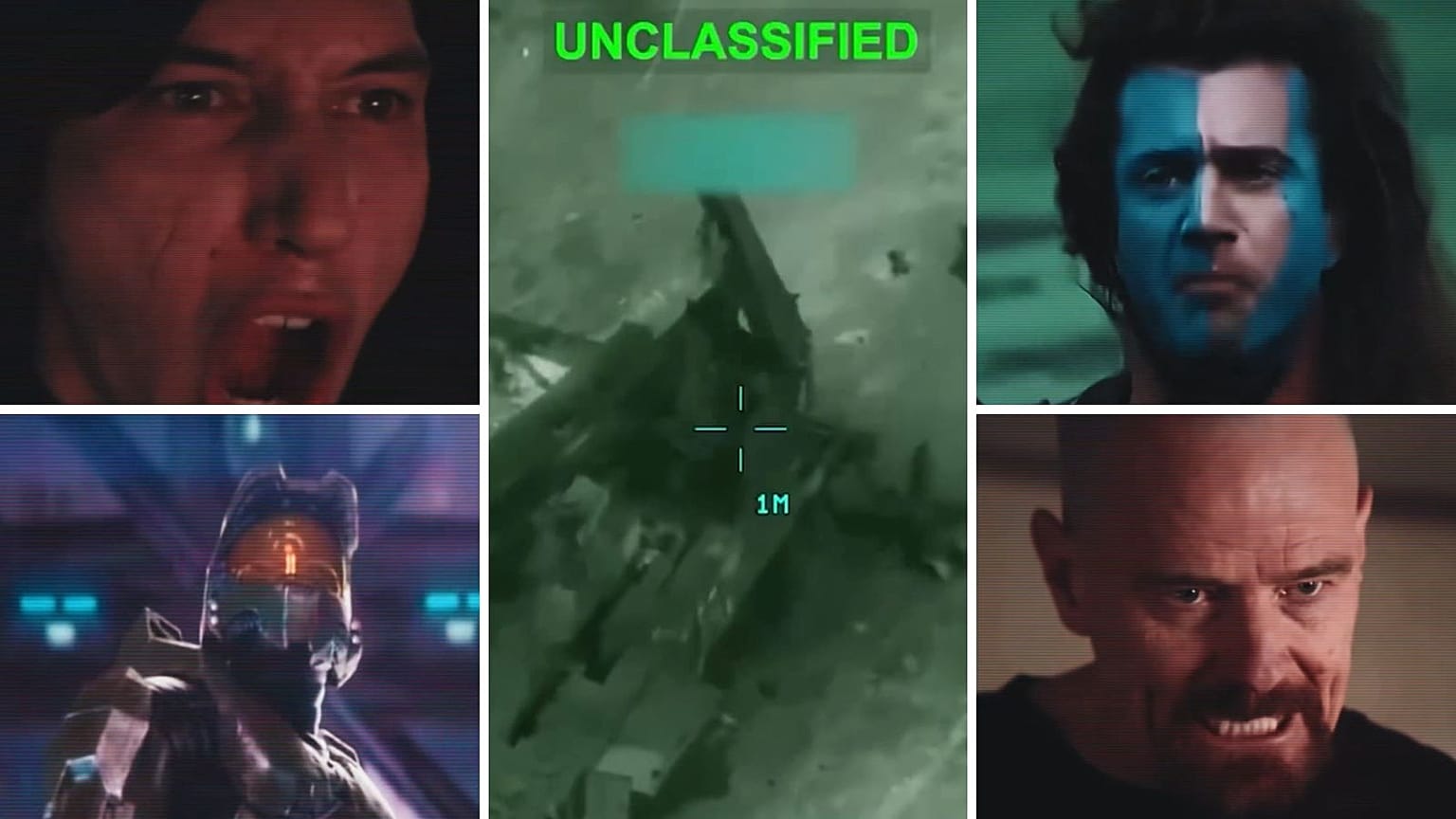
The White House has drafted Tom Cruise, Walter White and Sith Lords in a propaganda video which celebrates the Iran strikes. It shows once more to what extent the Trump administration’s trolling reveals a staggering lack of empathy.
“JUSTICE THE AMERICAN WAY,” reads a White House post accompanying a propaganda video that celebrates the US and Israel’s bombings of Iran.
The video is a supercut of drone footage spliced with extracts from action films and TV shows, featuring the likes of Robert Downey Jr’s Tony Stark from the Marvel films, Russell Crowe as Maximus in Gladiator, Tom Cruise in Top Gun: Maverick, Adam Driver as Kylo Ren in the Star Wars franchise and Bryan Cranston as Walter White in Breaking Bad.
Also featured are shots from Braveheart, John Wick, Superman, Deadpool and Halo.
Check it out below:
One of the clips is an extract from the comedy Tropic Thunder, directed by and starring Ben Stiller.
The actor has responded to the White House mash-up, writing: “Hey White House, please remove the Tropic Thunder clip. We never gave you permission and have no interest in being a part of your propaganda machine. War is not a movie.”
This is not the first time that Donald Trump and his administration have co-opted Hollywood clips and references, but this testosterone-fuelled video is a whole new low.
It has been widely mocked online, with many calling out the clip as ‘slopaganda’ (a conflation of ‘slop’ and ‘propaganda’) and accusing the Trump administration of behaving like immature teenagers - the biggest of all being "Secretary of War" Pete Hegseth, who cameos in the video.
It’s worth pointing out that the White House clip features vocal Trump critics (Downey Jr. actively campaigned for Kamala Harris, Bryan Cranston has been outspoken in his criticism of Trump); morally bankrupt characters (Walter White, Saul Goodman, Kylo Ren); films which satirise war and the American Dream rather than glorify it (Tropic Thunder, Breaking Bad); narratives which center on defying imperialism (William Wallace was fighting against an invading foreign army and resisting imperial occupation); and the death of irony, as many of the stars being used to trumpet the “American way” are not American (Crowe and Mel Gibson are from New Zealand and Australia, while Keanu Reeves is Canadian).
Beyond plummeting maturity levels and the irony of misusing culture touchstones – revealing once more a dearth of self-awareness and cultural literacy – there is an unabashed crassness to this video that is hard to overlook.
While the Trump administration may consider the video another way of “trolling” or “rage-baiting” its opponents, it only highlights a cruel lack of empathy towards the victims of war. Preliminary figures from the Iranian National Health, defence and interior ministries state that more than 1,300 people have died in Iran, at least 13 in Israel, and a seventh US service member has been killed in Saudi Arabia.
Also, there have been calls for an independent investigation into the attack on Minab primary school which killed 165 young pupils, with United Nations experts denouncing the deadly bombing as “a grave assault on children”. Rights advocates have pointed to the school attack as evidence of potential war crimes being committed by Israel and the US in a war that legal experts say was launched in violation of the UN Charter.
Missiles, Memes, and Masculinity: When the
White House Turns War Into Entertainment
Consider what’s missing from the videos: no civilians running from falling bombs. No grieving families. No returning veterans struggling with trauma.
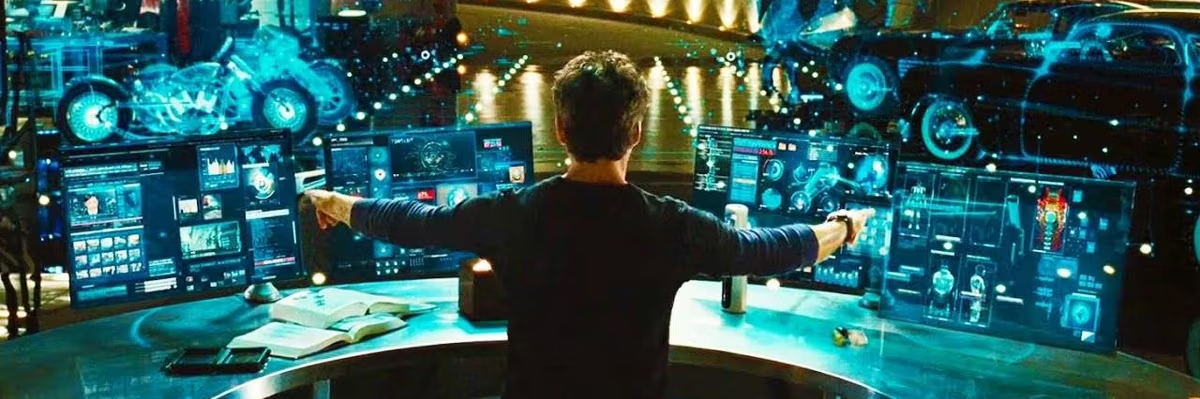
A video released by the White House that included clips from Hollywood action movies like Iron Man, Top Gun, and others was immediately mocked for reflecting the militaristic fantasies of teenage boys.
(Photo: Marvel Studios/Screengrab via WhiteHouse.gov)
Rob Okun
Mar 09, 2026
A week into Trump’s illegal war against Iran, the White House released a 42-second video on X, featuring movie scenes spliced with real military footage of strikes in Iran, promising “justice, the American way.” Rather than sober statements about national security or the grim human realities of war, the March 5 video resembled a movie trailer.
The clips stitched together real footage of missile strikes with pop-culture heroes: Russell Crowe in Gladiator, Tom Cruise in Top Gun: Maverick, Robert Downey Jr.'s Iron Man, Keanu Reeves’ relentless assassin in the John Wick films. Even SpongeBob SquarePants made an appearance. The video was immediately mocked for reflecting the militaristic fantasies of teenage boys (see Hegseth, Pete), more than that of the US starting a war.
The editing followed a familiar formula: a heroic movie quote, a dramatic cut to real explosions, then a video-game style victory sound. War, apparently, has become content. Actor Ben Stiller publicly demanded the removal of a Tropic Thunder clip, used without permission, stating, “War is not a movie.”
When political leaders celebrate military violence using the imagery of hypermasculine heroes, they reinforce those expectations rather than challenge them. What’s the message for our sons and grandsons?
The controversy over these videos isn’t only about taste or messaging. It’s about something deeper: the way American political culture still equates masculinity with domination and violence. When leaders celebrate military strikes using action-movie heroes and gaming tropes, they reinforce one of the oldest myths about manhood—that men’s strength is proven by crushing enemies.
Criticism of the videos continues for trivializing violence. Coverage from Reuters described them as part of a broader “meme war,” blending Hollywood imagery and gaming culture with real military action. But the controversy isn’t only about tone. It’s about something deeper: the way American culture still links masculinity with domination and force.
For generations, boys have been raised on stories where one’s manhood is proven through violence. Movies, video games, and political rhetoric repeat the same narrative: the male hero defeats the enemy through superior power. Beyond the troubling optics lies a deeper cultural question: What do these videos reveal about the way masculinity is still defined in 21st century America?
In this script, restraint looks weak. Empathy looks soft. Diplomacy looks naïve. Real men strike back.
Really!? A quarter of the way through the century, the slow, steady gains of an international movement to redefine masculinity still remains beneath the radar.
The White House videos used Hollywood mythology to bolster its geopolitical messaging. Consider the imagery: Maximus in Gladiator embodies righteous vengeance. Maverick in Top Gun represents fearless individualism. Tony Stark’s Iron Man combines technological power with swaggering bravado. The assassin played by Keanu Reeves in John Wick eliminates enemies with relentless efficiency.
Psychologist Mary L. Trump—Donald Trump’s niece—has written about how fragile masculinity often masks deep insecurity. In her book Too Much and Never Enough, she describes a family culture in which vulnerability was treated as weakness and domination became the only acceptable form of strength. That dynamic doesn’t stay confined to one family. It echoes through political culture.
When leaders, almost always white and male, celebrate explosions with movie quotes and gaming sound effects, they reinforce a version of masculinity that sees empathy as weakness and violence as proof of strength.
Such a cultural script carries real consequences. The overwhelming majority of violence worldwide—from mass shootings to domestic abuse to war—is committed by men. Researchers who study masculinity point to rigid expectations that equate manhood with dominance and emotional suppression.
When political leaders celebrate military violence using the imagery of hypermasculine heroes, they reinforce those expectations rather than challenge them. What’s the message for our sons and grandsons?
Consider what’s missing from the videos: no civilians running from falling bombs. No grieving families. No returning veterans struggling with trauma. War is no longer presented as solemn or ethically complex; it is packaged like a video game. If a podcaster promoted that, we’d be outraged. That our government is doing so demonstrates just how morally bankrupt the Trump administration is.
War appears not as tragedy, but as spectacle.
Across the country—and around the world—men are challenging the old patriarchal script. They are often choosing caregiving over breadwinning, confronting sexism rather than ignoring it, and working to prevent violence in their communities.
Their courage doesn’t appear in action-movie montages, yet it may be far more important. Because the real challenge facing our society isn’t simply defeating enemies abroad; it’s transforming manhood at home.
If we want a safer, more humane world, boys must learn that real courage isn’t measured by explosions or victory screens. It’s measured by the ability to protect life, show empathy, and reject violence—even in a culture that socializes you to believe violence is what makes you a man.
Our work is licensed under Creative Commons (CC BY-NC-ND 3.0). Feel free to republish and share widely.
Rob Okun
Rob Okun is editor-publisher of Voice Male, a magazine that’s been chronicling the antisexist men’s movement for 30 years.
Full Bio >
But who needs to worry about charters and international law when you can edit together a compassionless clip of your favourite Hollywood action movies, thereby transforming deadly conflict into bite-sized mass entertainment?

No comments:
Post a Comment