Issued on 09/03/2026 - FRANCE24
PLAY 06:43 min

A struggle to control artificial intelligence is playing out just as the United States increasingly deploys the technology in conflicts from Venezuela to Iran.
In its interventions in Venezuela and Iran, the United States military has reportedly used Anthropic's Claude chatbot to analyse battlefield data. At the same time, a monumental argument has broken out over the future capabilities of the game-changing technology.
Donald Trump's administration has ripped up its partnership with Anthropic and banned defence contractors from using Claude, after Anthropic insisted it should not be used for fully autonomous weapons or for mass surveillance of US citizens. These are not current uses, but the Pentagon notably sees ruling them out as an obstacle to keeping up with China.
For Samuel Hammond, Chief Economist at the Foundation for American Innovation, the ban is counterproductive.
"Designating Anthropic a supply chain risk is usually reserved for adversaries," he said, "for Chinese companies seeking to attack our systems".
It's the first time such a sanction has ever been applied to an American company. And now, the Trump administration has drafted strict rules for AI companies to obey in future government contracts, according to the Financial Times.
Hammond argues that Anthropic's market success contradicts the depiction of the company as radical "leftwing nut jobs" by President Trump.
"There's misinformation going on within the Department of Defense, within elements of the White House that believe Anthropic is a very left-wing company with extreme views," said Hammond, "When, in fact, they are currently the number one download on the App Store."
Anthropic has threatened to sue the Pentagon, while also trying to contain the fallout and defend its values.
When asked whether right-wing libertarian think tanks such as his had helped boost support for Trump, paving the way for him to wield power in this way, Hammond said, "This feels like a betrayal, both of their stated mission [in AI policy] and of broad libertarian values. It's not a libertarian value to seek to destroy a particular company."
"Who is the ultimate arbiter of how these tools are used? ... This is a longer-term process that we're going to have to work out through the democratic process."
Watch this week's Tech 24 for more on what happens when a power-hungry government is confronted with the possibility that someone else might want to call the shots on the most useful and promising technology of the age.
BY: Peter O'Brien
Anthropic takes Trump administration to court over Pentagon row
By AFP
March 9, 2026

The Pentagon took the unprcedented action of blacklisting Anthropic over its refusal to give unlimited control of its AI technology - Copyright AFP Brendan SMIALOWSKI
Anthropic filed suit Monday against the Trump administration, alleging the US government retaliated against the AI company for refusing to let its Claude AI model be used for autonomous lethal warfare and mass surveillance of Americans.
In the 48-page complaint, filed in federal court in San Francisco, Anthropic seeks to have its designation as a national security supply-chain risk declared unlawful and blocked.
In its lawsuit, Anthropic said it was founded on the belief that its AI should be “used in a way that maximizes positive outcomes for humanity” and should “be the safest and the most responsible.”
“Anthropic brings this suit because the federal government has retaliated against it for expressing that principle,” the lawsuit says.
Anthropic is the first US company ever to have been publicly punished with such a designation, a label typically reserved for organizations from foreign adversary countries, such as Chinese tech giant Huawei.
The label not only blocks use of the company’s technology by the Pentagon, but also requires all defense vendors and contractors to certify that they do not use Anthropic’s models in their work with the department.
“The consequences of this case are enormous,” the lawsuit states, with the government “seeking to destroy the economic value created by one of the world’s fastest-growing private companies.”
The suit names more than a dozen federal agencies and cabinet officials as defendants.
The dispute erupted after Anthropic infuriated Pentagon chief Pete Hegseth by insisting its technology should not be used for mass surveillance or fully autonomous weapons systems.
President Donald Trump subsequently ordered every federal agency to cease all use of Anthropic’s technology.
Hours later, Hegseth designated Anthropic a “Supply-Chain Risk to National Security” and ordered that no military contractor, supplier or partner “may conduct any commercial activity with Anthropic,” while allowing a six-month transition period for the Pentagon itself.
The row erupted days before the US military strike on Iran. Claude is the Pentagon’s most widely deployed frontier AI model and the only such model currently operating on the Defense Department’s classified systems.
In its lawsuit, Anthropic argues the actions taken against it violate the First Amendment by punishing the company for protected speech on AI safety policy, exceed the Pentagon’s statutory authority, and deprive it of due process under the Fifth Amendment.
“The Constitution does not allow the government to wield its enormous power to punish a company for its protected speech,” the complaint states.
Founded in 2021 by siblings Dario and Daniela Amodei, both former staffers at ChatGPT-maker OpenAI, Anthropic has positioned itself as a safety-focused alternative in the AI race.
By AFP
March 9, 2026
The Pentagon took the unprcedented action of blacklisting Anthropic over its refusal to give unlimited control of its AI technology - Copyright AFP Brendan SMIALOWSKI
Anthropic filed suit Monday against the Trump administration, alleging the US government retaliated against the AI company for refusing to let its Claude AI model be used for autonomous lethal warfare and mass surveillance of Americans.
In the 48-page complaint, filed in federal court in San Francisco, Anthropic seeks to have its designation as a national security supply-chain risk declared unlawful and blocked.
In its lawsuit, Anthropic said it was founded on the belief that its AI should be “used in a way that maximizes positive outcomes for humanity” and should “be the safest and the most responsible.”
“Anthropic brings this suit because the federal government has retaliated against it for expressing that principle,” the lawsuit says.
Anthropic is the first US company ever to have been publicly punished with such a designation, a label typically reserved for organizations from foreign adversary countries, such as Chinese tech giant Huawei.
The label not only blocks use of the company’s technology by the Pentagon, but also requires all defense vendors and contractors to certify that they do not use Anthropic’s models in their work with the department.
“The consequences of this case are enormous,” the lawsuit states, with the government “seeking to destroy the economic value created by one of the world’s fastest-growing private companies.”
The suit names more than a dozen federal agencies and cabinet officials as defendants.
The dispute erupted after Anthropic infuriated Pentagon chief Pete Hegseth by insisting its technology should not be used for mass surveillance or fully autonomous weapons systems.
President Donald Trump subsequently ordered every federal agency to cease all use of Anthropic’s technology.
Hours later, Hegseth designated Anthropic a “Supply-Chain Risk to National Security” and ordered that no military contractor, supplier or partner “may conduct any commercial activity with Anthropic,” while allowing a six-month transition period for the Pentagon itself.
The row erupted days before the US military strike on Iran. Claude is the Pentagon’s most widely deployed frontier AI model and the only such model currently operating on the Defense Department’s classified systems.
In its lawsuit, Anthropic argues the actions taken against it violate the First Amendment by punishing the company for protected speech on AI safety policy, exceed the Pentagon’s statutory authority, and deprive it of due process under the Fifth Amendment.
“The Constitution does not allow the government to wield its enormous power to punish a company for its protected speech,” the complaint states.
Founded in 2021 by siblings Dario and Daniela Amodei, both former staffers at ChatGPT-maker OpenAI, Anthropic has positioned itself as a safety-focused alternative in the AI race.
Trump admin sued as company claims 'extreme punishment' for defying president
Alexander Willis
March 9, 2026
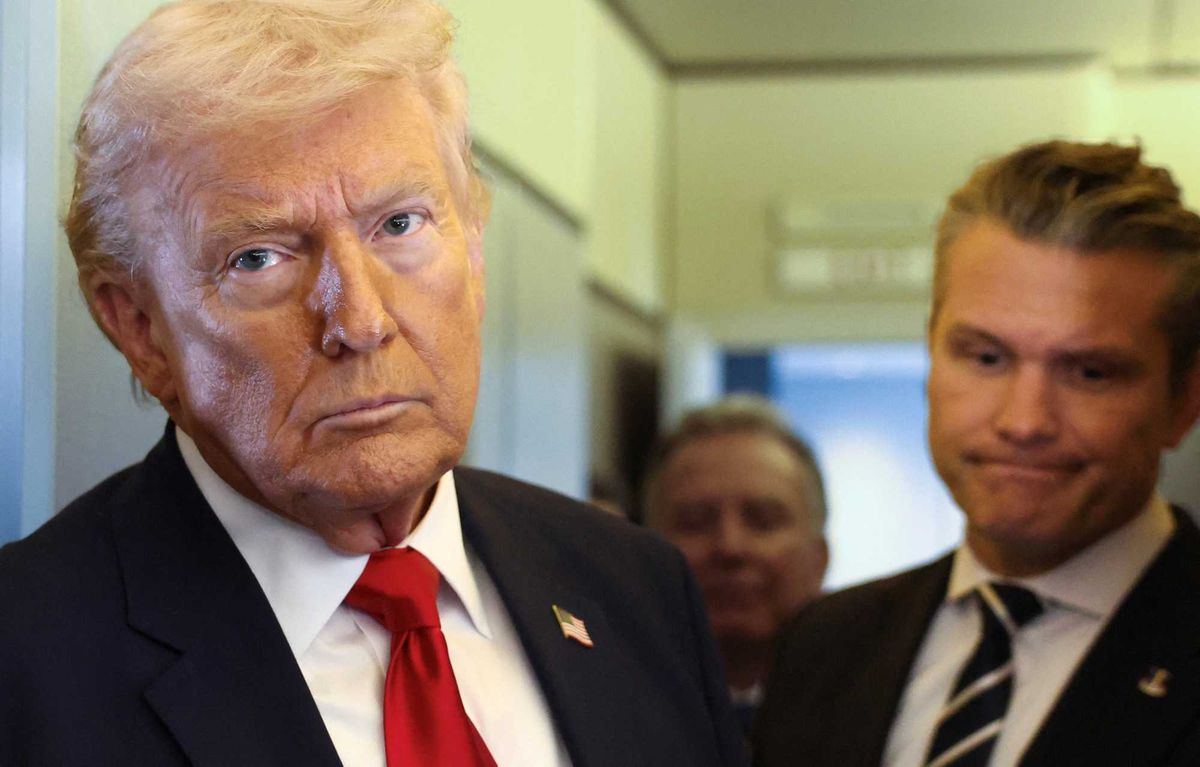
U.S. President Donald Trump, with Secretary of Defense Pete Hegseth at his side, looks on as he speaks to reporters aboard Air Force One on a flight from Dover, Delaware, to Miami, Florida, U.S., March 7, 2026. REUTERS/Kevin Lamarque TPX IMAGES OF THE DAY
The Trump administration was hit with a major lawsuit on Monday by AI developer Anthropic after it enacted an “extreme punishment” on the company over its refusal to allow its AI system to be used for mass surveillance and autonomous weapons, NBC News reported.
“This is a necessary step to protect our business, our customers, and our partners,” an Anthropic spokesperson told NBC News. “We will continue to pursue every path toward resolution, including dialogue with the government.”
Last month, Axios reported that Defense Secretary Pete Hegseth was getting “close” to cutting ties with Anthropic and classifying the company as a supply chain risk, a classification that would bar any business working with the federal government from maintaining ties with Anthropic.
The issue, Axios reported, was Anthropic's insistence that its AI technology wasn’t “used to spy on Americans en masse, or to develop weapons that fire with no human involvement.”
That insistence was apparently too much for the Trump administration, which ultimately cut ties with the company earlier this month and made good on its pledge to classify the company as a supply chain risk.
Now, Anthropic is hitting back with a lawsuit over what it described as the Trump administration’s “unlawful campaign of retaliation.”
The lawsuit, filed in California, accuses the Trump administration of violating its First Amendment rights, Politico reported, and of acting unlawfully in designating it as a supply chain risk.
Alexander Willis
March 9, 2026
RAW STORY
U.S. President Donald Trump, with Secretary of Defense Pete Hegseth at his side, looks on as he speaks to reporters aboard Air Force One on a flight from Dover, Delaware, to Miami, Florida, U.S., March 7, 2026. REUTERS/Kevin Lamarque TPX IMAGES OF THE DAY
The Trump administration was hit with a major lawsuit on Monday by AI developer Anthropic after it enacted an “extreme punishment” on the company over its refusal to allow its AI system to be used for mass surveillance and autonomous weapons, NBC News reported.
“This is a necessary step to protect our business, our customers, and our partners,” an Anthropic spokesperson told NBC News. “We will continue to pursue every path toward resolution, including dialogue with the government.”
Last month, Axios reported that Defense Secretary Pete Hegseth was getting “close” to cutting ties with Anthropic and classifying the company as a supply chain risk, a classification that would bar any business working with the federal government from maintaining ties with Anthropic.
The issue, Axios reported, was Anthropic's insistence that its AI technology wasn’t “used to spy on Americans en masse, or to develop weapons that fire with no human involvement.”
That insistence was apparently too much for the Trump administration, which ultimately cut ties with the company earlier this month and made good on its pledge to classify the company as a supply chain risk.
Now, Anthropic is hitting back with a lawsuit over what it described as the Trump administration’s “unlawful campaign of retaliation.”
The lawsuit, filed in California, accuses the Trump administration of violating its First Amendment rights, Politico reported, and of acting unlawfully in designating it as a supply chain risk.

No comments:
Post a Comment