Ewan Gleadow
March 9, 2026
RAW STORY
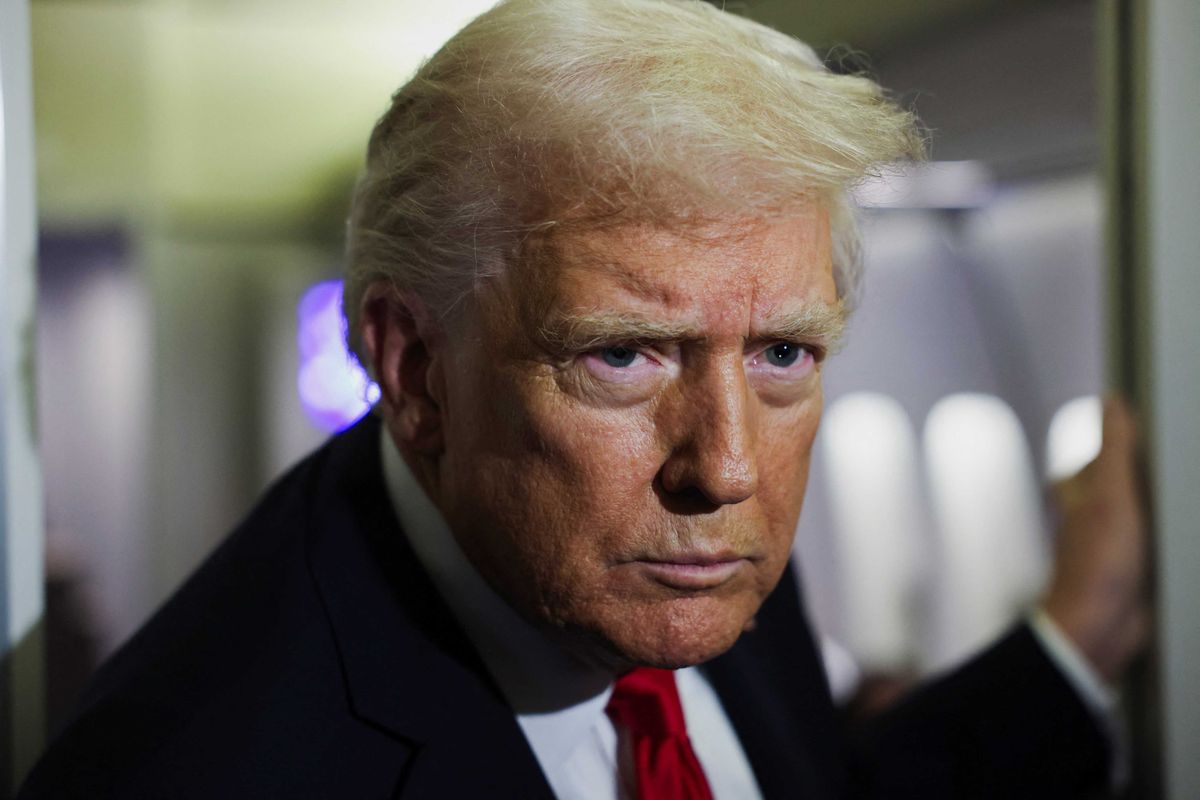
U.S. President Donald Trump looks on aboard Air Force One during travel to Palm Beach, Florida, from Joint Base Andrews, Maryland, U.S., November 25, 2025.
U.S. President Donald Trump looks on aboard Air Force One during travel to Palm Beach, Florida, from Joint Base Andrews, Maryland, U.S., November 25, 2025.
REUTERS/Anna Rose Layden
A pitch from Donald Trump to present himself as the strongman of the Middle East could destabilize the world, a political analyst has warned.
Though the U.S. joined Israel with a series of strikes on Iran, longer-term changes in the Middle East could prove troublesome for other world leaders not involved in the conflict. CNN analysts Stephen Collinson, Kylie Atwood, and Tal Shalev, suggest the strong-arming Trump has used to pull the U.S. into war with the Middle East could affect the wider world, irrespective of success.
The trio wrote, "Relentless US and Israeli air attacks — in a military playbook that feels far more planned out than the political one — stand a strong chance of neutering Tehran’s power to threaten its neighbors.
A pitch from Donald Trump to present himself as the strongman of the Middle East could destabilize the world, a political analyst has warned.
Though the U.S. joined Israel with a series of strikes on Iran, longer-term changes in the Middle East could prove troublesome for other world leaders not involved in the conflict. CNN analysts Stephen Collinson, Kylie Atwood, and Tal Shalev, suggest the strong-arming Trump has used to pull the U.S. into war with the Middle East could affect the wider world, irrespective of success.
The trio wrote, "Relentless US and Israeli air attacks — in a military playbook that feels far more planned out than the political one — stand a strong chance of neutering Tehran’s power to threaten its neighbors.
"This would benefit the wider Middle East, bill Trump as a regional strongman, deliver Israel from an existential threat, and improve U.S. national security after a near 50-year feud with the Islamic Republic.
"But without full regime change, Iranians might still pay a heavy price if crackdowns rather than counter-revolution follow. And if Trump’s war shatters the Iranian state and sparks civil war, a refugee crisis or grave economic consequence could destabilize the world."
Further trouble for European nations could be brewing too, according to Julien Barnes-Dacey, program director for the Middle East at the European Council on Foreign Relations, who believes most countries do not know what to do about the ongoing situation.
"They are, globally now, responding to the daily whims of a U.S. president who is causing immense disruption," Barnes-Dacey said. "They are caught between a rock and a hard place.
"On the one hand, they want to cling on to some sense of international law, or the rules-based order, and then on the other hand, they are desperately trying to keep themselves in Trump’s good books."
Some nations now find themselves on the opposing end of what Trump wants and may incur the wrath of the president. Sophia Gaston, a senior research fellow at the Center for Statecraft and National Security in the Department of War Studies at King’s College London, believes Trump wants a demonstration of loyalty from the UK.
She said, "The more a country like Britain invests in its sovereign strength, prosperity and capability, the more attractive it also then becomes for the United States as a partner, but also the more it can defend its own interests against the turbulence of such an alliance."
"But without full regime change, Iranians might still pay a heavy price if crackdowns rather than counter-revolution follow. And if Trump’s war shatters the Iranian state and sparks civil war, a refugee crisis or grave economic consequence could destabilize the world."
Further trouble for European nations could be brewing too, according to Julien Barnes-Dacey, program director for the Middle East at the European Council on Foreign Relations, who believes most countries do not know what to do about the ongoing situation.
"They are, globally now, responding to the daily whims of a U.S. president who is causing immense disruption," Barnes-Dacey said. "They are caught between a rock and a hard place.
"On the one hand, they want to cling on to some sense of international law, or the rules-based order, and then on the other hand, they are desperately trying to keep themselves in Trump’s good books."
Some nations now find themselves on the opposing end of what Trump wants and may incur the wrath of the president. Sophia Gaston, a senior research fellow at the Center for Statecraft and National Security in the Department of War Studies at King’s College London, believes Trump wants a demonstration of loyalty from the UK.
She said, "The more a country like Britain invests in its sovereign strength, prosperity and capability, the more attractive it also then becomes for the United States as a partner, but also the more it can defend its own interests against the turbulence of such an alliance."
‘The Situation Is Scary’: Global Economic Chaos as Trump’s Iran War Sends Markets Diving
“To me, it was not just the worst-case scenario,” said one economic analyst. “It was an unthinkable scenario.”
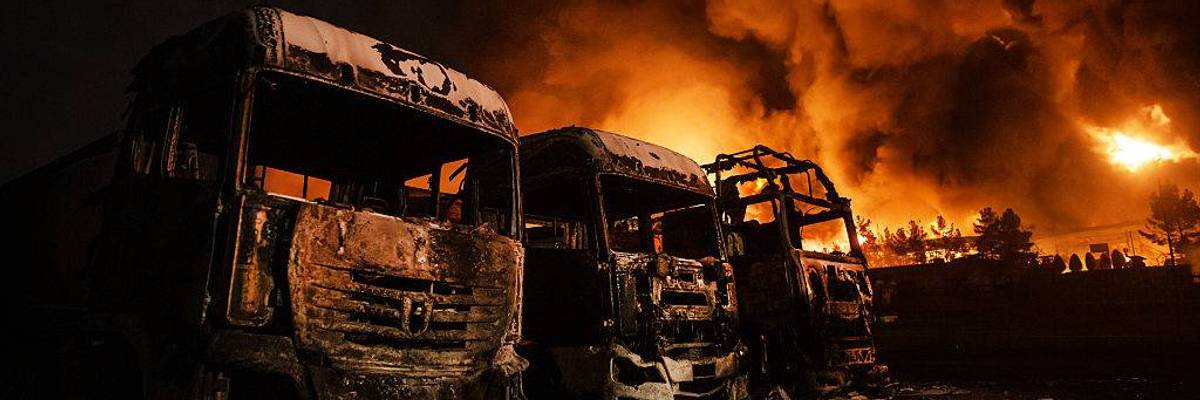
Fire breaks out at the Shahran oil depot after US and Israeli attacks, leaving numerous fuel tankers and vehicles in the area unusable in Tehran, Iran on March 8, 2026.
(Photo by Hassan Ghaedi/Anadolu via Getty Images)
Brad Reed
Mar 09, 2026
COMMON DREAMS
President Donald Trump’s unprovoked and unconstitutional war against Iran is sending shockwaves across the global economy in the form of skyrocketing oil prices and diving financial markets.
The prices of both Brent crude oil and WTI crude oil futures on Monday surged past $100 per barrel, as countries across the Middle East announced production cuts in the wake of chaos and destruction caused by the Iran war.
‘People Are Loving What’s Happening,’ Trump Claims While Massacring Iranian Children as US Oil Prices and Unemployment Spike
The impact of the price surge on the US stock market was immediate, as the Dow Jones Industrial Average opened Monday trading down by more than 600 points, while the Nasdaq dropped by 300 points.
According to a Monday report from the Wall Street Journal, both Iraq and Kuwait have announced oil production curbs because they have been unable to ship their supply through the Strait of Hormuz and have thus run out of space to store excess petroleum.
JPMorgan Chase analyst Natasha Kaneva noted to the Journal that this is the first time in recorded history that the Strait of Hormuz has ever been completely closed off for shipping, and warned the economic consequences would be severe.
“To me, it was not just the worst-case scenario,” Kaneva said of the strait’s closing. “It was an unthinkable scenario.”
The Journal wrote that Trump’s decision to launch a war with Iran has already sparked “the most severe energy crisis since the 1970s,” which is now “threatening the global economy.”
Petroleum industry analyst Patrick De Haan wrote in a Monday analysis that US drivers should expect to feel the impact of this oil shock in the coming days.
“Gasoline prices in many states could climb another 20 to 50 cents per gallon this week, with price-cycling markets potentially seeing increases as early as today,” De Haan projected. “Diesel may rise even more sharply, with increases of 35 to 75 cents per gallon possible as global distillate markets react.”
In a Monday analysis posted on his Substack page, Nobel Prize-winning economist Paul Krugman dove into the logistics of stopping and restarting oil production, and argued that the impact of the strait’s closure will grow significantly as time goes on.
“As the Strait remains closed, producers are shutting down, and this isn’t like turning off a tap that can be quickly restarted,” Krugman explained. “There’s apparently a real nonlinearity here: a two-week closure of the Strait has much more than twice the adverse impact on global oil supply as a one-week closure. If this goes on for multiple weeks... oil prices, which retreated slightly off their highs early this morning, could go much higher.”
Krugman said that the shock was not yet bad enough to make an economic crisis inevitable because the US is much less dependent on oil than it was in the 1970s.
Nonetheless, Krugman cautioned, “the situation is scary.”
Punchbowl News reported on Monday that the politics of the Iran war “have to worry” incumbent Republicans who were already in real danger of losing their majority in the US House of Representatives even before Trump launched an illegal war.
“With the Strait of Hormuz closed, oil prices have soared to more than $100 per barrel (from just under $70 per barrel 10 days ago),” wrote Punchbowl News. “There’s been a huge spike in gas prices nationally.”
The report added that Trump has not been helping his party by expressing indifference bordering on hostility to Americans’ concerns about how his war will impact their personal finances.
“Short term oil prices, which will drop rapidly when the destruction of the Iran nuclear threat is over, is a very small price to pay for U.S.A., and World, Safety and Peace,” Trump wrote in a Sunday Truth Social post. “ONLY FOOLS WOULD THINK DIFFERENTLY!”

No comments:
Post a Comment