Why did the US attack Iran? How long will the war last? What will the implications be? Don’t ask President Donald Trump!
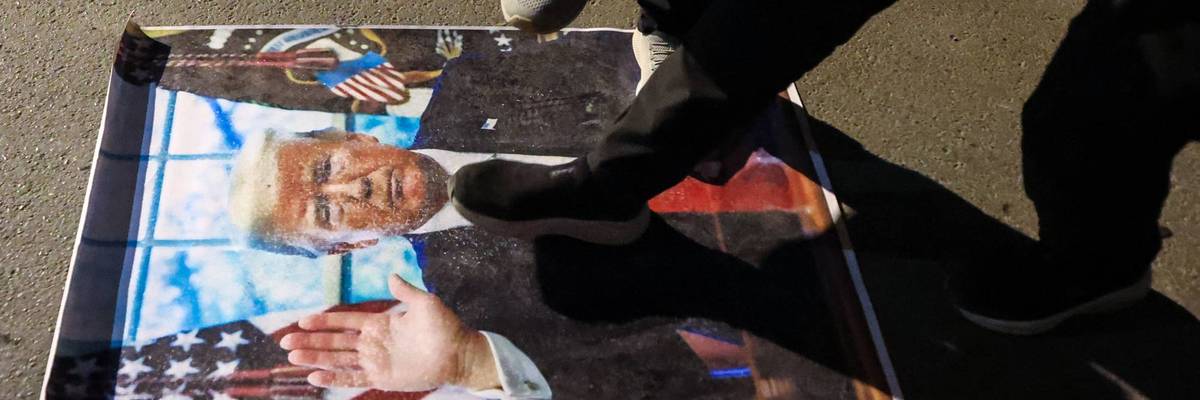
Demonstrators trample on a portrait of US President Donald Trump during a protest against the attacks by Israel and the US on Iran, as they march towards the US embassy in Baghdad on March 5, 2026.
(Photo by Ahmad Al-Rubaye / AFP via Getty Images)
Steven Harper
Mar 09, 2026
Common Dreams
Minimally competent leaders would have considered at least five obvious questions before launching the nation into war. President Donald Trump considered none of them.
No. 1: What’s the Objective?
It’s not surprising that more than half of all Americans oppose Trump’s War. From the outset, his administration has offered numerous and contradictory justifications for it.
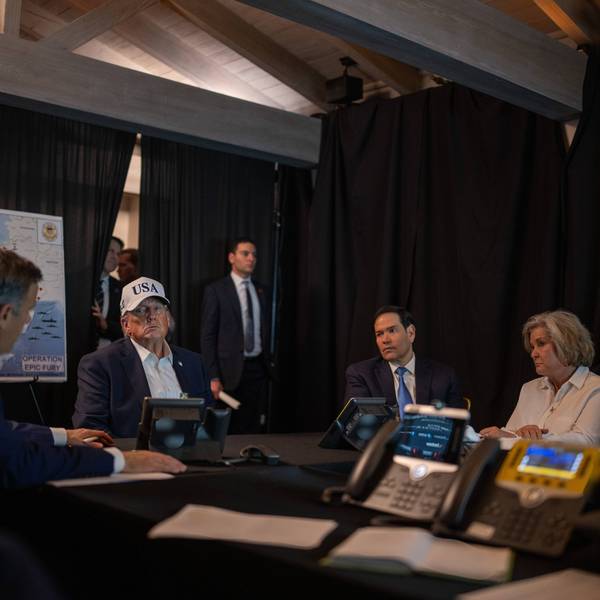
Experts Pillory Trump Case for War on Iran: ‘Flimsiest Excuse for Initiating a Major Attack’ in Decades
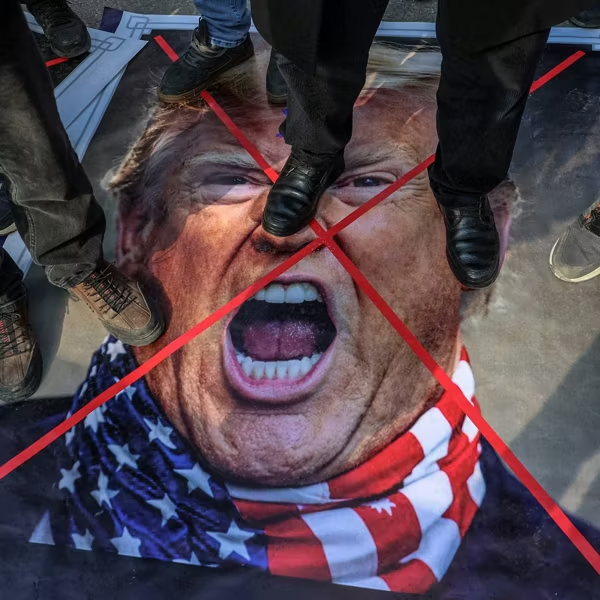
Call Grows to Impeach Trump, ‘The Most Dangerous Man on the Planet’
February 28:
Trump cited 47 years of grievances, a desire to destroy Iran’s missiles, and a message that the Iranian people should “seize the moment” because now was their chance to “be brave, be bold, be heroic, and take back your country.”
But he also said that the attack was a campaign to “eliminate the imminent nuclear threat,” although Trump had boasted in June that the United States had already accomplished that goal.
The next day, Pentagon officials told congressional staff members that no intelligence supported the notion that Iran was planning to attack the US first.
The same day, Trump told the Washington Post, “All I want is freedom for the people.”
United Nations Ambassador Mike Walz claimed to the UN Security Council that the US was invoking the right of self-defense in response to Iran’s imminent threat.
But the next day, Pentagon officials told congressional staff members that no intelligence supported the notion that Iran was planning to attack the US first.
March 2:
Secretary of Defense Pete Hegseth told the press that the objective was retaliation for decades of Iranian behavior, destruction of their missiles, and providing an opportunity for Iranians to “take advantage of this incredible opportunity.”
But only hours later, Secretary of State Marco Rubio offered a new justification for the war: Israel was going to attack Iran and, if that happened, Iran would then attack US interests in the region. He made it sound as if Israel’s Prime Minister Benjamin Netanyahu had maneuvered Trump into a corner.
The next day, Trump contradicted Rubio, saying: “It was my opinion that they [Iran] were going to attack first. They were going to attack if we didn’t do it.” Rebutting any impression that Netanyahu had manipulated him, Trump added, “If anything, I might have forced Israel’s hand.”
Rubio complained that his earlier remarks had been taken out of context and the operation “had to happen anyway.”
March 6:
Trump posted on social media that only “unconditional surrender” would end the war.
No. 2: How Long Will It Last?
March 1: Trump told the New York Times that the operation could take “four to five weeks.” He didn’t mention the Pentagon’s concerns that the war could further deplete reserves that military strategists have said are critical for scenarios such as a conflict over Taiwan or Russian incursions into Europe.
March 2: Trump said that the war could go on longer than four to five weeks.
March 4: Hegseth said that the Iran war is “far from over” and has “only just begun.”
March 6: Trump told the New York Post that he hadn’t ruled out putting “boots on the ground, if necessary.”
No. 3: Who Will Lead Iran After US Strikes Kill Its Supreme Leader?
March 1: Trump told the New York Times that he had “three very good choices” for who could lead Iran.
March 3: Trump admitted: “Most of the people we had in mind are dead… Now we have another group. They may be dead also, based on reports. So I guess you have a third wave coming. Pretty soon we’re not going to know anybody.” Asked about the worst-case scenario for the war, Trump said, “I guess the worst case would be we do this and somebody takes over who’s as bad as the previous person.”
More than a dozen Mideast countries are now embroiled in Trump’s war, including Israel, Saudi Arabia, UAE, Qatar, Kuwait, Bahrain, Oman, Jordan, Iraq, Syria, Lebanon, and Yemen.
March 5: Trump told Axios, “I have to be involved in the appointment [of Iran Supreme Leader Ayatollah Khamenei’s successor], like with Delcy in Venezuela”—referring to Vice President Delcy Rodriguez, who remained in charge of President Nicolás Maduro’s corrupt and repressive regime after the US abducted him. Trump said that Khamenei’s son—rumored to be a leading candidate as successor—is “unacceptable to me” and “a light weight.”
The same day, he told NBC News, “We have some people who I think would do a good job.”
March 7: The Washington Post reported that a classified National Intelligence Committee study issued prior to the war found that even if the US launched a large-scale assault on Iran, it likely would not oust the Islamic republic’s entrenched military and clerical establishment.
March 9: Iran chose Khamenei’s son, a cleric expected to continue his father’s hard-line policies, as the country’s Supreme Leader.
No. 4: How Would a US-Iran War Affect the Mideast?
Before US bombs began to fall, thousands of American citizens were in the war zone. But ahead of the strikes, the State Department didn’t issue official alerts advising Americans that the risk of travel in the region had increased.
Yael Lempert, who helped organize the evacuation of Americans in Libya in 2011 observed, “It is stunning there were no orders for authorized departure for nonessential US government employees and family members in almost all the affected diplomatic missions in the region—nor public recommendations to American citizens to depart—until days into the war.”
After attacks and counterattacks closed airspace and airports throughout the region, on Wednesday, March 4—four days into the war—the State Department finally began evacuations by charter flight. The following day, the New York Times reported:
Until midweek, the State Department had mainly provided stranded travelers with basic information about security conditions and commercial travel options via a telephone hotline and text messages. Before Wednesday, desperate people calling the hotline got an automated message that said the US government could not help get them out of the region.
No. 5: Could the War Lead to Humanitarian, Economic, or Geopolitical Crises?
Only a week into the war, the UN humanitarian chief warned, “This is a moment of grave, grave peril.”
Iran is a country of 90 million people. US-Israel bombing has already displaced more than 100,000 of them.
Israel’s companion attack on Lebanon has displaced more than 300,000 residents.
Asked to rate his Iran war performance on a scale of one to 10, Trump gave himself a “15.”
More than a dozen Mideast countries are now embroiled in Trump’s war, including Israel, Saudi Arabia, UAE, Qatar, Kuwait, Bahrain, Oman, Jordan, Iraq, Syria, Lebanon, and Yemen.
The ripple effects span the globe as oil prices spike and Iran disrupts tanker traffic in the Strait of Hormuz—through which one-fifth of the world’s oil flows. During his state of the union message, Trump boasted that the price of gasoline was down to $2,00 per gallon in some states. Last week, the national average price in the US was $3.41 per gallon.
Ominously, on March 6 the Washington Post reported that Russia is providing intelligence assistance to the Iranian military attacking US targets. But Hegseth is “not concerned about that.”
Asked to rate his Iran war performance on a scale of one to 10, Trump gave himself a “15.”
Introspection rarely accompanies incompetence.
Our work is licensed under Creative Commons (CC BY-NC-ND 3.0). Feel free to republish and share widely.
Steven Harper
Steven J. Harper is an attorney, adjunct professor at Northwestern University Law School, and author of several books, including Crossing Hoffa -- A Teamster's Story and The Lawyer Bubble -- A Profession in Crisis. He has been a regular columnist for Moyers on Democracy, Dan Rather's News and Guts, and The American Lawyer. Follow him at https://thelawyerbubble.com.
Full Bio >
Minimally competent leaders would have considered at least five obvious questions before launching the nation into war. President Donald Trump considered none of them.
No. 1: What’s the Objective?
It’s not surprising that more than half of all Americans oppose Trump’s War. From the outset, his administration has offered numerous and contradictory justifications for it.
Experts Pillory Trump Case for War on Iran: ‘Flimsiest Excuse for Initiating a Major Attack’ in Decades
Call Grows to Impeach Trump, ‘The Most Dangerous Man on the Planet’
February 28:
Trump cited 47 years of grievances, a desire to destroy Iran’s missiles, and a message that the Iranian people should “seize the moment” because now was their chance to “be brave, be bold, be heroic, and take back your country.”
But he also said that the attack was a campaign to “eliminate the imminent nuclear threat,” although Trump had boasted in June that the United States had already accomplished that goal.
The next day, Pentagon officials told congressional staff members that no intelligence supported the notion that Iran was planning to attack the US first.
The same day, Trump told the Washington Post, “All I want is freedom for the people.”
United Nations Ambassador Mike Walz claimed to the UN Security Council that the US was invoking the right of self-defense in response to Iran’s imminent threat.
But the next day, Pentagon officials told congressional staff members that no intelligence supported the notion that Iran was planning to attack the US first.
March 2:
Secretary of Defense Pete Hegseth told the press that the objective was retaliation for decades of Iranian behavior, destruction of their missiles, and providing an opportunity for Iranians to “take advantage of this incredible opportunity.”
But only hours later, Secretary of State Marco Rubio offered a new justification for the war: Israel was going to attack Iran and, if that happened, Iran would then attack US interests in the region. He made it sound as if Israel’s Prime Minister Benjamin Netanyahu had maneuvered Trump into a corner.
The next day, Trump contradicted Rubio, saying: “It was my opinion that they [Iran] were going to attack first. They were going to attack if we didn’t do it.” Rebutting any impression that Netanyahu had manipulated him, Trump added, “If anything, I might have forced Israel’s hand.”
Rubio complained that his earlier remarks had been taken out of context and the operation “had to happen anyway.”
March 6:
Trump posted on social media that only “unconditional surrender” would end the war.
No. 2: How Long Will It Last?
March 1: Trump told the New York Times that the operation could take “four to five weeks.” He didn’t mention the Pentagon’s concerns that the war could further deplete reserves that military strategists have said are critical for scenarios such as a conflict over Taiwan or Russian incursions into Europe.
March 2: Trump said that the war could go on longer than four to five weeks.
March 4: Hegseth said that the Iran war is “far from over” and has “only just begun.”
March 6: Trump told the New York Post that he hadn’t ruled out putting “boots on the ground, if necessary.”
No. 3: Who Will Lead Iran After US Strikes Kill Its Supreme Leader?
March 1: Trump told the New York Times that he had “three very good choices” for who could lead Iran.
March 3: Trump admitted: “Most of the people we had in mind are dead… Now we have another group. They may be dead also, based on reports. So I guess you have a third wave coming. Pretty soon we’re not going to know anybody.” Asked about the worst-case scenario for the war, Trump said, “I guess the worst case would be we do this and somebody takes over who’s as bad as the previous person.”
More than a dozen Mideast countries are now embroiled in Trump’s war, including Israel, Saudi Arabia, UAE, Qatar, Kuwait, Bahrain, Oman, Jordan, Iraq, Syria, Lebanon, and Yemen.
March 5: Trump told Axios, “I have to be involved in the appointment [of Iran Supreme Leader Ayatollah Khamenei’s successor], like with Delcy in Venezuela”—referring to Vice President Delcy Rodriguez, who remained in charge of President Nicolás Maduro’s corrupt and repressive regime after the US abducted him. Trump said that Khamenei’s son—rumored to be a leading candidate as successor—is “unacceptable to me” and “a light weight.”
The same day, he told NBC News, “We have some people who I think would do a good job.”
March 7: The Washington Post reported that a classified National Intelligence Committee study issued prior to the war found that even if the US launched a large-scale assault on Iran, it likely would not oust the Islamic republic’s entrenched military and clerical establishment.
March 9: Iran chose Khamenei’s son, a cleric expected to continue his father’s hard-line policies, as the country’s Supreme Leader.
No. 4: How Would a US-Iran War Affect the Mideast?
Before US bombs began to fall, thousands of American citizens were in the war zone. But ahead of the strikes, the State Department didn’t issue official alerts advising Americans that the risk of travel in the region had increased.
Yael Lempert, who helped organize the evacuation of Americans in Libya in 2011 observed, “It is stunning there were no orders for authorized departure for nonessential US government employees and family members in almost all the affected diplomatic missions in the region—nor public recommendations to American citizens to depart—until days into the war.”
After attacks and counterattacks closed airspace and airports throughout the region, on Wednesday, March 4—four days into the war—the State Department finally began evacuations by charter flight. The following day, the New York Times reported:
Until midweek, the State Department had mainly provided stranded travelers with basic information about security conditions and commercial travel options via a telephone hotline and text messages. Before Wednesday, desperate people calling the hotline got an automated message that said the US government could not help get them out of the region.
No. 5: Could the War Lead to Humanitarian, Economic, or Geopolitical Crises?
Only a week into the war, the UN humanitarian chief warned, “This is a moment of grave, grave peril.”
Iran is a country of 90 million people. US-Israel bombing has already displaced more than 100,000 of them.
Israel’s companion attack on Lebanon has displaced more than 300,000 residents.
Asked to rate his Iran war performance on a scale of one to 10, Trump gave himself a “15.”
More than a dozen Mideast countries are now embroiled in Trump’s war, including Israel, Saudi Arabia, UAE, Qatar, Kuwait, Bahrain, Oman, Jordan, Iraq, Syria, Lebanon, and Yemen.
The ripple effects span the globe as oil prices spike and Iran disrupts tanker traffic in the Strait of Hormuz—through which one-fifth of the world’s oil flows. During his state of the union message, Trump boasted that the price of gasoline was down to $2,00 per gallon in some states. Last week, the national average price in the US was $3.41 per gallon.
Ominously, on March 6 the Washington Post reported that Russia is providing intelligence assistance to the Iranian military attacking US targets. But Hegseth is “not concerned about that.”
Asked to rate his Iran war performance on a scale of one to 10, Trump gave himself a “15.”
Introspection rarely accompanies incompetence.
Our work is licensed under Creative Commons (CC BY-NC-ND 3.0). Feel free to republish and share widely.
Steven Harper
Steven J. Harper is an attorney, adjunct professor at Northwestern University Law School, and author of several books, including Crossing Hoffa -- A Teamster's Story and The Lawyer Bubble -- A Profession in Crisis. He has been a regular columnist for Moyers on Democracy, Dan Rather's News and Guts, and The American Lawyer. Follow him at https://thelawyerbubble.com.
Full Bio >
The Cost of War: Iran’s Strategy to Make Trump Pay
Iran’s actions suggest a strategic framework designed to raise the cost of the conflict beyond what its adversaries may be willing to bear. Whether the strategy ultimately succeeds remains uncertain.
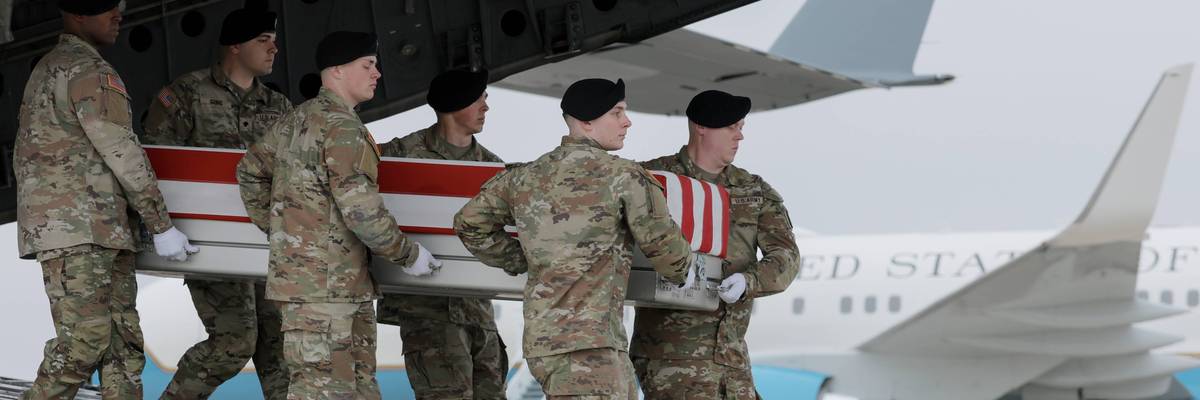
A US Army carry team moves a flag-draped transfer case containing the remains of Chief Warrant Officer 3 Robert M. Marzan at Dover Air Force Base March 7, 2026 in Dover, Delaware. Six soldiers from the 103rd Sustainment Command were killed in action by an Iranian drone strike March 1 in Port Shuaiba, Kuwait during Operation Epic Fury.
(Photo by Anna Moneymaker/Getty Images)
Iran’s actions suggest a strategic framework designed to raise the cost of the conflict beyond what its adversaries may be willing to bear. Whether the strategy ultimately succeeds remains uncertain.
A US Army carry team moves a flag-draped transfer case containing the remains of Chief Warrant Officer 3 Robert M. Marzan at Dover Air Force Base March 7, 2026 in Dover, Delaware. Six soldiers from the 103rd Sustainment Command were killed in action by an Iranian drone strike March 1 in Port Shuaiba, Kuwait during Operation Epic Fury.
(Photo by Anna Moneymaker/Getty Images)
Ramzy Baroud
Mar 09, 2026
Mar 09, 2026
Common Dreams
Iran is pursuing a multi-layered strategy—military, economic, political, and diplomatic—to raise the cost of war and prevent regime change.
Iran’s Strategy in the Current War
As the war on Iran continues to expand across multiple fronts, Tehran appears to be pursuing a complex strategy that combines military escalation, economic leverage, domestic mobilization, and diplomatic signaling.
Rather than relying on what Iranian officials once described as “strategic patience,” the current approach suggests that Iran is attempting to fundamentally reshape the battlefield by increasing the costs of the war for the United States, Israel, and any regional actors that choose to participate.
The strategy appears to rest on several interconnected pillars designed not only to respond to military attacks but also to prevent the broader objective that Iranian leaders believe lies behind the war: regime change.
Overwhelming the Battlefield
The most visible element of Iran’s strategy has been its attempt to expand the battlefield geographically and operationally.
Rather than focusing solely on Israeli territory, Iran has targeted a wide range of US and allied assets across the region. These include military bases, intelligence facilities, radar systems, and logistical infrastructure that support American operations.
The aim appears to be twofold.
First, Iranian strikes are intended to impose a form of “strategic blindness” on opposing forces by degrading radar systems, surveillance networks, and early-warning capabilities. Such attacks reduce the ability of the United States and Israel to monitor Iranian movements and respond effectively to missile launches or other military operations.
Second, by targeting US bases in multiple countries across the region, Iran is sending a clear message that the conflict will not remain geographically contained.
In practical terms, this means that any country hosting American military facilities risks becoming part of the battlefield.
Iranian officials have repeatedly emphasized that these strikes are directed at US military infrastructure rather than the sovereignty of host nations. Nevertheless, the message is unmistakable: if regional territory is used to launch attacks on Iran, that territory may also become a site of retaliation.
This approach reflects a major shift away from Iran’s previous policy of measured responses and limited escalation.
Instead, Tehran appears to be pursuing a strategy designed to overwhelm the enemy on multiple fronts simultaneously, raising the political and military cost of continuing the war.
Economic Warfare
Alongside its military operations, Iran is also leveraging one of the most powerful tools at its disposal: the geography of global energy supply.
The Strait of Hormuz—through which roughly a fifth of the world’s oil supply passes—has effectively become a war zone. Although Iran has not formally declared a blockade, the conditions created by the conflict have produced a functional shutdown of the waterway.
Missile exchanges, naval deployments, maritime attacks, and the growing threat environment have drastically reduced the willingness of commercial shipping companies to operate in the area. Insurance costs for tankers have surged, while several shipping operators have suspended or rerouted voyages altogether.
In practice, this means that the strait is not closed by decree but by the realities of war.
This distinction is important. Iran does not need to announce a blockade to achieve the strategic effects of one. The instability itself disrupts energy flows, drives oil prices upward, and injects uncertainty into global markets.
The consequences are felt far beyond the Gulf.
European economies—already weakened by energy shocks following the war in Ukraine—are particularly vulnerable to renewed volatility in oil and gas markets. Rising shipping costs, supply disruptions, and market speculation all compound the economic pressure.
For Tehran, this dynamic serves as a powerful form of indirect leverage.
The longer the war continues, the greater the economic consequences for the global system that underpins Western power. In this sense, the Strait of Hormuz functions not merely as a geographic chokepoint but as a strategic pressure valve capable of transmitting the costs of the conflict far beyond the battlefield.
Domestic Cohesion
Another key pillar of Iran’s strategy lies within the country itself.
Western analysts had widely speculated that sustained military pressure—or a leadership decapitation strategy—could produce internal instability or even trigger a political crisis within Iran.
The killing of senior political and military figures, including high-ranking officials, appeared to be designed in part to create such a vacuum.
Yet the anticipated fragmentation has not materialized.
Instead, Iranian authorities have focused on projecting unity and political cohesion. Mass rallies and public demonstrations have taken place across multiple cities, with large crowds gathering in public squares to express support for the government and condemnation of the attacks.
These displays serve an important political function.
By filling public spaces with supporters, the government is attempting to pre-empt the emergence of alternative movements that might claim to represent a popular response to the war.
In effect, the strategy denies external actors the ability to argue that military intervention is intended to support domestic opposition or restore democratic governance.
For Washington and Tel Aviv, the assumption that internal unrest could become a decisive factor appears to have been a significant miscalculation.
Calibrated Diplomacy
Despite the widening military confrontation, Iran has also sought to maintain a careful diplomatic balance with Arab governments.
Iranian officials have repeatedly emphasized that their strikes are directed at US military installations rather than the countries that host them.
This distinction is important.
Tehran’s broader objective appears to be preventing Arab states from becoming full participants in the conflict. While warning that any government enabling US military operations could face retaliation, Iran has simultaneously signaled that it does not seek confrontation with the region as a whole.
The message to Arab governments has therefore been dual-layered: do not allow your territory to be used for attacks on Iran, but if you avoid direct involvement, Iran does not consider you an enemy.
Such messaging reflects Tehran’s understanding that regional alignment could dramatically reshape the war’s dynamics.
Strategic Weaknesses
Despite the coherence of Iran’s overall approach, several weaknesses remain.
One of the most significant challenges lies in the realm of communication.
Iranian media outlets, operating under heavy pressure and frequent targeting, have struggled to project their narrative effectively to global audiences. Compared with the sophisticated international media infrastructure available to Western governments and Israel, Iran’s messaging often fails to reach wider international publics.
This limits Tehran’s ability to frame the conflict on its own terms.
A second challenge concerns the global anti-war movement.
While protests against the war have emerged in various cities around the world, they have not yet reached a scale capable of exerting decisive political pressure on governments supporting the conflict.
For Iran, the expansion of such protests could become a critical factor in constraining the military options available to Washington and its allies.
A War of Strategy
Taken together, Iran’s actions suggest a leadership attempting to wage war according to a clearly defined strategic framework.
Military escalation, economic disruption, domestic mobilization, and diplomatic signaling all appear to function as parts of a single integrated approach designed to raise the cost of the conflict beyond what its adversaries may be willing to bear.
Whether the strategy ultimately succeeds remains uncertain.
What is increasingly evident, however, is that the war is evolving into a contest not only of military capabilities but also of strategic coherence.
For now, Iran appears to be operating according to a calculated plan, while its adversaries continue to search for a sustainable path forward in a rapidly expanding conflict.
Our work is licensed under Creative Commons (CC BY-NC-ND 3.0). Feel free to republish and share widely.
Ramzy Baroud
Ramzy Baroud is a journalist and the Editor of the Palestine Chronicle. He is the author of five books including: "These Chains Will Be Broken: Palestinian Stories of Struggle and Defiance in Israeli Prisons" (2019), "My Father Was a Freedom Fighter: Gaza's Untold Story" (2010) and "The Second Palestinian Intifada: A Chronicle of a People's Struggle" (2006). Dr. Baroud is a Non-resident Senior Research Fellow at the Center for Islam and Global Affairs (CIGA), Istanbul Zaim University (IZU). His website is www.ramzybaroud.net.
Full Bio >
Iran is pursuing a multi-layered strategy—military, economic, political, and diplomatic—to raise the cost of war and prevent regime change.
Iran’s Strategy in the Current War
As the war on Iran continues to expand across multiple fronts, Tehran appears to be pursuing a complex strategy that combines military escalation, economic leverage, domestic mobilization, and diplomatic signaling.
Rather than relying on what Iranian officials once described as “strategic patience,” the current approach suggests that Iran is attempting to fundamentally reshape the battlefield by increasing the costs of the war for the United States, Israel, and any regional actors that choose to participate.
The strategy appears to rest on several interconnected pillars designed not only to respond to military attacks but also to prevent the broader objective that Iranian leaders believe lies behind the war: regime change.
Overwhelming the Battlefield
The most visible element of Iran’s strategy has been its attempt to expand the battlefield geographically and operationally.
Rather than focusing solely on Israeli territory, Iran has targeted a wide range of US and allied assets across the region. These include military bases, intelligence facilities, radar systems, and logistical infrastructure that support American operations.
The aim appears to be twofold.
First, Iranian strikes are intended to impose a form of “strategic blindness” on opposing forces by degrading radar systems, surveillance networks, and early-warning capabilities. Such attacks reduce the ability of the United States and Israel to monitor Iranian movements and respond effectively to missile launches or other military operations.
Second, by targeting US bases in multiple countries across the region, Iran is sending a clear message that the conflict will not remain geographically contained.
In practical terms, this means that any country hosting American military facilities risks becoming part of the battlefield.
Iranian officials have repeatedly emphasized that these strikes are directed at US military infrastructure rather than the sovereignty of host nations. Nevertheless, the message is unmistakable: if regional territory is used to launch attacks on Iran, that territory may also become a site of retaliation.
This approach reflects a major shift away from Iran’s previous policy of measured responses and limited escalation.
Instead, Tehran appears to be pursuing a strategy designed to overwhelm the enemy on multiple fronts simultaneously, raising the political and military cost of continuing the war.
Economic Warfare
Alongside its military operations, Iran is also leveraging one of the most powerful tools at its disposal: the geography of global energy supply.
The Strait of Hormuz—through which roughly a fifth of the world’s oil supply passes—has effectively become a war zone. Although Iran has not formally declared a blockade, the conditions created by the conflict have produced a functional shutdown of the waterway.
Missile exchanges, naval deployments, maritime attacks, and the growing threat environment have drastically reduced the willingness of commercial shipping companies to operate in the area. Insurance costs for tankers have surged, while several shipping operators have suspended or rerouted voyages altogether.
In practice, this means that the strait is not closed by decree but by the realities of war.
This distinction is important. Iran does not need to announce a blockade to achieve the strategic effects of one. The instability itself disrupts energy flows, drives oil prices upward, and injects uncertainty into global markets.
The consequences are felt far beyond the Gulf.
European economies—already weakened by energy shocks following the war in Ukraine—are particularly vulnerable to renewed volatility in oil and gas markets. Rising shipping costs, supply disruptions, and market speculation all compound the economic pressure.
For Tehran, this dynamic serves as a powerful form of indirect leverage.
The longer the war continues, the greater the economic consequences for the global system that underpins Western power. In this sense, the Strait of Hormuz functions not merely as a geographic chokepoint but as a strategic pressure valve capable of transmitting the costs of the conflict far beyond the battlefield.
Domestic Cohesion
Another key pillar of Iran’s strategy lies within the country itself.
Western analysts had widely speculated that sustained military pressure—or a leadership decapitation strategy—could produce internal instability or even trigger a political crisis within Iran.
The killing of senior political and military figures, including high-ranking officials, appeared to be designed in part to create such a vacuum.
Yet the anticipated fragmentation has not materialized.
Instead, Iranian authorities have focused on projecting unity and political cohesion. Mass rallies and public demonstrations have taken place across multiple cities, with large crowds gathering in public squares to express support for the government and condemnation of the attacks.
These displays serve an important political function.
By filling public spaces with supporters, the government is attempting to pre-empt the emergence of alternative movements that might claim to represent a popular response to the war.
In effect, the strategy denies external actors the ability to argue that military intervention is intended to support domestic opposition or restore democratic governance.
For Washington and Tel Aviv, the assumption that internal unrest could become a decisive factor appears to have been a significant miscalculation.
Calibrated Diplomacy
Despite the widening military confrontation, Iran has also sought to maintain a careful diplomatic balance with Arab governments.
Iranian officials have repeatedly emphasized that their strikes are directed at US military installations rather than the countries that host them.
This distinction is important.
Tehran’s broader objective appears to be preventing Arab states from becoming full participants in the conflict. While warning that any government enabling US military operations could face retaliation, Iran has simultaneously signaled that it does not seek confrontation with the region as a whole.
The message to Arab governments has therefore been dual-layered: do not allow your territory to be used for attacks on Iran, but if you avoid direct involvement, Iran does not consider you an enemy.
Such messaging reflects Tehran’s understanding that regional alignment could dramatically reshape the war’s dynamics.
Strategic Weaknesses
Despite the coherence of Iran’s overall approach, several weaknesses remain.
One of the most significant challenges lies in the realm of communication.
Iranian media outlets, operating under heavy pressure and frequent targeting, have struggled to project their narrative effectively to global audiences. Compared with the sophisticated international media infrastructure available to Western governments and Israel, Iran’s messaging often fails to reach wider international publics.
This limits Tehran’s ability to frame the conflict on its own terms.
A second challenge concerns the global anti-war movement.
While protests against the war have emerged in various cities around the world, they have not yet reached a scale capable of exerting decisive political pressure on governments supporting the conflict.
For Iran, the expansion of such protests could become a critical factor in constraining the military options available to Washington and its allies.
A War of Strategy
Taken together, Iran’s actions suggest a leadership attempting to wage war according to a clearly defined strategic framework.
Military escalation, economic disruption, domestic mobilization, and diplomatic signaling all appear to function as parts of a single integrated approach designed to raise the cost of the conflict beyond what its adversaries may be willing to bear.
Whether the strategy ultimately succeeds remains uncertain.
What is increasingly evident, however, is that the war is evolving into a contest not only of military capabilities but also of strategic coherence.
For now, Iran appears to be operating according to a calculated plan, while its adversaries continue to search for a sustainable path forward in a rapidly expanding conflict.
Our work is licensed under Creative Commons (CC BY-NC-ND 3.0). Feel free to republish and share widely.
Ramzy Baroud
Ramzy Baroud is a journalist and the Editor of the Palestine Chronicle. He is the author of five books including: "These Chains Will Be Broken: Palestinian Stories of Struggle and Defiance in Israeli Prisons" (2019), "My Father Was a Freedom Fighter: Gaza's Untold Story" (2010) and "The Second Palestinian Intifada: A Chronicle of a People's Struggle" (2006). Dr. Baroud is a Non-resident Senior Research Fellow at the Center for Islam and Global Affairs (CIGA), Istanbul Zaim University (IZU). His website is www.ramzybaroud.net.
Full Bio >

No comments:
Post a Comment