Showing posts sorted by date for query MOUNT POLLEY. Sort by relevance Show all posts

Wednesday, May 14, 2025

At U.N., mining groups tout protections for Indigenous people

Even as Oak Flat moves ahead, the mining industry commits to 
voluntary guidelines to consult with communities.


The International Council on Mining and Metals (ICMM), a pro-mining organization made an appearance last week at the United Nations Permanent Forum.
 (Tailyr Irvine, Grist)


Anna V. Smith
High Country News
MAY 9, 2025

This story is published through the Indigenous News Alliance, a collaboration between High Country News, Grist, ICT, Mongabay and other Indigenous media outlets.

In mid-April, the Trump administration cleared the way for a controversial copper mine proposed for western Arizona. The mine would destroy parts of Chi’chil Biłdagoteel — known as “Oak Flat” in English — over the objections of the San Carlos Apache Tribe and at least 21 other tribal nations. The administration then fast-tracked the project to fulfill President Donald Trump’s goal of more aggressively developing domestic minerals such as copper and gold, which are essential for renewable energy technologies. Nine other mining projects were also fast-tracked, seven of them located in the Western U.S.

The mine, which is operated by Resolution Copper, is a joint venture between the Australia-based mining company BHP and Rio Tinto, a British-Australian multinational. Both companies have previously destroyed or threatened Aboriginal cultural sites in Australia, and both belong to the International Council on Mining and Metals (ICMM), a pro-mining organization. (Rio Tinto and BHP did not respond to requests for comment.)

The ICMM made an appearance last week at the United Nations Permanent Forum on Indigenous Issues in New York City, the world’s largest annual gathering of Indigenous peoples, to stress their commitment to respecting Indigenous rights and obtaining the consent of Indigenous communities before mining.

An estimated 50 percent to 80 percent of the minerals that are critical to the renewable energy transition are located on or near Indigenous lands globally. “This does not give the industry license to mine at any cost,” said Haajarah Ahmed, senior manager at ICMM, which represents a third of global mining companies, on April 23.

Ahmed highlighted ICMM’s recently updated guidelines, which advise member companies such as Rio Tinto and BHP to engage with Indigenous people at the beginning of a project and to respect their rights and emphasize “the importance of reaching an agreement through a process that recognizes free, prior and informed consent.”

But the guidelines contrast bleakly with the reality on the ground. In the U.S., current laws and policies remain weak when it comes to tribal nations’ efforts to protect their ancestral lands and sacred sites off-reservation, far from international standards regarding how corporations and governments should address Indigenous concerns about projects that affect them.


In Canada, the courts have affirmed that the government has a duty to consult Indigenous communities on projects that might adversely impact their treaty rights. Nonetheless, many projects continue to move forward, including developments in Ontario’s Ring of Fire region and in Secwépemc territories in British Columbia.

Meanwhile, in the U.S., a case challenging the legality of the Resolution Copper mine is pending in the Supreme Court, which will consider whether the destruction of Chi’chil Biłdagoteel would violate Apache religious rights. The decision could impact other tribes’ efforts to preserve sacred sites outside their reservation borders.

“The U.S. government is rushing to give away our spiritual home before the courts can even rule — just like it’s rushed to erase Native people for generations,” said Wendsler Nosie Sr. of Apache Stronghold, the organization behind the lawsuit, which is made up of Apache and other Indigenous people and their allies. “This is the same violent pattern we have seen for centuries.”

Other mining projects fast-tracked by the administration last week have generated opposition from tribal nations. The Nez Perce Tribe is concerned that the proposed Stibnite Mine in Idaho could harm fishing and hunting rights, and the Fort McDermitt Tribe has long fought a proposed lithium mine on Thacker Pass in Nevada which would be built on a sacred site where U.S. cavalry troops massacred Indigenous people in 1865. All these concerns are matters that the U.N. Declaration on the Rights of Indigenous Peoples has said must be addressed.

According to a study published in February by the U.N. Permanent Forum on Indigenous Issues, “the absence or weakness of legal frameworks that protect the particular rights of Indigenous Peoples in the context of a global energy transition” is a “major concern.” This lack of legal protection, they wrote, means that the mining companies have the responsibility to obtain the free, prior and informed consent of Indigenous people, regardless of legal gaps.

A shift in corporate and industry policy towards consent could push governments to adopt consent in their own law and policy, said Kristen Carpenter, a law professor at CU Boulder. “It’s promising to see companies and industry groups adopt FPIC-based policies and guidelines,” said Carpenter, a past appointee to the Expert Mechanism on the Rights of Indigenous Peoples, which helps governments implement UNDRIP. “Increasingly it seems that private actors have come to see FPIC as a risk mitigation tool, realizing that working toward agreement with Indigenous Peoples is likely to avoid objections, lawsuits, and protests that arise when projects violate Indigenous Peoples’ rights.”

While voluntary guidelines advocated for by organizations like the ICMM have the potential to move faster than law and policy, they aren’t legally enforceable and can be created, or ignored, by industry, meaning they can’t be a stand-alone substitute.

“We do not seek to replace state obligations, but we can help fill accountability gaps when states fall short,” said Scott Sellwood, who represented the Initiative for Responsible Mining Assurance, or IRMA, at the forum. IRMA — which includes nonprofits, organized labor, mining companies and “affected communities” — also has voluntary mining standards, but its members are audited by a third party and the reports are published publicly to ensure that they are following the standards. “To do this effectively, voluntary mining standards should at minimum require mines to demonstrate that they have obtained (free, prior, and informed consent) from all affected Indigenous peoples.”

This article was first published in High Country News


Mining reps at the UN promise Indigenous consultation — but things look different on the ground

As President Donald Trump fast-tracks mines, industry group releases voluntary rules for obtaining Indigenous consent
The International Council on Mining and Metals, a pro-mining organization, made an appearance last week at the United Nations Permanent Forum on Indigenous Issues. Photo by Tailyr Irvine/Grist

This story was originally appeared in High Country News, and is published through the Indigenous News Alliance with minor style edits.


In mid-April, the Trump administration cleared the way for a controversial copper mine proposed for western “Arizona.”

The mine would destroy parts of Chi’chil Biłdagoteel — known as “Oak Flat” in English — over the objections of the San Carlos Apache Tribe and at least 21 other tribal nations. 

The administration then fast-tracked the project to fulfill President Donald Trump’s goal of more aggressively developing domestic minerals such as copper and gold, which are essential for renewable energy technologies. 

Nine other mining projects were also fast-tracked, seven of them located in the Western “U.S.”

The mine, which is operated by Resolution Copper, is a joint venture between the “Australia”-based mining company BHP and Rio Tinto, a “British-Australian” multinational. 

Both companies have previously destroyed or threatened Indigenous cultural sites in “Australia,” and both belong to the International Council on Mining and Metals (ICMM), a pro-mining organization. (Rio Tinto and BHP did not respond to requests for comment). 

The ICMM made an appearance during the United Nations Permanent Forum on Indigenous Issues in “New York City,” the world’s largest annual gathering of Indigenous peoples, to stress their commitment to respecting rights and obtaining the consent of Indigenous communities before mining.

An estimated 50 to 80 per cent of the minerals that are critical to the renewable energy transition are located on or near Indigenous lands globally. 

“This does not give the industry license to mine at any cost,” said Haajarah Ahmed, senior manager at ICMM, which represents a third of global mining companies, on April 23.

Ahmed highlighted ICMM’s recently updated guidelines, which advise member companies such as Rio Tinto and BHP to engage with Indigenous people at the beginning of a project and to respect their rights and emphasize “the importance of reaching an agreement through a process that recognizes free, prior and informed consent.”

‘Same violent pattern we have seen for centuries’

But the guidelines contrast bleakly with the reality on the ground. 

In the “U.S.,” current laws and policies remain weak when it comes to tribal nations’ efforts to protect their ancestral lands and sacred sites off-reservation, far from international standards regarding how corporations and governments should address Indigenous concerns about projects that affect them.

In “Canada,” the courts have affirmed that the government has a duty to consult Indigenous communities on projects that might adversely impact their treaty rights. 

Nonetheless, many projects continue to move forward, including developments in “Ontario’s” Ring of Fire region, and in Secwépemc territories in “British Columbia.”

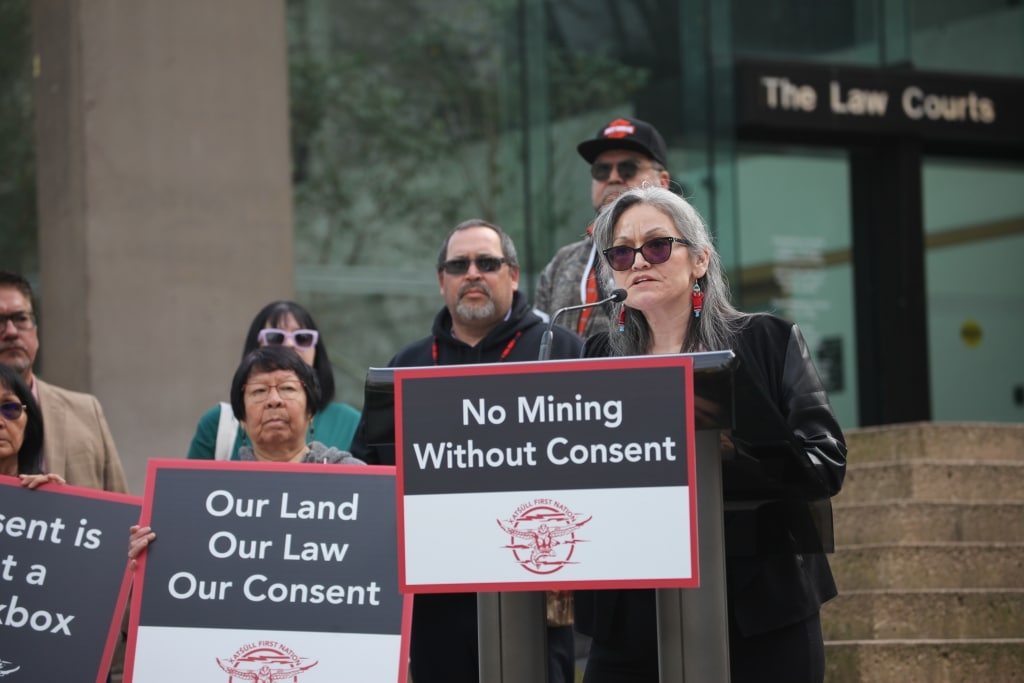
Kúkwpi7 (chief) Rhonda Phillips, of Xatśūll First Nation — part of the Secwépemc Nation — speaks alongside community members outside the Supreme Court of B.C., after launching a court challenge to Imperial Metals’ Mount Polley Mine permits on April 15. Photo by David P. Ball

Meanwhile, in the “U.S.,” a case challenging the legality of the Resolution Copper mine is pending in the U.S. Supreme Court, which will consider whether the destruction of Chi’chil Biłdagoteel would violate Apache religious rights. 

The decision could impact other tribes’ efforts to preserve sacred sites outside their reservation borders.

“The U.S. government is rushing to give away our spiritual home before the courts can even rule — just like it’s rushed to erase Native people for generations,” said Wendsler Nosie Sr. of Apache Stronghold, the organization behind the lawsuit, which is made up of Apache and other Indigenous people and their allies. 

“This is the same violent pattern we have seen for centuries.”

Other mining projects fast-tracked by the administration last week have generated opposition from tribal nations. 

The Nez Perce Tribe is concerned that the proposed Stibnite Mine in Idaho could harm fishing and hunting rights, and the Fort McDermitt Tribe has long fought a proposed lithium mine on Thacker Pass in “Nevada” which would be built on a sacred site where “U.S.” cavalry troops massacred Indigenous people in 1865. 

UN highlights need for free, prior and informed consent

All these concerns are matters that the UN Declaration on the Rights of Indigenous Peoples (UNDRIP) has stated must be addressed. 

According to a study published in February by the UN Permanent Forum on Indigenous Issues, “the absence or weakness of legal frameworks that protect the particular rights of Indigenous Peoples in the context of a global energy transition” is a “major concern.” 

This lack of legal protection, the study states, means that the mining companies have the responsibility to obtain the free, prior and informed consent (FPIC) of Indigenous people, regardless of legal gaps.

A shift in corporate and industry policy towards consent could push governments to adopt consent in their own law and policy, said Kristen Carpenter, a law professor at University of Colorado Boulder. 

“It’s promising to see companies and industry groups adopt FPIC-based policies and guidelines,” said Carpenter, a past appointee to the Expert Mechanism on the Rights of Indigenous Peoples, which helps governments implement UNDRIP. 

“Increasingly it seems that private actors have come to see FPIC as a risk mitigation tool, realizing that working toward agreement with Indigenous Peoples is likely to avoid objections, lawsuits, and protests that arise when projects violate Indigenous Peoples’ rights.”

While voluntary guidelines advocated for by organizations like the ICMM have the potential to move faster than law and policy, they aren’t legally enforceable and can be created, or ignored, by industry, meaning they can’t be a stand-alone substitute.

“We do not seek to replace state obligations, but we can help fill accountability gaps when states fall short,” said Scott Sellwood, who represented the Initiative for Responsible Mining Assurance, at the forum. 

The initiative — which includes nonprofits, organized labor, mining companies and “affected communities” —  also has voluntary mining standards.

But its members are audited by a third party, and the reports are published publicly to ensure that they are following the standards. 

“To do this effectively,” Sellwood said, “voluntary mining standards should at minimum require mines to demonstrate that they have obtained [free, prior, and informed consent] from all affected Indigenous peoples.”


Author

ANNA V. SMITH

Anna V. Smith is an associate editor of High Country News. She writes and edits stories on tribal sovereignty and environmental justice for the publication’s Indigenous Affairs desk from Oregon. Her work has also appeared in the New York Times, Audubon, and Slate, and featured in investigative collaborations with ProPublica and Grist.

Wednesday, December 11, 2024

'Are they going to walk away?': Charges 10 years after B.C.'s Mount Polley disaster

Doug Watt won't forget the sound of a tailings pond collapsing at the Mount Polley Mine more than 10 years ago, sending millions of cubic metres of waste into waterways in the British Columbia Interior. “I went outside, and you could hear the roar.

Nono Shen and Darryl Greer, The Canadian Press
12/10/2024
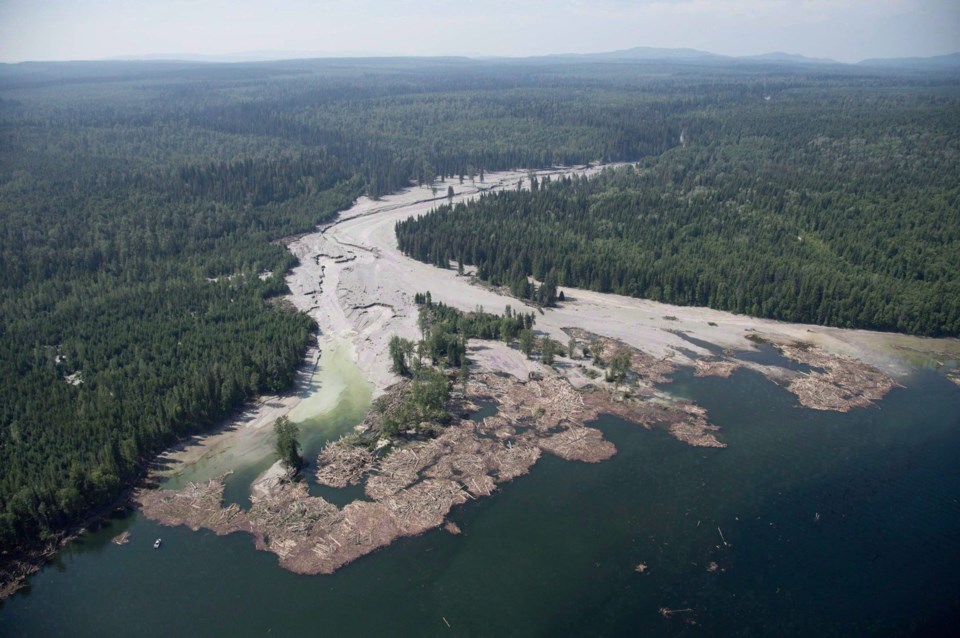
Contents from a tailings pond is pictured going down the Hazeltine Creek into Quesnel Lake near the town of Likely, B.C. on August, 5, 2014. Charges under the federal Fisheries Act have been laid against Imperial Metals Corp. more than 10 years after a tailings pond collapsed the Mount Polley mine, spilling more than 20 million cubic metres of waste water into B.C. Interior waterways. 
THE CANADIAN PRESS/Jonathan Hayward


Doug Watt won't forget the sound of a tailings pond collapsing at the Mount Polley Mine more than 10 years ago, sending millions of cubic metres of waste into waterways in the British Columbia Interior.

“I went outside, and you could hear the roar. It was like standing close to Niagara Falls,” the 74-year-old said in an interview Tuesday.

Fifteen federal Fisheries Act charges have been laid against Imperial Metals Corp. and two other firms after the dam collapse at the gold and copper mine in what would become one of the largest environmental disasters in provincial history.

Watt said he and other residents in Likely, B.C., the closest community to the dam, are pleased charges have been laid and now “only time will tell whether they actually get found guilty or not.”

“We're always wondering all the time, are they going to walk away with no accountability for what happened?" he said.

The earthen dam gave way at 1 a.m. on Aug. 4, 2014, sending about 25 million cubic meters of mining waste, including tailings and other materials, into nearby waterways.

A statement from the B.C. Conservation Officer Service issued Tuesday said it worked with the Department of Fisheries and Environment and Climate Change Canada to investigate possible contraventions of the act.

The indictment filed in B.C. Supreme Court on Dec. 6 outlines the charges against Imperial Metals, its subsidiary, Mount Polley Mining and Wood Canada Ltd., an engineering firm.

The indictment alleges the companies allowed a "deleterious substance" from the mine's tailings pond into several bodies of water "frequented by fish," including Polley Lake, Hazeltine Creek, Bootjack Creek, Edney Creek and Quesnel Lake.

It alleges the companies' work "resulted in serious harm to fish that are part of a commercial, recreational or Aboriginal fishery … namely the death of fish or any permanent alteration to, or destruction of, fish habitat.”


Imperial Metals said in a statement the company received the indictment this week, and as the matter is before the courts it won't be making further comment.

A report from an independent expert panel released in 2015 concluded the key reason for the dam's failure was its design.

It said the engineers didn't take into account the complexity of the geological environment in relation to the dam embankment foundation.

It said engineers failed to recognize that the dam was "susceptible to undrained failure" when subject to the stresses associated with the embankment.

A three-year deadline for provincial charges in the case passed in 2017.

A spokesman for B.C.'s Ministry of Environment referred questions to the Conservation Officer Service's statement and said there would be no further comment "as it’s before the courts."


In 2022, Engineers and Geoscientists B.C., the provincial regulatory and licensing body, fined two former project engineers a combined $226,500, while a third was temporarily suspended and ordered to complete additional training.

A post from August on the Mount Polley Mine website says more than $70 million has been invested in environmental repair and clean-up efforts, "demonstrating a strong commitment to restoring the affected areas."

In September 2023, the Mount Polley Mining Corp. was awarded the Jake McDonald Reclamation Award for its habitat remediation work in Hazeltine Creek and adjacent areas.

The company said in its post that ongoing environmental monitoring has shown steady recovery, and its efforts will ensure the long-term health of the ecosystem in the area.

Jamie Kneen, a spokesman with Mining Watch Canada, said the Mount Polley spill left “devastating environmental impacts,” including potential damage to the salmon runs in the Fraser River.

“There's the physical destruction of 25 million cubic meters of material ripping down Hazelton Creek and into Quesnel Lake,” said Kneen.

He said there are still many questions left unanswered, such as whether contamination from the spill is still active in Quesnel Lake.

“Aside from seeing these charges actually brought forward, our major concern is still the ongoing contamination,” said Kneen.

“What we don't know — and there isn't really enough study being done on it — is what the consequences are for the fisheries, or for the salmon runs, and part of that is that those are very complicated systems to study. But also there's not that much investigation being done to try and sort that out."

Even 10 years later, Watt said he doesn't drink the lake water because he has safety concerns.

“We've lived here for like 27 years or more, and we knew what the lake was like before this accident happened, and we see that it deteriorated,” he said.

The offences under the Fisheries Act listed in the indictment carry fines between $500,000 and $6,000,000.

Individuals guilty of an offence under the act can be imprisoned for up to three years if they are convicted for a second time, however only companies face charges in connection to the dam's collapse.

The Conservation Officer Service said Mount Polley Mining Corp. and Wood Canada Ltd. face the same charges and all three companies are due to make a court appearance on Dec. 18.

This report by The Canadian Press was first published Dec. 10, 2024.

Nono Shen and Darryl Greer, The Canadian Press

Saturday, December 07, 2024

Winnipeg plant one of largest F-35 parts producers in Canada

Magellan Aerospace builds the horizontal tail assemblies for the controversial aircraft


James Wilt 


A graphic showing Canadian contributions to the production of F-35 jets. 
Image courtesy Lockheed Martin.


Of the more than 100 companies in Canada that produce components for the F-35 combat aircraft, Mississauga-based Magellan Aerospace is one of the largest. Notably, it is also majority owned and chaired by billionaire N. Murray Edwards, the 35th richest person in Canada, who controls oil sands giant Canadian Natural Resources Limited, or CNRL, and the mining company Imperial Metals, responsible for the catastrophic Mount Polley tailings disaster.

However, most of Magellan’s fighter jet manufacturing does not take place in Ontario, where much of the Canadian F-35 supply chain is concentrated, or even in provinces like Alberta or British Columbia, where Edwards’ many other interests are located. Instead, Magellan’s main F-35 production happens in a large factory in the St. James neighbourhood of Winnipeg, right next to the city’s airport.

In 2013, the general manager of Magellan’s Winnipeg operations said the plant was “doing the largest volume of work on the F-35 in Canada.” This claim was reiterated in 2016 when the Winnipeg Free Press reported that that “Magellan’s St. James plant is one of the largest participants in the F-35 program in Canada.” Shortly after, the Winnipeg plant was again described as the “largest Canadian structural supplier to the controversial jet.”

Specifically, Magellan’s Winnipeg factory manufactures the horizontal tail assembly for the F-35A: the main variant of F-35 that Canada recently committed to buying 88 of, and that serves as the basis of Israel’s special subvariant, the F-35I. The company won an initial contract to build the essential parts in 2009, with the first completed tail assembly installed onto an F-35 at Lockheed Martin’s Fort Worth factory in 2013.

Magellan had this contract renewed several times since, most recently in late 2022, right before Canada announced its plan to finally pull the trigger on buying the fighters. Over the lifespan of the Joint Strike Fighter (JSF) program, Magellan’s Winnipeg plant is expected to ship more than 1,000 horizontal tail assemblies, accounting for half of all tail assemblies for the F-35A. In 2019, Magellan reported that the plant was ramping up deliveries to 60 per year. In total, it is anticipated that these contracts will be worth about $1.5 billion in revenues.


Magellan celebrates the manufacture of its 400th tail assembly for the F-35A fighter aircraft. Photo courtest Magellan Aerospace Limited/LinkedIn.The plant also produces vane boxes and transition ducts, critical components of the propulsion system for the F-35B, which is the “short take-off and vertical landing aircraft” (STOVL) variant. Magellan started working on F-35B parts in 2003, with its Winnipeg plant responsible for fabrication and assembly operations. By 2013, the company reported that it had manufactured these parts “for all of the F-35B Short Take Off and Landing variants flying today.” Many other smaller parts for F-35s have also been made in the Winnipeg factory.

Magellan’s F-35 production operations in Winnipeg have received massive support from all levels of government. In 2008, the federal government provided a $43 million interest-free loan for Magellan to expand its Winnipeg plant for F-35 parts manufacturing, which was followed by a $20 million loan from the province. In 2010, the City of Winnipeg sold a large parcel of surplus land valued at $638,000 to Magellan for $1, allowing for the construction of the 138,000 square foot Advanced Composite Manufacturing Centre, which was opened in late 2011. Then, in 2018, the federal government gave $5 million to Magellan for its Winnipeg plant.

Magellan has also received various indirect supports through state funding of research and technology development. The federal and provincial government has contributed millions of dollars to the Composites Innovation Centre, a non-profit set up to advance product development in composites that Magellan often collaborates with. In 2011, the federal government allocated $4.4 million to Red River College to establish the Centre for Non-Destructive Inspection Technologies (CNDI) at the Magellan campus, which the company heralded as “integral in meeting the demanding production schedule and quality requirements for the manufacture of the composite components that comprise the next-generation F-35 aircraft.”

Conservative politicians in particular have supported Magellan’s Winnipeg operations. The huge $43 million loan to the company was announced by the Conservative government only days before the election call in 2008, with MP Vic Toews stating “Prime Minister Harper and the government are working hard to maximize business opportunities available to Canadian companies under the JSF program.” Harper also visited the plant in 2010 for the formal groundbreaking of the Advanced Composite Manufacturing Centre, where the prime minister reportedly “lavished praise on the skills of the [Magellan subsidiary] Bristol Aerospace workforce for its success in building state-of-the-art parts for the new fighter jet.”

It was later reported that during this period, Conservative minister Rona Ambrose had vacationed on a yacht owned by Edwards, the billionaire owner of Magellan. The Globe and Mail reported that “archived public records show Magellan, or one of its divisions, won federal contracts or benefited from funding worth almost $100-million between 2008 and 2015, when Ms. Ambrose held a series of cabinet roles, including public works.” In 2016, Manitoba Premier Brian Pallister conducted a press conference alongside several major aerospace executives—including from Magellan—to call for greater federal support for the industry and more consideration of purchasing the F-35, “the construction of which has received considerable local investment.”

Notably, Magellan’s Winnipeg-based F-35 program director served as chair of the Canadian JSF Industrial Group, which played a major role in lobbying for Canada to buy F-35s over other fighter jets. Magellan has also claimed that the jobs of the 150 workers who manufacture F-35 parts at the Winnipeg plant were in jeopardy if Canada did not proceed with the acquisition, a threat that was curiously rebuffed by a Pentagon official who said it would not make a difference given existing contracts.

In total, F-35 parts production makes up about one-quarter of jobs at the Winnipeg plant—150 of about 600 jobs—with defence contracting accounting for one-third of Magellan’s total revenue. Magellan also appears a miserly employer, with a multi-month strike taking place in 2011, the sixth and longest in the 35 years prior, over the company’s attempt to cut retirement benefits and remove cost-of-living increases.

Canadian Dimension
 November 15, 2024 

James Wilt is a Winnipeg-based PhD candidate and freelance writer. His latest book is Dogged and Destructive: Essays on the Winnipeg Police.

Wednesday, August 07, 2024

BC

Locals mark 10 years since Mount Polley disaster

By Lauren Stallone
Posted August 5, 2024 

It’s been 10 years since the worst mine waste disaster in Canada’s history.

On Aug. 4, 2014, a massive tailings dam at the Mount Polley copper and gold mine in B.C.’s Interior collapsed. The incident about 56 kilometres northeast of Williams Lake sent over 20 million cubic metres of wastewater into nearby Quesnel Lake, Polley Lake, Hazeltine Creek, and surrounding waterways.

Despite a decade having passed, residents in nearby Likely, B.C., say they’re still struggling with unresolved emotions about what happened and should be held accountable.

“The quality of the lake and the water have been and are continuing to deteriorate,” said Doug Watt, an area resident. “Frankly it’s a very strong feeling of frustration.”


Watt was there when disaster struck, and recalls the moments vividly.

“I was asleep and got a call around 6 o’clock in the morning from Likely Fire and Rescue and they told me that the dam had burst,” he told CityNews.

An aerial view shows the damage caused by a tailings pond breach near the town of Likely, B.C. Tuesday, August, 5, 2014, after the Mount Polley mine disaster a day prior. THE CANADIAN PRESS/Jonathan Hayward

“I could hear it just like Niagara Falls from seven or eight kilometres down the lake.”

Watt says some residents have lived by the lake for over 50 years and are devastated to see what has happened since the collapse.

“The water’s cloudy, there’s algae bloom that never occurred before, there’s slime on the rocks,” he described.

He says many locals have opted to no longer drink the water from Quesnel Lake, which was their main water source. Despite these concerns, the government says the water meets drinking standards.

However, residents aren’t buying it.

“They’re polluting the lake, we are not going to drink it anymore,” said Watt.


Related articles:

Regulator fines engineers 8 years after Mount Polley disaster in B.C.
Mount Polley mine disaster five years later; emotions, accountability unresolved
Mount Polley mine disaster could happen again if laws don’t change: report

In a statement to CityNews, Minister of Energy, Mines, and Low Carbon Innovation Josie Osborne says “the government has taken significant steps to ensure the company responsible continues restoring and monitoring the impacted areas.”

“They have reformed B.C.’s regulations to establish what they say are some of the world’s most stringent safety and environmental standards,” Osborne continued.

The statement goes on to say “it was clear that B.C. had allowed a regulatory framework to exist that did not adequately protect the environment or people.”

“Economic development cannot happen without responsible management of industry, and we must maintain a world-class regulatory system to bring peace of mind to the mining sector and British Columbians,” Osborne’s statement concluded.

But even with the improvements made, the residents affected by the Mount Polley disaster are wary of the potential for things to go wrong.

“There are many mines in B.C. with very, very large tailings ponds. Every one of them is a liability,” said Watts.


 British Columbia

Residents worry about waterways 10 years after Mount Polley spill

'We're still picking up levels of metals like copper flowing down Quesnel River,' researcher says

Murky sludge leaches into blue waters
A aerial view shows the debris going into Quesnel Lake caused by a tailings pond breach near the town of Likely, B.C., on Aug. 5, 2014. (The Canadian Press)

The local fire department was on the line when Doug Watt reached for his phone the morning of Aug. 4, 2014.  

"The lady at fire and rescue said that there's been an accident at the mine, the dam is broken, it's pouring into the lake, nobody knows what's happening so get your boat out of the water, don't drink the water and be prepared to evacuate because you don't know whether the lake is going to flood or not," he recalled. 

After he got off the phone with the fire department, Watt stepped outside and heard the roar of the dam breach about seven kilometres away from his home in Likely, B.C.

"It was quite disconcerting," he said.

The tailings dam at the Mount Polley mine, about 231 kilometres north of Kamloops, B.C., failed that day, sending toxic mine waste into nearby lakes and streams. It is widely regarded as one of the worst — if not the worst — mine disasters in Canadian history. 

A murky looking creek
Hazeltine Creek, B.C., on Aug. 27, 2014, three weeks after the Mount Polley Mine tailings spill. (Kieran Oudshoorn/CBC)

Mount Polley mine records filed with Environment Canada reported that hundreds of tonnes of arsenic, lead, copper and nickel flowed out in the sludge. 

On the 10-year anniversary of the spill, residents worry not enough has been done to remediate the site and prevent future disasters. 

WATCH | Perfect storm of problems, engineer says: 

Why the Mount Polley tailings pond breached

10 years ago
Duration2:25
Designers overlooked or dismissed test results

10 years later

Researcher Phil Owens said about 25 million cubic metres of tailings material ended up in Hazeltine Creek and Quesnel Lake — the equivalent of 10,000 Olympic-sized swimming pools, he said. 

And most of that is still sitting at the bottom of the lake, researchers have found. 

"This was an instantaneous catastrophic failure ... and yet still 10 years later, we're still picking up levels of metals like copper flowing down Quesnel River and getting into the water column of the lake," he said. "That is quite surprising."

WATCH | Fishers worry about salmon following Mount Polley spill: 

Mount Polley spill salmon concerns

10 years ago
Duration2:19
Fraser River fishermen say they're worried

Copper, he added, has been detected in zooplankton, a key food source for salmon and trout in the river.

"I would be concerned about eating the fish, particularly those fish that live in the system for a long time because it's now been 10 years," Owens said.

Watt, who used to work in mining, said that while he still supports the industry, he believes the environment needs to be the top priority. 

"It's certainly opened my eyes to the immediate effect that a mine can have locally," he said.

WATCH | Residents raise concerns days after Mount Polley dam breach: 

Mount Polley: residents speak out

10 years ago
Duration2:26
People living near tailings pond aren't convinced it's safe

In 2014, B.C.'s environment ministry said it had repeatedly warned mining company Imperial Metals about the level of wastewater in the tailings pond at its Mount Polley mine prior to the breach, and then-NDP leader John Horgan said a previous report on Mount Polley's tailings pond noted a tension crack in the earthen dam.

A scathing auditor general report was released in May 2016, calling for an independent compliance and enforcement unit for the mining industry that would protect the environment from future disasters. 

Changes

Likely resident and biologist Richard Holmes said that shortly after the spill, he had high hopes for remediation and change in B.C.'s mining industry. But 10 years later, he said there's been little action. 

According to Imperial Metals, it has spent $70 million to clean up the Mount Polley spill site, which has gone toward removal of tailings and rebuilding the Hazeltine and lower Edney creeks, and building a new fish spawning and rearing habitat in Hazeltine Creek.

A sign reads "Restricted acces, area closed to public" and explains safety hazards and rehabilitation work in the area
Mount Polley spill remediation work as seen from a back road near Quesnel Lake in August 2021. (Betsy Trumpener/CBC)

The company also says it repaired the Quesnel Lake shoreline, planted native trees and shrubs in the area and built an on-site rainbow trout hatchery to raise more trout for Polley Lake.

In 2021, two engineers were disciplined for actions that led to the breach. Engineers and Geoscientists B.C., the regulatory body that oversees engineers in the province, found that both had demonstrated unprofessional conduct. 

Last week, Minister of Energy, Mines and Low-Carbon Innovation Josie Osborne released a statement explaining what the province has done following the Mount Polley breach. 

Osborne said the province has created a chief auditor role, Mines Audit Unit and a Mines Investigation Unit. It has also established financial penalties for companies and, Osborne said, the province has reformed B.C.'s mining regulations

"For many people, that day 10 years ago is hard to forget," Osborne said in her statement, adding that the NDP government will continue to strengthen mining regulations and oversight. 

Murky sludge leeches into blue waters
Damage caused by a tailings pond breach near the town of Likely, B.C., Tuesday, Aug. 5, 2014. (Jonathan Hayward/Canadian Press)

But residents of the central B.C. community of about 350 people have watched Quesnel Lake continue to deteriorate in the years since the spill, Watt said. 

"People that have been here for 25 or 50 years can see that and lots of concern and very much frustration with the fact that the [province] is not listening to what we see out here."

Holmes said he would like the province to give legal standing to rivers and streams in B.C., similar to Magpie River in Quebec, which was granted legal personhood in 2021 for protection. 

Holmes also thinks provincial funding should be made available for independent research.

"Very little has changed as a result of this disaster and certainly not enough has changed, that's for sure."