The degree of restraint and investigative rigor employed by Washington, NATO, and their media allies when ascribing guilt to Russia for any indiscretion bears little relation to how NATO’s actions are assessed. This has long been standard operating procedure, but the events in the Baltic Sea over the past two years take this pattern further.
Acts of aggression where the US or its allies motives are clearest must be most obfuscated, with logical conclusions displaced in headlines by nefarious sounding, circumstantial evidence that points elsewhere. The framing for the public of any reporting regarding Russia’s war with Ukraine must always note that the war was ‘unprovoked’ and a ‘full scale invasion’, their actions ‘brutal’, their forces a ‘war machine’, our Ukrainian brethren pure.
This ritual is bolstered by the ever growing count of sanctions imposed on Russia, which have spawned convoluted business arrangements that simplify the task of making various Russian entities look like they have something to hide. Creating this lens of distortion is a critical endeavor, for if the western public only believed their eyes, they might see the degree to which their government’s own actions look far more suspect.
The Webs that Sanctions Spawn
The quantity of sanctions imposed by the US government has increased every year for more than two decades. Joe Biden has long since set the high mark for sanctions introduced during any presidential term, including presidents in office for more than a single term.
The US treasury department alone maintains 38 different sanctions programs. Among them are sanctions targeting nations, non-nation organizations, and individuals, encompassing different combinations of trade, financial transactions, and economic assistance programs. Given the challenge for businesses to remain cognizant of and compliant with these sanctions, the market for software that flags compliance vulnerabilities in companies’ supply chains has grown to a value of several billion dollars.
Sanctions lead to business arrangements which would otherwise appear entirely arbitrary and inefficient, if not for the steps the parties involved must take to maintain compliance with the sanctions through loopholes and workarounds.
As one example, consider a recent case of a fish hatchery in Norway. Initially owned by a Russian firm, to maintain compliance with the hundreds of sanctions targeting Russia in response to Russia’s invasion of Ukraine, the fishery resolved to transfer ownership to one of the hatchery’s managers, a Norwegian citizen.
The prospective owner did not have the funds to buy it outright, but lending institutions would not participate in business transactions involving Russian entities amid the sanctions. Nor could the transfer be facilitated via financing from the original owner, as sanctions prevented the new owner from making loan repayments in rubles. The parties thus agreed on a financed sale of just under $1 million, not in currency, but to be repaid in actual fish hatchlings produced by the hatchery. Regulatory bodies in Norway— a country highly reliant on the seafood industry as an economic bedrock—voiced no issues with the agreement.
Despite this, the fishery’s operations were ultimately halted when they lost their insurance coverage. The insurer revoked their coverages, concerned about accepting the premium from a firm still associated with a Russian entity. The hatchery filed a suit against the insurer, and appeals are ongoing.
The trial proceedings thus far have illustrated that these sanctions produce results with little relation to the goals the sanctions ostensibly seek to achieve. In one courtroom exchange, the attorney for the insurer questioned the prospective buyer about whether the fish delivered to the seller as loan payment would “contribute to the Russian economy going round.”
The prospective owner answered the question with a question, because in any scenario he was going to be contributing to the Russian economy in several ways which would not run afoul of the sanctions:
“I have no qualification to know anything about that. Norwegian fish feed factories still buy raw materials from Russia for fish feed, soy, and other things grown in Russia. I cannot understand (sic) that it is okay, while it should not be okay to sell food to Russia.”
Russia’s ‘Ghost Ships’
The convoluted systems which the sanctions regimes lead to are useful to NATO’s interests in the realm of public relations. When they need to make Russia look suspicious for something, these complicated arrangements can be pointed to as suspicious and reported as such by the Western mainstream media. They likewise provide cover and deniability for NATO’s own actions, an important tool considering the degree to which they are invested in the conflict between Russia and Ukraine, a war in which NATO still claims to not be a direct participant.
Such a lens is useful in consideration of the recurring headlines alleging Russian involvement in the destruction of major infrastructure in the Baltic Sea in recent years, most recently regarding damage to undersea power cables, but originating with the Nord Stream pipeline explosions, an act of sabotage that destroyed billions of dollars’ worth of energy infrastructure and one of the worst environmental disasters in recent history.
The Eagle S
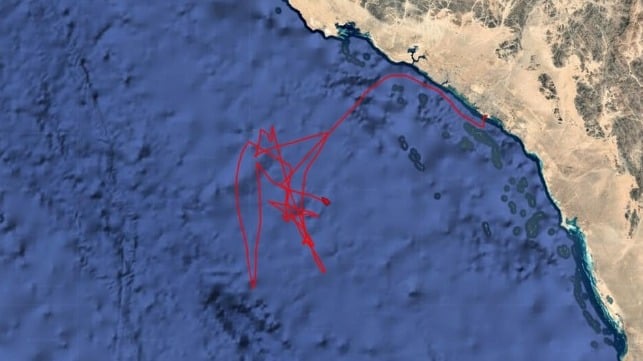
December 26, 2024, the New York Times reported that authorities in Finland had seized an oil tanker, the Eagle S, suspected of severing undersea cables by dragging its anchor:
The ship had been chartered by a Russian oil company to transport its oil. A December 27 follow up article in the New York Times, presented new analysis about the grave intentions of the ship, albeit without any new evidence. Citing an analyst from maritime journal Lloyd’s List: “It’s a sanctions evader, it’s really dangerous, it’s just a piece of rust bucket floating junk of steel.”
The day that the NYT ran this article, the same Lloyd’s List analyst also posted an article on the Lloyd’s site entitled “Russia-linked cable-cutting tanker seized by Finland ‘was loaded with spying equipment’.”
In that article, another anonymous source tells us the ship, characterized as part of the “Russia Linked dark fleet,” was outfitted with equipment to become a “spy ship” and had “huge portable suitcases” with “many laptops” that had keyboards suited for the Turkish and Russian language.
This ‘dark fleet’ designation, a footnote explains is earned if the “ship is aged 15 years or over, anonymously owned and/or has a corporate structure designed to obfuscate beneficial ownership discovery, solely deployed in sanctioned oil trades, and engaged in one or more of the deceptive shipping practices outlined in US State Department guidance issued in May 2020.”
The ‘or’ of that and/or covers quite some ground. In this case, the most obvious explanation is that the oil company needed a similar convoluted arrangement to that of the Norwegian hatchery in order to remain operational. Even considering the opaque ownership of this and other ship, it’s difficult to discern the crime Russia has committed, or to conclude from available evidence that this ship could fairly be characterized as “sanctions-circumventing”.
Indeed, a ship designated as being part of Russia’s so-called Shadow Fleet has nothing to do with illegal activity. A October 10th article in the Financial Times, “How Russia’s ‘shadow fleet’ gets its ships” clarifies for us that these ships are essentially just registered in ways to allow the continued export of Russian oil without involving entities in countries that have agreed to enforce the sanction—
“Since the first western restrictions on Russian oil exports were introduced in December 2022, Moscow has assembled a fleet of more than 400 such vessels currently moving some 4mn barrels of oil a day beyond the reach of the sanctions and generating billions of dollars a year in additional revenue for its war in Ukraine…It is not alleged that the transactions have broken any laws.”
The Yi Peng 3
In a similar story on December 12, Swedish officials alleged that the Chinese vessel Yi Peng 3 damaged cables in the Baltic Sea on November 17 and 18. While the Chinese vessel returned to a Swedish port for over a month while the incident was investigated, permitting Swedish investigators to board it for an inspection, Sweden has alleged the ship did not wait long enough for the right prosecutor to inspect the ship.
In this case, the Wall Street Journal reports that the Chinese captain was “induced” by Russian intelligence to cut the cables with the ship’s anchor and that the ship “includes a Russian sailor.” Fearing Russia behind every tree and under every rock, legacy media outlets accept their governments’ suggestions of elaborate connections to suggest a conspiracy among all of NATO’s adversaries. The reporting must not allow the public to make the simpler deduction that so many sanctions might induce greater cooperation among the countries without vested interests in these sanctions.
The Nord Stream Pipelines
The Nord Stream pipelines are a network of pipelines to transport natural gas from Russia into Europe. The Nord Stream 1 pipeline came online in November 2011. 51% of its $8 billion price cost came via Russian gas firm Gazprom, with the balance was split between German, French, and Dutch firms.
Nord Stream 2, an additional pipeline, was built at a cost of $11 billion, but this time funded entirely by Gazprom. It was completed in September 2021 but never came onstream. If it had, the two underwater pipelines would have had a net capacity to pump 110 billion cubic meters of natural gas per year across about 760 miles. Even without Nord Stream 2, about half of Germany’s and over 40 percent of the EU’s natural gas imports came from Russia before the Ukraine war.
The US had long advocated against the pipeline project, discouraging its allies in the EU and NATO from relying upon Russia. The Trump administration had introduced sanctions to this effect in December, 2019. In August, 2020, a cohort of republican senators threatened the managers of the Nord Stream port in Germany with sanctions if they continued to provide support to the Russian ships completing the pipeline.
Biden waived the sanctions against the pipeline in May, 2021, but in retrospect this action likely had more to do with dissociating his administration from Trump’s, as there was no difference of opinion between them on the issue of the pipeline.
Indeed, Biden’s Secretary of State, Antony Blinken stated during his confirmation hearing in January, 2021 that “I know [Biden’s] strong conviction that this is a bad idea, the Nord Stream 2. That much I can tell you. I know that he would have us use every persuasive tool that we have to convince our friends and partners, including Germany, not to move forward with it.”
On the 22 of January 2022, Undersecretary of State Victoria Nuland stated that one way or another, the Nord Stream 2 pipeline would not go forward if Russia invaded Ukraine.
Two weeks later on February 7, Joe Biden publicly made a similarly threatening, if clumsy, statement— “If Russia invades again, then there will be no longer a Nord Stream 2. We will bring an end to it.” Asked what he meant by that, he added, “I promise you we will be able to do it.”
The war began later that month.
The Sabotage of the Pipelines
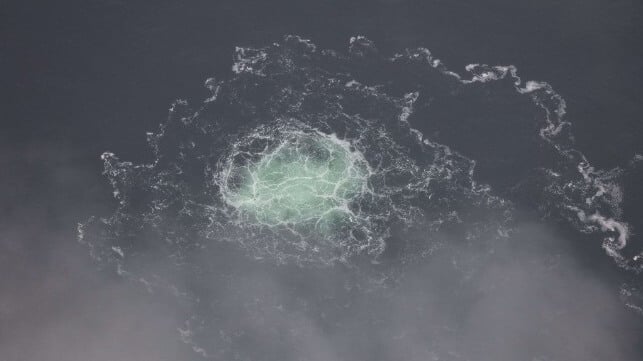
On September 26, 2022, Swedish seismologists reported that measuring stations registered several underwater explosions, between the Danish and Swedish coasts of the Baltic Sea. The explosions, detonated at a depth of about 85 meters, ruptured both pipelines.
Later studies estimated the amount of methane gas that escaped from the pipeline to be 523 kilotons, of which 478 kilotons (478,000 tons) reached the earth’s atmosphere—the largest leak in recorded history of a gas highly impactful in heating the planet. Over 20 years, methane traps about 80 times as much heat as carbon dioxide.
Danish scientists also noted that the blasts occurred within 20 kilometers of a WWII-era chemical weapons dumpsite, where 11,000 tons of chemical warfare agents were dumped in 1947.
In the immediate aftermath of the explosions, western mainstream media sources already were asserting that Russia had blown up the pipelines:
Russia had already been pumping much less gas to Europe due to the EU’s support for Ukraine in its war. These reports ignored the question of why Russia would cause so much damage to infrastructure primarily owned by Russians, when they had the option to simply stop pumping gas altogether. Ukraine had somewhat greater motive, but their military operation was by this point thoroughly intertwined with personnel from US intelligence agencies, so they would not have acted alone. The US particularly stood to profit massively, as the country was already in 2022 the top exporter of liquid natural gas in the world.
On October 3, the Brookings Institution, a massive Washington think tank, released a report scolding those who raised questions about motive, or noted the stated objectives regarding the pipeline by officials in Washington:
As is typical following an event like this, conspiracy theories about who was responsible quickly proliferated online, with the Kremlin promoting a familiar trope: that the United States was responsible for a nefarious, clandestine plot.
It would take considerable effort to maintain the spotlight on Russia. Within minutes of the explosions, then UK prime minister Liz Truss allegedly sent a text to US Secretary of State Antony Blinken that said simply, “it’s done.”
In his first public comments about the event the day after the explosions, Blinken described it as a tremendous opportunity for Europe.
Hersh’s Theory
In February, 2023, veteran investigative journalist Seymour Hersh reported the pipelines’ destruction was a CIA orchestrated operation which had been assigned at the direction of Joe Biden in December, 2021. In Hersh’s version, highly trained divers equipped with deep see diving equipment planted the explosives on the pipelines in June, 2022 during the annual NATO military exercises, “BALTOPS” in the region.
Hersh notes that the divers and equipment were based out of the Navy’s main diving center in Panama City, Florida. This is corroborated by research from the Swedish researcher Ola Tunander, who documents military flights from US air base nearest the blast sites to Panama City (one direct, another via the Norfolk air base) at the end of the exercises.
It would have been too obvious to trigger the explosives around the same time as the BALTOPS exercise, so a triggering mechanism was allegedly devised which could send a signal remotely if and when the pipelines were to be destroyed. The signal triggering the explosives would come from a sonar buoy to be dropped in the water above the pipelines from a military plane, then triggered on Biden’s orders. Indeed, a US Poseidon military plane operated for three nights in the days leading up to the explosions, patrolling Baltic Sea from September 22 and 25.
NATO’s Ghost Ships
During the June, 2022 BALTOPS exercises and in the leadup to the explosions that September, there was significant US and allied military vessel traffic in the Baltic near the pipelines, often with their automated identification systems (AIS) disabled in the regions surrounding the blast. Among these vehicles were the vessels necessary for the type of operation Hersh suggests.
Many of the US Navy’s Command ships were in attendance for BALTOPS, and multiple NATO vessels had the capability to carry a “midget submarine” and divers to make the dive to the pipelines. Ships with these capabilities were once again in the waters near the explosions days before they were set off.
This is known thanks to the harbor master of the port at the nearby Danish island of Christiansø, who went with first responders to check on the ships, as they had their AIS disabled. When approached, the ships identified themselves as American and directed the harbor master to leave them be.
On the very day of the explosions, the American vessel, USS Paul Ignatius left Poland for the site of the pipeline damage, initially keeping its AIS transponder off altogether, but briefly turning it on with a masked identity using a dummy identifier number ‘999999999.’
A Bad Carpenter Blames their Tools
The New York Times reported a different theory to Hersh’s in March, 2023. In their version, unnamed US officials are cited as laying the blame at a “pro-Ukrainian group” with no ties to the Ukrainian government. No other new information was provided.
Further reports in the Wall Street Journal that June, and in the Washington Post and Der Spiegel in November, 2023, built upon the Ukrainian perpetrator theory, spinning a tale using information provided to them by US officials. They alleged that a Ukrainian special forces officer, Roman Chervinsky, operating independently of any Ukrainian superiors, rented a sailboat, the Andromeda with a small team of divers in early September, 2022.
The team of six paid a Polish travel agency in cash to charter the ship from a company in Germany. The travel agency had no website but was registered, according to Polish authorities, to a woman who lives in Ukraine.
The divers all had fake passports from several countries, but the ship flew under a Ukrainian flag. At one point, a suspicious Polish port officer investigated the ships, reviewing their forged documents and then letting them go. While there had been footage of this interaction, Polish authorities have stated it was destroyed shortly after the Andromeda was let go.
The perpetrators traveled throughout Baltic Sea in the regions of the explosions, at one point being caught on a German speed camera, and returned to their port of origin three days before the explosions on September 19th.
The plan Chervinsky allegedly carried out was reported to be a tweaked version of a plan that had originally come directly from the Ukrainian leadership. The WSJ alleges that the CIA learned of the plan back in June, 2022 and urged Ukraine not to go through with it, a request they acceded to. Thus even if this theory is accurate, then the US would have had every reason to suspect Ukraine, despite pointing the finger at Russia immediately.
Conveniently, the Andromeda was not cleaned for four months upon its return. It was not until January 2023 that German police arrive at the charter company to inspect the ship. The suspects were sloppy at every turn, leaving traces of explosive material, fingerprints, and DNA evidence.
Meanwhile, US ships operating without their identification systems continued to maintain a presence guarding the explosion site. A Greenpeace vessel approached the site of the explosions in November 2022 to evaluate its environmental impact. Directly over the site floated a large ship, the Norwegian Normand Frontier, equipped with cranes and other heavy equipment. Upon approaching it, Greenpeace was intercepted by the US Navy ship USCGC Hamilton, operating in ‘ghost mode’ and sent away when it approached the Normand.
Six people on a sailboat, we are to believe, successfully planted eight explosives along pipelines more than 200 deep. WSJ dismissed the level of planning and expertise needed to conduct such an operation, citing a Ukrainian ‘officer involved in the plot’ as saying “I always laugh when I read media speculation about some huge operation involving secret services, submarines, drones and satellites. The whole thing was born out of a night of heavy boozing and the iron determination of a handful of people who had the guts to risk their lives for their country.”
To eliminate the potential for undesirable conclusions, Russia has been excluded from participating in the investigations opened by several countries into the explosions, and its requests for an independent investigation under the supervision of the UN have been dismissed. Countries that had opened investigations into the Nord Stream explosions have shared almost none of their findings thus far. Denmark and Sweden dropped their investigations in February, 2024, deferring to the conclusions of the ongoing German investigation.
Remarking on that development in April, 2024, Russia’s United Nations representative quipped, “It is as if a crime was committed — a murder — and a year later, the investigative authorities concluded that the victim was murdered.”
The Chinese representative added, “One can’t help but suspect a hidden agenda behind the opposition to an international investigation.”
The United States claimed in response that Russia wants to have further meetings about the incident in order to “spread disinformation.” Russia continues to call for meetings, as the investigations have continued to share nothing with the public. At a Security Council meeting they requested in October, Russia again stated its request to participate in the legal investigations as an affected party but have been ignored.
The US and its allies in the body criticized Russia for wasting time and resources on the meeting.
The destruction of the Nord Stream natural gas pipelines in 2022, the first in a series of infrastructure sabotage incidents in the Baltic Sea, followed the reverse chronology of the sabotage events it preceded. Instead of assigning responsibility for the damages to NATO members’ major infrastructure investments to Russia after the fact based upon circumstantial evidence, the Nord Stream pipelines’ destruction was immediately blamed upon Russia and was the basis for yet more sanctions on Russia.
US Naval ships without identifiers were present for all of the time periods in question, but in no mainstream reporting may these be characterized as a ‘Shadow Fleet’ or ‘Ghost Ships’.
Do there remain any other avenues through which the unvarnished truth may ultimately be made public? Perhaps—as with the case of the Norwegian fishery, the forces of capital may force the issue. In the case of the fishery, the insurer dropped their client out of an abundance of caution despite the fishery only being valued at just under $1 million.
In the case of the Nord Stream blasts, the sums in question are drastically higher. The operator of the pipeline, Nord Stream AG, filed a suit against the pipelines’ insurers for denying their $400 million claim. According to the filing, the sum insured under these policies was “EUR 100,000,000 each Occurrence and EUR 200,000,000 in the annual aggregate, in excess of EUR 10,000,000 each Occurrence.”
The policy specifies what an ‘occurrence’ is as follows: “one accident, loss, disaster, or casualty or series of accidents, losses, disasters, or casualties arising out of one event or continuous or repeated exposure to conditions which commence during the Period of Insurance of this policy and which cause physical loss, physical damage or destruction. Any amount of such damage or destruction resulting from a common cause, or from exposure to substantially the same conditions, shall be deemed to result from one Occurrence …”
Critically, among the exclusions on the policy are: “any claim caused by or resulting from, or incurred as a consequence of
(1) The detonation of an explosive.
(2) Any weapon of war and caused by any person acting maliciously or from a political motive.
- Any act for political or terrorist purposes of any persons, whether or not agents of a Sovereign Power, and whether the loss, damage or expense resulting therefrom is accidental or intentional.”
Resolving the case requires the resolution of the question whether Nord Stream’s sabotage was an act of war or an act of terrorism. If it was orchestrated by Ukraine, then the pipelines’ destruction came at the hands of a party to a war—an act of war, ordered by a government, and thus Lloyd’s would not be liable.
Columnist Jeffrey Brodsky consulted with Said Mahmoudi, a scholar of international law at the University of Stockholm on who held the burden of proof in the case. He relays Mahmoudi’s opinion:
“The defendants’ [the insurers] argument is prima facie irrelevant if one cannot prove that the damage is caused by a named government that has been directly involved in a war in the area…The burden of proof in this case is in my view on the defendant.”
Brodsky also introduces another familiar question—if the insurers are found liable, will the sanctions present hurdles for Lloyd’s in paying out damages to the plaintiffs, given the Russian share of ownership? He posed the question to Mahmoudi.
“According to Dr. Mahmoudi, the answer to this ‘interesting legal question’ is far from clear-cut. He cited case law for legal precedent but called any legal action a ‘remote possibility’ for investors and described it as a ‘long and uncertain procedure.’”
Whoever the guilty party in the Nord Stream sabotage is, they have benefited from a foreign policy establishment that renders the search for the truth long and uncertain.Facebook
Seth Meldon writes independently about issues in tech, intelligence, and international politics. His other work is published at his Substack. He resides in Massachusetts. Read other articles by Seth.