Showing posts sorted by date for query NORDSTREAM. Sort by relevance Show all posts

Sunday, November 30, 2025

NORDSTREAM BOMBING

Opinion - A German court may have just shattered one of the Biden era’s biggest lies


Jonathan Turley,
FOX NEWS  opinion contributor
Sat, November 29, 2025


It is often said that “the first casualty when war comes is truth.” A criminal warrant just issued in Germany shows that war continues to claim its victims. However, this warrant could prove to be as great an indictment not just of the government of Volodymyr Zelensky, but also of former President Joe Biden.

This week, a German court issued an arrest warrant for Ukrainian Serhii Kuznietsov, which may finally confirm what was long suspected: that Ukraine was responsible for the 2022 sabotage of the Nord Stream pipelines in the waters near Denmark and Sweden.

The Biden administration may have been given prior warning. It was allegedly told years ago by a Ukrainian whistleblower that a six-person team of Ukrainian special forces was planning to rent a boat, dive to the sea floor and blow up the Nord Stream project. The operation was reportedly led by Gen. Valerii Zaluzhnyi, commander-in-chief of Ukraine’s armed forces.

Nevertheless, after the attack, the Biden administration and many in the media fueled speculation that Russia had destroyed its own pipeline, despite evidence and logic to the contrary. It was another convenient claim of a Russian false-flag operation that allowed the Biden administration to ignore the possibility that Ukraine had not only engaged in environmental crimes but had also knowingly lied to its allies.

For years, some of us have questioned the official account from the Biden administration about the available evidence of those responsible.

The suggestion of a Russian attack on a Russian pipeline never seemed logical. However, the administration was funneling billions in support for Ukraine, funding that has now exceeds an estimated $180 billion. Having Ukraine sabotage pipelines to our allies would hardly be opportune when many were questioning the costs to U.S. citizens.

The Biden administration was not alone in running interference for Ukraine, as Zelensky denied responsibility despite mounting evidence to the contrary. When another alleged Ukrainian saboteur was found in Poland, a Polish court blocked the extradition to Germany and ordered his release. The reason? The judge did base the decision on Ukrainian denials. Instead, he declared that the act had been committed in the name of a just war. (Poland remains the frontline against Russian aggression in Europe).

An Italian court did not engage in such rationalization. It ordered the extradition of Kuznietsov, believed to be a key figure in the conspiracy. The attack involved leasing a yacht in the German port of Rostock, using forged IDs and a screen of intermediaries. Kuznietsov insists that he was an army captain serving in Ukraine at the time.

If the investigators are correct, it was not just the Ukrainian government that was lying to us. Biden was also presumably informed by the intelligence agencies of this evidence. Yet Biden kept suggesting anyway that the Russians were covering up the truth. He told the public, “The Russians are pumping out disinformation and lies. We will work with our allies to get to the bottom [of) precisely what happened] Just don’t listen to what Putin’s saying. What he’s saying we know is not true.”

Ironically, even if we were told about this evidence, the public might still have supported the commitment to Ukraine. After all, Ukraine is the victim of a horrendous invasion that has involved repeated charges of war crimes against the Russian forces. However, the public has a legitimate expectation that a country that is receiving billions in support will not engage in environmental attacks on our allies. These pipelines were in the economic zone of two NATO countries.

As the Germans work to find the truth, the question is whether the American public will ever be given transparency on our own government’s complicity or knowledge. The public was asked to pump billions into a war while the administration allegedly covered up an attack by Ukraine on a Western pipeline — and then may have misled the public.

The public also has a right to know if the CIA was told in advance that this attack was coming and either gave tacit approval or said nothing to our allies.

While Johnson is often quoted on his 1929 line about truth in war, the line following was equally poignant: “this mode of propaganda whereby … people become war hungry in their patriotism and are lied into a desire to fight. We have seen it in the past; it will happen again in the future.”

It may have happened in the U.S., and truth was not the only casualty. The American people were treated as chumps who could not handle the truth.

Jonathan Turley is the Shapiro professor of public interest law at George Washington University and the author of the best-selling book “The Indispensable Right: Free Speech in an Age of Rage.

Saturday, November 29, 2025

Friday, August 15, 2025


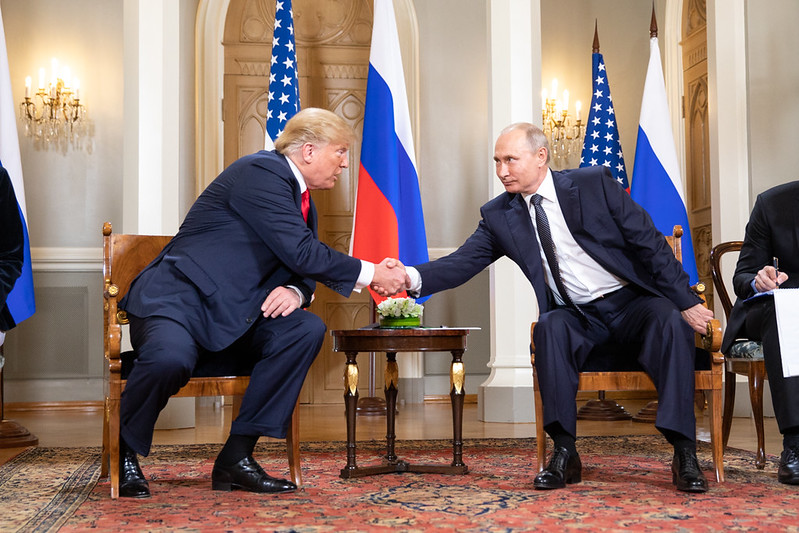
Trump to offer Russia access to minerals for peace in Ukraine


US President Donald Trump and Russia President Vladimir Putin. Credit: Trump White House Archived, under public domain license

The US may offer Russia access to its critical minerals alongside other economic incentives in an effort to bring an end to the war in Ukraine, according to The Telegraph.

The British paper reported on Wednesday evening that US President Donald Trump is prepared to let Moscow tap into its natural resources in Alaska and lift some sanctions on Russia’s aerospace industry. Another key element of the proposal is granting Kremlin access to rare earth deposits in Ukrainian territories currently under Russian occupation.

The deal will likely be presented to Russian President Vladimir Putin during an upcoming meeting in Anchorage, says The Telegraph. The meeting, scheduled for Aug. 15, represents the first between the nations’ leaders since Trump’s re-election in 2024.

US Treasury Secretary Scott Bessent is said to be coordinating the economic package, which could involve joint mining ventures to speed up the development of mineral deposits in Ukraine. The Eastern European nation is said to host significant deposits of critical minerals, most of which are unexplored.

The Ukrainian Geological Survey estimates that its critical minerals account for 5% of the world’s total. Amongst the most prominent are graphite, with 19 million tonnes in reserves, and lithium, for which it holds about a third of Europe’s endowment. Other key minerals featured in the state agency database are copper, lead, zinc, silver, nickel, cobalt, manganese and rare earth elements.

In addition to minerals on the ground, the US deal could also involve giving Russia development rights in the oil and gas-rich Bering Strait, a region estimated to hold 13% of the world’s oil reserves.

UK officials told The Telegraph that the proposed measures may be acceptable to European leaders — many of whom had expressed concerns over Ukraine’s exclusion from the summit.

Ahead of the summit, Trump told Fox News Radio that no comprehensive peace deal will happen without Ukraine’s participation. Meanwhile, European leaders and Ukrainian President Volodymyr Zelenskiy have strongly opposed any agreement that sidelines Ukraine or requires it to cede territory.

Earlier this week, Trump held a video call with Zelenskiy and other European leaders, emphasizing that securing a ceasefire is the top priority of his meeting with Putin.


Trump’s ‘Deadly Serious’ Russia Squeeze Shown in Big Tariffs on Ally India

  • Trump has doubled tariffs on Indian imports to 50% over New Delhi’s continued purchases of Russian oil.

  • The move risks nearly 1% of India’s GDP this year but underscores U.S. determination to coordinate with the EU on sanctions to weaken Russia’s economy and deter its geopolitical ambitions.

  • India, alongside China and Turkey, remains a top buyer of Russian oil, and Washington is preparing similar tariff threats.

“India is not only buying massive amounts of Russian Oil, they are then, for much of the Oil purchased, selling it on the Open Market for big profits,” U.S. President Donald Trump posted last week on Truth Social. “They don’t care how many people in Ukraine are being killed by the Russian War Machine. Because of this, I will be substantially raising the Tariff paid by India to the USA.” These words directly implicate buyers of Russian oil as accomplices in the murder of tens of thousands of Ukrainian people in the war started by the Kremlin on 24 February 2022, as indeed they have been. Had these words been said in 2008 when Europe continued to buy Russian oil after it attacked Georgia, or in 201,4 when the continent continued to buy Russian oil after it annexed Ukraine’s Crimea region, then the 2022 full-scale invasion of Ukraine might never have happened. They were not said, it did happen, but this time around, the U.S. President is looking to the future in his actions today. His seriousness is further underlined by the fact that India – long seen as a key ally to Washington in the Asia-Pacific region – now faces big tariffs. So what does this all mean, and what will happen next?

Slightly in advance of the 8 August deadline imposed by Trump on Russia to make a peace deal with Ukraine, the U.S. doubled its tariffs on India to 50% -- a rate that will come into effect on 27 August. The U.S. is India’s top export market, constituting 18% of its exports and 2.2% of its gross domestic product (GDP). Many of the country’s major exporting firms had already stated that they could not deal with the 25% tariffs, as they are too high to absorb, and passing them on to customers makes their products uncompetitive. Initial analysts’ estimates are that 50% tariffs could reduce India’s GDP by nearly 1% this year. But the U.S. knows all this, which is one of the reasons why it has chosen to do it, according to a very senior European Union (E.U.) energy security source who spoke exclusively to OilPrice.com on the day of the new Indian tariffs announcement. “India is known as a key ally of the U.S. globally, and especially in Asia Pacific, and the thinking is that if he [Trump] is willing to do that to India, then he would be willing to do that to anyone else, and this is absolutely the case – he [Trump] is deadly serious on squeezing Russia’s economy from here,” he said. “The message should not be lost on European countries who might be thinking of easing up on the sanctions being rolled out on Russia from now to December 2027 [when the intention is to end all imports of Russian oil and gas],” he added. Indeed, a closely co-ordinated ramping up of sanctions against Moscow by the U.S. and E.U. is seen by both sides as key to preventing Russian President Vladimir Putin from realising his dream of reconstituting the full scope of the U.S.S.R.’s previous European empire, as analysed in full in my latest book on the new global oil market order. “Trump believes that the continuation of European purchases of Russian oil and gas after the annexation of Crimea, especially in 2014, was key to the Russian action in Ukraine in 2022, as underlined in his comments on the Nordstream gas pipelines [from Russia to the heart of Europe],” he highlighted.

In this context, India has a multi-layered strategic importance to the U.S. The most notable of these is the objective of positioning it as the regional counterweight to China’s economic, political, and military presence in the Asia-Pacific region, as analysed in full in my latest book on the new global oil market order. Washington’s efforts in this regard intensified following the 15 June 2020 clash between Chinese and Indian troops in the disputed territory of the Galwan Valley in the Himalayas, as the U.S. believed this marked a new push back strategy from India against China’s policy of seeking to increase its economic and military alliances through its multi-generational power-grab project, the ‘Belt and Road Initiative’ (BRI). The U.S. further believed that this push back might also be echoed in India’s economic desire to finally make substantive progress on its ‘Neighbourhood First’ policy as an alternative to China’s BRI programme. However, for this to work, India would need access to secure energy sources over the long term, as – like China – it has few oil and gas sources of its own. Indeed, given the potential economic growth projections for India, the International Energy Agency forecast that the Asian sub-continental power would constitute the biggest share of global energy demand growth at 25% in the coming two decades. In fact, the IEA predicted India would overtake the European Union as the world’s third-biggest energy consumer by 2030. It was at this point – in Trump’s first term as president – that the plan was hatched to link this plan to use India to challenge China as Asia’s major power in parallel with a corollary objective to use the UAE to promote further relationship normalisation deals (‘Abraham Accords’) between Israel and key Arab states in the Middle East. This remains a second key reason why India is so important to Washington.

Nevertheless, India – along with China and Turkey – is still one of the biggest buyers of Russia's energy exports three years into Moscow’s war in Ukraine. According to industry figures, last month saw it receive 1.6 million barrels per day (bpd) of oil from Russia, while China imported around 1 million bpd and Turkey about 500,000 bpd. Over the entirety of 2024, China was the largest buyer of Russian oil, at about 2.2 million bpd, followed by India on 1.76 million bpd, and Turkey on 0.3 million bpd. The U.S. has already warned China that ongoing imports of Russian oil could lead to huge tariffs being imposed on the country, according to the E.U. source. “During the talks [end-July U.S.-China trade talks in Stockholm], [U.S. Treasury Secretary Scott] Bessent told his opposite number [Vice Premier He Lifeng] that legislation [‘Sanctioning Russia Act of 2025’] is being drawn up in Congress authorising the imposition of up to 500% tariffs on countries that buy sanctioned Russian oil,” he exclusively told OilPrice.com last week. In reality, the Act goes wider to encompass any country that “knowingly sells, supplies, transfers, or purchases oil, uranium, petroleum products, or petrochemical products that originated in the Russian Federation”. It currently has 84 listed co-sponsors in the U.S. Senate alone, according to the U.S. Congress website, and the Speaker of the House has also indicated his chamber’s support to pass the bill.

The U.S. has also suggested to China that it may treat Beijing’s assistance to Russia in much the same manner as it has started to treat the same for Iran. This was seen in the very recent U.S. State Department announcement on Iran-related sanctions that it would impose sanctions on 20 entities it believes are engaged in trading Iranian oil and petrochemical products, including China’s Zhoushan Jinrun Petroleum Transfer Co., an oil terminal in the greater Zhoushan port area. Under Secretary of the Treasury for Terrorism and Financial Intelligence Brian E. Nelson said of these China sanctions that: “The Iranian regime continues to fuel conflict in the Middle East to fund its destabilizing activities, [and] Today, the United States is taking action to stem the flow of revenue that the regime uses to support terrorism abroad, as well as to oppress its own people.” Zhoushan Jinrun was highlighted by the State Department for: “…knowingly engaging in a significant transaction for the purchase, acquisition, sale, transport, or marketing of petroleum or petroleum products from Iran”. The port is the fourth of China’s to be sanctioned by Washington in recent weeks, following similar actions against Huaying Huizhou Daya Bay Petrochemical Terminal Storage in March, Guangsha Zhoushan in April, and Dongying Port in May. “More is to come,” the very senior U.S. legal source told OilPrice.com at the time of the sanctions announcement and could include a dramatically increased list of blacklisted Chinese officials, businesses, banks, financial houses, ports, ships, and supportive infrastructure to the facilitation of Russian oil imports.

By Simon Watkins for Oilprice.com

Monday, March 17, 2025

AU CONTRAIRE

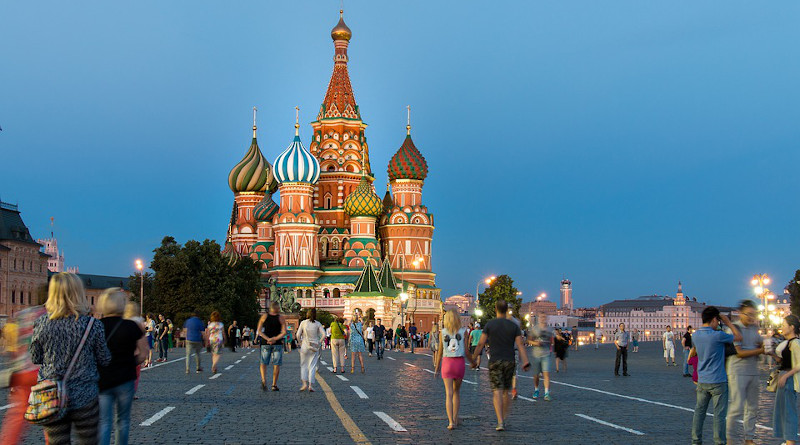
Moscow Red Square Russia Tourism Soviet Union

Western Pundits Should Stop Writing Idiotic Nonsense About Russia’s Economy – OpEd


By 

From an extremely small list, Owen Matthews has been one of the more balanced mainstream commentators on the war in Ukraine. Not seeking to take one side over the other, but to step back and look at the bigger picture.


I was shocked, therefore, by his article in the Independent this week.

The Russian economy is on the brink of collapse, and Putin knows it,’ ran the headline.

I’ve read a different version of the same headline over a hundred times since 2014, including while serving as the Economic Counsellor at the British Embassy in Moscow.

I am still waiting for it to be proved correct.

Firstly, some of the data in Matthews’ article were objectively not correct.


The ‘ruble has lost over half its value since Putin invaded Crimea in 2014.’

Wrong. It is around one third of its spring 2014 value. And as I’ve pointed out many times, a weak ruble has been an explicit article of Russian monetary policy since late 2016, to offset the effect of major energy price swings. That helped Russia pull in record tax receipts in 2022 because of the potent combination of sky high energy prices and rock bottom ruble rate. That’s basic economics.

‘Over $600bn of the Kremlin’s foreign currency reserves have been frozen in Western banks,’

Wrong again. The figure is less than $300bn, and Russia still retains the same value of available reserves, that would cover over a year’s worth of imports.

I could go on but won’t. Matthews is known as an historian, not an economist. I don’t claim to be an economist either, but I can count.

In broad terms, I don’t dispute the economic headwinds that Matthews points to, albeit clumsily. Domestic labour constraints driven by the war and Russia’s secular population decline are a problem. Massive fiscal stimulus is overheating the economy with inflation high. Although I’d argue that 9% isn’t ‘rampant’; one million percent in Venezuela is rampant.

However, Russia has been here before. Inflation breached the 9% mark in November 2014 following the oil price collapse, and didn’t fall below that level until early 2016. It peaked again at the start of the war in Ukraine hitting 18%. Interest rates in Russia now are extremely high at 21% but, again, they were hiked to 17% in December 2014.

It isn’t incorrect for Matthews to point out these legitimate economic challenges. The point is that neither inflation nor interest rates will ever be a strong enough reason for President Putin to change course in Ukraine.

Not now, not in 2014, not at any point since the Ukraine crisis started. He has always chosen to accept economic pain and manage the political consequences of that, to avoid backing down in the face of western economic pressure.

Like so many mainstream pundit, Matthews briefly sketches the economic fix Ukraine is in before hurrying along as if there’s ‘nothing to see here’.

Conveniently, he doesn’t explore the mathematics of how Europe will pay to keep the lights on in Kyiv while also funding Von der Leyen’s $800bn rearmament programme.

Nor has he considered what this would mean for ordinary European citizens who increasingly question the wisdom of funding a forever war that Ukraine cannot win.

Or considered the link between self-defeating war policy of identikit globalist European leaders and the rise in the popularity of anti-war nationalist parties all across Europe.

Owen Matthews doesn’t touch on Ukraine’s looming sovereign default and the collapse of its currency that would follow. Or the concern that, with a structural current account deficit, Ukraine has no way to exist as an independent, sovereign nation, other than, you guessed it, through western state handouts. Nor how the immense cost of bailing Ukraine out would fall on Europe on top of the contingent liabilities already enumerated above.

Rather, Matthews suggests that Europe needs to do more of what is has been doing for the past eleven years without success. More sanctions, even though over 90% of individual sanctions have absolutely no effect.

He doesn’t reflect on the fact that Russia has been under sanctions for eleven straight years, is the most sanctioned country on the planet, and yet is still growing faster than Europe, even though that growth is undoubtedly built on fiscal sand.

Yet still, finally and irrevocably, he suggests Europe could cut itself off completely from Russian gas. No need to dwell on the obvious economic truth that higher-cost energy in Europe is driven by a huge imbalance between supply and demand that neither the U.S. nor Russia experiences. No thought given to the notion that Europe’s deindustrialisation has been accelerated by the political choice to cut off 90% of piped Russian gas supplies.

As every other mainstream British pundit has called for more sanctions and less gas, Owen Matthews has plumped for the easy option too.

Presumably to show some value-added in his low-calorie commentary, Owen Matthews supports Ukrainian drone attacks on any energy infrastructure that facilitates the delivery of Russian gas to Europe. Clearly impressed by the destruction of the NordStream pipeline, like a spotty-faced teenager watching a Seventies Bond movie, he considers industrial terrorism to be a legitimate policy choice for western leaders.

I would like to say that his article was terrible. But in truth, it was no different from practically every other mainstream British Glavlit article on Russia’s economy that I’ve seen over the past eleven years.

And, the thing is, it isn’t that it was littered with data that was objectively untrue.

It was not the not the lack of economic analysis, or the failure to explore the greater economic challenge facing Ukraine.

It was not, even, the crass and frankly dangerous policy prescriptions.

It was that, like so many other journalists I had thought weaker, Owen Matthews was missing the point. Badly, irresponsibly, and idiotically, missing the point.

Despite the very clear economic challenges that Russia does face because of the war in Ukraine, its economy will always be better placed to manage the shock of war than Ukraine’s.

Every argument to punish Russia more will only embolden Putin to keep fighting.

In this war of attrition, Ukraine, and Europe, will run out of money first. And with Trump shutting off the taps of American money, that crunch point will come much sooner.


Ian Proud was a member of HM Diplomatic Service from 1999 to 2023. From July 2014 to February 2019 Ian was posted to the British Embassy in Moscow. He was also Director of the Diplomatic Academy for Eastern Europe and Central Asia and Vice-Chairman of the Board of the Anglo-American School of Moscow.