Showing posts sorted by date for query TransAlta. Sort by relevance Show all posts

Wednesday, October 08, 2025

MAKE ALBERTA GREAT AGAIN

‘It’s not us anymore’: Renewables go from boom to bust in the wind capital of Canada

By The Canadian Press
Published: September 28, 2025 

Power transmission lines and wind turbines as seen with the Rocky Mountains in the background near Pincher Creek, Alta., Thursday, June 6, 2024. 
THE CANADIAN PRESS/Jeff McIntosh

PINCHER CREEK — In Pincher Creek, wind is king, roaring down the eastern Rockies, delivering power for generations, so much so the municipal district made a windmill part of its corporate logo.

Not anymore.

District Reeve Rick Lemire said the windmill image, which sits alongside other Alberta icons on the logo — a wild rose, wheat, a pumpjack and cattle — will soon be erased.

“It’s not us anymore,” Lemire said in an interview.

There are few places where the wind blows as hard and as often as it does in Pincher Creek, where clusters of windmills tower over farmland, with mountains in the distance.


But in a few short years, new rules and changing attitudes have delivered a sharp pivot away from wind projects.

The biggest push has come from Premier Danielle Smith’s government, which put a short-term moratorium on renewable energy projects in 2023 before introducing new rules on where they can go.

Regulations forbid renewable energy developments within a 35-kilometre buffer zone from the Rocky Mountains, which applies to Pincher Creek, mainly on the grounds of preserving jaw-dropping Prairie viewscapes. The restrictions only apply to renewable energy projects.

Rohit Sandhu, spokesperson for Alberta’s department of affordability and utilities, said exemptions are available for wind projects currently in the buffer zone and the Alberta Utilities Commission can approve new projects on a case-by-case basis.

The commission declined to comment on the matter.

The district has more than 255 turbines producing nearly 511 megawatts of energy, says a third-party report commissioned last year by the town and district.

The issue is also about money.

Lemire said stopping renewable development means lost revenue down the line if companies can’t repower their wind farms once existing ones reach the end of their life.

About 30 per cent of the district’s budget relies on revenues from renewable electricity generation, says analysis by the Pembina Institute think tank, and landowners also collect a percentage of revenue generated by each turbine.

Despite the potential profit lost, Lemire said he believes residents are willing to take the hit.

“We’re starting to slide,” he said of the district’s renewable energy revenues. “We’re coming down — we understand that. Administration knows that.”


Lemire said residents soured on wind projects years before the moratorium took effect, because they found new transmission lines connecting turbines to the grid to be unsightly. But he said if the aging turbines are allowed to be replaced by fewer yet more efficient models, everyone wins.

Wayne Oliver, an intergeneration supervisor at TransAlta Corp. and a town councillor in Pincher Creek, agreed. Repowered wind farms, he said, would also likely have fewer turbines that produce the same amount of electricity and continue to provide revenues to the district.

While residents aren’t keen on new turbines, Oliver said, they’re on board with an improved status quo.

“The people that live around that Castle River wind farm with 60 turbines, when they hear that six or seven turbines can replace that, they get excited,” he said.

A spokesperson for TransAlta said it’s continuously assessing the future of existing facilities but couldn’t comment on specific sites.

Oliver, a resident of Pincher Creek for over 30 years, said he finds it remarkable how quickly times have changed in a few years.

“It popped a bubble,” Oliver said of the renewable moratorium. “It just shows you the power of government policy to change the direction of society.”

Will Noel, a senior analyst at the Pembina Institute, said what the industry needs is certainty. Noel wrote in a recent report that about 11,000 megawatts of renewable energy projects were cancelled in 2024.

He said modernization and consolidation can work.

“This is a great middle ground,” Noel said. “We’ll get rid of 40 turbines and put up 10 new ones — that’s a quarter of the turbines you have to look at, and you’re getting the same kind of power.”

Lemire said while you never say never on once again going big on wind, the district’s gusty love affair has likely peaked.

“We all agree that windmills are enough. That may change ... it can switch,” said Lemire, who is running for re-election this fall.

“(But) we’re gonna go back to where we started: agricultural.”

This report by The Canadian Press was first published Sept. 28, 2025.

Matthew Scace, The Canadian Press

Friday, September 26, 2025

World Nuclear News

Twenty-year renewal sees Darlington become longest-licensed Canadian plant


As the refurbishment of the Darlington nuclear power plant nears completion, the Canadian nuclear regulator has announced it is authorising the plant to continue operating until 2045.

(Image: OPG)

The Canadian Nuclear Safety Commission (CNSC) said it made its decision to renew the licence for the four-unit Candu plant after considering submissions from Ontario Power Generation (OPG), CNSC staff and 79 intervenors during a two-part public hearing held earlier this year, saying it concluded that "OPG remains qualified to carry on the activities that the renewed licence will authorise".

There are no changes to OPG's licensed activities under the renewed licence, the CNSC said, although the decision includes a requirement for OPG to provide two comprehensive performance updates to the Commission on the conduct of its licensed activities, as well as a new licence condition that requires OPG to continue its engagement with Indigenous Nations and communities throughout the licence period.

Candu units are pressurised heavy water reactors designed to operate for 30 years before refurbishment. Refurbishment is a major undertaking: it includes the replacement of key reactor components such as steam generators, pressure tubes, calandria tubes and feeder tubes, and involves removing all the reactor's fuel and heavy water and isolating it from the rest of the power station before it is dismantled. Thousands of components are inspected before the plant is rebuilt and is ready for another 30 years of operation.

Three of the four units at Darlington are currently in operation, having undergone refurbishment. The fourth unit is due to return to service in 2026, completing a 10-year execution phase which OPG says has exceeded all safety, quality, schedule, and financial forecasts.

"The longest-ever licence term for a Canadian nuclear station reflects the strong performance of the Darlington station, the proficiency of our highly skilled workers, and OPG's continued commitment to safety and operational excellence," OPG President and CEO Nicolle Butcher said. "Under this licence, Darlington will continue to safely and reliably produce electricity to help meet Ontario’s energy needs for decades to come."

The plant's current licence expires on 30 November.

Study confirms feasibility of Xe-100 SMR for Alberta


The study by X-energy Canada has confirmed the feasibility and benefits of repurposing an existing thermal generation site in Alberta with X-energy's small modular reactors, and establishes a foundation for further planning and regulatory engagement to support future deployment.
 
TransAlta's Keephills thermal plant in Alberta has been converted from coal to natural gas (Image: TransAlta)

The study was funded by Emissions Reduction Alberta through the Government of Alberta's TIER fund, and conducted with TransAlta, Hatch, PCL, and Kinectrics. It found "significant alignment between the province's unique energy and industrial profile and the attributes of the Xe-100" and identified areas where X-energy's technology can directly support the province's energy economy and long-term competitiveness.

It found that the Xe-100 high-temperature gas-cooled reactor is uniquely suited to Alberta's energy needs. As well as producing electricity, it is specifically designed to provide 565°C heat and steam for industrial applications, unlocking a broad range of use cases for Alberta's industrial and oil and gas sectors, the company said. The province's established supply chain capabilities are well-positioned to support the manufacturing and construction of the technology, while the Xe-100's design means it can use air-cooling systems, significantly reducing overall water usage, and offering greater siting flexibility over conventional light-water reactors.

Canada gets about 15% of its electricity from nuclear power with 17 reactors, mostly in Ontaria, providing 12.7 GWe of power capacity. Alberta does not have any nuclear power capacity, but in 2021 the province signed a memorandum of understanding with Ontario, New Brunswick and Saskatchewan to collaborate on small modular reactor (SMR) development, and has signed MoUs with several SMR developers. Energy Alberta has proposed building a nuclear power plant based on large-scale Candu Monark reactors at a site in the Peace River area of Northern Alberta.

In August, the province launched a public engagement initiative and public survey about nuclear energy's potential to meet future energy needs, with Alberta Premier Danielle Smith saying the government sees "tremendous potential" for nuclear in the province.

"Alberta is uniquely suited to leverage the benefits of the Xe-100 with a strong industrial base, skilled workforce, and unmatched energy expertise,". X-energy's Senior Vice President and Deputy Chief Commercial Officer Ben Reinke said. "We look forward to working with provincial and community leaders to explore Xe-100 applications in the province, and its potential to support critical Canadian industries with clean, reliable, and safe energy."

X-energy Canada is a subsidiary of X-energy Reactor Company, LLC. X-energy is advancing the Xe-100 as a grid-scale energy solution for utilities, industrial customers, and hyperscalers. Its first proposed plant at Dow's Seadrift site in Texas will provide the site with both power and high-temperature steam. Following that project, X-energy and Amazon have committed to deploy 5 GW by 2039, beginning in Washington state with Energy Northwest. X-energy has also recently announced an agreement with Centrica to deploy 6 GW in the UK.

TransAlta Corporation is one of Canada's largest publicly traded power generators, owning and operating a diverse fleet across Canada, the United States and Western Australia. The company completed the phaseout of all of its Canadian coal-fired generating capacity in 2021, when it converted the third unit of its Keephills power plant in Alberta from thermal coal to natural gas. The company retired some 3,794 MW of coal-fired generation capacity in Canada between 2018 and 2021.

IAEA issues fresh warning over drones near nuclear plants


The International Atomic Energy Agency has said drones flew within a few hundred metres of the South Ukraine Nuclear Power Plant, underlining the continued risks to nuclear safety from the on-going war. Meanwhile Zaporizhzhia Nuclear Power Plant continues to have to rely on emergency diesel generators after a loss of off-site power.
 
A file photo of the South Ukraine NPP (Image: Energoatom)

International Atomic Energy Agency (IAEA) experts stationed at the three-unit South Ukraine nuclear power plant were told that 22 unmanned aerial vehicles were observed on Wednesday night and Thursday morning within its monitoring zone, "some coming as close as half a kilometre from the site", the agency said.

"From their accommodation near the plant, IAEA team members heard gunfire and explosions around 01:00 am local time and today (Thursday) they visited the location where one of the drones had come down, observing a crater measuring four square metres at the surface and with a depth of around one metre," the agency's statement said.

"Once again drones are flying far too close to nuclear power plants, putting nuclear safety at risk. Fortunately, last night’s incident did not result in any damage to the South Ukraine Nuclear Power Plant itself. Next time we may not be so lucky. I continue to urge both sides to show maximum military restraint around all important nuclear facilities," IAEA Director General Rafael Mariano Grossi said.

"For more than three and a half years, the IAEA has been doing everything in its power to help prevent a nuclear accident during this devastating war. We will only be able to say that our mission was successful if the war ends without a serious nuclear accident. Our indispensable work is far from finished."

Meanwhile Zaporizhzhia Nuclear Power Plant has been without external power for more than 48 hours and has been relying on its fleet of emergency diesel generators. The IAEA said "the plant said it has the necessary spare parts and personnel to repair the line once the military situation permits. Ukraine has informed the Agency that it is also prepared to repair damages to a backup power line, when the military situation permits".

Following the loss of off-site power all 18 available emergency generators started operating, with the number reduced to those required to provide power to the site - seven - helping to preserve the diesel fuel. The IAEA has been told previously that 20 days' worth of fuel was stored at the site.

Zaporizhzhia Nuclear Power Plant has been under Russian military control since early March 2022 and is on the frontline of Russian and Ukrainian forces.

New nuclear financing models need to be developed, says Putin


Russia’s President Vladimir Putin has told World Atomic Week in Moscow that he sees peaceful nuclear technologies "as the basis for international cooperation and bringing states closer together".
 
(Image: Kremlin)

Speaking on the first day of the event, the president noted the projected increase in demand for new nuclear capacity in the coming decades and said "the growth in demand for peaceful nuclear energy will be driven largely by countries in the Global South and East, which are strengthening their technological and industrial potential".

He said that Russia supported these countries' ambitions, and said Russia rejected "so-called technological colonialism. We don't make our partners dependent on Russian technical solutions. Instead, we help them create their own sovereign national nuclear industry, including training personnel and establishing centers of excellence".

He said that it was "equal access to technology, including in the peaceful nuclear sector, that can ensure dynamic, yet equitable, and sustainable global development ... we view peaceful nuclear technologies as a foundation for broad international cooperation and for bringing states closer together".

The president also talked about finance, saying: "It is clear that the construction of nuclear power plants requires significant resources, which means the risks and benefits must be balanced among the main participants in such projects - states, investors, and consumers. I believe it is essential to develop modern models for financing the construction of nuclear power plants and to involve international financial institutions and development banks in such projects.

"I would like to add in this regard that earlier this year, the New Development Bank, created by the BRICS countries, confirmed its readiness to finance nuclear projects." (BRICS is a multilateral organisation of emerging economies with current members being Brazil, Russia, India, China, South Africa, Egypt, Ethiopia, Iran, Indonesia, Saudi Arabia and the United Arab Emirates).

He referred to estimates that, in the very long term, uranium resources were finite, and said Russia aimed to "launch the world's first nuclear energy system with a closed fuel cycle" in Tomsk, which would see 95% of used fuel reused repeatedly in reactors, thus helping solve the issues of radioactive waste and also of uranium resources.

The World Atomic Week International Forum, marking the 80th anniversary of the Russian nuclear industry, is taking place in Moscow from 25-28 September. A series of deals and announcements were made on the first day including:

  • Rosatom and the Beijing Research Institute of Uranium Geology signed an agreement providing access to, and exchange, of information on field testing at the Beishan Underground Research Laboratory, relating to the final disposal of high-level radioactive waste in underground repositories.

  • Rosatom and the Ethiopian Electric Power Corporation signed an action plan for developing a nuclear power plant project in Ethiopia. It creates a working group to prepare a roadmap for a feasibility study and intergovernmental agreement.

  • A contract was signed between Rosatom and the Belarusian Nuclear Power Plant Unitary Enterprise to cover the 'blanaced nuclear fuel cycle' at the Belarus plant - with Russian companies taking and reprocessing used fuel and Belarusian companies then accepting the reprocessed fuel.

  • Rosatom Technical Academy signed a memorandum of understanding with Myanmar's  Yangon Technological University, which provides for the development of "joint educational programmes, the exchange of curriculum and teaching materials, as well as joint research on advanced nuclear facilities and participation in international projects".

  • Altynbek Rysbekov, Deputy Minister of Energy of Kyrgyzstan, said the country was working with Rosatom "to determine which areas could [be] suitable for a nuclear power plant and what capacity it should have", according to the in-house Strana Rosatom publication.

  • Russia's Rosatom and Iran's Atomic Energy Organisation signed a memorandum of understanding for cooperation in the building of small modular reactors in Iran. 

International Atomic Energy Agency Director General Rafael Mariano Grossi was among those attending World Atomic Week, and he also held talks with President Putin at the Kremlin, focusing on a range of issues including on-going safety concerns about the Zaporizhzhia and other nuclear power plants amid the war between Russia and Ukraine.

On financing, the IAEA leader proposed a memorandum of understanding between the agency and the BRICS' New Development Bank. The organisation has arranged a similar partnership with the World Bank since it ended its longstanding ban on investing in nuclear energy-related projects. 

Centrus announces plans for Piketon expansion


The major expansion of Centrus Energy's uranium enrichment plant in Ohio is expected to boost production of both low-enriched and high-assay low-enriched uranium.
 
(Image: Centrus)

The plan was unveiled by Centrus Energy alongside Ohio Governor Mike DeWine, Senator Jon Husted, Congressman Dave Taylor, JobsOhio, Ohio Southeast Economic Development (OhioSE), and Pike County Economic Development. The expansion is expected to create 1,000 construction jobs and 300 new operations jobs at the site: JobsOhio and OhioSE will be long-term partners to Centrus as the company ramps up recruiting and hiring to fill those positions.

The size and scope of the expansion will depend on federal funding decisions for low-enriched uranium (LEU) and high-assay low-enriched uranium (HALEU), Centrus said, but noted that a large-scale expansion "would represent a multi-billion-dollar private and public investment into Ohio."

Centrus said it has already raised more than USD2 billion over the past 12 months through convertible note transactions and secured more than USD2 billion in contingent purchase commitments from utility customers in the USA and around the world in anticipation of the expansion. It has also announced collaborations with Korea Hydro & Nuclear Power and POSCO International to potentially invest in the project.

The company has submitted proposals to the US Department of Energy as part of a competitive selection process for potential awards to expand domestic production of LEU for existing reactors and HALEU for advanced reactors. Subject to being selected for the federal funding, Centrus's expansion plans call for a multi-billion-dollar public and private investment to add thousands of additional centrifuges at its American Centrifuge Plant to deliver large-scale production of both LEU and HALEU, it said.

The company will manufacture its centrifuges in Oak Ridge, Tennessee. The centrifuges and supporting equipment will then be sent to Piketon for final assembly, installation and operation.

"The time has come to restore America's ability to enrich uranium at scale," said Centrus CEO Amir Vexler. "We are planning a historic, multi-billion-dollar investment right here in Ohio - supported by a nationwide supply chain to do just that. When it comes to powering our energy future, it's time to stop relying on foreign, state-owned corporations and start investing in American technology, built by American workers."

"Centrus's commitment to expand and upgrade its Piketon facility underscores Ohio's importance in supporting our nation's economic and national security," Ohio Governor Mike DeWine said. "Uranium enrichment operations in Piketon have played a critical role in US national defence since the earliest days of the Cold War, and Centrus' facility provides the only technology available today capable of building out domestic enrichment at an industrial scale."

Centrus has already begun hiring in anticipation of the expansion.

PM Modi inaugurates Mahi Banswara nuclear project


The four-unit Mahi Banswara plant is one of a host of central and state governmental projects ceremonially inaugurated by India's Prime Minister Narendra Modi in Rajasthan.
 

PM Modi at the ceremony (Image taken from PM India Youtube)

The Mahi Banswara Rajasthan Atomic Power Project will comprise four 700 MWe pressurised heavy water reactors (PHWRs) designed by Nuclear Power Corporation of India Ltd (NPCIL), and is part of India's fleet mode initiative to build ten identical 700 MWe reactors at various locations across India under uniform design and procurement plans, an approach the Indian government says will bring in cost efficiencies and speed deployment, while consolidating operational expertise.

The Mahi Banswara units are to be developed under Anushakti Vidhyut Nigam Ltd (Ashvini), a joint venture between NPCIL and National Thermal Power Corporation (NTPC). Formation of the 51% NPCIL:49% NTPC joint venture set up to construct, own and operate nuclear power plants in India received approval from the government last year.

Earlier this year, India's Atomic Energy Regulatory Board (AERB) gave its consent to NPCIL for the siting of the reactors, near the village of Napla, the first major stage in its licensing process for a nuclear facility. That consent was transferred to Ashvini earlier this month.

The other reactors that make up the ten planned units are Kaiga units 5 and 6 (in Karnataka), Gorakhpur units 3 and 4 (Haryana), and Chutka units 1 and 2 (Madhyar Pradesh). Two 700 MWe PHWR units at Kakrapar, in Gujurat, are already in commercial operation. Another, Rajasthan unit 7, was connected to the grid in March, and construction is ongoing on Rajasthan unit 8.

The foundation stone laying ceremony in Banswara saw the Prime Minister inaugurate some INR1,22,100 crore (USD18.8 billion - 1 crore is 10 million) of projects. As well as the nuclear power plant, these included INR19,210 crore of solar projects and three power transmission projects worth over INR13,180 crore, as well as substations and other infrastructure projects.

"In today's era of technology and industry, development runs on the power of electricity; electricity brings light, speed, progress, connectivity, and global access," Modi said at the ceremony. For any nation to achieve rapid development in the 21st century, it must scale up its electricity generation, he said - and the most successful countries will be those leading in clean energy. "Our government is transforming the clean energy mission into a people's movement", he added.


Fermi America Secures Siemens Energy Deal for 1.1 GW Gas and Nuclear Tech

Fermi America, in partnership with the Texas Tech University System, has signed two letters of intent with Siemens Energy to secure 1.1 gigawatts of gas-fired generation equipment and collaborate on advanced nuclear steam turbine technology, marking a major step in the company’s plan to develop an 11 GW energy campus tailored to artificial intelligence (AI) demand.

The agreements, signed in New York, call for Siemens Energy to deliver three F-class SGT6-5000F gas turbines—capable of producing up to 1.1 GW in combined cycle mode—for delivery in 2026. These machines are designed for round-the-clock, base-load power, and add to Fermi’s total of 2 GW of secured or contracted natural gas generation capacity for its site.

The second agreement expands collaboration on Siemens’ nuclear steam turbines, generators, and control systems. These would be integrated into Fermi’s nuclear portfolio, which is expected to include four Westinghouse AP1000 reactors. Siemens Energy has previously modernized turbine systems at several U.S. nuclear plants, underscoring its role in supporting new nuclear deployment.

Fermi America’s 11 GW campus is being positioned as a flagship energy hub to meet surging demand from AI and high-performance computing. The company is pairing quickly deployable natural gas plants with long-term nuclear generation, aiming to provide highly reliable, always-on power without burdening the broader U.S. grid.

The project is being promoted as central to the Trump administration’s energy dominance agenda, which prioritizes expanding domestic natural gas generation, accelerating nuclear licensing, and securing strategic energy infrastructure for the AI economy.

“Winning the AI arms race doesn’t just take software developers. It takes more electricity,” said Doug Burgum, chairman of the National Energy Dominance Council. Former U.S. Secretary of Energy and Fermi co-founder Rick Perry added that the federal government is working closely with private-sector partners to ensure the U.S. leads in both AI and energy capacity.

Fermi America CEO Toby Neugebauer said the company is delivering on President Trump’s directive to build “highly reliable, unshakable base load energy” through its gas-nuclear buildout.

The Siemens Energy agreements reinforce a broader push to revive the U.S. nuclear industrial base, expand natural gas capacity, and ensure energy reliability for the data-driven economy. If completed, the 11 GW campus would be one of the largest integrated gas and nuclear power projects in the U.S.

By Charles Kennedy for Oilprice.com


Giant Oil Trader Begins Physical Trading In Uranium

  • Switzerland-based Mercuria has been increasingly investing in the metals business in recent years, using profits it raked in from high oil prices a couple of years ago.

  • The World Nuclear Association has predicted that demand for nuclear fuel will double by 2040 as technology companies scramble for energy to support AI and governments pursue zero-carbon targets.

  • Giant oil and gas trader Mercuria reportedly has begun physical trading in uranium, becoming the first major commodity company to do so.

Giant oil and gas trader Mercuria reportedly has begun physical trading in uranium, becoming the first major commodity company to do so, according to Reuters. If officially confirmed, which it has not been, it will mean that Mercuria joins the ranks of Wall Street banker Citibank, Natixis (part of French financial group BPCE) and other deep-pocketed traders who are betting on a nuclear energy boom driven by surging global electricity demand.

The World Nuclear Association has predicted that demand for nuclear fuel will double by 2040 as technology companies scramble for energy to support AI and governments pursue zero-carbon targets. 

Switzerland-based Mercuria has been increasingly investing in the metals business in recent years, using profits it raked in from high oil prices a couple of years ago. The uranium market is still small compared to commodities like oil, natural gas, copper, and aluminium, which are the forté of Mercuria, Trafigura, Glencore, and other large commodity traders.

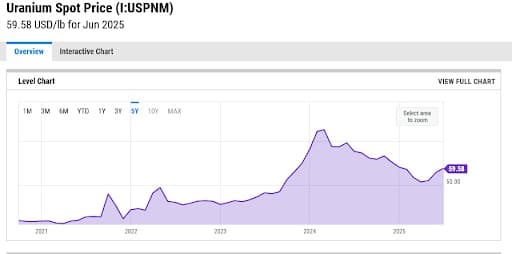
According to UxC, global utility demand for Uranium Oxide Concentrate (U3O8) clocked in at 175 million pounds in 2024, with 47 million pounds traded on the spot markets. Uranium prices have surged in recent years thanks to the global energy crisis. Citi analyst Arkady Gvorkyan has predicted that spot prices will hit $100 per pound in 2026 as miners struggle to keep up with the demand. Prices have pulled back from the all-time high of $106 reached in February 2024.

Source: Y-Charts

The uranium market is experiencing a structural supply deficit, creating potential challenges for nuclear operators. Unlike many commodities, uranium trading usually involves small volumes with specialized participants, making the nuclear fuel susceptible to significant uranium market volatility. Meanwhile, governments across the globe are repositioning nuclear as critical infrastructure rather than transitional tech.

Related: Iraq Expects Kurdistan Oil Exports to Restart This Week

These developments have forced uranium equities to re-rate sharply, with investors now recalibrating exposure to a sector long dismissed as too volatile, too political, or having an uncertain future. While uranium and nuclear stocks have pulled back from recent highs, the sector remains red-hot: the sector's popular benchmark, VanEck Uranium and Nuclear ETF (NYSEARCA:NLR) has returned 68.3% YTD, more than triple the 19.8% gain by the usually high-flying Technology Select Sector SPDR Fund (NYSEARCA:XLK), 6.4% by the Energy Select Sector SPDR Fund (NYSEARCA:XLE) and 12.5% by the S&P 500.

Uranium and nuclear stocks have easily outpaced the market : shares of advanced fission power plant developer, Oklo Inc. (NYSE:OKLO), have rocketed 459.4% in the year-to-date; Centrus Energy (NYSE:LEU) 357.1%, Energy Fuels Inc. (NYSE:UUUU) 235.9.4%, NuScale Power Corp. (NYSE:SMR) 112.0%, Uranium Energy Corp. (NYSE:UEC) 98.8%, Cameco Corp. (NYSE:CCJ) 66.8%, NANO Nuclear Energy (NASDAQ:NNE) 66.6%, BWX Technologies (NYSE:BWXT) 58.9%, VistraCorp. (NYSE:VST) 47.4% and NexGen Energy (NYSE:NXE) 34.0%.

Shares of California-based Oklo have been on a tear, gaining 1,340% over the past 52 weeks after the company announced a flurry of data center deals. Back in July, Oklo unveiled a partnership with Liberty Energy (NYSE:LBRT)wherein they will develop an integrated power solution for data center applications incorporating Oklo's Aurora powerhouse with Liberty's natural gas generation. The power plan will start with Liberty’s natural gas systems delivering quick energy. before shifting to Oklo’s clean nuclear generation over the long-term. 

Around the same time, Oklo announced a partnership with Vertiv (NYSE:VRT) that will see them join forces to revolutionize data center operations. “This agreement is about delivering clean power, energy-efficient cooling, and infrastructure solutions purpose-built for AI factories, data centers, and high-density computers,” said Oklo CEO and co-founder Jacob DeWitte. Oklo later revealed that it was selected for three of the U.S. Department of Energy’s reactor pilot projects, part of the DoE’s initiative to modernize and streamline nuclear licensing.

Bank of America has downgraded Centrus' shares to Neutral from Buy but raised its price target to $285 from $210, citing valuation concerns after the huge runup. Centrus achieved the 900-kilogram production milestone of HALEU for Phase 2, and confirmed a contract extension with the DOE through June 2026. HALEU, or High-Assay Low-Enriched Uranium, is a type of nuclear fuel enriched to between 5% and 20% Uranium-235. This is a higher concentration than the low-enriched uranium (LEU) used in most current reactors (3-5%), but lower than the highly enriched uranium (HEU) used in naval reactors and weapons. HALEU is crucial for the development of advanced nuclear reactors, particularly small modular reactors (SMRs) and microreactors, due to its potential for increased efficiency, smaller reactor designs, and longer refueling intervals.

By Alex Kimani for Oilprice.com

Wednesday, September 24, 2025

TWO GOOD LOCAL HISTORY SITES FOR LEFT WING ALBERTA


Dec 20, 2022 — The Hunger March of 1932 is inextricably linked to the material and socio-economic conditions of Alberta during the Great Depression.

by Poundmaker staff member, Eugene (Devil inside) Plawiuk.13 In contrast to ... founding meeting of Canada's first national socialist party, the CCF, was held.
368 pages' 


Monday, May 02, 2016

THE ALBERTA NDP THE PARTY OF OIL WORKERS

THE COINCIDENTAL BIRTH OF THE NEW DEMOCRATS AND THE OIL INDUSTRY IN ALBERTA

Rachel Notley warned New Democrats that adopting the LEAP manifesto which demands the end of oil extraction from the Tar Sands as well as conventional and shale gas plays, and NO pipelines, would put the Eastern arm of the party in direct conflict with a party that is proudly Albertan and directly involved in the oil industry history in the province even more so than the long ruling party the PC’s.

It was the development of oil and energy in Alberta that created new wealth and a new industrial province after WWII. The discovery of oil not only brought the oil industry but also the oil and energy workers union, a small American union that had an arm in Alberta, the Oil Chemical and Atomic Workers OCAW. In Alberta it was beginning its organizing of workers in the field and in the new gas and chemical plants being built between Edmonton and Fort Saskatchewan.

This was the post war boom, the party in power was Social Credit, and while  there was no NDP there was an active labour political movement housed in the AFL and Edmonton Trades and Labour Council, members belonged to the Communist Party, the CCF and some still belonged to the OBU and IWW.

Edmonton had a history of electing labour council members as Mayor, Aldermen (women), school board trustees and Hospital Board members. Elmer Roper  longtime labour activist, CCF activist and candidate, owner of ABC Printing and publisher of Alberta Labour News would be elected Mayor of Edmonton after the creation of the NDP by the merger of the CCF with the newly created post war Canadian Labour Congress.

The sixties saw the growth of the labour movement in Canada and in Alberta, including the creation of an active movement of organizing public sector workers, provincially, municipally and federally. The Federal Workers Union originating in Calgary would merge with the Ontario based National Workers Union to create what we know as the Canadian Union of Public  Employees, the Civil Service Union of Alberta would become a union known as the Alberta Union of Provincial Employees.

But throughout the oil boom of the fifties and sixties the union most associated with the provincial NDP was the Oil Chemical and Atomic Energy Workers Union under the leadership of Neil Reimer and his assistant Reg Baskin

That’s right the party was brought to life in Alberta by Oil Workers in the provinces new Energy market. Its first party leader was Neil Reimer, who would meet a charismatic young politician a contemporary of Peter Lougheed and Joe Clark at the University of Alberta, Grant Notley who would go on to become party Leader and its first elected MLA.

Notley himself did not represent Edmonton but his home region, the oil rich north of Alberta, the Grand Prairie, and Peace River riding.

As it had since 1936 the Social Credit party of Alberta held power in the province as a one party state, under the permanent leadership of Premier Ernest Manning, Preston’s daddy.  The New Democratic Party of Alberta focused its energy not only on consolidating union power in the party as well as the voices of the left and progressives but in challenging that Social Credit domination of Alberta Politics.

This was also the time of the Cold War and the Anti Communist Witch Hunts, a time being anti war, anti nuclear war, pro labour, was considered suspect. Where union members who were left wing were exposed to police spying, where padlock laws in Quebec had been used to raid imprison and steal property belonging to those accused of opposing the Duplesis regime or who were suspect of being Reds.

Duplessis ‘s party in Quebec aligned with that provinces Federal Social Credit Party which was aligned with Alberta’s Party as well. In both provinces the left faced one party dictatorship which reminded many despite their democratic trappings of the forces they had been fighting against in WWII.

As in Alberta it would be the post war labour movement in Quebec under Louis Lebarge that would mobilize politically as well as economically against the Old Regime, his right hand was a young activist lawyer named Pierre Eliot Trudeau. And like Alberta they were building a provincial and national party; the Liberals.

This then is the historical basis for the differences between the left in Quebec and the rest of Canada and why it took so long to breech these two solitudes, as was done in 2012 under Jack Layton and the federal NDP.

Premier Rachel Notley, the daughter of Grant Notley, the first NDP MLA ever elected to the Legislature, the first opposition member elected against the Social Credit party of Ernest Manning  had this rich history as her prologue at this week’s national NDP Convention in Edmonton where the party adopted the LEAP manifesto which challenges the very energy economy that makes Alberta a modern industrial state.

This province created the NDP under the leadership of  Neil Reimer, an oil worker and oil union organizer.  Neil was the first leader of the Party, and Reg Baskin was his right hand in their union and the party.

Neil also created the modern Canadian Energy Workers union,  Neil and Reg first represented oil workers in the new industry in the province with the OCAW  oil chemical and atomic workers of Canada, which had one other base of expansion; Louisiana.  He and Reg made it the Canadian Energy Workers Union, which became CEP merging with the Canadian Paper workers unions in BC, and now has consolidated with CAW to create UNIFOR.

Neil’s daughter was Jan Reimer two term Mayor of Edmonton during the 1990’s and while party labels are not used in Edmonton municipal elections everyone knew that we had an NDP mayor.

Meatpackers, a union that disappeared in the eighties with amalgamation of the meat packing industry into a smaller and smaller oligopoly, was a militant base of union workers and activists including communists and socialists, that was a large base for the party, as was Plumbers and Pipefitters Local 488.

These were the post war unions that were the party’s base in Edmonton and across the province. Federally the postal workers were a strong backbone for the Federal Party, though there were two separate unions at that time, letter carriers and inside workers, the latter being more left wing and militant with OBU IWW communist, socialist and Trotskyist activist workers.

It was the discovery of tar sands oil that led to the growth of the province, the union and the NDP. It was also this discovery and its needed development during the Arab Oil Crisis of 1971 that led to the end of the Social Credit government, its movement, but not its essence. In its place came the newest members of the Alberta Legislature elected in 1967 for the first time, the Lougheed Progressive Conservatives. They would be joined by Grant Notley and the NDP in opposition in 1968, when Grant won a by-election in Spirit River.

The “Progressive” element in the Lougheed PC’s represented the post war Liberal base among the non Anglo ethnic communities in Edmonton and Calgary, such as the recent post war immigration of Ukrainians, Italians, Portuguese, Greek, European, Asian, and Displaced Peoples. The Liberals had no political existence in Alberta since they were wiped out by the United Farmers/ Labour Party coalition in 1921.

Even Lougheed’s conservatism was not the neo conservative Austrian school embraced by the republican lite Preston Manning cons of today, it was classical liberal capitalism, that progressive aspect of capitalism that sought to ameliorate through regulation what short comings capitalism itself may suffer from despite its idealism of being the ‘ideal’ system.

The history of the Alberta NDP is the history of the Oil Workers and the Oil Industry in Alberta, even more than it is for the current batch of Conservatives provincial or federal.  The NDP in Alberta grew up with the oil industry with its workers and their union. For the Alberta NDP to reject both the LEAP manifesto and those call for the end of pipelines is natural and should have been expected by those who know the party history in the province.

For those who fail to understand this historic base of the party in Alberta fail to understand the social democratic politics of the oil industry, the NDP has long supported a form of nationalization under public ownership and increased workers control through unionization.

This occurred in the case of Suncor which was the earliest of the oil sands operators, before the Syncrude conglomerate was created.  In the early seventies after the Lougheed government promoted the oil sands, Suncor began mining operations.  Neil Reimer’s new Canadian Energy and Paperworkers union, CEP, got its birth in a long and bitter historic strike at the Suncor operations.

CEP went on to organize refineries in Edmonton, Sherwood Park and Fort Saskatchewan.
It tried but failed to organize Syncrude due to its conglomerate ownership and its concerted anti union efforts over the decade of the seventies into the eighties. Today unionized Suncor has bought out Syncrude so this situation opens it up to unionization decades later.

The seventies and eighties saw massive growth in the province including growth in both private and public union membership.

This also saw the success of the NDP and the left in Edmonton. While Grant Notley was a lone NDP member in Alberta Legislature, Edmonton saw a left wing U of A Prof David Leadbeater elected alderman.  Notley was joined in the house by Ray Martin, from Edmonton.
The NDP elected Ross Harvey its first federal MP from Alberta in the eighties from the old packing plant and union district of Edmonton Beverly. This was at the height of the Arab Oil Crisis of early eighties, which the Conservatives in Calgary blamed on the NDP Liberal National Energy Plan, NEP, which included the creation of the Canadian Publicly Owned Oil and Gas Company PetroCanada.

PetroCanada was a success and saved Calgary and the Lougheed Government during this oil crisis, it was able to buy up, nationalize, American oil companies like Gulf Mobile, Texaco, Chevron,  as well as smaller Canadian and American oil companies that were going broke or bailing out of Calgary heading back to Dallas and Huston.

And CEP was there to unionize it. Today PetroCanada is no more the Liberals privatized during the Austerity crisis of the Nineties, and Paul Martins Liberal Government sold off the last of our shares prior to the 2006 election.

Ironically it is Suncor that bought them and then bought up PetroCan and absorbed it., just as it has done with its competitor Syncrude.

It would be during the late eighties and early nineties that under Ray Martin the NDP would gain a record number of seats, going from 2 to 23 and status of official opposition. But by the time of the middle of nineties and the Austerity panic of debt and deficit hysteria and the birth of the neo conservative movement that two city Mayors, Ralph Klein of Calgary and Lawrence Decore of Edmonton would battle it out for Premier of the Province, Klein for the PC’s and Decore for the Liberals. Both ran on Austerity budgets, one promised massive cuts the other brutal cuts. It was a close election the losers were the NDP who were wiped out as a third party.

In Edmonton we had a new NDP mayor to replace Decore, Neil’s daughter Jan Reimer, joined by another leftist alderman the bus driver Brian Mason. The NDP centred itself in Edmonton at this time and got elected the enormously popular  team of Pam Barrett and Raj Pannu.
The CEP was critical in supporting the NDP at this time, including having its past president Reg Basking become leader of the Party.

After the shocking early death of party leader Pam Barrett, former alderman Brian Mason ran in her riding, Highlands, which also covers the Federal riding of Beverly that Ross Harvey once represented and won her seat in the house. Raj Pannu became the first Indo Canadian leader of an NDP party in Canada.  After he stepped down Brian Mason became the leader of the party.
The party went from four seats to two to four until Brian stepped down and the party elected Grant Notley’s daughter, Rachel Notley, who had sat in the house with Brian through all those ups and downs in electoral success.

The party base is the labour movement and left across the province and no less important unions such as CEP, IBEW, Carpenters and UA488 all involved in the oil sands and the petrochemical industry in Alberta.

So why are the various wags and pundits surprised when the Alberta NDP does not LEAP off the edge of a cliff named STOP PIPELINES, STOP DIRTY OIL.

In the finest of social democratic traditions, the Alberta NDP will do no such thing nor should it be expected to. It will ameliorate the worst of the environmental damages that the fossil fuel industry has and can be expected to cause. They will create a green plan, and expand the carbon fuel tax the PC’s brought in.

 It will do what the conservatives would not do, and that is eliminating Alberta’s Socred PC dirty energy economic backbone: coal. And that is the real dirty energy in Alberta, coal fired utility plants. These plants are evenly divided between private ownership, with state support from the ruling Socreds and PC’s, TransAlta Utilities, and publicly owned municipal utilities EPCOR and ENMAX. TransAlta is the original P3 funded by taxpayers under the Socred and spun off to become a private company where government cabinet members retire to the board of.

Even Lougheed was tied to the coal industry representing his old employer Mannix Inc, as a board member of Luscar Coal, which during the nineties created a major controversy with its efforts to mine outside of Jasper National Park.

Contrary to Greenpeace and other environmentalists who claim oil sands are the dirtiest energy the real dirty energy on the Palliser Plains of Alberta and Saskatchewan is coal.

Coal is the dirtiest fossil fuel that needs to be kept in the ground. There is no such thing as clean coal!

There is however clean petrochemical fuels, that is the nature of refining, creating finer and finer grades of hydrocarbons; ethenes, benzenes, oil and gas for plastic production, diesel etc.
That is the reason for both the Joffre and Scotford massive refining projects and the plan for the heartland refining project, which would allow the province to crack and refine bitumen into secondary and tertiary hydrocarbons.

That is what the future of the energy is in Alberta, stopping the use of coal, refining hydrocarbons and shipping them south, east, and west.

Why would the NDP limit the provinces ability to ship what it processes.

As I have pointed out the pipeline west will probably go through the Peace River Athabasca highway route to Prince Rupert, which coincides with BC Site C dam development and its LNG  pipeline development, giving pipeline companies an alternative to going to Kitimat via the BC Sacred Bear Rainforest.

Energy East will be built and the NDP will promote as it did in the eighties, the idea that Alberta energy for a fair price should go east. What occurred instead was it was shipped to refineris in Ontario and Quebec at discounted prices where it was refined and sold to the US while oil was imported from the Middle East.

This was the original idea of the NEP that the NDP and Liberals promoted to Lougheed, and he agreed to! And like the NDP this was his vision for Alberta oil before he died.
While the LEAP manifesto is suitably left wing green etc, even shudder, anti capitalist ( read anti corporations) it is not something either the labour movement or NDP in Alberta will agree to do much more about than debate. Debate will be welcome, dictat not so much.

LEAP like most environmentalism today fails to take into consideration that even if workers had control of publicly owned energy companies, we would still be producing hydrocarbons, and will be even after the glorious Socialist Revolution.

The dirtiest energy causing climate change is not oil sands in Alberta or Venezuela it is coal and wood burning worldwide.  That is the challenge we face to shut down coal, and wood burning, not to accept the myth of Clean Coal, and to make sure we ameliorate environmental damage caused through hydrocarbon production.

You want to keep something in the ground its coal, and the biggest fight back in Alberta today is the utility lobbies who oppose the Alberta NDP Government ending of coal fired utilities.

In Alberta the NDP is the party of oil and oil workers. Never forget it. The old Social Credit of Preston Manning’s daddy’s day and the PC’s of Lougheed Klein were both parties of coal.

Not Your Usual Left Wing Rant

No Taxes for the working class. That should be the watchword of the Left.

Left blogger a Class Act bemoans the state of the Canadian left on his blog. He says; "
When is the left going to quit trying to be like its opponents,and begin to define itself by it's own actions and ideology?Give the people a real choice,a choice that stands for something,but above all principaled."

Exactomundo. When the Reform party was created it based itself not on the neo-conservatism of the Reaganites but on Western Canadian populism, a populism based on the Left. Recall, referendum, the attack on taxation, were all antebellum left wing causes at the begining of the 20th Century.

Socialism as Class Act calls it. It included the ideology of the producer republic, Georgism in the United States, the Cooperative Commonweal in Canada and the UK. It included syndicalism for the working class, and producer cooperatives for farmers and small producers. It was anti-monopoly and anti-rentier, pro land ownership. See 
Rothbard’s Reds Redux


Socialism at the begining of last century was not yet tainted with Bolshevism. And I use that term deliberately to distinguish it from communism. For within the anarchist and statist socialist movements were movements of communism, which went farther and further in their critique of capitalism than the anti-state socialists did.

Unfortunately the socialist dream, or vision, was lost in the coming forth of the social democratic movement and its statist ideal of the welfare state. Far from dying at the end of WWI in Canada the CCF called for social revolution, as did many of the socialists of the day. They still had only had a small taste of government, in this case the Socialist Party of Canada had been crucial to maintaince of power for the provincial Liberals in B.C, in the last days of fin de sicle 19th century.

The Socialist movement in Canada coalesced around the CCF, the Communist party and the OBU. With the destruction of the later and the success of the former in gaining political power provincially and representation federally came the end of the extra parlimentary left in Canada.

By the 1960's the CCF and the labour movement had purged the radicals and were now liberal social democratics just like their German predecesors of the century before.

The extra-parliamentary left was centred around the anti-Nuclear Bomb movement, Our Generation magazine, and what could be loosely called an anarchist left. One that was sceptical that state power could change anything.

Today the NDP and its social democratic ilk are really liberals in a hurry. And thus the plight that Class Act finds us in. We go back to the orginal debate between State Socialists and Anti-State Socialists. Is socialism a set of principles and and ideal to strive towards or is it the pragmatic logic of gaining state power.
It is of course the former since the latter has been a historic failure.

Since I of course do not believe it is the latter, I hardly consider the NDP or even the Trade Unions on the left. That is they cannot concieve of a program of workers and community control that is a radical challenge to the corporate/financial and state monopoly. They in effect are , as the left communists call them, the left hand of capitalism. They merely wish to ameliorate the worst excesses of capitalism while maintaining the status quo.

Expect no real answers from them on how to change or challenge the system.

But thank goodness the long march to Ottawa by the neo-conservative right in Canada has finally ended in a minority government. Because they too called for a revolution in politics as usual. And they too have ended up being no such thing, just business as usual.

Where the left failed during the past two decades was to see that what Reform had harnassed was a real grass roots disgruntlement of the working class towards politics as usual. Not always reactionary, it was based on feeling powerless and wanting to feel in power over our own lives.

The Left never got it. Whenever the NDP called for taxing the rich, the guys in the Alberta Gas Plants, unionized, and paid overtime saw it as an attack on their wages. It didn't matter that the NDP meant the Rich, as in the 1% of Canadians that own all the wealth, or the corporations, their message was lost on the working class. And for good reason.

We hate taxes. We love services. And we will pay for services, but we hate taxes. And why shouldn't we, over the past fifty years the federal and provincial tax base has moved from the corporations to picking the pockets of you and me.

The NDP finally realised this simple fact during the 2004 election and during the last sitting of the house. They called for more tax breaks for the working class. But because this runs counter to their state socialism, they were faint hearted in their calls, faint hearted in their attack on the Liberals and Conservatives as parties of the rich and entrenched power. The so called special interests.

The fact is that the Conservative government in Ottawa is about to launch a massive assault on the working class through taxation.

They will fund their 1% GST cut by eliminating tax breaks the Liberals brought in. They will give out a baby bonus that will be taxed. They will fail to transfer funds to day care programs clawing them back.


The Left should be calling for no taxation for anyone who earns $100,000 a year or less. Period. That is the mass of the working class in this country.

No party currently will call for this and for the elimination of user fees and the GST. For these are the little taxes that hurt, the death by a thousand cuts that so irritate each and every wage slave in Canada.

Tax the Corporations NOT the People, should be the watchword of the Left. Want Daycare and Medicare, the corporations should pay, out of pre tax profits. It is social capital that they directly benefit from in their bottom line, its what makes them competitive against the American capitalist model.

Eliminate all corporate tax loopholes. Eliminate offshore investment havens for the Rich. And in the process this will eliminate the Tax Department.

The Left should attack the failure of the Reformers, who are still out there as the recent Fireweed Forum on Democracy showed, and the parliamentary reformers,
to address the real issue of political reform in Canada.

The need for real democracy, directly elected revocable delgates to constiuent assemblies. To the right to referndum, to a renewal of Canada as constitutional confederation of the people not a con job. See my
 Abolish The Senate

On economic renewal we should be calling for the creation of peoples banks, the deregulation of banking from the hands of the State into the hands of the people as pools of capital for usage with institutional pension funds and workers investments to build small and medium sized worker/producer cooperatives.
See 
Michael Alberts Economic Participatory Democracy project; Parecon.

This deregulation would also eliminate large banks as holders of capital in the national interest. That role should be continued by the Bank of Canada, which delegated it to the national banks twenty years ago under the Mulroney Conservatives.

We don't need a state in Canada we need a confederation of peoples and communities in a federal system not of Trudeau's making or Harpers but in the Proudhonist model of self government.


And this cannot be done through electoral means, it takes a social revolution. The Reform party tried to do this from the Right and the NPI and other attempts to reform the NDP did it on the left and the result is Jack Layton and Stephen Harper. Nothing changed.

So Class Act I agree with you that the Left needs renewal. And the Left needs first to divorce itself from the existing liberal social democratic parliamentary mileu.
Then and only then will it become an authentic voice for Canadians who are frustrated and pissed off with the system as it is. We have been told to embrace change for twenty years by the neo-cons as they privatized public services. That change for change sake ideology is deeply embedded in all of capitalism corporate and managerial structures now. It gives us a window to challenge the very system of capitalism with a real Left agenda of People Power.


Also see:

Unite the Left
A Peoples Program for Alberta

Left, Right and Liberty

State-less Socialism

Social Credit And Western Canadian Radicalism

Rebel Yell

Plutocrats Rule

WRITTEN IN 2006

 
LA REVUE GAUCHE - Left Comment: Search results for OBU ALBERTA