Showing posts sorted by date for query lèse-majesté. Sort by relevance Show all posts

Sunday, August 24, 2025

Opinion

The spectacle of moral hypocrisy: When America condemns South Africa


August 23, 2025
MEMO


President Donald Trump hands papers to South African President Cyril Ramaphosa during a meeting in the Oval Office of the White House in Washington, DC, on May 21, 2025. [Photo by JIM WATSON/AFP via Getty Images]

by Junaid S. Ahmad


Picture an empire so insecure that it hurls thunderbolts at a mid-sized African democracy for daring to think independently. That empire, draped in self-anointed moral authority, is the United States. Its newest villain? South Africa. In Washington’s theater of indignation, South Africa has been transformed from an ally recovering from apartheid into a subversive force guilty of lèse-majesté against American supremacy. What follows is not policy—it’s performance art. Except the actors are armed, and the tickets cost nations their sovereignty.

The theater of “white genocide”

The opening act came with the myth of “white genocide.” President Trump, in peak reality-TV mode, waved around fabricated images of murdered white farmers to Cyril Ramaphosa. The images turned out to be fake—one wasn’t even from South Africa. Yet this spectacle was swallowed whole by the American right, who suddenly discovered a deep concern for land rights abroad (while, back home, treating Indigenous treaties like quaint museum pieces).

Washington then bestowed refugee status on about sixty Afrikaners. Sixty. As if America had single-handedly airlifted a threatened population to safety. It was virtue-signaling with visas, the geopolitical equivalent of putting a “thoughts and prayers” hashtag on Instagram.

Tariffs: The punishment disguised as policy

When South African farm exports to the US surged—citrus, apples, wine, nuts—the US responded not with applause but with a 30 per cent tariff. Washington called it trade policy; in reality, it was a hissy fit disguised as economics.

The absurdity is glaring: America, a nation that loves to sermonize about “free markets,” suddenly pulls a protectionist about-face the moment a Global South country dares to compete. Free trade, yes—but only when America wins.

Foreign aid: Now you see it, now you don’t

Then came the vanishing act with USAID. Programs supporting HIV/AIDS were gutted, vaccine trials defunded, thousands of healthcare workers cast aside. A country still battling the world’s largest HIV epidemic saw critical support yanked away—not because South Africa suddenly cured AIDS, but because Washington decided sulking was a foreign policy tool.

It wasn’t just cruel; it was cowardly. Pulling out of health programs in a country with 7 million people living with HIV is not policy—it’s malpractice. But then again, nothing says “we care about your people” quite like abandoning them mid-pandemic.

Diplomacy as a contact sport

Diplomatic relations? Torched. South Africa declares the U.S. ambassador persona non grata after his undiplomatic tantrums. Naval drills with Russia and China become grounds for Washington to clutch its pearls, as if the Atlantic were still a British lake.

And neutrality on Ukraine? Unacceptable. In Washington’s worldview, “neutral” is just another word for “enemy.” One either parrots the script or faces the wrath. For a country that loves to extol freedom, the US has a peculiar allergy to nations exercising it.

The BRICS boogeyman

When South Africa joined BRICS, the American establishment lost its collective composure. Suddenly, a pragmatic choice to diversify partnerships became a grand betrayal. The audacity of South Africa seeking multipolarity was treated like treason.

BRICS wasn’t seen as an economic club but as an underground conspiracy—like a Marvel villain’s secret society, except with trade agreements and development banks instead of laser beams. Washington’s paranoia revealed more about its fragility than South Africa’s intentions.

The genocide charge that shook Washington

But nothing provoked greater American fury than South Africa dragging Israel to the International Court of Justice for genocide. For Washington, this was blasphemy. Israel is not a country to be judged but a state to be shielded, indulged, and excused.

South Africa’s history of dismantling apartheid gave it a moral authority that Washington could not tolerate. How dare Pretoria call out the grotesque violence of a fellow settler-colony? How dare it reveal that moral standards cannot be monopolized?

This was not just inconvenient; it was unforgivable. America’s entire moral economy depends on casting genocide as something only adversaries commit. South Africa punctured that illusion, turning the empire’s favorite accusation back on its favorite protégé. For Washington, it wasn’t law—it was heresy.

The Anglo-American war on BRICS

And here lies the heart of the matter: South Africa’s real offense is not its land reform policies, its neutrality, or its Hague petition. Its crime is being the final thorn in America’s side—the last “S” in BRICS.

The Anglo-American elite have already gone to war, figuratively and literally, with the other members. Russia is sanctioned into the Stone Age, China is tariffed and contained, Brazil is toyed with through political intrigue. India is tolerated, but only because Washington imagines it can be conscripted into the anti-China brigade.

That leaves South Africa. And so begins the Anglo-American war on BRICS. Aid cut, tariffs imposed, narratives spun, and diplomats unleashed with all the subtlety of sledgehammers. Washington cannot abide multipolarity; to them, it’s not competition but treason. Only one can win.

History echoes. Nasser and the Suez Canal. The Non-Aligned Movement smeared as Soviet puppets. Iraq shattered for daring to sell oil in euros. Libya turned into rubble for proposing an African gold dinar. And now South Africa, punished not for its sins but for its seat at a table the West cannot control.

BRICS, to Washington, is not an economic pact—it’s mutiny. And the punishment for mutiny is always the same: isolation, vilification, subversion.

The farce of structural contradiction

South Africa wants economic cooperation with the West but political independence abroad. Washington sees this as betrayal. In reality, it’s called sovereignty. But to US policymakers, sovereignty is a right reserved only for themselves and their allies.

The contradiction is not South Africa’s—it’s America’s. To demand absolute loyalty from countries it simultaneously undermines is not diplomacy; it’s delusion.

Domestic pressures, external pressure, no winners

Domestically, South Africa’s policies reflect a legacy of anti-imperial struggle and deep inequality. Washington doesn’t care. Instead, it courts fringe protest groups, amplifies the white farmer myth, and portrays redistributive justice as barbarism.

Trade becomes conditional on dismantling affirmative action, diplomacy becomes contingent on submission, and the net result is mutual erosion. South Africa loses critical partnerships; America loses credibility. A lose-lose masquerading as strategy.

History repeats, but with worse actors

In Apartheid days, at least the US could pretend its “constructive engagement” was about stability. Today, it’s pure theater. Aid cuts, tariffs, finger-pointing, and outrage are deployed not for principle but for petulance.

It is empire as improv comedy: unpredictable, over-the-top, and embarrassingly self-indulgent. Except the laugh track is replaced by real human suffering.

Conclusion

So let us be clear. America’s war on South Africa is not about morality, democracy, or rights. It is about monopoly. It is about policing the boundaries of empire. It is about crushing the final member of BRICS to preserve a world where the US plays referee, judge, and executioner all at once.

The tragedy—for America—is that the performance no longer convinces. The more Washington sermonizes, the more it exposes itself as a hypocrite in decline, a superpower confusing intimidation for influence.

South Africa, with all its flaws, has done something extraordinary: it has refused to bow. It has reminded the world that sovereignty is not granted by Washington but inherent to nations.

And in that act of defiance lies the true provocation. For what empires fear most is not war or poverty or instability. What they fear is irrelevance.

Thursday, July 31, 2025

Shock, chaos and a hollow win: Chasing a tariff deal with Trump

Jonathan Head
BBC
South East Asia correspondent in Bangkok
JULY 31, 2025


Export-driven economies like Thailand have been scrambling for a trade deal to avoid President Trump's steep tariffs


When US President Donald Trump made his dramatic tariff announcement on 2 April, nowhere was the shock greater than in South East Asia, a region whose entire world view and economic model is built on exports.

The levies went as high as 49% on some countries, hitting a range of industries from electronics exporters in Thailand and Vietnam to chip makers in Malaysia and clothing factories in Cambodia.

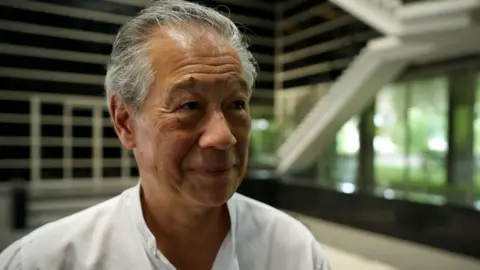
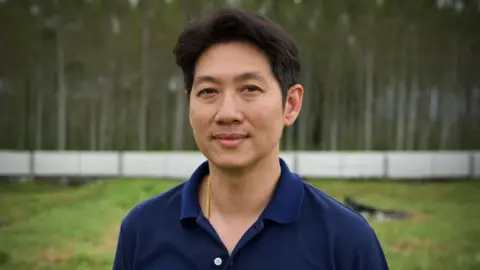
"I remember waking up in the morning. It was quite early, and seeing him standing there on the White House lawn with his board. I thought: 'Did I see that right? 36%? How could it be?" says Richard Han, whose father founded Hana Microelectronics, one of Thailand's biggest contract manufacturers.

Thailand, which was facing a 36% levy, now has a deal, like most of its neighbours, to reduce the tariffs to 19%.

The negotiations went down to the wire, finalised just two days before the deadline Trump had set - 1 August. It has been a fraught process getting there, and there is still very little detail about exactly what has been agreed.

Live Updates: 


Richard Han says the 36% levy on Thailand was a "shock"

The 10 countries in Asean, as the South East Asian regional bloc is known, exported $477bn (£360bn) worth of goods to the United States in 2024. Vietnam is by far the most exposed economy, its exports to the US totalling $137bn, making up about 30% of its GDP.

No surprise then that the Vietnamese government was first off the block to negotiate with the US, and the first in the region to do a deal to cut the punishing 46% rate Trump had imposed on them.

According to the US president, the deal cuts the tariffs to 20%, while he claims Vietnam will now impose no tariffs at all on any imports from the US. Tellingly, the Vietnamese leadership has said nothing about the deal.

There are no details, no written or signed documents, and some reports suggest Vietnam does not agree with Trump's numbers. But they set the bar for other countries in the region.

Indonesia and the Philippines followed with deals reducing their tariffs to 19%, although neither country depends much on exports to the US.

Thailand does export a lot to the US. Last year they earned it more than $63bn, about one-fifth of its total exports. Thailand too should have been at the head of the queue in Washington, pleading for a reduction in the 36% tariff Trump had designated for it.


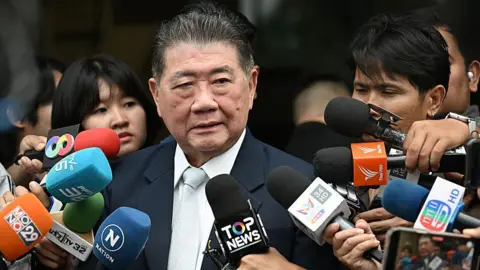
Thailand's acting Prime Minister Phumtham Wechayachai took office after the last PM stepped down over a political scandal

But Thailand is not Vietnam, a one-party communist state where critical decisions can be made quickly by a few leaders, with little need to worry about the opinions of businesses or the public.

Rather, like South Korea and Japan, whose deals came after much wrangling despite them being staunch American allies, Thailand too has to contend with domestic politics and public opinion. Thailand also has a weak and fractious coalition government, beholden to a range of vested interests.

Worse still, decisions it took which were entirely unrelated to trade angered the US side.

In February it sent 40 Uyghur asylum-seekers who had been stuck in Thailand for more than a decade back to China, defying warnings by the US Secretary of State Marco Rubio. One Thai trade official told the BBC the US negotiators were still bringing up the Uyghurs as a grievance at tariff talks in May.

Then a regional army commander filed a lèse-majesté complaint against a US academic, resulting in him being jailed and then forced to leave Thailand. So, far from being at the front, Thailand found itself at the back of the queue.

The other difficulty facing the Thai trade team was what the US was asking for in return for cutting the tariff rate, in particular access to Thailand's agricultural market, which is heavily protected.

Food is big business in Thailand. CP Group, one of the world's agribusiness giants, is the biggest company in the country. This US demand was painful for Thailand.

"Vietnam opened a Pandora's box," says another Thai trade official. "By offering zero percent tariffs on all US imports, they make it hard for those of us who can't easily open up all sectors to US competition."


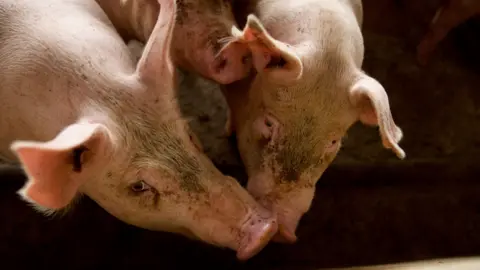
Zero tariffs on US pork imports would be a blow for Thailand's pig farms

Three hours' drive from Bangkok, in Nakhon Nayok, Worawut Siripun keeps 12,000 pigs – an important business in Thailand; Thais eat a lot of pork. He is active in the Thai Swine Raisers Association, and has been lobbying against eliminating tariffs on US pork.

"US farmers produce on a much bigger scale than us, and their costs are lower. So, the price of their pork will be lower, and domestic farmers won't be able to survive."

Access to the agricultural market was also a sticking point in negotiations with Japan, which sought to protect its rice farmers, and continues to be one of the main hurdles with India.

In Thailand, it is presumed that agribusiness giants like CP have also been lobbying against US demands to open up other sectors like poultry and corn. There have been fractious meetings between the trade team and cabinet ministers after every round of tariff talks in Washington, the BBC understands.

Worawut Siripun says he cannot compete with US farmers who produce a lot more

But on the other side are Thailand's manufacturers, who represent a much larger contribution to GDP than agriculture. They badly needed a deal.

"If we get 36% then it's going to be terrible for us," said Suparp Suwanpimolkul, deputy managing director of SK Polymer, before the deal was announced. The company makes a bewildering array of components from rubber and synthetic materials, for washing machines, fridges, air conditioners.

"I guarantee you would find at least one of our products in your home," he said.

SK Polymer was founded by Suparp and his two brothers in 1991. Its story is the story of modern Thailand, originating from their father's small family business, but riding the explosive growth of global trade which has been the foundation of Thailand's economy.

They are an integral part of a complex supply chain, where their products join other components from multiple countries to make consumer, industrial or medical goods for export. About 20% of the company's income comes from the US, but the number is much higher when products which contain its components are included. The Trump tariffs have thrown a spanner in the works.

"We have small margins," said Suparp. He said they could still manage with tariffs up to 20% or even 25% by cutting costs. When he spoke to the BBC, before the deal was announced, he said the uncertainty was the biggest challenge: "Please - to our government, just get the deal, so we can plan our business."

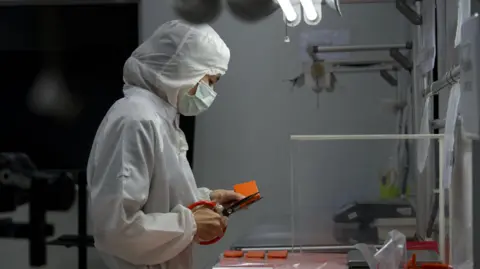
A worker at SK Polymer, which makes rubber products for export to the US

A 20% levy is also palatable for electronics manufacturers, a big industry in Thailand.

"If all of us in this region end up with around 20% our buyers won't seek alternative suppliers – it will just be a tax, like VAT, for US consumers," says Richard Han, CEO of Hana Microelectronics. The company makes the basic components that go into everything in our digital lives: printed circuit boards, integrated circuits, RFID tags for pricing.

Mr Han says only about 12% of his products go to the US directly, but like SK Polymer the proportion that goes indirectly, as part of other manufactured goods, is much higher. But it is not just the tariff number that worries him.

His concern is trans-shipment, the US charge that China is avoiding tariffs by routing its production through South East Asia. Already Vietnam, according to President Trump, will pay 40% - double the new tariff rate - on goods the US judges to be trans-shipped.

Both Thailand and Vietnam saw foreign investment increase significantly after tariffs were imposed on China in the first Trump term, and their exports to the US rose as well. Some of that was Chinese companies moving production; some was products using a lot more Chinese-made components. And they are not just from China.

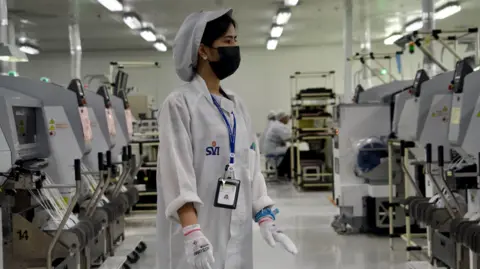
At another electronics manufacturer, SVI, robots glided up and down the assembly line bringing hundreds of tiny components to assemble circuit boards in machines that cost hundreds of thousands of dollars. A quick look at the labels showed the components came from Malaysia, the Philippines, Taiwan and China.

SVI makes security cameras, bespoke amplifiers, medical equipment, to whatever specification their customers, who are mainly in Scandinavia, want. Thailand's vital manufacturing sector is part of an immensely complex global supply chain which is almost impossible to rearrange to meet the US president's demands.

Under WTO rules a product is considered local if at least 40% of its value is added in the local manufacturing process, or if it has been "substantially transformed" into a new product, the way an iPhone becomes something different once it has been assembled.


Electronics manufacturer SVI is one of many Thai companies that sits at the heart of a complex global supply chain

The Trump administration pays no heed to WTO rules, and it is not clear what will be counted as trans-shipped, but Mr Han fears this could prove a bigger problem for Thai companies than the standard tariff rate if the US insists on more local components, or fewer from China.

"South East Asia relies very heavily on China," he explains. "China, by far, has the largest supply chain for electronics and many other industries, and they are the cheapest.

"We could buy materials from another part of the world. It would be a lot more expensive. But it would be virtually impossible for Thailand or Vietnam or the Philippines or Malaysia to get a very high threshold, say 50-60%, made within that country. And if that is the condition to get the US certificate of origin, then nobody's going to get the certificate of origin."

For the moment very few of these details have been revealed. Despite President Trump claiming he has got zero percent tariffs for US goods coming into the Philippines and Indonesia, both those countries have said this is not correct, and that much still needs to be negotiated.

For the Thai government, having started so late, and struggled to meet US demands, just getting a deal will have been a relief.

They will worry about how to make the deal work later, as the details are worked out, which typically takes years. And in that, they are far from alone – rich and developing economies alike are scrambling to keep up with Trump's mercurial tariff policy.

"At some point this has to stop. Surely it has to stop?" Mr Han says. "The trouble is, we don't know what the rules of the game are going to be, so we're all milling around, just waiting to find out how to play the new game."

PHOTOS BBC/ Lulu Luo 

Trump hits dozens of countries with steep tariffs, including 35% for Canadian goods


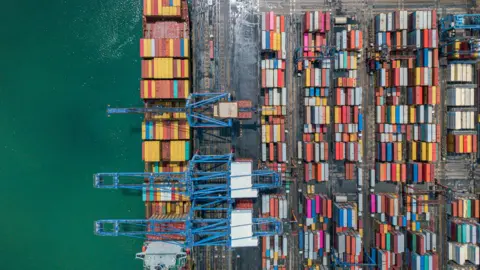
A drone view shows a vessel docked during a day of commercial activity at the port of Manzanillo, in Manzanillo, Mexico, Dec 14, 2023.
PHOTO: Reuters file

REUTERS
PUBLISHED ON July 31, 2025 


US President Donald Trump slapped dozens of trading partners with steep tariffs ahead of a Friday (Aug 1) trade deal deadline, including a 35 per cent duty on many goods from Canada, 50 per cent for Brazil, 25 per cent for India, 20 per cent for Taiwan and 39 per cent for Switzerland.

Trump released an executive order listing higher import duty rates of 10 per cent to 41 per cent starting in seven days for 69 trading partners as the 12.01am EDT (12.01pm in Singapore Time) deadline approached. Some of them had reached tariff-reducing deals and some had no opportunity to negotiate with his administration.

The order said that goods from all other countries not listed in an annex would be subject to a 10 per cent US tariff rate.

Trump's order said that some trading partners, "despite having engaged in negotiations, have offered terms that, in my judgement, do not sufficiently address imbalances in our trading relationship or have failed to align sufficiently with the United States on economic and national-security matters."

Trump issued a separate order for Canada that raises the rate on Canadian goods subject to fentanyl-related tariffs to 35 per cent from 25 per cent previously, saying Canada had "failed to co-operate" in curbing fentanyl flows into the US.

The higher tariffs on Canadian goods contrasted sharply with Trump's decision to grant Mexico a 90-day reprieve from higher tariffs of 30 per cent on many goods to provide more time to negotiate a broader trade pact.

A US official told reporters that more trade deals were yet to be announced as Trump's higher "reciprocal" tariff rates were set to take effect.

"We have some deals," the official said. "And I don't want to get ahead of the President of the United States in announcing those deals."

Regarding the steep tariffs on goods from Canada, the second largest US trading partner after Mexico, the official said that Canadian officials "haven't shown the same level of constructiveness that we've seen from the Mexican side."

The extension for Mexico avoids a 30 per cent tariff on most Mexican non-automotive and non-metal goods compliant with the US-Mexico-Canada Agreement on trade and came after a Thursday morning call between Trump and Mexican President Claudia Sheinbaum.

Trump hits Brazil with tariffs, sanctions but key sectors excluded


"We avoided the tariff increase announced for tomorrow," Sheinbaum wrote in an X social media post, adding that the Trump call was "very good."

Approximately 85 per cent of US imports from Mexico comply with the rules of origin outlined in the USMCA, shielding them from 25 per cent tariffs related to fentanyl, according to Mexico's economy ministry.

Trump said the US would continue to levy a 50 per cent tariff on Mexican steel, aluminium and copper and a 25 per cent tariff on Mexican autos and on non-USMCA-compliant goods subject to tariffs related to the US fentanyl crisis.

"Additionally, Mexico has agreed to immediately terminate its Non Tariff Trade Barriers, of which there were many," Trump said in a Truth Social post without providing details.

Korea deal, India discord

South Korea agreed on Wednesday to accept a 15 per cent tariff on its exports to the US, including autos, down from a threatened 25 per cent, as part of a deal that includes a pledge to invest US$350 billion (S$453 billion) in US projects to be chosen by Trump.

But goods from India appeared to be headed for a 25 per cent tariff after talks bogged down over access to India's agriculture sector, drawing a higher-rate threat from Trump that also included an unspecified penalty for India's purchases of Russian oil.

Although negotiations with India were continuing, New Delhi vowed to protect the country's labour-intensive farm sector, triggering outrage from the opposition party and a slump in the rupee.

Trump's rollout of higher import taxes on Friday comes amid more evidence they have begun driving up consumer goods prices.

Commerce Department data released Thursday showed prices for home furnishings and durable household equipment jumped 1.3 per cent in June, the biggest gain since March 2022, after increasing 0.6 per cent in May. Recreational goods and vehicles prices shot up 0.9 per cent, the most since February 2024, after being unchanged in May. Prices for clothing and footwear rose 0.4 per cent.
Tough questions from judges

Trump hit Brazil on Wednesday with a steep 50 per cent tariff as he escalated his fight with Latin America's largest economy over its prosecution of his friend and former President Jair Bolsonaro, but softened the blow by excluding sectors such as aircraft, energy and orange juice from heavier levies.

Read Also

Pakistan says deal concluded with US on tariffs, Trump cites oil reserves agreement


The run-up to Trump's tariff deadline was unfolding as federal appeals court judges sharply questioned Trump's use of a sweeping emergency powers law to justify his sweeping tariffs of up to 50 per cent on nearly all trading partners.

Trump invoked the 1977 International Emergency Economic Powers Act to declare an emergency over the growing US trade deficit and impose his "reciprocal" tariffs and a separate fentanyl emergency.

The Court of International Trade ruled in May that the actions exceeded his executive authority, and questions from judges during oral arguments before the US Appeals Court for the Federal Circuit in Washington indicated further scepticism.

US Treasury Secretary Scott Bessent said earlier that the United States believes it has the makings of a trade deal with China, but it is "not 100 per cent done," and still needs Trump's approval.

US negotiators "pushed back quite a bit" over two days of trade talks with the Chinese in Stockholm this week, Bessent said in an interview with CNBC.

China is facing an August 12 deadline to reach a durable tariff agreement with Trump's administration, after Beijing and Washington reached preliminary deals in May and June to end escalating tit-for-tat tariffs and a cut-off of rare earth minerals.


Read Also

Trump says US, India still negotiating after 25% US tariff threat


Source: Reuters


Trump modifies tariff rate for Lesotho to 15% as small country reels from tariff impacts


Workers execute their duties at the Afri-Expo Textile Factory, which makes clothing for the US market, on the outskirts of Maseru, the capital of Lesotho, July 9, 2025.
PHOTO: Reuters file

PUBLISHED ONJuly 31, 2025 

The small African country Lesotho received a modified tariff rate of 15 per cent Thursday (July 31) from US President Donald Trump as the nation continued to reel from high tariffs the administration had threatened to implement earlier this year.

In an executive order, Trump modified reciprocal tariff rates for dozens of countries, including Lesotho, which had been under threat of a 50 per cent rate since April, the highest of any US trading partner.

The Trump administration defended its tariff rate on the mountain kingdom in Southern Africa as reciprocal, stating that Lesotho charged 99 per cent tariffs on US goods.

Lesotho officials have said they do not know how the White House arrived at that figure.

After announcing the barrage of reciprocal tariffs in April, the administration paused implementation to give countries time to negotiate.

Under the tariff threat and uncertainty, many US importers cancelled orders of Lesotho-produced textiles, leading to mass layoffs.

"If we still have these high tariffs, it means we must forget about producing for the US and go as fast as we can... (looking for) other available markets," Teboho Kobeli, owner of Afri-Expo, which makes jeans for export, told Reuters earlier this year.

DURING THE 1990'S LESOTHO WAS COLONIZED BY CHINESE CLOTHING MANUFACTURERS WHO BUILT THE COUNTRIES INDUSTRIALIZED INFRASTRUCTURE 
ON JAN 1, 2000 THE WTO ALLOWED CHINA TO JOIN THUS AVOIDING THE PREVIOUS DECADES OF TARIFFS THAT WERE AVOIDED BY COLONIZING LESOTHO
THE MORNING OF JAN 1 LESOTHOIANS AWOKE TO A COUNTRY DESTITUTE OF CHINESE AND THEIR FACTORIES!!!

Saturday, July 19, 2025


OUTLAW LESE MAJESTE

Thai activist lawyer Anon Nampa faces over 29 years in prison over ‘Royal Insult’

Anon Nampa

A protester (center) standing in front of the Criminal Court on July 8, 2025, holding a picture of Anon Nampa (Photo by Ginger Cat). Source: Prachatai, content partner of Global Voices

This article was published by Prachatai, an independent news site in Thailand. An edited version has been republished by Global Voices under a content-sharing agreement.

Human rights lawyer and activist Anon Nampa has been sentenced to 2 years and 4 months in prison on charges of royal defamation and sedition, bringing his total prison sentence to 29 years and 1 month.

He was charged with royal defamation, sedition, participating in a gathering of more than 10 persons, and causing a breach of peace, as well as violations of the Emergency Decree, the Communicable Diseases Act, and the Public Assembly Act for participating in the November 17, 2020, protest in front of parliament to demand constitutional amendments.

Thai Lawyers for Human Rights (TLHR) reported that the court found Anon guilty of royal defamation because it believed that, when he mentioned selfies and putting on an act in his speech, he was referring to King Vajiralongkorn’s visit to Udon Thani, in which he greeted supporters, and Princess Sirivannavari’s selfies with members of the public. Although Anon did not mention the King and the Princess by name, the Court said the speech was defamatory because it believed he was calling them fake. It is illegal in Thailand to “defame, insult, or threaten” the Thai royal family based on the controversial Lèse-majesté law.

The court noted that Anon often expressed his disagreement with the monarchy. Although he said he did not want to overthrow the monarchy by criticizing it, but wants it to co-exist with democracy and dignity, the court said that he should have found other, more appropriate ways of doing so.

Activist Parit Chiwarak also faced the same charges. However, he was found not guilty of royal defamation because his speech criticized the parliament building and its design, although he used it as a metaphor about the structure of society and the monarchy.

The court found Anon and Parit not guilty of participating in a gathering and causing a breach of peace and violations of the Emergency Decree, the Communicable Diseases Act, and the Public Assembly Act because the protest was held in an open space at a time when disease control measures declared during the COVID-19 pandemic were already being relaxed. The prosecution could not prove that they organized the protest, and so he was not responsible for notifying the authorities of the protest or keeping it peaceful. Sharing the Facebook post announcing the protest does not mean that they organized it.

The court ruled that the protest was peaceful, and that the right to protest is enshrined in the Constitution and international laws, and so could not be limited by the police. Anon and Parit also told the protesters to stay peaceful and not try to incite unrest. The court also noted that most of those injured by tear gas and water cannons were pro-democracy protesters, and so they were not the cause of the violence. Anon and Parit also did not threaten Parliament into passing constitutional amendment bills in their speeches.

Nevertheless, the court found Anon and Parit guilty of sedition because they announced the end of the protest and called for another protest the next day at the police headquarters.

Anon was sentenced to three years in prison for royal defamation, reduced to 2 years because the witness examination provided useful information. He was sentenced to 6 months for sedition, reduced to four months for the same reason, bringing his total prison sentence in this case to two years and four months.

Anon has so far been found guilty of 10 counts of royal defamation, one count of sedition, one count of violating the Emergency Decree, and one count of contempt of court. The latest verdict brought the total prison sentence he is facing for his activism to 26 years, 37 months, and 20 days, or around 29 years and 1 month. He has been detained pending appeal at the Bangkok Remand Prison since 26 September 2023.

Parit, meanwhile, was sentenced to six months in prison for sedition, later reduced to four months.

The November 17 protest took place at the same time as a special parliamentary session, during which senators and MPs discussed seven proposals for constitutional amendments, including the so-called “people’s draft,” proposed by iLaw, a legal watchdog NGO, and endorsed by 98,041 voters. None of the drafts were passed.

The protest was met with blockades and riot police. Tear gas and water mixed with chemical irritants from water cannons were fired at protesters occupying Samsen Road and Kiak Kai intersection. There were reports of more than 10 waves of tear gas being used on protesters, both in canister form and from the water cannon, as well as some clashes between pro-monarchy protesters and pro-democracy protest guards.


Saturday, July 12, 2025

LESE MAJESTE

Trump threatens to revoke Rosie O'Donnell's US citizenship


Presenter Rosie O'Donnell speaks on stage about Madonna during the 30th annual GLAAD awards ceremony in New York City, New York, US, on May 4, 2019.
PHOTO: Reuters file

PUBLISHED ON   July 12, 2025 

WASHINGTON - US President Donald Trump on Saturday (July 12) said he might revoke talk show host Rosie O'Donnell's US citizenship after she criticised his administration's handling of weather forecasting agencies in the wake of the deadly Texas floods, the latest salvo in a years-long feud the two have waged over social media.

"Because of the fact that Rosie O'Donnell is not in the best interests of our Great Country, I am giving serious consideration to taking away her Citizenship," Trump wrote on his Truth Social platform, invoking a deportation rationale the administration has used in attempts to remove foreign-born protesters from the country.

"She is a Threat to Humanity, and should remain in the wonderful Country of Ireland, if they want her. GOD BLESS AMERICA!" he added.

Under US law, a president cannot revoke the citizenship of an American born in the United States. O'Donnell was born in New York state.

O'Donnell, a longtime target of Trump's insults and jabs, moved to Ireland earlier this year with her 12-year-old son after the start of the president's second term. She said in a March TikTok video that she would return to the US "when it is safe for all citizens to have equal rights there in America."

O'Donnell responded to Trump's threat in two posts on her Instagram account, saying that the US president opposes her because she "stands in direct opposition with all he represents."

Trump's disdain for O'Donnell dates back to 2006 when O'Donnell, a comedian and host on The View at the time, mocked Trump over his handling of a controversy concerning a winner of the Miss USA pageant, which Trump had owned.

Trump's latest jab at O'Donnell seemed to be in response to a TikTok video she posted this month mourning the 119 deaths in the July 4 floods in Texas and blaming Trump's widespread cuts to environmental and science agencies involved in forecasting major natural disasters.

"What a horror story in Texas," O'Donnell said in the video. "And you know, when the president guts all the early warning systems and the weathering forecast abilities of the government, these are the results that we're gonna start to see on a daily basis."

The Trump administration, as well as local and state officials, have faced mounting questions over whether more could have been done to protect and warn residents ahead of the Texas flooding, which struck with astonishing speed in the pre-dawn hours of the US Independence Day holiday on July 4 and killed at least 120, including dozens of children.

Trump on Friday visited Texas and defended the government's response to the disaster, saying his agencies "did an incredible job under the circumstances."


Lèse-majesté is a crime according to Section 112 of the Thai Criminal Code, which makes it illegal to defame, insult, or threaten the king of Thailand.


LA REVUE GAUCHE - Left Comment: Search results for LESE MAJESTE


UN experts condemn Thailand for using lèse-majesté laws against pro-democracy activists

UN experts on Friday voiced concern over ongoing judicial proceedings against Thai human rights defender Pimsiri Petchnamrob, urging the Thai government to drop all charges against her and other human rights defenders involved in pro-democracy protests. The experts also urged authorities to revise and repeal lèse-majesté laws, as they restrict freedom of expression and peaceful assembly.

The experts reiterated their previous call to amend and abolish the laws for creating an atmosphere of fear and self-censorship. They stated, “Public figures, including the highest political authorities, are legitimately subject to criticism,” emphasizing that the state must protect civil society and human rights without criminalizing their work.

Pimsiri Petchnamrob is a prominent Thai human rights activist and equality advocate. She was charged on 10 counts, including insulting the monarch, inciting insurrection, and illegal assemblies, in 2021, stemming from a speech she delivered during a peaceful pro-democracy demonstration in Bangkok in November 2020. During her address, she referenced a 2017 statement by a UN special rapporteur criticizing Thailand’s lèse-majesté law. In the past, courts have rejected Petnamrob’s requests to travel abroad, while the charges have led to restrictions such as bail and a ban on traveling abroad without court permission.

The lèse-majesté law is found in Section 112 of the Thai Criminal Code. It specifically states, “Whoever defames, insults or threatens the King, the Queen, the Heir-apparent or the Regent, shall be punished with imprisonment of three to fifteen years.” The law does not clearly define what amounts to an insult to the monarchy, creating space for significant discretion in how it is applied—a point often raised by critics.

Proceedings against Pimsiri Petchnamrob have also drawn a response from international human rights organizations. The World Organisation Against Torture noted that Pimsiri’s case reflects a “worrying trend of silencing peaceful dissent,” while the International Federation for Human Rights (FIDH) emphasized that the prosecution appears to be solely linked to her legitimate human rights work. Both organizations called for the charges to be dropped, describing the proceedings as an abuse of judicial processes aimed at suppressing freedom of expression and peaceful assembly.

From November 2020 to mid-June 2025, at least 280 people were charged under lèse-majesté law, some of them are currently in custody awaiting trial or appeal, while 14 are already serving prison sentences. Some of the activists have been convicted under Article 112 several times and therefore have to serve longer prison terms. While Thailand is a state party to the International Covenant on Civil and Political Rights (ICCPR) and is obliged to uphold international standards on freedom of expression, this legal provision raises concerns over its compatibility with those obligations.

Sunday, May 04, 2025

LESE MAJESTÉ IN SIAM

Prosecutors in Thailand drop royal defamation case against US scholar

Story by the Associated Press
Thu, May 1, 2025 


American political science lecturer Paul Chambers stands outside the police station in Phitsanulok, Thailand, where he was arrested on charges of insulting the monarchy. - AP/File

State prosecutors in Thailand announced Thursday that they don’t intend to press charges against an American academic arrested for royal defamation, an offense punishable by up to 15 years in prison.

The arrest last month of Paul Chambers, a political science lecturer at Naresuan University in the northern province of Phitsanulok, had drawn concern from the academic community, especially from Asian studies scholars around the world, as well as the US government

The decision not to prosecute the 58-year-old Oklahoma native doesn’t immediately clear him of the charge of insulting the monarchy— also known as “lèse majesté” — or a related charge of violating the Computer Crime Act, which covers online activities.


The announcement said that the Phitsanulok provincial prosecutor will request the provincial court to drop the charges and forward the case file and nonprosecution order to the commissioner of Provincial Police Region 6, covering Phitsanulok, who may review and contest the decision.

Chambers, a 58-year-old Oklahoma native with a doctorate in political science from Northern Illinois University, was arrested in early April on a complaint made by the northern regional office of the army’s Internal Security Operations Command.

He has studied the power and influence of the Thai military, which plays a major role in politics. It has staged 13 coups since Thailand became a constitutional monarchy in 1932, most recently 11 years ago.

The army’s Internal Security Operations Command told a parliamentary inquiry that it filed the complaint based on a Facebook post that translated words from a website operated by ISEAS–Yusof Ishak Institute, a think tank in Singapore, about a webinar on Thai politics that included Chambers as a participant.

Chambers’ supporters said that the blurb for the webinar, which was cited in his charge sheet as evidence, wasn’t written by him.

He had been jailed in April for two nights after reporting himself to the Phitsanulok police, and then granted release on bail, with several conditions, including wearing an ankle monitor. A court on Tuesday allowed him to take off the device.

Chambers’ visa was revoked at the time of his arrest on the basis of an immigration law barring entry to foreigners who are deemed likely to engage in activities contrary to public order or good morals, prostitution, people smuggling and drug trafficking. It wasn’t immediately clear whether the revocation will stand.

“This case reinforces our longstanding concerns about the use of lèse majesté laws in Thailand,” a US State Department statement said after Chambers’ arrest. ”We continue to urge Thai authorities to respect freedom of expression and to ensure that laws are not used to stifle permitted expression.”

Thailand’s lèse majesté law calls for three to 15 years imprisonment for anyone who defames, insults or threatens the king, the queen, the heir apparent or the regent. Critics say it’s among the harshest such laws anywhere and also has been used to punish critics of the government and the military.

The monarchy has long been considered a pillar of Thai society and criticizing it used to be strictly taboo. Conservative Thais, especially in the military and courts, still consider it untouchable.

However, public debate on the topic has grown louder in the past decade, particularly among young people, and student-led pro-democracy protests starting in 2020 began openly criticizing the institution.

That led to vigorous prosecutions under the previously little-used law. The legal aid group Thai Lawyers for Human Rights has said that since early 2020, more than 270 people — many of them student activists — have been charged with violating the law.


  THE KING AND I 

Tuesday, November 05, 2024


Thailand: Ruling Party Has Lost Credibility After Reneging On Lèse-Majesté Cases – Analysis

Thailand's Paetongtarn Shinawatra. Photo Credit: MGR Online VDO, Wikipedia Commons

By 

By Nontarat Phaicharoen


Thailand’s ruling Pheu Thai Party has lost its trust with citizens by breaking with an electoral promise of including royal defamation cases in a proposed amnesty bill for political prisoners, analysts said. 

In late October, the party reversed course by announcing it would now exclude so-called lèse-majesté cases in its version of the bill.

During the 2023 campaign, Pheu Thai, then a party in the opposition, had pledged that it would appeal to the courts to show leniency in the cases of people imprisoned for or charged under the draconian royal insult law, saying its use had been politicized.

Pheu Thai’s decision to exclude such cases in the proposed amnesty legislation shows the party’s true character, political analyst Olarn Thinbangtiao told BenarNews.

“Pheu Thai has now gone bankrupt in terms of credibility,” said Olarn, a political science associate professor at Burapha University.


“They have repeatedly broken their promises, exposing that their democratic ideals and justice are merely fictional narratives.” 

For instance, Pheu Thai reneged on its promise to join forces with the now-disbanded Move Forward Party to form the government.

The lèse-majesté law, framed under Article 112 of the country’s criminal code, carries a maximum jail term of 15 years for each conviction.

At least 27 people are currently imprisoned under the lèse-majesté law, according to the group, Thai Lawyers for Human Rights. And 274 people face 307 royal defamation cases from 2020 until September this year.

Pheu Thai probably took a lesson from the Move Forward Party, which was disbanded in August for 10 years for promising to abolish the royal defamation law, said Sunai Phasuk, a Thai advisor to Human Rights Watch.

Pheu Thai itself faces the specter of disbandment, with the election commission announcing on Oct. 21 that the party was being investigated for an alleged political violation.

“Pheu Thai has chosen to break its promises, possibly calculating that this reduces political risk, especially after seeing the Move Forward Party dissolved for proposing Article 112 reforms,” Sunai told BenarNews.

View from the street

Among Thai citizens, there appears to be an age divide on how Pheu Thai’s turnaround on the amnesty bill is being viewed. 

Peerawat Veeraviriyapitak, a student in Bangkok, said that the party had gone back on its promise. 

“Right now, it seems like Pheu Thai is going back on what they previously said,” Peerawat told BenarNews.

“If some people didn’t actually commit a crime, they should be granted amnesty too.”

But retiree Teerasak Kambannarak agreed with Pheu Thai’s decision.

“Article 112 should not be included in the amnesty bill, as the monarchy is an institution we should protect and uphold,” Teerasak told BenarNews.

While campaigning before last year’s general election, Pheu Thai said that Article 112 cases ought to be included in an Amnesty Act.

Then-party leader and now-Prime Minister Paetongtarn Shinawatra had said that royal defamation cases were problematic because anyone could file charges – a fact that has allowed the law to be used as a political weapon.

Paetongtarn’s father, former Prime Minister Thaksin Shinawatra, also faces Article 112 charges. He was charged in May for comments about the monarchy he made during a 2015 interview in South Korea. 

Parliament is considering four amnesty bill drafts, which include pardoning actions seen as provoking periods of political unrest in the Southeast Asian nation since 2006.

All four target politically motivated offenses. 

These include violations of articles 114, 116, 117 and 118. They are related to sedition, actions aimed at changing laws, incitement to strike for political change and activities against national symbols.

Two of the four drafts – one by the main opposition party People’s Party (formerly known as Move Forward) and a public initiative – called for the draft law to include Article 112 cases.

Parliament is set to review the amnesty bills next month.

Historical precedent

Article 112 has fundamentally become political, said Kitpatchara Somanawat, an assistant professor at Chiang Mai University’s Faculty of Law.

“Over the past 5-10 years, questions have arisen about the monarchy’s political involvement,” Kitpatchara told BenarNews.

“Academic works have suggested connections, leading some to view political expression about the monarchy as an active citizen’s duty. Therefore, Article 112 violations are inherently political crimes, not ordinary ones.”

Thailand has a historical precedent for such an amnesty measure. 

In 1978, the government granted amnesty to those arrested after the October 1976 protests in which 40 people were killed and 3,000 others thrown behind bars.

Ironically, several of those former students given amnesty now hold positions in Paetongtarn’s government.

They include Phumtham Wechayachai, deputy prime minister; Prommin Lertsuridej, the prime minister’s secretary-general and Pheu Thai MPs Adisorn Piengkes and Chaturon Chaisang.

Thailand’s political divisions will never end if the government decides to exclude Article 112 cases under the proposed amnesty law, political analyst Olarn of Burapha University warned.

“Pheu Thai’s decision may affect future democratic discourse and reform efforts in Thailand,” he said. 

“These political issues will remain dormant until the next development because we’re just hiding problems under the carpet.” 

Ruj Chuenban in Bangkok and Wanna Tamthong in Chiang Mai contributed to this story.


Radio Free Asia’s mission is to provide accurate and timely news and information to Asian countries whose governments prohibit access to a free press. Content used with the permission of Radio Free Asia, 2025 M St. NW, Suite 300, Washington DC 20036.