Sunday, March 28, 2021


OPINION

Myanmar's national disgrace is the Tatmadaw


PUBLISHED : 27 MAR 2021 
NEWSPAPER SECTION: OPED
WRITER: MARK ADAMS

Today is a national holiday in Myanmar called Armed Forces Day. It is intended to honour that country's military and, as such, it is a fitting time to reflect on what exactly is worth celebrating.

Known within the country as the Tatmadaw, it justified its Feb 1 coup by reverting to painfully well-trodden messaging. The generals argued their forceful political intervention, ousting an elected government at gunpoint, was necessary to protect the country from destabilising democratic processes. Alleging corruption in recent elections, the generals disregarded the observations of both domestic and international election observers that despite some issues the election certainly produced legitimate, free and fair results.

In the weeks since the coup, the country has increasingly descended into widespread public protests, mass desertions of the civil service, and the collapse of the economy. In response the junta has instructed security forces, the police and military, to steadily respond through beatings, terrorisation and outright mass murder. As the violence escalated, Singapore's foreign minister aptly declared the junta's actions against peaceful protesters a "national disgrace".

The wider truth is ever more evident: the Tatmadaw is and has been Myanmar's national disgrace for over 60 years. The military long justified its role in Myanmar's politics, economics and society because of the "disunity" and prospects for "disintegration" among its diverse peoples. This self-fulfilling prophecy has been sustained more by the Tatmadaw than any other actor. Many ethnically and religiously diverse countries are developed and stable.

More than any other stakeholder, the Tatmadaw deserves responsibility for the country's ethnic divides, civil war, political repression and impoverishment. For decades the Tatmadaw has applied barbaric counter-insurgency methods that target civilian populations with violence and deprivation. It used extreme violence to crush the 1988 uprising as well as 2007's "Saffron Revolution". The Tatmadaw is now capping off its decrepit history of division and violence by the genocide of Rohingya in 2017 and savagely trying to repress a country near universally erupting against it in revolt.

'Day of shame'
Myanmar protesters nominated for Nobel Peace Prize
Small Thai firms struggle in Myanmar

As Myanmar's people brace for what comes next, the only national cause remaining for Myanmar is overcoming its tortured history of military dictatorship. The unfolding resistance to Min Aung Hlaing's junta is an opportunity to rectify the mistakes of independence and the decades since. Independence was done in unfortunate haste and incomplete through the assassination of its founding father Aung San and the failure to see through compromises ensuring equity and equality via federalism. Ever since 1948 Myanmar has had a fractured political settlement. The bane of its existence has been a military that has long designated itself the country's keeper, manipulating its politics and diversity for its own benefit.

The current circumstances necessitate that Myanmar's people unite and fight for a future freed from the Tatmadaw in its current form. In important ways, the current period is potentially more significant to nation- and state-building than either the coups of 1962 and 1988, and in some ways even more so than independence. It is a historic opportunity to redo things for the better. Myanmar's people suffered under military rule for over five decades. The last decade was a heavily conditioned attempt at power sharing between the military and an elected civilian government. In the end, the military could not abide by the rules of the game that they themselves established in writing the country's 2008 constitution. Myanmar's people deserve to be free of military rule once and for all.

The question now facing Myanmar's people is how the junta can be defeated. For this there is a necessary but painful point to be made: pleas for international assistance will not be answered in any meaningful way. Most obviously because there will be no response to directly prevent violence by the junta's security forces. There will be no UN peacekeepers or US air raids targeting the Tatmadaw. The only countries that will undertake significant measures -- the support of weaponry, financing and political cover -- are those willing to benefit the junta. Russia and China's support is evident for the junta. The hard truth is that should the junta win and suppress the protesters, the world will simply re-engage with whatever government the junta forms.

Regardless, the reality is that Myanmar's people don't need international saviours for the junta to fail. Myanmar's people have the heart and bravery to do what is needed for themselves. That has become increasingly clear since Feb 1. There is now a historic moment building to rectify the mistakes of the past through solidarity and commitment to a shared future free of the military. The country's political settlement can be rebuilt on sincere notions of equality and equity manifest in the form of a democratic federal union. Uniting in the common cause of deposing the curse that is Myanmar's national disgrace of a military once and for all is necessary for the country to finally rectify the sins and mistakes of its earliest years.

The Tatmadaw's perpetual claims of superiority, patriotism and national duty, framed around twisted notions about the rule of law and need for stability, only ever served to justify repression, division, violence and theft. Myanmar's people deserve to be free of tyrannical military rule once and for all. Only Myanmar's people can decide the appropriate means necessary to achieve it. If disillusionment sets in, some groups will simply stop protesting, others will retreat into their mountainous citadels, while others will be left in the junta's prisons. Unity must come from the solidarity of persevering against a common national enemy, the Tatmadaw, and fundamentally relying on nobody else in what is a fight for a future worth having.

Mark Adams is a researcher focused on Southeast Asian politics and economics. An earlier version of this article appeared in Oxford Tea Circles.
Myanmar's armed ethnic factions will not stand by if more killed, says one group
General Yawd Serk, chair of the Restoration Council of Shan State/Shan State Army, one of the ethnic armed groups to have denounced the coup.PHOTO: REUTERS

PUBLISHED MAR 27, 2021,

CHIANG MAI, THAILAND (REUTERS) - Myanmar's ethnic armed factions will not stand by and do nothing if the military junta's forces continue to kill protesters, the leader of one of the main armed groups said on Saturday (March 27).

At least 16 protesters were killed by security forces across Myanmar on Saturday, according to local media and witnesses, as the junta celebrated the annual Armed Forces Day.

"The Myanmar Armed Forces Day isn't an armed forces day, it's more like the day they killed people," General Yawd Serk, chair of the Restoration Council of Shan State/Shan State Army - South (RCSS), told Reuters.

"It isn't for the protection of democracy as well, it's how they harm democracy," he said.

"If they continue to shoot at protesters and bully the people, I think all the ethnic groups would not just stand by and do nothing."

The RCSS, which operates near the Thai border, is one of several ethnic armed groups to have denounced the coup and vowed to stand with protesters. Myanmar's two dozen or so ethnic armed factions control vast swathes of the country.

Addressing a military parade earlier, junta leader Min Aung Hlaing said the army's job was to protect the people and promote democracy, reiterating his promise of a fresh election made after the army took power on Feb 1.

The junta says a Nov 8 ballot, won in a landslide by Ms Aung San Suu Kyi's National League for Democracy (NLD), was rigged, forcing the military to take control.

The latest fatalities would bring the total death toll to more than 340 in the army's efforts to stamp out the widespread opposition to the coup.

Many protesters are calling for the formation of a federal army and Gen Yawd Serk said he supported that.

"The ethnic armed groups now have a similar enemy and we need to join hands and hurt those that are hurting the people.

We need to join together," he said.

Myanmar army launches air strikes in Karen state, group says


(Reuters) - Myanmar army fighter jets launched air strikes on Saturday on a village near the Thai border in territory controlled by an armed ethnic group, the group said, as fears grow of civil war following last month’s military coup.

The Karen National Union (KNU), the armed ethnic group that controls the southeastern region, said fighter jets attacked Day Pu No in Papun district, an area held by its Brigade 5 forces, at around 8 p.m., forcing villagers to flee.

“They bombed the area... The villagers from that area said two dead and two injured,” a spokesperson for civil society group Karen Peace Support Network said, adding that communication was difficult in the remote region and there could be more casualties.

A spokesman for the junta did not answer phone calls seeking comment.

The reported air assault is the most significant attack for years in the region. The KNU had signed a ceasefire agreement in 2015 but tensions surged after the military overthrew Aung San Suu Kyi’s civilian government on Feb.1.

Earlier on Saturday, the KNU said Brigade 5 forces overran an army base, killing 10 soldiers including a lieutenant-colonel, as the junta celebrated its annual Armed Forces Day with a parade in the capital, Naypyitaw.

The KNU says it has been sheltering hundreds of people who have fled central Myanmar amid mounting violence in recent weeks. The junta’s troops killed dozens of people on Saturday, including children, in one of the bloodiest days of protests since the coup, news reports and witnesses said.

Reporting by Poppy McPherson; Additional reporting by Panu Wongcha-um; Editing by Alex Richardson and Frances Kerry
Myanmar security forces kill over 100 protesters in 'horrifying' day of bloodshed

By Reuters Staff

(Reuters) -Myanmar security forces killed 114 people, including some children, in a brutal crackdown on pro-democracy protesters on Saturday, the bloodiest day of violence since last month’s military coup, news reports and witnesses said.

The killings, which took place on Armed Forces Day, drew strong renewed criticism from Western countries. British Ambassador Dan Chugg said the security forces had “disgraced themselves” and the U.S. envoy called the violence horrifying.

Military jets also launched air strikes on a village in territory controlled by an armed group from the Karen ethnic minority and at least two people were killed, a civil society group said.

Earlier, the Karen National Union said it had overrun an army post near the Thai border, killing 10 people - including a lieutenant colonel - and losing one of its own fighters as tensions with the military surged after years of relative peace.

Senior General Min Aung Hlaing, the junta leader, said during a parade to mark Armed Forces Day that the military would protect the people and strive for democracy.

Demonstrators turned out on Saturday in Yangon, Mandalay and other towns, as they have done almost daily since the Feb. 1 coup that ousted elected leader Aung San Suu Kyi.

The Myanmar Now news portal said 114 people were killed across the country in crackdowns on the protests.

At least 40 people, including a 13-year-old girl, were killed in Mandalay, and at least 27 people were killed in Yangon, Myanmar Now said. A boy as young as five was earlier reported among the dead in Mandalay but there were conflicting reports later that he may have survived. Another 13-year-old was among the dead in the central Sagaing region.

“Today is a day of shame for the armed forces,” Dr. Sasa, a spokesman for CRPH, an anti-junta group set up by deposed lawmakers, told an online forum.

A military spokesman did not respond to calls seeking comment on the killings by security forces, the air strikes or the insurgent attack on its post.

“They are killing us like birds or chickens, even in our homes,” said Thu Ya Zaw in the central town of Myingyan, where at least two protesters were killed. “We will keep protesting regardless... We must fight until the junta falls.”

The deaths on Saturday would take the number of civilians reported killed since the coup to over 440.

‘TERROR AND DISHONOUR’

U.S. Ambassador Thomas Vajda said on social media: “This bloodshed is horrifying,” adding “Myanmar’s people have spoken clearly: they do not want to live under military rule”.

British foreign minister Dominic Raab said the killing of unarmed civilians and children marked a new low, while the EU delegation to Myanmar said Saturday would “forever stay engraved as a day of terror and dishonour.”

News reports said there were deaths in Sagaing, Lashio in the east, in the Bago region, near Yangon, and elsewhere. A one-year-old baby was hit in the eye with a rubber bullet.

Min Aung Hlaing, speaking at the parade in the capital Naypyitaw, reiterated a promise to hold elections, without giving any time-frame.

“The army seeks to join hands with the entire nation to safeguard democracy,” he said in a live broadcast on state television. “Violent acts that affect stability and security in order to make demands are inappropriate.”

The military has said it took power because November elections won by Suu Kyi’s party were fraudulent, an assertion dismissed by the country’s election commission. Suu Kyi remains in detention at an undisclosed location and many other figures in her party are also in custody.

RUSSIA ‘A TRUE FRIEND’

New U.S. and European sanctions this week increased external pressure on the junta, but the condemnation is not universal.

Russia’s deputy defence minister Alexander Fomin attended the parade in Naypyitaw, having met senior junta leaders a day earlier.

“Russia is a true friend,” Min Aung Hlaing said.

Diplomats said eight countries - Russia, China, India, Pakistan, Bangladesh, Vietnam, Laos and Thailand - sent representatives, but Russia was the only one to send a minister to the parade on Armed Forces Day, which commemorates the start of the resistance to Japanese occupation in 1945.


Support from Russia and China, which has also refrained from criticism, is important for the junta as those two countries are permanent members of the United Nations Security Council and can block potential U.N. actions.


In a warning on Friday evening, state television said protesters were “in danger of getting shot to the head and back”. It did not specifically say security forces had been given shoot-to-kill orders and the junta has previously suggested some fatal shootings have come from within the crowds.


Gunshots hit the U.S. cultural centre in Yangon on Saturday, but nobody was hurt and the incident was being investigated, U.S. Embassy spokesperson Aryani Manring said.

Author and historian Thant Myint-U wrote on Twitter: “Even after weeks of appalling violence, today’s killing of civilians is shocking both in nature and scale, with again children amongst the dead, and deserves the world’s concerted attention and help.”


Reporting by Reuters staff;Writing by Raju GopalakrishnanEditing by Simon Cameron-Moore, Michael Perry and Frances Kerry

THAILAND
Charges against pro-democracy protesters: an updated list


By Erich Parpart
March 26, 2021

After eight months of protests, more than 400 people are being prosecuted for alleged violations ranging from littering and obstruction of traffic to sedition and lese-majeste.

Of those, 77 have been charged with violation of Section 112 of the Criminal Code, one of the world’s strictest lese-majeste laws, which carries a jail sentence of three to 15 years.

Nineteen people are incarcerated awaiting trial with their bail requests repeatedly denied. Most of those are protest leaders charged with sedition and lese-majeste.

Lese-majeste

In June, King Maha Vajiralongkorn told Prime Minister Prayut Chan-ocha not to use 112 to prosecute civilians.

In November, Prayut said he will use all laws necessary to suppress the pro-democracy protestors, in remarks widely reported as meaning Section 112 was back in force.

Of the 77 lese-majeste cases since then, six are against people younger than 18.

Their cases ranged from putting up signs and posting online messages that the plaintiffs believed insulted the royal institution to making political speeches.

In the lese-majeste cases, 28 were brought by civilian plaintiffs, six by the Ministry of Digital Economy and Society, and the rest were filed by the police.

Many of the protest leaders are facing multiple charges.

Parit “Penguin” Chiwarak, now on his 12th day of hunger strike for his right to bail, faces 20 counts of lese-majeste.

Arnon Numpa, who has been in the same jail for more than a month, is facing 12 counts, while Panusaya “Rung” Sithijirawattanakul and Panupong “Mike Rayong” Jardnok are facing nine and eight, respectively.

Six others protest leaders are also facing three or four separate charges each.

Incarceration

Of the 19 people in prison awaiting trial, 13 are facing lese-majeste charges.

Here is the list of the detained.
Name Charge Detention date
Parit “Penguin” Chiwarak Lese-majeste February 9
Arnon Numpa Lese-majeste February 9
Somyot Pruksakasemsuk Lese-majeste February 9
Patiwat “Morlum Bank” Saraiyaem Lese-majeste February 9
Nattanon Chaiyamahabutr Damage to police property February 24
Tawat Sukprasert Damage to police property February 24
Sakchai Tangjitsadudee Damage to police property February 24
Chaluay Ekkasak Damage to police property February 24
Somkid Tosoi Damage to police property February 24
Chai-amorn “Ammy The Bottom Blues” Kaewwiboonpan Arson and lese-majeste March 3
Parinya “Port Fai Yen” Cheewinkulpathom Lese-majeste March 6
Panusaya “Rung” Sithijirawattanakul Lese-majeste March 8
Jatupat “Pai Dao Din” Boonpattararaksa Lese-majeste March 8
Panupong “Mike Rayong” Jardnok Lese-majeste March 8
Piyarat “Toto” Chongthep Criminal association March 8
Supakorn (last name omitted) Lese-majeste March 10
Pornchai (last name omitted) Lese-majeste March 11
Phromsorn “Fah” Weerathamjaree Lese-majeste March 17
Chukiat “Justin” Sawangwong Lese-majeste March 23

THAILAND
Foreign Ministry denies policy to detain pro-democracy dissidents from Myanmar


ByCod Satrusayang

March 27, 2021

AUDIO
https://www.thaienquirer.com/wp-content/uploads/2021/03/amazon_polly_25816.mp3?version=1616820717

Thailand’s Ministry of Foreign Affairs denied on Saturday news reports that the Thai government would detain and extradite back to Myanmar several leaders of the pro-democracy movement.

Viral posts on social media and Myanmar-language news reports purportedly showed posters at a refugee camp on the border, written in Thai, of six Myanmar protest leaders who “might use Thailand as a base to conduct operations against the Myanmar government.”

The six people are Min Ko Naing and Ko Jimmy of the 8888 uprising, Kyaw Moe Tun who is the Myanmar representative to the UN, Maung Maung who is the leader of the CTUM, Kyaw Thu who is the founder of the FFSS, and rock star Lynn Lynn.

According to Tanee Sangrat, the spokesman for the foreign ministry, Thailand “has no policy” on apprehending or sending back Myanmar dissidents.

“I can confirm that such information has no official status or basis in any policy whatsoever,” he told Thai Enquirer.

It is unclear who put up the poster in question. Calls to the Royal Thai Army which administers and guards the borders were not returned. Calls to the border police also went unanswered.

It is the second time in as many weeks where the Thai government has been questioned over alleged support to the Myanmar regime.

Earlier in March, a Reuters report found that the Thai army had been supplying rice to the Myanmar army units along the border. The Thai army has since denied these reports and said it was part of regular trade.

Ongoing crackdowns by the Myanmar junta has left scores of people dead. Three people were allegedly shot dead by security forces on Saturday in Yangon ahead of planned anti-coup protests.

The Myanmar military took power in a February 1 coup under the pretense of restoring democracy and getting rid of the Aung San Suu Kyi government which it said participated in widespread electoral fraud last year.
UN: Israel continues demolition, seizures of Palestinian homes

Israeli forces demolish Palestinian homes in Jerusalem on 1 March 2021 
[Mostafa Alkharouf/Anadolu Agency]


March 27, 2021 

Israeli occupation authorities demolished and seized 26 Palestinian-owned structures in Area C of the occupied West Bank and East Jerusalem between 2 and 15 March, the United Nations Office for the Coordination of Humanitarian Affairs (OCHA) has reported.

As a result of these demolitions and seizures, 42 people were displaced, including 24 children, the Protection of Civilians report published by the UN OCHA disclosed.

Seventeen of the structures, and all of the displaced people, were recorded in Area C, which is under full Israeli military control.

OCHA confirmed that two buildings were demolished in Ein Shibli village, in the Nablus area, displacing 17 people on the basis of Military Order 1797, which allows for demolitions within 96 hours of the issuance of a "removal order".

The remaining displacement resulted from the demolition of four homes in Al-Tuwani and Khallet Athaba' communities in Hebron and Beit Jala in Bethlehem.

READ: Israel demolishes Bedouin village for 185th time

The livelihoods of 20 people were affected by the demolition of a vegetable stall near Qalqilya city, while 16 were affected by the demolition of two uninhabited houses and the confiscation of one metal container in Isteih in the Jericho area.

Meanwhile, Israeli settlers injured six Palestinians in the Hebron governorate and damaged Palestinian-owned property, including vehicles and trees. Four of the injured were physically assaulted in three incidents.

Two boys, aged 13 and 14, were injured in separate incidents in the H2 area of Hebron and the Bir al 'Idd area, respectively. In the latter incident, the donkey on which the boy was riding was stabbed.

According to Palestinian sources, Israeli settlers damaged at least five vehicles, a house and an agricultural structure in the villages of Jalud and Huwwara in the Nablus district, and Kafr ad-Dik and Bruqin in the Salfit district.


Israel Won Its Independence Using Nazi Weapons? Yes, That Is True.

Stalin and the Soviets supplied Israel with weapons taken from the defeated Germans after Wo
rld War II.


March 26, 2021


Here's What You Need to Remember: Today it might seem odd that the Soviet Union would supply Israel with the weapons, given the close ties the country now has to the west, but it should be remembered that the Zionists who set up with communes in Palestine prior to World War II based these on the Soviet model.

NOT TRUE THE KIBBUTIZM WERE SOCIALIST COMMUNES PREDATING STALINISM, AND BOLSHEVIK


When Israel declared its independence as a sovereign state on May 14, 1948 it faced enemies on all fronts. A day later the forces of the Arab League, which included Egypt, Iraq, Lebanon, Syria and Transjordan, mobilized their sizable armies and invaded their smaller neighbor thus beginning the First Arab-Israeli War.


While nearly every one of the 600,000 Israelis now in their new homeland were ready to fight, one problem was that there wasn't really a single fighting force. The new government instead called upon members of the older independence groups, notably the Haganah ("The Defense") to help fend off the invasion. Needed as much as fighters were weapons, and in a strange twist of fate mass amounts of World War II surplus firearms from Nazi Germany were thus sent to help ensure the future of a Jewish state.

Following the Second World War Germany was defeated and more importantly disarmed. Much of the material, which include vast amounts of K98 Mauser rifles, Luger and P38 pistols, MG34 machine guns and other equipment was stockpiled in formerly occupied lands, notably Czechoslovakia.

And here is where the other odd twist of fate happened, Soviet dictator, Joseph Stalin provided the arms. Today it might seem odd that the Soviet Union would supply Israel with the weapons, given the close ties the country now has to the west, but it should be remembered that the Zionists who set up with communes in Palestine prior to World War II based these on the Soviet model.

THE KIBBUTIZIM WERE NOT AND ARE NOT ALL ZIONISTS. ORIGANALLY AS MANY WERE ANARCHIST AND SOCIALIST AS WERE ZIONISTS.


Moreover, the western democracies had mixed feelings about the creation of Israel and Stalin took advantage of this and hoped to spread communism into the Middle East from a new Jewish state.

While he couldn't openly provide the weapons, in 1947 Stalin allowed the Jewish agency to begin purchasing large amounts of arms and ammunition. The weapons couldn't be of Soviet design or manufacture – but there were vast amounts of those captured German weapons in the Soviet's new client state of Czechoslovakia.

The deal was handled via "Operation Balak," which involved several purchases of arms handled by Ominpol via a shadowy government holding company. The initial sale included dozens MG34 machine guns, 4,500 K98 rifles and more than 50 million rounds of ammunition – all of which was smuggled in Palestine. An advantage of using the German rifles was the fact that the 7.92x57mm ammunition was produced by Czechoslovakia after the war and thus could still be supplied.

The K98, which was one of the most widely issued bolt action rifles of the war and was carried by German conquerors across Europe, became the main battle rifle of the fledgling Jewish state. When it turned out that additional rifles were needed by Israel after Stalin's support for Israel wavered, the new nation turned to the Belgian Fabrique Nationale (FN), which continued to manufacture new K98 rifles – along with other weapons for the Israelis.


After successfully winning its first war with its neighbors, Israel then began to develop its own arms industry, yet the K98s remained in use during the 1956 Suez Crisis, even as more modern weapons became available. Israel also maintained close ties with FN, and in 1955 it officially adopted the FN FAL and FALO rifles, while the K98 was relegated to training and seconding use until being removed from service only in the 1970s.

Peter Suciu is a Michigan-based writer who has contributed to more than four dozen magazines, newspapers and website. He is the author of several books on military headgear including A Gallery of Military Headdress, which is available on Amazon.com.

This article was published last year and is being reposted due to reader interest.


Image: Reuters
The Revolutionary Power Of Deb Haaland

Her ascent to the Department of the Interior is nothing short of transformational for Native Americans.

AS TOLD TO ROSE MINUTAGLIO
MAR 26, 2021


JIM WATSON

Crystal Echo Hawk is an enrolled member of Pawnee Nation in Oklahoma and the founder of IllumiNative, a nonprofit working to increase the visibility of—and "challenge the negative narrative about"—Native Nations. 

Below, Echo Hawk on needing to "reset the relationship" between the U.S. government and tribes—and why she believes Secretary Deb Haaland, who made history last week as the first Native woman to head the Department of the Interior, is the one to lead the charge.

My grandfather, Ernest Echohawk, was taken from his family at a very young age and put into a boarding school, where he was abused and beaten for speaking his own language. He passed away in 2005 and, at the end of his life, had so much sadness about what was stolen from him. In his final years, I watched as he tried hard to remember our language. It was clear the pain of what he had experienced never left him.

When he was alive, my grandfather served on our tribal council and dealt a lot with the Bureau of Indian Affairs, which was so paternalistic and, in so many ways, demeaning to our people. I can only imagine how emotional he would be if he were still alive to see the first Native American Cabinet secretary—not to mention that it is a woman.

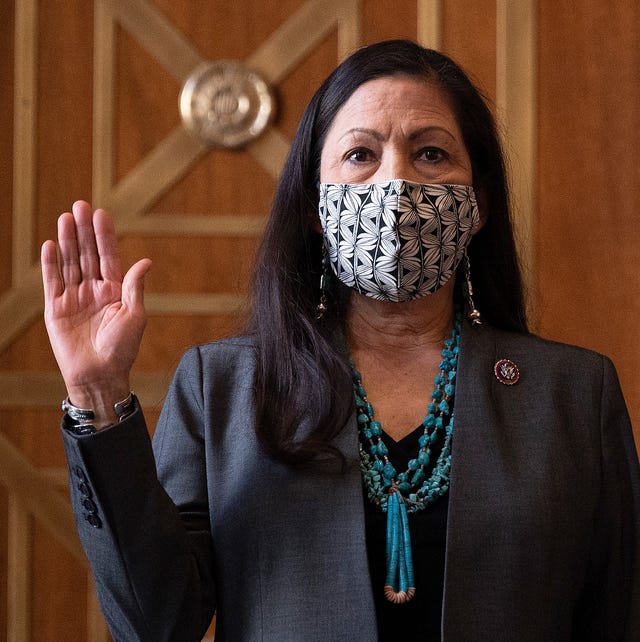
Deb Haaland's secretary of the Interior confirmation is transformational for Native people. Finally, a leader who can help Americans understand that we are human beings—not caricatures or mascots. We aren't a peoples that don't exist anymore. We are here.

My elders who are still alive never thought this could be possible—and certainly not in their lifetimes. I just wish my grandfather was here to witness this history-making moment, too.

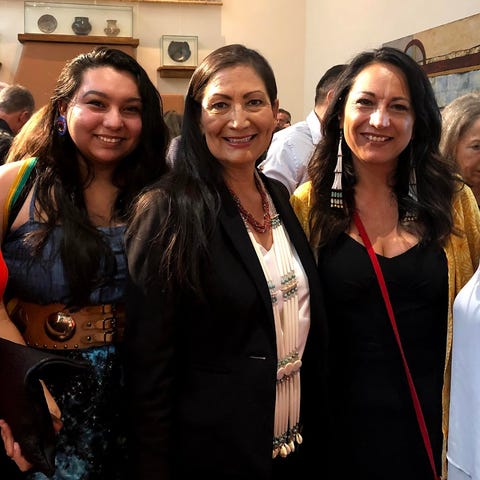
Echo Hawk (far right) with her daughter Wicanhpi EchoHawk (far left) and Secretary Haaland (center).

COURTESY CRYSTAL ECHO HAWK


saw firsthand growing up how hard Native women work in the leadership roles they hold in our communities. But looking outward into society, we were always invisible. No matter what tribe we came from. Too often in this country, Native people, and especially Native women, are considered insignificant. We operate in a space in which nearly 80 percent of Americans know little to nothing about us. A significant portion of that percentage aren't even sure we even exist.

Our invisibility is our greatest threat.


When Secretary Haaland was first elected to the House of Representatives in 2018, she helped us dream. She became a voice for Native people in a country that cannot conceive Native people in a 21st century context. She spoke out on a range of issues, not just ones important to her constituents in New Mexico, but she also spoke out on key issues like the murdered and missing Indigenous women epidemic, which has been largely ignored in this country up until recently. We're talking thousands of Indigenous women and girls who have been killed or who have disappeared, with no justice in sight.

Two years later, as COVID-19 spread to the U.S., there was hardly any coverage of how the virus was impacting Native American tribes. In that moment, our invisibility became a matter of life and death. Secretary Haaland, who was a congresswoman at the time, was one of just a handful of voices advocating on a national level for the federal government to come up with a response to support Native communities.
This content is imported from Twitter. You may be able to find the same content in another format, or you may be able to find more information, at their web site.


When I heard she was in contention for Secretary of Interior, I knew how profound this moment could be. The Department of Interior is the agency responsible for managing the federal government's "trust responsibility" to tribes and to Native Americans.

[Editor's note: The U.S. government has imposed itself as the "trustee" for various tribal lands. This "trust responsibility," as it's called, holds the federal government accountable for protecting "tribal and individual Indian lands, assets, resources, and treaty and similarly recognized rights," according to the Department of the Interior.]

RELATED STORY

Deb Haaland on Native American Voter Suppression
OCTOBER 2018 !!!!!!!

It is important to understand the harm that the agency has historically caused. Peel back the curtains and you'll find so much dark history, corruption, and mismanagement of resources belonging to tribes and individual Native Americans. One of Secretary Haaland's Interior predecessors gave a speech about the extermination policy of Native Americans—and that wasn't even that long ago.

To have a Native leader sitting in that role, and to have the opportunity to begin to reset the relationship between the federal government and tribes, which is one that has been characterized by genocide, violence, removal, and corruption—well, it is revolutionary.


Echo Hawk and her daughter, Wicanhpi Winyan, last year.
COURTESY CRYSTAL ECHO HAWK

IllumiNative helped host a virtual watch party on the night of the Senate vote to confirm Secretary Haaland. More than 21,000 viewers tuned it. It was beautiful, people from all over Indian country came together as the final votes trickled in. My daughter, Wicanhpi Winyan, texted me and said, "Mom, I want you to know I'm watching!" For her—someone who was relentlessly bullied in school for her looks and for having a traditional Dakota name—to see a Native woman ascend to that level of leadership was so empowering.

The implications of this moment are beyond what we can even imagine, especially for future generations, and especially for Native women.

Will Secretary Haaland solve every problem overnight? No, because it's so much bigger than that. But this is an important start.

This interview has been lightly edited and condensed for clarity.


STAFF WRITERRose is a Staff Writer at ELLE.com covering culture, news, and women's issues.

The Bizarre Story of the Montana Governor Shooting a Wolf From Yellowstone
MARCH 28, 2021

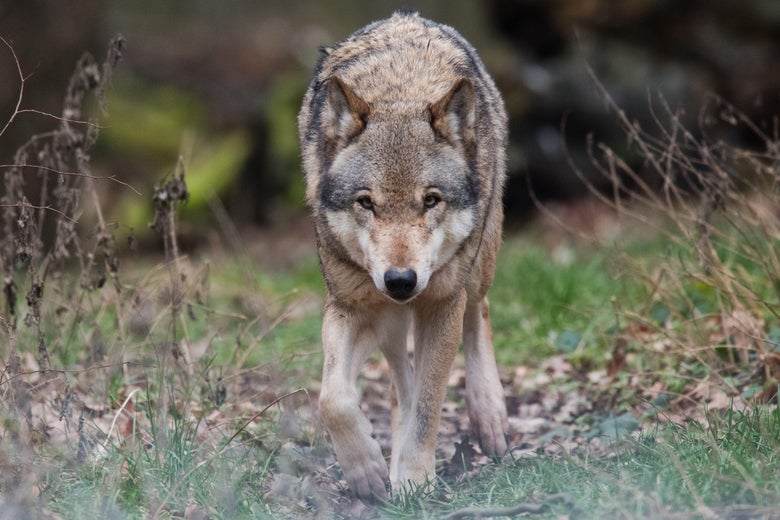
Not the wolf the governor killed. Julian Stratenschulte/Getty Images


On Tuesday, Nate Hegyi, a reporter for the Mountain West News Bureau, reported that Montana Gov. Greg Gianforte had trapped and killed a radio-collared wolf from Yellowstone National Park. Because the wolf had wandered out of the park, Gianforte was legally allowed to kill it, but the governor was cited for violating state hunting regulations for failing to take a required wolf-trapping education course. The story raised questions about Gianforte’s honesty and about whether the governor violated more serious hunting regulations.

Slate spoke to Hegyi, who lives in Missoula, on Friday to see how the story had gone down in his state. This conversation has been edited and condensed for clarity.

Slate: How did this story come about?

Nate Hegyi: I have to protect a source, so I’m going to be vague. I received a tip that the governor had trapped and killed a Yellowstone wolf. And I was like, What? That’s crazy.

The person who tipped me off gave me some pretty critical information that I needed to start my reporting into it. I started asking questions with Montana’s top wildlife agency, and they confirmed that the governor had trapped and killed a wolf near the park, and that he was given a written warning. We decided to do it as a written story first, instead of an audio story. Then it kind of blew up.

How would you say your typical Montanan feels about these Yellowstone wolves?

A typical Montanan, their political views are all across the board. We have these college towns, Bozeman and Missoula, where you’ve got a lot of pretty liberal environmentalists. I’m sure they would be super angry that he killed a wolf so close to the park, and that it was radio-collared. You have animal rights activists. You’ve got people who will spend an entire summer driving around following the wolf packs. And then you have the hunting folks here in the state—who may not be bothered about the wolf trapping itself, because that’s perfectly legal in the state of Montana, but would be bothered by the fact that the governor didn’t take the trapping course, because it’s like taking driver’s ed before you go driving.

And then you have the super conservative contingent in Montana, including a lot of people who have moved here in recent years from places like California or Texas. They’re coming with a much more Trumpian conservatism that we haven’t really seen much in the state prior to, even, the pandemic. A lot of those new folks are not going to care whatsoever that the governor did this. In fact, they might like the governor more because he did this.

And then you have among a lot of other Montanans a general dislike of wolves. Because they do kill sheep and livestock. They are kind of considered a boogeyman out here in the West. And so the idea of killing a wolf, trapping education or not, doesn’t really bother them, because they see them more as a pest or nuisance.

What has been the wider reaction to your story?

If you look at it nationally, there’s definitely an expected rage. That didn’t surprise me. But within Montana, it’s more just like, there are more questions. How did he expect to check his traps every day while also serving as governor? You have to check [traps] at least every 48 hours. But ethically, you should be checking it every day. And those traps were set two and a half or three hours south of the Capitol. It’s a very time-intensive thing to do, to trap. Was that the best use of the governor’s time?

Do you know how long those traps were out?

The governor told a local reporter that they’ve been out since January, which would be at least two weeks prior to trapping that wolf. This is where it gets a little wonky. Gianforte was setting traps on a private ranch owned by a big conservative media mogul. And that guy’s ranch manager (who’s also the vice president of the Montana Trappers Association)—his name was also on these traps. And so there’s a good chance that the ranch manager was actually checking the traps for Gianforte. And maybe Gianforte was lucky enough that he was just down there on a federal holiday, and there was the wolf, after two or more weeks of waiting for the animal to get trapped. Was it just serendipitous? Or was the wolf trapped, and the ranch manager found it and called Gianforte? I don’t want to say either way, but that’s my biggest question. If the ranch manager called Gianforte, and Gianforte drove or flew over to kill it, that would have broken the state hunting regulations. You’re supposed to kill it or release it immediately upon seeing it. It’s the more humane thing to do.

Can you tell me about the debates happening with the wolf management policy?

The state legislature is Republican controlled, and for the first time in a couple of decades, we have a Republican governor. And one of their top priorities is pushing through a slate of bills that would make it a lot easier to hunt and trap more wolves, with the goal of reducing the population of wolves in the state. And there’s talk of reimbursing people for the cost to hunt a wolf, which critics call a bounty.

What else do people from outside the state need to know to understand this story?

Wolves are super controversial. In the West, they do kill livestock. Some people rely on cows and sheep to make a living. On the other hand, Montana relies on a lot of tourism. Maybe you went to Yellowstone National Park to see those wolves. The wolves are a big boon for our tourism industry. And so it’s just kind of a very classic push-and-pull between those two camps. Americans had pretty much eradicated the wolf from the West up until 1995, when they were reintroduced in Yellowstone National Park. And so it’s still very fresh. They’re like a symbol for the kind of culture wars that happen out West.

Were there any major hurdles you encountered when reporting this story?

I was frustrated with the governor’s office for not answering the questions I posed to them and for not making the governor available for an interview. I think that that’s something we’ve noticed since the Trump era.

Gianforte is famously antagonistic towards reporters.

Yeah, absolutely. It’s just a bummer. Because there has been a culture in the past of openness among both Republicans and Democrats. And it’s been frustrating to watch that culture of openness change. It doesn’t feel very Montanan.