Sunday, March 20, 2022

POST CONVOY PROTESTS CONTINUE

Court grants immediate injunction on Beltline protests in Calgary against public health 

Police say intelligence indicates there may be an imminent

public safety risk

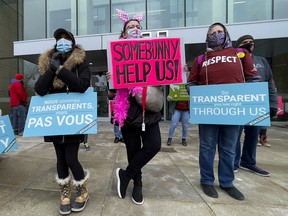
Protesters and police have clashed in Calgary’s Beltline in recent weeks. On Friday the City of Calgary said it was granted a temporary court injunction to address protesters in the area. (Helen Pike/CBC)

The City of Calgary has been granted a temporary court injunction to help address protests in the city's Beltline area against public health measures.

An Alberta Court of Queen's Bench justice granted an immediate injunction that will address protests in the Beltline and elsewhere in Calgary, the city said in an emailed statement.

The injunction prohibits ongoing violations of existing bylaws and legislation, and reinforces and clarifies enforcement authority.

The injunction prohibits blocking traffic on roads and sidewalks, walking in the middle of roadways, preventing vehicles and pedestrians from lawfully passing by or accessing amenities in the area, without authorization or permit. 

It also prohibits conducting activity in a park that unreasonably disturbs the use or enjoyment of the park for other users of the park, or hosting an event or using an amplification system in a park without a permit, and commercial activity within a park. It also applies to the unnecessary sounding of horns or other audible warning devices. 

However, community protests and events are still allowed to occur if they comply with bylaw requirements and secure appropriate permits, the city said. 

Read the temporary court injunction: 

Mobile users: View the document
(PDF KB)
(Text KB)
CBC is not responsible for 3rd party content

Police aware of protesters with links to white supremacy groups 

"There will be no marching tomorrow, there will be no mobile protest, and there will be nobody behaving that way down in the Beltline," police Chief Mark Neufeld said Friday during a special meeting between the Calgary Police Service and the Calgary Police Commission.

The injunction means that instead of officers doing bylaw enforcement, which would result in a ticket, if police see anyone doing any of the actions prohibited by the injunction, the offenders could go "directly to jail," Neufeld said.

Earlier this week, the police comission said ticketing organizers and attendees has proven "ineffective" in prior anti-mandate protests. 

Police also warned the public that their intelligence indicates there may be an imminent public safety risk at future demonstrations. Neufeld also said they are aware that there have been protesters with links to white supremacist groups. 

Police say the protest size has changed over recent months. In the beginning of 2022, there were about 300 people attending protests. In February, that number grew to between 2,000 and 5,000. At the end of February and early March, there were 1,300. 

Protesters, counter-protesters say they're going ahead

Protests in Calgary against COVID-19 public health restrictions started nearly two years ago.

They have continued in the Beltline and Central Memorial Park each week, despite the fact that most of the province's mandates have been lifted. In recent weeks, counter-protesters have started demonstrating in the area at the same time. 

Community Solidarity YYC, which has represented counter-protesters in the Beltline, tweeted that the group plans to peacefully assemble.

Jake Eskesen, who has been attending Beltline protests, said in an email to CBC that anti-mandate protesters will not be deterred by the injunction.

'There are consequences for breaking the law'

"[This] now is a really important warning shot to the people who are engaged in these kinds of protests that there are legal consequences for what's happening," said Doug King, professor of justice studies at Mount Royal University.

"There are consequences for breaking the law while engaged in a peaceful protest." 

Violating a court order is a Criminal Code offence, King said, which could lead to six months incarceration, plus the potential of a $5,000 fine.

King, who lives near the area, said that since the Coutts border blockade and simultaneous protests in Ottawa, the Beltline demonstrations have become increasingly aggressive. 

Police chief says he has regrets 

Police commission chair Shawn Cornett said work will ramp up after this weekend: "We need to look at what has gone on, what we've done, have we been doing the things that we needed to do? There's lots of discussions to happen." 

In an column penned by Neufeld for the Calgary Herald, the police chief said he regrets that "we find ourselves in a place where Beltline residents feel unsafe and unsupported in their community."  

"I also regret that despite ongoing efforts to come to a diplomatic resolution with some protest groups — something we have done for years in our city — we are now in a place where this situation must be resolved in less subtle ways," Neufeld wrote. 

Neighbourhood association pleased with injunction

The Beltline Neighbourhoods Association said they are pleased to see the temporary court injunction as a tool to help Calgary law enforcement respond to the demonstrations. 

"We are hopeful that this allows our community to return to being the vibrant, safe, and welcoming place it was before these aggressive demonstrations." 

With files from Colleen Underwood


Freedom protest moved to city hall, police monitor situation at Calgary park

Michael Franklin
CTVNewsCalgary.ca Senior Digital Producer
Published March 19, 2022 

A mass protest scheduled to take place in Calgary's Central Memorial Park on Saturday has moved out of the neighbourhood, resettling on the steps of Calgary city hall.

The rally, organized by a group calling itself Calgary Freedom Central, was supposed to take place at the park at 1 p.m., but CTV News crews found the gathering that had met in the park for the past several weekend never materialized there.

Instead, it took place outside city hall, where people waved flags and listened to speakers as police looked on.

It was a massive show of force from the Calgary Police Service, however, as hundreds of members were mobilized at the scene to keep the peace.

A group of counter-protesters, made up of Beltline residents who were tired of the ongoing demonstrations, also showed up at the scene, but they marched to Central Memorial Park.

Once there, they engaged with a handful of freedom protesters while police stood between them.


COURT INJUNCTION

The change in tone comes after a temporary court injunction was granted Friday and a resolution from the Calgary Police Service that says it will enforce those rules.

Following a meeting of the Calgary Police Commission, Chief Mark Neufeld said "there will be no marching" on Saturday.

"Residents will see a significant police presence," he said Friday afternoon.

"There will be nobody behaving that way on the Beltline."

The order says that anyone who blocks roads or sidewalks could be charged and potentially arrested.

The same threat applies to anyone accused of excessive noise or conducting commercial activity in parks without proper permits.

The rules come after a group of Beltline residents, fed up with the weeks of freedom rallies in their communities, organized a counter-protest on March 12 that turned ugly.


CHANGE IN MESSAGING

The freedom protesters, who had long fought against the COVID-19 public health restrictions imposed on Albertans and Canadians, also seemed to sing a different tune during this latest protest.

Instead of speaking about the unfairness of restrictions, many of them turned their attention back to Prime Minister Justin Trudeau and his Liberal government.

Last week, Premier Jason Kenney called out the protesters for their criticism of COVID-19 rules even though Alberta had virtually none to speak of.

"I would suggest that maybe people could find more productive ways of expressing their frustration, but maybe here’s an idea – how about we all just move on from the frustration of COVID?" said Kenney last week.

"How about we leave it in the rear view mirror?"


‘Several arrests’ as protestors and counter-protesters meet in Beltine District
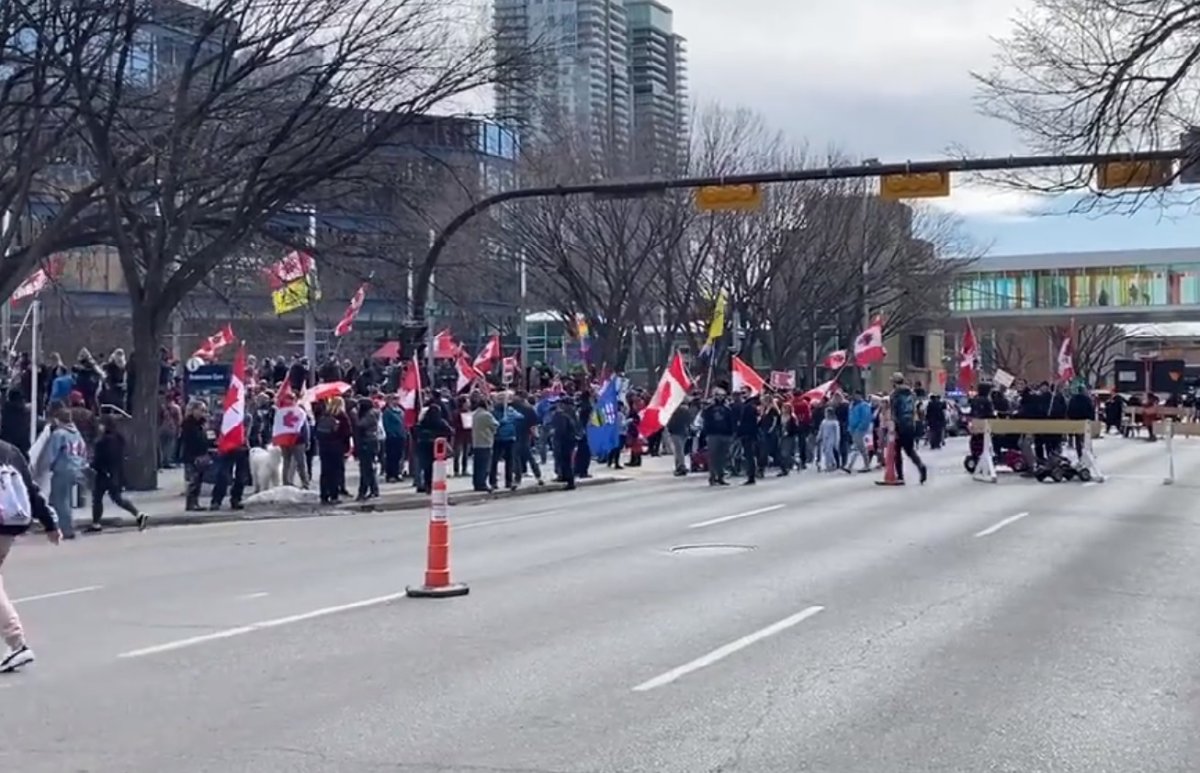
Protesters moved to city hall from Central Memorial Park Mar. 19, 2022. Global Newst

Protesters and counter-protesters gathered in the Beltline district Saturday for the first time since the city was granted an emergency injunction.


About 350 people gathered around 1 p.m. at Central Memorial Park in protest of medical mandates across Canada. After some speeches, the crowd — known as Group A in Calgary police tweets — began to move, making their way to city hall, a few blocks away.
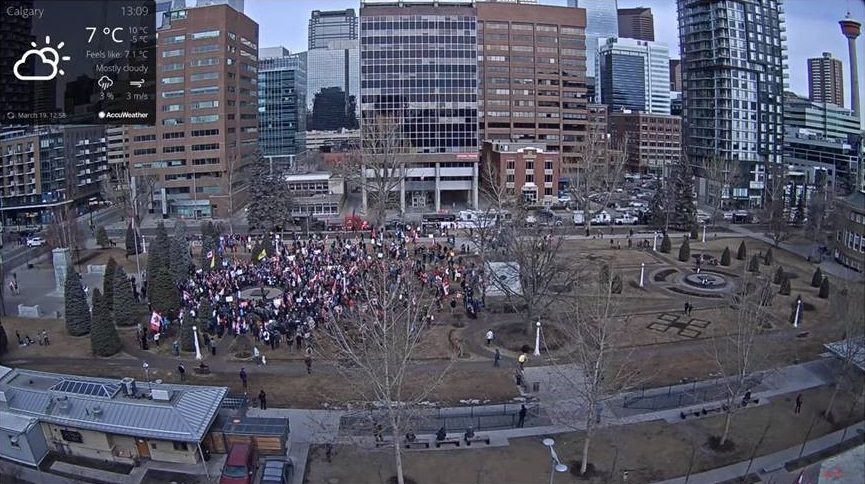
Protesters gathered at Central Memorial Park in Calgary Mar. 19, 2022. Courtesy: Delta Tech Calgary

Police told Global News at that point the protesters were not in violation of an emergency injunction put in place Friday afternoon, because they were staying on the sidewalk.

READ MORE: Justice grants City of Calgary temporary injunction against downtown protests

Around 2 p.m., police tweeted, saying Macleod Trail would be temporarily closed in front of Municipal Plaza to allow for crowds to cross safely.

Minutes later, CPS said the group had breached the injunction when they obstructed the roadway. As of 2:19 p.m. police said they had cleared the roadway and traffic was moving again.

(20) Adam MacVicar on Twitter: “Here’s the scene at City Hall right now. #YYC @GlobalCalgary https://t.co/gkGooChSvR” / Twitter

Dustin Nolan was among those who joined the anti-mandate protest. He said he felt compelled to show up.

“I think it’s very sad, because we have the right as Canadians to peacefully protest and gather like this and express our feelings and our thoughts towards everything, so the fact that they are trying to tell us we can’t is wrong,” Nolan said.

“I just think it’s wrong what the government is doing mandating vaccines. I can’t get on a plane to go see my family across Canada right now. It’s hard. I’d like to go visit people and travel and I can’t just because of my views.”

“I realize there are some people here with some strange views that I don’t agree with,” said Doug Tweet, another protester who gathered at CMP/city hall.

“There’s lots of conspiracy theories which I don’t agree with but I just agree with freedom.”

Counter protesters had gathered at nearby Lougheed House, but some made their way to Central Memorial Park, where police worked to keep the two sides apart.

Around 4 p.m., police said they made several arrests. Details are expected to be released later.

Continued protests

Anti-mandate demonstrations have been held weekly at Central Memorial Park, typically followed by a march down 17th Avenue.

Last weekend, area residents and others tried to “take back the community” and the two groups clashed in what police saw as a public safety issue. Police were seen in online videos physically moving some of the residents using their service bikes.

Calgary police chief addresses response to weekend Beltline protests

The situation led to an outcry from residents, a special city council meeting, a letter to the police commission from the mayor and, finally, an emergency injunction by the city on Friday afternoon.

Calgary Mayor Jyoti Gondek said on Twitter last weekend that the disruption, which she called a parade and festival without proper permits and licences, needed enforcement by police rather than crowd control.

READ MORE: Calgary mayor calling for police enforcement against continued COVID restriction protests

“This was a damned if you do and damned if don’t, no-win for the police,” police Chief Mark Neufeld said Monday.

The injunction strengthens police authority to enforce the law.

“This is the exact tool we need as we all work together to return a sense of normalcy to the Beltline community,” Neufeld said in a news release Friday.

Both city council and the police commission have said they received hundreds of emails and phone calls from Calgarians about the protests in recent weeks.

READ MORE: Ottawa’s crackdown on ‘freedom convoy’ finances created panic, confusion, MPs hear

A letter to the police commission from the mayor laid out some of those concerns.

“The level of noise from protester’s vehicle horns and chanting is negatively impacting quality of life,” Gondek wrote.

She noted residents, many of whom live in one- or two-bedroom condos or apartments, have been leaving the area to avoid feeling trapped in their homes on Saturday afternoons. Others have reported being harassed for wearing masks.

Businesses have reported lost income as customers flee the area before the protests begin.

Click to play video: 'Trucker protests: GoFundMe rep says discussions with Ottawa police led to suspension of fundraiser'Trucker protests: GoFundMe rep says discussions with Ottawa police led to suspension of fundraiser

— with files from The Canadian Press

Police arrest six people at anti-vaccine,
freedom protest in downtown Calgary


CALGARY — Police arrested several people at a so-called freedom protest in downtown Calgary on Saturday after some demonstrators refused to leave a park that has become ground zero in the city for the weekly rallies.


Calgary Police Service Chief Mark Neufeld said five people were charged with breaching an injunction, with one of them facing an additional charge of assaulting a police officer. And a sixth person was arrested on an outstanding warrant.

"These efforts will continue as we work together to bring peace back to the Beltline and the surrounding communities here in Calgary," Neufeld told a news conference just after suppertime.

By then, the park had emptied and few police remained on the scene.

"This was not an issue that developed in one day or one weekend and it's not one that's going to be completely resolved in one day or one weekend," Neufeld said, adding additional charges are expected.

One man was taken to the ground by multiple officers shortly after mounted units and police with bicycles began pushing people to the outskirts of Central Memorial Park in the Beltline neighbourhood.

Another man sat on a park bench and refused to leave. He was handcuffed in front of a crowd of hundreds with many holding signs against COVID-19 health measures.

Earlier, a group of about 1,000 people converged at the park before taking the protest to city hall. Police forced demonstrators back from roadways so traffic could move.

"They can't stop us," said a speaker over a megaphone.

Another said, "They're not going to scare me away. I am not fearful just like you are not fearful. Keep standing up."

Some people waved upside-down Canadian flags, Alberta flags and at least one Gadsden flag — a yellow banner with a snake reading "don't tread on me," which is sometimes used in support of far-right ideology.

Others carried signs that read "Freedom not Farce" and "No Mask or Vax Mandates."

Hours later, a portion of the group marched to the park where they were met with heavy police enforcement.

The group has typically marched down 17th Avenue, a popular street with restaurants, bars and stores. Last weekend, local residents clashed with protesters there in what police described as a public safety issue.

The ongoing weekend protests have led to an outcry from residents, a special city council meeting, a letter to the police commission from the mayor and an emergency injunction by the city on Friday.

The injunction strengthens police authority to enforce the law.

Premier Jason Kenney was asked to comment on the protests earlier Saturday while on his new weekly phone-in radio show on CHQR and CHED.

He said he didn't know why there were still protests, because Alberta removed its COVID-19 restrictions weeks ago.

Kenney suggested people could instead demonstrate at McDougall Centre, the provincial government's offices in Calgary, or the Harry Hays building, where the federal government offices are located.

"If you're upset about the federal travel vaccine mandates — so am I — go in front of there," he said. "You can make your point without inconveniencing people in that neighbourhood."

Both city council and the police commission have said they received hundreds of emails and phone calls from Calgarians about the protests in recent weeks.

The letter to the police commission from Mayor Jyoti Gondek laid out some of those concerns.

"The level of noise from protester's vehicle horns and chanting is negatively impacting quality of life," she wrote.

Gondek noted residents, many of whom live in one- or two-bedroom condos or apartments, have been leaving the area to avoid feeling trapped in their homes on Saturday afternoons. Others have reported being harassed for wearing masks.

Businesses have reported lost income as customers have been leaving the area before the protests begin.

Dan Murray, who owns I Love You Coffee Shop in the Beltline, said the protests started about 18 months ago and grew "worse and worse" after truckers took over Canada's capital city.

The demonstration at Parliament Hill lasted about three weeks until Prime Minister Justin Trudeau invoked the federal Emergencies Act. More than 100 people were charged with various offences between Feb. 17 and 18.

Peter Oliver, president of the Beltline Neighbourhoods Association, said the protests have turned into a "real toxic mix" that include white supremacists and other extremists.

"We have a serious problem here," he said earlier this week.

"It's a whole buffet of different losers."

— With files from Rob Drinkwater in Edmonton.

This report by The Canadian Press was first published on March 19, 2022.

Alanna Smith and Colette Derworiz, The Canadian Press

Charges against 6 Hamilton encampment activists withdrawn, with all agreeing to peace-bond terms

Withdrawal comes after months of public campaigning for

charges to be dropped

A video shared on social media by the Hamilton Centre for Civic Inclusion showed several protesters being arrested outside of the central police station on Nov. 26. (Hamilton Centre for Civic Inclusion/Twitter)

The charges against six activists arrested in connection to an encampment eviction at J.C. Beemer Park in November were withdrawn on Monday in a Hamilton court. 

The six agreed to enter into peace bonds that prevent them from crossing police caution tape, interfering with police operations related to unhoused people, and participating in illegal or violent demonstrations.

They could face criminal charges if they breach those terms before the peace bond expires Nov. 24, exactly a year after the encampment eviction at J.C. Beemer.

The group's lawyer, Dean Paquette, said the agreement with the Crown to withdraw the charges came "as a result of considerable discussion," and that those who contravene the peace bond's terms could be charged with breach of a court order.

The withdrawal comes after months of public support for the charges to be dropped by several organizations and community leaders, including the Hamilton Centre for Civic Inclusion, Afro Canadian Caribbean Association, the Hamilton and District Labour Council, Hamilton Centre MP Matthew Green, Beaches-East York MPP Rima Berns-McGown and others. 

A statement issued Monday by Hamilton Encampment Support Network (HESN), the group that organized the J.C. Beemer demonstration, says the arrests and resulting court process have been "incredibly difficult for those involved.

"We were arrested, brutalized and threatened with significant amounts of jail time for supporting our unhoused neighbours," says the statement on behalf of those who were initially charged including Jordan Grace, Rowa Mohamed, Sahra Soudi, Gregory Dongen, Sarah Jama and Ezra Amos.

"While we feel that dropping the charges was the best outcome, and couldn't be happier with this win, it is disturbing to know that no plans for action or significant policy change have been taken by the City of Hamilton to stop encampment evictions."

An update to Hamilton city councillors following a public works meeting on Jan. 26 showed 262 "encampment cleanups" were completed last year alone — 176 of which were done by the city and another 86 completed by a contractor.

A review of work orders showed those operations happened at 60 unique sites, the update stated, and that there were multiple visits made to the same sites.

Charges related to J.C. Beemer Park eviction

The charges dropped Monday were related to an encampment eviction on Nov. 24 and a subsequent protest at the central police station on Nov. 26. 

According to a statement of facts read in court, police were in the park Nov. 24 after a fire had engulfed two tents and damaged a hydro line. "Hydro crews were not able to assess and repair the damage if encampment residents remained in the park and the situation was deemed unsafe," the statement said. 

It said police created a taped-off area to allow hydro crews to work but then "demonstrators, including five of the six defendants, broke through the police tape, at which time the police immediately responded and physically took custody of two of the defendants restraining them, resulting in a physical encounter between police and the defendants, as well as other HESN activists. No party was seriously injured because of the altercation."

"Each accused accepts responsibility for their actions."

Police and the city said the encampment area at J.C. Beemer Park was not safe after a fire tore through several tents. (Dan Taekema/CBC)

A sixth person was charged based on actions at a protest two days later, demanding the release of one of the Beemer Park defendants, at the police force's central station. The statement of facts says protesters were ordered off police property.

"A physical altercation took place between the demonstrators and the police. A number of people... ran back onto the property, escalating the confrontation and eventually interacting physically with a police officer leading to Amos being grounded and arrested."

Defendant called process 'damaging'

The defendant arrested at the police station that day said Monday they were shocked to hear the agreed-upon statement of facts for the first time. 

Amos later told CBC Hamilton that they don't believe they crossed a police line or escalated the situation, and alleged that they were initially arrested mistaken for another protester. 

They also alleged police choked them and slammed them to the ground when they were arrested. "My handcuffs were so tight, I still have scars on my wrist," said Amos, who identifies as non-binary and uses the pronouns they/them.

Once inside the station, Amos alleges they were searched by six male officers with no female present, and were told their clothes would be cut off if they kept struggling. They said they were not given the option to specify their gender and were eventually put into a cell with men.

Amos says they agreed to the facts Monday "to keep the peace," saying the process so far has already been "damaging on so many levels" — partially because the lack of gender sensitivity they have encountered.

On Monday, Justice Amanda Joy Camara used female pronouns and Amos's birth name several times during the hearing, despite the court learning Amos's preferred name shortly after proceedings began. 

"At pretty much every level of the system, my identity has been disregarded and oppressed," said Amos, a visual artist who has since moved out of the city because of what happened and is currently crowd-funding for therapy. "I know that people expect [the dropping of charges] to be a celebration but I don't feel this comes anywhere close."

'They took responsibility': police chief

The Special Investigations Unit (SIU) investigated a separate reported injury related to the arrests but closed the case in January, saying it did not meet the criteria for a "serious injury" within the mandate of the SIU.

In an interview Monday afternoon with CBC Hamilton, police chief Frank Bergen said he encourages Amos to file a complaint with the Office of the Independent Police Review Director about their concerns with their arrest.

"That doesn't seem to be consistent with what we know about that interaction," he said, noting it is not a Hamilton police tactic to cut the clothes off someone who is being searched.

He said the force is constantly striving to do better in its interactions with gender diverse and trans people.

"That's part of what we do every day when we look at our policies and procedures, that in fact we are capturing pronouns... We are absolutely current and continue to learn, to do better, with every interaction."

Rowa Mohamed, right, spoke about her arrest at J.C. Beemer Park during a media conference held by the Hamilton Encampment Support Network in late November. (Dan Taekema/CBC)

As for the charges, Bergen said police had been working with the Crown to resolve the matter for some time. 

"What people had to recognize right from the very beginning, this is up to the five or six people involved," he said. "You can't impose a resolution on people if they're not willing to accept it. They took responsibility for their actions and that is part of the role."

Charges 'not in the public interest': activist

The agreement to withdraw the charges came the same day HESN rallied supporters to try to stop what they said was an expected encampment eviction on Linden Street. Later in the day however, they said on Twitter that the tear-down had been called off.

It also followed months of campaigning for the charges to be dropped, by HESN and several other community organizations, in addition to calls for a judicial inquiry into police actions during the arrests and for an end to encampment evictions. 

Jordan Grace, one of those arrested at the park, says he believes the charges were withdrawn at least partially because of the public support, and because "it was clearly not in the public interest to move forward with charges against us… The people who got arrested are people who are dedicated community members and volunteers. We were definitely victims of an overreaction by the police."

He says he couldn't help but compare his arrest with those last month of the anti-mandate convoy members in Ottawa, where some arrests occurred after weeks of occupying public space and complaints of noise and harassment.

He said the response of city council and police to homelessness is disingenuous and called their policies "inadequate and dysfunctional." 

The reason HESN takes the encampment issue so seriously, he said, is because many of its members have experienced poverty themselves.

"For us, it's a life-or-death situation," he said.

with files from Dan Taekema

The cost of living may be going up, but wages are rising, too

Demand for labour giving workers the upper hand for

raises

A 'now hiring' sign at Gerrity's Supermarket in Scranton, Penn, on Feb. 24. Numbers suggest that in this job market, if you're not getting a raise, it's time to change jobs because chances are it will pay more. (Hannah Beier/Bloomberg)

Inflation has risen to its highest point in a generation, pushing up the price of just about everything. But that goes for people's labour, too, as employers compete to keep up with their staffing needs.

Officially, wages have risen by only 3.1 per cent in the past year, about half the official inflation rate of 5.7 per cent. But because the pandemic had such an unprecedented impact on everything — including statistics — it can be helpful to compare things today to how they were two years ago, before COVID-19. 

Inflation is up by almost seven per cent in the two-year period up to the end of February, and wage data shows an interesting split between people who have changed jobs recently, and those who've stayed in the same one.

That former group — which the data agency defines as anyone who has been on their current job for three months or less — has seen its average hourly wage increase by 11.7 per cent. That compares to an increase of 7.2 per cent, about the same as the inflation rate, for those who've stayed in their same job for more than 18 months.

Those numbers suggest that in this job market, if you're not getting a raise, it's time to change jobs because chances are it will pay more.

Darcy Clark, a principal with Montreal-based HR consultancy Normandin Beaudry, said the competition for workers is fierce right now.

"Much like the housing market, it's unbalanced," he said.

"Whether you're hourly, production, salaried, management, executive and everything in-between, it's across the board a war for talent."

Companies are ratcheting up their compensation packages at a steady clip to meet their staffing needs. In the summer of 2021, the companies that work with Normandin Beaudry said they expected to increase their compensation by 2.9 per cent in the coming year — on the high side historically, Clark said, but not egregiously so.

Then in the latter half of the year, inflation took off and so did wage expectations. By the end of 2021, those same companies were now forecasting a 3.7 per cent increase in their total compensation spend.

"That's an enormous increase, the most I've seen in 20 years," Clark said.

"A change that quick signifies that companies were playing offence instead of defence," to attract and retain workers, he said.

'I deserve more'

In this era of high inflation, workers across the salary spectrum are expecting their pay packets to go up, too, and if they're not, many of them are showing they are willing to leave to get higher pay.

That's what Emilija Pruden did. The 27-year-old from Toronto has worked a variety of jobs while she was studying to become a registered massage therapist, and she said she's noticed a sea change in the way that labour is valued of late.

WATCH | Growing number of employers commit to living wage:

More companies are providing their employees with a living wage, reflecting the cost of living where they live. But some experts say rather than pushing companies to increase wages, the government should provide targeted policies to help people out of poverty. 2:08

Prior to the pandemic, she worked as an administrative assistant at a non-profit for about $20 an hour, but saw her compensation increase as she took on more and more senior roles. By the time she left, she had managed to negotiate working fewer hours every week, but at $28 an hour, so her paycheque didn't go down by nearly as much.

"I've seen huge changes in how people are approaching work," she said.

"The attitude [has] changed from feeling grateful to be employed at all, to feeling like I deserve more for my labour because it's essential."

She left that administrative job when she finished her studies in late 2021. Massage therapists can charge anywhere from $50 to $200 an hour, but because of the physically demanding nature of the work, Pruden has no plans to do it full time, so she supplements her income by working at Lululemon part time. She said she has been pleased by how valued she and her coworkers are made to feel for their labour.

WATCH | Employers 'playing catch-up' on wage gains, economist says: 
Jimmy Jean, chief economist with Desjardins Group, says wage increases are going to be the norm in 2022, because of a growing demand for labour. 0:36

Offering wage incentives

Retail jobs are often associated with minimum wage, which rose to $15 an hour in Ontario in January, but Pruden said she started at $17.25 an hour, with bonuses of up to $7 an hour depending on sales targets. The company offers profit sharing and a generous benefits package, which is why she said she plans on staying at the company even if and when her massage business takes off.

In the current market, she said any employer who fights against minimum wage increases or only mandates raises when they are forced to is going to lose staff "because it makes people feel not valued."

Starbucks recently beefed up its compensation packages to make sure all of its staff are getting paid more than minimum wage. (Micki Cowan/CBC)

Aiden Heese is one former minimum wage worker who has found himself moving quickly up the income ladder. The 26-year-old from Langley, B.C., started working at Starbucks about five years ago, earning what he thinks was the minimum wage in the province at the time, $12.65 an hour.

But he gives the company credit for rapidly upping their compensation game of late. Even before the pandemic, Starbucks started working to increase employee retention, bumping its starting salary up to $1 above whatever the local minimum wage is, followed by increases of about 25 cents per hour every six months. Add it all up, and he's now making about 50 per cent more per hour than he was when he started.

B.C.'s minimum wage is slated to increase to $15.65 an hour later this year but "I'm now making over $18/hr after being there for 4.5 years, which isn't too bad I guess for just being a barista," Heese said.

'Wage price spiral' underway

It's not just those on the low end of the wage scale benefiting. There are higher wages to be had all over the economy. The construction sector is red hot, to the point where companies are finding themselves having to pay new hires the same amount people with 10 years experience used to command. 

Matt Stainton, president of SG Constructors, recently tried to hire half a dozen new workers for a project, but after interviewing 50 people, he only managed to find two qualified candidates.

WATCH | New construction hires earning what it used to take 10 years experience to get:
Matt Stainton, president of SG Constructors, says wages are up by 30 to 40 per cent compared to where they were before the pandemic. But he worries what will happen to all those new hires with not as much experience if and when a downturn comes. (Photo credit: Michael Charles Cole/CBC) 0:33

He said he's paying people 30 to 40 per cent more today than he was for the same job before the pandemic.

"We've heard of supply chain shortages and the same goes on the supply for people," he said.

"We're really struggling with finding talent. It's a real challenge."

That's a recipe for higher wages, at a pace unlike anything that most economists have ever seen.

A "wage-price spiral is underway in Canada," Scotiabank noted in a recent report on the job market, while TD Bank economist James Orlando said in a recent report the "feverish demand" for labour has made it so that "workers have not had this level of bargaining power in decades."

With leverage like that, Pruden's advice for workers with a boss who says they can't afford raises this year is simple: get a new job, because chances are it will pay a lot more.

"If they switch and make an extra $30,000 a year that can be life-changing," she said.

"So why on earth wouldn't they switch? You'd be silly not to."

ABOUT THE AUTHOR

Pete Evans

Senior Writer, CBCNews.ca

Pete Evans is the senior business writer for CBCNews.ca. Prior to coming to the CBC, his work has appeared in the Globe & Mail, the Financial Post, the Toronto Star, Canadian Business Magazine and — believe it or not — Circuits Assembly Magazine. Twitter: @p_evans Email: pete.evans@cbc.ca Secure PGP: https://secure.cbc.ca/public-key/Pete-Evans-pub.asc

Striking auditor general workers welcome news of impending new offer

Members of the audit services group, who have been without a contract since September 2018, went on strike Nov. 26.

Author of the article: Andrew Duffy
Publishing date:Mar 18, 2022
Striking technical, professional, administrative and other Office of the Auditor General of Canada employees, along with supporters, picketed outside the Treasury Board of Canada Secretariat on Friday. 
PHOTO BY ERROL MCGIHON /Postmedia

Striking workers in the Office of the Auditor General, who have been on the picket lines for almost four months, received some welcome news Friday: A new contract offer will be tabled at the end of March

The Office of the Auditor General (OAG) announced Friday morning on Twitter that it had received a revised mandate from the Treasury Board of Canada Secretariat.

The move empowered the OAG to change its bargaining position and make a new offer to the 165 mostly-female members of the audit services group.

That offer will be presented to negotiators at a bargaining session scheduled for March 29.

“I’m ready for this to be over. I’m just looking forward to going back to work,” Isabelle Champagne-Bell said at a rally of the striking workers Friday outside the offices of the treasury board.

Champagne-Bell has worked at the OAG for 13 years in communications. She said the stress of the strike, combined with the pandemic and truckers’ protest, had been difficult to manage.

“It has been not good — a little demoralizing to be completely honest,” she said.

Members of the audit services group, who have been without a contract since September 2018, went on strike Nov. 26.

It was the first strike in the history of the OAG.

The strike that began in November is the first ever involving Office of the Auditor General staff. 
PHOTO BY ERROL MCGIHON /Postmedia

Last week, Auditor General Karen Hogan said the ongoing strike would delay publication of her next accountability report, possibly for months. The most important federal watchdog, the auditor general examines government programs for efficiency, cost-effectiveness and performance.

According to the Public Service Alliance of Canada (PSAC), the key issues in the strike are fair pay and the introduction of a salary grid that establishes escalating pay levels for higher job classifications.

The union says members of the audit services group are the lowest-paid workers at the OAG and one of the only groups in the federal civil service without a pay grid.

Alex Silas, PSAC’s regional executive vice-president for the national capital region, welcomed the government’s decision to table a new offer. “Treasury Board has finally taken notice of this,” he said Friday.

Silas said he hadn’t seen details of the new offer and didn’t understand why the auditor general would wait another 10 days to share them.

“Let’s see the new offer. Let’s get back to the table,” he said, adding: “We’re going to remain firm in our position: We need a wage grid. We need the same economic increase as at other treasury board tables.”

PSAC is seeking a 2.11-per-cent annual wage increased averaged over three years: the same wage settlement reached by other major bargaining groups for the years in question.

Silas said the Omicron wave and the truckers’ occupation made the strike difficult to conduct and forced much of the activity online.

Marie-Eve Tremblay works in professional development at the OAG, designing training courses, and serves as vice-president of the union local. She said the strike had been stressful.

“I never saw this coming and never thought this would happen,” said Tremblay who has been at the OAG for 12 years. “I have a family with three kids, so having to live with this has been frustrating.”

The OAG strike is the longest strike by PSAC members in more than two years.

PSAC’s four major bargaining units, which represent more than 100,000 civil servants, are negotiating with the treasury board on new contracts. The previous ones expired last summer. To confront rising inflation, PSAC wants a 4.5 per cent wage increase in each year of proposed three-year agreements.